Blog Archives
The Lobster (2016)
 When people decry the relentless slate of sequels, remakes, and redundancy from the Hollywood assembly line, they’re looking for something original and different, and there may be no movie more different this year than Yorgos Lanthimos’s The Lobster. David (Colin Farrell) is the newest guest at the Hotel, a place for singles to find their true love. He has 40 days to fall in love with a compatible mate or else he will be transformed into an animal of his choice (hence the title, David’s choice). The people at the hotel are all in competition to find their mate. Outside the confines of the hotel, in the woods, are dreaded single people, those who ignored the rules of society. They are to be feared and hotel guests are rewarded for capturing wild singles on weekly hunting trips. One way or another, David is going to have to decide his place in society as a person or animal.
The Lobster is daringly different, wildly imaginative, and drops you into the middle of its cracked, alternative landscape and expects you to pick things up as you go. It’s something that the writer/director already achieved with chilling, car-crash fascination in Dogtooth, a dark parable about extreme parental protection that crossed over into abuse. This is a world that opens with a distraught woman driving a long distance just so she can shoot a donkey in the head. Who is this woman? Why would she purposely murder this animal? Why is she so emotionally invested? And with that jarring act of peculiar violence, we’re off. We’re never told how this world came to be, it just simply is. There isn’t any extensive exposition save for one initial sit down David has with hotel management to determine what animal he’d like to turn into at the end of his stay if unsuccessful in love. There’s a genuine sense of authenticity to this deeply weird place and the characters all play it with straight-laced absurdity, which makes the satire land even harder. It sells even the most bizarre aspects, like the ongoing visual incongruity of wild animals just trotting around the background. You can sit back and think, “I wonder what that peacock’s story was, or that donkey, etc.” Its abnormal background pieces that add to the context of the world. I loved discovering new little wrinkles and rules to Lanthimos’ world that made perfect sense within its parameters. In a world where coupling is the only goal, of course masturbation would be a punishable crime. I enjoyed that there are other means guests have to stay at the hotel, chief among them hunting down the loners in the woods, which allow the more awkward or anti-social guests added time at the expense of others. Even in a world this bizarre, there are people who are making their own way, including the revolutionaries in the woods (more on them later). The movie is exceedingly funny and so matter-of-fact about its peculiarities to make it even funnier.
 The movie straddles the line between skewed ironic romance and cynicism, so I’m not surprised it’s rubbed people the wrong way. This can be a pretty dark movie and that’s even before the violence against animals/former people. It’s certainly written from the point of view of someone who is single and those currently in that category will likely relate the most to the film’s strident social commentary. “It’s no coincidence the targets are shaped like single people,” a man says in reference to target outlines. The pressures can seem absurd in their own regard, and the film has a clever concoction where the “happy couples” are merely two people who share a superficial physical trait. These two people are near-sighted. These two people get nosebleeds. These two people have a limp. Even the characters are named after their physical depictions, like The Limping Man and Short-Sighted Woman. It’s not exactly subtle but the satiric effect is still effective. The hotel manager says, to a newly cemented couple, “If you encounter any problems you cannot resolve yourselves, you will be assigned children, that usually helps.” The humor can be very dry and very dark, never stopping to inform you where to laugh. There’s a sad woman played by Ashley Jensen (TV’s Extras, Ugly Betty) who is desperate for companionship, offering sexual favors to any man who might just alleviate her loneliness. She is ignored and often threatens to kill herself, and then one day she does it by jumping out a hotel window, but she’s not successful. It’s one more dark, awful ironic point of suffering for this woman, and she screams in agony while others ignore her, including a clearly affected David, still trying to play indifferent to win over the hard-hearted woman he sees as his best way out of the hotel. It’s a hard moment to process but one that made me admire the film even more for the cold courage of its convictions.
Supplementing the dark satire is an off-kilter romance that emerges halfway through the film once David escapes the hotel. He finally meets up with the source of our narration, the Short-Sighted Woman (Rachel Weisz). It’s here that the movie shows glimmers of hope for the hopeless as David and this woman are drawn to one another. They’re in a world of outcasts but the rules of those in the forest do not allow coupling. They reject the expectations of the ruling order, and so they must remain resolutely single. the only time David and the Short-Sighted Woman can be open with their affection is when they go undercover into the city, posing as a couple, and getting a chance to kiss with abandon, all as a cover of course. They build up their own secret non-verbal language to communicate their feelings, much like a couple builds its own personal shorthand and inside jokes. The loners are only to listen to music individually and dance the same, but David and the Short-Sighted Woman synch their CD players to listen to the same track, to simulate like they are sharing a dance together even if not in proximity. It’s here where The Lobster becomes a beguiling and surprising love story and one where the heartless may grow a heart, watching two odd people find one another in such an odd world. However, Lanthimos does not let this emergence of romance blunt his message. The loner leader (Lea Seydoux) suspects coupling in her group and goes to some pretty drastic lengths to test the fortitude of feelings between David and his secret girlfriend. It’s like getting cold water dumped on the runaway spell of optimism. The fitting ending is left in ambiguity for the audience to determine whether they were meant to be after all.
It’s also in the second half of The Lobster that the movie loses some of its grandeur and momentum. We’re introduced to a new primary setting with new rules to adapt to and a new order to follow, and there’s a general interest to discovering another competing area of this landscape with a diametrically opposed social order. They punish people by mutilating parts that come into affectionate contact with another person. We see a couple with bandages around their red, swollen mouths, and then the reference of the “red intercourse” makes your imagination fill in the horrific blanks. David has left one regime dictating his life to another regime dictating his life, but they just aren’t as interesting. It feels like the film is starting to repeat itself. I would say the second half world building isn’t as compelling as the first but that’s why the romance emerges, something for the audience to root for. Now that he’s finally found someone he connects with they’re not allowed to be together. There’s never a shortage of irony in a Lanthimos movie.
 The actors are perfectly in synch with the strange rhythms of this world, and Farrell (Fantastic Beasts and Where to Find Them) and Weisz (The Light Between Oceans) deserve special attention for their committed performances. Farrell gained 40 pounds for the role, which seems to have translated right into his stint on season two of HBO’s True Detective. He’s a schlubby guy that’s still mourning the deterioration of his marriage and larger society is insisting he get over it. He has only 40 days to recover or he’ll be plucked from the ranks of humanity. There’s great sadness tinged in his nonchalant responses to the absurd realities of this world, and Farrell keeps finding ways to make you laugh and wince. Weisz is our placid voice into the strange new world and it helps establish a sense of grounding as well as connection to her character when she eventually emerges. She injects a palpable sense of yearning to her character, especially once David is in reach and they begin their relationship. It’s got the cute romantic comedy staples but on its own terms, and seeing Weisz smile warmly is a pleasure in a morbid movie.
The Lobster is a romance for our age and an indictment of the romance of our age, an era where the swipe of a finger on an app is the arbitrator of contemporary dating. It’s a satire on our fixation of coupledom and being in relationships even when they’re not sensible. It’s a cracked fairy tale that punctuates the romantic love we’ve watched distilled to an essence in Hollywood movies. It’s a surreal and dark movie that manages to become emotionally moving and poignant, leaving on a note of uncertainty enough for different factions in the audience to interpret as either hopeful or hopeless. The Lobster is a unique movie with a singular artistic voice that dominates every shape of the narrative, the characters, and the boundaries of this fantastic alternative world. I imagine my depth of feeling for the movie will only grow the more I watch it. This isn’t an overwhelmingly dark or unpleasant movie without the presence of some light. It’s not an overly off-putting movie without an accessibility for a curious audience, whether those people are single or in happy relationships. The movie is inventive, transporting, but still relatable, rooting the nexus of its weirdness on the same awkwardness and anxiety everyone feels with the prospects of prolonged romantic courtship. If 2016 was a year that celebrated the oddities of cinema getting their due, then The Lobster is a captivating and unusual creation deserving of its spotlight and surefire future cult status amidst lovers of the weird.
Nate’s Grade: A
Share this:

The Handmaiden (2016)
 I’m glad there’s still a filmmaker at the talent level of director Park Chan-wook (Oldboy) dedicated to making genuine Gothic romance with style and reverence. The Handmaiden is a ravishing, enrapturing, and momentously engaging movie with dark delights, startling depths, palpable romance, simmering tension, and high-wire twists and turns that keep redefining the story. The absurdly talented filmmaker takes a novel set in Victorian England and adapts the setting to 1930s Korea during the time of Japanese occupation, a fascinating and little-known time period for a Western audience. A poor orphan Sook-Hee (Tae-ri Kim) is pressured into a scheme to trick the wealthy Lady Hideko (Min-hee Kim) into being admitted to an insane asylum, her family riches sold. From the opening minutes, The Handmaiden produces immersive drama that pushes the central characters into consistent conflict to achieve their varying goals. They’re constantly at odds with one another and themselves. There’s even tension between those who hold onto their Korean culture and those who adopt the culture of their oppressors, namely Lady Hideko’s perverse and treacherous uncle. Sook-Hee grows an unexpected affection for her mistress, and this includes a burgeoning attraction that the movie communicates with serious sensuality. The passionate lesbian sex scenes are, if anything, a tad restrained from what I was expecting from Chan-wook, and they’re definitely far more restrained and absent the male gaze than the still excellent Blue is the Warmest Color. I felt the same carnal desire the characters were discovering, a feat worth celebrating for still staying true tonally without veering into tawdry exploitation. More than the sex or the top-notch technical aspects, it was the characters that hooked me and refuse to relinquish. The deepening relationships and the subtle shifts of loyalty, perception, and desire make what is essentially a twisty and twisted chamber-play into world-class drama. You think it’s one kind of movie, and then it flips the script, and then it does it again, each time opening wider this mysterious, dangerous, and invigorating world. My one quibble is that the final twenty minutes feels unnecessary and self-indulgent, Chan-wook finally scratching a few violent tendencies he had been keeping as veiled up to that point. The Handmaiden is a ridiculously entertaining movie that is handsomely mounted, wonderfully acted by its leading ladies, and a romance worth losing your self over. Plus, there’s also the sex.
Nate’s Grade: A-
Share this:

Passengers (2016)
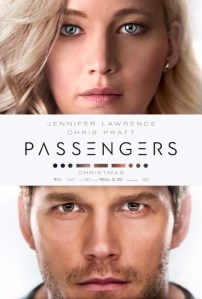 Reading the raft of reviews for director Morten Tyldum ‘s (The Imitation Game) new sci-fi movie Passengers, you would think the movie must have killed somebody’s mother. The resoundingly negative press stems from a an early plot development that critics have decried as offensive, disgusting, misguided, misogynist, and even “Titanic in space.” After having seen this controversial film, I feel like some of the moral outrage is overblown, or at least purposely ignoring complexities and context. Passengers is a movie that makes you think and feel and my feelings were more than billious invective.
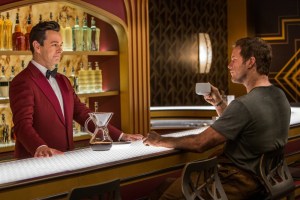
Jim Preston (Chris Pratt) is a passenger onboard the Avalon spaceship as it hurtles across the galaxy toward the colony of Homestead II. It’s a gigantic, sleek, and powerful vessel and the trip is expected to last 120 years. Except Jim was awakened early. 90 years too early. His hibernation pod short-circuited and he’s unable to go back to sleep. He’s destined to live out his life and die alone before any of the approximately 5,000 other passengers awakens. The Avalon is large and lonely, save for a handful of robotic and holographic guides, notably an android bartender named Arthur (Michael Sheen) who advises Jim to accept his circumstances and find enjoyment. One year later, binging on exotic food, playing video games for hours, and living without rules has lost its appeal enough that Jim is considering suicide. Then he sees the sleeping face of Aurora Lane (Jennifer Lawrence) and is awestruck. She’s beautiful but she symbolizes more. She’s a journalist and he reads all of her works, admiring her courage, sense of humor, ambitions, and determination. He feels like he’s falling for her and wishes she were awake. Jim asks Arthur, “What if you were stranded on a desert island and had the power to wish somebody else there? You wouldn’t be alone anymore but you’d be stranding them.” Arthur’s response: “Jim, these are not robot questions.” Jim decides to purposely wake Aurora, because if he didn’t there wouldn’t be much of a movie left. He hides his culpability and welcomes her to this new grim reality and they find solace with one another. The truth hovers over their heads but it’s not the only danger for Jim. The Avalon is experiencing a wealth of small technical glitches that cascade into bigger problems. If Jim and Aurora don’t stumble upon an answer, all 5,000 people onboard could perish far from home.
 While far from flawless, Passengers has plenty at play to engage an audience on different levels, be they intellectual, ethical, or science fiction thrills. The premise is strong from the first minute onward and screenwriter Jon Spaihts (Prometheus, Doctor Strange) has an astonishingly imagintive command of world building. The first act is one of discovery for Jim and the audience, and Spaihts provides plenty to discover that fits within the logical future. Jim sends out a video recording asking for help and then learns it will take 18 years to be sent to Earth and another 30 years to get the answer. It’s a nice moment that brings some science smarts to the proceedings. Colony planets are the next big corporate venture, and I appreciated the little touches that made this future world feel all the more plausible and authentic. Jim is a lower-class skilled laborer and will owe a percentage of his life’s earnings to pay for the voyage (sound familiar?). There’s also a class system alive and well, as Jim is denied the more delicious food and beverage breakfast items because he is not a Gold Star passenger. Beyond these little touches, Spaihts delivers a remarkably efficient story structure. The emphasis shifts in half-hour segments just long enough to fulfill a plot purpose before moving on to a natural transition. The rich contours of the Avalon are explored with plenty of built-in mysteries like what’s on the other side of the crew door. It’s a story implanted with strong mystery elements to smoothly guide the intrigue of an audience. The small scenes open up to wider scenes, and every set on the Avalon fulfills a purpose either emotionally or with suspense. I was definitely hooked and wanted to learn more about the ins and outs of this brave new world. Tyldum impresses with how easily he translates his visual prowess into the realm of large-scale science fiction. The set design by Guy Hendrix Dyas (Inception) is immaculate and had me begging to visit as many locations as possible aboard the Avalon. The many designs are more than just clean, sterile surfaces; there’s craftsmanship and personality in the rococo symmetry. I also greatly enjoyed the very intentional Shining visual motif of Arthur’s red velvet bar.
The film’s selling point is the relationship between its mega-watt stars, and Pratt (The Magnificent Seven) and Lawrence (Joy) deliver on their end. You could do far worse than spend 90 years with some of Hollywood’s most effortlessly charming, gorgeous, and self-effacing actors. Pratt and Lawrence seem to exist on a similar goofy yet spirited plane, and it works toward their eventual courtship. There’s a cute scene where Jim quizzes Aurora on her observational reasoning, guessing real aspects about several sleeping passengers. Jim is a man who feels out of place on Earth, looking to build anew, and Aurora is looking for an adventure worthy of a great story to equal her famous father’s literary works. It’s a fascinating question of whether a person would willingly jump forward in time 250 years, as Aurora plans to when she returns to Earth (if there still is an Earth). You’d be severing all tethers to human relationships from your past and also the world as you conceived. The characters aren’t the most in depth, and “Aurora Lane” is definitely a name that’s one step removed from being downright Jetsonian, but it’s the exceptional situation that makes them compelling to watch. How does one court the only other waking human being on a ship of thousands? What if Aurora happened to be gay? It’s a Last Man on Earth scenario that has been explored many times on TV and the big screen but there’s still something inherently interesting about the premise. I also enjoyed the care they build for their only other companion, Arthur the loyal bartender and confidant.
 Whether you see the movie as a parable about the horrible things people do when confronted with despair or as a fantasy for unchecked misogyny will depend upon if you view the problematic relationship as morally wrong but potentially empathetic or only irredeemably creepy. “You murderer!” Aurora accuses Jim when she discovers the awful truth, and she’s right. Jim has robbed her of a future and taken away her choice. I like to consider myself a relatively enlightened and progressive chap but I’ll admit I that I can only see things through my own white heterosexual male lens, so your mileage may vary. When Jim falls in love with Aurora from researching her background and pouring over every word she’s written in print, this may be the telltale sign for an audience. If you view it as a more heightened equivalent to falling in love through correspondence, an unrequited love fueled by missed chances, then perhaps you’ll still be onboard. However, if you view Jim’s love as the equivalent of falling in love with a coma patient (Pedro Almodovar’s Talk to Her?) and projecting feelings onto an unresponsive woman without agency, then this is a romantic paean that you’ll associate more with a horror movie.
There are several great and touching one-sided romances in the annuls of film, and I viewed Passengers as a higher concept rom-com where the misguided man (it’s usually the man) is hiding a secret about the murky circumstances surrounding the start of their relationship (like a She’s All That in space). That’s a fairly cheeky assessment of what could also effectively be dubbed a Stockholm syndrome romance, as Jim is the one responsible for kidnapping her from her planned future. I’ve read lots of ink from critics decrying this movie as an offensive, deeply flawed film. I think Passengers effectively communicates the full implications of Jim’s choice. It wants us to wade into that ethically troublesome pool with Jim. It doesn’t pretend he’s the good guy, though that judgment can be read too easily. It says Jim is a human being in a unique setting and that he made a selfish choice. There’s a complexity there I think is going ignored in a rush to moral indignation. I honestly think most people if given similar circumstances would make the same selfish decision. That’s not a lazy excuse but it is empathy, and empathy does not require comprehensive endorsement to still exist in some form or other.
With that being said, the movie certainly stacks the deck in Jim’s favor for some sort of redemption and/or forgiveness. The very fact that we have an actor as handsome and charismatic as Pratt shows the movie’s intentions. It’s not like Steve Buscemi was the one who woke up Jennifer Lawrence, and now that I’ve just written that sentence I’d be seriously interested to see that version of this story. I think that audience sympathies might be different for a more ordinary, homely man awakening a woman who, by conventional dating standards, would be out of his league on any planet. I think an audience might be more apt to interpret a lecherous angle to Jim’s actions if the part wasn’t so young and generally appealing. The opening act is the Cast Away section of the story that follows Jim’s discovery and isolation for a solid year, and it does much to engender good will for an audience, enough that his actions waking up Aurora force us as well into the uncomfortable ethical muck. “He was a drowning man, and he’ll grab onto anyone to save himself if he could,” is the only real overt effort at approaching apology.
 This premise is strong enough that different angles could have been explored. What if we only spent the opening ten minutes establishing Jim and his life on the Avalon? The awakening of a second passenger would serve as the inciting incident but the movie would purposely hide behind the plausible theory that she woke up by accident, by the same mysterious malfunction that Jim will relate. It would also provide a longer period of time for Jim and Aurora to develop together. Then the Act Two midpoint would be the reveal of Jim’s involvement and the fact that he had been awake far longer than he initially told her, perhaps with the original opening half-hour cut down to a few impressionistic flashback bits to communicate the stark loneliness and desperation. We would be just as shocked as Aurora. It’s here that the movie could completely become a horror movie, with Jim chasing her down through the empty space station. Maybe she even finds a locker with other women he woke up that were then murdered because they too found out too much. Then she has to take him down or else he will keep repeating this murderous behavior until he gets his perfectly submissive Eve. Admittedly, that takes the movie in an entirely different, albeit still interesting, tonal direction.
Passengers seems to bounce back and forth between existential horror movie and broadly romantic soap opera. It doesn’t always mix but I enjoyed the collision of ideas, tones, ethics, and discomfort, at least before it rumbles into a third act that becomes a series of life-and-death action set pieces. It’s not that Passengers goes slack in its final act; the visuals are consistently engaging as the spaceship shuts down piece by piece. When the gravity goes, Aurora’s swimming pool water becomes a floating prison, endangering her life. It’s a terrific moment even if it only serves as momentary suspense. There was always something to keep my interest with Passengers, from the world itself to the mysteries to the ever-changing script to waiting for the awful truth to finally hit about Jim’s misdeeds. Ultimately your opinion of this movie will be entirely based upon your view of how the movie handles Jim’s decision and its aftermath. You may view the movie as a fiendish masculine fantasy that strips away a woman’s right to consent or as an empathetically challenging, morally dubious drama with a relatably selfish choice that requires real consequences and introspection. Pratt and Lawrence are winning actors even if they might not make the most winning couple. Passengers is engaging science fiction made with pristine technical care and a smart screenplay that layers mysteries worth unwrapping. I hope more audience members decide for themselves rather than turning up their noses thanks to the staunchly negative critical reviews reeling with offense. There’s more here than given credit and I feel Passengers is a journey worth taking for fans of large canvas science fiction that still demand a personable entry point.
Nate’s Grade: B
Share this:

La La Land (2016)
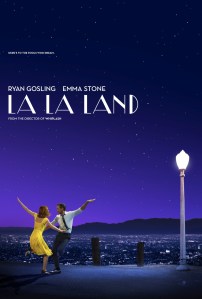 I understand that the year 2016 has been, charitably put, unkind to many people and why we all could use a little escapism around this time of year. Writer/director Damien Chazelle made a big Oscar splash with 2014’s Whiplash to make his passion project, a sincere musical that recreates the style of classic Hollywood. La La Land is a stylistic throwback that has enchanted critics and seems destined to compete for some of the biggest awards this season. Just imagine how much better it would be if it was great.
Chazelle and company certainly knows how to make an impression. The opening number transforms an L.A. traffic jam into a full-blown song-and-dance explosion, with commuters exiting their cars and coalescing into a teaming mass of jubilation on the freeway. It’s a moment that is sincere and full of energy and promise. The brightly colored commuters come together in long unbroken shots with a widescreen camera that dives and dips and leaves plenty of space for the audience to appreciate the dancing. This is a movie that wants you to see all of the rainbow-colored performers while they strut their stuff. It’s here that we’re introduced to Mia (Emma Stone), a part-time barista and struggling wannabe actress, and Sebastian (Ryan Gosling), a jazz musician who dreams of opening his own club at a historic site. These two dreamers resist each other but of course destiny has another plan. A highlight is a flirty sequence set atop a Hollywood Hillside overlooking the purplish dawn. Mia and Sebastian sing how beautiful this scenic view would be if only they were with someone they loved, playfully antagonizing the other into a dancer’s rivalry. The dancing is mischievous and fun and performed in wide angles to soak in the movements. It’s easy to get caught up in Chazelle’s early swell, a transporting experience that extols the virtues of classical musicals by the likes of Vincent Minnelli, Gene Kelly, and especially Jacques Demy’s The Umbrellas of Cherbourg. Chazelle fills out his frame like a painter. There’s an infectious love for Old Hollywood that tries to alchemize its influences into something new and old, and for a good while Chazelle is able to maintain this fizzy, effervescent experience and remind you of the soothing joys of a good movie musical told with finesse and brio.
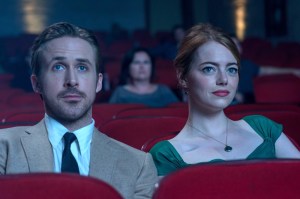 Then after about forty-five minutes the fizz gets a little staler and that’s when I felt the gnawing emptiness underneath all the Old Hollywood homage. It reminded me of 2011’s Best Picture winner, The Artist, as a movie that is more affectionate imitation than genuine substance. As I wrote in my review for The Artist: “The entire affair has such a slight feel to it; the movie is a confection, a sweet treat that melts away instantly after viewing. If you strip away all the old Hollywood nostalgia, there is very little substance here.” It’s all mimicry of the highest order but Chazelle hasn’t put enough authentic feeling into his imitation. There’s a fealty to the sources of his inspiration that Chazelle is replicating, and his screen pops with coded visual reminders (look, it’s Gosling leaning off a street lamp), but it fetishizes the inspirations rather than building from them. Quentin Tarantino is transparent about his outré influences but he doesn’t forget to tell an engaging story too. It’s in the movie’s dispiriting second half that it becomes all too clear just how little substance there is to our lovers as well as the industry satire. This is miles away from Singin’ in the Rain, folks (my favorite film musical, for the record) and more the same old broadsides about the industry: they’re shallow, they’re inconsiderate, they swallow up the dreamers, they “worship everything and value nothing,” as Sebastian put it. It’s not like the movie is telling you anything you haven’t heard before, and that’s fine but it limits any impact. It also seems to exist in a universe where minorities are mere background players to prop up the dazzling lives of the beautiful white leads. Imagine the enjoyment if some of that snappy industry satire was reserved for its less progressive casting practices. Can you imagine this kind of movie starring Tessa Thompson (Creed)?
Affection can only go so far because eventually the gravity of your characters, their relationship, their goals and dreams and relatability will need to kick in, and it doesn’t. I think this is because the first forty-five minutes are the typical rom-com story of the boy getting the girl. It’s the portion where the movie weaves its old Hollywood spell and courts us too, and it’s fun. And like bad relationships, once it has you La La Land feels like it has to do less work. Chazelle has to manufacture a series of pity problems (more below) to push his lovers apart and question whether these two star-crossed kids might make it after all. If the beginning half is the swirling romance that reverently celebrates old Hollywood, the second half is the attempt to “ground” the film in a sense of realism. It feels too late tonally to switch gears and it undercuts the first half. It might sound contradictory but if La La Land was just going to be a trifle then I wish it went all-in rather than half-heartedly trying an “edge” of harsh reality to mix the sour with the sweet. Just because the movie sets up the dreams of its characters, puts them together, and says not so fast doesn’t mean that Chazelle has properly set up this nascent melancholy.
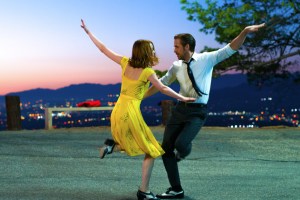 Mia and Sebastian are not particularly strong characters. The unified star power of the lead actors is enough to disguise this fact for a majority of the movie and maybe for some the entirety. They don’t have anything of import to say beyond their dreams and their jobs that are presently in the way of achieving said dreams. I couldn’t tell you anything else about these characters. For Mia and Sebastian, the world is divided into those who are pure and those who are impure, the real artists and the phonies, and the dichotomy will rankle anyone who has interacted with more than their share of hipster. Sebastian is a music snob who wants to impress upon the world the importance of jazz even as it shrugs indifferently. Nobody gets it, man. He’ll fight the good fight no matter what because Sebastian’s fight is Chazelle’s: taking outdated material and exporting value to a new generation. The characters serve the plot and exist to entwine and then be dutifully pulled apart. It’s hard to invest in the characters when they won’t show who they are and why they should be together. Maybe that’s the point ultimately, a rich meta commentary on how attenuated the central courtships in movies themselves are, or the fleeting relationship between film and audience, or maybe I’m just hoofing as hard as the leads to insert more meaning here.
The second half paddles into what my friend Ben Bailey affectionately termed White People Problems: The Musical. I won’t fully concur but the conflicts are too forced and the characters become whiney. Sebastian rejoins a pop band where he doesn’t feel 100 percent creatively fulfilled because he isn’t performing “true jazz.” The band is also popular and this causes friction because he has “sold out” on his dream, as if toiling during for any period of time is giving up. I guess you must be single-minded or it doesn’t count. Their combined egos won’t allow for different variations of success. La La Land pretends to endorse the dreamers but does it really? The only dreamers who seem to count are Mia and Sebastian. What happened to Mia’s lively group of roommates and friends from the beginning party? What about the nebbish screenwriter the movie mocks for an easy laugh? There are no significant supporting characters in this movie; the universe belongs to Mia and Sebastian. They’re not as insufferable as the characters from Rent but it’s definitely a detriment. Look at the characters in Fame, a group of hungry teenagers who came from all walks of life and circumstances to try and achieve their titular dream of stardom.
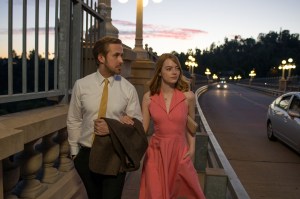 The limitations of its doe-eyed leads present some issues. Stone (Birdman) is smashing in the movie but part of that is because, aside from some song-and-dance choreography, the movie asks very little of her other than to be cute, a trait Stone has in natural abundance. There are two standout scenes for the actress. The first is an audition where she pretends to be a mistress getting the “sorry, I can’t do this” phone call from the man she thought had loved her. The sheer variety of emotions that Stone is so able to quickly convey on her face, in her tremulous eyes, and posture are remarkable. Of course the problem is that she’s too objectively good to keep getting blithely rejected by cold-hearted casting agents. The second is a musical showcase where Stone belts out a story about how her aunt inspired her to be a thespian. Stone is effortlessly captivating but she deserves better than to be foil to a grumbly Gosling. I feel that Gosling is one of those actors who can be amazingly talented when plugged into the right role and with the right director (see: Half Nelson, The Believer, The Big Short). He has an easygoing charm that all-too easily morphs into smarm without the right guidance or motivation on his part. Sebastian feels like a scowling grump who wants to bludgeon the world with his point of view. It feels more like he’s in it for submission. Gosling’s performance left me wanting someone else to play his part. They were so strong on screen in Crazy, Stupid, Love but that sizzling chemistry of old is gone here. They feel inert together, amplified by Gosling’s antiseptic performance. They’re both rather limited singers, very thin of voice, and that does hurt a musical. The songs by composer Justin Hurwitz and lyricists Benj Pasek and Justin Paul are exceptionally milquetoast. They’re all slight renditions on the same blandly pleasant tune. They evaporated from my memory by the time the end credits started rolling. Moana has nothing to fear come Oscar time from these at-best competent compositions.
If imitation is the highest form of flattery, then Chazelle’s anodyne musical is brimming with appreciation and adoration for the world of classic Hollywood, and that alone will be effectively transporting for many film critics and select audiences bred on a diet of Fred Astaire and Ginger Rogers. La La Land is an airy confection but one that dissipates all too easily after viewing thanks to the limited characters, the limited singing, the limited dancing, the limited songs, and the lack of overall substance independent from imitation. It has its lovely moments and Stone is an ingénue worth loving, though not as much her slim character, a dreamer who dreams the dreams of a dreamer. The breezy and bubbly first half doesn’t really mesh with the second half. I think it’s telling that Mia and Sebastian’s “love theme” is a sad plaintive piano trinkle. As the characters get more sullen and sour, the fizzy fun fades away and it starts to feel like a New Year’s Eve hangover that left you addled and warm but only in a vaguely ephemeral sense. If it leaves you toe tapping and giddy, I’m glad. I’m already mentally prepared for it to practically sweep the Oscars, as they do love celebrating their own importance. La La Land is a movie musical that is stuck looking backward that it loses its own footing.
Nate’s Grade: B-
Share this:

Bridget Jones’ Baby (2016)
 Coming 12 years after the last Bridget Jones outing, I was pleasantly surprised to discover how warm my feelings still were for this plucky, feisty heroine. Now in her mid/late 40s, Bridget is contemplating a life never becoming a mother when, surprise, she gets very pregnant and has two possible fathers: billionaire love guru Jack (Patrick Dempsey) or her newly available on-again off-again beau, Mark Darcy (Colin Firth). It’s a frothy plot contrivance but the screenwriters (including author Helen Fielding and co-star Emma Thompson) are able to produce fun comic scenarios that fully embrace the premise and its soapy conflicts. Bridget has two pretty appealing options, and when both men finally discover the possibility of the other, it becomes an entertaining game of one-upsmanship. The requisite romantic comedy elements don’t forget to be funny too, including an ending rush to the hospital that achieves some inspired slapstick. The film is swiftly paced and filled with zingers, and I just sat back for the two-plus hours and enjoyed the company of these silly yet realistic human beings. I enjoyed the adult humor and conversations that rarely get as much development in this genre. With all her self-sabotaging ways, you come to realize how much of a prize Miss Bridget is, and Zellweger slips right back into the role like no time has passed. However, plenty will grumble about Zellweger’s much-publicized plastic surgery, or the fact that she didn’t pack on the pounds for this picture, but I don’t see why any of that greatly matters in the interpretation of this character. The personality of Bridget is more than the alignment of her facial features. For fans of the series, Bridget Jones’ Baby is a welcomed return to form from 2004’s Edge of Reason and an extra dose of enjoyable fan service, tying up its tidy happy ending with a bow. Here’s something to chew over: my father had no prior knowledge of the Bridget Jones series, decided to see this movie, and enjoyed it thusly. Give Bridget Jones and her baby daddy drama a chance and you too may be surprised.
Nate’s Grade: B
Share this:

Carol (2015)
 Have you ever watched a movie that was so understated you wanted to jump into the onscreen world and push the characters around? That’s exactly how I felt with Carol, an unrequited lesbian romance set against the closeted and intolerant era of 1950s America. Carol (Cate Blanchett) is a rich wife who meets Therese (Rooney Mara), a department store employee who assists with her Christmas shopping. They are both drawn to one another in the strange way that love works, and their possible relationship could jeopardize Carol’s custody of her young child. Because of the time period, so much of this romantic liaison is internalized and thus we get longing looks, small gestures that are meant to speak volumes, and plenty of starting and stopping, leaving the audience to fill in the blanks. I don’t have an issue with unrequited romances but Carol is one that feels like its entire world, painstakingly recreated, has been placed under glass for study. There’s no passion evident throughout the movie and I was left wondering what exactly Therese saw in Carol and vice versa. Neither woman has a particularly strong personality, though that could be a side effect of having to live publicly as a different person. I couldn’t get into them as characters and so felt little interest in seeing them together, which made the constant circling and nervous indecision even more belabored. Blanchett and Mara are quite good and director Todd Haynes (I’m Not There) handles the material with respectful subtlety, I just wish that Carol could have shaken off some of that subtlety and given me a better reason to care about these women. It’s understated to death.
Nate’s Grade: C+
Share this:

Brooklyn (2015)
 If you’re looking for an Oscar movie this award season that will be perfect for grandparents, I direct you to the perfectly pleasurable Brooklyn. Beyond the throwback to the 1950 setting, it’s a movie that can appeal to multiple generations of audiences. There’s an admirable classical sense of filmmaking with Brooklyn, a delightful and charming movie with a healthy dose of nostalgia and heartfelt sincerity that should find a wide range of appeal to all ages.
Eilis (Saoirse Ronan) is an Irish immigrant who leaves her sister and mother to start a new life in Brooklyn. Thanks to a kindly Irish priest (Jim Broadbent) who had settled from her village, Eilis finds housing and a job. New York takes some getting used to, especially the density. Eilis is attending night classes to become a bookkeeper, but by day she works at a department store counter. It’s at one of the socials in her new Irish neighborhood where she meets Tony (Emory Cohen), a smitten yet confident Italian boy. She agrees to go on a date, actually two upfront, and it’s no time before Tony is walking her home from her night classes and talking about all his dreams. Eilis must return to Ireland for a family emergency. While she’s there, a bookkeeping job opens that needs her help, and a nice boy named Jim Farrell (Domhall Gleeson) grows closer to her with affections that aren’t exactly unwarranted. Eilis must decide which place to call her home and which life she wants to seek.
 While the story is set in the early 1950s, this movie could have been made in any decade of the film industry. It would not be out of place with the films of the 40s and 50s, hopeful and romantic odes about women finding new lives in the land of opportunity. There’s a classical sense to its storytelling that is rather universal about the struggles of self and independence. While this movie is awash in the period details of 50s New York City, it really could be told anywhere. The personal struggles of Eilis are completely relatable, which makes her an instantly engaging heroine. She’s a kind-hearted woman who’s trying to step out and discover who she wants to be, and this promising reality is a pleasure to watch. We’re watching the maturation of a person, watching her find her footing and gain confidence small victory after small victory. There aren’t any large or arch plot events to navigate. It’s the small moments in life, from starting a job, to becoming more sure of one’s self, to knowing whom to open up and trust. The movie is kept at a pleasantly low simmer of intensity, which works just fine. The gentle tone does not imply a lack of urgency but more so the beguiling and romantic spell. Thanks to writer Nick Hornby, who is becoming an ace screenwriter, the movie tells such a heartfelt and emotionally rich and resonate story in 100 carefully paced minutes. There’s a general joyous sensation that washes over you, elongating smiles naturally. The dialogue is often clever without being glib and the characters come across as realistic and humane. There’s only one character that is thinly drawn to approach being stock (well two counting the precocious “tells it like it is” kid). The others are hopeful, yearning, and fundamentally decent people. There’s something quite nourishing about watching decent people try and navigate their desires while maintaining their decency.
I think that’s what makes the love triangle work as well as it can, the fact that both options, not just the gentlemen at the center, are appealing. New York and Ireland both present options that afford Eilis opportunities in a career she wishes to pursue, both have compassionate men who have expressed an interest in her and are supportive of her education and goals, and both locations have a support system of friends. It may sound boring that Eilis can’t really go wrong with where and whom she chooses but I think that makes the ultimate decision that much more engaging. If these options weren’t so appealing then it wouldn’t be so interesting to watch. The mistake is that because the choices are good that there is less at stake when the opposite is true. She could rightfully be happy with either choice but which representation of Eilis will she decide? One life represents the old, the other he new. As I stated above, the characters in Brooklyn have an commendable decency to them, which makes the love triangle more difficult. Tony loves her completely but fears she may not come back, and yet he knows he has to let her go and she has to decide on her own where to call home. Jim is thoughtful and even though he obviously has feelings for her Jim knows that now is not the right time to ask, and so he too waits and hops he presents enough worth staying over. It’s a love triangle where you like all three participants, which happens so rarely in movies.
 Another strength of the film is that Ronan (The Grand Budapest Hotel) delivers a wonderfully felt performance. Much is placed upon her shoulders as our entry point into this world, and Hornby doesn’t resort to his characters explaining everything they’re thinking and feeling. Eilis is a woman who doesn’t speak in paragraphs but in short succinct sentences. She’s guarded but observant, and Ronan’s face is our great tapestry for understanding Eilis and her changing demeanor. We can watch her process the intimidating and invigorating world and read her thinking. It’s the most realistic Ronan has come across on screen as she has a habit of coming across slightly robotic, whether it’s as a pint-sized killer (Hanna), slain teenager (The Lovely Bones), or whatever the hell they were going for with the atrocious Violet & Daisy. With Ronan’s care, Eilis comes across like a resourceful young woman who is growing her sense of self. She’s a deserving lead for our simply story told with excellent care.
The only problem with a simple story told well is that it can also be predictable, which is a minor fault that doesn’t negate the impact of Brooklyn’s conclusion but does make it easy to anticipate. I’ll dance around spoilers but in a way I feel like even discussing the topic is going to be sufficient for you, dear reader, to accurately infer what direction the movie takes and which choice Eilis makes in the end. In short, Eilis makes a decision before leaving back to Ireland that somewhat stacks the deck in the favor of one of the two locations. This kept me from feeling like the choices were evenly considered. In the end, it’s a decision for Eilis about embracing her home and native culture and sense of community or branching out on her own and building something new and exciting. It’s possibility and independence versus comfort and family. It’s what can be versus what she’s known. It’s a decision that is universally relatable. Few of us have had romantic suitors and prosperous situations to vie over but many people have to make the normal decision of what path to embark, whether it’s the risk of something different or the reassurance of what is familiar and what has been earned. These aren’t the life-and-death stakes we see typically in the movies but they’re the decisions that often dictate fates.
Brooklyn is an easy movie to be carried away with. It’s full of honest and earned emotions that resonate from its reletability, tender heart, and gentle observations of watching a woman navigate the choices of her life. It’s an immigrant story and a coming-of-age tale, a romantic triangle with some fish-out-of-water elements. It’s a lot more than the sum of its parts, but with actors this good and with a script this tailored to deliver emotional uplift and satisfaction, those are some mighty impressive parts. If you’re on the hunt for a feel-good movie that won’t make you roll your eyes or overdose on sap, then I advise you and your family take a trip to Brooklyn and enjoy the sights.
Nate’s Grade: A-
Share this:

Not Cool (2014)/ Hollidaysburg (2014)
 Last year, Starz aired a reality TV series called The Chair. Produced by actor Zachary Quinto and Project Greenlight breakout Chris Moore, the aim was to give two different directors the same script, the same budget, the same shooting city, and the same access to resources to see what kind of movies they would create. The public would vote on a winner and the winning filmmaker would earn a $250,000 prize. Film is a director’s medium, and both of the chosen participants, Shane Dawson and Anna Martemucci, were allowed to rewrite the script, likely to the dismay of screenwriter Dan Schoffer. Dawson has built a following of millions making comedy shorts on his YouTube channel. Martemucci has written one other film and has professional ties to Quinto. Over the course of one winter in Pittsburgh, both Dawson and Martmeucci shot their films under the extra scrutiny of the reality show cameras. Whatever their TV portraits may have been, the work stands on its own. Dawson made the sex comedy Not Cool and Martemucci made the coming-of-age drama, Hollidaysburg. They are two quite different films, but are they any good and should The Chair be considered a success?
Scott (Dawson) is home for Thanksgiving break from his first year at college. In high school he was prom king and a big deal. Life since hasn’t been that easy. His girlfriend, Heather (Jorie Kosel), dumps him after a spontaneous hookup in a public bathroom. His father is closing the family’s record store. His sister, Janie (Michelle Veintimilla), might not graduate on time from high school. And then Tori (Cherami Leigh) accidentally hits him with her car. The two have history: Scott was responsible for Tori’s cruel nickname, “Tori the Whore-y.” Not having any of it, she lays in to him and unleashes years of anger, and then the two of them have sex. They try and pass it off as a one-time deal but they both can’t stop thinking of the other person. Tori’s pal Joel (Drew Monson) is determined to have sex with his high school crush, Janie. He agrees to help her with her schoolwork for a prime opportunity to make her fall in love with him. As Joel and Scott chase after their resistant love interests, they have to decide how far to go.
 I was completely unfamiliar with Dawson and his YouTube fame before seeing his film, and after watching Not Cool I wish I had remained in blissful ignorance. To call Not Cool unfunny is too kind. It is aggressively unfunny, going above and beyond to shock and appall. By no means am I a prude when it comes to crass comedy, but you have to put effort into it just like any other style of telling and developing jokes. You don’t just blurt out something vulgar repeatedly and confuse that for comedy construction. I knew I was in trouble when the movie resorted to projectile vomit within two minutes. Dawson’s direction consists of telling his actors to go as broad as possible; they feel like over-the-top cartoons engaging in shouting matches. A Thanksgiving dinner with Scott’s family feels like an insane asylum was evacuated. It’s fine that Not Cool doesn’t approach a relatable reality, but it needs to have some internal grounding that makes sense. It also needs to be funny. Much, much funnier. After ten minutes I had to stop the movie and gather pen and paper to start noting the unfunny and off-putting misogynist jokes on display. Let me make this clear: characters can be unlikeable and have non-P.C. POVs, but when the film itself seems to be adopting a tone and perspective that allies with ignorance and intolerance, that’s when a movie can become increasingly uncomfortable. Dawson’s interpretation of the script is rife with jokes that are homophobic, xenophobic, slut shaming and in general anti-women, and, I repeat, they just aren’t funny:
In response to dad’s new girlfriend (who is never mentioned again) being named Anastasia: “With that name she’s either a Disney princess or a stripper.” Fresh.
Janie relates how her sexist teacher is flunking her, which Joel responds with, “I’m surprised he didn’t give you an ‘A’ for those tit-ays.” Ugh. Just ugh.
“Tori the Whore-y? You look kinda good now. You know that nick-name might not be ironic anymore.” Because Scott is the arbitrator of what is acceptable attraction, therefore Tori should now have a sense of self-worth because he has deigned to find her of interest. This is later reiterated when Scott tells her, “You’re beautiful. You always were.” Thanks, now that you said it Scott it must actually be true.
Joel: “The only thing hotter than Leonardo DiCaprio is a retarded Leonardo DiCaprio in a sexy diaper.” What? I don’t think he ever wore a diaper in What’s Eating Gilbert Grape?. And Janie’s response is equally baffling: “That shit makes me so wet.” Huh? Watching an actor play a mentally handicapped child makes you sexually aroused?
To quickly wrap up this detour, let me highlight the most egregious stab at humor in the entire movie. During the film’s climax, his horny ex-girlfriend sexually assaults Scott. Tori sees this and, oh no, miscommunication. Scott explains he was raped and it was not consensual. The party’s host quietly walks over to a dry erase marker board that says, “Rapes at this Party.” He erases the zero and writes a “one” on the board, then goes back to partying. Let that sink in. The board was prepared for some sense of inevitable rape, and yet once it happens, the host carries on. That’s offensive on a number of issues.
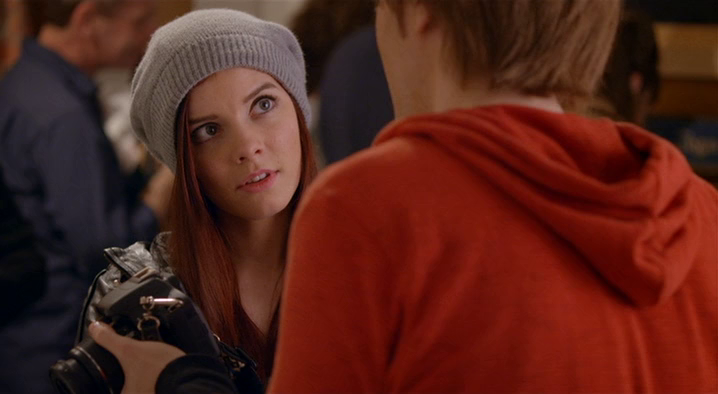 These scenes and lines are merely par for the course in what is ultimately a coarse and misguided comedy that is stocked with vile characters. Scott is served up as a figure that needs to get past his hubris, but the movie treats him more of a hero who the other characters just can’t help but love. It’s hard not to feel like the film is made to flatter Dawson as an actor. Within minutes of meeting Scott again, Tori says, “Would I have sex with you? Probably.” No one can resist his appeal, certainly not Tori’s family. Tori’s mother is practically begging to jump on top of him. When the character’s defining moment of humility and growth is cutting his Justin Beiber-like hair, it’s a failure. Tori is written in such an inconsistent fashion. She’s supposed to be all about negativity and hates everything in the world, but then she transforms into a Manic Pixie Dream Girl for Scott’s cutesy scavenger hunt. Leigh does a credible job with the character but she’s a half-formed assortment of quirks and messages meant to push Scott along. Dawson errs considerably by casting himself as the romantic lead. It further exacerbates Scott’s flattering portrayal, but really Dawson is just not a good enough actor to carry a film. But a lead role wasn’t enough, and Dawson appears as several female supporting characters in drag. The appearances stop the movie dead in its tracks. The characters are also just lame mouthpieces to blurt lazy inappropriate comments, especially a popular girl who just keeps calling people names at the top of her lungs. It is deeply unpleasant.
The worst character in the entire film is Joel. This guy is obsessed with having sex with his high school crush, who is still in high school while he’s in college, by the way. She has clearly and consistently stated that she does not have feelings for him, but what’s a woman stating her decisions going to matter to this guy? Joel’s pursuit of Janie is just insanely creepy. He mimes preforming cunnilingus on her. He stalks her online profiles to mine useful personal information. He enlargers and decreases a picture of her face on his phone and narrates the experience like she is giving him oral sex. At every point he treats her as a sex object. Even after a night out, where she wears a dress he picked out for her after trying it on himself and fondling himself in expectation (!), she tells him she doesn’t feel the same way, and he still forces the situation. It’s gross and at no point is Joel and his behavior held up to criticism. He’s rewarded for his “virtue” by having Janie pimp out all her promiscuous friends onto him. What makes the character even more repulsive is just how annoying Monson’s performance comes across; he’s going for faux bluster but it’s more like misplaced entitlement. If this storyline had ended with Joel murdering her while weeping and slow dancing with her corpse, you wouldn’t be that surprised.
 As the previous two paragraphs should indicate, there is certainly a point of view that emerges from the movie, one that trumps the heterosexual white male at the top and looks with derision on anybody that falls outside that definition. It feels like every joke is at someone’s expense. In the opening minute, an overweight woman tweets a picture of herself as a skinny model. I suppose it’s funny because she’s misrepresenting herself but it feels like the joke amounts to, “Ha, she’s ugly and fat.” But those who are conventionally attractive still don’t get off easy. Tori is slut shamed as a whore in high school, lead by Scott, and this is merely excused as the behavior of a loveable scamp. Janie’s friends are treated like idiotic sluts. Tori’s gay friend is defined by his flamboyance and obsession with sex. Disabled people are apparently hilarious just because they’re disabled and different. Tori’s older sister is blind and it’s funny because she accomplishes things… but she’s blind. I suppose the joke is that she shouldn’t have a successful life. There’s a woman at a party in a wheelchair (confession: I know this actress) and the joke is she’s doing normal activity. There’s one black character in the movie that is a homeless man who devours his own feces. At one point, his genitals are also used as a laugh. There’s also the characters’ flagrant and casual use of the word “retarded” to describe anything repulsive. The hoary stereotypes and unfunny portraits blend together, creating a mosaic of intolerance masked as comedy. Dawson’s sense of comedy is fairly puerile but it’s also offputtingly mean-spirited and denigrating.
Dawson makes too many fatal mistakes as a director for Not Cool to survive. Casting himself in the lead was a mistake. Appearing as female supporting characters was also a mistake. Excusing the bad behavior of his male characters, and rewarding them, was a mistake. Catering the humor to make fun of anyone that doesn’t classify as a heterosexual white male was a mistake. Relying solely on gross-out gags without better comic development was a mistake. Trying to earn a heart late into the film was also a mistake. After watching jerks behave like creeps with their inflated sense of entitlement, I don’t care if they maybe have feelings. Directing his actors to be heightened caricatures was a mistake. In short, Not Cool is a comedy graveyard of mistakes and bad decisions. I’m sure there will be people that find something to enjoy here, who laugh at the easy juvenile humor. I even laughed a couple times. There was a visual gag with a smuggled watermelon that was simply inspired. I think Dawson didn’t want to stray too far from his YouTube persona and the tone of his videos, lest he upset his fan base of millions, but what works as a three-minute YouTube short doesn’t translate to a feature film. Not Cool is proof enough that an overabundance of energy and cheap vulgarity does not compensate for a deficit in storytelling and execution. Not Cool is just not good.
 Going far in the other direction is Hollidaysburg, a modest coming-of-age drama that patterns itself after the mumblecore movement of indie cinema. Director Anna Martemucci definitely takes a more restrained approach to her interpretation of Dan Schoffer’s screenplay. She has some problems of her own but on a whole Hollidaysburg is the more promising and well-executed movie. It’s more sophisticated, better articulated, heartfelt, and comes far closer to achieving something worthwhile.
Right away you can tell a difference. We begin once more with Scott (Tobin Mitnick) and his girlfriend, Heather (Claire Chapelli), breaking up in the middle of sex, but they keep at it. It’s not exaggerated for extra laughs; the situation itself naturally draws them. The character isn’t made the butt of the joke either. It’s a much more encouraging opening than projectile vomit. Scott is also dumbstruck when he discovers his family home is days away from being emptied and sold. He reconnects with high school acquaintance Tori (Rachel Keller) and the two sleep together impulsively. As they’re trying to make sense of possible feelings, Heather is seeking out some company, anybody, and settles on her pot dealer, Petroff (Tristan Erwin), who happens to be buds with Scott. He’s wary of stepping over some kind of friend code, but in his efforts to get Heather out of her funk, Petroff starts to form a romantic interest he can’t help.
The focus is on our foursome of young, curious, and emotionally free-falling characters stumbling for some sense of personal identity. The theme of the film is about stasis versus change. Heather reasons that their long-distance relationship is not meant to be, and that it’s better to check out early. She’s also disillusioned by college, an experience that she had hoped would be remarkable at pointing her life in the right direction. Scott is quite literally saying goodbye to his childhood and his prior sense of who he was. His task for the holiday weekend is to pack the last of his childhood things in his old room so they can be sent to Florida. He won’t be returning to Pennsylvania likely, which is what Tori is also wrestling with. How far does she let herself get attached to something that could never happen? The two of them dance around their attraction and unconventional courtship. There’s real uncertainty about their possibility as a couple that’s palpable. Then there’s Heather’s sense of ennui that might just be a symptom of depression. She feels like she’s in a fog and that college is not the gateway others perceive it to be. Petroff is trying to juggle his role as friend and potential more-than-friend, and even though he has no real obligation to Scott on this one, he is trying to be deferential and sensitive. Before the breakup, he didn’t even consider Heather a friend. Now they’re getting to know one another on a much more personal level. The foursome is likeable, complicated, flawed, and pleasant to be around, enough to excuse some of the movie’s genial pacing.
 There are assorting supporting characters, notably siblings to Scott and Tori, but they are complimentary and better inform the story. Scott’s older brother spends the entire film trying to recreate his father’s recipe for pumpkin pie. It’s just the sort of concept that is slight enough to be fun but also lead into a dramatic character payoff. The dialogue feels attuned to the natural speech rhythms of human beings while still being entertaining. Scott and Tori’s initial reunion revolves around her keeping watch to make sure he doesn’t have a concussion after she hit him with her car. It’s a cute scenario that’s played with the right flirty tone that nicely sells the emergence of their romance. The humor isn’t as loud and underlined as Not Cool, and that’s to its benefit.
Your enjoyment of Hollidaysburg (named after a city in Pennsylvania) will depend mightily on your personal tolerance for the observational, delicate human comedies of the mumblecore genre. Sometimes derided as affluent navel-gazing, the often-DIY subgenre can have its own hardscrabble charm and touch upon relatable themes and conflicts that transcend their often self-indulgent characters. There’s also a stronger sense of realism in how fleshed out these worlds feel, and so I have enjoyed mumblecore primarily because of the combination of well-developed characters, emotional truths, and sincerity. I acknowledge a movie about a bunch of teenagers sitting around, mingling, smoking pot, and making life decisions is a harder sell than, say, sex comedy shenanigans. The difference is that you feel the care put in by Martemucci. She cares about these people and makes you start to care as well, or at least be interested. But if you’re not on the same wavelengths, one person’s observational is another person’s doddering.
While technically better on just about every level, Hollidaysburg has its own issues. The character arcs for Scott and Tori are rather nebulous. I’ll credit Dawson with this, in Not Cool the characters’ arcs were front and center and there was a progression. With Hollidaysburg, Scott is vaguely defined by his past but he doesn’t go into many details, failing to indicate how he’s undergoing some sort of high school hangover as he adjusts to a bigger pond. He’s uncomfortable with the discovery of how close Heather and Petroff have gotten, but this character turn doesn’t get developed enough to matter, instead coming across as a somewhat manufactured conflict break. Likewise Tori is looking to redefine herself in college but finding it harder than she anticipated. By the end of the film, her closing voice over quotes John Updike about being reborn every day, and how reassuring she finds this reflection. You could make the argument that through her romantic tryst with Scott, she’s better accepted the notion that she will define herself as she pleases, but I don’t even know if that approaches the conclusion. The two characters with the more clearly defined arcs are Heather and Petroff, and they’re on a relatively straightforward path where their biggest obstacle is hiding their emerging feelings from their mutual friend who would be hurt.
 I don’t necessarily know if I’d call The Chair a success. The fascinating premise has given birth to very different movies, but in the end one of them is an aggressively unfunny comedy and the other is an acceptable coming-of-age mumblecore entry. It’s hard to call either a rousing success. Not Cool is an abysmal comedy that is overly reliant on witless shock humor to substitute for storytelling basics. Dawson makes a slew of bad decisions, mostly playing to ego or his built-in audience, but I’ll say at least he goes for it. Martemucci certainly comes across as the more promising filmmaker; her film is better on a technical level and her handling of actors is far defter. At the same time, her aim is lower with her goals and her character arcs less defined. I suppose you could argue the hazy arcs tap into the characters trying to better find themselves but I won’t. Hollidaysburg is clearly the better film but Dawson’s legions of fans came to his service, and in the fall of 2014, Dawson was declared the victor by a majority of public voting. I purposely wanted to watch the finished movies before delving into the TV show so my feelings toward the filmmakers would not influence my reviews. Usually Project Greenlight was at its best when things were falling apart for its fledgling filmmakers, and I imagine the same level of entertainment will be had with The Chair. My foreknowledge will create a delicious dose of dramatic irony, as I know what all these efforts will lead toward. In my head I’ll likely be thinking, “Not worth it.”
I’ll add to this double-review after watching the series for any additional thoughts on Dawson and Martemucci as filmmakers and human beings.
Update: After having watched all ten episodes of The Chair, I can say neither director comes off terribly well. Martemucci is indecisive, poor with time management, and loses the big picture, but she’s far more open to collaboration and criticism. Dawson knows what he wants, is decisive, but is also quite thin-skinned and defensive and hard-headed to criticism. He seems incapable of thinking outside the bubble of his fanbase. He also has a far higher opinion of many elements of his film that I found awful, but that isn’t surprising. What’s surprising to me is that established producers could read Dawson’s script and watch the final movie and say, “Yeah, this is good.” Not everyone did though, as I discovered Quinto and another producer were so appalled by Not Cool that they elected to take their names off of it. They did not want to be associated with that material, which Dawson has trouble seeing as more ugly than standard “raunchy teen sex comedy” stuff (it is uglier, Shane). The funniest part for me was a tattoo parlor owner who discovers Dawson’s YouTube resume after she agreed to let him film in her parlor. She doesn’t want her shop’s name visible and associated with what she feels is racist, sexist, unfunny jokes. She even chastises Chris Moore about it. It’s like this one tattoo shop owner spoke as the prophet of me and all other home viewers and those who endured the awfulness of Not Cool. Congratulations for telling it like it is, Pittsburgh small business owner.
Nate’s Grades:
Not Cool: D
Hollidaysburg: B-
Share this:

Trainwreck (2015)
 Amy Schumer is having what some might refer to as a moment. Her comedic rise has accelerated as her sketch comedy show has gained greater notoriety for its social commentary from a post-feminist feminist perspective. For many, Schumer has become a relevant and empowering creative voice, and the fact that she breaks free from the Hollywood “thin is the only beautiful” mold is refreshing. Her star is only going to rise higher as soon as audiences get a load of Trainwreck, a raunchy romantic comedy penned by Schumer herself and starring Schumer as the lead. Paired with director Judd Apatow (Knocked Up), Schumer excels and surprises in Trainwreck, a modest but appealing rom-com that’s not afraid to get real when it counts and sweet when needed.
Amy (Schumer) is a magazine writer in New York City and follows her dad’s (Colin Quinn) words of wisdom he dispensed when she was ten years old: “monogamy is unrealistic.” Amy dates and sleeps with an assortment of men. Her current boyfriend Steven (the wrestler John Cena) likes to spend time at the gym but he doesn’t quite satisfy her, at least enough not to still see other men. Amy’s younger sister Kim (Brie Larson) rejected dad and settled down with a single dad and his son. The idea of marital bliss and raising children makes Amy uncomfortable. Amy’s editor (Tilda Swinton) assigns her a profile on a sports surgeon, Aaron (Bill Hader), specifically because Amy hates and is ignorant of sports. Amy and Aaron hit it off and she confidently takes their relationship in a non-professional direction. It’s then that Aaron surprises Amy. He calls her the next day and is interested in seeing her again. Amy has to come to terms with how to navigate a relationship with a good guy who understands her and would like more.
 The tone and spirit of Trainwreck is very clearly Schumer’s voice, following her brand of sexually brash humor from an unapologetic and independent perspective. Amy is a love-em-and-leave-em character who would shrug at being called a “loose woman.” Then again if we applied these same standards to men we don’t have the gender-swapped “loose man” nomenclature. Instead of the standard male playboy character who beds a plethora of sexual partners and then moves on about their day, this time it’s a woman, and while perhaps this isn’t the strongest foothold in the realm of being progressive, every bit counts (women can do it too!). Amy is unrepentant about her sexual appetites and she is not punished for them. Imagine that, a sexually liberated woman who enjoys sex and doesn’t have to suffer some physical or psychological trauma related to her desires. We’ve come a long way from Mr. Goodbar. The character of Amy is much more than just her dating habits. She’s ribald and unapologetic while finding ways to be relatable and more in depth than just the commitment-phobic lead character in a mainstream romantic comedy. Her views on relationships go back to idolizing her cad of a father and a strong sense of fatalism. Relationships can’t work out so why bother? This accentuates Amy’s already self-destructive habits, which make her in many ways our protagonist and antagonist. She’s an enjoyable character who can also be mean-spirited, petty, and push the important people in her life away from her. Her biggest challenge isn’t getting the story, holding a long-held secret, or even landing the guy, because he already wants to be with her. It’s about whether she can accept a different view of herself. That’s way more interesting and complicated than your standard rom-com fussbucket or workaholic.
The content of Trainwreck is far easier to engage with than Apatow’s previous film, 2012’s This is 40. Even though she has a cushy job and a nice apartment in the big city, Amy’s struggles with her relationship with her boyfriend, her sister, her father, and her boss, trying to please others without giving away too much of herself. Her father is the source of much of her discomfort as she and her sister debate how to take care of him in his ailing health. Where Amy views her father as an admirable straight-shooting guy who rebels against the social standards and expectations of decorum. Her sister views him as a bigoted and sexist jerk that was never much of a father. The slow acceptance Amy comes to about the degree of pain she’s dealing with and guilt related to her father is a key development. Her rejection of the “old ways” is a repudiation of her father. The arguments that she has with Aaron are realistic, and he admits that he’s uncomfortable with certain aspects of her lifestyle but he’s not forcing her to change. There are some dramatic turns in the film that require Schumer to do some heavy dramatic lifting, and she carries it gracefully, keeping in character but also losing her carefree façade. It opens up your sense of the character just as much as the actress. Trainwreck is still very much a romantic comedy and it spends its third act coalescing to its happy ending, but Schumer’s self-deprecation won’t let it get too saccharine.
The movie is also funny quite often though it ultimately gives in to more rom-com conventions than subverting them. There’s a funny sequence where Amy is trying to coax her boyfriend into being more vocally risqué during sex, and John Cena does a great job awkwardly trying to be dirty. There’s a funny moment tied to character as Amy mingles with far more straight-laced married women at a baby shower. They play a game of revealing secrets and it’s everything you would want it to be. The satirical broadsides at the tabloid and celeb navel-gazing industry are broad but quite amusing, including article topics like “Ugliest Celebrity Kids Under 6” and, “I’m Not Gay, You’re Just Boring.” Amy’s self-destructive attitude and her outer layer of confidence lead to many humorous observations and exchanges, especially with Hader. The two actors have good chemistry and bounce off one another well, capturing a fun energy of a couple that really enjoys one another’s company and exploring that. Swinton (Snowpiercer) is almost unrecognizable and quite hilarious as the unfeeling boss. The biggest scene-stealer and breakout star is the world’s greatest basketball player, Lebron. He plays the standard rom-com “concerned best friend,” even warning Amy not to break his man’s heart and having a dating debrief while playing very one-sided basketball with Aaron (all elements lampooned in last year’s rom-com spoof, They Came Together). The basketball scene is particularly amusing as Lebron dominates his friend so casually and without ego. It’s a fictionalized version of Lebron but the man just has natural comic timing and a star presence. I could totally see more acting work coming Lebron’s way if he wanted it.
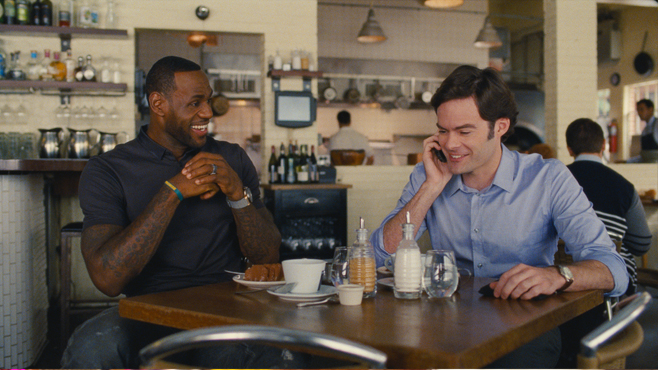 However, there are jokes, storylines, and moments that don’t feel as well constructed and simply don’t work, enough that it hampers the overall impact of Schumer’s story. There’s a recurring theme of gay equals funny, notably when all of Cena’s threats to a movie patron bear a striking homoerotic quality. That scene works well enough, but the theme reappears in a late storyline where a lisping intern at the magazine played by Ezra Miller (We Need to Talk About Kevin) unleashes his inner sexual freak, which involves a lot of homoerotic foreplay and positioning. It’s a comedy angle that gets old fast. I also never believed the sentimentality attached to Amy’s father after his health worsens. Schumer tries to turn a bigoted jerk into a well-liked character and it just doesn’t connect. He has real physical struggles dealing with MS but at no point does he come across sympathetic. I sided with Kim on this one, though I think I wasn’t supposed to by the film’s end. There’s also far too many supporting characters that just kind of float along the peripheral; this is common in Apatow comedies but these characters, from a homeless bum to Amy’s work colleagues, don’t feel well integrated. There’s a misfire late in the film when Lebron holds an intervention for Aaron. The core idea would work but Lebron’s intervention participants include Chris Evert, Matthew Broderick, and Marv Albert, with the bulk of the jokes being Albert’s in-game announcing. They don’t address that the figures are playing themselves until much later in the scene, so I was wondering if somehow Broderick was Aaron’s father. It’s a miss. The movie-within-the-movie is also never that funny or satirical of Sundance indies, but thanks for the effort.
As a side note, it seems like quite a missed opportunity that the Knicks game at the end of the film did not feature the Cavs. With Lebron as a supporting character, it would seem like a natural fit to include him in the climax. My theory on this is such: the Knicks play the Brooklyn Nets and we see Paul Pierce in a Nets uniform. As NBA fans know, Pierce left the Nets and signed with the Washington Wizards for the 2014-2015 season (he has since signed with the L.A. Clippers). That means that Trainwreck must have been filming the spring of 2014, which means Lebron was still with the Miami Heat. No wonder the movie didn’t feature the Cavs in its finale. Also, in what NBA universe is Amar’e Stoudemire the star of the Knicks? Does Carmelo Anthony and his $120 million dollar contract not exist in this universe? It’s a little comical that Stoudemire’s knee surgery is given such dramatic stakes for a player that the Knicks were looking to dump.
Trainwreck is by no means the disaster implied by its title. Even Amy isn’t really a trainwreck of a person. She can be mean and self-destructive, but her shocking behavior isn’t all that shocking. She drinks and has sex with multiple partners and does not feel shame in this. Look out, world. Yet it’s Schumer’s sprightly comedic voice that shines throughout the film even when certain jokes or storylines misfire. Make no mistake, Trainwreck is also a star vehicle for Schumer and she earns it. She even sheds some tears in very effectively dramatic moments. She can do it all (refraining from obvious bad joke…) and still be funny whether she’s cutting someone to size or the butt of a joke. Trainwreck is an enjoyable romantic comedy, another in Apatow’s sweet lineup of raunchy and somewhat old-fashioned romances with their happy endings. There should be more than enough to tide Schumer’s fans and for her to make new ones.
Nate’s Grade: B
Share this:

The Age of Adaline (2015)
 What happens when you mix the films of Douglas Sirk with a heavy dose of magic realism? The results might just look like The Age of Adaline, a throwback with a science fiction twist that’s surprisingly appealing and intelligently developed. The titular Adaline (Blake Lively) has a freak accident in the early twentieth century that stops the aging process. The premise and the trailer had me scoffing about how hokey it all seemed, and yet I found myself retracting most of my prejudicial broadsides. While focused primarily on the topic of romantic love, the movie credibly explores Adaline’s hardships and how she must keep reinventing and moving to a new home so often, lest people suspect. She’s purposely stopping herself from making deeper human connections. She’s afraid of being abducted and experimented on but she’s also afraid of her cursed condition harming those she cares about. Her daughter (Ellen Burstyn, now playing two consecutive daughters older then their parent) poses as Adaline’s “grandmother.” They have conversations dealing with end-of-life care. The film doesn’t duck the more grueling aspects of immortality and it provides a degree of substance to go along with the more fleeting fairy tale aspects of the plot. It’s the third act where the movie gets even better, when Adaline unexpectedly reunites with an old boyfriend played by the unexpectedly great Harrison Ford. He’s convinced he’s seen her face before. It’s driving him mad, and even though it’s decades hence, he still has yet to fully get over Adaline. Lively gives her best performance since 2010’s The Town. She has a beautiful melancholy that she carries with the character that doesn’t overplay the tragic elements. It’s clearly a melodrama, but it’s far more measured and tame that the larger elements feel grounded and sincere. Not everything works, including the superfluous narration from a future historian and the all-too-neat ending. There are probably more interesting stories that can be told with this premise since much of it is Adaline hiding from the world, and the specific focus on her romantic entanglements feels a little myopic for the material. And yet, I found myself engaged and wanting to see what happened next, appreciating the earnestness and the focus on the consequences of choices made and choices avoided. If you have to choose one Age of movie this summer, maybe try Adaline instead of Ultron.
Nate’s Grade: B


 nathanzoebl
You must be logged in to post a comment.