Blog Archives
Chappie (2015)
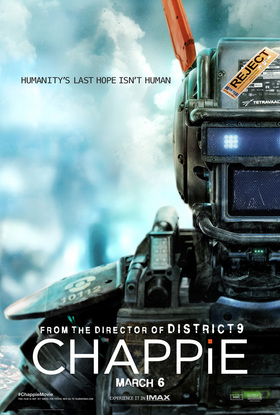 With each passing film, it regrettably is becoming more evident that District 9 seems to be the possible exception for writer/director Neill Blomkamp. It seemed like a new visionary had broken through who could meld heady themes with rousing sci-fi spectacle, a champion of both the visceral pleasures of genre movies and the satisfaction of narrative complexity. After two more films under his belt and with complete creative control, it’s starting to look like Blomkamp’s sense of storytelling is a bit more limited than District 9 would have lead on. The man is excellent at putting together concepts, and he likes to delve into major themes and messages, but the execution has been hobbled and the themes are simplistic to the point of being childish. Perhaps the man is suffering from unrealistic expectations or perhaps the greater world is finally seeing that Blomkamp has been remaking the same movie over and over with diminishing results each time. If you disliked 2013’s Elysium, you’ll probably have an even lesser opinion on Chappie.
In the near future, Johannesburg, South Africa is being policed by a series of rabbit-like robotic “scouts” created by Deon (Dev Patel). His boss (Sigourney Weaver) is happy with the results but very wary of Deon’s interest in artificial intelligence. Deon takes an old robot and installs his A.I. program, giving it sentience. But before he can marvel at his newest creation, a pair of grimy criminals, Yolandi and Ninja, kidnaps him. They dub the new sentient robot Chappie (Sharlto Copley) and plan on making use of him for a heist. Deon strongly disapproves, promising to come back so he can nurture Chappie’s creativity. Yolandi becomes “Mommy” who wants to encourage the robot’s sensitivity, Ninja becomes “Daddy” and wants to toughen him up, and Deon the absent father figure. At work, Deon’s rival inventor, Vincent (Hugh Jackman), is anxious for any opportunity to promote his own police force, a giant flying mech warrior known as the Moose. Unlike Deon’s robotic scouts, a human operator controls the Moose. Discovering Chappie is exactly what Vincent has been waiting for to destroy his competition.
 Chappie is a tonally inconsistent mess that ends up being a weird, garish, and unsatisfying hybrid between Robocop and Short Circuit. It jumps around from being a slapstick comedy, a sentimental unconventional family, an urban warfare action thriller, and a science fiction film exploring the possibilities of artificial intelligence. The tonal shifts can be quite jarring; one moment the movie wants you to feel sorry for Chappie getting beaten (he’s a helpless robot!) by a group of hoodlums (why does a robot fear pain anyway?), and the next moment Blomkamp wants you to laugh at the trashy gangster shenanigans. If the film could ever settle on one tone and take the time to develop it properly, Chappie might have been salvageable. Of course this assumes that Blomkamp restrains himself from explaining everything to his audience. He’s not exactly a subtle filmmaking when it comes to his deeper allegories even with District 9, but it just gets insulting how little faith he has with an audience, bludgeoning them silly. At one point, “Mommy” reads Chappie a bedtime story and it’s about the black sheep, the outcast, and just from that alone, we get the thematic connection. That’s not enough. Blomkamp has “Mommy” explain the thematic significance. Okay, fine, now he’s made the message explicit but even that’s not enough. “Mommy” then literally points to Chappie and says, in case anyone still wasn’t getting it, that he is the black sheep. It’s an illusion of greater intellectual depth that unravels as the film chaotically continues.
Let’s get to the biggest problems with the film: Chappie and his would-be adoptive parents are annoying. While Chappie is a technically impressive visual effect with a motion-capture performance by Blomkamp staple Sharlto Copley, the character is far less winsome. Why would a robot be acting like a child? It’s because Blomkamp wants to rely upon easy sentiment and emotional manipulation to get you to feel for his characters when the story alone is incapable of achieving this. Chappie as a personality is something of a blank slate, and this is filled by the trashy gangster wisdom of Yolandi and Ninja played by South African rap duo Die Antwoord. They’re pretty much playing themselves, credited as their stage names, they wear their own merchandise, and their exaggerated, beyond-ironic-back-to-pseudo-reverent garish style is off-putting in large doses. THEY’RE THE MAIN CHARACTERS. That’s right, two non-actors who plays themselves are the main characters. The movie relies on many Die Antwoord tunes to highlight its sense of funky nihilism. As performers, I’ll admit that there is something unique to them, but it’s foolish to give them a whole movie to carry. It feels like Blomkamp took the profane comic relief characters from another movie and said, “Hey, what would it be like to stretch them out for a whole movie and raise a kid?” Either you find a “gangster talking” robot with gold chains hilarious or you don’t.
The world of Blomkamp seems like it’s stuck on repeat, setting his futuristic steam punk tales in the slums of South Africa, but is this location really integral to tell Chappie? It was essential to District 9 because that movie was an allegory about the apartheid, but none of that specific history of culture plays into this movie in any meaningful sense. The setting then becomes inconsequential, though I could level the same charge at the overwhelming movies set in New York or Los Angeles. The world building of Chappie, like much of its narrative elements, feels half-hearted and curiously rendered. Yolandi and Ninja are threatened with seven days to pay off their debt, but you never feel like there’s a sense of urgency, as if the movie would prefer you forget about this ticking clock. This secondary bad guy seems to be the source of all crime in Johannesburg. Deon has created a widespread police force and yet it never feels like the other characters treat this with the magnitude it warrants. Likewise, Deon doesn’t seem to treat artificial intelligence as a big deal. Then again his boss, of a huge robotics corporation I want to emphasize, has to have artificial intelligence explained to her (again, Blomkamp of little faith). There’s also the way the movie is mired in weird office politics. Vincent is jealous that another program was successful and makes his program look bad, so he works to sabotage Deon’s robots so his project will get the go ahead. Vincent’s project is a glaringly obvious rip-off of the ED-209 from Robocop. It seems so strangely isolated, as if Vincent never thought about selling a flying mobile tank to the lucrative military. The most outlandish moment in the movie might be when Vincent points a gun to Deon’s head, threatens him, all within full view of a slew of co-workers, and then sheepishly retreats with the excuse, “It’s not loaded. Just a joke, mate.” How does this guy still have a job? Is the human resources department of the future replaced with robots as well?
 Here are a small number of other directions Chappie could have gone that I think would be more compelling than what we get, and these just came to me during the movie. Instead of having the robot officers being responsibly used, why not have the world as a police state overrun by these sentinels, an oppressive regime worth toppling. Then Chappie ends up being a robot that’s captured, reprogrammed by revolutionaries, and fights against his programming for what he believes is truly right. Isn’t that a better setting, and far more topical with the current militarization of police forces dominating news? This scenario is better than a work force of robots that most characters shrug over. Then there’s Vincent’s plot to sabotage the robotic scouts (mild spoilers). Instead of just turning the robots off and letting chaos reign, wouldn’t it be a far better angle for him to turn the robots against the civilian populace? Instead of broken robots we have killer robots. Again, it adds a greater sense of urgency but also a route that would seem far more in keeping with the nature of Vincent. Chappie is filled with these hypothetical plot detours you see in your head and wish the film had taken. The movie that Blomkamp delivers is a profane fairy tale that teases a greater experience that fails to materialize.
Chappie is one of those movies you sit and keep hoping it’s going to turn a corner, to get better, to finally capitalize on the setups its been throwing around, to coalesce tonally and magically reveal the madness behind its sloppy methods. Unfortunately, it just remains a disappointing film that feels like several revisions away from proper execution. The plot elements don’t come together. Worst, Blomkamp cannot trust his audience to get even the simplistic metaphors on display. It’s two movies in a row where Blomkamp has miffed on his story. His sense of visuals is unmistakable, and he sure knows how to fill his movies with cool stuff. I imagine his pitch sessions are great with studio execs. It’s just now becoming more apparent that his major shortcoming comes to realizing these stories. There’s a host of other miscues with Chappie. I’m going to go out on a limb and say you’ll never be seeing Die Antwoord as the lead actors in another movie again. Maybe Blomkamp hired them just to get a discount on playing their music throughout the movie. Blomkamp has recently been hired to direct an Alien sequel, and I hope he takes full advantage of this opportunity to creatively leave behind his old stomping grounds. Otherwise in space, no one can hear you yawn.
Nate’s Grade: C
Share this:

Transformers: Age of Extinction (2014)
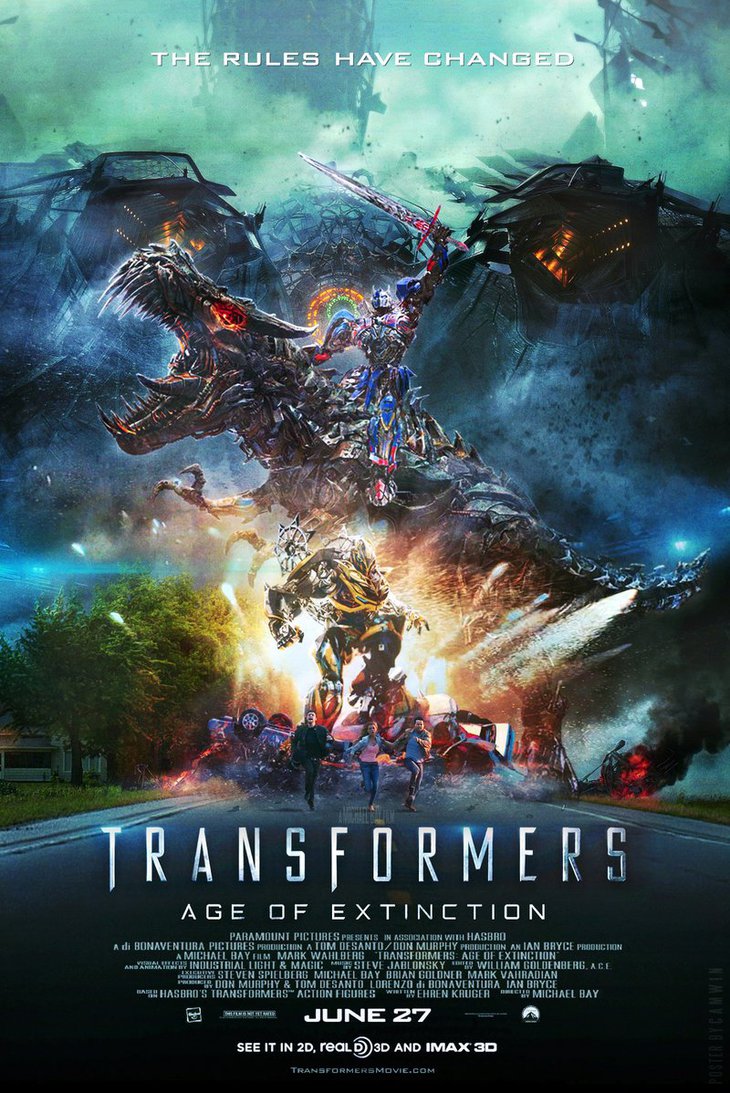 Four movies in, at this point you can either fall back on the old criticisms of Michael Bay as a filmmaker or simply let down your guard and look for any simple pleasures offered by the Transformers franchise, a series mostly known for chaotic plotting and action. Age of Extinction is probably the best Transformers film since the first one (take that for what you will) but it still has all the hallmarks of the obtuse and convoluted plotting, absurd and obnoxious characters, juvenile humor, intense product placement, and often incoherent action. Gone are the characters from the first three films and in their stead is Mark Wahlberg (upgrade) as a Texan inventor named, get this, Cade Yeager. He and his teen daughter come into contact with Optimus Prime and are on the run from multiple forces. Apparently a bounty hunter is looking to target Prime. The U.S. has a black ops team tracking down Transformers in hiding. And Stanley Tucci plays a business tycoon who wants to make his own Transformers via their magic substance “Transformium.” Reading all of that, you realize the pieces still don’t really make sense, and that’s before the robot dinosaurs come into play. And yet Bay and his team have fine-tuned the entertaining aspects of the franchise and better consolidated them in the fourth film. A badass alien bounty hunter/collector is a great addition, adding the government as an adversary, Titus Welliver (TV’s Lost) as a cocksure special agent, Tucci as a corporate blowhard, and robot dinosaurs, it all sort of works on its own terms. Again, if you try and logically connect the pieces, it won’t happen. By this point, if you’re not a fan of the series, there’s no real reason to continue watching, but if you’ve found any semblance of enjoyment then there should be enough to keep your attention with the fourth film, robot dinosaurs and all.
Nate’s Grade: C+
Share this:

Big Hero 6 (2014)
 Disney’s first adaptation of a Marvel property, it’s essentially a superhero origin tale mixed in with the “boy and his robot” formula borrowed from The Iron Giant. The story is fairly predictable but charming and unafraid to deal with loss and grief. The real star, though, is the inflatable robot Betamax (voiced by Scott Adsit), whose unfailingly optimistic and helpful nature is a loveable addition to a genre plagued with doom and brooding. The action sequences are colorful and well developed and paced. It’s an agreeable pilot film for a new animated franchise, and the characters are likeable and fun while still having enough emotional resonance to make the hard choices of sacrifice hit you in the gut. It’s a welcome change of pace to have a character interested, first and foremost, in the mental health of others. You just want to hug Betamax (parents, your children will be begging for the toys). The plot does follow many similar plot beats of the superior Iron Giant but this film is still enjoyable enough on its own terms.
Nate’s Grade: B
Share this:

X-Men: Days of Future Past (2014)
 Ever since Marvel’s Avengers destroyed the box-office in 2012, every studio with super hero franchises has been looking to follow suit. It’s not just about comic book franchises; it’s about building a comic book universe. It’s been a long dark period for the X-Men ever since the regrettable 2006 debacle The Last Stand, which callously killed characters, butchered others, and botched the most famous storyline in the history of the comic. In 2011, Matthew Vaughn proved there was still life to be found in the franchise with his terrific 60s-era prequel, X-Men: First Class. Now, post-Avengers, Fox is salivating at combining the past X-Men and the present X-Men into one colossal movie with a colossal budget. Back on board is director Bryan Singer, the director of the first two X-Men films and the man who helped kickstart the modern superhero era. If that wasn’t enough riding on the film, X-Men: Days of Future Past also follows the second most famous storyline in the history of the comic.
In the horrible future, killer robots known as Sentinels hunt down mutants. These are the invention of Dr. Boliver Trask (Peter Dinklage), a military scientist who was killed back in 1973 by the vengeful shape-shifting mutant, Mystique (Jennifer Lawrence). The murder convinced humans to subsidize Trask’s killer robot plan of defense. Thanks to experiments replicating Mystique’s mutant ability, the Sentinels have the ability to adapt to any power, turning them practically indestructible. In the future, the Sentinels are eradicating all mutants, mutant sympathizers, and eventually human beings. Magneto (Ian McKellen) and Professor Xavier (Patrick Stewart) have teamed up with a small band of surviving mutants, including Wolverine (Hugh Jackman). Thanks to the phasing powers of Kitty Pryde (Ellen Page), they can send Wolverine’s consciousness back to 1973 so that he can prevent the Trask assassination. The only ones who can help Wolverine is the younger Xavier (James McAvoy) and Magneto (Michael Fassbender), former mentors to Mystique. Except Xavier is a recluse and strung-out on drugs to dull his powers and Magneto is locked away underneath the Pentagon.
 The X-Men films have always had a topical advantage to them that provided a weightier sense of drama than your typical story about a reluctant soul blessed with amazing powers. The mutant allegory automatically applies to any sub-group facing oppression mostly through fear and ignorance. What other superhero franchise has two opening scenes in a German concentration camp? The stakes are even larger with this movie because of the Horrible Nightmare Future that must be prevented. Now we all assume said Nightmare Future will be avoided by film’s end, so the movie provides a proverbial reset button that the filmmakers can have fun with, and they do (look out future mutants). Excluding the Nightmare Future framing device that becomes an unnecessary parallel storyline, the majority of the film takes place in 1973. If X-Men: First Class tapped into the groovy optimism and “take me for what I am” sense of social justice of the time, then this film certainly taps into the disillusionment of the 1970s, where the promise of reform and hope morphed into anger and cynicism (hey, that’s like us today!). This loss of innocence is typified in Mystique, who becomes the central figure of the movie in many ways. Her seething desire for vengeance is what animates her, as well as the pain of betrayal from the men closest in her life, as well as the world who once held such promise. Also, Jennifer Lawrence (The Hunger Games) has become one of the biggest female stars on the planet, so it makes sense to bolster her role. The central conflict is stopping an assassination, one domino that leads to many others, but it’s emotionally about Mystique having to confront her feelings of hate. It’s another platform for the ongoing conflict of perspectives between Xavier (restraint, tolerance) and Magneto (strong defense, eye for an eye). But as I found in First Class, it’s hard not to agree with Magneto as human overreaction leads to rash and thoughtless actions, like Horrible Nightmare Future.
That’s not to say that X-Men: Days of Future Past fails to deliver when it comes to the popcorn thrills and action highs we crave in our finest summer blockbusters. The action set pieces are large without dwarfing the characters, playful and imaginative without losing a sense of edge and danger. I loved how the character Blink (Bingbing Fan) would utilize her mutant power of opening portals as a fighting strategy. It makes action sequences so much more inventive and visually exciting to throw a series of portals. The pacing is swift short of the second half of Act Two, gearing up for the climactic showdown in D.C. that dominates Act Three. The time travel story starts with a lot of exposition but it gets smoothed out as it goes, the rules of the story fall into place. Every action sequence hits, some admittedly better than others, but it’s the small touches that Singer injects that made me smile most. I enjoyed Magneto pointing a gun, being toppled, but still using his power to have the gun fire in midair. I enjoyed the animalistic nature of the Beast/Wolverine brawl. Jackman is looking even veinier than usual in his bulked out form. Thankfully the fish-out of-water timeline jokes are kept to a minimum. Wolverine is the perfect glue to hold both timelines together. And then there’s that standout Pentagon prison break sequence (more on that later). Singer might not have the most natural instincts developing and staging action, but the man is a surefire talent when it comes to staging eye-catching visuals (I would say the same about Christopher Nolan). Even his unfairly maligned Superman Returns is proof of the man’s cinematic gifts. As far as entertainment value, this is right up there with X-Men 2. I still view Vaughn’s savvy First Class as the best X-film of the bunch, which has only gotten better the more I’ve watched it.
 And if that wasn’t enough, Singer’s new film does what every fan has been hoping for: (spoilers) it erases all the crummy X-Men movies, namely 2006’s Last Stand and the first Wolverine solo effort, from the official timeline. It’s time to start anew, toss out the old stuff nobody liked, and forge ahead with a new unified timeline. There can be two parallel X-Men franchises, one present/future and one with the prequel casts, and they can go on forever as desired, or until the prequel cast prices itself out. In one fell swoop, Singer and company have reset the mother franchise and given fans new hope about the possibilities. Make sure to stick around to the very end of the credits for a scene that indicates directly who the next major villain will be in the 2016 sequel.
Let me take time to single out just how expertly Evan Peters (TV’s American Horror Story) steals the entire mutant-heavy movie. First, he’s the most comically attuned character, which is a nice break from how serious, and rightly so, every character is so often. Quicksilver provides a whole new jolt of entertainment, and when he checks out after the prison break sequence you’ll dearly miss him. The character is a rapscallion (as my late grandmother might have termed) that enjoys using his super speed powers to mess with people, to test his limits, to see what he can get away with, and a Pentagon jailbreak is right up his alley. Ignore the silly yet period appropriate outfit and ignore what initially seems like Peters’ smirking self-involvement from trailers and ads. When this character is onscreen the movie has a joyful sense of irreverence. He is instrumental to freeing Magneto and the onscreen depiction of his super speed is the best illustration of the power ever conceived in film and TV. There is a segment sent to Jim Croce’s “Time in a Bottle,” and some wonderful special effects, which is just so playful, so giddy, and so cool that it very well might be my favorite moment in any superhero movie… ever. It is definitely an applause-worthy moment and my audience responded in kind. Quicksilver is a perfectly utilized supporting player in a movie stuffed to the gills with characters.
The time travel geek in me has a few quibbles with the parallel lines of action from past and present. Wolverine’s consciousness is sent back in time but he film plays out like it’s happening simultaneously to the events of the future. So if Wolverine is pulled out in the middle of the movie, he’ll have failed his mission to change the future, even though by going back in time he’s already, blah blah blah butterfly effect. Anyway, I understand how they want to make the future story have a sense of urgency but it’s not like waking Wolverine from a dream; the times are not happening concurrently. He’s in the past, meaning that the moment he goes back there, the future will already be altered due to the consequences of his actions, for better or worse. There is no race against time to keep his consciousness back in time until he complete his mission. I can see why they went this route for a summer blockbuster, but that doesn’t quell the quibbles.
 X-Men: Days of Future Past is a time-hopping, unabashedly fun time at the movies; well as fun as preventing nightmarish futures built from the consequences of oppression and prejudice can be. With Singer back in the saddle and the bridging of the two X-Men universes, the series is back on track and once again the promising font of stories and characters. The newest X-film is one of the most entertaining, funny while still being dramatic, and while burdened with the largest cast of any super franchise, finds notable moments for its characters big and small to remind us that these people matter. While less philosophical and funky than First Class, this is one of the best films in the franchise, on par with X2. The action sequences and visual eye-candy are great fun with some inventive and memorable touches. It’s also nerdy fun getting to watch the past and present interact, and for many this is their first return since 2006’s crappy Last Stand. It’s not a perfect movie; I wish there was more early Sentinel action, I wish Dinklage had much more to do, and I wish that the plot didn’t so transparently hinge on Xavier not having his powers. The slate is clean and all X-Men fans can breathe a sigh of relief. The future is once again rosy. The X-Men, and not just Wolverine, are relevant once again.
Nate’s Grade: B+
Share this:

Pacific Rim (2013)
 Pacific Rim is director Guillermo del Toro’s (Hellboy, Pan’s Labyrinth) giddy ode to the great monster movies of his youth, and if you’re fond of men in suits and large-scale cardboard destruction, then this movie is definitely for you. The word “awesome” seems too inadequate to describe the rock ‘em sock ‘em action of this picture. This is likely the most realistic and serious this concept will ever be realized, with a gargantuan budget and some top-notch special effects. del Toro, already something of a god in fanboy circles, will get his chiseled bust alongside Joss Whedon. Pacific Rim is a transporting blockbuster that doesn’t pull its punches, at least when it’s dealing with robots fighting monsters. If this is why del Toro dropped out of directing The Hobbit then I think it’s a good trade off.
In the near future, a rift opens at the bottom of the Pacific Ocean that opens a gateway to another dimension. Through this portal, giant horrifying monsters the size of skyscrapers appear to wreck havoc on coastal cities. The monsters, known as kaiju, take a whole lot of work to go down. “To battle monsters, we had to make monsters, “ say a character in the prologue. The world unifies and responds with a program where two people pilot giant mechanical robots known as jaegers (yes college kids, you read that right). These pilots are psychically linked via a process known as the Drift; they work in tandem, sharing one mind. Raleigh (Charlie Hunnam) is a former jeager pilot recovering from the loss of his co-pilot/older brother in battle. Stacker Pentecost (Idris Elba) recruits him back to the final days of the jaeger program, a defense that has fallen out of favor with world leaders once the kaiju started winning again. Stationed in Hong Kong, Raleigh is looking for a new co-pilot and by all accounts it seems Pentecost’s diminutive assistant, Mako Mori (Rinko Kikuchi), is the best candidate, though Pentecost won’t allow it. Add some wacky scientists (Charlie Day, Burn Gorman) and an underground monster parts trader (Ron Perlman). The last days of the beleaguered jaeger program are all that stand between mankind and annihilation from giant beasts.
 It’s undeniable how well Pacific Rim taps into your inner ten-year-old, the kid who crashed his toys together imagining larger-than-life battles. Truthfully, if I were ten years old, I’d likely declare Pacific Rim the greatest movie of all time, that is, until I saw one with boobs in it. Conceptually, this feels like just about every anime brought to life, and fans of anime, as well as monster movies in general, should be in heaven. It’s so much fun to watch but it also doesn’t get lost in the cacophony of special effects like many modern blockbusters. del Toro has a wonderful way of showcasing his action without losing track of the scale or the destruction. Unlike Man of Steel, we have city-wide devastation that feels like devastation. Giant monsters are a state of life for the world and so is the day-to-day anxiety that one’s coastal existence is about to be in ruins. The movie doesn’t get bogged down in post-9/11 solemnity, but at the same time I appreciated that del Toro makes his violence feel significant and the loss feel real.
The action onscreen is often exciting and screenwriter Travis Beacham (Iron Man 3) employs a nice system of escalating the stakes by applying a category system to the kaiju, rating them on a 1-5 scale. It provides a natural progression of opponents. Plus, besides the inherent excitement with the premise, Beacham and del Toro drop us into the middle of this story, years after the jaegers have fallen out of favor as a means of defense, thus providing another hook – underdogs. Our heroes don’t just control giant fighting robots, they are also underdogs and have to prove their mettle to dismissive authority figures. I was hooked.
del Toro has always been a man who can create living, breathing worlds that you just want to explore, and Pacific Rim is the same. I loved immersing myself in the minutia of this world, learning the different fighting techniques of the robot designs, the cultures that harvest the kaiju bodies (there are monster groupies as well), the rock-star status of the jaeger pilots, and most of all, the Drift. Psychically linking the pilots is an ingenious way to add to the emotional investment of what are otherwise fairly clichéd character types. They have to be in synch mentally, which requires a whole other level of trust and connection. The tragic back-story of Raleigh is given even more weight knowing that not only was he witness to his brother getting eaten alive by a giant scary monster, he was psychically linked and felt his brother’s overwhelming fear and pain. That would definitely shake me. The Drift also provides a unique way to include back-story without feeling like forced exposition. Seeing Mako’s horrifying childhood survival account is quite affecting, but it works even better knowing this is also a chance for Raleigh to understand and bond with her. That sequence, Mako as a child, is stunning, staying with her pint-sized perspective as she tries to outrun a ferocious monster bearing down on her. It slows things down and allows the true terror of the situation to seep in. Beacham and del Toro have put a great amount of thought with how this world operates, and it’s appreciated as seemingly every detail adds to a richer big picture.
Naturally, the special effects are just about every positive accolade you can put together. It’s a CGI heavy film that doesn’t look like a cartoon; something Michael Bay’s Transformers have difficulty overcoming. The robot designs aren’t overly busy. In fact, the main robot reminds me a lot of Metroid’s Samus suit (anybody?). The monsters are all a bit too similar in design though. They all start to bend together making it hard to differentiate them from one another, especially when they’re supposed to be getting bigger and badder. Part of my lukewarm reception with the monster designs, besides from del Toro’s sterling past reputation when it comes to creature designs, is that so many of the epic fight scenes happen with some level of visual obfuscation. They fight at night, they fight in the rain, they fight in the fog, they fight underwater, but rarely will they fight in a setting where you can clearly focus on the fighters. This very well could be a budgetary decision, allowing less work for visual effects artists so they can cover the scope of del Toro’s imagination. Still, it’s hard for me to compose an argument that a $200 million-dollar movie needed just a bit more money to properly show off the goods.
 When it’s not wrecking havoc onscreen, the story can drag and you’ll notice how thin the characters are developed. It’s another reluctant hotshot and learning to get over a personal tragedy, trusting a new co-pilot, and taking stern advice from a begrudging father figure. That doesn’t mean they don’t work within the framework of the story; Hunnam (TV’s Sons of Anarchy) is solid if unspectacular, Elba (Thor, TV’s Luther) is the universe’s most authoritative badass, Day (Horrible Bosses) and Gorman (The Dark Knight Rises) provide a nice array of comic relief, and Kikuchi (Babel, The Brothers Bloom) makes for a formidable upstart hero. The character roles are familiar and thinly sketched but they come together in a satisfying manner, each contributing to the mission, and each finding a moment to make you care. When the fate of the world is at stake, it’s hard not to feel some investment in our ragtag assembly of heroes. With that being said, you will still feel drag in the middle, waiting for the next attack and for our heroes to suit up and do what they do best. The extended second act involves denying Raleigh and Mako the opportunity to do what we all know they need to do – man a jaeger. It can get restless as we keep getting roadblocks to something that seems inevitable. It’s akin to waiting too long for John Reid to accept his outlaw status in The Lone Ranger. I will give Beacham and del Toro extra credit for not leaving themselves open for an immediate sequel. Also, do stay through the credits for a nice treat.
I can easily recommend Pacific Rim with minor reservations, and if giant fightin’ robots and monsters is your thing, then the reservations won’t even matter when you get a movie this entertaining, fun, and skilled at providing the gee-whiz factor. I wish all summer movies were this fun. I was squealing with glee watching a giant robot drag a cargo ship across the streets of Hong Kong, gearing up to beat down a huge monster. The movie is packed with little moments like that. As with other del Toro productions, the world feels nicely realized, lived in, and sprawling with detail, even if the monsters all start looking the same (monster racism?). The plot does suffer a bit when it refocuses on the humans, but then again what plot wouldn’t suffer when it takes you away from giant robots fighting aliens? Pacific Rim isn’t the first of its kind. Besides the anime, Godzilla, and even Power Rangers influences that spring to mind, there have been numerous movies that follow a similar premise of Giant Thing A squaring off against Giant Thing B. What sets Pacific Rim apart is del Toro’s innate ability to channel your childlike glee at the concept, turning something monstrous into something fun while still giving respect to the weight of the moment. This is not a dumb action movie. del Toro’s sprawling artistic sensibility takes on summer blockbuster filmmaking and shows you how it can be done right for optimal effect without making your brain hurt. Now I need round two.
Nate’s Grade: B+
Share this:

Robot & Frank (2012)
 It’s the age-old story about an elderly man (Frank Langella) suffering from Alzheimer’s who teaches his robot helper to be his partner in jewelry heists. While that sounds a lot more fantastic than the movie we eventually get, Robot & Frank is a mellow, sincere, and overall nice movie that treats the particulars of its world with a wry sense of whimsy. The movie is really a mismatched buddy film as Frank is hostile to being forced to live with robotic help, but soon the two of them form the basis of a friendship, and when things get dangerous it’s heartwarming the lengths they’ll go to save the other. Give the Alzheimer’s subject, expect some twists in the final act concerning Frank’s world. The movie wants to hit us emotionally but I felt mostly remote, smirking at some of the fun of the old codger back in the burglary business of his youth. But the film just stays at a very even-keel level of emotional resonance, drawing us in but not exactly taking us anywhere. The ending is curiously without any sort of comforting resolution that could have put a solid piece of punctuation on the film’s emotional drama. Langella, it should be said, is excellent. Robot & Frank is a high-concept buddy film, fairly pleasant and entertaining but when it comes to a close you may wish that the film had relied less on chaste understatement.
Nate’s Grade: B
Share this:

Real Steel (2011)
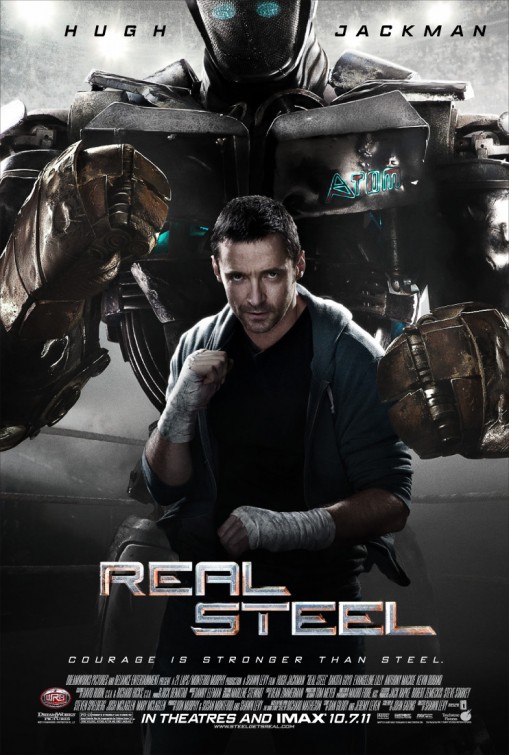 In the future world of Real Steel, set in 2020, robot boxing has become a huge sensation. It seems that audience bloodlust was not being satisfied with flesh and blood hitting the canvas, so robot brutality will do. Whatever happened to mixed martial arts, a sport arguably more popular than boxing in this day and age, popular enough it even got its own uplifting sports drama earlier this year (the overlooked Warrior). I strongly doubt that in only nine years we’d have giant fighting robots and that this “sport” would be nationally recognized. Did anyone see Comedy Central’s mechanical Coliseum showdown, Battlebots? There’s your answer, America.
In this future world where trucks have glass panels to show the world your feet (why? Because it’s “futuristic” you fool), Charlie Kenton (Hugh Jackman) is a has been. He enjoyed a fleeting career as a professional boxer before the mechanical men came into popularity. Now he goes from town to town trying to scrounge up some petty money with small-market robot boxing rings. His only pal is Bailey (Evangeline Lilly), his former flame and the owner of the boxing ring/chop shop that Charlie calls home. Charlie owes plenty of money to plenty of not nice people. His solution arrives in the form of his 11-year-old son, Max (Dakota Goyo). Charlie ran out on Max and his mother when Max was a baby, but now mom’s dead and custody is being discussed. Mom’s aunt (Hope Davis) and her rich hubby want Charlie to sign away his parental rights, which he agrees to do for the right price. Max spends one last/first summer with his estranged father before going off to live with his auntie. The two bond when Max discovers a beat-up old sparring robot when father and son are skimming parts illegally at a junkyard. The old bot, which Max names Atom, becomes a champion fighter. Father and son ride the success all the way to a championship bout with Zeus, a legendary robot that destroys all challengers. Can they stun the world? Can father and son bury the hatchet? If these answers are in doubt, I advise you to see any sports movie ever released.
J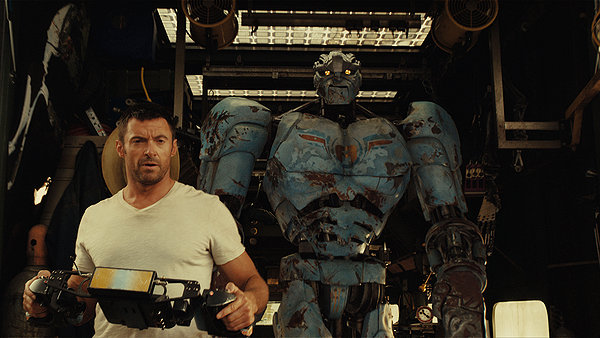 ust in case you stood clueless and slack jawed at the film’s storytelling prowess, you’re in luck because every character will take great pains to explain the significance of plot points, key metaphors and symbols, and personal motivations. Usually this stuff is tucked away as subtext, but Reel Steal decided that it would rather rub the audience’s nose in the architecture of its screenplay. Characters will just go around speaking blurting out their feelings in the most transparent way possible: “I can’t be with you again, I’m afraid of being hurt again, and seeing you in that ring is like seeing my father again in that ring, and fighting this fight is your attempt to regain redemption and prove yourself wrong, and the robot is old and busted but still has some fight in it left, just like you Charlie…” It gets tiresome. Max squeals, “All I’ve ever wanted was for you to fight for me!” Your dad’s kind of a lout, kid. You’d be better off being adopted by your preposterously rich aunt, which is really the moral we learned from Annie. Who talks like these people? It’s astounding how blatant the film is about explaining its sotry mechanics so that the dumbest common denominator in the audience can walk away feeling like Roger Ebert (“Did you notice how the robot was a metaphor for Charlie? I did.”).
Never in my life would I have anticipated that someone would watch Over the Top and say, “What if we added robots?” This movie essentially is a souped-up version of Sylvester Stallone’s 1987 flick where a dad fights for the custody of his kids through the weirdly court-approved process of the gentleman’s game of arm wrestling. First off, who in their right mind would make a movie about professional arm wrestling? There’s a reason this specific sports genre still stands with one entry. Charlie finds redemption over one summer spent with the kid he abandoned and then sold. The strange thing is that Max knows from the start that he’s more a commodity than a valued son. Yet he still bonds with dear old dad though he’s still going off to live with his rich aunt by the end. The father/son relationship becomes the heart of the movie, but what good can come from two annoying characters learning to get along? They’re still too annoying for me.
Charlie’s fight to become a better father is hampered by the fact that I wanted to strangle his kid. There was rarely a moment that passed where I didn’t want to punt this little brat. From the moment he first steps on screen, Max is surly and aggravating. Given that he’s meeting the father who abandoned him, I’d expect some confrontation but this little twerp cops a bratty attitude throughout. He hops on the boxing ring mic and walks around with a phony swagger and challenges the biggest baddest robot. The kid seems like a chip off the ole block, falling victim to hubris just like dead. When Goyo (Thor) screams it becomes a high-pitched caterwaul that caused me to writhe in physical pain. The subplot of Max teaching the robot how to dance is just embarrassing. You better believe the kid teaches his metal friend how to do the robot. The young actor deserves a fair share of the blame. Goyo flounders, overselling every emotion and hovering at a persistant petulant level of acting. I do not advocate the endangerment of children, obviously but I’d be lying if I failed to admit that I would have slept soundly had Max tumbled to his death in the robot junkyard. Goyo is so powerfully awful that he may well be the tarred as the Jake Lloyd of this decade (Lloyd infamously played the twerpy kiddie Darth Vader in the first of the regrettable Star Wars prequels). It’s hard for me to root for the reunion of father and son when I’d rather see father bury son in the ground.
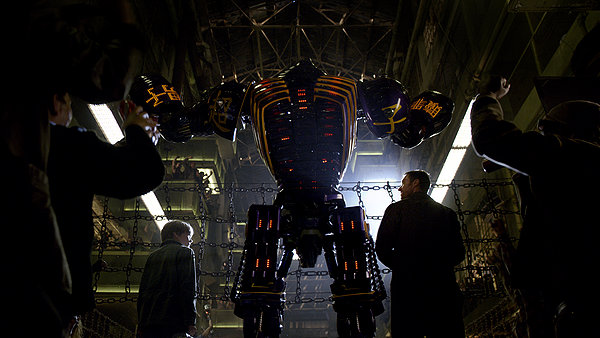 Real Steel is littered with nonsensical or dropped subplots, the worst offense being Atom’s secret. It’s revealed midway into the film that Atom is not just a sparring robot but a sentient being. It’s faking that it can only shadow human movement. When Charlie “teaches” Atom how to box he really is teaching the robot, though conveniently Atom seems to keep this knowledge to itself. Even when it’s being battered mercilessly, Atom doesn’t employ the skills it’s been taught. Maintaining his cover is more important than self-preservation, so suck on that Asimov. The fact that Atom is sentient is the filmmaker’s desperate attempt to add empathy to the robot. Without sentience, the robot is just a junky avatar that can be scrapped. It’s a piece of equipment but if sentient it becomes a character we can feel for. You don’t share empathy with a coffee maker. I kept waiting for this secret to somehow get out because it’s kind of a monumental deal. But it never does get out. The story never once revisits this gigantically important revelation. What does this mean about other robot boxers? Are they too sentient? What do they think about destroying each other for sport? There are important questions here that are ignored. What’s the point of making Atom sentient if you never do anything with it? It’s only a ploy to drum up empathy, but at no point does Atom feel like a character, only a collection of parts. It’s a coffee maker on steroids.
The movie borrows liberally from other sports movies, taking the emotional beats from Rocky and the family drama from a film like The Champ, though loses the downer ending. Everything is too recognizable, too formulaic, as if it was assembled on a factory floor. The only points of surprise are when Real Steel just carelessly drops plotlines, as mentioned above. What’s the point of introducing a plot point like the robots can malfunction if hit correctly in Act One and not have it resurface in Act Three? Jackman (X-Men) acts with all the power his neck veins can afford. He seems to be constantly growling or on the precipice of said growling. The romantic subplot with Bailey is an undeveloped thread only meant to tie back together into a pretty bow at the plot’s earliest convenience. Lily (TV’s Lost) plays the “girl,” which means all she’s given to do is remind the hero of his potential and be the warm body waiting in bed. But this is a family film, so we stop at late-night cuddling. Then Max ends up being a savant at mechanical engineering and electronics because… he plays video games? Give me a break. And it just so happens that every character we’ve been introduced to will be in attendance for the big fight, even the Texas bookie (the great and underutilized Anthony Mackie). Wouldn’t Detroit bookies take umbrage to this?
Do you like reaction shots? Real Steel is chock full of them: people wincing, people yelling and clapping at TVs, people muttering under their breath the optimistic instructions, “C’mon, c’mon, c’mon.” You accept some reaction shots as part pf the terrain of the sports movie, but when they’re presented in excess then it becomes a crutch, the director reminding the audience what to feel with the subtlety of a sharp stick to the eye. Then again subtlety was never the forte of director Shawn Levy, he of Date Night and Night at the Museum fame. The special effects are strong and the boxing sequences even have some livened suspense to them, though why would anyone build a robot boxer with two heads? What advantage does that offer other than two things to hit? Levy gets lost in the special effects and treats the actors with the same indifferent level of care that the humans show the robots.
Real Steel wants to be a rousing, family-friendly crowd pleaser; it just won’t ever let you forget that this is its primary function. This outlandish sports flick is much like its robotic pugilists: big, dumb, loud, and prone to malfunction. The film has no faith in its audience’s intelligence so every feeling and symbol is plainly explained with unwanted diligence. The characters are unlikable or underwritten, the story is shackled by lockstep devotion to formula, and Goyo’s wretched performance makes it damn near impossible to sympathize with the father/son reunion. Filled with unresolved plot setups and a mystifying similarity to Over the Top, Real Steel is just like every other boxing movie on record except this one has robots. I’m fairly certain the screenwriters were robots too. Why else would they make a robot becoming sentient seem like no big deal? Obviously this is propaganda to lull us into complacency before the impending robot war. Real Steel is a classic example of a movie done by committee; it feels like it was crudely assembled from the spare parts of other, better movies.
Nate’s Grade: C
Share this:

Transformers: Dark of the Moon (2011)

After the obnoxious, oafish mess that was 2009’s Transformers: Revenge of the Fallen, a sequel that took everything good from the first flick and undermined it and took everything awful and magnified it, I wasn’t expecting much. True, low expectations have benefited this franchise built upon merchandizing, product placement, and giant freaking robots that fight. I still remain a fan of the first film back in 2007, and I do feel like director Michael Bay (Bad Boys, Armegeddon) is a natural fit for this material. But after another overlong, overblown, and overloaded Transformers film, I’m starting to think that the franchise’s best days left with Megan Fox and her cut-off jean shorts.
Sam Witwicky (Shia LaBeouf) has graduated from college and is now perusing a job in Washington D.C.’s vast center of government contracts. He’s living with his new girlfriend, Carly (Rose Huntington-Whiteley), the assistant to a rich billionaire (Patrick Dempsey) and his fleet of collector cars. Sam gets a job with at a military private contractor run by a angry loon (John Malkovich). But Sam’s post-collegiate journey once again runs afoul with killer alien robots. The villainous Decepticons are plotting to steal a spaceship that crash-landed on the dark side of Earth’s moon. Inside that spaceship are teleporter orbs and a sleeping robotic giant known as Sentinel Prime (voiced by Leonard Nimoy, hooray). Optimus Prime, leader of the noble Autobots, revives his predecessor. Together, the group attempts to thwart the Decepicons, lead once again by Megatron (voiced by Hugo Weaving).
The Transformers films have been getting larger and larger in scope and destructive power; the first film messed up some L.A. streets, the awful second film trashed Egyptian pyramids (only Six Wonders of the World left in your punch card, Bay), and now the third film pretty much obliterates downtown Chicago in stunning and overblown fashion. The climactic Windy City beatdown lasts a solid 50 minutes and may just be the greatest thing Bay has ever put onscreen, which admittedly might be faint praise to many. Perhaps the city of Chicago thought this would make for good tourism: ”Hey kids, come see the buildings that were turned to rubble in your favorite summer movie!” The impressive special effects are uniformly terrific, and the integration of reality and fantasy seems seamless. That goes without saying. I must credit Bay for creating sustainable action that is, here it goes, actually coherent. I know that “Bay” and “coherency” rarely go together, so I’m as shocked as everyone. No longer does geography become a hindrance to understanding. During this climactic Chicago onslaught, the locations are established, the objectives are clear, and the audience has a crisp understanding of the different teams, their paths, and their organic roadblocks and setbacks.
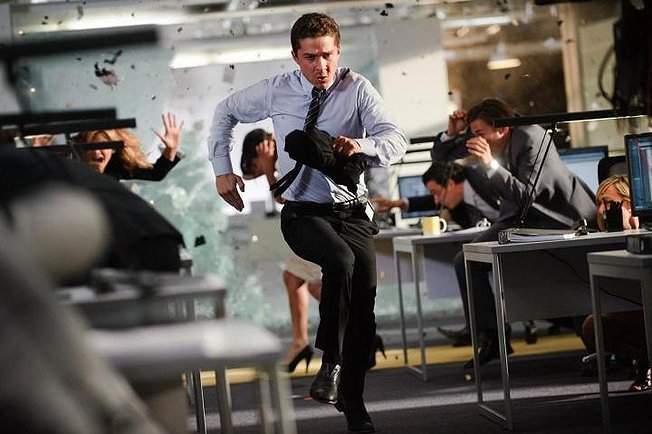 There’s a strong set piece within this 50-minute assault where Sam and company enter into a crumbling skyscraper that then teeters on its side. The organic complications allow for some nifty, almost ingenious, split-decisions utilizing a specific location, the hallmark of good action sequences. One moment they’re climbing up the floors, the next moment they’re tumbling through the floors, then sliding down the sheer glass wall, then firing at the glass to fall back inside and tumble some more. All the while a giant worm-like robot is churning through the foundation of this collapsing building. The scale of the sequence is quite thrilling for the time being. And yes, the 9/11 imagery is undeniable and relatively unearned without even a nod to solemnity or anything less than brainless summer spectacle. Sure the “cool-ness” of the individual parts never really materializes into something greater, and yeah maybe the action would have more impact if you actually felt for the characters, or knew who some of them even were, but you take what you can get in Michael Bay world. The extended climax for Transformers: Dark of the Moon is relentless and will beat you into submission, admiring the intrinsic beauty unique to Bay’s epic, albeit mind-numbing, demolition of the senses.
But Dark of the Moon is also the most visually coherent of Bay’s troika of Transformers flicks because the man has finally settled down when it comes to editing. Now no one will confuse this movie for Rope or Russian Ark (look it up, Transformers geeks), but the edit/panic button is given a slight reprieve. The shots last longer; the editing is far less frenetic and chaotically ADD-addled, and no longer does a Transformers action sequence look like jumbled, mechanical scrambled porn. Image A and Image B make a logical connection, at long last. You can tell which robot is which, for the most part. Perhaps this editing epiphany was a result of Bay’s corporate betters insisting that the film be shot in 3D (I chose to see the film in good old boring 2D, feeling that 150-minutes of Michael Bay with headache-inducing glasses was not worth the extra dough). Perhaps Bay had to consciously think about his audience’s well being so his shot selections lasted longer than his usual whirlwind of cuts. Perhaps the secret was loading Bay with cameras that weigh the same as couches. Maybe a little extra weight was all the man needed to formulate lucid action sequences.
And yet Dark of the Moon is just as stupid, outlandish, and tonally disjointed as the other movies, particularly the abysmal Revenge of the Fallen. The comedy remains at a puerile, sophomoric level. Bay’s sensibilities have always somewhat mirrored that of a snickering 14-year-old boy; the love of destruction, the fascination with things that go “boom,” the ogling of lithe feminine bodies. No joke, the first image seen directly after the film’s title is a close-up of Huntington-Whiteley’s ass ascending a staircase. I imagine there were plenty of men spasming in their 3D glasses trying to reach out and grab the circumference of a Victoria Secret model’s talents. I wrote about the second film: “Women don’t seem to exist in the Michael Bay world, only parts and pieces of women.” Huntington-Whiteley’s character certainly leaves much to be desired, outside aesthetics. At least Megan Fox’s character had, you know, some character traits. I also wrote: “Amazingly enough, [Fox] manages to lose more clothes the more she runs in slow-mo, allowing the male audience members to follow the nuance of her bouncing breasts. She’s clearly not the next Meryl Streep but this girl deserves more than being wordless arm candy.” Seems apt to me. Carly is as bland as she is blank-eyed beautiful, just the way Bay likes ‘em.
The first 90 minutes of the film is spent with the humans and it’s like being trapped inside a bad comedy. There has always been a strong comedic bent to the franchise ever since the first film in 2007; however, the latter films have taken to grotesque caricature. In Dark of the Moon, the comedy is so deeply unfunny but so consistently antic, trying to overwhelm you with its bad taste. There’s a scene where Ken Jeong (yes, you read that right) corners Sam in a bathroom stall to distribute his crackpot manifesto. Then Sam’s boss walks in and, oh boy, he overhears and thinks they’re having a homosexual liaison in the men’s stall. What a hoot. Then Sam’s mother gives him dating advice, stating there’s no earthly way her son is going to nab a third “hottie” unless her boy has a giant…. and trials off (wouldn’t a mother kind of have an idea about that subject?). And then there’s the little Autobots, the size of remote control cars (perfect presents for Christmas mom and dad), who wheel around spitting smart-alecky backtalk. The entire Malkovich portion could have easily been cut from the film without damaging a soul. The Ken Jeong stuff should have been eliminated first. There’s something to be said when John Turturro’s returning Agent Simmons is the least annoying comic sidekick in this movie. But hey, at least there aren’t any overt racist depictions and jokes about robot scrotums. Nope, there’s only infantile humor and nonchalant misogyny. The comedic pit stops and non-sequitors never allow the movie’s tone to gel.
 Before the movie descends into an all-out series of explosions and shrapnel, the setup actually has some genuine interest. Then it just all goes nuts at warp speed. The fact that the space race to the moon had a sinister ulterior motive, investigating alien technology, is an intriguing start. Bay even shoots the 1960s sequences like he’s ripping off Oliver Stone, swapping film stocks and black and white film to showcase his historical reinactors (three presidents get represented, including Obama). Apparently after this film and X-Men: First Class, the breakout star this summer is archived footage of JFK (man did he have a full plate, mutants and robots, and the man still found time to bang Marilyn Monroe). There’s even a cameo by the real Buzz Aldrin, which served to make me remember his better cameo on TV’s 30 Rock (“Would you like to yell at the moon with me?” he politely asked Tina Fey). The space race was a pretense for getting our human hands on some alien technology. Of course we were warned years ahead of time via Pink Floyd but nobody could put the pieces together. But there’s more alternative history to be had. Turns out that the disastrous nuclear accident at Chernobyl was caused by the Russians trying to operate alien/Transformer technology. I’m sure modern-day Ukrainians will adore having their deadly tragedy turned into a plot point in a stupid movie about fighting robots. The Decepticons wicked plan is to open a teleportation portal and bring their dead planet, Cybertron, to Earth. Then they will use Earth’s human population as slave labor to bring their dead planet back to life. My question is this: when you’re a huge robot the size of a building, wouldn’t puny little humans make for a terrible labor force with their stunted little legs and feeble muscles? I know there’s billions of them, but there’s a reason human beings have never turned on ants and forced them to become a labor force for our construction projects. How many more deadly things from Cybertron are secretly going to be hidden on Earth? And yet none of this is even one-tenth as stupid as Transformers’ heaven in Revenge of the Fallen.
Transformers: Dark of the Moon is likely everything fans would want from a franchise. There’s wanton destruction, a plethora of noisy explosions, and plenty of eye candy both in special effects wizardry and pouty, full-lipped women. But at a colossal 150-minute running time, this is a Transformers film that punishes as much as it entertains. There’s really no reason a movie about brawling robots should be this long. There’s no reason it should have to resort to so much dumb comedy. There’s no reason that the women should be fetishized as if they were another sleek line of sexy cars. There’s no reason why something labeled a “popcorn movie” can’t deliver escapist thrills and have a brain too. Dark of the Moon is saved by its long Chicago-set climax, which gives way to some staggering action set pieces. The newest Transformers movie is just as stupid as the rest (what the hell is up with the weird Igor robots tending to Megatron that just seem to grumble and grunt?) but, unlike the previous installment, it’s not offensively stupid. Dark of the Moon is an exhaustive experience whose thrilling high points even feel mechanical and pre-programmed. Is this the future of Hollywood? Bay and his army of robotics and excessive spectacle have taken over the world. When it comes to big-time summer entertainment, the machines of Hollywood are going nowhere fast and even louder.
Nate’s Grade: C+
Share this:

Surrogates (2009)
 Surrogates feels either like an early first draft or maybe one half of a discarded final draft; this half-baked, shrift movie is not complete by any means. It’s too streamlined following the most obvious plot beats imaginable and adding nothing new to the sci-fi genre. In the future, people don’t go out, they just sit back and experience the world through the eyes of their surrogate robotic person. This plot device is ripe for social commentary but instead it just becomes the starting point for a snoozy detective story destined to climax in “My God, what have we done?” territory. There is too many interesting avenues the story could have gone but it doggedly sticks to the well-tread main road of sci-fi: technology will turn against us. The movie comes across like one long allegorical jab against people devoted to technology, namely the Internet, and the end might as well carry big flashing letters that spell, “Got outside and play, you nerds!” The action and special effects are listless, and director Jonathon Mostow (Terminator 3) waited so long to make this movie but you never feel his interest in a single frame. I suppose, in the end, there is no surrogate for good writing.
Nate’s Grade: C
Share this:

Avatar (2009)
 Avatar cannot possibly meet expectations. Can it? The long-in-development pet project of director James Cameron has been dubbed as nothing short of a tectonic shift in moviemaking; it will “change movies forever.” Cameron had the idea for the movie 15 years ago but held on, waiting for the technology to catch up. After you’ve directed Titanic, the highest grossing movie in history, I suppose you have the luxury of waiting. The budget has been rumored to be wildly anywhere from $250 million to $500 million. Avatar was always planned as a 3-D experience and nothing short of the savior of modern movie and the theatrical experience. It would make going to the movies an event once again, something that could not be duplicated at home on puny TV screens. Given the reams of hype and anticipation, Avatar couldn’t possibly succeed, could it?
In the year 2154, mankind has posted a colonial base on the distant moon of Pandora. The planet orbits a gas giant and the atmosphere is deadly to humans after a few minutes exposure. The planet is inhabited by all walks of deadly, incredibly large life, including the indigenous Na’vi tribes, skinny, nine-feet tall blue aliens. The Na’vi also have connective tissues coming from their ponytails that allow them to connect with all nature by “jacking in,” so to speak. They are a relatively peaceful clan that makes sure to respectfully use every part of the space buffalo. It just so happens that they are also sitting on top of a huge enrichment of the mineral Unobtanium, which sells for a crapload of money back on Earth. A corporate exec (Giovani Ribisi) has hired a private army of mercenaries to forcefully move the natives. In the meantime, they are trying to reach a diplomatic solution. Dr. Grace Augustine (Sigourney Weaver) is the head of the Avatar program, where they biologically grow Na?vi bodies with some human DNA mixed in. People can then link their brains to the giant Na?vi bodies and walk and talk among the natives.
 Jake Sully (Sam Worthington) is an ex-Marine who is living the rest of his life in a wheelchair. His twin brother was apart of the Avatar program but was murdered, and he?s signed on to take his brother’s place (the avatars, naturally, are hugely expensive). Jake will plug into his avatar body and be able to feel like he can walk again. Colonel Miles Quaritch (Stephen Lang, superb) likes the idea of having a former Marine on the inside. He makes a deal with Sully: provide useful Intel on the Na’vi, and he’ll get his “real” legs back. Jake and his fellow avatars ingratiate themselves with the Na’vi, and Jake is taught the ways of the tribe by Neytiri (Zoë Saldana). Their teacher-student relationship transforms into a love affair, and Jake begins having second thoughts about his mission.
To the heart of the matter, the special effects are transcendent. This is one of those pinnacle moments in the advancement of special effects technology. Avatar is now the new standard. The environments are so incredibly realistic that if I were told that Cameron and his crew filmed on location in some South American jungle, I would believe it without a moment’s hesitation. But everything in this movie was filmed on a giant sound stage. The visual detail is lushly intricate and altogether astounding. The planet of Pandora feels like a living, breathing world, with a complex environmental system. Every blades of grass, every speck of dust, every living creature feels real. Cameron and his technical team have crafted an intensely immersive, photo-realistic alien world. The level of depth is unparalleled. I found myself trying to soak up the artistry in every shot, admiring a tree canopy four dimensions back. The planet has an extensive night period, which has allowed the planet to evolve with an emphasis on bio-luminescence. Everything from moss that glows from being stepped on, to dragonflies that look like spinning flames, to glow-in-the-dark freckles on the Na’vi allows the movie, and Pandora, to feel like it has a rich evolutionary history. The ecosystem makes sense given the particulars of this world. Cameron isn’t just giving an extra leg or another eye to make the wildlife alien. The special effects are so good that you can easily take them for granted, like Jake’s atrophied legs. Those were special effects as well and yet they looked so real that I never stopped to consider them.
The Na’vi don’t necessarily have the same level of photo realism, however, this is by far the greatest motion capture accomplishment of all time. The creatures don?t appear rubbery or waxy, and there is honest to God life in those eyes, the same life that is absent in Robert Zemeckis’ motion capture movies. The CGI characters have believable facial expressions, capturing subtle movements and realistically capturing emotion. I’m still not a fan of motion capture, but at least Cameron makes effective use of the technique by recording actors movements and mannerisms and transforming them into nine-foot tall blue cat people. That seems like a better use of the technology than having Tom Hanks play a mystical hobo.
 The 3-D is impressive as well but not the “game-changer” it was heralded to be. This is because Cameron doesn’t want to distract the audience and make them conscious of the 3-D gimmicks. There aren’t any moments where someone just hurls something at the screen randomly. There aren’t any clumsy swordsmen jutting forward. Because the 3-D glasses naturally dim the screen and make things darker, Cameron has smartly compensated by cranking up the natural light and vivid colors on screen. Nothing ever comes across as murky or hard to distinguish. Cameron has designed a 3-D environment that spaces out the different elements of the foreground and the background. There will be floating bits like ash or water that will seem right in front of your face. Short of that, you may find yourself forgetting about the 3-D because it’s not always utilized for a 160-minute action movie. It’s more just pushing the visual planes back with your depth of field. After all the praise about Avatar being the triumphant 3-D experience, I’m surprised that the best 3-D I’ve ever seen is still Zemeckis’ Beowulf. At least you still have that laurel, Zemeckis. For now.
From a narrative standpoint, Avatar has a lot of borrowed elements. It follows the exact same plot paces as Dances with Wolves. In fact, this story is exactly Dances with Wolves in space. Like Kevin Costner’s film, we follow an injured military man find acceptance and community with a native (Pandorian?) population. He falls in love, changes his world perspective, and realizes that these dignified people of the land deserve more than to be pushed aside for the greed of the Encroaching White Man. So he bands together and leads the natives against the superior military power of the White Man (It’s also the same plot formula for 2003’s The Last Samurai too). There?s even a young native that distrusts our hero at the start but eventually comes to call him “brother.” Add a few touches from Ferngully and The Matrix and there you have it. It’s the modern tale of colonialism where we, the people in power, are the enemy, though the villains of Avatar are corporations and private military contractors. That might not sit well with certain parts of the country; the same people that blithely think America can do no wrong simply because of its name. Cameron’s politics are pretty easy to identify on screen, and it’s probably too easy to dismiss the flick as “tree-hugging” eco-worshipping prattle. However, this is the same man that wrote and directed True Lies, which is nothing but the cool allure of the military industrial complex AND the villains were Arab terrorists.
Now, the characters aren’t too deep and the love story between Jake and his blue lady seems to be missing a couple reels worth of romantic development, but the movie follows its familiar beats with ease and the last act is terrific. It’s once again one of those all-out endings that gives way to a relentless series of explosions, but Cameron brings together all the creatures and characters he has established prior, which makes for a hugely satisfying and kick-ass payoff. Cameron is one of the greatest masters when it comes to constructing an invigorating action sequence, and he pulls out some great ones in Avatar. Geography is so key to staging a compelling action sequence, utilizing the particulars of the location and having an audience familiarized with the location. By he end, Cameron has fleshed out his world so well that we recall specific locations and remember their strategic value. The assault between the giant mechanical robot suits and the noble natives is great, with different points of action on the ground and in the air. Some have complained that the action sequences of Avatar are like a video game cut scene, and so what? My one complaint about the action is that we lose perspective by being with the Na’vi for so long. The audience becomes accustomed to seeing the world from the Na’vi proportional perspective, forgetting that these creatures are nine feet tall and even they look tiny on their flying dragon creature things, so how big must those things be?
 The movie is not without some level of flaws, primarily in the storytelling department. The first 90 minutes of the movie feels really solid but then the next hour kind of simplifies everything in a rush to the climactic booms. The human villains become dastardly, the Na’vi become extra noble, and the romance with Jake and his blue lady gets consummated in a sequence begging for biological questioning (Do they “jack in” to each other? Is this somehow considered bestiality?). Jake could have benefited with some more back-story as well. The earnest “I see you” Na’vi greeting can get silly after a while. The whole avatar aspect doesn’t feel fully committed and could use more explanation. The Ribisi character is a shallow glimmer of the corporate weasel that Paul Reiser played so perfectly in Aliens. Cameron never says why the Unobtanium element is so valuable in the movie; apparently, Earth is out of energy resources. There are elements that border on the ridiculous, like the giant mech robot suit having a giant Bowie knife. The end leaves the distinct impression that the defeated human beings will just come back with bigger hardware and stronger nukes. If this Unobtanium element is so valuable to the energy resources of Earth, I doubt that one butt whipping is going to stop the exploitation of Na’vi resources. The sappy end credit love song by James Horner and Leona Lewis also might elicit more than a few guffaws.
The only real groundbreaking part of Avatar is the visuals but a familiar story doesn’t stop Cameron’s technical achievement. The plot is entirely predictable, and wholly borrowed, with a crazy different environment and a fresh coat of CGI. But can a highly derivative story kill a project built upon visual wonders? Not for me. Star Wars itself was derivative of many other stories, from samurai tales like Akira Kirosawa’s The Hidden Fortress, to Buck Rogers and Flash Gordon, to Westerns like The Searchers, and war movies like The Guns of Navarone and The Dam Busters. Has that hindered the lasting impact of George Lucas’s quintessential space opera? I’d doubt you?d find too many folk with nagging complaints about Star Wars being too derivative. That’s because the characters were interesting and we cared about them, the story was satisfying, and the visual techniques pushed the medium forward. I could repeat that exact same sentence, word-for-word, about Avatar. It might not change movies forever as we know it, but Avatar is a singular artistic achievement that demands to be seen at least a few times, if, for nothing else, to stare at lifelike trees some more.
Nate’s Grade: B+


 nathanzoebl
You must be logged in to post a comment.