Blog Archives
Borderlands (2024)

I’ve never played the popular looter-shooter video game that Borderlands is based upon, but I have to say that the fan base certainly deserved more than a low-rent combination of Guardians of the Galaxy merry pranksters with Mad Max freakazoid wasteland gangs. You can clearly tell the specific X-Meets-Y of the pitch, although apparently writer/director Eli Roth (Cabin Fever, The House with a Clock in the Walls) was auspiciously inspired one day by, literally, watching his dog squat over and poop and said, “This, this has to be in the movie.” So, from those noble creative origins comes a movie that labors so hard to be breezy and fun but feels so gassed and desperate. In this future sci-fi universe, there’s a special planet that is populated with different space crooks and gangs all fighting to discover a hidden vault of legend. The world is overrun by masked marauders known cheerfully as “psychos.” There’s also a prophecy about a chosen one, a kidnapped daughter to a very dangerous man, and Jack Black voicing one of the most obnoxious sidekicks in recent memory. That’s the thing about Borderlands: everyone is obnoxious or trying badly to be so indifferently cool. It doesn’t work. Cate Blanchett is not the right fit for the lead character of Lilith, a blase bounty hunter/for-hire killer that finds herself gathering a band of bickering bandits. The movie wants us to see them as a dysfunctional family of lovable losers, but each mediocre character is distilled to an underwhelming essence of quips, snark, and stylish killing. If there was a whiff of personality to be had with the different characters, their different and conflicting perspectives, this universe and its interesting locations for world building, even the unique weapons and fighting abilities, there might be even some fleeting entertainment to be had. Alas. It’s not funny. It’s not exciting. It’s not visually appealing. It’s not interesting. It’s not surprising. It’s just sort of loud with capital A-attitude and a forced sense of jocular PG-13 whimsy. It’s not… a lot of important things. Instead, Borderlands only makes me reflect how much better James Gunn has proven himself with these kinds of funky found families.
Nate’s Grade: C-
Share this:

Atlas (2024)
 In the world of Netflix releases, it’s hard to judge what is gauged as a success. Take for instance their new sci-fi action movie Atlas. It cost the streaming giant $100 million and they now tout it as being the top movie across the globe on their platform. This could very well be true, though Netflix has long been cagey about sharing their viewing numbers, instead preferring to go with the, “Hey, just trust us, okay?” defense, which hasn’t exactly been reassuring in an era where bonuses are linked to number hits. With the ever-expanding catalog of titles, being a reported hit on Netflix can sometimes feel like being, say, Homecoming Queen from 1989, an accomplishment soon eclipsed and forgotten. What was the last big Netflix action movie that had cultural staying power, that caused people to continue to discuss weeks or months later? Netflix swears their most-watched movie is 2021’s Red Notice, a star-laden breezy adventure caper that I challenge anyone to remember much about besides its stars. This is the challenge of gaining traction in a world of near endless content choices. Atlas is an above average film benefiting from a strong character dynamic at its core even if the rest of its story elements feel forgettably disposable.
Atlas (Jennifer Lopez) is a data analyst who has also helped develop Earth’s orbital security system. An A.I. program/robot named Harlan (Simu Liu) was born from Atlas’ mother, and then Harlan went and murdered millions of humans. The killer robot fled Earth with his robotic followers and Earth has been awaiting his return for decades. Atlas joins a mission to land on a distant planet where they think Harlan has operated as his base. However, Atlas must work with an A.I. program inside her mech suit that calls itself Smith. In order for them both to survive in this new world, they must work together.
 I found everything within the mech suit of Atlas to be engaging and dynamic, and everything that happens outside that giant suit to be underdeveloped and mediocre. I was genuinely surprised how Atlas essentially becomes a buddy survival movie. It’s the human who is distrustful of accepting help from others and especially from advanced technology with a mind of its own, and an A.I. program that is trying to improve its capabilities by getting to know its user and learning how to grow from her. They need each other to survive and that requires a trust and relationship to be fostered, and it’s a surefire enjoyable plot to watch two enemies become allies and maybe even friends over the course of their united struggles. The growth between them also feels relatively organic, coming at a natural progression with personal insights and offerings without clunky leading dialogue lines, like, “So why don’t you trust robots, huh?” This dynamic reminded me a bit of 2004’s I, Robot where Will Smith played a detective who hates robots who has to work with a robot and the two of them form a bond (there are other similarities I’ll get to later). Much of the movie takes place within a three-foot window from the capsule inside this mech suit, and the shared struggle between Atlas and Smith is the heart of the movie, and it’s actually quite good. Both of these characters find ways to surprise one another, both of them shed preconceptions, and both of them will discover the lengths they go to protect the other even if it puts their own existence in question. As a story about a woman and her robot, Atlas is a fun and fairly involving sci-fi buddy movie adventure.
Now, the world building and story that gets Atlas to this alien world, and the escalating stakes of world destruction are where the movie dissipates into an amorphous cloud of sci-fi action keywords. I don’t know why it had to be killer terrorist robots that brought out Atlas and her team of mech-suited warriors to this foreign planet. The reason why the characters are stranded on this unknown planet is unimportant. It could just as likely be a science team exploring a potential new habitable world for an Earth burning through its natural resources too quickly. It could be exploring the remnants of a possible alien civilization. It could even simply be the closest planet available during a distress from their spaceship going down for whatever mechanical or orbital obstruction. The story is about the relationship between the human being and the robot/A.I. working together to survive in an unfamiliar and hostile land.
 The robot insurrection feels like an acceptable plot device but it’s so under-explored until the movie needs to dramatically escalate the stakes into an apocalyptic cataclysmic scale. The fact that Harlan, which let’s agree is a terrible name for the villain of your movie, determines that the best way to save humanity is to annihilate humanity is already a tragically familiar refrain we’ve heard from numerous sci-fi villains, from The Hunger Games to Infinity War to The Day the Earth Stood Still to even I, Robot. In that last movie, the A.I. system determines the only way to protect humanity is through controlling and ultimately eliminating them, and this same motivation comes to Harlan. This character is introduced as our Big Bad through an opening montage, he disappears, and then only comes back at the end to be a force to threaten Earth. The entire robot uprising is so tremendously underwritten that the movie doesn’t even do the barest whiff of ambiguity to question whether humanity has been mistreating its robot servant class. Instead, Harlan is introduced right away as a terrorist figure and stays true to this characterization. I thought that Act Three would be upending for Atlas, where she learns the robots were framed or at least the conflict is more nuanced and her “side” might be more culpable than the military’s cover story. Nope. Evil Robot King is simply Evil Robot King. Fine, he’s a boring killbot, but then why go to such lengths to provide a personal connection for Atlas and Harlan. It’s unnecessary when she has to stop the killer robot from killing the Earth; we don’t need a personal connection for this to work. The level of personal guilt attached to Atlas is ridiculous, including multiple levels of tragedy that feel far too overwrought. Atlas didn’t need to feel guilty over her involvement in developing Evil Robot King as a child; she could have been simply the daughter to the woman who unintentionally brought this killer tech forward, or she could have simply been a woman who experienced a tragedy linked to the robot uprising without having a mom who developed the technology. She could just be a victim. She doesn’t have to be the first victim.
 Atlas is really a one woman show, so your feelings of Lopez (Hustlers) as an actress will dominate how you feel about the overall experience. I don’t know if Atlas is made substantially better with her as the lead actress but she certainly performs ably and doesn’t seem left unmoored by the fact that she’s talking to a voice in an empty space for most of her months filming. Lopez has a determination that gives her action novice character an underlying strength to tap into upon the call of action.
As a sci-fi action spectacle, the blockbuster aspects are sufficient for our casual entertainment fulfillment. The special effects and action are pretty solid under director Brad Peyton (San Andreas, Rampage) who knows his way assuredly around effects-heavy spectacle (he was also co-creator of the delightfully daffy 2019 Netflix apocalyptic series Daybreak). Much of the movie takes place within one mech suit, but I never felt a sense of visual claustrophobia thanks to the buddy dynamic and Peyton’s use of space. The big action sequences at the end have their share of impressive cool moments, but they also benefit from coming at the end of a character relationship that has helped to make the action more satisfying. I do lament the modern trend of filming on such large green screens or LED stages that lighting is always the same bright overhead setting without significant variance with shadows and other light sources.
If you’re looking for a Netflix action movie to divert your attention, or even barely pay attention to, then you could do far worse than Atlas. It might even hold your attention and keep you engaged thanks to the fun buddy film dynamic that serves as its foundation. There are plenty of elements that feel tacked on, underdeveloped, or blandly familiar, but the core works and Atlas is worth a couple hours of escapism.
Nate’s Grade: B
Share this:

Rebel Moon – Part Two: The Scargiver (2024)
 Back in December, Zack Snyder offered his very Snyder-y holiday take on big-budget space operas with Rebel Moon, a project that began as his Star Wars pitch that was turned down. It was what you would expect from a Snyder movie: big, loud, silly yet played completely serious, and drained of all vibrant color. Rebel Moon Part One was on my worst of 2023 list and I felt was a waste of two hours. I was not looking forward to the concluding Part Two. I was worried it would be two more hours of the same, and now having seen Part Two, a.k.a. The Scargiver, the edgy nickname of our lead rebel Kora (Sofia Boutella) fighting the good fight against the Evil Empire, I can now say that the Rebel Moon duology is now a dreary waste of four of your waking hours.
Saying Scargiver might be minimally better than Child of Fire (did you remember that was the subtitle for Part One? Don’t lie to me, dear reader, you know you didn’t) is a nominal victory. There’s more action and a clearer sense of climax, with our underdogs planning their guerrilla war against the overpowering forces approaching (we’re basically watching the training of a Vietcong-like insurgency) and then pulling off their unexpected victory. The problem is that we’re still stuck with all the same characters from Part One, few of which will prove to be emotionally engaging or intriguing. We’ve assembled our fighting force thanks to the events of Part One, but far too many of them are interchangeable and punishingly free of personality besides the default character creation setting of “stoic badass.” There’s one lady who has laser swords so at least that sets her apart. When it comes to attitude, personality, perspective, and even skill level, these characters are awash, which makes the action falter when it comes to any sort of meaningful emotional involvement. The bare bones story is so plain with broadly drawn good versus evil characters from its obvious cultural influences. The fact that it’s derivative is not itself a major fault, it’s the fact that it does so little with these familiar pieces that the movie feels like it’s trying to skate by on your familiarity. After four hours, it’s clear to me that Snyder and his co-writers composed this not as a living, breathing universe with its own lore and history and intrigue, but as a story where he could have used the Star Wars universe to fill in the gaps.
 Snyder can be a first-class visual stylist but his sense of fluid and engaging action stops at “cool images,” like living splash pages from comic books. Like Part One, there is no sense of weight to these action sequences. Things are just happening, and then in the next shot things are just happening. Occasionally there will be a sliver of relation, but whether it’s 60 minutes or 6 minutes, the effect is still the same. The action feels like it’s all happening in a vacuum, and the momentum we feel the upstarts are gaining is hampered. We went through the trouble of explaining their counter-offensives, so why does so much of it feel like it’s just watching a jumbled, ashen group of characters fire guns? This is best epitomized by Jimmy the robot (voiced by Anthony Hopkins) who has gone rogue from his programming and sits out much of the action for reasons entirely unknown. Then he arrives, takes down a few evil tanks, and I guess decides to sit back out. If this is our fighting force, what exactly has it amounted to? This makes the entire movie, and its predecessor, a frustrating viewing even for forgiving action fans. Things blow up good, and there are a few impressive visual orchestrations, but it’s so fleeting and slim.
Over the course of two two-hour movies, totaling four hours, with the promise (threat?) of more, it’s clear that what we really had here was perhaps one underdeveloped movie at best that has been unfortunately spread out over two (and counting) movies of time. Part One was entirely about assembling the team of rugged defenders, and this could have served as the first 45 minutes of the overall movie, with the events of Part Two filling in the rest. With Scargiver, the defenders don’t even start training the villagers until 40 minutes into the movie and the big battle doesn’t kick in until a full hour. Structurally, this doesn’t feel like we’re using our time wisely, and this is best evidenced by the fact that after AN ENTIRE MOVIE of character back-story, Snyder still stops the action to have his characters sit around and share their sad back-stories. Did these characters just not talk at all to each other after initially gathering person-by-person? Tarak (Staz Nair) still hasn’t put a shirt on. I felt like yelling at my TV as the character took turns, and another 15 minutes, for each member to share their tortured back-story again but with different visuals. I was almost worried that right before the battle another character would say, “Wait, before it all really goes down, I need to share, yet again, more of my back-story.” It’s not like these extra glimpses give us new understanding or even meaningfully differentiate their characters; they’re all just victims of an abusive space government that imposes its terrible will most forcefully.
 There is one tragic back-story that does separate itself from the pack, notably because it literally separates itself from the pack and is told well before our group share. Kora explains her part in the assassination of the royal family, securing the military coup that left the Evil Empire extra evil, and I guess the guy named Balisarius as supreme leader (oh how this man must have been teased for his name as a schoolchild, which might be his own tragic back-story that we’ll get three helpings of with an eventual Part Three). This betrayal is personal and stands out, with Kora being the one to shoot the little princess, a girl who, in her dying breath, says she forgives Kora. That’s rough. This is actually a good sequence from a character standpoint as it establishes Kora’s accountability and guilt convincingly. However, Snyder makes some baffling creative choices that blunt the impact of this sequence. During the assassination, the musical score favors a string quartet, which is an emotionally plaintive choice. However, the music is actually diegetic to the scene, meaning it’s coming live from the room. There is literally a string quartet of musicians playing in the room while the royal family is betrayed and slaughtered. These guys are really dedicated to their art to keep playing throughout, and I assume they must also be part of the conspiracy or else big bad Balisarus (snicker) would kill them too. You might as well have them also start stabbing the royal family with their bows. It’s details like this that trip up Snyder, a man beholden to images and ideas but lacking the finesse to make them work.
An issue I had with this conflict was the disparity in scale between the forces, mainly my nagging question of why put together a ragtag group of space adventurers to defend this town if the Evil Empire could just nuke the planet from space? Well Snyder attempts to answer this early with Part Two, and the answer appears to be… grain. This community theorizes that the empire needs their grain yield so badly that they wouldn’t do anything to damage it, so their plan is to harvest all their wheat, turn it into grain, and then use the grain like human shields, hiding behind the valuable resource as cover and distributing it across the village. This is beyond silly. First, this isn’t like an entire planet harvesting grain, it’s one little village on the outskirts. It’s not like we’ve seen a giant warehouse that goes for miles and miles stockpiled with thousands if not millions of deposits of this food. Also, we’re talking grain here (stay tuned for my exclusive Rebel Moon-related podcast called “Talkin’ Grain”). It’s not like we’re talking about some super rare mineral or substance that is only found on this one planet, something linked toward like the power source for an ultimate weapon or space travel. We’re talking about grain here. Grain. You think this Evil Empire won’t nuke the planet because they’re worried they won’t get enough grain, the same crop that can be harvested on multitudes of other planets? How about they just kill everyone and then repopulate the planet with robots to harvest the precious grain? Or how about this simple village make some upgrades as we’re in a future world with space travel and artificial intelligence but people are still harvesting wheat by hand like they’re the Amish. Regardless, I hope you love slow-mo montages of grain harvesting because that’s what you’re getting for the first 40 minutes, as if Snyder is rubbing your face in his silly non-answer.
 In the conclusion to Rebel Moon Part Two, once the dust has settled, and long since that grain has been harvested, the last five minutes sets up a would-be Part Three, informing us that an unresolved storyline is next up on the docket. The characters gang up for their next adventure, and you’re expected to be chomping at the bit for this continuation. I openly sighed. Every movie feels like a tease for the next adventure, and it seems to promise that this one will be the real one you’ve been waiting for, but it feels like franchise bait-and-switch. It’s more than incomplete or lazy storytelling, it’s a scheme to leverage interest in a world and series that deserves little. The universe of Rebel Moon is not interesting. The characters of Rebel Moon are not interesting. The visuals of Rebel Moon are fine, though some of the costume choices again can rip you right out of the reality of this universe (a guy fighting in blue jean overalls?!). In short, not enough has been established, developed, or even paid off to make Rebel Moon an interesting and satisfying movie, let alone two, let alone three, let alone however many Snyder wants to leech out of Netflix. I would say Part Two is better because at least it provides an ending but it doesn’t even do that, merely an intentional passing of the baton to the next movie, and round and round we go. Rebel Moon is a living poster stretched to its breaking point. Leave this shallow universe behind.
Nate’s Grade: C-
Share this:

Five Nights at Freddy’s (2023)
 I’ve learned so much more about pre-teen horror video games in the years since I’ve become a parent. There is no shortage of horror-themed games, many of them available through Roblox, that act as gradual entry points for burgeoning new horror fans that might not be emotionally ready for more intense horror (for my money, the creepy smiley creatures with dozens of teeth are more frightening than Michael Myers on any day). This brings me to the Five Nights at Freddy’s movie based on the insanely popular video game series that essentially said, “What if Chuck E. Cheese was, like, evil?” The game involved shifting between security cameras to keep watch on some frisky animatronics that have a hard time staying put, and of course jump scares and bloodless deaths. It’s a game about alternating camera feeds and waiting, and so the big screen version is also a movie very much about waiting for the creatures to stir. That’s probably why a quarter of the feature is watching Josh Hutcherson (The Hunger Games) travel into a dream-space to try and communicate with mysterious children to figure out what must be some of the more obvious plot revelations that he just can’t seem to grasp about this sleepy town and its history of missing kids. Why are we spending this much time on the human character’s back-story when we have killer robots to maim dumb teenagers? There are more scenes with the ghost kids than the animatronics of fame. The protagonist’s motivation seems wishy-washy since he’s putting his life on the line to keep his little sister and then makes an ill-advised bargain with the robots to get rid of her because… we need a moment for him to realize what really matters most? Huh? The scenes of horror rely much more on impressions, favoring shadows and implied violence than featuring anything too overt. I found the revelation of the ultimate villain to be laughable, no matter if it matches up with whatever the convoluted lore is for a game that, again, is flipping through TV channels and trying not to get eaten. There just isn’t a whole lot going on here, and the human drama of Hutcherson trying to win custody of his little sister feels a bit too dramatic and real for something this silly. He can’t get any other job than guarding an abandoned pizza parlor? Why does anyone just not enter the restaurant? He keeps returning to the job even after he realizes the danger. Unless you’re a diehard fan thrilled to just see live-action versions of your favorite furry friends, Five Nights at Freddy’s fees like four nights too many.
Nate’s Grade: C
Share this:

Robots (2023)
 Robots takes the romantic comedy genre and adds a dash of science fiction satire. Charles (Jack Whitehall) is a sleazy womanizer who likes to use his robot double, named C2, to put in all the getting-to-know-you effort with dates so then Charles can jump in for any later physical intimacy. Elaine (Shailene Woodley) uses her robot double, named E2, to bilk dumb men out of money and gifts. Then one day Charles and Elaine meet cute at an ice skating rink and begin a relationship. She doesn’t know Charles is really C2, and he doesn’t know Elaine is really E2. This confusion is cleared up when E2 and C2 run away together and abandon their human selves. The real Elaine and Charles must work together as they cross the country to find and regain their robots before they cause trouble.
Where Robots goes wrong is with its clunky execution, as its promising premise succumbs to gassed rom-com cliches and some tonally confounding comedy, when it does remember to be a comedy. It’s a given that our two human characters, or at least the flesh-and-blood versions, will grow closer together over the course of their road trip to find their runaway mechanical selves. This unique situation pushes them out of their comfort zones and allows them to better open up. The possibility is there to even follow a strict rom-com formula and still be satisfying, if the romance felt organic and charming. It does not. If anything, the movie uses your knowledge that these two will likely fall in love against you, speeding through the process with haste. The movie’s idea of romance consists of a montage sequence where our two characters laugh, get drunk, and hang out in a hotel room. It’s like the screenplay zapped over the actual development of the romance, the moments where one character saw another differently, where the initial conflict began to thaw, so what we’re left with feels hollow and artificial. The actual robot versions have a stronger bond than their human counterparts (I’m sure this is part of the joke). I didn’t care about our romantic couple because the movie itself didn’t seem to care enough about them to develop their romance beyond the basic framework of convention.
 The comedy and commentary can also be very off-putting and incongruous. The premise deserves more scrutiny, either by the characters or the script itself. These two people are duping their prospective dates, one for money and the other for sex, and the movie just kind of shrugs about using robotic slaves for manipulative gain. I assume the filmmakers wanted to keep things light, but there’s at least more comedy to be had from the bad things these bad people made their innocent robots do for them, even a point of arguing who is the worst person. If they’re bad people, then dig into it. The movie also dispels with the contrasts between the couples too quickly. The screwball romance ramifications are ditched too early to send Charles and Elaine on their mission. When your premise has mistaken identity programmed front and center, you would think the comedy would take full advantage of this and escalate to farcical levels. Nope. There isn’t even anything approaching the cringe comedy co-director/co-writer Casper Christensen (Klown) is better known for. The humor is stuck on broad slapstick and easy jokes that confuse vulgarity with instant comedy. Robots includes a video of C2 and E2 committing a mass shooting. The plot purpose of this is for the robots to vilify their human identities and to force them to hide from the public out of fear of being caught, but why an implied mass shooting, especially in this day and age? Why not have them rob a bank? The purpose is to commit a crime and publicize themselves to make life harder for their humans. It’s too blunt a choice to work.
Likewise, the political commentary that pervades the opening is completely absent throughout the rest of the movie. We open with a buffoonish U.S. president celebrating the construction of a border wall with Mexico, never mind that it’s easy to slip through. Unexpectedly, the cry of “them Mexicans took our jobs” has now been replaced by “them robots took our jobs.” You would think there would be ample room here for satire on the economic struggles of Americans, the salivating exploitation of big business, or even the xenophobia that often coincides with economic distress. Any political commentary is done away with after this opening. If offices can just have robot doubles doing all the boring drudgery, then what does that do for human interaction? Surely businesses would prefer workers who technically lack human rights and never need to eat or sleep. The screenplay gives us one character to discuss any of these topics, an obnoxious best friend (Paul Jurewicz) to air out his hatred of robots. There’s also another character that serves as a plot convenience for how our two leads got their doubles. Other than that, the world seems oddly absent from any significant cultural shifts from robot inclusion. Part of this is the convenient plot point that “personal use” robots are outlawed, which again you would think would produce more conflict with our pair having to hide their ownership. Mostly though, it feels like the writers just didn’t think through how their world would be different in a meaningful way, which robs the movie of better satire, comedy, and simply ideas.
 What makes the movie mildly worth watching are the talents of its two leads. I wouldn’t exactly say Woodley and Whitehall have a spark-worthy chemistry, but both actors are professionals who have no qualms about getting silly in the name of comedy. Whitehall (Jungle Cruise) is amusingly droll, and while his deadpan can be hilarious, it can also sap the energy of certain scenes. Still, he’s an enjoyable performer who has fun playing a louse. Woodley (Divergent) isn’t exactly the actress you’d think of for broad comedy but she has great fun playing the different versions of her character and tweaking sexist male fantasies. Both of these actors are good with the material that they’re given, so it makes you even more wistful about what could have been with even better material for them to really shine.
Robots is a comedy that could use more comedy, a romance that could use better romance, and a social satire that seems to forget pretty suddenly what it’s satirizing. That’s quite a surprise considering one of the co-writers/co-directors has both Borat films on his resume. It feels like a poorly developed episode of Black Mirror; however, I know I’m in the minority on this one, I find the majority of Black Mirror episodes to have intriguing premises that go nowhere. So, by that assessment, it is a Black Mirror episode. The actors are enjoyable and some of the jokes land, but you’re mostly left wondering what could have been from this wasted premise. The whole enterprise just seems to run out of ideas and energy and inspiration halfway through, stranding good actors and a fun premise in a movie that needed more beta testing to be its best version.
Nate’s Grade: C
Share this:

Star Wars: Attack of the Clones (2002) [Review Re-View]

Originally released May 16, 2002:
Yes, it’s easy to say that Attack of the Clones is better than Phantom Menace, but hey, most anything was better than watching that movie about trade and taxes. The truth of the matter is that for a long while Clones is just as boring as Menace, especially anything involving Anakin onscreen. It’s slow moving, dull, and remarkably poorly written. Lucas cannot write dialogue and someone needs to take away his yellow writing notebooks before he strikes again. The movie only shows life during the last 45 minutes when it finally cooks with a non-stop rush of action. Before then though I would recommend resting up for this period.
Can anyone ever say “no” to the Jedi master in plaid? What Lucas needs desperately is collaboration, writing and directing. Lucas needs to loosen up the reign of his empire before the three Star Wars prequels undermine the original set. He may have the technology to create any manner of CGI creature but he has no power to get his actors to show any of the realistic and animated life. It seems all Lucas cares about is directing blue screens and leaving his actors out to dry.

And that much ballyhooed romance between Anakin and Amidala? Oh ye God, what romance? You could find something more alive in a monastery. Portman and Christensen have as absolutely no chemistry (unlike the romantic pairs in another, huge Hollywood movie out now). Portman has perfected the staring ahead method. I don’t know if that’s supposed to be romantic. Now I like Natalie Portman, I really do. Her performance in The Professional gets me every time, but her acting is stiff and overly serious here.
I thought Anakin could not get any more annoying than Jake Lloyd’s awful “yippee”-filled run in Menace, but I’m starting to reconsider this begrudgingly. It’s easy to see why Christensen was chosen, he looks like the lost N’SYNC member. His acting on the other hand is not with the force. The Clones Anakin mopes around and when he gets upset he whines in a falsetto voice. It’s actually quite funny to see the future Darth Vader, evil master of the Dark Side and much feared, whining like a six year old throwing a tantrum. This Anakin needs a time out and a lolly.
When Anakin returns to become a protector for the senator, upon their first meet in ten years he shoots her the puppy eyes and says, “I see you have grown as well — grown more beautiful.” Subtlety, thy name is not Anakin Skywalker. The very next scene where they’re alone he’s trying to put the moves on her, though he does not try and use the force to undo her bra. Then somewhere along the line his dogged persistence just wears Amidala down and she relents. She says, “I’ve been dying a little bit day by day, ever since you re-entered my life.” Ugh. You’re likely to find more romantic passages in a Harlequin bodice ripper at 7-11.

The romance in Clones is like spontaneous romance. There is no beginning, the nurturing of it is not shown, we don’t see the eventual progress. All that happens is he shows up and then instant romance. It just happens. I don’t think so. It’s like a kid went to a girl’s third grade birthday party, then they meet in high school for the first time since that day and are instantly in love. Do you buy that? Well I certainly don’t.
The scenes revolving around Obi-Wan are the only ones worth opening your eyes for. Ewan McGregor has got the Alec Guiness voice down and proves to be a capable leading hero. His voyage to see the clone army and Jango Fett is the subplot that we want, but the movie keeps skipping back and forth between this and the inept romance. By this time everyone knows that Yoda shows off his fighting mettle with a light saber. This is a great idea and the audience I saw it with was having the time of their life during this moment. It’s the only part of the movie that taps into the feeling of whimsical fun of the original trilogy.
Lucas curtailed the criticism of Menace saying it was the setup for all five other movies. I imagine he’ll say the same thing with this one, except that it was setup for four movies. Yes it’ll make a huge amount of bank. Yes it’s a technical achievement but what good are all the bells and whistles if we as an audience are bored? You’ve got one more Star Wars left George, please do it right.
Nate’s Grade: C+
——————————————————
WRITER REFLECTIONS 20 YEARS LATER

Something unexpected has happened in the ensuring twenty years since the Star Wars prequels were first released to a generally muted response from the rabid fandom. A generation has grown up with these movies as “their Star Wars.” In my own anecdotal experiences, many teenagers do not just view Episodes I-III as entertaining movies, they even view them as their preferable Star Wars trilogy. After the latest Star Wars movies, Episodes VII-IX, some fans have even been looking back on George Lucas’ much maligned prequels with revised appreciation. “At least there was a cohesive vision,” they’ll say, in comparison to the wild pendulum swings between directors J.J. Abrams (Force Awakens, Rise of Skywalker) and Rian Johnson (Last Jedi). Have we all been too harsh on Lucas and his moribund attempts to inject life into his three-movie arc charting the fall from grace from legendary villain, Darth Vader a.k.a. Anakin Skywalker? The short answer is… no. While I agree that children who grew up with the likes of Jar Jar Binks and CGI overkill will consider Episodes I-III more their style, the flaws of these films are undeniable when compared to the superior storytelling and characterization of the others. Even in comparison to the new Star Wars, these movies still suffer. So please remove your rose-colored glasses, fandom, and accept that even with time, Attack of the Clones is still a lousy adventure.
I think a majority of Star Wars fans experienced the five stages of grief upon the 1999 release of The Phantom Menace, the first new Star Wars movie in 16 years. I remember a classmate who wore Star Wars T-shirts every day for weeks in fevered anticipation of the new movie, including T-shirts relating to the new characters and merchandizing opportunities (what the “new characters” were, even Darth Maul). After the movie came out, I remember charting over the last weeks of school his response, going from claiming that, “Of course it was great,” to a more measured, “Well, it wasn’t what the originals were, but it’s still good,” to, “It has its problems but…” and finally the acceptance that it just wasn’t a very good Star Wars movie or even a good movie. He stopped wearing T-shirts emblazoned with Phantom Menace characters.

This was the backdrop for the production of 2002’s Attack of the Clones, a realization that must have spurred Lucas to do better. During the many years of pre-production for Phantom Menace, Lucas was cloistered by yes men agreeing that every new addition was going to be sensational. Lucas was astonished to learn about the volume of hatred against Jar Jar Binks, a character he thought would transcend and become the most popular character in all of Star Wars. The intense negative feedback threw the old Jedi Master in plaid for a loop. Maybe residing in a creative bubble that only reinforces everything you say isn’t the best environment. We were told that Lucas had learned from his mistakes from Phantom Menace. He even brought on another screenwriter to help him, Jonathan Hale (The Young Indiana Jones TV series), something he didn’t do for the concluding Episode III: Revenge of the Sith. At the time, I was among the throng of fandom that wanted to cling to hope, that maybe The Phantom Menace was an aberration, that maybe that same feeling of elation could return of the Star Wars of old. And then I watched Attack of the Clones and it confirmed what I and many feared: Phantom Menace was no fluke; it was merely the way things were going to be from here onward.
The prequels had two major storytelling goals: 1) to explain the transformation of Anakin Skyler into the mighty Darth Vader, and 2) to explain the rise of the evil Empire and its Emperor. To offer some compliments before the onslaught of criticisms is unleashed, I think Lucas does an agreeable job with developing the latter goal. This movie came out around the time of Bush’s War on Terror where the threat of attack was enough to call pre-emptive strikes and where the president was given special war powers that, to this day, and the formal conclusion of the wars in Iraq and Afghanistan, haven’t been fully relinquished. There are several obvious and eerie parallels to the political instability of its initial release but also for today in 2022. We are witnessing one political party lurching toward rampant authoritarianism, a repudiation of democratic norms and ideals, and celebrating personality over principles and winning at any cost. Watching the different alien races of the Republic champion the need for a strong, decisive ruler to cut through the bureaucratic red tape of representative democracy, someone who seems above politics, someone who will protect the people, and someone who sees opponents as enemies of the state, well it’s not hard to make the connections. This is the path of fascism, the rise of dictators, and it was the same brew of nationalism, grievance, fear-mongering, bigotry, scape-goating, and information distortion during the 1930s as it is during the 2020s. For those angry Star Wars fans upset by the diversity of the newer movies, screaming, “Keep politics out of my Star Wars,” you do understand the entire thing has been a metaphor for fighting fascism, right? It’s not even subtle.

However, where the movie pitifully fails is by linking Anakin’s downfall with his romantic relationship with Padme (Natalie Portman). There was potential here with a forbidden romance where Anakin fights against the oath of chastity to the Jedi and both must try their best to subsume their out-of-control feelings. I’m sure that’s what Lucas thought he was making. It didn’t quite work out that way. The romance in Attack of the Clones is laughably bad. The dialogue is cringe-worthy and deeply inauthentic. Every character speaks like a robot. When Anakin starts to finally court Padme, he shares his infamous “I don’t like sand” observation, but he directly pivots toward liking his current location because it’s “soft and smooth,” and it is WITHIN SECONDS of saying this that he stares weirdly at Padme and they share their first kiss. That line worked! Upon meeting Anakin, almost every character remarks how much he’s grown up, as if Lucas is trying to say, “He’s no longer a kid, so it’s okay for him to try and get some.” Padme repeats this observation at several points, and I started to question what exactly was the age difference between these two. Nothing about this romance feels genuine. At one point, they literally roll down a hill like two children rough housing. The romance is so hilarious juvenile and poorly developed. In my original review in 2002, I referred to it as a “spontaneous romance,” and that’s exactly what it feels like. Anakin’s yearning looks more like a child having a temper tantrum. Also, Padme ignores a host of red flags including when Anakin confesses to killing “men, women, and children” in a blind rage upon his mother dying. She also tells him to stop looking at her because it makes her uncomfortable, and does he stop? No.
The other problem is that the actors are clearly bored with one another. Natalie Portman has since become of my favorite actors, but she’s always been an actress that has trouble hiding her boredom with a role she doesn’t connect with. You can feel her eagerness to be done with the franchise in every green screen scene (just keep chanting, “Only one more movie, Natalie”). Her destiny is to be a mother and to be the catalyst for Darth Vader becoming Darth Vader, and she’s never been looked as anything more. Sure, you can argue she’s headstrong and resourceful in a general sense, but then she has to be scraped by an arena monster so she can bare her midriff during the climactic action scuffle. I don’t think any actress can make this clunky dialogue work, like, “I’ve been dying a little every day since you came back into my life.” Is that supposed to be complimentary? Another quick dialogue criticism: EVERYONE is always addressing everyone all the time with titles. “My old friend,” and, “Master,” and, “My Padewan,” and, “Master Jedi,” in case anyone forgets for a moment what the character relationships are.
This was Hayden Christenson’s first movie as Anakin and it’s worth noting that for a time being he was regarded as a hot up and coming actor. He was nominated for a Screen Actor’s Guild Award for 2001’s My Life as a House, and he’s genuinely fantastic in 2003’s genuinely fantastic Shattered Glass, a film role that takes full advantage of the actor’s whiny, pubescent acting tendencies. Christenson was widely lambasted for his performances in Episodes II and III. His performance is definitely weak, especially compared to the heft of James Earl Jones’ voice. He’s not good as Anakin Skywalker but nobody would have survived this role. It was one thing to find out big bad Darth Vader used to be an annoying little twerp of a kid, and it’s not that much better to also discover that annoying kid matured into an annoying, moody teenager. It’s demystifying one of cinema’s greatest villains and providing so very little in return. Patton Oswalt had a comedy bit about not caring where the stuff you love actually comes from. There was a rash of villain back-stories in 2000s cinema, with Vader and Hannibal Lector and Michael Myers, and none of these stories lived up to providing a satisfying explanation. Christensen has been unable to exit the shadow of the Star Wars series. He has a brief stint as a leading man, most notably in 2008’s Jumper, but has receded into the world of direct-to-DVD offerings, appearing in five movies since 2010. He’ll be reprising Darth Vader in Disney’s upcoming Star Wars TV series, so it will be interesting to see if the brunt of fandom that once rejected him now accepts him.

The other sad aspect of the prequel trilogy is just how meaningless so much of the action feels. I was watching the extended climax on Genosis, which feels clearly inspired by 2000’s Gladiator, and just shrugging at all the onscreen CGI carnage. I just didn’t care. While the prequels have more action and special effects wizardry, and the lightsaber battles are more intense and acrobatic, the emotional stakes are still so absent. Watching a dozen CGI characters kill a different dozen CGI characters is no more exciting than watching dominoes fall unless there is an emotional connection to what is happening. Any emotional connection with the prequels is strictly imported from the prior movies. I find it hard to believe that people can watch Episodes I-III and genuinely care about the conflicts of these characters. The prequels also reveal that Lucas was at his best not just with collaboration but also with restraints. With all the money in the world, the man doubles down on his worst directing and writing impulses, and everything onscreen feels weightless and vapid and intended to sell a new line of toys. The movie takes so long to get going because it divides its time between a romance that does not work and an investigation into a clone army that can only go so far. It’s memorable and a little fun to watch Yoda (voiced by Frank Oz) as a mighty Jedi lightsaber warrior, but that’s about all that I found Attack of the Clones had for me as far as intentional entertainment value.
I also want to note that the movie really clears any doubt about the aura and competency of the Jedi. These guys suck at everything. They get killed pretty easily. They are terrible at sensing the encroaching Sith and Dark Side. They are terrible at upholding rules, order, galactic safety. They just suck at everything they do. They carry a cool laser sword and can play mind tricks and that’s about it. Maybe Lucas was intentionally laying a critique at the guardrails of democracy, saying we cannot trust the guardians to stand alone to protect against the rise of fascism, but I think I’m projecting too much thematic clarity onto a man that thought Jar Jar Binks was destined for greatness. Another side note: it’s hilarious to me that Lucas has Jar Jar as the Senator that proposes giving Palpatine the emergency war powers. It’s like Lucas said, “Oh, you don’t like my silly Jamaican rabbit alien? Well, what if I made him an essential footnote to the end of the Republic? You can’t erase him now, unless you’re me, and I’ll tinker however I want!”
My 2002 movie review was right on, which has been something of a rarity for the early part of this re-review. I enjoyed the line about this Anakin needing a “timeout and a lolly.” I would probably lower my rating down to a C. I’d rather watch this or any of the prequels before 2019’s Rise of Skywalker, but that’s because I was more invested in those characters and their stories and thus far more disappointed in how Abrams handled his finale. Maybe that’s to its benefit, that the characters are so poorly written, and poorly acted, and the CGI action is so blandly imagined, that I’d rather watch Attack of the Clones and let my eyes glaze over.
Re-View Grade: C
Share this:

The Matrix Resurrections (2021)
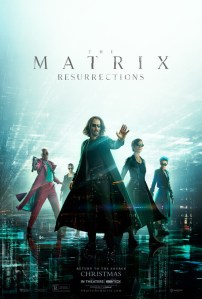 It is hard to overstate how influential The Matrix was upon its release in 1999. It rewrote the science fiction and action genres for Hollywood and introduced American audiences to many of the filmmaking techniques of Eastern cinema. It was exciting, philosophical, challenging, and made an instant brand out of the Wachowskis, the writing/directing siblings who had previously only directed one indie movie. The 2003 sequels were filmed back-to-back and released to great anticipatory fanfare and then, later, derision. The Matrix sequels, Reloaded and Revolutions, became a shorthand joke for bloated artistic miscalculation. They were talky, draggy, and just not what fans were hoping for jacking back into this strange world, and years later I think they’re worth a critical re-evaluation. Flash forward to 2021, and Lana Wachowski has resurrected The Matrix, and with the original actors for Neo and Trinity, both of whom died in Revolutions. Why go back? I think part of this was the declining career of the Wachowskis as directors. I personally loved 2012’s Cloud Atlas but it was an expensive and messy money-loser, the same as 2008’s Speed Racer and 2015’s Jupiter Ascending, a cosmically bad movie. So now it’s back to The Matrix with an older Neo, and older Trinity, and more of the same by design. The Matrix Resurrections just made me sad. It’s a movie that feels resentful for its own inception.
Thomas Anderson/Neo (Reeves) is living out his life as an award-winning game designer. His company and business partner, Smith (Jonathan Groff), are looking for their next big hit, and they’re looking backwards at Anderson’s biggest success… the “Matrix trilogy.” It was a virtual reality program that skewered the difference between reality and fiction. Mr. Anderson might have even based the role of Trinity on Tiffany (Carrie Anne-Moss), a woman he has grown infatuated with over time at a coffee shop. Except Mr. Anderson is having trouble determining what is real and what is only in his head. That’s because a new, younger Morpheus (Yahya Abdul-Mateen II) is telling him that he’s Neo, that he’s destined for greater things, and that he’s been kept in an unorthodox prison to keep him out of the action. Everyone seems interested in reactivating Neo, but for what purpose, and what has happened in the ensuing decades since the end of the war with the machines?
 Part of my struggle with Resurrections is that it too is struggling with its own existence, and not in a meta-textual sort of identity crisis, more like a reason to carry on 18 years later. Fair warning, this movie is far, far more meta than you are anticipating. The entire first hour of the movie features characters justifying rebooting “The Matrix,” the game. It’s a movie where characters glibly talk about parent companies going forward with the IP with or without the involvement of the original creators, so better to be the one trying to staunch the bleeding I suppose. A character literally says Warner Brothers wants a new Matrix and they will not stop until they get one. There are characters that sit around a table and try and break down what made the original Matrix (the game) so cutting-edge, and every person has a different brand slogan. “It was edgy.” “It blew your mind.” “It was a thinking man’s action story.” This prolonged section of Resurrections feels entirely like Wachowski speaking directly to her audience and saying, “Look, I had no reason to be back here. They forced my hand, and I want you to know that I’m not happy about it.” There are literal moments from the 1999 film that are presented as if the characters in the matrix are watching The Matrix to recreate scenes like avid cosplayers. There is one part where a character just starts screaming the word “reboot” with profane intention, promising to get their own spinoff as a threat. The entertainment industry satire about reboots and cash-grab sequels is funny but misplaced and coming from a perspective of defiance. If this was all the movie was then it would have been a fascinating example of an artist burning the bridge to their most successful franchise out of willful spite. However, if we had our own little focus group and asked what made the original Matrix so enjoyable, I doubt anyone would list, “entertainment industry satire and meta humor.”
The Matrix movies are well known for being a smarter, more ambitious viewing experience (“A thinking man’s action story”), blending philosophy and mysticism into anime-style action and kung-fu fights. There’s an intentional repetition here, built upon delivering something familiar and safe to audiences but with a “next gen” feel. We have a new Morpheus and a new Mr. Smith here, but did we require either? When they go through the motions of patterning themselves on characters of old, it feels strained, it feels gassed, and it’s another instance where Wachowski telegraphing to her audience, “Look, the studio demanded I bring back these characters, but I’ll be damned if I know what to do with them.” Morpheus has a little more story leverage as a catalyst for bringing Neo back to his path of enlightenment. Truth be told, I don’t really know half of what was happening in this movie, which lacked the elegant connectivity of the best action movies, linking cause and effect (the Merovingian would be proud of me) and pushing the movie forward to its inevitable conclusion. Even the prior movies felt more like the creators knew what was going on, even if the audience was lagging behind. With Resurrections, it feels like Wachowski and her screenwriters, novelist Dave Mitchell (Cloud Atlas) and Aleksandar Hermon (Sense 8 finale), have just given up trying to make sense of it all.
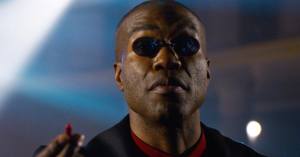 Another disappointment is the lack of any signature or memorable action sequences or, in the words of the Matrix round table, moments that “blew your mind.” The use of phones as transport in and out of the matrix has been replaced with mirror portals and doorways, which initially got my hopes up. There are such playful visual possibilities incorporating portals into action (see: Doctor Strange, even Matrix Reloaded), and I felt that Wachowski was up to the imaginative challenge. It too feels like another element that barely registers. The movie takes the anyone-can-become-an-Agent threat of the original trilogy and says, “What if instead of facing deadly Agents, it was just dumb zombies?” The new machines decide to rely upon a hive-mind system of grabbing whatever humans are in the vicinity and taking control of them into mindless foot soldiers. Let’s explore what a downgrade this is. The Agents were dangerous because they had powers that ordinary humans could not hope for, like the bullet dodging. In this movie, ordinary people are easily foiled and often a pathetic excuse for super-powered adversaries. The final act involves an escalation in numbers of the hive mind, but we’ve already been here with the multiple Agents Smiths of the sequels. There is one disturbing change-up where the machines realize how humans can just serve as canon fodder that is dark but a more effective attack. Even the requisite martial arts battles and gravity-defying wire work are humdrum this round.
If there is one thing that Resurrections does well it’s staking its identity out as a romance. Much of the second half prioritizes the relationship between Neo and Trinity, which was always taken for granted in the sequels. It was a romance of more utilitarian purpose, providing Neo with a love interest to motivate him to be saved in times of great peril. With Resurrections, the movie actually takes time to devote to Neo and Trinity as people with desires and what they would find appealing about the other. He’s not the savior of mankind, and she’s not his gateway to knowledge and empowerment. They’re portrayed as people, somewhat unhappy in their lives, and just hoping they might have another chance meeting at their shared coffee shop for one more electrifying conversation. The evolution of the movie places even more importance on this human connection, so I’m glad time has finally been given to exploring what it is that connects Trinity and Neo, especially if their love story is going to play as prominent a resolution to Resurrections. If you have never cared about Trinity and Neo as a couple, then you’ll likely be in for a disappointing second half.
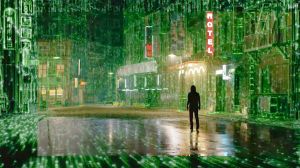 From a technical standpoint, Resurrections is still a feast for the senses. The photography is moody and atmospheric. The musical score is pumping. The special effects are state-of-the-art. There are a lot of talented people working on this sequel. So why then does the movie feel so perfunctory? In some regard each Matrix sequel has felt this way, adding extraneous pieces onto an already perfect standalone film. Having re-watched both Reloaded and Revolutions again, I can affirmatively declare Resurrections to be the weakest Matrix entry yet. We were all a bit too harsh on the prior two Matrix movies, which fall short of capturing the original’s magic alchemy but bring the goods when it comes to memorable set pieces, eye-popping visuals, and narrative zigs instead of zags (It was undercutting audience expectations before it was cool). They are still a bit too stuffy and talk in circles, but there are definite Major Ideas percolating underneath. In contrast, Resurrections feels more powered by resentment, by Wachowski coming back to this world against her better wishes and judgements. Maybe we should have left things alone.
Nate’s Grade: C
Share this:

Finch (2021)
 Delayed almost two years thanks to COVID and eventually sold to Apple, Finch is the story of Tom Hanks trying to survive the irradiated post-apocalypse with a dog and a robot. That’s the pitch and that’s actually about the extent of the movie. Tom Hanks plays a man dying from UV exposure and trying to create a provider for his beloved dog, who itself has a sad back-story. It’s a simple story but the movie succeeds on the detail of its world-building and the sincerity of Hanks and Caleb Landry Jones (Get Out) in a mo-cap performance as the nascent robotic helper who names himself “Jeff.” It’s a post-apocalyptic buddy film, a road trip movie, and a survival thriller against the new reality of supercharged weather elements and the threat other people can present. The set pieces are effectively developed and open up Finch as a character. Almost after every big moment we have a quiet one where Finch uncorks a monologue that explains more about his own tragic past, the tragic events that left much of Earth to be highly irradiated, or the relationship he had with his own absentee father. Hanks is nicely vulnerable and warmly paternal as a man teaching a robot how to be human in the pursuit of caring for others. This could have been a post-apocalyptic one-man show, a Cast Away meets I Am Legend, but Jones is an enjoyable foil as the clumsy robot who is trying to make his creator proud. The robot design is very minimal but Jones is able to find small ways to communicate the childlike emotions of the character. The movie doesn’t have any devastating moments of suspense, terror, or meaty character drama. It coasts on a pleasant and gentle spirit with a touch of melancholy but Finch mostly keeps things in a relatively heart-warming territory. Finch isn’t much more than its initial pitch, but I’m happy to spend two hours with Tom Hanks trying to teach a robot how to be nice and brave in order to save a dog (spoiler alert: the dog lives too).
Nate’s Grade: B
Share this:

A.I.: Artificial Intelligence (2001) [Review Re-View]
 Originally released June 29, 2001:
A.I. is the merger of two powerhouses of cinema – Stanley Kubrick and Steven Spielberg. The very mysterious film was given to Spielberg by Kubrick himself who thought ole’ Steven would be a better fit to direct it. The two did keep communication open for like a decade on their ideas for the project until Kubrick’s death in March of 1999. What follows is an imaginative futuristic fairy tale that almost grabs the brass ring but falls short due to an inferior ending. More on that later.
In the future technological advances allow for intelligent robotic creatures (called “mechas”) to be constructed and implemented in society. William Hurt has the vision to create a robot more real than any his company has ever embarked on before. He wants to make a robot that can know real love. Flash ahead several months to Henry and Monica Swinton (Sam Robards and Frances O’Conner) who are dealing with their own son in an indefinite coma. Henry is given the opportunity to try out a prototype from his company of a new mecha boy. His wife naturally believes that her son could not be replaced and her emotions smoothed over. Soon enough they both decide to give the boy a try and on delivery comes David (Haley Joel Osment) ready to begin new life in a family. David struggles to fit in with his human counterparts and even goes to lengths to belong like mimicking the motions of eating despite his lack of need to consume. Gradually David becomes a true part of the family and Monica has warmed up to him and ready to bestow real love onto their mecha son.
 It’s at this point when things are going well for David that the Swinton’s son Martin comes out of his coma and returns back to his parents. Sibling rivalry between the two develops for the attention and adoration of their parents. Through mounting unfortunate circumstances the Swintons believe that David is a threat and decide to take him away. The corporation that manufactured David had implicit instructions that the loving David if desired to be returned had to be destroyed. Monica takes too much pity on David that she ditches him in the woods and speeds off instead of allowing him to be destroyed.
David wanders around searching for the Blue Fairy he remembers from the child’s book Pinocchio read to him at the Swinton home. He is looking for this magical creature with the desire she will turn him into a real boy and his human mother will love him again. Along David’s path he buddies up with Gigolo Joe (Jude Law), a pleasure ‘bot that tells the ladies they’re never the same once he’s through. The two traverse such sights as a mecha-destroying circus called ‘Flesh Fairs’ complete with what must be the WWF fans of the future, as well as the bright lights of flashy sin cities and the submerged remains of a flooded New York. David’s journey is almost like Alice’s, minus of course the gigolo robot of pleasure.
There are many startling scenes of visual wonder in A.I. and some truly magical moments onscreen. Spielberg goes darker than he’s even been and the territory does him good. Osment is magnificent as the robotic boy yearning to become real, but Jude Law steals the show. His physical movement, gestures, and vocal mannerisms are highly entertaining to watch as he fully inhibits the body and programmed mind of Gigolo Joe. Every time Law is allowed to be onscreen the movie sparkles.
 It’s not too difficult to figure out which plot elements belong to Spielberg and which belong to Kubrick, since both are almost polar opposites when it comes to the feelings of their films. Spielberg is an idealistic imaginative child while Kubrick was a colder yet more methodical storyteller with his tales of woe and thought. The collaboration of two master artists of cinema is the biggest draw going here. A.I.‘s feel ends up being Spielberg interpreting Kubrick, since the late great Stanley was dead and gone before he could get his pet project for over a decade ready. The war of giants has more Spielberg but you can definitely tell the Kubrick elements running around, and they are a gift from beyond the grave.
I thought at one point with the first half of A.I. I was seeing possibly the best film of the year, and the second half didn’t have the pull of the first half but still moves along nicely and entertained. But then came the ending, which ruined everything. There is a moment in the film where it feels like the movie is set to end and it would’ve ended with an appropriate ending that could have produced lingering talk afterwards. I’m positive this is the ending Kubrick had in mind. But this perfect ending point is NOT the ending, no sir! Instead another twenty minutes follows that destroys the realm of belief for this film. The tacked on cloying happy ending feels so contrived and so inane. It doesn’t just stop but keeps going and only gets dumber and more preposterous form there. I won’t go to the liberty of spoiling the ending but I’ll give this warning to ensure better enjoyment of the film: when you think the movie has ended RUN OUT OF THE THEATER! Don’t look back or pay attention to what you hear. You’ll be glad you did later on when you discover what really happens.
The whole Blue Fairy search is far too whimsical for its own good. It could have just been given to the audience in a form of a symbolic idea instead of building the last half of the film for the search for this fictional creature’s whereabouts. The idea is being pounded into the heads of the audience by Spielberg with a damn sledge hammer. He just can’t leave well enough alone and lets it take off even more in those last atrocious twenty minutes.
A.I. is a generally involving film with some wonderfully fantastic sequences and some excellent performances. But sadly the ending really ruins the movie like none other I can remember recently. What could have been a stupendous film with Kubrick’s imprint all over turns out to be a good film with Spielberg’s hands all over the end.
Nate’s Grade: B
——————————————————
WRITER REFLECTIONS 20 YEARS LATER

There are two aspects that people remember vividly about A.I.: Artificial Intelligence and that’s the fascinating collaboration of two of the most influential filmmakers of all time and its much-debated and much-derided extended ending. Before we get into either, though, a fun fact about its very helpful title for Luddites. Originally the title was only going to be A.I. but the studio found that test audiences were confused by the two-word abbreviation and several clueless souls thought it was the number one and not the capital letter “I.” The studio didn’t want their high-concept meeting of cinematic masters to be confused with a popular steak sauce.
In the realm of cinematic titans, Steven Spielberg and Stanley Kubrick rise to the top for their artistic ambitions, innovations, versatility, and great influence on future generations, but you’d be hard-pressed to see a uniquely shared sensibility. Kubrick’s films are known for his detached, mercurial perspective, flawless technical execution, leisurely pacing, and a pessimistic or cynical view of humanity. Spielberg’s films are known for their blockbuster populism, grand imagination and whimsy, as well as the director’s softer, squishier, and more sentimental view of humanity. It almost feels like a mixture of oil and water with their contradictory sensibilities. And yet Kubrick and Spielberg developed A.I. for decades, starting in the late 1970s when Kubrick optioned the short story “Super-Toys Last All Summer Long” by Brian Aldiss. Kubrick felt that Spielberg was a better fit for director in the mid-1980s, but Spielberg kept trying to convince Kubrick to direct. Both took on other projects and kept kicking A.I. down the road, also because Kubrick was dissatisfied with the state of special effects to conceive his “lifelike” robot boy. Kubrick died in early 1999 and Spielberg elected to finally helm A.I. and finish their creative partnership. He went back to the original 90-page treatment Kubrick developed with sci-fi novelist Ian Watson and wrote the final screenplay, Spielberg’s first screenwriting credit since Close Encounters of the Third Kind (and his only one since 2001). I view the final movie as a labor of love as Spielberg’s ode to Kubrick and his parting gift to his fallen friend.
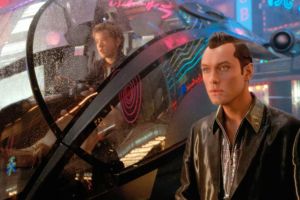 Watching A.I. again, it is a recognizable Kubrick movie but through the lens of Spielberg’s camera and budget. In some ways, it feels like Spielberg’s two-hour-plus homage to his departed mentor. The movie moves gradually and gracefully and, with a few delicate turns, could just as easily be viewed as a horror movie than anything overtly cloying or maudlin. The opening 45 minutes introduces a family whose child is comatose with some mystery illness and the likelihood he may never return to them. The husband (Sam Robards) is gifted with a shiny new robot boy, David (Haley Joel Osment), as a trial from his big tech boss (William Hurt) who wants to see if he can make a robot child who will love unconditionally. The early scenes with David integrating into the family play like a horror movie, with the intruder inside the family unit, and David’s offhand mimicry of trying to fit in can make you shudder. All it would take is an ominous score under the scenes and they play completely differently. One scene, which is played as an ice breaker, is when David, studying his parents at the dinner table, breaks out into loud cackling laughter. It triggers his parents to laugh alongside him, but it’s so weird and sudden and creepy. David’s non-blinking, ever-eager presence is off-putting and creepy and Monica (Frances O’Connor), the mother, is rightfully horrified and insulted by having a “replacement child.” However, her emotional neediness steadily whittles away her resistance and she elects to have David imprint. This is a no-turning-back serious decision, having David imprint eternal love and adoration onto her, and if she or her husband were to change their minds, David cannot be reprogrammed. He would need to be disassembled. With this family, David is more or less a house pet kept around for adoration and then discarded when he no longer serves the same comforting alternative. Once the couple’s biological child reawakens, it’s not long before jealousy and misunderstanding lead David to being ditched on the side of the road as an act of “mercy.”
From there, the movie becomes much more episodic with David and less interesting. The Gigolo Joe (Jude Law) addition furthers the story in a thematic sense and less so in plot. Gigolo Joe is a robotic lover on command, and framed for murder, and just as disposable and mistreated as David. From a plot standpoint, David’s odyssey is to seek out the Blue Fairy from Pinocchio, a book his mother read to him, and to wish to become a real boy and be finally accepted as his mother’s legitimate son. Thematically, David’s real odyssey is to understand that human beings are cruel masters. In short, people suck in this universe and they don’t get any better.
 People, or “orga” as they refer to organic life, are mean and indifferent to artificial life, viewing the realistic mechanical beings, or “mecha” as they are referred to, as little more than disposable toys. Despite its cheery happy ending (and I will definitely be getting to that), the movie is awash in Kubrick’s trademark pessimism. Early on, David is stabbed by another boy just to test his pain defense system. David is only spared destruction from the Flesh Fair, a traveling circus where ticket-buyers enjoy the spectacle of robot torture, because the blood-thirsty audience thinks he’s too uncomfortably realistic. I don’t know if they’re supposed to be confused whether he is actually a robot considering that the adult models look just as realistic. He’s not like a super advanced model, he’s just the first robot kid, but applying the same torture spectacle to a crying robot child is too much for the fairgoers. However, this emergent reprieve might be short-lived once these same people become morally inured to the presence of robot kids after they flood the consumer market. Once the “newness” wears off, he’ll be viewed just as cruelly as the other older models also pleading for their pitiful mecha lives.
The tragedy of David is that he can never truly be real but he’ll never realize it. His personal journey takes him all over the nation and into the depth of the rising oceans, and it’s all to fulfill a wish from a benevolent make-believe surrogate mother. His programming traps David into seeing the world as a child, so no matter how old his circuits might be, he’ll always maintain a childish view of the world and its inhabitants. He’ll never age physically but he’ll also never mature or grow emotionally. Because of those limitations, he’s stuck seeing his mother in a halo of goodness that the actual woman doesn’t deserve. Monica felt like she was being helpful by ditching David before returning him to his makers, but this boy is not equipped to survive in the adult world let alone the human world. He cannot understand people and relationships outside the limited confines of a child. So to David, he doesn’t see the cowardice and emotional withdrawal of his mother. She knew the consequences of imprinting but she wanted to feel the unconditional love of a child again and when that got too inconvenient she abandoned him. Their relationship is completely one-sided with David always giving and his mother only taking. David’s goal is to be accepted by a woman who will never accept him and care for him like her organic child. She will never view David as hers no matter how hard David loves her. He cannot recognize this toxic usury relationship because he’ll never have any conception of that. David is trying to be loved by people undeserving of his earnest efforts and unflinching affections.
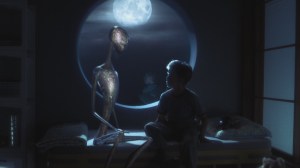
Do these look like robots to you?
Let’s finally tackle that controversial ending, shall we? The natural ending comes at about two hours in, with David in a submersible at the bottom of the ocean and pleading with a statue of the Blue Fairy in Coney Island to make him a real boy. He keeps whispering again and again to her, and the camera pulls out, his pleading getting fainter and fainter. The vessel is trapped under the water, so he’ll likely live out the rest of his battery life hopefully, and hopelessly, asking for his wish. It feels deeply Kubrickian and a fitting end for a tragic and unsparing movie about human cruelty and our lack of empathy. It’s also, in its own way, slightly optimistic. Because David is so fixated, he’ll spend the rest of his existence in anticipation of his dream possibly being granted with the next request. He has no real concept of time so hundreds of years can feel like seconds. Everything about this moment screams the natural ending, and then, oh and then, it keeps going, and the ensuring twenty additional minutes try and force a sentimental ending that does not work or fit with the two hours of movie prior. Two thousand years into the future, David is rescued by advanced robots (I thought they were aliens, and likely you will too) who finally grant his wish thanks to some convenient DNA of his two-thousand-year dead mother. These advanced robots can bring the dead back to life except they will only last one day, so David will have one last day to share with his mother before she passes back into the dark. However, David’s conception of his mother isn’t the actual woman, so his rose-colored glasses distortion means he gets a final goodbye from not just a clone but one attuned to his vision. It’s false, and the fact that the movie tries to convince you it’s a happy ending feels wrong. Also, the world of 4124 still has the World Trade Center because A.I. was released three months before the attacks on September 11th. It’s just another reminder of how wrong the epilogue feels.
This extended epilogue desperately tries to attach the treacly sentimentality that was absent from the rest of A.I., which is why many critics felt it was Spielberg asserting himself. Apparently, we were all wrong. According to an interview with Variety in 2002, the opening 45 minutes is taken word-for-word from Kubrick’s outline and the extended ending, including the misplaced happy every after, is also strictly from Kubrick’s original treatment. It was Kubrick who went all-in on the Pinocchio references and parallels. Even the walking teddy bear was his idea. Watson said, “Those scenes were exactly what I wrote for Stanley and exactly what he wanted, filmed faithfully by Spielberg.” The middle portion was Spielberg’s greatest writing contribution, otherwise known as the darkest moments in the movie like the Flesh Fair and robot hunts. The movie is much more sexual than I associate with Spielberg. There has been sex in Spielberg’s past films, but it’s usually played as frothy fun desire with cheeky womanizers (Catch Me If You Can) or as a transaction with unspoken demands (Schindler’s List, The Color Purple). Then again, when Spielberg really leaned into a sex scene, we got the awkward and thematically clunky “climax” of Munich. With A.I., the perverse nature of humanity is another layer that reflects how awful these people are to the wide array or robots being mistreated, abused, and assaulted on an hourly basis in perpetuity.
 Twenty years later, the movie still relatively holds up well and is good, not great. It’s more a fascinating collaboration between two cinematic giants, and the fun is recognizing the different elements and themes and attributing them (wrongly) to their respective creator. The special effects are still impressive and lifelike even by 2021 standards. Even though the movie is set in 2124, so over 100 years into the far-flung future, everyone still dresses and looks like they’re from the familiar twentieth century (maybe it’s retro fashion?). It’s a slightly distracting technical element for a movie otherwise supremely polished. There is a heavy emphasis on visual reflections and refractions of David in his family home, exploring the wavering identity and conceptions of this robo kid. Spielberg’s direction feels in keeping with Kubrick’s personal style and sensibility. A.I. is a labor of love for Spielberg to honor Kubrick, and he went another step further with the 2018 adaptation of Ready Player One where one of the missions was exploring a virtual reality recreation of the famous Overlook Hotel from The Shining. In my original 2001 review, I took the same level of umbrage with the miscalculated ending as I do in 2021. In the many years since its release, A.I. has been my go-to example of a movie that didn’t know where to properly end. As a result, it’s still a fascinating if frustrating experience on the verge of greatness.
Re-View Grade: B
Share this:

The Mitchells vs. The Machines (2021)

After watching it twice on Netflix, I have come to the conclusion that The Mitchells vs. The Machines is my favorite animated film since 2018’s Into the Spider-Verse. It’s so colorful, so exuberant, so clever, while still being heartfelt on its own terms and packing more jokes into a minute than any studio comedy in years. Everyone should check out 2021’s first cinematic treat.
The Mitchells are known as the weird family in their community. Rick (voiced by Danny McBride) is more about the outdoors and hands-on activities. His teenage daughter, Katie (Abbi Jacobson), is more about the digital sphere and creates her own sardonic, strange videos. She’s leaving for college and eager to fly the coop. Rick feels his last opportunity to bond with his daughter is leaving with her, so he forces the family into a cross-country road trip to drop Katie off at her school. Linda Mitchell (Maya Rudolph) is doing her best to be supportive of her husband and daughter while trying to bridge their divide. Youngest son Aaron just wants everyone to get along and talk about dinosaurs endlessly. The road trip gets even more precarious with a machine uprising and flying robots rounding up humans to eventually jettison them into space.

This is a gloriously entertaining movie that looks absolutely gorgeous. The animation is accentuated with similar styles from Into the Spider-Verse, so the filmmakers have implemented an overlay that adds a two-dimensional shaping and shading to the characters to provide more distinct definition. It’s a new design I heartily enjoyed in the Oscar-winning Spider-Verse and I hope more major animation projects employ it. It’s combining the fluidity and scale of 3D animation with the tactile and personal flavor of traditional animation. The movie also echoes its Gen Z-YouTube culture with cute hand drawn additions that will pop on the screen as accents or take over as quick freeze frames. I thought it was fun and a good indicator of Katie’s meta-drenched sense of humor and creative voice. This is also an explosively colorful movie with vibrant arrays popping off the screen. There were several visual sequences that took my breath away just at the arrangement of colors. The heavy use of neon pastels made me wonder if Nicolas Winding Refn (Neon Demon) was a visual consultant. There’s a stretch that highlights pinkish sunsets and the beautiful light blues of approaching dusk that I said this was the Nomadland of animated movies. Even when this movie has nothing happening, it’s a pleasure just to take it in and appreciate the artistry.
But oh my goodness there is so much happening with The Mitchells vs. The Machines. It’s a longer animated movie at 110 minutes but it’s also so fast-paced and antic, filled with ideas and jokes and moments it feels like it cannot wait to share. In some ways it feels like talking with a hyper-literate, boundlessly excited little kid, and I don’t mean that as a negative. I’m sure there will be more than a few viewers who will tire out early or find the pacing exhausting, but if you’re a fan of The Lego Movie and its hyperactive style of comedy, then you should be able to adapt here. The movie is densely packed with jokes, some that zip by in fractions of a millisecond to reward multiple viewings. I was laughing throughout and besides myself at several points, laughing hysterically from the slapstick to the offhand one-liners to the callbacks and silliness. There’s a little of everything here comedy-wise and it all works. It’s a buffet of laughs. One joke that is simply a tonally serious push-in on the question of mortality had me howling and it’s only a one-second gag. There’s a segment in a deserted shopping mall with the re-emergence of Furbys that is inspired lunacy (“Behold, the twilight of man!”). You have to be this good to be this smartly silly. This is the kind of comedy you can only do in the realm of animation, packing as much into the visual frame as possible and moving at the clip of the creative’s imagination. The side characters are the film’s secret weapons. The dumb dog made me laugh just about every time he was onscreen, and the fact that the movie legitimately finds a significant solution with this dog later is fantastic. The family also come across a pair of malfunctioning robots (voiced by Beck Bennett and Fred Armisen) and take them in as part of their unconventional family, and the robots are a terrific team for comedy bits, from their early entrance trying to ineptly persuade the family they are in fact humans (“Yum yum. Yum yum good.”) to their one-off remarks from a confused perspective had me laughing regularly.

The movie is more than just an assembly line of expertly calibrated gags, though again it must be said how flat-out hilarious this movie can be, like it’s disarming how instant the funny can break. The Mitchells vs. The Machines is also a well written movie from a character perspective and makes the audience genuinely care about this self-described clan of weirdos. My girlfriend looked at the running time for the movie and initially balked at how long it was, especially since we had seemingly come to a part that could serve as its Act Two break. “It better be worth that extra time,” she warned, and by the end even she agreed that it was time very well spent.
The heart of the movie is on the father-daughter relationship and while the other characters don’t get shut out, they become helpers to their various sides of this fractured relationship. The conflict is relatable, about the disconnection between two loved ones who just don’t feel like they have much in common any longer. For Rick, he doesn’t understand technology, the thing that Katie thrives in, and he’s struggling to adjust to her growing older. Those familiar daddy-daughter points of bonding don’t have the same appeal to her as a young woman increasingly embarrassed by her Luddite father. There’s a sincere warmth between the two, it’s just they don’t know how to express it fully to the other person and be seen as how they would like to be seen. It’s a generation gap, yes (Rick’s fear of technology will ring true to those with Boomer parents), but it’s also just two people who cannot use the same old tools to get the same results. The screenplay serves up both sides so that we see where each is coming from, understand their frustrations and overreaches, and pull for their reconciliation and growth. The themes are kept simple but expertly developed and with wonderful payoffs not just for Rick and Katie but for everyone. Each member of the Mitchell family unit has a character arc with a payoff, and each is utilized in a meaningful way with our outlandishly joyous climax, and that includes the dog and robots! Even the villain’s perspective is a parallel to our central family conflict, and that is just good writing. The story is deceptively clever and there’s more going on under the surface.
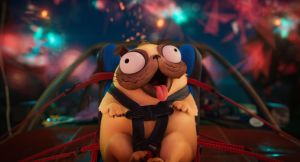
Besides the visuals, the comedy gold, and the heartwarming family relationships, there’s amazingly even more reasons to enjoy The Mitchells vs. The Machines. The voice acting is great, with McBride (This is the End) being a surprise standout as a loving middle-aged father. Also, of note, is that 2/3 of the principal cast of Netflix’s Disenchanted series are found in this movie (where for art thou, Nat Faxon?). The thrumming musical score by Mark Mothersbaugh is a synth-heavy blast that made me recall the scores for Blade Runner 2047 and his own Thor: Ragnarok score. The movie even features inclusivity in a casual manner; the son’s autism and the daughter being LGBTQ are treated with “yeah, sure” acceptance. At no point is either called out or featured in a moment to highlight this but neither are they dismissed as unimportant. Stick around because there are extra levels to the end credits, and I was happy for each because I didn’t want this wonderful time to end, so I kept hoping for more resolution to play out.
The movie was originally meant to be released a year and a half ago but COVID pulled its release date, and eventually Sony sold their project to Netflix for a cool $100 million. It’s hard for me to put an exact price on a work of art (what is this, an NFT? Seriously, someone explain these things to me) but I’m happy Netflix saved this movie and gave it a home. At this point, I’m willing to give producers Phil Lord and Christopher Miller the utmost benefit of the doubt when it comes to anything animated. After Cloudy with a Chance of Meatballs, The Lego Movie, Spider-Verse, and now this, they haven’t let me down yet. The Mitchells vs. The Machines is an eye-popping action movie and a superb comedy that the whole family can enjoy.
Nate’s Grade: A


 nathanzoebl
You must be logged in to post a comment.