Blog Archives
Wrath of the Titans (2012)
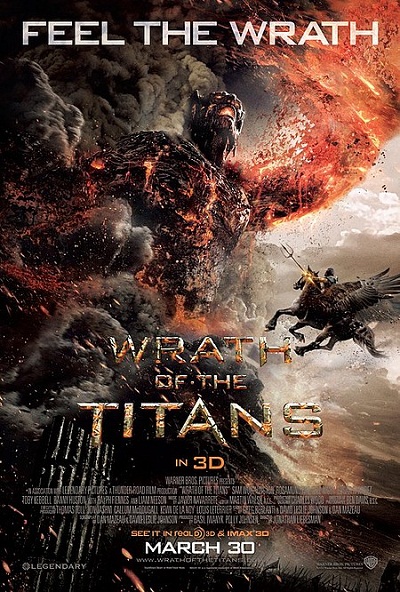 The 2010 Clash of the Titans made some sizable sums of money but it really became famous for one reason – the beginning of the 3D fleecing and the public’s souring on what was supposed to “save the movie going experience.” Clash was converted to 3D in post-production, and its lack of foresight and rushed conversion showed. After the high of Avatar, it only took approximately three months for the public to feel ripped off by 3D. Certain Hollywood bigwigs are concerned that bad 3D conversions will kill the golden goose, and it is having an effect. The percentage of movie audiences seeing big releases in 3D has slipped steadily from 2010. Whether it is the added cost or the underwhelming conversion, movie audiences are warier of the third dimension. And it was Clash of the Titans that destroyed a nation’s innocence. Two years later, the sequel is out and, surprise surprise, you also have the ability to see it in 3D. Either way, this movie will cause you a headache.
In the wake of Perseus successful slaying of the Kraken, he is now a widower with a young son, living their lives quietly, trying to avoid the daring heroics of his earlier life. Fat chance, kid. The gods are at war, particularly Hades (Ralph Fiennes) and Aries (Edgar Ramierez) versus Olympian head honcho Zeus (Liam Neeson), Perseus’ absentee father. The titan Kronos will be unleashed from his prison, Tartarus, and this powerful behemoth will lay waste to the armies of mankind. The gods have grown weak due to mankind’s dwindling faith, and as such they cannot conquer Kronos without the help of man. It’s up to Persues, Queen Andromeda (Rosamund Pike), and Poseidon’s demigod son a (Toby Kebbell) to track down the right magic artifacts to take down Kronos.
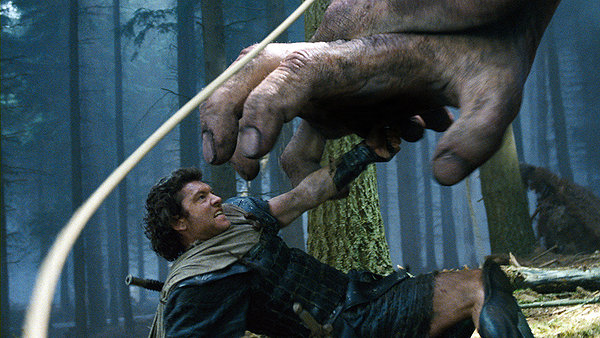 Once again we have a threadbare story that involves running from one location to another to find a clue that leads to the next location; the plot is just a series of magic-item gathering missions, much like a video game. Greek mythology made regular use of magic weapons to slay great monsters, but the myths at least gave their audience heroes worth fighting for. Worthington’s scowling rendition of Perseus is a bore, and giving him a son doesn’t help much. Just because the guy keeps insisting he has someone to protect doesn’t fill his void of characterization. He’s so free of charisma, so gruff and without any defining personality, that you wish he could find some magic shortcut to find his dumb magic items faster. The whole setup with our villain is also vague, beyond the very specialty of the god in question. And then there’s the whole concept of the gods dying, which was also featured in last fall’s glorious-to-look-at-but-empty-on-the-inside Immortals, another cinematic tussle with the titans. What’s the point of being a god anymore if the defining quality, immortality, can be ripped away? I suppose the screenwriters wanted to raise the stakes when Zeus and other gods enter the fray, dangling the threat that they too could perish. “We may not have weapons, but we’ll fight how long we can,” Zeus declares with modesty, and then he proceeds to zap enemies with lightning bolts. I don’t think a club is going to outrank a giant projectile of electricity. Realistically, I think the whole death-of-the-gods angle, which cold have brought some real somber and existential weight to the film, was just a setup to allow the producers to recast future sequels with less costly actors (goodbye, Neeson and Fiennes; they’ll be no more Kraken-releasing for either of you).
Director Jonathan Liebesman (Battle: Los Angeles) isn’t going to wow anybody with his addition to cinema, but he can put together a serviceable sequence of action. My favorite sequence in the entire film is when Perseus and crew enter the underground maze of Tartarus. The stone walls are constantly shifting around and the characters are zooming all around the room. It reminded me of the moving staircases in the Harry Potter world or think of it as the real prequel to Cube. And yet, even this nice sequence is limited because Liebesman and the screenwriters don’t take full advantage of their situation. We have a constantly shifting three-dimensional maze, and nobody gets lost at all? And the heroes, after discarding the map, easily find their way to the other side? What kind of design flaw is that? Liebesman prefers a lot of handheld camerawork and low angles, which can be jarring at times. Worse, the action favors a visceral chaos rather than steady development. There are plenty of people dying, columns exploding, fireballs tossing, but little of it adds up to much. It’s all disparate shots, like every character is in a separate movie. Such a shame because the special effects are rather good. If you’re going to spend this kind of money on a Greek mythology spectacle, at least make us care beyond a “fire pretty” level of tepid enjoyment.
The movie is in some breech of false advertisement since the title clearly states a plurality of titans, but by my modest account we only really have one titan to deal with, the giant lava beast Kronos (do the smaller creatures and Cyclops count as titans? I doubt this). Now we all love how fire looks, though some love it a bit too much. And lava itself has long been a childhood adversary. Who amongst us has never pretended the floor was once lava and but a handful of couch cushions were the only stepping-stones to safety? It’s hard to get an exact feel for how massive Kronos is considering he emerges from a mountaintop and seems to extend even higher into the sky. It’s intended to be a threatening and horrifying sight, but I kept thinking of a Marine ad from the 1990s where prospective recruits displayed their mettle by combating giant lava creatures (“Marines: Keeping the U.S. safe from lava men since 1916”). Instead of being awed by Kronos, I started picking apart the logistics of being a lava man. I suppose when you’re a god, or a titan for that matter, you don’t have to really eat or drink or do the things we mortals must for sustenance. But how does a lava creature work when part of his fiery M.O. is how drippy and malleable he can become? Perseus flies into the mouth of the lava beast but why does a beast, which needs no food or drinks, even needs a mouth? It’s not like this guy is speaking beyond a ground-shaking mumble. The entire face is almost superfluous. It’s not like a lava creature has eyes or a working circulatory system. Now I could apply these same annoying ticky-tack questions to any monster or mythological creature. The reason I did this is because the monster of monsters is no more intimidating, or satisfying, as the array of giant monsters that Godzilla would fight (or for you youngins – the Power Rangers). When your ultimate bad guy, and lone titan, can just as easily be blown up in the same manner as the Death Star, then we have a problem.
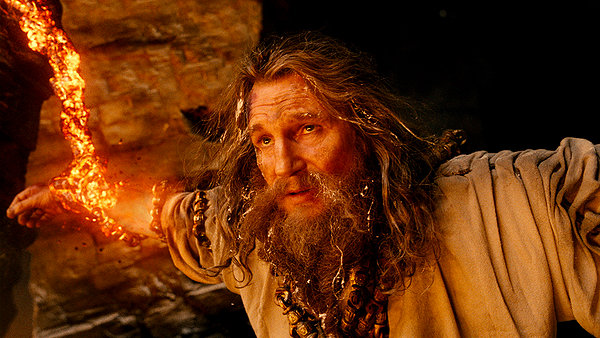 There’s a certain level of entertainment watching dignified actors in something so inherently campy. Neeson (The Grey) and Fiennes (Harry Potter and the Deathly Hallows: Part Two) are a long way from their Shindler’s List collaboration. The two men lend a level of gravitas to a movie that is leagues below their talents. Perseus proves to be such a dull demigod, that I wish the entire movie had followed the warring gods instead. That approach would have been much more interesting considering that they must confront mortality. Worthington (Avatar) still has a notable screen presence in the realm of action cinema, but his constant scowling is just getting tiresome. Hollywood, give this man something to do other than scowl and he may surprise you, like in The Debt. Pike (Doom) is unconvincing as a warrior princess, and her forced romance with Persues could not be more contrived (did somebody say, rebound?). The best actor in the movie is Bill Nighy (Underworld) who shows up as a daffy version of Hephaestus, the god of metallurgy and blacksmiths. Nighy understands how completely cheesy the whole getup really is and delivers a performance on the comic wavelength that the entire movie should have held.
While not nearly as humorless and joyless as the 2010 edition, Wrath is still a fairly block-headed romp through the noisiest parts of Greek mythology. After two movies with “titans” in the title, it’s somewhat remarkable that we only witness one single titan in the entire combined 245 minutes. It’s all CGI sound and fury with little cohesion to make anything feel important, despite huge mythological creatures demolishing cities. From an action standpoint, Wrath packs enough serviceable, escapist sights for the eyes to please diehards of Greek mythology and genre fans with low expectations. I wish there was a more compelling reason to run through all this stuff than big monsters needing to be killed; this hero’s quest needs more motivation or at least a grander sense of awe. The demise of the gods due to mankind’s mounting religious doubt seems like a juicy subject that could have opened these characters up. But then the theological discussions would get in the way of people hitting made-up CGI monsters. If you like your cheese feta, then Wrath of the Titans will provide enough wrath for your bucks, though found lacking in titans.
Nate’s Grade: C
Share this:

Coriolanus (2011)
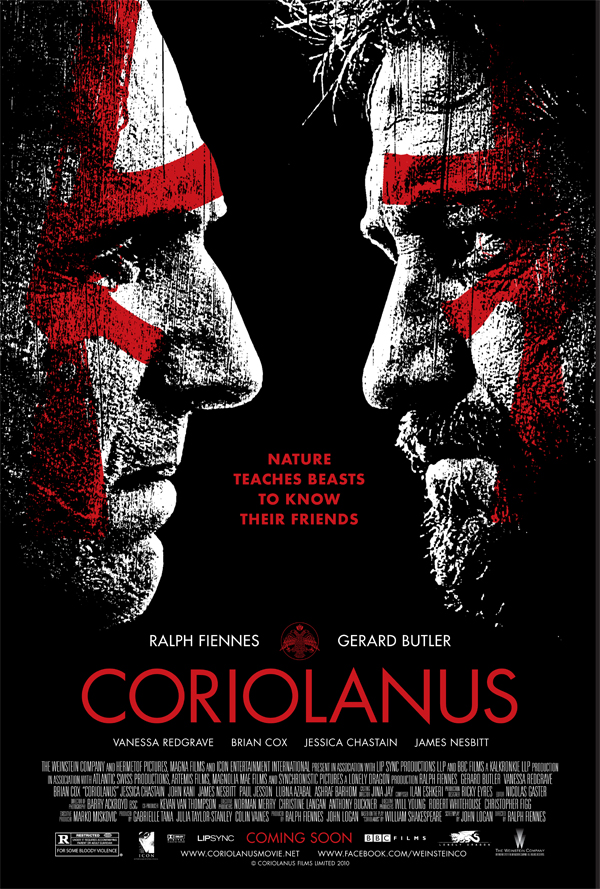 William Shakespeare’s little-known play has a surprising amount of cultural relevance: attacks on the border, suspension of civil liberties, political scheming, populist uprisings and riots, and a military elite arguing against the principles of appealing to the uneducated, mob-ruled masses. Plus Ralph Fiennes, taking on the hat of director for the first time, sets the play in modern-day. It seems like a struggle between Scotland and England, judging from the two mortal enemies, Coriolanus (Fiennes) and Tulius Aufidus (Gerard Butler). So it’s the Scotland/England struggle, termed ancient Rome, but set in what looks like the war-ravaged Balkans. Hey, at least Fiennes gets to have a nose in this film. The Shakespearean verbiage is certainly beautiful to hear, especially coming from the mouths of excellent thespians, notably Fiennes, Brian Cox, and Vanessa Redgrave. The actors achieve that synergetic level of excellence where it feels like they were always meant for the parts. Butler acquits himself well though his character sort of disappears unless needed by the plot. The elements that work best reside in Coriolanus’ refusal to play the game of political optics, neither serving a crowd of ignorant peasants he feels should remain out of the political process or the wily, double-crossing, self-serving politicians inflaming populist unrest. The movie sets itself up for some serious wrath to befall Rome, and besides the Greeks (and Koreans), nobody does revenge like this guy Shakespeare. We’re chomping at the bit for a cataclysm of death, but then the plot just sort of skips to a hasty conclusion, ditching the wrath. It makes you realize that, except for the intriguing title character, this isn’t one of the bard’s better plays. The characters are hard to empathize with, their conflicts too repetitive without deeper insight, and an ending that would be best described as a bit of a rush job. Still, even Shakespeare’s lesser work towers above most writers’ best material. Fiennes does a fine job as director, choosing lots of disorienting close-ups to communicate the rage of his character. Coriolanus is an interesting stab at something more, it’s just that sometimes it swings and misses.
Nate’s Grade: B
Share this:

Harry Potter and the Deathly Hallows: Part Two (2011)
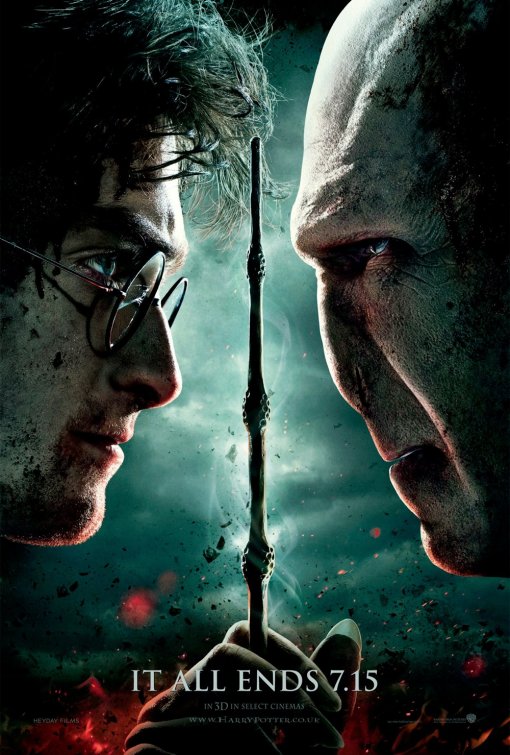 While not the best film in a series spanning ten years, part two of the final chapter of Harry Potter is a solid, satisfying close that’s fittingly grandiose but also sneakily emotional at points. The plot finally gets simplified once all those silly magic items are found, and what we have is a war at the Hogwarts School of Magic between good vs. evil. The action sequences are the best in the film’s series and some very dark events take place, including the deaths of many characters, some children, though too many critical deaths occur off camera. Harry (Daniel Radcliffe) faces off against Voldermort (Ralph Fiennes) for the fate of the world, and after the protracted, wearisome setup of Part One, it’s a relief to say that the final film moves like it’s on fire. There’s very little downtime and a great pull of urgency to the flick. So what if Ron (Rupert Grint) and Hermoine (Emma Watson), Harry’s best pals since the start, are completely forgotten and useless in the movie’s final hour. The focus is all on Harry and his messianic sacrifices. Alan Rickman shines again, showing a depth of emotions not available to Snape until the character’s final revelations. In fact, there needed to be more Rickman, but I can lay this same charge with every film. I wish the resolution, spanning forward 19 years, would have slowed down a bit and accept the paternal/maternal changing-of-the-guard as the emotional payoff billions of people have been waiting for. Harry Potter and the Deathly Hallows: Part Two is a thrilling, gratifying capper to a series that, while to me was never as magical as the Potter die-hards have claimed, was, over eight movies and almost 20 hours, an enchanting franchise that stayed consistent in quality and entertainment. Here’s to you, Potter. Now maybe I can finally stop hearing people badgering me about how the books were better.
Nate’s Grade: B+
Share this:

Harry Potter and the Deathly Hallows Part 1 (2010)
 When author J. K. Rowling dropped off her last 700-page tome in the Harry Potter series, the world went into a state of mourning, right after ravishing every page of The Deathly Hallows. There would be no more literary adventures. You can expect that same sense of longing for the studio suits over at Warner Brothers considering the Harry Potter franchise has grossed over five billion worldwide. The bounty was about to be over, especially with one last book to adapt into an eventual overly long movie. Then the suits came across a genius strategy: split the last book into two separate movies. Filmed simultaneously over a year, Harry Potter and the Deathly Hallows will be released in two parts eight months apart. I understand that it’s hard to say goodbye to the boy wizard that charmed millions, and tow movies almost guarantee that nothing will be left out in the adaptation process. It also ensures that Warner Brothers will have two movies that make giant piles of money instead of one. Deathly Hallows: Part One plays its part setting up the finale, but judging from what we’re given, this series conclusion could have effortlessly been condensed to one overly long film instead of two.
Picking up shortly after the events of Half-Blood Prince, Harry (Daniel Radcliffe) and his best pals, Ron (Rupert Grint) and Hermione (Emma Watson), are on the run. Lord Voldermort (Ralph Fiennes) is determined to be the one to slay the boy wizard. Voldermort and his influence have taken over many facets of the magic world’s infrastructure, and they are all after Harry. Harry learned that his snake-faced nemesis has broken his soul into pieces and hidden them inside magical items known as horcruxes. Unless these horucruxes are destroyed, Voldermort will never be able to truly die. Harry and company has to hunt down those accursed horcruxes while being hounded by evil forces determined to kill them all.
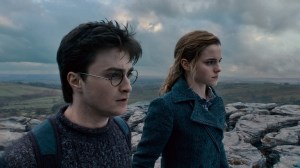 For a solid hour I felt like I was watching the second best Harry Potter film; Alfonso Cuaran’s Prisoner of Azkaban still stands as the artistic highpoint. Watching the characters on the run and constantly in peril spurs your protective feelings. We’ve seen them grow up, vanquish evil and hormones, and now they seem to be in serious danger and you feel real tension. I stopped to realize how much I actually cared for these characters and how concerned I was. There is a somber sense of finality, and I enjoyed characters and events colliding back together for one big finish. It truly feels like everything is coming to a titanic close, and the film manages to be the most emotionally satisfying of the series. That’s likely because it’s building off six films of character growth and goodwill. But it’s also due to the fact that Deathly Hallows spends the most time examining the characters of Harry, Ron, and Hermione. The series has followed a very lockstep plot formula and now it’s been stripped away. The kids are removed from the school setting so we get to spend plenty of time alone with the trio. In fact, it’s a bit too much time. We spend an interminable amount of time with these kids lost in the woods, waiting for something important to happen. While we wait we have the trio address fears, anxieties, and emotional hang-ups, which turns Part One into the most insular, reflective movie in the entire series. While this makes the movie rich with feeling before we come to the finish line, it also makes the film somewhat boring because these kids aren’t that deep.
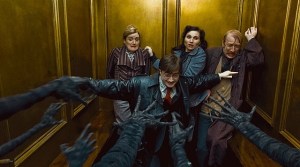
Luckily, Deathly Hallows Part One presents some of the more exciting action sequences and tense mood yet for a franchise mostly built upon investigation and Hardy Boys stuff (with extra magic!). The Harry Potter world has always been more interesting to me the darker it got, and now the series has now firmly converted to the dark side (as far as PG-13 fantasies go). The opening shows each of the three kids being left alone, including Hermione protecting her Muggle parents by wiping away their memory of their daughter. Tough stuff. Then we transition to a floating Hogwarts teacher held prisoner by Voldermort and his legion of Death Eater followers. She’s struck dead and we see a tear roll down her bloodied face right before Voldy’s pet snake eats her. Parents be warned, this is no longer kid’s stuff. Death comes to several supporting characters and there’s plenty of spooky stuff that adds up to a gloomy atmosphere. The infiltration of the Ministry of Magic is a thrilling sequence. Harry and pals disguise themselves as Ministry workers to locate a horcrux from Dolores Umbridge (I cheered at the sight of Imelda Staunton back in pink). The scene is tense and lays out the stakes and important characters to fear. It also produces some potent drama as Ron is disguised as a Ministry member whose innocent wife is being interrogated. The moment culminates in a genuinely exciting chase sequence that got me excited for what was ahead. What I failed to realize is that there was not much more ahead.
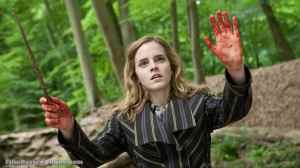
 With all that extra attention spent on character, I can also say that Part One has some definite issues with its stagnating narrative. Having never read the books (get over it, Potter nation), I go in blind every time short for the mega-spoilers that I can’t help but learn thanks to all the Potter readers inhabiting my circle of friends and family. I can tell you if something doesn’t make sense because I don’t have the background knowledge of the books to fill me in. There was plenty in Deathly Hallows that made little sense. The adaptation introduces the titular deathly hallows, which ends up being another three super special magic items. There’s a nicely Gothic animated sequence to try and explain the three hallowed items, but it all adds up to a fairy tale that makes little traction. The narrative has already shaped up into a portentous scavenger hunt. Harry and friends are after the remaining horcruxes containing the soul of Mr. Snarly Face. The entire 145 minutes of Part One is spent destroying a single horcrux, leaving 3 or 4 remaining. Now they add three more magic items to find and it all compounds my feelings of fatigue. Did I mention they also have to find a magic sword? How many magical items are these kids going to be responsible to find and how many am I expected to care about?
I left the theater with many questions about what the hell the deathly hallows were, why they mattered, and all sorts of other storylines too. I could not follow all the new characters they threw so late into the game, especially some old wand maker and his connection to wand thievery. And when the hell did everyone gain the ability to teleport at will? Why don’t they teleport all the time then, especially out of danger or when they’re chased through the woods? My friend (an avid Potter reader) had to deal with a litany of stupid questions, likely treating me as a parent would a child asking about where the sun goes when it becomes night.
Also, the film is intended to be a prelude for an epic finale but it mishandles its own sense of climax at several turns. I’ll refrain from heavy spoilers, but one of the most interesting characters, played by an actor I adore, is killed off screen. Off freaking screen! Some other character comes back and says, “Oh yeah, he’s gone,” and then everyone looks glum and goes about their business. It happened so matter-of-factly and anticlimactically that I never made the connection. So later in the film when it’s confirmed that this character is in fact dead, I felt pretty thick. The last chapter of Harry Potter is destined to be a combined 5 hours, and you’re telling me they couldn’t fit in a fight scene that lets this character go out with style? I suppose somebody thought it was more dramatic to just mention a character death offhand. Following this logic, I can’t wait for the grandiose finale where Harry Potter just walks back into a room and says, “Oh, by the way, I just killed Voldermort. So who wants to get a bite to eat?” The emotional climax of the film involves the death of a supporting character I have yet to see onscreen for 8 years. How am I supposed to feel for a character that hasn’t been seen for so long? The ending is sad, sure, but it would have been more effective if: a) I knew what significance the character had in the narrative, and b) it didn’t look like Harry was clutching a rubber doll to his chest. We spend too much time with new characters that end up having minor worth or come across as one-offs. The movie would have benefited from some of the deathly exposition that clogged the first two film’s storylines. As the movie comes to a close it should be clearing things up instead of polluting the narrative with more names and faces.
 Director David Yates has been captain of the Potter helm since 2007’s Order of the Phoenix, and he seems to have found a unifying visual balance for the series. The film’s tone has gotten heavier and having a singular director take the series to an end looks to be a godsend. Despite a lengthy slog in the middle, Yates keeps the pacing fairly tight and tense. The visuals and special effects are just as luminous as ever. The true treat for me is watching all these splendid British actors assembled: Alan Rickman, Ralph Fiennes, Imelda Staunton, Helena Bonham Carter, Timothy Spall, Jason Isaacs on Team Evil, and Brendan Gleeson, David Thewlis, Rhys Ifans, Julie Waters, Robbie Coltrane, Michael Gambon on Team Good. Then there are new additions like glass-jawed David O’Hara (Wanted) and the great Peter Mullan (Young Adam) making strong yet short appearances. I don’t really care why all these talented thespians are together but I’ll enjoy them all the same.
Harry Potter and the Deathly Hallows: Part One is the beginning of the end, literally a prelude for the finale coming to theaters in summer 2011. The film manages to be exciting and dramatic and equally boring and confusing, especially for someone who has willfully refused to read the books. Spending more time with the teen actors has its pluses and minuses, chief minus being that while they wait for stuff to happen so do we. The manufactured end point for the movie feels far from satisfying, but the film manages to effectively whet the appetite for the follow-up. As the Harry Potter series comes to a close it’s hard not to get nostalgic and apologetic, but I resist this urge. Looking back, many of the Potter films have been fine pieces of entertainment but also too long, misshapen, and too slavish to making a book on tape. Part One of Deathly Hallows still falls victim to some of these faults, but the accumulated goodwill of the series and actors makes a 145-minute prologue easily bearable.
Nate’s Grade: B
Share this:

Clash of the Titans (2010)
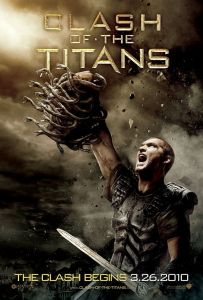 Rather unremarkable and rather dingy, a big-budget remake of Clash of the Titans removes all the fun from the campy 1981 original. Stop-motion is replaced with the sheen of super CGI, but the whole souped-up production feels hollow and overly serious for a movie involving fantastical creatures and Liam Neeson as Zeus. The original film was by no means a classic but it had an enjoyable retro spirit thanks to effects by Ray Harryhausen. The gods are trivialized and hardly in the movie, which is a shame. Danny Huston, as Poseidon, gets one single line in the film. Worse, Perseus (Sam Worthington) is given the motivation of revenge, instead of love, seeking to stand up to the gods who have left man to stew in despair. He blames the treacherous Hades (Ralph Fiennes) for the death of his father. And so the epic adventure is for vengeance, which gives everything a somewhat nasty pall. Who wants to watch a story about Greek mythology where the main character wants to rid the world of the gods? Why would Zeus go along with this? For a fairly straight forward plot, the movie frantically rushes from scene to scene. The action sequences are a particular letdown for director Louis Leterrier (Transporter). The CGI effects, mostly efficient, are like quick blurs and whooshes. You can?t tell what’s happening or you just don’t care. The movie has no character development and I’m not even certain I liked Perseus. Worthington?s scowling and howling is starting to get old after three high-profile action roles in an 18-month window. Would you believe that there isn’t even a titan to be clashed?
Nate’s Grade: C
Share this:

Harry Potter and the Half-Blood Prince (2009)
 Not every film franchise gets to a sixth installment, although Police Academy and Friday the Thirteenth managed to. After over twelve hours of storytelling, is it even possible for non-fans to enter the Harry Potter world (only an idiot would begin a film series at number six)? I am a willful Muggle to this universe. I am content to wait for the movies, and it drives the readers nuts. “The books are so much better,” they all say. Then they tell me what was left out of the movies, and honestly it’s usually a good thing. Harry Potter and the Half-Blood Prince echoes the increasing darkness of the later books by author J.K. Rowling, but now I can finally walk out of a Potter film and know, without a shadow of a doubt, that the book must have been superior. Half-Blood Prince is a film adaptation that spends too much time in all the wrong places.
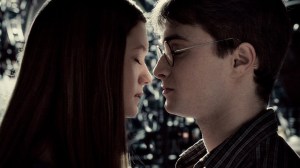
Lord Voldermort (Ralph Fiennes, seen only for literally a split-second) is back with a vengeance, and his followers, Death Eaters, are branching out and attacking the Muggle world as well. Headmaster Dumbledore (Michael Gambon) has asked Harry (Daniel Radcliffe) for help in recruiting a former Hogwarts professor. Horace Slughorn (Jim Boradbent) used to be an esteemed potions professor, and one of his bright students was none other than a young Voldermort (Hero Fiennes-Tiffin, Fienne’s real-life nephew). Dumbledore and Harry explore liquid memories that belong to the Dark Lord in hopes of learning how to defeat him. In the meantime, the kids are under attack not by Voldermort but by hormones. Harry’s friend, Ron (Rupert Grint) and Hermione (Emma Watson), are secretly in love but neither has the heart to say something. Ron uses his star Quidditch status to “snog” with the eager Lavender Brown (Jessie Cave), who’s infatuated with Ron. This infuriates Hermione and she seeks comfort in a studly student herself. Harry is starting to feel his heart go pitter-patter for Ron’s sister, Ginny (Bonnie Wright), which requires Harry to be very delicate in negotiating the “Can I snog your little sister?” portion of male friendship. Oh yeah, and apparently Harry is also using a potions textbook that used to belong to some whiz kid known as the Half-Blood Prince.
 The further I get away from Half-Blood Prince the more certain I am that it is the least involving film of the series. The plot is somewhat nebulous and unclear, and so much of the story is dominated by boring teenage romance. I understand that Hogwarts is swimming in hormones, but these kids spend the whole time making shifty doe-eyes at each other than doing anything substantial. That makes for a boring romance, and when the movie is dominated by this stuff for two hours it doesn’t make the movie too engaging. I understand that the Ron/Hermione courtship has been setup for some time, but it takes forever to move even incrementally closer to that coupledom. The Harry/Ginny material is lacking at best. She’s such an empty presence and they do so little with her character that I have no idea what would warrant Harry’s affections. There is no spark, no heat, no sexual tension, and no interest. I was actually relieved when Half-Blood Prince drops practically every storyline with twenty minutes left. Seriously, these plotlines aren’t resolved or capped or even addressed, they just don’t exist once Harry learns the word “horacrux.” And let’s talk about that subject just for a moment. Dumbledore lures Professor Slughorn back to Hogwarts so Harry can learn Voldermort’s secret of eternal life, a secret that Dumbledore already knows because he’s been taking leaves to locate and destroy Voldy’s horacruxes. I felt detached and disenchanted throughout Half-Blood Prince.
There are other plot holes and irregularities, and I wonder if writer Steve Kloves (who took the fifth movie off) is merely serving up 153 minutes of plodding prologue for the big finish. The drama is becoming more static and the supporting characters of previous installments reappear and do little but stand with hands in their pockets; they have nothing to do. The flashbacks to Voldermort as a child reveal relatively nothing new; only indicating her was a creepy kid. The two action sequences squeezed in are not from the book, meaning Kloves was trying to add some excitement to what is a rather sleepwalking storyline. The action sequences mean little; the opening attack on London’s Millennium bridge offers some nice sights but little consequence, and the destruction of the Weasely house comes across like Kloves was grasping for greater conflict. Too much of his film is the young love foibles with the occasional sideways glance at Draco (Tom Felton) brooding in the shadows. The ending, with its notable death, still strikes an emotional cord but it also comes across as rushed and without depth and resolve.
 What is the significance of the Half-Blood Prince in this adaptation? The mysterious figure was good in potions class and his old textbook helps Harry in class. That is it! The late reveal of the identity of the Half-Blood Prince is so incidental and off-the-cuff, that the actor practically has to say, “Hey, remember that whole Prince thing like an hour ago? That’s me. Yep. So see ya.” It’s such an indifferent plotline handled with such indifference. I had to ask my Potter-versed wife why Rowling would even bother naming the book after such a minor, irrelevant plot footnote. Kloves’ adaptation feels lost and mostly like filler.
So why does a slower, less coherent, less interesting Harry Potter rank better than the first two films? Because director David Yates takes an artistic step forward and this addition has style to spare. Returning to the Potter director’s chair, Yates has a stronger feel for the world and creates striking film compositions with the added help of noir cinematography by Bruno Delbonnel (Amelie, Across the Universe) and the foreboding production design by Stuart Craig. The sets have a grand Gothic appeal and help compensate in tone for what is lacking in the screenplay. The opening bridge attack allows for soaring flights through London and then into the magic world, and it’s a great opening visual rush. The memory flashbacks have splendid visual artistry to them as we watch inky brush strokes coalesce into solidified images. It’s a fantastic special effect and it is welcomed every time. This isn’t one of the more special effects heavy installments but the effects are as good as ever especially when seen through Delbonnel’s lens.
It’s interesting to have watched the three main actors grow up in their roles, which also gives them the ability to revert to autopilot when the movie lags. In the Half-Blood Prince, the trio burrows back into previous acting episodes. Radcliffe gets talked to a lot so much of his acting in this jaunt seems to involve intense bouts of nodding. He does have one sequence of exaggerated comedy when he swallows a luck potion, and the actor feels delightfully unrestrained. Grint gets the most screen time he’s had in ages and continues to dial up the daffy humor. As I stated with my review of Order of the Phoenix, I think Watson began as the best actor of the trio and is now on a fast-paced downward slide. Her character gets to experience jealousy and heartache, and Watson shows some ability to convey mixed emotion. The most interesting actor of all the kids is Felton, who I found to be surprisingly empathetic. He’s tortured over his fate, a mission given to him by the Dark Lord. He’s torn apart by moral indecision and a sense of duty. That’s way more interesting than watching Ron and Hermione try to make each other jealous. Why didn’t Kloves devote more time to the anguish of Draco? That’s where the drama is. There just isn’t much room for character growth and acting in the rest of Half-Blood Prince. The best acting award goes to Broadbent (Moulin Rouge, Hot Fuzz). He conveys the regret of Slughorn with every manner and gesture. His sad, poignant confession is oddly the emotional highlight in a movie that includes a momentous death later.
 Harry Potter and the Half-Blood Prince feels like a half-hearted adaptation, with way too much time spent on tepid teen romance. This is the most visually arresting Potter film next to 2004’s Prisoner of Azkaban, but it just fumbles the storytelling. The sixth film is too often boring and inconsequential. Too much of the film feels like it was purely made for the die-hard Potterheads, and if any Muggles have questions of clarity they are required to seek out a friend to ask. This is just sloppy writing. It feels like everyone is just busying themselves before the sprint to the big finale. We’re just about at the end of the long winding road that is Harry Potter, though I’m sure the fact that the producers are splitting the final book into two movies likely will not mean that the individual movies can finally have a two-hour running time. Half-Blood Prince would have greatly benefited by being shorter, more precise, and more significant; the 16-year-old romantic squabbles seem so slight in the backdrop of Voldermort and his army on the rise. I’ll give everyone the benefit of the doubt, but this is not a Potter venture I’ll likely return to again. It just doesn’t measure up when it comes to movie magic.
Nate’s Grade: B-
Share this:

The Hurt Locker (2009)
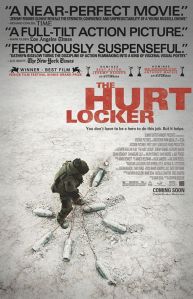 The Hurt Locker is an action movie on a very human scale. Sure there is a time and place for your Michael Bay-esque action vehicles, the type that scorch square miles and leave recognizable world cities in ruins. However, those kinds of action movies are never the kind where storytelling ever enters the fray beyond a meager question of how to get from Point/Explosion A to Point/Explosion B. In fact, Bay openly admits to planning the story of Transformers 2 by working on various action sequences during the 2007 writer’s strike and then tasking screenwriters to connect the dots. The Hurt Locker exists in a frighteningly believable world. This isn’t a movie about explosions but about the extinguishing of explosions. It follows the Explosives Ordinance Disposal (EOD) unit, tasked with detecting and detonating bombs and other improvised incendiary explosives (IED) in the field of combat. You will not be restless for loud “booms” while watching The Hurt Locker. In fact, you will be on pins and needles hoping that you never hear another loud “boom.”
Delta Company are the men responsible for protecting the other soldiers by disposing of bombs. The new team leader, Staff Sgt. William James (Jeremy Renner) has defused over 800 bombs during his tour of duty. He knows he’s the best and he’s addicted to the thrill of being so close to death. He will make occasionally reckless decisions putting himself, but not his fellow company men, at higher risk. This does not sit well with Sergeant JT Sanborn (Anthony Mackie), a by-the-book type that doesn’t appreciate his officer chasing a thrill. The other EOD unit member, Specialist Owen Eldridge (Brian Geraghty), is a man more accustomed to taking orders than giving them, and his indecision may have actually cost the life of the former head of the EOD. Both Sanborn and Eldridge worry that their new team member is going to get them all killed.
 Director Kathryn Bigelow (Near Dark, Point Break) has been directing male-centered action flicks for over two decades; it’s been seven years since her last feature, the regrettable Harrison Ford submarine flick, K-19: The Widowmaker. The Hurt Locker is her finest work to date by far. Her action sequences are visceral and downright agonizing to sit through. She is masterful at setting up the geography of the set piece, ratcheting up the suspense, adding organic obstacles and complications, and then makes sure with her camera and editing that an audience knows exactly what’s happening to whom for every minute that ticks off the clock. Bigelow takes her time to establish the particulars of her locations and sequences, allowing the audience to, surprise, understand what is happening and better engage in the movie. Bigelow chose to shoot the movie in Jordan, the neighboring country to Iraq, and the locations and actual refugee extras add an unvarnished sense of realism. The movie goes without music during much of the action, which makes it all the more uneasy. There isn’t any over eager composer telling you how you should feel, no direction that now things will get even more hairy. You will feel every second of danger, and Bigelow crams in a whole lot of danger. Things can go wrong very, very quickly.
There’s nothing to action cinema quite like the bomb that’s only a few tick-tocks away from doing its dirty work. Do you cut the yellow wire or the green wire? Never cut the red wire. The bombs found in Iraq are a stark range of death. There’s the crude incendiary device just wrapped up in garbage, but then there’s also the fiendishly clever devices with multiple charges and there are grotesque devices as well. At perhaps the film’s most guttural and shocking moment, Staff Sgt. William James finds the corpse of an innocent stuffed with explosives. The easiest thing would be to simply detonate the bomb, but that would also desecrate the body of someone we have come to know. Watching James snip open the crude stitching and dig inside the chest cavity, if we didn’t know then we know now, Bigelow has made sure that The Hurt Locker is the most emotionally resonating contemporary war film in memory.
 Bigelow and screenwriter Mark Boal, an Iraq War journalist, create a vivid sense of dread, antipathy, and most of all, paranoia. Is that a kite flying in the air or is that a signal? Is that a nondescript observer with a cell phone or is that a terrorist with a remote detonator? Is that child being friendly or collecting intelligence? Your mind will race through all these possibilities because Bigelow teases out her action sequences to an unbearably taut level. The audience cares about these soldiers and wants to see them make it back home (we’re informed how many days Delta Company has left on their tour throughout the film), which Bigelow uses to her advantage at every turn. What happens matters. My nerves were frayed during several sequences, including one where the soldiers are pinned down by distant enemy gunfire. The moment turns into a duel and a chess game, as each side tries to adjust their gaze in the searing heat and measure their long-range shot before the other side beats them to it. Then the sequence turns into a waiting game. This is the kind of movie that keeps you poised on the edge of your seat fearful that at any moment something disastrous will suddenly happen. Every time Staff Sgt. William James went back out to defuse another bomb, my sense of dread intensified. I began to doubt everything that I would ordinarily take for granted in other movies.
While being a top-notch action movie, Boal (In the Valley of Elah) has also crafted a great character study. In between the bomb episodes we learn more about these men, which makes it all the more hard to see them then head out to defuse another explosive. The film opens on a quote equating war as a drug, and we explore this notion through the character of Staff Sgt. William James and the weight his unique duty bears. It takes a special person to volunteer for defusing roadside bombs. The defuser must be extremely intelligent, be extremely cool under pressure, and be able to work in a giant suit that makes them look like a chubby astronaut, while enduring debilitating desert temperatures of 110 degrees. It sounds like a suicide mission. James is an adrenaline junkie and war is his drug. He exudes a Zen-like calm in the heat of the moment and this is now the only life for him. Shopping for cereal back home has lost its meaning. Being a husband has lost its meaning. His life now has one purpose. Renner (28 Weeks Later, North Country) gives a stirring performance laced with cavalier confidence and resignation. Mackie (Eagle Eye, We Are Marshall) is also another standout in the pared down cast. When he laments about the dishonor of having no one to remember you in death, you feel the man’s existential sorrow.
 Ignore the political cranks that decry The Hurt Locker as another partisan anti-war film from Hollywood. The American public has been mostly indifferent to any contemporary movie that aims to tackle our current military conflicts in Iraq and Afghanistan, but The Hurt Locker eschews the politics of war to focus on the realities and dangers of its characters. These guys are more concerned with surviving the next bomb than the politics of why they’re in the Middle East. The public has voted with their wallets and does not want to see the reality of war onscreen, or at least the Hollywood version of war reality, but I pray that those same people give The Hurt Locker a fighting chance. There is no preaching to be found here. The Hurt Locker could just have easily taken place during other wars, though the current Iraq War allows for added cultural dissonance (Is the central goal of bomb-defusing a metaphor for our conflict in the region?). This is a film that transcends politics and genre.
The Hurt Locker is more than an action movie, more than a war movie, more than a psychological study; this is an outstanding movie. This movie is a drug to the adrenaline senses and I need another hit. This is one of the finest films of the year and as it expands across the nation, I highly encourage everyone to seek out The Hurt Locker.
Nate’s Grade: A
Share this:

The Reader (2008)
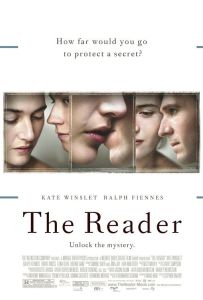 Every now and then, the assorted members that make up the Motion Picture Academy make, shall we say, quizzical selections. There are snubs and undeserving winners, but then there’s the crazy nomination where you see the movie and say to yourself, “What the hell were they thinking?” In recent years I’ve usually found at least one Best Picture nominee that left me scratching my head. In 2007 it was Atonement, in 2004 it was Finding Neverland. But I could at least fathom a guess as to why each of those movies appealed to the Academy and garnered a Best Picture nominee. I’m stumped when it comes to 2008 Best Picture nominee, The Reader. Based upon an award-winning novel, I can only surmise that Academy voters saw the words “Kate Winslet” and “Holocaust” and thought the movie had to be far worthier than the likes of WALL-E or The Dark Knight.
In post-World War II Germany, teenager Michael Berg (David Kross) begins a torrid affair with an older woman, Hanna Schmitz (Winslet). He’s 15 years old; she’s easily twice his age. She instructs her young lover to read to her before they engage in sexual activity, which turns reading into an act of foreplay. The summer affair ends abruptly when Hanna runs off after her employer has given her a promotion. Michael is heartbroken that his lover has flown the coop. Flash forward several years and Michael is attending law school in Berlin. He and his fellow students visit an ongoing trial that features a group of former female concentration camp guards. To Michael’s shock, Hanna is on trial as one of the murderous Nazi guards. The young boy is beset by his feelings of love for a person who has committed despicable deeds. Hanna is keeping a deeper secret and will go to her grave to keep it. Eventually an adult Michael (Ralph Fiennes, wasted) finds his life returning to an imprisoned, older Hanna, possibly his life’s greatest love.
 The Reader contains interesting story elements: sex, guilt, romantic affairs with former Nazi prison guards. But rarely do any of these interesting elements actually transform into an interesting story. The movie just kind of lies there, basking in some phony reflective pause when the movie manages to be so distant and uninvolved. At times the movies seems to have little interest in its own self. This movie feels like it was made to be Oscar-bait because it deals with Big Themes and Important Topics, or at least the film wants to appear like it deals with said items. The Reader is mostly shallow. It pretends to present a moral quandary but director Stephen Daldry (The Hours) doesn’t bother to analyze the contradictions of his characters. The film alternates between characters shouting obvious declarations and just stumbling around in contemplation, bumping into the furniture. It’s simultaneously annoying and boring. The movie wants to put a human face on monstrous deeds, which can be a noble pursuit. The Reader fails to be a “challenging” movie when it can’t be bothered to challenge its characters to do something.
The message of quasi redemption at the center of this specific film is either laughably naïve or downright insulting. Hanna keeps a personal secret shame at all costs, and she would rather go to prison for life as a Nazi murderer than let people know she cannot read. I’m sorry, but that’s dumb. The fact that it seems like The Reader presents the theory that Hanna’s illiteracy mitigates her guilt is offensive. I’m sure the 300 people that were locked in a burning church to die would be sympathetic that their killer couldn’t read See Spot Run. In what world is illiteracy more shameful than genocide? If you’re going to float ridiculous notions at least commit to exploring their very ridiculousness, and therefore acknowledge that there is something amiss. The Reader instead seems to flutter from idea to idea without ever truly delving deeper. If you’re going to craft a character that’s more afraid of a library than a book burning, at least try and explore this enigma. There’s drama in the disconnect. But the movie never feels like this should be an issue. Can’t you see, silly movie goers, that Hanna is but a symbol for the German people who couldn’t read the signs to come and were ignorant to the extent of Hitler’s horrors. She would rather stick to her duty than claim moral responsibility. That’s fine, but there are a great number of movies, and countless more books, that have examined the psychological culpability that can turn a populace into silently willing participants in mass murder. The Reader would rather spend its closing moments exploring the magical healing power of literature. The fact that the film eliminates the novels’ section where Hanna reads news articles and novels about the Holocaust (thus gaining moral clarity) is dumb. Instead of gaining insight into her actions she reads Chekhov. The movie ends up transforming into a weird and wrongheaded episode of Reading Rainbow.
 Winslet’s acting is fine. She’s such a gifted actress that I doubt you’ll see her give a bad performance even if the movie doesn’t live up to her talent. She isn’t doing anything showy to make Hanna a sympathetic character, which works out well, but the film’s distant perspective means that Hanna seems more like an aloof cipher. She’s this formless blob of a character that expresses a mixture of human emotions but doesn’t resemble a recognizable human. This is the fault of the director and screenwriter who chose to replace subtext with ponderous silent stares (note to all “deep” filmmakers: THEY ARE NOT THE SAME). Winslet slips into the character with the same ease she has slipping out of her clothes. The Reader is another nudity-filled performance for Winslet, her eighth movie featuring her nude (also her fourth Oscar nomination for a nude performance, there must be some connection). As readers can attest, I am no prude when it comes to the female form, but even I thought things were getting a little gratuitous. In the first 45 minutes, Winslet is naked in almost every scene she shares with Kross. It’s almost as if the nudity is supposed to disarm the audience and make Hanna a more intimate. Winslet is one of her generation’s finest actresses, which is reason enough that she shouldn’t be handed a Best Actress Oscar for substandard material.
The Reader may not be a traditional Holocaust film and in fact it’s really not so much about the Holocaust. Sure, that colossal event casts a shadow over Germany, but the movie is mostly about a cold and daft woman and the callow boy who loves her. It’s about two characters, but it the movie is too reserved and then some. Everybody just seems numb, which makes for a boring movie after a while. I repeat: a boring movie about underage sexual affairs with freaking’ Nazis! Winslet’s fine performance is not enough to redeem the whole movie. I think much was lost in translation from page to screen. The Reader actually was more effective when it was just a cradle-robbing unorthodox love story. But then, those flicks don’t typically get nominated for Best Picture Oscars.
Nate’s Grade: C
Share this:

The Duchess (2008)
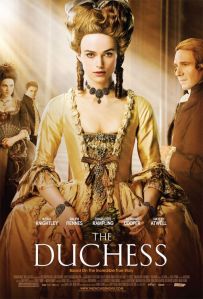 I think I understand the real appeal of costume dramas. No matter what else happens, the costume drama must seem smarter. You have actors, primarily British, waltzing in elaborate costuming in realistic historical settings, each offering demure statements and looking for love and acceptance in a time of chaste expression. You could place Saw 18 in that setting and it would automatically seem smarter. I think the ye olde setting for costume dramas automatically gives these films more plot leeway, but not every film actually proves that it should have earned that leeway. Saul Dibb’s handsomely mounted period drama The Duchess offers little beyond the superficial enjoyment of well-crafted costumes.
In 1770s England, young Georgina (Keira Knightley) has been betrothed to the older Duke of Devonshire (Ralph Fiennes). The newly minted 17-year-old Duchess of Devonshire is whisked away to live in a giant manor. The Duke is rather cold and seems uneasy with human interaction; he shows the most affection for his dogs. He expects Georgina to primarily bear him a son. Several daughters later, the Duke is engaged in affairs and siring illegitimate children. Georgina has become a star of the social sphere, and it is here that she befriends Bess Foster (Hayley Atwell), a woman who is trying to regain her children from her ex-husband. Things get even more complicated when the Duke takes a liking of Bess, and the two become an unofficial union. Georgina has had her only friend taken away and turned into a co-wife. The only solace for the Duchess is in her flirtatious relationship with a politician, Charles Grey (Dominic Cooper). Georgina feels like a prisoner in her own home and yet she cannot desert her children. What’s an oppressed woman to do in 18th century England? That answer should be sadly obvious.
 The Duchess breaks no new ground and, in fact, treads water for the majority of its second half. Georgina was an independent spirit in a time that frowned upon breaking from conformity and tradition. As a woman, she was the victim of a double standard that allowed her husband to sleep with whomever he desired but she could not find physical comfort outside her loveless marriage. Marriage was widely viewed as a means to an end for male progeny, not the culmination of romantic love. Women were pressured into delivering male heirs, despite the fact that men are the ones who determine gender. Typically marriages were family arrangements for class and land ownership, so true passion was procured through marital affairs. I get it because I’ve read Jane Austen novels and seen dozens of period movies that have made the same stilted points. The Duchess presents Georgina as a feminist before her time and then a patriarchal society crushes her spirit. During the second half, when aristocratic life keeps producing heavy obstacles for Georgina, the movie just piles it on. I was left questioning what the point of all this corseted drama actually was.
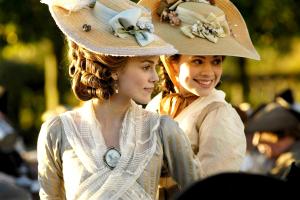
After a while with my downtime I determined whom this movie is really for – hat enthusiasts. This is a Big Hat movie that puts other hat movies to shame. There are gigantic floppy hats, hats that look like fruit displays, hats that look like eighteen-layer cakes, hats that look like they have their own hat, hats with feathers zigging and zagging in every direction, and hats that look like they are consuming their host’s heads. If you work in the haberdashery industry or have an above average interest in hats and hat-related products, then run, don’t walk to The Duchess. You will be enraptured by the orgy of towering hats that jostle for screen time. Rarely are women seen without hats, so you truly will get your hat money’s worth over the course of the film’s two hours. If there were a specific Oscar category for Hat and Hat-like Accoutrement then The Duchess would dominate. I expect it will get nominated for Costumes, and really that seems like half the point in making these powdered wig period dramas.
I think the other point of The Duchess is to channel the modern story of Princess Diana, who is actually a distant relative of Georgina. The two seem to lead somewhat similar lives since they both married young, both had their husbands prefer the mistresses, both were fashion trend setters, both were beloved by the public, and after death both had their husbands remarry the mistresses. The tagline for the film is, “There were three people in her marriage,” a paraphrased quote that Princess Di said in an interview. The Di parallels seem to be all that the filmmakers intended to do with Georgina as a character; she is the least interesting person in her marriage. The Duke and Bess are far more complex and intriguing figures. I’m sure the Georgina biography that serves as the movie’s source is rich in Georgina characterization and personal detail, but all the movie cares about is establishing her as a marital martyr. There is more to this character but she just endures disappointment and punishment; I cannot fully engage with a character when their only personal attribute is suffering. The movie fails to present any notable reason why this woman of history deserves having a feature film.
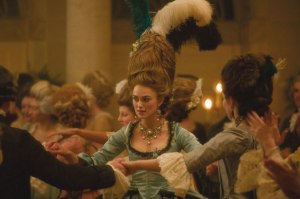 Knightley seems to spend half her film life in corsets. I’m still undecided upon whether she possesses innate acting ability; to me she too often comes across as a pin-up with great cheekbones. That said her eyebrows do a great bit of acting in The Duchess. She has the habit of cocking one ever so slightly and imbuing a scene with a hint of sexual allure or mystique. They’re pretty thick eyebrows too. Knightley does acquit herself well with the material and I doubt this will be the last time I see her in a tremendous silk gown and a humongous hairdo. The most interesting actor is Fiennes because his character is so reserved and awkward in his own skin, so much must be said through the use of gestures, body language, and the perfect execution of line delivery. His character seems just as ill in his setting as Georgina. Atwell is given the most complex character to play. To say that Bess has conflicted loyalties is an understatement. She betrays Georgina but romancing the Duke can ensure that she sees her children once again. Bess should have been the centerpiece of the movie because, as presented, she is far more interesting with more dramatic conflicts and turmoil other than being wronged.
The Duchess is no more and no less than every other costumer period piece you’ve seen before. It starts well but then falls into boring and repetitious plotting (Georgina wants something, she’s denied, she wants something, she’s denied; rather, rinse, repeat, end). The Duchess will delight those in search of yet another unrequited period romance, but I feel that moviegoers should expect more from their entertainment that mechanically fulfilling the period-y checklist. The technical merits like the production art and the costumes, especially the hats, are first rate. There’s little feeling beneath all the fabulous fussing about. It’s too bad the actual drama couldn’t at least be as interesting as the hats.
Nate’s Grade: C+
Share this:

Harry Potter and the Order of the Phoenix (2007)
 The most interesting aspect for me about the ongoing Harry Potter big screen adaptations are how each new director handles the material. Christopher Columbus got the ball rolling with his autumnal and slavishly loyal films, Sorcerer’s Stone and Chamber of Secrets. Then Alfonso Curaon made the series feel magically its own for the first time with Prisoner of Azkaban. Mike Newell made The Goblet of Fire feel like a teen romantic comedy. Now it’s David Yates’ turn to be at the Potter helm. Yates has little to his resume beyond assorted TV movies, but his direction must have impressed the Potter brass. Harry Potter and the Order of the Phoenix feels somewhat like setup to more important events yet to come, but with Yates and new screenwriter Michael Goldenberg, this new entry feels up to the entertainment challenge of its forebears.
Harry Potter (Daniel Radcliffe) is entering his fifth year of education at Hogwarts School of Magic. The Ministry of Magic is trying to silence Harry’s claims that Voldermort (Ralph Fiennes) has arisen anew. They’ve installed one of their own, Delores Umbridge (Imelda Staunton), as the new Defense Against the Dark Arts professor. But she’s not interested in teaching the students actual magic. The Ministry feels it’s best for the Hogwarts youth to just have a theoretical knowledge, so they’re distributed out of date and censored textbooks. Umbridge gathers greater power and eventually has the run of Hogwarts, forcing Harry and his friends, like longtime buds Ron (Rupert Grint) and Hermoine (Emma Watson), to practice their own protection spells in hiding. Umbridge and the Ministry are convinced Harry and Headmaster Dumbledore (Michael Gambon) are trying to unseat their leadership. In actuality, they’re just trying to warn people about a war that is on the horizon.
 The fifth movie is also the most grownup in tone and temperament yet. Harry is in a very different place and feeling alienated from the important people he cares about. The Ministry of Magic is turning the public against him by making everyone believe that Harry is a liar. Order of the Phoenix explores a lot of psychology and doesn’t have anywhere near the humor of previous installments, especially 2005’s heavily comedic Goblet of Fire. I think this is a step in the right direction. Harry’s mortal enemy has been resurrected, his schoolmate has been murdered, and you can’t really go back to zippy Quidditch matches and silly spells that make people hurl slugs. The Harry Potter universe has gotten darker and more serious and Order of the Phoenix reflects this. Harry warns his peers during a training session that death is a real consequence of what they’re about to face, and that bad things will indeed happen to good people.
Order of the Phoenix is structured into two dominant storylines: Umbridge and the school repression, and Voldermort’s attempts to infiltrate Harry’s mind. Voldermort is handled as a murky puzzle, mostly in a succession of quick flashes and nightmares, and this results in the storyline feeling more like a fuzzy memory. I found the Umbridge character to be far more interesting and even far more menacing than He Who Must Not Be Named. The combination of political suppression of the truth, fear mongering and paranoia, torture interrogations, trampling over civil rights, and teaching students censorship in the name of safety is a fascinating correlation with our own modern society. The book may have been released in 2003, and written by an English woman, but the political repression feels alive and relevant today. While I appreciated the well-crafted peeks to the nasally-challenged Dark Lord, I found Harry raging against the system trying to keep him mum to be the real meat of Order of the Phoenix. I lost some interest once Umbridge had been vanquished.
Harry Potter advocates of all stripes and sizes constantly ask me why I have little interest in sitting down and reading the actual novels, why I’m content to wait the extra time for the movies. The answer is two-fold: 1) I’m lazy, and 2) I think the slimmed down screenplays may boil the essence of J.K. Rowling’s verbose books and present a better and more focused story. In all honesty, I don’t really care about who wins a Quidditch game, or how someone helps a magical creature that is of no consequence to the story. Rowling’s massive tomes seem so overstuffed, and I repeat that I am passing this judgment never having read one book, that I don’t mind all the superfluous subplots and characters that are trimmed and/or eliminated in the path of economic storytelling. The essential essence of the story and all the really important elements will be included, any the quibbling of what gets tossed aside is often enough to confirm for me that I don’t need to read the books to see what I’m missing. Then again, this entire paragraph may do nothing but prove that I am willfully ignorant or just plain wrong. Oh well. Two more movies to go and two more books not to open.
 Yates brings in the shortest Harry Potter movie to date at 2 hours and 18 minutes long, but the hastened pace sometimes causes the film to stumble or lack clarity. There’s a death late in the film (while I’m sure the entire world knows the person’s identity I will refrain from spoiling) and I had no idea what had just taken place. The death is abrupt, and the person just sort of leans back and disappears into some gate that is never given context. The whole scene is meant to be defining drama but if I hadn’t known ahead of time what was supposed to happen then I would have been scratching my Muggle head. The prophecy that the bad guys want so badly seems rather unimportant, so the ending scuffle over this little glowing ball seems like much ado about nothing. Most of the new characters, like Helena Bonham Carter as Bellatrix Lestrange, don’t feel well incorporated into the overall story. But the worst part of the hasty pace is the fact that when we finally get an all-out wizard battle between good and evil that it ends far too quickly. The Order and Voldermort’s Death Eaters are going at it with colorful attacks jettisoned around the room, but this exciting bite of action turns out to be little more than a morsel. After the wizard-on-wizard combat, Order of the Phoenix goes back to a pretty predictable finish with little in payoff. And was Hagrid’s giant goofy brother really necessary to include?
The adults have always been impeccably cast in the Potter flicks, and real star of the fifth film is Staunton (Vera Drake). Umbridge is a juicy role and Staunton brilliantly plays this fascist little school marm in Pepto pink. She has this exquisite stuttering giggle, and her ever-smiling, cherubic face quivers like there are strings attached. Staunton makes even the most innocent “excuse me” sound like it’s dripping in poison. She’s so peppy and seemingly wholesome but in the same moment is There’s one scene between Umbridge and Professor Snape (the irreplaceably awesome Alan Rickman) where he can’t stand her presence and adds an extra dose of snarl in his annoyed replies; this woman has found a way to make Alan Rickman even more awesome. Order of the Phoenix is at its best when Staunton is stalking the corridors and enforcing her brand of control. I’ll miss her dearly.
 I think I need to reverse my stance on the child actors of this profitable series. With the first movies, it seemed like Watson was the real star as the studious and nitpicky Hermoine. It also appeared that Grint would never escape the trappings of squealing cowardly relief. Radcliffe seemed to suit the material but felt overly wooden and I predicted he would never be anything but a blah actor. I now must rescind my earlier predictions. Watson has become more grating as the films progress, She outshined her fellow actors when they were 11, but now that she’s a teenager and working the same limited, yet extremely huffy, acting range, turning her character into more of an annoyance than an ally. Radcliffe, on the other hand, is nicely growing into his role and expressing deeper emotions and anxiety as the weight of his Harry’s name and destiny weighs on him. I think Radcliffe will have a career outside the boy wizard; he was strikingly funny on an episode of HBO’s Extras that sent up his youthful image. I don’t think we’ll ever hear much from Grint and Watson again once the end credits roll on movie seven.
After five movies, I think we pretty much know what we’re going to get with the Harry Potter series. The stories are getting more mature and serious, and this means that the films need more attention to adaptation and weeding out the nonessential elements. I think the fans that are still grumbling about the books being butchered have missed the point (they’re also still fuming over the “new” Dumbledore, even though Gambon has been in 3 movies now). Order of the Phoenix was the longest book but has been turned into the shortest movie, and it still resonates as an exciting and emotionally engrossing fantasy now taking definite and irrevocable steps toward something dark and meaningful. Yates is scheduled to direct the next Potter chapter,The Half-Blood Prince, and even though I won’t have a new director’s style to analyze, I look forward to more adventures with these characters. Just don’t tell me to read the books.
Nate’s Grade: B


 nathanzoebl
You must be logged in to post a comment.