Blog Archives
Silver Linings Playbook (2012)
 I am in love. It’s been days since I watched Silver Linings Playbook and I’m still under its spell. It’s a movie that gave me such rapturous emotional peaks, a deeply satisfying crowd-pleaser that doesn’t just nail the big moments, it crushes them. This is a movie that works so well with just about every facet of storytelling, from acting to writing to directing, that you’re liable to be in awe as I was.
Pat (Bradley Cooper), a high school history teacher, came home one day to find his wife in the shower with another man. He admittedly lost it, beating the man bloody, and has been remanded to a state psych ward for the past eight months. It’s determined that Pat is an undiagnosed bipolar case, and the court orders him to stay on his meds and stay 500 feet away from his now ex-wife, Nikki. Having lost his home, Pat is living with his parents (Robert De Niro and Jackie Weaver), both of whom don’t know how to help their troubled son. Pat is convinced he can win back his wife. He starts conditioning by running, wearing a garbage bag to better sweat off the pounds, and meets Tiffany (Jennifer Lawrence). She’s been fighting through depression after coping from the sudden death of her police officer husband. She agrees to help Pat get in contact with his ex, passing a letter, but at a price. He must compete with her in a dancing competition. They spend hours practicing their routine, getting to know one another, and stabilizing one another, providing a foundation for healing and success.
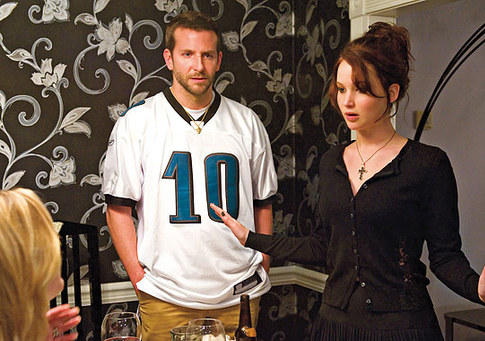 The story itself isn’t anything groundbreaking; you could glibly label it as the “bipolar rom-com” and it does adhere to that structure for the second half. But this is David O. Russell we’re talking about, the man behind 2010’s The Fighter, yes, but also offbeat dysfunctional family comedies like Spanking the Monkey and Flirting with Disaster. The man has a way of working within the framework of conventions and finding the rough edges, to make stories at once familiar and excitingly new. Is there anything groundbreaking with Silver Linings Playbook? It’s your boy-meets-girl formula at heart, but the execution is so extremely sure-footed, so exceptionally handled, that the movie leaves you buzzy and beaming. Once it ended, I wanted to run around, shouting from the rooftops for people to run out and see this movie. You want others to share in something so special and affecting. I felt a similar passion after seeing the unconventional romance Safety Not Guaranteed, and I’d advise any fans of Safety to certainly check out Silver. Being a rousing, crowd-pleasing sort of movie is not necessarily a yoke to weigh down its artistic integrity. As if enjoyment and creative accomplishment are opposing forces. I freely admit that Silver Linings Playbook is a masterful movie that knows what it takes to get an audience cheering, and I was thrilled to be part of that cheering throng. Here is a movie that just makes you feel good, and when was the last movie you saw that made you feel glowing with happiness?
This in an emotionally rich film; I was so happy after my screening that it felt like a high I didn’t want to come down from. To engineer a reaction that enhanced, that enlightened, that potent, well I must sing the praises of Russell and his actors. I bought into the love story and family drama big time. The payoffs are meaty and numerous, and I often found the film to be sincerely moving. There’s a great satisfaction in watching two oddballs find their special someone’s, and when the characters are this interesting, this human, and so well portrayed, it makes every stop along the journey that much more engaging and emotionally triumphant. It’s got an ending that pulls it all together in spectacular fashion, giving us exactly what we want while feeling earned and on its own eccentric terms. This is a deeply felt and compassionate film, one with as much uplift as acerbic rebellion. You feel like these people really do love one another. Silver Linings Playbook has memorized the playbook on how to win over an audience, but it always comes down to the same Xs and Os: strong characters, a compelling story, and people we genuinely care about, and that includes distaff supporting characters too.
 The characters are so interesting and beautifully flawed, and the actors are so in tune with one another, delivering bar-raising performances that take the movie into another realm of enjoyment. When actors are given plum roles about people with mental illnesses or disabilities, it must be very enticing to overindulge in tics and self-conscious mannerisms. That doesn’t happen with Silver Linings Playbook. Beyond an uptick in tempo, the actors portray their parts as characters rather than ailments. If anything, the acting in this movie is practically restrained given the circumstances. What’s more, Silver Linings Playbook is a fine example of what can happen when the cast works in tandem, challenging one another to up their game. It’s like every actor felt revived from all the talent on display. Russell knows how to push his actors like few other directors, and while this has lead to notorious Internet videos of his actors losing their cool, it’s also given way to raw performances that burn in your memory. Russell gets his actors to bring their A-game and then some. The Fighter got three Oscar nods for acting and I wouldn’t be surprised if Silver Linings Playbook gets three as well (I think Lawrence and De Niro are locks).
Cooper (The Hangover) has always had a certain smirking, leering quality about him, a guy used to portraying louts with charisma. I have never seen him tackle anything nearly as challenging as what he does with Pat. He’s unpredictably combustible, ready to explode at any moment, but also empathetic, trying to do better. Pat isn’t meant to be seen as a loveable loser. This guy has serious problems he’s working through. Cooper is simply incredible, showcasing skills and nuance you didn’t know the man had, radiating with an intense outpouring of spontaneous energy that doesn’t ever feel forced. Cooper is not bouncing off the walls here as some wild-eyed loony, playing upon codified ideas of what a bipolar person behaves like. He’s a deeply complicated guy, processing challenging and contradicting feelings in a brain that doesn’t necessarily follow the rules. He has so many impulses leading him in different directions. Pat is obsessed with his goal of impressing his wife, so much that he seems blind to the tangible connection he’s formed with Tiffany, and we yearn that he realizes the catch in front of him. I was won over completely by Cooper’s committed, attentive, anxious, and lively performance.
Readers will know that I harbor a serious crush when it comes to the talented actress, Lawrence (The Hunger Games). I was expecting her to be great in this movie, as this is pretty much my default setting with the actress at this point. I was not expecting what she delivered, a performance that is so enthralling, so astonishing, that you’ll be left stupefied that a woman at only the young age of 22 could be this phenomenally gifted. Lawrence had several scenes that just left me speechless. Lawrence is in elite territory now as far as I’m concerned. Her command of the character is just about impeccable, and you perk up every moment she’s onscreen. She’s a damaged woman recovering from her own powerful grief, but she’s so many things at any one moment. She can be lusty, provocative, angry, sullen, commanding, vulnerable, and hurtful. There are scenes where she will bounce around a plethora of emotional states, but each one gradually shifts to the other, making the transformation genuine and another layer to the character. If she were just some crazy girl we wouldn’t care if she eventually got her happy ending with Pat. With Lawrence’s talents, and Russell’s sharp writing, Tiffany becomes a figure worth fighting for, a bruised romantic that finds her rare kindred spirit who accepts and appreciates her messiness.
The supporting cast from top to bottom may not be at the same level as Cooper and Lawrence, but their output is also impressive. De Niro (Limitless) hasn’t been this good in ages, delivering a few monologues that will hit you square in the gut. Weaver (The Five-Year Engagement) is something of an enabler for the family, but she also gets her moments to shine and reassert her strength and dignity. Chris Tucker (in his first non-Rush Hour movie since 1997) is the least Chris Tucker I’ve ever seen him. He’s downplayed his motor mouth tendencies completely, and he’s a wonderful presence as he ducks in and out. He even teaches Tiffany how to “black up” her dance, a fact that most heterosexual males in the audience will be thankful for this time of year.
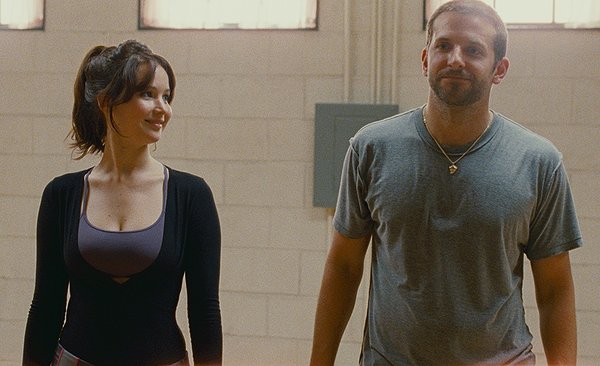 Russell deserves serious credit for portraying mental illness in a manner that doesn’t dance around the seriousness of the condition. Statistically one in three people suffer from a mental illness at some point in their life, and I’ll even admit that post-divorce, I too fell amongst those ranks (I’m a statistic!). In the case of Pat, He’s not just some unfeeling jerk who says inappropriate things or has problems reading social cues. He’s a guy going through serious personal struggles, same with Tiffany. These are not jokes. They are not send-ups of mental illness; they are people. At no point does the humanity of these characters get lost. We will laugh at their inappropriate comments, sure, but we are never laughing at them from some cushy sanctuary of superiority. I also think Russell examines an interesting, more socially-acceptable form of mass mental illness, namely the OCD-nature associated with sports superstitions. Smart and capable people can get caught up in the allure of superstitions, and when it concerns sports in general, groupthink overpowers. I consider myself a sports fan as well (I’m a double statistic!) and fully accept the ridiculous nature of fandom, but I thought it was a clever move for Russell to hold the mirror up to our own cracked community and its irrational behavior. And as any Philadelphia sports fan will acknowledge, they take fandom to a whole other level.
At this point, I don’t know what more I can write about this movie without coming across as a complete, frothing madman. Football, mental illness, ballroom dancing! I’m smitten big time with Silver Linings Playbook. I’m completely in the tank for this film. Future viewings (already planning one soon) will probably highlight certain minute flaws I’ve failed to notice the first go-round. And even if those flaws become more apparent (yes the final dance is something of a contrived climax) I simply do not care. The movie’s many virtues far exceed any shortcomings that could potentially arise. It plays to some familiar rom-com elements but it goes about its business with its own funky charm. The acting, writing, and directing are all on such a heightened level of excellence, it’s amazing just to watch all the parts work together so masterfully. I wasn’t just won over by this movie; I’ve become its disciple. I preach the gospel of Silver Linings Playbook. Here is a rapturous feel-good movie that doesn’t feel like it’s pandering or dulling its edge even after it takes some conventional turns. Cooper is terrific, Lawrence is astounding, and together they form the couple you cheer for. Silver Linings Playbook is everything you’d want in a stellar movie. I can’t wait to watch it again and get caught up in its wondrous spell once more. It took a long ten months but The Grey has finally been knocked off the perch. Silver Linings Playbook is nothing short of the best film I’ve seen this year.
Nate’s Grade: A
Share this:

Holy Motors (2012)
 I like movies that are different. I like movies that can be hard to understand. Holy Motors, a surreal French film, is both very different and very hard to understand. The movie follows a man as he goes about transforming into nine different characters, each with their own bizarre mission. Is he performing? For whom? Who is behind all this? Does he ever stop assuming false roles? Questions such as these hardly matter in movies such as this. You’re either transported by the lyrical weirdness and unpredictability, or you find it tiresome and much ado about nothing. After a while, I just gave up with this movie. I’m not a fan of weird for weird’s sake and I felt like that was all I got with Holy Motors. I’m sure you could write a doctoral-level thesis decoding this movie, but why waste valuable hours of your life? This movie is nothing but strange imagery that adds up to precious little. I thought the concept of playing roles/manufactured realities was better explored in Charlie Kaufman’s Synecdoche, New York. When a Kaufman movie is more accessible than your film, your name better be David Lynch or you’re in trouble. I’m sure several fans of the obscure and outrageous will find amusement at the sheer randomness with Holy Motors. It’s got martial arts acrobats, Kylie Minogue breaking out into song, magical resurrection, spontaneous band performances, talking cars, and for good measure chimpanzees. I hope you get more out of it than I did. I found the enterprise to be more tedious than titillating, more frustrating than fascinating, and not worth the trouble of fashioning meaning from the discarded puzzle pieces.
Nate’s Grade: C
Share this:

Moonrise Kingdom (2012)
 It feels good to be a Wes Anderson fan once again. The indie auteur has a very distinctive style that he seems to have little regard in altering. I’ve been critical of Anderson’s idiosyncratic style, comparing it to crafting wonderfully composed, intricate dollhouses minus compelling or relatable characters to inhabit these artfully constructed mini-worlds. Without that necessary element, it’s all just fancy window dressing. Finally, Anderson, with Moonrise Kingdom, has concocted another movie where the characters grab more of your attention than the backgrounds.
Set in 1965 on a small island just off the New England coast, the movie follows the adventures of Sam (Jared Gilman) and Suzy (Kara Hayward), both twelve years old. Sam has run away from his summer camp, the Khaki Scouts, led by Scout Master Ward (Ed Norton). Suzy has run away from her parents (Bill Murray, Frances McDormand). The small island’s one police officer, Captain Sharp (Bruce Willis), enlists the help of several Khaki Scouts he deputizes to find the missing duo. It’s revealed through a serried of letters, and flashbacks, that Sam and Suzy have been plotting their escape for over a year. They’re in love, and they’re going to make sure nobody interferes.
 What more relatable than young love? Sam and Suzy just want to be together and the rest of the adult world seems intent on keeping them apart. Right away you’re pulling for these kids, rooting for their triumph, and the movie does a fantastic job of replicating the innocence of young love without overly romanticizing a very nervous, awkward time in life. When Sam and Suzy practice kissing, for what is obviously the first time, I defy anyone sitting in the audience not to feel a recognizable pang of insecurity. The experimentation is a tad more realistic than you might expect with the PG-13 rating but still nothing to shatter the youthful innocence of the picture. There is not a tawdry moment in Moonrise Kingdom. It’s a time in life when the knowledge of sex existed without a keen understanding of sensuality, like in Miranda July’s Me, and You, and Everyone We Know. It’s more like fumbling around with what you think is appropriate activity. Still, the fact that the movie features twelve-year-olds in their underwear dancing and mildly experimenting means Moonrise Kingdom might draw a swath of ticket-buyers for the wrong reasons (beware the patron in a raincoat).
The scrupulous attention to detail is the same obsessive quality you come to expect from a Wes Anderson movie. He builds living worlds and his color schemes and shot arrangements add much texture to this idiosyncratic landscape. Unlike Life Aquatic and Darjeeling Limited, these artistic elements work in harmony rather than conflict; Anderson actually seems to care about the people here. Chances are if you’re not a Wes Anderson fan, Moonrise Kingdom will probably not be the movie to win you over. The whimsical, storybook nature of the film actually accentuates the broader themes; bright-eyed exploration, the magic of possibility with love, and an unyielding hope. The movie feels like one of Suzy’s storied adventures come to life but without compromising the relatable character conflicts. The movie does build a nice head of steam thanks to the pursuit of our runaway romantics. There’s also a palpable sense of danger lurking, as the kids risk life and limb and even experience death, albeit a dog (Suzy: “Was he a good dog?” Sam: “Who’s to say?”). It’s a poignant tale of childhood but it doesn’t feel childish, a family film meant for people probably too young for families.
Moonrise Kingdom walks a fine line between whimsical and overly precious. Less skilled filmmakers haven fallen suit to making insufferably twee film productions consumed by their own indulgent sense of preciousness. Moonrise Kingdom is full of the typical Anderson quirk but it doesn’t overpower the narrative or define the characters in such limited personal scopes. There’s plenty of laughs to be had with the film, most in the wry chuckle variety; I was laughing throughout, finding those staple peculiar touches to be the most amusing, from the Scout Master reading a magazine titled “Indian Corn,” to Bob Balaban’s questionably omniscient narrator, to some improvised natural earrings.
The movie is consistently funny but also far sweeter than I would have imagined given the detached, arch nature of Life Aquatic and The Darjeeling Limited. Again, the kids are precocious and the adults act more like children, but everyone is really hurting and lonely and looking for a means of coping or persevering, with the biggest source of pain being love; the longing, the ache, the uncertainty of when and if it will return. Usually Anderson’s films involve dysfunctional families mending some degree of their brokenness by film’s end and formulating a connection. With Moonrise Kingdom, the plot is on two kids falling in love and their will to endure. I appreciate that Anderson and co-writer Roman Coppola (Darjeeling Limited) do not trivialize or look down upon the relationship between Sam and Suzy (“Oh, it’s just puppy love you silly, naïve, waifs.”). To them it feels like everything. The tender approach to young love opens the film up to a broader audience without compromising the director’s unique vision. I’d hardly say the film approaches overt sentimentality. What’s there feels earned and more reserved than what we might expect from burgeoning romance. When the expressions of affection occur, they have greater weight and make a greater impact charming the audience.
 The first-time child actors do a credible job with carrying the film. Hayward and Gilman are charming and easy to like, though I wish Anderson had pushed his young actors a tad harder. They seem stiff at times and a little above-it-all in attitude. I applaud the kids for acting somewhat reserved rather than going crazy with their budding hormones. Both characters are also characterized as “emotionally disturbed,” though this seems like another of the film’s damning details about the out-of-touch adults dictating their lives. I just wished we sensed a greater degree of urgency from them about this whole adventure and the possibility of losing one another. They feel a tad blasé, all things considered.
The bigger celebrity names in the cast assume smaller roles, and many of the supporting characters are thinly sketched with personal conflicts mostly kept at a simmer. These are grownups that, at their heart, don’t know what to do with their feelings. Sam and Suzy feel liberated by their feelings. I found Murray’s blustery sense of anger amusing, and Willis does some subtle work to give you a sense how truly lonely his character is to the core, but it’s Jason Schwartzman (Scott Pilgrim vs. the World) who steals the show in my book as the fast-talking, mercurial, scheming Cousin Ben who seems to have whatever somebody needs. When he agrees to marry Sam and Suzy and acknowledges that their marriage will not be deemed official under any court whatsoever, you get a sense that Moonrise Kingdom has been missing a propulsive and delightful character like Cousin Ben. I wish he had been inserted earlier, but this is Sam and Suzy’s movie, after all.
It’s not on the same level as Rushmore of The Royal Tenenbaums (my favorite Anderson films), but it’s a film that feels a lot more alive and emotionally resonant. It feels like a return to form for Anderson, remembering that the characters and their drama need to be as engaging as the set design. The turbulent young love of Sam and Suzy is sweet and leads to some tender yet poignant moments that warm the heart without making you overdose on cheap sentiment. The idiosyncratic touches are all there, the ironic humor, and the stellar soundtrack selection (Benjamin Britten’s deconstructive orchestral marches stand out as a thematic core), everything you’d expect from a Wes Anderson movie, except this time you’ll find the characters recognizable, their struggle compelling, and the end rewarding. Moonrise Kingdom isn’t the most substantive film playing in theaters but damned if it isn’t the most alluring, amusing, and affectionate, yet all on its own terms. Who would have guessed that a pair of twelve-year-olds would help us show what real love is in 2012?
Nate’s Grade: A-
Share this:

Men in Black III (2012)
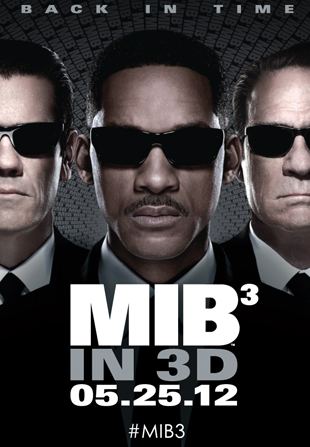 It wouldn’t be a Men in Black film without script problems. The first film languished for some time, originally taking place in Kansas of all places, before director Barry Sonnenfeld became attached and insisted upon a New York City location. The 1997 sci-fi buddy cop comedy was a hit, and rightfully so, and Will Smith became a megastar. Then the 2002 sequel’s climactic action sequence had to be rewritten due to the fact that it was originally going to take place in the World Trade Center. If only that lackluster sequel had gone through more extensive creative revisions. However, these past hiccups don’t seem to come close to Men in Black III, which to Sonnenfeld’s admission, started shooting in late 2010 without a finished script. It had a beginning, an ending, but nothing definite to tie together. So the whole production took eight months off to work on the meat of that movie sandwich. Hollywood movies, especially modern films of huge-scale budgets and set release dates, have routinely started production without completed scripts, including Gladiator, Jaws, Apocalypse Now, and Lawrence of Arabia. Naturally, those are the exceptions to the rule.
Boris the Animal (Jermaine Clement) has escaped from pison and out to seek revenge on the man who put him away and took his arm – Agent K (Tommy Lee Jones). Boris travels back to July 1969, when a young Agent K (Josh Brolin) thwarted the big bad Boris. Boris kills Agent K and alters the future. The Earth is now vulnerable to an alien invasion from Boris’ species. Agent J (Smith) has to travel back in time to save his old partner and the planet.
It’s been ten years since the spotty Men in Black II and almost four years since Smith has been seen in a movie. Where did the time go? Fortunately, this third movie hews closer to the droll brilliance of the first film. Part of that is a sharper story with a more clearly defined goal and a return of the playful exuberance that belies the franchise. Also, I must say that absence has made the heart grow stronger, because I’ve missed Smith’s effortless charisma onscreen. Agent K is such a natural fit for the guy and it’s just fun to watch him stumble through strange alien encounters (this time we learn all super models are aliens; listen good, young women of America who punish themselves to fit this image of beauty). Time travel is usually employed when a franchise seems like it’s all out of gas; it’s usually more focused on the comic fish-out-of-water possibilities, which there are a few in Men in Black III. As one characters notes, 1969 wasn’t exactly a great time for black people in America, and J combats casual racism, black panic, and ignorance with a defiant attitude that is amusing to watch. I’m glad the whole race-relations reality was addressed, though it’s also for the best that the movie doesn’t get bogged down with scenes of Agent J conflicting with bigoted authority. Men in Black III remembers that we’re here to have fun, and the screenplay by Etan Coen (Tropic Thunder) has a light-handed touch. I enjoyed the opening jailbreak sequence with Boris, though I would have thought a lunar prison would have better security. Bill Hader (Superbad) has a fun cameo as a self-hating Andy Warhol, really an undercover MIB agent, though the idea that Warhol’s Factory artists as aliens seem a tad simple. The glaring cameo omission was Jon Hamm (TV’s Mad Men) as a scotch-drinking MIB ladies man of legend.
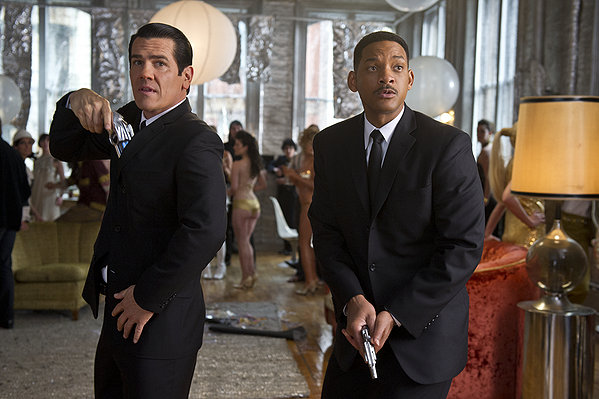 As evidenced from the trailers and marketing, Men in Black III is really Brolin’s movie. The guy establishes an uncanny Tommy Lee Jones impersonation. The eerie brick-faced stoicism, the melodic lilt of his voice, the syncopation of his speech patterns; Brolin nails it all. Watching his interaction with K are the film’s most enjoyable segments. At this point in the series, Agent J and K have gone beyond the rookie/mentor phase and now have something of a friendship, though their arguments at year fifteen of their partnership sound more like the arguments they would have in year two (you need to “open up” and be less grumpy, sounds elementary). Still, there is a personal connection to this case that eluded the last movie, and it gives the film a sense of urgency even when the comic shenanigans seem to hog the spotlight. The personal reveal in the last act didn’t have as much emotional power for me, mostly because I did the math and realized whom a certain unseen character of significance was before we got their true identity. The end does give the film series a circuitous sense of finality.
For a franchise that seems like it can go anywhere at any time with limitless possibilities, the worst thing you can do is be shut off to better avenues of storytelling. Take for instance the climax at Cape Canaveral, which itself is a rather anticlimactic sequence involving the launch of Apollo 11 (don’t they know that alternative 1960s history was sooo summer of 2011?). J has his time travel doohickey that lets him travel back. He gets to use this device once during the climactic fight, allowing him to travel back one minute in time so he knows how to properly duck. That is it. What a fantastic waste. If you’ve got a device that essentially allows for unlimited do-overs, then I want this device to be an integral part of the climax. I want J to have to regularly use it to fix past mistakes and learn more and more from each time jump. Just memorizing how to duck is lame. The entire subplot with Agent O (Emma Thompson in the present, Alice Eve in the past) and her dalliance with K is so carelessly thrown away that I wonder why the filmmakers even bothered to include it. Then there’s our villain, Boris, whose name itself is even lazy. He’s just a bad dude with some sort of insect that lives in his hand and shoots spikes. That is it. He’s a guy who can fire projectiles. So what? What about that makes him interesting? An unrecognizable Clement (Flight of the Conchords) does his best but the character just doesn’t have anything about him that deserves special attention; he could have been any villain (I think Vincent D’Onofrio was undervalued in his go-for-broke physical performance as the first film’s villain). I did like the idea of Present Boris arguing with Past Boris, but like most promising ideas in Men in Black III, this space-time sparring is never fully realized. While enjoyable, there’s little you’ll be able to think back on with Men in Black III and say, “That was well developed.”
Paradoxically, I think Men in Black III has a character that might simultaneously be the best and worst thing about the film. Allow me to explain. About halfway in, we’re introduced to the alien Griffin, played by the great Michael Stuhlberg from A Serious Man and TV’s Boardwalk Empire. He’s a creature who can see nigh unlimited timelines, all the variations of choice and possibility play out before his eyes, one after another. He never knows which timeline he’s in until the moment occurs, thus he’s constantly worried about every moment to come in his life. This foreknowledge sounds like a wretched curse, and with Stuhlberg gives a forlorn edge to his character’s eccentricity. So when J and K meet the guy, there are some clever moments, like when Griffin details every peculiar aspect of chance that lead to the 1969 Mets World Series victory. The moment, and by extension the character, is a nicely reflective idea that every moment is a miracle of causation. Griffin is just an interesting character. Here’s where the worst part comes in. Rarely is he treated as a character because, you see, Griffin is really a magic plot device. He can tell the Men in Black agents whatever they need to do at any point, instantly providing a narrative cheat. When in doubt, just ask the guy who sees the future and he’ll steer you without fail to the next necessary plot point.
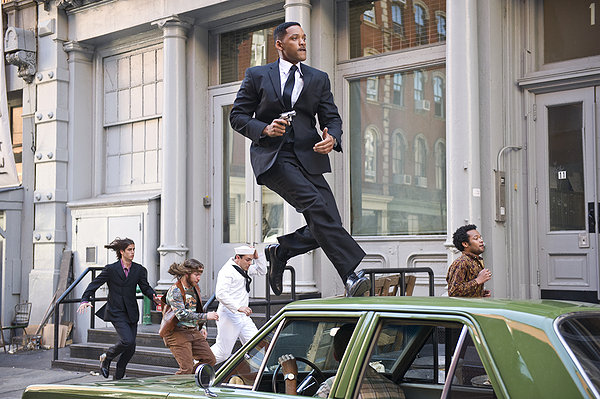 I saw this movie in 3D, not by choice mind you, and for the first half hour it felt like one of the better 3D conversions out there. Sonnenfeld’s camera plays a lot with depth of field and primarily forward-backwards movement, which made for a slightly elevated viewing experience. But somewhere around the halfway mark, I swear the movie forgot it was supposed to be 3D and the dimensional differences became negligent. It never really recovers, and so I advise all potential ticket-buyers to skip the 3D screenings.
With most time travel escapades, there’s going to be some plot holes. Working with a flurry of alien technology, it would have been exceptionally easy for the filmmakers to just explain away the plot holes with some magic device, much like the Paradox Machine in Dr. Who. Hey, there’s a machine that makes sure we don’t have paradoxes? Good enough for me. It’s like in Thank You for Smoking when Rob Lowe’s character explains why actors would be able to smoke in an all-oxygen space environment: “It’s an easy fix. One line of dialogue. ‘Thank God we invented the… you know, whatever device.’” The fact that Men in Black III doesn’t even address its biggest plot hole astounds me. If Agent K is killed in 1969, then he was never alive to recruit Agent J into the service. Let’s even assume that J’s credentials would still get him noticed and staffed with the MIB; if Boris killed Agent K in the past, then there was no reason for Boris in the future to travel back in time to kill Agent K. Again, these aren’t nit-picky gripes, these are major, easily understood plot holes, and I’m dumbfounded why no characters even address them. I could nit-pick over why Boris decides to go to 1969 when he just as readily could have gone to a time when K was a child and thus more vulnerable. Surely a child is easier to dispatch than a 29-year-old man.
Men in Black III is a far improvement over its stilted predecessor, but it still ends up falling well short of the potential it flashes. It’s intermittently amusing with some fun cameos and some visual panache, but this movie should have been stronger, stranger, and more playful with its central time travel conceit. It’s hard to work up that much distaste for the movie, especially since it has such a lively, jocular feel. Not all of the jokes work, but enough do, and the movie maintains an overall pleasant sensibility, zigzagging in imaginative directions that most Hollywood movies never beckon. It’s the stuff that works that illuminates the potential left behind as it goes into summer blockbuster territory. Men in Black III is an example of diminished returns, yes, but some franchises start so high that even latter, lesser sequels will have more entertainment value than their competitors. While it won’t set the world on fire, Men in Black III exceeds expectations and provides enough entertainment that it’s worth a look and little else.
Nate’s Grade: B
Share this:

Extremely Loud & Incredibly Close (2011)
 The biggest surprise on the morning of the Academy Award nominations was the inclusion of Extremely Loud & Incredibly Close in the nine nominees for Best Picture. Critics have universally derided the 9/11 drama, becoming the lowest critically rated Best Picture nominee in the last 30 years, according to some awards pundits. The second lowest rated Best Picture nominee in that same span of time? The Reader, also directed by Stephen Daldry. Under new Academy voting rules, a nominee has to garner at least five percent of first place votes on members’ ballots. That means that at least 250 Academy members voted this crass, manipulative, off-putting, wrongheaded, exploitative movie as the best film of the year, thereby voluntarily divulging they must not have seen a single other movie for 2011.
Oskar Schell (Thomas Horn) was nine years old when his father, Thomas Schell (Tom Hanks), was killed on September 11, 2001. He was in one of the World Trade Center buildings and left six frantic phone messages before perishing. In the ensuing months after the disaster, Oskar is lashing out against his mother (Sandra Bullock) who spends all day in bed. Then one day he discovers a mysterious key in his father’s closet inside an envelope labeled “Black.” Oskar’s father used to send his son on a series of adventures around New York, looking for a fabled “sixth borough,” forcing Oskar to confront his numerous fears and insecurities. Oskar looks through the New York phone book and catalogs over 400 separate people with the last name of Black in the five boroughs. He’s convinced that his father has left one last hidden message somewhere in the city.
 My main sticking point was that I found Oskar to be an insufferable, bratty, little jerk. I understand he’s hurting and he’s trying to work through his pain. I understand he is gripped by irrational fears and has a hard time relating to others. I understand that Oskar’s father even tested him for Asperger’s, though the results were negative. Some people will try and explain away Oskar’s callous behavior in sweeping generalizations having to do with the ignorance of children or some undiagnosed medical problem. I’ve known people with Asperger’s syndrome and while Oskar fits a few of the superficial tics, being a jerk is not a symptom, sorry. He’s so mean to his grieving mother and indifferent about other people that I wanted to slap him. I found him to be unsympathetic and wholly irritating. I found his unsupervised journeys for cutesy quests throughout New York City to be dubious. His parents just let their ten-year-old socially awkward kid run around New York City by himself at all hours? The movie goes in a bad direction when it partners this talky nuisance up with a silent old man, played by the wonderful Max von Sydow (the movie’s only other Oscar nomination; another stretch I’d say).
Here’s a breakdown of my thought process: Oskar comes home on 9/11 to find the last recorded messages of his father, including an admission of love for his family. Oskar runs out and buys an identical answering machine and sneakily hides the original, denying his mother, a grieving widow, the chance to hear her husband’s voice one last time. Screw that kid. I’m sorry but that’s what went through my mind and to me he never recovered. His actions are inexcusable. Then he gets mad because his mom sleeps all day. She’s grieving you little snot! And then he has the gall to tell her, “I wish it was you instead!” It’s a moment intended to draw gasps, ripping the scab clear off whatever pretensions mother and son have with one another. But it just made me dislike the kid even more. The fact that even by the film’s ending emotional catharsis Oskar still hasn’t shared the answering machine messages with his mother is reprehensible.
The other factor that caused me to despise the main character was how Horn proves to be a dreadful actor. This is the first acting role for the former teen Jeopardy champ. He’s able to spit the rapid-fire, idiosyncratic dialogue burdened with cumbersome detail. However, Horn gives a terribly mannered performance. He has this annoying manner of over enunciating every single word, getting lost in a character affectation, always stagy and artificial. You combine a bad actor with an aggravating character and make them the lead of the story, and I’m already daydreaming possible murder scenarios (I don’t condone child murder mind you — I’d make it look like an accident). As for Oskar’s parents, Hanks is hardly in the movie and Bullock does shockingly well, nailing her most emotional moments. I’d rather see this movie from her point of view, trying to make sense of the insensible to her challenging son who hates her.
 Daldry wishes to use the backdrop of 9/11 to talk about important items. It’s too bad that his movie has nothing legitimate to say about healing. I was assuming that over the course of the film Oskar was going to run into a diverse collection of people, all healing, all with their own stories of pain, and then he would learn that the real treasure was the community of strangers he had brought together. Nope! Oskar runs into a gamut of fine actors, including Viola Davis, John Goodman, and Jeffrey Wright, but they all become mere baton-passers to a self-involved kid. They and their stories don’t matter. The lock to our missing key doesn’t matter. There’s a final revelation concerning Oskar’s mother and her activities to benefit her son that seems entirely implausible. Daldry and screenwriter Eric Roth (Forrest Gump, Curious Case of Benjamin Button) have transformed Jonathan Safran Foer’s novel about collective grief into a strangely myopic narrative given the scale of the suffering.
The movie is so transparently manipulative, shamelessly exploiting 9/11 anxieties and trauma to tell its intolerable little quest. In no way is 9/11 meaningfully connected with the overall story of loss. Oskar’s father could just have readily died in a war or had a brain aneurism. What 9/11 is used for, however, is an easy device to stir the audience’s emotions. Daldry will flash back to it at seemingly random moments in the narrative, to goose the audience into feeling gloomy. I’m sure many people will sit through this movie and feel moments of genuine sadness, but that’s because the filmmakers are shamelessly manipulating the raw feelings we have over a national tragedy. It’s hard not to feel a lump in your throat seeing the towers smoking, frantic calls to missing or doomed loved ones, and final recordings bearing the weight of compounded dread. It’s not too soon to talk about the psychic wounds of that terrible day but I strongly resent people who exploit those memories. There are moments that are so misguided and yet given the Hollywood gloss of an awards-bait picture. The very opening image is of Tom Hanks free-falling to his death. Oskar’s little picture book he constructs at the end of his journey includes a final page with the World Trade Center. And there’s a little slip that when pulled creates a picture of a man falling up back into the tower. What? Is that supposed to be a good thing?
Extremely Loud & Incredibly Close is such a misguided, crass venture that’s also extremely shameless and incredibly cloying. The main character is unlikable, exasperating, and portrayed by a rather amateurish child actor. Daldry’s hackneyed direction will settle on treacle and contrived sentiment whenever possible, but the emotions never feel properly earned. He’s pressing buttons and forcing tears, and several viewers will be unaware of how efficiently they were manipulated into having a moving experience at the theater. I know I can’t be alone is seeing through the manipulation and feeling indignant about the ordeal. I’m not against tackling the difficult subject of 9/11 in movies (I declared United 93 the best film of 2006). Here’s a good question for you filmgoers out there: is there that big of a difference between this movie and 2010’s unpleasant teen drama, Remember Me? Both use the 9/11 attacks to cover narrative and characterization deficiencies, vulgarly exploiting our feelings of the events to engender feeling, and both don’t belong anywhere near an awards stage.
Nate’s Grade: C-
Share this:

Submarine (2011)
 Submarine is the latest coming-of-age story, this time set in 1980s Wales, and while not breaking any new ground, it manages to be witty, stylish, and a completely winning portrait of a unique kid and his unique view of the world.
Oliver Tate (Craig Roberts) is a 15-eyar-old kid with two life goals. He’s like to romance the rebellious loner Jordana (Yasmin Paige) and, if possible, lose his virginity in the process. Oliver is also on a mission to save his parent’ marriage. Jill Tate (Sally Hawkins) has been drifting from her husband, Lloyd (Noah Taylor), a marine biologist who has been in a depressive funk for years. Jill’s old boyfriend, Graham (Paddy Considine), has moved in next-door and begun to insert himself back in her life.
Submarine is going to be something of an acquired taste. It’s almost drowning in whimsy, following the numerous affectations of its main character. Fans will say that the movie borrows liberally from Wes Anderson’s 1998 film, Rushmore; non-fans will just say the movie cops to outright theft. Like Rushmore, this movie follows the coming-of-age trials and tribulations of an intelligent but lonely outcast, a wiseacre beyond his years. What sets this movie apart is that we taken on the point of view of Oliver. He often refers to his life as if it were a movie, noting dramatic moments that would be accompanied by dramatic music, and a solemn moment that would feature a crane shot rising above the ground but if the budget were low he’d settle for a slow zoom out (the actual movie chooses the slow zoom). “I have turned these moments into the Super-8 footage of memory,” he remarks. Oliver is a student of pop-culture, an early Rob Gordon (High Fidelity), and as such blurs the line between reality and the movies. He will routinely point out film tropes ad then indulge in them. We are each the stars of our own stories. In this manner, Submarine separates itself from the idiosyncratic, miniaturized-doll house world of Anderson’s films or the fanciful magic realism of Jean Piere Jeunet (Amelie). For me, the multitude of quirks were appealing instead of insufferable because we were inside the mind of Oliver, seeing his world through his unique worldview. This brings rationale for the whimsy.
 Oliver is both an unreliable narrator and a flawed protagonist, a fantastic development. So often coming-of-age tales are mainly autobiographical (this one is based off a book by Joe Dunthorne), and as such the authors usually portray themselves as individuals whose chief fault is that they are naïve. Some life experience will shatter their innocence, usually a girl, and thus they will grow and learn. With Submarine, Oliver gains our sympathy by being clever but then he tests it with the compromises he makes to fit in. He engages in some very mean bullying all to win over Jordana. He’s trying to seem so mature, using advanced vocabulary to provide the illusion of adulthood, but really Oliver can’t comprehend the subtleties of social cues. Just when Jordana appears to be opening up and looking to him for need, that’s when he botches it, acts kind of awful, and then justifies it in his head, like so many of us will do with our mistakes. Still, I never stopped rooting for this kid. I was rooting for him and Jordana to work out. So hard was I yearning for these two loner oddballs to have their happy ending, I think I pulled something (my dignity?). We can see Jordana through Oliver’s infatuated eyes, but then we can also see deeper, see the vulnerability that comes forward that Oliver might be blithe to. Paige (The Sarah Jane Adventures) is a true breakout star and it’s easy to see why Oliver is so infatuated with the charming lass. She’s bruised but approachable, risky but relatable. We can see the connection building between these two, and we want it to continue (maybe that’s my own high school experience speaking out). The youthful romance is sweet and unconventional without seeming like a coming-of-age folly, something that Oliver is supposed to learn some gallant life lesson.
The other plot development, the rocky relationship between Oliver’s parents, is less resonant but it does provide for some fine moments of humor. The new neighbor, Graham, who practices martial arts and believes himself to be a New Age mystic, healing people by sensing their aura colors, just feels like a leftover Napoleon Dynamite. It provides Considine (In America) a springboard to act goofy, which he’s quite good at. The goofiness of the character, however, cuts into the credibility of being a threat to steal away Jill. She may be caught up in this guy’s tiny bubble of fame, but there’s no way she would leave her husband for this doofus, even if her husband has been suffering from depression for years. Oliver’s attempts to reignite his parents’ marriage are plenty hilarious, but they’re also informed with a sweet, if misguided, earnestness. He loves his parents and wants them to stay together. He doesn’t want a ninja mystic for his new dad. Fortunately, Oliver’s attempts to sabotage Graham are kept to a minimum and restrained enough not to resort to cheap slapstick or gross-out humiliation. Maybe it’s the distinctive point of view steering the narrative, but the potential doom of the marriage never feels as portentous and heartbreaking as Oliver’s hope at wooing Jordana.
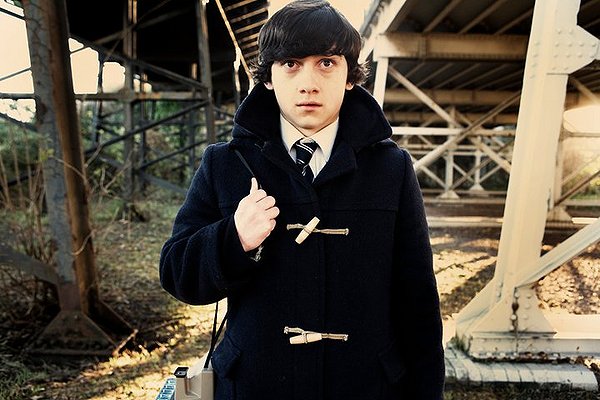 Debut director Richard Ayoade, who also adapted the screenplay, utilizes every visual trick in the book to tell this story. If the main character weren’t so amusing, and his plight so interesting, all the visual artifice might be exhausting. Instead it keeps the movie lively, crafty, and constantly wonderful to observe. Ayoade’s also quite a talent when it comes to screenwriting. He smoothly captures the very mannered speaking style of Oliver. Then there are just lines that make you laugh out loud from the sheer absurdity of misplaced teenager awe: “He wasn’t even considered hard until the Watkin twins famously stabbed him in the back with compasses. He said nothing; showed no discomfort as his shirt blossomed with blood poppies. His stoicism reminded me of the brave men who died in the First World War.” Ayoade, best known for his starring role on The IT Crowd, will probably soon have a lot more offers to direct features once people get a gander at Submarine. The man’s a natural storyteller and will be snapped up by Hollywood in no time flat.
Finally, the movie’s lead actor needs to be good, better than good, if this movie is going to rise above the din of precocious, coming-of-age cinema. Roberts (Jane Eyre), hollow eyed and just a little “off” looking, handles the material with ease, never letting his performance transform into a series of tics strewn together. Oliver is straight-laced throughout, letting the peculiarities of his imagination and worldview seem ordinary. Roberts doesn’t get overwhelmed by the material and makes a strong impression as a more literate, less rebellious, more anxious, less despondent Welsh version of Holden Caulfield (okay, so maybe that allusion doesn’t hold).
Submarine is an unfailingly entertaining vehicle full of quirk and humor and surprising heart. Oliver’s relationship with Jordana is sweet and mildly touching. I was surprised at how emotionally invested I was in their romance. The movie is also refreshingly low in angst, resorting more to Oliver’s comic anxieties and insecurities. It certainly owes a debt to Anderson’s Rushmore, but Submarine is so good, so thrilling in its creative voice, that it can stand outside the mighty shadow of Anderson and his indomitable influence.
Nate’s Grade: A-
Share this:

The Future (2011)
 Miranda July is a writer/performance artist/filmmaker whose unique voice earns as many praises of “precocious” as it does hails of “pretentious.” Her previous effort, 2005’s Me and You and Everyone We Know, had such oddities as a group of cars creating a caravan to save a goldfish left atop one’s roof and children engaging in online sex chat over sharing feces from behind to another ( ))<>(( is the visual articulation of this function). Yeah.
With her second feature film, The Future, we follow Sophie (July) and Jason (Hamish Linklater), a couple who decide to adopt an injured cat they find. Named Paw-Paw by Sophie, they must wait 30 days for the medical checks to clear before they can pick up the cat. They believe that they are doing a kindness and giving the cat a good place to live in its last month of life. Then the vet informs them that if bonded, the cat could live an additional five years. Sophie and Jason will be 40 in another five years, and this realization stops them cold in their tracks. Both are unhappy with their lives, he works as a technical help guru and she teaches dance to preschool-aged children. They decide that for the next 30 days they will reinvent themselves. They will take the road less traveled and see where it takes them. Jason volunteers to be an environmental solicitor on a whim. Sophie wants to do 30 dances in 30 days but is crippled by fear. She reaches out to Marshall (David Warshofsky), an older single dad who proves to be a source of unlikely temptation. Along the way to the conclusion of those 30 days, Jason will utilize his abilities to stop time, speak with the moon, an old T-shirt will crawl will come alive, and the story will be narrated at turns by Paw-Paw.
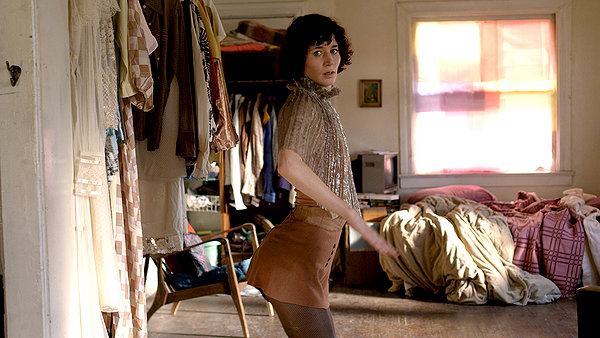 It should be obvious at this point that July is not going to be everyone’s taste. You could just as well furrow your brow at all these pseudo-intellectual bohemian artsy smartsy pretensions and make snide remarks under your breath. And I can’t say I’d blame you at points. However, if you happen to catch a ride on July’s funky wavelengths, then The Future becomes a poignant, observant, and occasionally profound rumination on human connection. July’s two main characters encounter a full crisis of self, fearing that their lives will essentially be over upon turning 35, which they reason is almost 40, which is practically 50, and all that back-half stuff is “loose change” (not enough to really get what you want). I believe I heard none other than Jessica Simpson herself utter a similar statement on her ill-fated Newlyweds reality TV show. She said, “I’m turning 23, which is practically 25, which is almost 30.” Perhaps Ms. July was also watching that episode, and if so this will be the only time in print that I congratulate Jessica Simpson for anything. This manufactured anxiety over doing something of worth and lasting value with your time on this planet is nothing new but it is deeply relatable, despite the silly numbers game the characters endure. It’s a paralyzing existential doubt. Who doesn’t want to feel like their life had purpose? You only get one. July makes a series of observant comments about human interaction. For their life project, Sophie decides to cancel the couple’s Internet connection. They have but moments, perhaps seconds left, before the Internet is lost to them for 30 days, and they scramble to open their laptops to do important stuff. “Only look up stuff we can’t find in books or by talking to people,” Jason intones. Slowly, both of them come to the same realization and close their laptops. It’s a silent admission that the technology we feel dependant upon might not be so.
There’s a striking clarity when an artist cuts through everything and finds something dwelling inside your grey matter. For me, July is that kind of artist. I loved a sequence where Sophie, out of slumming desperation, takes a job as a receptionist back at her old work place. One day two of her female friends come into the studio. Both women are several months pregnant, and Sophie is aghast that she let time get the better of her. She keeps shaking her head, rationalizing that it must have only been a couple weeks since last she saw her friends. Then through a series of edits, we witness a fantastic fantasy that highlights Sophie’s abject feelings of accomplishing little while time flies by. Every time the camera cuts back to the friends more time passes; we see them hold newborn babies, then we see those babies as kids, then as young adults, and finally as adults who themselves have married each other and wish to enroll their own daughter into pre-dance. They inform Sophie that their mothers passed some time ago. And all the while, Sophie is still in her dead-end job. It’s a terrific scene that highlights the anxiety we all feel about being lead footed in life, watching others skirt by and negatively assessing our own personal journeys by someone else’s accomplishments. The Future is full of moments like this that hit so hard you feel like the ground beneath you has vanished. Jason’s refusal to restart time is painfully identifiable, the wish to stay frozen in time to defer facing the hard pains of a breakup, the rueful knowledge that life will be forever different, and worse, in the passing of a second. The future can be a painful place we’d all like to hide under the covers and avoid.
Like July’s previous film, The Future is more a series of encapsulated vignettes, each with their own peculiarities, than a fully formed coherent story. While I enjoyed the separate vignettes better in Me and You, the overall story congeals better in The Future even if the results are messy. This is a less romantic and hopeful film than Me and You. It’s much more ambiguous (that’s saying something) and bleak when it exposes the missed chances that can haunt, none more so than Paw-Paw, our bandaged feline narrator. Scurry to the next paragraph if you’d like this part unspoiled for you, sensitive animal-loving readers. Paw-Paw speaks about her new sense of happiness, about having owners that will be kind to her, and this new sense of belonging fills the cat with a ballooning hope that her real life has finally begun. But then Paw-Paw doesn’t make it. She dies a day before either Sophie or Jason comes by to pick her up. But the cruel irony is that Sophie and Jason missed picking up their cat/metaphor of their relationship on its release date. Paw-Paw could have spent her last day on earth with the people she had yearned to be with, the people she wrote an imaginary letter to telling them how grateful she was and how much she promised to love them. Instead, the cat dies, forever waiting. That’s pretty rough, and even though July’s scratchy, high-pitched Paw-Paw voice can be annoying, God help me if the pet lover in me wasn’t in tears every time this damn cat was narrating, including after its death. That’s the kind of film The Future offers. It does not dish out easy answers for life’s Big Questions. Even as the end credits roll, you’re left to ponder whether you believe that Sophie and Jason will reconcile.
 July, resembling a cross between Kristen Schaal (Dinner for Schmucks) and Juliette Binoche (The English Patient), is probably also her biggest hindrance. She’s not that developed as an actress, or is being purposely opaque, and thus Sophie seems to be lost in a medicated fog. This was less of a problem with Me and You because the ensemble was larger. Here, it’s mainly three actors. July delivers every line in a flat style that makes her character harder to decipher and harder to empathize with when she goes off into her affair. The entire storyline with the sign making “other man” is kept at a mystery. We’re not really sure why Sophie would be attracted to this man or what problems are ailing her relationship with Jason. I suppose the early mid-life crisis could serve as a fire to get Sophie to reach out to someone who offers more security, but that’s merely my best estimation. It’s a detour that could use more attention to explain its significance. I suppose it could be July’s version of a romantic comedy staple of being with the wrong man and finding out late your mistake. It’ll be up to the viewer which guy fills the role of “wrong man.” Luckily, Linklater (TV’s New Adventures of Old Christine) is a winning presence, affable without being offbeat and striving for meaning without coming across as pompous.
Whether it’s a dance inside an oversized T-shirt or choosing a song to communicate undying love in the event of amnesia, The Future is chockablock with memorable moments, images, insights, and peculiarities. Whether all of that comes together into a fully realized movie is another matter. The scattershot nature and July’s own acting shortcomings clip the film’s momentum, but the uniqueness of voice and observant vision of July as writer/director makes me forgive much of The Future’s faults. It’s not exactly an easy sell of a movie, especially to concerned pet lovers, but July is one of those polarizing artists I’m glad finds the time to empty their brain every now and then. I may not fully understand everything but The Future held enough promise for me to leave feeling satisfied.
Nate’s Grade: B+
Share this:

Beginners (2011)
 Burying a parent is one of the most gut-wrenching hardships of life, a passage I have thankfully not had to endure yet in my own life. Writer/director Mike Mills (Thumbsucker) turned his own heartbreak into a subdued, life-affirming movie called Beginners. This gentle movie is comic, poignant, and frustratingly limited thanks to a miscalculation in its structure.
Oliver (Ewan McGregor) is reeling from the loss of his elderly father, Hal (Christopher Plummer). After the death of his wife, in his seventy-fifth year, Hal came out as being gay his whole life. And he decided to have some fun in those last years too, notably with a hunky younger boyfriend (Goran Visnjic, remember him, ER fans?). We get several flashbacks with Oliver and his ailing father, who was diagnosed with stage four lung cancer soon into his gay reemergence. In the present, Oliver, as a dissatisfied graphic designer, is trying to find his bearings after burying both of his parents. Hal’s dog, a Jack Russell terrier, is mourning as well, refusing to be left alone. As a result, Oliver takes the small dog with him wherever he travels, including social events. He meets Anna (Melanie Laurent) at a friend’s costume party. He’s dressed as Sigmund Freud and she mimes having laryngitis. Anna, a young actress who spends most of her life in hotels, invites him back and the two explore the possibility of a relationship. She’ll be off to another film shoot in a month, but the two become inseparable during the time they have together. Anna learns about Oliver and his complicated relationship with the complicated man he knew as his father. Oliver, and in flashback Hal, are beginners on a road to making sense of their lives.
 What eventually holds Beginners back is its clipped structure. The film diverges into two main storylines, father and son (60%) and son with new love (40%). The new love stuff is presented fairly linearly, however, the father/son material is not, consisting of memories that can be triggered by objects or offhand sayings. Like (500) Days of Summer, memories are presented not in a linear fashion but through a connection of theme or tone. Rarely do we recount memories in a chronological fashion, and as such Oliver is beset by deluges of images of his father ailing at various points. But it’s like Mills took that fleeting memory approach to heart because Beginners is a slave to the altar of jump cuts. The editing, and the narrative, is constantly leaping forward; scenes rarely last longer than 30-45 seconds, making the film feel like somebody had their finger mashed against a stubborn fast forward button. As a result, the film feels hurried and unsettled, and this clipped structure mollifies the emotional impact of the movie. It’s because the romance only feels like someone’s remembrance of those burgeoning happy beginnings. The film doesn’t feel like it is in its own present; we’re in 2003 and Oliver will occasionally inform us, in High Fidelity-styled notation, of life at that moment. It feels like the entire enterprise is an assembly of past memories ping-ponging off one another. Another hurdle is that Anna and Oliver’s main conflict concerns their fear of happiness. Each had parents who wed as unhappy people, had unhappy unions, and both are fearful that they too will commit to living unhappy lives. It’s not an impossible feat, to be sure, but it does make it somewhat harder to relate to your characters when the main relationship problem is that they cannot accept happiness. While psychologically interesting in larger scope, due to the structure of Beginners, this conflict for Anna and Oliver seems petty and insufficient. The antsy story structure limits the emotional resonance of the movie. What should be a nourishing meal about the human condition ends up being a tidy snack instead.
Don’t get me wrong, Beginners is still a fairly moving film in its own right. Just the very nature of the story, dealing with the last months of an ailing parent and what to do next, is destined to hit poignant pockets of drama. Plus you have gifted actors doing fine work to wring out those tears. Mills’ tale is semi-autobiographical, which allows for several personal insights that can wound, like direct shots of honesty. Oliver narrates the steps taken after a parent’s death, including the mundane yet painful trivialities needed to convince every bill collector that their client has left the Earth. When Hal is informed that he has a spot of cancer the size of a quarter in his lung, the screen flashes to black as the doctor continues her somber diagnosis. A quarter appears. Then five nickels, finally twenty-five pennies. It’s a small little visual insert, and yet it manages to seem like a believable, personally relatable moment when delivered such thundering news. Something the size of a quarter will be responsible for your father losing his life. Five nickels. Twenty-five pennies. The scenes with father and son, coming to terms with saying goodbye, reflecting on lives lived and lives deferred, is what gives Beginners its beating heart. The clipped present-day romance plays more like a post-script attempt to forge a neat resolution after all that heavy grief.
Plummer gives a performance that is equal parts weighed with the gravity of death and the electricity of life. After his wife’s death, Hal finally has an opportunity to embrace who he has been his whole life. Mills and Plummer are delicate with how they handle the relationship between Hal and his wife (Mary Page Keller in flashback). Neither hated the other, and both did express love, but they were together in a marriage of convenience, both of them hiding who they were from preying eyes (Oliver’s mother hid that she was Jewish). Plummer’s celebration of life, the twinkling realization of accepting who you truly are, is an uplifting path for his character, and thanks to both Mills and Plummer it never feels like he’s dancing on the grave of his long-suffering wife. He’s not celebrating her death; he’s embracing who he is in the twilight of his years. He’s looking for a small amount of kindness and comfort while finally being socially recognized without fear or intimidation. Plummer is delightful during Hal’s happier moments and heart wrenching during the realities of his failing body. Plummer deftly bites into one of those juicy, Oscar-bait roles.
 McGregor acts very well even if his character is kept in a very tight box of emotional expression. His character seems to sleepwalk from scene to scene; often little is said and much left to the imagination through pregnant pauses or gestures. McGregor does a fine job of balancing the different timelines of grief his character is experiencing. He’s in comic shock about his father’s newfound immersion in a gay lifestyle, he’s in mourning about the recent loss of his father, he’s in annoyance tinged with guilt about the burdens of taking care of a man that was often absent in his own life, leaving him in the care of his mother, resigned to a life of dutiful despondency, and he’s infatuated with the possibility of romantic love, a cleansing force. It’s a lot for one actor to keep straight and McGregor does an admirable job. Laurent does not fare as well. The Inglourious Basterds‘ actress is forced to rely mostly on wry smiles and her penetrating eyes. She also cocks her head to the side a lot, or a least that’s how I recall. She’s given something of a thanklessly underwritten role but she manages to be adorable from her first moment onscreen, which is her most vital acting accomplishment here. She’s supposed to be that happy ending we want Oliver to have.
Beginners is a moving, charming, and perceptive movie. If only there was more of it. The clipped, hurried jump cut-heavy structure keeps the audience at a certain distance and capping the emotional resonance. The father/son stuff is going to be easier to empathize with, both good times and bad, than two good-looking thirtysomethings afraid of being happy because their parents are screwed up. Ultimately, the film’s pretenses of a budding, quirky romance will take away from the more genuine father/son bonding late in life. You’ll get weepy at turns, maybe even swoon here and there, but the rewards are sadly too momentary, never cohesively assembling into a full-fledged narrative. Beginners has an equal number of hard truths and light moments of whimsy (the subtitled dog is a hoot), but ultimately it’s a movie that makes you wish it had left a better impression when it had the chance.
Nate’s Grade: B-
Share this:

Dogtooth (2010)
 Dogtooth is a surprising, sometimes shocking, sometimes maddening vicious little film that serves up dark satire with plenty of tense, incredulous laughter. But make no mistake; this is no comedy in the traditional sense. This Greek flick is deceptively slow-witted, drawing us in to a very different world. The film chronicles the three teenage children (one older brother, two twin sisters) kept at home in isolation by their parents. These kids have been taught to fear the outside world, they have been taught erroneous vocabulary (a “zombie” is a yellow flower; a woman’s privates are known as a “typewriter”), they believe that cats are man-eating beasts, that Frank Sinatra is their grandfather singing to them, their dead little brother lives on the other side of a hedge that they toss food to, and that overhead planes can be plucked from the sky. They even have to get on all fours and bark to scare away intruders. And then there’s a troubling budding sexual element, made considerably more complicated once the woman the father hires to satisfy his son introduces sexual curiosity to the twin sisters. Dogtooth is a detached yet fascinating portrait of one seriously screwed up family, where children are trying to make sense of the limited and sometimes fantastical concepts they’ve learned through severe sheltering. This manufactured artificial world, a satiric swipe at those who believe ignorance to be a suitable protection, is perilous yet believable. Dogtooth raises plenty of questions about the nature of society, parenting, knowledge, responsibility, and identity all in a package of bleak social satire that Luis Bunuel could admire. It may take some effort, but give yourself over to this Greek oddity and enjoy the unique weirdness.
Nate’s Grade: A-
Share this:

Scott Pilgrim vs. the World (2010)
 What happens when the millennial generation gets its own (attempted) seminal movie? It stays home and plays video games, letting the film, Scott Pilgrim vs. the World, languish at the box-office. I guess that’s what happens when you finance a movie whose target demographic will just as readily download the movie for free off the Internet.
Scott Pilgrim (Michael Cera) is a 22-year-old Toronto slacker. He?s the bass player for the band Sex Bob-Omb, along with lead singer Stephen Stills (Mark Webber) and acerbic drummer Kim (Alison Pill), a former ex-girlfriend of Scott’s from high school. The band’s biggest fan is 17-year-old Knives Chau (Ellen Wong), who also happens to be Scott?s new girlfriend. The world of Scott Pilgrim is abuzz with this scandal, especially Scott’s gay roommate Wallace (Kieran Culkin) and Scott?s younger sister (Anna Kendrick). Scott insists it’s all on the level and he has no ulterior motives for dating a high schooler. Then he sees the mysterious and alluring Ramona Flowers (Mary Elizabeth Winstead) who?s new to the area and American. Scott rabidly pursues her in what could best be described as stalking, eventually getting her to agree to date him. Trouble is, he hasn’t broken up with Knives just yet before starting this new venture. Scott is then confronted at the Battle of the Bands concert by a man who comes bursting out from the ceiling. He is the first of Ramona’s seven evil exes and Scott must defeat them all in order to earn the right to the violet-haired beauty. “Everybody has baggage,” Ramona says. “Yeah, but my baggage doesn’t try and kill me,” Scott wearily replies.
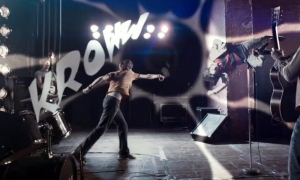
 Visually, this movie showcases director Edgar Wright (Hot Fuzz, Shaun of the Dead) using every crayon in the Crayola box. This is a visually resplendent film where every scene seems crammed with details to delight the eyes and light up the senses. It’s a rush to watch the kaleidoscope of colors and motions. The Scott Pilgrim universe clearly differs from our own. This is a realm that borrows heavily from old school video games, where people burst into coins when vanquished, where life-decisions are met with “leveling up,” where people have onscreen pee bars that will deplete after a trip to a urinal. Sound effects will routinely be verbalized on screen, everything from a “RIIIIIIIIIIING” of a telephone to the “Ding Dong” of a door. It’s amusing, though also easily overused. Jobs and stuff like that are for the real world, hence too square to be depicted. It’s this entire idiosyncratic comic book world treated like everyday reality.
The enormous display of style is impossible to ignore. Scott Pilgrim is a slick, flashy piece of entertainment that is riddled with nostalgic references for a select crowd. I appreciated how a nice walk was accompanied by the theme song from The Legend of Zelda, or that sound effects and onscreen graphics echoed the fights from Street Fighter II (don’t ask me which of the 800 versions). Scott Pilgrim is an excellent pop pastiche of a specific culture, namely a slacker, hipster, amiable, comics and gamer group. I myself was an avid Nintendo gamer back in my day, but I admit to waning interest when the games got too complicated and grisly (“Back in my day we had two buttons to push, one to jump and the other to shoot, and that’s how we liked it!”). The movie is an explosion of color, light, and (lo-fi garage rock) sound, which also might sound like the description of a seizure or a stroke to some. Like those ailments, Scott Pilgrim will be seen by some as an infliction. It’s hyperactivity and eagerness to please via nostalgic reference points will be what drives people to this film and what drives them away in equal measure.
The Scott Pilgrim graphic novels total six volumes and approximately 1200 pages, which means it?s not the easiest fit for a two-hour window. It also hurts that the Pilgrim books have a wide supporting cast of characters to tussle with, plus there?s the whole seven deadly exes thing which means the movie has to provide about a solid 20 minutes of set-up before finding enough time for seven antagonists (or boss battles, following gamer parlance) and a reasonable amount of resolution. Add on top of this the fact that Wright keeps the movie moving at an outrageous, ADD-addled pace, like the plot conveyor belt lever got broken and the scenes speed one after another. Everything about this movie feels fast and over caffeinated. The editing in particular has characters holding conversations where every line is in a new location, implying an added sense of movement. So you shouldn’t be too surprised when the Scott Pilgrim film feels like a whole lot of a little; it’s moving at the speed of light to entertain.
 Because of the plot mechanics and oversized cast of characters, Pilgrim can give off the impression of shallowness. It seems like all style and little substance and that’s because the movie attempts to cram an entire series of stories, back-stories, and conflict into two hours. The film version only has enough time to attempt to give Scott and Ramona characterization, though both come across as weak-willed, tentative, and less than charismatic, wondering if either party is worth the trouble. The movie tries to paint over these differences through distraction and force of will. The large cast of supporting players all elbows each other just to be mouthpieces for one-liners. Knives actually comes across as the most complete character, consumed by her infatuation, heartbreak, and then quest for misguided vengeance. She’s somewhat dismissed and yet she is the most developed person on screen thanks to Wong’s endearing and relatable performance. The entire experience of Scott Pilgrim vs. the World can be somewhat fatiguing when there’s little evidence presented for emotional investment. The books supplied the reasons for caring besides the whole underdog angle.
The movie aims to be a battle over love, but it’s not entirely convincing. Scott appreciates Knives because she’s simple, a relationship he doesn’t have to invest much within, something casual and enjoyable while it lasts or until it becomes too taxing. Then he goes ga-ga for Ramona and stalks her, wearing down her defenses. He’s purely smitten with her and willing to do whatever it takes to earn her affections, though he can?t explain why he feels this way. Here’s a note to screenwriters: when characters are asked why they love somebody, do not have them say, “I don’t know.” But for Ramona, Scott is her Knives. He’s something easy that won?t break her heart, an escape from the jerks she’s been dating before. He?s low maintenance. He’s something to pass the time. There’s an interesting dynamic here, made even more complicated by the fact that Scott’s time with Knives blended with his time with Ramona. There was not a clear end point. The movie takes a literal approach to the idea of love being a destructive force of nature. Scott is punished throughout because of his infatuation with Ramona, but he persists despite the bruises. And he doesn’t even really know much about her. There’s an interesting statement somewhere there about the punishment we endure, sometimes foolishly, over the affections of people we may love, or convince ourselves of, but not even like.
 It may sound peculiar but I’m paying Michael Cera a compliment by saying his performance in Scott Pilgrim is the least Michael Cera the actor has ever been on screen. Gone is his gawky, awkward, ironic shtick that has fast become the Cera persona in films like Superbad and Year One. Scott is unjustifiably confident in his life’s pursuits, and Cera gets to act cocky and quippy, even if it?s done with a wink. He?s an unlikely kung-fu star but then again he?s also an unlikely leading man. Winstead (Live Free or Die Hard) is cute but plays her part a bit too toned down, like Ramona’s still searching for the right medication combination. Culkin and Pill are both scene-stealers of the first order, doing so with unabashed and flippant sarcasm. Every scene is made better by their presence. Among the evil exes, Brandon Routh (Superman Returns) has plenty of fun as a dim-witted super-powered Vegan bassist (“Vegans are just better than other people”), and Jason Schwartzman epitomizes hipster snark with such relish. The film is exceedingly well cast from top to bottom.
I’ve read some reviews positing that Scott Pilgrim vs. the World is an elaborate fantasy taking place in the mind of its titular hero, that he blends his knowledge of comics and video games to help make sense of the troubled waters of relationships and lingering hurt from the demise of love. I think that’s a nice explanation but perhaps trying too hard to frame this film as some form of psychoanalytical commentary on modern youth’s interpersonal relationships and the value of love. Scott Pilgrim vs. the World is really just a spastic, hip, clever wank that, as presented, gives little room or emotional investment. It?s a blurry, messy, prankish good time at the cinema that doesn’t translate into much more than the equivalent of sensory button mashing (video game reference). It’s fun while it lasts but it doesn’t have much beyond those astounding visuals to make it feel lasting, and I say this as a genuine fan of the graphic novels by Bryan Lee O’Malley. Alas, heavier discussions about the thorny, maddening issues of love are better left to more dramatic, and romantic, movies like Brokeback Mountain, Eternal Sunshine of the Spotless Mind, and even WALL-E. This movie is more preoccupied with spinning as fast as it can and then vomiting.
Nate’s Grade: B


 nathanzoebl
You must be logged in to post a comment.