Blog Archives
Lady Bird (2017)
 Coming-of-age movies typically coast on a combination of mood, sense of place, and character, and Greta Gerwig’s Lady Bird excels in all areas and supplies a straight shot of happiness to the senses. Gerwig serves as solo writer and director and tells a semi-autobiographical story of “Lady Bird,” a quirky, determined, feisty, self-involved, and vulnerable teenager (Saoirse Ronan) trying to leave the lower-middle-class confines of her Sacramento life for bigger pastures. Ronan (Brooklyn) is spectacular in the title role and displays a heretofore-unseen sparkling sense for comedy, punctuating Gerwig’s many witty lines with the exact right touch. This can be a very funny movie and it has a deep ensemble of players. Ronan’s character is a magnetic force of nature that commands your attention and finds ways to surprise. The film follows her high school senior year’s ups and downs, potential new friends, bad boyfriends, social orders, family struggles, jobs, and most importantly her dream of getting into an East Coast college and leaving the trap she sees is her hometown. Her parents (Laurie Metcalf, Tracy Letts) are stressed and exasperated with their demanding daughter. Metcalf (TV’s Roseanne) is outstandingly affecting as the beleaguered matriarch. Much of the movie’s ongoing conflict, and later triumphs, revolve around the fraught mother/daughter relationship, and Ronan and Metcalf are never better than when squaring off. This is a movie rich in authentic lived-in details and observations. It can stray into overly quirky territory but Gerwig as director has a remarkable feel for when to hold back. There’s a genuine and poignant family drama at its heart that doesn’t get lost amid the whimsical additions that cater to Lady Bird’s vibrant personality. By the end of a coming-of-age movie, the characters should feel a little wiser, having learned through heartache, bad choices, and changes in perspective. This isn’t a movie about big moments but about the ebb and flow of life and the formation of one’s sense of self. We should enjoy having spent time with these characters on their journeys. With Lady Bird, I couldn’t stop smiling like an idiot.
Nate’s Grade: A-
Share this:

The Killing of a Sacred Deer (2017)
 Greek filmmaker Yorgos Lanthimos might just be the most perversely ingenious creative mind working in movies today. After Dogtooth and The Lobster, I will see anything that has this man’s name attached to it, especially as a writer/director. Lanthimos’ latest, The Killing of a Sacred Deer, is a challenging revenge thriller, a macabre comedy, a morality play, and a generally uncomfortable watch that is just as alienating as it is totally brilliant.
Steven Murphy (Colin Farrell) is a heart surgeon with a loving family that includes his wife, Anna (Nicole Kidman), teen daughter Kim (Tomorrowland’s Raffrey Cassidy), and young song Bob (Sunny Suljic). Then there’s Martin (Barry Keoghan), the lonely son of a patient who died on Steven’s operating table. He won’t leave Steven alone and doesn’t understand boundaries, even trying to hook up Steven with his lonely mother (Alicia Silverstone, yep you read that right). Martin even takes an interest in Kim. However, once Steven’s son falls victim of a mysterious illness and becomes paralyzed, Martin makes his true intentions clear. He’s poisoned all three of the Murphy family members and they are destined to die slowly unless Steven kills one of them. He has to choose which family member’s life to take with his own hands, or else they all die.
 It’s hard for me to think of whom exactly to recommend this movie to because it is so intentionally off-putting. It’s intended to make you awkwardly squirm and question what you are watching. This will not be a fun watch by most accounts unless you’re a very select person who has a dark sense of humor and an appreciation for something different. Lanthimos seems to be purposely testing his audience’s endurance from the start. We open on several seconds of black to test our patience and then an extended close-up of real open-heart surgery. My pal Ben Bailey had to shield his face from the screen. From there, the movie defies your expectations at most turns and digs further into its depths of darkness. This is one of those movies where you wonder whether it will go “there” and it most assuredly goes there and beyond. One minute you’ll be cringing, the next you’ll be cackling, and the next you’ll be deeply unsettled, and then maybe back to laughing if you’re like me. Much like Lanthimos’ other movies, his deadpan sense of comedy is his prescription for an absurd world. It’s a movie where you have to actively work to adjust to its bizarre wavelength, but if you can, there are rewards aplenty. I can’t stop thinking about it.
Unlike The Lobster, this doesn’t exist in a completely parallel universe but more of a cracked, heightened version of our own. Lanthimos’ breakout film, 2009’s Dogtooth, dropped the audience into a strange world and expected us to catch up. This is similar. The flatly comic conversations become a sort of absurdist poetry. Everyday moments can be given one extra strange beat and become hilarious. Scene to scene, I didn’t know what would happen. The movie allows its story to properly breathe while finding room for its characters to discover intriguing diversions and insights, like Martin’s recollection of how he and his father eat spaghetti the same way. There’s an unusual sexual kink that involves giving oneself completely to another that makes more than one appearance, enough to question the connection between them. The very geneses of that kink I think alligns with a character’s god complex, but that’s my working interpretation. It made me rethink about the aberrant concepts of sexuality in Dogtooth, a.k.a. the nightmare result of helicopter parenting. The handling of pubescent sexuality, and the idea of incorrectly applying information learned from other settings, is just one more tool to make the audience uneasy. Killing of a Sacred Deer exists in a closer approximation of our world in order for there to be a better sense of stakes. Somebody is going to die, and if Steven cannot choose then everyone will die. This isn’t a fantasy world but a real family being terrorized by a demented and vengeful stalker. This gangly teenager is more terrifying and determined than just about any standard slasher villain.
 This is a modern-day Greek tragedy literally inspired by an ancient one. Prior to the Trojan War, Agamemnon was hunting and killed one of the sacred deer belonging to Artemis. The angry goddess stranded Agamemnon’s ships and demanded a sacrifice in order for the winds to return. He had to choose one of his family members to kill, and Iphigenia got the short end of that one. Euripides’ classic work gets a fresh retooling and Lanthimos is not one to merely stand on ceremony. He smartly develops his premise and takes it in organic directions that feel believable even given the ludicrous circumstances. That is Lanthimos’ gift as a storyteller, being able to make the ludicrous feel genuine. After the half-hour mark, where Martin comes clean, the movie really takes off. Does Steven tell his family and how much? Does he take matters into his own hands to convince Martin to stop? Is he actually culpable for the death of Martin’s father? Once the reality becomes clear and people starting getting increasingly sick, the movie becomes even direr. Steven is given the unenviable position to choose life and death, though he frequently shucks responsibility and only continues to make matters worse. Once his family comes to terms with the reality of Martin’s threat, they each try different methods to argue their personal favor to dear old dad. They vie to be father’s favorite or, at least, not his most expendable loved one. It’s a richly macabre jockeying that had me laughing and then cackling from the plain absurdity. Lanthimos presents a tragedy and forces the audience to simmer and contemplate it, but he doesn’t put his characters on hold either. They are adapting and have their own agendas, mostly doing whatever they can to campaign for their lives at the expense of their family (Vin Diesel’s Fast and Furious character would loath this movie with a sleeveless fury).
The end deserves its own mention but fear not dear reader I won’t spoil it. It’s a sequence that had me literally biting my own hand in anxiety. I was pushing myself backwards in my chair, trying to instinctively escape the moment. It’s the culmination of the movie and feels entirely in keeping with Lanthimos’ twisted vision and the depiction of Steven as a weak man. There’s a strange sense of inevitability to it all that marks the best tragedies. I don’t know if I’ll sit through a more intense, uncomfortable few minutes in 2017, and yes I’ve seen, and appreciate, Darren Aronofsky’s mother! of difficult 2017 sits.
As much as this is a thriller it also feels just as much a satire of overwrought Hollywood thrillers. The killer isn’t some shadowy evil genius. He’s just a very determined teenager in your neighborhood. There are several moments that are difficult to describe but I know Lanthimos is doing them on purpose as a critique of thrillers. At the end, a character shakes a generous heaping of ketchup onto a plate of French fries, and we’re meant to get the lazy metaphor of the sloshing ketchup as spilled blood. However, under Lanthimos’ heavy direction, the shot holds longer, the accompanying soundtrack becomes an operatic crescendo, and the whole thing turns comic. Lanthimos has to know what he’s doing here, commenting on the lazy symbolism of dread in overwrought thrillers. There’s another instance where Martin has severely bitten into Steven’s arm. Martin’s apologetic and promises to make it right and then proceeds to bite a chunk of flesh out of his own arm and spit it onto the floor as an offering. That would have been creepy enough but then Lanthimos goes one step further. “Get it, it’s a metaphor,” Martin explains. It’s one in a series of moments where Lanthimos goes a step further into pointed genre satire. It’s possible I’m reading too much into the rationale behind some of these oddities but I don’t really think so. It seems too knowing, too intentional.
 The Killing of a Sacred Deer is a movie that invites discussion, analysis, and just a general debriefing in the “what the hell did I just watch?” vein. This is a movie experience that calls upon the full range of human emotions, and sometimes in the same moment. Lanthimos’ modern Greek tragedy serves up a self-aware critique of its own genre, as he puts his personal stamp on the serial killer thriller. This is also an alienating film that doesn’t try to be accessible for a wider audience. It almost feels like Andy Kaufman doing an experiment replicating Stanley Kubrick (and it was filmed in Cincinnati). Even if you loved Lathimos’ most high profile work, The Lobster, I don’t know if you’d feel the same way about Killing of a Sacred Deer. It wears its off-putting and moody nature as a badge of honor. I found it equally ridiculous and compelling, reflective and over-the-top, sardonic and serious. Dear reader, I have no idea what you’ll think of this thing. If you’re game for a demanding and unique filmgoing experience and don’t mind being pushed in painfully awkward places, then drop into the stunning world of Lanthimos’ purely twisted imagination. Killing of a Sacred Deer just gets better the more I dissect it, finding new meaning and connections. If you can handle its burdens of discomfort, The Killing of a Sacred Deer is one of the most memorable films of the year and also one of the best.
Nate’s Grade: A-
Share this:

Brigsby Bear (2017)/ Dave Made a Maze (2017)
 One way to stand out in a crowded marketplace is to differentiate your movie by making it weird and whimsical. Just being different can grab your attention, and Brigsby Bear and Dave Made a Maze are definitely different. Both of these indie films attracted attention for their unusual concepts and lo-fi designs, banking on a sense of nostalgia for a homemade style of art that’s a little rough around the edges. These might be two of the strangest films that will be released in 2017.
James (Saturday Night Live’s Kyle Mooney) is living underground with his parents, April (Jane Adams) and Ted (Mark Hamil). He does his homework, listens to his parents about never going outside, and anxiously waits every new episode of Brigsby Bear, a children’s fantasy TV show starring a Teddy Ruxbin-looking bear that teaches life lessons. Eventually we discover that April and Ted are not, in fact, James’ parents. They abducted him when he was a baby. The FBI raids their compound and returns James to his biological family, the Popes (Matt Walsh and Michaela Watkins as mom and dad, Ryan Simpkins as younger sis). James just wants to know when the next episode of Brigsby will come out. Unfortunately for James, Brigsby isn’t real. Ted produced the show on a nearby sound stage. He’d even occasionally hire other actors. James is the world’s most knowledgeable fan of a TV show no other person knows one iota about. He’s determined to give it a proper ending and recruits family, friends, and neighbors to make the ultimate Brigsby movie.
 I was pleasantly surprised at how effectively Brigsby Bear was at being cheery and sincere. I was expecting, given the premise, an ironic riff on nerd culture or obsessive fandom, and Mooney and company instead decided to play things very seriously. They take a fantastic premise that seems begging for derisive commentary and choose to find a human story within the absurd. That’s much more commendable and harder to achieve. As I’m aging, I’m becoming more and more appreciative of sincerity over irony (part of this is also that our modern age is inundated with irony). I was reminded of last year’s Swiss Army Man, an alarmingly strange movie with Harry Potter’s farting corpse and went for sincerity without any whiff of detached irony. Brigsby Bear isn’t at the same level of artistic accomplishment and lasting power as Swiss Army Man, but it’s an unconventional and touching movie that earns its quirky-yet-feel-good emotions.
It’s easy to see where this story could have exclusively dwelt in psychological darkness. James was abducted as a child and raised in a strange environment that makes him emotionally stunted and grossly ill prepared for the real world outside his reclusive safe space. The movie could have understandably dealt with James’ crippling sense of loneliness, betrayal, and inability to assimilate since his sense of self were cultivated by a fake children’s TV show. He could have easily been the creepy oddball who makes people uncomfortable. Instead, they made him the goofy oddball who makes people smile. His childlike sense of wonder is in tact and frees him from self-doubt. James is remarkably cheery for having his world turned upside down, and the movie follows his lead. This movie could have been another perplexing Dogtooth and instead it’s more accurately reminiscent of those old Mickey Rooney “we’re putting on a show” pictures. I was waiting for a moment of artificial conflict, a darker plot turn late into the film where perhaps it’s revealed that Ted was a molester. There’s 700 episodes of Brigsby Bear so I figured a few of them would reveal disturbing clues about something even worse. The film never does take that darker turn and instead stays upbeat to the very end.
 As he adjusts to his new home, the movie serves as both a delayed coming-of-age movie and a love letter to the power of creativity and how it can build community. With James transported into the outside world, much is made over his awkwardness with human interactions and his complete lack of guile. He gets his first kiss with a girl, and shortly after his first handjob, and wonders if that means they have to get married. It’s a sweetly naïve reflection. We watch the growing pains of James as he starts to make friends and become more confident in himself, which is a surefire way to win over an audience. James isn’t held up for ridicule. People want to be part of his project. He’s overcoming adversity and triumphing through the transformative power of art. There’s a joy in watching characters find themselves anew, and James serves as the catalyst. This person knows how to do special effects. This person used to act when they were in college. In his heartfelt attempt to provide closure to the Brigsby series, and possibly a chapter in his life, James’ project takes on a life of its own that brings people together. It shows how the community of art can be an empowering venture that can freely inspire the best in others.
The movie doesn’t become overly reliant upon nostalgia either. I figured it would be an ode to 80s television and culture but it really just uses that as backdrop. The world building of the show of Brigsby is bizarre and entertaining every time it’s included, especially when you comprehend the propaganda messages that Ted is sneaking in like, “Curiosity is an unnatural emotion.” The sense of wonder and whimsy doesn’t overwhelm the movie and its poignancy. Director Dave McCary (Saturday Night Live) makes the most of the retro pastiches while still serving the story. James could just have easily been obsessed with any show or ongoing work of art. The content of the show is unimportant. It’s about facilitating his growth into a person comfortable and confident with whom they are. By the end of the film, I was fighting back tears as the full assembly of characters watches the finished product of their labor. You watch them smile, laugh, take a sense of pride in their communal efforts, and they can see the world as James does. It’s a whole-heartedly pleasurable movie with surprising currents of emotional uplift.
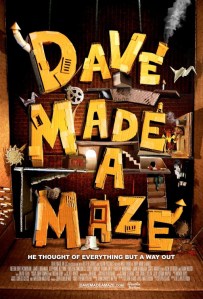 With Dave Made a Maze, the titular Dave (a beardless Nick Thune) is lost in a maze that he built in the apartment he shares with his beleaguered girlfriend, Annie (Meera Rohit Kumbhani). This maze consists of a cluster of cardboard boxes taped together. In time, a group of their friends and even strangers have assembled to admire the maze. Dave warns them not to enter but they do so anyway, and once inside they realize that the maze is considerably bigger and byzantine, and everyone expectedly gets lost. Annie and a documentary crew travel (lead by James Urbaniak) deep into the maze to rescue Dave. They all must confront booby traps, a Minotaur, thirty-something existential ennui, and the unsettling realization that the maze is expanding all on its own.
The real star of Dave Made a Maze is the fantastical environment inside the maze. The resourcefulness, imagination, and implementation of such a bizarre vision on such a limited budget is incredible. Each new room offers a new opportunity for the surreal. The characters stumble from room to room in mixtures of awe and bemusement, and the audience will feel the exact same way. Production designers Trisha Gum and John Sunner, and Art Director Jeff White, come from a world of animation, and they’re meticulous attention to detail pays off to an astonishing degree. In a just world, they would be nominated for an Oscar. There’s a DIY inventiveness that carries an irresistible charm with it, re-purposing everyday items to create a unique and whimsical world. Even when people are being gored to death and dismembered it adheres to the whimsical tone. The blood is replaced by red yarn, confetti, and silly string. The movie smartly underplays the lack of consistent logic within the world of the maze, and so weird things can just happen at a moment’s notice, like the main characters turning into puppet versions of themselves made out of paper lunch bags. There’s even a half-finished maze within the maze, which draws derision from the tired and frustrated people just seeking a way out. Some of the weirdness feels too half-formed and self-conscious, but the movie has an Eternal Sunshine quality where each new location provides another enjoyable opportunity for potential discovery.
 Where Dave Made a Maze runs into problems is when you realize there isn’t anything beyond that sense of invention. There isn’t a larger thematic core to this movie and the characters remain, at best, background players elevated to starting status. Most of these characters are jokes but they don’t even supply much in the way of jokes. The closet to a substantive theme is simply an arrested development fable where the man-child is struggling to finish a laboring artistic accomplishment, he feels humbled and humiliated, and his strained relationship with his accommodating girlfriend will always come together in the clincher. Dave lashes out that he didn’t feel like an adult at 30, so maybe he retreated to the halcyon days of childhood, or maybe it was a nostalgic retreat. Whatever the case may be, the movie suffers from an inevitable lull once the giddy novelty of its DIY fantasy starts to wear off. There’s one sequence where Dave and Annie have a circular conversation that just keeps going, and I’m sure if the filmmakers weren’t so desperate for material that it would have been trimmed down significantly.
Even at 76 minutes before credits, this is a movie that feels stretched beyond the limit because it’s lacking greater consideration to story. There are jokes that feel like they should be funnier too, like a latecomer to the maze who sets off the traps that Dave warns about earlier. This should be a fun structural payoff, allowing us to see both sides of the rooms. It doesn’t really work out that way, and the bumbling latecomer becomes another relatively unmemorable and undeveloped body on screen taking up space. The documentary crew conveys some mild satire as the crew leader keeps prodding others into saying what he needs for his movie, but even this inclusion feels more like a transparent device to get the characters to talk through plot points. Another misfire is the curious lack of stakes. The movie has a light-hearted charm but then doesn’t ever quite make up its mind on the danger being confronted. Real friends die for real. By the end of the movie, they do not come back even after the maze is kaput. They are really dead. Yet the film plays the stakes at a low simmer and the survivors just sort of shrug and move on. The film gives me little reason to be attached to any of these people, alive or dead.
 Whimsy is a fleeting feeling that’s hard to conceive and harder to hold onto. Both movies take whimsical premises that cater to the peculiar but only one delivers something of lasting substance. Brigsby Bear is a charming, heartfelt, and exceedingly sincere movie about an oddball finding his place in the world through the power of the creative process. He is transformed through his love of art and how that serves as the foundation for community. Whereas Dave Made a Maze is a lo-fi curio that I can admire more than enjoy. It’s missing crucial elements that make its journey worth the effort, beside its imaginative and scrappy production design. Both movies are charged by the power of the imagination to transport the ordinary into the extraordinary. Brigsby remembers to use its flights of imagination and whimsy to tell an engaging and ultimately touching story. Dave Made a Maze has cool sets and some infectious silliness. If you see one story of a man-child escaping into a world of nostalgic imagination and inviting friends to tag along, make it Brigsby, a film that uses whimsy to still tell compelling human stories.
Nate’s Grades:
Brigsby Bear: A-
Dave Made a Maze: C+
Share this:

The Lobster (2016)
 When people decry the relentless slate of sequels, remakes, and redundancy from the Hollywood assembly line, they’re looking for something original and different, and there may be no movie more different this year than Yorgos Lanthimos’s The Lobster. David (Colin Farrell) is the newest guest at the Hotel, a place for singles to find their true love. He has 40 days to fall in love with a compatible mate or else he will be transformed into an animal of his choice (hence the title, David’s choice). The people at the hotel are all in competition to find their mate. Outside the confines of the hotel, in the woods, are dreaded single people, those who ignored the rules of society. They are to be feared and hotel guests are rewarded for capturing wild singles on weekly hunting trips. One way or another, David is going to have to decide his place in society as a person or animal.
The Lobster is daringly different, wildly imaginative, and drops you into the middle of its cracked, alternative landscape and expects you to pick things up as you go. It’s something that the writer/director already achieved with chilling, car-crash fascination in Dogtooth, a dark parable about extreme parental protection that crossed over into abuse. This is a world that opens with a distraught woman driving a long distance just so she can shoot a donkey in the head. Who is this woman? Why would she purposely murder this animal? Why is she so emotionally invested? And with that jarring act of peculiar violence, we’re off. We’re never told how this world came to be, it just simply is. There isn’t any extensive exposition save for one initial sit down David has with hotel management to determine what animal he’d like to turn into at the end of his stay if unsuccessful in love. There’s a genuine sense of authenticity to this deeply weird place and the characters all play it with straight-laced absurdity, which makes the satire land even harder. It sells even the most bizarre aspects, like the ongoing visual incongruity of wild animals just trotting around the background. You can sit back and think, “I wonder what that peacock’s story was, or that donkey, etc.” Its abnormal background pieces that add to the context of the world. I loved discovering new little wrinkles and rules to Lanthimos’ world that made perfect sense within its parameters. In a world where coupling is the only goal, of course masturbation would be a punishable crime. I enjoyed that there are other means guests have to stay at the hotel, chief among them hunting down the loners in the woods, which allow the more awkward or anti-social guests added time at the expense of others. Even in a world this bizarre, there are people who are making their own way, including the revolutionaries in the woods (more on them later). The movie is exceedingly funny and so matter-of-fact about its peculiarities to make it even funnier.
 The movie straddles the line between skewed ironic romance and cynicism, so I’m not surprised it’s rubbed people the wrong way. This can be a pretty dark movie and that’s even before the violence against animals/former people. It’s certainly written from the point of view of someone who is single and those currently in that category will likely relate the most to the film’s strident social commentary. “It’s no coincidence the targets are shaped like single people,” a man says in reference to target outlines. The pressures can seem absurd in their own regard, and the film has a clever concoction where the “happy couples” are merely two people who share a superficial physical trait. These two people are near-sighted. These two people get nosebleeds. These two people have a limp. Even the characters are named after their physical depictions, like The Limping Man and Short-Sighted Woman. It’s not exactly subtle but the satiric effect is still effective. The hotel manager says, to a newly cemented couple, “If you encounter any problems you cannot resolve yourselves, you will be assigned children, that usually helps.” The humor can be very dry and very dark, never stopping to inform you where to laugh. There’s a sad woman played by Ashley Jensen (TV’s Extras, Ugly Betty) who is desperate for companionship, offering sexual favors to any man who might just alleviate her loneliness. She is ignored and often threatens to kill herself, and then one day she does it by jumping out a hotel window, but she’s not successful. It’s one more dark, awful ironic point of suffering for this woman, and she screams in agony while others ignore her, including a clearly affected David, still trying to play indifferent to win over the hard-hearted woman he sees as his best way out of the hotel. It’s a hard moment to process but one that made me admire the film even more for the cold courage of its convictions.
Supplementing the dark satire is an off-kilter romance that emerges halfway through the film once David escapes the hotel. He finally meets up with the source of our narration, the Short-Sighted Woman (Rachel Weisz). It’s here that the movie shows glimmers of hope for the hopeless as David and this woman are drawn to one another. They’re in a world of outcasts but the rules of those in the forest do not allow coupling. They reject the expectations of the ruling order, and so they must remain resolutely single. the only time David and the Short-Sighted Woman can be open with their affection is when they go undercover into the city, posing as a couple, and getting a chance to kiss with abandon, all as a cover of course. They build up their own secret non-verbal language to communicate their feelings, much like a couple builds its own personal shorthand and inside jokes. The loners are only to listen to music individually and dance the same, but David and the Short-Sighted Woman synch their CD players to listen to the same track, to simulate like they are sharing a dance together even if not in proximity. It’s here where The Lobster becomes a beguiling and surprising love story and one where the heartless may grow a heart, watching two odd people find one another in such an odd world. However, Lanthimos does not let this emergence of romance blunt his message. The loner leader (Lea Seydoux) suspects coupling in her group and goes to some pretty drastic lengths to test the fortitude of feelings between David and his secret girlfriend. It’s like getting cold water dumped on the runaway spell of optimism. The fitting ending is left in ambiguity for the audience to determine whether they were meant to be after all.
It’s also in the second half of The Lobster that the movie loses some of its grandeur and momentum. We’re introduced to a new primary setting with new rules to adapt to and a new order to follow, and there’s a general interest to discovering another competing area of this landscape with a diametrically opposed social order. They punish people by mutilating parts that come into affectionate contact with another person. We see a couple with bandages around their red, swollen mouths, and then the reference of the “red intercourse” makes your imagination fill in the horrific blanks. David has left one regime dictating his life to another regime dictating his life, but they just aren’t as interesting. It feels like the film is starting to repeat itself. I would say the second half world building isn’t as compelling as the first but that’s why the romance emerges, something for the audience to root for. Now that he’s finally found someone he connects with they’re not allowed to be together. There’s never a shortage of irony in a Lanthimos movie.
 The actors are perfectly in synch with the strange rhythms of this world, and Farrell (Fantastic Beasts and Where to Find Them) and Weisz (The Light Between Oceans) deserve special attention for their committed performances. Farrell gained 40 pounds for the role, which seems to have translated right into his stint on season two of HBO’s True Detective. He’s a schlubby guy that’s still mourning the deterioration of his marriage and larger society is insisting he get over it. He has only 40 days to recover or he’ll be plucked from the ranks of humanity. There’s great sadness tinged in his nonchalant responses to the absurd realities of this world, and Farrell keeps finding ways to make you laugh and wince. Weisz is our placid voice into the strange new world and it helps establish a sense of grounding as well as connection to her character when she eventually emerges. She injects a palpable sense of yearning to her character, especially once David is in reach and they begin their relationship. It’s got the cute romantic comedy staples but on its own terms, and seeing Weisz smile warmly is a pleasure in a morbid movie.
The Lobster is a romance for our age and an indictment of the romance of our age, an era where the swipe of a finger on an app is the arbitrator of contemporary dating. It’s a satire on our fixation of coupledom and being in relationships even when they’re not sensible. It’s a cracked fairy tale that punctuates the romantic love we’ve watched distilled to an essence in Hollywood movies. It’s a surreal and dark movie that manages to become emotionally moving and poignant, leaving on a note of uncertainty enough for different factions in the audience to interpret as either hopeful or hopeless. The Lobster is a unique movie with a singular artistic voice that dominates every shape of the narrative, the characters, and the boundaries of this fantastic alternative world. I imagine my depth of feeling for the movie will only grow the more I watch it. This isn’t an overwhelmingly dark or unpleasant movie without the presence of some light. It’s not an overly off-putting movie without an accessibility for a curious audience, whether those people are single or in happy relationships. The movie is inventive, transporting, but still relatable, rooting the nexus of its weirdness on the same awkwardness and anxiety everyone feels with the prospects of prolonged romantic courtship. If 2016 was a year that celebrated the oddities of cinema getting their due, then The Lobster is a captivating and unusual creation deserving of its spotlight and surefire future cult status amidst lovers of the weird.
Nate’s Grade: A
Share this:

Swiss Army Man (2016)
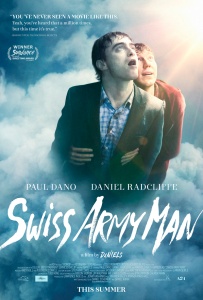 Swiss Army Man shouldn’t work as a movie, and in fact it will only work for a narrow swath of the world’s audience. There were plenty of walkouts during its Sundance premiere. The triumphant riding of a powerfully flatulent corpse in the film’s opening ten minutes should seal the movie’s fate. How does a movie survive such a juvenile, taste-obliterating moment, and one that is meant as an introduction to the film? Amazingly, stupendously, Swiss Army Man delicately walks that narrow tonal path and succeeds wildly, rapturously, and produces the rarest commodity in Hollywood, something daringly different and excitingly new. I fully anticipate that sizeable portions of readers are going to have an immediate and repellent response from just reading the plot synopsis, and I can’t blame them. I will do my best to try and explain why the movie worked so well even if I know this will be a fool’s errand for many, but if I can convince one more human soul to give Swiss Army Man a chance, then I’ve done the Lord’s work.
Hank (Paul Dano) is stranded on a desert island and about to hang himself when a dead body (Daniel Radcliffe) washes ashore. Unfazed, Hank is still determined to end his life, that is, until he can no longer ignore the farting of the body. That’s when he gets an idea and uses the power of the farting corpse to ride back to the mainland. Hank drags the corpse with him finding unique benefits, like his retention of drinkable rainwater. He’s still stranded and it’s at this point that Manny, the name he gives the corpse, begins speaking and inquiring about the world and what it means to be human.
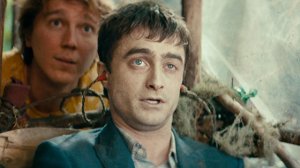 Swiss Army Man is a disarming buddy comedy that weirdly yet miraculously deepens as it goes, becoming a genuine relationship drama that touches on the profound and philosophical. For the first act, the movie is an unconventional survival drama with Hank finding peculiar yet helpful uses with his savior, the dead corpse. It’s a guy lugging around a dead body at the end of the day. I was wondering if this was really a story that was more suited as a short and didn’t have the substance to merit a feature-length runtime, and that’s when the magic realism steps up and when Manny comes into focus. This is easily one of the most oddball buddy comedies ever. Manny is an innocent, a proverbial babe in the woods, and doesn’t know much about himself and the world, and Hank becomes his teacher. Through this process he’s forced to examine his own life from an altogether different perspective and actually starts to vocalize and come to grips with his own life’s shortcomings, insecurities, and frustrations. It’s through Manny that Hank is able to open up and examine what it means to be human. Their interaction becomes a truly rewarding and emotionally honest buddy film where one of them just happens to be a talking corpse that farts a lot. Manny wants to learn about the world and to feel what it means to be alive, and it’s this new path that emerges that gives the film a new life.
You would expect something this strange to be drenched in irony or pushing the audience to laugh at the characters, but you would be completely wrong. Swiss Army Man is one of the most earnest movies you will ever see. It is completely genuine, heartfelt, sincere in every crazy detail, and it’s what gives the movie its emotional resonance. It treats the relationship between Hank and Manny with credibility. It’s a movie about celebrating and claiming ones weirdness, told from a movie that is proudly offbeat. Hank feels left out by normal social interactions. He’s the typically withdrawn and awkward Dano character we’ve come to expect from his catalogue of films; however, rarely has he seemed this artfully articulated. He’s a man who has some deep-seeded neuroses and fears, including farting aloud in public, and he’s using his ongoing experiences with Manny to exorcise some of these past failings, to become the determined, self-actualized man he wants to be. There’s a touching part where Hank talks about the poor relationship with his father; the two have signed up for one another to get birthday e-cards via email. That’s the extent of their connection at this point, and yet Hank remarks that even if he were to die his father would still get a birthday card from him in perpetuity. It’s a small little thing but it hits and makes one think about the impact and legacy we’ll have after we’re gone for good. Are we more than just an occasional birthday card? The fact that the movie utilizes a climax that incorporates farting in public as an emotional catharsis is amazing, but what’s even more amazing is that this moment is completely earned and gratifying.
Another aspect of Swiss Army Man that kept me specifically amused is the clever use of ambiguity. As the fantastical plays out with even-keeled realism, it’s easy and expected to believe that much of what we are witnessing is all in the mind of Hank. He’s projecting his needs and hopes onto this analogue for a friend that also represents himself. That’s why Hank uses Manny to relive personal experiences and to try and get them right. Then the third act comes along and causes you to question even more, putting the behavior of Hank into a muddier realm that makes you wonder if he’s this innocent wounded heart we had come to know previously. Then there’s Hank’s fixation over the pretty girl (Mary Elizabeth Winstead) he gravitated to on his bus rides. He looks to her as a goal, something he can return to once finally rescued and returned home. As he plays out his brief experiences with her, dressed as her, with Manny in the position of Hank, a faux courtship ensues. Hank, as her, and Manny, as stand-in for Hank, and it’s weird and wonderful and not afraid to accept the homoerotic qualities of its implications. This is a love story ultimately but a unique kind of love, and it’s up to the audience to determine what that means exactly. Is it romantic, bro-mantic, or simply a dude coming to terms with his own life in a very unusual therapeutic manner? The writer/directors The Daniels (Dan Kwan, Dan Scheinert) don’t outright tell you how to think or feel throughout any of this movie, which is a blessing. They present a complicated world with complicated and broken people doing their best to try and make their own sense, and they invite the audience along on this beguiling journey and just ask that they be patient and open-minded and then come to their own conclusions.
 The music is a wonderful element that is also another facet of the characters, layering in even more whimsy and character depth. The music is often accompanied by Radcliffe and Dano, their mutterings and ramblings becoming syncopated and layered into a soothing collage of sound. They’re providing their own soundtrack to the movie of their life. Early on Hank describes the music from Jurassic Park as the proper accompaniment for life’s big moments, with a little nestling of nostalgia as well. It’s especially enjoyable to listen to either of the guys break out into their rendition of the majestic Jurassic Park theme. It’s silly and sweet but it also gets at the psychological element of Hank being outside himself, seeing his life as a movie and he as its lead. He also hums what he remembers of “Cotton Eyed Joe,” which reappears throughout with comically incorrect and changing lyrics. The music is another reflection of the characters and it imbues the scenes with an extra sense of whimsy that helps to maintain its magic realism tone.
Radcliffe (Harry Potter and the… everything) and Dano (Love and Mercy) are terrific together and Radcliffe gives a tour de force physical performance. The way he’s able to contort his body, malign his posture, make use of stilted facial expressions is amazing. This goes leagues beyond the simple slapstick of Weekend at Bernie’s. The way he’s able to convey a character and a performance through this crazy decaying prism. Manny wants to help people, is eager to learn, and it makes his character so endearing, and then you remember he’s a corpse who might just be a figment of Hank’s diseased imagination. Radcliffe completely lets go of vanity and delivers one of the best performances of the year. Dano is in more familiar territory but shines again, serving as a dry comic foil for Radcliffe. The two of them form a highly entertaining and winning buddy team.
Swiss Army Man is a unique film experience and one that shouldn’t work. It’s filled with juvenile body humor. Its key supporting role is a dead body. It’s about a guy who may or may not be a stalker living in a fantasy world in his own head. This should not be, and yet like Manny himself, miraculously it has been birthed into existence and we are better for it. Every time it feels like the movie is heading for a more conventional direction that will weigh it down, be it a love triangle or some slapdash “he was dead the whole time” twist ending, it calmly steers away. This is a wonderfully humane, touching, earnest, and emotionally affecting movie, one that, yes, also involves farting. The body humor stuff is a reflection over confronting what we feel uncomfortable with and why that is, what social conventions tell us is in poor taste, tell us to box ourselves in and play by the rules. Here is a movie that gleefully plays by its own rules. It’s not going to be for everyone but if it’s for you, like me, there might not be much else that can rival its cinematic highs. Even if you think you will hate this movie, see it. See it just to have seen one of the strangest and most beguiling movies of the modern era. See it and judge for yourself. I’m still awed at how life affirming and profound a movie with a farting corpse can be. Swiss Army Man is a labor of love, an explosion of feeling, and a declaration to stay weird.
Nate’s Grade: A
Share this:

Me and Earl and the Dying Girl (2015)
 In many ways Me and Earl and the Dying Girl feels like the perfect specimen that was programmed and brought to life in some mad scientist Sundance film lab. It’s got a hip point of view, a meta commentary on its plot and the directions it doesn’t take, style to spare with lots of self-aware camera movements, and even Wes Anderson-styled intertitles and colorful visual inserts, including stop-motion animation. It’s about two amateur filmmaking teenagers, Greg (Thomas Mann) and Earl (R.J. Cyler), who befriend Rachel (Olivia Cooke) who happens to have terminal leukemia. The movie has a good heart and it deviates from convention with its storyline, though it has to stop and add narration to point out how it does this, like it demands a pat on the back for not being a “typical cancer weepie.” The big problem is that we’re stuck with the perspective of Greg, who is the least interesting character and just trying to stay invisible. He has a low opinion of himself and his friendship with Rachel will somehow make him a better person. Earl and Rachel are both tragically underwritten but valiantly played by their actors. The annoying aspect is that Greg makes everything about him and so does the movie. The supporting parts are broadly portrayed and fit awkwardly with the larger setting, like Greg’s overenthusiastic teacher, Rachel’s lush of a mother who seems one drink away from committing statutory rape, and Greg’s mom, who forces Greg to hang out with Rachel, even though they were acquaintances at best, because the plot demands it. The script by Jesse Andrews, based upon his YA book, sets up the completed tribute film as an emotional climax that cannot be met, and the abstract movie results prove it. This is a likeable, funny, and entertaining indie with a sense of style and wit. It’s good, but it could have been better. I wish the “Me” had been removed from its title.
Nate’s Grade: B-
Share this:

Birdman or (The Unexpected Virtue of Ignorance) (2014)
 Expecting a comedy from Mexican director Alejandro Gonzalez Inarritu would have preposterous. The man was known for his cinema verite of suffering, notably Babel, 21 Grams, Biutiful, and his best film, Amores Perros, roughly translated to Love’s a Bitch. Perhaps there isn’t much of a shift going from tragedy to comedy. Inarritu’s newest film, Birdman or (The Unexpected Virtue of Ignorance), has been wowing critics and audiences alike, building deafening awards buzz for its cast, Iarritu, and the superb cinematography, but will it fly with mainstream audiences? This may be one of the weirdest Oscar front-runners in some time.
Riggan (Michael Keaton) is an actor best known for playing the superhero Birdman in the early 1990s and walking away from the franchise. He’s still haunted by that role (sometimes literally) and struggling to prove himself as an artist. He’s brokered all his money into directing, adapting, and starring in a theatrical version of Raymond Carver’s short story, “What We Talk About When We Talk About Love.” The show is in previews and about to open its run on Broadway but it’s already got a rash of problems. The leading man needs to be replaced immediately. The supposed savior is famous actor Mike (Edward Norton), an undeniably talented but temperamental actor who pushes buttons to find some fleeting semblance of “truth.” Mike’s girlfriend, Lesley (Naomi Watts), is growing tired of his antics and desperate for her own long-delayed big break. Laura (Andrea Riseborough) is Riggan’s “girlfriend” and co-star and may be pregnant. Sam (Emma Stone), Riggan’s personal assistant and also his detached daughter, is fresh from rehab, and spiteful against her neglectful dad. Toss in Riggan’s best friend/manager/play producer (Zach Galifianakis), Riggan’s ex-wife (Amy Ryan), and a feared theater critic (Lindsay Duncan) who is determined to kill Riggan’s show to send a message to the rest of Hollywood polluting the integrity of the theat-tah. Oh, and throughout all this, Riggan hears an ominous voice that alternating encourages him and humiliates him.
 It’s an industry satire, a bizarre comedy, a father/daughter drama, an examination on identity and the complicated pulls of affection and admiration, and a stunning virtuoso technical achievement. As a movie, Birdman is hard to pin down or categorize. It’s a movie that you definitely need to experience on your own rather than have described (don’t stop reading, come back…), and that is a reason enough to see the film, a rare aspect among modern movies. It’s an artistically offbeat movie and yet it ultimately is about one has been actor looking back on his career and coming to terms with his own impact with pop-culture, art, and his family. It’s about a man struggling to find his place in his own life, beset at all odds by doubters and traitors and obstructionists. The refreshing aspect about Riggan is that he’s a has-been but not a sad sack; he’s fighting from the beginning, sometimes pathetically and sometimes in vain, but the man is always fighting to regain his dignity, to reclaim his life’s narrative, and to fight for his legacy. Riggan, after all, set the stage for the modern superhero industry that currently dominates Hollywood bean counters. He was too just soon, and the parallels with Keaton (Batman) are superficially interesting but there’s more of an original character here than a reflection of the actor playing him. He’s neurotic, egotistical, hungry, and fighting for respect, like many actors, and the film flirts with the façades people inhabit. Many of the characters are emotionally needy, desperate for validation wherever they can find it.
Another strength of the film is that it finds a moment for each of its talented ensemble players to shine, chief among them Keaton. The actor hasn’t had a showcase like this in some time and he is a terrific guiding force to hold the entire story together. Whether it’s marching in his tighty whities or working through his complicated degrees of neuroses, Keaton is alive in a way that is electrifying. We see several highs and lows over the course of two hours, some moments making us cheer on Riggan and others making us wince, but he comes across more like a person than just the butt of a joke. It’s also just fun to watch him adopt different acting styles when he steps on stage, including one early on where he’s purposely too stilted. It’s so comforting to watch Norton (The Grand Budapest Hotel) get to be great again, not just good but great. Early on, you see the appeal of Mike, his allure, and Norton keeps pushing the audience, as well as the characters, back and forth with his wealth of talent. Stone (Amazing Spider-Man 2) spends most of the film as the sulky daughter but she gets to uncork one awesomely angry monologue against her loser dad. The thawing father/daughter relationship ends up supplying the film with its only degree of heart. Watts (The Impossible) is comically frazzled for the majority of her time but gets a memorable character beat where she breaks down in tears, realizing her dream of “making it” might never materialize. Riseborough (Oblivion) also has moments where he sadness and vulnerability cut deep. The supporting characters aren’t terribly deep but they all have a moment to standout.
It’s a decidedly offbeat film that dips into the surreal though never dives completely inside. The movie is rather ambiguous about whether or not the fantastical flourishes are a result of Riggan being mentally ill, or at the least overtaxed with stress. Is there really a Birdman or is it a voice in his head, a manifestation of his ego or a ghost to remind him of the past when he was a star? Does Riggan really have the powers he seems to believe he does, including the ability to make objects move with his mind? Innaritu playfully keeps the audience guessing, treating the bizarre in an offhand manner reminiscent of magic realism. The bizarre embellishments blend smoothly with the film’s darkly comic tone. It’s a funny movie but one that you laugh at between clenched teeth.
 Is it all the unblinking camerawork a gimmick? I don’t think so. While the story can engage with its weirdness and surreal unpredictability, the long tracking shots bring a heightened reality to the unreal, they bring a larger sense of awe to the proceedings, watching to see the magic trick pulled off to the end. If anything, it’s an extra thrill to the script and greatly compounds the artistic audaciousness of the film, but I think it also channels the live-wire energy of theater, of watching actors have to walk that tightrope of performance and blocking, weaving together to pull off the ensemble. It makes the film medium feel more like live theater. Thematically I think the style also connects to the anxious mentality of Riggan. In the end, I don’t truly care that much whether it’s a gimmick or not (though I vote it is not) because the camerawork is rapturous. Made to resemble an entire two-hour tracking shot, it is a joyous thrill to watch these technical wizards do their thing, to watch the best in the business perform a visual magic trick over the duration of two hours. Even if you don’t care for the overall movie you can at least be entertained by the imaginative and thoroughly accomplished cinematography by Emmanuel Lubezki, fresh from his Oscar for Gravity and who should be clearing shelf space for the next bushel of awards he’s destined to win with this film. It’s an intoxicating experience to behold, though the film is structured into 10-minute or so chunks for feasibility. If you want to watch a real cinematic magic trick, check out the film Russian Ark, which is an entire movie, performed in one uncut single tracking shot.
I’m still wrestling with the debate over whether Birdman is an artistically ambitious romp or a truly great movie. Much like the characters in the film, I’m wrestling with whether I have confused my admiration with adoration. It’s a movie that I feel compelled to see a second time, and maybe a third, just to get a handle on my overall thoughts and feelings. That may be a sign that Birdman is a film for the ages, or maybe it’s just a sign that it’s not as approachable and denied a higher level of greatness by its obtuseness. Inarritu’s surreal showbiz satire is plenty entertaining, darkly comic, and a technical marvel thanks to the brilliant camerawork. The percussion-heavy musical score is another clever choice, naturally adding more urgency and anxiety to the proceedings. Birdman is a strange and beguiling movie, one that deserves to be seen, needs to be experienced, and stays with you rolling around in your brain. That sounds like a winner to me.
Nate’s Grade: A
Share this:

The Grand Budapest Hotel (2014)
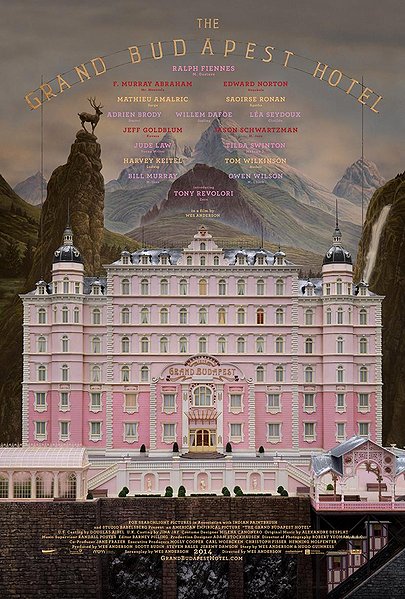 Wes Anderson is a filmmaker whose very name is a brand itself. There are a small number of filmmakers who have an audience that will pay to see their next film regardless of whatever the hell it may be about. Steven Spielberg is the world’s most successful director but just having his name attached to a movie, is that enough to make you seek it out and assume quality? If so, I imagine there were more than a few disappointed with War Horse and Kingdom of the Crystal Skull. But Wes Anderson has gotten to that height of audience loyalty after only seven movies, mostly because there are expectations of what an Anderson film will deliver. And deliver is what the quirky, fast-paced, darkly comic, and overall delightful Grand Budapest Hotel does.
In the far-off country of Zubrowka, there lays the famous hotel known the world over, the Grand Budapest. The head of the hotel, the concierge, is Gustave (Ralph Fiennes), a highly mannered Renaissance man who caters to the every whim of his cliental. Zero (Tony Revolori), an orphaned refugee, is Mr. Gustave’s apprentice, a lobby boy in training learning from the master in the ways of hospitality. Gustave likes to leave people satisfied, including the wealthy dowagers that come from far just for him (Gustave: “She was dynamite in the sack,” Zero: “She was… 84,” Gustave: “I’ve had older.”). One of these very old, very rich ladies is found murdered and in her rewritten will, the old bitty had left a priceless portrait to Gustave. Her scheming family, lead by a combustible Adrien Brody, plots to regain the painting, which Gustave and Zero have absconded with.
 For Wes Anderson fans, they’ll be in heaven. I recently climbed back aboard the bandwagon after the charming and accessible Moonrise Kingdom, and Grand Budapest is an excellent use of the man’s many idiosyncratic skills. The dollhouse meticulous art design is present, as well as the supercharged sense of cock-eyed whimsy, but it’s a rush for Anderson to pair a story that fits snuggly with his sensibilities. The movie is a series of elaborate chases, all coordinated with the flair of a great caper, and the result is a movie over pouring with entertainment. Just when you think you have the film nailed down, Anderson introduces another conflict, another element, another spinning plate to his narrative trickery, and the whimsy and the stakes get taken up another notch. The point of contention I have with the Anderson films I dislike (Life Aquatic, Darjeeling Limited) is the superficial nature of the films. As I said in my review for Darjeeling, Anderson was coming across like a man “more interested in showing off his highly elaborate production design than crafting interesting things for his characters to do inside those complex sets.” With this film, he hones his central character relationships down to Gustave and Zero, and he can’t stop giving them things to do. Thankfully, those things have merit, they impact the story rather than serving as curlicue diversions. We get an art heist, a prison break, a ski chase, a murderous Willem Dafoe leaving behind a trail of bodies, not to mention several other perilous escapes. This is a film packed with fast-paced plot, with interesting actions for his actors, maybe even too packed, opening with three relatively unnecessary frame stories, jumping from modern-day, to the 1980s, back to the 1960s, and finally settling into the 1930s in our fictional Eastern European country.
The other issue with Anderson’s past films, when they have underachieved, is that the flights of whimsy come into conflict with the reality of the characters. That is not to say you cannot have a mix of pathos and the fantastical, but it needs to be a healthy combination, one where the reality of the creation goes undisturbed. With Grand Budapest, Anderson has concocted his best character since Rushmore’s Max Fisher. Gustave is another overachieving, highly literate, forward-driving charmer that casually collects admirers into his orbit, but he’s also a man putting on a performance for others. As the head of the Grand Budapest, he must keep the illusion of refinement, the erudite and all-knowing face of the luxurious respite for the many moneyed guests. He has to conceal all the sweat and labor to fulfill this image, and so he is a character with two faces. His officiously courtly manner of speaking can be quite comical, but it’s also an insightful indication that he is a man of the Old World, a nostalgic European realm of class and civilization on the way out with looming war and brutality. And as played by the effortlessly charming Fiennes (Skyfall), Gustave is a scoundrel that the audience roots for, sympathizes with, scolds, but secretly desire his approval, much like Zero. It is a magnificent performance that stands as one of the best in any Anderson film.
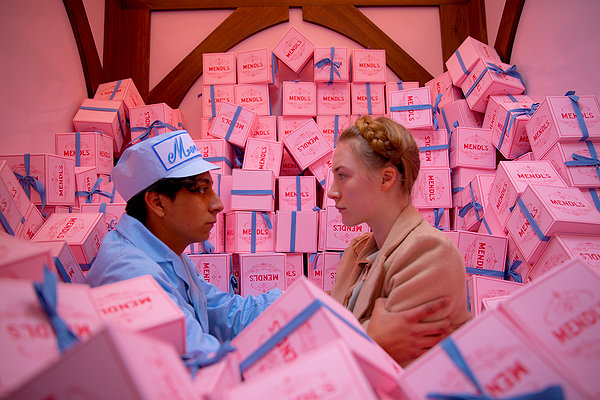 The fun of a Wes Anderson movie is the zany surprises played with deadpan sincerity, and there is plenty in Grand Budapest to produce smiles and laughter. It’s hard to describe exactly which jokes land the best in a Wes Anderson film because they form a patchwork that elevates the entire movie, building an odd world where oddballs can fit right in. It was under a minute before I laughed, and I smiled through just about every remaining minute of the film. I enjoyed a joke involving a dead cat that just kept being carried from scene to scene. I enjoyed a sexually graphic painting that just happened to be lying around. I enjoyed the fact that Zero draws on a mustache every morning to better fit in with the men of his day. But mostly I just enjoyed the characters interacting with one another, especially Gustave and Zero, which forms into the emotional core of the film. It begins as a zany chase film and matures as it continues, tugging at your feelings with the father/son relationship (there’s also a subtly sweet romance for Zero and a pastry girl played by Saoirse Ronan). One of the big surprises is the splash of dark violence that grounds the whimsy, reminding you of the reality of death as war and fascism creep on the periphery. In fact, the movie is rather matter-of-fact about human capacity for cruelty, so much so that significant characters will be bumped off (mostly off screen) in a style that might seem disarming and unsatisfying. It’s the mixture of the melancholy and the whimsy that transforms Grand Budapest into a macabre fairy tale of grand proportions.
The only warning I have is that many of the star-studded cast members have very brief time on screen. It’s certainly Fiennes and Revolori’s show, but familiar names like Bill Murray, Tilda Swinton, Tom Wilkinson, Jeff Goldblum, Lea Seydoux, Jude Law, Harvey Keitel, Jason Schwartzman, Owen Wilson, F. Murray Abraham, and Bob Balaban are in the film for perhaps two scenes apiece, no more than three minutes of screen time apiece. Norton, Brody, and Dafoe have the most screen time of the supporting cast. Though how does Revolori age into the very non-ethnic Abraham? It reminded me of Street Fighter: The Legend of Chun-Li (here me out) where, as she ages, Chun-Li becomes less and less Chinese in her facial appearance. Anyway, the brevity of cast screen time is not detrimental to the enjoyment of the film, considering all the plot elements being juggled, but I would have liked even more with the dispirit array of fun characters.
The Grand Budapest Hotel is Wes Anderson at his best, pared down into a quirky crime caper anchored by a hilariously verbose scoundrel and his protégé. Naturally, the technical merits of the film are outstanding, from the intricate art direction and set dressing, to the period appropriate costumes, to the camerawork by longtime cinematographer Robert Yeoman. The movie is a visually lavish and handcrafted biosphere, a living dollhouse whose central setting ends up becoming a character itself. The trademark fanciful artifice is alive and well but this time populated with interesting characters, a sense of agency, and an accessible emotional core. The faults in Anderson’s lesser films have been fine-tuned and fixed here, and the high-speed plotting and crazy characters that continually collide left me amused and excited. If you’re looking for a pair of films to introduce neophytes into the magical world of Wes Anderson, you may want to consider Grand Budapest with Moonrise Kingdom (Royal Tenenbaums if they need bigger names). In the end, I think Anderson more than identifies with his main character, Gustave, a man enchanted in a world of his own creation, a world better than the real one. Who needs the real world when you’ve got The Grand Budapest Hotel?
Nate’s Grade: A
Share this:

Violet & Daisy (2013)
 It’s not often that I say this but… what the hell did I just watch? I know it’s a movie called Violet & Daisy, written and directed by Geoffrey Fletcher, the man who won a screenwriting Oscar for adapting Precious. But what is this? It is some meta commentary on film violence? A twisted fairy tale? A dark comedy? Whatever it is, I know for certain that it was not very good or entertaining.
Violet (Alexis Bledel) and Daisy (Saoirse Ronan) are teenagers who also work as hired assassins by their boss, Russ (Danny Trejo). Their next assignment has a personal angle: Michael (James Gandolfini) stole a large sum of money from Russ. The gals hide out in Michael’s apartment only to fall asleep. When they wake up, Michael is sitting there, accepting his fate, begging the girls to complete their job. He’s dying from terminal cancer, estranged from his daughter, and hoping to exit this world on his own terms. Over the course of one long afternoon, the gals run into rival gangs, a trained sniper, police, neighbors, and all sorts of other plot contrivances to delay the death of Michael.
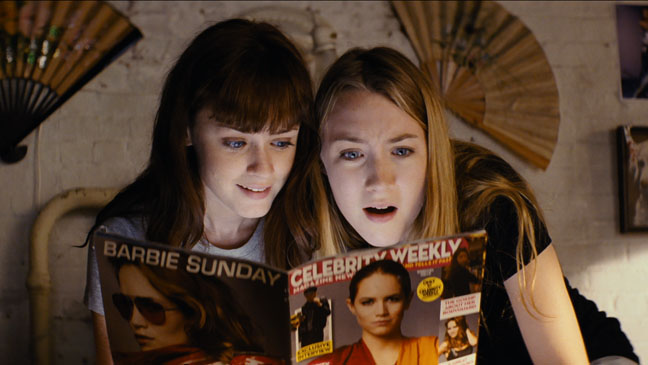 If you’re like me, with similar expectations when it comes to your moviegoing experiences, you’ll be left scratching your head and fumbling for some kind of rationale why people decided to make a film like Violet & Daisy. It feels instantly dated, relying upon the hook of young teen girls with big guns, you know, the same model that has translated to many a successful video game. More so than that, the aspiration, or at least direct inspiration, appears to be a Tarantino-knock-off. Not ripping off Tarantino, as many did in the mid-to-late 90s, but ripping off a poor Tarantino knock-off, like Two Days in the Valley or, the more adept comparison, The Big Hit. There is so much crap in this movie that exists merely because somebody thought it would look cool. Violet and Daisy open the movie dressed as pizza-delivering nuns (is this a fetish I am unaware of?) and open fire on a gang of criminals. But before their fateful gunfight, you better believe it, they have an innocuous conversation about something small, you know, like Jules and Vincent. Why are they dressed as nuns, let alone nuns delivering pizza? It doesn’t matter. This is a movie that doesn’t exist in a universe minutely close to our own. Everything about this film feels painfully and artificial. You know what previous job Violet and Daisy had? They worked at the “doll hospital,” a literal ward for dolls. The decisions of this movie are driven purely by a stylized self-indulgent whimsy. Once you realize this, and you will, the movie becomes even more of a chore to finish.
Then there’s the bizarre and sometimes uncomfortable infantilization of the female lead characters. These ladies do not act like adults; they don’t even act like teenagers. Even though they’re both over 18 years old, their behavior more closely resembles that of a flighty seven-year-old. Their speaking patterns are often in an annoying and partially creepy baby coo. They play paddy cake after successful hits. They ride tricycles. They chew bubblegum and blow bubbles during hits. They get excited about new Barbie Sunday dresses, and this is their real motivation for taking assassination jobs. Yes, to buy dresses. Then there’s their game, the Internal Bleeding Dance, where they hop up and down on the chests of their dying victims, blood spurting out of their mouths, the girls giggling, as if they were bouncing on a bed at a slumber party. These women aren’t remotely actual characters; they are masturbatory quirky hipster fodder, the ironically detached, sexy baby doll killer approximation. Except there is never any commentary at work. The depiction of Violet and Daisy as petite killers never approaches anything meaningful. They are killers because it’s cool. They talk like lobotomized film noir archetypes because it’s cool. This is quirk run amok, quirk with a gun and no purpose. I’m trying hard to ignore the obvious sexual kink undercurrents of the whole enterprise.
 Even with all these flaws, perhaps Violet & Daisy could have been morbidly interesting, except that the circuitous plot twiddles its thumbs, padding out a half-baked story. This is a movie that takes its time and seems to go nowhere. Once the girls meet Michael, the plot has to come up with numerously lame excuses to delay Michael’s execution. I kid you not, there are THREE instances where the girls run out of bullets and have to stop and walk back to the hardware store to go buy ammo. This happens. This is a thing that keeps the plot moving. It’s like as soon as the main characters get into a room together, Fletcher has to struggle to come up with reasons why his narrative should still exist. So we get a second group that Michael stole from because this guy has an even bigger death wish. This second group of spurned bad guys is on their way. If Fletcher was going this route, he might as well gone whole-hog imitating Smokin’ Aces and just had numerous crews all fighting over taking out this schlub first. It feels like Fletcher is making up the story as he goes, taking us on relatively pointless nonlinear interludes to pad the running time. The film, like Tarantino, breaks up the story into a series on onscreen chapters, though one of these only lasts like a minute. Then there’s a loopy dream sequence. The narrative is so stagnant that whatever interest you may have had will long be gone. By the time the movie actually does end, at about 80 minutes, it has long felt creatively exhausted, totally gassed. Fletcher throws out all the stops to get across that finish line.
Even though it was filmed way back in 2010, it’s hard to escape the morbid irony of Gandolfini (Enough Said) playing a character discussing his own inevitable death. He’s the best actor in the film, offering a paternal warmth that goes wasted amidst all the stylistic nonsense. Our other two featured players, Bledel (TV’s Gilmore Girls) and Ronan (The Host), have a sprightly chemistry together that works. I just wish all three actors had something to do rather than strike artificial poses and quip.
After enduring The Paperboy, and “enduring” is indeed the correct term, I was certain that the messy, tonally uneven, sometimes garish flights of fancy in Precious were due to director Lee Daniels. After enduring, and again “enduring” is the correct term, Violet & Daisy, I’m starting to think that Fletcher is deserves equal credit. Violet & Daisy is a curious exercise in twee indie hipness, suffused with quirk standing in place for characters, story, meaning, etc. It feels like the development stopped once the core concept of teen girl assassins was concocted. The off-putting childish nature of the adult girls, juxtaposed with the baby doll sexuality of the film, makes for an uncomfortable watch. To call the film bad taste is too easy. Whether this is a bizarre dark comedy, a whacko modern fairy tale, or whatever term you want to apply to justify the artificial excesses and emptiness, Violet & Daisy is a contrived mess that labors to fill out a basic feature running time, often doubling back and delaying. There isn’t a story here, more just an incongruent, irregular style. If you’re content with a knockoff of a Tarantino knockoff, with an extra dose of whimsy, then enjoy Violet & Daisy and you can dance your cares away atop bleeding bodies.
Nate’s Grade: D+
Share this:

Escape From Tomorrow (2013)
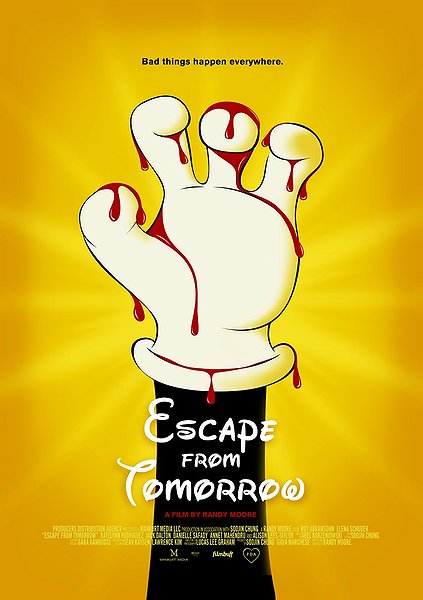 Escape From Tomorrow built a wave of buzz coming out of the Sundance Film Festival, namely because it was a bizarre, psycho-sexual little indie film shot secretly on the premises of Disney World and Disney Land. Writer/director Randy Moore shot his movie in secret, unbeknownst to Disney and the park employees. He was so paranoid about word getting out what they had done that Moore edited the film in another country. There is palpable fear at the reach and power of Disney’s coffers, enough so that a character mentioning the very D-word is silenced, and so I recall early on that people predicted Disney and its armada of lawyers would never allow Escape From Tomorrow to be released. Rather than get litigious, the Mouse House has decided to simply clam up, refusing comment. It’s a smart move, because besides a passing novelty, no one is going to remember the oh so monotonous Escape From Tomorrow in a matter of months.
The wisp of a plot involves a family vacationing at a Disney park. On the final day, the father (Roy Abramsohn) has been told he has lost his job. The rest of the day follows suit as the father loses his grip with reality, interpreting sinister signs throughout the park. He also keeps running into a pair of French teen girls who enjoy holding hands, being flirty, and singing. After the third or fourth time, the father starts to trail the girls, eerily entranced. They warn him that dire things will befall him if he doesn’t go with them.
 Take away the ballsy, surreptitiously recorded angle, the “how did they do that?” factor, and ultimately is there a movie here worth watching? I would definitively say… no. Admittedly it’s interesting to dissect how this guerrilla-style stunt was accomplished, watching scene after scene and figuring out what was shot in the parks unbeknownst to tourists and employees, what was likely shot on a set, where the cuts marry the two, and what techniques the director and his crew utilized to film a movie without blowing their cover. I think many of the scenes had to be improvised, at least the dialogue within the park, because starting and stopping and repeating lines in public, out in the open, would seem suspicious (the cursing would also seem to be courting danger). The Disney theme parks have millions of visitors, so people recording every action would not seem out of the ordinary. Escape From Tomorrow works as a stunt, with the audience picking apart the magic trick simultaneously as it’s performed.
However, a stunt is all that Escape From Tomorrow is because from a thematic, subtext standpoint, this movie is a mess. There just isn’t enough weirdness going on here and whatever small doses of it we get is given precious little connection to any larger theme. It feels like the filmmakers settled on the most facilely subversive idea – Disney Land, the happiest place on Earth, is not. Undercutting all of Disney’s famous family-friendly iconography with the occasional weird thing is not enough. A kid has black eyes. Ten minutes later a stranger makes an offensive comment. Ten minutes later something in a ride that is supposed to be happy looks mean instead. The majority of the movie plays out like you’re watching someone’s boring vacation. You don’t care about the characters. There is no plot to speak of, and that can be acceptable in an atmospheric film that serves as a visual descent into madness. There just isn’t enough madness here. Escape From Tomorrow is far too tedious to be effective. Long stretches are just watching the family traverse the theme park, notably with the father always running into the French teens. There is far too much padding, little connection from scene to scene, and the end is just a confusing muddle groping for a deeper meaning. Midway through, when the father is captured and held underground at Epcot, it looks like the movie is going to take that next step, ramping up the weirdness. Well that conflict is readily solved and then we’re back to the occasional boring out-of-place item. I want to say that Escape From Tomorrow is like David Lynch’s vacation video, but that is giving too much undeserved praise. This is like the deleted scenes of David Lynch’s vacation video.
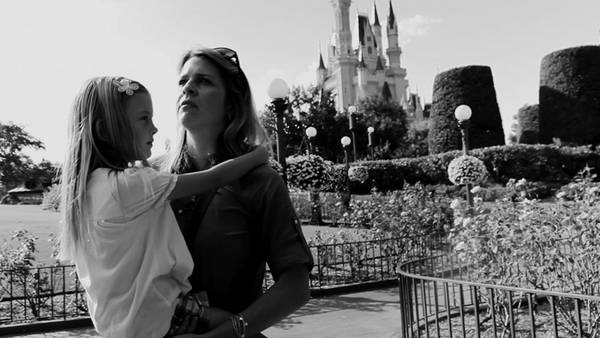 My colleague Ben Bailey countered my negative option with the idea that Escape From Tomorrow is meant to be a dark comedy and to view it through that lens; all right then, because as a “comedy” it still is half-baked, meandering, and poorly executed. The incongruous imagery, often sexual or demonic, is rather cheap in the sense that it’s just flipping the staid Disney script on wholesomeness with no more subversive substance than a moody teenager scribbling on his notebook. The Disney princesses double as high-priced courtesans? Okay, now go further rather than just taking a standard Disney character and making it adult in a shallow manner. There’s a scene where the father escapes by squeezing a tube of Neosporin to lubricate his hands out of confines, and oh boy, the white liquid shoots onto hanging pictures of female body parts. What a riot. Taking a cockeyed, perverted look at Disney is not the same as developing comedy, and even that cockeyed view is lame. I think that the father’s lustful pursuit of the French girls is meant to be comedic, but it was only creepy. When he sneaks up to spy on them in their bathing suits, how else should I interpret that? If this is supposed to be a comedy then Escape From Tomorrow is an even larger misfire.
Escape From Tomorrow is a nonsensical, plodding, superficial film, and it adds up to a whole lot of nothing. There isn’t a grander statement or sense of commentary. There is just scene-to-scene weirdness that grows old rapidly. I commend the ingenuity of the filmmakers for being able to secretly record a movie at one of the most heavily trafficked locations in the world. I don’t think the filmmakers had any clear vision of what they wanted to say with their movie, settling on “weird crap at Disney Land,” and then putting all their time and energy into planning how to pull off this coup, never mind the fact that the finished product was not nearly worth the effort. If you’ve ever wanted to be trapped on a bad vacation, then enjoy, movie masochists.
Nate’s Grade: C-


You must be logged in to post a comment.