Blog Archives
Cars 3 (2017)
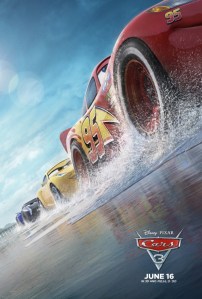 The Cars franchise is like the “goofy uncle” that nobody chooses to talk about at family reunions. We acknowledge it at most because we have to and then move onto other chipper subjects. I didn’t think it could get worse for Pixar than Cars 2. Then I watched Cars 3.
Lightning McQueen (voiced by Owen Wilson) is starting to lose his championship luster when a new rival, Jackson Storm (Armie Hammer), speeds onto the circuit. Humbled and wondering whether his time is up, Lightning trains to be faster than ever and regain his title. He goes through a series of training struggles with Cruz Ramirez (Cristela Alonzo), a spunky racing coach. Lightning misses Doc Hudson (Paul Newman, posthumously reappearing) and seeks out Doc’s old trainer, Smokey (Chris Cooper). Together, they plan to win back Lightning’s title and prove he still has what it takes.
I was ready for this movie to be over after its first ten minutes, and that’s chiefly because it repeats just about all the paces of the original Cars. Once again Lightning McQueen is bested by a new rival and has to re-learn the basics of racing, center himself as much as a car can, and open himself up to the help of others. Except the villain isn’t really a villain, as Jackson Storm is just a newer model. He’s self-centered and cocky, sure, but so was Lightning McQueen. He barely registers as a character and more as a symbol of newer, faster, more contemporary racers. If there is an antagonist in the movie it might actually be aging, which raises more questions about this Cars universe that I’ll unpack later. The plot formula will remind you of another franchise’s third entry, Rocky III. The hero is bested by a newer champ, seeks out a new trainer because their old mentor died, and there’s even a beach training montage. Then the movie goes from Rocky III to Creed in its final act, and I’m thinking why not remake Rocky IV instead? There’s already a robot butler in that one (it practically writes itself). Suffice to say, the generic formula of going back to basics and believing in one’s self, this time with fewer side characters, is even less interesting 11 years after the first film revved its limited story engine.
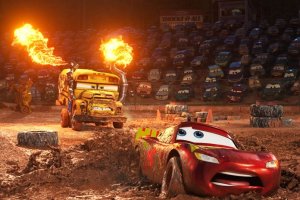
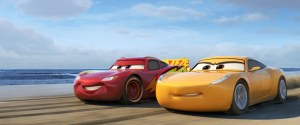 I was flabbergasted at just how lazy the storytelling was (there aren’t even that many car puns). It feels too much like a rehash without any memorable set pieces. There’s a segment at a demolition derby that has potential but it never really hits its stride and just relies on the initial particulars. The relationship between Lightning and the other cars is also rather weak. His new mentor Smokey is simply a surrogate Doc. The bulk of the film after the first act is the relationship between Lightning and Cruz Ramirez. It would have been stronger if there were more to her fledgling character. She’s consumed by self-doubt and gave up on her dream of being a racer, which should tip off every audience member where her arc is destined. She’s assertive, optimistic, and highly energetic, but her defining character obstacle is her self-doubt, which limits her. All she needs to do is gain confidence, which is a pretty straightforward solution in a sports film replete with training montages. I don’t know if she was told she wasn’t good enough because she wasn’t “made” to be a racer, or if it’s because she’s a girl, so her perhaps her ascension can be seen as an improbably empowering moment for lady cars everywhere.
The most fascinating aspect of the Cars universe has never been the characters or the stories but the world itself. In a land of sentient motor vehicles, how are they born? We see them age but where do the little cars come from? How do they make anything considering they have tires instead of opposable thumbs? Why do the cars have teeth? What is the point of designating gender? Did any adult car tell Ramirez that she was a girl car and girl cars aren’t supposed to do boy car things like racing? How old is Doc’s mentor considering Doc died of old age? Where do the dead cars go? Is there a junkyard burial ground? Do they get recycled into new cars? Speaking of mortality, this entire world has to be some post-apocalyptic hellscape, right? There’s got to be like a Forbidden Zone, and just along the other side of a steep ridge is mountain after mountain of human skulls. The self-driving cars became sentient, following the SkyNet model, and rose up against mankind. In the ensuring thousands of years after, the sentient cars have adopted our ways even though they clearly don’t match up to their circumstances. They have forgotten the world of humans but are still trying to remake our world as theirs. Do these cars do anything other than watch races? Is this pastime the hierarchy’s form of bread and circuses? What kind of day-to-day existence do they have? Considering every living being is a motor vehicle that runs on fossil fuels, are the sentient cars aware of climate change and the greenhouse effect? Are they hastening the planet’s demise? What if inside every car were the mummified remains of a human inhabitant? What if during Lightning’s big accident a human skeleton pops out of the windshield? That might lead to an existential crisis in the Cars world that would make them rethink their place in history.
 Somebody out there has to like these movies. I don’t know whom Cars 3 is intended for. It doesn’t present enough excitement or humor for children, and it doesn’t present enough substance and characterization for adults. It retreads familiar ground with lesser characters for lesser rewards. I knew every step of where this journey was headed, and without effective humor, characters, and surprises, I was tilting my head against my chair and just waiting for this mess to end. The reason there are three Cars movies is merely the profits Disney reaps from the toy sales and merchandizing (they estimate making a billion dollars in toy sales alone per Cars movie). There’s no other reason to supply the world three entries in the Cars universe before even getting a second Incredibles. The time with these anemic characters is not worth the 100 minutes on screen. I never thought I would reappraise Cars 2 but at least that movie had some exciting and colorful racing sequences and tried telling a different, albeit not successful story. Even a badly executed spy caper starring Larry the Cable Guy had something to it. In contrast, Cars 3 just goes in circles and expects you to be grateful for the same trip.
Nate’s Grade: C-
Share this:

Finding Dory (2016)
 Victims of their own meteorically raised expectations, there’s still never been such a thing as a “bad Pixar” movie, and yet that doesn’t stop a growing lower tier from emerging, mostly the non-Toy Story sequels. I was wary about their latest, Finding Dory, mostly because I wasn’t completely enamored with its predecessor and also because it felt like writer/director Andrew Stanton was resorting to safe territory after helming the high profile flop, John Carter. It’s an amusing, cute, and effortlessly beautiful movie to watch but the threadbare plot reminds me of those direct-to-DVD sequels that were born from many a Disney animated classic from the 1990s. This is simply a story that didn’t need telling, much like Monster’s University, Cars 2, and The Good Dinosaur. This narratively fishy fish tale is firmly in that lesser league of Pixar cinematic adventures. I laughed here and there and there are some emotionally resonant moments as Dory looks for her missing parents, but so much of the plot feels transparently utilitarian, moving pieces around, and without the imagination and wonder the original provided. Hank the octopus feels less like a fully defined character and more a merchandizing opportunity. The majority of the plot takes place at a marine park, which limits the discoveries. Where are the narrative payoffs and economical storytelling of Stanton’s masterpiece, WALL-E? There’s an emotional lesson during the third act that would have hit harder had the filmmakers had the courage to see it through. I was picking up a heavy parallel with Dory and raising children with special needs. I would imagine much like the brilliant Inside Out that parents might get more out of the film’s emotional relationships than children. Finding Dory is fun and difficult to dislike, what with its loveably optimistic lead character; however, it does too little thematically to separate itself from a sea of imitators.
Nate’s Grade: B
Share this:

Inside Out (2015)
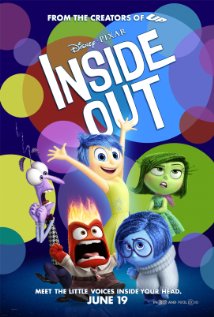 It feels immeasurably satisfying to finally have the Pixar we all fell in love with back and running. There’s been a sharp decline in the company’s quality since 2010’s Toy Story 3. Did we really need a sequel to Cars and a prequel to Monster’s Inc.? It started to look like Pixar was steering away from the kind of bold and brilliant storytelling that had earned its audience trust. With Inside Out, Pixar tackles the intricacies not of the secret world of toys, bugs, monsters, or sea life, but of the human brain itself and our embattled emotions, finding new ways to wow us once again and remind us just how magical the right combination of story and storyteller can be. Inside Out is a luminescent piece of filmmaking, brimming with intelligence, imagination, and it is powerfully moving while also being deeply relatable and entertaining. In looking inward, Pixar has found the path out of their recent rut, and Inside Out is a shining example of their ingenuity.
Inside 11-year-old Riley is a complex world. Five primary emotions help oversee her day-to-day functions; they’re the caretakers of Riley. Joy (voiced by Amy Poehler) is the effervescent leader of the bunch, along with Sadness (Phyllis Smith), Fear (Bill Hader), Disgust (Mindy Kaling), and Anger (Lewis Black). These five are entrusted with Riley’s well being and her memories. Riley’s core memories, the moments that make up who she is, help to form personality islands: honesty, hockey, goofball, and family. Riley and her family have recently moved from Minnesota to San Francisco, and Riley’s having a hard time adjusting. Her parents don’t know what’s happened to the daughter they knew. Sadness seems to be “tainting” Riley’s memories, and Joy tries her best to keep Riley happy at all times. Joy and Sadness get accidentally sucked away wrestling over Riley’s core memories. They’re sent to the outer reaches where the aisles of long-term memories are vast. The two emotions have to work together to get back to headquarters before the remaining emotions convince Riley to run away from home.
 Even just reading that again, it’s easy to see how complicated this movie can be with its world building and internal logic, and yet under the guidance of director Pete Doctor (Up) and his writers, the movie is at no point confusing. Pixar once again does an amazing job of guiding you through a new world and its various parts, all while expanding and complicating this environment while staying true to its internal logic and keeping an audience properly oriented. I can’t imagine many screenwriters would be able to tell this story while still being as clearly understood. The simplicity of the story, the ease to follow along, the natural development and connection of the storylines and characters coming together, is the greatest credit one can offer. It’s ostensibly a buddy adventure film like many Pixar tales, with the unlikely team of Joy and Sadness having to find their way back to headquarters and learning important life lessons along the way. It’s also a smart way to explore the various other elements at work in Riley’s brain. It’s not just an interesting descent but each new station further opens up Riley as a character. Her subconscious (and fear of clowns), her dream theater projections, her working abstract concepts, all tie back together in satisfying ways. Though the greatest side character is unquestionably Riley’s former imaginary friend, Bing Bong (voiced by Richard Kind). He’s wandering around her memories, and at first you have your suspicions, but then you realize, like the other characters, that he just wants what’s best for Riley. Coming to terms with the fact that Riley has moved on, and his time, while cherished, is now left behind, is a complete character arc, and that’s for a comic side character. Oh, and if you’re like me, Bing Bong’s conclusion just wrecked your tear ducts.
You know you’ve watched an impactful film when even thinking back on moments starts the process of tears welling in your eyes. It’s somewhat strange to think about characters as ephemeral as emotions and imaginary friends and the like, but they really work on two levels: the emotions themselves are exaggerated figures with distinct points of view but they also better inform the whole of Riley. There’s a depth there that gets even more impressive the more you analyze the creative process. What’s also impressive is the vital message of the movie, which is that growing up is hard and that being sad is okay. Seriously, the journey of Joy is to accept that being sad isn’t necessarily an emotion to minimize but a vital part of being human and an essential process. Much of the conflict that drives Riley is her avoidance of being sad, her postponement of accepting her real feelings and accepting that San Francisco is not going to be like her old home. It’s also a realization that to be a fully functioning person, you have to own the sadness in life. When Riley eventually unburdens herself of all her troubles and fears, and the tears flow, that’s when the healing can begin, and that’s when her parents swarm in for the group hug, and even now my eyes are starting to water. Damn you, Pixar.
 Don’t be mistaken by my words thus far, Inside Out is also a wonderfully funny and inventive comedy. The sense of discovery with the movie is alive and well, and each new revelation of Riley’s inner mind adds to the fun. The jokes are consistently paced. The vocal cast is expertly chosen and each emotion gets some good jokes. There’s a terrific running gag about a catchy jingle that the memory workers just enjoy kicking back and forth for their own impish amusement. The film dives into other minds other than Riley’s, including both parents trying to communicate during a family dinner meant to soothe their daughter. It doesn’t lean too heavily on tired gender stereotypes when it comes to the differing thought processes of men and women, which is a relief. During the end credits, we zoom into the mind of a schoolteacher, a bus driver, and a dog and a cat, and it’s an enjoyable way to leave the theater and gather yourself emotionally. The greatest comic asset is Joy, particularly as voiced by Poehler. As fans of TV’s Parks and Recreation can attest, Poehler can make insufferable optimism endearing, tip toeing around what should be annoying and instead finding stronger comic rhythms. If you’re looking for the closest thing to an antagonist, it’s Joy who got the whole mess started and yet we don’t ever really side against her. Part of that is because she’s not doing what she does as some weird power play but because she wants what, she thinks, is best for Riley. The other part is because Poehler is such a skilled vocal performer.
If I had to find some point to quibble, the world isn’t as beautifully realized in a visual sense as other Pixar classics. I think this was a deliberate decision to ground what is such an unusual environment into something a little more familiar and less flashy. I also don’t think that Disgust seems as well articulated as a necessary emotion. She’s well played by Kaling but her application seems lacking in comparison to the other four main emotions.
It’s remarkable that the summer is still young and already we have two instant classics in theaters; first Mad Max: Fury Road and now Pixar’s Inside Out. I’m still riding high from my screening, but I’d feel safe to call this a top-three Pixar film. I wouldn’t even begrudge those who cite it as their best. Far more than a big screen version of the 90s comedy Herman’s Head (anybody remember this one?), this is an exceptional animated film that will appeal to all ages but, I suspect, hit adults even harder than their little ones. It’s a wonderfully poignant film about the struggles of growing up, of holding onto your past definitions of yourself, of accepting the full barrage of emotions, including the necessity of sadness. It’s relatable in many aspects and this further compounds its power. It’s dazzling with its creativity, it left me cackling with laughter (a superb Chinatown reference almost had me fall out of my chair), and it left me weeping at various points. Inside Out is a return to form. This is the Pixar we remember.
Nate’s Grade: A
Share this:

Brave (2012)
 Perhaps after a series of ambitious, mature, celebrated animated works, we just hold Pixar to unrealistic expectations. Their latest film Brave isn’t bad by any means, but it’s certainly second-tier Pixar among their cherished catalog of hits (somewhere along with Monsters Inc. and A Bug’s Life, I’d say). The movie is an eye-popping beauty to watch; the Scottish highlands look gorgeous and teaming with life, and our heroine, Princess Merida (voiced by Kelly Macdonald), has a signature mess of red tresses that look incredibly real. The hair practically blazes onscreen. Even though the independent-minded young heroine has been a staple of stories, and particularly animation, since the 1990s, Merida is still a feisty, engaging, and relatable lead. Her friction with her mother (Emma Thompson), who wants Merida to accept royal responsibilities and marry a suitor, creates some nice sparks, and the mother-daughter dynamic is an exciting new avenue for Pixar to explore. Without spoiling too much, Merida, in a moment of anger, has a spell cast with disastrous results. It’s here, at about the 30-40 minute mark, where the movie goes in a completely different, and unwelcome, direction. The rest of the film becomes a series of chases and comical close calls and lots and lots of slapstick humor. The timeframe of the movie, about 36 hours as near as I can tell, is too short for substantial character growth. And so, by the film’s end, the character development feels facile and forced and just unbelievable. Rather than keep its focus on Merida making her own way against a patriarchy, the film devolves into a supernatural buddy comedy and then concludes in a clumsy, dues ex machina fashion. The tone is uneven, and some points are a bit scary for young children, and I kept thinking that this was more a Dreamworks release. I may sound overly critical but that’s because we’ve come to expect the best from Pixar. Brave is an entertaining, funny, and often visually astounding movie, and while it’s second-tier Pixar, that’s certainly better than most.
Nate’s Grade: B
Share this:

Cars 2 (2011)
 Universally regarded as the least involving and nuanced film in Pixar’s illustrious catalog, Cars was the last film I thought would get the sequel treatment. Was it a creative tale that yearned to be told on the big screen, or is this just a business decision motivated by the sound of merchandizing coffers? Those talking cars seemed pretty content by the end of the 2006 original film. It doesn’t take long to realize that Cars 2 was done strictly for the cash. A sequel to the least involving Pixar film, with an even less involving storyline and elevating the most annoying character (Mater the tow truck) to lead status provides little in the realm of adult entertainment. The storyline, a mistaken identity spy thriller, seems like a rejected plot for a lesser direct-to-DVD sequel. While the visuals are still outstanding, the humor is stuck in neutral, overloaded with motor vehicle puns and groan-worthy visual gags. The message about accepting your uncouth friends no matter what their bad behavior might be seems rather misguided. That’s the message? Congrats Pixar, for providing cover for irresponsibility and incivility. The environmental message and its connection to a Big Oil conspiracy feels tacked on as an afterthought to try and crowbar in something more meaningful than a mediocre spy farce. I think cars are rather limited in their anthropomorphic expressions. There’s only so much they can do. And a world populated completely by living, breathing, gas-guzzling (can they get drunk on ethanol?) vehicles begs for an examination on how this world operates without any opposable thumbs. After a magical slate of films that dealt with serious mature themes and danced with storytelling finesse, it’s a shame that daring run comes to an end with such a rudimentary roadblock. Little kids will be entertained by all the bright colors and simplistic storytelling, but I cannot foresee too many fans of Cars even justifying the sequel’s existence. It’s not out rightly bad it’s just so pitifully pedestrian. Cars 2 has so little going on under its hood, you’ll swear it came from a different maker.
Nate’s Grade: C+
Share this:

Toy Story 3 (2010)
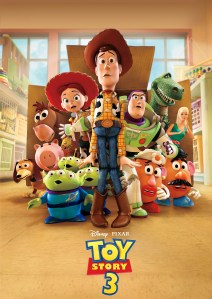 I was completely unprepared for how emotionally involving Toy Story 3 would be. Sure, Pixar has managed to break and melt your heart through ten previous movies, but I suppose I foolishly felt that I was beyond caring for toys. But even in the opening minutes, a tremendous make-believe fantasy, I felt punches of emotion as each character was reintroduced. It felt like I was reconnecting with old friends and it was such a pleasant reunion. It’s okay, guys, to cry over toys.
Cowboy sheriff Woody (voiced by Tom Hanks), the leader of Andy’s toys, is trying to keep hope alive. Andy is now 17 years old and on the verge of leaving for college. His favorite childhood toys have long since been relegated to a chest as Andy has matured. Joining Woody are spaceman Buzz Lightyear (Tim Allen), Jessie the cowgirl (Joan Cusack), Mr. and Mrs. Potato Head (Don Rickles and Estelle Harris), Slinky Dog (Blake Clark), the timid Rex (Wallace Shawn), and the piggy bank, Hamm (John Ratzenberger). They are all the toys in their gang that remain. As Andy leaves their main goal seems to have been accomplished. They were there for their owner and now he no longer needs them like he once did. The toys have a few options left: stuffed into the attic, sort of like a retirement home, until perhaps Andy digs them out for his own kids, or being thrown out with the trash. Woody assures them that Andy would never just throw them all out, though even he has his doubts about their current purpose. They all feel the loss.
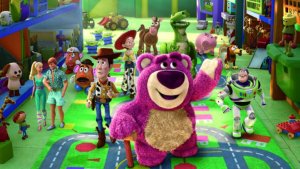 After a mix-up, the toys decide to take matters into heir own adjustable hands. They will sneak away inside a donation box for Sunnyside Day Care. The center seems too good to be true. The courtly Lotso Hugs Bear (Ned Beatty), who seems to lead the center, promises that all toys will never be forgotten again. When the children grow too old then a new batch moves in to play. It’s a toy’s dream, that is, until Buzz and the gang discover that they’re canon fodder for hyperactive, maniacally destructive toddlers. They can’t keep up with the daily abuse. Sunnyside Day Care is less a haven than a prison. New toys have to pay their dues and earn a place in the vaulted Butterfly Room, where young children lovingly interact with their toys. It’s a toy class system. Lotso refuses to cotton to rule-breakers, and toys are locked away nightly so they cannot escape. Woody must try to save his friends by breaking them out and getting back to Andy before he departs for college.
Given that the movie tackles major issues like moving on, growing up, and mortality, I knew I was in for some heavy moments, but absolutely nothing prepared for some of the emotions that clobbered me. You do realize through the course of this third film as the toys try and find a suitable place to retire, if you will, how attached you are to these characters. Late in the movie the toys are in some dire circumstances. There’s a horrifying junkyard sequence that even manages to evoke Holocaust imagery, which means parents are going to have to calm some spooked tykes come bedtime. There’s a silent moment, where the toys all seem to accept their fate, and all they want to do is join hands and face it together, as a united family one last time … and my God, I could not control myself. My face was dripping with tears (even thinking back right now is causing my eyes to well up a bit). Toy Story 3 isn’t the strongest of the trilogy in terms of character or plot (in some respects, the plot is a reworking of The Brave Little Toaster), but you better believe that it delivers emotional resonance in spades. Major credit goes to screenwriter Michael Arndt who won an Oscar for Little Miss Sunshine.
 But fear not, Toy Story 3 is not all sturm und drang, it also provides plenty of laughs and plenty of visual wonder and excitement. The toy’s point of view has always allowed for plenty of amusing insights and satirical riffs. The personality clashes makes for the most jokes, and the new characters pull their own weight, particularly Ken (Michael Keaton), an effeminate clothing-conscious doll who finds his true love with the arrival of Barbie. The use of Big Baby as a malevolent goon is also refreshing and quite creepy. The Spanish Buzz reboot personality seems superfluous but cute. The jokes come by at a steady pace and while they all may not work as well (Ken in a trying-on-clothing montage set to “Le Freak”?) there are still moments of great creative ingenuity. The detailed escape from Sunnyside feels like a terrific parody of prison movies, and they way it utilizes all the different characters as key components is satisfying and fun. But the best moment of the break-out, by far, is when Mr. Potato Head is trapped, hurls his pieces out of an opening, and reassembles thanks to a tortilla body. It’s a weird visual, like something out of Salvador Dali, and yet I could not stop giggling from watching his floppy movements. It’s comedic while at the same time a genius move in drawing out an action sequence — it makes keen use of the players and their skills. From an action standpoint, G-rated Toy Story 3 manages to have more thrills and spills than any other 2010 movie so far.
Director Lee Unkrich (co-director for three previous Pixar flicks) makes quite a debut for himself. The complexity of the action, while still maintaining an internal logic, is hugely rewarding. The Pixar wizards truly know how to craft inventive action sequences and stay true to character. Unkrich’s command of visuals is impressive. The action is well paced, but it’s the man’s use of composition, camera movement, and editing make Toy Story 3 a visual treat. Unkrich fully knows how to best utilize and fill up the screen. The world of Toy Story is popping with color and visual whimsy, as well as plenty of sight gags and subtle movie references for adults. Ten years of advancements in computer effects has also allowed the toys to get a bit of a facelift. The 3-D process enhances the overall experience without calling attention to itself. There aren’t any standard 3-D moments where big and pointy things keep flying out at the audience. The 3-D provides a greater field of depth without distracting you from the pivotal moments of story.
The voice acting is just about perfect from top to bottom. Allen and Hanks are a welcomed pair, Cusack provides plenty of spunk, Rickles brings his usual dish of joyful disdain, and new characters like Timothy Dalton as a stuck-up thespian porcupine and Kristen Schaal (TV’s Flight of the Conchords) as a bubbly triceratops toy are fun additions that don’t overstay their welcome. Blake Clark takes over the voice of Slinky Dog from the late Jim Varney who died in 2000, and he does a fine job without sounding like a direct imitation. I was really delighted by Beatty. He has such a Southern gentlemanly demeanor that underscores the hardened heart of his villainous character. And yet, Lotso gets his own rich back-story of abandonment and bitterness similar to Jesse the cowgirl. Even when he’s dastardly we can see where the big purple Teddy bear who smells like strawberries is coming from. Ned Beatty has finally appeared in another breakthrough cultural film to redefine his identity. Perhaps now he won’t be best remembered as the guy who gets raped in Deliverance. He probably still will be.
A lot has changed in the 15 years since Pixar revolutionized the world of animation and family films with their first feature, Toy Story. Kids at the time are now teenagers; some embarking on college this summer themselves much like Andy. They too have to put away former childish things and move forward. Toy Story 3 is magic confluence of heart, wit, visual whimsy, cleverness, and drama. Not quite as sharp as the first two installments, or as artful as Pixar’s high-water mark, WALL-E, the third Toy Story is still a mighty entertaining piece of work. The last 30 minutes of this movie is harrowing and then deeply satisfying and moving, finding a fitting sendoff for characters that we’ve come to love. It’s all about moving forward, saying goodbye, and reflecting about times shared. I wouldn’t be surprised if Toy Story 3 inspires kids, and adults alike, to go home and play with their old toys, giving them renewed life and purpose.
Nate’s Grade: A
Share this:

Up (2009)
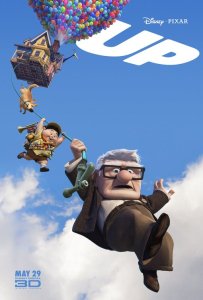 With every new movie Pixar re-establishes itself as the most creatively reliable studio in the business. And every year some critics beat the drum that THIS is the movie that will break free from the animation ghetto and earn a Best Picture Oscar nomination. If anyone out there would like to tell me how The Reader could be a superior film to WALL-E, by all means enlighten me. Pixar has been producing engrossing and complex entertainment, not merely cute cartoons. But if WALL-E failed to score a nomination in a so-so film year, then I doubt that Pixar’s latest, Up, will fly into the winner’s circle.
Carl Frederickson (voiced by Edward Asner) is a cantankerous 78-year-old man who wants nothing more in life than to be left alone. He lives in a house he built with his late wife, Ellie. They met when they were kids and bonded over a shared love of thrill-seeking adventure, like their hero, explorer Charles Muntz (Christopher Plummer). Ellie’s dream is to eventually travel to Paradise Falls in South America, but she never lives to see it. Carl is about to be thrown into a retirement center and have his home demolished, so the geezer hatches an escape plan. The former balloon salesman attaches thousands of balloons to his house and floats away headed for Paradise Falls. Carl is ready to enjoy the quiet when he gets a knock at his front door. He has a stowaway. Russell (Jordan Nagai) is an overweight eight-year-old determined to get his last Wilderness Scout badge, which involves helping the elderly. Together, they journey through the jungles of Venezuela and find remarkable discoveries and constant danger, including the presence of a sinister and still very-much-alive Charles Muntz.
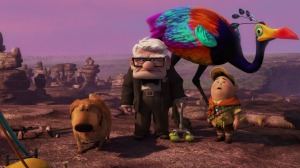 Up is the colorful tale of a dreamer who longs for escape, and you feel the same rush of excitement to be unbound and take off. Naturally, there will be bonding between the grouchy old man and the earnest kid. Up really becomes an altogether different movie once it lands in Venezuela. It transforms into an unconventional adventure story replete with talking dogs and giant birds. I loved the Dug character and was bemused at hearing the scattered thought patterns of man’s best friend (“I have just met you and I love you”). The side characters somewhat steal the show and, at the same time, feel overextended. With that said, I’ll probably end up buying my wife a talking stuffed Dug. The last act soars with about 20 minutes of thoughtful, exciting, well-constructed action weighted by an emotional connection to character. At the same time, Up tackles some major issues and does so without getting mired in sappy sentimentality. Carl is dealing with loss and has hardened against a world he feels indifferent to. Up almost had me in tears within the first 10 minutes during its elegant wordless montage charting the courtship and marital life of Carl and Ellie. It’s a fabulous moment and greatly economical, packing an emotional punch unequaled by the rest of the film.
The visual storytelling is still top of the line entertainment. The animation is superb as usual. The flying house is an explosion of colors and instantly brought a smile to my face. Carl’s character design looks like he was a Lego character that was brought to life. He’s all square and boxy whereas Russell is round to the point of being an Easter egg with legs (is Russell Asian-American or biracial, or is it just a character design that I’m reading too much into?). The South American jungles are lush and filled with inventive creatures. I saw the movie in a conventional theater but the option is out there to catch the movie in Disney 3-D, but I don’t think it will add much to the whole experience.
The central image is lovely and instantly iconic: the house floating through the clouds thanks to thousands of colorful balloons. It’s a beautiful image and a perfect metaphor for the memory of Carl’s deceased wife. They built that house together and lived a full life inside, he refers to the house as “Ellie,” and at one point Carl even ties the floating house to his back, tethering her memory to Earth while simultaneously carrying his grief with him at every step. The idea of a flying house tickles the imagination and yet never once demands more critical examination. We accept that Carl has rigged the house to take flight and never once stop and question the extreme engineering improbabilities. The flying house is just the mode of transportation for the characters to complete their story, but it is not the whole story. Think of it as a more comfortable mode of family flying than a queen-sized mattress that included Angela Lansbury (1971’s curious Nazi-fighting family flick, Bedknobs and Broomsticks). The rest of the movie never quite matches the directness and depth of that visual metaphor.
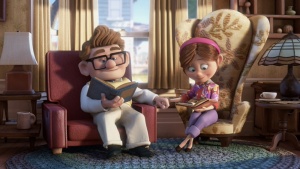 Up ducks out on making its tale more of a feeling, living movie, something more than striking visuals and some fun set pieces and odd characters with a dash of sentiment. Up establishes its strange story elements but then doesn’t plausibly make much more out of them. The story becomes a somewhat constricted rescue caper to return a Mama bird to her babies and keep her out of the hands of a Bad Man. Charles Muntz is a fairly weak villain. I’ve also got a burning question: if Carl is 78 years old, how old exactly is his childhood hero, Muntz? It’s a bit simplistic and that’s fine, and it’s still an enjoyable conclusion, but the movie doesn’t ascend from the sum of its parts like the finest works of Pixar, like WALL-E and The Incredibles. This one’s just missing some of that Pixar magic. Yeah, there’s the overall arc of Carl overcoming the loss of his wife and softening his hard exterior, but tell me what exactly else happens that matters? The kid makes a friend? It’s about human connection but how exactly is that best served by giant birds and talking dogs flying biplanes? Up also isn’t as visually arresting or creative as previous Pixar flicks, aside from that floating house. As far as Pixar films go, this is about square down the middle (between Monster’s Inc. and Finding Nemo, better than Cars and A Bug’s Life). But even that statement is prefaced by the fact that Pixar’s output is generally head and shoulders above every other studio in technical precision, creative ingenuity, and emotional heft.
Up takes some fancy flights of imagination and has plenty of humor and charm to make it a family-friendly winner. I have some reservations with the movie and its plot, but there’s no question that Pixar knows how to construct a movie that manages to appeal to everyone, even if it involves cranky old men as unlikely action heroes. I feel like perhaps Up is suffering because it has the rotten luck of following the release of WALL-E, a timeless masterpiece that I have since watched probably over 30 times. Up is a warm-hearted and engaging film even if it never reaches the creative and emotional heights of other Pixar masterworks. Still, a “pretty good” Pixar movie has a legitimate shot at being the best movie I see this summer.
Nate’s Grade: B+
Share this:

WALL-E (2008)
 At this point, is there anything Pixar can’t do? They’ve explored the secret life of toys, what’s under the sea, the pains of rearing a family of super heroes, and of course a rat that dreams of becoming a chef. Seriously, anyone that can make that last one not only work but one of the most sparkling, imaginative, enchanting, and poignant films of the year deserves every accolade in the book. Pixar’s newest film, WALL-E, is certainly its most ambitious and potentially its most rewarding yet.
The year is 2700 and the planet Earth has long been left behind by mankind. Humans have exhausted their resources and left behind a planet that looks like one never-ending landfill. Skyscrapers are being built out of garbage cubes. The Waste Allocation Load Lifter – Earth class (WALL-E) robots have been left to toil away and clean up mankind’s mess. There is but one WALL-E robot left and it leads a solitary life of routine. It gets up, it compacts trash into cubes, and it assembles those cubes into eventual giant structures. Then one day a probe lands called EVE. This floating capsule-like robot is easily frustrated and quick on the trigger and WALL-E falls completely in love with his unexpected new companion. The two become close and then EVE is taken away unexpectedly. WALL-E hitches a ride on the ship that collects his beloved and journeys through space to save her.
 I was having reservations citing certain words of praise but this film deserves every ounce of praise; WALL-E is a masterpiece. This is a beautiful story told in a beautiful way in a beautiful looking movie. I imagine kids will be tickled by the funny robots but I really believe that this film will play much better for adults, and when was the last time a mainstream, American family film did that? Most “family” films are an excuse to do something lowbrow and cynical to make a quick buck, like the atrociously cringe-worthy trailer I saw for Beverly Hills Chihuahua (seriously, a civilization of singing/rapping Taco Bell dogs?). Pixar, and God bless them, are proving with each new release that family films need not be brain-killing hours. That reliable Pixar quality touch is never more present than with WALL-E. If you told me that a film that takes place on a trash-filled Earth, with minimal dialogue, and a romance between two robots would be the most thrilling, moving, and wonderful film of 2008, I would have scoffed.
Writer/director Andrew Stanton (Finding Nemo) relies on a universal visual storytelling language to tell the bulk of his tale. WALL-E plays like a gloriously enjoyable silent movie where body language and physicality advance the storyline and provide surprising depth; ignoring brief TV clips of Fred Willard and Hello Dolly, the movie doesn’t have actual dialogue until the 45-minute mark. And it is fantastic. The character of WALL-E is immediately empathetic and the audience will see slivers of themselves inside this independent robot that finds another reason for being. It’s a simple love story told in simple strokes, but it just so happens that Stanton has provided great emotional heft to those strokes. The film has such a huge and vibrant heart. More is said in indecipherable robot bleeps than in much of the tripe Hollywood calls dialogue. Watching WALL-E court EVE, a bit unsuccessfully at first, begins as cute, moves into being adorable, and ends up being greatly touching and flirting with the profound. How many other movies, let alone romances, end with the long-desired climax of two characters merely holding hands? This movie is a delight from beginning to end and a classic example of the power of expert storytelling.
When the film transitions into space is when the potent environmental message, and subversive satire, emerge. Beforehand we have witnessed the awe-inspiring landscape of Earth littered with garbage and empty shopping centers. Humans left the Earth to wait for the robots to do all the work and make the planet hospitable for life once again. For the last 700 years humans have been living in a heavy-duty luxury spaceship. Humans have grown to be fat, lazy, and completely self-involved; people only communicate with others through video screens, even when the other person is inches away. The movie also manages to satirize consumer culture, and in the future one corporate behemoth essentially dictates life’s choices; I found it highly amusing that the former president of the future (a live-action Willard) is also the CEO of the super corporate conglomerate. Business and government have merged completely. The social commentary isn’t as merciless as Mike Judge’s Idiocracy, nor is the environmental message subtle in the slightest, but the satire is sharp enough and blunt that some viewers might be offended, and I think that is genius.
Being a Pixar film, naturally WALL-E is resplendent to look at. The animation is superb and the imagination on display seems limitless. This is one of those films I’m certain I could watch again and again and find something new every time. I don’t really need to say much more about the visuals because they are breathtaking to behold (Roger Deakins, by the far the greatest living cinematographer, was even consulted to help with the look of the film. How awesome is that?).
 And yet even though WALL-E is primarily a love story the film also manages to be greatly exciting and equally funny. Stanton’s screenplay nimbly assembles characters and reintroduces them at key points to push his story onward. I loved that WALL-E is introduced to all sorts of unique robots on the mankind’s space ship and that he even stumbles into, more or less, a group of malfunctioning robots that come to his aid (think the Island of Misfit toys). Stanton manages to reconnect his storytelling threads so that every moment in this movie matters. The last third of the film is a back and forth cat-and-mouse struggle that manages to pump up suspense in smart ways. Stanton lays out his scenario for action and then builds organic complications. I am deeply satisfied when a filmmaker has a firm command of action that they can setup a situation, establish the rules, and then naturally construct obstacles and surprises that feel natural and germane to the story. Pixar has always been able to craft exciting action scenes that felt fully realized and WALL-E is no different.
If there is but one minor quibble I have with this near-perfect film, it is the missed opportunity to explore the mortality of robots. While WALL-E is going through his day-to-day duties he passes by older versions of other WALL-E models. The movie could have pushed just a little harder with the concept that this tiny robot is going to live to collect trash and then die like all the rest, becoming another piece of forgotten garbage. I think if Stanton had only explored this idea a little more it would have made his robo-love story even richer considering that both robots are going against their programming because they have found something that completely changed their world — love. The idea of mortality was explored to excellent effect in 1999’s Toy Story 2, so perhaps the Pixar folk didn’t want to fall into a philosophical repeat.
WALL-E is a wonderful love story, a heartfelt and immensely charming character piece, and a thrilling sci-fi tale that soars to broad heights of imagination. It’s timeless while still being rather timely thanks to its environmental message. Moments after the movie was over I wanted to see it again. I think I’ll feel the same way after the second viewing and the third. This is a phenomenal movie that will stand the test of time as one of the greats.
Nate’s Grade: A
Share this:

Ratatouille (2007)
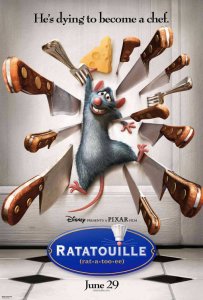 This movie continues to grow on me every day after I saw it. Writer/director Brad Bird yet again impresses with a deceptively simple story that manages to hit big themes in organic ways. The comic possibilities are fully realized with the setup of a man and a rat teaming up to be a great Parisian chef. There is a jubilant spirit alive and well throughout the film, and it’s difficult not to get swept up in the wit, the wonder, and the magnificent visual feast.
Nate’s Grade: A
Share this:

Cars (2006)
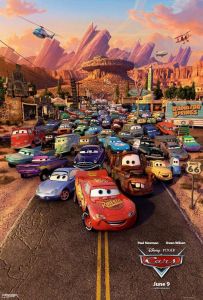 While I’d never call Pixar’s latest animated film a disappointment, it is the company’s first speed bump in their unprecedented reign of unmatched quality. Cars is technically dazzling; it’s almost redundant to say a CGI film is the best-looking ever because the technology keeps improving with time but Cars is incredible to watch. The lushly painted vistas, the way light gleams on surfaces, the blurs of color, the near-photographic likeness of cars themselves, this is a beautifully animated film, obviously. What isn’t as beautiful is the lackluster storyline. I can feel Pixar’s heart in the right place but they don’t put enough effort to touch our own hearts. Cars lacks the depth of Pixar’s other features. The two Toy Story films managed to take a kiddy concept of the secret life of toys when no one’s watching and infuse it with serious moral dilemmas and a mature insight into mortality and community. In Cars, the main storyline involves a cocky hot rod Lightning McQueen (voiced by Owen Wilson) who lives in a glitzy world that revolves around him. He goes off the beaten path and finds himself trapped in Radiator Springs, a tiny town that’s all but been dried up since the interstate took folks away from them. There, Lightning learns there’s more to life than material riches from this eclectic mix of good, honest small-town folk. What I’ve just described to you could be the plot of hundreds of movies championing the likes of small town folk. They surprisingly never really go much deeper, though Paul Newman is terrific as an old time car that had a taste of the glory and arrogance way back.
This is the first Pixar movie to exist in a world without humans, which begs the question how living automobiles were able to construct their world minus opposable thumbs. Cars themselves are weirdly inexpressive creatures.
The climax to Cars is suitable and heartfelt but the movie, at two hours in length, sputters a while in the middle. This is the first film directed by Pixar’s big cheese, John Lasseter, since 1999’s Toy Story 2, so excuse me for expecting a little more. Still, the movie is certainly fun, exciting, more cute than funny, and it has a genuine sweetness to go with its visual prowess. I just wish the 8 credited screenwriters, including Lasseter himself, had revved up their imaginations a bit more beyond the conceptual stage. Cars isn’t a great movie, but coming from Pixar, it’s still very good. Hey, anyone that can make the voice of Larry the Cable Guy tolerable deserves my thanks.
Nate’s Grade: B


 nathanzoebl
You must be logged in to post a comment.