Blog Archives
Wicked: Part One (2024)

It’s shocking that it took this long for Wicked to make its way from the Broadway stage to the big screen. The musical, based upon Gregory Maguire’s novel, began in 2003 and while it may have lost out on the biggest Tony Awards that year to Avenue Q (it seems astonishing now but… you just had to be there in 2004, theater kids) the show has been a smash for over two decades, accruing over a billion dollars as the second highest-grossing stage show of all time. As show after show got its turn as a movie, I kept wondering what was taking so long with an obviously mass appealing show like Wicked. It’s the classic Hollywood desire of “same but different,” a reclamation project for none other than the Wicked Witch of the West, retelling her tale from her perspective. Well, Wicked’s time has eventually dawned, and the studio is going to feast upon its protracted wait. Taking a page from the YA adaptation trend that dominated the 2010s, they’ve split the show into two movies, separated by a full year, hoping to better capitalize on the phenomenon. I was wary about Part One being 150 minutes, the same length as the ENTIRE Wicked stage show, but having seen the finished product, and by “finished” I mean one half, I can safely say that Wicked is genuinely fabulous and deftly defies the gravity of expectations.
In the fantasy world of Oz, the green-skinned outcast Elphaba (Cynthia Erivo) is looked at with scorn, derision, and fear. She’s always been different and never fully accepted by her father who blames her for her mother’s death and her younger sister Nessarose (Marissa Bode) being stricken to a wheelchair. Nessa is going to study at Shiz University with all the other up-and-coming coeds of the land of Oz, including Glinda (Arianna Grande), a popular and frivolous preppie gal peppered in pink pastels. Glinda desperately wants to be taken seriously and become a witch, studying magic under the tutelage of the esteemed Madame Morrible (Michelle Yeoh). Instead, Morrible’s fascination falls upon Elphaba after she reveals her tremendous magical ability in a moment of extreme emotion. Now Elphaba is enrolled at the magic school and learning about the way of the world, and she’s stuck with Glinda as her roommate. The two women couldn’t be any more different but over the course of the movie, we’ll uncover how one became Glinda the Good and the other the Wicked Witch of the West.

At two-and-a-half hours long, again the length of both acts of the stage show, Wicked Part One only covers the events of the show’s first act, and yet it feels complete and satisfying and, even most surprising, extremely well paced. It’s hard for me to fathom what could have been lost to get the running time down as each scene adds something valuable to our better understanding of these characters and their progression and the discovery of the larger world. It’s a movie that feels constantly in motion, propelling forward with such winning ebullient energy that it becomes infectious. It’s also not afraid to slow things down, to allow moments to breathe, and to provide further characterization and shading that wasn’t included in the stage show. The adaptation brings the fireworks for the finale and raises the visual stakes and danger in a manner that feels exciting and compellingly cinematic. Considering the resplendent results, I feel I could argue that the movie is actually -here comes the heretical hyperbole, theater kids- an improvement over the stage musical. It makes me even more excited for a bolder, longer, potentially even more emotionally satisfying second part in November 2025.
One of my primary praises for 2021’s In the Heights was that director John M. Chu, who cut his teeth helming the Step Up movies, knows exactly how to adapt musicals to maximize the potential of the big screen. If you’re a fan of musicals, old and new, you’ll find yourself swept away with the scope and intricacy of these large fantasy worlds, the flourishes of costume and production design, as well as the creative choreography making fine use of spaces and the power of film editing. There’s a rousing dance sequence set in a library with shelves that rotate around the room, making the slippery choreography that much more immersive, impressive, and acrobatic. Even big crowd numbers are given the knowing framing and sense of scale to hit their full potential, from the opening rendition of Munchkinland celebrating the death of the Wicked Witch of the West complete with giant burning effigy that would make a Wickerman envious, to the introduction to the City of Oz where it appears every citizen has a jovial role to play in welcoming strangers to their enchanted capital city. Chu’s nimble camerawork allows us to really enjoy the staging and skills of the talent onscreen, bringing a beating sense of vitality we crave from musical theater writ large. Wicked is simply one of the best stage-to-screen adaptations in musical theater history and a joyous experience that allows the viewer sumptuous visuals.

At its core, the story of Wicked is about some pretty resonant themes like self-acceptance, bullying, the fear of what is different or misunderstood, and all of this is built upon an irresistible friendship between Glinda and Elphaba. The rivals-to-allies formula isn’t new but it is tremendously effective and satisfying, especially when both characters are as well drawn and deserving of our empathy as these two ladies. They’re each on a different meaningful character arc for us to chart their personal growth and disillusion with what they’ve been taught is The Way Things Are. One is starting from a disadvantaged position and gaining traction through an outward demonstration of power, and the other is beginning in a position of privilege and becoming humble and more considerate as she acknowledges the challenges of others in a manner that doesn’t have to reconfirm her enviable “goodness.” It just works, and both women are fantastic in their roles. I was on the verge of tears at several points and my heart felt as full as a balloon throughout because of the emotional engagement and heartwarming camaraderie between our two leading ladies. With all its razzle dazzle, Wicked is a story of feminine friendship first and foremost and emotionally rewarding to experience, with the soaring music as a bonus.
Let’s finally talk about the music, a key factor in the enjoyment of any musical, naturally. The music was written by Stephen Schwartz, the Oscar-winning composer for “Colors of the Wind” from Pocahontas as well as “Believe” from The Prince of Egypt. I found his Wicked numbers to range from good to astoundingly good, with catchy ear-worms like “Popular” to the anthemic power and sweep of “Defying Gravity.” The cheeky and toe-tapping “Dancing Through Life” is a showcase for Jonathan Bailey (Bridgerton) and benefits from the aforementioned creative library choreography. “I’m Not That Girl” is a heartbreaking ode to the girls who don’t think of themselves as enough, which is begging for a reappearance in Part Two. The only clunker is “A Sentimental Man” but that’s more the result of the deficiencies of Jeff Goldblum as a singer than the song. I await the reuse of themes and motifs that will make the music even more thematically rich in the eventual Part Two.

Count me as part of the skeptical throng when it was announced that Grande, who hasn’t acted in over ten years, was cast as Glinda. I’m here to say that she is uniformly great. The Glinda role is the more outwardly showy role and thus immediately more memorable. It’s the far more comedic role, in fact the main source of comedy in the show, and Grande has serious comedic chops. Naturally she excels with the singing and its purposeful miasmic bombast, but it’s the subtle comedic styling and the exaggerated physicality that impressed me the most, like a moment of her twirling on the floor as an added dramatic flourish. There’s one scene where she’s just marching up and down a hallway in full exuberance, kicking, dancing, and exploding with joy. I anticipated that Erivo (Bad Times at the El Royale) would be exceptional, and of course the Broadway vet is, as she brings such simmering life to Elphaba. There’s a strength in equal measure to her vulnerability, making the character fully felt. Erivo also delivers during the big moments, like the climax of the movie that can give you goosebumps in hiw it weaves together empowerment and defiance and self-acceptance. Together, the two women are an unbreakable pair of performers and heroes that we’ll want to see triumph over adversity.
After decades of belabored waiting, Wicked finally makes its journey from stage to screen and I must say it was worth every minute. The film, even at only one half, feels complete and richly realized, building upon the strong foundation of the stage show and its numerous winning elements and masterfully translating them to cinema, taking full advantage of the visual possibilities while also expanding upon the story and themes for further enrichment. While born in the early 2000s War on Terror Bush era of politics, Wicked’s themes of anti-immigrant fear-mongering as scapegoats still bears striking resonance today, as do the emerging warnings of fascism in Oz. If you’re a fan of The Wizard of Oz, musical theater, or even just grandiose spectacle that doesn’t dilute grandiose feelings, then step into Wicked and you too will feel like you’re floating on air.
Nate’s Grade: A
Share this:

The Hunger Games: The Ballad of Songbirds & Snakes (2023)
 Who exactly was watching The Hunger Games and thought to themselves, I wonder if this evil old fascist dictator played by Donald Sutherland was ever young and sexy and in love? Well fear not, whomever you are, because 2023 gave us the adaptation of The Ballad of Songbirds & Snakes, the far too long adaptation of Suzanne Collins’ prequel book, thus granting the studio more material to grind into products. I guess we should all be grateful that this wasn’t stretched into two movies like the original plan. Taking place 60 years prior to the events of the first movie, young Coriolanus Snow (Tom Blyth) is trying to financially secure his family’s safety in the Capitol, and he’s also mentoring one of the district combatant’s in the tenth annual Hunger Games death match. His charge is District 12’s Lucy Gray Baird (Rachel Zegler), a feisty Romani-esque young woman who uses song as her vehicle for rebellion, and young Snow has to coach her to victory if he has any hope of righting his family’s lost standing. Fortunately, the Hunger Games behind-the-scenes coordination and development is interesting, and filled with top-level actors living it up in these outsized roles (Viola Davis, you national treasure). The deadly games themselves are confined to one dilapidated arena and are visually engaging even in such a limited space. Unfortunately, the would-be Romeo and Juliet romance between Snow and Lucy Gray is far less engaging, and young Snow proves to be a handsome bore. There was potential here in exploring the origin of a monster but the villainy seems awfully contrived to push him along on an arc, with several drastic personal decisions absent believable development. We’re talking big character leaps here, the kind that I can’t even really explain except, “Well, I guess he just had it in him the whole time.” The hazy rationalization and rushed development reminded me of Anakin Skywalker’s underwhelming descent into the dark side. Songbirds & Snakes is only really going to work for the diehard fans of the franchise asking for a little more time in this dystopian universe and daydreaming about the washboard abs and baby blue eyes of their favorite older fascist.
Nate’s Grade: C+
Share this:

Unfrosted (2024)
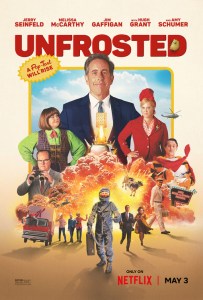 What to make of a movie like Netflix’s Unfrosted. It’s Jerry Seinfeld’s directorial debut, working off a screenplay he co-wrote, his first foray into film writing and acting since 2007’s Bee Movie. His eponymous sitcom “about nothing” was a 1990s mainstay and popularized an ironic meta form of comedy that still continues to dominate comedic tastes. Making a movie about the pseudo history of the invention of Pop Tarts, and the corporate rivalry between the major cereal brands, seems like a further exercise in that realm of humor, potentially satirizing a burgeoning sub-genre of late, the Biopic of Products (Air, Tetris, Flamin’ Hot, Blackberry). Except this supposed “biopic about nothing” is really a head-scratcher. Its humor feels pained and stale, the satire feels missing or glancing at best, and it seems like an expensive lark, wasting the nigh-infinite money of Netflix to purposely make a stupid comedy with all his friends.
Set in the mid 1960s, we follow two households, both alike in dignity, in fair Battle Creek, Michigan where we lay our scene. Kellogg’s has been the dominant cereal-brand for years but its chief rival, Post, is set to launch a new product that will revolutionize breakfast mornings. Bob (Seinfeld) is the head of development for Kellogg’s and reaches out to his old colleague, Donna (Melissa McCarthy), when it becomes evident that Post stole their unused research to develop a pastry treat designed to be cooked in one’s toaster. The warring CEOs, with Jim Gaffigan as Edsel Kellogg III and Amy Schumer as Marjorie Post, are desperate to one-up one another and be seen as more than an inheritor of their family’s wealth. It’s a race to see which company can get their treat to market first and capture the hearts, minds, and sweet teeth of America’s youth.
 I’d be lying if I said I didn’t laugh at points through Unfrosted, which operates like a spoof movie on a slower jokes-per-second pacing guide. There are zany sight gags amidst broadly drawn characters treating the silly straight, though occasionally you’ll have wisecrackers commenting on the inherent absurdity of moments, mostly confined to the stars making asides to the audience. Sometimes it’s lazy jokes that rely upon our foreknowledge, like when Bob coins a NASA beverage by saying it has a “real tang” (get it?). The movie frequently intensifies into goofy escalation when Kellogg’s impanels a team of mascots and inventors as a breakfast brain trust. Every one of these wacky characters is here to provide the exact same joke they will provide throughout the movie, and their inclusion is already suspect. Having the Schwinn bicycle guy (Jack McBrayer) comment on why he should be there is not enough. The hit-to-miss ratio will vary per everyone’s personal sense of humor, but overall I just felt mystified why this project would tempt Seinfeld from his comedy repose. What about this idea excited him? Was it just his lifelong love of cereal and Pop Tarts, a topic from his standup act decades ago? I ate a lot of cereal as a teenager too but I don’t want to make a movie about the Lucky Charms advertising campaign teaching children to beat and pillage the Irish (maybe Ken Loach could direct – to the three people on the Internet who appreciate this joke, I want you to know I appreciate you also).
It can be fun to simply watch dozens of famous people take their turns being silly in what is unquestionably a “dumb comedy.” When you have comedians of this quality in your movie, they’ll find ways to make even so-so jokes hit a little better, and that’s the case here. There’s an entertainment value in just wondering who will show up next, as many characters are only onscreen for a single scene or an abbreviated moment. Unfrosted becomes an example of Seinfeld’s industry power as he empties his Rolodex to fill even the tiniest of roles. Look, it’s James Marsden as Jack LaLanne. Look, it’s Bill Burr as JFK and Dean Norris as Kruschev (double Breaking Bad). Peter Dinklage as the head of the nefarious milkmen cartel? Why not? If you set your expectations low, maybe lower than what you were accounting for, there can be a mild amusement scene-to-scene just seeing who might show up next, almost like a modern-day version of those anarchic big ensemble comedies like It’s a Mad, Mad, Mad, Mad World.
 There is one segment that fell so flat for me that I was in utter amazement, and that was the unexpected January 6th insurrection parody. In a movie that has sustained a surreal and offbeat version of our universe, it evokes one of the most startling days of recent history. I think the humor is meant to derive from simply seeing a bunch of mascots in big colorful costumes as a mob running havoc, but there’s no jokes about like the challenges of a mascot costume in a fight, or say someone tipping over and being unable to get back up like a helpless turtle. There are jokes that can be had with this scenario, but instead Seinfeld is relying on the ironic juxtaposition of the ridiculous with the serious, and I don’t think it ever works as a joke. My sinking feeling began when Hugh Grant’s embittered mascot character wore a headdress resembling the QAnon shaman. It feels tacky and strange and the longer it persists the more I kept wondering what Seinfeld was doing with this. Why include this especially as the only form of relatively topical political humor, beyond, I guess, the depiction of business elites being complete morons? Why this? Again, it would be different if it was funny in execution, like the Saving Private Ryan D-Day parody from Sausage Party. This just isn’t funny, and its inclusion feels so odd compared to the stale nature of its other comedy.
As an admittedly silly enterprise, one that doesn’t even pretend to be accurate even as it flirts with the truth, Unfrosted is a successfully stupid comedy that feels a little too aimless, a little too edge-less and safe, and a little too dated and stale in its approach to comedy (lots of 1960s Boomer nostalgia ahoy). It’s hard to work up that much risible anger over a 90-minute movie that features a living ravioli creature. Clearly this movie wasn’t trying to be anything other than a gleefully stupid comedy, but I wanted more pep from its jokes and whimsy and general idiocy. I think the way to go may have been all the way in the other direction, treating the formation of a toaster pastry like international nuclear secrets and playing the corporate espionage completely straight while also making it patently ridiculous. Unfrosted did, however, make me want a Pop Tart that I ate afterwards, although it was my local grocery store’s generic brand, so I guess that doesn’t directly benefit Kellogg’s. This movie exists as a Seinfeld curiosity that ultimately left me hungry for more.
Nate’s Grade: C
Share this:

The Station Agent (2003) [Review Re-View]
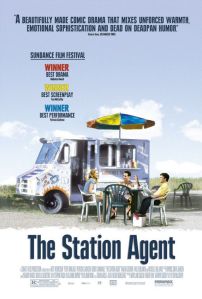 Originally released December 5, 2003:
This is the most charming film of 2003, and Im not just saying this because I had an interview with one of its stars, Michelle Williams (Dawson’s Creek). Fnin McBride (Peter Dinklage) is a man with dwarfism. With every step he takes every look he gives, you witness the years of torture hes been through with glares and comments. Hes shut himself away from people and travels to an isolated train station to live. There he meets two other oddballs, a live-wire hot dog vendor (Bobby Cannavale) and a divorced mother (Patricia Clarkson). Together the three find a wonderful companionship and deep friendship. The moments showing the evolution of the relationship between the three are the films highlights. Its a film driven by characters but well-rounded and remarkable characters. Dinklage gives perhaps one of the coolest performances as the unforgettable Fin. Cannavale is hilarious as the loudmouth best friend that wants a human connection. Clarkson is equally impressive as yet another fragile mother (a similar role in the equally good Pieces of April). The writing and acting of The Station Agent are superb. Its an unforgettable slice of Americana brought together by three oddballs and their real friendship. You;ll leave The Station Agent abuzz in good feelings. This is a film you tell your friends about afterwards. There’s likely no shot for a dwarf to be nominated for an Oscar in our prejudiced times but Dinklage is deserving. The Station Agent is everything you could want in an excellent independent movie. It tells a tale that would normally not get told. And this is one beauty of a tale.
Nate’s Grade: A
——————————————————
WRITER REFLECTIONS 20 YEARS LATER
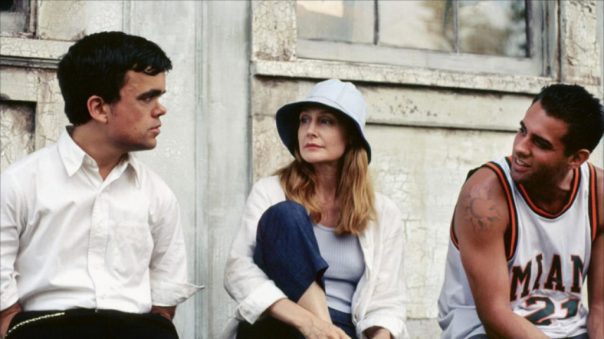
Tom McCarthy didn’t invent the quirky, found family indie but he sure seems to have nearly perfected it, starting with 2003’s The Station Agent. This little gem of a movie is so subdued, so relaxed, and so gentle that it seems to adopt the very personality of its lead character, Fin (Peter Dinklage), a dwarf who just likes trains a lot and wants to live his life in solitude. He’s an unassuming man who keeps to himself as a means of survival, because almost every time he goes into public life Fin is met with stares, snickers, and harassment (the convenience store lady gets his attention to take his unsolicited picture). Very few will get to know this man beyond his superficial physical characteristics, so he retreats within himself, perhaps purposely obsessing over an antiquated hobby as a means of escape to the past. He’s a lonely man and the movie is about him finding his clan, his place in the world, by slowly lowering his defenses. It’s a simple sort of story that is lifted by the strength of its characters and its wonderful ensemble cast.
With such a taciturn main character we need a contrasting character, a much more talkative person with high energy, and this is beautifully embodied by Bobby Cannavale. He plays Joe Oramas, a coffee truck operator who exemplifies joy de vie. He’s charming, garrulous, and relentlessly upbeat, which makes for a magnificent odd couple contrast with Fin, and it allows both characters to gradually change and grow attached to one another’s mutual friendship. Finn allows himself to become more vulnerable and form bonds and Joe starts to see the world from Fin’s point of view, allowing himself to slow down and appreciate the smaller things he might have missed in his excitable and irascible activity. Dinklage’s dry understated performance is a perfect counterpoint to the churning energy emanating from a grinning Cannavale. This is a fine showcase of both actors, who would go on to win six Emmys between them in the years ahead.
The third member of this found family is Olivia, played by Patricia Clarkson, and I actually think the movie might have worked better without her character. She does provide a point of view that our two guys lack; she’s experienced significant grief over a lost child and her life is in shambles as she tries to discover what she wants from her cratering marriage to a young-er John Slattery. Clarkson is also wryly enjoyable and gets some of the best lines in the movie, so she’s not at fault here. I think it’s because I’m confused about how this character is treated, especially compared to the natural opposites-attract dynamic of Fin and Joe’s friendship. Olivia feels like a broken thing that the boys need to try and help get better, but we were already covering this with Finn’s reserve from a lifetime of feeling ostracized. The possible romance between Fin and Olivia is also awkward because there are obvious implications that she sees Fin as a replacement son, even having him sleep in her son’s old bed. At one point, in her anger, she yells at Fin that she’s not his mother, but it feels much more like she’s the one who is looking for a surrogate son, and just because Fin is a dwarf and perhaps of similar heights makes the whole thing feel uncomfortable and ill-advsied. I’m not going to refuse an added Patricia Clarkson in my movie, but upon my re-watch twenty years later, it’s hard not to feel like McCarthy didn’t have as much envisioned for this part.
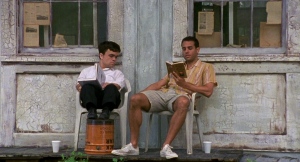 McCarthy’s movie acclimates the viewer to the simple charms of its people and the small town, getting to know the various characters and their foibles and hopes, getting used to the rhythms of this life and adjusting much like Fin. There are small victories that are payoffs, like Fin finally getting a library card, or speaking in front of a school class about his affinity for trains. It works so well. McCarthy continued his found family writing with 2007’s The Visitor and 2011’s Win Win, both anchored by the emotional enormity of sad, lonely men learning to open up to companionship. There were some dips in the road but McCarthy worked his found family magic to the biggest stage with 2015’s Best Picture winner, Spotlight, which McCarthy directed and co-wrote. His only follow-up theatrical movie was 2021’s Stillwater, where an oil rig dad (Matt Damon) tries to save his daughter overseas from a very ripped-from-the-headlines scandal (Amanda Knox was very unhappy). There is also a 2020 Disney Plus movie about a kid detective and his imaginary polar bear best friend (that actually sounds adorable). I guess I figured a Best Picture Oscar on your resume, as well as a history of working within the studio system and world of indies, would have given McCarthy more work than directing a handful of episodes for 13 Reasons Why and creating Alaska Daily. I’ll always be looking for the next McCarthy project when I can.
McCarthy’s failures can be just as intriguing as his successes. The Cobbler is just such an astounding idea that it’s hard to imagine anyone thinking it would work out, with Adam Sandler as a magic shoe-maker. However, this same pessimistic mentality probably prevailed when McCarthy was trying to raise money for The Station Agent. His indie successes proved that he could take any jumble of strange characters and turn it into a functional movie. Maybe that hubris, well-earned along with his contributions to the Oscar-nominated Up script, finally caught up with 2014’s The Cobbler. I would pay good money to one day watch that un-aired footage of the original Thrones pilot, the one the producers themselves acknowledged to be deeply troubled. After retooling the show and cast, bringing in Michelle Fairley and Emilia Clarke, McCarthy departed, though is credited for helping to secure Dinklage’s involvement, and it’s impossible to think of the zeitgeist-defining excellence of the HBO series with anyone else playing the iconic role of Tyrion Lannister.
 Re-evaluating The Station Agent twenty years hence, its many charms are still abundant and I appreciated how gentle and relaxed everything felt. When indie movies deal with heavy amounts of quirk and oddities, it can often be heavy-handed and abrasive, never letting the audience forget for a second just how special and strange and different the movie must be (here comes 2024’s look at Napoleon Dynamite). McCarthy’s movie almost feels like a writing exercise where he plucked three very different characters out of a hat and challenged himself to build a grounded movie built upon their unexpected friendships. It’s a movie confident to just let the characters speak for themselves. It’s more a slice-of-life glimpse at people who feel far more real than most Sundance indies built upon oddballs and quirk. I would slightly lower the grade from an A to an A minus simply because of the Olivia character. Clarkson is great but her role feels undeveloped, somewhat redundant, and a little sloppy. Still, the enjoyable performances, the observational detail, and the simple pleasures of a story well told with characters you genuinely care about are what shines through even twenty years later.
Author’s note: In my original review, I cite having interviewed Michelle Williams (yes, surprise, she plays the small-town librarian). While I was my college newspaper’s film critic from January 2002 to May 2004, I did have the opportunity to interview several actors and directors through phone cattle calls with other collegiate journalists. These names include Angelina Jolie (Tomb Raider 2), Billy Bob Thornton (Bad Santa), Kevin Smith (Jersey Girl), and the late Paul Walker (Timeline). However, my school schedule was not accommodating for the Williams interview, so I had my dormitory neighbor and friend Tim Knopp call in and ask my question. It wasn’t me. I’m coming clean after twenty years, folks. I also recall having him quote a line her character says in The Station Agent, saying Fin had “a nice chin,” and being told that she was baffled and blanking on the reference. I’m sorry, eventual multi-Oscar nominee Michelle Williams, for trying to be clever.
Re-View Grade: A-
Share this:

Human Nature (2002) [Review Re-View]
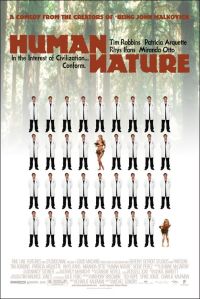 Originally released April 12, 2002:
Screenwriter Charlie Kaufman jumped on to Hollywood’s A-list when his feature debut Being John Malkovich was unleashed in 1999. Malkovich was a brilliant original satire on identity, be it celebrity or sexual, and was filled with riotous humor but also blended beautifully with a rich story that bordered on genius that longer it went. Now Kaufman tries his hand expounding at the meaning of civilization versus animal instinct in Human Nature. As one character tells another, “Just remember, don’t do whatever your body is telling you to do and you’ll be fine.”
Lila (Patricia Arquette) is a woman burdened with excessive body hair ever since she was old enough for a training bra (with the younger version played by Disney’s Lizzie McGuire). Lila feels ashamed by her body and morbidly humiliated. She runs away to the forest to enjoy a life free from the critical eyes of other men. Here she can commune with nature and feel that she belongs.
 Nathan (Tim Robbins) is an anal retentive scientist obsessed with etiquette. As a young boy Nathan was sent to his room for picking the wrong fork to eat his meal with. He is now trying his best to teach mice table manners so he can prove that if etiquette can be taught to animals it can be ingrained toward humanity. Lila and Nathan become lovers when she ventures back into the city, eliminating her body hair for now, because of something infinitely in human nature – hormones. The two of them find a form of content, as neither had known the intimate touch of another human being.
“Puff” (Rhys Ifans) is a grown man living his life in the woods convinced by his father that he is an ape. One day while walking through the woods, Nathan and Lila discover the ape-man and have differing opinions on what should be done with him. Nathan is convinced that he should be brought into civilization and be taught the rules, etiquette, and things that make us “human.” It would also be his greatest experiment. Lila feels that he should maintain his freedom and live as he does in nature, how he feels he should.
What follows is a bizarre love triangle over the reeducation of “Puff,” as Nathan’s slinky French assistant Gabrielle (Miranda Otto) names him. Lila is torn over the treatment of Puff and also her own society induced shame of her abundant amount of body hair. Nathan feels like he is saving Puff from his wayward primal urges, as he himself becomes a victim of them when he starts having an affair with Gabrielle. Puff, as he tells a congressional committee, was playing their game so he could find some action and “get a piece of that.”
 Kaufman has written a movie in the same vein as Being John Malkovich but missing the pathos and, sadly, the humor. Human Nature tries too hard to be funny and isn’t nearly as funny as it thinks it is. Many quirky elements are thrown out but don’t have the same sticking power as Kaufman’s previous film. It’s a fine line between being quirky just for quirky’s sake (like the atrocious Gummo) and turning quirky into something fantastic (like Rushmore or Raising Arizona). Human Nature is too quirky for its own good without having the balance of substance to enhance the weirdness further. There are many interesting parts to this story but as a whole they don’t ever seriously gel.
Debut director Michel Gondry cut his teeth in the realm of MTV making surreal videos for Bjork and others (including the Lego animated one for The White Stripes). He also has done numerous commercials, most infamously the creepy-as-all-hell singing navels Levi ad. Gondry does have a vision, and that vision is “Copy What Spike Jonze Did as Best as Possible.” Gondry’s direction never really registers, except for some attractive time shifts, but feels more like a rehash of Jonze’s work on, yep you guessed it, Being John Malkovich.
Arquette and Robbins do fine jobs in their roles with Arquette given a bit more, dare I say it, humanity. Her Lila is trapped between knowing what is true to herself and fitting into a society that tells her that it’s unhealthy and wrong. Ifans has fun with his character and lets it show. The acting in Human Nature is never really the problem.
While Human Nature is certainly an interesting film (hey it has Arquette singing a song in the buff and Rosie Perez as an electrologist) but the sum of its whole is lacking. It’s unfair to keep comparing it to the earlier Malkovich but the film is trying too hard to emulate what made that movie so successful. Human Nature just doesn’t have the gravity that could turn a quirky film into a brilliant one.
Nate’s Grade: C+
——————————————————
WRITER REFLECTIONS 20 YEARS LATER

I’m at a loss with 2002’s Human Nature. I thought in the ensuing twenty years I would have more to say with coming back to the early burst of brilliant writer Charlie Kaufman in the immediate wake of his successful debut, 1999’s Being John Malkovich. 2002 was a big year for Kaufman; he had three movies released that he wrote, all of them wildly different. His best work was Adaptation, a reteaming with Malkovich’s Oscar-nominated director Spike Jonze, that earned Chris Cooper a Best Supporting Actor Oscar and Kaufman was close to winning for Best Original Screenplay and sharing the honor with his pretend twin brother, the both of whom were portrayed by Nicolas Cage. It was the most challenging and creative and fulfilling of the three. There was also Confessions of a Dangerous Mind, the debut for George Clooney as a director, was a lark of a movie, taking Gong Show host Chuck Barris’ “unauthorized autobiography” where he claimed he was doubling as a CIA black ops hitman. I recently re-watched this one months ago and my opinion even lowered because there’s nothing to the movie beyond the central irony of the unexpected reality of this unexpected man being a spy and assassin. There’s no real insight into Barris as a character and he comes across as scummy and unworthy of a big screen examination. It’s a story that only exists to be ironic and missing the messy humanity and pathos of Kaufman’s best.
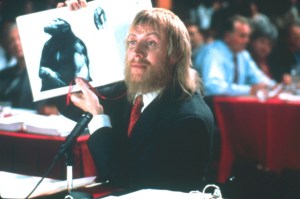
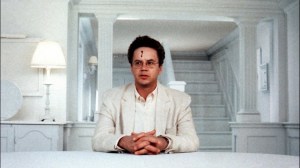
But Kaufman’s most forgotten movie in his screenwriting career is definitely Human Nature, the debut film for Michel Gondry, one of Kaufman’s other collaborators along with Jonze, both men having gained great acclaim for eclectic and visionary and just plain weird music videos. It follows three main characters, each debriefing their tale to an audience. Lila (Patricia Arquette) is accused of murder and discussing her lifelong malady of growing intense amounts of body hair, enough so that she worked as a gorilla woman in a circus sideshow. Puff (Rhys Ifans) is a man raised in the wild who intended to be an ape and returned to society, been trained in etiquette, and become an example of the transformative power of civilization. Dr. Nathan Bronfman (Tim Robbins) is telling his story after death with a bullet hole in the middle of his pasty forehead, as the scientist who found Puff, trained him, and romanced Lila before cheating on her with his French assistant (Miranda Otto). Immediately, the movie presents questions for us to unpack: how did Nathan die? Who was really responsible? What will be the connections between these three very different characters? Then there are assorted kooky side characters that come in and out, but the focus is mostly on this trio, perhaps a foursome with Otto, and the shame is that there is only one really interesting character among them.
Lila is the only protagonist worth following. She feels like a freak, even served in a “freak show,” and must hide her secret from lovers who would object to her untamed mane. She’s vulnerable and hopeful but pressured to conform to be accepted, and her journey to radical self-acceptance would have been an entertaining movie all on its own. However, by fragmenting the narrative with Puff and Nathan, she gets far less attention and her story becomes, for far too long, just her willfully sublimating herself to Nathan’s standards of beauty. Lila frustratingly feels like a character furiously trying to do whatever she can to keep the affections of a bad man. It’s reductive to the movie’s most interesting character. Puff and Nathan, in contrast, just feel like ideas, opposite poles in a discussion over the differences between animal instinct and the ideals of human civilization in all its hypocritical splendor. Even though both men are given comic-tragic back-stories, neither is really a richly defined character. Puff is all impulses and his urges become a tiresome comic device when we watch him hump somebody or something for the eightieth time. Nathan’s preoccupation with social niceties is meant to be absurd (teaching table manners to mice?) and petty, a meaningless articulation of “high culture and values.” I did laugh out loud when Nathan was teaching Puff how to respond at the opera, complete with a constructed box seat. Nathan is a satirical punching bag for a bourgeois sensibility. Neither him nor Puff feel like characters, instead more like conflicting points of view of humanity.
 The other disappointing aspect to Human Nature is as I declared in 2002, it feels like quirky for quirky’s sake screenwriting. Kaufman has become a screenwriting legend and he’s able to marry absurd, bizarre, and dangerous elements into meaningful and subversive and satirical masterstrokes, but the man cannot be expected to perform at the highest heights every time. Human Nature is stuffed full of wacky moments and wacky characters and it doesn’t feel like it ever amounts to more than the sum of its transitory parts. In contrast, 2022’s Everything Everywhere All At Once is an example of how one can take the most bizarre ideas and still find ways to tie them back in meaningful ways that braid into the larger theme. However, much of Human Nature feels like a quirk dartboard being hit over and over, a catalog of strange visuals and goofy ideas (Lila breaks out into song!) that fails to coalesce into a larger thesis like an Adaptation or an Eternal Sunshine of the Spotless Mind or the vastly underrated Synecdoche, New York, Kaufman’s directorial debut. He’s a master of the idiosyncratic, but Human Nature suffers because ultimately what does it have to say? Puff is set up for ridicule. Nathan is set up for ridicule. Even Lila is set up, though for murder. In the end, when Puff returns to the wild in a public galivanting that feels like a ceremonial bon voyage from the society that came to love him, he then scampers out of the woods and escapes back to the comforts of society with Nathan’s French mistress. In the end, is the point that we’re all rubes and hypocrites?
This was Gondry’s first film and it feels like a training vehicle for what would be his real masterpiece, 2004’s Eternal Sunshine of the Spotless Mind, one of my favorite films ever. Gondry’s style is still recognizable, especially reminiscent of his tactile, kitschy, avant garde music videos he directed for Bjork, the queen of weird 1990s music videos. Gondry’s hardscrabble, idiosyncratic style was a natural match with Kaufman’s vivid imagination. It’s surprising that they never reunited after Eternal Sunshine. Gondry had a few movies (2006’s The Science of Sleep, 2008’s Be Kind Rewind) but they felt lacking, trifling without a stronger writer to guide and ground them in human drama. Gondry even tried his hand at studio action to middling results with 2010’s The Green Hornet. He mostly retreated back to music videos and commercials and had a short lived series on Showtime with Jim Carrey as a former children’s TV entertainer whose fantasy is blending with reality. It seemed like a good fit for Gondry, and a nice starring role for Carrey, but it was canceled after two seasons. Even the realm of music videos seems so far removed now, where Hollywood was snatching up every visual virtuoso.
Human Nature has plenty of familiar faces, no doubt eager to attach their names to a daring Kaufman movie. Arquette is winning and the best part of the movie. She would later win an Academy Award for her decade-in-the-making performance in Richard Linklater’s Boyhood. Now I enjoy her in a chilly, villainous role as the shady corporate boss on Apple TV’s stunning sci-fi satire, Severance. Robbins is officious to a fault here. He too would later win an Oscar for 2003’s Mystic River. Poor Ifans, so big after his scene-stealing role in 1999’s Notting Hill, who never seemed to capitalize on his success (even his Spider-Man villain got the weakest treatment in No Way Home). He’s had a long career and prominent TV roles with Berlin Station and the Game of Thrones prequel series, House of the Dragon. I did laugh out loud at his “yahoo” after being zapped by his electric shock collar. You’ll also see Rosie Perez, Peter Dinklage, Robert Forster, Toby Huss, Hillary Duff, and Mary Kay Place. As I said in 2002, acting is not the problem with Human Nature. It’s the writing and characterization that lets these people down.
I usually like to devote a paragraph to going back and re-evaluating my initial words from twenty years ago, but I agree with everything I wrote. Everything. That’s initially why I thought this would be a shorter review. What more am I going to say other than my initial opinion of this movie is the same opinion I have upon re-watching? With the distance, it’s even more clear to me that Human Nature is the weakest film of Kaufman’s career. Even a movie I didn’t really gel with, like 2020’s I’m Thinking of Ending Things, at least has a lot more ambition I can recognize. It’s a character study obfuscated with too much eccentric clutter but there’s still an artistic vision there, even if it didn’t work for me. Kaufman is too unique a voice to only have made three movies in the last 14 years, and it makes it even more frustrating when I don’t connect with his long-in-the-making projects. Human Nature is too limited in scope and characterization. It’s slightly interesting as a footnote to a great screenwriter but little more.
Re-Review Grade: C
Share this:

Cyrano (2021)
 I did not expect the new Cyrano to be a musical at all, though it is a reprisal of a 2018 stage musical by Erica Schmidt. This fact made the movie even more entertaining and surprising, separating it from the pack of Cyrano de Bergerac adaptations (there is a 1970s Cyrano musical with Christopher Plummer in a Tony Award-winning role). This is an old story and this new version still taps into the potent recesses of unrequited love, social scorn, and the farcical angle that transitions into tragedy. You still understand why audiences from multiple generations come back to this story to laugh and cry anew (it began as a play in 1897 by Edmond Rostand). However, when modern filmmakers are tackling these tried-and-true stories of old, I expect, or at least hope for, something new to justify this latest cinematic addition. It could be an elevated point of view given short shrift before, allowing us new eyes into an old tale. There are plenty of earlier versions that haven’t been as considerate to minority positions. It could be updating or transposing the story to a different setting. It can be simply making it weird. Director Joe Wright’s 2012 Anna Karenina adaptation was an attempt to do something different, with the strange concept that it was taking place on a theatrical stage. I guess because the elites felt so obsessively observed? It didn’t really work, but I admire Wright’s game efforts in trying something different with an oft-told tale. With Cyrano, the story translates well into the realm of a screen musical, and one where Wright wants to work within that unique toolbox, letting the audience get caught in the sweep of the movie magic.
Cyrano (Peter Dinklage) is a dwarf but one of the smartest men alive in 1640 France. He’s unafraid of jousting with pompous actors, pompous aristocratic dandies, and even assassins (their pomposity is up for debate). His true challenge is telling Roxanne (Haley Bennett) that he loves her. This is made even more difficult when Roxanne falls head over heels for Christian (Kevin Harrison Jr.). She seeks out her good friend Cyrano’s help to inquire about the boy’s feelings being reciprocal. Christian does indeed fancy Roxanne except he’s unable to articulate his thoughts. Cyrano agrees to serve as the carrier of his words and write his feelings for him in order to better woo Roxanne. Letter by letter, flowing with poetic verse, Roxanne falls in love with Cyrano’s soul, thinking it belongs to Christian. This is made even more complicated by a fiendish fop, De Guiche (Ben Mendelsohn), who expects Roxanne to marry him and give herself over to him, body and soul.
 The other thing you need to know is that Cyrano is a deeply un-hip musical, and its square-ness is also part of its offbeat charm. This is not 2017’s crowd-pleasing The Greatest Showman. These songs are not manufactured to be pop ditties fit for radio airplay. These are songs written and composed by the members of the band The National, an alt rock band better known for their soulful dirges (the lead singer performed the mournful end credits cover of “The Rains of Castamere” for that infamous Game of Thrones episode). The songs of Cyrano by Aaron and Bryce Dessner and Matt Berninger are not going to be the ones you clap your hands to and sing along in the car with your friends. There are no catchy anthems here, no inspirational melodies to rise to triumphant fist-pumping crescendos. These are songs that are methodical, mournful, and, at points, atonal, like twisting the words and sounds to fit an unnatural shape. However, this is the same appeal of songs by The National, how they make uniquely composed tunes that challenge and break free of standard melody conventions. For some, they will find the songs of Cyrano to be slow and low in energy, too self-serious to the point of parody. But for people willing to take the lyrics and songs on the terms presented, there is a smoldering sense of splendor to them, something unexpected, just like the character of Cyrano. Beauty found in unexpected places.
There is one song in particular that disarmed me with how affecting it was. “Wherever I Fall” isn’t even a song sung by any of the main characters. It’s the refrain of a bunch of otherwise nameless and faceless soldiers, the ones who know they will not survive a suicide march into enemy fire during the Franco-Spanish War. This is the song for the fallen and it’s heart-breaking. We take turns with each man writing one last letter and offering instructions to the carrier, which take on the form of last rites. Each man reflects on their life and their cherished loved ones that will read their letter after their inevitable demise. The entire construction of the song is heavy with emotional weight, but I was surprised how much it got to me. I was tearing up for men who weren’t even featured as characters before, or at least served as extras in other scenes that didn’t draw my attention. Bonus points for making the first soldier Glen Hansard (Once). “Someone to Say” has a sweet and lyrical melody that comes in and out as a bountiful motif, and it’s the romantic tug for our lovers. “Every Letter” and “I Need More” have a thrumming intensity of strings and heartbeat-like percussion that reminded me of the soaring 1990s/early 2000s singer-songwriters like Tori Amos and Dido. As I adjusted to its somber wavelength, the music grew on me. It’s music for a rainy day made into an old-fashioned musical that isn’t trying to score points for being edgy.
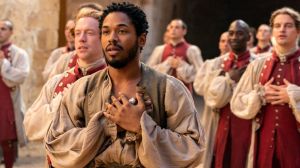 Dinklage (I Care a Lot) is an excellent choice for Cyrano. While he might be the weakest singing voice of the cast, Dinklage is definitely the most accomplished actor and proves it again. His character’s inner struggle and true feelings consuming him is wonderfully portrayed by Dinklage. He has his big outbursts, where he inflicts his wit like a sharp-edged weapon, and others where it’s the total of years of frustration from being sidelined and overlooked and discounted, but it’s the quieter moments where Dinklage retreats behind his sad puppy eyes that got me the most. Bennett (The Girl on the Train) has a spark to her that reminds you why Cyrano would fall in love from a distance. Her light at the beginning of the movie threatens to be snuffed out by bad men, and it feels like a real loss. Bennett and Dinklage are also reprising their roles from the stage musical, so their natural chemistry and comfort with the roles improves the experience. Mendelsohn (Captain Marvel) is a pro at playing those officious, lecherous, pathetic roles, and once again he’s on target. His creepy rendition of “What I Deserve” sounds like the skin-crawling mantra for male chauvinism writ large. It might even make you retch.
Wright’s (Darkest Hour, Hanna) direction makes fine use of the big screen space, and his penchant for long takes and sweeping camera movements for verisimilitude enhance the viewing experience by allowing us to better immerse in the world and appreciate the talents of the professionals. It’s a musical that lets you enjoy it being a movie musical, and its editing is judicious without being disorienting. The movie doesn’t feel like its trapped by its stage-bound origins. The lush setting of Italy and its pristine estates adds an extra layer of enjoyment that makes the movie more transporting.
Cyrano is a sneaky movie, one that seems old and new, serious and impish, square and traditional while still making its own stamp on classic literature. Much of your enjoyment factor will likely rest upon your assessment of the music and songs, which is a fair critical point for a musical. I found them to be romantic and gloomy and so achingly serious that I found it to be adorable. The music worked for me, as a moderate fan of The National, but if you cannot click with the songs or accept that everyone is not going to be a trained singer, then your enjoyment level will certainly dip. I found this movie to be a modestly pleasant surprise that won me over by its depressing finale.
Nate’s Grade: B+
Share this:

Avengers: Infinity War (2018)
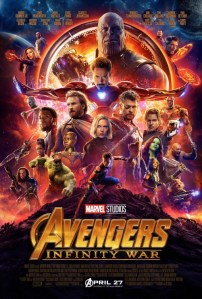 It’s hard to draw comparisons to the major commitment to long-form storytelling that the Marvel Cinematic Universe (MCU) has dabbled with over the course of ten record-shattering years of success. I can think of movie franchises that have been popular over long periods of time, like James Bond, but rarely do they keep to continuity. It’s been 18 movies and ten years since the caddish Robert Downey Jr. first stole our hearts in the original Iron Man, and its stable of heroes and villains has grown exponentially. Looking at the poster for Avengers: Infinity War, it’s hard to believe there’s even enough space just for all of the actors’ names. Infinity War feels like a massive, culminating years-in-the-making film event and it reminded me most of Peter Jackson’s concluding Lord of the Rings chapter, Return of the King. After so long, we’re privy to several separate story threads finally being braided as one and several dispirit characters finally coming together. This is a blockbuster a full decade in the making and it tends to feel overloaded and burdened with the responsibility of being everything to everyone. It’s an epic, entertaining, and enjoyable movie, but Infinity War can also leave you hanging.
Thanos (Josh Brolin) has finally come to collect the six infinity stones stashed around the universe. With their power, he will be able to achieve his ultimate goal of wiping out half of all life in the universe. Standing in his murderous way is a divided Avengers squad, with Tony Stark (Downey Jr.) still on the outs with a wanted-at-large Captain America (Chris Evans) and Black Widow (Scarlett Johansson). One of the in-demand infinity stones resides in the head of the Vision (Paul Bettany), who is in hiding with his romantic partner, Scarlet Witch (Elizabeth Olsen). They know Thanos will be coming for Vision eventually. On the other side are the Guardians of the Galaxy who have a few personal scores to settle with Thanos, the adopted father of Gomora (Zoe Saldana) and Nebula (Karen Gillan). Elsewhere, Thor (Chris Hemsworth) strikes out looking for the key to defeating the big purple menace. Thanos’ loyal lieutenants attack Earth to gather the remaining infinity stones, drawing the attention and push-back of Doctor Strange (Benedict Cumberbatch) and Peter Parker (Tom Holland). The various heroes of Earth and space unite to eliminate the greatest threat the universe has ever known.
 Avengers: Infinity War serves not as much a series of payoffs as it is climaxes, with climactic event right after another, and this time it’s for keeps (more on that below). There are moments that feel like major payoffs and moments that feel like shrug-worthy Last Jedi-style payoffs. Infinity War is the longest MCU movie yet at 149 minutes but it has no downtime. That’s because it has to find room for dozens of heroes across the cosmos. With the exception of three super heroes, everyone is in this movie, and I mean everyone. This is an overstuffed buffet of comic book spectacle, and whether it feels like overindulgence will be determined by the viewer’s prior investment with this cinematic universe. If this is your first trip to the MCU, I’d advise holding off until later. Any newcomer will be very lost. I’ve deduced the seven MCU movies that are the most essential to see to successfully comprehend the totality of the Infinity War dramatics, and they are Iron Man, The Avengers, Captain America: Winter Soldier, Guardians of the Galaxy, Captain America: Civil War, Doctor Strange, and Thor: Ragnarok. Naturally, being intimately familiar with the previous 18 movies will be best, but if you don’t have thirty hours to spare then please follow my seven-film lineup and you’ll be solid.
As far as the stakes, the MCU has been notoriously reluctant about killing off its characters, but Infinity War is completely different. I won’t spoil circumstances or names, of course, but the march of death happens shockingly early and carries on throughout. There are significant losses that will make fans equally gasp and cry. This is a summer blockbuster that leaves behind an impressive body count across the known universe and ends in a downbeat manner that will naturally trigger reflexive Empire Strikes Back comparisons. It’s hard to feel the full impact of the drastic decisions, and the grief over their losses because I know there is a Part Two coming summer 2019, and with that comes the almost certainty that several important events will be diminished or straight-out reversed. After all, in comics, nobody is ever really dead, though with movies the heroes have the nagging habit of aging. With that said, you better believe I was holding my breath during some standoffs, tearing up at some sudden goodbyes, and reflecting upon journeys shared.
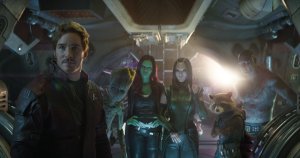 This is very much Thanos’ movie, which was one of the bigger surprises for me. Beforehand, our exposure to the big purple guy has been relatively minor, a brief moment here or a cameo there during a post-credit scene. Considering Thanos is supposed to be the universe’s biggest bad, it makes sense to finally give him his due, and that is what Infinity War does. Thanos gets the most screen time of any character and is given an honest-to-God character arc. He’s a villain who goes on an actual emotional journey as he follows a path that he feels compelled to even as it tests him personally. He finally opens up as a character rather than some malevolent force that is oft referred to in apocalyptic terms. We get his back-story and motivation, which is less a romantic appeal to Death like in the comics and more a prevention of the apocalypse reminiscent of the Reapers in the Mass Effect series. Thanos sees himself as a necessary corrective force and not as a villain. He’s never portrayed in a maniacal, gleeful sense of wickedness. Instead he seems to carry the heaviness of his mission and looks at the Avengers and other heroes sympathetically. He understands their struggle and defiance. Having an actor the caliber of Brolin (Deadpool 2) is a necessity to make this character work and effectively sell the emotions. Thanos is the most significant addition to the MCU appearing the latest, so there’s a lot of heavy lifting to do, and Infinity War fleshes him out as a worthy foe.
 As an action spectacle, however, Infinity War is good but not great. The action sequences are interesting enough but there’s nothing special and little development. There’s nothing that rivals the delirious nerdgasm of the airport battle in Civil War pitting hero-against-hero to dizzying degree. The characters are separated into units with their own goals leading to a final confrontation that feels more climactic conceptually than in execution. That’s because this is an Avengers film that falls into some of the trappings of the glut of super hero cinema, namely the army of faceless foot soldiers for easy slaughtering, the over exaggerated sense of scale of battle, the apocalyptic stakes that can feel a bit like a bell rung too many times, and even minor things like the lackluster supporting villains. Thanos’ team of lieutenants are all the same kind of sneering heavy with the exception of one, a sort of alien cleric heralding the honor of death from Thanos. Carrie Coon (HBO’s The Leftovers) is generally wasted providing the mo-cap for the Lady Lieutenant That Sounds Like a Band Fronted by Jared Leto, a.k.a. Proxima Midnight. There are far too many scenes where characters reluctantly strike a deal to give up an infinity stone if Thanos will spare the life of a beloved comrade. The film’s greatest point of entertainment isn’t with its action but the character dynamics. The fun is watching years-in-the-making character interactions and seeing the sparks fly. There’s more joy in watching Downey Jr. and Cumberbatch try and out smarm one another than with any CGI collision of a faceless army of monsters. There are so many characters that few are given fully defined arcs. Most are given beginnings and stopping places. Though the eventual sequel will have fewer characters needing to share precious screen time.
The standouts on screen are Hemsworth (12 Strong) carrying a large portion of the movie and not missing a beat of his well-honed comic rhythms from Ragnarok, Bettany (Solo) brings a sad soulfulness to Vision as a man who knows fate is likely unavoidable, and Dave Bautista (Blade Runner 2049) is perfectly deadpan as Drax and has the funniest lines in the movie followed closely by the exuberant Holland (Lost City of Z). To even say which characters deal with more complex emotions might be a spoiler in itself but there are several actors showing an emotive level unseen so far in the bustling MCU.
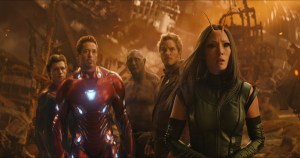 Avengers: Infinity War marks a significant concluding chapter for one of cinema’s most popular series, until at least the next movie possibly makes it feel less conclusive. I pity Marvel because expectations are going to be astronomical for this climactic showdown. There are so many characters, so many crossovers, and so much to still establish, like Thanos as a character more than a spooky force of annihilation, that it feels rather breathless even at nearly two-and-a-half hours. You may be feeling a rush of exhilaration on your way out or an equally compelling sense of exhaustion. Infinity War doesn’t have the imaginative highs of a Dcotor Strange, the funky personality and style of a Guardians of the Galaxy, the wonderfully thought-out structure of a Spider-Man: Homecoming, the adroit weirdness of a Thor: Ragnarok, or even the hero-against-hero catharsis of a Civil War (still my favorite). What it does have is a sense of long-gestating finality, of real stakes and dire consequences. It’s not all pervading doom and gloom; this is still a fun movie, buoyed by crackling character team-ups and interactions. While, Infinity War won’t be all things to all people, myself included, it will please many fans, casual and diehard alike.
Nate’s Grade: B
Share this:

Three Billboards Outside Ebbing, Missouri (2017)
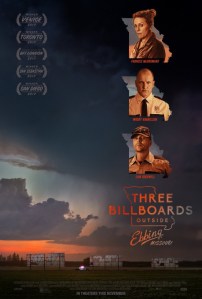 Mildred (Frances McDormand) is a divorced single mother working in the small town gift shop of the small town of Ebbing, Missouri. It’s also been seven months since her teenage daughter was raped, murdered, and set on fire. She rents out three billboards on a rarely used side road to advertise her frustrations with the slow pace of law enforcement. The billboards say, “Raped while dying,” “Seven months and no arrests,” “How come, Chief Willoughby?” The chief (Woody Harrelson) tries to pacify the grieving mother while keeping his loyal officers in check from retaliation. Deputy Dixon (Sam Rockwell) is trying to apply pressure to get the billboards removed by any means. The small town loves their sheriff and turns on Mildred, which suits her just fine. The more people that disagree with her the more it helps fuel her sense of righteous indignation. Mildred engages in an escalating series of battles with the police and town that might just make justice impossible.
Three Billboards Outside Ebbing, Missouri feels like a Coen brothers’ movie played straight, and it’s borderline brilliant in its depiction of homespun characters allowed tremendous emotional latitude. These are people with complex depth who are allowed the power to be contradictory. They can be vicious one moment and kind the next, wise one moment and impulsive and self-destructive the next, capable of great acts of mercy and cruelty. This achieves two things: 1) making the characters feel far more convincingly drawn, and 2) making the characters consistently surprising. This is a messy movie but I don’t mean that as any intended insult. It’s messy in scope, messy in tone, and yet it thrums with the messy feelings and messy complications of human tragedy. What happened to Mildred’s daughter is utterly horrifying and her rage is righteous; however, that doesn’t sanctify her. She makes mistakes, pushes people away, and can be cruel even to her own family. I was expecting Harrelson’s police chief to be a sort of villain, either incompetent or conniving, willfully ignoring the murder investigation. This is not the case at all and he is full of integrity and rightfully beloved in his community. As happens in many criminal cases, the trail of evidence just ran cold, but Mildred would prefer every male in the city, state, and even the country be blood tested to find a culprit. Her demands are fundamentally unreasonable and Willoughby points out the many civil rights protections in possible violation. Just because Mildred has been wronged does not make her the hero, and just because Willoughby is the face of local law enforcement does not make him the enemy. They are people with much more in common than they would ever admit. The awful circumstances of the plot have pit them against one another in an escalating tit-for-tat that serves as projection for Mildred’s blinding fury against a world that would rob her of her daughter.
 The dichotomy of sweetness and terror is best exemplified in the transformation of Mildred and Dixon, one of the most satisfying and engrossing film experiences of the year. Thanks to writer/director Martin McDonagh’s deft handling, these two characters start at opposite ends and grow before our eyes. Mildred tests the limits of her resolve and anger and makes costly mistakes. Dixon begins as the screw-up with a badge (hat he literally misplaces) rumored to have tortured a black prisoner in jail. He seems like the dim-witted poster boy for unchecked masculine privilege. He feels like an enforcer of the corruption we (wrongfully) assume is at work in this small town. As Mildred descends into darker decisions, Dixon ascends and chases a redemptive arc, which is amazing considering the damning behavior he engages in at the halfway mark. These two characters start as adversaries and develop into begrudging allies in a completely organic way that doesn’t blunt either character. That transformation is thrilling to watch and terrifically satisfying on its own terms. By the very end of the movie, I was ready and willing to watch its hypothetical sequel setup, especially if it meant I got to spend more time with these carefully crafted people.
McDonagh’s film juggles many tones, effortlessly switching from laugh-out-loud comedy to crushing drama and back again. I was genuinely surprised how many times I laughed and how hard I was laughing. During my second theatrical viewing, there was an old woman in the back who was quite vocal in her bafflement about how anyone could be laughing. And if you were told the specifics of the plot and its heavy subject matter, I would tend to agree. McDonagh has a preternatural feel for how to find humor in the most unlikely of places. The humor dissipates as the film marches into its second half, a natural byproduct of having to raise the dramatic stakes and make things feel serious. This is the first grounded drama in McDonagh’s filmography (In Bruges, Seven Psychopaths). He doesn’t shortchange the impact of his drama by weaving in more heightened comedic moments. The characters feel realistically developed and portrayed and are allowed to exist in moral grey areas. There’s a minor character played by Peter Dinklage who is positioned as a romantic option and a bit of a fool, but by the end you feel degrees of sympathy even for him. Even this most minor of supporting characters (not a comment on Dinklage’s stature) has earned your emotions. That’s great storytelling but it’s also tremendous execution from the director. Another sure sign of McDonagh’s command for tone is that he undercuts his story’s moment of triumph. I’ll dance around spoilers but Three Billboards looks to end in a way where several characters would claim a hard-won victory, and McDonagh casually strips that away. Even though this is a movie, and even though there are moments of broad, irony-laced comedy, the complexities and disappointments of real life emerge. Even to the very end, Three Billboards doesn’t follow the expected rules of How These Things Go.
 The excellent acting gives further life to these tremendous characters. McDormand (Fargo) is radiating with ferocious resentment and indignation. Her character is a walking missile that just needs to be pointed in the right direction. Her stares alone could cause you to shrivel. McDormand hasn’t been given a character this good in years. She opens up the full reserve of her deep acting reservoir, able to flit from great vulnerability to intense repulsion. She has plenty of big moments where she gets to tell off the disapproving townspeople and media members. It’s ready made for easy laughs, but McDormand is so good that she shades those moments with subtler emotional nuance. You get the laugh and you also get further character insight. It’s a performance of such assured strength that I imagine you’ll be hearing her name often during the awards season. Rockwell (The Way, Way Back) has also never been better. He has to play a similarly deep array of emotions, from idiot comedy to heroic dramatics, and at every point Rockwell is stunning. He makes every joke twice as funny. When Dixon becomes a larger focus of the story is when he undergoes more intensive introspection. He goes from buffoon to three-dimensional character. Harrelson (War for the Planet of the Apes) also delivers a worthy performance as a proud yet wounded man who is trying to do right against a world of pressures and self-doubt.
Three Billboards is an impressive, absorbing, searing film gifted with some of the best-developed characters in 2017. The portrayal of the characters is so complex and given startling life from such amazingly talented actors. You’ll watch three of the best performances of the year right here. You get a really strong sense of just how life has been irrevocably altered from this heinous crime, not just with Mildred but also for the town as a whole. Things cannot go back to being the way they were. The characters you like can make you wince. The characters you don’t like you might find yourself pulling for. Thanks to the complexity and nuance, the film delivers a raft of surprises, both pleasant and painful. These people feel closer to real human beings. McDonagh’s brilliant handling of tone and theme is a remarkable work of vision, cohesion, and execution. This is a darkly comic movie that can make you bust out laughing and an affecting human drama that can make you cry. It takes you on a journey that feels authentic and wildly entertaining. Three Billboards Outside Ebbing, Missouri (which should have simply been called Three Billboards) subverts typical Hollywood clichés by making sure, even during its wilder flights of comic fancy, that everything is grounded with the characters first and foremost.
Nate’s Grade: A
Share this:

X-Men: Days of Future Past (2014)
 Ever since Marvel’s Avengers destroyed the box-office in 2012, every studio with super hero franchises has been looking to follow suit. It’s not just about comic book franchises; it’s about building a comic book universe. It’s been a long dark period for the X-Men ever since the regrettable 2006 debacle The Last Stand, which callously killed characters, butchered others, and botched the most famous storyline in the history of the comic. In 2011, Matthew Vaughn proved there was still life to be found in the franchise with his terrific 60s-era prequel, X-Men: First Class. Now, post-Avengers, Fox is salivating at combining the past X-Men and the present X-Men into one colossal movie with a colossal budget. Back on board is director Bryan Singer, the director of the first two X-Men films and the man who helped kickstart the modern superhero era. If that wasn’t enough riding on the film, X-Men: Days of Future Past also follows the second most famous storyline in the history of the comic.
In the horrible future, killer robots known as Sentinels hunt down mutants. These are the invention of Dr. Boliver Trask (Peter Dinklage), a military scientist who was killed back in 1973 by the vengeful shape-shifting mutant, Mystique (Jennifer Lawrence). The murder convinced humans to subsidize Trask’s killer robot plan of defense. Thanks to experiments replicating Mystique’s mutant ability, the Sentinels have the ability to adapt to any power, turning them practically indestructible. In the future, the Sentinels are eradicating all mutants, mutant sympathizers, and eventually human beings. Magneto (Ian McKellen) and Professor Xavier (Patrick Stewart) have teamed up with a small band of surviving mutants, including Wolverine (Hugh Jackman). Thanks to the phasing powers of Kitty Pryde (Ellen Page), they can send Wolverine’s consciousness back to 1973 so that he can prevent the Trask assassination. The only ones who can help Wolverine is the younger Xavier (James McAvoy) and Magneto (Michael Fassbender), former mentors to Mystique. Except Xavier is a recluse and strung-out on drugs to dull his powers and Magneto is locked away underneath the Pentagon.
 The X-Men films have always had a topical advantage to them that provided a weightier sense of drama than your typical story about a reluctant soul blessed with amazing powers. The mutant allegory automatically applies to any sub-group facing oppression mostly through fear and ignorance. What other superhero franchise has two opening scenes in a German concentration camp? The stakes are even larger with this movie because of the Horrible Nightmare Future that must be prevented. Now we all assume said Nightmare Future will be avoided by film’s end, so the movie provides a proverbial reset button that the filmmakers can have fun with, and they do (look out future mutants). Excluding the Nightmare Future framing device that becomes an unnecessary parallel storyline, the majority of the film takes place in 1973. If X-Men: First Class tapped into the groovy optimism and “take me for what I am” sense of social justice of the time, then this film certainly taps into the disillusionment of the 1970s, where the promise of reform and hope morphed into anger and cynicism (hey, that’s like us today!). This loss of innocence is typified in Mystique, who becomes the central figure of the movie in many ways. Her seething desire for vengeance is what animates her, as well as the pain of betrayal from the men closest in her life, as well as the world who once held such promise. Also, Jennifer Lawrence (The Hunger Games) has become one of the biggest female stars on the planet, so it makes sense to bolster her role. The central conflict is stopping an assassination, one domino that leads to many others, but it’s emotionally about Mystique having to confront her feelings of hate. It’s another platform for the ongoing conflict of perspectives between Xavier (restraint, tolerance) and Magneto (strong defense, eye for an eye). But as I found in First Class, it’s hard not to agree with Magneto as human overreaction leads to rash and thoughtless actions, like Horrible Nightmare Future.
That’s not to say that X-Men: Days of Future Past fails to deliver when it comes to the popcorn thrills and action highs we crave in our finest summer blockbusters. The action set pieces are large without dwarfing the characters, playful and imaginative without losing a sense of edge and danger. I loved how the character Blink (Bingbing Fan) would utilize her mutant power of opening portals as a fighting strategy. It makes action sequences so much more inventive and visually exciting to throw a series of portals. The pacing is swift short of the second half of Act Two, gearing up for the climactic showdown in D.C. that dominates Act Three. The time travel story starts with a lot of exposition but it gets smoothed out as it goes, the rules of the story fall into place. Every action sequence hits, some admittedly better than others, but it’s the small touches that Singer injects that made me smile most. I enjoyed Magneto pointing a gun, being toppled, but still using his power to have the gun fire in midair. I enjoyed the animalistic nature of the Beast/Wolverine brawl. Jackman is looking even veinier than usual in his bulked out form. Thankfully the fish-out of-water timeline jokes are kept to a minimum. Wolverine is the perfect glue to hold both timelines together. And then there’s that standout Pentagon prison break sequence (more on that later). Singer might not have the most natural instincts developing and staging action, but the man is a surefire talent when it comes to staging eye-catching visuals (I would say the same about Christopher Nolan). Even his unfairly maligned Superman Returns is proof of the man’s cinematic gifts. As far as entertainment value, this is right up there with X-Men 2. I still view Vaughn’s savvy First Class as the best X-film of the bunch, which has only gotten better the more I’ve watched it.
 And if that wasn’t enough, Singer’s new film does what every fan has been hoping for: (spoilers) it erases all the crummy X-Men movies, namely 2006’s Last Stand and the first Wolverine solo effort, from the official timeline. It’s time to start anew, toss out the old stuff nobody liked, and forge ahead with a new unified timeline. There can be two parallel X-Men franchises, one present/future and one with the prequel casts, and they can go on forever as desired, or until the prequel cast prices itself out. In one fell swoop, Singer and company have reset the mother franchise and given fans new hope about the possibilities. Make sure to stick around to the very end of the credits for a scene that indicates directly who the next major villain will be in the 2016 sequel.
Let me take time to single out just how expertly Evan Peters (TV’s American Horror Story) steals the entire mutant-heavy movie. First, he’s the most comically attuned character, which is a nice break from how serious, and rightly so, every character is so often. Quicksilver provides a whole new jolt of entertainment, and when he checks out after the prison break sequence you’ll dearly miss him. The character is a rapscallion (as my late grandmother might have termed) that enjoys using his super speed powers to mess with people, to test his limits, to see what he can get away with, and a Pentagon jailbreak is right up his alley. Ignore the silly yet period appropriate outfit and ignore what initially seems like Peters’ smirking self-involvement from trailers and ads. When this character is onscreen the movie has a joyful sense of irreverence. He is instrumental to freeing Magneto and the onscreen depiction of his super speed is the best illustration of the power ever conceived in film and TV. There is a segment sent to Jim Croce’s “Time in a Bottle,” and some wonderful special effects, which is just so playful, so giddy, and so cool that it very well might be my favorite moment in any superhero movie… ever. It is definitely an applause-worthy moment and my audience responded in kind. Quicksilver is a perfectly utilized supporting player in a movie stuffed to the gills with characters.
The time travel geek in me has a few quibbles with the parallel lines of action from past and present. Wolverine’s consciousness is sent back in time but he film plays out like it’s happening simultaneously to the events of the future. So if Wolverine is pulled out in the middle of the movie, he’ll have failed his mission to change the future, even though by going back in time he’s already, blah blah blah butterfly effect. Anyway, I understand how they want to make the future story have a sense of urgency but it’s not like waking Wolverine from a dream; the times are not happening concurrently. He’s in the past, meaning that the moment he goes back there, the future will already be altered due to the consequences of his actions, for better or worse. There is no race against time to keep his consciousness back in time until he complete his mission. I can see why they went this route for a summer blockbuster, but that doesn’t quell the quibbles.
 X-Men: Days of Future Past is a time-hopping, unabashedly fun time at the movies; well as fun as preventing nightmarish futures built from the consequences of oppression and prejudice can be. With Singer back in the saddle and the bridging of the two X-Men universes, the series is back on track and once again the promising font of stories and characters. The newest X-film is one of the most entertaining, funny while still being dramatic, and while burdened with the largest cast of any super franchise, finds notable moments for its characters big and small to remind us that these people matter. While less philosophical and funky than First Class, this is one of the best films in the franchise, on par with X2. The action sequences and visual eye-candy are great fun with some inventive and memorable touches. It’s also nerdy fun getting to watch the past and present interact, and for many this is their first return since 2006’s crappy Last Stand. It’s not a perfect movie; I wish there was more early Sentinel action, I wish Dinklage had much more to do, and I wish that the plot didn’t so transparently hinge on Xavier not having his powers. The slate is clean and all X-Men fans can breathe a sigh of relief. The future is once again rosy. The X-Men, and not just Wolverine, are relevant once again.
Nate’s Grade: B+
Share this:

The Station Agent (2003)
This is the most charming film of 2003, and Im not just saying this because I had an interview with one of its stars, Michelle Williams (Dawson’s Creek). Fin McBride (Peter Dinklage) is a man with dwarfism. With every step he takes every look he gives, you witness the years of torture hes been through with glares and comments. Hes shut himself away from people and travels to an isolated train station to live. There he meets two other oddballs, a live-wire hot dog vendor (Bobby Cannavale) and a divorced mother (Patricia Clarkson). Together the three find a wonderful companionship and deep friendship. The moments showing the evolution of the relationship between the three are the films highlights. Its a film driven by characters but well-rounded and remarkable characters. Dinklage gives perhaps one of the coolest performances ever as the unforgettable Fin. Cannavale is hilarious as the loudmouth best friend that wants a human connection. Clarkson is equally impressive as yet another fragile mother (a similar role in the equally good Pieces of April). The writing and acting of The Station Agent are superb. Its an unforgettable slice of Americana brought together by three oddballs and their real friendship. Youll leave The Station Agent abuzz in good feelings. This is a film you tell your friends about afterwards. Theres likely no shot for a dwarf to be nominated for an Oscar in our prejudiced times but Dinklage is deserving. The Station Agent is everything you could want in an excellent independent movie. It tells a tale that would normally not get told. And this is one beauty of a tale.
Nate’s Grade: A


 nathanzoebl
You must be logged in to post a comment.