Blog Archives
Shutter Island (2010)
 This was a pulpy B-movie put together with A-movie artistry. In a year that had some artistically polished genre movies, Shutter Island was Martin Scorsese’s return to genre filmmaking and he brought with him an entire team of experts and professionals. The movie is playful and intriguing, engaging the mind enough for a crime thriller that appears to be a straight-forward mystery but then shows flashes of being about something more, something darker. And when you’re dealing with a movie with Holocaust flashbacks, dead kids, Nazi doctors, mental asylums, well you know you’re not going to be reaching subtlety even with a stick. But the way Scorsese orchestrates all these foreboding elements, tying together various plotlines, and working at different levels to satisfy the informed and uninformed, right before delivering a dynamite twist that calls for further investigation and rewatching, well it’s nothing short of masterful. Shutter Island may not be anything more than a souped-up B-movie, but with this level of artistry, it’s also one of the most entertaining films of the year.
Nate’s Grade: A-
Share this:

Robin Hood (2010)
 So what happens when you make a Robin Hood movie that doesn’t have any Robin Hood? What’s the point of revisiting the legend when you don’t even bother incorporating the elements that made it legendary to begin with? It’s not like they sacrificed familiarity for historical accuracy. Director Ridley Scott’s film spends more time setting up the various pieces of a Robin Hood tale; it’s a prequel at best. This is mostly a historical drama about the English faring off French invasions (the opening text also identifies the setting as the wrong century). The film still manages to be relatively entertaining. The production design and cinematography are top-notch, the acting is robust, Russell Crowe makes a good, if aged, Hood, and the action sequences are thrilling and visually striking. The problem is that there are few action sequences and way too much yakking about foreign policy and Medieval politics and debt. I don’t think people were clamoring for a big-budget Robin Hood revival that explores in depth the financial consequences of an overextended military on the English treasury. This is just not an appealing origin story. The movie resorts to having Hood pose as Maid Marion’s (Cate Blanchett) husband, and it’s as eye-rollingly contrived as any sitcom setup. Originally, the film was designed so that Crowe would play both Hood and the villainous Sheriff of Nottingham (barely seen in the movie). While that is a terrible and senseless idea, at least it would have made the film worth watching from morbid curiosity. Robin Hood isn’t a bad film, but it barely ranks as a Hood outing, and it’s steps behind the delightfully cheesy Kevin Costner version.
Nate’s Grade: B-
Share this:

Get Low (2010)
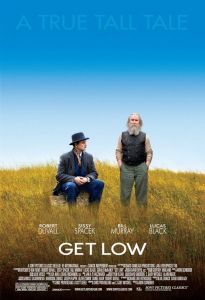 This slice-of-life Depression era tale examines a hermit named Felix (Robert Duvall) coming to terms with his life. He’s the scary old man that everyone has a story about, and now he’s come to town to make his funeral arrangements with a sleazy funeral director (Bill Murray). Except Felix wants to have his funeral while he’s alive, invite everybody in town, and have them share their collected stories, and he?s got his own story to share that’s been haunting him for decades. This is a very slow burn of a drama, to a fault. It works itself into a corner, and when Felix reveals his haunting secret you sort of shrug and think, “Is that all?” The pacing is languid; the movie feels lived-in and authentic down to its terse sense of humor and local color. You can feel the fingerprints of the Coen brothers on the film even though they had no involvement. This is a mildly touching, occasionally inert drama that benefits tremendously from the talents of Duvall and Murray, both relishing their folksy characters. This is a movie where the actors have time and space to dig in and explore their characters. Duvall and company keeps the movie from drifting off into melodrama. Get Low follows a cue from its lead actor. It’s understated, low key, and will likely go unappreciated because of its emphasis on subtlety, sometimes too much subtlety.
Nate’s Grade: B
Share this:

Prince of Persia: The Sands of Times (2010)
 This video game adaptation has the curious distinction of being both too simplistic and too complicated, sometimes in the very same breath. The harried screenplay could have used a lot more clarity concerning back-story, exposition, character roles, setting, rules of this Middle Eastern time period, supernatural rules, etc. At the same time, Prince of Persia is saddled with a pretty dopey story with weak characters. The plot is far too repetitious; somebody has the magic dagger that can turn back time, they lose it, they regain it, they lose it, repeat for over an hour. It feels like the story is never getting anywhere despite the fact that new, and still weak, characters are being introduced. The tone and look of the movie feels too beholden to its video game roots; the action is momentarily rousing but then seems overly coordinated to squeeze in all the game’s special signature moves. You’ll grow tired of all the wall flipping, wondering if a controller is stuck somewhere. For a movie dealing with a time-traveling dagger, give me more time travel. This fantastic plot device is used too sparingly in a ho-hum plot about an adopted son (Jake Gyllenhall, buff and with a sporting accent) of the king being accused of killing the king. Despite the Disney name, this feels less like a Pirates of the Caribbean knockoff and more cut from the same cloth that gave us the Mummy sequels. It’s loud, stuffed with empty special effects, and feels like junk food for your brain but it’s not even good junk food. Weirdest of all, the movie is one big metaphor for the U.S. invasion of Iraq (acting on false intelligence about some country aiding an enemy by manufacturing weapons). Seems Prince of Persia is Hollywood’s second attempt to rewrite our past political blunders in the Gulf and come up with a dubious happy ending.
Nate’s Grade: C
Share this:

49 Up (2006)
 In 1964, filmmaker Michael Apted (Coal Miner’s Daughter, Gorillas in the Mist) interviewed 14 seven-year-old kids from different British backgrounds asking them about their futures. The half-hour TV special by Granada was called 7 Up and it aimed to show the world where the future politicians and doctors and trash collectors would begin. Every seven years since, Apted has returned to those same kids and peaked in on their lives, chronicling their lives. It’s one of the most famous documentary series in history. Thanks to the virtues of Netflix’s streaming service, I was able to watch six of the seven movies in the Up anthology (sorry 35 Up, the lone film not available for streaming). I spent the next twelve hours watching the lives of 14 complete strangers from childhood to middle age, and by the end they didn’t feel like strangers any more. They felt, weirdly, like family. And that’s the true appeal of the ongoing series: you are watching the evolution of human beings. It’s not everybody that gets a visual scrapbook of their life that’s viewed by millions worldwide.
 Finally, after many hours, 49 Up is the first in the anthology to address the ideas of selective editing and building storylines to suit the “characters.” Long before reality television smoothed away life’s edges to make everybody fit into archetypes, Apted positioned the Up series as his thesis on class struggle. He purposely selected a cross-section of English schoolchildren from private schools and public schools and even two from a boy’s school for orphans. You can see it at 14, 21, and 28 how Apted sticks to his same line of questioning about class advantages and disadvantages, peppering his subjects with questions about what they didn’t have and then showing their current situations in a specific manner to make the audience feel a specific emotion. It’s not deliberately diabolical or partisan but the class warfare ideology certainly can chafe. Do the kids at the top still get all the perks? Are the kids at the bottom suffering with limited opportunities? Has anybody transcended class? Apted starts attributing achievements by the upper class boys as part of their upper class advantages and not due to their hard work, dedication, or talent, which they have every right to complain about. John complains at 21 that when, at seven, they declare their education ambitions, and Apted follows it up with narration, “John did attend such and such,” that it creates the illusion that everything has been handed to them. The hard work and long hours are not shown, and fair point. A few of his subjects actually begin to challenge Apted over his perceptions. Suzy takes aim at his line of questioning, hinting at her life’s disappointments, and fights back, accusing Apted of trapping her into a small narrative box. She even brings up another heated conversation in the history of the series, when Apted questioned whether Suzy, at 21, had experienced enough of life to settle down (she eventually divorced years later). You witness her youthful indignation and she remarks, with some resignation, that Apted is free to edit this outburst as he will and she is helpless (obviously Apted kept this in). It’s the first time I’ve seen the stars of Up contest their onscreen portrayals.
It is also with 49 Up that the film series starts to finally reflect. Part of that comes with living half a century, and many of the 12 on camera subjects are now at an age where they have grandchildren and are setting up retirement (I wonder what the economic meltdown of 2008 did for those plans). They can reflect about the accomplishments of their lives, the past dreams captured on camera that never came true, the marriages that dissolved, the joys and struggles of rearing children, the pains of burying parents, etc. They seem to be at that stopping point where they can take stock of a life lived. On top of that, the participants now begin to reflect on what being apart of the Up series has meant to them. It certainly shapes public opinion about who they are as people, and Apted gropes for any new info to connect with the prior material in the earlier movies.
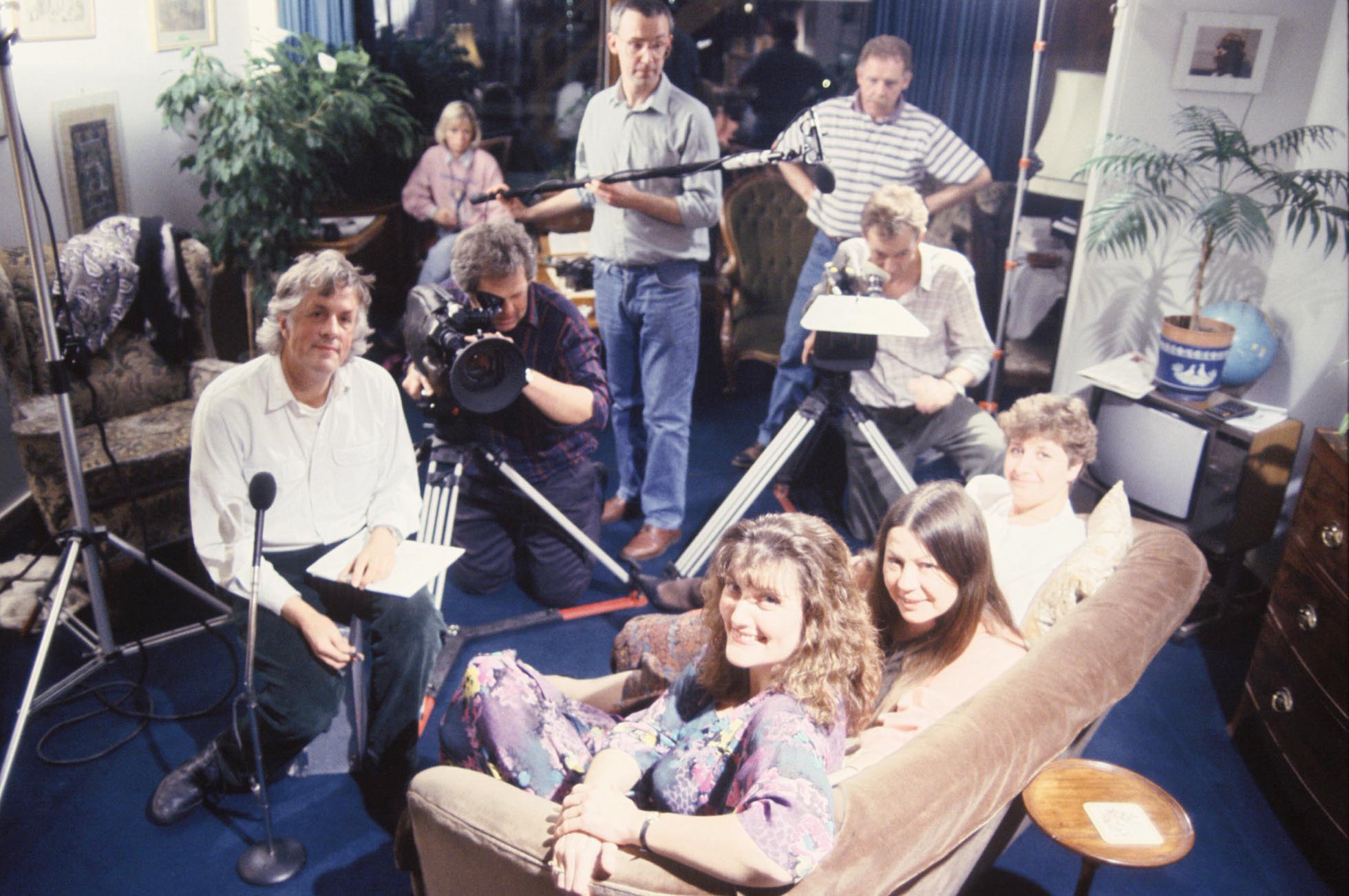 Perhaps Apted feels like he has to keep flogging his class thesis because most of his subjects are pretty regular, i.e. boring, people. They’ve lived lives of modesty and hardship and persevered, but they’re at heart no more interesting than your neighbors. The problem with selecting a bunch of seven-year-olds you plan to follow for the rest of their lives is that you have no clue what will happen. The narrative is completely up in the air. This is why Apted, early on in the series, sticks doggedly to his class thesis to provide some sort of framework he can revisit every seven years. That’s why the series starts to become something of an echo chamber. The exact same sound bytes get used over and over again, trying to find new relevancy. The adults get forever defined, and continuously redefined, by something they said at seven years old, like Neil’s worry that a wife would force him to eat greens and he “don’t like greens” (I’m in the same boat, kid). The echo chamber effect is even more obvious if you watch the Up series in a row. You will start to memorize the childhood catch phrase of everybody and then watch the same clips recycled from 7 to 42. Each is like a little stepping-stone to the present. When viewed as a whole, the series can almost come across as facile. Apted doesn’t probe very deep into his subjects and their lives, mainly sticking to the Life’s Checklist of Accomplishments of Being an Adult: school, job, spouse, family. Personally, I hate how we become defined by a profession. That seems to be the second question that rolls off our tongues when we meet a stranger: “Who are you and what do you do?” What do we do? That’s a loaded question and I object to the idea that our job is the only relevant thing that we “do.” But that’s just my hang-up, I suppose. Apted also lets his subjects reveal the biggest changes in their lives, meaning that if somebody doesn’t want to broach a topic then it gets left unanswered. It can get frustrating and makes for some opaque follow-up visits.
Not every participant is thankful for the Up series. In fact, many of them are wary and somewhat disdainful of participating. Every seven years these people have to rehash their life’s highs and lows, boil them down into a package, and then have it picked over by Apted and his leaning questions, stirring drama anew. It’s easy to see why this becomes a difficult and challenging experience for most, something akin to a cross-examination about your life. So why do most of the 14 return every seven years? Is it the secret hunger for fame? John Brisby ducked out of the Up series after the third installment, upset that he had been made into the series villain through editing. He came across pompous and like a prototypical “old money” sort who lived in a small privileged world (fox hunting!) and reinforced Apted’s thesis on class advantages. Of course his interviews didn’t help him, but I’ll give the guy the benefit of the doubt. I’d hate for everything I said when I was 14 and 21 to follow me for the rest of my life. Well, in 35 Up, John returned, though begrudgingly. He had a reason. His wife and he had begun a charity to raise funds to help the beleaguered educational state of Belarus, a country where John’s family once resided. In 49 Up, he travels once again to that ancestral country and he remarks, somewhat graciously, that it was directly because of exposure on the Up series that donations increased and the kids in Belarus today have books and school buildings and dedicated educators. John made the most of his fame and directed it to a worthy cause. Plus, it doesn’t hurt that John’s passionate desire to help Belarus (his wife is the daughter of an ambassador to the country) feels like the “character” of John has matured.
 Is there any sense of privacy when you know that cameras will be regularly scheduled to appear? There’s this enormous pressure to continue with the Up series, I imagine. But whom do these lives belong to? They were chosen by school officials and Granada at age seven, so they never really had much of a say in what has turned into a lifelong commitment. It seems that the world has a sense of ownership over these 14 individuals’ lives, an ownership that they never granted permission. They must feel an enormous obligation to keep informing the public about their lives, much like a nagging relative. We are a nosy, intrusive lot, human beings are. And I must say that I personally feel weirdly paternal about them. I feel happiness when they too reach happiness through whatever means. I was smiling from ear to ear when Nick, who at 14 was so shy and awkward, became a wonderfully charismatic, articulate, thoughtful, and rather handsome 21-year-old man (he looked strikingly similar to Andy Samberg). I feel despair as well when marriages don’t work out or once secure jobs vanish. Watching the Up series is like watching the evolution of a human being through time-lapse photography; it’s voyeuristic but at the same time it’s like having an extended surrogate family that requires no commitment. We can watch people grow up, mature, gain wisdom, and without anything more than the click of a button. We can watch hairlines get thinner, faces get larger, bodies get saggy, wrinkles multiply, all while playing the visual game of connecting the current iteration of participants with their past selves. We have these 14 people’s lives at our disposal for entertainment.
The Up series aren’t individually great documentaries. In fact, they’re pretty plain and not fairly insightful. As a whole, they present a fascinating document of the human experience and make for a great way to spend a rainy day. You can’t help but reflect on your own life after watching several of the Up movies, and curiously wonder what you have done with your own life at various intervals. As of this writing, all 14 original participants are still alive, which is somewhat amazing in itself. It will be morbidly interesting to see how the film series carries on after one or more of the participants pass away. Millions around the world will mourn what otherwise would have been a normal stranger passing. It’s probably selfish to keep hoping for future installments, and for the participants to keep updating me about their personal lives, but after a 45-plus year investment for some, it’s hard not to feel a sense of attachment to these people.
Nate’s Grade: B
Series Grade: A-
Share this:

The Wolfman (2010)
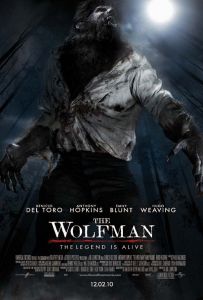 After re-shoots, reedits, a second director late in the process, and delayed release dates, it’s no surprise that The Wolfman is a bit of a shaggy mess.
In 1880, Lawrence Talbot (Benicio Del Toro) is an actor who returns home to England when he learns that his brother has been killed. Gwen (Emily Blunt), the fiancé to Talbot’s dead bro, writes that the departed brother was mauled, which points toward some kind of vicious creature roaming the woods. Inspector Aberline (Hugo Weaving) has been called in to clear the matter. Talbot’s father, Sir John (Anthony Hopkins), welcomes his prodigal son back but warns him of the dangers lurking in the countryside. The villagers are ready to blame the gypsy caravan and their chained bear when the feral creature strikes again, thus exonerating the bear. Talbot is bitten by the beast but survives only to transform into the cursed werewolf once every full moon.
Structurally, this movie feels like it’s all Act 1 and Act 3 with about ten minutes in between. By that I mean it’s all protracted setup and climax and little to connect the two. The beginning takes so long, with characters walking around like zombies who have no sense of wonder or fear given the extravagant circumstances. This is a movie that confuses set changes with plot advancement. Dour characters enter half-lit rooms and say little that isn’t cryptic or terse about the unusual happenings. This is what you have to look forward to for about an hour. The central mystery of who is the initial Wolfman is pretty easy to figure out when you play the economy of characters, which only compounds the movie’s sluggish pacing problems. You’re going to have definite pacing issues when your monster can only appear once a month, so say hello to massive time-lapse montages with the moon. It makes it hard to keep track of how much time is actually elapsing.
 There is little cogent explanation for why anything happens and the movie does an extremely poor job of maintaining a credible suspension of disbelief. What exactly are the rules here? What are the limitations for the Wolfmen? How far back does this whole thing go? The movie traces it back to an Indian kid, who looks like Gollum, in a cave, but where did he get it from? What is the history of this lycanthropy illness? When you turn into the monster, do you have any control? Are you a slave to your animal impulses? Are you culpable for what happens? Is it more like having multiple personalities except one of them is harrier? Nothing is really made clear and the movie just plows along while the unanswered questions continue to pile up, never to be addressed.
The Wolfman does a fine job of establishing an ambiance that feels ripped right from the old Hammer horror films, but fog and shadows and art direction can only take you so far. Every room looks like it’d be a prize-winning example of how to build a haunted house, though the lighting tends to be overly murky. Danny Elfman also provides a darkly lush score that mingles well with the onscreen atmosphere. But the refined sets only tease a better movie. An attack at the gypsy camp can get interesting. The beast flaring up at an insane asylum calls for something wickedly entertaining and scary, but everything is over before it really gets going, and we’ve moved on to the next scene of character sitting glumly in the dark. There’s nothing to startle beyond some overused jump scares. The movie lacks good scares because the film fundamentally can’t sustain a mood because the plot is never elaborated.
The character work is exceedingly shallow. Talbot is the main character but what do we learn about him? He’s an actor, he left town, he gets bit by a wolf, he skips stone’s with his dead brother’s girl, and that’s about it, folks. There’s an entire back story about Talbot spending time in a mental ward, which could prove to be fascinating but it’s just another set piece and nothing more. Talbot is pretty much a placeholder for a character; he’s the dude that has to get bit for there to be a story. He’s more catalyst than character, and you can feel that painful realization in how Del Toro (Traffic, Che) plays his non-character. Del Toro is a truly capable actor but he sleepwalks through the entire movie and mumbles most of his lines. Despite being a dead ringer for Lon Chaney Jr., he brings no energy to his role, nor does he ever seem truly concerned with his beastly transformation. You got more reaction and contemplation from Michael J. Fox in Teen Wolf.
The rest of the actors try and make good with the parts they’ve been tossed. Blunt (Sunshine Cleaning) can be a very good actress but she’s playing the thankless task of the underwritten love-interest-to-monster part. She’s no more fleshed out than the blonde damsel that screams and faints in the old classic monster movies. Blunt has the annoying habit of her voice turning into this simpering whine when she’s distressed. Hopkins (Fracture) pretty much gives the plot away with his maniacal cackling and incessant ear-to-ear grinning. You can pretty much faithfully assume where his character is going from the first malevolent twinkle in his eye. The screenplay exerts no effort to disguise its easily telegraphed character reveals. The person who comes out best is Weaving as the inspector, but that may be directly linked to the fact that he has the least amount of screen time of any of the main characters.
The special effects are fairly good and the practical makeup effects by screen legend Rick Baker are even better. The actual Wolfman is a snarling, spooky creature, but I wonder why we don’t get more shots allowing us to fully view the makeup work. Director Joe Johnston (Jurassic Park 3, Jumanji) seems to be more of a proponent of CGI, which means that we get scenes of Wolfie jumping from ye olde rooftop to rooftop like he’s any sort of wily creature. There’s nothing in the movie that really makes use of the specifics of being a Wolfman. We get a few POV shots of the Wolfman running extremely fast, but little else takes advantage of what makes the Wolfman a creature to be reckoned with. We only get a slew of decapitations and sliced innards that display the ferociousness of those wolf claws. Johnston isn’t afraid of gore but he doesn’t help his case when he fails to create any feeling of dread. It’s hard to dread what you can barely understand and with people you don’t really care about. Consider me stubborn, but when I got to a movie called The Wolfman I want some attention paid to the title animal.
 As I was watching The Wolfman I began to disassemble it in my head and piece together my own version of the film, an infinitely better version. For the sake or argument, I’ll explain my version and you can tell me which seems like the superior product. In my imaginary version, I completely eliminated Blunt, Hopkins, and most of the other side characters. I focused on Talbot and the Inspector and their relationship. Talbot has known about his lycanthropy for some time but he’s been able to control it for the most part, until recently. It haunts him, his inability to stop the sinister urges inside him that take over. The inspector is called in after the mysterious murders have picked up and they resemble some equally gruesome murders from 20 years prior (when Talbot first grappled with his hairy alter ego). The bent of the plot would then be on the relationship forged between the two men, how it turns into mutual affection and admiration all the while Talbot is trying to stay one step ahead of the investigation. Then my Act 2 break would be the Inspector finally realizing who is responsible for the murders (his friend!) and struggling with his own moral obligation to meet justice. Maybe this sounds too much like a crime thriller, but to me that sounds like a better film than watching two CGI werewolves claw at each other and spit.
The Wolfman is yet another misguided remake in a genre being gutted by horror remakes. The old monster movies of old were more than creature features and deserve better treatment than this bloody mess. I suppose few films can survive given the retooling process this one went through. This super serious monster movie has terrific production design, some alluring atmosphere, and a whopping void where a story should be. Characters will bumble about and the plot hums along with no explanation or elaboration given, meaning that setup often immediately crashes into climax. That’s not a satisfying recipe for a moviegoer. The Wolfman is mostly suspense-free and the actors are phoning it in; Hopkins is a kook, Blunt trembles her lower lip, and Del Toro seems to be drugged. This is mostly a costume drama with a little gore splashes in for good measure. It’s boring and half-baked and the best attribute is the scenery. If I wanted to watch scenery I’d flip through a Home and Gardens magazine. I was expecting entertainment here but instead it’s just another reminder to stick with the original.
Nate’s Grade: C
Share this:

An Education (2009)
 In 1961 Britain, Jenny (Carey Mulligan) is a 16-year-old schoolgirl plowing away at her education. She?s on track to enroll at Oxford “reading English” and her parents (Alfred Molina, Cara Seymour) have overscheduled the girl with hobbies and clubs to help build her academic portfolio. Then one rainy night she meets David (Peter Sarsgaard), a thirty something man who offers to give her and her cello a ride. This enchanting man keeps coming back around to see Jenny, sweeping her off her feet. He invites her to go to concert recitals with his older friends Danny (Dominic Cooper) and Helen (Rosamund Pike), trips to the country, and even a fabulous getaway to Paris. “You have no idea how boring my life was before you,” she confesses to David. But David is coy about how he can pay for such extravagances. Jenny’s grades begin to suffer and it looks like she may miss out on being able to enroll at Oxford. She has to make a decision whether to continue seeing David or going back to her primary school education.
An Education is a handsomely recreated period drama that manages to be very funny, very engaging, and very well acted. It’s also rather insightful and does an exquisite job of conveying that strange wonderful heartsick of love, maybe better than any movie since My Summer of Love. You can practically just drink in all of Jenny’s excitement. Jenny isn’t a silly girl prone to naivety. She’s a smart and clever girl, and not just because other characters say so or we see her stellar test grades destined for prime placement on the fridge. You witness her intelligence in how she interacts through different social circles. Since the movie is entirely Jenny?s story, we need to be convinced that she’s smart in order to believe her willingness to be duped. She has reservations about David’s habits but doesn’t want to risk going back to a dull life of books and family dinners. She has to be a smart, vibrant girl anxious to keep a good thing going, willing to ignore certain warning signs that otherwise might cause her pause. Even Jenny’s parents get caught up in the seduction, swooning over David and his upper class connections and comforts.
 The teen-girl-with-older-male aspect might make us squirm, but in the realm of 1961 Britain, it’s acceptable. Jenny and David don?t need to hide their affair in dank hotel rooms and avoid any suspicious eyes. We don’t get any agonizing inner turmoil over dating a teenage girl, mostly because it’s from Jenny’s perspective and that everybody else seems okay with it all. This acceptance means that the drama for An Education can focus on something less seamy. That doesn’t mean that everybody approves. While Jenny’s friends think she hit the jackpot, and hang from her every word about her amazing sophisticated boyfriend, her literature teacher (Olivia Williams) sees through David?s whirlwind of charms. This isn’t the tale of some girl being drawn into the dark side, turning into an unsavory, rebellious teenager flouting the law and good manners. Jenny is not that kind of gal.
Mulligan is fantastic and delivers such a sumptuous performance that you feel like a human being is coming alive before your eyes. She lights up with the dawning realization that a charming and worldly man is courting her, and you feel every moments of her swirling delight and awe. Mulligan even goes so far as to get even the small details right, like the way Jenny opens her eyes to peak during a kiss to make sure it’s all not just some passing dream, or the way she has to look away at times and break eye-contact because she’s just so happy, with those twinkling eyes and a mouth curling like a cherry stem. She’s bashfully coquettish in her physical attraction to David, though in my praise it also sounds like I, too, have fallen for the girl. Much ink has been spilled declaring Mulligan as a rising Audrey Hepburn figure, mostly because she sports that famous short bob of a haircut that many girls had in 1961. To me, Mulligan gives a stronger impression as being the luminescent little sister to Emily Mortimer (Lovely & Amazing, Match Point). Mulligan is a fresh young actress that delivers a performance of stirring vulnerability. It’s a breakout performance that will likely mean that Hollywood will come calling when they need the worrisome girlfriend role for the next factory-produced mass-market entertainment (she’s finished filming the Wall Street sequel, so perhaps we’re already there).
 Adapted by Nick Hornby (About a Boy) from a memoir by Lynn Barber, An Education follows the coming-of-age track well with enough swipes at class-consciousness. But man, I was really surprised how funny this movie is. An Education is routinely crackling with a fine comic wit, and Jenny and her father have the best repartee. Molina is an unsung actor and he dutifully carries out the role of “uptight neurotic father” with more than a stiff upper lip; the man puts his all in the role. While he can come across as hysterical at times, Molina is paternal with a capital P. It’s refreshing just to listen to smart people banter at an intelligent level.
The movie’s theme ponders the significance of education. There’s the broader view of education, learning throughout one’s life from new and enriching experiences. She gets to learn a bit more of the way of the world, and Jenny feels that she can learn more and have fun with David than sitting through lectures and slogging through homework. She values what David has to teach her above what she can find in a textbook. Jenny’s father stresses the virtues of learning and thinking but once Jenny has a chance to marry an upper class, cultured male then education no longer matters. She is now set for life through David. All that learning to become a dutiful housewife in a lovely, gilded cage. Is that the real desired end to personal growth: to snag a husband? The school’s headmistress (Emma Thompson in practically a cameo) doesn’t serve as a great ambassador to higher learning: she stresses the lonely hardships, internal dedication, and she herself is openly anti-Semitic, proving that an intelligent mind is not the same as being open-minded. To her, Jenny is jeopardizing her lone chance at a respectable life.
 Jenny rejects the traditional route of education and chooses to pursue a life with David, that is, until the third act complications beckon. Jenny finds out about David’s secret rather too easily, I’m afraid (secret letters should never be hidden the glove compartment). While the end revelations are somewhat expected, what is unexpected is that every character pretty much escapes consequences by the end of the film. No one is really held accountable for his or her decisions. Pretty much everyone is exactly where he or she left off just with a tad more street smarts. It’s the equivalent of learning not to trust every person after getting ripped off.
Despite all the hesitation, and the age difference, An Education is an actual romantic movie. It’s a coming-of-age charmer with all the preen and gloss of an awards caliber film. You feel the delight in the sheer possibility of life for Jenny. The story unfolds at a deliberate pace and allows the audience to feel every point of anxiety and bubbling excitement for Jenny. Mulligan gives a star-making performance and practically glows with happiness during the movie’s key moments, making us love her even more. The plot may be conventional but the movie manages to be charming without much in the way of surprises. Still, An Education is a breezy, elegant, and clever movie that flies by, even if its biggest point of learning is that age-old chestnut that something too good to be true must be.
Nate’s Grade: A-
Share this:

A Single Man (2009)
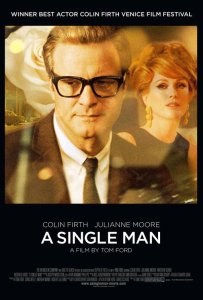 Tom Ford is a rare human being. He seems to be good at everything. The prominent fashion designer has never been averse to risk. He left work in America to toil for Gucci, a faltering European luxury brand. He became the creative director from 1994-2004, eventually leaving to form his own company. And after decades of success in the world of fashion, Ford decided to make the jump into movies. From fashion mogul to film director, nobody else has done it, let alone done it with such acclaim right out of the gate. A Single Man has been met with rich praise and Ford has been touted as a natural filmmaker. Perhaps Ford’s odyssey into moving pictures will inspire others to drop their needle and thread and pick up a camera instead. Who wants to see a Project Runway/Project Greenlight crossover?
In the early 1960s, George Falconer (Colin Firth) is a 50-year-old English professor still recovering from the loss of his love. Jim (Matthew Goode) and George had been together for over 16 years, that is, until Jim died in a car accident one rainy night. George has never fully recovered since that awful night. He doesn’t intend to waste any more time waiting for a reunion; at the end of the day, he will kill himself. He lays out his suit, empties his safety deposit box, and writes letters to his remaining friends and family. This will be George Falconer’s last day in Los Angeles, but perhaps in the meantime he’ll discover more reasons to give life another chance.
 Ford comes from the world of high fashion and here he proves that he should be taken seriously as a filmmaker. He has a sumptuous eye for visuals. A Single Man looks great in every scene. The costumes and period details are impeccable and may even give the historical consultants from Mad Men some due pause. The cinematography by Eduard Grau can become irritating because the colors go from drab to vibrant, reflecting the main character’s changing moods (lifted spirits = brighter colors!). At first it’s a neat visual gimmick but as it persists it becomes a crude blinking light, inelegantly summing up what the movie feels it cannot communicate. At times it just feels like piling on. I don’t need the color to drain from the screen to understand that George is sad.
Ford’s adaptation skills, on the other hand, could use some more polish. He and David Scearce spent years adapting the 1964 novel by Christopher Isherwood. They even added the whole suicide angle, which becomes their narrative crutch. There is a refreshingly funny sequence where George tries to act out his suicide position and goes from the shower to his bed, finally deciding upon shooting himself inside a zipped sleeping bag to cover the ensuing mess. This little five-minute stretch is like an oasis of humor in the super serious desert that is the rest of the film. The second half of the film is dominated by a will-he-or-won’t-he flirtation with a good-looking lithe college student (Nicholas Hoult, the boy all grown up from About a Boy). The kid shows definite interest. The romantic angle syncs up with George’s lost love and proves to be a welcomed distraction to George’s dejection. However, their connection is extremely thin, with Hoult making flirty eyes and inquisitively tilting his head for an hour. The romantic story exists as a means of making sure the narrative can mend George’s broken heart.
The story meanders for too long with a few revealing flashbacks, but honestly how hard is it to wring pathos from a suicidal man? How hard is it to write a middle-aged man taking stock of his life, getting his affairs in order, and saying his fuzzy goodbyes to people who don?t realize the significance. Everything gains magnitude under that prism; every pause, every inhalation, every wistful glance becomes riddled with deeper subtextual meaning, or so we are lead to believe. Every moment can unlock a new memory or secret, like when he sniffs a stranger’s dog and recalls his former beloved pet he shared with Jim. Under this guide, it is hard to tell whether the movie is doing any actual dramatic lifting. So much is supposed to be interpreted in the blankness, which the audience is entrusted to craft meaning to the character’s nostalgic pit stops. “Oh, he must be taking in the scent of the ocean one last time,” or, “Oh, he must be thinking about… something. But he’s gotta definitely be thinking about something. Something deep.” Can you see how this might get tedious after a while?
 A Single Man could have afforded more peaks into George’s background and less of Julianne Moore. She plays an old boozy Brit friend of his from back in the day. Her moments onscreen, while limited, are a chore to get through because Moore just consumes her characters sadness. She gets drunk on the one emotion she’s been hired to play. She’s certainly not embarrassing herself like in 2006’s Freedomland, but this isn’t a performance for her illustrious highlight reel. I don’t care if she does get nominated for a supporting actress Oscar, as seems all but certain; I expect more from Moore.
Firth is the whole movie so it’s a relief that he turns in the performance of his career. He gives a complex portrayal that doesn’t nicely fit into the typical Firth cinematic creature: priggish, clever, dry, ultimately a good guy. Here you can practically see the gears in his head processing the last moments of life. The extent he can convey with his eyes or simply the corners of his mouth are exquisite. He provides so much of what the narrative does not. He’s a sad creature mired in one long day of existential grief, but I need more from this character than what Ford affords.
George Falconer gives a dandy speech about the fear of the minority, almost outing himself to his college class, but for a flick about an older gay male passing through life to be an invisible member of society, Ford adopts a “don’t ask, don’t tell” approach to narrative. He buttons up his characters emotions. Understatement is lovely when there’s enough to work with. That’s the issue with A Single Man. Ford hasn’t given himself enough to work with, instead forcing the audience to make up the work by inserting meaning into every furtive brow and pained expression. This is a meditation on a life in passing, told through a series of small vignettes. I need more than a melancholy man listening to the clock strike seconds off his soon-to-be-ended life. If I wanted to watch that movie I’d check out the latest Gus van Sant art house masturbations.
Nate’s Grade: B-
Share this:

Sherlock Holmes (2009)
 Sherlock Holmes as a gritty pub-brawler? Before you dismiss the big-budget Hollywood retooling of the literary detective, look back at author Arthur Conan Doyle’s source material. Appearing in over 50 stories, Holmes was a bit of a rude rapscallion who would get into brawls and recreationally use cocaine. It was only until Dr. Watson stepped into his life that Holmes cleaned up and became a proper, respectable gentleman and the figure we know. With stylish director Guy Ritchie (RocknRolla) attached, it appears that this Holmes for a new generation is actually a throwback to his roots.
Famous detective Sherlock Holmes (Robert Downey Jr.) and his assistant, Dr. Watson (Jude Law), are at an impasse. Watson wishes to leave Holmes establishment and start a new life with a woman he loves. Holmes is also threatened by Lord Blackwood (Mark Strong), an aristocrat in prison for killing women in ritualistic manners of the dark arts. He’s about to be executed when Lord Blackwood promises he will return from the dead, and his murders will continue. Sure enough, after Blackwood is hung by the neck and pronounced dead by Watson, the murders resume and the dead man himself is seen walking among the living. Holmes is on the trail of his resurrected foe when he meets Adler (Rachel McAdams), the woman who broke his heart. She’s employed by a mysterious stranger and becomes mixed up in the deadly hunt to stop Lord Blackwood.
 As is quickly becoming commonplace, Downey is the best part of the movie. His combative relationship with Law makes the movie worthwhile. They have a feisty, squabbling chemistry that generates a lot of humor, and they interact like a 1980s buddy cop movie. Their verbal jousting practically saves the movie from collapsing due to the overwrought plot. At its best moments, Sherlock Holmes feels like a buddy cop movie transplanted to Victorian England. Downey is having a hoot as the character and brings a vibrant energy to his role, turning Holmes into an eccentric who gets buggy if he cannot obsess over a case, taking several cues from the Monk playbook of eccentric detective genius. Downey is cocksure and a charming cad, enjoying every moment he can outsmart the competition. Law is more equal than sidekick and plays the straight man to Downey’s neurotic detective. I’m not usually one to bemoan foreign accents, but this is one movie that would benefit from subtitles. The actors don’t necessarily talk in thick accents but they speak so fast that it begins to sound like an unintelligible mumble.
The romantic subplot is a non-starter as Holmes reunites with both The One That Got Away and his Crafty Equal. McAdams is a fine actress with a luminescent smile, but her involvement is really an afterthought. She’s the old flame that always re-enters in those 1980s buddy cop movies. She stays long enough to rekindle some old feelings and provide a figure in need of rescuing. Her storyline is one of several that could have been completely eliminated. The same could be said for Watson’s girlfriend, the steamboat accomplice, the put-upon maid, and many of the conspirators.
The plot for Sherlock Holmes feels like three screenplays were crudely sewn together. There are so many junky side stories and characters that need to be eliminated. It’s just far too busy without anything making real traction. The story is weighed down with expository dialogue and mounting subplots. There are a few sequences that jump forward in time but don’t inform the audience, so we’re left a tad discombobulated. The film jumps immediately into the fray without any pertinent flashbacks or setup, daring the audience to pay attention. At some point in the middle I gave up, having disengaged from the plot and determined to simply wait it out for Holmes to explain what I was missing. I think at one point I was even starting to nod off to sleep, which is a deadly sign for an action movie. The central occult conspiracy has a lot of men in cloaks but no discernible outcome. The movie is littered with conspirators and locations and details that all seem meaningless until Holmes can tie all the jangled pieces together. The script is overloaded and half-cocked and bides its time waiting for Holmes to provide relative clarity. It gets old after a while when only Holmes knows the clues and he won’t share.
 You don’t usually think of the intellectual detective in the deerstalker cap as a man of action, but this brash reinterpretation would be acceptable if Holmes found himself in some action sequences that would befit his legendary stature. Ritchie?s hyperbolic shooting style makes for a lot of fast whooshing and quick spinning but it doesn’t add up to many satisfying sequences; the best is probably a battle with Holmes and a giant that destroys a shipyard plank by plank. Ritchie introduces an intriguing action device for this beefed-up Holmes; he mentally envisions the steps of his attack, going from punch to counter punch. This technique is a fun peek into the mind of Holmes and it makes the action easier to follow for the audience. The fact that this narrative action device is used twice in the 30 minutes made me alert. Surely this cool little stylish flourish would come into play during a climactic moment. Nope. This visual quirk is done twice and then curiously never resurfaces. Instead, the movie ends in a climax dotted with the tired routine of atop high places. The showdown is rather weak. Watching Holmes and Watson beat their way through thugs has its meta-literary appeal but Ritchie and his screenwriters fail to summon entertainment amidst the cluttered chaos.
I am a self-described Ritchie fan, though he hasn’t made a good movie since 2001’s Snatch. He lathers on the style right from the opening studio titles being integrated into the cobblestone streets of London. The production design is impressive and the actors seem to be having a game go with the literary legend, but it all comes back to the murky story. Sherlock Holmes could have succeeded on a crackerjack story or on being an entertaining thrill-ride, but it fails in both areas. The nonsensical conspiracy plot feels like a leftover from a bad Dan Brown novel (redundant?) with secret societies and mystic orders and blah blah blah. The characters feel less than real because they aren’t given time to be fleshed out, so they resort to being stock archetypes locked into well-defined place by the fact that the plot gallops from the start. The action is uninspired and occasionally incoherent. Sherlock Holmes as a man of action is an acceptable premise but he needs to be placed in strongly constructed, inventive action sequences. I like Downey and Law, and I especially like their time together, but the movie lets them down. Maybe I was just holding out hope that Holmes would come back and explain the whole movie, providing compelling evidence for mass entertainment that I had been missing. It was never to be.
Nate’s Grade: C+
Share this:

The Box (2009)/ Capitalism: A Love Story (2009)
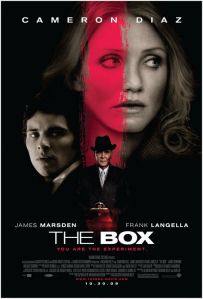 Both films on the surface seem so radically different and yet I found lots of common ground between a sci-fi conspiracy and a muckraking documentary about the biggest financial meltdown of the modern era. Both are centered around the concept of greed and whether humanity can forgo selfishness for empathy of their fellow man. Would you kill a stranger for a million bucks? Would you rig a financial system so that the richest one percent can gamble the life of a nation? Both movies also bite off more than they can chew and both movies exist as interesting yet dispirit elements that could use more cohesion and resolution.
You have been given a box with a button. If you press the button tow things happen: somebody you do not know will die and you will receive a million dollars. Do you press it? That’s the hook of writer/director Richard Kelly’s sci-fi morality tale based upon a short story by Richard Matheson. The Box is a messy and outlandish conspiracy sandwiched between two moral tests, the second a consequence of the first and a means to wipe the slate clean. There’s plenty of weird unsettling moments, including the horrendous wallpaper of the 1970s, but not everything really hangs together. Kelly’s intergalactic conspiracy can get readily outlandish with all the variables and needed participants, but like in Donnie Darko, he lays out enough tantalizing info to keep your attention and then keeps the narrative vague enough for personal interpretation. However, unlike Darko, this movie needed to cleanup its loose storylines. It just sort of ends in perplexing rush, and I sat in silence through the end credits waiting for some kind of scene to help tie together dangling storylines that were left to dangle for an eternity. The Box has a nicely tuned foreboding atmosphere, and it certainly keeps you guessing, but it will also keep you scratching your head to try and make sense of everything from button boxes to teleportation pools to Mars probes to sudden nosebleeds to Satre’s No Exit. Kelly, as he has done with his previous movies, packs a lot in two hours. Whether or not it all formulates is up to the viewer’s wearying patience. I’d rather have more movies like The Box than more thoughtless drivel from the Hollywood assembly line.
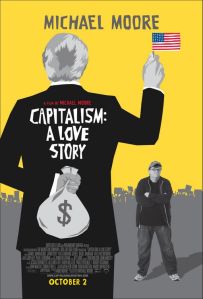 After 20 years, you pretty much know at this point what you’re going to get from a Michael Moore documentary. There’s the anecdotal evidence, emotional interviews of the downtrodden, the one-sided arguments, the nods to the depressive state of Flint, Michigan, and Moore trying to bully his way to see the powers that be that have no interest seeing him. In a way, Capitalism: A Love Story is like a greatest hits collection for Moore that reminds you of his better moments and better films. Despite all the outrage, Moore wants to throw the baby out with the bath water. He cites capitalism as an evil that needs to be eradicated. His thesis isn’t very cohesive and consists of a series of related and unrelated anecdotes, some of them grossly offensive like companies profiting from the death of employees thanks to “Dead Peasant” life insurance policies. But at no point do you walk away thinking, “Let’s start from scratch. What has capitalism gotten us?” Several of his points are easy to agree with. There is a flagrant disregard for the well being of others on Wall Street, who carelessly gambled the nation’s fortunes and then got the taxpayers to cover the loss. The bailout is a crime of pure capitalism and in a true capitalistic society there is no such thing as “too big to fail,” there is only fail. It’s not following an ideology built upon greed that has hurt the U.S., it’s unchecked greed, capitalism run amok without any oversight or regulation that has endangered the nation’s livelihood, and I’m surprised Moore didn’t emphasize the process of deregulation from Reagan to Bush more. The story of our financial meltdown is too large for a confined two-hour narrative window, and it’s too important a lesson for a man like Moore to use it as fire to ignite a people’s revolution.
Both movies: C+


 nathanzoebl
You must be logged in to post a comment.