Blog Archives
It (2017)
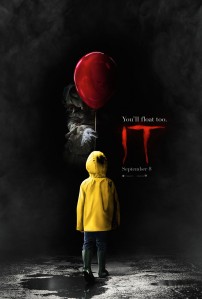 Stephen King movies have had a spotty track record at best. For every Shawshank Redemption or The Shining, there’s an overwhelming multitude of disappointments and dreck, including this summer’s long gestating and prophetically disappointing Dark Tower adaptation. The two-part It mini-series came out in 1990 and is best known for Tim Curry’s unnerving performance. Otherwise, it wasn’t that great itself but, grading upon a steep King curve, it comes out as perfectly tolerable. Hollywood has been trying to get a new It movie in development for years, and I mostly just shrugged at the idea. Did we really need another version? After seeing the 135-minute finished film, I can say that the answer to that is a definitive and enthusiastic yes. It is a fiendishly fun horror movie with rapturously composed visuals, an affecting emotional core, and impressive craftsmanship. It’s easily already in the top echelon of King adaptations.
Back in 1989, children have been mysteriously disappearing from the small town of Derry, Maine. Bill (Jaeden Lieberher) is still recovering from his younger brother who went missing one fateful rainy day. Bill holds onto the hope that somehow his brother is still alive, washed away through Derry’s series of sewers. He and his group of friends, affectionately nick-named The Losers, are being hunted and haunted by a strange clown who calls himself Pennywise (Bill Skarsgard). This evil clown feasts on the children’s fears and has been frightening Derry every 27 years, snatching children to consume, including Bill’s lost little brother. The Losers band together to stop this clown menace.
 Director Andy Muschietti (Mama) brilliantly brings to life a dynamic funhouse of scares, suspense, and big screen delights that will leave you howling for more. Much like James Wan’s Conjuring films, Muschietti doesn’t present anything radically new into the world of horror, but he takes older, sustained horror techniques and executes them to near perfection. The greatness of horror is when you simmer in that delicious sense of tension nervously awaiting what’s to come next. For this effect to have any punch, a filmmaker needs to lay a deliberate foundation to then twist and manipulate. Muschietti is amazing at heightening the atmosphere of dread and drawing it out. There are scares in It that are textbook in their masterful orchestration. Take for instance a scene with Ben (Jeremy Ray Taylor) in the basement of a library. He looks over his shoulder to see an ashen child’s body standing on the stairs. Given the lowered camera angle, the top of the ceiling cuts off the ashen kid’s head. Then as he stumbles down the stairs it’s revealed… he has no head. It’s a startling reveal and it carries on from there. Pennywise coming through a haunted slideshow of Derry was another creepy highlight. The red balloon of Pennywise transforms into an alarming totem for the audience, a signal to begin your nervous anticipation. The movie keeps finding new ways to creep you out until the very end. It’s movies like It that can remind you what tremendous fun horror movies can achieve.
Let’s get straight to the clown, the star of so many nightmares. Curry is the reason why anyone remembers the 1990 TV mini-series. Fortunately, Skarsgard (Atomic Blonde) goes in his own direction for his own personal interpretation of the character. There are similar tics, in particular the lisp, but Skarsgard makes it his own and he is wonderful. His command over his body is incredible and it magnifies the creepiness of every appearance. He holds his cheeks together in a rictus grin that looks downright painful, and he’ll lock into expressions and just let dribbles of saliva drip off his chin. Even while playing this big, broad, malicious character with a penchant for theatricality, Skarsgard can find little touches to create an even more unsettling impression. I’ve never been impressed by Skarsgard’s performances before, mostly amounting to my unchecked hatred of his awful Netflix TV series, Hemlock Grove. He impressed the hell out of me in It. This is a Pennywise that has such loose, alarming contortion over his body. When he pulls his face back revealing row after row of sharp teeth, it’s almost a relief from the more horrifying human version of Skarsgard’s outsized antics. Tim Curry owned his character’s sense of campiness. In contrast, Skarsgard feels deliberately more unhinged and also a creature in complete revelry of being so deranged. If you have a fear of clowns, I would advise that you simply never watch this movie in your entire life.
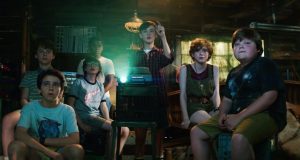 While I was expecting the big top entertainment from Pennywise, I was surprised at how involving and relatable the teenage drama can be. The screenwriters have done an admirable job at taking time to establish the characters and their relationships to one another. The town of Derry is a world of criminally neglectful adults. Everyone in this town seems to be an asshole; even the librarian chides Ben for the indecency of looking at books in a library during the summer (do your job, lady!). It’s a world where grownups disappoint and where adulthood is just a miserly existence of abuses. Beverly’s father lecherously takes ownership over his daughter’s body. Eddie’s (Jack Dylan Grazer) hypochondriac mother tries to lock her son away from the larger world, not out of protection but out of her own selfish comfort. These are the kind of people that look the other way while the local town bullies are literally carving initials into a child’s flesh. With all of this awfulness, the coming together of the Losers and their unified friendship provides a lifeline of support. They’re relatable, realistic, and heart-warming in their affection for one another. They talk and act like authentic kids, which also means they make dumb decisions out of curiosity. The movie stops to share little coming-of-age moments that ring true, like Beverly’s (Sophia Lillis) awkwardness at shopping for her first tampons or the boys trying to act cool in front of a girl. As he did with Mama, Muschietti is super-humanly adept at directing child actors. Seriously, he might have to direct all child performances from here on. The young actors do fine work at building out their characters, though some are expectedly underwritten. Special notice should go to Lieberher (Midnight Special) as the stuttering Bill still trying to grasp his brother’s death.
Given the childish nature of the fears and the theatricality of its villain, the movie is inevitably going to skid into goofy territory, but instead of rejecting this It swerves into the skid and becomes even better. When you deal with a killer shape-shifting clown who hides in the sewers and lives upon the fear of children, things can get silly and pretending otherwise is a waste of time and energy. Muschietti and company acknowledge the otherworldly with proud panache, making the goofiness part of the fun and ultimately part of the terror. Skarsgard is tremendous at turning on a dime, having his lisping, big grinned clown go from broad and ridiculous to terrifying, and he can do it with just a look. It happens even in his earliest big screen appearance. This is a Pennywise who feels like an alien’s idea of a party clown; the original elements are there but connect wrong or are amped up. There are a couple instances where Pennywise dances, and I absolutely adored each. His malevolent gesticulations felt like an exaggerated cartoon given unholy life, which seemed more than fitting. You may laugh at points and then gasp the next, and I’m fully convinced that’s the intended response. The childhood fears are much improved from the classic Universal monsters from the original novel (I’m sorry, nobody is afraid of mothballed versions of Dracula or Frankenstein in this day and age). Seeing them manifested as misaligned phantoms is far worse, even if the effect might not be as jarring without the accompanying music and sound design.
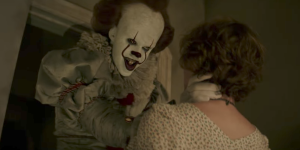 The only structural problem I would cite is that It has a little too much fun with its scary set pieces and starts to feel redundant in the middle. It becomes a figurative funhouse (before the literal haunted house) of set pieces with each one of the Losers being tormented by our clownish friend multiple times. There are seven of them after all. We could have probably done with one or two fewer of these encounters. You’re having so much fun waiting with anticipation for each encounter that I can’t complain too hard. It’s difficult to push yourself away from the funhouse and get back on track to a narrative conclusion meant to cleave a 1000-page book into a workable satisfying endpoint. I thought the bully character featured considerably throughout the story was going to become an increasingly significant antagonist into Act Three. That didn’t quite happen. The ending scene bonding the children together also seems to exist in such an earnest tone, and yet the amount of blood onscreen for their bloody hand-holding ritual is comically excessive, which caused me to giggle. I choose to believe it was Muschietti undercutting the feel-good triumphant moments with some darkly macabre touches, to remind the viewer that while our characters have survived they are still forever distorted.
Let’s also discuss the most controversial aspect of the original novel that so many people seem to have conveniently forgotten and for good reason. Spoilers follow, though they do not pertain to this adaptation, because nobody in their right mind would ever include this. At the end of the childhood section, as the kids defeat Pennywise, they’re all coming down from facing the living embodiment of their fears. So what do you do next? Well if your answer is “have a child orgy,” then you’re correct, and also likely sick in the head. The kids all start having group sex, in the dank sewers mind you, with Beverly, the only girl, being the recipient of much of it. It’s an out-of-nowhere plot development that serves no justifiable artistic purpose and feels so wrong-headed that it’s hard to believe. But it’s real, folks. King won’t admit what seems the most obvious culprit (he was on a lot of drugs in the 1980s), and instead has offered some strange rationale saying the act was a connection between childhood and adulthood and… I don’t know. This narrative choice also grossly mistreats Beverly. It seems like an obvious and baffling misstep to have a pre-teen girl suffer viciously demeaning sexual rumors, the very real sexual abuse from her father, and then decide her ultimate gift to the group of boys that accepted her is to let them all have their way with her (excuse me while I vomit). Stephen King, just admit you were on drugs and this was a weird, lamentable mistake. It’s that easy, man.
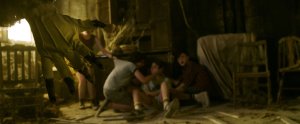 The newest incarnation of It is a glorious chiller with top-notch acting, directing, cinematography, production design, sound design, and just about all the elements that suffered from the lackluster 1990 TV mini-series. The 2017 movie is top-notch nightmarish mayhem treated as a marquee thrill ride. You strap yourself in and wait for the carefully calibrated scares and suspense and payoffs. However, the human element is not lost amidst the ride, and the children and their bond forms an emotional anchor. Muschietti demonstrates a consistent mastery of classic horror techniques. He allows scenes to build, to surprise, to startle in uncomfortable ways. Having such a talent at the helm, I was pinned to my seat and lapping up every moment of wonderful unease. The It mini-series was split into two stores, one focusing on the characters as children and another as middle-aged adults (the childhood stuff was, without question, superior material). The movie ends with the title “Chapter One” and the promise that, if the box office gods deliver, there will be a second chapter transporting us to the present. I was indifferent before but not longer. Muschietti has made me a believer. Give me more of It.
Nate’s Grade: A-
Share this:

Tulip Fever (2017)
 Tulip Fever was originally filmed back in 2014 and has endured two years of delayed release dates. In the time it took the studio to make and release Tulip Fever, Alicia Vikander filmed The Danish Girl, it was released, and she won an Oscar, and now she’s going to portray Lara Croft in a new Tomb Raider franchise. The question arises why something seemingly so innocuous would take so long to release. The studio seems quite hesitant about the finished product. The Weinstein Company even packaged a rare red band trailer for their movie, something more associated with ribald comedies and bloody action films. A movie about tulips and love affairs seems like an odd choice, but hey, people got to see some extra Vikander nudity for free. It’s being dumped into theaters over a tepid Labor Day release and the advertising is billing it as an “erotic thriller,” which is a mistake on two fronts. It’s not truly erotic, lacking a primal carnal power, and it’s not really a thriller. It all smells less than rosy and more of desperation.
Set in the early 1600s in Amsterdam, and the nation has gone wild for tulips. The flowers are being traded and sold in the backs of taverns, and the tulip market seems limitless. Meanwhile, Sophia (Vikander) is a young woman who is married off to Cornelis Sandvoort (Christoph Waltz), the self-described “king of peppercorn.” The relationship lacks passion as their nightly sessions fail to deliver a child. Cornelis, thinking about his legacy, hires a painter, Jan Van Loos (Dane DeHaan), for a portrait of he and Sophia. The painter falls in love with his subject and he and Sophia begin having an affair. The servant woman, Maria (Holliday Grainger), is witness to her mistress’ secrets, and as their affair continues, both parties devise an elaborate means that they can be together.
 Tulip Fever is awash in strange and ineffective plotting. Firstly, the film never presents a suitable rationale for why Sophia would fall into bed with Jan. It presents her frustrations and malaise with her husband, so being in a position for finding a passionate alternative and outlet is established. After a few painting sessions with Jan, apparently they’re smitten with one another, though the movie never does the slightest work to establish a spark between them. It’s not like much would have been required. Make Jan a charmer who makes Sophia feel valued and desired. A handful of careful exchanges hinting at an inappropriate fascination are all that was needed. Instead their coupling feels largely arbitrary and from thin air. Movies directly hinging upon romantic affairs succeed on the virtue of making you feel the desire of the characters, whether that’s a romantic yearning or even just simple hardcore lust. Sexual tension is a paramount necessity. I felt no chemistry, desire, or even sexual tension between DeHaan and Vikander. There was no heat or sensuality here. Then there’s the matter of Sophia’s relationship with Maria, our curiously chosen narrator. We’re told that Maria sees Sophia like a sister, but once again the movie doesn’t show anything to indicate a particularly close relationship between the two. Then when Maria announces her pregnancy she threatens her “sister” if she gets thrown out of employment. She’ll tell Sophia’s husband what she’s been up to with her painter pal. Maybe it’s the hormones but that doesn’t exactly sound like a close, sisterly relationship. Although just when it seems like Maria might be a thorn in her mistress’ side and upset the power balance, the story abandons this idea altogether and Maria recedes back into a harmless cherubic aid.
It’s during Maria’s pregnancy where Tulip Fever’s plotting becomes its most tonally egregious, becoming a 17th century episode of Three’s Company. Sophia’s mission ever since her wedding has been to get pregnant and produce a son for her husband to carry on his family line, but due to a combination of erectile dysfunction and impotence, this seems like an unlikely task. So when Maria is pregnant, the two ladies scheme to do a switcheroo; they’ll pretend that Sophia is really pregnant, downplay Maria’s changes, and then pretend the newborn is Sophia’s child. This plan leads to several almost comical sequences to maintain the ruse, like when Sophia pushes Maria aside to take claim over her recent spate of morning sickness. The entire time I kept thinking that wouldn’t it be so much easier for Sophia just to get impregnated from her younger lover? Instead we’re given this storyline that approaches farce, and that’s not the end of it. Tulip Fever also features faking one’s death, sending the drunkest person out to retrieve the most valuable item in the country, a character conscripted into the Navy immediately, and contrived mistaken identity developments that also require characters to never do any follow-up questions to confirm the worst of what they think they just witnessed. These kinds of farcical plot elements indicate that the filmmakers were not confidant that their central relationships could sustain a narrative unto themselves. And yet I’ll admit that these unexpected plot turns provided a level of entertainment that was lacking beforehand.
The actors do what they can with their characters and marshal forward with straight faces. Vikander (The Light Between Oceans) is a luminescent actress who can communicate paragraphs through her tremulous eyes. She very capably conveys Sophia’s mixed emotions over her marriage, her gnawing sense of loyalty, and when in the throes of passion, an unburdening that serves as a personal awakening. Sadly, those romantic throes are paired with DeHaan, an actor I’m becoming more and more skeptical with every new performance. In the recent sci-fi bomb Valerian and the City of a Thousand Planets, he chose to speak in a bizarre voice that mimicked 90s Keanu Reeves. With Tulip Fever, I understood the origin of that voice, because in this movie he sounds like 90s Keanu Reeves gamely attempting his woeful British accent in Dracula. Does Dane DeHaan have range or is he incapable of playing anything without ironic detachment? He makes for a pretty pitiful romantic affair option, and I never cared what transpired to him. Waltz (Spectre) becomes the most sympathetic character by the film’s end and has a genuine character arc that might elicit some real emotion. He’s pompous and a bit oblivious, but he never really becomes the film’s villain. He doesn’t mistreat Sophia. He doesn’t threaten anyone. He just wants a child, and a wish he made to God haunts him. He truly cares about his wife, and it’s only later that Sophia realizes what her plot machinations have done to this man. Waltz’s performance is well within his nattering wheelhouse. The supporting cast includes Judi Dench, Cara Delevigne, a hilariously pervy Tom Hollander, Kevin McKidd, and an unrecognizable Zach Galifianakis. It’s enough to make you wonder what in this story got them all here.
 The story seems to exist only in parallel with the tulip market that gives the film its title. It feels like two different movies on different tracks that rarely come together. I hope you enjoy textbook economics lessons on market bubbles, because you’ll get plenty information imported on the buying and selling power of tulips. These little flowers just kept going up and up in value and investors believed that they would never go down (oh how familiar this sounds). At times the movie hints at being a Big Short in 17th century tulips futures. This could be an interesting topic because of how foreign it is today, the thought of flowers being so valuable that a person’s life savings might get squandered. However, the story that takes shape in Tulip Fever feels generally unrelated. It’s a love affair with comical complications but the only time the bullish tulip market factors in is when supporting characters get rich quick from some lucky bulb prospects. They just as likely could have gotten their fortunes through any form of gambling. It didn’t have to be tulips. The setting doesn’t feel integral to the story the movie wants to tell, which is a waste of such a supremely unique moment in world economics history. Although there is a moment where Maria narrates that a madness took over people, and I so dearly wanted her to follow up that statement with, “A tulip madness.” Unfortunately, she did not.
Tulip Fever is a costume drama that may have appeal for those usually left cold by the stuffy genre of half-glances and unrequited passions. It does have some screwy plotting linked to its screwy couple, so while it doesn’t quite work as a developed story with engaging characters, it does make for a fitfully entertaining experience. The messy plotting and arbitrary coupling limit the power and empathy. I ultimately felt more for Waltz’s character by the end than anyone else, and I don’t know if that was intended. It’s a handsomely made film with strong production design, costuming, and cinematography. If only the characters and their exploits were worthy of such efforts.
Nate’s Grade: C
Share this:

Detroit (2017)
 Something akin to an art house exploitation film, Kathryn Bigelow’s Detroit is a pressure cooker about the horror of institutional racism, but it’s also a limited drama that lacks any sense of catharsis for an audience. Set among a hellish series of days in 1967, the film follows the events at the Algiers Motel, where Detroit police officers killed three innocent black men in their pursuit of what they believed to be a sniper. An all-white jury then acquitted the officers. Will Poulter (We’re the Millers) plays the lead racist cop and instigator, the man who tries using every effort to get a confession. His bad decisions lead to further bad decisions and miscommunication and then cold-blooded murder. It takes a solid 45 minutes to establish the various supporting characters, the fragile tinderbox that is Detroit during a series of riots, and getting everyone to the fateful motel. Afterwards, it’s like a real-time thriller that’s extremely harrowing to watch. It’s very intense and very well made by Bigelow and her go-to screenwriter Mark Boal (Zero Dark Thirty). Like Get Out, it turns the day-to-day black American experience into a grueling horror film. I was squirming in my seat and felt nauseated throughout much of the movie. I wanted to scream at the screen and tell people to stop or run away. However, it’s a movie with a lower ceiling, whose chief goal is to provoke primal outrage, which it easily achieves, but it feels like there’s little else on the artistic agenda. The characterization can be fairly one-note, especially with the racist cops who stew over white women hanging around virile black males. It’s victims and victimizers and we get precious little else. Your blood will boil, as it should, but will you remember the characters and their lives, their personalities, or mostly the cruel injustices they endured? It’s an intense, arty, exploitation film, and I can perfectly understand if certain audience members have no desire to ever watch this movie. It’s not so much escapism as a scorching reminder about how far race relations have come and have yet to go in this country. Detroit is a movie with plenty of merits but I think it’s the least of the three major Bigelow-Boal collaborations.
Nate’s Grade: B
Share this:

Lady Macbeth (2017)
 Cool, calculating, impassioned, and razor-sharp in its shrewd storytelling, the period film Lady Macbeth is worthy of the title of Shakespeare’s manipulative anti-heroine. Katherine (newcomer Florence Pugh) is recently married and expected to fulfill her wifely duties. Except her husband demands she stay inside and he also wants nothing to do with her physically. While away, she strikes up an affair with Sebastian (Cosmo Jarvis), one of the servants hired to tend the estate. She finally feels desired but also free, able to do what she wants and without the stifling control of patriarchal forces. There are three impediments to Katherine continuing to enjoy her status and relationship, and each one requires another step into moral turpitude. Lady Macbeth does a very effective job of developing taut tension born out of its premise. Every plot point naturally leads to another, creating more frisson and conflict. It pushes an audience into an uncomfortable position of deciding how far their sympathies will align with our put-upon protagonist. The ending is fitting but will likely produce a lot of heavy sighs and foot shuffling out of the theater. Pugh delivers a star-making performance in a role we’ve seen often in nineteenth century literature, the oppressed woman yearning for autonomy of body and mind. However, this isn’t an unrequited romance of furtive glances and pearl clutching, this is a meaty psychological thriller seeped in murder. Pugh expertly portrays a fascinating figure, a woman capable of cruelty to stake her claim in a cruel world. She commands the screen. A great reoccurring image is Katherine sitting on a settee and going through breathing exercises, as if to get into character for what she must do. Lady Macbeth (based upon the Russian novel Lady Macbeth of Mtsensk) is a tightly wound psychological thriller that brings a darker, absorbing carnality to the bonnet drama.
Nate’s Grade: B+
Share this:

Atomic Blonde (2017)
 Atomic Blonde is based on a 2012 graphic novel called The Coldest City (by Antony Johnston and Sam Hart), a title I doubt many were that familiar with. Charlize Theron was. She snapped up the option rights before it was published and saw it as a vehicle for herself to cut loose, have fun, and show off her affinity for fight choreography thanks to her background in dance. If you don’t walk out of this film with an uncontrollable crush on Theron, then I don’t know what movie you saw, my poor friend.
Set in 1989 Berlin, on the eve of the wall going down, Lorraine Broughton (Theron) is working undercover for her Majesty to uncover who is killing British agents in East Germany. Her local contact is David Percival (James McAvoy), a black-market kingpin and popular mover and shaker. One of his contacts (Eddie Marsan) has committed secret spy files to memory and wants an escape to West Germany. He’s even gotten the attention of other spooks, including French intelligence agent Delphine Lassalle (Sofia Boutella), who gets intimately close to Lorraine. The smuggling of the contact goes bad, lives are lost, and Lorraine has to explain to her superiors (Toby Jones, John Goodman) what went wrong and who is secretly the murderous traitor.
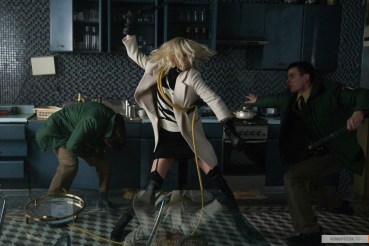 This film could have just as easily been re-titled Sexy Charlize Theron: The Movie. It is a two-hour celebration of the actress and her many formal gifts. Watch her look sexy in this sexy outfit (i.e. every outfit Theron wears or doesn’t wear). Watch her look sexy strutting down a hallway in slow mo. Watch her bathe in ice. Watch her dispatch bad guys with ease, sexily. And then there’s the sapphic romp with Boutella (The Mummy), which is just an explosion of sexy that might be too much for the weaker-hearted audience members to handle. A female friend of mine used to refer to Angelina Jolie in the early 2000s as “walking sex,” a woman that simply oozed sex appeal with her every glance and movement. I think that term deservedly applies to Theron in Atomic Blonde. The surface-level pleasures are rampant, from the 80s chic clothing, to the pumping New Wave soundtrack, to the very stylized way people take long dramatic drags from their cigarettes, the movie exudes a sense of cool with every frame. There is plenty to ogle, and that includes the casual nudity of a 41-year-old Theron, who has plotted this showcase role for years as an unapologetic badass statement and maybe the nonchalant nudity is part of that (“You think women over 40 are unattractive? Well take a good gander at this, Hollywood”).
The film has style to spare but thankfully it also has enough substance to match, and by that, I mean its depiction and development of action. Coming from David Leitch, one of the co-directors of the John Wick franchise, I expected very fluid and well-choreographed action sequences, and Atomic Blonde delivers. I am happy that we have moved away from the Bourne-style docudrama approach of the jangled edits and gone the other direction, treating action sequences like the dance routines they are and allowing an audience to fully take them in and appreciate the skill and artistry. The showstopper everyone will be talking about is an extended fight sequence that closes out the second act. Lorraine ducks into a tenement building and gets into a bruising fight with several goons. This sequence goes down several floors, careens into empty rooms, and eventually ends up in the middle of a speeding car trying to make a desperate escape. It’s filmed to be one long take and the sequence is exhilarating and only becomes more so with every passing minute.
 Admirably, Atomic Blonde also brings a sense of realism to all its action. As the fight continues, Lorraine becomes understandably fatigued, as do the baddies. She is not impervious to their attacks. She’s gutsy but still vulnerable, still human. You feel the blows and the intense duration, which makes me marvel all the more at Theron’s sheer balletic grace when it comes to her ass-kicking capabilities. Having an experienced, accomplished fighter opens up the complexity of the action sequences. The stunt work is a consistent joy in this movie and what will make it stand out amidst the pack.
The only major gripe I have with the film is its rather convoluted spy plot. The Cold War as well as East Berlin is just a backdrop for the cool shenanigans. The movie toys with spy movie pastiches but clearly it only amounts to genre window dressing. It’s almost on par with the music, used to evoke a mood and not much more. It feels like even Atomic Blonde recognizes this and just blurts out more nonsensical “who can you trust?” plot mechanics to get to the next sexy set piece. If you don’t already know who the eventual traitor will be by the end of the first act, you haven’t been doing the math. The communist bad guys are an unremarkable lot but they do make for solid punching bags.
The opening scene sets up the death of a British spy as a personal blow to Lorraine (she kept a photo of the two of them in her dresser drawer) but he’s quickly forgotten and never mentioned. His assassination doesn’t even stir any simple impulses of revenge. The non-linear framing device also seems designed just to skip ahead to the good stuff or provide a break in the action where Lorraine’s superiors can provide disapproving, fuddy-duddy commentary about her blasé behavior. The plot is a bit too needlessly complicated and muddled for what the film needs. It’s as if screenwriter Kurt Johnstad (300) was given the edict to make things obtuse with paranoia and intrigue just long enough. There’s an extended coda that feels like a reshoot; however, it also has several significant plot revelations that completely change your understanding of the characters.
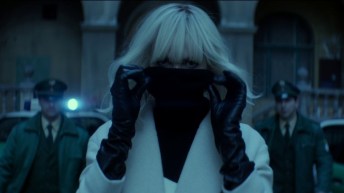 Atomic Blonde is the kind of movie that knocks you around and overpowers you with its spiky attitude. At its best, the movie pulsates with a buzzy rush of adrenaline, setting up dangerous dilemmas for Lorraine to take out with her fists, feet, and any old thing lying around. Her ingenuity during the fight sequences adds a welcomed degree of unpredictability and satisfaction, and it makes the locations become an integral part of the fight choreography as well. There’s a reason I’ve been expending most of my review on the action sequences and sense of style, because there isn’t much more to Atomic Blonde. It’s all retro fashions, stylish artifice, an overeager soundtrack, and lots of too-cool bravado, but unlike say Suicide Squad, it actually pulls it off. It’s not posturing when it works. Theron is a absurdly convincing as a super sexy super agent, and it feels like they dropped her into a James Bond story (with Sofia Boutella as the Bond girl). The added realism and long takes allow the film to feel even more viscerally kinetic. If this is the start of a Charlize Theron franchise then I say we are living in the sexiest of times.
Nate’s Grade: B
Share this:

Dunkirk (2017)
 Christopher Nolan is one of the rare filmmakers in the world that can do anything he wants. He’s reached a level of critical and commercial success that he has earned the leeway to tell the stories he wants with a blank check. Apparently he’s been eager to tell the big screen story of Dunkirk, the mass evacuation of 400,000 Allied troops on a French beach in World War II, and it would be the first film of his career to not have a crime or science fiction slant. If this is what he has to turn into in order for mainstream Oscar attention then please go back to making your sci-fi puzzle boxes, Mr. Nolan, and let someone else make the underwhelming WWII epics. Don’t believe the effusive praise from critics saying this is Nolan’s masterpiece or the finest of his career. Dunkirk is Nolan’s least engaging film and maybe even the least ambitious of his otherwise storied Hollywood career.
Dunkirk is less of a cohesive movie and more a series of moments, never eclipsing the next or coalescing into a larger, more meaningful, more satisfying whole. We keep cutting from primarily three perspectives (air, sea, land) but it fails to feel more than a check-in before moving onto the next vantage point. It’s a shame because the opening ten minutes launch you immediately into this world of danger and Nolan sets up the different perspectives with effective visual clarity. I thought it was a great moment having the soldiers collect the fluttering propaganda fliers meant to remind them about how the enemy surround them. The initial burst of violence is visceral and unnerving. The burial of a soldier in the sand is a somber moment. Things were getting good, and then I kept waiting for the movie to escalate, to hit a new gear, and it never came. Instead it repeated the same plotting that just forced the bland characters from one curtailed escape to another. Screenwriting is about setups and payoffs, and that is strangely absent throughout Dunkirk. Bad things just kind of happen, and then they happen again, and then you tune out. That’s even before Nolan throws in needless non-linear elements that I was ignorant about. Dunkirk is Nolan’s first film under two hours since 2002’s Insomnia, and yet it could still stand to lose even more. After a while, your mind drifts when all you’re watching is poorly written characters, many of whom you can’t identify, jump from one crummy situation to another without a stronger storytelling drive. If you want a more personally involving retelling of the heroes of Dunkirk, just watch the film-within-a-film of the underrated 2017 gem, Their Finest.
 The miracle of the Dunkirk evacuation is really lost in this film. Without a more involving story, it’s hard to get a sense about the personal sacrifices and risks of the evacuation. The scope feels mishandled. We’re told that 400,000 men were rescued but I did not get any sense of that scale. We’re stuck to a small corner of a beach, or a small section of the sky and sea, for the far majority of the film, which again traps the film at a lower register. We don’t adequately sense the monumental scale of what is at stake. The embodiment of the threat is condensed down to a single German fighter plane that Tom Hardy has to chase for half the movie. It’s like this guy is the freaking Red Baron. Another aspect that exacerbates this issue is Nolan’s haphazard command of screen geography. When the camera is inside the various ships, your sense of space is uncertain. When things go bad, it just all feels like a mess, with no clear indication of where the characters are, their proximity to others, or even the interior design of the ships. Without a coherent sense of geography, the action and suspense is going to be inherently limited. Nolan locks into a claustrophobic sensation at the expense of audience clarity, and without better-developed action and interesting characters, it’s a decision of diminishing returns.
The characters are so indistinct that most of them in the end credits didn’t even merit names (Irate Soldier, Shivering Soldier, and Furious Soldier are among the lot). This is one of the biggest mistakes of Nolan’s movie. By not providing characters that an audience can engage with he’s handicapped how much an audience can care. We don’t learn about any of the main characters we follow, with the slight exception of Mark Rylance’s even-keeled seafaring father. I challenge audience members to even remember a who’s who of the young men because I don’t think I’d be able to identify them in a lineup. I was still trying to recall which of them may have died. I haven’t had this much trouble keeping people straight in a war film since Terrence Malick’s The Thin Red Line. With Dunkirk, there are faces we follow really more than characters. The most recognizable is Tom Hardy and that’s because he’s Tom Hardy and not because of anything related to his character. Kenneth Branagh’s character just seems to be here to stare off into the distance with awe and say something about “seeing home.” It’s as if Nolan had no interest in telling a war story from a human perspective, which is a vastly strange approach considering the large-scale human cost.
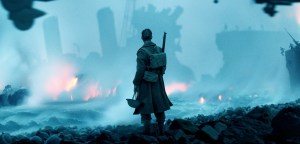 Nolan is a smart filmmaker. He has to know these characters are thinly sketched ciphers at best, so the question becomes why is Nolan choosing to make Dunkirk this way. If I had to hazard a guess I think Nolan was trying to accomplish a visceral, immersive war experience to echo the hopelessness and confusion of those men in jeopardy. They’re meant to be faceless everymen. This would explain why it feels more like a series of moments, of jumping from one failed escape to another and one fraught encounter to another. Nolan does a fine job of introducing conflict (in a wartime setting this also shouldn’t be too hard) but without more distinction he runs the serious risk of everything feeling like more of the same. At the end, thousands of soldiers are ferried back to England and congratulated. One of them is incredulous, not feeling like retreating is worth the fuss. “We just survived,” he says. “Well that’s good enough,” the other says. It’s like Nolan intended to place the audience into a crucible where just getting out was enough to satisfy demands. I don’t think it is.
From a technical standpoint, Dunkirk is often breathtaking, no more so than in its mesmerizing sound design. Nolan uses brilliant sound tacticians to heighten your senses and build a sense of dread. An oncoming fighter plane tearing through the sky can raise the hair on the back of your neck. The sound does the heavy lifting when it comes to creating tension. The score by Hans Zimmer is very effective in that regard as well. Its central musical element sounds literally like a ticking clock, which instantly heightens any scene. Granted adding a ticking clock sound against anything would make it more fraught (you’ll never fill out boring paperwork the same way again). Visually, the aerial photography is gorgeous with the IMAX cameras able to take in such startling depths. Cinematographer Hoyte Van Hoytema (Interstellar) has some beautiful visual compositions, especially as different boats capsize and the water rushes in at odd angles. This is a film that has commendable technical achievements. It’s Nolan who lets down his team.
War movies often run the risk of being overly reliant upon broad themes of heroism, nationalism, patriotism, sacrifice, and such, which can be in replacement of a strong narrative and well developed, interesting characters. War is a film genre like any other, and there are inherent genre shortcuts that can be abused. However, it’s like any other genre in that, regardless of the setting or situation, you are expected to tell an interesting story with characters the audience cares about. Nolan sacrifices all for the immersion in his war experience machine, providing listless, interchangeable characters and a story that amounts to a collection of harrowing moments but not a movie. My pal Joe Marino chided the movie as akin to visiting a planetarium, sitting back, and taking in the wonderful visual spectacle but walking away unmoved. It’s like Nolan has created the Dunkirk Experience: The Ride instead of an actual worthwhile story.
Nate’s Grade: C+
Share this:

Wonder Woman (2017)
 I owe Gal Gadot an overdue apology. When the news first broke that the Israeli model-turned-actor had won the role of Wonder Woman, I was quite dismissive. My heart had been set on Gadot’s Fast and Furious 6 costar, Gina Carano, a former MMA fighter who displayed a natural screen presence. I apologize for not thinking the relatively slim Gadot had what it takes to fill out Diana Prince’s wonder boots. I just couldn’t see it, and that’s an error of imagination on my part. When Gadot made her debut in 2016’s otherwise abominable Batman vs. Superman, she was one of the few high points, granted she was only there for like fifteen minutes. My concerns were abated but could she hold her own film? After 140 minutes of consideration, I can declare that Gadot is a star and a terrific Wonder Woman. The rest of the film is pretty good though not up to her wonder level.
Diana (Gadot) is an Amazonian princess living on a mysterious hidden island ruled by ageless female warriors like Hippolyta (Connie Nielsen) and Antiope (Robin Wright). One fateful day a downed airplane crashes close to their shore. Diana rescues the pilot, Steve Trevor (Chris Pine), and is fascinated to learn he is a man. The Amazonians are distrustful of a man in their land. He warns them about the “war to end all wars” going on that threatens the greater world. The Germans are developing a powerful chemical weapon thanks to the treacherous Dr. Poison (Elena Anaya) and Luddendorff (Danny Huston). Diana decides she cannot stay idle. She leaves her home and travels with Steve to London and eventually the the European Front. Diana is certain the one responsible for the global conflict is none other than the god of war Ares, who will stop at nothing to annihilate mankind.
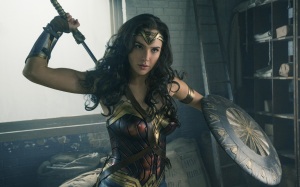 Wonder Woman is an entertaining, empowering, and engaging Golden Age superhero throwback that manages to be the best the DCU has had to offer. This is the movie many fans have been waiting for. Wonder Woman’s structure and tone feels like what would happen if you crammed together Marvel’s Thor and Captain America: The First Avenger. It’s got the ancient mythological society that is separate from mankind. It’s got the fish-out-of-water comedy of a god traveling to the world of man and trying to make sense of our clothing, customs, and backwards gender norms. It’s also set during a world war far in the past and resonates with handsome period-appropriate production values. The comedy aspects are surprisingly restrained; the fish-out-of-water jokes are mostly deployed during Diana’s first encounter with Steve’s secretary, Etta (Lucy Davis). The humor goes a long way to help coalesce the varied tones, tying the campier elements with the more serious war backdrop. It’s a movie that recognizes, at long last, that the DCU can actually be fun. The lighter tone works as well to establish the charming dynamic between Diana and Steve. There’s a screwball comedy feel that gracefully comes in and out, allowing Pine (Star Trek Beyond) to be simultaneously amazed and flat-footed at his ever-increasing crush’s agency. They make a winning pair and there are several moments that are funny, touching, and lovely between them that made me smile.
Gadot (Keeping Up with the Joneses) is a wonderful lead and delivers a star-making turn. She draws you in immediately. Gadot succeeds as a cultural icon come to colorful life. She succeeds as a comic actress bemused and wary at the era’s gender politics. She succeeds as a dramatic actress able to convey the emotions of doubt and torment. But most significantly she succeeds as a person overcome with the sheer thrill of self-discovery. There’s a moment where Diana takes a flying leap to grab a stone tower’s ledge. She grabs it but the ledge breaks and she starts sliding down the face of the tower. She stops her downward plummet by punching her own handhold. She then punches another. Gadot’s face lights up, taking in the sheer scope of her personal possibility. She launches herself up the face of the tower, more determined and blissful than before. Gadot’s greatest strength is her capacity of expressing Diana’s growing sense of self. Her ongoing declaration of agency is given a welcomed and fitting action-movie cool treatment.
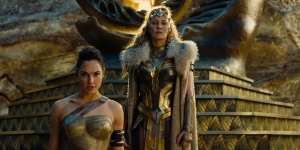 Director Patty Jenkins (Monster) acquits herself impressively in the world of big-budget action. The first action sequence involves ancient Greek femme warriors against German soldiers, and it’s awesome. Watching the galloping horses and gilded warriors confidently mow down the enemy soldiers is a primal joy. Jenkins pleasingly frames her action sequences and uses judicial cuts, keeping an audience oriented through the duration. It’s action you can comprehend and relish. Jenkins has a great command of her visual space and how to sell the bigger moments. We don’t see Diana in her full Wonder Woman regalia until an hour in but when it comes it feels like a big screen moment decades in the making. Diana gets her deserved heroic entrance. Jenkins color palate follows the gun mettle grays of Zach Snyder’s pre-established diluted color scheme, but the less oppressive tone makes it feel less dreary. Something of interest is also how little her camera sexualizes Gadot, who is by all accounts a stunning human being. Given Wonder Woman’s costume, her creator’s kinky origins, and the generally prevalent practice of the male gaze, I would have assumed there would be certain moments to highlight Gadot’s physical assets. The movie does so but it highlights her strength and fortitude rather than her curves. Her femininity isn’t tied into how her body looks to appeal to men. It’s about what her body can do and often to the immediate threat of men. She does get a couple killer evening gowns to wear but her sword is tucked away behind her shoulder blades, a powerful reminder that she’s no man’s sexual object.
With all that said, the praise is a bit over pronounced for Wonder Woman, because while it is clearly head and shoulders above the other DCU films, it’s still only an overall good film and not a great one. I understand that many will celebrate a big-budget action showcase for an idol of female empowerment, but I don’t want to ignore problems either. The biggest issue for Wonder Woman is just how simplistic its characters and themes are. Diana is an interesting character but she’s not that deep. She’s following a common hero’s journey and learning about the possibilities of man, good and bad. She’s trying to understand the inherent contradictions of life, civilization, and war. There isn’t any major test she has to overcome besides a broad accepting of one’s destiny. Steve falls into the love interest/damsel role primarily reserved for women in these sorts of things. His scenes with Diana are some of the best in the movie but he’s still underwritten too. The themes of responsibility and inaction are fairly broad and kept that way. There isn’t much room for nuance. Example: Steve brings Diana into the trenches on the Front and says their destination is on the other side of No Man’s Land, the stalemate between enemy trenches. He then says “no man” two more times, as if the audience doesn’t quite get it and needs it underlined (get it: Diana is “no man”). There’s also the idea that Ares is responsible for men warring with one another to make a point about man’s nature. Minor spoilers here but, shocker, Aries is eventually vanquished and the German soldiers all act like a magic spell has been broken. They’re much more chummy and not as interested in fighting. Doesn’t this then assume that the next war, the one with the Holocaust, was all mankind’s responsibility? Aren’t we proving Ares’ point about our very volatile nature?
 The supporting characters are pretty stock even by stock standards. There’s the charming Arabic soldier (Said Taghnaoui) who dreamed of being an actor, the Scottish sharpshooter (Ewen Bremner) who is unable to shoot any more, and the expat Native American (Eugene Brave Rock) looking to make a profit from war. None of these characters are given a moment to shine nor do they impact the plot in any way. Each one is given a minor characterization note but they don’t come back to them. They are robbed of payoffs. Why give the sharpshooter a PTSD-like trauma if he doesn’t rise to the occasion or explore that trauma? You literally don’t see him shoot anyone from a distance, meaning that his specialty he brings to the group is null and void. The Arab wannabe actor doesn’t get a chance to use his skill set either. Why introduce these characters and provide an angle for them if they’re ultimately just going to be an interchangeable support squad? I know they’re meant to be supporting characters but it goes to the lack of development, and less developed characters that are kept more as background figures offer a less realized world with less payoffs and a somewhat lowered ceiling of potential entertainment.
The third act is also where Wonder Woman becomes another in the tiresome line of CGI overkill. Beforehand Jenkins had done well enough to play into the already established visual stylings of the Snyderverse but the movie is eventually swallowed whole, becoming indistinguishable from the noisy, calamitous, and altogether boring climax of Batman vs. Superman. It’s another CGI monster fight with lots of explosions, flying debris, and the Snyder staple of slow-motion-to-fast speed ramps. The final battle between Diana and Ares doesn’t really alter its dynamics. They take turns punching, throwing things, and taunting one another. There’s no real variation to the fighting. This is supposed to be the ultimate showdown, a battle of the gods, and it feels so detached. Part of this is also because the film keeps the identity of Ares cloaked, which keeps the ultimate bad guy as more a philosophical presence for too long. I think the film also errs by having the actual actor onscreen for the fighting. It would have been best for Ares to have just been a CGI monster rather than what we ultimately get. I’m also unclear exactly what Wonder Woman’s powers are because all of a sudden she just seems to do stuff. This all leads to a final standoff that goes on far too long and feels anticlimactic.
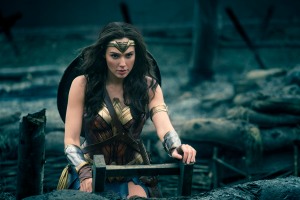 There is also a moment with a mustache that needs highlighting for its sheer hilarity (oblique spoilers). There is a flashback to a thousands-year-old story, and a certain character retains a large, bushy mustache, and it took all my power not to bust out laughing at the absurdity of the image. This could have been preventable. They could have hired any younger actor. The audience would still have known who the onscreen figure was since they were narrating their own tale. They could have also just shaved the stach. Is it possible that the villain’s powers are completely linked to this item of facial hair? Is this a modern-day Samson, a cruel joke practiced by Zeus, who never could have foreseen an age where anachronistic facial hair would be celebrated with undue irony (hipsters will be the death of us all)?
Wonder Woman is going to make a lot of people happy, especially those who have been yearning for a worthy showcase not just for the character but for a strong heroine who doesn’t need romantic entanglements or a man’s approval. Celebrate the big screen outing befitting the biggest female superhero in comics’ canon. Gadot is a genuine star and has a charming and capable sidekick with Pine. The action is enjoyable, the humor keeps things light enough to blend the different tones, and the stylistic choices from Jenkins keep the movie fun for all ages and genders. It’s a celebration of a woman’s might and not necessarily how she looks in her star-spangled mini-skirt. It’s a relative bright spot for the otherwise dreadful, dark, and dreadfully serious DCU, though I still cannot muster any hope for Wonder Woman’s next appearance, Snyder’s Justice League. With all of its virtues and entertainment, Wonder Woman still suffers from some poor development decisions and a lousy final act that hold it back from true greatness. It’s a good movie, but walking away, I couldn’t help feeling that even the best DCU movie (thus far) was about lower middle-of-the-pack compared to the mighty Marvel Cinematic Universe. Wonder Woman is a considerable step forward in the right direction but there’s still many more left to go.
Nate’s Grade: B
Share this:

King Arthur: Legend of the Sword (2017)
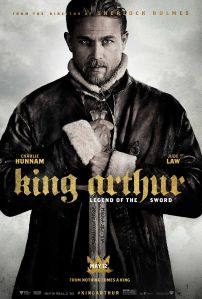 Sometimes a movie just gives the wrong impression from its conception, pre-production, and initial advertisement, and that’s exactly King Arthur: Legend of the Sword. Optimistically planned as a six-part franchise, this new big-budget rendition of Arthurian legend looked like a total disaster. Director and co-writer Guy Ritchie (Sherlock Holmes) seemed like the wrong fit for the material, the tone seemed messy and unclear, and it screamed a transparent attempt by Hollywood execs to sex up something old. I was holding out a sliver of hope that it might be stylish, mindless fun, and this was coming off of Ritchie’s unexpectedly enjoyable Man from U.N.C.L.E. remake. If I do not see a more headache-inducing, self-indulgent, cumbersome, illogical, and generally exasperating movie this summer, I will consider myself most fortunate.
Arthur (Charlie Hunnam) is a streetwise youth raised in a whorehouse on the dirty streets of Londinium. He’s a low-level criminal with his own loyal crew and his own moral code. He’s also, unbeknownst to him, loyalty in the making. Arthur is the son of the former King Uther (Eric Bana) who was murdered by his brother and mage, Vortigern (Jude Law). Arthur runs afoul of the law and is captured, and his identity is revealed when he successfully pulls Excalibur from the stone. Vortigern must kill the young upstart but a group of dissidents kidnaps Arthur and pleads with him to join their cause. Together they can topple Vortigern and free England of his tyranny.
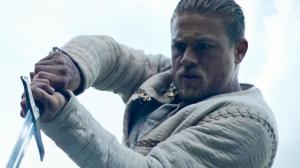 If you can keep up with Ritchie’s willfully shifty film narrative then you’re of sounder mind than me because it felt like King Arthur was just being made up on the spot. Whenever one tells a story in a fantasy realm with fantasy figures, the rules are important to establish, otherwise everything can just feel airless and arbitrary and anticlimactic. If a movie can’t establish its own internal logic and system of rules it feels obtuse. There aren’t setups, and without setups there can’t be well-orchestrated payoffs. This is basic structure, plain and simple. This does not happen in King Arthur at all. Beyond the most flimsy good-guys-triumph-over-evil underpinning, there is nothing that makes sense. Characters will all of a sudden achieve some advanced knowledge without the audience seeing how this was gained. Characters will make use of powers that would have been very useful if they had been used earlier but we have no explanation why. The Mage (Astrid Berges-Frisbey) all of a sudden summons a giant snake, or turns into a giant snake, and I’m thinking, if you have giant snake-making powers, why did you wait so long on this? Conversely, Vortigern offers blood sacrifices to an evil squid-siren-sister-threesome, but what he gains in exchange is vague, their demands are vague, as is their overall fit into a larger scheme. I thought Arthur was trying to stage an insurgency and court a political revolution, but that fizzles out after a few scenes of rare coherency. I gave up trying to understand the movie within the first twenty minutes. It feels like Ritchie and company are just hurtling through expected fantasy elements as if they were merely expanded features from a trailer and a chore to overcome. Arthur has an incredibly expedited adventure on an island with oversized animals (literal R.O.U.S.!), and it feels like Ritchie is just laughing at the expense of the audience and whatever genre demands they might have had.
The characters are also extremely uninteresting and kept me at a distance for the entire film. Ritchie is trying to incorporate his cheeky gangster movies into the fantasy mythology of the King Arthur legend, and the two don’t exactly fit. An early sequence involves Arthur explaining his routine that day through repetitious, annoying narration and a non-linear time-skipping timeline. It’s the kind of narrative trick we’ve become accustomed to in Ritchie’s movie. This time it was shallow because it wasn’t funny, interesting, and its only justifiable purpose seemed to be beating an audience into submission to remember the names of Arthur’s pals through rote repetition. The characters have stupid, Dick Tracy-in-Midlevel times names like Goose Fat Bill, Wet Stick, Back Lack, Chinese George, Jack’s Eye, Blue and Mischief John. Silly names by themselves are not an issue, as Snatch had characters with monikers like Franky Four-Fingers and Bullet-Tooth Tony, but by God those characters were memorable. These characters lack striking personalities and general purpose other than filling the frame. If you challenged me to put names to faces I would probably fail (the main female character doesn’t even get a name; she’s simply The Mage). These boring people just drifted from scene to scene, bumping into an increasingly arbitrary, ungainly, and meaningless plot.
The subtitle is also an indication of the deeper problems inherent with the plot. It’s “Legend of the Sword” and not “Arthur,” and it doesn’t even name the sword. We’re told that the sword wields immense power, though like much it’s never explained in any sort of manner that would provide context or general understanding. The sword is powerful but it’s also more active than our hero, because Arthur is told that the sword controls him and not the other way around. His mission then is learning to simply allow the sword to do its thing. His mission is to become more passive when fighting? Does that strike anybody as a character arc that makes sense or would be satisfying to watch?
With so many missteps at so many levels, the only way this movie could have been salvaged is from some sensational action sequences to quicken one’s pulse. Ritchie is a stylish director but I don’t think he’s ever been a great stager of action. His documentary-style zooms, speed ramps, and quick cuts are more about engendering an impression. An excellent example, and probably the high-point of the movie, is a montage establishing Arthur’s childhood growing up on the rough and tumble streets of Londinium. It’s wordless, set to a gasping, percussion-heavy score, and quickly establishes through concise visuals how Arthur came of age and gained his street smarts. The legitimate action sequences are underwhelming and poorly orchestrated. The setups are rushed, confusing, and the edits are a scrambled mixture of slow motion, fast motion, and extreme close-ups, a combination that doesn’t aid in coherency. The advanced fighting feels like the movie just accelerated into a video game cut scene. It’s generally as incomprehensible as the plot and as ultimately tiresome as the various characters.
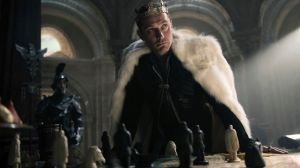 Allow me to indulge an exemplary example as to why King Arthur is as stupid, irritating, and headache-inducing just from a plot standpoint, never mind Ritchie’s filmmaking tics. The villain has three chances to kill Arthur and he inexplicably whiffs every freaking time. The first is when Arthur is a young boy and his father manages to place him on a small dingy and pushes him out to sea like he’s Moses in a basket. Vortigern is his super video game bad guy ultra self, who we later see has the power to launch fiery projectiles, and he just watches as the slowest boat in the world slowly drifts away, forgetting he has projectile powers. Either that or the movie inserts an arbitrary limitation for no reason. Now established as king, Vortigern lives by the prophecy that Arthur will return and pull Excalibur from the stone and one day vanquish him; however, Arthur can still be killed because he is mortal. Arthur pulls the sword from its stony sheath and passes out. Does Vortigern kill his long-prophesied enemy while he’s unconscious? No. Does he kill him while he’s locked in a jail cell? No. Does he kill him before a big public ceremony where, surprise, a group of outlaws rescue Arthur? No. Even if you were being generous and account these foolish actions as the result of unchecked hubris, consider the very climactic battle between the adult Arthur and Vortigern. Once again, Vortigern has adopted his fiery, giant video game boss battle visage, the same that killed Arthur’s father that fateful night. It’s clearly a life and death showdown, and at one point Arthur gets thrown, hits his head on rock, and is knocked unconscious. He eventually wakes up and looks over to find… Vortigern just standing on the other side of the rock and admiring like a stone altar. It’s the battle between good and evil and evil decides to take a walk. Three obvious instances where the villain could have won, easily, and three illogical excuses that showcase the absence of even acceptable storytelling.
So what if the story of King Arthur: Legend of the Sword is dumb and feels like it’s being randomly made up on the spot? So what if the characters are underwritten, lacking in distinguished personalities, and are rather pointless? So what if the main character has to learn to better give up his agency to a stupid magic sword? So what if the only significant female character doesn’t even merit a name? So what if the action often resorts to a slow-motion frenzy of a CGI dust cloud? So what if there are 300-foot sized elephants in this movie and then never appear again? So what if I don’t understand anybody’s personal relationships besides good and evil designations? So what if I was so bored and disengaged from the movie that I started contemplating strange subjects to pass the protracted time, like why does Hunnam’s natural British accent sound so fake, and why does Jude Law’s hair remind me of Bill Murray in Ghostbusters? The ultimate question is whether or not something as ostensibly irreverent as a cockney crime King Arthur is fun, and the answer is unequivocally no. If you’re still wondering how poorly conceived and executed this movie is, I’ve saved the best doozy for last, which coincidentally is also one of the final moments in the two-hour film. I kid you not, the movie ends with the eventual Knights of the Round Table actively befuddled by the existence of a round table. They cannot apply their knowledge of tables to this new, rounder model. They gawk, shake their heads, and wonder what it is exactly. There you have it, a group of heroes mentally defeated due to the absence of corners.
Nate’s Grade: D+
Share this:

Their Finest (2017)
 Their Finest (not to be confused with Their Finest Hours, even though this is based on a book called Their Finest Hour and a Half) is a disarmingly sweet and poignant true story that resonates with empowerment and the power of creativity. Set at the start of WWII, the British film industry is trying to make ends meet as well as provide morale boosts to the public. Catrin Cole (Gemma Arterton, her best performance yet) goes in for a copywriting job and walks out a hired screenwriter, pegged to write the “women’s parts.” Thanks to the depleted workforce, Catrin has an opportunity she never would have otherwise and she blossoms under the crucible of creative collaboration. This was one aspect of the movie that I was very taken with, as a writer and screenwriter myself, the natural progression of creativity, solving a problem, finding a solution, and the elation that follows. The complications keep coming, first from the British film office who need the movie to be inspirational, then from the divergences from the true story of a pair of French girls who stole their uncle’s boat to rescue soldiers at Dunkirk, then from working with American producers who insist on an American hero who can’t act, and then from natural calamities of scheduling, casting, and oh yeah, the bombing and blitzes that could obliterate everyone. The movie is alive with conflict and feeling and the sweet story of a woman finding her sense of empowerment in the arts. The movie-within-the-movie is filmed to period appropriate techniques, and Bill Nighy is effortlessly amusing as an aging actor still fighting for some scrap of respect in an industry ready to forget him. The insights into the different stages of film production were fun and illuminating. I appreciated that the war isn’t just something in the background but a constant. It upsets the order, takes lives, and is a striking reminder why these people are doing what they’re doing. The film also rhapsodizes the power of the arts, and in particular cinema, in a way that feels reverent without being overly sentimental or self-congratulatory. A great collection of characters is assembled as a ramshackle sort of family with a mission, and the movie drives right into one payoff after another, lifting your spirits and warming your heart. There is a sudden plot turn that will likely disappoint many in the audience eager for a simple happy ending, but I almost view it as industry satire on the difference between American and European cinema tastes. Their Finest is a small gem with sympathetic characters trying their finest and achieving something great. It’s a rich story that deserves its moment in the spotlight and I’d advise seeking it out if possible.
Nate’s Grade: B+
Share this:

The Zookeeper’s Wife (2017)
 Antonina Zabinski (Jessica Chastain) and her husband Jan (Johan Heldenbergh) are the keepers of the Warsaw Zoo. Their lives are thrown into turmoil when Germany invades and occupies Poland. Their animals are slaughtered or moved to the Berlin Zoo, under the care of Nazi party member and amateur geneticist Lutz Heck (Daniel Bruhl). Feeling impotent to the horrors around them, Antonina and Jan risk everything to hide Jews in their zoo and eventually smuggle them out to safe houses.
The Zookeeper’s Wife is one of those slice-of-life stories about good people risking much to save lives during the Holocaust that come from obscurity to remind you that there are still fresh, invigorating stories from a topic that can feel tapped out after 70 years. However, it’s also an indication that you need the right handling to do it justice. The Holocaust is by nature such a horrific subject matter that it’s hard to do it justice with a PG-13 or below rating, but it can be done with the right amount of artistic restraint as long as the overall story doesn’t feel hobbled with limitations. Reluctantly, The Zookeeper’s Wife feels a bit too sanitized for the story it’s telling. When it comes to cruelty and human atrocity, you don’t need to shove the audience’s face in the mess to fully comprehend its distaste, but overly avoiding the reality can also be a detriment. The Zookeeper’s Wife, as a PG-13 movie, does not feel like the ideal way to tell this real-life story. It feels too restrained and some of those artistic compromises make for a movie that feels lacking and distracting at points. Fair warning: there are plenty of animal deaths in this movie, though they are all dealt with off-screen with implied violence. The edits to work around this can be jarring and would take me out of the picture. This is only one example of an element that, in order to maintain its dignified PG-13 rating, unfortunately undercuts the realism and power of its story.
 For a Holocaust story set in Poland, the stakes feel abnormally low. The zoo is a sanctuary compared to the Jewish ghettos. The danger of hiding over 300 Jewish people over the course of the entire war feels absent, which is strange considering it should be felt in just about every moment. There are a handful of scenes where we worry whether they will be caught but they’re defused so quickly and easily. After Antonina is caught talking to a very Jewish-looking “doctor” in her bedroom by the housekeeper, they just fire the housekeeper who leaves quietly and never comes back again. It’s a moment of tension that can be felt and it all goes away in a rush. This scene also stands out because the narrow escapes and close calls are surprisingly few and far between. Even when Antonina’s son commits stupid mistake after stupid mistake, including impulsively insulting a Nazi officer to his back, there’s little fear of some sort of retribution. The movie can also lack subtlety, like watching Heck say three times he’s a man of his word and will be trustworthy. We all know he’s going to fall short. There’s also a moment where Jan is literally loading children, who each raise their arms in anticipation, onto a train car. It’s like getting punched in the stomach with every child. Much of the time spent on the zoo is with the quiet moments trying to make the Jewish survivors feel like human beings again (the animals-in-cages metaphor is there). The details of the smuggling and hiding are interesting but cannot carry a movie without more.
The biggest reason to see this movie is the promise of another leading Chastain (Miss Sloane) performance. Ever since rocketing to prominence in 2011, Chastain has proven to be one of the most reliably excellent actors in the industry regardless of the quality of the film. She’s been dubbed a Streep in the making and Zookeeper’s Wife allows her to level up to her “Sophie’s Choice acting challenge stage” and try on that famous Slavic accent that turns all “ing” endings into “ink.” Chastain is terrific as a person trying to navigate their way through the unimaginable, calling upon reserves of courage when needed, and she’s at her best during the moments with Herr Heck. She has to play the dishonorable part of the possible lover, and Heck definitely has his heart set on Antonina. The scenes with the two of them draw out the most tension and afford Chastain a variety of emotions to play as she cycles through her masks. In some ways I wish the more of the movie was focused on this personal conflict and developed it even further.
There was a small practically incidental moment that got me thinking. As stated above, the film has a PG-13 rating and one of the reasons is for brief nudity from Chastain. Now the actress has gone nude before in other movies so that’s not much of a shocker, but it’s the context and execution that got me thinking. Antonina and Jan are lying together in bed after sex and Chastain does the usually Hollywood habit of the bed sheet being at her shoulders while it resides at the man’s waist (those typical L-shaped bed sheets). No big deal. Then, during their discussion over what to do, Antonina rolls over and exposes her breast for a second before she covers herself up again. The reason this stood out to me, beyond the prurient, is because it felt like a mistake. It seems obvious that Chastain was not intended to be seen naked in this intimate post-coital conversation but it was used in the final cut anyway, which made me wonder. Was the take so good, or so much better than the others, that director Niki Caro (Whale Rider, McFarland, USA) and Chastain said “the hell with it” and kept the briefly exposed breast? Did they enjoy the happily accidental casual nature to the nudity, creating a stronger sense of realism between the married couple? Or in the end was it just another selling point to help put butts in seats? I’m thinking best take is the answer. You decide.
 I am convinced one of the main reasons that Chastain wanted to do this movie, and I can’t really blame her, is because she would get to hold a bunch of adorable animals. Given the subject matter, I was prepared for a menagerie of cute little creatures, but I started noticing just how many of them Chastain is seen holding. She holds a rabbit for a monologue. She holds a lion cub. She holds a baby pig. She holds a monkey. She even kind of holds a rubbery baby elephant doll (talk about Save the Cat moment, this movie takes it even more literally). There may very well be animals I simply have forgotten she held. I would not be surprised if in her contract there was a rider that insisted that Ms. Chastain hold at least one small, adorable animal every third day of filming on set.
Stately and sincere, The Zookeeper’s Wife is an inherently interesting true story that should have more than enough elements to bring to life a compelling film experience. It’s an acceptable movie that’s well made but I can’t help but feel that there’s a better version of this story out there. It feels a tad too safe, a tad too sanitized, a tad too absent a sense of stakes, like it’s on awards-caliber autopilot. Chastain is good but her Polish accent becomes a near metaphor for the larger film: it’s polished and proper but you can’t help but feel like something is lacking and going through the motions of what is expected. This is a worthy story and I’m sure there are great moments of drama, but The Zookeeper’s Wife feels a bit too clipped and misshapen to do its story real justice.
Nate’s Grade: B-


 nathanzoebl
You must be logged in to post a comment.