Blog Archives
The Eyes of Tammy Faye (2021)
 Deeply compassionate but perhaps a little too minuscule, The Eyes of Tammy Faye is the biographical movie about Christian broadcasting pioneer Tammy Faye and her rise and fall along with her bad husband, televangelist Jim Bakker. This is based upon the 2000 documentary by the same name, which is well worth watching the real Tammy Faye provide reflective insights into her unique life. For the live-action film, Tammy is played by Jessica Chastain, who apparently held onto the film rights of Tammy Faye for over a decade, meaning this has been a dream project for the Oscar-nominee. Chastain is fantastic and nails the chirpy voice, ebullient personality, and general naivete of a woman who was a true believer and loved all people so thoroughly that her empathy could be used against her, like when Jim (Andrew Garfield) chastises her for saying gay people are deserving of love, not condemnation, in front of none other than Jerry Falwell (Vincent D’Onofrio). The movie clearly presents Tammy Faye as a genuine soul, though part of this appeal is mitigated by the broadly comic tone of the movie. Under the direction of Michael Showalter, a man more known for farcical satires, The Eyes of Tammy Faye veers into stretches of camp bewilderment, where the movie is inviting you to laugh at its eccentricities. It never fully stabilizes, and the movie feels like it wants to humanize this woman but then also laugh at her. To be fair, Tammy Faye is such a broadly theatrical character who undergoes dramatic physical changes as she ages, her heavy makeup becoming like warpaint. The film’s makeup is likely going to be an Oscar-front runner as it completely transforms Chastain into the chipmunk-cheeked Faye over the course of four decades. The best parts of the movie for me were the strife between her and her husband, an insufferable man too high on his own ego and jealous of his wife’s success. When Jim Bakker confesses to his own infamous affair with his secretary and hasty cover-up, he tries to pin the blame on his wife, saying he must have done it to try and prove something to her. Tammy Faye is a unique woman who lived the gospel she preached when it came to unconditional love. She embraced those with AIDS in the 1980s (recreated in a moving interview), she saw her position as one to remind people of God’s kindness rather than his judgement, and her lifelong interest in puppets and children’s ministry shows her priority in making worship inclusive. The Eyes of Tammy Faye won’t tell you much more about Tammy Faye under the surface but then again maybe there wasn’t. She even says she’s an open book, what you see is what you get. The world would be a better place with more Tammy Fayes leading the way and fewer Jerry Falwells.
Nate’s Grade: B
Share this:

tick… tick… BOOM! (2021)
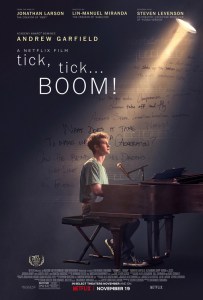 Netflix’s tick, tick… BOOM! is a cause celebre that has attracted none other than the likes of Lin Manuel-Miranda. This is Miranda’s directorial debut, which Netflix won in a bidding war, and it’s filled to the brim with Broadway legends and theater titans who all want to rally to the cause of bringing alive the other show of Jonathan Larson’s tragically short career. Larson would go on to create the hit musical Rent but died before it opened to the public, succumbing to a sudden aortic aneurysm at the age of 35. He never lived to see the tremendous success of Rent and that legacy is the emotional substance of tick, tick… BOOM!, if you happen to know about it. The story, and consequently the movie, feel like a lob to the insulated world of theater aficionados. The movie is semi-autobiographical about Larson (Andrew Garfield) on the verge of turning 30 in New York City in 1990 without achieving his big artistic dreams. He’s been toiling with a satirical sci-fi musical opus for years and is close to finishing it for a make-or-break presentation. The movie is based on Larson’s one-man show detailing his creative process and being young and hungry in New York in the early 90s. It was moderately successful and paved the way for Rent, but it was further adapted in 2001 into a three-person show, which has expanded even further with the film. The songs, written and composed by Larson, are enjoyable but none of them really stand out. I may have liked the least substantial one the best where Larson sings about his distaste at serving brunch patrons in a parody of Stephen Sondheim’s Sundays in the Park with George. The sequence is also wall-to-wall with Broadway cameos. I could not better emotionally connect with the movie. It hangs with looming tragedy of Larson’s surprise death, only five years away, as he wants to do something great with his life and make artistic waves. I think if you removed that added dramatic irony of tragedy, it’s watching a young artist struggle in the theater scene and hold onto his vision, integrity, and friendships, something we’ve seen but benefits with the verve of perosnality. As a story, it’s fallen into a trap where the struggles can be quite relatable to aspiring creatives and also not specific enough to greatly care about Larson as a character onscreen. Garfield sings well and is perfectly charming. Miranda proves apt with the language of film to translate from the confines of the stage. The entire project feels suffused with admiration and good intentions. tick, tick… BOOM! is a labor of love from many theater professionals. It’s an amusing but emotionally limited musical experience. Still, with this much talent, heart, and good will, it’s worth watching for no other reason to see what Miranda and his theater brethren can do together when trying to celebrate one of their own.
Nate’s Grade: B
Share this:

King Richard (2021)
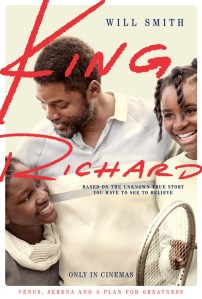 King Richard confounds me and also doesn’t. I can understand what the point was and shrug my shoulders at its choice of narrative perspective. It’s a hagiography that settles on audience foreknowledge to alleviate any tension, or sustained interest, and at its core is a contradiction of a man deserving scrutiny but served up for celebration. As my pal Michael Galusick put it, “I can’t believe there’s a movie about the rise to greatness for the Williams sisters [Venus and Serena], and it’s centered around their dad.” King Richard is an awards-season hopeful, produced by the Williams sisters, and a questionable biopic with a questionable perspective aimed at telling the hidden story behind the meteoric success of two of the greatest tennis stars of all time.
In the late 1980s, Richard Williams (Will Smith) is working all night as a security guard and spending his mornings to train his two pre-teen daughters, Venus and Serena, in tennis. Richard is convinced they will be superstars, that he and his wife Brandy (Aunjanue Ellis, Lovecraft Country) will be rich and move from their Compton, California neighborhood. Richard gets beaten by local gangs, studies tennis magazines and instructors, and tries to get his girls formal training from professionals while holding them back to his demands. He has a plan, he repeatedly tells others, for their success, and nothing will dissuade him from it.
 Firstly, we finally get a movie about the Williams sisters and their dominant rise through the world of tennis, and the movie is almost entirely centered upon their demanding father and his vigilant bordering on abusive training regimen? Richard is meant to be a contradiction and had the movie explored his contradictions in full this could have been an illuminating character study and warts-and-all biopic. However, it’s a movie that fully relies on every viewer’s implicit understanding of the great success of the Williams sisters, so the entire movie serves as a two-hour-plus “I told you so” to Richard’s doubters. Silly neighbor, questioning whether forcing his daughters to perform for hours in the pouring rain constitutes child endangerment. Silly wife, questioning why Richard has insisted his family move into the neighborhood of Compton to better raise his children through adversity and still complain about the dangers that Compton presents and that his daughters must rise above to leave and make something of themselves. Silly tennis coaches, questioning Richard, a man who has no tennis background himself, for demanding his sideline coaching be prioritized over the professionals. Silly “tennis parents,” the kinds that Richard says should be shot, even though he behaves the same way. Silly Williams children, feeling that their demands will be heard and acknowledged as far as their own personal paths and that the other Williams sisters will earn a similar level of attention and affection. Silly sports agents, for being skeptical about this man who says he had a 70-page “plan” for athletic success before his kids were even born and preaching that his unorthodox methods, including paying neighborhood kids to harass and intimidate his girls while they played, would be proven correct. Because, I suppose, it all worked out because Venus and Serena had tremendous success and were inspirations to millions of young African American kids who could finally see themselves in a sport that was privileged and exclusive for generations. He was right, so all of his unorthodox, crazy, dubious methods must have worked, so intuits the movie. It’s less because Venus and Serena have talent and skills and more that their dad worked really really hard and suffered.
With the involvement of the Williams sisters, King Richard only ever goes so far when it comes to critical analysis of its title character. He is certainly presented as a dedicated, hard-working dreamer, but his eccentricities and self-aggrandizing get sanitized as “tough father” when that toughness can cross over into obsession and abuse. It’s like watching 2014’s Whiplash but turned into a feel-good inspirational tale for the ages. At least Whiplash explored the harm of obsession and the pessimistic belief system that whatever it takes to a achieve greatness is excusable. With King Richard, the movie is not at all critical of this ethos. Oh sure, there are points where Brandy Williams speaks up with measured irritation at her husband making rash decisions, excluding the involvement and contributions of others to see his great plan through, and these moments are easily the best in the movie. Finally, someone is pressing this man on his methods and making him confront himself and his flaws. But then Brandy blends back into the background until another half hour goes by and the movie needs to tap her services again. This is the same woman, by the way, who in real life Richard hid her birth control pills in order to back her into a pregnancy and begin his master plan. That’s real. That happened. Same with intentionally keeping his children in Compton so they would learn adversity (tragic side note: one of his older daughters, Yetunde, died in 2003 near a gang house in Compton). And also the fact that Richard walked out on his previous family before Brandy, leaving behind five children all under the age of eight. When he speaks in the movie about always being there for his girls, unlike his father who ran out on him, it rings hollow with the full unflattering context.
 The movie seems to adopt Richard’s belief that if he didn’t push so hard for so long, while also withholding them from the tennis juniors circuit, denying them matches for three years, then perhaps they too would have burnt out and gone down a similar path as young superstar Jennifer Capriati. Except Venus’ first breakout success is because of her own insistence and Richard finally, at long last, acquiescing to the choices being made by his own daughters. Who knows, maybe she would have had success even earlier and not burnt out? It’s just as plausible considering that Richard’s regimen included forcing the girls to earn all As in high school on top of rigorous training. I think this detail is meant to make Richard seem like he values their education on par with their sports performances, but it reads to me as another high-pressure burden he’s beset upon his beleaguered daughters to meet his personal definition of success.
Again, if the movie portrayed this man in a more honest approach, questioning his methods and bringing light to his inherent contradictions, holding people to standards he was unable to hold to himself, taking credit solely for the success of the hard-working women in his family, then the movie would have been an intriguing and revelatory character drama. It would have justified shifting the perspective from Serena and Venus to Richard. But the script by Zach Baylin is too uninterested about those interesting details and contradictions. It knows Serena and Venus succeed so it all becomes a long journey of people doubting him only to be proven wrong. The movie feels more than enough like it reaches its emotional climax, father acceding to daughter as she approaches the big stage, and then there is twenty more minutes of tennis action. Why do we need a drawn-out tennis match at this point? The montage of real-life footage of tennis championships achieves the same emotional effect. If the decision was to finally dwell in the excellence and tenacity of Venus as an athlete cutting loose, then why does director Reinaldo Marcus Green (Joe Bell, Monsters and Men) keep favoring other people’s perspectives during the climactic debut match? We keep cutting back to Richard watching, or those in the crowd, or a squat TV screen monitor. I understand the nature of editing coverage, but if this is celebrating Venus’ moment and handing over the baton to her, then why not give her our full focus rather than repeated check-ins on Richard basking in the ascendant triumph of his hard work?
 Anyway, if you can take King Richard on its own terms, maybe it will prove fitfully entertaining and inspirational as it follows its formula to the bitter end. It’s received widespread critical praise especially for Smith’s humbled performance. I think Smith is perfectly good, but I also think his inherent charisma, and a generation of audience good will, project onto the character to more excuse Richard’s questionable actions. It would be like watching Tom Hanks portray Jeffry Dahmer; you might not condone all his actions but, come one, that’s American treasure Tom Hanks eating human flesh there. As a sports movie or a father/daughter movie, certain fans of those features might plug into the emotional beats of a feel-good universe and ignore the problematic parts. Maybe we’ll get a story of Venus or Serena from their own perspective, one that sees their father in less flattering terms. In the meantime, King Richard is a feel-good biopic that made me feel bad the more facts I uncovered, and its hero worship of a, at best, complicated man without adequate hesitation made me feel like this was a gift from the Williams sisters for their dear old dad’s ego and legacy.
Nate’s Grade: C
Share this:

Mulholland Drive (2001) [Review Re-View]

Originally released October 19, 2001:
Mulholland Dr. has had a long and winding path to get to the state it is presented today. In the beginning it was 120 minutes of a pilot for ABC, though it was skimmed to 90 for the insertion of commercials. But ABC just didn’t seem to get it and declined to pick up David Lynch’s bizarre pilot. Contacted by the French producers of Lynch’s last film, The Straight Story, it was then financed to be a feature film. Lynch went about regathering his cast and filming an additional twenty minutes of material to be added to the 120-minute pilot. And now Mulholland Dr. has gone on to win the Best Director award at Cannes and Best Picture by the New York Film Critics Association.
Laura Harring plays a woman who survives a car crash one night. It appears just before a speeding car full of reckless teens collided into her limo she was intended to be bumped off. She stumbles across the dark streets of Hollywood and finds shelter in an empty apartment where she rests. Betty Elms (Naomi Watts) is a young girl that just got off the bus to sunny California with aspirations of being a big time movie star. She enters her aunt’s apartment to find a nude woman (Harring) in the shower. She tells Betty her name is Rita after glancing at a hanging poster of Rita Hayworth. Rita is suffering from amnesia and has no idea who she is, or for that fact, why her purse is full of thousands of dollars. Betty eagerly wants to help Rita discover who she is and they set off trying to unravel this mystery.

Across town, young hotshot director Adam Kesher (Justin Theroux) is getting ready to go into production for his new film. He angers his mob producers by refusing to cast their chosen girl for his movie. After some harassment, threats, and a visit by an eyebrow-less cowboy assassin (God bless you David Lynch), he relents.
In the meanwhile, people are tracking the streets looking for Rita. Betty and Rita do some detective work and begin amassing clues to her true identify. As they plunge further into their investigation the two also plunge into the roles of lovers. Rita discovers a mysterious blue box and key in her possession. After a night out with Betty she decides to open it, and just when she does and the audience thinks it has a hold on the film, the camera zooms into the abyss of the box and our whole world is turned upside down.
David Lynch has made a meditation on dreams, for that is at the heart of Mulholland Dr. His direction is swift and careful and his writing is just as precise. The noir archetypes are doing battle with noir expectations. The lesbian love scenes could have been handled to look like late night Cinemax fluff, but instead Lynch’s finesse pays off in creating some truly erotic moments. Despite the population of espresso despising mobsters, wheelchair bound dwarfs, and role-reversal lesbians, the audience knows that it is in hands that they can trust. It’s Lynch back to his glorious incomprehensible roots.
Watts is the true breakthrough of Lynch’s casting and she will surely be seen in more films. Watts has to play many facets of possibly the same character, from starry-eyed perky Nancy Drew to a forceful and embittered lesbian lover.
One scene stands out as a perfect example of the talent Watts possesses. Betty has just been shuffled off to an audition for a film and rehearsing with Rita all morning. She’s introduced to her leathery co-star and the directors await her to play out the audition scene of two kids and their forbidden love. As soon as the scene begins Betty vanishes and is totally inhabited by the spirit of her character. She speaks her lines in a breathy, yet whisper-like, voice running over with sensuality but also elements of power. In this moment the characters know, as the audience does, that Betty and Naomi Watts are born movie stars.
It’s not too difficult for a viewer to figure out what portions of the film are from the pilot and what were shot afterwards. I truly doubt if ABC’s standards and practices allows for lesbian sex. The pilot parts seem to have more sheen to them and simpler camera moves, nothing too fancy. The additional footage seems completely opposite and to great effect. Mulholland Dr. has many plot threads that go nowhere or are never touched upon again, most likely parts that were going to be reincorporated with the series.
The truly weirdest part of Mulholland Drive is that the film seems to be working best when it actually is still the pilot. The story is intriguing and one that earns its suspense, mystery, and humor that oozes from this noir heavy dreamscape. The additional twenty minutes of story could be successfully argued one of two ways. It could be said it’s there just to confound an audience and self-indulgent to the good story it abandons. It could also be argued that the ending is meticulously thought out and accentuates the 120 minutes before it with more thought and understanding.
Mulholland Dr. is a tale that would have made an intriguing ongoing television series complete with ripe characters and drama. However, as a movie it still exceeds in entertainment but seems more promising in a different venue.
Nate’s Grade: B
——————————————————
WRITER REFLECTIONS 20 YEARS LATER

How much is a dream worth to you? That’s my main takeaway re-watching David Lynch’s surreal indie Mulholland Drive twenty years later from its release. Lynch has had plenty of his own run-ins with the dream makers of Tinseltown, from the difficulty to see his admittedly weird projects off the ground to the swift cancellation of his once zeitgeist, and deeply weird, TV series, Twin Peaks. It’s common knowledge now that Mulholland Drive began as a 1999 TV pilot that Lynch re-conceived as a movie, shot 30 minutes of additional footage, and earned a 2001 Best Directing Oscar nomination for his perseverance and creative adaptability. The movie has since taken on quite a reputation. The BBC and Los Angeles Society of Film Critics have both hailed it as the best film of the twenty-first century (so far). Lynch has retreated back to his insular world of weirdness with hypnotic, over-indulgent retreads, Inland Empire, and bringing back his signature TV series for a Showtime run in 2017. In 2001, Mulholland’s Drive’s success seemed to be the last point with Lynch working with the studio system he so despised. In a way, this is his farewell letter to chasing his own dreams of stardom, at least as far as a director can have creative control and a steady supply of protection and money to see his vision through. Watching Mulholland Drive is like stepping through a dream, which has been the hallmark of Lynch’s more celebrated, obtuse filmography from 1977’s Eraserhead onward. The movie is meant to operate on a certain dream logic, sustained with choices that seem artistically self-destructive, but the journey might feel as emotionally or intellectually fleeting as a dream as well, so I ask you, dear reader, to think as you continue, how much is a dream worth?

The failed pilot serves as a majority of the film’s running time and it’s filled with peculiar beginnings that will never pay off. There are actors like Robert Forster (Jackie Brown) and Brent Briscoe (Sling Blade) who show up for one whole scene and then are never seen again. Presumably, the roles would have been more significant as detectives snooping around from the peripheral. There are mysterious forces chasing after “Rita” (Laura Harring), an important-looking woman who has conveniently lost her memory and adopted her name after seeing a poster of Rita Hayworth. She’s got a bag filled with money, a gun, and blue key. One would assume over the course of a network season that we would get closer to discovering the real identity of our amnesiac leading lady. There are also scenes that seem to exist as their own short films, like the darkly comedic hapless hitman and the scared man detailing his spooky dream to a concerned friend in a diner. These characters, presumably, would come back for more significance or at least larger interplay. The same with the mysterious locked box and key. You can practically identify the J.J. Abrams “mystery box”-style of storytelling for future intrigue. The role of a TV pilot is to serve up a storytelling engine that can keep churning, as well as ensuring that there’s enough curiosity to hook an audience through commercial breaks. Lynch is used to inserting strange symbols and starts in his movies that potentially go nowhere, so the difference between a Lynch pilot and a Lynch movie aren’t terribly noticeable. These characters, clues, and moments were perhaps intended to be developed further, or perhaps they never were. It’s as if the movie itself is a nightmare of different television programs colliding incoherently.
There does seem to be a consensus interpretation for Mulholland Drive, one that synchs up the various doubles and symbols. For two hours, we’re riding along with Betty (Naomi Watts) as she moves to L.A. with big dreams and perky naivete. She finds the amnesiac Rita in her aunt’s apartment and takes it upon herself to give her a home and investigate her identity. They grow close together, Betty nails her big acting audition, and then Betty and Rita become lovers. They go to a club (Silencio) where performance artists insist “everything is recorded,” and thus already happened, phony, and a replication of memory, and then Rita inserts that mystery blue key into the mystery box and mysteriously vanishes. We next return to the scene of Diane, who at first was a dead body that Rita and Betty found during their investigation. Now it’s Betty, or at least Watts playing her, and she’s a struggling actress who is jealous of the success and favor her girlfriend, Camilla (also played by Harring), is indulging in from their seedy director, Adam (Justin Theroux). Overcome with torment, she hires a hitman to kill Camilla. From there, she’s attacked by a homeless monster, tiny versions of the people portraying Betty’s parents in the first part, and she takes her own life in grief and guilt. The most common interpretation is that the final twenty or so minutes with Watts as Diane is the real story and that the proceedings 110 minutes was Diane’s dream trying to process her guilty conscience and mixed emotions. The blue key, the symbol from Diane’s hired hitman of a job completed, is the point of transportation between the dream and returning to a living nightmare of regret. Adam’s prominence in the first two hours is explained as punishment from Diane’s mind, so this is why he is emasculated repeatedly, from being robbed of control over his movie, his marriage, and ultimately his future.
Just because this is the most prominent interpretation, and even perhaps the author’s intended one, doesn’t mean other viewers cannot find equally valid and differing interpretations. That’s the appeal or point of frustration with Lynch’s most Lynchian work. However, the problem with asserting that the first two hours of your two-hour-plus movie were all a dream can make it feel overindulgent and unsatisfying. The TV pilot segments are shot in a way that evokes the cliché storytelling stye that prevailed at the time, with overly lit scenes and flat acting. I cannot say for certain but it feels like Lynch purposely told Watts (King Kong) to try and be hammy. Lynch has been known to purposely ape the style of prime-time soaps to provide subtle satirical contexts. Is Watts doing a bad job with the purpose of making us think of other bad actors from soaps? The one scene Betty comes alive is during her audition scene. We’ve already seen her act it out once so we’re expecting more of the same, but in that moment, she comes alive with sensuality, taking control from the aged acting partner who was just there to exploit some young new starlets. The intensity she unleashes, a mixture of carnal desire and self-loathing, is nothing like bright-eyed Betty. Is the irony that when Betty is pretending to be someone else that’s when the performance excels? You can see the points for interpretation, especially considering the ending thesis, but if so, it’s such a bold gamble by Lynch that could prove so alienating. You’re deliberately having your lead actress act in a cliched and stilted manner to perhaps make a point fewer will grasp? Obviously, the ending wasn’t intended to pair with the pilot parts, so it feels like projecting an unintended meaning onto the intentions of acting decisions, but dreams are murky that way.
I wouldn’t be surprised if just as many people are tested by Mulholland Drive as they are mesmerized. It’s a combination of different genres and film iconography, from Manning as a living-breathing femme fatale, to dark whimsical comedy, to surreal mystery, to tawdry erotic drama, to industry-obsessed soap. As much as it feels like a pilot retooled into a new beast, it also feels like a collection of genres being retooled for whatever intended association Lynch wants to impart. It’s ready-made for dissection and ready to take apart the Hollywood studio system. I enjoyed some of the strange moments that felt most ancillary, like the mobster with the extremely refined taste for espressos, and the eyebrow-less cowboy assassin threatening Adam. That scene in particular still has an unsettling menace to it, as Lynch takes what could have been absurd and finds a way to make this man overtly threatening without ever explicitly doing anything threatening. His browbeating to Adam over the difference between listening and hearing is well written and ends perfectly: “You will see me one more time, if you do good. You will see me… two more times, if you do bad. Good night.” I wish more sequences like this could stand on their own. So much of Mulholland Drive seems intended to provide a skeleton for meaning to be provided later as the added meat that Lynch didn’t value as highly.
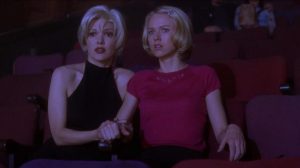
Watts became a star from this movie and was taken to another level with the success of 2002’s The Ring. From there, she was in the Hollywood system of stars and after toiling for ten years from rejected interviews to rejected interviews. She was thinking of quitting acting and going back to her native Australia at the time she got asked to play Betty/Diane. The audition scene, the later distraught and frail Diane, as well as the mannered Betty served as an acting reel for every casting agent that had rejected her. Here was Watts, capable of doing it all and then some (she was nominated for two Oscars – 2003’s 21 Grams and 2012’s The Impossible).
My original review in 2001 is also wrestling with the question over interpretation versus intention, with the genre mash-ups as symbolic satire or as laborious TV pandering. Mulholland Drive is like watching a dream and trying to dissect its many meanings. Some people will relish the puzzle pieces that Lynch has provided and finding further hidden mirrored meanings, and other people will throw up their hands and ask for a road map, or lose interest by then. I don’t think this is the best film of the first twenty years of this new century. I don’t even think it’s close. I think at its best it can be hypnotic and intriguing; it’s a shame that these are only moments for me, and twenty years later these moments felt even further spaced apart. I just didn’t find Lynch’s movie quite worth the long, surreal drive into the dark of his imagination.
Re-View Grade: B-
Share this:

The United States vs. Billie Holiday (2021)
 The good news is that Andra Day is a surefire star. In her debut performance, the singer makes a bold impression as Billie Holiday, with her raspy voice, sterling stage presence, and powerful singing. Day was nominated for an Academy Award, just as Dianna Ross was for her own film debut, also playing Holiday in 1972’s Lady Sings the Blues. The highlight of this movie is a tight close-up of Day singing “Strange Fruit,” her anti-lynching protest song, written by a Jewish schoolteacher, a song that incensed the U.S. government and essentially began the woe-begotten War on Drugs with a racist task force targeting Holiday as their first victim to make an example of. The moment is filled with rising emotions and barely held restraint and the sheer power of Day’s performance communicates the danger and anger of this politically-charged song that earned such controversy. However, the rest of the movie is a bit of an unholy mess, as director Lee Daniels (Precious) takes his signature campy, over-the-top style and cannot say no to any creative decision in his mind. I don’t know what’s harder to grasp, the clashing tones or timelines, as the movie literally and figuratively jumps all over the place, at one instant having Holiday on top of the world, and another being beaten by a parade of one-dimensional and nearly indistinguishable abusive men, to waltzing through heroin hallucinations, and cuddling close with an FBI informant (Trevante Rhodes) who is definitely a fictional character. Like the recent Judas and the Black Messiah, we divest time from the star to the men who betray her, but none of these louts and schemers are worth that precious time. It becomes an uncomfortable misery montage as we watch Holiday get abused, shoot up, cry, get harassed by the police, and repeat endlessly for 130 minutes. I don’t know if maybe Daniels was trying to make me feel like I was on drugs while watching but the antic, unfocused, and careening narrative and energy levels certainly made me feel dizzy and nauseated. An then there are ridiculous moments where I just wanted to laugh, like the backroom of racist government agents saying lines like, “This jazz music is the devil’s work. That’s why this Holiday woman has to be stopped.” This is based on a chapter of a book about the early War on Drugs, not Holiday’s biography, and it feels very much like her own identity and significance is being strung along just to be a martyr for the evils of government persecution. The movie paints her chiefly as a victim and then seems to glorify in victimizing her, and it all feels so garish and ghoulish and misguided. Billie Holiday deserves an amazing movie but she’ll just have to settle for an amazing performance in an otherwise melodramatic mess of a movie.
Nate’s Grade: C
Share this:

Wolfwalkers (2020)
 Beautifully animated with painterly water color visuals, Wolfwalkers is another treat from the acclaimed Irish studio that is single-handedly trying to bring back hand-drawn animation. The visuals are a delight and styled in a flat dimensional space reminiscent of Medieval tapestries (and Wes Anderson movies). The story brings to life 17th century Celtic mythology in a way that is still relevant today and concerns weighty themes about family identity, female independence, religious persecution, prejudice, colonial occupation and exploitation, and environmental conservation. It’s part Miyazaki and Brave and also reverent to its own cultural heritage, and it’s emotionally affecting and engrossing as well as being a treat for the eyes. We watch a young girl befriend a wild “wolfwalker,” a girl who can transform into a wolf when she sleeps. their bond will push each other to fight against forces trying to dominate the forest and morality. The filmmakers have carefully laid out the rules of their story and the implementation of the special powers so that everything happens through gradual circumstances where the plot feels as if it is following an entirely organic path. The voice acting is excellent and heartrending and perfectly paired for the exaggerated, wood-block-styled character designs. It’s a lovely and entertaining supernatural fable with enough thematic relevance, girl power, and visual grace to reaffirm just how magical traditional animation can still be.
Nate’s Grade: A-
Share this:

Moulin Rouge! (2001) [Review Re-View]

Released May 17, 2001:
Director Baz Luhrmann’s last project was the MTV-friendly William Shakespeare’s Romeo + Juliet (like someone else has a Romeo and Juliet) which was adored by the under 15 set that now buy N*SYNC merchandise. Luhrmann waited a long time for his follow up with Moulin Rogue, a manic musical that seems like candy for the eyes. It may have been a long time but it was well worth the wait.
The sparkling world of Moulin Rogue is around turn of the century France. Christian (Ewan McGregor), an aspiring writer, has traveled to this place against his father’s wishes. Christian believes in the beauty of love and the pull of the heart. Within minutes of setting foot in France he gets wrapped up into a production by a dwarf (John Leguizamo) and his cadre of assistants. Christian is sent to the most provocative club in town, the Moulin Rogue. Here he attempts to persuade the most famous showgirl Satine (Nicole Kidman) to help push for their musical to get financial backing. Satine inadvertently confuses Christian for the man she is supposed to seduce for a large some of money, the Duke (Richard Roxburgh). And thus the merry band of misfits get their play the backing while Christian blossoms a love for Satine. But their love must remain hidden for the Duke is led to believe that Satine is his and his alone.

Kidman owns this movie, plain and simple. From her first shattering entrance being lowered from the ceiling to the last scene, she is absolutely magnificent. McGregor gives a nice performance as the dough-eyed lover. Jim Broadbent plays the Moulin Rogue’s owner, Zidler with howling delight in all his manic expressions. Even Roxburgh gives an underwritten antagonist the right amount of weasely twitch.
One of the more surprising features is how well the two leads can actually sing. Kidman gives a soft and sexy take on “Diamonds are a Girl’s Best Friend” and McGregor can belt out a tune with some admirably throaty pipes. As these two veer in and out of songs it’s a pleasure to watch and hear.
Luhrmann has crafted a musical with ADD, but I say this as a compliment. Moulin Rogue‘s pace is fast and pounding. People twirl above the sky, the camera zooms wildly through town streets, and dump trucks worth of confetti fly through the air. Moulin Rouge is exploding with glitz and never lets up. The editing and visual artistry is stirring. By about ten minutes into the proceedings when a green fairy starts singing a seductive version of “The Hills Are Alive” you know you are in for something else. And what a something else the film delivers. There was not a moment I didn’t have a smile glued to my stupid face.

Moulin Rogue could be described as a musical for people who dislike traditional musicals. In traditional musicals people go along stuffy formula, then break out into great choreography song-and-dance. With Lurhmann’s musical is a breakneck of pomp where the characters zip around to exaggerated Hanna-Barbara sound effects and start chiming away with 70s and 80s pop songs that we all know. After the initial shock/humor of hearing characters belt out renditions of “Roxanne” and “Like A Virgin,” a familiarity sets in and it blends in to produce a surprising artistic addition.
The story of the movie is nothing new or extraordinary; it’s well worn territory. But where Moulin Rouge breaks apart and shines are with its style and exposure. The visuals are astoundingly lush and lively, the music is game and pumping, and the movie is just screaming to be seen. This was a true work of love.
The movie is bursting to the seams with life. I loved every single second, every single frame, every single moment of Moulin Rouge. I can’t wait to go see it again.
Nate’s Grade: A
——————————————————
WRITER REFLECTIONS 20 YEARS LATER

This was a movie I was looking forward to revisiting and was partly dreading. With the movies that I loved in my past, there is more at stake revisiting them and finding that some of the luster, some of that original magic that enchanted me twenty years hence might be missing. Nothing is lost by re-learning that something like Freddy Got Fingered is still as awful today as it was in 2001. I had this same nagging concern with several of my favorites of 1999 and 2000, and not all of them held up (these re-reviews cannot help being partly biographical). Moulin Rouge wasn’t even a movie I had much interest in seeing back in 2001. I went at the behest of my friend Kevin Lowe and I remember my expectations being low, or maybe I wasn’t in the greatest mood, but within ten minutes that all changed. Moulin Rouge is a movie I unabashedly loved at 19 years old and watched repeatedly through my early 20s and consider a personal favorite. I was caught up in the razzle, the dazzle (especially the dazzle), but the sumptuous and crazed artistry of it all, where it could simultaneously be nostalgic and modern, irreverent and deeply serious, hopelessly romantic in the squarest of terms while being so quizzically weird. It could have been a spectacular disaster but it ended up being a spectacular spectacular. I’m happy to report that Moulin Rouge retains its charm and soaring passion even twenty toe-tapping years later.

This has and will always be a love-it-or-hate-it film. I don’t think there are many people who can watch this movie and remark, “Eh, it was okay I guess.” The opening act is relentlessly paced, anarchic and antic, bouncing all over the place, exploding with information, humor, colors, and bawdy and bizarre imagery, intending to shake you from your doldrums of what a modern big screen musical experience can entail. Under the mad genius of co-writer/director Baz Luhrmann, the movie is bracingly transporting and takes you for an immediate rush, and just as it slows down, you’re hooked. Or, if you’re in the hate-it camp, you’ve found the movie to be a scattershot, self-indulgent, ADD-addled, exhausting ride you’re eager to depart. An amusement park ride is a fine analogy for Moulin Rouge, a movie reverberating with energy and movement; it really does feel like it can’t possibly stand still. There’s a seductive green fairy line dancing, and a singing moon performing opera, and a narcoleptic Argentinian, and John Leguizamo as a dwarf, and plenty of ribald sexual humor and goofy slapstick comedy. It is, to put it lightly, a lot to handle.
With apologies to modern poets, for most of us, the poetry of our modern culture is the songs that have shaped us and our biographical experiences, the soaring ballads, the friendly singalongs, the bangers to shout at the top of your lungs, the love songs to swoon along to and melt away. Moulin Rouge is a major musical that only has one original song, the modern wedding staple “Come What May,” which was actually written for Luhrmann’s prior movie, 1995’s Romeo and Juliet, and thus declared ineligible for the Academy Award for Original Song (sorry Randy Newman, but your Monster’s Inc. song cannot compete). It is a musical composed of renditions and snippets of hit music, cementing its amalgamation as a pop-culture chimera. In many ways it previews the viral Glee music mashups and remixes, the effortless blending of one song into another, the melodies gliding like dancers and then becoming something excitingly new. It’s a different kind of creativity because it’s one thing just to hit “play” on some Greatest Hits CD and it’s another to make sure the songs track the emotional journeys and perspectives of its primary players. Early on, as Christian (Ewen McGregor) belts tunes from The Sound of Music, captivating his peers with his apparent genius, we immediately understand the instant appeal this man would have, seeming like a musical prophet to those lucky enough to listen in 1899 Paris. It’s a clever shorthand and another reflection that modern music has enough vitality and depth to serve as the romantic poetry of our age. Moulin Rouge also predates the sharp rise in jukebox musicals, using the songs of the past, usually limited to one artist, as part of the infectious fun.

The singing and song renditions are luscious and odd and beautifully re-calibrated. The introduction of Satine (Nicole Kidman) is a bold move, lowered on trapeze, her pale skin practically glowing, as she breathily sings “Diamonds Are a Girl’s Best Friend.” It’s like the movie perceives Satine as an angel being lowered to the mores of man. A male duet of “Like a Virgin” between club owner Harold Zidler (Jim Broadbent) and the villainous, twitchy, possessive and foppish Duke (Richard Roxburgh) is hilarious and at points unfathomably creepy. Watching “Roxanne” performed as a sultry tango is so good that you’ll never want to hear it any other way. The singing by the famous stars is remarkably polished and without the advent of Autotune, especially from McGregor who belts his tunes with impressive range. The blending of this sonic soundscape, especially McGregor inter-cutting with that “Roxanne” number, can be overwhelming to fully process, like the movie is trying to reach you on a pure emotional, elemental level where you feel it before you can fully process it intellectually. I think that sums up the movie and its lasting appeal well, because I can logically pick apart certain artistic choices, like the exaggerated cartoon sound effects that could have been pared back, but the movie is a messy, joyously messy, exuberant love letter to big messy emotions and cheesy romanticism even to the point of mockery. This is a big screen musical for our modern age, and it’s meant to tap the right combination of buttons to make you fall in love, and I do every time.
It’s amazing to me how Moulin Rouge feels like a crossroads of the old and new, reaching back to the big movie musicals of old but with the hyper-kinetic style of modern music videos. It’s immediately fresh but also familiar, and that clever construction most notably extends to its very specific use of music. It’s not trying to erase the old school musical but drag it into a new century, drafting off of modern music hits to reach a new audience waiting to feel that same heightened reality that those old musicals might not capture for a younger generation. The movie also begat a resurgence of big screen musicals like 2002’s Chicago, 2004’s Phantom of the Opera, 2005’s Rent and The Producers (also co-starring Kidman), 2006’s Dreamgirls, 2007’s Sweeney Todd and Hairspray, and on and on to recent musicals like 2019’s Rocketman (jukebox musical) and 2020’s The Prom (also co-starring Kidman). Everything Chicago did, I felt like Moulin Rouge did better the year before, and I’m convinced Kidman’s Best Actress Oscar for The Hours was a makeup award for being overlooked for her superior performance in Moulin Rouge a year prior. I don’t know if Kidman was ever better than she was here at this moment in her career, fresh off her divorce from Tom Cruise. I feel strongly that Broadbent should have won his 2001 Best Supporting Actor Oscar for this and not Iris. The movie was nominated for eight Oscars and justly won two for Best Art Direction and Costumes, both going to Luhrmann’s wife, Catherine Martin, who would also win two Oscars for her husband’s equally lush and anachronistic 2013 adaptation of The Great Gatsby. The electric editing, glittering cinematography, and all the bravura technical elements blend into a rare artistic vision so complete and so extravagantly bold at this budget level.

It should also be noted that Moulin Rouge was adapted into a Broadway stage musical in 2019, updating with more twenty-first century hits like “Crazy in Love” and “Firework” and “Toxic” and “Bad Romance” among others. Its stage run was postponed because of COVID although a national tour is planned for 2022.
From my original review back in 2001, many of my same points still hold up and it was difficult to perfectly capture the spell this movie can have, the same difficulty I’m running into today in 2021 to try and convey its unique hold on me. Regrettably, it’s another review that I felt I needed to take a potshot on “teenyboppers” from my oh so dismissive position as critic. It’s nice when I find myself agreeing with my twenty years younger self. I especially agree with this one summative statement: “There was not a moment I didn’t have a smile glued to my stupid face.” Moulin Rouge is one of my happy movies and twenty years later my stupid face is still smiling.
Re-Review Grade: A
Share this:

My Octopus Teacher (2020)
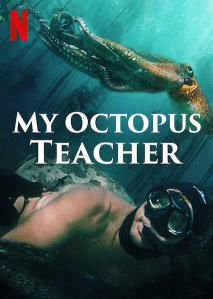 I’m close to finishing the documentary My Octopus Teacher and felt the urge to already begin typing out my thoughts, something I rarely do as I prefer to marinate over movies, let alone waiting for them to conclude. This Oscar-winning documentary wasn’t even part of Netflix’s critics screeners they sent me in the mail to consider for the top documentary prize, which tells me even its home didn’t have the highest of hopes for the true story of one man’s relationship to a mollusk. As it steamrolled through the awards season, my curiosity grew, and I finally took the plunge and watched the movie within hours of it being declared the finest documentary of the year by the Academy. As you can likely guess from the fact that the movie is still ongoing while I write, I may disagree with the Academy’s choice. My Octopus Teacher is a beautiful looking movie with some larger messages about our connections to nature and conservation, but the entire time I kept looking around and thinking, “There has to be more to this, right?” Alas, this is the story about one man and the octopus that won his heart, as told by that man, and that is it.
Craig Foster was a depressed nature photographer who was feeling lost. He would dive into the icy waters off the South African coast to reconnect with his childhood. He discovers a peculiar octopus and follows her movements, studying her for months, and earning the trust of the creature. Craig learns about himself and his view of nature through this fortuitous undersea bond.
 This is literally the story about one man explaining, without interruption, his life lessons he has learned through his yearlong relationship with an octopus, and I just couldn’t fully engage with this on an emotional or intellectual level. The underwater photography is stunning and gorgeous to watch, as would many high-gloss nature documentaries covering the same environment. Watching the octopus hunt, hide from predators, camouflage, contort itself, and even seemingly walk on its tentacles is fun to watch, and nature has plenty of weird specimens to discover and analyze. I’m on board with re-examining the depths of our understanding with some of the weirdest creatures doing their thing thanks to millions of years of evolution. However, where the movie left me wanting is that it is, one hundred percent, one guy talking to the camera and explaining his observations about one nifty octopus and what he has learned from these experiences. The scope of the movie is so minor that it feels less a film and more like a filmed nature article, a little colorful expose that your local news might play to close out its programming. I found the movie to be too slight and unvarying in its information and delivery.
Perhaps I’m a curmudgeon at heart but I kept thinking that Craig Foster was projecting a lot of emotions onto this octopus. I believe this creature meant something special to him, and he became familiar enough that the octopus saw him less as a threat and more as a… what? Does this octopus really see this man in a snorkel as a friend or an ally? She reaches out a tentacle to touch the appendage of this underwater man, but what does that mean? Is this signaling a friendship or is it merely signaling an animal taking stock of its surroundings? I don’t know and depending upon your personal relationship with the animal world, you will either accept everything Craig says at face value without skepticism or you will see him as a slightly foolish romantic.
 The movie’s gentle and empathetic nature is unbroken, though I’d be lying if I didn’t say I thought about the extremes of where this man/octopus relationship could lead. I wondered if Craig was going to declare that he and this octopus were getting married, he was leaving his wife, and that no one could compare to the touch of her tentacles. I don’t mean to sound cruel or dismissive about this man’s emotional experiences. This shared bond clearly touched this man and allowed him to realign his relationship with nature. He even says he feels like a better man and father thanks to these experiences. I’m happy that Craig found that kind of epiphany and direction in his life, and his story has fun details that made me agree that octopuses can be strangely fascinating creatures. However, that doesn’t mean I needed an 85-minute documentary about the guy more or less debriefing to the camera about his year of journaling. It’s just not that grabbing of a subject to satisfy a feature-length documentary. I don’t feel like I gained anything monumentally more from this movie being 85 minutes than I did if it was 25 minutes.
I may watch My Octopus Teacher again and give it another chance (for those wanting to know, it’s since concluded as I compose this review). It beat out serious competition in a year that had some seriously excellent documentaries (Collective and Dick Johnson is Dead both made my Top Ten of 2020). I’m happy so many people seem to be moved by this man’s personal tale of his magical bond with an eight-armed buddy. I was left mostly indifferent. The photography and plenty of the exclusive video captured is interesting to watch, but there’s little separating My Octopus Teacher from a viral clip you’d see forwarded to you from an animal blog. You can find plenty worse movies out there but I guess what makes this movie so special is just lost on me.
Nate’s Grade: B-
Share this:

Another Round (2020)
 In one of the best lines in The Simpsons‘ history, Homer Simpson makes a summary toast: “To alcohol, the cause of –and solution to—all of life’s problems.” This edict populates the Danish comedy Another Round, written and directed by Dogme 95 co-founder Thomas Vinterberg (The Hunt, Far From the Madding Crowd), who recently earned a surprise Academy Award nomination for Best Director. The movie follows a foursome of middle-aged school teachers trying to reclaim their lost mojo, chief among them Martin (Mads Mikkelsen), a history teacher who feels adrift as a husband, father, and an educator. A friend mentions a theory from an obscure academic that human beings are born with a .05% blood-alcohol deficiency, and to operate at peak performance, a person should regularly imbibe a serving of alcohol to maintain a buzzed feeling. Martin and his three friends agree to live this experiment, sneaking booze onto school premises, and then pushing further, raising the blood-alcohol minimum to see if they can keep up.
 In some ways, Another Round feels ready-made for the kind of wacky ensemble comedy territory on the peripheral of drama, something the likes of a new Judd Apatow comedy (Knocked Up), and I wish that this Danish film had followed a more mainstream and crowd-pleasing approach. I know that sounds sacrosanct, the American film critic decrying the foreign film and wanting it to be filled with more dick and fart jokes, but this is because I see the true comedic potential at play, and I know an artist with the sensibilities of an Apatow or even a Greg Mottola (Superbad) could crush this. Labeled as a comedy, Another Round is more “comedy” in broad theory than execution. You would think a group of middle-aged school teachers testing a theory about operating at peak efficiency while being buzzed from booze would lend itself to all kinds of amusing, hilarious exchanges and set pieces where the men cause trouble and get into unexpected shenanigans while trying to keep their secret. The appeal would be watching this group of men cut loose in a way that feels liberating, pushing them outside their comfort zones and discovering something about themselves and their capabilities before, of course, the dark side and going too far, chasing an increasing high. I feel like many readers can picture the Apatow comedy right there. The problem with Another Round is that nothing is ever really funny. There’s the brief occasion of physical slapstick and even briefer encounters of the men behaving goofy, caught up in their feel-good vibes. But mostly the movie is devoid of recognizable comedy, even awkward, cringe-inducing comedy. It feels like the filmmakers said, “Let’s tackle a premise that seems like an Apatow comedy but let’s play it mostly straight and see how it goes.” Well, it went.
As far as a drama, I also found Another Round to be promising but ultimately lacking. We don’t really know the supporting characters before they begin their experiment, particularly what is holding them back or what obstacle they seem to perceive is holding them back. This is a movie about drastic change and how it affects these four men, and yet we barely know where they are starting off to contrast how the experiment affects them, good or bad. The men all seem to have succumbed to a general malaise and the joy of teaching has left them. Once they begin the experiment, they find that joy has emerged and they are more engaged in their classrooms, more adept at connecting with their teen students and keeping their attention, and more likely to make the learning meaningful and impactful as it relates to their dreaded high-pressure finals. Really, it sounds like, on paper, that these men use this opportunity to simply become better teachers because they allow themselves to put more of themselves into their teaching. The men don’t seem beholden to superstition, feeling they need the alcohol to be the most effective teachers, so one would think they could take the experience and learn lessons about how they can reclaim that feeling of purpose, of being an effective educator without the catalyst of alcohol to get them there. Without a more meaningful picture of these characters and their personal ennui, it makes the experiment feel inconsequential, as if it could have been anything else that shook these men from their general malaise. It takes away from the drama of what these men went through and what it might have cost.
 I suppose if the comedy was going to be muted, I was expecting Another Round to be more dramatic. Martin is our main character and his rocky relationship with his wife serves as the heart of the drama; he wants to reconcile after being too removed. We root for him but we’re not really invested. The bigger drama isn’t even involving Martin. One of the guys in the group becomes a cautionary tale of descent, not seeing a reason to stop drinking, and his downturn is played with such nihilistic certainty for tragedy that it seems strange how nobody intervenes. It would play more emotionally if this character was better developed. The other characters are missing clear arcs and more interesting and relatable character moments. I can envision the kinds of supporting characters under this scenario that populate the Apatow version of this premise, each a reflection of a different kind of malaise, each a different personality, and each finding room to progress on an arc where they learn lessons both good and bad but come out wiser. The start is right there, but without making the most of the shared time, it feels like we’re hanging out at a party with people we barely know and overhearing an anecdote we’re missing vital info from.
Mikkelsen is best known stateside for his intense villainous roles (Hannibal, Doctor Strange) and as the occasional flinty badass (Polar, Arctic), so there is a degree of appeal to watching him play a normal school teacher. Mikkelsen is solid throughout and really shines when the character’s inner life returns, thanks to alcohol and then, later, his own sense of self-worth. It’s sturdy but unremarkable acting, notable for its normalcy and the edges of humor we don;t usually see from the actor. Much is built upon Martin’s past jazz ballet class and this is the closest thing the movie has to a comedic payoff, finally gifting the audience with the sight of a joyful, fluid Mikkelsen prancing across the screen at the very end (the actor actually has legit ballet training). It’s a fun sight but, as the film’s biggest comic payoff, it’s not exactly one that could sustain your built-up imagination.
 Another Round is a fine movie about friendship and recovering one’s lost sense of self, but as a comedy it’s not very funny, and as a drama it’s not very dramatic, and so it feels stilted, stuck between both realms and just kind of bouncing around a miscalculated middle-path. You won’t be angry by what you’re watching from Vinterberg and the actors but you might not be hooked. Given its surprise Best Director Oscar nomination, over the likes of Aaron Sorkin, Regina King, Spike Lee, Florian Zeller, and Darius Marder, I think I was expecting something more bracing, something more intellectually engaging, and something where the vision was so perfectly predicated by the precise tone of its nominated director. I’m sorry to say, dear reader, but I just don’t see it. I cannot see what on screen lead to Vinterberg’s unexpected nomination over a crowded field. I cannot see what on screen convinced people Mikkelsen was a Best Actor contender. I cannot see what on screen makes Another Round the odds-on favorite for Best International Film, especially in a category where Romania’s Collective is also competing. Maybe I’m just not the right audience for this movie. Maybe I was expecting too much. Maybe I’m just being unfair. It’s possible, or it’s also possible that this heralded foreign film has a muted identity crisis that saps away its comic and dramatic potential and my potential entertainment.
Nate’s Grade: C+
Share this:

Memento (2001) [Review Re-View]
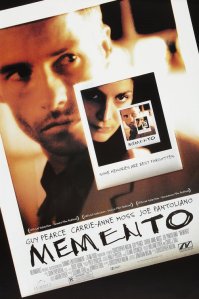 Released March 16, 2001:
A film is taking the nation by storm and it isn’t anything from a big studio. In fact it’s the first release of a new indie production house called New Market, and these people have lassoed a real winner. Memento is a murder mystery bubbling with perfect elements of noir, suspense, and trickery. Memento is the tale of Leonard Shelby (Guy Pearce) who is searching desperately for John G., the culprit he believes that raped and murdered his wife. Along the way Leonard gets assistance from his friend Teddy (Joe Pantoliano) and Natalie (Carrie Anne-Moss), a down on her luck bartender.
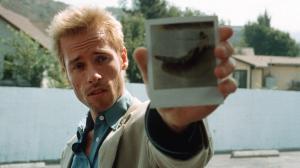 Except Leonard has a peculiar problem plaguing his one-man investigation for justice. After the attack on his wife the assailant knocked him out, and Leonard was left with no short-term memory whatsoever. Leonard cannot develop new memories. So if something happens to him, he is liable to immediately forget it within five minutes. To aid himself he write on small post-its telling him which car is his, what hotel he’s at, etc. all over his body are tattoos of clues he has amassed. He takes Polaroids of people and writes their names on them to remind him of the faces he sees that he won’t remember. Leonard’s investigation is about what his notes tell him. He doesn’t know whom he can trust and whom he cannot.
If this wasn’t enough to make Memento interesting the entire tale is told out of sequence and run from end to beginning. The entire film is told backwards. This action robs the audience of the same information that escapes Leonard. We too know neither who to trust. The effect could fall into gimmick territory but makes the movie fresh and adds for some great comic situations as well, like when Leonard awakens with a bottle of champagne in his hand and tells himself he doesn’t feel drunk.
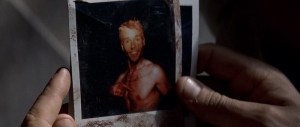 Pearce is gripping as the emotionally shattered and fractured Leonard. He is a man that can trust nothing and must live from repetition but is intent on bringing his wife’s killer to bloody justice. Pantoliano and Moss provide good support as the weary characters that weave into Leonard’s plight. The acting it excellent all around. They leave us guessing and reassembling our perceptions as more of the puzzle unravels.
Memento is top-notch film noir. It’s a breathless thriller of a first rate caliber. The direction given by Christopher Nolan from his screenplay is tight and highly effective. The character of Leonard is fleshed out in all his paranoia, pain, and frustration. Nolan has delivered a gift to movie audiences always hungry for fresh material. One has to see the film a second time just to see how well the segments play together.
Memento is the coolest movie around. Rush out and see it, then see it again, and then again. It’s the best movie of 2001 by far as of now and has the Best Original Screenplay Oscar locked [Editor’s note: it lost to Gosford Park of all things.] It’s destined to be a cinematic classic people will talk about for years.
Nate’s Grade: A
——————————————————
WRITER REFLECTIONS 20 YEARS LATER

Without a doubt, there has been no filmmaker that has had the meteoric rise over the last twenty years than Christopher Nolan. The man has entered that rare, hallowed upper echelon of the Steven Spielbergs and Quentin Tarantinos where his name alone is the selling point. You go to see a Nolan movie because you know it will be an experience that no other filmmaker can quite deliver, and from 2005’s Batman Begins onward, he’s been given immense studio resources and unchecked creative control to make his big dreams come true on the biggest stage. It’s thus very fun to go back to the little 2001 indie movie where it all started for the future box-office titan. It has many of the hallmarks that have followed the director’s ascendant career, like dead wives as back-story, cool emotions, an unreliable protagonist, and especially its crackerjack, air-tight narrative. Memento already had a dynamite premise, an amateur investigator seeking justice who couldn’t hold new memories because of a mental condition. It was based on an unpublished short story by his brother Jonathan (future frequent collaborator and creator of HBO’s Westworld), which is why it qualified as an original screenplay at the Oscars, to which it would eventually lose out to Gosford Park (go figure). Nolan deliberately made the story even harder to follow in a gambit that would come to define his screenwriting experimentation. He told the entire movie backwards, so that the story began at its ending and finished at its beginning. Every few minutes, we, like our memory-challenged lead Leonard Shelby (Guy Pearce), are left to ask, “How did we get here?” It puts you in the stark position of the lead’s perplexed and scrambling sensibility. It’s a raised bet of a storytelling check, one that Nolan delivers with incredible panache, but twenty years later, is Memento more than a brilliantly executed magic trick?
 Even after watching Memento likely half a dozen times in my life, this is still one very confusing movie to follow. There are two current storylines that crisscross and eventually overlap, like tributaries reconnecting to a source. The black-and-white segments of Leonard narrating his rules, tattoos of key clues, practices, and investigative successes as he narrows his search for the mysterious “John G.,” the man he claims assaulted him and his wife, are filmed more objectively, playing out in linear fashion, given to rampant exposition to better orient the audience to the tricks of the movie. The color segments are the main action, watching Leonard go from murdering a confidant to then explaining how we got here, roping in scummy drug dealers, violent men, sad-eyed barmaids, and people looking to take advantage of Leonard and his unique disability (the motel owner rents him multiple rooms). These sequences are played in the backwards trajectory that drives the movie, so every pit stop essentially resets the movie as we know it. It’s an amazing device because it makes every scene its own little movie with its own little payoff, with a dopamine reward for seeing how the opening of the last image came to be. Some of these are played for laughs but many are extremely well thought out to keep an audience guessing. Leonard opens a closet to find a beaten and gagged man who swears it was Leonard who did this to him. Leonard begins in mid-chase, seeing a man running parallel to him. “Oh, I must be chasing this guy,” he comments in voice over, until seeing the man’s gun in hand and his advance. “No, he’s chasing me,” he corrects, and runs in the other direction. Then there’s the question of who Leonard can trust, and your assessment of the supporting characters in his orbit will shift. You’ll feel bamboozled just like Leonard, that is, if he could remember. The backwards-narrative allows Nolan to make his revenge thriller so much more mysterious and audacious and playful, and the director takes full advantage of the possibility. It’s a rare screenplay of near genius quality.
On a later DVD release, there was a hidden special feature that could be unlocked that would play the movie in chronological order, and I feel like this would be like watching a magic performance with X-ray vision. It would completely take away the appeal. While I think the level of details and continuity and thematic connections would be even more apparent with more traditional, linear plotting, it would seriously negate much of the fun and potential of the movie. That’s not to say that Memento is only effective because of its narrative shuffling. It’s still a lean thriller with a brimming confidence that can give you an artistic contact high. The character of Leonard Shelby is a fascinating and tragic figure worth exploration, which the movie allows for deeper discussion off-board. However, when you’re witnessing a thoroughly thought-out magic trick that is performed at such a heightened degree of excellence, why blow it up with asking for convention?
It’s also fun to revisit the 2001 movie and see many of Nolan’s staples of creative collaborators. There’s his brother, who he’s co-wrote a very successful Batman trilogy with, along with Doddy Dorn as the editor (Insomnia), David Julyan (The Prestige, Insomnia) as the composer, and especially Wally Phister as the cinematographer who helmed every Nolan movie from 2001 to 2012, winning an Oscar for 2010’s Inception.
 I’ll preface these next two paragraphs with a spoiler warning, which I acknowledge is perhaps overdoing it for a movie that’s been available for twenty years, but I’m going to discuss the ending (beginning) of Memento and its implications, so if you’d prefer to be surprised and are one of the people on the planet who hasn’t seen this movie, or been spoiled, then go watch it and then come back to this review. The through line of Memento is Leonard’s murder of “John G,” a.k.a. Teddy (Joe Pantoliano), a supposed ally that may work in law enforcement. The movie becomes a question over whether Teddy was guilty or whether Leonard was manipulated from beyond, and this proves to be the case, though the culprit is rather unexpected. It’s not Natalie (Carrie Anne-Moss) seeking vengeance for her dead drug-dealing boyfriend, though she plays her part, but the real manipulator is none other than Leonard himself. Teddy has set up a fall guy for Leonard to take out to get his long-sought vengeance, and maybe he can remember to be satisfied, but as Teddy recounts, it always fades. They’re always back repeating their old loops. Given the circumstances, Teddy sets up his pal to take out local lowlifes and figures why not profit from the experience (his warnings to ditch the drug dealer’s car go unheeded by Leonard, who instead chooses to drive it around town and even wear the clothes of his victim, a nice visual cue that leads to the big sucker punch reveal Nolan has coiled).
Teddy’s real offense, however, is telling Leonard a truth he does not want to accept. The back-story that has driven him is deemed fictional, conflated with an ongoing anecdotal analogy about Sammy Jankis (Stephen Tobolowsky), a memory-impaired man whose wife tests him that results in her overdose on insulin. Leonard’s wife survived the assault. It was she who overdosed on insulin to test her husband’s condition. This truth runs counter to everything Leonard has defined himself by and he rejects it, and through that hostile rejection, he sets Teddy up for a cruel fate. He ensures Teddy will be hunted down as the next “John G.” suspect, and thus Leonard actively chooses to live the fiction than deal with truth. In 2021, especially after four years of a pungent presidency that shamelessly warped reality to whatever was deemed preferable, and with millions of gullible Americans still falling for the fantasy, the story of a man choosing the comforts of self-delusion over uncomfortable accountability is striking for its topicality. It’s about the lies we tell one another. Leonard says he deals with facts because memory can be fickle, it’s unreliable, and then the script proves this to be exactly the case, having hidden the answer right in front of your face. I love that the implications can be deliberated even twenty years later and the question of whether Leonard is a secret villain. He believes he’s doing righteous work, but he also proves he can never be satisfied and will very likely continue to hurt others to sustain his preferred reality. Because of the narrative trickery, or limitations of building from a foundation, it’s hard to say that Leonard is a deep character rather than a blunt force instrument. It’s in the revelation and lingering implications where the depth of Leonard Shelby emerges, and I think it’s a depth that often gets overlooked by those trying to keep up with the admittedly confusing storyline.
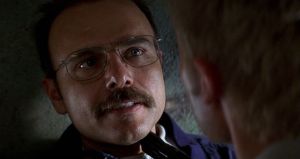 Revisiting Memento, there’s a definite nostalgia quality, watching two stars from The Matrix and the young upstart from L.A. Confidential bouncing around a Polaroid-snapping L.A. noir mystery from the man who would come to redefine blockbuster cinema. It’s not an understatement to say Nolan is in a class of his own, and his critical and commercial success seems to have convinced him that every movie needs his narrative sleight-of-hand. Some of those films didn’t really benefit from the extra complications. I thought the three timelines compressed on top of one another in 2017’s Dunkirk was entirely unnecessary and distracting. It got even worse in 2020’s deliberately palindromic Tenet, which was a puzzle box from Nolan I felt no desire to solve. Nolan has told movies with just about every construction of linear and non-linear plotting imaginable, and it’s hard not to feel like he’s struggling to find some new fix to hold his interest. Maybe the appeal of the Nolan signature magic trick is wearing off for me; I’ve been relatively disappointed with every Nolan movie since 2012’s Dark Knight Rises, which gets a bad rap for not being the zeitgeist-tapping flick that was The Dark Knight. Maybe he’s getting bored. It certainly felt like Tenet was more an intellectual exercise than an accessible entertainment for the masses. It would explain his experiments with indecipherable sound design. You don’t go to a Nolan movie to turn your brain off. There is an explicit demand that you will need to pay close attention. It just feels like the later films haven’t quite been worthy of the extra efforts.
Back in 2001, I recall being blown away by the narrative trickery of Memento. It was my top movie of that year, tying with Moulin Rouge! before I decided my heart was more aligned with Baz Luhrmann’s glitzy extravaganza (I’m looking forward to revisiting this one in two months). I didn’t have much in the way of critical analysis in 2001 beyond my exaltation of its greatness, declaring it a new classic that people would talk about for years. That’s partially true, but mainly because of the huge career that Nolan has undertaken since. My original review was also certain it would win that Best Original Screenplay Oscar and, honestly, this one still befuddles me (Gosford Park?). Twenty years later, Memento is still a daring and confusing movie, one that rewards close reading and invites deliberation and deconstruction. It’s a top-grade magic trick from an excellent illusionist and sometimes even that is enough. While I would argue it is more than its famous gimmick, it’s still enough to warrant two viewings for everyone’s lifetime.
Re-Review Grade: A


 nathanzoebl
You must be logged in to post a comment.