Blog Archives
The Holdovers (2023)

Oscar-winning director Alexander Payne and Paul Giamatti re-team for a poignant and crowd-pleasing holiday movie about outcasts sharing their vulnerabilities with one another over the last week of 1970. Giamatti stars as Paul Hunham, a rigid history teacher at an all-boys academy who just happens to be liked by nobody including his colleagues. He gets the unfortunate duty of staying on campus during the Christmas break and watching over any students who cannot return home for the holidays. Angus (Dominic Sessa) is the last student remaining, a 15-year-old with a history of lying, defiance, and on the verge of expulsion. The other holdover member is Mary (Da’Vine Joy Randolph) as the kitchen staff forced to feed them, a woman whose own adult son recently died in Vietnam. The teacher and student butt heads as they try and co-exist without other supervision, eventually connecting once they lower their defenses and attempt to see one another as flawed human beings with real hurts and disappointments. It’s a simple movie about three different characters from very different experiences pushing against one another and finding common ground. It’s a relationship movie that has plenty of wry humor and strong character beats from debut screenwriter David Hemingson. There may not be a larger theme or thesis that emerges, but being a buddy dramedy about hurt people building their friendships is still a winning formula with excellent writing, directing, and acting working in tandem, which is what we have with The Holdovers. It’s a slice of-life movie that makes you want bigger slices, especially for Mary’s character who thought having her son attend the same prep school would set him up for a promising future (he was denied college admission and thus deferral from the draft). It’s a beguiling movie because it’s about sad and lonely people over the holidays, each experiencing their own level of grief, and the overall feel is warm and fuzzy, like a feel-good movie about people feeling bad. That’s the Alexander Payne effect, finding an ironic edge to nostalgia while exploring hard-won truths with down-on-their-luck characters. The Holdovers is an enjoyable holiday comedy with shades of bitterness to go along with the feel-good uplift. It’s Payne’s Christmas movie and that is is own gift to moviegoers.
Nate’s Grade: B+
Share this:

Master and Commander: The Far Side of the World (2003) [Review Re-View]

Originally released November 14, 2003:
Without sounding easily amused, this movie really is glorious filmmaking. With Peter Weir’’s steady and skilled direction we get to really know the life of the early 19th century. We also get to know an armada of characters and genuinely feel for them. Russell Crowe is outstanding as Captain Jack Aubrey. His physicality and emotions are expertly showcased. When he gives a motivational speech you’’d understand why people would follow him to the ends of the Earth. Paul Bettany (again buddying up to Crowe after ‘A Beautiful Mind’) is Oscar-worthy for his performance as the ship’s’ doctor and confidant to the Captain. He’’s not afraid to question the Captain’’s motives, like following a dangerous French ship all around South America. ‘Master and Commander ’hums with life, and the battle sequences are heart-stopping and beautifully filmed. It took three studios to produce and release this and every dollar spent can be seen on the screen. ‘Master and Commander’ is fantastic, compelling entertainment with thrills, humanity, and wonder. It’’s grand old school Hollywood filmmaking.
Nate’s Grade: A
——————————————————
WRITER REFLECTIONS 20 YEARS LATER

They really don’t make movies like Master and Commander anymore and that is a detriment to every facet of our society. It took three different studios to bankroll this expensive movie, made all the more expensive by being almost entirely set at sea, a very costly and volatile location. In a just world, this would have been the beginning of a cinematic universe to rival Marvel, and the dashing Captain Jack Aubrey (Russell Crowe) would be as beloved as Captain Jack Sparrow, and children would beg their parents to read the dozen naval adventure novels by Patrick O’Brian. Just imagine lines of children for Halloween eagerly dressed in little admiral outfits with long blonde ponytails. Unfortunately, we do not live in this utopian universe, and 2003’s Master and Commander was the one and only movie we ever got. It received ten Academy Award nominations including Best Picture and Best Director for Peter Weir, winning two Oscars for Cinematography and Sound Editing, two of the only categories where runaway champion Return of the King wasn’t nominated. This is a masterpiece and a prime example of Hollywood filmmaking at its best. It’s just as easy to be transported in 2023 as it was back in 2003.
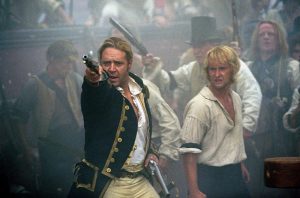
This movie is still effortlessly engaging and enthralling, dropping you onto the HMS Surprise during the Napoleonic wars. Even the opening text starts to get your blood pumping: “Oceans have become battlefields.” The opening act is a tremendous introduction to life onboard an early nineteenth-century ship, giving us a sense of the many crewmen and their responsibilities, as well as the different pieces working in tandem while under attack from a French vessel. The movie is structured as an elongated cat-and-mouse chase between the two ships, with the English trying to outsmart the faster French ship with its heavy cannons that easily outnumber the Surprise. Each stage presents a new challenge. One sequence involves them setting up a ruse with a smaller ship attached with a lantern to trick the French vessel into following the decoy at night. The constant threat of this sleeker ship getting the drop on them and attacking is always present, turning the opposition into a mythic monster breaking forth through the fog. The tests of command and camaraderie lead to important questions over duty and sacrifice. There are several children manning the decks as well, cadets eager to be the next generation of English warriors. It’s a shocking reality to process through our modern perspective, and it’s made even harder when tragedy befalls these youngest sailors just like any of the other crew. The movie is steeped in authentic details and realism that makes you feel like you’ve dropped into living history.
In 2023, Gabriella Paiella wrote a GQ article titled “Why Are Guys So Obsessed with Master and Commander?” noting its enduring popularity with a certain selection of Millennial men (yours truly included). She theorized part of its ongoing appeal is how wholesome the movie comes across, with depictions of positive and healthy male friendships. Even the dedication to service is depicted in a way forgoing jingoism. This is a deeply empathetic movie about men who deeply love one another. The most toxic depiction on screen isn’t one born of masculinity run amok during wartime but more a division in class amplified by superstition. Pity poor midshipman Hollum (Lee Inglebee), a man who cannot make friends with the crew because they disdain his privilege and will never see him as a better or an equal. He becomes a scapegoat for the bad luck of the ship, as they feel he is a “Jonah,” a curse. Poor Hollum, who sees no way out of this dilemma and literally plunges overboard with cannonball in hand, ridding the crew of their reputed curse (the wind picks up the sails the next morning). Beyond this valuable and sad storyline, the men of the Surprise seem so grateful for one another’s company. It’s a guy movie that invites men to escape to the frontier as an inclusive summer camp (no girls allowed!).

By the end of this movie, as we’re utilizing every nautical trick we’ve learned and preparing to seize the elusive French boat, my body was shaking in anticipation. We’ve gone on this journey and gotten to know a dozen faces, and we feel part of the team to the point that we’re onboard too. Seeing any of these men close their eyes permanently is awful. It’s not just keen military strategy and theory being discussed; we feel the real human cost. A small moment at the end, where a young man asks for help to sew the death shroud of his mentor, just hits you in the guts. Even watching poor Hollum processing his final fateful decision is heartbreaking. I still gasp even today watching Doctor Maturin (Paul Bettany) accidentally shot and then have to perform his own surgery. You feel the highs and lows throughout this voyage because the movie has made you care. The sheer adventure of it all is terrific, but it’s the immersive details and the strong character writing for everyone that makes this movie so special. It’s not just a rousing high-seas tale of bravery but also a stirring and empathetic character piece and absorbing drama.
It’s astounding to me that Weir isn’t still one of the hottest working directors. The Australian has earned four Best Director nominations across three decades (1985’s Witness, 1989’s Dead Poets Society, 1998’s Truman Show) and proven he can handle any genre with any style. He’s only directed a single movie since Master and Commander, 2010’s Siberian prisoner of war movie, The Way Back. In twenty years, we’ve only been given one other Peter Weir movie, and that is a travesty. In a recent interview, Weir confirmed he’s essentially retired from directing. If only time had been kinder to this great director. For comparison’s sake, other famous artists that also have four Directing nominations include Clint Eastwood, Stanley Kubrick, and Francis Ford Coppola.
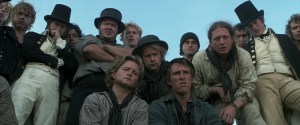
I assumed Master and Commander would still be good to re-watch in 2023, but I was amazed at how quickly I fell back under the movie’s sway so completely absorbed. It’s the kind of movie where everything just feels so natural, so authentic, and so compelling, where the hard work can be too easily undervalued because it all just feels like a documentary. This movie is so captivating and enthralling and every adjective you can devise. It earns them all. Why oh why did we never get a second of these? There were over a dozen novels as source material at the time of the first movie. According to that same 2023 GQ article, the studio head at Fox, Tom Rothman, explained that he was a lifelong fan of the O’Brian novels, having fallen in love with them as a boy. It took the studio chief using his position to get this kind of movie made in 2003, that’s the level of corporate power necessary to circumvent all the naysayers trying to kill this. I guess rather than mourn the lack of sequels I should count my blessings that we have even one. You were too good for this world, Master and Commander: The Far Side of the World.
Re-View Grade: A
Share this:

Lost in Translation (2003) [Review Re-View]
 Originally released October 3, 2023:
Sofia Coppola probably has had one of the most infamous beginnings in showbiz. Her father, Francis Ford, is one of the most famous directors of our times. He was getting ready to film Godfather Part III when Winona Ryder dropped out weeks before filming. Sophia Coppola, just at the age of 18, stepped into the role of Michael Corleone’s daughter. The level of scathing reviews Coppolas acting received is something perhaps only Tom Green and Britney Spears can relate to. Coppola never really acted again. Instead she married Spike Jonze (Being John Malkovich) and adapted and directed the acclaimed indie flick, The Virgin Suicides. So now Coppola is back again with Lost in Translation, and if this is the kind of rewards reaped by bad reviews early in your career, then I’m circling the 2008 Oscar date for Britney.
Bob Harris (Bill Murray) is a washed up actor visiting Tokyo to film some well-paying whiskey commercials. Bob’s long marriage is fading and he feels the pains of loneliness dig its claws into his soul. Bob finds a kindred spirit in Charlotte (Scarlet Johansson), a young newlywed who has followed her photographer husband (Giovanni Ribisi) to Japan and is second-guessing herself and her marriage. The two strike up a friendship of resistance as strangers in a strange land. They run around the big city and share enough adventures to leave an indelible impression on each other’s life.
 Lost in Translation is, simply put, a marvelously beautiful film. The emphasis for Coppola is less on a rigidly structured story and more on a consistently lovely mood of melancholy. There are many scenes of potent visual power, nuance of absence, that the viewer is left aching like the moments after a long, cleansing cry. There are certain images (like Johansson or Murray staring out at the impersonal glittering Tokyo) and certain scenes (like the final, tearful hug between the leads) that I will never forget. Its one thing when a film opens on the quiet image of a woman’s derriere in pink panties and just holds onto it. It’s quite another thing to do it and not draw laughs from an audience.
Murray is outstanding and heartbreaking. Had he not finally gotten the recognition he deserved with last year’s Oscar nomination I would have raged for a recounting of hanging chads. Murray has long been one of our most gifted funnymen, but later in his career he has been turning in soulful and stirring performances playing lonely men. When Murray sings Roxy Music’s “More Than This” to Johansson during a wild night out at a karaoke bar, the words penetrate you and symbolize the leads’ evolving relationship.
Johansson (Ghost World) herself is proving to be an acting revelation. It is the understatement of her words, the presence of a mature intelligence, and the totality of her wistful staring that nail the emotion of Charlotte. Never does the character falter into a Lolita-esque vibe. Shes a lonely soul and finds a beautiful match in Murray.
 Lost in Translation is an epic exploration of connection, and the quintessential film that perfectly frames those inescapable moments of life where we come into contact with people who shape our lives by their short stays. This is a reserved love story where the most tender of actions are moments like Murray carrying a sleeping Johansson to her room, tucking her in, then locking the door behind. The comedy of disconnect is delightful, like when Murray receives incomprehensible direction at a photo shoot. The score by Jean-Benoît Dunckel, front man of the French duo Air, is ambient and wraps around you like a warm blanket. The cinematography is also an amazing experience to behold, especially the many shots of the vast glittering life of Tokyo and, equally, its emptiness.
Everything works so well in Lost in Translation, from the bravura acting, to the stirring story, to the confident direction, that the viewer will be caught up in its lovely swirl. The film ends up becoming a humanistic love letter to what brings us together and what shapes how we are as people. Coppola’s film is bursting with such sharply insightful, quietly touching moments, that the viewer is overwhelmed at seeing such a remarkably mature and honest movie. The enjoyment of Lost in Translation lies in the understanding the audience can feel with the characters and their plight for connection and human warmth.
Writer/director Sofia Coppola’s come a long way from being Winona Ryder’s last-second replacement, and if Lost in Translation, arguably the best film of 2003, is any indication, hopefully well see even more brilliance yet to come. This is not going to be a film for everyone. A common argument from detractors is that Lost in Translation is a film lost without a plot. I’ve had just as many friends call this movie “boring and pointless” as I’ve had friends call it “brilliant and touching.” The right audience to enjoy Lost in Translation would be people who have some patience and are willing to immerse themselves in the nuances of character and silence.
Nate’s Grade: A
——————————————————
WRITER REFLECTIONS 20 YEARS LATER

I have never done this before in the four years of my re-reviewing movies, but I really just want to quote my introduction into Lost in Translation because I feel like this perfectly sets the scene, as well as giving my 21-year-old self some kudos: “Sofia Coppola probably has had one of the most infamous beginnings in showbiz. Her father, Francis Ford, is one of the most famous directors of our times. He was getting ready to film Godfather Part III when Winona Ryder dropped out weeks before filming. Sophia Coppola, just at the age of 18, stepped into the role of Michael Corleone’s daughter. The level of scathing reviews Coppola’s acting received is something perhaps only Tom Green and Britney Spears can relate to. Coppola never really acted again… So now Coppola is back again with Lost in Translation, and if this is the kind of rewards reaped by bad reviews early in your career, then I’m circling the 2008 Oscar date for Britney.” Besides the unnecessary broadside against Ms. Spears, who I’ve already apologized for with my re-review of 2002’s Crossroads, I think all this holds true. Within three films, Sofia Coppola went from an unfortunate punchline (not her fault!) to Oscar winner and indie darling.
Lost in Translation was my favorite American movie of 2003, so I’m always curious how my then-favorites stack up twenty years later. I’ve softened on American Beauty and Requiem for a Dream, and still consider The Iron Giant, Magnolia, and Moulin Rouge to be excellent. My feelings toward Lost in Translation, upon re-watch, remain mostly the same, though after two decades of watching other slow-burn, character-centric indies and widening my viewing, its highs aren’t quite the rhapsodic high for me in 2023 but it’s still an effective melancholy mood piece.
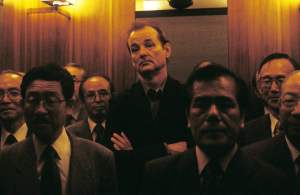 Lost in Translation taps directly into a universal feeling of yearning for connections in a time where it’s becoming easier and easier to disconnect into our own little bubbles. You don’t have to be stuck in a foreign country to feel isolated or out of sorts, and Coppola uses the external circumstances as a means of reinforcing the emotional isolation and then re-connection of her characters. This is why I brush aside some of the harsher criticisms levied against Coppola’s portrayal of Japanese culture and the locals. This is an outsider portrayal, and I don’t think there’s so much a critical judgment over Japanese culture as being inferior as just being different from what these characters are used to. They are clearly out of their element; it’s not that the culture is weird, it’s that the culture is different (that doesn’t mean there aren’t some overstayed stereotypes here as well). Trying to simply communicate with people that all speak another language is a quick and accessible dynamic to better visualize and articulate disconnect. I feel like this story could have been told from any racial or ethical perspective; it’s about two outsiders finding one another. The racial dynamics are less important. Obviously Coppola’s own personal experiences and outsider perspective in Japan are what provides the specific details with this tale, but I think what makes the movie still so effective in 2023 is because it’s so relatable on a deeper level that it eclipses any specific personal details. It’s about feeling lost and then feeling seen.
The key scene for me happens about seventy minutes into the movie, after Bob (Bill Murray) and Charlotte (Scarlett Johansson) have had an adventure with the Japanese hospital system. They’ve become one another’s insomnia buddies, teaming up to explore the city’s nightlife. As they lay side by side in bed during the wee hours, they have an intimate and poignant conversation, and it has nothing to do with sex. “I’m stuck,” she says. “Does it get any easier?” It’s about a young woman asking a middle-aged man for guidance and wisdom and him offering what he can with the caveat that he too is still struggling for his own wisdom. It’s the illusion that at some magic predetermined number of trips around the sun, the mystery of life will somehow become perfectly realized, as if now we can see the grand architectural design. There is no magic number. Everyone is trying their best and making it up as they go, and that’s what this conversation represents. She’s begging for reassurances that adult life will get easier, that she’ll find her footing, and Bob encourages her to continue pursuing her hobbies and passions even if she can’t stand her own art (which sounds like every artist I’ve ever known). Much of his actionable advice comes down to being patient including with yourself. Everybody is in their own way trying their best with what they have. He assures her that the more she gets comfortable with who she is the less things can bother her. It’s a beautiful scene and the reason it works even better is that Coppola doesn’t treat this moment with the gravity it has. It’s not even the film’s climax. Much like real life, when we look back at the exchanges that prove the most formative, we don’t have alarms ringing to better inform us that this is a moment that will have maximum import. We don’t know until it’s over.
 I have never viewed Lost in Translation as some kind of will-they-won’t-they May-December romance, and at no point was I secretly hoping that Bob and Charlotte would get together. This is because they do get together but it’s not a purely romantic connection, although once you start really analyzing romance itself, there are far more complicated and nuanced dimensions to this overly simplified concept, and one could argue this is a romance of sorts but not one about physical passion and infatuation that dominate our association. It’s about two human souls drifting along in life who find a kinship with one another when they need it the most. I never wondered at the end whether they would kiss or have some kind of affair or even run off together, because that wasn’t what was so essential to this dynamic. It wasn’t how far they would go for love, including what would they give up or who would they hurt, it was about each of them serving as a life preserver, something to hold onto during a turbulent time. I truly believe that if they had kissed and had some kind of tawdry love affair that the film would have been cheapened. When Bob carries Charlotte back into her hotel room bed, I never viewed this act as two lovers but of a father and daughter. It’s too easy to just reduce every relationship into a sexual pairing. We all have meaningful relationships with many people who occupy different spheres of our life and our experiences, and our lives could be irreversibly altered without their influence no matter how fleeting our time together may have been. To reduce everything into whether they spark something sexual or passionate is just plain boring.
This was a turning point in the careers of all three of its major figures. For Coppola, it was confirmation of her artistic voice and stepping from the long shadow of her father. She won an Oscar for Best Original Screenplay and was nominated for Best Director, only the third woman ever at that time. That’s a big deal. This was a statement film for her and she’s been making very leisurely paced, lushly photographed, somber character pieces since, very Sofia Coppola Movies (her latest promises to highlight the perspective of Priscilla Pressly). She never quite had another movie land as well as this one though 2006’s Marie Antoinette is due for a reappraisal as well. For Murray, it was confirmation that he had real dramatic acting skills that he’d shown flashes of in other movies like The Razor’s Edge and Rushmore, and it earned him his only Academy Award nomination. For Johansson, it was also the beginning of establishing her as an adult actress of serious caliber, and there was a critical stir that she had been snubbed by the Academy in 2004 not just for her role in Lost in Translation but also Girl with Pearl Earring. Johansson had been a steadily working actress since she was a child, and this was confirmation that she was ready to make the next jump. From there, she found a creative kinship with Woody Allen, and Wes Anderson, and even became an action movie star that could headline her own blockbusters. She finally got her first Oscar nominations in 2019, for both Marriage Story and Jojo Rabbit, becoming only the twelfth actor ever to be nominated twice in the same year. Murray’s star has fallen out of favor recently from his onerous onset behavior, though he did reunite with Coppola for 2020’s On the Rocks.
 One of the stranger post-scripts for this movie relates to Johansson’s singing. The karaoke scene in Lost in Translation is one of the best, and it works on a magical elemental level where the music becomes our means of expression. When Murray sings “More Than This,” it’s hard not to read more into the moment. It’s right there in the song choice. Both actors do their own singing, adding to the fun and authenticity. Johansson would later release her own album in 2008 titled Anywhere I Lay My Head. It wasn’t uncommon for young actresses to moonlight as singers for a vanity project (Paris Hilton and Lindsay Lohan did this too), but what set this album apart was that it was almost entirely comprised of Tom Waits covers. According to Yahoo, as of August 2009, it had sold only 25,000 copies, which to be fair is twenty-five thousand more than I’ve ever sold, so what do I know? She released one more music album, 2009’s Break Up.
Looking back at my original 2003 review, it’s easy to see how smitten I was discovering Lost in Translation and trying to argue its virtues in my college newspaper. I think I assumed most of my fellow collegians would rather watch raunchy comedies like Van Wilder rather than a slow-burn indie about sad people roaming a foreign city. To this day I still have an equal number of friends who deem Lost in Translation as slow navel-gazing fluff to beautiful and beguiling. As I said before, it’s a mood piece about disconnected people, and I think if you’re in the right mood, or an open mind with the patience to spare, then there’s still something appealing and rewarding about an understated movie about two lonely people finding an unexpected kinship that defies reductive romantic classification. I just experienced something on this level with 2023’s Past Lives. I’m glad that Coppola has kept the final whisper between Bob and Charlotte a secret because it doesn’t matter what he specifically says so much as the meaning of this exchange for the both of them. It’s a goodbye of sorts but also a recognition of one another’s help and compassion. It’s not for us to hear. It’s too intimate. It’s a perfect ending for a film that still proves indelible twenty years later.
Re-View Grade: A-
Share this:

Avatar: The Way of Water (2022)
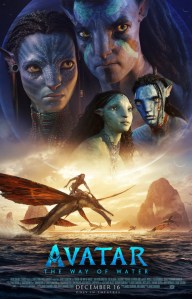 In the 13 ensuing years since James Cameron’s smash hit Avatar, we’ve debated whether or not the collective consciousness has simply moved on and forgotten what was, at one point, the highest-grossing movie of all time. What cultural dent had it made? Are there really still fans? Was it a fad of the new 3-D, itself already dissipated? Does anyone really want three or four sequels? Then Avatar: The Way of Water was released in late 2022 and it didn’t do as well as its mighty predecessor. Instead of being the highest-grossing movie ever, it’s only the third highest-grossing movie ever with a paltry $2.3 billion worldwide (how can the man even sleep at night?). It’s a lot of the same, both in its big feelings, awe-inducing visuals, and its resurrection of characters, scenarios, and conflicts of before, so you’ll likely find yourself reliving your own 2009 Avatar reaction.
Cameron’s long-awaited follow-up returns to the alien word of Pandora where our Marine-turned-Na’vi Jake Sully (Sam Worthington) has raised a large blended family with his Na’vi partner, Neytiri (Zoe Saldana, given little to do but cry this time). The first hour of this three-hour blockbuster is establishing the family dynamic with the different kids, including adopted daughter who is… somehow… the daughter of the deceased scientist Grace (both Sigourney Weaver) as well as the human child nicknamed Spider who is the biological son of Quaritch (Stephen Lang), our deceased villain. Nobody seems to stay dead in this series as Quaritch concocted his own backup plan in case of his untimely demise. He transferred his consciousness into a tank-born avatar, and this new Na’vi Quaritch has his own team of Marines in blue-skinned Na’vi bodies. They’re heading back to Pandora for some out-of-body vengeance, and thanks to their genetics, they seem to get a pass from the natural environment of Pandora mistaking them as native.
 There’s a lot of set up here, and the second hour introduces us to the coastal community, and it becomes another formula of the outsiders learning the rules and culture of the new setting and integrating, turning enemies into friends, gaining honor, etc. It’s within this second hour that the big environmental message coalesces around whaling, with one Sully son bonding with an alien whale Free Willy-style. There’s a whole hunt sequence that poaches a mother and her calf that’s quite upsetting. The parallels are obvious but subtlety is not exactly one of the storytelling options in the Avatar universe. This is a broad canvas in the biggest sense, so every message will be spelled out very finely and underlined, with character voicing obvious themes and villains practically twirling space mustaches. And that’s okay. The final hour is an action-packed showdown bringing all the characters to account and forcing Jake to face off once again with his old commander.
The visual immersion is outstanding and the real reason to sit still during all three hours of Way of Water. The Oscar-winning visual effects are transcendent, and the extended sequences underwater really captivate and achieve the sense of natural awe Cameron aspires for. It is an exceedingly pretty movie to watch, and the level of high-definition detail is astounding. There’s a tangible realism here even when it’s entirely gangly CGI characters. At no point does it feel like an empty green screen stage or an over-exposed cartoon. The world of Pandora is still interesting and worth exploring, and the coastal aliens with their evolutionary differences makes me excited to explore other corners and communities of this alien world. The story works, and the payoffs work, and each of the Sully kids has a moment to shine, though I kept confusing the two older brothers (where did one of these kids learn to say “bro” every other word?). It’s a bit strange to see and hear Weaver in a preteen alien’s body, but that disconnect is part of the point, as the character feels like a foreigner searching for meaning. Considering the decade-plus delay, the huge scope, and setting up potentially three other movies, I’m impressed that Way of Water even works as well as it does as a sequel. I was able to re-acclimate pretty easily in that first hour.
 It’s not revolutionary storytelling but not every movie need be. It follows a familiar formula but puts in the work to make the action meaningful and connected to character and for the emotional beats to resonate. I thought the upside-down sinking military vessel had some striking, terrifying Poseidon Adventure-esque visuals, and the sequence was rooted in the family trying to save one another. With so many moving pieces and characters, the plot can be overburdened and redundant at times (the Sully kids get kidnapped so often they might as well save time and tie themselves up early) but even at three hours it doesn’t feel slow or wasteful. There is a sense of repetition in bringing back so many of the same faces, like literally rehashing the same villains. I wish more consideration was given to the new Quaritch and his own existential journey of the self. Just because you have the brain of this dead evil guy, do you have to follow in his doomed path? That could have been a really intriguing and profound character journey, the cloned Marines bred to be weapons who decide their own identities. That could have sufficed as the entire movie for me. The messages are heavy-handed but effective, though Pandora already had a natural resource that Earth wanted to exploit so I didn’t think we needed a second natural resource that essentially functions as immortality juice. At this point, will the third movie introduce ANOTHER magical resource that cures cancer? Likewise, I hope the next movie doesn’t find us yet another Quaritch (a twin brother!) looking for further score-settling. The ending sets up a larger confrontation with Earth’s corporate elite that will come about with the ensuing sequels, though I would have thought since Way of Water makes a big leap forward in time that Earth’s powerful forces would have already marshaled their unhappy response to being kicked out in the original movie.
Cameron has an innate blockbuster sensibility and storytelling structure; the man just knows how to tell rousing big screen adventures like few others. I didn’t see Way of Water in theaters but I won’t make the same mistake with the many Avatar sequels that will dominates the 2020s. It’s a bit hokey though deeply sincere, and Cameron proves yet again that he should not be doubted on big stages of his own creation. It might take the domestic gross of a small country to make these sci-fi epics of his, but the man delivers like few in the rarefied field of dependable blockbuster artists. There’s going to be an Avatar sequel every two years, so this universe won’t go extinct anytime soon, and I’ll be there waiting too.
Nate’s Grade: B
Share this:

The Whale (2022)
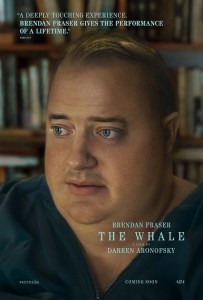 Much has been written about Brendan Fraser’s comeback role and the mountain of prosthetics he was buried under to portray a self-loathing 600-pound man in director Darren Aronofsky’s The Whale. The concern was that the movie would stigmatize overweight people as disgusting and treat fatness like a moral indictment, condemning their lifestyles as slovenly and doomed to misery. I watched the film ready to cringe at a moment’s notice with the hyped portrayal that earned such livid and divisive reactions. I found The Whale to be deeply empathetic but I’m uncertain about whether or not it was fully compassionate, and it’s that artistic distinction that I’m trying to square as I analyze Aronofsky’s melodramatic yet flawed character study.
Charlie (Fraser) is a morbidly obese English teacher who keeps his camera off during his online classes. The closest relationships he has is with his nurse, Liz (Hong Chau), who checks on him regularly with alarm and concern, as she’s also the sister of Charlie’s deceased partner. The movie chronicles one eventful week in Charlie’s life as he tries to make the most of his dwindling time and reconnect with his estranged teenage daughter, Ellie (Sadie Sink).
 For me, Charlie is less a clinical case of what being morbidly obese can do to a person and he’s more a case study of self-destruction. In 1995’s Leaving Las Vegas, Nicholas Cage won an Oscar playing a man determined to drink himself to death over the course of one eventful weekend in Vegas, and I saw more parallels with his character and Charlie, a man who turned to eating as his source of grief that then became his vehicle for self-destruction. The movie is not casting judgment that all fat people, even those approaching the size of Charlie, are destined for eternal loneliness or crying out for help. However, this specific man is using his increasing weight as a form of suicide. This facet makes Charlie interesting but also increasingly confounding as well. He seems genuinely remorseful about the time he’s missed from his now-teen daughter’s life. He’s saved up his life’s money and plans to give it to her, but I kept wondering why, exactly, he had to die for this? He won’t take care of himself because any medical cost could take away from the handsome sum he plans to leave, in full, to Ellie. He apologizes for being absent but seems unable to see an alternative where he can be present. After so many years apart, maybe she would actually prefer having her dad back in her life? Charlie stubbornly holds to an all-or-nothing ideal, like some kind of fumbling romantic gesture, but he doesn’t have to die for his daughter to live her best life. She doesn’t even get a say. It’s his inability to see through this false choice he’s determined is the best outcome that makes the character frustrating. He only views his death, and I’m sure the insurance to go with it, as his biggest reward that he can offer his estranged daughter, and that makes it even more frustrating at the very end, where he’s trying to prove something to her but is also likely traumatizing her for life. That love he proclaims so readily for his daughter seems questionable when he prefers a misguidedly noble demise to getting to know her and allowing her to choose for herself. The character seems so frustratingly myopic about his own life and its value only being its end.
Complicating this matter is the reality that Ellie is, quite clearly, a horrible person. She’s angry at the world and trained her ire on her absentee father, who she believes left her and her mom to pursue an illicit affair with one of his male students (the reality is a bit more complicated). She is well and truly awful. Ellie insults her father repeatedly. She yells that she wants him to die and that she would be better off. She agrees to spend time with him for a hefty price. She even takes pictures of him and posts them online for social media derision. She’s detestable, and yet the screenplay by Samuel D. Hunter (Baskets), adapted from his play, wants me to yearn for a hopeful father/daughter reconciliation. There isn’t a hidden pool of depth with this character, a brilliance that we know just needs to be nurtured and that Ellie can tap back into. She’s just the unrepentant worst. I think The Whale errs by placing so much of its dramatic foundation on this pairing. It made me question why this man is literally killing himself for this bratty teen. The late reveal for Charlie’s essay that he often quotes like a religious mantra is obvious and still doesn’t open up Ellie as a character. There’s a brief tear-stricken moment at the end that I guess is meant to represent Ellie with her guard down, but I didn’t buy it, and I found her to be a thinly written archetype that is unwinnable. She’s more of a plot device to motivate a redemption arc. Maybe the point is she’s undeserving of her father’s graceful overtures but I guess that’s parenting, folks.
 Charlie says he’s always been a bigger guy but his weight got away from him after the loss of his partner, and it’s this unfathomable grief that caused Charlie to go on feeding binges. He sought comfort in the immediate appeal of food, and plenty of people can relate to stress eating or eating their feelings when times are turbulent. I don’t think the movie is setting Charlie up as a cautionary tale to avoid. Charlie’s grief is tied to religious intolerance and its own trauma. He opened himself to another person and then had his new sliver of happiness dashed away directly related to a religious intolerant mindset that his partner was unable to break free from. He’s a victim who saw no way out including a heavenly reward supposedly denied to him. It’s not this dead man’s fault that he was raised in a diseased environment that viewed his own identity as an illness, and it’s not worth blaming this man for being unable to break free from this mentality. It’s the intolerance that has contributed to Charlie’s weight gain and his fatalistic sense of self. Heartbroken, Charlie has retreated from the world, and it’s the guise of spiritual salvation that proves alluring to the determined young missionary, Thomas (Ty Simpkins, Jurassic World). He sees the flesh as the prison for the soul, and he tries to sell Charlie on a salvation that asserts itself as liberation from his body, which the young man views with horror. Charlie doesn’t want the spiritual guidance, especially from the same community that poisoned the mind of his late partner. Like the Ellie character, I don’t think we gain much with this storyline and the amount of time that the screenplay gives Thomas. I guess we’re meant to see him as another wayward soul trying to live authentically, but he’s another underwritten archetype given misplaced emphasis.
The best reason to sit through The Whale are the performances from Fraser and Chau. We’ve never seen Fraser in a movie quite like this, a man best known for broad slapstick comedies (George of the Jungle, Furry Vengeance) or dashing action-adventure movies (The Mummy films), and he’s great. His performance is less mannered than you would assume for an actor undergoing such a physical transformation. In fact, his vocal range makes Charlie often sound anesthetized, like he’s already given up moving out of a comfortable yet limited range of emotional output. It’s kind of heartbreaking but he’s also got a gentle heart that chooses to see the best in people, even when they might not be there. Fraser is compelling in every moment and disappears into the role of Charlie. His best scene partner is Chau (The Menu), and the movie is at its best when they’re sharing the screen. Liz is the closest friend Charlie has, and they have a shared special kind of pain relating to the loss of Liz’s brother. She’s also enabling his self-destructive impulses and is devastated that Charlie is accepting a doomed fate rather than letting her take him to a costly hospital. Chau is heartbreaking as you feel her fear and guilt, afraid of losing another person so dear to her but also severing another connection to her brother.
 The Whale is an experience that makes me wonder about its best artistic intentions. Even the title of the movie feels like a glancing blow; what other analogy are you supposed to make other than Charlie as our very own Moby Dick? The critical essay he keeps reciting takes a sympathetic view of the marine animal and posits the fruitless efforts of those who wish to cruelly hunt it down and how this will not provide personal fulfillment (it shouldn’t be too hard to figure out who represents who in this dramatic dynamic). It’s also the least distinguishable Aronofsky film of his provocative career, confined to a single location and devoid of the director’s usual vision and verve. It feels like a challenge in restraint for Aronofsky, almost like he’s approaching theater and just wanting to get transfixed by the dramatic surges of the actor’s interactions. I found the central character to be interesting but confounding, not that human beings are ever so clearly understandable in every facet of their being. I don’t think the supporting characters really added much, with the exception of Hong Chau, and I wish the daughter plot had been scrapped. But if you’re sitting down to watch The Whale, you’re doing so to experience Fraser’s career-best performance where he reveals layers to his acting that you never knew were possible. He can still lean into his innate generous spirit and charm to get you to root for Charlie to find some peace. For Fraser alone, The Whale is worth watching and might open some hearts.
Nate’s Grade: B-
Share this:

All Quiet on the Western Front (2022)
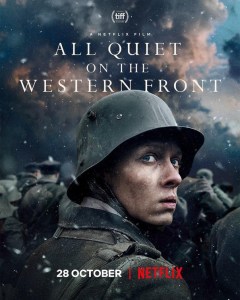 The surprise surge of the Oscar season is a German-language remake of the 1929 Best Picture winner, and after watching all 140 minutes, it’s easy to see how it would have made such an impact with modern Academy voters. All Quiet on the Western Front is still a relevant story even more than 100 years after its events. It’s a shattering anti-war movie that continuously and furiously reminds you what a terrible waste of life that four-year battle over meters of territory turned out to be, claiming over 17 million casualties. I’ve read the 1928 German novel by Erich Remarque and the new movie is faithful in spirit and still breathes new life into an old story. We follow idealistic young men eager to experience the glory of war and quickly learn that the horror of modern combat isn’t so glorious. There are sequences in this movie that are stunning, like following the history of a coat from being lifted off a dead soldier in the muck, to being reworked at a seamstress station, to being commissioned to a new recruit who questions why someone else’s name is in his jacket. It’s a simple yet evocative moment that sells the despairing reality. The movie doesn’t skimp on carnage as well, as long stretches will often play out like a horror movie where you’ll fear the monsters awaiting in the smoke and that nowhere is safe for long. And yet, where the movie hits the hardest isn’t depicting the trenchant terror but with the little pieces of humanity that shine through the darkness. There’s a small moment in a crater shared by two enemies where one of them is dying, and these final moments of recognizing the same beleaguered helpless and frightened humanity of “their enemy” are poignant. Make no mistake, All Quiet is a condemnation on the systems of war where old pompous generals send young men to needlessly die for outdated and absurd reasons like the concept of “maintaining national honor.” A significant new subplot involves Daniel Bruhl (Captain America: Civil War) as a representative of the German government trying to negotiate an armistice when the French representatives are looking for punishment. It allows us to take a larger view of the politics that doomed so many and laying the foundation for so many more doomed lives. The ending of this movie is a nihilist gut punch. The production values are impressive and elevate the artistry of every moment. The sound design is terrific, the cinematography is alternatingly beautiful and horrifying, and the production design is startlingly detailed and authentic; it’s easy to see how this movie could have earned nine Oscar nominations. All Quiet on the Western Front is a warning, a eulogy, and a powerful reminder that even older stories can still be relevant and resonant.
Nate’s Grade: B+
Share this:

Argentina 1985 (2022)
 How does one adjudicate a country’s own nightmare and find justice? That was the situation Argentina found itself in after returning to a democratic state following seven years under a military junta that kidnapped, tortured, interrogated, and killed thousands of its own citizens in the guise of “stopping radical communists.” Argentina 1985 gives you its setting in the title but it’s really about the chief prosecutor (Ricardo Darin) trying to hold the top generals accountable for their crimes against humanity. There is a lot riding on this case and plenty going against him, including near-constant death threats for he and his supportive family. There are some very harrowing personal accounts in the movie, but it’s set up almost like an underdog courtroom drama conceived by Aaron Sorkin, and much is made about putting together the young hotshot team and seizing the day. The movie is swiftly paced for being over two hours and has notable comic relief to keep things from getting too overwhelmingly gloomy given the subject matter. However, Argentina 1985 never loses its focus on making the powerful account for their sins. It’s a rousing courtroom drama with piercing details, engrossing human stories, and the temerity of history. In the light of rising authoritarian movements around the world and even in the U.S., this movie has even more urgent political relevancy about making sure the crimes of government officials are accounted for and that justice is served. It’s a testament to the heroism of everyday citizens and it makes for an invigorating drama that doesn’t lose sight of the big picture amidst the plethora of procedural details.
Nate’s Grade: B+
Share this:

The Hours (2002) [Review Re-View]
 Originally released December 25, 2002:
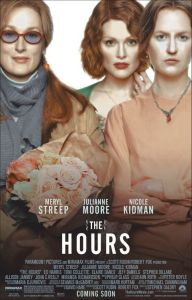
Okay, after watching the Golden Globes award show and seeing The Hours crowned with the highest prize, and hearing incessantly about Nicole Kidman’’s fake prosthetic nose in the movie, it was time to venture into that darkened theater and see how good the awards-friendly The Hours was. Little did I fully realize what I was getting myself into.
Nicole Kidman plays Virginia Woolf, who is in the midst of writing her novel Mrs. Dalloway, where she proposes to display a woman’s entire life through the events of a single day. Julianne Moore plays Laura Brown, a housewife in 1951 having difficulty adjusting to a domestic life that she feels ill equipped for. Meryl Streep plays Clarissa Vaughan, a gay copy-editor in 2001 planning a party for a poet and former lover (an emaciated Ed Harris), who is suffering from the late stages of AIDS. These three storylines will be juggled as the film progresses, with each woman’s life deeply changing before the end of the day.
The Hours is a meandering mess where the jigsaw pieces can be easily identified. The attempt at a resolution for an ending, tying the three storylines together, is handled very clumsily. The film spins on and on that you start to believe the title may be more appropriate than intended. What this movie needed was a rappin’ kangaroo, post haste! The film is wrought with victimization and screams “Give me an award already!” Before you know it you’’re being bludgeoned to death with what is profoundly the most over serious Lifetime network movie ever assembled. And there’s nothing fundamentally wrong with Lifetime movies but The Hours does not share the sensibilities of its TV brethren.
 Kidman, nose and all, gives a strong performance displaying the torture and frailty of a writer trapped within her own mind but too often relies on wistful staring or icy glares. Moore is effectively demoralized but cannot resonate with such a shallow character. Streep is the least effective of the three and fizzles among an over-stuffed assembly of characters.
The supporting cast is unjustly left for dead. The characters are seen as parody (Toni Collette as Moore’s un-liberated homemaker neighbor), extraneous (Claire Danes as Streep’s daughter, Allison Janney as Streep’s lover, Jeff Daniels as Harris’ ex-lover, you know what, almost anyone in the Streep storyline), one-note (the workmanlike John C. Reilly who plays yet another doting and demystified husband) or merely obnoxious (Moore’s brat child that refuses to separate from her). It appears The Hours is the three lead actress’ game and everyone else is not invited to play along.
Stephen Daldry’s direction shows surprising stability and instinct after his art-house pandering Billy Elliot showed little. The technical aspects of ‘lThe Hours are quite competent, especially the sharp editing and musical score, which just points out further how slickly hollow and manufactured the film is.
The Hours is an over-glossed, morose film that is too self-important for its own good. It sucks the life out of everything. And for all its doom and gloom and tsunami of tears, the only insightful thing The Hours is trying to pass off onto the public is that women are more depressed than you think.
Nate’s Grade: C
——————————————————
WRITER REFLECTIONS 20 YEARS LATER
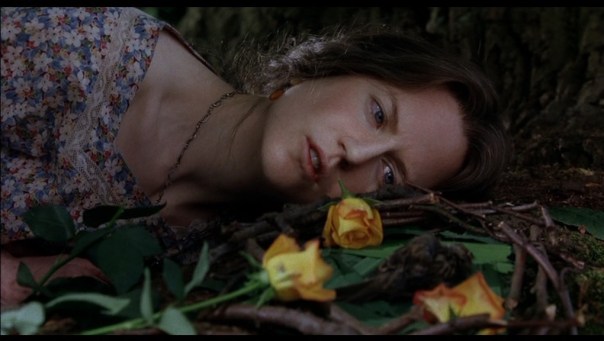
I thought 2002’s The Hours would be a good movie to come back to not necessarily because I thought it would be revelatory but because I thought it may have been emblematic of my more dismissive, glib attitude when I was a twenty-year-old smart alack getting published in his college newspaper and considering myself a hotshot wordsmith. I was worried that my initial review would come across as snide and condescending considering the subject matter. I dubbed it the “most over serious Lifetime network movie ever assembled” and yet, twenty years later, after having devoted two more hours watching The Hours, I must say that this comment still holds merit.
I was fully ready to disavow my younger self as being unkind to this movie, or being too quick to dismiss a movie about women’s suffering through three generations, especially as a young man trying to be clever and, by early 2000s standards, snarky and cynical. Well, even in 2022, I still dislike The Hours, and it’s because of how overwrought everything comes across in this movie. This movie is overstuffed with the trapping of importance, and the 1950s section featuring Julianne Moore as an unhappy housewife stifling her desires (not to be confused with her 1950s unhappy housewife also stifling her desires in 2002’s Far From Heaven) is played to the point that it could be self-parody. That’s not the kind of artistic approach you’d think you would want in something so transparently desirous of special award consideration. For me, it was unmistakable even early on, and the heightened melodramatic atmosphere made me, at several points, almost want to giggle at how obvious and cloying and annoyingly reaching each moment came across. There is no subtlety to be had with The Hours, and that’s fine, but there is also no real striking substance beyond a few transitory moments of grace that stand out. The Moore segment has her drifting through the day like a zombie and almost on the verge of tears at every single turn. I felt sorry for Moore, who is coasting on emotional instinct as the character she’s been given is, at best, meant to be a symbolic placeholder of millions of women of her era. Her interaction with her son makes her sound like a deranged android grasping for human behavior. The moment where they sift flour together and claim it’s beautiful was just so stupifying. It’s amazing to me that Moore was nominated for Best Supporting Actress for this role. She’s also the example of the kind of woman that Woolf was writing about with her titular Mrs. Dalloway heroine, but without Woolf explicitly commenting, the entire 1950s segment is one big airless melodrama, meant as a misdirect of the movie’s miserablist obsession with suicide. By the time old lady Julianne Moore shows up to unload a hasty monologue explaining decades of unknown drama, you may have decided that the three stories could have been two (or one).

Each of the three plot segments is intended to better inform the other, to coalesce into a thesis statement on the plight of women, except each storyline is so thinly written. Without the others to provide direct companionship, each one of these storylines would be pitifully minimal and fail to evolve the notions of feminine hardship. Virginia Woolf (Nicole Kidman) is sad because she feels stifled by the country and doctors who are trying to improve her mental health. Laura Brown (Moore) feels stifled because she is a cloested lesbian pretending to be a happy and doting housewife to her oblivious husband (John C. Reilly, not to be confused with his other oblivious husband in 2002’s Chicago). And Clarissa Vaughan (Meryl Streep) is sad because one of her closest friends (Ed Harris) is dying from AIDS. That’s it. Each of the three timelines is threaded together for the intention of greater relevance, but what it really does is put the onus on the viewer to find more relevancy in context. Sometimes the three women will be doing the same actions, sometimes one will make a comment that seems to be answered by another, and sometimes they’ll inadvertently quote one another or Woolf’s novel. Except the connections and layers are superficial and clinging to an obvious thesis and biding its overlong time for absent depth.
Much of the early publicity around The Hours circulated around Kidman’s fake nose, which producer Harvey Weinstein hated (he also hated the score by Phillip Glass that would later be nominated for an Academy Award) but Kidman absolutely loved. During the time of production, she was divorcing Tom Cruise and was a tabloid magnet but the prosthetic nose allowed her a degree of refreshing anonymity with the paparazzi. She kept the nose on for the entire movie. I’ve been more critical of Kidman’s since her early 2000s career summit (Moulin Rouge, The Others, The Hours), but she legitimately is good in this and has more spark and reserved melancholy than she’s shown in numerous latter roles. Whether she deserved the Best Actress Oscar over the likes of Diane Lane (Unfaithful), Salma Hayek (Frida), Renee Zellweger (Chicago), and Moore (Far From Heaven), is another question I think I already know the answer to, but it allowed every single critic and would-be Oscar historian to use the same hacky joke: “she won by a nose.”

This cast is stacked to the point that even small parts are played by great actors. On top of the big three you’ve got Harris and Reilly, Toni Collette, Claire Danes, Margo Martindale, Eileen Atkins, Allison Janney, Miranda Richardson, and Jeff Daniels. It’s an embarrassment of acting riches, which makes it all the more disappointing when they are kept strictly as archetypes and stereotypes.
Director Stephen Daldry is a complete mystery to me. His first three directing features earned him three Oscar nominations for Best Director (2000’s Billy Elliot, The Hours, 2008’s The Reader). I thought The Reader was horribly misguided but it led to Kate Winslet winning her first Oscar, and I thought his follow-up, 2011’s Extremely Loud and Incredibly Close, was also horribly misguided and was still nominated for Best Picture. I don’t understand the adulation.
In my original review, I concluded by saying, “The Hours is an over-glossed, morose film that is too self-important for its own good. It sucks the life out of everything. And for all its doom and gloom and tsunami of tears, the only insightful thing The Hours is trying to pass off onto the public is that women are more depressed than you think.” I thought re-evaluating the movie twenty years later would prove more insightful and perhaps prove my younger self wrong, but the me of the year 2022 was the one in the wrong. I agree that its central thesis is relevant, but having three underwritten stories of sorrow stacked atop each other and expecting poetry is asking a lot. I wish this movie was indeed better but it’s prime early 2000s overwrought Oscar bait.
Re-View Grade: C
Share this:

Gangs of New York (2002) [Review Re-View]
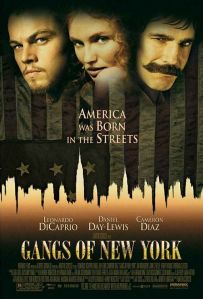 Originally released December 20, 2002:
Watching Martin Scorsese’s long-in-the-making Gangs of New York is like watching a 12-round bout between two weary and staggering prize fighters. You witness the onslaught of blows, see the momentum change several times, and in the end can’t really tell which fighter is victorious. This is the experience of watching Gangs of New York, and the two fighters are called “Ambitions” and “Flaws.”
The film begins in the Five Points district of 1840s New York among a vivid gang war over turf. Amsterdam (Leonardo DiCaprio) witnesses the slaying of his father, Priest Vallon (Liam Neeson), at the blade of William “Bill the Butcher” Cutting (Daniel Day-Lewis) and his “Native” Americans gang. So what does this son of a dead preacher-man do? Well he grows up, plots revenge by making a name under the wing of the Butcher becoming like a surrogate son. But will vengeance consume him?
 Watch Leo DiCaprio assemble toughs, rake heels, and ne’er do wells to his Irish gang of rapscallions with facial hair that looks to be tweezed! Witness a one-dimensional Leo suck the life out of the film like a black hole! See Leo become the least frightening gangster since Fredo. Watch the horribly miscast Cameron Diaz play pin-the-tail-on-an-accent! Witness as she tries to play a pickpocket with a heart of gold that falls hopelessly and illogically in love with Leo! Marvel how someone looking like Diaz would exist in a mangy slum! See the brilliant Daniel Day-Lewis upstage our stupid hero and steal every scene he inhabits! Witness one of the greatest villains in the last decade of movies! Watch Day-Lewis almost single-handedly compensate for the film’s flaws with his virtuoso performance! Admire his stove-top hat and handlebar mustache!
Witness a wonderful supporting cast including John C. Reilly, Jim Broadbent and Brendan Gleeson! Wish that they had more screen time to work with! Wonder to yourself why in all good graces this film took nearly two years of delays to get out! Speculate away!
Gangs has the sharp aroma of a film heavily interfered with by its producers. The whole exercise feels like Scorsese being compromised. Gangs is a meticulous recreation of 1860s New York that often evokes an epic sense of awe. The story has more resonance when it flashes to small yet tasty historical asides, like the dueling fire houses and the Draft Riots. But all of these interesting tidbits get pushed aside for our pedantic revenge storyline with Leo front and center. You know the producers wanted a more commercial storyline, which probably explains why Diaz has anything to do with this.
 The script is credited to longtime Scorsese collaborator Jay Cocks, Steven Zallian (Academy Award winner for Schindler’’s List) and Kenneth Lonergan (Academy award nominee for You Can Count on Me). So with all these writing credentials, don’t you think one of them would realize all of the dumb things going on with the story? The ending is also very anticlimactic and ham-fisted. Just watch as we segue from a graveyard to present day New York, all thanks to the Irish rockers of U2!
I know this much, Day-Lewis needs to stop cobbling shoes and act more often. Gangs is his first visit to the big screen since 1997’’s The Boxer. He spent part of this hiatus in Italy actually making shoes. I don’’t know about everyone else but this man has too much talent to only be acting once every five years. Somebody buy his shoes and get him a script, post haste!
Scorsese’s Gangs of New York is at times sprawling with entertainment in its historic vision and at other times is infuriating, always dragging behind it a ball and chain called “stupid revenge story/love story.” I’’m sure the film will get plenty of awards and Oscar nods in prominent categories, and this seems like the Academy’’s familiar plan: ignore a brilliant artist for the majority of their career and then finally reward them late for one of their lesser films. So here’’s hoping Scorsese wins the Oscar he deserved for Raging Bull and Goodfellas.
Nate’s Grade: C+
——————————————————
WRITER REFLECTIONS 20 YEARS LATER
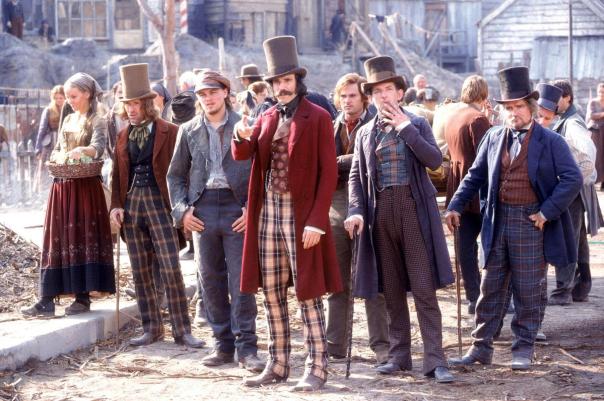
It is rare to find a movie that is almost exact in its percentage of good aspects and poor aspects. This 50/50 balance is best exemplified by 2002’s Gangs of New York. The ten-time Oscar nominated movie (and zero-time winner) was intended to be director Martin Scorsese’s epic, and twenty years later it’s still his biggest movie in size. Scorsese waited twenty years to tell this sprawling story of New York City’s early criminal underworld, so at 160 unwieldy minutes it’s no surprise how overstuffed and unfocused the finished product ended up. It’s a movie with so many engrossing historical anecdotes, amazing texture and supporting actors, and a stunning return to upper-tier acting by Daniel Day-Lewis, and yet it is hampered by Leonardo DiCaprio’s lackluster storylines, both for vengeance and for love (maybe a love of vengeance?). It’s so bizarre to watch this movie because there can be sequences where the movie just excels, and then there are sequences where I just want to sigh deeply. It’s like the movie is in conflict with itself, and you, the viewer, are ultimately the frustrated victim.
Let’s focus on the good first. Day-Lewis had essentially retired from acting and went to work in Italy as a cobbler until Scorsese appealed to him to reconsider acting. Every second this man is onscreen deserves your utmost attention. DiCaprio was the advertised star of the movie but Day-Lewis was the real star. The movie is almost a Trojan horse of sorts, luring you in with a standard revenge plot line only for you to lose all interest and root for the charismatic villain. Day-Lewis is so enthralling, so commanding as Bill the Butcher that every moment he is absent feels like an eternity. He remained in character for the duration of the shoot, spooking waitresses, and learned how to throw knives from circus performers and how to cut meat from an actual butcher. Considering the man’s famous Method-acting approach, I wonder just how many skills Day-Lewis has acquired over decades. This man could be the living embodiment of Michelle Yeoh’s character in Everything Everywhere All at Once, able to, at a moment’s notice, tap into a uniquely honed skill-set upon need. I wish that itself was a movie; Day-Lewis filming a role when terrorists invade the set, and now he has to utilize every lesson and skill of his past acting roles to defeat the baddies and save the day. He may be the most interesting man in the world. Since Gangs, Day-Lewis has only appeared in five other movies, and amazingly he has been nominated for Best Actor three times, winning twice (that averages an Oscar every 2.5 movie roles). This man has become like an acting Halley’s Comet, waiting for him to swing around again and burn brightly and then, just as suddenly, pass back into the lengthy waiting period.
I loved the historical asides in this movie. I loved the scene showing, in one unbroken take, Irish immigrants stepping off the boat into New York harbor and getting immediately signed into service, given a rifle and uniform, and lined up to board another boat to fight the Confederacy. I loved the entire character of Boss Tweed (Jim Broadbent) and how transparently corrupt he is, reminding me of Claude Rains in Casablanca. I loved him competing with the dozens of other firefighting units squabbling over turf while a house burned down to cinders. I loved him scrambling for some entertainment for the masses, and he asks Bill to gather up four nobodies that they can publicly hang, and then we cut right to these relatively innocent men saying their last words before being hanged, including one man’s young son watching. It’s an incredible sequence. The culmination of the 1863 Draft Riots is terrific and maximizes the messy nature of the movie best, communicating the many breaking points that lead to this notorious riot. The opening of this movie is wonderful and a terrific mood setter as we watch the members of the Dead Rabbits assemble for battle, with the rattling percussive score by Howard Shore (The Lord of the Rings), finally breaking outdoors and watching gangs advance like armies. I loved the narrated history of the different gangs settled in New York and their peculiarities and fixations. I loved the before and after stories of Happy Jack (John C. Reilly), who settled as a corrupt police officer, and Monk McGinn (Brendan Gleeson), a mercenary who tries to go straight through, of all things, politics. I loved that the movie reminds us that just because these people reside in the North doesn’t stop them from being racist (an archbishop is especially aghast at a black man being allowed in his church). I loved the occasional P.T. Barnum appearance. I loved the proliferation of so many tall hats amidst all the handlebar mustache-twirling villainy. I loved when the movie felt like a living documentary, soaking up the richness of the recreated history.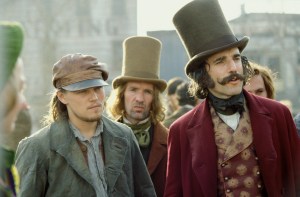
Where the movie sputters is with just about all that involves DiCaprio’s character, Amsterdam. The revenge storyline is just so boring compared to everything else going on, enough so that I think even the movie forgets about it. Amsterdam becomes Bill’s budding protege and literally saves his life at several points (if your goal is for him to die, why save the man?). He’s such a boring character because all he thinks about is vengeance, so every relationship he builds is only about how much closer to achieving his goal he can be. Amsterdam is a thoroughly dull character, and DiCaprio doesn’t come across as a credible tough guy yet, especially diminished in the large shadow from Day-Lewis’s Butcher. It wasn’t until 2006’s The Departed where I felt like he shed his boyishness fully to play a credible adult man. DiCaprio has been great with Scorsese, and this movie was the start of a decade of collaborations (four movies, two Oscar nominations), but he feels miscast here as a brooding hero given inordinate attention.
Worse is the romance with a pick-pocket prostitute played by Cameron Diaz. I pity Diaz. She’s been given the spunky love interest role in the Oscar-bait movie, which is generally underwritten and only viewed as aiding the hero’s journey of our male lead or being the offramp not taken (“Don’ get y’er refenge, Amsti’dam, ‘stead come wit me to San Fran in Calyfer’nia”). This is not a good character and she’s meant to give voice to the female underclass perspective, so it’s even more irksome when her headstrong, defiant nature gets sublimated as a rote romantic option. Diaz is also woefully miscast and my 2002 quip of her playing “pin-the-tail-on-the-accent” is accurate. I might argue that maybe dramas aren’t her strong suit, but she was great in Being John Malkovich and In Her Shoes and The Holiday, though all of those had notable comedy elements. She has the ability but this might just have been too unfamiliar for her, and so she struggles throughout with a character defined by her sexual connections to the villain and the hero.
While these characters and the performances are the biggest misses in Gangs of New York, there are other misguided or poor elements adding to that 50/50 margin. The opening sequence is great until the actual gang warfare begins and you realize that Scorsese, arguably the greatest living American director, cannot direct action to save his life. The action is choppy and lacking any of the kinetic qualities we associate with most Scorsese movies. Not even the talents of editor Thelma Schoonmaker can help save this deficit. The movie’s overall scattershot nature also makes it rather uneven and difficult to build momentum. The ending plays out like a footnote to the Draft Riots and robs the viewer of whatever catharsis could be granted from the long vengeance plot. If the whole movie has been leading up to Amsterdam’s vengeance, well robbing him of it could be meaningful, if the self-destructive nature of vengeance had been a theme. It’s not like Amsterdam has suffered at all, beyond the occasional stab wound or black eye, so him learning a lesson about the futility of vengeance would seem inappropriate and trite. I also want it known for posterity that there is an un-credited actor listed online as playing “Hot Corn Girl.”
”Twenty years later, Gangs of New York is still a frustrating and sometimes exhilarating viewing. It began a road for Scorsese that led to him finally winning his first, and still only, Oscar for directing The Departed. The sprawling nature of the movie is both a blessing and a hindrance. It allows for a wider scope and cast of characters but it also means that if you’re liking a subplot or a supporting character, you’ll have to wait your turn before they re-emerge. My old review back in 2002 perfectly sums up the majority of my feelings in 2022. There’s much to see and much to like with Gangs of New York but also too much to restrain its potential greatness.
Re-View Grade: C+
Share this:

Glass Onion (2022)
 When writer/director Rian Johnson wanted to take a breather after his polarizing Star Wars movie, he tried his hand at updating the dusty-old Agatha Christie mystery genre, and in doing so created a highly-acclaimed and high-grossing film franchise. The man was just trying to do something different and at a smaller-scale with 2019’s Knives Out, and then it hit big and Netflix agreed to pay $400 million dollars for exclusive rights to two sequels. Now as Johnson has reinvented his career as a mystery writer the big question is: can he pull it all off again?
Renowned detective Benoit Blanc (Daniel Craig) has been invited to the world’s most exclusive dinner party. Miles Bron (Edward Norton) has invited all his closest friends to his Greek island soiree, setting up a murder mystery game his friends must spend the weekend solving. Except there are two interlopers: Andi Brand (Janelle Monae), the former partner of Miles who was betrayed by Miles and his cronies and… Benoit Blanc himself. Why was the detective invited to the murder dinner party unless someone planned on using it as an excuse to actually kill Miles?
 Knives Out was a clever deconstruction of drawing room mysteries and did something remarkable, it told you who the murderer was early and changed the entire audience participation. Instead of intellectually trying to parse clues and narrow down the gallery of suspects, Johnson cast that aside and said it didn’t matter as much as your emotional investment for this character now trying to cover up her tracks while working alongside the “world’s greatest detective.” It made the movie so much more engaging and fun, and for his twisty efforts, Johnson was nominated for a Best Original Screenplay Oscar. Now, every viewer vested in this growing franchise is coming into Glass Onion with a level of expectations, looking for the twists, looking for the clever deconstruction, and this time It feels like Johnson is deconstructing the very concept of the genius iconoclast and including himself in the mix. The movie takes square aim at the wealthy and famous who subscribe to the idea of their deserved privilege, in particular quirky billionaires whose branding involves their innate genius (many have made quick connections to Elon Musk in particular). The movie’s first half is taken with whether or not Miles Bron’s murder mystery retreat will become a legitimate murder mystery, but by the midpoint realignment, Glass Onion switches into pinning down the bastard. It makes for a greatly satisfying conclusion as Blanc exposes the empty center of Miles’ calculated genius mystique.
 As Blanc repeatedly says, the answers are hiding in plain sight, and this also speaks to Johnson’s meta-commentary of his own clever screenwriting. This is Johnson speaking to the audience that he cannot simply copy the formula of Knives Out. This is a bigger movie with more broadly written characters, but each one of them feels more integrated in the central mystery and given flamboyant distinction; it’s more like Clue than Christie. Through Miles’ influence, we have a neurotic politician (Kathryn Hahn), a block-headed streamer (Dave Bautista) pandering to fragile men on the Internet, a fashionista (Kate Hudson) who built an empire on sweatpants and has a habit of insensitive remarks, and a business exec (Leslie Odom Jr.) who admits to sitting on his hands until given orders from on high by Miles. All of these so-called friends are really bottom-feeders propped up by Miles’ money. It would have been easy to simply replay his old tricks, but Johnson takes the heightened atmosphere of the characters and plays with wilder plot elements of the mystery genre, such as identical twins and secret missions and celebrity cameos (R.I.P. two of them) and corporate espionage. The very Mona Lisa itself plays significantly into the plot (fun fact: Ms. Mona was not the universally revered epitome of art we know it to be until its 1911 theft). This is a bigger, broader movie but the larger stage suits Johnson just fine. He adjusts to his new setting, veers into wackier comedy bits with aplomb, and has fun with all the false leads and many payoffs. You never know when something will just be a throwaway idea, like the hourly chime on the island, or have an unexpected development, like Jeremy Renner’s hot sauce. Glass Onion is about puncturing the mirage of cleverness, and by the end, it felt like Johnson was also playfully commenting on his own meta-clever storytelling needs as well.
It’s so nice to watch Craig have the time of his life. You can clearly feel the passion he has for the character and how freeing this role is for an actor best remembered for his grimaced mug drifting through the James Bond movies. Craig makes a feast of this outsized character, luxuriating in the Southern drawl, the loquaciousness, and his befuddled mannerisms. After Knives Out, I begged for more Benoit Blanc adventures, and now with a successful sequel, that urge has only become more rapacious. Johnson has proven he can port his detective into any new mystery. Netflix has already paid for a third Knives Out mystery movie, and I’d be happy for another Blanc mystery every so many years as long as Craig and Johnson are willing. These are fabulous ensemble showcases as well with eclectic casts cutting loose and having fun. Norton (Motherless Brooklyn) is hilariously pompous, especially as Blanc deflates his overgrown ego. Bautista (Dune) is the exact right kind of blowhard. Hudson (Music) is the right kind of ditzy princess with a persecution complex. Her joke about sweatshops is gold. Jessica Henwick (The Gray Man) has a small role as the beleaguered assistant to Hudson’s socialite, but she delivers a masterclass in making the most of reaction shots. She made me laugh out loud just from her pained or bewildered reactions, adding history to her boss’ routine foot-in-mouth PR blunders.
 There is one big thing missing from Glass Onion that holds it back from replicating the surprise success of its predecessor, and that’s the emotional lead supplied by Ana de Armas. She unexpectedly became the center of the 2019 movie and it was better for it. Glass Onion tries something similar with Andi Brand, and while she’s the easiest new character to root for among a den of phonies and sycophants, it’s not the same immediate level of emotional engagement. That’s the biggest missing piece for Glass Onion; it’s unable to replicate that same emotional engagement because the crusade of Andi Brand isn’t as compelling alone.
Glass Onion is a grand time at the movies, or as Netflix insisted, a grand time at home on your streaming device. It’s proof that Johnson can handle the rigors of living up to increased expectations, making a sequel that can stand on its own but has the strong, recognizable DNA of its potent predecessor. It’s not quite as immediate and layered and emotionally engaging, but the results are still colorful, twisty, and above all else, immensely fun and satisfying. I’m sure I’ll only think better of Glass Onion upon further re-watching as I did with Knives Out. Johnson once again artfully plays around with misdirects and whodunnit elements like a seasoned professional, and Glass Onion is confirmation that Benoit Blanc can be the greatest film detective of our modern age.
Nate’s Grade: A-


 nathanzoebl
You must be logged in to post a comment.