Blog Archives
Monster (2003)
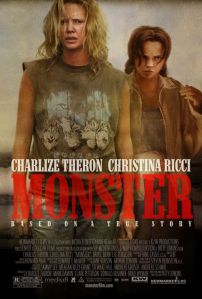 Monster follows the life of Aileen Wuornos (Charlize Theron, now nominated for a Best Actress Oscar), Americas only known female serial killer. In the late 1980s, Wueros was a roadside prostitute flexing her muscles with Florida motorists. She describes hookin’ as the only things shes ever been good at. One day Wuornos has the full intention of taking her own life, but she meets 18-year-old Selby (Christina Ricci) at a lesbian bar and finds a companion. Driven by a growing hatred of men from sexual abuse, Wuorno’s starts killing her johns to try and establish a comfortable life for her and Selby.
Let’s not mince words; Theron gives one of the best performances I have ever seen in my life. Yes, that’s right. One of. The. Best. Performances. Ever. This is no exaggeration. I’m not just throwing out niceties. Theron is completely unrecognizable under a mass of facial prosthetics, 30 extra pounds, fake teeth and a total lack of eyebrows. But this is more than a hollow ploy to attract serious attention to the acting of a pretty face. Theron does more than simple imitation; she fully inhabits the skin of Aileen Wuornos. The closest comparison I can think of is Val Kilmer playing Jim Morrison in The Doors.
Theron is commanding, brave, distressing, ferocious, terrifying, brutal, stirring, mesmerizing and always captivating. It may be a cliché, but you really cannot take your eyes off of her. Her performance is that amazing. To say that Theron in Monster is an acting revelation is perhaps the understatement of the year.
With previous acting roles in Reindeer Games and The Cider House Rules, Theron is usually delegated to pretty girlfriend roles (who occasionally shows her breasts). Who in the world thought she had this kind of acting capability? I certainly did not. If Nicole Kidman can win an Oscar for putting on a fake nose and a so-so performance, surely Theron should win an Oscar for her absolute transformation of character and giving the performance of a lifetime.
With this being said, and most likely over said, Monster is by no means a perfect film. Minus the terrific central performance, Monster is more of an everyday profile of a grotesque personality. The film weakly tries to portray Wuornos more as a victim, but by the end of the film, and six murdered men later, sympathy is eradicated as Wuornos transforms into the titular monster. Some supporting characters, like Ricci’s narrow-minded Christian up bringers, are flat characters bordering on parody. The supporting characters are generally underwritten, especially the male roles that serve as mere cameos in a film dominated by Sapphic love.
Monster is proof positive that human beings will never be phased out by advancing machinery when it comes to acting. Monster boasts one of the greatest acting achievements in recent cinematic history, but it also coasts on sharp cinematography and a moody and ambient score by BT (Go). Monster is a haunting film that you wont want to blink for fear of taking your eyes off of Theron. She gives an unforgettable tour de force performance that will become legendary.
Nate’s Grade: B
Share this:

Cold Mountain (2003)

Cold Mountain (2003)
Premise: At the end of the Civil War, Inman (Jude Law, scruffy) deserts the Confederate lines to journey back home to Ada (Nicole Kidman), the love of his life he’s spent a combined 10 minutes with.
Results: Terribly uneven, Cold Mountain‘s drama is shackled by a love story that doesn’t register the faintest of heartbeats. Kidman is wildly miscast, as she was in The Human Stain, and her beauty betrays her character. She also can’t really do a Southern accent to save her life (I’m starting to believe the only accent she can do is faux British). Law’s ever-changing beard is even more interesting than her prissy character. Renee Zellweger, as a no-nonsense Ma Clampett get-your-hands-dirty type, is a breath of fresh air in an overly stuffy film; however, her acting is quite transparent in an, “Aw sucks, give me one ‘dem Oscars, ya”ll'” way.
Nate’’s Grade: C
Share this:

The Last Samurai (2003)
 The Last Samurai (2003)
Premise: Alcoholic Civil War vet (Tom Cruise) is hired by the Japanese emperor to modernize his army. After being captured by samurai, he finds solace and fights alongside his former enemy against the emperors modernized army.
Results: A miscast Cruise is not turning Japanese, no matter if he really thinks so. The Last Samurai is a conservative by-the-book epic the limply transports the framework of Dances with Wolves and effectively creates Dances with Japanese People. Dont believe me? Lets go to the videotape. Civil War vet (check) haunted by massacre of Native Americans (check), finds peace with a foreign culture (check), falls in love with one of the foreign women (check), and must battle the invading former culture that threatens his new happiness (check). The film does have lovely cinematography and production design, if that means something to you.
Nate’s Grade: C+
Share this:

Lord of the Rings: Return of the King (2003)
 To all those hairy-footed Tolkien geeks that chewed me out for having the audacity to call 2002’s Two Towers, of all things, boring, let me say this: while I still find the second entry of The Lord of the Rings to be disappointing and pretty flawed, the final chapter, Return of the King, is a glorious and satisfying conclusion. Instead of doing a usual review (plot synopsis, strengths/weaknesses, etc.), I’m going to bring back the charges I had against Two Towers and explain why Return of the King does not suffer from these ills. Will the defendant please rise as I read aloud the charges.
Charge Number One: Two Towers has nothing going on for its majority except hyping an oncoming battle.
And I still feel this way. Short of the great Helms Deep battle, there was oh so little going on in Two Towers that they could have easily trimmed an hour away from it. And don’t give me this crap about the whole kingdom of man subplot or Aragorn (Viggo Mortensen) realizing his eventual responsibilities. Whatever. Now, in Return of the King, there is so much going on and the pacing is so tight, that despite being the longest film by far (3 hours and 20 minutes), this is the FIRST Lord of the Rings films that has not put me to sleep in the theaters. The nearly hour-long battle involving the 200,000 Orc army with its huge elephant creatures is mesmerizing and visually stunning. But even after the battle and before, unlike Two Towers, there is plenty going on that actually matters, not just three characters running around endlessly.
 Charge Number Two: Despite nothing going on except waiting for a battle, Two Towers has little characterization of any of its characters.
So even though little is going on, Two Towers still doesn’t use all this free space to deepen characters. But in Return of the King, the characters come through and shine. The hobbits are back to the front burner and the film is better for it. Sam (Sean Astin, in the finest performance of the film) and Frodos journey becomes increasingly important and the strain and deception of Gollum puts a wedge between their friendship. When Frodo (Elijah Wood) looks scornfully at Sam and dismisses him from their journey, it’s heartbreaking. Why? Because after two years we as an audience have come attached to these characters and do feel for their struggle. When Sam, toward the climax, says, “I may not be able to carry the ring, Mr. Frodo, but I can carry you!” I dare anyone to try not choking up. We also get deeper moments of character with peripheral characters, like Faramir realizing he can only satisfy his father by a suicidal mission. Even the smaller characters from the second film, like Eowyn (Miranda Otto) and her kingly father Theoden (Bernard Hill), have wonderful moments where the emphasis is on characterization. Return of the King is filled with rich character moments that remind us how much we enjoy and feel for these people … uh, and hobbits.
Charge Number Three: Most of the characters from Fellowship of the Ring have scant appearances in Two Towers.
This still holds true. Gandalf (Ian McKellen, brilliant) returned from the dead but had about three minutes of screen time. The elves (Liv Tyler, Hugo Weaving, Cate Blanchett) were given the amount of screen time most people would consider cameos. And then the hobbits were left alone for the overlong subplot involving Theoden and his clan. What Two Towers really was was the dwarf, elf, and Aragorn movie. And I like each of those characters but this story is not theirs its the hobbits. So the disproportionate amount of time spent with Gimli (John Rhys-Davies), Legolas (Orlando Bloom) and Aragorn felt like what would happen if, in Star Wars, C-3PO and R2D2 had their own film. It wasn’t as interesting and it wasn’t right. But with Return of the King, the attention is back to the hobbits, and all of the characters in the entire film have at least one stirring moment of quality time. Gandalf is back in a big way and its welcomed. What else is welcomed is the increasing attention Merry (Dominic Monaghan) and Pippin (Billy Boyd) have. They started as merrymakers, but by this trilogys end they are desperate to join the ranks and fight. The shared moments between Merry and Eowyn in battle are great. The moments between Pippin and Gandalf are even better. And even though the elves still get the short end of the stick, they make lengthier appearances that are more satisfying. It appears, though, that Cate Blanchett’s longest amount of time in this whole trilogy was narrating the opening prologue.
 Charge Number Four: Excessive dwarf jokes.
Even if you disagree with me on the previous three charges, you must agree with me that Two Towers had about a million dwarf jokes too many. Return of the King, to my knowledge, doesn’t even have ONE dwarf joke. Fabulous. This is not to say I want less Gimli. The subplot involving the Two Towers trio seeking an army of the dead (a tad deus ex machine) is intriguing, and his competitive banter with Legolas is still ripe (Bah! That still counts as one!).
Return of the King is an amazing experience and one that is a fully satisfying conclusion, unlike say, I don’t know, maybe the last two Matrix films. The danger feels more abundant now that the end is near and the tension mounts. The payoffs are rewarding and the climax is fittingly climactic. However, the 20-minute resolution is a bit drawn out. It seems director Peter Jackson can give us three hours of fast-paced action but cant speed through a medley of hugs. You think its over…. and then theres more, then you think its over…. then there’s more. This is a small quibble for such an epic trilogy, and Return of the King proves that it’s really one large triumphant film, with a bit of a sag in the middle. What? Did you think I’d get through all this Lord of the Rings love-fest and not take one last jab at Two Towers? Though I still prefer Fellowship of the Ring out of the three, Return of the King cements the trilogys cinematic greatness in our time. Oh yeah, and the cinematography, special effects, production design, makeup, and score are magnificent too.
The defendant is cleared of all charges.
Nate’s Grade: A
Share this:

21 Grams (2003)
 21 Grams (2003)
Premise: A mathematician (Sean Penn) in need of a heart transplant, a recovering addict (Naomi Watts) mourning the loss of her husband and children, and an ex-con (Benicio Del Toro) whos found redemption in Jesus, are all linked by a horrific car accident. The aftermath will bring them together out of grief, guilt, and revenge.
Results: The greatest asset 21 Grams has, bar none, is the trio of breathtaking performances. De Toro gives a powerful performance as a man consumed by grief and seeking answers in the unknown. Watts gives the definition of a raw performance. What isn’t cool is the structure, told out of order like the directors first film, the brilliant Amorres Perros, translated: Loves a Bitch. But the mixed-up structure of 21 Grams is needlessly complicated d frustrating, plus it pulls you out of the movie. Im sure theres a rationale reason for it, but the surprises and expectations it produces are minimal. The whole thing would have been better plunked in an old-fashioned linear structure. The sensational performances and intelligent story will stay with you long after the film ends.
Nate’s Grade: B+
Share this:

House of Sand and Fog (2003)
 House of Sand and Fog (2003)
Premise: Kathy (Jennifer Connelly) has lost her family home due to a bureaucratic error, and a former Iranian colonel (Ben Kingsley) and his family move in for a rock-bottom price. Neither is willing to budge, and their turf tussle soon becomes a tragedy.
Results: Perhaps the first real estate thriller, House of Sand and Fog is a smartly written, emotionally harrowing film with phenomenal acting. Kingsley is superb and deserves a Best Actor nomination. Shohreh Aghdashloo is heartbreaking as Kingsley’s wife, who doesn’t know a lot of English but loses sleep over the word ”deportation.” The drama is meant to convey that both sides have a convincing claim to the house, but who are audiences going to side with, an American screw-up who could have avoided the whole mess by mailing in a letter, or a hard-working family ere the son is willing to take a second paper route to help out? The final act is a bit overly bleak, and the cop boyfriend character is an easy go-to for plot turns. House of Sand and Fog is one of the more compelling films of the year. What more could you want in a prestige picture?
Nate’s Grade: B+
Share this:

Master and Commander: The Far Side of the World (2003)
 Without sounding easily amused, this movie really is glorious filmmaking. With Peter Weir’s steady and skilled direction we get to really know the life of the early 19th century. We also get to know an armada of characters and genuinely feel for them. Russell Crowe is outstanding as Captain Jack Aubrey. His physicality and emotions are expertly showcased. When he gives a motivational speech you’d understand why people would follow him to the ends of the Earth. Paul Bettany (again buddying up to Crowe after A Beautiful Mind) is Oscar-worthy for his performance as the ship’s doctor and confidant to the Captain. He’s not afraid to question the Captain’s motives, like following a dangerous French ship all around South America. Master and Commander hums with life, and the battle sequences are heart-stopping and beautifully filmed. It took three studios to produce and release this and every dollar spent can be seen on the screen. Master and Commander is fantastic, compelling entertainment with thrills, humanity, and wonder. It’s grand old school Hollywood filmmaking.
Nates Grade: A
Share this:

Pieces of April (2003)
 The set-up for Pieces of April, a low-budget film starring Katie Holmes, is a pastiche of familiar independent film elements so much so that it could across as parody. Holmes plays April Burns, a beleaguered teen living on her own in a grungy New York apartment. Today is Thanksgiving and her family will be stopping by for a grand Thanksgiving meal prepared by April. Her cantankerous mother (Patricia Clarkson) is ailing from breast cancer, and when she tries to think of one good memory shes had with April, she can only conjure memories belonging to younger daughter Beth (Alison Pill). She also will be introducing her family to her new boyfriend, Bobby (Derek Luke of Antoine Fisher). April has 24 hours to cook a memorable meal for her family and it could be the last Thanksgiving they spend together.
In the world of independent film, it seems like theres a whole sub-genre of movies that revolve around chaotic Thanksgiving dinners and dysfunctional families. The holiday setting, her mothers cancer, April’s spirited attempts at autonomy in the big city, interracial dating and an apartment complex full of cute oddballs all seem like tried-and-true staples of indie film.
Pieces of April was written and directed by Peter Hedges, writer of What’s Eating Gilbert Grape? and co-writer of About a Boy. His pedigree would certainly state that he knows something about family drama, and Pieces of April is a nice continuation of his observational humor. Hedges has a skilled confidence in his writing. The characters feel real and we gravitate to their vulnerability and hope. We see every sincere detail of Aprils plight to make her family proud. The choice to shoot Pieces of April on digital video adds an extra element of intimacy, like were trapped inside a home video.
Holmes gives her best performance to date. April, with patches of bright orange hair and arms enclosed with bracelets, is a sweetly vibrant character. When a neighbor asks about her relationship with her mother, April describes herself as the first pancake. She’s the one you’re supposed to throw out, another neighbor explains. Holmes’ performance is like a slow simmer of frustration, optimism and determination that wins your heart. Her more dramatic moments of helplessness and disappointment are quite affecting.
The supporting cast for Pieces of April is top-notch. Clarkson gets some weighty moments as the ailing mother, like when she runs out of the car in tears because she cant afford one more bad memory with April. She gets the showy part but enlivens every moment. Oliver Platt further feeds my theory of his quest to be in every movie ever. In Pieces of April he plays the put-upon father who frets his wife could pass any moment. Pill shines as the hyperactively cheerful and overachieving Beth. Her cherubic cheeks and glowing smile leave an indelible impression, and makes me question if her face ever got sore from excessive smiling.
Pieces of April is a pleasurable little comedy thats borderline touching. It’s not much more than a small slice of family drama, but with excellent writing and strong acting, Pieces of April distinguishes itself as more than a collection of familiar staples, and as a warm and quietly charming homespun comedy with an extra helping of heart.
Nate’s Grade: B+
Share this:

Mystic River (2003)
 The acting is phenomenal. The story is twisting and layered with incredible amounts of depth. The direction is calm and focused. This is a great Greek tragedy and a great crime story and human drama. Eastwood scores again.
Nate’s Grade: A
Share this:

Lost in Translation (2003)
 Sophia Coppola probably has had one of the most infamous beginnings in showbiz. Her father, Francis Ford, is one of the most famous directors of our times. He was getting ready to film Godfather Part III when Winona Ryder dropped out weeks before filming. Sophia Coppola, just at the age of 18, stepped into the role of Michael Corleone’s daughter. The level of scathing reviews Coppolas acting received is something perhaps only Tom Green and Britney Spears can relate to. Coppola never really acted again. Instead she married Spike Jonze (Being John Malkovich) and adapted and directed the acclaimed indie flick, The Virgin Suicides. So now Coppola is back again with Lost in Translation, and if this is the kind of rewards reaped by bad reviews early in your career, then I’m circling the 2008 Oscar date for Britney.
Bob Harris (Bill Murray) is a washed up actor visiting Tokyo to film some well-paying whiskey commercials. Bob’s long marriage is fading and he feels the pains of loneliness dig its claws into his soul. Bob finds a kindred spirit in Charlotte (Scarlet Johansson), a young newlywed who has followed her photographer husband (Giovanni Ribisi) to Japan and is second-guessing herself and her marriage. The two strike up a friendship of resistance as strangers in a strange land. They run around the big city and share enough adventures to leave an indelible impression on each other’s life.
 Lost in Translation is, simply put, a marvelously beautiful film. The emphasis for Coppola is less on a rigidly structured story and more on a consistently lovely mood of melancholy. There are many scenes of potent visual power, nuance of absence, that the viewer is left aching like the moments after a long, cleansing cry. There are certain images (like Johansson or Murray staring out at the impersonal glittering Tokyo) and certain scenes (like the final, tearful hug between the leads) that I will never forget. Its one thing when a film opens on the quiet image of a womans derriere in pink panties and just holds onto it. It’s quite another thing to do it and not draw laughs from an audience.
Murray is outstanding and heartbreaking. Had he not finally gotten the recognition he deserved with last year’s Oscar nomination I would have raged for a recounting of hanging chads. Murray has long been one of our most gifted funnymen, but later in his career he has been turning in soulful and stirring performances playing lonely men. When Murray sings Roxy Music’s “More Than This” to Johansson during a wild night out at a karaoke bar, the words penetrate you and symbolize the leads’ evolving relationship.
Johansson (Ghost World) herself is proving to be an acting revelation. It is the understatement of her words, the presence of a mature intelligence, and the totality of her wistful staring that nail the emotion of Charlotte. Never does the character falter into a Lolita-esque vibe. Shes a lonely soul and finds a beautiful match in Murray.
 Lost in Translation is an epic exploration of connection, and the quintessential film that perfectly frames those inescapable moments of life where we come into contact with people who shape our lives by their short stays. This is a reserved love story where the most tender of actions are moments like Murray carrying a sleeping Johansson to her room, tucking her in, then locking the door behind. The comedy of disconnect is delightful, like when Murray receives incomprehensible direction at a photo shoot. The score by Jean-Benoît Dunckel, front man of the French duo Air, is ambient and wraps around you like a warm blanket. The cinematography is also an amazing experience to behold, especially the many shots of the vast glittering life of Tokyo and, equally, its strange emptiness.
Everything works so well in Lost in Translation, from the bravura acting, to the stirring story, to the confident direction, that the viewer will be caught up in its lovely swirl. The film ends up becoming a humanistic love letter to what brings us together and what shapes how we are as people. Coppola’s film is bursting with such sharply insightful, quietly touching moments, that the viewer is overwhelmed at seeing such a remarkably mature and honest movie. The enjoyment of Lost in Translation lies in the understanding the audience can feel with the characters and their plight for connection and human warmth. A work of art like this sure doesn’t come around every day.
Writer/director Sophia Coppola’s come a long way from being Winona Ryder’s last-second replacement, and if Lost in Translation, arguably the best film of 2003, is any indication, hopefully well see even more brilliance yet to come. This is not going to be a film for everyone. A common argument from detractors is that Lost in Translation is a film lost without a plot. I’ve had just as many friends call this movie “boring and pointless” as I’ve had friends call it “brilliant and touching.” The right audience to enjoy Lost in Translation would be people who have some patience and are willing to immerse themselves in the nuances of character and silence.
Nate’s Grade: A


 nathanzoebl
You must be logged in to post a comment.