Blog Archives
Beasts of the Southern Wild (2012)
 After months of rapturous praise from Sundance and Cannes, allow me to be the wet blanket of the critical community, because Beasts of the Southern Wild is one big helping of “meh.” I didn’t enjoy this movie at all and its mixture of strange fantasy elements and a hellish childhood reminded me of another misfire, 2009’s Where the Wild Things Are.
Six-year-old Hushpuppy (Quvenzhane Wallis) lives on a spit of land off New Orleans and below the levy. This tucked-away land is nicknamed by its colorful, besotted residents as the Bathtub. Hushpuppy lives with her father Wink (Dwight Henry) in large shacks elevated high off the ground. This comes in handy because after a disastrous flood, Hushpuppy and her father have to navigate the waters to find others and scramble for some return to their life and culture. The residents must also make sure to be cautious because the U.S. government, which is evacuating all flood-devastated areas, is looking for survivors to forcibly remove. Wink is sick and has to impart the ways of his family and culture to young Hushpuppy, who sees herself as one piece in a big puzzle.
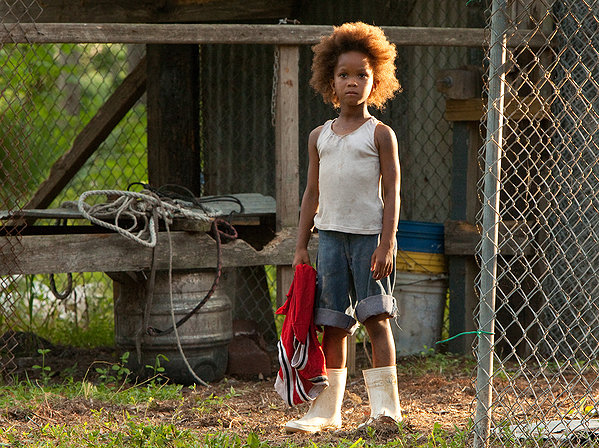 This movie is awash in all sorts of tones and storylines, failing to cohesively gel together or form some kind of meaningful message. I could have sworn that the fantasy elements, namely the giant thundering pack of large boars, were just going to be a visual metaphor for Hushpuppy’s journey. And then they actually show up and every person can see them. So, now what? The boars are one of many ideas that the movie just sort of toys around with before losing interest. This is not a film of magic realism. This is not a film about the escapes from a hard reality. In a way, this movie plays out like if Terrence Malick had made Gummo, and if you know me, you know I loathe both Gummo and Terrence Malick movies. Beasts constantly flirts with pseudo-intellectual pabulum, trying to reach something profound but instead settling for confounding. Hushpuppy’s curlicue unnatural narration talks about being a little piece in a big universe and the interconnectedness of all things, but by film’s end you get no dynamic sense of this. What I got was a little kid’s poor life getting worse, and that’s about it. If the film has anything larger to say about the world, Katrina, human connection, then I’m at a loss as to explain what that may be. Beasts offers half-formed ideas, strange, conflicting imagery, and characters that are rather thinly written and barely register. I never found Hushpuppy an engaging protagonist and felt like her very age and the heavy burdens she is forced to carry were manipulative substitutes for actual characterization. I cannot understand the love here.
The movie is something of a wild stew of Southern folklore and coming-of-age tropes and plenty of indie trappings, like weak political allegory, roaming handheld camerawork, and sacrificing story to the altar of realism. So much of this movie feels like it was made to give a sense of how an overlooked life in poverty is lived. From that standpoint the film does a commendable job of showing everyday life and the struggle to feed and survive. There’s a certain sense of ingenuity at work. But all of these setting details do not take the place of an involving story and characters we should care about. I felt sorry for the various residents of the Bathtub and their lot in life, but I never felt attached to any of them. That’s because, as mentioned before, they’re bland and simplistically drawn, but also because Beasts doesn’t bother to do anything else other than create its rich, tragic, harsh world. It’s authentic all right, but what does all that authenticity have to add to genuine character work? Artistic authenticity is not always synonymous with telling a good story. The Bathtub feels real, got it. So now what?
Hushpuppy lives in squalor and the movie has a disquieting romanticism of abject poverty. To the residents of the Bathtub, they are living in some forgotten paradise away from the concerns of the mainland. They refuse to leave their homes and their lives, even though there isn’t much of a home to call one’s own. We wade in this horrible existence and are meant to pretend like it’s an idyllic lifestyle, you know, with all the creature comforts of child abuse thrown in for extra measure. While Beasts looks entirely authentic with its impoverished, junkyard-esque production design, the overall mood and atmosphere hardly seems worth celebrating. Now, I’m not saying that characters can’t make the most of whatever life has given them and meet the implacable with fearless optimism. These characters would likely shun our pity; they reject any government assistance after the great flood and just want to sneak back to their simpler lives. This is not an enviable life, and the fact that the movie tries to romanticize it feels deeply irresponsible. At least with a film like Winter’s Bone, where you felt the crushing existence of systemic poverty, the filmmakers didn’t try and put a smile on all the drudgery. In that movie, you felt the trappings of poverty and how it can sink into your soul. On some level perseverance in the face of adversity is noble, but so would escaping poverty. Regardless, this is not worthy of romanticizing or fetishizing.
 Little Wallis is certainly getting her fair share of attention for anchoring the film. She’s six years old so it’s hard to assess her full acting potential, but the kid looks to have some fire in her. However, it is not a performance that leaves a lasting impression. I realized that much of her performance was long reaction shots and that ponderous voiceover narration. True, she does get some dramatic sequences and lets loose a few tears, but it feels like the movie didn’t want to push her too far and settled on a barrage of shots of Hushpuppy being stoic. I was more impressed with Henry, he too an acting novice making his debut. His character is more complex than an innocent naïf we have as our protagonist. He’s clearly dying and trying to quickly get his daughter prepared for a life of independence. He’s also quick to anger and you can feel the heavy weight of his life and his fledgling mission. In fact, I think Beasts would have been better if it had been told from the father’s perspective rather than our child trying to understand the great big scary world. There’s certainly a lot more drama and an easier route for sympathy, even if he could be accused of being cruel and neglectful.
I’ll admit that Beasts of the Southern Wild is different, daring, and fitfully imaginative, as well as benefiting from strong production design and special effects work. But “different” and “daring” doesn’t always mean good. I cannot in good faith say I enjoyed this movie, especially with its freeform plot, messages, tones, and occasional garish imagery. The plot seems desperate for some form of greater meaning, defaulting to ponderous poetry rather than supply a workable narrative and characters that are developed. Then there’s the whole romanticizing of systemic poverty that I find off-putting and wrongheaded. This is just a swampy mess of a movie, one that sinks under the weight of its own pretensions. It’s admirable from a technical standpoint but as a movie, Beasts of the Southern Wild is an exercise in eclectic navel-gazing.
Nate’s Grade: C+
Share this:

Brave (2012)
 Perhaps after a series of ambitious, mature, celebrated animated works, we just hold Pixar to unrealistic expectations. Their latest film Brave isn’t bad by any means, but it’s certainly second-tier Pixar among their cherished catalog of hits (somewhere along with Monsters Inc. and A Bug’s Life, I’d say). The movie is an eye-popping beauty to watch; the Scottish highlands look gorgeous and teaming with life, and our heroine, Princess Merida (voiced by Kelly Macdonald), has a signature mess of red tresses that look incredibly real. The hair practically blazes onscreen. Even though the independent-minded young heroine has been a staple of stories, and particularly animation, since the 1990s, Merida is still a feisty, engaging, and relatable lead. Her friction with her mother (Emma Thompson), who wants Merida to accept royal responsibilities and marry a suitor, creates some nice sparks, and the mother-daughter dynamic is an exciting new avenue for Pixar to explore. Without spoiling too much, Merida, in a moment of anger, has a spell cast with disastrous results. It’s here, at about the 30-40 minute mark, where the movie goes in a completely different, and unwelcome, direction. The rest of the film becomes a series of chases and comical close calls and lots and lots of slapstick humor. The timeframe of the movie, about 36 hours as near as I can tell, is too short for substantial character growth. And so, by the film’s end, the character development feels facile and forced and just unbelievable. Rather than keep its focus on Merida making her own way against a patriarchy, the film devolves into a supernatural buddy comedy and then concludes in a clumsy, dues ex machina fashion. The tone is uneven, and some points are a bit scary for young children, and I kept thinking that this was more a Dreamworks release. I may sound overly critical but that’s because we’ve come to expect the best from Pixar. Brave is an entertaining, funny, and often visually astounding movie, and while it’s second-tier Pixar, that’s certainly better than most.
Nate’s Grade: B
Share this:

Extremely Loud & Incredibly Close (2011)
 The biggest surprise on the morning of the Academy Award nominations was the inclusion of Extremely Loud & Incredibly Close in the nine nominees for Best Picture. Critics have universally derided the 9/11 drama, becoming the lowest critically rated Best Picture nominee in the last 30 years, according to some awards pundits. The second lowest rated Best Picture nominee in that same span of time? The Reader, also directed by Stephen Daldry. Under new Academy voting rules, a nominee has to garner at least five percent of first place votes on members’ ballots. That means that at least 250 Academy members voted this crass, manipulative, off-putting, wrongheaded, exploitative movie as the best film of the year, thereby voluntarily divulging they must not have seen a single other movie for 2011.
Oskar Schell (Thomas Horn) was nine years old when his father, Thomas Schell (Tom Hanks), was killed on September 11, 2001. He was in one of the World Trade Center buildings and left six frantic phone messages before perishing. In the ensuing months after the disaster, Oskar is lashing out against his mother (Sandra Bullock) who spends all day in bed. Then one day he discovers a mysterious key in his father’s closet inside an envelope labeled “Black.” Oskar’s father used to send his son on a series of adventures around New York, looking for a fabled “sixth borough,” forcing Oskar to confront his numerous fears and insecurities. Oskar looks through the New York phone book and catalogs over 400 separate people with the last name of Black in the five boroughs. He’s convinced that his father has left one last hidden message somewhere in the city.
 My main sticking point was that I found Oskar to be an insufferable, bratty, little jerk. I understand he’s hurting and he’s trying to work through his pain. I understand he is gripped by irrational fears and has a hard time relating to others. I understand that Oskar’s father even tested him for Asperger’s, though the results were negative. Some people will try and explain away Oskar’s callous behavior in sweeping generalizations having to do with the ignorance of children or some undiagnosed medical problem. I’ve known people with Asperger’s syndrome and while Oskar fits a few of the superficial tics, being a jerk is not a symptom, sorry. He’s so mean to his grieving mother and indifferent about other people that I wanted to slap him. I found him to be unsympathetic and wholly irritating. I found his unsupervised journeys for cutesy quests throughout New York City to be dubious. His parents just let their ten-year-old socially awkward kid run around New York City by himself at all hours? The movie goes in a bad direction when it partners this talky nuisance up with a silent old man, played by the wonderful Max von Sydow (the movie’s only other Oscar nomination; another stretch I’d say).
Here’s a breakdown of my thought process: Oskar comes home on 9/11 to find the last recorded messages of his father, including an admission of love for his family. Oskar runs out and buys an identical answering machine and sneakily hides the original, denying his mother, a grieving widow, the chance to hear her husband’s voice one last time. Screw that kid. I’m sorry but that’s what went through my mind and to me he never recovered. His actions are inexcusable. Then he gets mad because his mom sleeps all day. She’s grieving you little snot! And then he has the gall to tell her, “I wish it was you instead!” It’s a moment intended to draw gasps, ripping the scab clear off whatever pretensions mother and son have with one another. But it just made me dislike the kid even more. The fact that even by the film’s ending emotional catharsis Oskar still hasn’t shared the answering machine messages with his mother is reprehensible.
The other factor that caused me to despise the main character was how Horn proves to be a dreadful actor. This is the first acting role for the former teen Jeopardy champ. He’s able to spit the rapid-fire, idiosyncratic dialogue burdened with cumbersome detail. However, Horn gives a terribly mannered performance. He has this annoying manner of over enunciating every single word, getting lost in a character affectation, always stagy and artificial. You combine a bad actor with an aggravating character and make them the lead of the story, and I’m already daydreaming possible murder scenarios (I don’t condone child murder mind you — I’d make it look like an accident). As for Oskar’s parents, Hanks is hardly in the movie and Bullock does shockingly well, nailing her most emotional moments. I’d rather see this movie from her point of view, trying to make sense of the insensible to her challenging son who hates her.
 Daldry wishes to use the backdrop of 9/11 to talk about important items. It’s too bad that his movie has nothing legitimate to say about healing. I was assuming that over the course of the film Oskar was going to run into a diverse collection of people, all healing, all with their own stories of pain, and then he would learn that the real treasure was the community of strangers he had brought together. Nope! Oskar runs into a gamut of fine actors, including Viola Davis, John Goodman, and Jeffrey Wright, but they all become mere baton-passers to a self-involved kid. They and their stories don’t matter. The lock to our missing key doesn’t matter. There’s a final revelation concerning Oskar’s mother and her activities to benefit her son that seems entirely implausible. Daldry and screenwriter Eric Roth (Forrest Gump, Curious Case of Benjamin Button) have transformed Jonathan Safran Foer’s novel about collective grief into a strangely myopic narrative given the scale of the suffering.
The movie is so transparently manipulative, shamelessly exploiting 9/11 anxieties and trauma to tell its intolerable little quest. In no way is 9/11 meaningfully connected with the overall story of loss. Oskar’s father could just have readily died in a war or had a brain aneurism. What 9/11 is used for, however, is an easy device to stir the audience’s emotions. Daldry will flash back to it at seemingly random moments in the narrative, to goose the audience into feeling gloomy. I’m sure many people will sit through this movie and feel moments of genuine sadness, but that’s because the filmmakers are shamelessly manipulating the raw feelings we have over a national tragedy. It’s hard not to feel a lump in your throat seeing the towers smoking, frantic calls to missing or doomed loved ones, and final recordings bearing the weight of compounded dread. It’s not too soon to talk about the psychic wounds of that terrible day but I strongly resent people who exploit those memories. There are moments that are so misguided and yet given the Hollywood gloss of an awards-bait picture. The very opening image is of Tom Hanks free-falling to his death. Oskar’s little picture book he constructs at the end of his journey includes a final page with the World Trade Center. And there’s a little slip that when pulled creates a picture of a man falling up back into the tower. What? Is that supposed to be a good thing?
Extremely Loud & Incredibly Close is such a misguided, crass venture that’s also extremely shameless and incredibly cloying. The main character is unlikable, exasperating, and portrayed by a rather amateurish child actor. Daldry’s hackneyed direction will settle on treacle and contrived sentiment whenever possible, but the emotions never feel properly earned. He’s pressing buttons and forcing tears, and several viewers will be unaware of how efficiently they were manipulated into having a moving experience at the theater. I know I can’t be alone is seeing through the manipulation and feeling indignant about the ordeal. I’m not against tackling the difficult subject of 9/11 in movies (I declared United 93 the best film of 2006). Here’s a good question for you filmgoers out there: is there that big of a difference between this movie and 2010’s unpleasant teen drama, Remember Me? Both use the 9/11 attacks to cover narrative and characterization deficiencies, vulgarly exploiting our feelings of the events to engender feeling, and both don’t belong anywhere near an awards stage.
Nate’s Grade: C-
Share this:

My Week with Marilyn (2011)
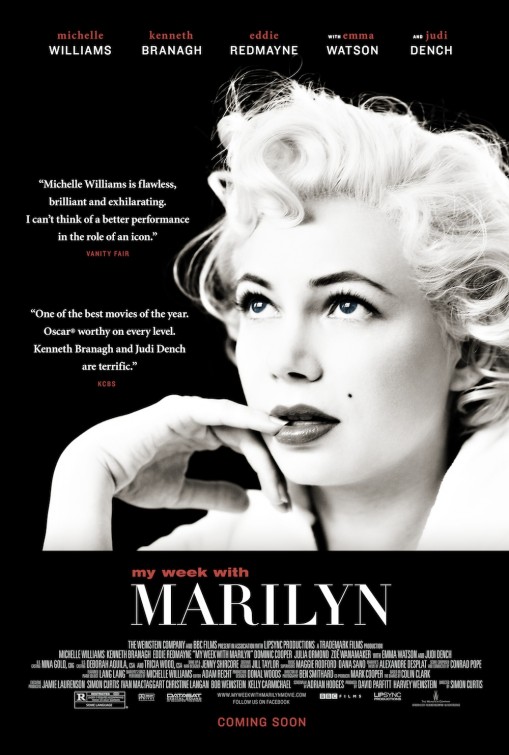 In 1957, Marilyn Monroe (Michelle Williams) was the biggest star in the world but she wanted to be taken seriously as an actress. Laurence Olivier (Kenneth Branagh) was an award-winning thespian considered to be acting royalty, but he was looking to siphon some of Monroe’s fame and vigor. Monroe flew over to England to shoot the light comedy The Prince and the Showgirl, directed by and starring Olivier, and it was here that she changed the life of Colin Clark (Eddie Redmayne). Clark was an ambitious young chap who served as the third assistant director and Oliver’s personal assistant as well. He was mainly a glorified go-fer but the position allowed him to glimpse the world of Marilyn Monroe and her various handlers, Paula Strasberg (Zoe Wanamaker) and Milton Greene (Dominic Cooper). Monroe’s flighty behavior and struggles with acting drive the more professional Oliver stark raving mad. Monroe’s rocky marriage to playwright Arthur Miller (Dougray Scott) is causing her fits of depression. Who better to cheer her up than young Colin Clark? Over the course of nine days, the two become inseparable and Clark falls head over heels for the world’s most glamorous woman.
The character of Colin Clark seems to be stripped of all defining personality traits. He’s this bland kid caught in continual awe. He just seems to be smiling and twinkling those big, compassionate eyes of his, typifying the earnestness of young love. I think he’s been rendered into a cipher for the audience to put themselves in his shoes, becoming star struck with Monroe’s attention. The screenplay takes far too much time on showing Clark coming to the repetitive rescue. His romance with a costume girl (Emma Watson) is a nonstarter and the movie doesn’t even try and hide the fact. She’s the backup romantic option, so the fact that he goes back to her after being spurned by Monroe and we’re supposed to feel that this is growth seems disingenuous and a bit caddish. Perhaps she didn’t take it too hard; if you’re going to be dumped for anyone else, there’s no shame if it’s Marilyn Monroe. Judging by the movie’s depiction, Clark is a rather boring young man, and I didn’t buy for a second that Monroe would cling to him as her hero.
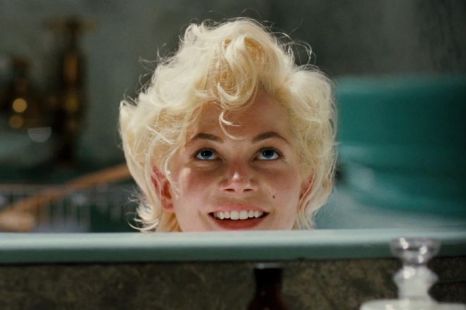 My Week with Marilyn is really focused on the titular star. Clark is just out path to the real star. I doubt there’s anything particularly revelatory about Monroe here. She was plagued with insecurities, a need to be loved, and the fatigue of “playing” herself all the time, all hips swivels and winks. At one point Clark and Monroe are taking a walk and met with a group of fans. “Shall I be her?” she coyly asks Clark and then turns into the vampy goddess the public loved, striking poses and smiling wide. By the very constricted nature of the timeline, we’re not going to learn too much about the famous beauty. She flubbed her lines, she and Olivier didn’t get along, and a mini-entourage of sycophants who were meant to be a surrogate family for the troubled gal surrounded her. Was she a lonely gal crushed by the weight of stardom or a manipulative lady who knew how to get what she wanted? The movie doesn’t take a side, instead serving up all sides of Marilyn Monroe, including a few in the buff. The film has some enjoyable juicy bits, particularly the friction between Monroe and Olivier, but the movie ultimately becomes another fawning admirer of its star. There are a couple musical numbers with Monroe that feel clumsily reproduced and the tone seems too light too often for the dramatic moments to have any real bearing. It becomes another fan that celebrating her image and sponging off her fame and legacy.
While the film may not be revelatory, Williams (Blue Valentine) herself is the revelation. She’s not exactly a dead ringer for the curvaceous, buxom blonde beauty, but she inhabits the spirit of the woman rather than sticking to a breathy imitation. She doesn’t capture the baby-doll voice but the demeanor she has down pat; when she turns it on you can feel the screen light up with the luminescence of star power. There’s quite a difference between the sad, depressed, codependent Marilyn and the sexy pinup fantasy. It’s an incredible performance in an otherwise so-so movie, though I wish the screenplay had given her more complexity to work with. Branagh (Valkyrie) is great fun as the stuffy, overbearing Olivier who gets plenty of snappy lines to vent his frustration over Monroe’s antics (“Teaching Marilyn how to act is as useful as teaching Urdu to a badger!”). Both actors are so good, and so good together, that I wish we could just remove the “my week with” from the title and focus on the relationship between Monroe and Olivier.
Allow me to question the voracity of Clark’s account. He waited until 1995 to publish his film set diaries, and then after his first memoir of his time with Monroe sold well he published another one in 2000, this one filling in a nine-day gap he says was that fateful week with the sex icon of the twentieth century (eat it, Clara Bow!). The second memoir was written fifty years after the fact and from the nostalgic perspective of an old man looking back to his youth. I feel that the particulars have been smoothed over and romanticized. The fact that surviving actors from The Prince and the Showgirl cannot verify any sort of relationship, and that several sources say that Monroe and her new husband Miller were inseparable at the time, cause me to doubt the validity of this personal account. In his first memoir, Clark even criticizes Monroe’s physical appearance (“Nasty complexion, a lot of facial hair, shapeless figure and, when the glasses came off, a very vague look in her eye. No wonder she is so insecure.“). Yet in the second book he becomes her defender. So which is it? Who wouldn’t, with sixty years of hindsight and a best-selling first memoir, embellish their one-time dalliance with a star like Monroe? The most desired woman in the world and he, a 23-year-old nobody, was the one to become her confidant? Aren’t we full of ourselves? And he crawled into her bedroom and was asked to stay the night and didn’t consummate that relationship? In the book she offers and he declines. Talk about the biggest mistake of your life.
 If you’re going to embellish, then you might as well get some action out of it. Then again, maybe in the books Clark says that Monroe gave him a pity handjob and the filmmakers deleted this (I can hear him screaming from beyond the grave, “You fools! The handjob was a metaphor. The whole tale falls apart without it!”). If I ever had even a fighting chance of getting lucky with Marilyn Monroe, you’d best believe I would be telling that story so often that my grandkids would roll their eyes in disgust (“Geez, we get it grandpa. Marilyn gave you a handy once.”). The post-script tells us that after The Prince and the Showgirl, Monroe went on to Some Like it Hot and Olivier went back to the theater for some of his best-reviewed runs of his career. So clearly, these two stars owe all their good success to the heroics of Colin Clark, who nudged them from greatness to legendary. We have only Clark’s take since Monroe cannot dispute Clark’s claims so I feel like the memoir, and the film adaptation, is an exercise in serving Clark’s ego.
My Week with Marilyn is a light, weightless movie that retells the shooting of a light, weightless movie. Well done, everyone. The emphasis on this bland kid and his fairly unbelievable whirlwind romance of the twentieth century’s most iconic sex symbol makes the movie feel self-serving. Does anyone honestly believe the events of this story? Whatever the validity of the events, a movie should be entertaining on its own rights. My Week with Marilyn has its bouncier moments and is saved by stellar acting from Branagh and the radiant Williams. But even the best acting in the world can’t save a movie that feels like it’s completely some old man’s exaggerated, embellished, and somewhat boring fantasy. If this is the relaxed standard for getting a movie made, then I look forward to the eventual film adaptation of my soon-to-be-released novel titled, My 28 Hours of Incredible Sex with Angelina Jolie.
Nate’s Grade: B-
Share this:

Tinker, Tailor, Soldier, Spy (2011)
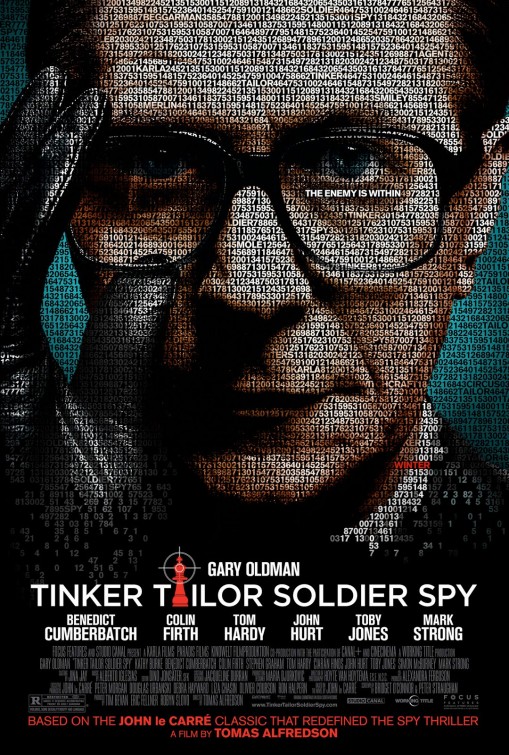 Billed as one of the most dense films of the holiday season, I was startled to discover that Tinker, Tailor, Soldier, Spy is not nearly as puzzling as people have protested. The adaptation of John le Carre’s famous novel follows retired British spy George Smiley (Gary Oldman) performing a clandestine investigation to flesh out a mole in the highest level of the agency. Directed by Tomas Alfredson (Let the Right One In), condensed form a 7-hour BBC miniseries, and stuffed with a wealth of terrific Brits, the movie is tricky, clever, and rather brainy, ultimately coming to the conclusion that these little communities of intelligence knew little. The movie has a rich array of characters and teases out back-story in flashbacks, meaning the film hops around time wise and will also take turns with different perspectives. It demands your attention but, honestly, I found it easy enough to follow. But in the end, what does all that narrative trickery and obfuscation get you? It’s a fairly dispassionate film about dispassionate people played out in a dispassionate manner. For some this will be hailed as a virtue, communicating the duty-first sacrifices and compartmentalization of these secret spies. For me, that just sounds like a cop out. Beyond the mystery, it’s hard to get involved in the movie. The reveal of the mole is anti-climactic, though the resolution, set to the tones of Julio Iglesias, is aces. The meticulous production design is stellar, including an agency meeting room that looks like it was wallpapered with checkerboards. The details of the ins and outs of the agency are absorbing. I’m debating whether I should watch the movie again, looking for nuance I must have missed. Tinker, Tailor, Soldier, Spy is an espionage thriller with a bit too many stiff upper lips.
Nate’s Grade: B
Share this:

The Artist (2011)
 Ever since it charmed audiences at the Cannes Film Festival, The Artist has been one hot commodity. The Weinstein Company snapped up the film rights though they have a bit of a hard sell. The movie takes place in the era of silent movies and it also happens to be a silent movie itself. Ignoring Mel Brooks’ unsung efforts, asking paying customers to sit through 100 minutes of silence, albeit accompanied by a musical score, may be a risky financial bet. That’s where the appeal of being an award-winner comes into play. The Artist has been racking up awards since Cannes and has been tagged by many as the favorite to take home a Best Picture Oscar. This celebration of the Hollywood of old is a nostalgic trip through the ages, but I’m doubtful that the film is deserving of the gushing admiration. I think this would have been better had it been one of them new-fangled talkies.
In 1927, the biggest star in Hollywood is George Valentin (Jean Dujardin). His latest spy caper is knocking them dead. He’s prancing before a sea of photographers when he bumps into Peppy Miller (Berenice Bejo). He graciously brings her into the act and the two pose for pictures. “Who’s the new girl?” demands the newspaper headlines. Peppy is given her big break as George’s co-star in his spy series. Peppy is a natural and over the course of two years she becomes a bona fide star. Also over those two years Hollywood has undergone a drastic makeover. New “talkies” are all the rage with the public, who now demand to hear their favorite actors speak. George is adamant that talking pictures are only a fad and he plunks his personal fortune to bankroll his directorial debut. The movie is a flop. George is viewed as a has-been; yet Peppy has been keeping a watchful eye on her old friend and waiting for the time to reveal her love for the fallen star.
 The Artist is a completely silent movie except for two key sequences; one of them a nightmare where George hears objects make noise. The film is an unabashed love letter to old Hollywood, and writer/director Michel Hazanavicius makes witty use of the storytelling techniques of the silent era. Much relies on editing and reactions for shaping the narrative. The story, therefore, is broken down to its simplest incarnation. Peppy Miller’s star rises, as George’s grows fainter. Still, The Artist has many recognizable pieces for fans of the silent era. George even has a trusted Jack Russell Terrier at his side, a clever pooch with keen mimicking abilities. There’s a cute moment where Peppy slips her arm into George’s coat hanging on a coat rack and pretends to caress her self as him. It’s a small yet slyly tender moment. It’s not a prerequisite to be well versed on silent cinema, though it helps. While a French film (a foreign designation seems superfluous when it’s silent), the movie was shot in Los Angeles and is stocked with English stars like John Goodman (TV’s Treme) as a film director, James Cromwell (Babe) as George’s dutiful butler, Penelope Ann Miller (Flipped) as George’s unhappy wife, Missi Pyle (Big Fish) as a silent film co-star, Beth Grant (Donnie Darko) as a maid, Ken Davitian (Borat) as a pawnbroker, and Malcolm McDowell (Halloween II) as a dismissive old man in a chair (the role he was bon to play). It almost becomes a side game of cameos.
It’s a sprightly, charming, sometimes enchanting little experiment, but in the end an experiment is all the movie turns out to be. The Artist is no great story; in fact it’s pretty much the 80th rendition of A Star is Born. The transition between silent films and talkies is a subject rife with drama, and a lead character who sees his fame and fortune crumble by being left behind in a changing society, well that should be interesting. What’s surprising to me the most about this film is how little you invest with it. I don’t know if it’s the silent gimmick or just the idle characterization, but I found myself never really engaging with the movie, always a step removed. The characters were nice but I neither celebrated their triumphs nor bemoaned their hardships. The entire affair has such a slight feel to it; the movie is a confection, a sweet treat that melts away instantly after viewing. If you strip away all the old Hollywood nostalgia, there is very little substance here. Praise Hazanavicius for his dedication to silent filmmaking techniques, but let’s be reasonable here because The Artist is a pleasant experiment but nothing more. The characters and story do not bear scrutiny. This story would have been more interesting had the movie been a traditional talky. Alas, we are limited to a handful of title cards with single lines of dialogue and extreme amounts of pantomiming. If you took away the central gimmick, would anyone be interested in this movie? I wanted to be swept away by The Artist after reading all the fawning accolades, but I wasn’t. The commitment of the artists on screen is commendable but the finished product is little more than an amusing trifle of a movie.
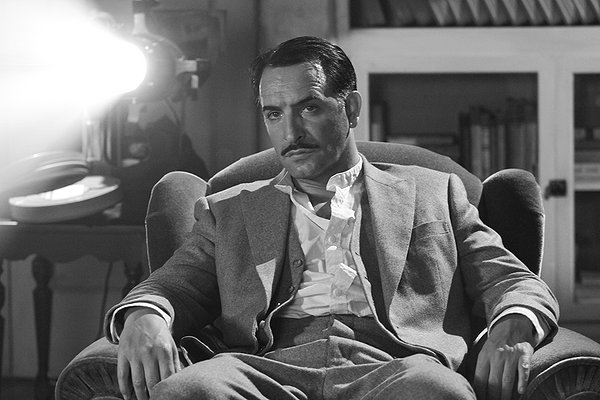 Dujardin (OSS: Lost in Rio) and Bejo (Modern Love) look like they stepped off the screen from an old Hollywood movie, al la Purple Rose of Cairo. Dujardin is a suave presence with great comedic physicality at his disposal. There’s a poignant moment where George, broken down and washed up, looks into a tuxedo store window, seeing his reflection appear above the neck of the tuxedo. He gingerly smiles, wistful of times gone by, and in that sad, face crinkling little moment, Dujardin reveals more about the man behind the flashbulbs than the script ever will. Even without a word spoken, you can tell that Dujardin and Bejo have great chemistry. Bejo, the wife of the director by the way, matches Dujardin note for note in terms of star wattage. She’s got a terrific smile and one of those classic faces for an Age When They Had Faces. It’s a shame that the characters don’t have more interaction.
The Artist is a fine film but ultimately disappointing given the hype. The saddest part about my reaction to The Artist is how little I find myself having to say about this much-ballyhooed silent film. It’s an exercise in nostalgic back-patting, but if you strip away the silent movie gimmick I feel like there’s so little at heart here. I walked away liking the movie, being charmed by the actors but feeling unengaged and mildly indifferent. The threadbare story is too familiar, the characterization is slight, and the movie ultimately becomes light, airy, and insubstantial. The novelty eventually does wear off and you may find yourself adding a mental commentary to the film to fill in the blanks. You’d have to be a Scrooge to resist the film’s whimsy and the talents of the charismatic performers, but I’m scratching my head at the adulation give to The Artist. In a year heavy with reminiscence, The Artist overdoses on feel-good Hollywood nostalgia, and in a down year at the movies, perhaps that’s enough when it comes time for awards.
Nate’s Grade: B
Share this:

War Horse (2011)
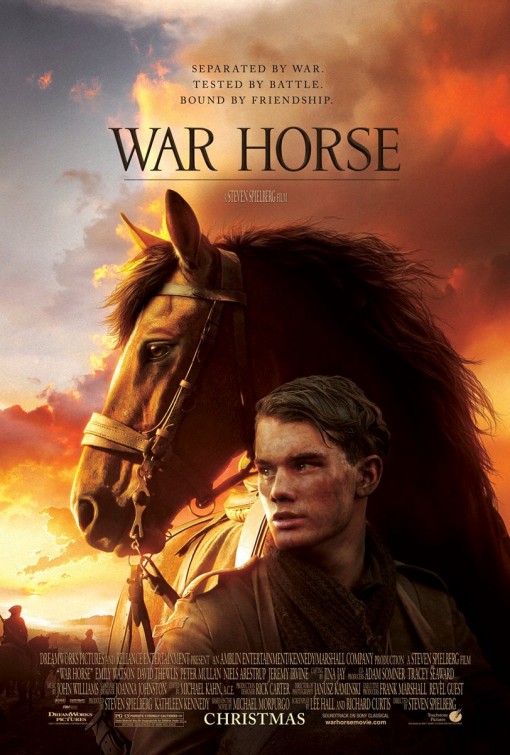 Steven Spielberg and war seem like a dynamite combination. The popular director puts away his childish things and becomes a much more mature, thoughtful artist, with the obvious exception of 1979’s 1941. War Horse is the adaptation of a children’s book-turned-Tony-Award-winning play, where the title star was brought to life on stage via skilled puppeteers. And lo, did people weep for that puppet horse on stage, and lo will they likely weep for the flesh-and-blood version on the big screen. However, I’d hardly call this movie a mature examination on the horrors of World War I. It’s more of a touchy-feely, stodgy, vignette-heavy drama that brings out the worst in Spielberg’s sentimental side.
We’re introduced to our young horse early on, where young Albert (Jeremy Irvine) spies the colt and forms an instant bond. Albert’s father Ted (Peter Mullen) buys the horse on a whim, even though the family could really use a plow horse. Albert names the horse Joey and is determined to prove everybody wrong who doubts the both of them. Together they indeed plow that rocky field and Albert’s family keeps their farm. Then World War I breaks out across Europe and the family ends up losing the horse. Joey is confiscated by the English cavalry and goes on a fantastic journey, switching sides over the course of the war (and allegiances?). Albert enlists in the military so that he can find his long-lost horse. I guess they’ll be no “Dear John” letter when your beloved only has hooves.
 War Horse is a throwback to old-fashioned Hollywood epics. It’s like John Ford took control of this movie from beyond the grave (note to self: premise for a supernatural comedy). My theater was filled to the rafters with old people. It was like the nursing home emptied out for the Greatest generation’s couples night. It’s easy to see why the movie would appeal to such an older crowd. It’s a simple story told with its emotions squarely on its sleeve like a badge of honor (mixed metaphors!). It’s so unflappably earnest and sentimental that it can occasionally fall into cornball territory. There’s the greedy landlord who wants to kick the poor family off their farm. Being a Spielberg movie, no expense is spared in milking as many emotions as possible. Spielberg demands tears and you will deliver them, or so help him. It’s all about Joey the horse prancing through people’s lives, touching hearts, bringing enemies together. The movie is primed for mass (older) audience appeal; for God’s sake there is a sassy goose that Spielberg can’t help himself but continue to include. Sassy goose equals money in the bank. This is the only movie I can imagine where plowing is treated as a point of dramatic catharsis. Suffice to say, War Horse is a stodgy war drama that won’t offend anyone with delicate sensibilities.
I wasn’t expecting War Horse to be the equine version of The Red Violin (if you unfamiliar with the masterful 1999 film The Red Violin, go see it immediately instead of watching this flick). We see the horrors of war through a series of vignettes as Joey passes from owner to owner, each befalling some unfortunate fate, though I don’t think the horse is to blame (or is he…?). The vignettes run about 15-20 minutes or so apiece and because the one constant is the horse, that means we have to feature characters talking out loud explaining everything they do and feel. The horse just kind of takes in everyone’s secrets, probably wishing these people would stop their yapping. The characters are drawn rather broad so we get the German brothers who desert their posts, a French girl wanting to learn to ride a horse, and a noble English cavalry marshal, amongst others. It’s hard to get attached to such disposable characters that fail to leave a modest dent. I thought maybe all these characters would converge in the end for an emotional climax, but then I remembered that many of them were dead, so nope. It’s a strange screenwriting shortcoming when the most engaging character for most of the movie is on four legs and never says a word.
It’s hard not to emote when Spielberg lathers on the sentimentality with aplomb. But if you took away John Williams’ earnest score, Spielberg’s sappy staging, and all those close-ups of animals, would you feel anything for this story or these characters; would you feel anything without all the reminders to feel? I doubt it. Don’t count me heartless, for I’ll have you know I bawled like a baby who just watched another baby hit with a shovel at Marley & Me, but does the life of one horse matter so much more than the millions of lives lost at war? We watch all those boys, many not old enough to be called men, run into the unforgiving gauntlet of war, but someone the life of one horse is supposed to outweigh the countless death. I understand a tight narrative focus so that large, unfathomable horrors can feel personable and better felt. Shindler’s List is that kind of movie. War Horse is not. This isn’t even Black Beauty or National Velvet. One of the English soldiers chides the sobbing Albert with a sharp quip: “It’s not a dog, boy, it’s just a horse.” I felt sad when the horse was in danger; I’m not a heartless bastard.
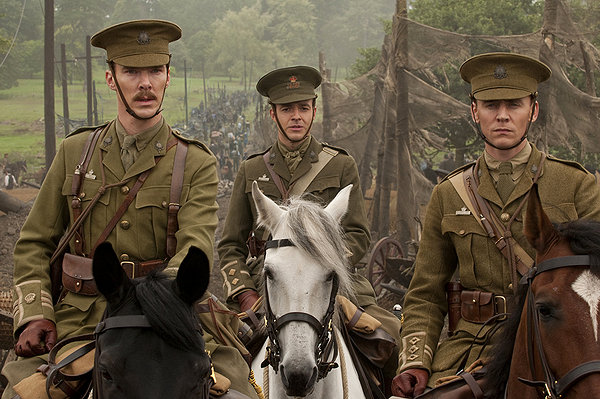 And oh does this horse seem to be Spielberg’s symbol of purity, mankind’s ultimate accomplishment, or, you know, something Big and Important. At one point, Joey gets tangled in a mess of barbed wire and the English and Germans all come to some sort of uneasy truce to work together to free this beautiful animal (if only more hapless horses had gotten lost in No Man’s Land maybe the war would’ve been over sooner – now I sound heartless). The horse is supposed to represent some messianic cost of war, where we destroy nature, turning majestic creatures into weapons of war, etc. I don’t really know what the message/symbolism is striving for but it’s constantly grappling, looking for a suitable sticking point. Honestly, if Joey was supposed to represent purity, goodness, nature, then that filly needed to get turned into glue by film’s end (spoiler alert). I erroneously predicted War Horse to be the “Marley & Me of war pictures.” The horse lives, rejoice America. Never mind the millions of people who died horribly. You can’t have a messianic symbol without martyrdom. If Spielberg wants to drive home the loss of innocence that many underwent thanks to the War to End All Wars (oh, if only), then the horse, a symbol of innocence and nature, needed to die at the machines of war. Otherwise the movie becomes an episodic journey of a single horse, an equine Forrest Gump. I can’t imagine that’s what Spielberg had in mind. I envisioned an M. Night Shyamalan-esque ending wherein the horse does eventually die, get turned into glue, and that glue is sued to construct a bomber plane for World War II. That plane? The Enola Gay. Cut to end credits. War Horse!
This movie has deteriorate in my mind the more I think back, picking away its cornball earnestness and stodgy sensibilities. When the horse is your greatest character then your war drama has some problems. War Horse is not a bad movie by most counts. It looks swell, the emotions are big, and hey horses are pretty aren’t they? But for any discerning moviegoer looking for a strong narrative, incisive commentary on the war, or even moderately appealing characters, well I hope you like looking at horses.
Nate’s Grade: B-
Share this:

Young Adult (2011)
 The basis for the movie Young Adult sounds like writer Diablo Cody settling a few sore scores. You’d think winning an Oscar for Best Original Screenplay for 2007’s Juno would have sufficed. Reteaming with her Juno director, fellow Oscar-nominee Jason Reitman (Up in the Air), the duo takes aim at the bitchy, stuck-up, popular girl that seemed to rule the school. Young Adult is much more than a vicarious act of vengeance on mean high school adversaries. It’s a revealing, awkward yet compelling dark comedy about the perils and pitfalls of arrested development.
Life hasn’t turned out exactly the way Mavis Gary (Charlize Theron) would have thought. The former high school queen bee has left her small town for life in Minneapolis. She’s the ghostwriter for a successful series of young adult books, a series that is coming to an end. She’s divorced form her husband, facing financial ruin, and living alone with her tiny Pomeranian, Dolce, her only friend. Mavis decides to forgo writing the last book in the cancelled series and instead return to her hometown the triumphant mini-celebrity she knows herself to be. She’s determined to find her old boyfriend, Buddy Slade (Patrick Wilson), and win him back. The fact that Buddy is married and has a newborn baby is no real impediment to Mavis’s crazy plan (“Hey, I’ve got baggage too,” she reasons). Once home, she runs into Matt Freehauf (Patton Oswalt) in a bar. Matt and Mavis went to high school together, though she has long forgotten the likes of him. Matt’s claim to fame was that a bunch of jocks in high school savagely beat him thinking he was gay. Matt sees right through Mavis and the two of them become an unlikely pair as Mavis plots and schemes her way to victory.
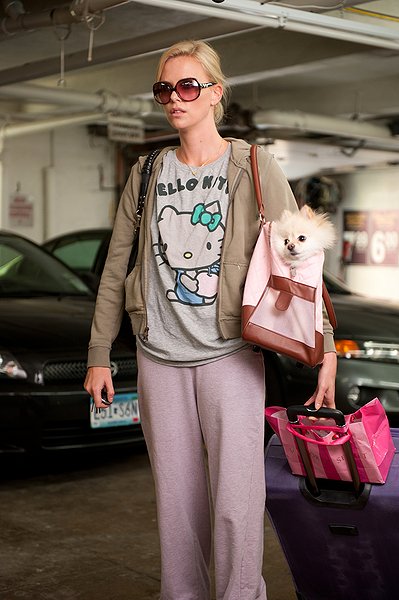 Young Adult is one of the most enjoyable squirmiest times you can have at the theater. Much of its humor, and it is very funny, is built around the pained awkwardness of Mavis’ self-involved, self-destructive mission. My friend was nervously fidgeting in his seat the entire time (he may have just had to go to the bathroom). The sense of dread is palatable; we’re watching a slow-moving car crash, waiting for the inevitable to hit. Every scene carries the apprehension of, “What is she going to say/do next? Is this it?” And yet Cody’s sharp, pointed writing makes the film compulsively watchable. We dislike Mavis, an irredeemable character who doesn’t even try to be likeable, and yet by the film’s conclusion most audience members will likely feel more pity for Mavis than outright hatred. I’ve had some friends ask me if Young Adult was anything like Bad Teacher, another movie about an abrasive, selfish, unlikeable bad apple. This movie is different. This movie is actually good. Mavis is not some wacky cartoon character, and Reitman has kept his reaction shots to a minimum, abstaining from having to remind us via public reaction how inappropriate Mavis can be. Unlike Bad Teacher, this grown-up meanie feels all too real, and her actions come across as believably threatening. This woman could do some serious damage on her way to massage her damaged ego. The movie never condones her actions, though Reitman and Cody make a point of piling on against Mavis. This woman is an ugly wreck, and Cody’s writing and Theron’s gutsy performance speaks volumes. Cody’s writing isn’t the hyper-literate, stylized dialogue we’re accustomed to from Juno. The dialogue and characters are eerily recognizable, miles away from the cuteness of Juno’s sunny, optimistic fairy tale inhabitants. Young Adult is a more nuanced, droll, mature work that deserves as much recognition as Juno and cements Cody, in my mind, as one of the most thrilling writers today (I can almost forgive her for Jennifer’s Body. Almost).
Along with all the bleak comedy, Young Adult lands a surprising number of poignant dramatic blows. Cody has crafted an exacting character study on a severe case of arrested development. Many of us can relate to knowing that one gal in high school, the pretty, popular one who had everything in life handed to her. In Young Adult, Cody shows the devastating consequences of a lifetime of entitlement and zero introspection. Mavis secretly knows that she’s past her prime, that all the people she left in her Podunk town have moved on to richer lives while she’s stayed in the same holding pattern her whole life. Some part of her has never left high school. She’s an emotionally stunted woman trying to live out the fantasy of one of her undervalued books (her misreading of the end of The Graduate into a love-conquers-all message is rather telling). Mavis’ life is hardly the stuff of Champaign wishes and caviar dreams, but to the people of her hometown, life in the “Mini-apple” is the Big Time. There’s a fabulous scene where Mavis goes into a bookstore and sees her series on a clearance stack. The bookstore employee tells her they don’t sell and will be most likely sent back to the publisher. Mavis takes out her pen and autographs one, informing this minimum-wage peon that she is the fabled author of the series. She’s expecting fawning admiration. The employee flatly tells her, “If you sign them, we can’t send them back to the publisher.” In her disgust, she tries to sign as many as she can as an act of defiance. Later in the movie, Cody sheds light on Mavis’ family life, offering intriguing clues for how this woman became so broken. Her parents just seem to shrug off Mavis’ admission of alcoholism, like they’re used to their daughter acting out, even if she might really be crying out for help. She’s a fascinating character to watch crash and burn.
What gives the film its most potent sense of heart (Grinch-sized though it may be) is the unlikely yet compelling relationship between Mavis and Matt. Unlike Mavis’ perceived slings and arrows, Matt has suffered real trauma from high school. His bones were shattered from that brutal beat down and he’s left to limp with a crutch. He hasn’t been able to mentally leave high school behind completely himself, but then again he has a constant reminder. Mavis is strangely her most open with Matt, possibly because she doesn’t view him as a threat or a credible alternative (the joys of high school revisited – the pretty gal ignoring the existence of the lower classes). He’s portrayed as the film’s voice of reason, voicing concern over Mavis’ kamikaze narcissism. Together they form what could charitably be described as a friendship. She seeks him out to talk at odd hours of the night and he’s straightforward with her. He thinks her plan is nuts, but he’s also secretly enjoying his unexpected friendship with the queen bee of high school, albeit twenty years later. “Guys like me are made to love girls like you,” he confides to Mavis. Oswalt has shown some dramatic skills in the underappreciated sports fanatic flick, Big Fan. With this movie, Oswalt gives an achingly felt performance, the most empathetic character in the whole movie and a joy to watch onscreen in a high-profile role that fits him like a glove.
 But the true star of the film is Theron, who gives a fully formed and entrancing performance as someone who is as ugly on the inside as she is beautiful on the outside. Her character could have easily slipped into being an unsympathetic monster; someone the audience wants punished (like Cameron Diaz’ character in Bad Teacher). But the actress finds her own twisted, tricky way to center the character. Every detestable glance, every pained inhalation, every rigorous attempt at seduction, it feels like the character coming alive before our eyes. Theron has dissolved into the abhorrent mess that is Mavis Gary. She’s convinced that Buddy could never be happy with such a mundane life in a mundane town (“There’s a restaurant that’s a Pizza Hut, Taco Bell, and KFC in one building” she says incredulously). Her perspective is so deluded that you start to see the manufactured world Mavis has so cautiously built around herself as a defense from reality. She watches wall-to-wall reality TV, the perfect metaphor of our times concerning the idolization of idiocy and self-absorption. She may not be likeable but she’s definitely compelling, and Theron is so good as that-girl-from-high-school all grown up, that she might even win over some slight sympathy by the film’s end. At one point, the inner fear of Mavis reveals itself, and she expresses her confusion about the attainability of happiness. Why can others find happiness with so little, and she cannot find it with everything that she has?
Young Adult is a dark comedy of squirm-inducing, uncomfortable bleakness and a drama of surprising poignancy and depth. It’s the good kind of uncomfortable, the kind where you can’t look away or leave the vicinity of your seat. Theron and Oswalt are fantastic. Cody’s gift with words, teamed up with Reitman’s gift with actors, makes a beautiful combination even when the end product is charting the misery or a miserable person. The measured tone is kept from start ot finish, meaning even when the movie appears on the precipice of life-lessons and Mavis might turn her life around, it pulls back. There will be no hugs and gained wisdom with this movie, a crackling comedy that’s also one of the best pictures of the year. Take that, popular girls who never gave me the time of day.
Nate’s Grade: A
Share this:

Shame (2011)
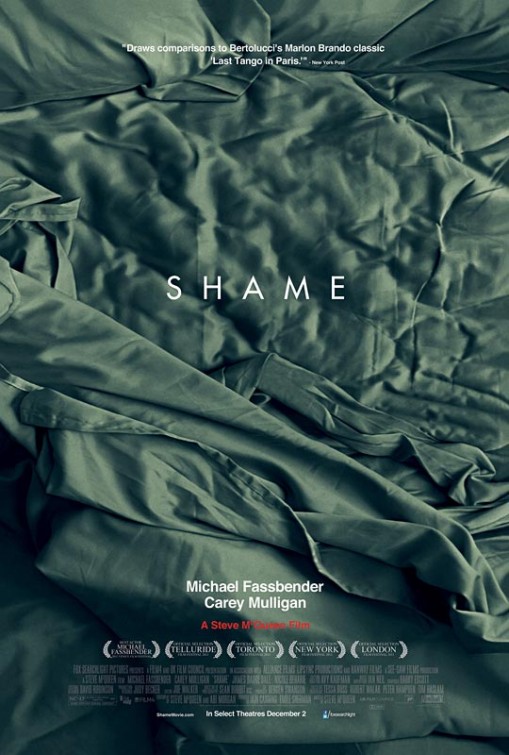 Most of the press about the seedy drama Shame has centered on the exhibition of star Michael Fassbender’s manhood, hence the NC-17 rating shackled to the film. Director/co-writer Steve McQueen, who teamed with Fassbender on the riveting Irish hunger-strike drama Hunger, decided against recutting his film for a more audience-inclusive R-rating. The Fassbender penis cannot be cut (draw your own circumcision conclusions). All of this fuss over seeing a penis onscreen seems a little ridiculous and immature. It just seems silly to censor a story about sex addiction by being coy with the appearance of the male anatomy. If they gave awards for onscreen penis performances, Harvey Keitel would have gotten a lifetime achievement award years ago. For all the physical nakedness on screen, when it comes to compelling characters and a story, that’s where Shame goes limp.
Brandon Sullivan (Michael Fassbender) is a high-powered New York City businessman working in a high-powered office doing important business stuff. At least, that’s about the impression the movie gives. What makes Brandon tick, though, is the biological highs of giving in to his carnal desires. He is a sex addict. He has sex daily, some with women he picks up, some with prostitutes. He has a mighty stash of pornography and his work computer is filled to the brim with smut. Brandon’s world of empty physical pleasure is interrupted when his sister, Sissy (Carey Mulligan), drops by to stay a while. She’s a needy, emotionally troubled woman, the kind of girl that gets into bed with her sex addict brother to feel some kind of warmth. Sissy drives Brandon mad, a madness that not even meaningless sex can cure. When sissy sleeps with Brandon’s married boss, his life becomes even more hectic. Perhaps brother and sister aren’t far off in their dysfunction.
 What’s most shocking about Shame is not the explicit sex scenes or the full-frontal nudity (sigh, another reason to hate Fassbender) but what a shallow move this is. From beginning to end, everything in this movie is surface level. We don’t get to know anything about Brandon except for his expensive interior decorating. Ooo, he has a fine collection of vinyl, it makes perfect sense that he would be a sex addict now. The movie is filled with joyless sex, but just because there’s a lot of it, and the camera takes time to show Fassbender’s remorseful expressions mid-coitus, does not mean we have approached anything introspective or revealing. The most we learn about Brandon is that his longest relationship lasted four months. When Sissy comes to crash with her big bro it seems to unnerve the man. Why? Is it because her emotional neediness holds a mirror up to Brandon about his own broken behavior? Is it because she’s the only person in his life he has some relationship with and he wants to sever this, to cut him off completely from feeling anything? What has caused both of these people to become so dysfunctional? What about their parents? Your guess is as good as mine. McQueen and co-writer Abi Morgan (The Iron Lady) cannot be bothered to shed light on their characters. This must have been the easiest movie in the world to write, as well as one that almost fulfills some sort of filmmaking exploitation dream (“No no, we’re doing a serious art movie. Now ladies in this scene you’ll be engaged in a threesome for an exhausting amount of screen time. Make sure to lick those nipples like you mean it”).
Because of the narrative shortcomings, the film can grow rather tedious. You never get a real sense of sexual addiction. Just because we watch a guy have sex with strangers, prostitutes, and watch a lot of porn does not mean we are any closer to understanding his urges and compulsions. There’s one brief moment where McQueen seems to communicate Brandon’s thinking, as the camera cuts between sensuous close-ups of a female officemate (Nicole Beharie). This technique is used too sparingly, though, and we’re left to just assume, “Oh, this guy has just gotta have it.” I would have greatly appreciated McQueen taking a more assertive role in communicating the mindset of his main character. Let’s get into his head, let’s see the world the way he does, let’s through the power of editing feel the gnawing craving for physical release. There is one terrific scene during the opening where Brandon and a woman on the subway seem to be communicating a shared desire simply through careful expressions and body configuration. It’s the one scene in Shame that feels like we’ve gotten a peak into Brandon’s world. Instead, the majority of Shame is far too cold and clinical, watching Brandon’s self-destructive behavior from a safe distance like we’re afraid of catching something. I get that all of the onscreen sex is supposed to be seen as unsexy, but that doesn’t mean we couldn’t have followed Brandon’s point of view deeper. Just following a character’s POV is not the same as consent of their lifestyle. McQueen’s camera favors pretty long takes that voyeuristically eavesdrop on his characters, creating a sense of reality that can become ensnaring. I wanted to break free from a near five-minute take filmed from the back of Brandon and Sissy’s heads while they sit on a couch watching, in a strange moment of public domain access, a cartoon from the 1930s. McQueen’s film almost feels like a bait-and-switch bauble, promising the audience the seedy perversions of a man dominated by his uncontrollable desires, and then just delivering a guy who speaks little and jerks off at work a lot.
 From an acting point of view, the lone saving grace of Shame, both Fassbender and Mulligan give captivating performances. Fassbender has had an incredibly varied year performance-wise, posing as Rochester, Magneto, and Carl Jung (one wonders what Freud would make of Brandon). The steely actor has a commanding presence and he’s able to reflect a burning intensity with the power of his eyes. Brandon, on the page, has about maybe 100 words of dialogue, so much is left to the actor’s fluid imagination, and Fassbender makes his character compelling to watch, at least for a while, despite the fact that the screenplay does not give him a compelling character to play. Mulligan (Drive, Never Let Me Go) is becoming rather adept at playing sad-eyed Kewpie doll women. Her character has a bit more to say in Shame, a girl trying to connect to the only family she has left, a brother who wishes to cut himself off from all feelings. The movie is at its best when these two are onscreen together. And for the horndogs out there, Mulligan matches Fassbender’s “I’ll show you mine” dare and delivers the full-frontal goods as well.
Shame is a sexually frank movie that seems curiously tight-lipped when it comes to character and plot. It’s filled with body parts but rarely do those parts assemble into a character. The movie is all surface, shallow and repetitive, and if that’s meant to communicate the self-loathing nature of its main character then what a strange mission that McQueen has achieved. The movie is flat, tedious, and distant, too timid to go deeper with its characters and their compulsions. I want to see Brandon’s personal and/or professional life suffer because of his addiction. I want to see the struggle to keep the urges at bay. I want to see Brandon hit rock bottom. I want to feel his desire to change. But we get none of this. Shame ruefully takes its narrative cue from Brandon, which means it’s a whole lot of nothing in between bouts of meaningless, empty sex.
Nate’s Grade: C
Share this:

Hugo (2011)
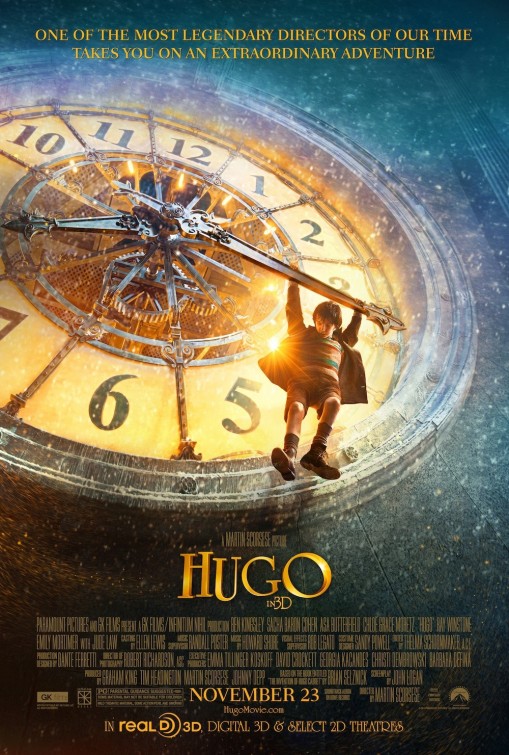 Martin Scorsese tackling a children’s film feels like an odd fit for the man responsible for classic gangster epics and symphonies of violence. But if David Lynch, Kevin Smith, Tim Burton, and Danny Boyle can all make family films that don’t make your brain rot, then why not the greatest living director? Maybe notorious sadist Lars von Trier will be next. Adapted from the award-winning children’s book, Hugo is, as my pal Eric Muller put it, a family film for film historians.
Hugo (Asa Butterfield) is an orphan boy living beneath the walls of the Paris train station. He’s secretly the one responsible for winding up all the clocks and keeping time. He has to stay one step ahead of the Station Inspector (Sacha Baron Cohen), who snatches wayward boys and sends them off to an orphanage. Hugo has been swiping clock pieces from the booth of a mysterious toy collector, George (Ben Kingsley). He needs the tiny pieces to fix a metallic man that Hugo and his late father (Jude Law) had been working on together. Hugo is convinced that if he fixes the metal man the automaton will write out one last message from his father. Hugo befriends George’s niece, Isabelle (Chloe Grace Moretz), and the two of them explore the various shops and shopkeepers of the station. As they uncover more clues, the kids realize that George is actually George Méliès, the filmmaking pioneer best known for the 1902 fantasy, A Trip to the Moon (the one where the moon gets a bullet in its eye).
 Scorsese’s first foray into 3D filmmaking is a rousing sensation for the eyes. The images pop without superfluous objects flying at the camera. The depth of field is nicely and creatively toyed with by Scorsese. Best of all, the 3D enhances the story rather than distracting you. Hugo is a celebration of the advances in moviemaking, and 3D is the latest advancement meant to make the theatergoing experience special. Of course the theatergoing experience has always been special, as the movie indicates. Where else but a theater can we collectively bond with a group of strangers, laughing collectively, feeling the pangs of emotion in unison? There’s a thematic rationale for Scorsese’s use of the third dimension. He masterfully fills the screen with wonderful images, like the massive inner working of clock towers. Scorsese’s signature tracking shots zoom in through the wintry 1930s Paris landscape and train station. A visual highlight is when a trunk of sketches busts open, the papers scattered all over the screen, some moving like flip books, creating the illusion of animation. I can honestly advise people to seek out a 3D showing of Hugo if given the option. For once, it’s worth the extra dough. I only anticipate making this same recommendation for the upcoming Piranha 3DD.
It’s the second half where the movie shows its true intentions, becoming a love letter to the power of cinema and the early pioneers of the art form. Scrosese has long been a historian of the movies, and Hugo is his celebration of the early cinematic dream makers, notably Méliès and his surreal theatrical landscapes. Arthur C. Clark famously said that “any sufficiently advanced technology is indistinguishable from magic.” That’s what early cinema was to a populace that had never seen the likes of moving pictures (we see an early audience fearing for their lives watching a film of a train arriving). It was like a new magic. The turn-of-the century filmmakers like Méliès were charting new terrain as visual storytellers, opening the public to new wonders of the imagination. Simple tricks of editing substitution, dissolves, and visual arrangement could help foster the ongoing illusion. It may be low-rent, like hand painting individual film frames, but it was the special effects of their day. D.W. Griffith once said of Méliès, “I owe him everything.” Scorsese is sharing his passion for the history of the movies and it’s hard not to feel the power of the movies.
But when Hugo gets swallowed whole by Scorsese’s nostalgia, the rest of the plot becomes incidental. The characters, which were not strong to begin with, are given pat resolutions that make you realize how flimsy the characterization is. The movie takes a sub-Amelie route, letting Hugo bring together disparate couples, but you don’t really know anything about these people. Emily Mortimer’s female florist has maybe two lines in the movie, so why should I root for her to get with the Station Inspector? There’s an older couple whose romance is sabotaged by an aggressive pooch. You can imagine the scintillating resolution that awaits. The film history section is honestly the best part of the movie, but it means that everything leading up to that point was just in service to prop up the academic nostalgia. It means that the characters and their mysteries were really unimportant, and they feel that way by film’s end. The movie just grinds to a halt. The mystery of the metal man is that he’s a MacGuffin, a means to discover Méliès’ past. The whole clockwork symbolism can be clumsy, instructing us time and again that people are broken and Hugo feels the need to fix things. Too bad he couldn’t fix the disjointed story.
 The actors manage to make favorable impressions when they can fight free of the movie’s educational pull. Butterfield (The Boy in the Striped Pajamas) is a strong lead actor who rises above the sniveling preface of his character. He makes you root for the kid even when we don’t really know much about him beyond his Dickensian conditions. The kid has some pretty piercing Paul Newman-esque blue eyes too. Moretz (Let Me In, Kick-Ass) is showing the poise and grace to make it long term in this business. Kinglsey (Shutter Island) is effectively curt with his poorly veiled pain and regret. Cohen (Borat) expands his dramatic range noticeably, adding touches of empathy for a character that could mostly have been arch and cartoonish. He’s still the film’s best source for comedy. Michael Stuhlbarg (A Serious Man) makes a welcomed appearance as an expert on early filmmaking, Méliès especially. He serves as the mouthpiece for Scorsese’s passion.
Hugo is a family film that ultimately gets swallowed whole by the filmmakers’ passion. It makes for an entertaining and informative essay on the skill and vision of turn-of-the-century filmmakers, but if people are anticipating a fun story about a scrappy kid and his mischievous adventures, then this is not that movie. Hugo benefits from terrific visuals, strong acting, and Scorsese’s blend of whimsy and innocence without stooping to anything crass or lowbrow. Hugo aspires for the rich, romantic experience of a Jean-Pierre Jeunet film (Amelie, A Very Long Engagement) but comes up short. Hugo is at turns charming and magical but as a narrative it is too often flimsy, a wispy thing meant to lead to Scorsese’s love letter. It’s a fine and fitting tribute but even the best and most powerful love letter can only go so far, never mind the hassle of special 3D glasses.
Nate’s Grade: B


 nathanzoebl
You must be logged in to post a comment.