Blog Archives
Noirvember: L.A. Confidential (1997)
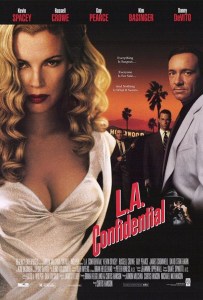 There was no stopping Titanic in 1997, iceberg be damned. James Cameron’s epic disaster movie had all the momentum of the times, and yet it’s a smaller movie that captured more of the critics and was far more deserving of the ultimate Oscar prizes that year. L.A. Confidential was based upon a James Ellroy novel that many argued was unfilmable. Enter journeyman director Curtis Hanson and novice screenwriter Brian Helgeland, and the pair stripped the book down from eight main characters to three, kept the spirit and essence of the book alive while rearranging the storylines for large-scale popcorn thrills. It’s been nearly twenty years since L.A. Confidential first seduced big screen audiences and its powers are still as alluring to this day. It’s a neo noir masterpiece.
In 1950s Los Angeles, not all is what it seems. The captain of the police, Dudley Smith (James Cromwell), is looking to keep the peace in the City of Angels as outside criminal elements are looking to fill the void from Mickey Cohen going to prison. Three police officers of very different stripes find themselves on the edges of a complicated murder case stemming from a massacre at the Nite Owl cafe. Ed Exley (Guy Pearce) is the son of a famous police captain and wants to rise up the ranks as quickly as possible. He’s a political animal and unafraid of ruffling feathers. Bud White (Russell Crowe) is a bruiser of a man who enforces his own level of justice when it comes to men who beat or harass women. Jack Vincennes (Kevin Spacey) is a happily shady officer who serves as a consultant for a hit TV police procedural. The Night Owl case takes them into many sordid corridors of sex, money, and power, including Lynn Bracken (Kim Basinger), part of Pierce Pratchett’s (David Strathairn) stable of prostitutes meant to look like movie stars, the mysterious self-serving sources to tabloid journalist Sid Hudgens (Danny DeVito), and good cops and bad cops on the controversial L.A. police force.
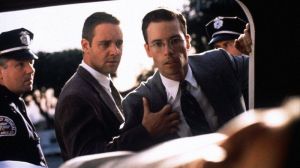 This movie is a master class in plotting and structure, enough that it should be taught in film schools. By nature noir plots are meant to be busy and mysterious, and a guarantee for mystery is a Byzantine plot full of plenty of suspects, dispirit elements, and strange coincidences that eventually coalesce into a larger picture. The beauty of what Hanson and Helgeland have done is that they have made the script complex yet accessible, able to lose one’s self in the tangled web of intrigue but still able to see how all the myriad pieces fit perfectly together by the conclusion. There is an efficiency to the screenwriting that is mesmerizing. It all seems so effortless when you’re with storytellers this gifted or who have a divine connection to the source material. Forgoing the customary slow builds of recent film noir like the oft-cited Chinatown, L.A. Confidential just moves from the opening narration. Within the first 25 minutes, the movie has expertly set up all three of its main characters, what defines them, their separate goals, the obstacles in place, and previews how they will intersect into one another’s orbit, and then the Nite Owl case explodes. Every scene drives this narrative forward. Every scene reveals a little more depth to our characters or fleshes out a superb supporting cast. Every scene cements that contradictory theme of the glitzy allure and unseemly darkness of the post-war City of Angels. My only quibble is that before the truncated third act the movie resorts to a few easy shortcuts but by that point Hanson and Helgeland had more than earned their paces. This is one of the greatest modern screenplays, period (WGA listed it as #60 all-time).
There are so many remarkably assured sequences but I want to emphasize one in particular – Exley’s interrogation of the three Nite Owl suspects. “Oh I’ll break him,” Exley promises his superior before entering into the first interrogation room. At first you’re with the other officers and morbidly curious with his arrogance. By the end, your jaw hangs in amazement at the intuitive pressure this man is expertly applying. It’s a terrific moment that allows Exley to masterfully manipulate three different men, taking pieces and running toward accurate insinuations, building momentum and clarity. Each man is different and each man offers a new piece of the overall puzzle. A slight reference by one unlocks another’s confession. An overheard sound byte pushes another into self-defense. I’m convinced it was this scene that ensured robust and thorough interrogation was a crucial element of the gameplay for the 2011 video game L.A. Noire, a noble misfire that definitely looked to replicate Hanson’s film as a user experience.
 Noir is one film genre with a visual code that can get the best of directors, but Hanson played this to his advantage. Classic noir is filled with criminal activity and the allure of sex and violence, typified perhaps best in the position of the untrustworthy but oh-so-sexy femme fatale. Yet the majority of film noir was produced in an era of censorship thanks to the implementation of the notorious Hayes Code, making sure that audiences didn’t enjoy the sordid elements too far. Free of these restrictions, some modern filmmakers take the opportunity to revisit the noir landscape and fill in the blanks of old, furnishing an outpouring of unrestrained exploitation elements. Brian DePalma’s 2006 film The Black Dahlia (also based on an Ellroy novel) gets drunk on this mission, though “restrained” has never been a word I would associate with DePalma’s filmmaking anyway. My point, dear reader, is that it’s easy to get lost in the superficial trappings of the genre: sexy dames, corrupt lawmen, temptation, shootouts, schemes, and chiaroscuro lighting. It’s easy to dabble in these elements because they’re so nostalgic and celebrated.
Hanson did something different with his 1997 masterpiece. He builds upon the audience expectations with noir but he doesn’t let his complex story and characters come second to the visual spectacle of the famous genre. L.A. Confidential is in many ways a movie that straddles lines; old and new, indie and Hollywood classicism, and film noir and drama. It’s an adult film that doesn’t downplay its darkness, brutality, and moral ambiguity, yet when it comes to those exploitation elements, especially sex, it’s almost chaste. The relationship between Lynn and Bud seems refreshingly square, like it was pulled from Old Hollywood. The entire movie feels that way, an artifact that could exist any decade.
Hanson was something of a journeyman for most of his career, directing competent thrillers like The Hand That Rocks the Cradle and The River Wild. As Variety film critic Owen Gleiberman wrote in his eulogy for Hanson (he died in September 2016, a fact I shamefully didn’t know until writing this review), after 25 years in the industry the man became an earth-rattling auteur after the age of 50. That is a rarity. Who knew the guy had something this singularly brilliant within his grasp his entire career? The care he puts into the screen is evident from the opening montage onward. There’s an elusive magic to the filmmaking on display, a bracingly divine sense of how to move the camera for best effect, how to escalate and deescalate audience nerves. He knows his story structure and characters inside and out, but he also knows how to play an audience. His time making serviceable studio thrillers certainly helps him during the film’s climax, a bloody shootout that’s also a mini-siege thriller.
 Hanson also assembled an incredible crew to enable his vision. The technical elements recreate the early 1950s L.A. time period with beguiling immediacy; the cinematography by Dante Spinotti (Heat) gives a sense of the darker elements just under the surface without having to overly rely upon the film language of staid noir visuals. Peter Honess’ sharp editing provides a downright Thelma Schoonmaker-esque musical orchestration to the proceedings, especially as the multiple storylines and developments spill onto one another. Speaking of music, the score by Jerry Goldsmith (Star Trek) is thick with the jazzy overtones of the genre. It’s a score that simmers with sexual tension and malevolence. The casting director deserves a lifetime free pass. There are a whopping 80 speaking parts in the movie, and each person is a great hire that builds a richer film.
While the plot of L.A. Confidential sucks you in right away, its characters take hold the strongest. Film noir is one genre that has a codified cheat sheet of character archetypes, and this movie fulfills and subverts them, finding surprising and gratifying ways to further round out these figures into complex and nuanced human beings. The three main characters all provide a different approach to law enforcement and when we see them start to work together it’s a wholly wonderful turn of events. Bud is the muscle, Exley is the brain, and Vincennes is the charm, and each one attacks the Nite Owl case and its subsequent leads from different angles that best apply to their set of skills. Each of the three characters discovers new pieces of evidence, new contacts and suspects, and when they start to work together it not only provides a payoff with the combined evidence but with the satisfying nature of their teamwork. That’s because they become better people when they work together and each moves closer to some moral redemption.
Bud is the loyal cop with a hair trigger and a penchant for being a white knight to abused women. His personal history of abuse makes him seek justice, often by his own fists. He has a rigid moral code of right and wrong and isn’t afraid to cross lines to achieve it. He’s also tired of being a bully and wants to be more than just the muscle. Exley is a straight arrow with a strong sense of moral righteousness and a mind for politics. He knows how to play sides for his own gain. He’s not afraid of making enemies within the department, and his opportunistic choices create many. He’s trying to forge his own path outside the shadow of his father, a famous lawman who was gunned down by a random purse-snatcher (“Rollo Tamassi”). He has to learn that he can’t do everything on his own. Finally, Vincennes is in many ways the face of the department as an ambassador to the world of TV and film. He’s succumbed fully to the glamour of Hollywood but he’s also full of profound self-loathing, trying to count how many compromises he’s made in life and where it’s gotten him. The appeal of the old life is crumbling and his detective instincts are reawakened, spurring Vincennes into the fray and surprising even himself. It’s extremely rare for any movie to successfully develop more than one protagonist, let alone three, and yet L.A. Confidential achieves this milestone so that when we alternate perspectives there isn’t a drop in viewer interest. Each man brings something different and interesting, each man reveals new hidden depths, and each character is fascinating to watch in this setting.
 The gifted actors take the already excellent written material and elevate it even further, turning an already sterling movie into one of the all-time greats. Almost twenty years later, it’s fun to see these famous actors when they were young and, arguably, in their prime. Spacey (House of Cards) was on a tear at this point in his career, between his two well-deserved Oscar wins, and having the time of his life in every role. His character seemingly has the least complexity, a man who knows he’s sold out but believes himself to be enjoying the ride, but Spacey offers poignant glimpses of the man behind all that oily charm and sly glances. There’s a scene where he stumbles across a mistake of his making and the subtle, haunted expression playing across his face is amazing. The man was capable of expressing so much, and still is. Crowe was still a couple years from his big breakout in 2000’s Gladiator but he put himself on the Hollywood map as Bud White. He’s a coil of anger and pain looking for an outlet, and Crowe is magnetic as hell. His glowers could burn right through you. Pearce (Memento) was another knockout that solidified leading man status thanks to his performance as the rigidly self-righteous Exley. He’s a character that thinks he’s above moral reproach, and his humbling is a necessary part of solving the case. Exley is constantly surprising his peers and it feels like Pearce does the same, showing exciting new capabilities from scene to scene, from his stirring hire-wire act with the interrogation scene to his understated glimmer of fear through a poker face. These three performances are golden.
Nobody better represents sleaze than Danny DeVito’s character and the man brings a merry lechery to his tabloid journalist/exposition device. His unquenchable thirst for the worst in humanity to sell more papers feels even more sadly relevant given the media climate that contributed to the recent presidential election. Kim Basinger (Batman) won an Oscar for her somber performance, which reinvigorated her career. She’s good but I can’t help but feel that she won the Oscar in a weak field (my choice would be Julianne Moore for Boogie Nights). David Strathairn (Good Night, and Good Luck) is enjoyably nonplussed as a man who specializes in delivering vice. James Cromwell used every bit of audience warmth associated as the loveable farmer from Babe and used that to his advantage. His pragmatic police captain is a father figure for Exley and the audience and perfectly sets up a turn that leaves the audience spinning even twenty years later.
There are little details the could go unnoticed but confirm for me just how much thought was put into L.A. Confidential. Exley is chided by his superiors for wearing glasses as they think it makes him look weak. As the film develops and he gets more immersed in the Nite Owl case, his compulsions against violence and rash judgment start to waver about the same time he stops wearing his glasses, a subtle symbol of his difficulty to see things for what they truly are. I enjoyed that our introduction to Lynn is in a liquor store and she’s wearing a winter cloak that strongly resembles a nun’s habit. It’s a memorable costuming choice and also suggest Lynn’s penchant for straddling the line of devotion. The Patchett “whatever your heart desires” line of high-class prostitutes has allusions to our current media culture of celebrity worship and personalized sexual fantasies. It naturally ties into the exploitation of the dream factory of Hollywood that takes young ingénues with dreams in their head and squashes them pitilessly. It’s not the first film to explore the darker side of the film industry but that doesn’t make its themes lesser.
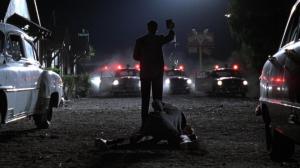 L.A. Confidential feels like the noir thrillers of old but stripped down to its essentials and given a new engine. It’s something that celebrates noir thrillers of old and Old Hollywood but it isn’t so lavish to either the genre or older time period that it loses sight of its own storytelling goals. The elaborate plot is complex and intensely engaging while still being accessible, populated with memorable and incredibly well developed characters, each given their own purpose and own insights that contribute to the larger whole. Hanson’s lasting accomplishment is a near-perfect masterpiece to the power of story structure and characterization. The three lead detectives are compelling on their own terms and the movie keeps them separate long enough that when they do come together it feels like a payoff all its own. Hanson recreates the world of classic film noir and makes it his own, using new Hollywood to lovingly recreate Old Hollywood. It’s the kind of movie I can watch again and again and discover new depths. It gave way to a wave of success for its participants. Hanson never quite delivered another movie on the level of L.A. Confidential, though I’ll posit that In Her Shoes is an underrated character piece. Helgeland has become a go-to screenwriter for many projects low (The Postman) and high (Mystic River) and became a director for A Knight’s Tale and 42. It’s a movie that plays just as strongly today as it did almost twenty years ago, and that’s the mesmerizing power of great storytelling and acting. L.A. Confidential is a lasting achievement that proves once more the power of our darker impulses. It’s stylish, seductive, smart, subversive, and everything you could ask for in a movie.
Nate’s Grade: A
Share this:

The Birth of a Nation (2016)
 Sold for a record $17.5 million at the Sundance Film Festival, there were big expectations for the Nat Turner biopic, The Birth of a Nation. Writer/director/actor Nate Parker was the toast of the town and the studio had its sights set clearly for a fall release and a big Oscar push. Then came the revelation from Parker’s past linking him to an accusation of sexual assault (it should be noted he was acquitted of the charge, though it should also be noted the woman declined to continue pressing charges during the second trial). Suddenly the Oscar hopes for Birth of a Nation were put into a tailspin and journalists were wondering if this salient news would provide older Oscar voters just the excuse they needed not to watch the movie. After having finally seen the film for myself, I can attest that this movie wasn’t going to go far into the Oscar race anyway. My friend Ben Bailey said it best as we walked out of The Birth of a Nation, making an apt comparison to the 2013 Best Picture Winner: “12 Years a Slave was a better movie made from a less interesting story; and this is a more interesting story but given a much lesser movie.”
In 1830, Nat Turner (Parker) is earning extra money for his friendly slave owner (Armie Hammer) as a preacher, convincing slaves on other plantations to work harder and obey their cruel masters. He reaches a breaking point and organizes a revolt, violently killing the same plantation owners that kept them in bondage. Nat felt his revolt could be the catalyst for slaves all over, but it was put down by overwhelming forces two days later.
 Nat Turner is a historical figure extremely deserving of a big Hollywood spotlight. The problem is that Parker’s movie feels like the arthouse version of the Hollywood Martyr Blockbuster, a field popularized by director Edward Zwick (Glory, Blood Diamond). This thing checks just about all the formula boxes you’d expect by showing the arc of a character called into action, forced to take a stand against an exploited people and series of injustices, and the eventual death for the cause. It’s meant to be inspirational but that sense of inspiration can be capped when you see the machinations. All storytelling at some level is about pulling the strings of an audience, but the storyteller must do their best to make this as nonobservant as possible so as not to disturb the experience. Parker doesn’t have that skill quite yet, either as a director or as a screenwriter.
His movie kept my interest but I felt oddly removed from it, unable to fully absorb the characters, which should never happen in a revolt against slavery. Case in point, we know how the movie is going to end so Parker needs to engineer something of a win for Nat, and that’s where Raymond Cobb (Jackie Earle Haley), nasty slave catcher, comes in handy as a conquerable antagonist. He ends up being the man responsible for chasing Nat’s father away, so it’s even more personal. During their final fight, Cobb implausibly wrestles atop a struggling Nat (this guy has to be at least 60 years old and it’s Haley, not Stallone). Parker even includes the knife that’s just… out… of… reach. I rolled my eyes. Parker shouldn’t have to resort to these tactics to rouse his audience, and as stated above, they’re just too nakedly transparent in their formula machinations. I wanted more suspense sequences like during the opening when Nat’s grandmother has to think on her feet to conceal contraband, smart uses of dramatic irony and ratcheting up the tension. The movie is structured too narrowly as Nat’s call to action, but Parker seems preoccupied with hitting all these other checkmarks to fully open him up as a human being.
Structurally, this movie is amiss because we don’t need 90 minutes to justify why slaves would violently revolt against their masters. The best part of Birth of a Nation is its final act when the revolts come and the slave owners get what they have coming. Some will equivocate that not all slave owners abused and terrorized their slaves to the same degree of abject cruelty, but the very nature of owning another human being is an assault on fundamental morality. 12 Years a Slave had an excellent 15-minute section where it disproved the notion of the “good slave owner” with Benedict Cumberbatch’s character. Even he too was corrupted because the institution of slavery is a corrupting agency. What that movie was able to communicate in 15 minutes is what The Birth of a Nation takes 90 minutes to do the same. The entire movie should have been the slave revolts with some choice flashbacks interspersed to give the movie even better context for the personal animosities against specific slave owners. That way we can better explore the emotional side of Nat Turner and his company without resorting to extended degradation. Parker deserves some credit for being very tasteful in his depiction of the brutality against slaves and the heavy heart of aiding and abetting an unjust system. It doesn’t whitewash, so to speak, the horror of slavery but also refrains from exploiting tragedy for easy gains. With that being said, and I may be alone in this observation, but I found it a bit peculiar that the sexual violence committed against women seems to be primarily framed as how it impacts the male characters, making them sad or angry at the mistreatment of their women. I may be over-analyzing this but it happens twice and stuck out to me. The structure of the movie does a disservice to the emotional power it demands, and Parker should have shown us the bloody campaign rather than the lead-up to the campaign.
Parker also shows some noticeable shortcomings when it comes to directing his fellow actors. His performance is a highlight and his moments where he’s trying to hold back the tide of mixed emotions working for the slave owners and using Scripture to justify the worst of the worst. This is a great showcase for Parker as an actor of suitable range. It’s not a great showcase for any other actor. The performances are a bit big when needing restraint, and a bit broad when nuance would be required. There’s no character that even comes close to the deeply wounding impressions left by the brilliant Lupita Nyong’o and Michael Fassbender from 12 Years a Slave. Hammer (The Man from U.N.C.L.E.) is given one note to play after the first act and that is aspiring drunk. I don’t know if there’s a scene where he isn’t accompanied by some bottle. It’s meant to communicate his increasing sense of shame he has to excuse, but it’s also a fairly facile acting crutch. The women in the film come across as angelic (there’s even a vision of an actual angel in the film) or maternally strong as steel. The lack of variance becomes frustrating, as it seems that Nat Turner is the only character, and by extension actor, allowed depth. You’ll enjoy the actors on screen but be scratching your head to recall anything memorable.
 The Birth of a Nation is very purposely meant to evoke the title of the famous 1915 D.W. Griffith movie, the world’s first film blockbuster and also virulently racist to its core. It’s about the formation of the Klu Klux Klan in a Reconstruction era to save all the honorable white people from the new hordes of wanton free slaves. It’s deeply offensive though an undeniable touchstone in the history of narrative filmmaking. I was looking for some kind of larger thematic connection beyond slavery but it seems that Parker’s movie is meant to be a reclamation of the title. There’s a moment at the very end that made me think that there was another possibility (spoilers). As Nat Turner is executed, one of the last images is a close-up on the face of a young teenage slave who witnesses his death. The camera then pulls out and that boy has aged into a man and is fighting with a battalion of other black soldiers during the Civil War (the movie literally becomes Glory!). I was wondering if we were going to continue skipping forward in time, next to the Civil Rights marches, next to protests against police brutality in the modern era, so that Parker was drawing a direct line from the experiences of old and how they have shaped the America of today, the birth of our current national racial injustices. This doesn’t happen, unfortunately. The Civil War flash forward is the only jump in time.
I’ve been critiquing Nate Parker’s movie for the majority of this review and I don’t want to leave you, dear reader, with the false impression that this is a bad movie; overrated and slightly disappointing, yes, but not bad. If it didn’t sound like faint praise I would say that The Birth of a Nation is a perfectly fine movie. It held my attention though I kept thinking of other ways this movie could have improved, from a restructured plot that begins with the slave revolts, to more attention to the supporting characters, to less fidelity to the patented formula of the Great Martyr Biopic. This was a passion project for Parker and took him over six years to complete. Walking out of my theater, I simply didn’t feel like that same passion was evident on the screen.
Nate’s Grade: B-
Share this:

Sully (2016)
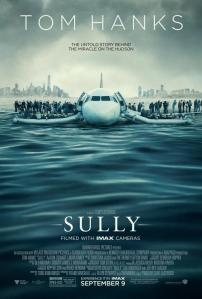 I think I had the same initial thought that most did when they saw the news that there was going to be a movie about the Miracle on the Hudson airline pilot: where exactly is the feature-length story? The flight itself lasted only about 200 seconds before landing on the river, and the sequence is thrillingly recreated and held off until halfway through the movie. The hero in the cockpit, Sully (Tom Hanks), is consumed with ensuring each and every last passenger is accounted for. When he gets the news that all survived, he can finally allow himself to breathe, to take in the full magnitude of the events, and it feels like a cleansing moment of deep emotional catharsis for him and the audience. But what’s the movie here? Apparently the NTSB and the airline insurance companies are disputing whether Sully could have safely landed the plane back at an airport instead. It’s exactly the kind of flimsy, manufactured conflict that sets itself up for moral grandstanding and a courtroom confrontation where our heroes will be vindicated, and we get all that. Sully’s unexpected spotlight wears on him as he feels like an ordinary citizen not worthy of the term “hero.” No other plane has successfully landed in water without a loss of life, so I’m sorry pal, but you’re a hero, even if you think you were just doing your job. Hanks is suitably low-key and humble and strong and emotionally resonant, though he was better on just about every front with Captain Phillips. The direction from Clint Eastwood is respectful without going into hagiography. The overall message is one of uplift, widening the focus from Sully to other heroes in New York City that day that came together to help others. It’s a moving message without having to resort to melodrama. At a mere 96 minutes, Sully gets you in and out and provides a solidly entertaining glimpse at the people who rose to the challenge when needed most. It’s a well-made movie that goes as far as it can without trying your patience.
Nate’s Grade: B+
Share this:

Carol (2015)
 Have you ever watched a movie that was so understated you wanted to jump into the onscreen world and push the characters around? That’s exactly how I felt with Carol, an unrequited lesbian romance set against the closeted and intolerant era of 1950s America. Carol (Cate Blanchett) is a rich wife who meets Therese (Rooney Mara), a department store employee who assists with her Christmas shopping. They are both drawn to one another in the strange way that love works, and their possible relationship could jeopardize Carol’s custody of her young child. Because of the time period, so much of this romantic liaison is internalized and thus we get longing looks, small gestures that are meant to speak volumes, and plenty of starting and stopping, leaving the audience to fill in the blanks. I don’t have an issue with unrequited romances but Carol is one that feels like its entire world, painstakingly recreated, has been placed under glass for study. There’s no passion evident throughout the movie and I was left wondering what exactly Therese saw in Carol and vice versa. Neither woman has a particularly strong personality, though that could be a side effect of having to live publicly as a different person. I couldn’t get into them as characters and so felt little interest in seeing them together, which made the constant circling and nervous indecision even more belabored. Blanchett and Mara are quite good and director Todd Haynes (I’m Not There) handles the material with respectful subtlety, I just wish that Carol could have shaken off some of that subtlety and given me a better reason to care about these women. It’s understated to death.
Nate’s Grade: C+
Share this:

The Big Short (2015)
 Adam McKay is not exactly the kind of name you associate with a prestige picture that’s building serious Oscar heat. McKay is best known as the director and co-writer of Will Ferrell’s best movies, from Anchorman and its sequel to Talladega Nights and the underrated 2010 buddy cop movie, The Other Guys. If you stuck through the closing credits for Guys, you were treated to an animated education lesson on the size of Wall Street’s greed and accountability in regards to the 2008 financial crisis. It was impassioned, angry, and an interesting note to end an otherwise goofy comedy. The Big Short is based upon Michael Lewis’ (Moneyball) best-selling book and it’s a disaster movie where the biggest disaster is the world economy. The movie McKay co-adapted and directed is bristling with intelligence, indignation, and a clear purpose. He wants to make you very angry, and by the end if you’re not, you haven’t been paying enough attention.
In the wake of the financial collapse in 2008, the fallout was so tremendous that many people felt nobody could have seen this coming. There were a few and they made out like bandits while trying to warn others about the impending doom. In the early 2000s, Michael Burry (Christian Bale) is a hedgefund manager who sees warning signs that the housing market is a bubble ready to burst. He sees the toxicity of the majority sub-prime mortgages wrapped together and sold as a seemingly safe security, a CDO (collateralized debt obligation). His bosses think he’s mad and they’re furious when they discover Burry has gone from bank to bank making big bets against the housing market. The banks are eager to take what they believe to be easy money from a sucker. How could the housing market burst? Other Wall Street investors take notice of Burry, notably Jared Vennett (Ryan Gosling) who pitches the plan to “short” the housing market. Nobody takes him seriously except Mark Baum (Steve Carell) and his small team who works for Goldman Sachs. Baum is curious how something so large could go unnoticed, so he and his team fly to Florida and Vegas to investigate the realities of the market and what they find does not match the rosy cheerleading from Wall Street. A pair of wannabe traders (Finn Witrock, John Magaro) stumbles across Burry’s analysis and try to make their own bets, except they need a bigger name to make the trades. They reach out to an ex-Wall Street trader (Brad Pitt) who agrees to shepherd them on this quixotic quest. Are these men righteous defenders of fraud or just people trying to get their own cut of the pie?
 The brilliance of The Big Short lies in its accessibility and the virulent passion that McKay has for the subject matter. The movie is structured like a heist and an underdog story, suckering in the audience to root for the upstarts trying to fleece the big banks and profit off their greed and stupidity. For the first 90 minutes or so, the film comes across like a caper and we follow our group of misfits as they fight against the conventional wisdom that the housing market could never topple. These guys see the signs and the risks that others could not or would not see, especially since the flow of money was rich and the good times could be shared, which lead to collusion from the very same agencies designed to regulate and enforce the financial laws. For those 90 minutes the movie flies by on its sense of whimsy and are-we-getting-away-with-this good fortune, putting our band of misfits in position to win big on the losses of the ignorant and fraudulent. And then, in one swift move, it all comes down and you’re reminded, rather indignantly by Pitt’s character, that what they are benefiting from is the meltdown of the U.S. housing market and by extension the American economy. What once felt like a celebratory caper now starts to feel queasy, and it’s in the last act that The Big Short reminds you just how awful the events of the 2008 financial crisis were and how these guys did nothing more than benefit from mass misery. These are not heroes, though Mark Baum is given plenty of moral grandstanding moments that present him as the closest thing we have in the picture. These were a bunch of guys who got rich betting on a lot of other people’s bad bets, bets that almost destroyed the world’s economic systems. The concluding half hour feels like a sudden stop after a sugar rush, where you’re left to question your decision-making but also come to terms with the reality of what seemed like a fun time. McKay lures his audience in with the guise of a heist/underdog story, appealing and accessible avenues of cinema, and then serves the cold hard medicine in the concluding moments.
McKay is admirably trying to educate and advocate while he entertains, but he truly wants the audience to understand why they should be sharpening their pitchforks. At several points, characters will break the fourth wall and talk directly into the camera, admitting that certain events didn’t happen exactly as we saw, or occasionally they’ll remind us that what we watched was exactly how it happened. It’s a measure that isn’t overplayed and helps juice the spirits of the movie, becoming something of a confidant in the schemes with the onscreen participants. When things gets a little hard to understand with the mountain of Wall Street lingo, McKay will cut to celebrity cameos to help explain the more arcane instruments of the financial system. Margot Robbie luxuriates in a bubble bath and explains sub-prime mortgages, Anthony Bourdain explains CDOs, and Selena Gomez, in a rather cogent analogy, explains synthetic CDOs as an endless chain of side bets being made off one hand of blackjack. The movie goes pretty fast and a viewer might experience information overload but McKay knows when to slow things down and provide a well-timed assist so that his learned audience will see the true extent of the corruption and greed rampant in how Wall Street handled its business.
 Of the three storylines, I found Mark Baum and his team easily the most interesting and I think McKay and co-screenwriter Charles Randolph (The Interpreter) agreed, which is why he’s the biggest part of the movie. Burry gets things started but he recedes into the background after the first act, and that’s where Baum and his financial team step into the spotlight to further explore how unstable the housing market just might be. I think this is Carell’s best dramatic performance to date (I wasn’t wowed by Foxcatcher). He’s playing perhaps one of the angriest people seen on screen but that’s because he has a moral center and the bad business practices, let alone the sociopathic greed of his “peers,” constantly enrage him. He’s something like a flabbergasted crusading journalist who keeps shaking his head in stupefying revulsion at just how deep this whole thing goes. Having Baum as our entry into the moral morass of Wall Street allows the audience to feel a sense of ethical superiority, and then like Pitt’s character, it can all go away with one perfectly articulated retort. There’s a moment where Baum is lambasting a mortgage ratings officer (Melissa Leo, her only scene too) after she admits that if they don’t rate bad mortgages as good, the banks will just go to their competitor, and then she accuses Baum of being a hypocrite. His reason for the office visit is not his outrage at the fraud but the fact that this fraud is holding up his winnings. He’s not the crusader he may wish to be. Bale (American Hustle) and Gosling (Only God Forgives) are perfectly cast and provide strong supporting work in small doses spread throughout. Pitt is in 12 Years a Slave producer mode where he knows he needs to appear in the movie to better sell it to audiences, and so he’s here and rather unremarkable. There is a bevy of familiar faces (Marisa Tomei, Rafe Spall, Max Greenfield, Karen Gillan) appearing in small moments as if everybody in Hollywood wanted to get in on McKay’s party.
There is one annoying misstep in the movie and it occurs about halfway and it’s made to stretch out the stakes in a haphazard manner. The Big Short is a disaster movie where the audience knows exactly when the disaster is coming, and yet there’s a section in the middle where the characters are all left in doubt whether their big bets will pay off because of the ratings fraud. Burry is threatened with losing his job. It’s silly because we know the economy is going to crash in 2008, but the movie throws out a weak obstacle that, hey, maybe it won’t crash. It reminds me of the Hinderberg movie from the 1970s. There were several moments where it looked like that zeppelin full of hydrogen was going to go up in flames… except students of history know that moment is fated in New Jersey, so all the close calls were foolish fake-outs for a major event that was well anticipated. We all know the economy is going down so there’s no need for the manufactured doubts.
McKay and company want to wake up a fairly apathetic general public about the crimes and negligence of the Wall Street robber barons that risked the world’s economy and then managed to skip out on the tab. The tones can juggle wildly, and I’d credit McKay’s background in comedy for his ability to maintain a reliable and firm comic footing for the film without losing the significance of his message. It’s hard to nail down a genre for the movie; it’s a dark comedy, a drama, a true crime picture, and a wake-up call. You have moments that feel like a heist flick and moments that feel like a sickening journalistic expose. It’s got highs, lows, laughs, groans, and plenty of human emotions, though the most prominent would be disgust and disbelief. The Big Short is advocacy populism as pop-entertainment, and it succeeds ably. It’s an economics lesson for the public. At the end of the movie, the closing text informs us about “bespoke tranches,” which are investment opportunities that banks are flocking to ($5 billion in 2013 to $20 billion in 2014). It’s just another name for CDOs. Unless an informed public demands action from the system, it seems that Wall Street is doomed to repeat its same high-risk mistakes and that same vulnerable public is doomed to clean up the mess.
Nate’s Grade: A-
Share this:

The Revenant (2015)
 Which do you value more, verisimilitude or narrative? If you’re looking for an intense, immersive filmgoing experience that’s just as harrowing as it is beautiful, then perhaps The Revenant is your movie. If you are looking for characters and a story to engage with, then maybe it won’t be. Leonardo DiCaprio plays the real-life frontiersman Hugh Glass who was mauled by a bear and left for dead by his companions. He miraculously survives and tracks down those who betrayed him for some frontier justice Under the unyielding vision of director Alejandro Gonzalez Innarito (Birdman), the movie opens up its scary world with an exhilarating sense of detail. Inarritu favors lots of natural light and long, gorgeous tracking shots, which creates a spellbinding sense of realism. The attacks and escapes and moment-to-moment survival communicate the remarkable dangers of this natural world. The cinematography by Emmanuel Lubezki is flawless, using light and camera placement to stunning effect. However, The Revenant (meaning a person who has come back from the dead) is a series of beautifully rendered moments delicately stretched over a ponderous running time of 157 minutes. There’s just not enough plot events to fill that running time, so to compensate Inarritu gives way to some Terrence Malick (Tree of Life) impulses that try for philosophical poetry but miss. DiCaprio is getting plenty of plaudits for his demanding role, and he’s quite good and visceral (and no, he does not get raped by a bear). I was more impressed with Tom Hardy, who plays the target of Glass’ fury. Hardy imbues depth into his antagonist, and while you won’t exactly be rooting for him to get away you can see the guy as more pragmatist than mustache-twirling rogue. He even has an interesting back-story surviving being scalped that informs his decision-making. Much of the film is watching Glass endure physical hardship after physical hardship, which may grow wearying for many audience members, especially those most squeamish. When it’s firing, The Revenant is a magnificent and stunningly realized survival thriller with sprinkles of engaging human drama. The problem is that there isn’t enough to go around for its running time.
Nate’s Grade: B
Share this:

Anomalisa (2015)
 It’s been seven long years since the last Charlie Kaufman movie graced our screens. Cinema needs a voice as wonderfully strange and intelligent as Kaufman’s, and if it wasn’t for a successful Kickstarter campaign in 2012, we might have had to wait even longer. The stop-motion animated film Anomalisa is one of Kaufman’s most accessible movies and it involves felt puppets. Think about that for a second.
Michael Stone (voiced by David Thewlis) is a successful motivational speaker traveling to Cincinnati for a brief conference. He’s supposed to give a keynote speech on the importance of treating the customer like they are special; however, Michael is trapped in a purgatory of redundancy. Every other human being looks the same and sounds the same (all voiced by Tom Noonan), even Michael’s wife and young son. Then he hears a voice that breaks from the conformity of Noonan’s vocal chords. The voice belongs to Lisa (voiced by Jennifer Jason-Leigh), an unassuming and unabashed fan of Stone. She’s bright and lively but guarded due to a facial burn that hampers her self-esteem. She’s eager to spend time with Michael and confused when he insists on spending more time with her. Men usually gravitate to Lisa’s more carefree and forward friend. Not her. Over the course of that night, Michael and Lisa navigate one another. He’s fascinated to hear a new voice and wants to know all he can about her. She’s flattered with the sincere consideration. Michael only wants to be with Lisa from now on, but this decision will have consequences and it feels like there is an invisible force fighting against their union.
 I still can’t shake the fact that there seems little reason for this movie to be animated. Perhaps it’s the fact that it started as an oral play, but the use of the animation medium and everything it can provide so rarely feels utilized. The repeated faces of all the other humdrum human beings in the world, that wider-eyed gnome-like face, is a fine touch but the same could be accomplished through rudimentary computer effects now. Hell, Kaufman’s own Being John Malkovich achieved this in a memorable scene and that was over 16 years ago. I won’t pretend to know the economics of the animation industry but I just assume anything as time-consuming and precise is going to be pricey (reportedly the budget was $8 million). I thought of money during the first thirty minutes. It’s almost like a bet, as if Kaufman and co-director Duke Johnson (TV’s Frankenhole, Community) were trying to animate the banality of a business trip just because nobody has ever done it before. Here are a short list of other things, I assume, have escaped being replicated in animated form: waiting in line at the DMV, looking for a lost TV remote, cleaning one’s ears, watching the Republican presidential debates, changing the toilet paper roll, and filling out the iTunes user agreement. Would any of these banal acts deserve to be animated? Probably not, but I’m sure that’s the point for Kaufman and Johnson. For the longest time we’re meant to live the empty existence of Michael Stone and so we spend thirty minutes making pained small talk, checking into a sterile hotel room, calling loved ones, reconnecting with an ex, and visiting a sex shop in a drunken haze. My friend Ben Bailey asked the same question at five-minute junctions: “Is anything going to happen?”
Once Lisa is introduced, the movie finds its footing and purpose and it is a relief. Maybe that was Kaufman and Johnson’s design so that we, the audience, would also feel the same elation. The rest of the movie is watching a love affair, two people coming into one another’s orbit. The dialogue exchanges are very natural and slowly reveal different layers of the characters, mostly Lisa. Michael is intoxicated and demurs often, instead only wanting to hear the sweet sound of her voice. There’s a delicious irony to Michael working in customer service, an industry that is often listening to people’s angry voices over phone lines, and his inability to distinguish speech. Instantly we get a strong understanding of just how desperate Michael is to form a real connection. It’s his fawning attention that allows Lisa to allow herself to be vulnerable and assertive. In one of the most realistic sex scenes ever captured in movies, Lisa communicates what she wants and what provides her satisfaction, and Michael dutifully abides, determined to hear the sounds of her wonderful voice reach climactic degrees of pleasure. The love scene has garnered plenty of press just for the fact that it’s an animated film and our two characters are fully rendered, though this goes beyond just having recognizable parts. The way the bodies move, the way the lines and creases fold, the way people react to the inherent awkwardness of sexual congress, it’s all faithfully recreated and done so without a hint of comedy. This is by no means the raucous copulation from Team America. It’s a surprisingly touching moment as these two characters simply connect on a few levels.
It’s after the sex scene that everything changes. I’ll forego spoilers and say that there’s a certain buyer’s remorse when it comes to impulsive love affairs, and trying to maintain that same feeling of ecstasy can be like chasing a drug that requires more and more of oneself. There’s a very interesting transition that brilliantly illustrates Michael’s anguish. The conclusion is at once inevitable, hopeful, and also despairing. That’s because it opens up the world in a new way and provides further examination on Michael and the consequences of his crushing depression. The core of the movie is about the need for human connection. I wouldn’t cite Kaufman as a romantic but he does prioritize human connection and believes in the power of those fleeting moments. Aren’t we all looking for our own anomaly, someone whose voice slices through the din? Once those moments run their course, some of us grieve and some of us ascend, made stronger and more complete from the sum total of those magical experiences. The ending provides a new lens to interpret the movie, though most viewers will have already suspected given the mundane prison of the world onscreen. It’s not exactly a twist ending but more a confirmation that Michael Stone is personalizing his misery and unable to escape it. All he can look forward to are those fleeting moments of human connection and hope.
 The stop-motion animation is impressive though it seems intentional to elicit a certain strangeness. Stop-motion used to have that certain stutter-stop movement that made it wonderfully alien. With advances in technology, stop-motion can now look as seamlessly animated as other forms of the medium, as evidenced by the wonderful Laika releases like The Box Trolls and ParaNorman. Johnson and Kaufman decided to use felt dolls which allows the characters to have a certain glow to them, as if they’re emanating some internal lightness of being (apologies to Kundera). The illusion is getting easier to hide. Johnson makes the decision to show the seams of his universe. The facial marks that indicate the interchangeable partitions remain visible, making the Noonan-voiced characters look like they’re all wearing glasses. It’s an animated movie that wants to remind you it’s animated but tell a story that doesn’t need the assistance of animation. That’s one unconventional goal. I’ll admit that it did tickle me to watch the ongoing troubles of getting a room key card to work. Johnson also makes use of long takes to better communicate the reality of this world, from the mundane to the ecstasy. There’s one dream sequence that dips into more identifiable and surreal Kaufman territory, but excluding this moment the movie is mostly the ordinary fixtures of ordinary hotel rooms.
Following the uniqueness of its idiosyncratic creator, Anomalisa is unlike anything else out there and an animated film that is nakedly personable and desperate to grasp for something richer and more meaningful. I can’t say that this was a story that demanded to be told through this style or animation or if it even benefits from this approach, but Kaufman’s ear for human relationships is still sharp and refined. It’s like watching a stage play that just happens to be made with felt puppets that oddly feel very real. It’s a movie that has different layers of what constitutes reality, given an extra sheen of artifice. It’s a movie that conveys the hopes and disappointments of human connection from the awkward to the mundane to the revelatory. The film does an excellent job of communicating the all-encompassing heaviness of depression, how the ordinary can be just as soul crushing and harmful. And yet the film ends not on Michael but on Lisa and on a degree of hope, that the chance encounters that mark our lives are not without consequence and benefits, aiding people to take needed steps outward. It’s a movie about the significance of human connection; something that Michael desperately spends years looking for again, to feel fully human once more, to ignite the synapses. Anomalisa is a thoughtful and touching story. I don’t know if it’s an excellent movie or an unnecessary adaptation of an innately affecting stage play, but it’s Kaufman as romantic and cynic. Who knew puppets could get so deep?
Nate’s Grade: B+
Share this:

Brooklyn (2015)
 If you’re looking for an Oscar movie this award season that will be perfect for grandparents, I direct you to the perfectly pleasurable Brooklyn. Beyond the throwback to the 1950 setting, it’s a movie that can appeal to multiple generations of audiences. There’s an admirable classical sense of filmmaking with Brooklyn, a delightful and charming movie with a healthy dose of nostalgia and heartfelt sincerity that should find a wide range of appeal to all ages.
Eilis (Saoirse Ronan) is an Irish immigrant who leaves her sister and mother to start a new life in Brooklyn. Thanks to a kindly Irish priest (Jim Broadbent) who had settled from her village, Eilis finds housing and a job. New York takes some getting used to, especially the density. Eilis is attending night classes to become a bookkeeper, but by day she works at a department store counter. It’s at one of the socials in her new Irish neighborhood where she meets Tony (Emory Cohen), a smitten yet confident Italian boy. She agrees to go on a date, actually two upfront, and it’s no time before Tony is walking her home from her night classes and talking about all his dreams. Eilis must return to Ireland for a family emergency. While she’s there, a bookkeeping job opens that needs her help, and a nice boy named Jim Farrell (Domhall Gleeson) grows closer to her with affections that aren’t exactly unwarranted. Eilis must decide which place to call her home and which life she wants to seek.
 While the story is set in the early 1950s, this movie could have been made in any decade of the film industry. It would not be out of place with the films of the 40s and 50s, hopeful and romantic odes about women finding new lives in the land of opportunity. There’s a classical sense to its storytelling that is rather universal about the struggles of self and independence. While this movie is awash in the period details of 50s New York City, it really could be told anywhere. The personal struggles of Eilis are completely relatable, which makes her an instantly engaging heroine. She’s a kind-hearted woman who’s trying to step out and discover who she wants to be, and this promising reality is a pleasure to watch. We’re watching the maturation of a person, watching her find her footing and gain confidence small victory after small victory. There aren’t any large or arch plot events to navigate. It’s the small moments in life, from starting a job, to becoming more sure of one’s self, to knowing whom to open up and trust. The movie is kept at a pleasantly low simmer of intensity, which works just fine. The gentle tone does not imply a lack of urgency but more so the beguiling and romantic spell. Thanks to writer Nick Hornby, who is becoming an ace screenwriter, the movie tells such a heartfelt and emotionally rich and resonate story in 100 carefully paced minutes. There’s a general joyous sensation that washes over you, elongating smiles naturally. The dialogue is often clever without being glib and the characters come across as realistic and humane. There’s only one character that is thinly drawn to approach being stock (well two counting the precocious “tells it like it is” kid). The others are hopeful, yearning, and fundamentally decent people. There’s something quite nourishing about watching decent people try and navigate their desires while maintaining their decency.
I think that’s what makes the love triangle work as well as it can, the fact that both options, not just the gentlemen at the center, are appealing. New York and Ireland both present options that afford Eilis opportunities in a career she wishes to pursue, both have compassionate men who have expressed an interest in her and are supportive of her education and goals, and both locations have a support system of friends. It may sound boring that Eilis can’t really go wrong with where and whom she chooses but I think that makes the ultimate decision that much more engaging. If these options weren’t so appealing then it wouldn’t be so interesting to watch. The mistake is that because the choices are good that there is less at stake when the opposite is true. She could rightfully be happy with either choice but which representation of Eilis will she decide? One life represents the old, the other he new. As I stated above, the characters in Brooklyn have an commendable decency to them, which makes the love triangle more difficult. Tony loves her completely but fears she may not come back, and yet he knows he has to let her go and she has to decide on her own where to call home. Jim is thoughtful and even though he obviously has feelings for her Jim knows that now is not the right time to ask, and so he too waits and hops he presents enough worth staying over. It’s a love triangle where you like all three participants, which happens so rarely in movies.
 Another strength of the film is that Ronan (The Grand Budapest Hotel) delivers a wonderfully felt performance. Much is placed upon her shoulders as our entry point into this world, and Hornby doesn’t resort to his characters explaining everything they’re thinking and feeling. Eilis is a woman who doesn’t speak in paragraphs but in short succinct sentences. She’s guarded but observant, and Ronan’s face is our great tapestry for understanding Eilis and her changing demeanor. We can watch her process the intimidating and invigorating world and read her thinking. It’s the most realistic Ronan has come across on screen as she has a habit of coming across slightly robotic, whether it’s as a pint-sized killer (Hanna), slain teenager (The Lovely Bones), or whatever the hell they were going for with the atrocious Violet & Daisy. With Ronan’s care, Eilis comes across like a resourceful young woman who is growing her sense of self. She’s a deserving lead for our simply story told with excellent care.
The only problem with a simple story told well is that it can also be predictable, which is a minor fault that doesn’t negate the impact of Brooklyn’s conclusion but does make it easy to anticipate. I’ll dance around spoilers but in a way I feel like even discussing the topic is going to be sufficient for you, dear reader, to accurately infer what direction the movie takes and which choice Eilis makes in the end. In short, Eilis makes a decision before leaving back to Ireland that somewhat stacks the deck in the favor of one of the two locations. This kept me from feeling like the choices were evenly considered. In the end, it’s a decision for Eilis about embracing her home and native culture and sense of community or branching out on her own and building something new and exciting. It’s possibility and independence versus comfort and family. It’s what can be versus what she’s known. It’s a decision that is universally relatable. Few of us have had romantic suitors and prosperous situations to vie over but many people have to make the normal decision of what path to embark, whether it’s the risk of something different or the reassurance of what is familiar and what has been earned. These aren’t the life-and-death stakes we see typically in the movies but they’re the decisions that often dictate fates.
Brooklyn is an easy movie to be carried away with. It’s full of honest and earned emotions that resonate from its reletability, tender heart, and gentle observations of watching a woman navigate the choices of her life. It’s an immigrant story and a coming-of-age tale, a romantic triangle with some fish-out-of-water elements. It’s a lot more than the sum of its parts, but with actors this good and with a script this tailored to deliver emotional uplift and satisfaction, those are some mighty impressive parts. If you’re on the hunt for a feel-good movie that won’t make you roll your eyes or overdose on sap, then I advise you and your family take a trip to Brooklyn and enjoy the sights.
Nate’s Grade: A-
Share this:

The Danish Girl (2015)
 While you watch The Danish Girl, you can feel the full weight of everybody’s good intentions. The filmmakers and cast all seem to realize that they are telling a story that will humanize and help others better understand trans issues. It’s the first sexual reassignment surgery and a community that is still fighting for wider acceptance. Nobody wants to screw up this story and do a disservice to representing the stories of the trans community. You feel the earnest good intentions with every frame, and yet I would argue those same good intentions end up paralyzing the movie and its impact.
Lili Erbe (Eddie Redmayne) is living her life as Einar Wegener, a Danish landscape painter of some renown in the 1920s. His wife, Gerda (Alicia Vikander), is a portrait artist trying to be more than the wife of a famous painter. One day, Gerda’s model is absent and she asks Einar to step in. He puts on stockings, holds a gown to his body, and it’s a revelation. Soon after Einar is wearing women’s garments under his clothes and Gerda dresses him up with makeup and a wig. It’s a fun diversion and something of a turn-on for Gerda, and then her husband informs her that Lili isn’t the costume, Einar is. Lili tries to find a sense of explanation with disdainful psychiatrists and doctors but is deemed aberrant. Lili is struggling with this crisis of identity and self-acceptance, and then a new beginning emerges with a helpful doctor who can physically transform Lili from a man into a woman. The surgery is not without risk but Lili is willing to do whatever it takes to feel whole (note: since Lili is the chosen gender identity for the film’s subject, I shall be referring to her as Lili and using feminine pronouns).
 Redmayne (The Theory of Everything) gives a suitably affecting performance that is full of empathy and a halting sense of fragility. He seems like he’s about to crumble at any moment, his nervous smile and pleading and confused eyes communicating Lili’s trepidation and flights of exciting discovery. Redmayne’s delicate androgynous features and long-limbed dancer’s body play to his strengths, as he adjusts his physicality to reflect his mind’s experimentation of what it would be like to be a woman. There’s a rather lovely visual where Lili visits a peep show in Paris. After a few minutes of bashful eye contact, she begins to mimic the peep show model’s physical poses, and the camera’s focus melts between the two. It feels like a dance between the two and in this simple visual much is communicated. Unfortunately, the majority of the movie lacks the impact of this poignant visual. Redmayne too often retreats into his stable of nervous gesticulations and halted speech. It’s a performance that feels too detached and too opaque to make you feel the full turmoil of Lili. There’s an interesting moment when, dressed as Lili, a smitten man kisses her without permission. Lili is upset at the lack of consideration, to which the man replies, “I couldn’t chance you saying no.” That little moment highlights the challenges of women in a society that doesn’t respect their agency. It’s too bad the movie doesn’t present more scenes that explore this new dynamic that Lili will have to adjust to. Instead the move repeatedly falls back on her as Brave and Strong. As presented, Lili is more catalyst than a fleshed-out character, which is remarkable considering the movie is reportedly about her struggles. Rather, the real focus of the story seems to be Gerda, who, incidentally, is the only person on screen referred to as “the Danish girl.”
Gerda is given equal attention in the screen adaptation by Lucinda Coxon (The Crimson Petal and the White), which is generous and will likely leave several viewers confused. First, Gerda is given the most complete character arc and a surprising amount of consideration for her perspective. I suppose she could be the audience’s entry point into this story, the relatable position for many audience members trying to better understand a loved one saying they were born in the wrong body. The movie presents greater empathy for Gerda’s plight than it does Lili, which is definitely unexpected and perhaps misplaced. Surely finding the courage to embrace a controversial identity that precious few will even acknowledge, let alone the bastions of contemporary medical science declaring such thinking to be signs of a degenerative brain, is a bit more of a risk than being a supportive spouse. I don’t want to mitigate Gerda’s own personal struggles dealing with the outward transformation of Einar into Lili. It’s a position that deserves deep empathy and the movie has it in spades, as we watch Gerda try to be supportive while the person she fell in love with erases himself. Vikander (Ex Machina) also kills it. Her performance is full of the breadth of emotions that I found wanting in her screen partner. Vikander’s face registers all the complicated emotions; she’s in a sense saying goodbye to her husband and a specific life they shared, and while for her it can feel like mourning, for Lili it is a rebirth. Viankder’s compassionate and nuanced performance as Gerda is the exclamation on one hell of a year for the Swedish actress.
Director Tom Hooper (Les Miserables, The King’s Speech) gives everything the proper stately appearance with his signature visual indulgences (the man loves his asymmetrical one-shots and generous head room in the camera frame). There are several landscapes or venues that look gorgeous or given a dream-like sense just from Hooper’s framing. His handling of his actors is first-rate, and there’s a comfortable sensuality to scenes between Einar and Gerda, further communicating just how enraptured each is with the other. The musical score by Alexandre Desplat (The Grand Budapest Hotel) is a bit over excited to explain all the many emotions you should be feeling, but other than that the technical aspects of The Danish Girl are pleasing to the senses and enhance the story. I just wish the screenplay gave us so much more to think about when it comes to Lili.
 As a strange aside, I’d like to question what the MPAA is referring to with its disclaimer that The Danish Girl is R-rated for such content as “full nudity.” I understand the concept of partial nudity since you’re only seeing a fraction of the form, but what exactly makes one’s nudity full? Do they mean “complete” as in you see everything, front to back? If so, I thought that content was already covered in the oft-used term of “graphic nudity.” For you ratings aficionados out there, or people who are intrigued with arcane movie trivia like myself, I’ve discovered that “graphic” often means two things: the sight of a penis or pubic hair. If its breasts, bottoms, or female genitals absent the appearance of hair, it’s commonly categorized plainly as “nudity.” There’s likely a larger essay on why male genitals are thought of as “graphic,” and especially why seeing pubic hair on women is somehow a sight in need of more forewarning than simply “nudity,” but I’ll set that bit of cultural soul-searching aside for a later day. If you must know, there’s a brief shot of Redmayne tucking his genitals behind his legs and creating the image of a woman. I double-checked and the MPAA hasn’t revised the rating rationale for 1991’s Silence of the Lambs (also a prominent film tuck display), but I’ll let you know, dear reader, if any more information comes across my news desk on this very weird subject.
Tasteful to a fault, The Danish Girl is a reserved biopic that goes about its story with a sincere and earnest sense of responsibility. It wants to tell its story correctly instead of telling its story in the best-developed and executed fashion, and there is a difference. The performances are strong, though Viankder is the standout as the film’s surprising focus. Redmayne feels too timid and fragile to make Lili’s story resonate beyond common human compassion. The screenplay doesn’t place us insider her mind. Instead, we’re treated more to how Lili’s choices are impacting her supportive but anguished wife. In 1930, a mere four months after the fourth and final surgery, Lili died from complications related to the operation, lending a greater sense of tragedy (this fact is left out of the concluding text). It’s a movie that feels too distant even from itself. Everything is so reserved, so tasteful, so artfully opaque, so afraid of making the wrong step that The Danish Girl ends up being an Oscar-bait biopic that feels too hesitant and bloodless.
Nate’s Grade: B-
Share this:

Room (2015)
 It’s hard to think of a more emotionally grueling and uplifting movie this year than Room. It drops you right into a scary world and, thanks to its carefully balanced tone, the film eschews sensationalism and gets at the beating heart of its survival story, namely the love and protection of a mother for her son. It is an emotionally powerful story that hits the big moments, the small moments, and everything in between. It left me analyzing it and rethinking it for hours, the repercussions still reverberating through me.
Ma (Brie Larson) has been held in a single soundproof room for seven years, the captive of an older man who is termed “Old Nick” (Sean Bridgers). Complicating matters is that Ma has a five-year-old son Jack (Jacob Tremblay) born into this captivity. It is the only world he’s known. To spare him the full horror of their circumstances, Ma has created an elaborate world for him that only exists in Room. After his fifth birthday, Ma tries speaking honestly to her son, lifting the veil of kind fabrications. Together they will scheme to escape their one-room world, but it comes with tremendous cost.
 It would be easy to fall onto the more unseemly elements of this harrowing story and linger on just how bad things are and the horrifying lengths that Ma has to go through to survive. Director Lenny Abrahamson (Frank) doesn’t have to wallow in depravity to get its point across. There’s a sensitivity that manages to temper some of the abuse in a manner that won’t make you run out of the room screaming. When Old Nick enters the room for his special time with Ma, we don’t need explicit detail to understand what is happening and what Ma is shielding Jack from by demanding he stay in the closet. The reality of their captivity is enough without underlining the worst of the worst for the lowest common denominator. The emotional weight of everything is clear without having to be bludgeoned. The implications are always just peaking around the corners from the safer version of reality Ma has proposed to protect her child. As the audience, we can see the cracks, we can see her front, and we can see the effort and the toll it’s taking on Ma. The stakes are clear as well, and so when Ma is instructing Jack and preparing him on their joint escape plan, you’ll start to feel waves of anxiety travel through your body. I was shaking with suspense that something could go wrong but also because Ma and Jack are such vulnerable characters that rely upon one another completely. I knew what was going to happen in broad strokes but I was still on the edge of my seat and that’s because the movie made me deeply care about the characters and their plight. The escape scene was on par with some of the better suspense sequences in the equally brilliant Sicario.
It’s not really a spoiler to say that Ma and Jack do get out of their one-room prison because the second half of the film deals with the ongoing consequences and challenges of adjustment. We’d like to think that we can be plugged into our old lives after spending time away, but that’s just not how things work, let alone for people who have experienced substantial psychological and physical trauma. Ma is struggling to readjust to her old life under the care of her mother, Nancy (Joan Allen). She looks through old high school pictures and you can tell she laments “what could have been” and even bears some resentment for her old friends who got to live the lives she should have had. Just because she’s free doesn’t mean she’s better. Her father Robert (William H. Macy), since divorced from Ma’s mother, can’t even look at Jack because of the pain it causes; Jack is a child of rape, but Ma demands he be acknowledged as her flesh-and-blood, and even that can be too much too soon for Robert. He’s more about seeking justice through the courts and as a result stays on the peripheral of the story for most of the movie. There is no exact time table for PTSD and Ma goes through highs and lows, none lower than when pressed with the question of why she held onto Jack after he was born. Would he not have had a better life in someone else’s care, assuming Old Nick would have abandoned him rather than kill his own blood? It’s a hard question and it stings.
For an obviously punishing story about the worst of humanity, I am not kidding when I say Room is an uplifting film. The darkness is easy to identify and Old Nick is a fearsome and all too real antagonist, one who could roam our very streets in anonymity. However, what stays with me several days after watching Room is not the suffering but the resiliency of spirit, the knack human beings have to persevere amid the worst. Ma’s recovery is rockier but more understandable for us to trace and relate with. Hers is an experience where she can finally begin to focus on something other than her child’s safety and deliverance, namely her own well-being. For Jack, there is no playbook. He’s spent his entire life inside a small room and never seen the outside world. His sense of understanding has been extremely limited and yet his sense of exploration is alive. Jack slowly and surely builds trusting relationships with Ma’s relatives, engaging in other activities, and acclimating to his new surroundings, reforming his sense of the world. It’s ultimately Jack who is able to make the greatest breakthrough to his mother, and it’s this moment of sacrifice and love that unleashed the last torrent of my tears. Previously I had cried two times over the horrors and Ma’s love as her strength, and it was this final moment, this sharing of his “Strong,” that let loose the happy tears.
It should go without saying but Larson gives an exceptionally powerful performance. After 2013’s stupendous Short Term 12, I knew this actress was destined for great things, especially the way she can zero in on a character and inhabit them fully. With Ma (she’s never given any other name) Larson is able to convey a multitude of emotions, many of which she has to hide from her son out of loving deference. He can’t know just how scared and exhausted she is, though these emotions do take over at time. Larson is tremendous as she exhumes maternal might as she does everything in her power to save the two of them. Early on, she’s the character we empathize with the most because she’s had her world taken from her and hoping to return. She’s so resourceful, from the way she’s able to answer her son’s questions about the world, to the way she’s able to practice and drill their escape plan to a child with no concept of “outside,” this is a powerful woman driven by the instinct to endure. When Larson’s façade breaks down with Jack, that’s when the movie started stabbing me like daggers. In the second half, her character has a long road to go to recovery, if that’s even an appropriate word, and Larson gives sensitive and empathetic consideration to every exhausted development. She is easily going to be the one to beat this year for the Best Actress Oscar.
 Paired with Larson is the remarkably natural child actor Jacob Tremblay, and his performance is worthy of awards consideration itself. At first his worldview is precocious because of how unique it is, which makes him more a figure of fascination than tragedy. He’s bright and active with the world around him, turning household items into useful toys and emotional attachments. The film uses parts of his narration to give better insight into just how he’s processing the world he knows versus the world as it exists. These bouts of narration never come across as cloying. As the movie continues, he learns more about how his preconceptions of the world are wrong, but he’s more intrigued than frightened. During the escape plan, when Jack gets to see the outside world for the first time, it’s a transcendent emotional moment. His guarded behavior around others is necessary as Jack builds positive associations with men who are not Old Nick. Tremblay is utterly magnificent; there is no hint of artifice to his performance, which is especially rewarding considering his is a role that could have been suffocated with eccentricities and tics. You feel like you’re watching a child grow before you through supportive nurturing.
Within the first twenty minutes of watching Room I already knew this was one of the best films of 2015. It just connects so vividly and succinctly, effortlessly powerful and yet skillfully avoiding sensationalism and exploitation while telling an entertaining survival story that still resonates with emotional truth. The performances from mother and son are outstanding and Larson and Tremblay form a heroic duo that take hold of your heart. It doesn’t mitigate the darkness or the cruel realities of its premise but Room also doesn’t dwell in the darkness, castigating its characters as hapless victims forever broken from their incalculable suffering. They are resourceful and resilient and while their trauma will not be forgotten it is not the one defining moment of their burgeoning lives. It may sound maudlin but it is the power of love that resonates the longest with Room. That love at first is about protecting the innocent, and then it transforms into healing and acceptance. I hope everybody gets a chance to see Room, a remarkable film with two remarkable performances and plenty to say about the humanizing benefit of love.
Nate’s Grade: A


 nathanzoebl
You must be logged in to post a comment.