Blog Archives
Frankenstein (2025)
 One of the reasons Mary Shelley’s novel Frankenstein has been so richly relevant two hundred years later is because of her thought-provoking themes and concepts, which still prove potent with each new malleable reinterpretation from the newest creative caretaker. It’s the “be careful what you wish for” adage combined with man’s hubris and our self-destructive impulses to play with things we don’t fully understand. It’s also a monster story that asks us to reconsider the perception of who the monster may truly be, and under writer/director Guillermo del Toro, the answer is always and forever man himself. This isn’t a surprise from the same filmmaker who gave us Hellboy and The Shape of Water. The man identifies with the monsters more than other people. The man turned his astounding stop-motion animated Pinocchio movie into a deft Frankenstein allegory, so the famous story has been on his mind for quite some time. It’s been an obvious influence, and now that he’s gotten his chance on his own imprint, it’s hard not to see elements of del Toro’s other movies everywhere. It creates this bizarre echo chamber of creative influence where the movie can feel derivative at times even though the source material was an influence on those other del Toro works. It’s just the nature of finally tackling the influence later in his career. It reminds me of 2012’s John Carter, based on Edgar Rice Burroughs’ highly influential sci-fi series, and yet because it took 100 years to leap to the big screen, it couldn’t help but seem derivative of the same popular movies that were inspired by it. This is a convoluted way of saying del Toro’s Frankenstein is a much better Guillermo del Toro movie than a Frankenstein adaptation.
You probably know the story well enough to recite it yourself. Victor Frankenstein (Oscar Isaac) is obsessed with conquering death after his own mother’s demise in childbirth. He gathers the parts of criminals and dead soldiers to reanimate into a new being, a Creature (Jacob Elordi) of superhuman strength and regeneration who cannot die. Victor’s cruelty punishes the Creature and disowns it, setting the stage for a showdown between dysfunctional father and son and the havoc caused by recklessly playing God.
 There are deliberate decisions that mitigate some of the more compelling characterization of the novel. With del Toro’s version, Victor is the clear-cut villain. There’s some setup given to his strict childhood where his domineering father (Charles Dance) would quiz him and physically abuse Victor if he failed to recite the correct answers to his medical questions. Dear bad dad was doing this, you see, out of a belief that good doctors need to know intuitively because any hesitation could cost lives. When we witness Victor abusing the Creature in the same manner, we’re meant to see the connection between abusive fathers confusing disappointment with defiance. In the original story, Victor abandons the Creature on the night of its birth and then it’s gone. In this version, Victor imprisons the Creature, keeps him chained, attempts to train him, grows frustrated, and then tries to destroy the evidence. That’s a little more diabolical than simple morning-after regrets. This Victor can also be viewed as a forefather of incels the way he projects his romantic feelings onto Elizabeth (Mia Goth) and then gets huffy when she doesn’t return them. There are other deaths later in the story that are directly attributed to the Creature that are now Victor’s doing, which continues to squeeze out moral ambiguity from Shelley’s novel. If the Creature is purely innocent and Victor is purely villainous, that makes the relationship between father and son, Creator and Creature, far less meaningful and layered. It’s so obvious that another character, in their literal dying words, says to Victor, “You are the real monster.” It all becomes an ongoing cycle of bad fathers and the Creature ultimately trying to reach forgiveness. Even if the Creature ultimately finds that, is this Victor even worthy of redemption?
Another significant feature of del Toro’s retelling is, how do I put this delicately, the inherent magnetism of the Creature, a.k.a. Sexy Frankenstein. Elordi (Saltburn) is a tall, lithe actor to begin with with classical Hollywood features, but there was a conscious choice to portray this figure in a certain light, a sexy light. You might find parts of you that are suddenly alive while watching the character onscreen. That’s why even though he’s a literal assembly of corpses the makeup effects are very minimal and less intentionally grotesque or monstrous. The delicate lines around his body make me think of a cross between the Engineers in Prometheus and the body paint of that Gotye music video “Somebody I Used to Know.” The gentle makeup is meant to further convey the Creature as a sensitive figure; granted, he’s also capable of ripping the jaw off a wolf. By swerving away from the Creature’s physical deformities, the movie is also inadvertently downplaying the isolation that he felt that led to such rage and resentment. Is this man that hideous that some good woman couldn’t love him as is? The movie is already presenting Elizabeth as someone who sees through to his gentle nature, and she certainly also seems more than a little attracted to what he’s got going on. This Sexy Frankenstein reconfirms del Toro’s penchant for identifying with the monster, the outcasts, the underdogs. However, Sexy Frankenstein also takes something away from the horror and cost of the creation if he’s just going to be another brooding, misunderstood Byronic hero. Still, there are definitely worse pieces of meat you could be watching, so enjoy monster sweethearts.
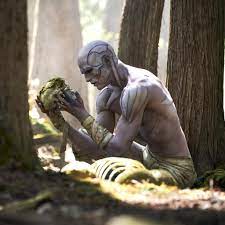 With all that being said, del Toro’s Frankenstein is still a sumptuously made and entertaining Gothic spectacle. The production design is immense and immersive with del Toro’s knack for perfect details to create such a lived-in sense of mood (never enough giant stone face edifices). I loved Victor’s models of human torsos that looked almost like ballet dancers at rest; granted, ballet dancers having their skin peeled back by dozens of hooks. I just wanted to spend as much time as possible soaking up these sets and this heightened Gothic realm. It’s the kind of world where Victor’s laboratory needs to be an opulent abandoned castle complete with a pit in the middle of the floor plan that goes through several floors to a sewar/aqueduct basement level. There’s even what appears to be a water slide out of the estate, and the Creature gets to escape it in the most fun way. The movie is gorgeous with del Toro’s signature orange/green color palette bathing his universe. Even if the story isn’t quite reaching the heights it could, the visuals are always sterling and inviting. There’s also a surprising amount of gore, which maybe shouldn’t have been that surprising. I don’t know if we needed as much of the Arctic framing device, which itself was structured as a series of letters in the novel. It’s a platform for del Toro to demonstrate the Creature’s physical prowess and get some quality big-screen bloodshed flowing. I don’t know if we needed to keep cutting back throughout the whole running time like it’s a Christopher Nolan movie. Regardless, if you’re a general fan of monster movies, there’s going to be plenty here to proverbially sink your teeth into and savor on that super Netflix budget.
Mary Shelley’s Frankenstein gave birth to science fiction in 1818 and the James Whale movies from the 1930s gave birth to some of cinema’s most iconic and lasting images and influences. There’s quite a legacy for anyone who wants to put their own stamp on the material, so it helps that Guillermo del Toro has quite a legacy himself, a career built upon the dark recesses of a verdant imagination (I’ll always lament what could have been his version of The Hobbit movies, alas). His Frankenstein has all the hallmarks of a classic del Toro film experience, from the impeccable technical qualities, to the celebration of the mythic and Gothic, to the sympathetic portrayal of the outsiders condemned by a society too square to accept them, and an unironic emotional undercurrent that can approach self-parody. It’s a little long, a little ungainly in its shape, and a little too simplistic with its themes and characterization, but it can also be fittingly transporting and romantic and easy to feel that swell even if it’s all too familiar. For my money, the best Frankenstein adaptation is still the 1994 Kenneth Branagh version, flaws and all.
Nate’s Grade: B
Share this:

The Flash (2023)/ Spider-Man: Across the Spider-Verse (2023)
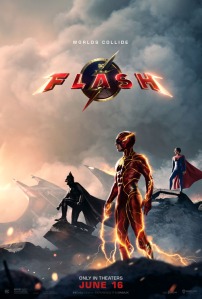
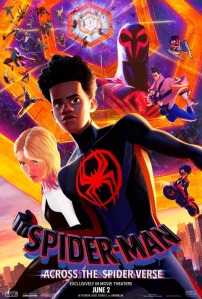
Released within two weeks of one another, two big summer movies take the concept of a multiverse, now becoming the norm in comic book cinema, and explore the imaginative possibilities and wish-fulfillment that it proposes, but only one of them does it well. Spider-Man: Across the Spider-Verse is the sequel to the Oscar-winning 2018 revolutionary animated film, and it’s a glorious and thrilling and visually sumptuous experience, whereas DC’s much-hyped and much-troubled movie The Flash feels like a deflated project running in place and coming apart. Let this be a lesson to any studio executive, that multiverses are harder than they look.
Barry Allen (Ezra Miller) has the ability to travel at fantastic speeds as his superhero alter ego, The Flash. He’s tired of being the Justice League’s errand boy and still fighting to prove his father is innocent of the crime of killing Barry’s mother. Then Barry discovers he can run fast enough to actually travel back in time, so he returns with the intention of trying to save his mother. Except now he’s an extra Flash and has to train his alternate self (also Miller) how to control his powers. In this different timeline, there is no Justice League to combat General Zod (Michael Shannon, so thoroughly bored) from destroying the planet for Kryptonians.
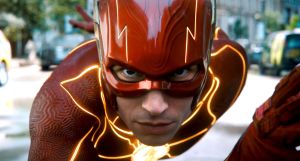
This is the first big screen solo outing for The Flash, and after none other than Tom Cruise, Stephen King, and James Gunn calling it one of the best superhero movies of all time, it’s hard to square how trifling and mediocre so much plays out as an example of a creative enterprise being pulled in too many directions. Miller was cast as the speedster almost ten years ago, and this tale has gone through so much tortured development, leaping through numerous filmmakers and writers, that its purpose has now gone from being a pillar of the expanding DC cinematic universe began with Zack Snyder’s Man of Steel in 2013 to becoming the Snyderverse’s death knell. The premise of traveling back in time is meant for Barry to learn important lessons about grief and responsibility and the limits of his powers, but it’s also intended as the reboot option for the future of these cross-connected comic franchises. It allows Gunn, now the co-head of the new way forward for DC movies and TV, to keep what they want (presumably Margot Robbie and Jason Momoa) and ditch the rest (Henry Cavill, Ben Affleck, Black Adam, Shazam, and Zack Snyder’s overall creative influence). So reviewing The Flash as only a movie is inadequate; it’s also a larger ploy by its corporate overlords to reset their comic book universe. In that regard, the quality level of the movie is secondary to its mission of wiping the creative slate clean.
Where the movie works best is with its personal stakes and the strange but appealing chemistry between the two Millers. It’s an easy starting point to understand why Barry does what he does, to save his mother. This provides a sturdy foundation to build a character arc, with Barry coming to terms with accepting his grief rather than trying to eradicate it. That stuff works, and the final talk he has to wrap up this storyline has an emotional pull that none of the other DCU movies have exhibited. Who wouldn’t want one last conversation with a departed loved one, one last opportunity to say how you feel or to even tell them goodbye? This search for closure is a relatable and an effective vehicle for Barry to learn, and it’s through his tutelage of the other Barry that he gets to see beyond himself. The movie is at its best not with all its assorted cameos and goofy action (more on both later) but when it’s a buddy comedy between the two Barrys. The older Barry becomes a mentor to himself and has to teach this inexperienced version how to hone and control his powers as well as their limits. It puts the hyper-charged character into a teaching position where he has to deal with a student just like him (or just him). It serves as a soft re-education for the audience alongside the other Barry without being a full origin story. The impetuous young Barry wanting to have everything, and the elation he feels about his powers, can be fun, but it’s even more fun with the older Barry having to corral his pupil. It also allows the character an interactive checkpoint for his own maturity and mental growth. Miller’s exuberant performances are quite entertaining and never fail to hit the comedy beats.
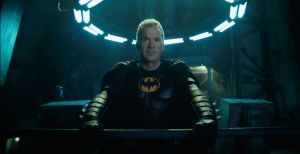
The problem is that the movie puts so much emphasis on too many things outside of its titular hero. Much was made of bringing back Keaton to reprise his Batman after 30 years. I just wish he came back for a better reason and had legitimate things to add. His role is that of the retired gunslinger being called back into action, and there’s an innate understanding with Barry wanting to go back in time and save his family, but too much of this character’s inclusion feels like a stab at stoking audience nostalgia (the callback lines all made me groan). I highly enjoyed Keaton as Batman and appreciated how weird he could make the billionaire-turned-vigilante, but he’s no more formed here than a hologram. The same thing happens with the inclusion of Super Girl a.k.a. Kara Zor-El (Sasha Callie). In this universe, there is no Superman, so she’s our requisite super-powered alien that Zod is hunting to complete his plans for terraforming Earth. She’s an intriguing character as a tortured refugee who has lingering doubts about whether humanity is worth the sacrifice, but much of her usage is meant only to make us think about Superman. She’s not given material to make her own impression, so she simply becomes the imitation of the familiar, the shadow to the archetype already being left behind. But these character additions aren’t even the worst of the nostalgia nods, as the final climactic sequence involves a collision of worlds that harkens to just about every iteration of the famous DC heroes, resurrecting several with dodgy CGI and uncomfortable implications (spoilers… the inclusion of George Reeves, when he felt so typecast as TV’s Superman that he supposedly killed himself because he thought his acting career was over, can be galling).
The action of The Flash is mostly fine but with one exceptional example that boggles my mind. In the opening sequence, no less, Barry is trying to help clean up a crumbling hospital when it collapses and literally sends a reign of babies falling through the air. I was beside myself when this happened, horrified and then stupefied that this absurd action sequence was actually happening. Barry goes into super speed to save the day, which more or less reverts the world into super slow-mo, though he needs to power up first, so we get a quick edit of him stuffing food into his face to load up on calories. We go from Barry breaking into a falling vending machine, stuffing himself in the face with snacks, getting the green light from his suit which I guess measures his caloric intake, and then grab a baby and literally put it in a microwave to shield it from danger. Just describing this event makes me feel insane. I figure the filmmakers were going for an over-the-top approach that also provides light-hearted goofiness to separate the movie from the oppressively dark grist of Snyder’s movies. However, this goes so far into the direction of absurdity that it destroys its credibility. It’s hard for me to fathom many watching this misguided and horrifying CGI baby-juggling sequence and say, “Yes, more please,” rather than scoff and shake their head. It’s not like the rest of the movie keeps to this tone either, which makes the sequence all the more baffling. There are Flash rules that are inconsistently applied to the action; Barry’s caloric intake is never a worry again, and the effects of moving a person during super speed don’t ever seem to be a problem except for one spewing gross-out gag.
While not being an unmitigated disaster, it’s hard for me to see the movie that got so many figures in the entertainment industry raving. The Flash has some notable emotional stakes, some amusing buddy comedy, and some goofy special effects sequences that run the gamut from amusing to confounding, but it’s also quite a mess of a movie, and too many of its nods to the fandom feel like empty gestures of nostalgia compensating for imagination. For all it gets right, or at least keeps interesting, it seems like another cog in a multi-billion-dollar machine, a stopping point also intended to be a reset and starting point. It feels like the character wasn’t trusted enough by the studio to lead his own solo movie even after years of buildup with Miller, nine seasons of the popular TV series, and 80-plus years of prominent placement in DC comics.
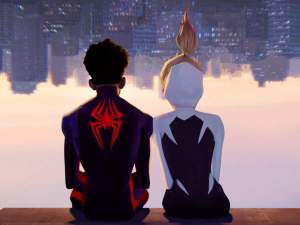
Conversely, Across the Spider-Verse is a sequel that expands an already stuffed story but knows what stories and themes to elevate so they don’t get lost amidst the fast-paced lunacy. Taking place a year later, Miles Morales (voiced by Shameik Moore) has grown into his role as the new Spider-Man for his world. He strains to meet the expectations of his parents, and keep up his grades, while fulfilling the duties of a superhero jumping into danger. When Gwen Stacey (voiced by Hailee Steinfeld) reappears to discuss joining the multiverse police, Miles jumps at the chance, having genuinely missed his other Spider friends, especially Gwen. There are countless Spider people in countless worlds, even including a Spider-T. Rex and a Spider-Car (Peter Parked Car, I believe the name was). Miguel O’Hara (voiced by Oscar Isaac) is the Spider-Man tasked with keeping order across the many interconnected multiverses, and he insists that sacrifice is essential to maintain balance, one that hits too close to home for Miles to abide.
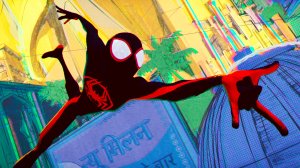
The 2018 original is a hard act to follow, and while Across the Spider-Verse doesn’t quite overrule its predecessor it is a more than worthy sequel that has everything fans loved about the first trip. The visual inventiveness has been taken even higher, with the mixture of even more different animation and art styles. I loved seeing each Spider person and how they fit into their unique art style of their world, like the living water colors of Gwen’s world and the punky paper collage style of Spider-Punk (voiced by Daniel Kaluuya). There’s a villain that comes from a paper universe, so he resembles a three-dimensional paper construction with hand-scribbled notes appearing around him like Da Vinci’s commentary. There is something to dazzle your senses in every second of this movie. The visuals are colorful, creative, and groundbreaking with the level of detail and development. There’s probably even too much to fully take in with just one viewing. I want to see the movie again not just because it’s outstanding but so I can catch the split-second vernacular asterisk boxes that pop up throughout the movie. Going further into living comic book aesthetics, new characters will be introduced with boxes citing their comics issue reference point, and certain names and vocab will get their own citations as well. These are split-second additions, nothing meant to distract from the larger narrative. Simply put, this is one of the most gorgeous looking movies of all time, animated or live action. It’s bursting, thrumming, nearly vibrating with life and love stuffed into every nook and cranny, and it’s exhilarating to just experience a vivid, thriving world with animators operating at peak talent.
However, the movie has an engrossing story to better position all those eye-popping visuals. The worry with any modern multiverse story is that the unlimited possibilities of variations and opportunities for characters to do just about anything will overwhelm a narrative, or like The Flash, become a checklist of overburdened and empty fan service. The screenplay by Phil Lord, Christopher Miller, and Dave Callaham is all about relationships. If Miles’ relationship with his stern police lieutenant father (voiced by Brian Tyree Henry) wasn’t such an important focal point, then the emotional stakes of the movie would be meaningless. We see a relatable struggle from both sides, the parents trying to connect with their growing child and give him enough space to find himself, and the child who clearly loves his parents but doesn’t fully appreciate or understand their concerns. They worry about Miles leaving them and whether others will love and support him like his parents. Miles has to experience a wider world of possibility, but these experiences make him appreciate what he has at home, and what could be permanently lost. I don’t mind saying there were more than a few moments that caused me to tear up. I found Gwen’s storyline equally compelling, and her turmoil over keeping her secret identity and then coming out to her father was rather moving. The family bond resurfacing will get me every time, and the simple action of a hug can be as heartwarming and fulfilling as any romantic ode. Across the Spider-Verse makes sure we care about the characters and their personal journeys.
At a towering 140 minutes, this is the longest (American) animated movie ever, and it’s still only one half of a larger story. I knew ahead of time this was only the first part so as soon as we entered Act Three I kept gearing up for the cliffhanger ending. Every five or so minutes I thought, “Okay, this is going to be the end,” and then it kept going, and I was relieved. Not just because I got to spend more time in this unique universe but each new moment added even more to raise the stakes, twist the intrigue, and make me excited for what could happen next. I was shaking in my seat at different points, from the excitement of different sequences to the emotional catharsis of other moments. I cannot wait to experience this same feeling when the story picks back up reportedly in March 2024, though I fear it will get delayed to late 2024.
Even with the unlimited possibility of jokes and silly mayhem, the filmmakers keenly understand that it doesn’t matter unless we care about the characters and their fates. I am shocked that a goofy character I thought was going to be a one-scene joke, The Spot (voiced by Jason Schwartzman), could end up becoming the ultimate destroyer of worlds. I think this reflection nicely summarizes the impeccable artistry of Across the Spider-Verse, where even the moments or characters misjudged as fleeting or inconsequential can be of great power. It’s a movie that is full of surprises and thrills and laughs, all in equal measure, and a blessed experience for a movie fan. In the crush of comic book multiverse madness, Across the Spider-Verse is a refreshing and rejuvenating creative enterprise, one that builds off the formidable talent of its predecessor and carries it even further into artistic excellence that reminds us how transporting movies can be. If you see one superhero multiverse movie this summer, the choice should be as obvious as an inter-dimensional spider bite.
Nate’s Grades:
The Flash: C
Across the Spider-Verse: A
Share this:

Dune (2021)
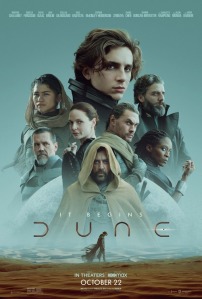
I attempted to read Frank Herbert’s novel Dune when I was in the seventh grade. I had begun to read more fantasy literature and was looking at older, heralded novels. I can still recall my frustration of reading those first five pages and having to repeatedly flip back and forth to a twenty-five-page glossary of terms so that I could even start to comprehend what was happening on the page. After those five excruciating pages, I gave up. Maybe I was too rash, and maybe my older present self would be more accommodating to the struggle, or maybe it just wasn’t worth the effort. I never watched the 1984 David Lynch adaptation that was met with great derision from critics and fans alike, although it does have its vocal defenders (Hindsight alert: Lynch turned down directing Return of the Jedi to helm Dune). So when acclaimed filmmaker Denis Villeneuve (Arrival, Blade Runner 2049) became attached to direct a big-budget, large-scale adaptation of Herbert’s novel, I was finally interested for the first time in my life. It was originally slated to be released in 2020, and after the studio planned to release Dune onto its HBO Max streaming service, Villeneuve and the production company negotiated to make sure a theatrical release would still be an important part of the plan. Alas, I watched the 2021 Dune at home, and I found myself enjoying the experience and development of the world building. However, it’s unlikely to watch this version of Dune and feel like you got a full movie for your money.
In the distant future, like 10,000 A.D., mankind has colonized worlds and the most important planet of them all is Arrakis. It’s a desert world inhabited by poor natives, Freeman, who live a moisture-preserving life mining the natural “spice,” a special substance that makes space travel capable as well as prolonging human life. The top family houses are vying for dominance and House Atreides has been assigned by the unseen Emperor to rule over Arrakis and bring it and its spice production back in line. Duke Leto Atreides (Oscar Isaac) sees great opportunity but also great danger. The other houses will scheme to engineer the failure and desolation of House Atreides, especially House Harkonnen, led by the Baron (Stellan Skarsgard), who is like a mixture between Marlon Brando from Apocalypse Now and Marlon Brando from The Island of Doctor Moreau (plus with levitation powers?). Paul Atriedes (Timothee Chalamet) is his family’s heir and much is expected of him, especially from his mother, Lady Jessica (Rebecca Ferguson), who believes he may be long-prophesied messiah. On Arrakis, Paul and his father must tackle this very delicate new mission while keeping the many adversaries at bay.
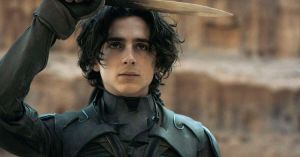
As anticipated, Dune is yet another visually stunning and gorgeously immersive visual experience from one of the greatest visual filmmakers working today. If you can watch the movie on a big screen, or at least a bigger screen, then you owe it to yourself to do so. The sweeping vistas and startling science fiction imagery have so much power and grandeur to them. If Lynch’s movie inspired a generation of devotees and impressionable children, I imagine that this superior modern version will do likewise. The production design and costumes are terrific and perfectly in keeping with the larger scope of the expansive visuals. You really feel the size of this world and its imposing weight. Villeneuve has such a natural keen eye for pleasing visual compositions, but he also has the patience many famous big screen stylists lack. He allows the moments to linger and to let scenes breathe in a way that feels more transporting and immersive. If you were simply looking for a visually resplendent movie-going experience, then Dune is the ticket. The sound design is also very smartly aligned and makes use of unconventional and alien sounds to make the movie feel even more like its own thing. When Dune came out in 1965, this was before much of the modern building blocks of our sci-fi pop-culture, so in a way while Dune was the influence it feels partially like an odd after-effect rather than a predecessor. The same thing happened with 2012’s John Carter, based upon a novel a hundred years old that influenced many sci-fi adventure serials and now seems derivative even though it came before the many imitations. I was happy with the first 90 minutes of Dune and felt like the slow pace of the first hour, and its heft of needed but spaced-out exposition, was paying off with a thrilling assault. The concept of the protective shields is a smart way to communicate the casualties of battle, where “kill shots” are illuminated in red, informing the audience of a mortal wound. It makes for an easy to read visual to keep up with the development of battle and stay in a safer PG-13 realm. The whole rescue sequence on the mining station is thrilling at every step.
The cast is another major credit to the success of Dune. Chalament (Little Women) has a soulful yearning to him, to learn, to be his own man, to prove his father wrong and then prove worthy of his father’s faith. Surprisingly, the next biggest role isn’t Zendaya (Malcolm and Marie), the woman that Paul dreams about (prophetically?); it’s Rebecca Ferguson (Doctor Sleep) as Paul’s mother. She’s a woman with deep secrets belonging to a powerful religious sect that might be the real power behind the throne. Lady Jessica is more Paul’s mentor than any man. She teaches him to hone and focus his mind, to use the “Voice” to impart his will, and to prepare for the hardships to come. With every new exposition dump, and she has many, we learn about her growing concern for the fate of her son and her possible culpability for that fate. There’s a genuine warmth between them that serves as the film’s emotional core. I enjoyed watching Jason Momoa (Aquaman) and Dave Bautista (Army of the Dead) as opposite ends of Super Good Fighter Guy, though Momoa looked unsettling without a beard. Needless to say, the 2021 movie is far more diverse than the 1984 movie. It makes space feel more lived in when it’s reflective of a diversity of people that we already have at this point in our history.
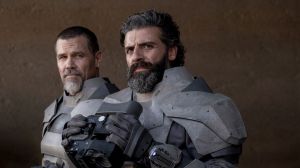
And then, after the hallway mark, Dune became a protracted sequence of chases and then I started to worry that things were just going to end in an unsatisfying manner, relegating the 150 minutes as setup for the as-yet-unplanned sequel, and that’s exactly what happened. My mood began to deflate somewhat during the last hour of Dune. I was still interested and the visuals were still mighty captivating, but the events had the unmistakable feeling of being stretched out to meet a frustrating stopping point, a pause that didn’t produce a satisfying endpoint. I just kept thinking, “Oh, they’re not going to resolve this,” and, “Oh, Zendaya is barely going to be in this movie,” and the movie proved my predictions correct. It’s hard to judge the movie as its own entity since it’s so dependent on a Part Two that has yet to be greenlighted (though its strong opening box-office returns are hopeful). This is an expensive movie, possibly pushing $200 million, so it’s quite a gamble to declare you would only be adapting roughly half of the story. Villeneuve’s Blade Runner sequel, a movie I loved, had a budget of $150 million and a worldwide gross that didn’t make the producers comfortable going forward with a Blade Runner 2050. To be fair, that was an original story, a sequel, and rather well contained. Still, it’s an expensive sci-fi movie that has as much in common with dry art house fare as it does blockbuster adventures, like Villeneuve’s Dune. The promise of a second movie is not secured. If Dune doesn’t do well enough, we’ll forever be left with a movie that feels designed to only be a teaser. It reminds me of the hubris of 2007’s The Golden Compass where the filmmakers had a whole 20-minute finale that they carved out with the intention of having it be the opening for the assumed sequel (welp). Even when designing a multi-movie arc, it’s necessary to plan each entry so that it can exist as its own beginning-middle-end and with a suitable intermediary climax. The Lord of the Rings movies each had their own climax, each moving the larger picture forward, and each had storylines and subplots that came to a head by film’s conclusion. Dune doesn’t. There are more dead characters by the end and certain characters are displaced, but it feels less like the end of the big-budget Dune movie and more like the conclusion of episode two of the Dune mini-series.
My resonance with the source material is minimal, but the world of Dune feels stuffed with stuff and not as deep in the realm of commentary. Fans of the book series will likely thrill at the level of minutia the 2021 movie luxuriates in, allowing fans to lap up the lore. For those of us uninitiated into the fandom, it feels like there could be more going on behind the scenes. The book was released in 1965 and has clear parallels to Middle East occupations and quagmires, a subject even more relevant in the first quarter of this new century. There’s the occupying force coming in to manage the supposedly primitive natives on a desert planet, replacing the last occupier who made bold promises that were unable to be met by the reality on the ground. The parallels of colonialism are there and obvious, but that’s because everything in Dune seems obvious to me. The bad guys are corpse-white and dressed in all black. They look like the alien zombies from 1998’s Dark City (itself referencing the silent sci-fi classic, Metropolis). The leader of House Harkonnen is this noxious man who bathes in black goo and sucks the life force from others. I don’t need my sci-fi to be ambiguous about its heroes and villains. We clearly recognize the bad guys because they’re grotesque. However, the lessons learned by the heroes seem a bit stilted. Its attacks on capitalism are a little more nuanced but not much. The planet of Arrakis could produce water but that’s not in the interest of the power brokers of the galaxy. They need the spice for the economy and thus keep the exploitative status quo. The parallels are there but there’s not much more to be had other than direct summations. The movie has more to say with religion and messiah figures but at this point we’re grading on a curve, and the more complex commentary attached to messiah figures seems reserved for a Part Two.
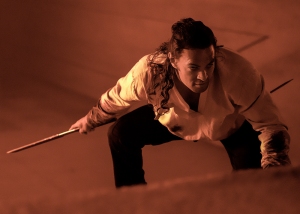
Another aspect I want to highlight that seems trivial but no less intriguing to me is how Herbert chooses his character names. We’re eight thousand years into the future, spanning multiple planets with names like Arrakis and Giedi Prime and Salusa Secondus, and then we have such anodyne twentieth-century names like… Paul and Jessica? It’s funny to me that Herbert goes to the trouble of coming up with so much jargon and terminology and alien-sounding names and then he says, “Hey, this guy’s name is… Duncan Idaho,” like he’s a supporting character in Point Break. I realize this is a very dubious criticism, and there are other character names to conflict with this assertion, but it made me laugh at the different levels of effort Herbert put into his world-building and universe than selecting character names for that same far away land.
After watching the new Dune, I went and watched the 1984 David Lynch version for the first time and was, quite simply, dumbfounded. I’ll credit Lynch for many of the weird choices in style and how it never stoops to even be accessible for a mass audience, despite having characters explicitly narrate their schemes and motivations out in the open (by scene one, the power play that took up 90 minutes of Dune 2021 is awkwardly explained in full). By the end of Lynch’s movie, it is an incomprehensible campy mess. I only have more appreciation for the 2021 Dune after watching the goofy (those eyebrows!) 1980s version that Lynch has disowned entirely, although that stirring guitar riff from the score still rocks thirty years later. The new Dune is only intended as Part One as its presumptive title promises, and because of this key artistic decision, there’s a feeling of padding and wear by the end. I found myself reflecting back on the first 90 minutes more fondly. It’s not that the last hour is absent great moments or audacious style, but it’s hard to fully judge this Dune when its last line is its own conditioning of expectations: “This is only the beginning.” The 2021 Dune is a visually remarkable movie experience with fantastic artists executing at some of the highest points of their talent. I’m eager to see if a Part Two can provide the satisfaction lacking in this beginning half. It’s a hell of a start but it feels too incomplete and in need of an ending.
Nate’s Grade: B
Share this:

Star Wars: The Rise of Skywalker (2019)
 In 2017, there was a great disturbance in the Force when Star Wars Episode 9 director Colin Trevorrow (Jurassic World) was unceremoniously jettisoned. He had spent over a year developing a script for the concluding film in this new Star Wars trilogy (he’s still listed in the credits for story) and I guess the producers must have had some strong feelings. Trevorrow was out and J.J. Abrams returned to close out the saga he had kicked off with 2015’s The Force Awakens. It felt like a safe choice, the return of an artist best known for dabbling in other people’s established worlds. 2017’s The Last Jedi, written and directed by Rian Johnson (Knives Out), was, to say the least, divisive with the fanbase. It made sense to jump back in with Abrams who had delivered a fun, lively kickstart that made box-office records. Surely Abrams and his army of magicians would steer the franchise into safe territory and provide a satisfying ending to the character he created?
Note: I promise to keep this review free of significant spoilers beyond some minor plot points. If you want to avoid reading anything further until after having seen the film, I understand.
The Emperor (Ian McDiarmid) is alive and well and offering a fleet of planet-destroying starships if Kylo Ren (Adam Driver) will kill Rey (Daisy Ridley). She’s trying to uncover hidden clues about her parentage and still believes she can reform Kylo from the dark side. Finn (John Boyega) and Poe (Oscar Isaac) are chasing after a series of artifacts to find the secret location for the Emperor’s secret planet and rebuild the fledgling resistance. Kylo and Rey are headed for a final confrontation to determine whether they turn to the light side or the dark side.
 It is with a heavy heart that I feel like I have to admit that there wasn’t a single storytelling choice that I enjoyed in The Rise of Skywalker. It feels like Abrams and company were in a mad panic after the divisiveness of The Last Jedi and retreated to the safety of nostalgia and fan expectations. This feels like the producers made a list of fan demands and then acceded to them. It certainly feels like an overblown course correction, let alone discarding major changes and characters from Episode 8. Now fan service in itself is not a negative; there is such a thing as good fan service and bad service. The difference is that bad fan service relies heavily on pandering and reference points, leaving an audience unchallenged, and that certainly feels like Episode 9, a movie ever beholden to its calcifying past. My anecdotal evidence already tells me that many fans will love this movie, more than likely the same contingent that found such stinging fault in Episode 8, and I don’t wish them ill. I’m happy for them. For me, Episode 9 is a mess of bad plotting, rushed pacing, truncated character arcs, useless cameos, and a reheated Return of the Jedi climax that was as boring as it was exhausting and dispiriting. It’s supposed to be an end to this new trilogy, and a trilogy of trilogies, but the backwards-looking franchise will never be done paying homage to its cherished past while it eats its own tail until it vomits. This movie is so eager to please as many fans as possible that it feels like an anxious hostage.
I think it was a major mistake for The Emperor to come back into play this late. The very reappearance already cheapens the sacrifice Darth Vader made in Return of the Jedi, and it begs the question what has this evil old man been doing for three decades? Has he just been hanging around his completely empty rock planet sitting on his uncomfortable rock throne? Abrams throws some haphazard lip service that Palpatine was really behind everything, we just never knew it, but that feels cheap. It’s like in 2015’s Spectre when Christoph Waltz emerges and says, “Hey James Bond, while you’ve never met me until this moment, I’m responsible for every bad thing that happened in your life, not those other bad guys, and I just didn’t feel like saying anything.” It wasn’t a satisfying plot development then and it isn’t now. The “boss’ boss” manipulating in the shadows is simply an aggravating shell game. If Palpatine lived even after the second Death Star exploded, then what’s to say if he can ever be defeated? Even if he is toppled in Episode 9, what’s stopping him from being resurrected in Episode 12 to serve as another quick excuse for a major villain? This decision to bring him back to life also taps into a further reverence for bloodlines that The Last Jedi was valiantly fighting against. Star Wars may take place in a different galaxy but it frustratingly feels like only three families populate it. The Last Jedi proposed that you didn’t have to come from select magic bloodlines to be somebody important, that your past was irrelevant, and now Abrams and company sharply reverse course, hugging the concept of the Chosen One until it bursts. It feels creatively starved.
 Too much of the movie’s 142-minute run time was devoted to hasty, convoluted plotting that served little else than to fill time. By the concluding movie in a trilogy, there should be no moments left to fill time, nor should we really be introducing new worthless side characters rather than using the people we’ve already established. The first 90 minutes of this movie could be condensed to “get a thing to get a thing.” It’s one superfluous obstacle after another, one item to gain another, that reminded me of video game fetch quests. Even worse, none of it felt like setbacks or difficulties because the movie was rushing through every sequence. If we have to rush through to cover four abbreviated action set pieces, why can’t we consolidate to two really good and developed action set pieces instead? A great way to make your movie forgettable is to cram it full of disposable plotting and short action sequences that never take off. I kind of liked one lightsaber battle along the surf of the ruins of a Death Star (of course there has to be another Death Star!) but that was it for the action. There wasn’t anything onscreen that even came close to replicating the thrills or suspense from Episodes 7 and 8. I felt more suspense in The Last Jedi for Rose’s doomed sister than I did for anyone in Rise of Skywalker. There was space where Abrams and company could have expanded and developed important themes and given characters room to grow, but the pacing feels so breathless in order to distract from the hasty plot retreats.
Characters feel like they zapped to the end of their character arcs because that was what was expected, but why they reached these milestones feels arbitrary from a plotting standpoint. It reminded me of, I’m heartbroken to even say, the final season of Game of Thrones; fans didn’t object on their face to character destinations but the journey to reach these points felt like it was missing key moments to serve as connection. Why redemption now? Why tempted by the dark side now? It plays more like Abrams said, “Well, we ran out of time folks, so let’s skip to the end.” Looking back on the trilogy, it was clearly Rey and Kylo’s story first and foremost, but the supporting characters ultimately feel abandoned and wasted. Finn had a great perspective, a Stormtrooper who defects, but that unique position is cast aside by introducing a new side character that serves no purpose other than to remind you that Abrams must have really not liked Rose (Kelly Marie-Tran). Seriously, Rose is sidelined to study monitors. Abrams tapped an old Lost alum, Dominic Monaghan, for this thankless duty, so why can’t Rose at least be the sidekick? We don’t need another new sidekick this late. Poe is another wasted character. He learns greater responsibility and teamwork in Last Jedi, but he’s really just a Han Solo stand-in, the rakish rogue quick with a quip. Episode 9 gives him an old flame but not much in the way of additional characterization. He feels the same from his first scene in Episode 7. Oh, and all the forced cameos Episode 9 makes time for feels almost like a Star Wars reunion special. That’s including the awkward use of existing General Leia footage to cobble together something for her. I’m wishing more and more that it was Leia that went badass kamikaze in Episode 8 as her exit.
 At every point, the movie seemed determined to undercut itself when it came to themes, when it came to character growth, and when it especially came to sacrifices and stakes. There are four fake outs when it comes to deaths. What’s the point of sacrifices when it can just be reversed with little explanation? What’s the point of learning when the Force can just serve as a magic hand-wave solution for anything you need? There are some pretty remarkable leaps in what exactly the Force can do in Episode 9. The Rise of Skywalker even resets some pretty inane things, like Kylo Ren gluing his smashed helmet back together or a certain character getting a long-overdue medal for valor. The themes Abrams works with are extremely broad and lack the questioning of the inerrancy of the Jedi order from Episode 8. It’s also confusing when the theme is that your destiny is not written by your station when the movie repeatedly elevates the mythic at the expense of the nuance and human. It’s like saying your past doesn’t dictate your future while slavishly venerating the past at the expense of the present story.
Given the budget, talent involved, and Abrams’ natural pedigree for blockbuster filmmaking, Rise of Skywalker still has moments of grand spectacle and fun. The actors are still enjoyable to watch and Adam Driver (Marriage Story) is the definite MVP of this new trilogy. His character is, by far, the most interesting and the one that goes on the biggest emotional roller coaster. Abrams slides in some rather pleasing visual compositions. The score by John Williams serves as kind of a greatest hit collection of his many themes over the course of the 40-year saga. The denouement feels right, even if I quibble with the final line spoken. There are things to like, plenty, and I know many fans will find even more, but the good is trounced by the mistakes and miscalculations which just happen to be the really big stuff (plot, resolutions, characterization, action development, structure, payoffs, etc). Abrams himself has joked that he’s really good at starting stories and not so great at finishing them, so maybe choosing to have Episode 9 function as a conclusion not just to three movies but to three times three was overburdening.
 I’ve seen it twice now and given some time to think it over, and I think I’ll declare Star Wars: The Rise of Skywalker as my least favorite of the nine core movies. I know these are inflammatory words, and for an easily-inflamed fanbase, but my level of disappointment is immense. I’ve enjoyed both of the previous Star Wars saga installments but I wasn’t quite expecting this. I groaned throughout the movie more than I laughed. Even the much-derided Phantom Menace had less at stake, and that’s why I hold the disappointment of Rise of Skywalker as the more grievous of the two. It had much to accomplish and much to payoff and its missteps cast a shadow over the previous movies. It also reconfirms for me my worry that there will only be a small world for Star Wars, a set of pre-approved parameters that creatives must adhere within, taking the same pieces and delivering variations of the same story. There are definite ideas that could work here with Episode 9, but the rushed pacing, inconsequential plot filler and side characters, and its use of nostalgia as a heat shield (look at that cameo please!) doom its execution. As much as Abrams wants to reject destiny, his Star Wars are still driven by a devotion to destiny. We won’t be getting another Star Wars for several years until 2022 and I think that’s a good thing (also without the Thrones writing team now too). The producers need some distance to determine where to go next. I just hope they understand they have an awfully big universe of untapped stories at their disposal and a wealth of eager storytellers with fresh ideas. Star Wars will always be Star Wars but it can also be much more if it wanted to be.
Nate’s Grade: C
Share this:

Life Itself (2018)

Under the thumb of writer/director Dan Fogelman (TV’s This Is Us), the lives of several inter-connected characters in Life Itself are bonded by a seemingly endless assembly of human tragedy. That’s life, he seems to say, but there’s also a lot of death here. There’s death by accident, death by suicide, death by cancer, parental abandonment, addiction, mental illness, let alone fleeting mentions of sexual abuse and incest. Throughout it all, the characters of Fogelman press onward, making whimsical observations about human existence and perception, some of which I don’t think are quite as profound as he may think. What does “life is an unreliable narrator” exactly mean? I understand the implication of unexpected twists and turns, but life is objective, it’s more a medium for events that others will impart differing perceptions… it doesn’t matter. We jump around through multiple chapters across generations, though it all looks like it takes place in the same five or so years, waiting for the final revelations of what connect these different people and their stories of heartache. Much of the story hinges on these connective revelations because a far majority of the characters have little characterization other than broad strokes. they are pieces meant to form a puzzle. Because of its ensemble nature, some storylines are just more interesting than others, and some characters are given more meaningful things to do onscreen. The film gets significantly better once we transition away from Oscar Isaac as an over-caffeinated smarty-pants reflecting about his pregnant ex-wife (Olivia Wilde). From there we go overseas to an olive ranch in Italy and Antonio Banderas, who uncorks a swell Spanish monologue to a man he wants to ingratiate into his family. Fogelman alternates his hearty doses of old melodrama with meta asides, some of which work like a grandfather-granddaughter sit-down where they express the verbose subtext out loud, and some of them do not, like Samuel L. Jackson appearing as a literal flesh-and-blood narrator. An ongoing diatribe about a Bob Dylan song from his 1997 comeback album also seems a strange student film-level pretentious linchpin. I liked individual performances, individual moments, but Life Itself cannot escape the smothering effect that Fogelman employs as a dramatist, trying to turn every moment into a mosaic he feels will gain beauty and clarity if he just keeps pulling further and further back to reveal the grand design. It wants us to take comfort in the big picture but the details are misery.
Nate’s Grade: C+
Share this:

Operation Finale (2018)
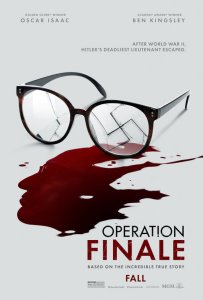 Operation Finale is one of those kinds of movies that is just good enough to make me wish it had been better. It’s based on the true story of an Israeli team of spies that located Adolph Eichmann (Ben Kingsley), one of Hitler’s lieutenants who authored The Final Solution. He’s been hiding in Argentina for years and giving public lectures, which isn’t helpful with keeping a low profile. Oscar Isaac (The Last Jedi) leads the Israeli spies as they plot to kidnap Eichmann, get him to admit his guilt for the Holocaust in writing, and smuggle him out of the country and to Israel to stand trail for the deaths of millions. This story should be exciting, it should be fascinating, it should be compelling, and for stretches it can be, but Operation Finale errs in capturing Eichmann too quickly. The majority of the film is the spy team holding him in a secret location and interrogating him, while the surprisingly Nazi-coddling police force of Argentina hunts for their location. I’m assuming the filmmakers were accurately telling the true story, but you start to question why the spies are taking their sweet time. Why not get on a boat as soon as possible and sail to another country to fly away, one less friendly to former Nazis? There aren’t really any set pieces where their cover might be blown. It’s mostly Isaac talking with Kingsley, and while their conversations are entertaining, it’s yet another preview of a better movie that we’re never going to have delivered. The film lacks enough urgency. The characterization is too limited and the supporting characters are more faces than people; Melanie Laurent essentially plays The Woman Spy. Operation Finale should have either spent more time on the specifics and complications of nabbing Eichamann, presenting a challenge, or it could have accentuated the debate between Isaac and Kingsley over the nature of culpability, rationalization, guilt, and vengeance. There’s probably a really good Nazi-hunting mini-series or Nazi-debating play in here. Either way, the actual finished film is well made, well acted, and well intentioned but also dramatically lacking.
Nate Grade: C+
Share this:

Annihilation (2018)
 Alex Garland has been one of Hollywood’s most stable sci-fi screenwriters for some time. In 2015, Garland made his directorial debut with Ex Machina, a sly and invigorating potboiler that made you think. It helped make Alicia Vikander a star and Garland himself was nominated for an Academy Award for his original screenplay. The movie even won an Oscar for best visual effects, beating out some pretty pricey competition. With one movie, Garland displayed a natural knack for directing. His follow-up, Annihilation, is based on a book by Jeff VanderMeer and has already run into some trouble. After poor test screenings, the producer tried to force changes but these were refused. In a face-saving outreach, Annihilation will only be playing theatrically in North America and will debut on Netlfix weeks later for the rest of the world. The suits are not confidant in the larger public clicking with Annihilation, and they might be right. This isn’t going to be one of those films that people leave declaring their love over in effusive terms, despite what the critical praise may lead you to believe. This is a movie that you leave saying, “Huh.” It’s so powerfully inscrutable to the point that most other conventional forms of cinematic entertainment and narrative are smothered. And yet, it’s that inscrutability that might be the movie’s biggest point and might be its biggest asset.
Lena (Natalie Portman) is a biologist whose husband (Oscar Isaac) has been missing for a year ever since he ventured into a strange environmental disaster zone. Then he reappears with a mysterious illness and little memory of the events. Lena joins an all-female crew of scientists (Jennifer Jason Leigh, Tessa Thompson, Gina Rodriguez, Tuva Novotny) to find out some answers by exploring The Shimmer, the site where an alien meteorite collided with coastal land and has been changing local life forms at an alarming pace.
 Like I said, this movie is a conundrum, not just in a “What did I just watch?” sort of analysis but also in a, “Did I actually like that movie?” personal introspection. There isn’t really a mystery here to unpack as there is an enigmatic experience to explain. I’m doing something I don’t normally like to do, which is immediately type my review shortly after seeing a movie. I generally like to marinate on my feelings after experiencing a movie; however, with this one I felt compelled to put furious fingers to the keyboard, trying to explore my myriad conflicted feelings and find my way out the other side, or at least articulate that journey. I’ll try and steer away from any major spoilers though I worry that even discussing some of my confounding responses will require some thematic and plot context, so beware readers who wish to go into this experience completely pure.
Annihilation is an existential horror movie about biology’s indifference to mankind; at least that’s my best thematic interpretation. In the beginning, Lena is explaining the history of cellular life, the simple splitting of cells that begat all life on the planet. There was no larger forethought, no agenda, and no malice, only the enacting of DNA programming. Ultimately, I think the alien mutations are running on a similar principle. This isn’t an invasion by any traditional definition. This isn’t anything nefarious. This isn’t even anything as clearly identifiable as a virus spreading its illness. This is simply life stirring in a few new recipes. There’s a general level of indifference to the overall setting, which makes the environmental wonders and horrors more dispiriting. For those who demand clear answers from their storytelling, they will be left sorely disappointed. Annihilation doesn’t have any real answers for why these things are happening. They just are occurring, much like the beginning steps of cellular life that found new modes of survival on Earth billions of years prior. It’s just another stage in the development of life. The fact that humanity can be so easily cast aside, it’s hard not to feel insignificant. There’s a mounting sense of existential dread about man’s inevitable demise. One character dubs their mission suicidal and is corrected by another. “People confuse suicide with self-destruction,” she says. “Very few people are suicidal, but all of us are self-destructive.” The plotline confirms this as characters fall victim to hubris and curiosity. However, one may argue there is biological in destruction and reconstitution.
 Be warned, dear reader, this is a rather slow movie with a lot of space for breathing, the kind of thing meant to establish a particular atmospheric mood. If you connect with the material, it works, obviously. The problem with Annihilation is that because it’s so inscrutable, because it keeps you at a distance on purpose, that it allows more opportunities to check out. We’re anticipating weirdness and a general breakdown in the group of scientists, and Garland seems to understand this, which may be why he gradually delivers his genre scares. There is an amazing sequence in the middle that is the fuel of nightmares, made all the more searing and scaring by a horrifying sound design that’s even worse when you connect it with the visual source. I was almost compelled to look away and spare my memory this ghastly sight. There are other unsettling moments and the overall feel of the film is definitely one of discomfort and dread, but it’s this scene I’ll always remember and that also solidified the nasty surprises from Mother Nature. Unfortunately, these moments are few and far between. The eventual ending should be easy enough to predict thanks to Garland’s flash-forwards tipping your expectations, that is, if you can actually understand the ending. I still cannot say for certain what happened and why or whether I cared about a why. If, as stated above, the point of the movie is man’s inability to find a recognizable motive in the replication of life by biological factors, then that lends itself to a generally unsatisfying end.
One interesting idea that I regret gets short shrift is just the fact that this is an all-female group of scientists venturing where literally only men have gone before. I’m not celebrating this as some sort of nod at feminism but because it offered an interesting storytelling avenue. All the previous groups were all men and they either were killed by the new environmental dangers or went crazy and killed each other. Minor spoilers, but the women fall under the same sway, destined to the same fate, and it feels like a shame. If you’re going to make a point of questioning whether the deterioration of order and sanity is related to an all-masculine entanglement of thinkers, then don’t just have the women repeat the same decline. Or maybe that’s the point? I don’t know.
 Portman (Jackie) does an convincing job of alternating looking confused and spooked, mimicking most of the audience reaction. Her character isn’t asking to be found likeable, only capable, though the first time we get a little taste of her as a person is far too late into the movie. Her marriage might not have been built on the strongest foundation, which again leads to the potential thematic deliberation over self-destruction and rebirth. Leigh (The Hateful Eight) is a bit too flatly monotone for my liking. It feels like she’s sleepwalking through the film, like maybe she was on Ambien and can’t remember even performing in this movie. Tessa Thompson is underwhelming especially with knowing how fully captivating she can be onscreen (see: Thor: Ragnarok). The other notable actress is Rodriguez (TV’s Jane the Virgin) who put on some muscle and swagger and has a terrific breakdown sequence that showcases some unnerving desperation.
I still cannot even say if I liked Annihilation. There are aspects I can definitely admire, like the commitment of its actors, the emphasis on a more scientific approach to an outbreak/invasion thriller, and Garland’s general sense of place. I still think the majority of audiences are going to leave shrugging. Annihilation is more akin to an Under the Skin or Solaris than a monster hunt. It’s quiet, philosophical, and also often boring. It has its thrilling points, its moments of mystery and intrigue, but it also feels like a slow windup to the eventually disappointing reveal that won’t be enough to justify the lethargic pacing. In the end, this is a difficult movie, but not in a way that requires a thorough decoding like mother! or even in a way that requires repeat viewings to play out the twists. Annihilation is difficult by design, keeping its audience from fully engaging, and then offering little in the way of answers or resolution. And I still don’t know if I like that. Dear reader, this is a confounding movie but it might not be the good kind of confounding.
Nate’s Grade: C+
Share this:

Star Wars: The Last Jedi (2017)
 As I stated in my review of Star Wars: The Force Awakens, “The first mission for Episode VII is to reset the course, to wash away the bad taste of the prequels that haunt many.” Mission accomplished, mostly, though the biggest criticism for J.J. Abrams’ resurgent sequel was how all too closely it hewed to the original plot beats of its own past. It was an overcorrection, a swing too far in the other direction and turned a reboot into “a loving homage that approaches facsimile.” I enjoyed the new characters, the next generation of Star Wars heroes, and wanted to see what would happen to them next. I just hoped the franchise could steer a course of its own. Having a talent as unique as Rian Johnson (Brick, Looper) as the writer/director of Episode VIII certainly portends to that. The Last Jedi is a better movie, structurally and even emotionally than Force Awakens, but it’s flawed and definitely less fun and is driving so many fans to the dark side.
The First Order is crushing the last vestiges of the puny Resistance. General Hux (Domhnall Gleeson) is chasing the last ships of General Leia (Carrie Fisher) through the galaxy. Finn (John Boyega) is looking for Rey (Daisy Ridley) who is missing. He is teamed up with Rose (Kelly Marie Tran), a plucky mechanic, to find a master code breaker to thwart the First Order’s tracking system so everyone can safely escape. Meanwhile, Rey has sought out the last Jedi, Luke Skywalker (Mark Hamil), who agrees to train her just to teach her why the Jedi are wrong and he will not help the Resistance. She’s also been psychically linked to Kylo Ren (Adam Driver), who is still struggling with his own identity as a pupil of the dark side. Supreme Leader Snoke (Andy Serkis) has lost his faith in Kylo, who he feels is too weak to embrace his darkest impulses. Kylo believes he can convince Rey to join him, and Rey believes that Kylo can be saved and turned into an ally. The Resistance is looking to survive another day and rebuild their rebellion in the hearts and minds of the downtrodden.
 I was hopeful Johnson would be able to tread safely away from the undertow that is the pull of Star Wars nostalgia, and he did so, both to the movie’s great benefit and oddly to its peril at different points. Episode VIII is not a repeat of the plot beats of Empire Strikes Back, though there are some thematic similarities that go along with a middle chapter in a trilogy, like separating the heroes, experiencing losses, etc. Clearly, once Johnson received the handover from Abrams, there were certain Star Wars storylines setup in Force Awakens that he had no interest in continuing. I won’t specify what they are for the sake of spoilers but Johnson definitely undercuts the expectations of extraordinary developments with ordinary, mildly indifferent responses. Certain characters fans may have thought would be more important are gone. It’s as if Johnson is saying to the audience, “Did that thing really matter to you? Who cares?” It’s not Johnson’s fault the fanbase spun off intense theories. He undercuts your expectations throughout. The characters are allowed to fail. The reported saviors don’t want the responsibility. By upsetting the balance of the force, if you will, Johnson has injected a sense of uncertainty into the Star Wars mix, a badly missing element ever since the original trilogy. When a major character looks ready to sacrifice his or herself, you start to believe that this genuinely may happen. When the characters finally fulfill their mission and track down their special contact, they’re denied their goal. You can tell Johnson is having fun with misdirection and, as one character says, “letting the past die.”
However, that same sense can also get Johnson into trouble. From a narrative standpoint, we’re not much further by the end then where we began. From an emotional standpoint, I don’t know if we’re that much farther either. There are elements you can clearly tell that excited Johnson, namely the Rey/Luke/Kylo moments. That relationship, dynamic, and hidden history is easily the best part of The Last Jedi. The decision to psychically link Rey and Kylo seems cheesy at first but works out beautifully, synching up the two force wunderkinds forces them closer and each one looks at the other as a potential kindred spirit. They each think they can save the other, and so it becomes a far more concrete battle over the soul of our characters rather than just a philosophical exercise. It opens up more of a literal dialogue between these opposites and deepens their chemistry. Luke might be following a typical hero’s journey/acceptance of the call, but it’s still an interesting path because he’s bitter and lost his faith in the moral primacy of the Jedi.
 On the flip side, there are also elements where you can clearly tell Johnson had less excitement. The middle section involves a side mission onto an alien casino, and it feels like filler, especially with where it eventually goes and what it opens up about the world. I think it’s meant to showcase the exploitation of the underclass, the rich getting richer off war profiteering and the subjugation of civilizations. It doesn’t land and detracts from the other, more interesting storylines. The cutsey comic relief characters inserted to sell toys are not overpowering but they clearly feel like a studio requirement. At least I’m giving Johnson the benefit of the doubt that he didn’t decide that his Star Wars movie needed winged, big-eyed guinea pig creatures. The concluding half hour also could have been eliminated considering the second act break feels like a more climactic ending. The premise of an elongated chase through space that exhausts fuel supplies and where an enemy ship can track light speed jumps is oddly reminiscent of the first episode in the Battlestar Galactica reboot series (maybe Johnson was a fan). There are things the Force is able to do that we’ve never seen before. It begs questions over what exactly are the parameters of this invisible made-up zen power. Also, if you just solve things by saying “new Force powers” then it becomes a Star Wars cheat. There are also nobodies that could have been, and should have been, replaced by other higher-profile characters. There’s a moment of pure unchecked badassery that should have been someone else taking the sacrifice. By cramming in all of this other material, Johnson is trying to find things for his various characters and storylines to do, and not everything is on the same plane. Finn and Poe (Oscar Isaac) recede into the background all too easily. This is the longest Star Wars movie in franchise history and it could have easily been cut down by 20 minutes.
Fortunately for us, Johnson’s eye for striking visuals and strong, punctuated character moments is still alive and well, and The Last Jedi has moments that left me awed. There are a handful of visuals that are burned into my memory. A multi-dimensional shot of action that pans over to a frantic eyeball. A blast of light that cuts through space like a razor, with the sound dropping out for that extra degree of awe. Speeding ships kicking up red plumes. A slow-motion team-up that all but dares you not to pump your fist. Johnson’s unique sense of visual composition is still present an accounted for. He also reveals a strong handle over the coordination of action sequences, an unknown quantity for him until he landed on this biggest stage. The opening sequence is a great showcase for Johnson with multiple points of action both macro and micro. The X-wing fights are snazzy but the simple struggle of pilot trying to reach a detonator is terrific tension. Abrams, and now Johnson, have brought the feel of Star Wars back, where the alien settings are real and not just a green screen warehouse like the prequels. The light saber battles (all two of them) are given personal stakes. The fights matter. Unlike the prequels, we have people that behave and fight like human beings and not cartoons that leap off walls, do thirty flips in the air, and take leaps off 100-foot canopies. The characters and their conflicts don’t get lost among all the special effects wizardry and explosions.
 The characters with the best material are also the ones who give the best performances. Hamil (Sushi Girl) is fantastic as the old curmudgeon, the bitter man who’s lost his faith. There are later moments where all of his acting is performed through his eyes and little twitches over his face, and he communicates so many emotions. Ridley (Murder on the Orient Express) continues her flinty determination while being somebody who isn’t as instantly adept at every new challenge. Her one-on-one sessions with Luke and Kylo are made better from her charisma. She’s a star. Driver (Logan Lucky) is still compelling as a villain struggling with being a villain. I enjoy having a bad guy who is sloppy, tempestuous, and not fully immersed in the dark side. It makes scene-to-scene more interesting and it plays better to the film’s theme of trying to save one’s soul from the power of influence. Driver has less “woe is me” moments than Force Awakens and feels more committed to his character’s ultimate journey. Kelly Marie Tran (XOXO) is the newest edition and makes quite a favorable impression as the crafty, thoughtful Rose. She’s got some key emotional moments and Tran nails them. She’s also an eager fan of the heroes of the Resistance, namely Finn, and when the reality doesn’t quite match her fantasy, she mimics the Star Wars fandom in her dejection. While the movie doesn’t find the most useful places for her inclusion, I was happy to watch Rose make her case as a new and valuable addition to the franchise. The actor I felt worst for is Gleeson (Goodbye, Christopher Robin). His character is simply an officious weasel we’re not really meant to take seriously, and this is further accomplished by Gleeson’s screeching voice. I worried the man was going to give himself an aneurysm.
This is also the last time we’ll see Carrie Fisher in the Star Wars universe, barring the misbegotten CGI version of her that resembled a chalky blow-up doll in Rogue One. Fisher died almost a year ago and that knowledge hangs over every one of her scenes. You wonder if there will be any sense of closure with her character in this universe. Johnson provides a scene between Luke and Leia that is so poignant and shot so tenderly that it feels like the perfect sendoff for Fisher. He even kisses her forehead before slowly departing, feeling the urge to stay, while a burst of light halos her face. If you were going to cry at any point in The Last Jedi it will probably be this moment to remind you of Fisher’s passing. Leia does have a couple other appearances after this moment but it’s really this scene that serves as her effective curtain call from this massive franchise.
 Star Wars: The Last Jedi is an exciting transitional chapter, and this movement seems to be chaffing many fans, bringing forth the question of whether the fanbase will allow there to be a different Star Wars. This is a movie that discards storylines and characters with the wave of a hand, that subverts expectations and plays with misdirection. This is Rian Johnson’s response to nostalgia in place of genuine emotional responses. As Kylo Ren says, “Let the past die.” It’s not the movie’s fault that people devoted countess hours to speculating about possible film theories that were deemed relatively inconsequential. Johnson refocuses on the characters that matter most, Rey and Kylo, by pairing them up as twin forces. While The Force Awakens definitely has more of a brash sense of fun, I find Last Jedi to be the better movie. It’s not quite up to par with the original trilogy. Johnson gets a little overburdened by trying to add too many things, including a casino subplot that feels like a unsatisfactory side mission in a video game. The new Star Wars films have lacked the bold unpredictability of the original trilogy. There’s nothing quite as seismic as Darth Vader being revealed as Luke’s father or even Han Solo captured and locked in carbonite. Even the major deaths in the new films feel anticipated, like in Episode VII, or less momentous, like in Episode VIII. There are some fake-outs with major deaths that many will deem cheap gambits, and I won’t disagree. I was entertained throughout The Last Jedi. I enjoyed the new characters. I enjoyed the action sequences. I even enjoyed the porgs. This is a movie that is looking for balance between the light and dark, and Johnson establishes a Star Wars that resets the table in exciting and frustrating ways. With J.J. Abrams now onboard of Episode IX, we’ll see how he brings home the characters that he brought into the universe a long time ago in a galaxy far, far away. I imagine the fans grousing this new direction might be more forgiving of nostalgia.
Nate’s Grade: B+
Share this:

Suburbicon (2017)
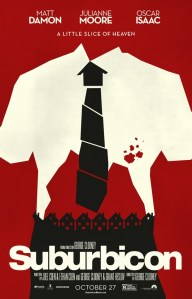 Suburbicon began as a script written by Joel and Ethan Coen back in the 1980s. They shelved it and went on to other stories and justifiable acclaim. George Clooney came across the old screenplay and rewrote it with his longtime partner Grant Heslov (Monuments Men). Clooney’s version of suburban strife is a wash and also easily the worst effort of Clooney’s Oscar-nominated directing career. I wish Suburbicon would make up its mind on which of the three different movies it wants to tell. This is possible proof that Coen brother stories should best be left chiefly to the Coens.
Set amidst the 1950s, an African-American family moves in to an all-white suburban neighborhood and instantly changes the climate. The Mayers have upset the other middle-class white neighbors who want them gone, and they don’t mind subjecting this black family to all forms of harassment to get the job done. Meanwhile, Gardener (Matt Damon) and his wife (Julianne Moore), her twin sister (also Moore), and his son, are threatened by loan shark goons. The family is never the same but there’s more than meets the eye to this domestic tragedy, and the costly cover-up ensnares everyone in danger.
 This is a movie that feels badly stitched together with competing ideas and storylines. Two of these competing movies are so haphazard and lazily explored that it feels like Clooney and company tacked them on for some sort of extra failed social commentary about The Way We Live Now. The shame of it is that either of these vestigial storylines could have existed as their own compelling movie. The integration of the suburbs with a black family brings about an intense reaction. Fellow suburbanites harass the family at all hours of the day, destroy personal property, and do everything to let them know they are unwelcome in this “good-natured” community. The reactions are so virulent and disgusting, and all for a family just existing on the block, shopping at the same grocery store, thinking they too were eligible for the American Dream. There’s a movie there in its own right because, as evidenced in Suburbicon, it’s just background for a larger indictment on suburban values hypocrisy that never generally materializes. At no point does Clooney give the racist response any depth, nuance, or even a deserving spotlight. The only thing we learn is that it’s wrong, which should already be obvious. The entire storyline feels so unfairly attached to another unrelated movie. This family’s story is worth telling right rather than just having something else to cut back to.
Then there’s the larger satire on suburbia itself and its reported family values philosophy. Just because bad people exist and bad things happen in a “nice” community does not mean your satirical work is done. You’re just supplying air quotes to your location. This is the most facile form of irony, lazily slapping together something vulgar against an idyllic setting of morality. That’s why I had no interest in The Little Hours, a comedy that looked to be built around one sole joke, unexpectedly offensive nuns (“Oh ho, that pious person used profanity, and that will never not be funny”). Suburbicon is a story that could have existed in any setting, which further devalues any attempt at legitimate social satire. This isn’t about The Way We Live Now or Even Then.
If you look closely you can see the bones of a Coen brothers’ story here, the only movie of the three that could have worked for Suburbicon. An insurance fraud scam that involves murder and complications is a juicy start for a thriller with some dark comedy edges. This aspect of the movie is the most compelling because it’s obvious that the most attention has been paid to it. Also, there are reversals and unexpected turns that keep the story twisting and turning while accessible. However, the impact of the story is limited by the fact that none of the characters are generally likeable or that interesting. You won’t really feel anxiety over whether or not these people get away with their scheme, which deflates the film’s acceleration of tension despite the best efforts of Alexadre Desplat to replicate an ominous Carter Burwell, a.k.a. “Coen brother,” score. If you don’t care about the characters then they better get into some crazy escalating collateral damage. For a while, it feels like Clooney and Suburbicon understand this principle and begin to ratchet up a body count, though oddly it’s far too fast. Oscar Isaac (The Force Awakens) turns up as a nosy insurance investigation and is taken care of only in his second appearance. The film doesn’t take the time to force the characters to luxuriate in the unease. It just goes straight for the sudden violence, and after awhile it becomes pat and expected.
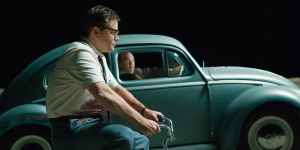 This is Clooney’s weakest directorial effort yet. He’s clearly working from the visual framework of the Coen brothers’ classics, using the cookie-cutter production design of colorful suburbia for intended kitschy menace. Even some of the camera angles feel like something lifted from the Coen brothers. Alas, Clooney is not the Coens. He is a director capable of great things depending upon the subject matter, but this movie is a misfire from the start. Clooney cannot decide what the tone is supposed to be, so different actors seem to be operating in their own separate, competing movies. Damon (The Martian) is at either turn hapless or malevolent. I never knew what his read on his character was supposed to be. Moore (Kingsmen: The Golden Circle) is so over-the-top as a distressed housewife that you think she might start bouncing off the walls. It’s only Isaac that feels like he finds the sweet spot of what Clooney must have been going for, and thus it’s even more disappointing about his character’s limited screen time.
Messy, tone deaf, and lacking greater commentary, Suburbicon is a fatally flawed, overbearing dark comedy that has things on its mind and no clear idea about how best to articulate them. It feels like dissonant movies badly stitched together. The overall execution is lazy and relies upon the simplest form of irony to substitute as subversive suburban satire. The tone veers too wildly and the actors are desperate for some better sense of grounding. The characters are pretty flat and poorly developed. It’s an altogether mess that has a few inspired moments and a whole lot more uninspired. The victimized black family deserves to have their own movie and not be the backdrop of somebody else’s broad comedy. The racism is far too real to mesh with the comic goofiness of the rest of the criminal shenanigans. Clooney needed to settle on the movie he wanted to tell. I doubt the final version of Suburbicon that I saw is close to the Coen’s original screenplay. There may have been a good reason that they originally shelved it. Clooney shows that replicating the Coen look and style can be a fool’s errand even by an otherwise talented director. This is the worst Coen brother movie and it’s not even theirs.
Nate’s Grade: C-
Share this:

X-Men: Apocalypse (2016)
 “We all know the third movie is the worst,” says young Jean Grey (Sophie Turner) in a curious moment that is too meta for its own good. It’s meant to be an in-joke, and possible a jab at 2006’s heavily derided X-Men: The Last Stand, but it ends up summarizing more than one X-Men movie. Easily the weakest of the prequel series, X-Men: Apocalypse is a muddled super hero movie that marginalizes its interesting characters, lacks a thematic linchpin, pushes a new batch of boring and often superfluous new mutants, and feels like everyone is running through the paces of what they think an X-Men movie should be. It’s not Last Stand, the near franchise-killer that Days of Future Past had to wipe out of existence, but this movie is a dull and clear example of the lousy mediocrity of compounded missed chances suffered at the expense of loyalty to formula.
In 1983, Charles Xavier (James McAvoy) is running his school for gifted youngsters, a.k.a. mutants, and has a new class of students including Jean Grey, Scott “Cyclops” Summers (Tye Sheridan), Kurt “Nightcrawler” Wagner (Kodi Smit-McPhee). Magneto (Michael Fassbender) is trying to live a simple life and exclude himself from a larger fight between humans and mutants. Mystique (Jennifer Lawrence) is crossing the globe and discovering new mutants to rescue. Everything changes when an ancient mutant is awakened in Egypt. Apocalypse (Oscar Isaac) is thousands of years old and is rumored to be the first mutant. He collects four mutant helpers he deems his Horsemen, and in 1983 it happens to be a young Storm (Alexandra Shipp), Psylocke (Olivia Munn), Archangel (Ben Hardy), and Magneto. Apocalypse promises a world built for only the strongest mutants and will wipe the planet with those found lesser.
 Let’s start with the empty void that is the titular super villain; Apocalypse is a complete waste and a complete bore. Oscar Isaac is a terrific and soulful actor who can be so malleable to roles as diverse as misanthropic Llewyn Davis to dreamy X-wing pilot Poe Damaron. He is buried under pounds of purple makeup that limit his expression, coupled with a heavy costume that also limits his movement. Apocalypse should have probably been a motion capture performance. Andy Serkis has proven that mo-cap performances can exhibit tremendous emotive qualities and the technology can support it. Mo-cap would have been better than staring at Ivan Ooze lumbering around. Then there’s his haphazard characterization. Apocalypse is both too all-powerful and shackled with powers that are too vaguely ill defined. He doesn’t seem like the kind of guy that needs an entourage for support despite the whole snazzy “Four Horsemen” backing band name. Apocalypse should be the solo act; he doesn’t need a backup band. You could have written Storm and Psylocke out entirely and had no impact on the plot whatsoever. My pal Eric Muller even jokes that Psylocke literally walks off the movie. Allow me to indulge my X-Men fandom a moment and just say how Apocalypse is my favorite X-Men villain and Psylocke was one of my favorite X-Men way back when I was reading the comics consistently in the 90s. I loved the psychic blade of Psylocke, though in this movie it’s pretty much just a laser arm sword, which is a underwhelming. Seeing both of these characters completely wasted is particularly disappointing to 90s me.
But back to Apocalypse, he seems too powerful to need to seek out a select group of super lieutenants and part of this is also because of how poorly the movie explains the specifics or limitations of his powers. He absorbs the powers of his host mutants but what are those powers exactly? The movie never specifies beyond the weird shifting-humans-into-walls thing that looks a bit too silly to be truly terrifying. Every time he displays a new fancy power we just have to accept it, but if he keeps unleashing powers we never know about then why does he even need assistance? We already see Apocalypse turning the world into dust clouds, so why does he need Magneto to, I believe, rip the metal core out of the Earth? It’s not like he has a meaningful relationship with Magneto, the only Horseman who truly matters. Apocalypse should be the mutant equivalent of a god, and credit to my pal Ben Bailey on this assertion, and the world of mutants should be forced to make a choice to follow this god who genuinely wants a new world consisting only of his “children.” Instead he’s just a bloviating and boring demagogue that makes a terrible lead villain. For a guy who might be the “first mutant” and inspire the Bible, it sure seems like squandered potential.
 The trio of the core characters of the prequels (Professor X, Magneto, Mystique) is largely sidelined and you can certainly tell that the actors are eyeing the exit door, no more than Lawrence. These are the characters we’ve gotten to know and the ones we’ve built up an emotional attachment to, so why not just push them to the outer edges of your story and shove some new even younger X kids in place to dominate the narrative? Lawrence and Fassbender especially are given the least to do. When Mystique has to become a de facto X-Men leader and teacher, you can feel like everyone is just going through the motions. They just look bored or at least unable to hide their ambivalence with the muddled screenplay. The new X kids are also fairly bland with little charisma. I think there’s an actual scene where Nightcrawler is walking around a mall in plain sight. The X kids are here to take over for the Magneto/Xavier/Mystique unit and provide a bridge to the original X-Men series. It is here where I must now gripe because First Class was set in 1961 and Apocalypse is set in 1983 and nobody looks like they’ve aged. Maybe that’s a mutant ability plot device but then Rose Byrne’s human character hasn’t aged much either. Her character is also completely pointless in this movie. She might not be as badly shoehorned into the action as Lois Lane was in Batman vs. Superman, but then again there still isn’t anything as terrible as anything in BvS.
The X-Men franchise from the beginning has been a super hero saga with subtext and social commentary. It might not be completely subtle but it was effective and brings greater relevance and emotional power to the struggles of our mutant heroes. The first prequel was about a core philosophical divide between Xavier and Magneto; the second movie was about the individual versus society and was personally exemplified by the moral crisis of Mystique’s hunt for vengeance that would lead to the downfall of humanity. This third movie has none of that. Magneto is suffering from a personal tragedy caused by prejudice and fear but the basic theme is the same from First Class just not nearly as well articulated. Here it’s more just blunt “kill ‘em all” vengeance, and he’s made to be a practically mute cipher until called upon at the very end for some tidy plot work. I haven’t even talked about the tacky return to a concentration camp. The characters are either fighting the bad guy or fighting with the bad guy. That’s it. There isn’t any major personal or philosophical conflict that is highlighted by the subtext of the plot. It’s all just more grist for world-ending CGI nonsense.
Apocalypse at best is a series of moments, and the overall quality level rarely rises beyond competently acceptable, not exactly a ringing endorsement. The movie’s action sequences are rather dull and visually repetitive, making poor use of geography and development. The entire third act is a blandly extended action sequence in the dusty ruins of Cairo. Things just sort of happen and then more things just sort of happen. The opening action sequence in Days of Future Past is better than 99% of the scenes in this movie. The clear highlight that everyone will rightly cite is Quicksilver (Evan Peters) showcasing the amazing potential of his super speedy powers, but even this is a repeat of a highlight from a previous movie. It’s like the producers decided to take the moment everybody loved and do it bigger and better. It was a real fun surprise in the first time, and now it’s become the newest part of the X-Men formula. Still, it’s a fantastic sequence with great visual panache and a lively sense of humor. When the world slows down and Quicksilver steps into the frame, it’s almost like a hero moment for the audience to cheer. He saves a school of mutants, and a dog, from a colossal explosion, but it too is just another moment that could have been cut from the movie entirely. It’s a fantastic moment, the obvious highpoint, and yet it’s still superfluous. The other highpoint is an extended cameo at Alkali Lake, and again it is superfluous and calls into question greater franchise continuity.
 Speaking of continuity, there are some major events in Days of Future Past but especially Apocalypse that make me question how the events in the 2000s X-Men still stand. According to the events of the prequels, Mystique “outed” herself to the world and proved the existence of mutants to the wider public when she tried killing Boliver Trask (Peter Dinklage) and infiltrated the Nixon White House. Cut to 1983 and Apocalypse broadcasts a message to every human and mutant on the planet. He launches the world’s entire arsenal of nuclear weapons into space. That seems like a big deal, the kind of deal that would dramatically alter the events in the 2000s to the point that a mutant registration act would seem hilariously quaint and far too late. The character relationships in the first X-Men movie must also be reassessed with the events of Alkali Lake. It’s hard for me to reconcile the earlier films matching up with these prequels at this point.
The studio execs and producers behind the X-Men series have already gone on record speculating that their next movie will take place in the 1990s and have Mr. Sinister as its chief villain. I think they’re getting a little too ahead of themselves with the larger franchise vision much like what happened to Sony after their 2012 Amazing Spider-Man reboot. They started plotting two sequels, a spin-off, and lost sight of simply making a good movie with characters you care about and memorable action sequences. They lost track and had to reboot their Spider-Man franchise yet again, this time with an assist from the Marvel bigwigs. I don’t need an X-Men-a-decade adventure. I just want good movies. Out of six movies, half of them are great and the rest are acceptable to terrible. Apocalypse won’t kill its franchise but I think the negative and indifferent response from the public, as well as less-than-robust box-office returns, will give the studio caution. Don’t just throw out an X-Men movie in order to lay the tracks for the next two X-Men movies. Make a compelling and entertaining X-Men film that stands on its own. If you can’t do that, then there won’t be too many more X adventures, period.
Nate’s Grade: C


 nathanzoebl
You must be logged in to post a comment.