Blog Archives
Bad Lieutenant: Port of Call New Orleans (2009)
 This is a crazy movie. It is not weird, it is not bizarre; it is not silly. Werner Herzog’s whacked-out movie is a remake of a 1992 movie that wasn’t that good to begin with. This certifiably crazy movie mostly involves Nicolas Cage as a corrupt cop playing all sides and snorting everything that isn’t bolted down in the Big Easy up his nose. For a stretch during the middle, he starts to sound like Jimmy Stewart with lockjaw. The central murder investigation plot is pretty much an afterthought in an environment like this. You want the crazy, and with Cage and Herzog, it is in no short supply. There’s Cage threatening an elderly woman at gunpoint, crawling reptile POV shots, a man’s “soul” break-dancing after the man lies dead, and neon iguanas that may exist only in Cage’s drugged-out mind. The film has been described as a trippy parody of standard cops-and-robbers fare, or as a seriously demented anti-drug message, but I think the best description is just “crazy-ass movie.” It has moments that make you do nothing but shake your head and laugh, like when Cage is about to hit rock bottom and EVERY case/storyline gets solved in a matter of seconds to his bemused disbelief. The comedy is straight-faced but it is definitely there. Cage harnesses his eccentricities and delivers an insanely entertaining performance that reconfirms that there is indeed an actor underneath his Hollywood veneer. He is compulsively enjoyable and the movie is compulsively watchable, every crazy freaking second of it. Iguanas!
Nate’s Grade: B
Share this:

Knowing (2009)
 Knowing is a movie about the consequences of seeing the Eternal Plan. If you could know the exact day of your death, would you want to know? How would that impact your life? Would you feel motivated to live every other day to its fullest, or would it cast a pall over the rest of your time? One character in Knowing is told the day of her death and it destroys the rest of her life. I think this topic is interesting but perhaps I’m in the minority. Knowing has been savaged by film critics, and I can certainly see the validity of some of their complaints. It’s not a flawless movie by any means, but I found Knowing to be an effective and suspenseful B-movie.
In 1959, a Massachusetts school buried a time capsule with drawn predictions of what students though the world would be like in 2009 (lots of robots and rockets, how we’ve let them down). One girl, Lucinda Embry, wrote a series of numbers. Flash forward 50 years. MIT professor John Koestler (Nicolas Cage) is a widower raising his eight-year-old son, Caleb (Chandler Canterbury). When the school reopens the time capsule, the schoolteachers pass out the individual letters to students. Naturally Caleb is given the envelope with the number code. He brings it home to show his father, who becomes intrigued and looks for patterns. John reasons that the string of numbers is an eerie predictor for major disasters around the world. They predict the date, the number that die, and the location via longitude and latitude. All of the numbered disasters have already taken place (including the hotel fire that killed John’s wife), but there are three more numbered disasters that have yet to happen. It?s about this time that Caleb is visited by mysterious thin men in long black trench coats. John seeks out assistance from Lucinda’s daughter (Rose Byrne), whose daughter also hears the same voices that Caleb does about an impending doom.
 Count me genuinely surprised at how taut I found Knowing. This movie builds a good head of steam and I dreaded what was to follow (in the good sense). When John figures out the exact design of the numbers, pinpointing date and location of disasters, he feels compelled to try and prevent the loss of life. Would you do the same? I think if I had been given a secret celestial code that predicted cataclysmic disasters that I would make sure to steer clear from those locales, rather than running to them. Director Alex Proyas (Dark City, I, Robot) expertly stages the carnage, to the point that I was grimacing and wincing. The plane crash, all shown in one unending shot, is a realistic nightmare that gets more and more disturbing. John hops through the wreckage to attempt to save people and encounters one burning victims after another, all screaming in terror. There are subsequent explosions amongst the wreckage that engulf more people in flames. The scene is spellbinding and unflinchingly horrific. The same can be said about the second disaster sequence in New York City, indelicately evoking some 9/11 memories. After these sequences I was dreading every moment leading up to the next, yet I was also perversely interested to see what would happen next.
I?m glad that the screenwriters tackled the fallacy of numerology early. One of John’s MIT colleagues says that people see what they want to see in the numbers, and surprise then they find them. This was completely the case with the ridiculous 2007 thriller, The Number 23. Jim Carrey went crazy deducing everything to one number, but it was the human mind projecting what it desired to see. The same thing goes for psychics who express vague statements so that the poor saps paying can fill in the details and make it personally relevant (“I’m thinking of a grandfather who died… He was a man?”). I had less of a logic gap with the numbers in Knowing. Granted, I have no idea which set of numbers the code is going with. For example, it lists a set number of deaths for the 2004 tsunami that killed over 250,000 people. But with such a massive event, how do we calculate the dead? There could be loads of people missing and presumed killed by the tsunami. Do people that die as a result of injuries count as direct victims, or are they victims of infection? My point is either the number code is going by the reported estimate on the news or has the exact number, which would be different than what the estimate was in the press. Either way, it presents a mild discrepancy for John.
The movie paints itself into a corner and the astute viewer will realize that it?s only a matter of time before one of the two supernatural A-words gets dropped as the force behind the strange occurrences (or a hybrid of both options). While the movie gets somewhat silly toward the end with its apocalyptic resolution, Knowing refrains from getting stupid. Yes it’s weird that John somehow lives in a giant house decorated to look like some peeling haunted mansion. Yes it’s weird that some supernatural force could predict every man-made disaster yet decide not to intervene in the biggest one. Yes it’s weird when Cage screams, “We have to go where the numbers want us to go.” But here’s the thing, Knowing is packed with ideas, some of them derivative (the ending borrows liberally from Arthur C. Clarke’s novel, Childhood’s End), but there is an ongoing discussion over the nature of science, religion, destiny and free will, and this discussion does not pander. I would have expected a conventional movie to transform John back into a man of faith over the amazing course of events, but it never fully happens. The movie never deduces that religious faith is the right prescription for our ailing times, and it even questions the ideas of divine intervention, namely that we live in a universe of determination rather than randomness, though it won’t specify what that determination is. The movie adheres to its pessimistic viewpoint right down to the end, which result in some ballsy choices for a mainstream Hollywood thriller. The heavy-handed ending didn’t break the enjoyment of the movie for me, though I expect it will for many.
 Not that it was needed but Knowing offers some nice little moments of characterization. I really enjoyed John’s monologue about his wife’s passing. He laments what he was doing at the time of her death, mainly blowing leaves off the lawn. He thought you were supposed to know, to feel something when your loved ones are in peril. He was just tending to the leaves, unaware of his wife’s fiery death. I really appreciated this insight into John and also how realistic the scenario felt: the depressing realization that the universe let you down. This seems like a much more believable reason for John’s scientific atheism than anything Mel Gibson went through in Signs.
The acting is cranked up to an exaggerated level of screaming. Cage spends a good portion of the movie with his mouth agape. The rest of the time he’s frantically screaming, which could account for most of the acting. It alternates between catatonic and hysterical. Cage is rather decent as his life is consumed by mysteries. I must say though that the acting only made me raise my eyebrow a few times and never pulled me out of the movie. This is no Wicker Man embarrassment of monumental proportions.
[Knowing is a solid B-movie with some super special effects to go along with its haunting scenes of disaster. It?s a step above your average sci-fi flick thanks to a lack of pandering to easy answers. I’m somewhat amazed that a movie this fatalistic and bleak would be greenlighted and given the budget it has. Proyas make sure the movie doesn’t succumb to numerology hokum, though the movie does tilt a bit toward the silly by its conclusion. I went into Knowing knowing little beyond the fact that the movie was ripped apart by other critics. Perhaps my positive reaction is born completely out of low expectations, but I found Knowing to be a juicy bit of sci-fi escapism that diverted the time nicely
Nate’s Grade: B
Share this:

National Treasure: Book of Secrets (2007)
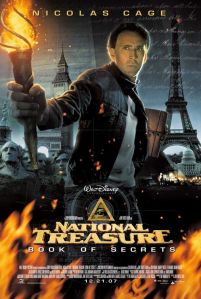 National Treasure: Book of Secrets is like a big dumb puppy that just wants love. It does a trick and thinks it deserves some form of recognition, and me with my cold heart just wants to shrug and move on with my day. How can I be so unmoved when there’s even a cartoon before the movie? For any prospective moviegoers, if you enjoyed the 2004 National Treasure, where I remind all that the U.S. Declaration of Independence had a secret treasure map on its other side, then chances are good you’ll enjoy Book of Secrets. That’s because they’re pretty much the same movie.
Ben Gates (Nicolas Cage) and his father (Jon Voight) are basking in their newfound respect from proving that their crackpot treasure schemes were in fact real. Their respectability is turned upside down, however, when Mitch Wilkinson (Ed Harris, with a dollop of a Southern drawl) has evidence that great-great-grandaddy Gates was responsible for planning President Lincoln’s assassination. He has a piece of John Wilkes Booth’s diary and a list of conspirators is jotted down, with great-great granddaddy Gates listed right there. The diary is authenticated and the Gates are devastated but ultimately unconvinced. They know their Civil War era ancestor would never betray his country and was unknowingly decoding a secret that could lead the Confederacy to an ancient golden temple, something that could help turn the tide of the war. This ancestor ripped pages out of the diary and threw them in a fire to protect the welfare of his country and was then shot by a secret Confederate soldier. In order to clear his ancestor’s good name, Ben Gates will have to find this hidden treasure, which is precisely what Mitch has wanted from the start.
 Gates re-teams with his pals from their first successful adventure, computer whiz Riley (Justin Bartha) and Abigail (Diane Kruger), who has thrown Gates out of their home due to his single-minded focus. Dating a treasure hunter is a certain path to a rocky relationship, ladies. Riley, who even wrote a book about his treasure exploits but still can’t get recognized, is game but Abigail has to be tricked into help. The group finally figures out that the only way to verify the temple’s hidden location is by getting their eyes on the mysterious President’s Book of Secrets, which only presidents can read. This means that Ben has no choice but to get the president (Bruce Greenwood) alone and beg to see a book not meant for outside eyes.
Book of Secrets is a little less dopey than the first preposterous National Treasure adventure, but that doesn’t mean it isn’t chock full of stupidity. According to these movies, apparently damn near everything in this country is built over an Indian burial ground or a giant cavern of treasure. I advise all readers to try digging in their backyards because it appears that the odds are in their favor (also: beware of your real estate company moving the tombstones but not the bodies). The clues are a little less mind-boggling, so instead of a single brick that’s been undisturbed for 200 years we get matching furniture for the Queen of England and the President of the United States. One doozey of stupidity is that one clue requires people to douse a large rock formation with water in hopes that they hit exactly the right spot and have an invisible eagle make its appearance. The plot is still structured on the clue-leads-to-other-clue template, which can be exhausting after a while because there’s never any indication of progress until the end arrives.
The subplot about kidnapping the president is ridiculous in the fact that, while already being dumb, it adds needless conflict. When Gates “”kidnaps” Mr. President he does so through a secret tunnel under George Washington’s Mt. Vernon estate. The passage closes behind them and cuts off the frantic Secret Servicemen. It is here where Gates makes his plea for the titular Book of Secrets, which the president confirms but cannot confirm publicly (well, it is a secret book of secrets). Instead of sensibly saying to his men, “Sorry guys, you know how old these places are, we got trapped, but Mr. Gates here helped get me out,” the movie tries to claim that the next course of action is that Gates will be on the run for kidnapping the leader of the free world. Huh? What makes this sequence stand out is how easily explainable it could all pass, and yet Book of Secrets figures the movie is better served by a contrived complication to add more outside pressure on Gates and his treasure hunting crew.
Of course all of the silliness and off-the-wall shenanigans would be acceptable if the film delivered some exciting action sequences that pinned you to your chair, but just like the first National Treasure, this movie is pretty much devoid of a well-thought out action sequence. Returning director Jon Turtletaub has no real visual flair and lets the material simply lay there on screen without much effort to jazz it up. Many action sequences are brief and never really flirt with complications. Usually, the script will propose a simple sequence of events like, say, “Good Guys on Run from Bad Guys” and then Turtletaub will show us exactly that, no better no worse. There’s nary a scene that actually utilizes its globetrotting destination to its advantage; most of the action is not geographic based, which means that it could happen anywhere because it doesn’t take advantage of the specifics of exotic locales. That is inexcusable to me, a big fan of good action sequences. A lengthy trip to an underground golden temple tries the patience as it rambles on and unabashedly apes the Indiana Jones series. Book of Secrets has a halfway decent car chase through the streets of London and that ends up being the highlight of the film. The trouble is that there’s more than an hour left at that point.
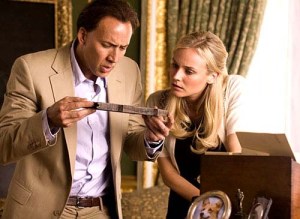 Book of Secrets is a slightly better film than the original. It jumps around in time through the lineage of the Gates clan and gives a better sense of the personal stakes for Ben and his father. Having their long-dead heroic family members linked to a dastardly assassination is good motivation for action, even if that action is ultimately finding an underground temple of gold (how A+B = C I will never know). The production design is skillful and the various European locations bring some sense of grander excitement that, sadly, will never be fully capitalized upon. The characters are still pretty shallow and one-note, but it seems like it’s less annoying this time because there’s less setup on who these characters are, which is, in short, shallow and one-note.
Cage is on autopilot and plays up his goofy mannerisms and William Shatner-esque line readings. This is a paycheck job for Cage and nothing more. Just because the first flick made tons of money is a lark to him and not an indication that he should try something different. He’s giving the people what they seemingly want, which is a wacky Nicolas Cage hamming it up with his patented version of kooky acting. Kruger is the exact copy of her character from the previous National Treasure, meaning she’s the bickering blonde counterweight to the conspiracy theorists on the journey. I suppose she plays a damsel in distress adequately. Voight gets more screen time this go-around thanks to a plump subplot involving the team seeking out the assistance of his ex-wife, played by Oscar-winning actress Helen Mirren. Yes, that Helen Mirren. Harris is given a do-nothing part as the villain and then the movie can’t even follow through on that. Everyone seems to have fun with all the nuttiness and goofy stunts, so I can’t fault them too much for faking it in a big Hollywood blockbuster.
I understand the appeal of these movies, which have found a sizeable audience willing to lap up a Cliff Notes of History along with their popcorn thrills. I imagine the fans of the original will show up in droves and make sure that National Treasure 3: The Mystery of Franklin’s Syphilis is fast-tracked for a future holiday release. I don’t mean to be a killjoy (my mother really enjoys these films) but I cannot get behind the National Treasure movement when the movies are riddled with rampant stupidity, contrived situations, convoluted conspiracies, one-note characters, and inept action sequences that never amount to much of anything beyond teetering homage to better adventure films. Book of Secrets is essentially the exact same movie reheated to take the chill off. Replace Sean Bean for Ed Harris as rival treasure hunter, add another female character, and there you have it, a mostly undisturbed formula that proved profitable in 2004.
Nate’s Grade: C
Share this:

Next (2007)
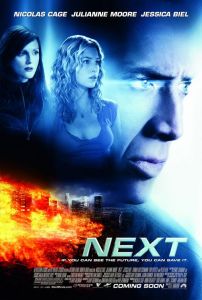 Nicolas Cage, channeling Tom Hanks’ greasy mullet in The Da Vinci Code, can see his own future but only two minutes ahead. Based on a Phillip K. Dick something or other (does it really matter at this point?), this half-baked sci-fi thriller keeps shooting itself in the foot by retreating back in time to reveal, over and over, that what was just shown was merely Cage seeing his future. Now it’s do-over time, hooray. This tricky concept is given little thought and Next hews close to tired thriller clichés and formulaic trappings. There’s the hot girl dragged into the fray (Jessica Biel, pretty but pointless), the shady government agents that need Cage’s help but don’t fully trust him, and the nondescript bad guys with a hidden nuke. Next had potential for disposable escapist entertainment, but man do they blow it big time. For a 90-minute film, there’s way too much setup and not nearly enough payoff. There’s about a grand total of two action sequences for the entire film, neither very good, and then the movie utterly collapses as half of it folds in on itself as one of Cage’s visions. In the blink of an eye, half of the movie we watch is erased; it’s a freakin’ cheat, especially when the movie slouches to a close right after. This easily forgettable sci-fi bobble is another nail in Cage’s coffin as a reliable actor.
Nate’s Grade: C-
Share this:

Ghost Rider (2007)
 Nicolas Cage’s career has been flaming out, so what better role than a burning skeleton biker who serves as a bounty hunter for the Devil, in this case Peter Fonda. A cliché-riddled script, laughable performances, cheesy effects and dull villains doom any entertainment prospects this movie might have had. Cage, as the titular rider, gets to fight a group of escaped demons who all have one connection to an element; one has the power of fire, another the power of wind, etc., it’s like a hellish Captain Planet squad. But what’s the point when Ghost Rider simply vanquishes them so easily? It’s repetitive and goes nowhere. There’s one moment Sam Elliot “turns” into an older ghost rider/bounty hunter and rides along with Cage to save the day. But then he says, “Well, I could only do that once more, so good luck.” What? You could only turn into a flaming ass kicker one more time and you wasted it on riding a horsey through the desert? Eva Mendes is awful as her role of “girlfriend from past,” and why, if she and Cage grew up as childhood sweethearts, does he look over 15 years older than her in the present? I guess working for Satan can really take a lot out of you.
Nate’s Grade: D
Share this:

Grindhouse (2007)
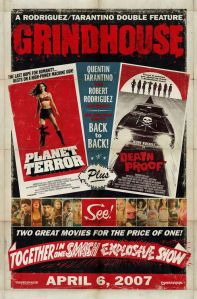 The movie going experience isn’t what it used to be, and Quentin Tarantino and Robert Rodriguez want to do something about it. There?s no denying that the joy of seeing a movie has been watered down a bit; there’s soaring ticket prices, floundering product, and let’s not forget the influx of teenagers with cell phones. Rodriguez and Tarantino grew up gorging upon the exploitation films at their neighborhood grindhouse, where they could see kung-fu, blaxploitation, gory Italian zombie movies, and nearly anything that promised to be titillating and shocking. These movies dealt in copious amounts of sex and violence on a shoestring budget and teenagers lapped it up. Grindhouse was designed to be a double feature with Rodriguez and Tarantino each writing and directing an 80-minute movie. This three-hour plus movie is stuffed to the gills with 70s reverence, right down to cheesy retro clips telling us the film rating via an animated cat. If Rodriguez and Tarantino could, they probably would make the floors stickier just to round out the experience. But that’s the marvelous thing about Grindhouse — it turns the filmgoing experience into an event once again.
First on the bill is Rodriguez’s Planet Terror. An outbreak is about to sweep across a small Texas town. A toxic green gas is causing people to break out in festering wounds that are spreading rapidly. Cherry Darling (Rose McGowan) is a go go dancer who runs into an old flame, Wray (Freddy Rodriguez), a badass drifter with a dark past. They get attacked by a group of “sickos” who take Cherry’s leg as a chew toy. At the hospital we’re introduced in rapid succession to Dr. Block (Mary Shelton) and her creepy husband (Josh Brolin) she plans on leaving for the lovingly massive cleavage of Fergie from the Black Eyed Peas (she gets eaten and can, one assumes, be described as being Fergilicious). The sheriff (Michael Biehn) has an unsettled score with Wray and refuses to trust him, even though the town is slowly being overrun by what appear to be zombies. The survivors take refuge at a Bar-B-Q joint, run by the sheriff’s brother J.T. (Jeff Fahey), located only two miles away from the military outpost that released the gas.
 Planet Terror is a great blast of fun, a perfect ode to schlocky B-movies. Rodriguez creates action movies closer to cartoons, and the more over-the-top and crazy things get the more joyous his films generally turn out. This is a gonzo world cranked up to a wonderfully weird wavelength, where Cherry can have a machine gun leg without any nagging question on how she even gets it to fire let alone why it would be more accurate. It doesn’t matter because this movie is all about 80-minutes of awesome, twisted, gloriously gory fun. Planet Terror isn’t the first zombie comedy, and its inspirations are quite plain, but the film establishes a wide-range of colorful characters effectively and then ramps up the chaos. Rodriguez amuses with even small touches, like a woman trying to operate a car with a anesthetized hands, a pair of skimpy babysitters who clobber a car with baseball bats, and a bio-chemical scientist (Naveen Andrews) that has a penchant for collecting and bottling the testicles of the men who fail him (hey, we all need hobbies). Even amongst an exaggerated canvas there’s still plenty of humor and adoration for the grindhouse experience, like when the beginning of a sex scene is interrupted with a “reel missing” sign. Rodriguez also intentionally downgrades the look of his film, adding hairs and scratches and pops in the film to look like it had been dragged across the floor. Planet Terror even has a dreadfully dated synth score to compliment the full-tilt celebration of splattery schlock.
Tarantino’s Death Proof is going to sharply divide audiences. The action in Planet Terror is relentlessly paced, which makes the adjustment to Tarantino?s half all the more hard. Rodriguez is all about genre relevance and making a film that would excel in the grindhouse era; Tarantino, on the other hand, is all about taking the genre and catapulting it into something ambitious and different and greater.
 Death Proof is Tarantino’s take on the slasher horror genre, with the unique twist being that Tarantino?s roving killer takes out his prey with his car. Stuntman Mike (Kurt Russell) is a stuntman of the old guard. The youth of the day have no idea of the TV shows he worked on or the celebrities he rubbed elbows with. The only lasting visages he has from those removed days are a long scar decorating the side of his face and his stunt car. The vehicle has been outfitted to be death proof, meaning that Stuntman Mike can get into any wreck and come out alive. A group of women are visiting Tennessee for a film shoot. Abernathy (Rosario Dawson) is a makeup artist, Lee (Mary Elizabeth Winstead) is an actress, and Zoe Bell (herself) and Kim (Tracie Thoms) are professional stunt women. The stunt ladies are interested in test-driving a Dodge Charger, the same iconic car used in Vanishing Point. Zoe wants to play a dangerous game known as “Ship’s Mast,” which entails strapping herself to the hood of the car as it speeds along. This is when Stuntman Mike comes roaring with his death proof material and plays an extreme game of chicken.
The narrative structure of Death Proof is deliberately slow. The focus is on a group of Texas girls (including Sydney Poitier’s daughter named, rather unoriginally, Sydney Poitier). They dance to jukebox jams and drink. And they talk, and talk, and talk, and talk. The dialogue is clever but you worry Tarantino has been hypnotized by his own pithy writing. The movie drags a bit but mostly because it follows a film that had the pace of a runaway train. The slow buildup is an intentional correlation to slasher films, which would spend their first half hour setting up characters for the eventual slaughter. I liked how Stuntman Mike was seen playing with his prey and interacting with them. The wait is worth it, though, but then Tarantino turns around and repeats this same setup with a new batch of girls. Many will grow impatient going through the same process all over again and become irritated that they have to endure another round of talky pop culture diatribes in order to get to some more vehicular manslaughter. And at this point, the only character the audience has any affinity for is Stuntman Mike, so it’s a little tough to wait so long for his reappearance. When he does appear, the movie takes some unexpected turns and transforms into a female revenge thriller that left my audience cheering by its conclusion. My wife loved it. I married the right woman.
The makeup work is outstanding. Most of the effect work gets its spotlight during Rodriguez’s half, and Greg Nicotero and KNB have created the most gut churning, sickeningly inventive makeup work since John Carpenter’s The Thing. Rodriguez’s Planet Terror is dripping in blood, and the gore is heightened to such an unrealistic, comical degree that it becomes more tolerable and, in the end, another element in the overall outrageous vibe of the film. Some memorable gore work includes makeup pioneer Tom Savini being ripped apart like a child’s jigsaw puzzle, soldiers whose faces undulate and bubble until they look like close relatives of the Elephant Man, and a truck smashing against bodies like they were made of paper and filled to the brim with Kool-Aid. This is the kind of movie where entire hoses of blood explode from single gun shot wounds. It is a gory, gruesome, sticky icky movie but that?s part of the fun.
 Whereas the makeup work shines in Planet Terror, the stunt work in Death Proof is stupendous. Bell was Uma Thurman’s stunt double in the Kill Bill tandem, so by writing a part specifically for her Tarantino knew he could get up close and personal during the scary moments. Seeing Bell struggling to stay atop the hood of a car zooming at 80 miles per hour is nerve-racking and exhilarating, and you know there isn’t any computer trickery given how Tarantino’s own characters bemoan how computers have blunted action cinema output. That really is Bell and even though it’s all a movie a part of you does think, “Oh my God, this woman is going to die for real.” This killer bumper-car sequence in Death Proof will have you holding your breath. It takes much longer for Tarantino to rev up his action, but when he does he puts the pedal to the mettle.
But don’t get up for pee breaks once Planet Terror is over, because you may miss some of the best parts of Grindhouse. In between the feature films are three fake trailers directed by friends of Tarantino and Rodriguez, who made a fake trailer himself for Machete, about a Federale (Danny Trejo) out for revenge. The Machete trailer gave me the everlasting gift of a line, “They f***ed with the wrong Mexican.”
The best trailer, hands down, is Shaun of the Dead director Edgar Wright?s trailer for Don’t, a Dario Argento style horror film where a narrator instructs the audience lots of items not to do (“If you are thinking about turning this door… DON’T! If you think about going into the basement… DON’T!”). What makes Don’t so wonderful is that the trailer builds a thick head of steam, to the point where all wee see are bizarre rapid-fire images and the announcing repeating the message, “DON’T!” The momentum builds to a great comic high that left me giggling.
Eli Roth, who gave us Hostel and Cabin Fever, one of my all-time favorite filmgoing experiences, runs a close second with his slasher trailer for Thanksgiving. The concept is rather straightforward, a person dressed as a Pilgrim picks off residents around Turkey Day, and a great showcase for Roth’s sense of tongue-in-cheek homage and his warped sense of humor. This trailer has some gasp-inducing moments, chiefly among them a topless cheerleader who performs the splits right onto a knife blade. Wow. Then there’s a guy humping a stuffed turkey with a human head attached. I’ve said it before and I’ll say it again, Roth is one sick bastard but he’s my kind of bastard.
 Rob Zombie’s trailer for Werewolf Women of the S.S. sounds better on paper than how it turns out. There’s a subgenre of Naziploitation films (did you know you could add “-sploitation” to damn near any word?), most famously popularized by Ilsa, She-Wolf of the S.S. Zombie’s trailer has got hairy wolf boobs, Nazis, shiny fetish outfits and S&M, but it feels too new and doesn’t work on the same vibe of Grindhouse. It feels too polished and too happy with itself; it spends more time telling you who’s in this fake movie than delivering anything juicy. The trailer is saved by a brilliant cameo by an actor whom I will not spoil, but suffice to say that I was left in stitches.
Honestly, I cannot say another movie released this year that provides more bang for your buck than Grindhouse. Tarantino and Rodriguez’s double bill will leave you giddy. This is the fastest 3 hours and 10 minutes of your life, folks. Unfortunately, the film hasn’t been doing as well at the box-office and this has caused the Weinsteins to contemplate splitting the films into two to make the most of their investment. I suppose Grindhouse was never going to have a 300-sized audience, since the idea of making a sloppy three-hour love letter to trashy cinema seems destined for a limited appeal. This is a high-art tribute to high camp, and you really do feel you get more than your money’s worth even if you pay, like I do, 10 bucks a pop for a show. I can’t imagine having a better time at the movies this year than the one I had during Grindhouse.
Nate’s Grade: A
Share this:

Lord of War (2005)
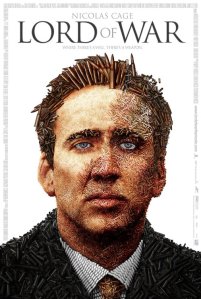 Andrew Niccol is back in my cadre of cool. He’s responsible for two awesome movies (Gattaca, The Truman Show) and one very lackluster Hollywood satire (Simone). But now the man is back and Lord of War is a startling look into the amoral world of international arms dealing. The film is enthralling as Uri (Nicolas Cage) narrates us about the ins-and-outs of his world a la Ray Liotta in Goodfellas. Not to be outdone by a juicy narrative by Niccol the writer, Niccol the director adds lots of stylish flash to his tale. The opening watches the manufacturing and journey of one bullet, it’s ending destination in the head of a little African boy caught in the crossfire. It’s jarring, it’s powerful, and it’s direct. That’s Lord of War in a nutshell.
Nate’s Grade: A-
Share this:

National Treasure (2004)
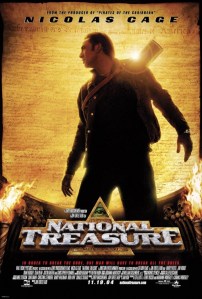 The premise for National Treasure, the newest Jerry Bruckheimer action film, is something of a mess. According to the film, during the Crusades a magnificent treasure was found. The Knights Templar swore to protect it, and the Masonic order carried the vow through the ages. The founding fathers of the Unites States were among this Masonic order, and they went about hiding the fabulous riches and set up a series of elaborate clues to discover its whereabouts. These clues include symbols on the back of our currency and, get this, a secret invisible message on… the back of the Declaration of Independence. Yes, the Declaration of Independence is a treasure map. The silly premise for National Treasure equates the Declaration of Independence with a Denny’s place mat. Can something this outlandish make for a good movie? Well, it depends on your working definition of “good.”
Benjamin Franklin Gates (Nicolas Cage) is somewhat of a laughing stock amongst his peers. His family name is cursed with the crazy belief in some long lost treasure hidden by the founding fathers. His father (Jon Voight) rues the family name being attached to such foolish theories. Of course such foolish theories in Hollywood are always right, no matter how stupid (did I mention the Declaration of Independence is a treasure map?). Ben and his treasure hunting partner Ian Howe (Sean Bean) find a definitive clue, but then Ian double-crosses on Ben and, gasp, wants the treasure for himself. This turns into a race to see who can steal the Declaration of Independence, though Ben wishes to steal it to protect the document and the treasure. Along the way, Ben teams up with a techno-nerd (Justin Bartha) and a hot government official (Diane Kruger) to crisscross historical monuments and sites to unravel the clues before Ian can.
 National Treasure is dumb. Little to absolutely nothing makes sense in this film. This is an obvious, embarrassing attempt to ride the popular coattails of The Da Vinci Code and Americanize the quest. Except that National Treasure really comes across as some half-baked movie version of a kid’s educational game show.
There are so many holes, so where do I begin? First off, why would the founding fathers make it so pointlessly, hopelessly elaborate to find this stockpile of treasure? I’m talking crazy complicated, like having one clue involve finding a ship buried in the Arctic Circle. Yes, the Arctic Circle. Supposedly, the founding fathers decided to hide the treasure because they didn’t want the British to get their grubby, nice-fitting gloves all over it. Something tells me that the founding fathers had more important things going on, like, oh I don’t know, a war! It’s purely absurd to have Washington, Franklin, Jefferson, Adams, and all the rest more interested in hiding some treasure than breaking from England and building an independent nation based on their ideals.
There are some other head-smackers, like the fact that an assembly of clues has been left entirely undisturbed in 200 plus years, like a single special brick. And, for that matter, how does Cage cut through mortar so easily with just a pocket knife? If there’s a gigantic catacomb under D.C., then what’s holding up the city? How come 200 year old oil still burns as well? Wouldn’t that have dried out by now?
 Cage reverts back to his manic show-offy character behavior. In Bruckheimer movies, Cage seems to have theoretic spurts here and there, like he keeps sticking some extremity in an off-screen light socket. He’s generally likeable but his character comes across more like some social studies teacher’s daydream. Bartha and Kruger add less-than-snappy one-liners, but their presence never becomes grating. Bean seems to be playing the stock bad guy role he always is, whether it be GoldenEye, Don’t Say a Word, or Patriot Games.
Sure, even the Indiana Jones films had plot holes (how does closing your eyes guard you from the wrath of God?) but their thrilling adventures overcame any quibbles. National Treasure, on the other hand, is an adventure lacking anything thrilling. This is the first action film to put me to sleep. I can forgive an action/adventure flick being dumb but being boring is a capital offense.
The action sequences in National Treasure are never fully thought out; they usually involve Cage and his cronies outrunning Sean Bean’s group of thugs (repeat). The film’s best moment is the actual theft of the Declaration of Independence. This is the lone sequence in the film that feels like thought was put into drawing out suspense, thinking of natural and interesting complications, and, surprisingly, having the sequence not be overcome by idiocy. After this scene, National Treasure descends into ill-conceived chase scenes strung between crazy elaborate clue hunting. By the time the film reaches its anticlimactic ending, you may have rustled through your change, eyeing the backs of quarters and dimes to ensure there’s no hidden message about a sequel.
National Treasure is a ridiculously stupid, inexcusably boring, ineptly plotted historical adventure for people who get their history solely from movies. Bruckheimer and Cage have an up-and-down partnership, but National Treasure starts with the worst film premise of the year and can?t go much further. Fans of clue-hunting adventure tales may excuse the gaping plot holes, and National Treasure has found a sizeable audience willing to go along for the ride, but the movie doesn’t contain much thrills, entertainment, or anything historically resonant. National Treasure should have stayed buried.
Nate’s Grade: C
Share this:

Captain Corelli’s Mandolin (2001)
 We open on an island on the offshoot of Greece in the start of the 1940s. The waters are blue, the sand is white, the people are happily ethnic, and it’s basically a postcard. The island is overpopulated with idyllic beauties and friendly people and then evil evil war had to come and steal the innocence. Cruz plays a woman who has a first name that I have no clue of or remotely how to pronounce it, but I am certain it began with a P. Cruz is studying to be a doctor under the tutelage of her wise old customed father (John Hurt). She’s engaged to be wed to hunky fisherman Mandras (Christian Bale) until the war threatens their peaceful isolated world. Mandras feels the patriotic urge to go to war and thwart the advancing Italians and Cruz pines for his safe return writing letter after letter with no answer to only fear the worst.
 As the war continues the Italians do advance further and take occupation of the Greek island. Captain Antonio Corelli (Nicolas Cage) is amongst the divisions assembled to this Mediterranean isle. He is agreed to stay in Cruz’s home and, as always, begins to develop feelings for Cruz. She feels some as well but is torn on what her actions should be. Corelli, it turns out, is far more a singer than a fighter. He has a battalion of men he dubs his “opera” and they break into frequent song and an overall zeal for life. They run around drinking and singing on the beaches complete with topless women making this Italian occupation seem like summer camp.
The good times don’t last of course and the war rages closer and closer. Soon the Italian army surrenders and then the Germans come in to retake occupation of the Greek island. Corelli must decide to go home or help fight amongst the guerrillas and native people to keep their beautiful land away from Nazi hands.
Penelope Cruz seems to be heavily pushed on me by Hollywood. She is too mute at times and the emotions that we should see tearing her up are simply dampened by her staring downcast or biting her lip.
Cage is an Italian-American and yet his Italian accent is atrociously comical. His performance is like the Joker doing an Italian accent. He also kisses like he is trying to swallow poor Penelope’s tiny head. Somehow beyond my reasoning the talented Christian Bale got in this movie. He’s about as convincing as a Greek as Laurence Olivier was as a Moor. The rest of the cast is filled with Greek people portraying Greek people.
The love story of Captain Corelli’s Mandolin is a mishmash of un-involving war violence and a cloying romance that never gets into the proper gear. There are elements of guilt and affection, but they aren’t transcendent of any reality. The first time Corelli tells Cruz he loves her they have sex in a field that very moment. There is not enough groundwork laid to produce a decent romance. So the supposed “smolder” between Cruz and Cage is thematically unbelievable, and kind of a bit creepy.
 Corelli suffers from A.I. syndrome in that it desperately needed to end twenty minutes earlier than it did. The fact that Cage survives a machine gun execution because a SINGLE PERSON stood in front of him is bad, but it gets even worse for the inhabitants of the Greek island. Some get hung by their own people, some get shot in the face from Germans, and then everyone must suffer after the war by having an earthquake level half of their town. This stretch of film goes from pointless to comically absurd. It’s like John Madden fell asleep in his director’s chair and someone thought, “Well, let’s model the last act of the film after a Universal tram ride. Hey, can we have Jaws pop out of the water at some point?” Corelli has failed as a romance and during its end stretch it completely fails as any kind of cogent drama.
The direction is adequate by Madden but the script just doesn’t cut the mustard. In the end they rely on the old Hollywood principal of Nazis being pure evil, so much so they might as well have mustaches to twirl. I thought at one moment they were going to tie Cruz to a railroad track and would have preferred it if they had. This is a film caught between romance and war, and it does a disservice to both. The war is a naive afterthought and the romance lacks any credibility. The scenery sure looks nice though. In the end, Captain Corelli’s Mandolin is a film desperately out of tune.
Nate’s Grade: C-
Share this:

The Family Man (2000)
 If I poked this movie it would spray sap in my eye and blind me. It’s essentially a Hollywood remake of Frank Capra’s It’s a Wonderful Life with a bit more cynicism and a bit less success. Cage is a heartless Wall Street whiz who catches a “glimpse” of an alternative life where he’s married to Tea Leoni and has kids in the suburbs. The Family Man wants to kill you with its message of “business is EVIL” and “suburbs and mini-vans and bowling leagues and family… good!” It’s almost caveman like in its bludgeoning. Sap flows freely in this supposed feel-good flick, but stalls in a lackluster ending.
Nate’s Grade: C


 nathanzoebl
You must be logged in to post a comment.