Blog Archives
Mission: Impossible – The Final Reckoning (2025)

It’s not just the increasing age of producer and star Tom Cruise, the Mission: Impossible movies have become victims of their own outlandish success, and this might have led to their ultimate end. This franchise has become known for its amazing stunts and placing Cruise in the thick of them. After every gasp-inducing, eyeball-popping stunt, the inevitable question arises, “What could top that?” And so writer/director Christopher McQuarrie, who has steered the franchise for a decade straight, has placed himself in a filmmaking arms race of action set pieces, and these budgets keep getting bigger and bigger, to compensate for the increasing scope and scale. As a result, these movies need to make an even higher amount of money to break even to cover their expanding expenses, and it doesn’t look like the M:I franchise has reached that next level of success (six of the previous seven movies have grossed between $175 million and $220 million domestically). As a result, Final Reckoning is the winding down of the franchise, or at least this incarnation, and it has enough to satisfy long-time fans, yours truly included, but it’s also a reminder of how things have gotten away from the series in the name of chasing spectacle.
Agent Ethan Hunt (Cruise) is tasked once again by the Impossible Mission Force (IMF) to save the world. In a continuation from the 2023 movie, Dead Reckoning, an evil A.I. known as The Entity is taking over the world’s complex computer networks and taking over control of nuclear missiles. It’s only a matter of time before the last four nations fall victim as well, so Ethan and his team (Simon Pegg, Ving Rhames, and now Hayley Atwell as Grace) must work together to get the only code that can kill The Entity.

Final Reckoning is the Scream 6 of the Mission: Impossible franchise. For those who never saw the sixth entry in an irony-drenched, self-reverential slasher series, it was intended to be the final entry in the franchise, and in doing so that made it try to tie back as many elements and moments as possible to the previous five movies. It was meant to feel not just final but full-circle for the fans. Naturally, the problem for Scream 6 is that it wasn’t going to be the final movie, and so a sequel is scheduled in 2026, and all that finality and franchise-reflection seems a bit like misguided internal stargazing. Coincidentally, the Mission: Impossible franchise also began the same year as the first Scream, 1996, and so this movie is intended to (possibly) close the door on the 30-year franchise and on (possibly) Ethan Hunt’s career as the best damn agent the IMF has ever had and yet whom they always doubt his motives in every movie.
M:I 8 takes far, far too much time trying to set up its stakes, which were already set up in M:I 7, which at the time was titled Dead Reckoning Part One before the “Part One” was scrubbed. Seriously, the first 45 minutes or so is awash in M:I clips from the previous seven movies and sloppy attempts to connect everything back together. Now the evil A.I. threatening the world has been revealed to be born from… the “Rabbit’s foot,” the undetermined MacGuffin from the third Mission: Impossible in 2006. Is that better? Does anyone really care about that? How about one of the cops being the son of a previous character? Does that change your opinion of Chasing Cop #2? How about the one guy in the first movie who found Ethan’s knife after he broke into the CIA in that movie’s most memorable sequence? Did you ever wonder what happened to him? Did you ever care about his well-being? I strongly doubt it. These Easter eggs to the older movies would be less egregious if this supposed final movie didn’t squander its first 45 minutes going over its own history as a means of trying to convince the audience This Stuff Really Matters. It’s even more egregious when the running time is 165 minutes long. All of this backward-looking ret-coning and clip show montages feel like an attempt to add weight to a franchise that never needed it. Let the stunts and set pieces stand for themselves. I don’t need all this nostalgic congratulatory back-patting.

And there is a truly outstanding action set piece that anchors this movie, so much so that it actually comprises a full hour of the film. Set up in the preceding movie’s prologue, we know the only way to kill the evil A.I. is by securing a code located in a Russian submarine at the bottom of the Bering Sea. Just planning to find the location is the first hurdle that Ethan and the team have to surmount. Then there’s getting onto a clandestine U.S. submarine and launching out its tubes to swim to the bottom of the ocean, securing passage inside the fallen sub, and working one’s way through the different chambers, filled with frozen dead bodies, while the sub rolls around, tumbling further and further along the ocean floor. Each smaller sequence has a clearly defined series of mini-goals and organic complications, the kind of exciting escalations that make these set pieces so much better. It’s not enough for the pros to come up with a comprehensive plan, there needs to be unexpected complications that force them to improvise. A foolproof plan that goes perfectly is anathema to action cinema. This sequence has it all, which is why I have no qualms about its length because McQuarrie has justified every link in this set-piece chain. It’s also fantastic visually and really taut, especially as Ethan is tumbling through the innards of the sub with torpedoes falling over and pinning him underneath. This is a prime example of the maximalist virtuoso blockbuster filmmaking excellence that people have come to expect from the franchise.
The problem is that there’s an entire hour after this sequence and, once again, an M:I movie has peaked early. I think only Fallout and Dead Reckoning have their best moments during their actual climaxes. It hurts that Gabriel (Esai Morales) is the weakest villain the franchise may have ever had. I don’t care that the prior film tried to ret-con younger Gabriel into killing Ethan’s love and thus motivating him for vengeance and entering into the IMF. That personal connection and tragedy is a transparent attempt to make this character more important and menacing, and frankly, I am still astounded that this guy… THIS GUY… killed Rebecca Ferguson’s Ilsa. I can confirm, sadly, she is still dead, a reality that astounds me in the realm of a spy thriller where people assume identities. It’s she that Ethan should be fantasizing about in what could be his final moments, not Grace, and I will stand by that (no disrespect to Atwell, who is a genuinely fun and flirty addition to the team as an expert thief).

Regardless, back to Gabriel, who is just an empty suit of a villain, partly because the real villain is the scary A.I. conquering the world’s nuclear arsenals. It’s hard to really vilify a computer code for a movie, so enter this human handler, but he was uninspiring, so they added the secret back-story connection. It doesn’t work. I don’t really care about this guy being defeated, nor do I find him particularly threatening, miraculously killing Ilsa notwithstanding. The ultimate fight atop warring biplanes is visually impressive with its aerial photography, but the conclusion feels anticlimactic and the thrill of the set piece feels even slightly redundant when we remember Cruise has already hung from the side of a plane in M:I 5 and dangled from a helicopter in M:I 6. There’s yet another ominous timer ticking down, yet another deadly device with wires needing to be cut, and yet another side character possibly bleeding out to death. It feels rather par for the series, perhaps a thematic distillation of all those clips. There’s also some extra Fail Safe-style political hand-wringing at the highest levels of the U.S. government whether to give Ethan the benefit of the doubt or resort to some unorthodox methods for added stakes. It just adds up to a final hour of some strong moments in passing and too much of the same for a franchise that chartered new heights.
Placing it through the M:I pecking order, Final Reckoning is probably the weakest of the McQuarrie Era and arguably lesser than Mission: Impossible III, but it is leagues better than the first two Mission: Impossible entries. Realistically, this isn’t the end of the Mission: Impossible franchise, which has grossed close to five billion dollars over the span of its eight movies, but it is the end of Cruise as our star. The franchise was already previously engineered to hand off to Jeremy Renner in 2011’s Ghost Protocol, but then the movie proved too popular to persuasively function as writing off Ethan Hunt (unlike the other franchise also trying to hand off to Renner at the time, 2012’s Bourne Legacy, which proved so unpopular that Matt Damon came out of Bourne retirement). Cruise is now 63 years old and probably aware that these kind of death-defying stunts might be behind him even at his pace. Though I think the three separate shirtless scenes with Cruise are intended to dissuade you about the limits of his age (hey, I hope I look as good as Cruise’s abs when I’m 63). Final Reckoning is another chance to bid goodbye to its seminal action hero, which may be why there’s so much looking back and connecting unnecessary dots. This franchise is a celebration of the highs of big–budget action storytelling with the most game superstar with a death wish Hollywood could provide, so it’s bittersweet to see it reach some form of an end. McQuarrie, the David Yates of the franchise, has been an excellent shepherd with a kinship with Cruise for grand popcorn entertainment. It’s not the best entry but even a lesser M:I movie still rises above just about most studio action cinema. It’s definitely underdeveloped, too long, and structurally questionable with its pacing and climax, but at its best, it still reminds you why this franchise rose above the rest.
Nate’s Grade: B
Share this:

Civil War (2024)
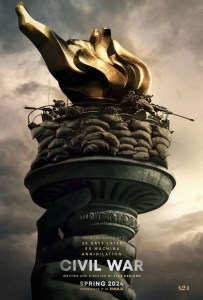 In writer/director Alex Garland’s Civil War, the United States has broken after a third-term president (Nick Offerman) has disbanded the FBI, attacked his own citizens, and used the power of the government to remain in office. The forces of California and Texas have joined an unlikely alliance to depose the American president. With this conflict escalating, we follow a group of journalists, primarily prize-winning war photographer Lee (Kirsten Dunst) and her would-be protege Jessie (Priscilla’s Cailee Spaeny), as they drive from New York down to D.C. with the intention of getting one more interview with the president before it all comes to a bloody end.
Civil War is Garland’s (Ex Machina, Men) attempt to evoke the ethos of journalists who stress merely trying to depict the world rather than question it. It’s a movie really about shared trauma, as these characters are plunged into a world where your neighbor might be stringing up men at the car wash. Garland’s sound design does him major credit at being able to keep his audience unsettled, not just in the melange of gunfire and explosions but also the absence of sound. After one close explosion, the sound drops completely for over a minute. During key parts of the frantic action, the movie will cut to the black and white images of our photographers, providing an immediate reprieve to contemplate as a depiction of what is taking place. Garland’s movie keeps things on a realistic level and is really less of a movie about an America on the brink than a story of journalists going about their dangerous job. It just so happens that instead of it being Afghanistan or Syria or other more familiar war zones that it’s the United States. As a simplified, point-A-to-point B war zone road trip, the movie works well enough, unless, that is, you’re expecting anything more than the quasi-objective documentation of terrible acts.
 However, that same ethos of centrist non-engagement also kept me struggling to really invest in the movie. I kept waiting for… simply more to happen, for insightful exchanges with our characters, for harrowing moments really crystallizing the state of this nation, for clues that gave a clearer picture of the larger conflicts and how the United States got to this point. For anyone expecting much from Offerman’s presidential character, he’s literally in the movie for, at best, two minutes. The far majority of the movie follows along on this road trip with these undeveloped characters taking pictures of occasionally upsetting and occasionally mundane events, although the totality of these events fails to add up to a clearer picture or more coherent social commentary. I just kept waiting for the characters to get more compelling, along with the conflict, and it just didn’t. I think we were following the wrong characters, people who are trying to stay objective and above it all, because then they’re just stand-ins for a camera and a microphone. We know Lee is a celebrated war photographer, and we get snippets of her past worldwide skirmishes, but what else do we know about her? What else do we know about Jessie, besides she’s an aspiring photographer who idolizes Lee? Does a mentorship relationship form? Not really. Does a rivalry form? Not really. The characters are just there, opaque, acting essentially no more than a stand-in for the audience. Now there’s a deeper conversation to be had about the ethics of embedded journalism, of documenting horror rather than intervening, or turning tragedy into digestible art for the masses. What are the ethics of non-intervention and holding to one’s moral objectivity in the face of the most objectionable? However, this is not the movie interested in having that conversation.
 The world of this civil war felt strangely unaffected. Hotels are going about their business, WiFi is carrying on, local shops are carrying on their discounts. I understand that part of this is meant to be surreal, the juxtaposition of a nation going about business as usual, even though these are unusual circumstances, but it makes the movie feel less significant, and the cavalier attitude of the characters continually betraying the stakes of the drama. If it’s just another assignment, how bad can it be? It makes Civil War feel like there’s hardly much of a civil war going on, which begs the question why even tackle this concept if this is it? If you have a movie about an American civil war but pussyfoot around on the why, forgo making the impact felt, and have the majority of the characters shrug it all off, then why are you even going through this story? The apolitical nature makes it so that many viewers will project their own perspectives and prejudices to fill out the unspoken history. It’s an interesting artistic decision but also one that nagged at me as a “both sides are bad” declaration to the middle to tell us that polarization is the real enemy.
There are a few sudden jolts and unsettling moments in the movie, but watching Civil War feels like I’m only watching 45% of a movie that will never be filled in. By that I don’t mean I need every point spoon-fed to my stupid plebeian brain, but I needed a movie where the time added up to something more substantial than “people do bad things during war.” I kept mentally going back to The Purge franchise, a concept that asked what people might do if they had a brief window of lawless freedom, and what that says about us as a society when the rules are put on hold. That is a franchise that embraces its genre roots and premise but finds ways to make its concept a reflection of our troubled times, and while it’s blunt commentary, when we have Nazis marching in the streets, maybe blunt times call for blunt commentary. Civil War feels so timid to say anything really that might be relevant to our current anxious and fractious political climate. Civil War was disappointing to the point that I was longing for the clarity and conviction of The Purge franchise.
 There are so many different versions of this story and concept that can prove compelling, so it’s all the more mystifying for me why Garland wanted to pick this version. Imagine a grueling Downfall-style drama about the last hours inside the White House of a three-term fascistic president who turned on his own people and enacted a bloody civil war, and imagine watching those closest to him reconcile with their own culpability as well as the resignation of the end coming for all of them and what they have done. Or even imagine a similar version about being behind enemy lines and looking for safe harbor, not knowing which American could be trustworthy and which might ultimately be a defector (as Jesse Plemons so ominously says in the movie’s intense high point, “Okay, but what kind of American are you?”). There’s a little known indie war movie from 2017 called Bushwick, starring Brittany Snow and Dave Bautista, that has a similar premise, following a military invasion of Brooklyn (Texas allies with the Southern states to attack the big cities, though they didn’t expect so much push-back from the locals). This is a better version of the similar modern civil war premise, with characters that are more compelling, a conflict that keeps upending our sense of safety, and some gutsy filmmaking choices, not all of them successful (the ending is too bleak and mean and deserved a ray of hope). There are myriad ways to tell this story and make it engaging and though-provoking, and Garland inexplicably chose this dull option. You could do worse than Civil War, but with such tantalizing dramatic potential, you could do better.
Nate’s Grade: C+
Share this:

The Lego Movie 2: The Second Part (2019)
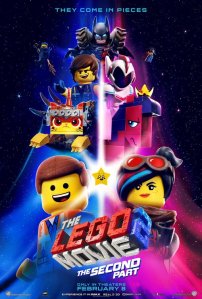 Everything might not be awesome but it’s still pretty great for this creative, heartfelt, and hyperactive family franchise that is better than it has any right to be thanks in part to returning writers Phil Lord and Chris Miller. It’s not quite as fresh and clever as the first go-round but it manages to better its predecessor in some key ways. Now that we know the colorful and zany antics of the animated Lego characters are also simultaneously the imaginative play of a real-world family, it provides a deeper thematic subtext with the unseen nature of siblings in conflict. I remember my own younger sister wanting to play with me and my toys, and me rebuffing her, and the film struck home some key emotional points about the inclusion of cooperative play. The different styles of play are on display as our characters are abducted by a shape-shifting space queen (voiced by Tiffany Haddish) who is determined to marry Batman and possibly rule the universe. A fantastic running joke is how transparently malevolent the queen is, which leads to an even better payoff. There are more songs and each is pretty well constructed, relevant to the story, and assuredly catchy, like “Catchy Song” used to brainwash people through pop, and a mournful version of “Everything’s Not Awesome” that becomes genuinely inspirational and uplifting by its climax. The life lessons are easily digestible and the sense of breezy fun is still alive and well. I was laughing throughout, sometimes quite hard, and the brother/sister subtext had me wondering if I owed my younger sister a decades-late apology for my behavior (sorry, Natalie). Lego Movie 2 is a worthy sequel that finds new and interesting ways to build off the irreverent original’s model. Bring on the Toy Story 3-style ending where our grown-up owner says goodbye to his childhood toys and friends. At this point, Lord and Miller can do anything and imbue it with wild wit, whimsy, and unparalleled mass entertainment (except Star Wars, I suppose).
Nate’s Grade: B+
Share this:

Bad Times at the El Royale (2018)
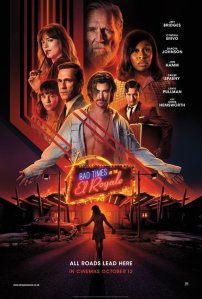 It is no disservice when I say that Bad Times at the El Royale joins the ranks of the finest of Tarantino imitators. It’s packed with twists and turns that keep an audience glued to the screen and continually re-evaluating the characters that we thought we knew. Because of that dynamic the movie invites the audience into becoming more involved, dissecting the information available and waiting for the next clue or plot revelation. It turns watching the film into a game and makes the experience that much more active and thrilling.
In the summer of 1969, the El Royale hotel is in for one hell of a night. The old fashioned hotel sits on the border between Nevada and California, allowing its dwindling customer base the opportunity to choose which state they would like to stay in. A group of strangers cozy up for the night including a priest (Jeff Bridges), a chatty vacuum salesman (Jon Hamm), a hopeful lounge singer (Cynthia Erivo), a skittish bellhop (Lewis Pullman), and a mysterious woman (Dakota Johnson) who happens to have a hostage in her trunk. As the night progresses and the characters uncover one another’s secrets, sometimes with deadly results, menacing cult leader Billy Lee (Chris Hemsworth) comes swaggering to the El Royale to reclaim by force what he feels is rightfully his.
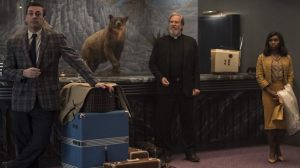 There are Act One twists and reveals in El Royale that would have been the Act Threes of other movies. Writer/director Drew Goddard (Cabin in the Woods, The Martian) has packed his movie full of sinister intrigue as he establishes the hotel, the main characters, and an immediate impression of each in the first 15 minutes. From there, the movie is divided into chapter titles (another Tarantino motif) where we follow different room inhabitants who get 20-minute-vignette spotlights. Once in private, the characters shed their false faces and begin to reveal who they really are, or who we think they might really be, and the movie starts to resemble Tarantino’s own hidden identity parlor game, 2015’s Hateful Eight. The vignettes begin to overlap, ending on cliffhangers and then circling back with a new character as our focal point, re-watching prior scenes but from a different perspective. Goddard’s script is wonderfully clever, layering in questions and answers and a constant desire to upend audience expectations. Even though some segments will repeat, Goddard doesn’t waste time on redundancy. A character will be seen prying loose floorboards searching for something desirable, and we never have to relive the before or after of this moment from that character’s perspective because we’ve been imparted the necessary info and can put the pieces together with the next jump. I appreciated Goddard’s faith in the intelligence of his audience. The pleasure of El Royale is watching it deftly unfold as a fun, funny, startling, appealing mystery.
The characters must also be worthy of our attention, and Goddard does fine work teasing out his colorful cast of criminals and lost souls and deepening most. Everyone has something to hide at the El Royale, and finding out his or her true intentions and motivations is part of the film’s fun. I won’t spoil any of the big surprises or which characters are really putting on a show. Despite all the many plot machinations intertwined, Goddard still finds time for his film to breathe and let the characters talk, opening themselves to one another, sometimes with the assistance of dramatic irony. Jeff Bridges and Cynthia Erivo play the best characters and deliver the best performances. Both of them are haunted by pasts they don’t feel like sharing, both are under some element of disguise to embark on finding their happy ending, and both form a sort of bond throughout the film as kindred spirits, even if they can’t fully trust one another. Bridges has the most complicated back-story but it actually links with a very real and emotional condition: memory loss. His character is (legitimately) going through early dementia and he’s losing full control of his sense of self, occasionally blanking and forgetting who he even is and how he got where he did. For a character pretending to be someone else, there’s a cruel irony to this malady. The seven main characters aren’t all on the same level (some are more plot devices than people) but Goddard knows this, making sure his 142-minute movie spends the most time with the best of them.
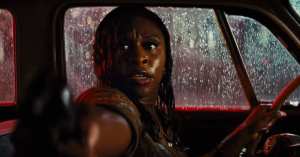 The actors given the best characters are also the ones that deliver the best performances, if you can imagine that. Bridges (Hell or High Water) brings a strong sense of pathos to his memory-addled priest trying to assess his life and his choices. He seems genuine in every moment, which is a feat considering his character has his share of secrets like anyone else. Erivo is a Broadway star making her film debut here, and she steals the show with her bruised sense of optimism. She’s the heart of the movie and a proven survivor, especially from a rigged system that protects predatory men. She brings a quiet power to her character as well as a believable vulnerability that makes you care. Hemsworth (Avengers: Infinity War) is all shaggy, scraggly charm as a cult leader who gets off pitting his followers, and captives, against one another. Really he likes to listen to himself speak, and Hemsworth is having a grand ole time with the part. Another actor exhibiting clear joy is Hamm (Baby Driver) who is, if you’ll pardon the pun, hamming it up with great gusto. He does a far majority of the talking for the first twenty minutes. He’s practically bouncing all over the place as an unchecked extrovert, but when alone, Hamm demonstrates an additional layer to his outlandish character. Another strong impression is from Pullman (Strangers: Prey at Night) as the lone employee eager to find absolution for his part in the El Royale’s history of sin as well as his own personal demons. The weakest of the ensemble ends up being Johnson (Fifty Shades Freed) who gets lost in her femme fatale archetype and can’t seem to find her way out again.
This is only Goddard’s second directing feature and his best directing aspect is that he knows when to linger on the written page. There are several segments that dwell in a certain emotion, elevated by Goddard’s tracking shots to continue the predicated unease. There’s one early moment where the bowels of the El Royale are revealed as hidden viewing areas to secretly record the guests doing their seemingly private illicit good times. The lead character of this vignette walks along the corridor, studying other characters and slowly realizing the implications of what he or she is finding. The scene is given a beautiful and eerie soundtrack thanks to Darlene practicing her singing, belting out “This Old Heart of Mine” like her life depended upon it, the tune taking on a sinister edge as it echoes through the dark hallway along with the tick-tock of the metronome. There’s another terrific singing suspense segment in this very same location, except with a different character spying on Darlene as she and another character work in conjunction to coordinate their movements, timing striking sounds in the room to her claps. Goddard has an adequate eye for visuals but he benefits from the gorgeously conceived and constructed El Royale setting, allowing the quirks of the rundown hotel to serve as another character to his ensemble. I enjoyed little touches, like only the Nevada side having a liquor license and the bright red line that runs down the middle of everything.
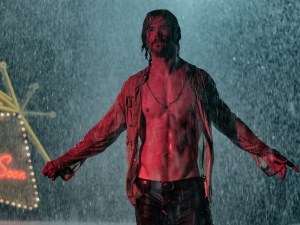 And yet there are some lingering doubts that halt me from a full-throated endorsement of El Royale, and I’ve been trying to articulate them better in the days since I watched the film. It frankly doesn’t fully come together by the end in a way that feels suitably climactic. Once Billy Lee enters the third act, the movie stabilizes and we spend time with the remaining characters assembled together to be terrorized by the cult leader. After seeing everyone else’s story in smaller vignettes with some slippery non-linear perspectives, we’ve finally come to our big confrontation and summit with everyone. Except it doesn’t feel as big as the movies needs it to be. Characters will be dispatched swiftly, and instead of it feeling shocking it feels abrupt and contrived, devaluing the character arcs that had been shuffling forward to that point. The deaths feel too ho-hum, and the final confrontation and melee too chaotic and random. The sacrifices feel wasted and sloppy rather than the payoff from some long established setup. It’s here where Goddard cannot hide his narrative trickery anymore and the machinations are exposed. I couldn’t help but feel that the final act was slowly losing the momentum and excitement that had been built carefully over the course of two hours. Billy Lee isn’t quite the force that his whispered presence has been made out to be, no fault to Hemsworth, who impresses me more and more with every new performance. It’s like by the end of his movie Goddard has realized that certain characters were inevitably just more interesting than others and he saves room for them to get a climax and brushes off the rest. Thematically I don’t quite know if it comes together with any sort of final statement about the 1960s, the dichotomy of good and evil, or anything else. It’s a final act that left me a little disappointed and realizing the end wasn’t nearly as fun as the journey.
Bad Times at the El Royale is a movie jam-packed with twists, plot turns, and colorful characters played by great actors who are clearly enjoying themselves, given the room to roam and stretch their muscles as exaggerated and dangerous criminal cohorts. Goddard’s film is impeccably structured up until its final act where it feels like the answers and confrontations cannot match the mysteries and setup that had been laid before. If you’re a fan of the top level of Tarantino imitators, like Things to Do In Denver When You’re Dead or Lucky Number Slevin, or enjoy unpacking a good mystery, then check into the El Royale, a hotel where maybe the cockroaches have the best chance at survival.
Nate’s Grade: B+
Share this:

The Founder (2016)
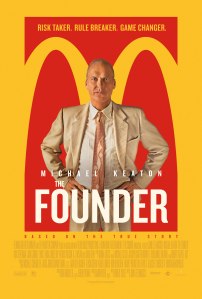 The Founder aims to be The Social Network of hamburgers and milkshakes, a warts-and-all biopic of a huckster who glommed onto other’s success and transformed it into an empire, a pragmatically ruthless entrepreneur run rampant with ambition and leaving behind a trail of lawsuits and disgruntled little people. Michael Keaton, on a roll since Birdman, teams up with screenwriter Robert Siegel (The Wrestler) and director John Lee Hancock (Saving Mr. Banks) to bring to life the story of the man behind the ubiquitous golden arches. The details are routinely fascinating and the movie presents a larger thesis on shifting and conflicting concepts of the American Dream and whether a ruthless yet victorious huckster is to be celebrated, pitied, scorned, or all of the above.
In the mid 1950s, Ray Kroc (Keaton) was a struggling milkshake mixer salesman striking out with just about every drive-in and dinner in the Midwest. His wife Ethel (Laura Dern) is exasperated by Kroc’s flights of fancy, shilling whatever new product might be his ticket to riches. His life changes thanks to one very efficient hamburger stand in San Bernardino, California. The McDonald brothers, Mac (John Caroll Lynch) and Dick (Nick Offerman), have ordered eight of Kroc’s milkshake mixers because they can barely keep up with demand. Kroc travels out West to see for himself and discovers a tasty and speedy hamburger assembly line that nobody else is doing. He pushes the McDonald brothers to franchise their model with him in the lead. They’re wary but agree with a strict contract that still gives full executive decision-making to the brothers. Kroc languishes at first but finds growing success, barely able to keep ahead with the mounting overhead costs. Kroc wants to keep going but the McDonald brothers are unyielding over their terms of business. Kroc schemes to push them out of their own business, establish himself as the founder, and take their very name for himself.
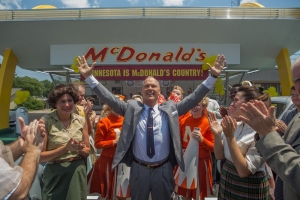 Firstly, the story of the formation of McDonald’s is probably far less known than the formation of Facebook, and this provides plenty of opportunities for illumination. It is an inherently interesting story. There’s the invention of the modern-day fast food assembly line and the difficulty in perfecting this process and getting customers acquainted with the new reality. Initially, after years of drive-in service, customers are befuddled that they have to physically walk up to a window and order and throw away their own trash. The early history, hiccups, and adjustments are interesting, but it all gets more engrossing once Kroc comes aboard. It’s here where the film becomes very business-like in its examination of Kroc’s ruthless business tactics that lead to his ascent. Without Kroc’s intervention, perhaps the world would never have known the name McDonalds. He’s not an instant success either. He’s already middle-aged when he comes across the McDonald brothers. He’s not a brilliant salesman by nature. He’s cunning and doggedly persistent, the key he tells us since the world is rife with talented, educated, and good people who go nowhere. Kroc is a constant motor that can never be satisfied. Ethel asks him if anything will ever be enough, and after a short pause he replies without pretense, “Probably not.” He cannot enjoy success because he always feels he should be entitled to more. It’s the kind of unmoored ambition that leads him to throw his litigious weight around, knowingly breaking legal contracts and handshake deals to get exactly what he wants. Kroc’s business triumphs will remind certain viewers of Donald Trump, a man who uses similar advantages of wealth to exploit others and force them into advantageous deals. Even when explicitly in the wrong he just rolls along undeterred.
It is Keaton’s (Spotlight) movie and he more than delivers under pressure. Keaton adopts a speaking affect that makes the character weirdly magnetic without being wholly charming, an interesting combination that reflects the conflicted nature of Kroc. He’s a fast-talking salesman who enjoys the sound of his own voice but he doesn’t fool himself. He’s a man who knows what he wants and it just happens to be everything. He knows his limitations but he strides forward. He is bursting at the seams to get out from under the thumb of the McDonald brothers, who he sees as limiting the growth of a company that is more his than theirs. Kroc delights in being treated to the upper echelons of power. He loves having people proverbially kiss his ring and lavish his greatness. It’s the story of a man who scraped by his entire life until stumbling upon someone else’s genius idea. Keaton plays the man with a wily canniness that is always entertaining, channeling the actor’s natural oddball energy and style into a Midwestern McBeth. He says if he saw his competitor drowning he’d “shove a hose down his throat.” He’s generally cold but Keaton and Siegel don’t present him with a standard redemption arc. He’s kind of a hapless jerk at the start and becomes a powerful, egotistical jerk by the end. Keaton’s layered performance gives the film a solid anchor to keep viewers invested in the film.
 If only the other parts of The Founder had as much nuance and care as Keaton’s role. The supporting characters have flashes of interest but are too relegated to be much more than symbols or less developed foils to Kroc. The McDonald brothers have a poignant level of tenderness to them but they’re set up to be symbols of American values that will inevitably be trampled upon by Kroc’s corporatist version of the American Dream. Mac is the hopeful and trusting brother, Dick is the no-nonsense devote to quality and ethics, and together they could use additional ambiguity or depth. They’re meant to represent an older way of doing business, the familiar edict that hard work, dedication to customers, and quality will pay off. The brothers are successful and content at their level of success; they lack the naked ambition of Kroc and his disregard for the rules. They’re set up to be defeated and swindled and victims of Kroc’s tactics, which limits them as characters. There’s a sliver of detail with Dick’s concern for his brother’s diabetes threatening him, but the brothers are more martyrs than anything else. You anticipate their defeat with slight dread but more a sense of impending inevitability. Their good-natured values are no match for the winner-takes-all mentality of a man on a mendacious mission.
Similarly, Kroc’s wife is another figure set up from the start to be trampled upon. She’s supportive but not supportive enough Kroc feels. Like the McDonald brothers, she’s too content within her station and what she deems a good existence, a life of dinners at the club with a retinue of upper middle class friends. Ethel is a plain looking woman of simple pleasures. You already know that there’s a ticking clock before Kroc will trade up. With these expectations, more could have been done to establish her character. Too often Kroc’s selfish, indifferent, or casually hurtful broadsides are treated with silent suffering from Ethel. She’s set up as a walking pained reaction shot. It almost gets to comical levels as the pattern repeats itself and you anticipate a slightly elongated, wounded reaction shot. Kroc’s second wife, Joan Smith (Linda Cardellini), is a sweetly smiling prize but proves herself more than a pretty face. She shares Kroc’s ambitions and proposes swapping real milk for instant milk mix to save refrigeration costs. There’s obviously more to this woman, who we meet already married to a business associate of Kroc’s, but the movie keeps her as a mostly symbolic, almost Fitzgerald-esque trophy. The other side characters that come into Kroc’s orbit, B.J. Novak’s scheming real estate fixer, Kate Neeland’s esteemed secretary, Justin Randell Brooke’s loyal lieutenant, are clipped so that they only appear in the film when they offer some service or advice useful to Kroc. Perhaps there’s a meta level here exploring how Kroc views those seemingly closest to him in strict transactional terms, or perhaps I’m just reaching for more.
 The other liability from an otherwise still entertaining script is the director. Hancock is better known for softer, feel-good films about American values. The Founder is a story that subverts all of those notions and Hancock doesn’t seem to master the skills in order for the satirical and darker implications to land. The onscreen visuals seem to clash with the movie’s overall disquieting tone. The colors are bright and the musical score by Carter Burwell seems curiously jolly at points, confusing the tone of darker scenes. It just doesn’t feel like Hancock had a good feel for the material and how best to execute it. It feels like he’s missing the layers of potential with Siegel’s screenplay. I’ll readily credit Hancock for part of Keaton’s terrific performance but Hancock’s touches are best realized in the art direction details recreating a bygone era. I feel that somebody like a Steven Soderbergh would have tapped more into this story’s satirical potential.
The Founder is an entertaining biopic of a scoundrel who ran roughshod over others dreams and turned their success into his own. It’s anchored by a complex performance from Keaton. It’s a rags-to-riches story that doesn’t tell the audience how to think about its centerpiece character. He’s underhanded, sure, but he’s also got everything he wanted and his tactics proved successful. Is this an ends justify the means story to rationalize the power of avarice, or is this an exploration of the darker undercurrents of the passing American Dream usurping others’ dreams and accomplishments (closing text informs us that McDonald’s feeds one percent of the world’s population every day)? The movie doesn’t seem to take a stand, neither fully condemning nor excusing Kroc’s actions. The tale behind the worldwide fast food giant is full of supersized drama and interesting procedural details about the rise of the most recognizable name in burgers. It’s unfortunate then that the movie struggles to reach the same heights as Keaton. The supporting characters are tragically underdeveloped and kept as figures for comparison to chart Kroc’s ascendance. Director John Lee Hancock also feels like an poor fit for the material, his instincts seemingly at odds with the film’s tone and intentions. The Founder is an interesting movie with a strong central performance but it can’t help but feel like its destiny was far greater, that it’s not meeting the full potential of the material.
Nate’s Grade: B
Share this:

The LEGO Movie (2014)
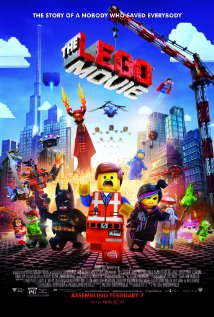 Highly creative, cheeky, frenetic, and bursting with visual splendor, The LEGO Movie will likely surpass all expectations you had for what was assumed a 90-minute LEGO commercial. I cannot even tell if it’s actually a commercial or a subversive consumerist satire, or perhaps a blending of both. Writer/directors Phil Lord and Christopher Miller take their same anarchic, comic rambunctious absurdity exhibited in Cloudy with a Chance of Meatballs and 21 Jump Street and produce another movie so fast-paced, so freewheeling in energy, and so comically alive that you feel rejuvenated by the end. These are gentlemen who fully know the storytelling power with animation and they create worlds that are astounding to watch. While completely computer generated, the world looks like it was stop-motion. In fact, the detail that everything in the physical world is made of LEGOs was a nice touch, including fire, water, and smoke. The story of an unremarkable guy (slyly stupidly voiced by Chris Pratt) mistaken for The One, and the complications that arise, is a fitting satire of superhero fantasy mythos filmmaking. The social commentary on conformity and the media is cutting without distracting from the plot’s ongoing mission. The characters are fun, the jokes land assuredly, and the action sequences are mesmerizing. But then it takes a meta turn in the third act that gives the movie a whole other prism that helps define its previous outrageousness while leading to a poignant message about the inclusiveness of play. It’s a movie that celebrates imagination and individuality, and while it will more than likely also sell a crapload of toys, it’s an animated film with more on its mind. To paraphrase the top radio hit in the world of LEGOS, everything is just enough awesome.
Nate’s Grade: A-
Share this:

The Kings of Summer (2013)
 Working part-time at a movie theater in the summers, I come across, let’s say, an interesting selection of customers with… interesting opinions. One middle-aged woman openly opined, while looking at the poster for the coming-of-age comedy The Kings of Summer, that she’s had enough with movies told from a teenage male perspective. While this same woman had very specific and narrow demands for an acceptable movie, she got me thinking. Why do we get so many coming-of-age movies from a male perspective? Let’s forget the easy answer that Hollywood has a lot more male filmmakers than female. There’s always that sense of romance with coming-of-age films, a nostalgic look back at a supposedly simpler time that now seems better appreciated. Maybe men are just more prone to romanticizing the past while women look forward to the future. Or maybe there are really just more men calling the shots about films get made. Whatever the reason, the woman didn’t go see The Kings of Summer, and judging by her attitude, I don’t think she missed out.
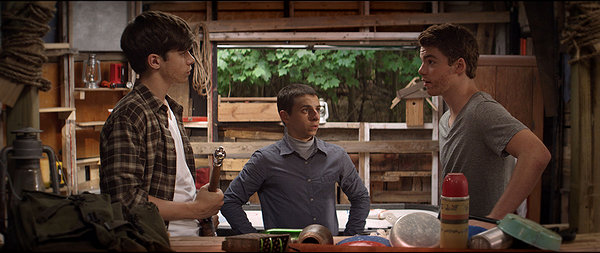
 Joe (Nick Robinson) has just finished his freshman year in high school. He has a long summer ahead butting heads with his no-nonsense father (Nick Offerman). Then Joe gets the brilliant idea. He and his pal Patrick (Gabriel Basso), who is also sick of his annoying parents, will build their own home in the woods, a sanctuary where they can set the rules. Joe and Patrick pack up their belongings, find a quiet spot in the woods, and build that dream home. Biaggio (Moises Arias), a weird and gangly kid, takes an interest in the youthful declaration of independence and joins in. The guys invite girls over, explore the wilderness, grow patchy wisps of facial hair, and live out their fantasies of roughing it like real men. Of course it helps when a Boston Market is just down the road.
From start to finish, The Kings of Summer kept me laughing. I did not expect the comedy to be as consistent and thorough as it was, but writer Chris Galletta has a sure handed way of making the comedy derive from the situations and characters. Even with some outsized elements, notably Biaggio and the fact that the boys home-away-from-home is way too advanced for a kid who blundered through shop class, the humor never feels forced. That is an accomplishment, though the script also overly relies on Biaggio to say outlandish or weird lines. I especially enjoyed his one-scene pep talk with his father late in the movie. That confidant sense of humor goes a long way to relax an audience, allowing us to attune to the mellow waves of the film. It’s fun to watch the guys try to forage a life out in the woods, slowly learning how hard this whole survivalist lifestyle may actually be. The adults are viewed as blithe buffoons or hardasses, though they don’t come across as caricatures. Credit the attention paid to Offerman’s (TV’s Parks and Recreation) character as Joe’s father and credit Offerman’s uncanny ability to make gruff parenting endearing. This is an easy film to like, to go along with the flow, and to enjoy. It never really falters in entertainment and routinely has another joke at the ready to make you smile. It’s a sweet movie that does enough to keep you charmed.
While pleasant, I had to stop and reflect that there was absolutely very little to these characters. The boys all kind of blend together in their youthful romanticism of freedom and rebellion of lame parents, but you’d be hard-pressed to describe them beyond core physical descriptions. The moments that do supply character development are mostly broadly comedic or somewhat generic in their coming-of-age tropes, notably the broken heart administered by a guy’s crush. Example: Biaggio is essentially little more than a walking punchline machine. While quite funny and well acted, every line of his dialogue feels like a punchline. He comes from nowhere. At one point, Joe advises Biaggio that a girl may be interested in him, but Biaggio demurs and says that won’t work out. All right, here we go. Here’s where the movie sheds some light on him. Biaggio admits to being gay. The very next line involves him confusing gay with cystic fibrosis. It’s a funny joke but it turns a moment where a character was getting added dimension and just manufactures another punchline. Again, The Kings of Summer is a very pleasant film going experience, and one that made me laugh consistently, but objectively, the impact is too limited because of the lack of proper characterization.
 And I suppose this leads into a bigger question of whether this lack of substantial characterization even matters. Coming-of-age movies, like any subgenre in film, have their own expectations and conventions. We all have our different tolerance levels for narrative familiarity, and depending upon the genre, familiarity may be a necessity. Fans of coming-of-age films want to see those familiar elements. They want to see the bonds of friendship, the neglectful parents, the first crushes that lead to first heartaches. It’s just like fans of romantic comedies finding comfort in the two leads hating one another until, inevitably, they love each other, or the public sing-alongs. I think many coming-of-age films at some level tend to be somewhat broad or generic to make them more relatable. Perhaps I’m just being too generous to formulaic pictures. If you’re a fan of coming-of-age movies then you’ll probably be quite forgiving of the shortcomings in The Kings of Summer. Me, I prefer Jeff Nichols’ Mud and its more textured, empathetic look at adolescence in a working poor Missouri riverbed community.
Director Jordan Vogt-Roberts (TV’s Mash Up, Funny or Die Presents…) makes the film look beautiful. The romanticism of the youth running away to live in nature is improved with some spectacular looking natural settings and compositions. The film was primarily filmed in Cleveland and northern Ohio, and as a native Ohioan, I have to puff my chest. Vogt-Roberts is also skilled at handling his actors and balancing tone; while I criticize the over reliance on comedy at the expense of fleshing out characters, the tone is not divergent. It plays within the same cohesive wavelength throughout. If there is a breakout actor from this movie, it would have to be Arias (TV’s Hannah Montana, The Middle). The kid has a tremendous ability to tap into an oddball character, making him quirky rather than insufferable. He also has a unique look to him, and that’s got to be a plus for a working actor. Just ask Steve Buscemi.
Genial and undemanding, The Kings of Summer isn’t anything close to royalty in the coming-of-age genre but it’s consistently funny and enjoyable. The acting is good, the jokes work, and the movie’s out after 90 minutes. It’s a nice summer diversion but doesn’t contain the resonance to be considered more than that. The weak characterization and broad humor, while opening its wide appeal, also makes the film less substantial. It’s sweet and funny but little to distinguish it from other sweet and funny coming-of-age entries. If you’re a fan of the genre or looking for a mellow and pleasant evening at the movies, think of The Kings of Summer. Just don’t think it’s going to be anything more.
Nate’s Grade: B
Share this:

Sin City (2005)
 Like film noir on steroids. Director Robert Rodriguez has made the most faithful comics adaptation ever; giving life to Frank Miller’s striking black and white art. The visuals are sumptuous but the storytelling is just as involving, a perfect mix of noir/detective elements and subversive, highly memorable characters. Sin City may be the most violent studio film … ever, but the over-the-top tone keeps the proceedings from becoming too nauseating, even after limbs are lost, heads roll (and talk), and dogs pick away at living bodies. This is a very ball-unfriendly movie; lots of castrations. The blood even looks like fluorescent bird crap. The stories become somewhat repetitious (anti-hero saves distressed woman), but Miller and Rodriguez keep their tales tight, pulpy, comic, and unpredictable. My friend turned to me after it was done and said, “That was a great movie.” I could not argue.
Nate’s Grade: B+


 nathanzoebl
You must be logged in to post a comment.