Blog Archives
Hellboy (2019)
 The new Hellboy reboot is utterly fascinating but in a way I doubt the filmmakers intended. The confluence of bizarre, arbitrary plotting, budget limitations, artistic self-indulgences, and tonal imbalances makes for a truly entertaining watch but for all the wrong reasons. A recent apt comparison would be the Wachowskis’ 2015 shining artifact-of-hubris Jupiter Ascending, an expensive and ambitious mess that left me dumbfounded how something like that could slip through the studio system. Right from the 500 A.D. opening prologue of Hellboy I was laughing under my breath, trying valiantly to make sense of what I was watching. It played like camp, ridiculous high-end camp, but I don’t think that was the intent of director Neil Marshall (The Descent) and company. I think they were going for a cocky, carefree sense of apathetic cool and wanted to have fun unleashing an adolescent fantasy of monsters, violence, and droll one-liners. Hellboy is an experience, all right.
Hellboy (David Harbour), child of hell and intended tool for evil Nazi world domination, has been raised by his surrogate father, Professor Bloom (Ian Mcshane), as a valuable asset in the Bureau of Paranormal Research and Defense (BPRD), the fighters against the things that go bump in the night. An ancient evil witch, The Blood Queen (Milla Jovovich), is being resurrected one dismembered piece at a time. Hellboy and his associates, psychic smartass Alice Monaghan (Sasha Lane) and agent/were-jaguar Major Ben Daimio (Daniel Dae Kim), must track the whereabouts of the Blood Queen before she can fulfill her goal of unleashing hell on Earth.
 The storytelling for the 2019 Hellboy is its biggest hurdle that it cannot get over. I think ninety percent of this movie’s dialogue, and storytelling in general, is expositional, and the remaining ten percent are groan-worthy quips (after kissing a gross witch, Hellboy says, “Somebody get me a mint” — har har). Every moment is explaining the person in the scene, the stakes of the scene, the purpose of the scene, the setting of the scene, the other people in the scene, and then re-explaining one of these elements. Every single freaking scene. Every ten minutes a new character is thrown into the mix and the cycle starts anew; it feels like the screenplay is cramming for a test by the end credits. In addition to these expository present-day scenes, there are five separate flashback sequences to explain superfluous back-stories. Do we need a flashback to explain the motivation behind the pig man, who is pretty much a standard henchman? Would the audience not believe he has a grudge against Hellboy if we lacked a key flashback to set up the history between our protagonist and this unimportant side villain? Does Daimio need a flashback to showcase his military team being attacked by something vaguely mysterious? Or can he just say he was attacked and we reveal later the full extent of his… were-jaguar powers? Did we need an entire segment where Hellboy travels to another dimension to tussle with the imprisoned witch Baba Yaga to find out a location? Did we need an entire Arthurian legend to set up a super special weapon that will kill our villain, or could it have been anything else? Then there are prophecies and counter-prophecies and I was exhausted by the end of these relentless two hours. It feels less like a coherent two-hour movie and more like an aborted television pilot intending to set up weekly wacky adventures and preview a larger realm of potential storytelling avenues. We even get the extended set-up for a hopeful sequel that will all most certainly never materialize.
 The bonkers narrative inconsistency and runaway pacing make it feel like anything can happen at any moment, but not in a good way. It makes it feel like very little onscreen legitimately matters because the next second a character could just say, “Hey, here’s that thing,” or, “Here’s a new person that cancels out that previous thing.” It feels like the internal rules of the storytelling are completely ephemeral. I kept shaking my head and shrugging my shoulders, just like the breathless inconsistency of Jupiter Ascending. I was not a fan of the original 2004 Hellboy (if I recall I cited it as one of the worst films of that year) and one major reason was just the sheer number of goofy elements that felt overwhelming to any sense of a baseline of believability for me to gravitate toward. I feel like if I were to revisit the original Hellboy I might be more charitable (I enjoyed the second film), but this 2019 edition is an even bigger culprit because it feels like nothing in any previous ten minutes matters. The screenplay is structured like one disposable video game fetch-quest after another.
You can almost see the movie that Marshall and his team were aiming for, a weird hard-R action/sci-fi film with strange creatures and smarmy attitude. There are moments where you can tell a lot of fun was had designing certain ghouls and monsters, like the hell beasts unleashed that include a spike-legged monstrosity that ka-bobs people as it stomps. It’s moments like that where you see the zeal of crazy creativity that must have attracted Marshall and others to this project. It’s too bad there aren’t enough of them. There’s a sequence where Hellboy takes on a trio of giants that’s filmed in a style meant to evoke one long tracking shot. It doesn’t quite get there thanks to the limits of the budget’s special effects to conceal the seams. This is an issue throughout the movie. The special effects can get surprisingly shoddy, especially a spirit late in the film that shockingly resembled something akin to an early 2000s PS2 game. If the budget could not adequately handle these sequences then maybe there should have been less new characters and excursions and we could have concentrated on what we had and done it better.
 I pity Harbour (Stranger Things) for stepping into the oversized shoes of fan favorite Ron Perlman. It’s quite a challenge to follow up the guy who seemed born to play this part, but Harbour does a good job with what he’s been given. The character is a bit more sulky and surly than we’ve seen in the previous incarnations. It makes Hellboy feel like a giant moody teenager chaffing under his dad’s house rules and saying nobody understands him. The practical makeup is great and still allows Harbour the ability to emote comfortably though he always appears to be grimacing. MacShane (TV’s American Gods) is a more ornery father figure than John Hurt, and he seems in a hurry to get through his lines and get out of here. Jovovich (Resident Evil… everything) is an enjoyably hammy villain with her withering sneers and overly dramatic intonations, but she knows what she’s doing here. The same can be said for what might be the most pointless character in the whole movie, a Nazi hunter known as “Lobster Johnson,” played by Thomas Haden Church (Easy A), who plays it like he’s in one of those heightened propaganda inserts from 1997’s Starship Troopers. The actual side characters for Hellboy are the weakest because the film doesn’t know what to do with them. Lane (American Honey) and Kim (TV’s Lost) are both good actors but the movie doesn’t understand that a character foil is more than a bickering, doubtful sidekick.
I would almost recommend watching the new Hellboy reboot for the same reasons I would Jupiter Ascending. It’s rare to see a big screen stumble where it feels like the movie is just being made up as it transpires before your eyes, where the mishmash of tones, intent, and mishandled execution is confusing, disconcerting, and even a little bit thrilling. This might not be a good film for various reasons but it can be a good watch. If that sounds like your own version of heaven, give the newest Hellboy a passing chance.
Nate’s Grade: C
Share this:

Never Look Away (2018)
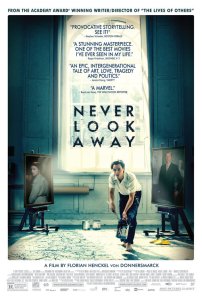 This is only the second film for writer/director Florian Henckel von Donnersmarck since his 2006 Oscar-winning masterpiece, The Lives of Others. Seeing his name attached to any movie was enough to secure my ticket. Going back to his native language, the director traces the life of a young, daring Dresden artist, loosely based on Gerhard Richter, trying to find his sense of self and truth from the reign of the Nazis to the GDR under Soviet influence. It’s a sprawling yet intimate human drama that has a full range of emotions, from the swooping romance to the heartbreak. It balances many emotions and tones as it presents a rich portrait of a young man’s life set across a fascinating backdrop. His free-spirited aunt, an inspirational figure, is abducted due to her schizophrenia and ultimately sentenced to death by an SS-enabling doctor (Sebastian Koch). This gets even more complicated when he goes to college and starts secretly dating the daughter… of that very same doctor, now being protected by a high-ranking Soviet official he aided. The simple strokes of a love story, or the disapproving father trying to destroy their love story, or the efforts of the family post-war to find some foothold in a new East Germany, it all adds up to a deeply felt and deeply alluring human drama with plenty of breathing room. The length (3 hours 8 minutes) gets to be unwieldy, especially during the third hour when we visit our second art school education. It’s just less generally captivating to watch a guy try and find his artistic voice when his life has all this other potent drama afoot, and that’s even after the lingering fallout from a forced abortion and hidden Nazi searches. Never Look Away is compelling, compassionate, thoughtful, and a tad too long for its own good. Hopefully the director doesn’t take another long eight years for a follow-up (please!).
Nate’s Grade: B+
Share this:

Welcome to Marwen (2018)
 When I saw the trailer for Welcome to Marwen my first response was pained wincing. Robert Zemeckis is one of the most daring, inventive, and imaginative filmmakers working today, but this movie just looked misguided with its approach. Welcome to Marwen is so fascinating, so tonally off, that I might almost recommend people watch it.
Mark Hogancamp (Steve Carell) was a war illustrator until the day he was attacked by a gang of neo Nazis. In the ensuring months, Mark has lost portions of his memory, is unable to use his hands to illustrate any longer, and has become something of a shut-in. He has gained notoriety through his new artistic outlet. Mark has created a WWII era Belgian town called Marwen with a group of dolls fighting evil Nazis. We escape into fantasy sequences where Mark imagines himself as Cap’N Hogie and his gang of supportive ladies. Nicol (Leslie Mann) moves in next door to Mark and he takes an immediate interest in her (she even appears in Marwen in doll form). Mark must grapple with his feelings and work up the courage to attend the court hearing to make sure the men who hurt him stay in prison.
 I was amazed at how miscalculated Welcome to Marwen plays out. It feels like Steve Carell’s Patch Adams, a sentimental movie where every step seems strange, mistaken, maudlin, and false. Firstly, this is the second documentary that Zemeckis has taken and adapted into a live-action film, as if the man is spending the wee hours of his nights pouring over award-winning documentaries of the past and determining which he can add a little razzle dazzle to with visual whimsy. Look out The Cove because maybe an undersea realm of talking dolphins will open up that horrifying Oscar-winner to a whole new mainstream audience. I’d have less of an issue with Zemeckis remaking the documentary if it didn’t seem like his entire rationale was the fantasy interludes.
The original documentary is about one man and his unique brand of healing through art. He is becoming further whole by building an intricate world through his imagination. By visualizing the fantasy worlds, Zemeckis is turning the doll segments into literal escapism that becomes tedious, obvious, and often redundant. The doll segments are about his gang of girls supporting him, expressing his interest in his kind new neighbor, and tackling the Nazis in a safe space where he can win. Every time we cut to the doll sequences it feels like the movie is spinning its wheels with these ill advised fantasy cut scenes. It gets boring watching the doll segments without any sense of stakes. The special effects are creepy and there are aspects that amplify this, like one doll’s penchant for having her top ripped off in combat, revealing her stout, rounded chest. Keep in mind that the female dolls, with the exception of one, are all analogues for people in his life, so then Mark is consistently indulging in stripping one woman of her clothes. Even though the movie sets this character up to be a potential love interest, it’s still not a good choice. Zemeckis intends to literalize Mark’s struggles and fears so that he can triumph over them, but it feels like it’s minimizing the complexity of trauma into digestible whimsy. With every trip to Marwen, I was eager to return back to the land of human beings where they might still be over-the-top but at least I wouldn’t have to watch creepy doll CGI.
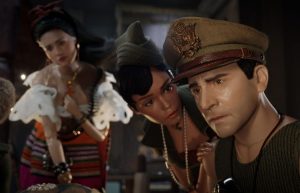 The most significant doll is the blue-haired Deja Thoris (Diane Kruger) who is meant to represent Mark’s suicidal impulses. He keeps her atop his wall so that she can watch over him, and in his sleep he dreams about her whispering in his ear, “Nobody will ever love you like I do. You should just end it now.” Oh man, that’s heavy, but when applied through the prism of a talking Barbie doll it loses its sense of seriousness. If you don’t lose yourself in the central conceit and take the dolls seriously, the movie will fall flat. Take for instance the cross-dressing aspect of Mark, which is what lead to his brutal beating. It’s a delicate subject and something easy to get muddled, and that’s exactly what happens in the presentation of this movie. The shoe fetish is initially portrayed as wacky and then becomes serious and then becomes like an artifact of horror. It’s another sign that the tone for this movie is mismatched. These things require a delicate touch with some ambiguity and sensitivity. Welcome to Marwen turns these into a loud, noisy cartoon that bumbles into its messages. Things that are meant to be charming or endearing or emotional can come across as goofy or campy or even uncomfortable.
I felt bad for so many of the actors. Carell (Vice) is trying to maintain his character’s sense of dignity throughout, but the story often goes into contrived contortions to force him into dramatic confrontations. It turns out the court appearance is rescheduled to be the same day of Mark’s photographic exhibit. Will he be able to triumph over these forces to stand up for himself? Carell is a capable dramatic actor but he’s struggling here to find stable footing because of the mish mashing tones. The development of Mark makes him come across as a creep in some moments, like his one-sided advances for Nicol, and a simpleton at other moments, where he might have sustained brain damage. Mann (Blockers) is sweet and gentle but strangely the movie hides her most interesting character aspects, like the prospect of a deceased child. You would think overcoming tragedy would be a tool for Nicol and Mark to bond. Merritt Wever (Godless) is another sweet and gentle woman in a world that seems overstocked with them. It feels like everyone in this small town exists just to be nice to Mark. She’s clearly romantically interested in Mark but he doesn’t care until the very end. She deserves better than being someone’s runner-up choice, especially only after he was turned down.
 A movie that deals with delicate issues through fantasy escapism can work, but it requires a precise hand with tone and with its storytelling detours. Guillermo del Toro has been able to prove he can tell rich, adult stories with the assistance of whimsical, weird fantasy elements. Charlie Kaufman has been able to weird the mundane and the fantastic. It can be done and Zemeckis has done it himself before, best evidenced by the masterpiece, Who Framed Roger Rabbit?. However, Welcome to Marwen is a sizeable tonal misfire. The serious elements don’t blend well with the fantasy elements, and even worse, they are made less serious and approach the realm of camp. The fun, fantasy elements are given bizarre and unsettling contexts that make them creepy and inappropriate. Escaping into Mark’s imagination winds up stripping him of much of his agency, and literalizing his psychological push-and-pull feels like a misguided examination on depression. I left my theater in a daze, trying to make sense of what I had just witnessed. The filmmakers and cast certainly mean well and want the film to be a triumph of the human spirit. I found it to be two meandering hours of watching somebody play with their disused toys.
Nate’s Grade: C-
Share this:

The Zookeeper’s Wife (2017)
 Antonina Zabinski (Jessica Chastain) and her husband Jan (Johan Heldenbergh) are the keepers of the Warsaw Zoo. Their lives are thrown into turmoil when Germany invades and occupies Poland. Their animals are slaughtered or moved to the Berlin Zoo, under the care of Nazi party member and amateur geneticist Lutz Heck (Daniel Bruhl). Feeling impotent to the horrors around them, Antonina and Jan risk everything to hide Jews in their zoo and eventually smuggle them out to safe houses.
The Zookeeper’s Wife is one of those slice-of-life stories about good people risking much to save lives during the Holocaust that come from obscurity to remind you that there are still fresh, invigorating stories from a topic that can feel tapped out after 70 years. However, it’s also an indication that you need the right handling to do it justice. The Holocaust is by nature such a horrific subject matter that it’s hard to do it justice with a PG-13 or below rating, but it can be done with the right amount of artistic restraint as long as the overall story doesn’t feel hobbled with limitations. Reluctantly, The Zookeeper’s Wife feels a bit too sanitized for the story it’s telling. When it comes to cruelty and human atrocity, you don’t need to shove the audience’s face in the mess to fully comprehend its distaste, but overly avoiding the reality can also be a detriment. The Zookeeper’s Wife, as a PG-13 movie, does not feel like the ideal way to tell this real-life story. It feels too restrained and some of those artistic compromises make for a movie that feels lacking and distracting at points. Fair warning: there are plenty of animal deaths in this movie, though they are all dealt with off-screen with implied violence. The edits to work around this can be jarring and would take me out of the picture. This is only one example of an element that, in order to maintain its dignified PG-13 rating, unfortunately undercuts the realism and power of its story.
 For a Holocaust story set in Poland, the stakes feel abnormally low. The zoo is a sanctuary compared to the Jewish ghettos. The danger of hiding over 300 Jewish people over the course of the entire war feels absent, which is strange considering it should be felt in just about every moment. There are a handful of scenes where we worry whether they will be caught but they’re defused so quickly and easily. After Antonina is caught talking to a very Jewish-looking “doctor” in her bedroom by the housekeeper, they just fire the housekeeper who leaves quietly and never comes back again. It’s a moment of tension that can be felt and it all goes away in a rush. This scene also stands out because the narrow escapes and close calls are surprisingly few and far between. Even when Antonina’s son commits stupid mistake after stupid mistake, including impulsively insulting a Nazi officer to his back, there’s little fear of some sort of retribution. The movie can also lack subtlety, like watching Heck say three times he’s a man of his word and will be trustworthy. We all know he’s going to fall short. There’s also a moment where Jan is literally loading children, who each raise their arms in anticipation, onto a train car. It’s like getting punched in the stomach with every child. Much of the time spent on the zoo is with the quiet moments trying to make the Jewish survivors feel like human beings again (the animals-in-cages metaphor is there). The details of the smuggling and hiding are interesting but cannot carry a movie without more.
The biggest reason to see this movie is the promise of another leading Chastain (Miss Sloane) performance. Ever since rocketing to prominence in 2011, Chastain has proven to be one of the most reliably excellent actors in the industry regardless of the quality of the film. She’s been dubbed a Streep in the making and Zookeeper’s Wife allows her to level up to her “Sophie’s Choice acting challenge stage” and try on that famous Slavic accent that turns all “ing” endings into “ink.” Chastain is terrific as a person trying to navigate their way through the unimaginable, calling upon reserves of courage when needed, and she’s at her best during the moments with Herr Heck. She has to play the dishonorable part of the possible lover, and Heck definitely has his heart set on Antonina. The scenes with the two of them draw out the most tension and afford Chastain a variety of emotions to play as she cycles through her masks. In some ways I wish the more of the movie was focused on this personal conflict and developed it even further.
There was a small practically incidental moment that got me thinking. As stated above, the film has a PG-13 rating and one of the reasons is for brief nudity from Chastain. Now the actress has gone nude before in other movies so that’s not much of a shocker, but it’s the context and execution that got me thinking. Antonina and Jan are lying together in bed after sex and Chastain does the usually Hollywood habit of the bed sheet being at her shoulders while it resides at the man’s waist (those typical L-shaped bed sheets). No big deal. Then, during their discussion over what to do, Antonina rolls over and exposes her breast for a second before she covers herself up again. The reason this stood out to me, beyond the prurient, is because it felt like a mistake. It seems obvious that Chastain was not intended to be seen naked in this intimate post-coital conversation but it was used in the final cut anyway, which made me wonder. Was the take so good, or so much better than the others, that director Niki Caro (Whale Rider, McFarland, USA) and Chastain said “the hell with it” and kept the briefly exposed breast? Did they enjoy the happily accidental casual nature to the nudity, creating a stronger sense of realism between the married couple? Or in the end was it just another selling point to help put butts in seats? I’m thinking best take is the answer. You decide.
 I am convinced one of the main reasons that Chastain wanted to do this movie, and I can’t really blame her, is because she would get to hold a bunch of adorable animals. Given the subject matter, I was prepared for a menagerie of cute little creatures, but I started noticing just how many of them Chastain is seen holding. She holds a rabbit for a monologue. She holds a lion cub. She holds a baby pig. She holds a monkey. She even kind of holds a rubbery baby elephant doll (talk about Save the Cat moment, this movie takes it even more literally). There may very well be animals I simply have forgotten she held. I would not be surprised if in her contract there was a rider that insisted that Ms. Chastain hold at least one small, adorable animal every third day of filming on set.
Stately and sincere, The Zookeeper’s Wife is an inherently interesting true story that should have more than enough elements to bring to life a compelling film experience. It’s an acceptable movie that’s well made but I can’t help but feel that there’s a better version of this story out there. It feels a tad too safe, a tad too sanitized, a tad too absent a sense of stakes, like it’s on awards-caliber autopilot. Chastain is good but her Polish accent becomes a near metaphor for the larger film: it’s polished and proper but you can’t help but feel like something is lacking and going through the motions of what is expected. This is a worthy story and I’m sure there are great moments of drama, but The Zookeeper’s Wife feels a bit too clipped and misshapen to do its story real justice.
Nate’s Grade: B-
Share this:

Yoga Hosers (2016)
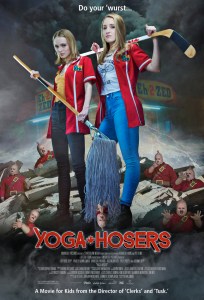 Kevin Smith has been a filmmaker who has flouted expectations. When people didn’t think the Clerks guy could make a religious thriller, he did it. When people said a movie about a man being transformed into a walrus creature was undoable, he did it. I was a moderate fan of Tusk, that man-as-walrus-as-Frankenstein movie that started as a joke premise from Smith’s popular podcast and then given strange cinematic life. Yoga Hosers is the second part in Smith’s “True North” trilogy of Canadian-set horror films. I wasn’t expecting much with Yoga Hosers and I felt like I got even less than that.
Colleen Collete (Lily-Rose Depp) and Colleen McKenzie (Harley Quinn Smith) are bored clerks at a Winnipeg convenience store. Their world is turned upside down when an attractive senior boy invites them to a “grade 12” party. Too bad they have to work, though even when on the clock the girls hardly work, instead preferring to jam in the back storage room as a fledging rock band. The girls have bigger threats than unruly customers. They’ll have to battle bad Satanists, forgotten Canadian Nazis, and tiny bratwurst men who leak sauerkraut when smashed. What’s a Canuck to do?
 The two areas that have always been the hallmarks of a Kevin Smith movie, his idiosyncratic characterization and ribald humor, are both strangely absent and desperately needed. Within the first ten minutes of the movie, I turned to my friend and confided, “I think I hate these girls already.” It’s somewhat ironic that Smith has gone back again to the bored convenience store clerks as the platform for his heroes. Where Dante and Randall were railing against pop-culture, adult responsibility, and a society that constantly made them feel inferior for their menial occupations, these girls aren’t railing against anything. If anything they’re retreating from the world, their noses constantly glued to their smart phones and social media. The excursions with youth culture feel rather inauthentic. The teen dialogue lacks comic snap and repeats phrases too often that it feels like set-up for T-shirt slogans (“Basic!”). Smith is far from his territory of dick and fart jokes and esoteric pop-culture detours. We’re introduced to many new characters with a slam edit of an Instagram-like cover page accompanied by an irritatingly chirpy 8-bit score. The intro graphics appear so quickly as to have little impact other than annoyance. The lead characters have no engaging personalities. They have an infatuation with older, cute boys, a love of yoga, a general attitude against authority, and a common level of self-involvement, but they’re not characters. They’re goofy but rarely are they grounded or better developed. One girl is daft and the other girl is… less daft. I’m not expecting these characters to have depth considering this is a movie with one-foot tall killer bratwurst Nazis, but some degree of personality is demanded. It’s the bare minimum.
Smith’s millennial satire is fairly toothless, which sadly is much like the comedy of Yoga Hosers. I hope you like puns and jokes about how funny Canadian accents are. The Colleens say “soory aboot that” and isn’t that hilarious? How about a convenience store called “Eh-2-Zed”? How about a yogi whose name is Yogi Bayer? How about an off-brand version of Lucky Charms called Pucky Charms? Why are there so many freaking puns? Then there’s the re-emergence of Johnny Depp’s wacky Quebec investigator, Guy Lapointe, allowing Depp to indulge his tendency for prosthetics and heavy accents. The shticky Lapointe character absolutely derailed Tusk and whatever unsettling momentum had been built, but he feels far more at home in the goofy world of Yoga Hosers. I might even say his presence is one of the highlights, as once more Depp gets to sink his teeth into all the Peter Sellers physical comedy tics he’s been holding back.
There’s just not enough comedy to go around here. There are goofy elements that crash into one another, like the Brat-Zis and a gigantic Goalie Golem, but it feels very much like Smith is just throwing a lot of dispirit elements together and expecting cohesion. He might even be expecting the audience to be satiated just in seeing something “different.” While Red State and Tusk were films that had sharp tonal shifts, Yoga Hosers never really settles into the silly supernatural teen comedy it desires to be. I laughed here and there but it was mostly attributed to Smith letting his more capable comic actors go off on tangents, like Justin Long’s yogi with his unorthodox poses. Ralph Garman, Smith podcast regular, shows up late as a Nazi who prefers to discuss his plans via celebrity impressions, a talent of Garman’s. It’s the kind of “hell, why not?” plotting that dominates the movie and makes you wonder if there ever was a finished script.
 I doubt any version of this story would have materialized if it wasn’t starring the daughters of Kevin Smith and Johnny Depp, and I don’t have a huge issue with this. Nepotism has been a core function of Hollywood for over a hundred years, and if Smith wants to create a vehicle for his daughter, by all means. The two young ladies have a pleasant chemistry and are believable BFFs. Their back-and-forth will occasionally elevate the jokes, like their insistent yet limited Batman impressions. Harley Quinn Smith has an enjoyable mugging quality that shows she’s studied her expressions from the school of Silent Bob. Her companion, Lily-Rose Depp, may be the real breakout. She’s the more consistent actor and the stronger anchor for the film. Even when the dialogue lets her down she still infuses a notable energy into her performance. There’s an emerging talent under the surface that looks ready for discovery, and perhaps the French film Planetarium with Natalie Portman will make others take notice. I get the impression that Kevin Smith and Johnny Depp are proud papas and just wanted to have fun together as a family. Consider the movie the equivalent of a quirky sweet 16 birthday party.
Yoga Hosers is a movie for a very select group of people, perhaps only Smith’s immediate family, friends, and most ardent of podcast listeners. I doubt that’s me. I’ve been a Smith fan since my own teens. His was one of the cinematic voices that awoke my own sense of what movies could be. I miss the caustic wit that separated Smith from the indie pack. The man was one of the few writers who could spin crass vulgarity into Shakespearean gold. He was a writing talent that many emulated but few could reproduce. Smith’s whip-smart comic perspective has always been his biggest cinematic draw, but with Yoga Hosers it feels decidedly neutered and wound down. I know he has gone on record saying he’s making the movies he wants to make without interference, but it doesn’t feel like the same Smith. Admittedly, a filmmaker in his early 20s is going to have a different perspective and creative impulses than a husband and father in his mid 40s. This apparently means that Smith has veered away from his conversational comedies and button-pushing topics and bought fully into genre filmmaking, mixing a pastiche of horror elements and varying tones. As an artist he doesn’t owe me or any other fan anything. Yoga Hosers might be a one-off, a love letter to his teen daughter and her bestie, or it could portend what is to come. Kevin Smith is making movies for himself at this point in his career. If you feel left out in that equation, like me, that’s okay. We can always go back and watch Clerks again. From my viewpoint, it feels like Smith is voluntarily erasing what made him a unique cinematic voice and choosing to disappear into the benign morass of schlocky genre filmmaking.
Nate’s Grade: C-
Share this:

Bloodrayne: The Third Reich (2011)
 It took five years and three movies, but notorious film director Uwe Boll has finally gotten to the original time period of the Bloodrayne video game. The popular game concerns a lithe, redheaded half-vampiric lass killing nefarious Nazis in World War II. You would have thought that would make for a decent starting point. But Boll instead took his time, possibly always envisioning a trilogy to do the character and his storytelling ambition proper service. Or it was just a way to make more money. So after stops in 18th-century Romania and the Wild West, Rayne comes home, so to speak in Bloodrayne: The Third Reich. What if somebody was adapting the Grand Theft Auto franchise into a film and took Boll’s dawdling approach? The first film would probably start with horses and buggies.
Rayne (Natassia Malthe), our favorite dhampir, is back at slaying them dead. She teams up with Nathaniel (Brendan Fletcher) and his band of resistance fighters on the Eastern front. They rescue one train filled with prisoners and get into a shootout with Commandant Ekhart Brand (Michael Paré). But Rayne makes the unfortunate mistake of biting the Commandant before impaling the guy. She has unknowingly turned the Nazi officer into a vampire like her, one that can walk in daylight. You would think after 200 years of existence she would have a handle on this. The Commandant is educated in the ways of the vampire by a mad scientist, Dr. Mangler (Clint Howard), who enjoys torturing human and vampire alike for science. At one point the doc says, while slicing up a living body,” Vampires no longer have any bonds to the moral laws of man.” That seems like a pot/kettle situation to me. The Commandant assembles his own undead army of vampire soldiers. Rayne feels responsible for this ugly mess and vows to kill the Commandant again and to a satisfying degree of dead this time.
 For a while, Bloodrayne III looks like it might be the best in the trilogy, admittedly a dubious honor. Despite all my misgivings, Bloodrayne III almost works on its own lowered-expectation exploitation genre level. Almost. The campy combination of Nazis and vampires is a wild premise, though hardly original, and should reap some ripe and schlocky exploitation entertainment. The locations in Croatia are terrific and add just enough authenticity for a story about a vampire lady killing Nazis. In fact one sequence plays like Boll’s take on Tarantino’s Inglourious Basterds, involving a tavern showdown where people play a tense game of secret identities. There are moments that work, little bursts of promise, but they get reaped all too quickly. Boll’s action choreography is sadly limited in scope and editing. He sticks too close to his characters, never allowing for complicated tussles or expanding the scope of the action. There are a few serviceable explosions, some minor gore effects, but Boll does nobody any favor when the action is too brief and brittle. Everything feels pared down so most of the fights involve minimal players and the sequences themselves mostly give way to redundant posturing.
The failings of Bloodrayne III are roughly the same failings that dogged Bloodrayne II: Boll does not embrace his film’s inherent cheesiness. I wrote about 2007’s Bloodrayne: Deliverance: “Boll seems uneasy about embracing its supernaturally campy potential. Bloodrayne II has little blood, zero gore, no nudity, no sex, and a pitifully scant amount of action. In other words, it’s missing all of the exploitation elements that make a movie like Bloodrayne II worth watching.” While Boll has seen fit to correct the absence of certain genre elements, notably blood and boobs, he still cannot seize the pulpy premise into Grand Guignol. Nazi vampires, an immortal Hitler, a 200-year-old ass-kicking woman with signature arm-blades AND Clint Howard as a mad Nazi scientist and this is the best you can do? That’s unacceptable. The supernatural potential is wasted here. Rayne’s vampire side is barely utilized. She bites people, she jumps high once, but there’s nothing really vampiric about her beside one scene where she complains about having to drink pig’s blood. She might as well be anything else if you’re not going to take advantage of what makes a vampire a vampire. At one point, the Commandant turns his best tracker into a vampire for the purposes of finding Rayne (her secret hideout turns out to be a not very discreet large castle). That idea had great promise, all things considered, but like most of the other fights, it’s one-and-done. Rayne takes out the guy and we move along. Rayne is betrayed by one of the brothel girls who has her eyes set on running the business (“You’re a cocksucking entrepreneur,” someone declares, though I wouldn’t put that exact terminology on a resume). She gets turned into a vampire too. All right, she could work as a character that could get close to Rayne. But then she too is dispatched with mercurial swiftness. Why the hurry? Bloodrayne III runs a total 72 minutes before end credits. The film could have used a lot more fleshing out, and it could have benefited from being less serious with something so flatly ridiculous.
It wouldn’t be a Boll movie without the whiplash-inducing shifts in tone. One second we’re dwelling on the campy idea of Herr Hitler becoming a powerful vampire (there’s even a goofy dream sequence where Rayne is terrorized by Adolf with fangs) and the next minute the film descends into soft-core porn territory. Rayne visits a brothel to get an oiled massage, because apparently being a centuries-old undead slayer of evil can really cause some killer knots that only hookers are properly trained to knead away. Anyway, Rayne saves one of the brothel girls from an abusive Nazi john, and the women of the brothel wish to show their gratitude via some sex “on the house.” We’re then treated to a solid four minutes of heavy breathing and gauzy soft-focus shots of hands, nipples, and crevices. To Boll’s credit, it’s on par with most soft-core porn productions. When Rayne is beating the Nazi john she becomes a feminist mouthpiece: “I can’t punish you for the legions of women who have been brutalized by men, but I’ll give it my best shot.” If Sucker Punch proved anything, it’s hard to stand on a feminist soapbox when your characters are pure male fantasy figures. The onscreen lesbian tryst would fit the context of the film better if Boll kept a continuity of tawdry sensuality. I don’t recall any other lesbian leanings in previous entries but I suppose spontaneous lesbians/opportune bisexuality just goes with direct-to-DVD territory. The only other element of sexuality occurs late in Bloodrayne III, like ten minutes to credits. Rayne and Nathaniel decide it’s time to get it on. Oh, did I mention that they come to this decision while in the back of a German transport truck on the way to Berlin. Nonetheless, an awkward and deeply unerotic sex scene follows before their rescue. They appear to be making the most of their time, though curiously both participants leave their fingerless gloves on while they copulate. I call it “hobo lovemaking.
Boll doesn’t seem to understand what a truly juicy concept vampire Nazis are so we are treated to a lot of talking. But it’s not talking that really establishes character, setting, or plot; it’s mostly a jumble of self-aggrandizing, hyperbolic asides as heroes and villains are constantly reconfirming the stakes. Vampire Nazis. Trust us, we get it. But alas, the Commandant keeps gripping his fists and speaking about being “power incarnate” and how everyone shall bow to his power and how he’s “the prodigal son of the Third Reich,” which I don’t think is the proper analogy to apply. Dr. Mangler (too on-the-nose or an attempt to reference Dr. Mengele? You be the judge) will not let any situation to bray about the obvious go to waste, sometimes with peculiar anachronisms. Over the course of the film, this talkative evil scientist will reference Shakespeare, say “the world is your oyster,” and even, “The times they are a changin’, gyspy.” He even slams the father of penicillin, saying, “Alexander Fleming had his fungi. I have [Rayne].” But the worst offenders have to be Rayne and Nathaniel. At one point they bellow, “He’s not just a vampire! He’s a vampire with an entire German army behind him!” You know, in case you couldn’t grasp the subtleties of the narrative. Rayne is given to long passages of voice over where we get to listen to her wax poetic about man’s inhumanity to man, the cycle of violence, and other hilarious grasps at being mistaken as having, you know, depth or thoughts. This is the same character who ends the film saying, “Guten tach, mother fuckers!” Yeah, this one’s a regular Rodin.
 The film is populated entirely with Boll’s stock players, so you know the acting returns will be fairly diminished. Malthe (Elektra) returns for her second go-round as the titular half-vampire half-human heroine. For what reason, I could not say. Perhaps the former Maxim model had a large gas bill one winter. Malthe hasn’t advanced much as an actress in the layover between sequels. Malthe looks deathly pale in the film with alabaster skin. Apparently in the 60 years since the events of Bloodrayne II, she decided to keep the cleavage-accentuated fighting outfits but lose her skin tone and her heretofore signature red hair. But fear not video game aficionados because this Rayne has streaks of bright red amongst her otherwise jet black tresses. I suppose she found the one Hot Topic open on the Eastern front. Malthel looks the part, no matter what improbable form-fitting outfit she chooses to slay evil in, until she opens her mouth and destroys the illusion. To be fair, the Rayne character is mostly defined by costuming and weaponry. Don’t believe me? Read the user reviews by fanboys and see what they quibble over most.
It wouldn’t be a Boll film without his lucky charm, Paré (11 Boll film appearances!). The plainspoken actor was actually a fine fit in Bloodrayne II as a cowpoke. He’s not so well a good fit as an evil Nazi officer. Paré is never truly threatening in any capacity as a Nazi or a vampire. That’s pretty sad. He’s given tough guy things to say, and he bites people, but he never comes across as menacing. He’s letting the uniform do the acting for him. Likewise, Howard (first Boll appearance since 2003’s House of the Dead) gets lost in the broad generalization of his character. Howard always seems like he’s on the verge of breaking into third person. He seems lost in a daze too often. Howard comes across as more Igor than mad scientist. He’s definitely not going to be one the scientists other countries offer asylum for at war’s end.
Bloodrayne: The Third Reich could have been a ridiculously yet enjoyably campy B-movie that knew how to play to its strengths – vampire Nazis, attractive woman killing vampire Nazis. You would think that salaciously junky concept would write itself. The problem is that Boll seems to have made a movie that seemed like it would write itself. It’s not enough to just have a handful of genre elements (vampires, Hitler, lesbians!), you have to present those elements in an appealing manner. The premise is workable but the plot, characters, action, and tone are not given necessary attention. I never thought I would say this, but there’s just not enough holding together a movie about vampire Nazis. The dialogue is mostly characters talking in circles, rehashing what should be obvious, explaining why the bad guys should be threats when they fail to be credible onscreen. The film might be the best of the ongoing trilogy, but what exactly is that saying? Barely covering 75 minutes, with negligible action and an overall rushed pace, Bloodrayne III is a sterling example of disposable entertainment that hasn’t even been given the necessary components to be “entertainment.” Instead it’s just eminently disposable. The saddest part is knowing it’s only so long before this character gets resurrected for a fourth movie. Perhaps by then Boll will have figured out what to do with his vampire-killing lead. Fourth time’s the charm, right?
Nate’s Grade: C-
Share this:

The Reader (2008)
 Every now and then, the assorted members that make up the Motion Picture Academy make, shall we say, quizzical selections. There are snubs and undeserving winners, but then there’s the crazy nomination where you see the movie and say to yourself, “What the hell were they thinking?” In recent years I’ve usually found at least one Best Picture nominee that left me scratching my head. In 2007 it was Atonement, in 2004 it was Finding Neverland. But I could at least fathom a guess as to why each of those movies appealed to the Academy and garnered a Best Picture nominee. I’m stumped when it comes to 2008 Best Picture nominee, The Reader. Based upon an award-winning novel, I can only surmise that Academy voters saw the words “Kate Winslet” and “Holocaust” and thought the movie had to be far worthier than the likes of WALL-E or The Dark Knight.
In post-World War II Germany, teenager Michael Berg (David Kross) begins a torrid affair with an older woman, Hanna Schmitz (Winslet). He’s 15 years old; she’s easily twice his age. She instructs her young lover to read to her before they engage in sexual activity, which turns reading into an act of foreplay. The summer affair ends abruptly when Hanna runs off after her employer has given her a promotion. Michael is heartbroken that his lover has flown the coop. Flash forward several years and Michael is attending law school in Berlin. He and his fellow students visit an ongoing trial that features a group of former female concentration camp guards. To Michael’s shock, Hanna is on trial as one of the murderous Nazi guards. The young boy is beset by his feelings of love for a person who has committed despicable deeds. Hanna is keeping a deeper secret and will go to her grave to keep it. Eventually an adult Michael (Ralph Fiennes, wasted) finds his life returning to an imprisoned, older Hanna, possibly his life’s greatest love.
 The Reader contains interesting story elements: sex, guilt, romantic affairs with former Nazi prison guards. But rarely do any of these interesting elements actually transform into an interesting story. The movie just kind of lies there, basking in some phony reflective pause when the movie manages to be so distant and uninvolved. At times the movies seems to have little interest in its own self. This movie feels like it was made to be Oscar-bait because it deals with Big Themes and Important Topics, or at least the film wants to appear like it deals with said items. The Reader is mostly shallow. It pretends to present a moral quandary but director Stephen Daldry (The Hours) doesn’t bother to analyze the contradictions of his characters. The film alternates between characters shouting obvious declarations and just stumbling around in contemplation, bumping into the furniture. It’s simultaneously annoying and boring. The movie wants to put a human face on monstrous deeds, which can be a noble pursuit. The Reader fails to be a “challenging” movie when it can’t be bothered to challenge its characters to do something.
The message of quasi redemption at the center of this specific film is either laughably naïve or downright insulting. Hanna keeps a personal secret shame at all costs, and she would rather go to prison for life as a Nazi murderer than let people know she cannot read. I’m sorry, but that’s dumb. The fact that it seems like The Reader presents the theory that Hanna’s illiteracy mitigates her guilt is offensive. I’m sure the 300 people that were locked in a burning church to die would be sympathetic that their killer couldn’t read See Spot Run. In what world is illiteracy more shameful than genocide? If you’re going to float ridiculous notions at least commit to exploring their very ridiculousness, and therefore acknowledge that there is something amiss. The Reader instead seems to flutter from idea to idea without ever truly delving deeper. If you’re going to craft a character that’s more afraid of a library than a book burning, at least try and explore this enigma. There’s drama in the disconnect. But the movie never feels like this should be an issue. Can’t you see, silly movie goers, that Hanna is but a symbol for the German people who couldn’t read the signs to come and were ignorant to the extent of Hitler’s horrors. She would rather stick to her duty than claim moral responsibility. That’s fine, but there are a great number of movies, and countless more books, that have examined the psychological culpability that can turn a populace into silently willing participants in mass murder. The Reader would rather spend its closing moments exploring the magical healing power of literature. The fact that the film eliminates the novels’ section where Hanna reads news articles and novels about the Holocaust (thus gaining moral clarity) is dumb. Instead of gaining insight into her actions she reads Chekhov. The movie ends up transforming into a weird and wrongheaded episode of Reading Rainbow.
 Winslet’s acting is fine. She’s such a gifted actress that I doubt you’ll see her give a bad performance even if the movie doesn’t live up to her talent. She isn’t doing anything showy to make Hanna a sympathetic character, which works out well, but the film’s distant perspective means that Hanna seems more like an aloof cipher. She’s this formless blob of a character that expresses a mixture of human emotions but doesn’t resemble a recognizable human. This is the fault of the director and screenwriter who chose to replace subtext with ponderous silent stares (note to all “deep” filmmakers: THEY ARE NOT THE SAME). Winslet slips into the character with the same ease she has slipping out of her clothes. The Reader is another nudity-filled performance for Winslet, her eighth movie featuring her nude (also her fourth Oscar nomination for a nude performance, there must be some connection). As readers can attest, I am no prude when it comes to the female form, but even I thought things were getting a little gratuitous. In the first 45 minutes, Winslet is naked in almost every scene she shares with Kross. It’s almost as if the nudity is supposed to disarm the audience and make Hanna a more intimate. Winslet is one of her generation’s finest actresses, which is reason enough that she shouldn’t be handed a Best Actress Oscar for substandard material.
The Reader may not be a traditional Holocaust film and in fact it’s really not so much about the Holocaust. Sure, that colossal event casts a shadow over Germany, but the movie is mostly about a cold and daft woman and the callow boy who loves her. It’s about two characters, but it the movie is too reserved and then some. Everybody just seems numb, which makes for a boring movie after a while. I repeat: a boring movie about underage sexual affairs with freaking’ Nazis! Winslet’s fine performance is not enough to redeem the whole movie. I think much was lost in translation from page to screen. The Reader actually was more effective when it was just a cradle-robbing unorthodox love story. But then, those flicks don’t typically get nominated for Best Picture Oscars.
Nate’s Grade: C
Share this:

Postal (2008)
 I feel very strange at this moment. I may need to consult a physician. I’m undergoing an altogether new and confusing sensation. You see, I’m hesitant, almost embarrassed to admit this, but I finally found a Uwe Boll movie that I, well, don’t hate. In fact, I was laughing with Postal and not derisively at it. I would never have guessed that a social satire co-written and directed by Boll, which begins with hijackers flying a plane into a large skyscraper, is actually intentionally funny. That’s not to say that the outrageous, violent, and messy film is verifiably good, but for the first time I feel like Boll is genuinely progressing as a filmmaker and may prove that he can craft a competently entertaining movie in the future. And if you know anything about Boll, that statement is akin to going from crawling to flying an F-14 fighter jet blindfolded while constructing a birdhouse out of Popsicle sticks.
The slapdash plot takes place in the small town of Paradise, Arizona. Postal Dude (Zack Ward, TV’s Titus, Bloodrayne II) is a guy who gets pushed around by life. His fat wife is cheating on him constantly, he’s bullied by rednecks that live in the neighborhood trailer park, and he can’t find a job to escape. He’s looking for any way out. His uncle Dave (Dave Foley) has started a doomsday religious cult of disenfranchised hippies. The IRS is currently targeting him and needs a quick money fix. Uncle Dave and Postal Dude scheme to steal the lone shipment of “Krotchy” dolls, a doll that resembles male testicles that is highly in demand (the Chinese shipment capsized and the crew all died, but luckily the dolls were saved). Also looking to snatch the dolls is a terrorist cell that includes Osama bin Laden (played by Jewish actor Larry Thomas, best known as the Soup Nazi on Seinfeld). The plot isn’t important per se, but you will find yourself openly questioning why respected actors like J.K. Simmons and Seymour Cassel are doing in this mess.
 I think Boll has finally found a genre best suited for his cinematic interests. Setting Postal in the wacky comedy world has a freeing effect for Boll: he doesn’t have to adhere to any form of logic. His other movies usually suffered through continual lapses in thought and deed. With Postal, Boll can be as silly as he wants and not have to worry about disrupting his narrative. It should be no surprise then that Postal contains the best acting ever seen in a Boll movie. The good German has always had a seemingly inability to control his actors or provide any helpful direction, but finally he has found a genre that will work with actors giving unrestrained performances that are figuratively all over the thespian map. Shockingly, Ward and Foley both give quite good straight-laced comedic performances (nothing can prepare you for Foley’s generous dose of full-frontal nudity).
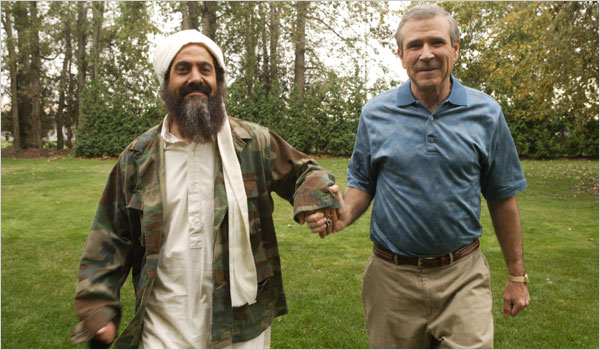
Boll stuffs a lot of extreme elements into his movie, including Islamic terrorists, Osama bin Laden frolicking hand-in-hand with President Bush, inbred rednecks with garish teeth, sex scenes with the morbidly obese, crass racial stereotypes, sexual abuse gags, the media’s opportunism in response to tragedy, an ending that takes a page from Dr. Strangelove, a mentally handicapped martyr, and much more. The movie’s aim is to offend and it has many targets. Boll is no insightful political satirist but even he finds humor in the absurd. The movie is blunt and belittles everyone. Postal skewers religious fundamentalism/apocalyptic yearnings on all sides. There is one sequence where Ward is pinned down by rednecks, Islamic terrorists, and crazy cult followers. He tries appealing to their hearts and establishing common ground. “Well,” one of the terrorists says, “We all hate the Jews,” and then everyone nods solemnly. That’s funny. It’s not deep or biting but it is funny in setup and delivery. I give credit where it’s due. Postal takes some seriously demented detours that take advantage of the wacky, anything-goes atmosphere.
The movie’s jokes hit high and low but some of them definitely stick. The concept of our main character caught in a shootout at the welfare office is given a wicked twist when he crawls along the incapacitated victims looking to trade up a better waiting number. There are comedic riffs hat actually work. Postal isn’t clever or scathing, and is hardly subtle or nuanced, but I could honestly see Postal developing a small cult following, one removed from the cult following already built around bashing Boll.
 Here is a list of moments that made me actually laugh: using a man in a vegetative state bound in wheelchair as a stepping stone to help climb a chain-link fence, Foley and Ward arguing decimal placements, watching Mini-Me actor Verne Troyer pushing a suitcase bigger than himself across a long shot, the fact that Osama bin Laden casually walks around in broad daylight to underscore the nagging fact that the man is still at large, the concept of using a cat as a silencer for a gun (fear not animal lovers, the cat lives), a “God shelter” in case of rapture, Osama attending a workshop on leadership styles and having his credit card declined, a character’s dying attempt to discover if he’s gay or merely bisexual, and the insane religious prophecy involving Troyer and 1000 horny monkeys. That last one is almost inspired in its sheer lunacy. The best part for many will be when Uwe Boll appears onscreen as himself. He admits he finances his crummy movies via Nazi gold and then, no kidding, the actual creator of the Postal video game appears and shoots Boll in the groin. For many, this is a vicarious moment to be savored.
Postal could have worked even better had Boll had a more consistent tone. Simply put, being offensive and shocking and wallowing in bad taste does not guarantee being funny. Watching a truck run over a baby carriage isn’t funny because it’s shocking. Without greater context or setup, it’s the equivalent of a tired and morose “dead baby” joke: tasteless but lacking any humor. And yet here are more missed comedic opportunities that Boll fails to capitalize upon. The missed comedic opportunities mount (Islamic terrorists eventually descend upon a redneck trailer park and … nothing?). Some jokes teeter but then hit a wrong note and become uncomfortable. Watching a black police officer (Chris Spencer, Bloodrayne II) brutally murder an Asian driver is not funny. Seeing a montage of children being massacred by stray gunfire is not funny and has no hope of being funny. When the movie utilizes realistic violence, it must walk a very delicate tone to spring laughs from darker territory. Realistic violence by itself is not funny because brutality is hard to milk for laughs.
Boll will drift and lose his comedy momentum. The highly publicized opening sequence is actually kind of funny. Two terrorists have hijacked a plane but then have second thoughts after they realize there are discrepancies about the number of post-martyrdom virgins. They begin to then analyze the gaps in theology and decide to turn the plane around and head to the Bahamas instead. With this segment Boll has taken a politically sensitive subject and given it a twist. Where the segment goes wrong is not when the passengers storm the cockpit and cause the plane to crash, this serves as irony. Where the segment goes wrong is when it cuts to a window washer atop a skyscraper and we watch the plane come closer and crash into a fiery blaze. The view doesn’t serve as any comedic punchline and places the viewer in an uncomfortable position of not only reliving 9/11 but also reliving it from a hapless victim’s perspective. It’s one example of a misstep that ruins the joke. By the film’s end it has turned into an incoherent bloodbath.
 Not to kill Uwe Boll with praise, but Postal is also his best looking movie to date. The shot compositions are framed well, there is actual camerawork that gives off a slight Coen brothers’ vibe, and the cinematography by Boll staple Mathias Nuemann is crisp and clean. This is a good-looking movie that works within its limited budget and locations.
Postal wasn’t given much of a chance out of the gate. It has been sitting on a shelf for over a year, it was dumped into a small number of theaters opening the same weekend opposite the slightly higher profile Indiana Jones sequel. Boll arranged a free screening of the film and a majority walked out after the opening segment involving the hijackers. Postal is a bizarre and distasteful movie that relies too heavily on shock tactics and the idea that offensive equates humor. There are holes, inconsistencies, shallow satire, and many missed comedic opportunities, and yet, in spite of everything, I laughed at several points. This is Boll’s most intentionally entertaining movie to date. While it may sound like heresy, I would rather watch Postal again than the much more commercial and critically lauded Pineapple Express.
It feels like Boll is actually progressing as a filmmaker, however, I make this statement under the caveat that the confines of the wacky comedy genre forgive lapses in content. But I may not be alone. Boll submitted his flick to the Hoboken International Film Festival and actually won. Boll was named Best Director and the film was awarded Best of the Festival, which is a category based upon audience votes. Perhaps it’s just my lowered expectations with any Boll production, but Postal almost works; not quite but almost. And that’s a tremendous leap forward for a man whose movies have made me retire synonyms for “stupid.”
Nate’s Grade: C
Share this:

The Counterfeiters (2007)
 The Oscar-winner for 2007 foreign film is certainly a fine film and a respectable winner, but let’s be honest, the foreign film category was watered down a tad. France nominated Persepolis over The Diving Bell and the Butterfly because a country is only allowed to nominate a single film (sucks to be you, countries with good movies). This rule has resulted in past incidents like Spain nominating Tuesdays in the Sun over Pedro Almodovar’s Talk to Her, which ended up winning the 2002 Best Original Screenplay Oscar despite Spain’s snub. The hard decision by France was moot because Persepolis didn’t make the Academy 2007 shortlist of nine nominees. The biggest snub from that shortlist was Romania’s 4 Months, 3 Weeks, and 2 Days, a harrowing film about two college-aged women seeking an illegal abortion in 1980s communist Romania. It won the Palme d’Or at the Cannes Film Festival and also won the Best Picture award by the European Film Awards (Austria’s The Counterfeiters wasn’t even nominated). Then there was Israel’s amusing and touching film, The Band’s Visit, about an Egyptian band that takes a wrong bus and finds itself in an Israeli town. But the Academy’s foreign films ruled that The Band’s Visit had too much spoken English and therefore could not be ruled as a foreign film. Also left out were Germany’s Edge of Heaven and Spain’s The Orphanage. Nothing against The Counterfeiters but the foreign language field had already snubbed most of the main contenders.
The Counterfeiters is a deeply fascinating true-story about the world’s largest counterfeiting ring. Sal Sorowitsch (Karl Markovics, with a face as hard as flint) is a master forger leading a life of luxury in Berlin until the police capture him and send him to a concentration camp with his fellow Jews. As World War II carries on, the Nazis recruit Sal to lead a team to forge the British pound and the American dollar. The Nazis hope to destabilize their enemies’ economies. Sal is given greater freedoms in the camp and the S.S. officers try to become his chums. But he has to ask himself what his cost his actions will have. He could be prolonging the conflict and actually helping Germany win, but if he doesn’t assist the Nazis then he will surely be murdered as will his team.
Write/director Stefan Ruzowitzky creates great tension from scene to scene but it is the moral dilemmas that stick. What are principles worth? Are they worth dying for? Are they worth endangering others’ lives? The movie takes a docu-drama approach with bobbing handheld camerawork; even the film stock looks like it was soaked in grime for authenticity. And yet I wish The Counterfeiters had chosen to be less enigmatic. The main character is a criminal that keeps his emotions close to the vest, but Ruzowitzky cheats the audience by keeping Sal mostly in his head. The story is filled with factual intrigue and the natural tension given the situation, but after it’s over there isn’t much that’s memorable for a genre that expects more of itself. The Holocaust genre (and let’s not kid ourselves, it is a genre at this point) has some pretty high dramatic expectations and produces films that sear into our brains. The Counterfeiters is a very well told tale with great acting and some interesting character relationships but it can’t fully measure up to other Holocaust parables.
Nate’s Grade: B+
Share this:

The Good German (2006)
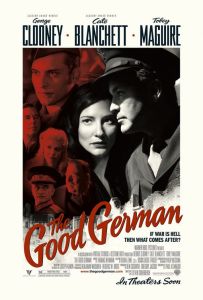 Steven Soderbergh has always seemed uncomfortable with his success and thus tried to stretch his creative wings with experimental gambles. They’re certainly ambitious but many times Soderbergh seems to be giving himself busy work. Did anyone see Bubble? I didn’t think so. The Good German is a film that wants to be seen as a forgotten relic from the 1940s, and Soderbergh went so far for period accuracy that he filmed with equipment from the same bygone era. That kind of artistic integrity is great, but what does it do to make the movie any better? The Good German aspires to be a cinematic cousin to Casablanca, even aping the iconic ending to that famous film. You’ll also get Chinatown déjà vu, especially when characters say, “Hey Jake, it’s Berlin.” The plot hinges on a murder around the Berlin conference with the Allied powers that will decide the fate of Europe and reshape the map. The story is too muddled and confusing and seems to amount to little to nothing after flirting with intrigue. The actors give hammy performances that may be true to the stagy, well-articulated acting styles of old Hollywood, but it does little in the realm of being enjoyable. Cate Blanchett is intended to be Marlena Dietrich, and George Clooney is intended to be Cary Grant, but neither manages to escape being a second-rate impression of their film noir forbears. There’s an interesting post-war story buried under all this period homage and Method-style artifice, but Soderbergh only seems interested in pleasing himself with these experimental errands, and this is coming from someone that loved Schitzopolis.
Nate’s Grade: C+


 nathanzoebl
You must be logged in to post a comment.