Blog Archives
Freaky Tales (2025)
 Watching Freaky Tales, an ode to 1980s Oakland California, punk, rap music, and grindhouse cinema, is like washing in someone else’s nostalgia. It’s a fun throwback experience but it doesn’t amount to much more than transitional diversions that won’t have the same appeal. This is an anthology movie following the events of a few nights in 1987 Oakland with criss-crossing characters told out of order. Given the abbreviated nature of the stories, you either have to make a strong impression with the characters, have memorable and surprising adventures, or have an intricate connection to the different stories that allows the narrative to keep reforming. Otherwise it’s a collection of shorts that don’t really add up to much else. While entertaining in spurts, there isn’t much more to Freaky Tales. The first story involves a punk rock club defending themselves against neo-Nazi bullies. It centers on a budding romance and works well with an exuberant, youthful energy and the theme of a vulnerable community standing together against hate is easy to root for especially when it results in bloody and maimed Nazis. The second story is the weakest and follows a female rap act trying to make the most of a stage show. The third story involves a mob enforcer (Pedro Pascal) trying to make a clean break and coming to terms with his past after a tragedy. It’s a story more memorable for some unexpected cameos and turns rather than supplying an antihero worthy of Pascal. The final story involves a professional basketball player seeking vengeance against the men who killed his family in a burglary-gone-wrong. It’s the most entertaining and ridiculous segment, especially as the pro player reveals the extent of his martial arts and mind powers. While each segment doesn’t quite overstay its welcome, none of the segments feel essential or cleverly integrated with the rest of the tales. As a result, Freaky Tales feels like gonzo campfire stories that don’t exactly go anywhere; pleasantly silly but missing out on greater fun.
Nate’s Grade: B-
Share this:

The Ministry of Ungentlemanly Warfare (2024)

This is my kind of Guy Ritchie, leaning into the pulp sensibilities of genre movies with style, swagger, and cheek, and The Ministry of Ungentlemanly Warfare is his grand ode to the WWII men-on-a-mission capers. While reportedly based upon the recently divulged secret files of Winston Churchill, the heavily fictionalized account of Gus March-Phillips (Henry Cavill) assembling a team of experts to blow up Nazi plots treats the men like super heroes. For the first hour or so, the movie is rollicking, with the team mirthfully mowing down Nazis at a steady pace, chumming it up, and having a fine time. It’s only after that midpoint where some of the movie’s flaws start to drag and become more apparent. First of all, an extended mission of getting close to a Head Nazi (Til Sweiger) and abscond with some ships off the coast of Africa makes for a very labored stay but without much fekt in progression or complication. I was feeling wanderlust to get moving. Next, the entire team feels unstoppable to the point of becoming boring. They never break a sweat fighting and casually plow through their enemies, so the entertainment value of the slaughter begins to ebb when it all feels too easy for too long. You can do an entire movie of Nazi destruction from the hands of an unstoppable force, like Sisu, but the bloody appeal of that movie is its creative carnage. We needed more variation in the action and set pieces. These gents have no formidable adversary, no overwhelming odds, and no real bouts of bad luck to thwart them. Alan Ritchson (TV’s Reacher) is a hulking mountain of a man, and he has such poise and charisma to be the breakout character, and Ritchie just fumbles it. Ritchie has excelled in the past with easily imbuing striking and memorable personality and conflicts with his Cockney crime larks, and I was missing more of that peppy style and unique flavor. Don’t get me wrong, The Ministry of Ungentlemanly Warfare has great promise and entertainment value, but it unfortunately creates its own ceiling, stalling in the second half and failing to develop intriguing challenges to test its underwritten crew.
Nate’s Grade: B-
Share this:

Hellboy (2004) [Review Re-View]

Originally released April 2, 2004:
Guillermo del Toro loves things that go bump in the night. The Mexican born writer/director has shown prowess at slimy, spooky creatures with Cronos and 1997’s Mimic. He helmed the 2002 sequel to Blade, which had super vampires whose mouths would open up into four sections with rows of chattering teeth. The man sure loves his movie monsters. del Toro also loved Mike Mignola’s cult comic book Hellboy enough to turn down directing Harry Potter 3 and Blade 3 to ensure he could bring Hellboy to the big screen. Was it worth the sacrifice?
Let me just explain to you the villains of this movie as an example of how ridiculously stupid Hellboy is. The villains are … Nazis. Yes, the tried and true villains everyone can hate – Nazis. But these ain’t yo’ daddy’s Nazis; they’re immortal and led by zombie Rasputin (yes, the Rasputin). They all wish to puncture a hole into another dimension. What’s in this alternate dimension? Why nothing except for a giant floating spaceship that houses, I kid you not, the Seven Gods of Chaos, which all happen to be gigantic space squids. Why would anyone create a universe that has nothing but the imprisoned gods of evil? That seems awfully precarious. How exactly are giant squids going to take over the industrialized, nuclear-age world? Shoot ink at everyone? Sorry, space ink?

Let me not forget a Nazi assassin and his handy dandy arm-length blades. This assassin is also 100 years old and his body is filled entirely with sand. He winds himself up like a big clock. But if his body is filled completely with sand how can the clock gears work inside? You see what the normal audience member has to deal with? Plus these are just the villains, there’s a whole plot left to toil over as well.
The story revolves around a hulking, red demon named Hellboy (veteran character actor Ron Perlman). Hellboy escaped the space squid dimension in the 1940s when the Nazis unsuccessfully tried to open a dimensional hole large enough for your everyday on-the-go space squid. Now, Hellboy is an elite soldier for the government’s Bureau of Paranormal Research. He fights the creepy crawlies. He has to deal with a wide-eyed rookie, the watch of his “father” (John Hurt) and an attempt to rekindle a romance with a mentally troubled fire starter (Selma Blair). Oh yeah, and all the Nazi/Rasputin/space squid stuff mentioned before.
Perlman is really the only redeeming thing about this movie. The makeup is impressive, and he gives an enjoyably droll performance as a man who fights monsters with the same ho-hum-ness as a plumber reacts to clogged sinks. The rest of the acting runs the gamut of either being too serious (I’m looking at you Blair) or just too over-the-top silly (I’m looking at you, league of villains).
Hellboy is strung together with bizarre inanities, flat one-liners, heavy Catholic imagery, conflicting logic and contradictions, ridiculous villains, painful comic relief, half-baked romance and frustratingly ever-changing plot devices.
Watching Hellboy is like playing tag with a kid that keeps making up new rules as he goes (“You can’t tag me; I have an invisibility shield!”), and after a while you lose any interest. Late in the film, the Nazis will all of a sudden decide not to be immortal, and at a very inopportune time. Why? How? I don’t know. Hellboy also gets sudden new powers for some reason. Like he can bring people back to life by whispering otherworldly threats in their ears. For some reason nobody’s clothes burn when they’re set on fire.
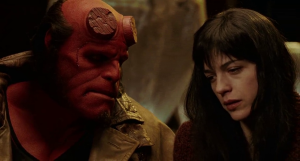
Not only does Hellboy frustrate by changing the rules of its world arbitrarily, it will also frustrate out of sheer uninhibited stupidity. How come characters can’t hear or see a pendulum the size of the Chrysler building? How come during a vision of the apocalypse we see a newspaper that actually had the time and staff, during the Apocalypse, to print an issue that reads, “APOCALYPSE”? Why doesn’t Blair use her pyro superpowers immediately to vanquish all the H.P. Lovecraft creatures instead of letting Hellboy foolishly wrestle with them all? The gaping holes in Hellboy are large enough to squeeze a gigantic space squid through.
All this frustration and insanity might have been moot if the action sequences were somewhat thrilling. Sadly, they are not. del Toro’s action sequences seldom matter. There’s such little consequence of what’s going on that the action becomes stiff and lifeless. The first time we see Hellboy chase a creature through city streets it’s a fun experience, but soon the novelty wears off. The overuse of CGI wears down the audience, and after the third or fourth time we watch Hellboy battle the same monster, the audience is ready to go to sleep. There’s little entertainment in the film’s action sequences but just as much frustration and stupidity.
I have never watched a film that induced more eye rolls, shoulder shrugs, raised eyebrows, pained and confused glances and mutters of, “What the hell (boy)?” Comic book aficionados may enjoy the fruits of Hellboy but general audiences will simply shrug. I’m amazed that the majority of film critics seem to think positively about this movie. Maybe I’m the last sane person in an insane world but Hellboy is one of the worst films of the year and one of the craziest films you could ever hope to see in a lifetime.
Nate’s Grade: D+
——————————————————
WRITER REFLECTIONS 20 YEARS LATER
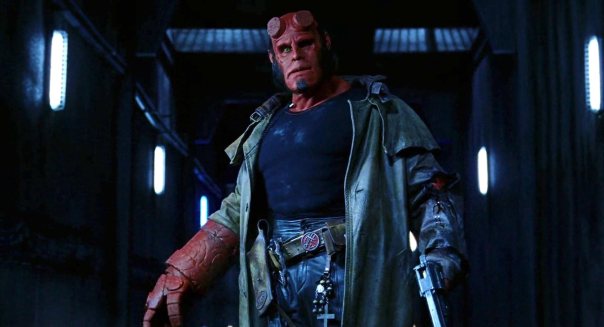
When I first saw 2004’s Hellboy, toward the tail end of my undergraduate years that April, I had no real familiarity with the character and went in with my pal, and fellow college newspaper entertainment critic Dan Hille. I went in a blank slate to the grumbling demonic lug created by Mike Mignola. To say I was underwhelmed would be an understatement in my original review. I had an extremely hard time gelling with the world and finding some firm internal logic, and my general astonishment colored every inch of that incredulous review from a snarky 22-year-old soon-to-be college grad. Twenty years later, we have a sequel, reboot, and a series of animated shorts and feature-length films, so the character is much better known today than back in 2004. I also think its occult-heavy, Lovecraftian world-building has also been further established through mainstream horror and science fiction projects. So, in 2024, I’m more familiar with the title character, the cultural connections and background, and especially Guilermo del Toro as a filmmaker, and I’m still left unmoved by this initial pitch to the character and his weird world.
It took del Toro and company years to get this movie made as the big studios lacked faith in the material, in Ron Perlamn as the lead, and in superhero and comic book properties period. This really was its own superhero story with outlandish villains, oversized heroes burdened with secrecy, shame, and guilt, and heavy themes reaching into religion and determinism. The concept of an underground agency of monsters to fight monsters is a good starting point for stories, and Perlman brings the right degree of curmudgeon charm to the outcast character who might become the ultimate hero of the world or its instrument of doom. The iconography of a demon trying to be a good guy provides a fun sense of irony, as well as a natural point of conflict as the wider world would have trouble seeing past the red skin, forked tail, and big curved horns. It makes me think of the gut-punch reveal from Arthur C. Clarke’s novel Childhood’s End where the benevolent aliens look exactly like the common visualization of a hooved and horned demon. The starting point for Hellboy has potential. However, it’s the rest that ultimately lost me.
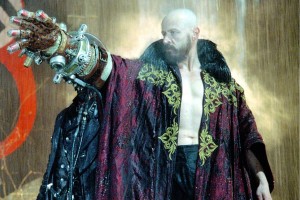
Secret agencies and hidden conspiracies working behind the scene need to, themselves, be interesting. Think of the Men in Black and their assortment of goodies and agents. With the Bureau for Paranormal Research and Defense (BPRD), I expect more from the supporting characters and what they can unlock about our understanding of the world and the unknown. There really are only two super-powered supporting players, with Doug Jones playing Abe Sapian, a variation on the Creature from the Black Lagoon gillman, and Selma Blair as a pyrokinetic woman who checks herself into mental asylums to protect others. Both of these characters have possibility and are fellow outcasts like Hellboy, but neither feels sufficiently fleshed out and incorporated into this story. Because of Abe’s scenic limitations of being in water, he serves as more of a taste of “the world world” and narrative device. He’s not even involved in the entire final act of labyrinth misadventures. With Blair’s unstable pyro, her character is relegated to a tormented love interest for Hellboy to save, get jealous, and also save again through even more ludicrous means. For a secret agency, it all feels a little too small.
The biggest side character is John Myers (Rupert Evans, The Man in the High Castle), invented for the movie to be the audience’s entry point into learning more of this strange land of strange creatures. He’s a total bore, and he also doesn’t factor much more into the story than being a living reaction shot. He has one significant moment in the climax, and that’s simply telling Hellboy to remember who he is, ultimately convincing the big man to turn back from his destiny of enabling the apocalypse. Why do we need this character? Can’t another super-powered creature serve this same purpose? Why not Blair’s love interest figure, which would then present more attention on beginning that romantic connection between her and Hellboy? There’s a reason in X-Men that we followed a mutant to learn about other mutants and not some boring human. John Myers isn’t even included in the 2008 sequel, The Golden Army, because by that point he had served his only purpose of introducing us to a new world and being a benign romantic foil.
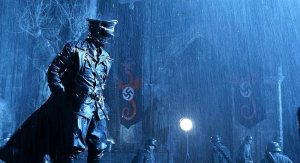
In a story with literal living Nazis brought to life through the magic of anti-Semitic clockwork, I’m dumbfounded why so much of the movie is watching Hellboy fight these boring lizard creatures with tongue tentacles. I appreciate the emphasis on practical effects and the reality that it’s a bunch of stunt performers in monster suits rather than complete CGI. The movie is another love letter of del Toro’s to his influences. His affection for the monsters and outsiders is apparent in every movie going back to his first, 1993’s Cronos. It’s too bad then that the primary opponent are these rudimentary lizard monsters that feel like the kind of easily disposable pawns you would see heroes fighting in other superhero spectacle. They’re faceless, and the fact they can regenerate and duplicate upon death doesn’t make them more formidable, only makes them more depressing as they can’t be easily rid of. If you’re going to give me giant space squids in an alternate dimension, then give me the giant space squids. If you’re going to give me Nazi zombies led by Rasputin, then give me that crazy mess. Don’t confine these potentially interesting villains to the opening and closing only. I will also say the ending is still a rather sizable letdown as far as how formidable these evil space squid gods might prove in a world of explosive devices and a modern military with a practical blank check for its budget.
Fun fact, at the time of its release, some theaters were so worried about playing a movie with “hell” in the title during Easter weekend, and coming off the ongoing success of The Passion of the Christ that brought in more conservative ticket-buyers, they decided to re-title it “Helloboy” on their theater marquis. I find this absolutely hilarious.
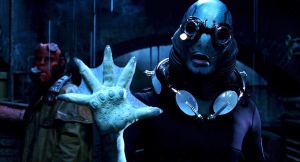
Hellboy has some points of interest, as del Toro was still fine-tuning his brand of fantasy-horror into a more mass-appealing conduit. It’s got terrific makeup effects and some fun ideas, and it’s also certifiably insane. It threw me for a loop back in 2004, and I just couldn’t process this level of hyper absurd elements jumbled together, and it still makes for a bumpy viewing. I enjoyed the 2008 sequel much more, which took more of a dark fantasy bent, and I wonder if I was more accepting of that realm of material than I was for Lovecraftian sci-fi nonsense. del Toro has learned from the Hellboy experience, becoming something of a masterful chameleon. He delivered one of the best kaiju action movies of all time that made me feel like a giddy kid. He created a haunting fairy tale timed to the Spanish Civil War. He created a charming romantic fable where a woman falls in love with a fish and it won an Oscar for Best Picture and he won Best Director. He created one of the most visually impressive stop-motion animated movies of all time that can make me cry like a baby and deservedly won another Oscar. Next up, he’s got another stop-motion animated movie and another creature feature, a remake of Frankenstein. Through his versatility, creative consistency, and inherent ability to find human drama in the most peculiar places, I’ll see any movie that del Toro decides to devote his worthy attention towards. Hellboy though? I’ve seen it twice now, and I think I can leave it at that. I’ll upgrade my earlier ranking but not too higher, Hoo boy is that 2004 review a fun read.
Re-View Grade: C
Share this:

Indiana Jones and the Dial of Destiny (2023)

I held off watching Indiana Jones and the Dial of Destiny for almost half a year as I feared that this even longer-in-the-tooth Doctor Henry “Indy” Jones (Harrison Ford) would make me reassess the 2008 Kingdom of the Crystal Skull more favorably. Having re-watched the original trilogy, I can say that Dial of Destiny has made me reassess the much-maligned 2008 sequel. It’s still not good, and has many wide misses, but it’s also a more interesting movie to watch even in its myriad ways of disappointment. Maybe that’s the Steven Spielberg difference, a filmmaker so talented that even his rare cinematic follies have their own dynamic appeal. Dial of Destiny is a nostalgia slog, including the opening action caper with a de-aged Indy set in 1944 battling Nazis, just like we like. The action sequences lack the whimsy and satisfying scope and scale of the past, but everything here just feels on autopilot, including a gruff Ford as an Indy well past his prime in a world that has only gotten more complex. He’s given two lackluster sidekicks, neither of which are well integrated, and an old former Nazi (Mads Milkkelsen) who literally wants to find the ancient time travel device to go back to WWII and give Hitler notes. It all feels so deflated and absent the spirit and fun of the original movies, and it’s disappointing in a manner that is more bland and predictable than crazy and outlandish (nuking the fridge, killer ants, Tarzan swings, etc.). There’s an interesting kernel of a concept here, an archeologist possibly finding a skeleton in an ancient excavation that belongs to himself, and an ending that could have been ballsy and poetically fitting for the adventurer to become literally part of history. Alas, the one really exciting aspect of Dial of Destiny wimps out, settling for an ending that feels like another weak feint to the franchise’s storied past. I was so thoroughly disengaged by this movie throughout its 154 minutes. It is bereft of lasting charm and imagination and fun. At this point, with an 81-year-old Ford, I think it’s time to leave the character in a museum.
Nate’s Grade: C-
Share this:

The Zone of Interest (2023)

The Zone of Interest is one of the more maddening film experiences I’ve ever had, and I’m sure that was part of the intention of writer/director Jonathan Glazer (Under the Skin). While based upon a 2014 fictional book by Martin Amis, Glazer had hollowed out the novel’s fake story and replaced it with its inspiration, the Höss family, a real-life German couple and their children who literally had their villa next door to the horrendous Auschwitz concentration camp. The husband was the chief commandant for the camp, and he had his family literally sharing wall space with the notorious factory of death. The entire feature film is then given to observing this family from afar as they try to live a “normal domestic life” in the shadow of something profoundly abnormal and abhorrent. It’s a classic example of a type of movie I will dub the “Yeah, okay, so what?” movie. I get it, I do, but why is this exactly a feature film?
I understand artistically what Glazer is going for here. It’s the ironic juxtaposition of the ordinary and the awful, asking the viewer to think about how many millions of Germans went along with the mounting anti-Semitic and racist policies of Nazi Germany out of self-interest and/or willful ignorance, the banality of evil, as Hannah Arendt termed it. That becomes the challenge of the movie, watching this family tend to the garden, host a birthday party, and read bedtime stories while watching the gloom of the chimneys, listening to the constant soundtrack of scattered gunshots and the screams of victims, including the wails of babies. Every scene is elevated by the dramatic irony of the context that it is happening next door to a concentration camp. We watch them plant flowers, and it just so happens to be next door to a concentration camp. We watch them invite the mother-in-law to make her new bedroom her own, and it just so happens to be next door to a concentration camp. It gets tedious as a viewer because without the irony, we’re just watching a family live their life. I get that’s the point, this example of one family trying to ignore the terrifying reality literally at their very doorstep. I understand that message and I understand why that is even more relevant to our troubled modern times with an alarming rise in anti-Semitism and the celebration of fascism and repressive strongmen. However, I don’t think we get real insights into these characters because they’re more just general ideas intended to forward the critical thesis of the power of self-delusion and excuse-making. That’s fine as a starting point for a provocative movie, but don’t make me watch a family do their laundry for an hour and then tell me it’s an Important Statement because they happen to be next door to the horrors of history.
Let me try this same kind of approach on another human tragedy. Say we have a family drama about a hard-working couple trying to go through the day-to-day challenges of marriage and raising a family, and it JUST SO HAPPENS that they live within distance of… the internment of the Japanese in World War II. Does this magically transform and elevate the ordinary actions on-screen into more than what they are? Perhaps to some, but for me it felt too transparently methodical and quickly redundant. I don’t need a whole movie documenting a family next door that barely scratches the surface of their circumstances of living.
There are a few moments that manage to break through. There’s a scene where the daughters are swimming in the nearby river and the family realizes that the gray streams intruding upon the water are the ashes from the camp. From there they furiously scrub themselves clean, the grotesque horror something they attempt to cleanse, whether they’re horrified because the ash belongs to people or because it specifically belongs to Jews. The mother (Sandra Huller) refuses to move away after her husband Rudolph (Christian Friedel) is reassigned by the Nazi brass. This is the home she’s put her time into remodeling and reshaping and she isn’t going to just let anyone live under her roof. This setback is far more upsetting to her than anything she overhears on the other side of her garden walls. There’s also an ongoing story where one of the Höss children is leaving behind a trail of apples, inspired by a favorite bedtime fable, and this has an unfortunate unintended tragedy for people these children will never know or see. There’s an offhand remark by the mother-in-law as she’s touring the backyard where she wonders if a woman in her book club is among the throng next door in the camps. Rather than use this as a moment of reflection over the genocide occurring next door, she then moves onto lamenting that she never got this same woman’s curtains that she always prized. I wish the movie had more of these character moments that directly confront the willful ignorance rather than keeping the audience simmering with the same meditative Big Picture concept that has been relentlessly winnowed down so finely that it may as well be dust.

Glazer makes very specific choices to highlight the detachment of the movie. His camera angles are often taken from far fixed points, and the coverage makes for smooth edits that let you know there were multiple cameras filming these scenes rather than the stress of multiple setups and different takes to cobble together. This makes the movie feel closer to a documentary where we have captured real life as it is happening instead of a group of actors on a set pretending to be different people putting on a show for our entertainment.
The Zone of Interest is a movie that crushes you in the everyday details, and in that it reminded me of 2020’s The Assistant, another indie that didn’t quite work for me. That film was about a young woman who served as a film production assistant to a producer modeled after Harvey Weinstein, and it asked how much she can ignore for the sake of her own upward mobility. It had a really compelling premise but the movie spent most of its running time just watching her do her job, filing papers, getting coffee, walking home, with the implicit knowledge banging around in our anxious minds to then elevate the mundane (she’s not just fixing the copy machine, she’s fixing the copy machine and Harvey Weinstein might be abusing someone just in the next room!). This ironic juxtaposition proved too tiring for me without also exploring the characters and conflicts more explicitly. Things happening off-screen while far more boring things happen on-screen is not itself great drama. Being drama-adjacent does not automatically magically imbue the ordinary with transcendent meaning. I need more than, “Big things are happening… over there.” The Zone of Interest is a critical favorite for 2023 but I think many viewers will have the same response I did: yeah, okay, so what?
Nate’s Grade: C+
Share this:

Bulletproof Monk (2003) [Review Re-View]
 Originally released April 16, 2003:
This is one of the dumbest movies you will ever see. I don’t mean to sound overly sensational or alarmist, but this is the honest truth if you sit and watch all of Bulletproof Monk. Item #1: The bad guys in the film are –get this– the grandchildren of Nazis. Yes, that’s right, Nazis. We had to have Nazis as the bad guys. There’s actually a scene where a blonde-haired blue-eyed granddaughter wheels her decrepit Nazi grandpa around. Oh yeah, and one of the Nazis runs the –get this– Museum of Tolerance. Oh stop it, you’re killing me. Item #2: The titular monk (Chow-Yun Fat, pray for him) recruits pick-pocket Kar (Seann William Scott) to be his apprentice. Kar is an idiot. The Monk doesn’t help. His big mystery is –get this– why hot dogs and hot dog buns come in different numbers? Man, haven’t heard that one since the third grade. That would heartily explain why a character is called “Mr. Funktastic.” Item 3#: The monk teaches in stupid opposite talk (“You cannot be free until you have been taken. You cannot be cold until you are hot. You cannot die until you have lived,” you try some). One of the monk’s lessons is that the laws of physics, mind you the LAWS of physics, can be bent just by putting your mind to it. He says gravity can be overcome if you just don’t believe in it. This is insane. At least in The Matrix it had some plausibility. Item #4: The movie is a complete rip-off of The Matrix. I’m not just talking style, no, I’m talking everything. There is a scene where the monk and Kar run through a street and building, defying gravity, being chased by men in suits and sunglasses, and they get to a roof where they must combat a helicopter. What movie does this sound like, hmmm? Item #5: The visual effects are done by –get this– Burt Ward’s effects house. Yes, that’s right, the guy who played Robin on the campy 60s Batman show has an effects company. And they did the horrible work on Bulletproof Monk. This movie is so terrible at every level of filmmaking that it becomes enjoyable to watch, in the same vein as 2001’s stinker Dungeons and Dragons. I defy anyone to find merit in any of it. Sometimes you have to wonder what Hollywood was thinking.
Nate’s Grade: F
——————————————————
WRITER REFLECTIONS 20 YEARS LATER
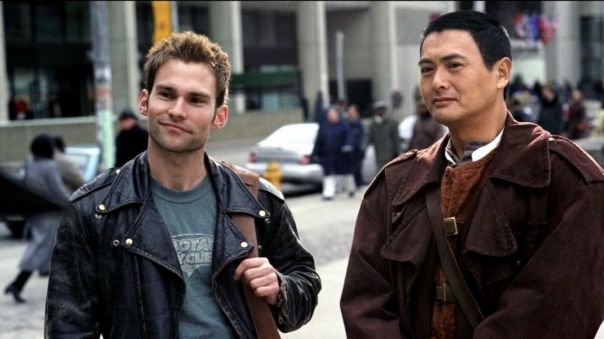
This is, without a doubt, one of the worst movies I have ever seen, and I was entertained for every bizarre, outlandish, and awful second of it. Bulletproof Monk is based on a comic book series but it’s really an incompetently designed and executed $50-million mock version of The Matrix. Within seconds of the movie, I was already laughing out loud, and I need to go into detail just for the first ten minutes, which I highly recommend to everyone as a taste setter. We open with two monks battling atop a rope bridge and, even accounting for the poor aging of special effects two decades later, it is some of the hokiest green screen I’ve ever seen. The way both characters leap, the way the movie haphazardly edits around the fight, the speedy levitating like a video game glitch, the duel spinning that goes on and on without orienting the audience, and then it all concludes with the apprentice grabbing the elder monk’s incongruous rubber sneaker before he falls. In just a short couple of minutes, we already have a clear indication what a mess this will be. Then the Nazis show up and kill the Tibetan monks and search for a mystical scroll that has the power to destroy all life on the planet, which is a good enough reason not to leave it easily accessible to Nazis. The lead Nazi massacres the monks with the exception of Chow Yun-Fat’s nameless monk who has just recently been dubbed the supreme monk in charge of scroll security. The main Nazi shoots him and the monk falls off a cliff, but not before the Nazi says “monk” a dozen times, including screaming it to the heavens to conclude the scene when he cannot find the fallen body. I defy anyone to watch and appreciate the opening on an intentional level.

The action goes from incomprehensible to boring. It’s the kind of movie where the bad guys will just show up with a helicopter with attached Gatling guns and fire into a warehouse even though there’s been no established reason they know our characters are inside or where inside they should start firing. It doesn’t matter because all the movie wants is a sudden burst of action with a vroom-vroom going pew-pew-pew until there’s a big boom. These same goons are also perhaps the dumbest hired goons in memory, as they’ll miraculously get the jump on our heroes, complete with helicopter action, but not check behind doors when coming onto a roof. There’s a moment where Sean William Scott is overpowering a man six inches taller than him and clearly with a hundred more pounds on him. This isn’t through some ingenious example of outsmarting the competition or using torque to your advantage, it’s just Scott out-pulling this guy, and this is before he even adopts the fantasy-blurring superpowers the monk will teach him.
The action scenes are all chopped up with jumbled edits. The choreography can be passable at points but seems to emphasize the exact wrong moments, like the duel spinning monks that twirl needlessly forever in the opening or Fat leaning forward and spinning around the floor while casually eating a bowl of noodles to clown Scott. It’s badly composed and badly edited. The action scenes are so silly and stupid and then you throw in the willful distortion of gravity because, as we’re told, physics are only real if you believe in them. The world of bending reality worked in The Matrix because reality was an illusion (or, as the Merovingian would say, “an eloooschean”) and a virtual reality setting where rules could be bent. What we’re entering here is a realm closer to 2008’s Wanted, where the tried-and-true laws of nature are merely suggestions, and all the cool kids can curve bullets if they really put their mind to it. It’s not like action movies don’t already exist in a heightened world of expectations and genre pyrotechnics, and then you add martial arts mysticism on top of it with wire-fu and we’re already stretching the bounds. I think what rubs me the wrong way thoroughly with Bulletproof Monk is how lazy it is. It’s not like this monk has some special power that allows him to overcome physics, some master knowledge that will educate his protégé. He just tells him that belief is stronger than physics, like this was a sentimental children’s movie about Santa Claus. If that’s the level of explanation that’s acceptable, it’s a bad sign how much more effort will be put into any storytelling or entertainment factor in this ridiculous mess.
Let’s also zero in on the apprentice character played by Scott, an actor I’ve generally enjoyed and who was hitting his commercial heights circa 2003. He plays Kar, though when the monk informs him that he is mispronouncing the Cantonese word for “family,” the American pickpocket brushes away the cultural correction from the native speaker. Here is a man who lives and works in an old Chinese movie theater with a crotchety old Japanese owner (Mako) and where he watches classic kung-fu movies and teaches himself martial arts. I suppose Kar could be a self-taught genius but he displays little dedication or skill beyond pickpocketing, which has always been a nagging movie cheat to me where people can just barely bump into you and magically gone inside your coat pocket and lifted a wallet all without your awareness. He’s the wise-cracking sidekick-slash-protégé learning about the wider world and breaking the rules, like Neo. Except he’s mostly obnoxious and useless, that is, whenever he isn’t inexplicably taking out professionally trained mercenaries with moves he learned from Bruce Lee marathons. Kar is not even an enjoyable annoying role for Scott like in 2003’s The Rundown.
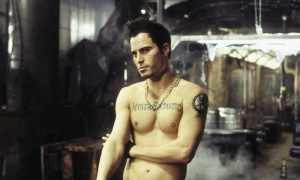
Another ridiculous character and storyline involves the leader of the underground street gang and his name is Mr. Funktastic. I know this because Marcus Jean Pirae (Girl Next) literally has “Mister Funktastic” tattooed on his bare chest (though it looks like he might be missing a well-placed “N” as well). He’s British and the leader of a gang of would-be street toughs and orphans, and it’s like the movie has dipped into something downright Dickensian, or maybe the 1991 Teenage Mutant Ninja Turtles movie. These guys are upset that Kar is stealing on their turf and challenge him to prove his mettle. I don’t know what this idiot character adds to this universe besides further making it incredulous. He and “his girl” even party in the underground raves in old subway cars, and all of this just makes me wonder what adults think goes on in subway systems. Oh, and that’s right, the female love interest is named Jade, played by Jaimie King (Sin City, Pearl Harbor), and this plays into one of the most stupid yet hyper specific ancient prophecies that tips off the monk to Kar’s potential. All you need to know about the supporting characters in this movie is that there are multiple generations of Nazis and they are running a Holocaust museum secretly to hold onto their trophies under the cover of enlightening the world about anti-Semitism and white supremacy.
Bulletproof Monk is the only movie directed by Paul Hunter, a respected music video director who has worked for decades and is responsible for Aaliyah’s “One in a Million,” Mariah Carey’s “Honey,” the “Lady Marmalade” remake from Moulin Rouge, and the unfortunately titled duet by Jay-Z and convicted rapist R. Kelly, “Guilty Until Proven Innocent.” This experience must have been so bad that Hunter swore off ever helming another feature-length movie again. The nature of music video direction attracts stylists, but this movie is so overburdened with trying to ape The Matrix on a scaled-down budget, with janky bullet-time effects and wire work (our heroes are even on the run from men in suits and sunglasses). The wire work doesn’t add grandeur and majesty to the movie because it doesn’t have the understanding of how to present it so that it looks cool; it always just seems goofy and inferior to better references. I think Hunter’s personal vision and style were just swallowed whole by the demands of making this silly movie, encroaching studio pressure, and it feels like he just gave up and the movie was benignly born by committee. I don’t blame Hunter for giving up on this movie and I guess on all movies.
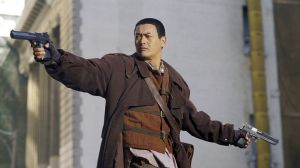
Can you enjoy Bulletproof Monk on a so-bad-it’s-good level? Do hotdogs come in packages of ten and hotdog buns come in packages of eight? The answer is an enthusiastic yes. This movie is ridiculous in every moment, only forming a somehow more ridiculous whole that defies not just the laws of physics but conventional storytelling and good taste. It’s a movie that has no idea what to do with Chow Yun-Fat and his abilities, instead coasting on the idea of the man’s involvement like the geezer teasers of recent memory that don’t so much challenge their famous stars as advertise they could afford them for a weekend or two of un-taxing demands. It’s a movie that begs to exist on a dumbed-down level of action movie junk science but doesn’t understand how to, properly, have fun within that setting. It’s so transparently indifferent or lazy or ripping off its many action/sci-fi inspirations, chiefly The Matrix. John Woo is a producer on the movie and it’s not hard to see how a Woo-directed Monk would have played to its outlandish peaks. Instead, everything is an inferior version of the better reference point. It’s silly and worthy of a night with friends, adult beverages, and lots of boorish and increasingly incoherent commentary.
Looking back at my initial review from 2003, I think my criticisms still hold but I would elevate the grade simply from its unintentional entertainment value. This is pure unintended camp, and as such Bulletproof Monk might be one of the worst movies I’ve watched and still undeserving of a failing grade, and so I will charitably raise it a letter to a D grade (on a curve, a bullet curve).
Nate’s Grade: D
Share this:

Hillbilly Elegy (2020)/ Feels Good Man (2020)
 Hillbilly Elegy is based upon the memoir by JD Vance and in 2016 it became a hot commodity in the wake of Trump’s surprising electoral ascent, with liberals seeing it as a Rosetta Stone to understanding just how so many working-class white people could vote for a billionaire with a gold toilet. The movie, directed by Ron Howard (Apollo 13) and currently available on Netflix, follows an adult JD (Gabriel Basso). He’s a Yale law candidate forced to go back home to Middletown, Ohio after his mother Bev (Amy Adams) lands in the hospital for a heroin overdose. It’s 2011, and Bev has been fighting a losing battle with opioids for over a decade, costing her a string of boyfriends and jobs. JD’s homecoming isn’t quite so rosy. While he can take comfort in fried bologna sandwiches and his sister (Haley Bennett), the town is not what it once was. The factory has closed, poverty is generational, and his mother is one of many struggling to stay clean. In flashback, we watch MeeMaw (Glenn Close) take in the young JD (Owen Asztalos) and raise him on the right path. JD must decide how far the bonds of family go and how much he may be willing to forgive his mother even if she can never ask for help.
The subtitle of Vance’s novel was “A Memoir of a Family and a Culture in Crisis,” and it’s that latter part that got the most attention for the book and critical examination. Many a think piece was born from Vance’s best-selling expose on the hardscrabble beginnings of his personal story along the hills of Kentucky and the Ohio River Valley and his recipe for success. Given his libertarian political leanings, it’s not a surprise that his solutions don’t involve a more interventionist government and social safety nets. According to Vance’s book, he saw poverty as self-perpetuating and conquerable. It was the “learned helplessness” of his fellow Rust Belt inhabitants that Vance saw as their downfall. For me, this seems quite lacking in basic empathy. You see these people aren’t poor because they’ve been betrayed by greedy corporations, indifferent politicians, a gutted infrastructure and educational system in rural America, pill mills flooding Appalachia with cheap opioids, and a prison system that incentivizes incarceration over rehabilitation. For Vance and his like-minded fellows, upward mobility is a matter of mind over matter, and these working-class folks have just given up or won’t work as hard as before.
 Now, as should be evident, I strongly disagree with this cultural diagnosis, but at least Vance is trying to use his own story as a launching point to address larger points about a portion of America that feels forgotten. The movie strips all of this away. Screenwriter Vanessa Taylor (The Shape of Water) juggles multiple timelines and flashbacks within flashbacks as Vance follows the formula of prodigal son returning back to his home. The entire draw of the book, its purported insights into a culture too removed from the coastal elites, is replaced with a standard formula about a boy rediscovering his roots and assessing his dysfunctional family. At this rate, I’m surprised they didn’t even time it so that Vance was returning home for Thanksgiving.
Removed of relevant social commentary, Hillbilly Elegy becomes little more than a gauzy, awards-bait entry meant to uplift but instead can’t help itself from being overwrought poverty porn. If we’re not looking at the bigger picture of how Appalachia got to be this way, then Vance becomes less our entry point into a world and more just an escaped prisoner. Except the movie doesn’t raise Vance up as exceptional and instead just a regular guy who pulled himself up by his bootstraps through will and family support. I’m not saying he is exceptional, I don’t know the man, but this approach then ignores the reality of why so many others just aren’t following his footsteps of simply trying harder. Without granting a more empathetic and careful understanding of the circumstances of poverty, Howard has made his movie the equivalent of a higher-caliber Running with Scissors, a memoir about a young man persevering through his “quirky, messed up family” to make something of himself on the outside. This reductive approach is meant to avoid the trappings of social commentary, and yet in trying to make his film studiously apolitical to be safer and more appealing, Howard has stumbled into making Hillbilly Elegy more insulting to its Appalachia roots. Systemic poverty is seen as a choice, as people that just aren’t trying as hard, that have given up and accepted their diminished fates. Never mind mitigating economic, psychotropic, and educational circumstances. I imagine Howard wanted to deliver something along the lines of Winter’s Bone, unsparing but deeply aware of its culture, but instead the movie is far more akin to a sloppy compilation of Hallmark movies and catchy self-deprecating bumper sticker slogans. Seriously, about every other line of dialogue feels like it was meant to be on a T-shirt, from “Where we come from is who we are, but we choose every day who we become,” to, “There are three types of people in this world: good Terminators, bad Terminators, and neutral.” Well, maybe not that last one. The insights are fleeting and surface-level, with vague patronizing along the fringes.
The personal story of J.D. Vance takes the center stage and yet he’s the biggest blank of characters, and what we do get isn’t exactly that encouraging. I think we’re meant to engage with his triumph over adversity, but he has such disdain for his background while clinging to it as an identity, and this intriguing dichotomy is never explored. Vance as a character is merely there. His awkward experiences relating to the rich elites are just silly. He calls his girlfriend (Freida Pinto) in a panic over what fork to use at a fancy dinner table, as if this perceived social faux pau would be the difference between getting a law firm gig. He’s supposed to feel like an outsider, both at home and away, unable to escape his past that defines him, but the movie doesn’t even make Vance feel alive in the present. Most of the movie he is just there while big acting takes place around him. He listens to the life lessons bestowed upon him, good and bad, and it makes him the kind of man that when he grows up will join Peter Thiel’s venture capital firm, so hooray? I sighed when the movie established the stakes as he needs to get back in time for his big lawyer job interview, a literal family vs. future crossroads. The movie treats its frustrating main character as a witness to history rather than an active participant, and his personal growth is what? Coming to terms with the limitations of his mother? Accepting himself? Leaving them all behind to survive? I don’t know. There is literally a montage where he gets his life back on track, starts getting better grades, ditches his no-good friends, and heads out into the world. This could have been a better articulated character study but instead Vance comes across as much a tourist to this downtrodden world and eager to return to safer confines as any morbidly curious viewer at home.
 I simply felt bad for the actors. This is the kind of movie where subtlety isn’t exactly on the agenda, so I expected big showcases of big acting with all capitals and exclamation marks, and even that didn’t prepare me. I watched as Amy Adams (Vice) worked her mouth around an accent that always seemed elusive, with a character that veered wildly depending upon the timing of a scene. Almost every moment with Bev ends in some alarming escalation or outburst, like when a new puppy ends with Bev declaring she will “kill that dog in front of you,” or a ride back home descends into a high-speed promise of killing herself and child out of spite. This woman is troubled, to say the least, and her addictions and mental illness are what defines the character. With that guiding her, Adams is left unrestrained and usually screaming. There’s just so much screaming and wailing and crying and shouting. It’s an off-the-mark performance that reminded me of Julianne Moore in 2006’s Freedomland, where a usually bulletproof actress is left on her own in the deep end, and the resulting struggle leans upon histrionics. Was I supposed to feel sympathy for Bev at some point? Does the movie ever feel sympathy for this woman who terrorizes and beats her child? The broad portrayal lacks humanizing nuance, so Bev feels less like a symbolic victim of a larger rot of a society abandoned and betrayed and more a TV movie villain.
Close (The Wife) disappears into the heavy prosthetics and baggy T-shirts of MeeMaw, but you could have convinced me the character was a pile of coats come to life. Truthfully, MeeMaw is, by far, the most interesting character and the story would have greatly benefited from being re-calibrated from her painful perspective. She’s the one who bears witness to just how far Middletown has fallen since her and PawPaw ventured as young adults with the promise of a secure new life thanks to the thriving factory. She’s the one symbolizing the past and its grip as the present withers. She’s the one who has a history of abuse only to watch her daughter fall into similar patterns. Think of the guilt and torment and desire to rescue her grandson for a better life and save her family. That’s an inherently interesting perspective, but with JD Vance as our mundane lead, MeeMaw is more a slow-walking curmudgeon taken to doling out profane one-liners and grumpy life lessons. Close is easily the best part of Hillbilly Elegy and deserved more attention and consideration. A moment where she clings to JD’s high-scoring math test like a life raft is heartfelt and earned, more so than anything with JD.
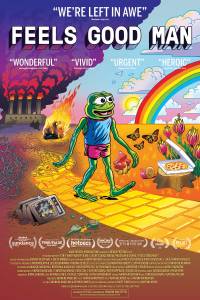 Another slice of America that feels forgotten and angry is on display with the documentary Feels Good Man, a.k.a. the Pepe the Frog documentary. Who is Pepe? He’s a cartoon frog created by Matt Furie as part of a comic series of post-college ennui between four friends. The character was adopted by the commenters on the message board 4Chan as their own symbol, and as their memes spread and became more popular with mainstream suers, and that’s when the 4Chan warriors had to do something drastic to save their favorite frog. They began transforming Pepe into a symbol of hate in order to make him toxic for outside use, and then the irony of their attempts at reclamation faded away and Pepe became a real symbol for Neo-Nazis and white supremacists. The character is currently listed on the Anti-Defamation League’s list of symbols of hate. The movie explores this evolution and de-evolution of Matt Furie’s creation and serves as a cautionary tale about the scary shadows of Internet culture and the nature of reclaiming meaning and intent with art.
Firstly, is there enough material here for a full-fledged documentary? We’re talking about a cartoon frog filling up the memes of Internet trolls. Is that enough? I think so, though I wish the movie shed even more critical scrutiny upon the 4Chan fringes of the Internet that have become a toxic cesspool of alienation and recrimination. These are people that self-identify and celebrate their social isolationism. The acronym N.E.E.T. stands for NOT Employed, Educated, or Trained and is adopted by many as an odd badge of honor. We even see home video footage of people sharing their personal lives in cluttered, trash-strewn basements. These are people electing not to engage with a larger functioning society and yet also feeling hostile to those that choose otherwise. Maybe it’s all a big joke to them, so why even bother; maybe it’s a defeatist mentality that plays upon social anxiety and learned helplessness. Maybe it’s just a noisy, nihilistic club that doesn’t want anything for themselves other than to disrupt others. The interview subjects from the 4Chan community are few but offer chilling peeks into this subculture. They see the world in terms of a very high school-level of social hierarchy, and the people who are pretty, successful, and having sexual relationships are the “popular kids” keeping them down. I think in terms of a Venn diagram, that incels and these NEET freaks are a flat circle. It almost feels like Vance’s cultural critiques of his poor Appalachia roots syncs up with the disenchanted 4Chan kids. This self-imposed isolation and self-persecution stews into a hateful mess of resentment. It’s not a surprise that several mass shooters have partaken in 4Chan and 8Chan communities.
 This scary subsection of Internet culture has been left to fester and it went next level for the 2016 presidential election. The trolls recognized their own sensibilities in Donald Trump, a candidate whose entire presidency seemed on the precipice of being a bad joke. The alt-right celebrated the man and used Pepe as a symbol for Trump’s trolling of norms and decorum, and the 4Chan message boards became an army of meme makers to steer Internet chatter. It’s hard to say what exactly the cumulative effect of these memes and trolling efforts achieved, in addition to the successful efforts of Russian hackers and a media environment that gave Trump billions of dollars in free airtime, but the 4Chan crowd celebrated their victory. “We memed him to the White House,” they declared. From there, Pepe became a synonymous symbol of a newly emboldened white supremacist coalition and any pretenses of ironic detachment dissolved away.
The rise and mutation of Pepe makes up most of the movie, and it’s certainly the most fascinating and scary part of Feels Good Man. However, there is a larger question about the ownership of art and interpretation that the movie presents without conclusive answers. Symbols are a tricky thing. They’re not permanent. The swastika wasn’t always associated with Hitler and Nazis. A pentagram has significantly different meanings depending upon a Wiccan and conservative Christian audience. Feels Good Man examines Furie as a humble albeit slightly naïve creator. He’s a nice guy who just can’t get his head around what has happened to his creation. How far does the artist’s intent go when it comes to credible meaning? At one point, Furie tried stemming the negativity by killing off Pepe in a limited comic, but it didn’t matter. The 4Chan followers simply remade him as they desired because at that point Pepe was their own. He has been built and rebuilt over and over again, that no one person can claim interpretative supremacy. Furie’s version of Pepe might be gone but there are millions of others alive and well. This gets into the nature of art and how every creator in some regard must make amends with letting go of their creation. Once it enters the larger world for consumption, they can steer conversations but art can take on its own life. The last third of the movie follows Furie taking action to enforce his copyright law to push back against the more outlandish uses of Pepe the frog, including from InfoWars’ Alex Jones, the same man who told us the government was making frogs gay for some unexplained conspiracy. Jones makes for a pretty easy villain to enjoy seeing defeated, and the conclusion of the movie involves dueling taped depositions between Furie and Jones over intellectual trademarks and free speech. It makes for an easy to navigate victory for Furie to end the movie upon, but is this larger war winnable? I have my doubts and I don’t think the trolls of the darker reaches of the Internet are going away.
I also want to single out the beautiful animation that appears throughout Feels Good Man, giving a visual representation to Pepe in a manner that’s like trying to give him a say in his own intent.
 So, dear reader, why did I pair both of these movies for a joint review? I found both of them as investigations into a sliver of America that feels forgotten, left behind, stuck in ruts outside their control, and resentful of a changing culture they see as exclusive to their hard-hit communities. I thought both Hillbilly Elegy and Feels Good Man could provide me, and others, greater insight into these subcultures and perhaps solutions that can make them feel more seen and heard. The problem is that Elegy doesn’t provide solutions other than “pull up your bootstraps” and Feels Good Man involves a destructive coalition that I don’t want better seen and heard. Both movies in their own ways deal with the nature of how very human it can be to retreat to their safe confines of people who too feel ostracized, hurt, and overwhelmed. I have pity for the people of the Rust Belt, the hillbillies experiencing generational poverty and hardships, though “economic anxiety” is not simply a regional or whites-only worry. I have less pity for the basement trolls of 4Chan trying to celebrate school shooters because it’s somehow funny. I’m amazed that so many talented people were part of Hillbilly Elegy and had such high hopes. For all of its full-tilt screaming, the movie is thoroughly boring and formulaic. Given the nature of an elegy, I was expecting Howard’s movie would be more considerate of its people, but their humanity is lost in this pared-down characterization, and the tragedy of society failing its own becomes an inauthentic Horatio Alger story of the plucky kid who went to Yale and became a real somebody. Feels Good Man might not be the best documentary but it feels more authentic and owns up to its inability to answer larger questions about human behavior, art, and interpretation. Both of these movies will prove horrifying to watch but only one is intentionally so.
Nate’s Grades:
Hillbilly Elegy: C-
Feels Good Man: B
Share this:

Becky (2020)
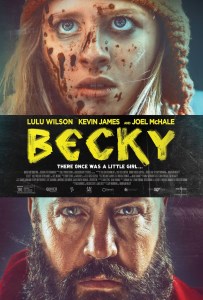 Imagine if Home Alone was more intense and populated with neo Nazis, and you’ll get a feel for Becky, a jubilantly gory, highly stylized indie thriller that might be as off-putting as it is entertaining. Kevin James, yes Paul Blart himself, gives an about-face turn as the leader of a group of Nazis that recently broke out of prison. With his bushy beard. swastika tattoos, and intensely quiet monologues, the stunt casting works out well, and James can be truly menacing. His band of goons are terrorizing a blended family in search for a macguffin of which just happens to be in possession of Becky (Lulu Wilson), an adolescent hellion they will soon reckon with. She knows the terrain of the family cabin and the woods and goes about picking off the bad guys one-by-one in fiendishly bloody, wildly over-the-top panache. That’s the real appeal of the movie, the various ways our pint-sized heroine takes down the Nazis. Directors Cary Munion and Jonathan Milott (Cooties, Bushwick) infuse plenty of visual style into their thrills, amplifying the intensity further, like a pounding camera edits and a walkie talkie confrontation between hero and villain where a series of pans makes it feel like they’re face-to-face. The film can be unsparingly brutal and hard to watch at times, walking a line between being darkly comic to simply being gross. Becky herself comes across like a brat and, as the killings continue, gleefully sociopathic. She’s still hurting from her mother’s death, she doesn’t want to have to save her soon-to-be stepmom and brother, but she’ll do it if it means killing more Nazis. One big tough Nazi has a crisis of conscience and demonstrates, at least onscreen, more depth than Becky. It’s all a bit too nihilistic by the end for my tastes. Becky ultimately is a movie about killing Nazis gory good and looking good doing so. If that’s enough for you, give it a watch.
Nate’s Grade: B-
Share this:

Jojo Rabbit (2019)
 Writer/director Taika Waititi has played a vampire, an intergalactic rock monster, and now perhaps the most challenging role of his career, Adolf Hitler. Coming off his meteoric success with the MCU, Waititi is using the time in between mega-budget Thor sequels to write/direct/produce/co-star in a smaller daring indie comedy. Jojo Rabbit follows a young German boy, Jojo (Roman Griffin Dais), during the last year of World War Two. He fantasizes about having an imaginary Hitler (Waititi) as the voice over his shoulder, reinforcing the teachings of adults and authority figures. His worldview is challenged when he discovers a teenager hiding in the family’s walls who just happens to be Jewish. Jojo doesn’t know what to make of Elsa (Thomasin McKenzie), nor does she know what to make of him, and Jojo decides to keep her presence a secret to spare his doting and put-upon mother (Scarlet Johansson). Jojo tries interrogating this wily girl but ends up learning more than he ever imagined.
Given the subject matter, setting, and overall tone, it’s a wonder how well Jojo Rabbit works. I was worried about what kind of tone the movie would be striving for given the delicacy of its subject matter, not that other filmmakers have shied away from incorporating comedy into Holocaust settings. I don’t mean this to be overly flippant but for portions of the movie I felt like I was watching “Wes Anderson’s Nazi Germany.” The entire Act One camp sequence feels like a warped deleted scene from Moonrise Kingdom. I was genuinely surprised how often I was laughing with Jojo Rabbit. Waititi can be hysterical as a bratty, temperamental version of the Fuhrer, but there are moments where he gets caught up in the oratory of his hateful rhetoric that serve as a reminder that even for Jojo, he realizes this man isn’t exactly best friend material. The Hitler imaginary friend goes away for long stretches in the second half as the film emphasizes more drama, which is the right choice as Jojo is coming to doubt what he has been taught from that imaginary friend. The portrayal of Hitler might be offensive to some viewers but I feel like Waititi walks a fine line to root it from the perspective of childhood fantasy. It’s taking the figure on TV and adapting it to suit the needs of a lonely kid wanting to belong. Of course he’d want Hitler to select him as the best little young Aryan that Germany has going. It’s not dismissing the evil of the man but instead serving him up through a specific prism that allows laughter not necessarily even at Hitler himself but at a youthful and immature understanding of something far more complex.
 I was also worried that the comedy might dampen some of the more dramatic turns coming, and this was so not the case. There are dramatic moments hiding under the surface thanks to seeing them from Jojo’s naïve perspective, but then there also big obvious dramatic moments of suffering that hit. As much as the whimsy prevails early, the dramatic moments are delivered in tasteful ways that do not detract from the feelings being felt by the characters as well as the willing viewers. There are a few gut punches that remind you that even with the whimsy of childhood naivete, real people are dying in awful ways because of those complicit in racist genocidal policies. The relationship between Jojo and his mother is the second most significant one, after he and Elsa, but it’s this central focus where we see the starting point of his character arc. His mother tries to shield her child from the larger terrors of their society but that’s increasingly difficult when people are being hanged in the street for helping Jews. She’s hoping to simply play her part in public, get through this terrible time, and finally have the son back that she knows, hoping he will eventually shake free from the propaganda. It’s a role that requires Johansson to play like another cartoonish adult, all bubbling energy and quirky nonchalance, while burying her increasing concern. Part of me almost wishes that she was a co-equal protagonist so we could get an even richer perspective to contrast more fully.
There’s a sprightly whimsy to the proceedings that comes from being locked into the perspective of an imaginative child. It’s not that the world is 100 percent his vision, it’s more that we know that the representation of what we’re seeing might not be a completely objective reflection of the reality Jojo is encountering. This especially includes the portrayal of many adults involved in various levels of the Nazi party. They play out like cartoons and buffoons but are still dangerous cartoons and buffoons. When Jojo’s childhood friend Yorki is talking about fighting on the front and we see him handling a rocket launcher, this is clearly an exaggeration of the desperation of the moment and a young boy’s eagerness to be involved. This creative approach allows Waititi to dabble in the fantastic and keep his audience alert, allowing them to second-guess what we’re seeing on screen and look for the reality in hiding. I laughed pretty consistently at the intended humor and incredulous nature of the adults trying to pass off wrongheaded insights and suggestions as scientific fact or common sense. It’s a movie where you laugh at the ridiculous idiots while hoping that the idiots won’t get the people we care about killed.
 The acting is very strong overall. Newcomer Roman Griffin Davis is exuberant and relatable without coming across as overly cloying or mannered, which can be a rarity for child actors. He has a very difficult role to play from a tone and perspective standpoint, and he succeeds. Another great child actor is Thomasin McKenzie (Leave No Trace) as Elsa, a young girl in an extremely vulnerable position who looks upon this new boy with equal amounts fear, disdain, and pity. She cannot be herself and must choose her words and responses carefully, so it’s a guarded performance of restraint but McKenzie is fabulous in quieter, subtler shifts. The adults are all enjoyable as broadly comical cartoons, with Stephen Merchant (Logan) earning considerable unease as an S.S. officer leading a team sweeping for Jews in hiding. Johansson (Avengers: Endgame) seems a little too eager, a little too antic, but this may pertain to her character’s nerves and desperation, trying to overcompensate her anxiety. Rockwell (Vice) gets the biggest adult role as a disenchanted military vet who sees the writing on the wall. At first his detached nihilism is a source of dark comedy and later he becomes an unexpected father figure for Jojo. I don’t quite know if his hero moments have the desired impact but he’s still an amusing presence.
However, there are also some drawbacks to being a fable, namely a lack of larger specific substance beyond general lessons and general characterization. Jojo Rabbit is being billed as an “anti-hate satire” and I definitely think that summary fits the intent, but “anti-hate” sounds like such a nebulous buzzword that seems more meaningful at first glance and less upon reflection. I would assume every responsible story set during the era of the Holocaust would adopt an “anti-hate” sensibility, because the alternative would be championing the foundations of Nazism. It’s hard for me to imagine any movie desiring a public release being anything other than “anti-hate.” Essentially, we have a character coming to see through the propaganda of the era, judging people as people rather than scary caricatures, and start to reject the teachings of manipulative authority figures. This isn’t a new formula for coming-of-age stories or tales set during times of great strife. It’s a lesson in empathy and rejecting dogma on its face. When it comes to Nazism, that should be the easy part, facilitated by any prolonged exposure to anyone previously deemed an undesirable.
My nagging issue with Jojo Rabbit is that for all its impish whimsy with such a serious historical subject, it ultimately plays things pretty safe. That’s fine, it doesn’t have to a revolutionary film, but it does dull the message a bit when the ultimate lasting takeaway is “hate is bad, Jews are people too.” It’s a bit pat, a bit simple, and a bit too easy. The characterization can also be hampered by this same ethos. The characters are pretty much exactly what you see at first blush. The only character who changes or has room to explore is Jojo. Even Elsie feels more like a stagnant person despite her unique circumstances. This may be because she’s more change agent than character, a figure for Jojo to be horrified by, then entranced with, and finally see as a friend. I still felt moments of genuine emotion for characters onscreen and for Jojo’s journey of self. The movie still works well with its stated goals and direction, it’s just a bit limited because of the simplicity of its message and the lack of greater substance for its many characters.
 The Jojo Rabbit novel was written before the rise of Donald Trump but Waititi has said that when they were filming that America’s current political climate was on his mind, and it’s not hard to make a few adaptations to apply this for the modern era. Perhaps a young boy sees Donald Trump as his imaginary friend and together they’re both all-in on trying to “make America great again” by first and foremost reporting any immigrant they see as illegal. Then later in the story he discovers his family is willfully hiding an undocumented child from being deported after they were stripped from their parents who were then deported. Now our naïve protagonist must reconcile the harsh rhetoric he has been taught with the growing empathy of connecting with another human being who doesn’t seem as dangerous or as sub-human as others claim. If you wanted to even make this parallel, it’s there, though I think that diminishes the setting. We shouldn’t need to tell movies during the Holocaust as metaphors for our modern struggles. I suppose this is another scenario where if you want to Inuit more of a relevant modern message, you can.
Jojo Rabbit (a nickname that seems forgotten after its christening) is a coming-of-age fable with equal parts charm and horror. Waititi takes a serious subject and doesn’t mitigate the evils of Nazism with his portrayal of a daffy imaginary Hitler. The production has an admirable swagger to it as it charts its own course, tackling serious subjects and young whimsy to portray a poignant story about childhood, loss, and growing up. It’s an amusing and heartfelt enterprise that I can’t help but feel could have done more than settling for some pretty safe messages and limited characterization. There wasn’t a moment with Jojo Rabbit where I wasn’t entertained, but I do wish the movie had more on its mind that reminding everyone that hate is bad.
Nate’s Grade: B
Share this:

Auschwitz (2011)
 I’ve been waiting years to finally see Uwe Boll’s take on the Holocaust. It was originally filmed around 2010 but never got a home release, making me scan the Internet for a chance to see a German movie that nobody in the world seemed to want to see. I’m not surprised it took almost eight years to finally see this movie, which was widely available on YouTube in its entirety, uncut, for over a year. If you’re curious, dear reader, you can easily see it for yourself, though I might caution you against that. It is, after all, the harsh reality of the Holocaust, and it is, after all, Uwe Boll, a filmmaker not exactly known for subtlety and tact in his career. I was worried that Boll’s Auschwitz (even that phrasing seems unduly unkind) would be a disservice to the men, women, and children who perished in that horrible atrocity. I’m relieved that Boll seems to have his mind on higher ambitions than exploitation, though I don’t know how well the academic intent translates.
It’s less a movie and more of an educational special on the practices of a concentration camp and the mentality of the people sentencing others to their doom. The opening four minutes consist of Boll speaking directly to the camera, switching off talking in German and then English three times, setting up his rationale for why he would tackle a filmed recreation of an Auschwitz gas chamber. He says that young people today do not know about the Holocaust and the concentration camps and are in need of a powerful reminder (more on this later). What then follows is about six minutes of Boll interviewing various German teenagers over what they know about Hitler, WWII, the Holocaust, and the systematic eradication of European Jews. After that, Boll’s film goes into a 35-minute live-action recreation of life at a concentration camp, leading dozens of people to their deaths in the gas chambers of Auschwitz. After that, Boll returns to his interviews with real German teens, interspersed with archival footage from WWII. That’s the whole movie, amounting to a little over 68 minutes long, not meeting the typical minimum.
 As someone who has worked in education for ten years now, I can reaffirm that a distressing number of young people have a general ignorance about the Holocaust. I suppose part of this is inevitable with the passage of time; the more years pass the less people can get to know survivors and veterans of the war. As it recedes into the past it becomes less pertinent and in some ways less real for many people. This is the reason why I personally include Holocaust texts in my school curriculum to check the knowledge level of students and build upon it, to make sure something this dastardly would not be forgotten. The early interviews Boll conducts (in what appears to be a bathroom?) appear to have a slippery sense of what the Holocaust was about as well as the cruel realities that befell those Hitler found as sub-human. But the latter interviews involve different students who have an amazing command of the Holocaust, even citing centuries-old incidents of anti-Semitism. If Boll’s intent is to show that his movie is needed why include interviews with students who are clearly not ignorant of the subject? That seems self-defeating, even if I’m pleased that there are articulate, intelligent students out there.
The biggest discussion piece will be on Boll’s extended live-action recreations of the atrocities of Auschwitz. Recreating the crushing reality of the Holocaust is a delicate subject, trying to find a line to maintain respectful voracity to what the people suffered through and steer away from exploitation thrills that highlight the perverse depravity for titillation. Stanley Kubrick famously said to make a Holocaust film that would do justice to the events would make it unbearable. Boll said in a 2010 Vice interview that he didn’t want a narrative to dull the impact of his intents, citing Schindler’s List and The Pianist as fine films but flawed because they attempted stories. Ignoring that both as personal accounts, I think Boll misses the importance of narrative, a device that makes the horrors of history more palatable for viewing because of an accessible entry point. We focus on a character and their experiences, their character’s journey, and how the events impact and change this person, which provides a rooting interest to maintain watching. The other unfortunate reality of purposely removing a narrative is that it makes the recreations seem constructed merely for their shock value. They exist not in the larger realm of a story but as events meant to convey the horrific reality and nothing more. I think this was a misstep.
Boll has handled real-world violence and genocide before, from school shootings (2003’s Heart of America) to mass shooters with god complexes (the woe begotten Rampage series), to the genocide in Darfur (2009’s Attack on Darfur), and the results have been decidedly mixed. His heart may be in the right place but rarely do his message movies succeed at their ambitions. The messages often get lost amidst the exploitation elements or Boll goes overboard to wake up his audience, leaning into the suffering in a manner that can come across as indulgent. This too happens with Auschwitz, as it seems Boll is unable to restrain himself with a subject as well known as the factory of death. One could argue restraint dilutes the memory of those who died, but again it becomes a delicate balancing act to veer away from being pornographic.

Boll’s recreations are solemn and affecting. You can certainly feel his reverence for the topic and his desire to do right. The onscreen depiction follows a group arriving at the death camp, being separated, lead to a gas chamber, where the collection of women, the elderly, children, and the disabled choke to death on the fumes of poison gas. We then watch a handful of prisoners gather the dead, shave their heads, pull out their teeth, transport their clothes and shoes, and then dispose of the bodies in the ovens. It’s impossible to watch the recreations of these panicked deaths and not feel something, especially when Boll includes innocent young children in the mix. It’s horrifying and Boll films the reality of these scenes in an admirable docu-drama style. The nudity is not played for titillation but as a means of showcasing the vulnerability and humanity of the victims. It’s not shied away from but Boll’s camera doesn’t make a point of finding it either. Granted, the close-ups, especially once the gas hits, seem to predominantly feature the pained grimaces of women, but I’ll chalk that up to Boll viewing distressed women as more emotionally powerful. The people featured during these sequences are also admirably ordinary. These people look like who you would see walking down your street. They don’t look like models who were hired because their nude bodies would be something the audience would desire. There are children and they too are seen with the same vulnerability in the nude, though I’m sure the inclusion of naked children will sabotage any noble intent for some viewers.
However, Boll’s inclinations can get the better of him, like the majority of his more high-minded “message movies” that can transform into pulpy genre fare. There are moments where Boll just goes too far, chief among them the baby murdering sequence. Of course this was a reality of Auschwitz and other extermination camps because the Nazis had no need for babies. One of the most startling details in Elie Wiesel’s famous novel is his recount of watching babies hurled into a pit of fire, as it would naturally traumatize anyone for life. But just because it happened doesn’t mean it needs to be given inordinate attention. There’s a difference between unflinching and simply gratuitous. A child is held in the air and we see another SS officer point a pistol at the baby’s head. Rather than cut away and imply the ensuing violent death, Boll purposely stays within the scene, watching the muzzle flash and the CGI blood spray lightly (thankfully that’s the extent of whatever gore is applied to this scene). This happens three times and each time Boll makes sure we know this gun is firing at this baby’s head. Once gets the point across but three times is just excess. The same can be said for the gas chamber sequences. There are two, one presented at the very start of the arrival at Auschwitz, intercut with the people disembarking from the train and lining up. It’s unclear whether this is a flash forward but the faces seem different. Also, I have no interest in re-watching it for further study. That means in the course of 35 minutes we endure two groups of people asphyxiating to death. Here’s another instance where a lack of narrative is harmful. Without a story, without characters, this presentation is just nameless innocents suffering. What does the second sequence provide that the first lacks? It’s indulgent, and indulgence built upon human suffering is just bad.

Boll’s limited budget also constrains his ambitions. He filmed Auschwitz simultaneously as he filmed two other movies, a third Bloodrayne film and a bizarrely conceived satire of this same movie, Blubberella. Even for a workaholic like Boll, making three movies at once is insane. This might be why the live-action segment only amounts to 35 minutes and involves minimal dialogue. There are only three credited actors including Boll himself as an SS guard (the symbolism of director as participant seems ripe for dissecting). There is one extended sequence where two SS officers discuss mundane small talk, hammering home the banality of evil. But it’s right back to another gas chamber sequence from there, the director’s true preoccupation. The Auschwitz camp was half the size of Manhattan. What we see onscreen is a pittance. It feels so incredibly small. It makes me wonder why Boll felt the need to draft off the name recognition of Auschwitz. This setting could have been any concentration camp as the gas chamber outcome was not unique to Auschwitz, and that is really the only thing visualized with these recreations. It’s not life at the camp, the struggles of survival, it’s only a quick march to a painful death. There’s no reason this had to be Auschwitz.
Even with misgivings, I do think there can be an academic value to what Boll has put together. Written accounts and stories are a valuable tool, but sometimes a visceral and visual demonstration can bring to life history for people in powerful and valuable ways. This movie could rattle people and stay with them years after viewing, translating the horrors of the Holocaust in a way that is blunt, direct, and reverent. However, Boll’s yearning for profundity comes into direct conflict with his schlocky, exploitation-loving impulses, which pushes him to prolong the onscreen misery in the name of “staying true to how it was.” Without a narrative to provide a foundation, the movie becomes an uneven documentary with bouts of strained intensity. I wouldn’t judge this movie as harshly as Boll’s Rampage films. I sense his noble intents. There’s even a maturity with the filmmaking that I don’t think a younger Boll would have found. Ultimately, Auschwitz is more supplemental teaching tool than movie, and to that end it might do some needed good, proving that even Uwe Boll can make the world a little better.
Nate’s Grade: C+


 nathanzoebl
You must be logged in to post a comment.