Blog Archives
Superman (2025)
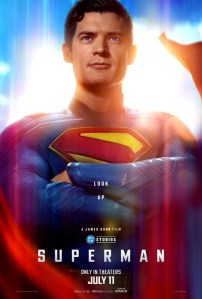 Has the world ever needed Superman more? I don’t know about you, but I could really use a symbol of good right now who represents the best of us, fighting for justice and protecting the innocent against the diabolical in power that seek to profit and prey upon the vulnerable. Vulture film critic Allison Wilmore has a fantastic headline for her review: “Superman [the movie] isn’t trying to be political. We just have real-life super villains now.” James Gunn, the quirky filmmaker who made us fall in love with a raccoon and a tree in the Guardians of the Galaxy trilogy, ascended to be head of DC movies in 2022, and he eyed reigniting Superman as the top priority, selecting himself as writer and director. It’s a lot of pressure to rebuild the DC movie brand by yourself, as there are only two other movies with scheduled release dates currently. This movie could make or break the fledgling DC Universe (DCU) rebuild soon after the smoking demise of the DC Extended Universe (2013-2023), informally dubbed the Snyderverse. Fortunately, Gunn’s take on the boy in blue is a reminder why this character has lasted so long and why the world still needs a symbol of hope.
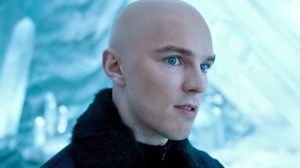
Superman (David Corenswet) a.k.a. Clark Kent, has been a defender of Metropolis for three years now. He’s romantically involved with ace reporter Lois Lane (Rachel Bosnahan), who knows his secret identity but still chides Clark on somehow getting all those “exclusive interviews” with Superman. He’s also been a thorn in billionaire industrialist Lex Luthor’s (Nicholas Hoult) side and become an obsession of his. The world is still debating Superman’s unexpected intervention, thwarting a powerful military from invading its neighbor’s sovereign border (very reminiscent of Russian aggression). The U.S. government needs actionable proof that Superman is a threat, and Lex is determined to eliminate the alien for good.
 Amazingly, this movie feels like the second in a series rather than a reboot kickoff. From the opening text, Gunn drops us into this world already in progress. We’re skipping over the origin story, the character introductions, and all the table-setting that comprises many first films in franchises. It’s usually that second film that really takes advantage of the setup and patience of the first movie, expanding the world and deepening the character relationships and conflicts. Gunn has mercifully skipped over all that and gotten us right to the good stuff. The opening minutes of the movie drop us into a super-powered battle with the declaration that this is the first time our Superman has lost, and that beginning follows the most powerful alien on Earth having to patch up his injuries. I think that’s a very intriguing first impression, but I’ll detail more of that in a later paragraph. The world that Gunn establishes already feels well underway but the story is still accessible and the supporting characters have meaning within this world. This is a world that has been used to super heroes, a.k.a. metahumans, for some time, so when Superman finally dons his red underwear it’s not a complete shocker. This is not necessarily a reality where one super-charged character has reconfigured mankind’s entire sense of identity. The world is accustomed and adapted to extraordinary figures and monsters. This is where the Justice Gang comes in (Green Lantern, Hawkgirl, and Mr. Terrific). They’re the corporate supes, the ones called in to sign autographs, smile for pictures, and save the day for good P.R. Perhaps that’s too flippant, but the trio of established heroes doesn’t feel the same call to activism like Superman. It’s hard to fully articulate, so bear with me dear reader, but Gunn’s Superman already feels fully established, with the figure known, his relationship with Lois already in play, and Lex having already put nefarious time, research, and lots of money into combating this super obstacle with his own lethal experiments. With Gunn, there’s no time to waste. It’s already fully formed from his imagination, and the parts have their reasoning and meaning, making the whole much more satisfying.
Another way to differentiate this Superman is less from his strength than his vulnerabilities. This is a character long regarded as overly powerful, too indestructible and therefore lacking realtability. Well with Gunn’s version, here is a Superman that gets beat up. A lot. Ben Affleck’s Batman pointedly asked Henry Cavill’s Supes, “Do you bleed?” Gunn has answered in the affirmative. Much like Matt Reeves’ 2022 Batman, we get a work-in-progress superhero that is still feeling out how to best be a superhero. It’s a version that takes lots of lumps and Gunn finds interesting ways to test Superman’s limits, both emotionally and physically. The introduction of nanites into orifices certainly provides nods to Gunn’s body horror roots. While this is a Superman that gets knocked around quite a bit, his biggest vulnerability is his doubt. He’s simply trying to do good and save lives regardless of the political ramifications, but the world and its people, and especially their fears and paranoia of an Other, are more complicated. Superman explains he intervened in an international border war for the simple reason of saving lives. When Lois pushes him in a practice on-the-record interview, during one of the better scenes, about his decision-making, thinking through the consequences, consulting with world leaders and the like, he gets flustered and says there wasn’t time. All he wanted to do was save lives that would have been lost, so why is the rest of the world having a hard time with that? Over the course of those two hours and change, we watch this Superman battle through his self-doubts in a very real and compelling way that I don’t feel like any other Superman movie has better demonstrated. This is a world already rife with heroes, but is it better with a Superman? Is his existence a net positive?
 Gunn truly understands the character in a way that Zack Snyder never did. With Man of Steel and the subsequent film appearances, we were given a Superman that didn’t really want to be Superman. He was an overburdened superior being tasked with serving as mankind’s savior, and came across as annoyed. That version of Pa Kent famously told his super son that it might have been best if Clark had just let a bus full of kids die to keep his secret. Thanks for the life lesson, dad, and oh, by the way, your sacrifice was ultimately meaningless when your entire worldview was proven wrong by the end of Man of Steel. Regardless, here is a Superman that is unabashedly sincere and even a little corny. That’s who this character is, a do-gooder wanting to inspire others and wanting to save all life, even the villains, even the wildlife (my theater took special note when Superman saved a squirrel from being crushed). Snyder’s Superman was part of an entire Metropolis 9/11 of horrible collateral damage disaster porn. Gunn’s Superman works hard to make sure the giant kaiju monster, when teetering over, doesn’t fall on any building to protect the people inside. This is also a Superman that feels compelled to be a hero, to do better with his super gifts, and to keep trying even when he fails, that there can be dignity in losing a fight but continuing on because you know that fight is worth it. The depiction of Superman/Clark makes him feel much more a character worth closer examination. He’s not a detached god feeling above these petty mortals always needing saving. The real super power is his empathy and desire to help others, and that may sound corny, but Superman is too, and that’s completely fine in a world that would be better if we had more Supermans and fewer wannabe super villains.
The big question for me was whether Gunn could adapt his cheeky, irony-rich goofball sensibilities from the Guardians movies and make a Superman movie that was earnest and restrained. He has, and let this be a lesson that Gunn does not disappoint when it comes to superhero projects. There are still unmistakable elements of Gunn’s humor and style, like the ironic distance from action serving as an extended joke while characters discuss an unrelated topic, the bouncy and specific needle-drops that cue extended fight or action sequences, and of course the quippy sense of humor. I don’t agree with some of the early reviews I’ve come across that accuse Gunn of undercutting his drama with too many jokes. That is exactly why I was afraid that Gunn would be too insecure with straight drama and earnestness that he would have to rely upon an awkwardly squeezed-in ironic joke to, in his mind, balance the tone. There are jokes, some of them wild and unexpected, but this is most certainly not a movie in the same tonal space as anything Gunn has done before either as a director or a screenwriter. I did not feel that the comedy ever undercut the stakes or the sincerity of the scenes and the movie as a whole. Gunn has shown he can re-calibrate his style and comedic voice while at the same time still making things his own without copious slow-motion. The action is refreshingly staged to be immersive, with few cuts and wide camera swings in order to present everything on the screen in an easily oriented field of vision.
 Corenswet (Pearl, Twisters) has some big tights to fill, as I would argue while there have been iffy-to-bad Superman movies there hasn’t been a bad Superman. Obviously the one that all others are defined by is Christopher Reeve who was the greatest special effect the original movie had (I know the flying sequences were groundbreaking for their time, but they play out so cheesy and dated, complete with sudden Margot Kidder poetic resuscitation). Watching him switch from suave hero to clumsy Earthling in a split-second was the best. Corenswet certainly looks the part, clean-cut All-American looks, even though he’s British. He really channels the character’s big heart with his struggle to be accepted, by the public, by the media, by Lois, by even his enemies. He’s got the presence to fill out that suit but the emphasis is not on the contours of his abs but on the unfailing dedication and goodness of a character trying to do right. He won me over early, and it doesn’t hurt hat he has terrific chemistry with Brosnahan, who has been readying herself for this part for years with The Fabulous Mrs. Maisel. She’s great too. Hoult (Nosferatu) channels his smarm perfectly as a very punchable Lex who might make you think about a certain DOGE-master and his team of flunkies wreaking havoc on the rest of the country through unchecked hubris. I loved his pettiness and thinly-veiled vanity, like during an approaching apocalyptic cataclysm and he says to screw the people of Metropolis. “They chose him, let them suffer.” It sounds a lot like, “Your state voted against me, so you won’t get immediate emergency assistance.” You will cheer hard for Lex’s defeat, even more so when his plan involves literal extra-judicial forever confinement.
However, the real brreak-out star of the movie will most certainly be Krypto, the adorably jumpy super dog. Every time this pooch makes an appearance it is welcomed and he’s utilized as more than just easy comic relief. I expect a sharp uptick in the number of good boys named “Krypto” afterwards.
 James Gunn has alleviated all of my fears about him tackling the Man of Steel, and he’s created a Superman that soars above the superhero field. It’s so vibrant and funny and accessible to anyone regardless of their prior feelings or understanding of Superman. It’s also a clear-cut example of what a Superman movie can and should be, sincere and bright and, yes, a little bit corny too. We need this character, and we especially need film artists that know how to craft engaging stories with this character who’s existed for almost 90 years. There’s an inherent lasting power to Superman, and it’s his sheer goodness as an outsider, a feared alien, who has all the powers in the world but just wants to help others. Many have long viewed Superman as boring, a Boy Scout in a world that has grown too morally murky to maintain such a morally unwavering figure of truth, justice, and the American way (what does that last part even mean any more in the bleak environment of 2025?). Gunn has shown us how necessary the character can be, a balm to our troubled times, and the reality that do-gooder figures can be inspirational and aspirational no matter the circumstances. He’s made a Superman movie with an intriguing, lived-in world, one that I now believe can easily support a fuller universe of stories and side characters. He’s also made what I consider the best Superman movie to exist yet (apologies to the nostalgia of the fans of the Richard Donner/Christopher Reeve originals). I have some minor quibbles, like how Lois fades into the background for the second half, but they are only quibbles. This movie was exactly what I needed. I’m sure there are millions of others yearning for the same. Superman is proof that the DC film universe might actually have the perfect person in charge of charting their cross-franchise courses. Kneel before Gunn.
Nate’s Grade: A-
Share this:

Guardians of the Galaxy vol. 3 (2023)
 It’s taken me longer to review the third, and reportedly final, installment of the Guardians of the Galaxy trilogy because I didn’t think that I nor my family had the emotional bandwidth when the movie was originally released to herald the summer. I’ve been a big fan of writer/director James Gunn’s comic book escapade efforts with the Marvel Cinematic Universe (MCU), as well as his first DC entry, 2021’s The Suicide Squad, the best DC film of the new era, so I’ve been highly anticipating a third Gaurdians ever since the second ended six years ago. Of course all fans have had to wait a little longer after Disney fired Gunn in 2019 for offensive social media posts they already knew about before the first Guardians film in 2014, and then they came to their senses and re-hired one of the most unique voices working within their giant sandbox of superheroes. The reason I decided to wait even longer is because I had been warned by many of my critical colleagues about the heavy thematic nature of the third entry, namely the frequent sequences of animal abuse. My family had to put down their household dog of over ten years in late April, and having to re-open that wound by watching pretend animals get abused was not the best for any of our emotional states. And so I waited until it was available on digital and in the comfortable sanctity of my home, and I alone in my family watched Volume Three, partly as a harbinger of future warning over what scenes to skip over for them. It’s a fitting end to a strange and funky series of movies that taught us to feel real emotions over racoons and trees, and even though I’d rate this as last in its respective Guardians standing, it’s still a winner and a topical reminder that these big-budget blockbusters are only ever as good as when the passion is evident.
The Guardians are on a mission to save their friend, Rocket (voiced by Bradley Cooper). He’s been incapacitated and is sought after by his creator, The High Evolutionary (Chukwudi Iwuji), a maniacal man with a god complex who is trying to create a perfect life form. This forces the Guardians to learn more about Rocket’s tragic past as a cruel science experiment, and it brings back Gomorrah (Zoe Saldana), though she’s not the same woman who fell in love with Peter Quill (Christ Pratt), and he’s having a hard time reconciling the different green girls. They’ll have to work together to rescue Rocket and stop the High Evolutionary from further harm.
 This is a movie built around the back-story and emotional connections of Rocket, a character that, prior to Gunn’s first film, had fewer than a dozen comic appearances but has had an outsized influence over the movies. If the first movie was about the formation of our team, and the second was deepening the supporting characters, as well as exploring Quill’s daddy issues, then the last movie is all about how we say goodbye to the ones we love. Volume Three is clearly structured like Gunn’s fond farewell for these characters rather than merely a pause in their contractually obligated appearances (whether Marvel overrules Gunn is another matter). It makes the interaction more meaningful and also more emotionally rich, not just because certain characters might perish, but because of the journey we’ve been privileged to hop along for, how far they’ve come and how much they matter to others, and by extension us, the audience.
Case in point: the emotional evolution of Rocket Racoon. He began as a surly visual joke, a teeny mammal with a big gun and a big attitude. It wasn’t until a drunken outburst in Volume One that you got a glimpse of the trauma and pain beneath that antisocial demeanor. With Volume Three, he gets sidelined pretty early, which means the majority of the time we spend with Rocket is through a series of flashbacks with baby Rocket and his cute pals, all ongoing science experiments (one needs only to recognize the absence of these childhood friends as grown-ups to anticipate where this is inevitably heading). In some ways, it is cheap and manipulative. It’s not hard to make an audience feel extreme emotions by introducing a slew of adorable animals as well as a villain who hurts them and sees them as expendable experiments undeserving of sympathy. I wish Gunn hadn’t gone so hard in this direction because it feels excessive in the ideas that the film bluntly communicates. Yes, a storyteller will need time to establish a baseline of relationships, conflicts, and looming change, but do we need six or seven flashbacks to settle the concept of animal testing and animal cruelty being a bad thing? I credit Gunn with making his thematic intent unambiguous; this is wrong, and you will feel it explicitly. However, sidelining Rocket for a majority of the movie and having characters project onto his unconscious body, while providing more insight through a system of excessive and heavy-handed flashbacks, might not be the best model for ensuring this character gets his due when it comes to this showcase. Quill keeps calling Rocket his “best friend” and I’m trying to remember when this happened. I re-watched Volume Two this summer, and now consider it the best of the trilogy, and I cannot recall the specific events that bonded these two bickering alphas into inter-species BFFs.
 Another facet of Gunn’s relevant themes is personified in the romantic realizations of Quill. Not to get too complicated, the current Gomorrah is a past version of herself and not the one who joined the Guardians, fell in love with Quill, and died in Infinity War. She’s back, but from her perspective she never left, and this moon-eyed dolt keeps projecting his feelings onto her. I respect that Gunn doesn’t try and wave away this complication, nor does he mitigate the agency and importance of this Gomorrah not having to follow the same path as her predecessor. The easy thing would have been for Quill to wait and for this new/old Gamorrah to see the same qualities that made the old/dead Gomorrah fall in love. It would be like one of those soapy romances where a person suffers amnesia and gets to fall in love with their spouse all over again. Gunn doesn’t do that. These are different people, and despite the aching desire of Quill to rekindle what he had, it has been lost, and this needs to be acknowledged and accepted. “I bet we were fun,” she says, and it’s a bittersweet summation that extends beyond the Guardians.
There is still Gunn’s signature sense of style and humor while checking the boxes of a big-screen action blockbuster. There’s an infiltration set piece that plays like a goofier Mission: Impossible setup but in a squishy bio-mechanical facility that reminded me of the eccentric and schlocky sci-fi diversions personified in the Lexx movies and TV series. There’s an entire planet of animal-human hybrids that feels wasted as further proof of the High Evolutionary’s already established evil. The entire character of Adam Warlock (a beefed up Will Poulter) is a himbo that definitely feels lacking in larger purpose now that the Infinity Era is over. There is one signature action scene involving a protracted fight through a crowded hallway, and it’s exciting and fun. The jokes are mostly contained to sardonic banter, which can be hilarious depending upon the combination of characters, though it also can be grating when it feels forced, like Mantis (Pom Klementieff) and Nebula (Karen Gillan) butting heads. The celebrated dad rock soundtrack has moved onto 90s and early 2000s music, and as a 90s kid, it gave me a personal nostalgic lift watching scenes jamming to dreamy whoo-hoo alt-rock acts like Radiohead and Spacehog and The Flaming Lips.
 This also might be the grossest MCU movie yet, and not just from the animal abuse but a face-peeling scene that will startle most. I had to pause the screen and drag my 12-year-old stepdaughter into the room with the promise, “Want to see the grossest thing ever in a Marvel movie?” She agreed that it was indeed that. It’s reassuring that no matter the budget, Gunn’s sensibilities that make him the unique storyteller he is, the same man who began with Troma, will be there. Though this point also concerns several of my friends wondering if Gunn can abandon these silly and schlocky tendencies to tell an earnest and tonally appropriate tale for his 2025 Superman reboot.
Guardians of the Galaxy volume 3 is the end of an era for Gunn and for the MCU. As the new head of the DC film and TV universe, it’s unlikely he’ll be lending his talents to Marvel any time soon, although the characters he made us fall in love with could carry on. Gunn clearly loves these characters, and especially identifies with Rocket, the angry malcontent lashing out in pain, so it’s fitting to give this character the big stage for a final outing, and if he can throw in some animal cruelty messaging along with silly humor and pathos, then so be it. This practically feels like Marvel is giving Gunn even more leeway as an apology for firing him. The Guardians trilogy stands out from the prolific MCU assembly because of how much Gunn has personalized these movies to make them special. They have permission to be weird, to be heartfelt, and to be reflections of their idiosyncratic creator, a much more benevolent force than the High Evolutionary. Perhaps there’s even a parallel to be drawn there, a filmmaker trying to endlessly tinker with their creation in the futile pursuit of perfecting it whereas the imperfections and rough edges are often the lasting appeal of a movie. I don’t know if the MCU will contain a series quite like this again, and that adds to the feeling of this serving as a farewell. It was a fun, messy, ridiculous ride, and it was all Gunn.
Nate’s Grade: B
Share this:

Waitress (2007)
 Kerri Russell is irresistibly charming in this winning romantic comedy from the late write/director Adrienne Shelly. I fell totally in love, head over heels, with Waitress and I’m not ashamed to say it. In a perfect world, Russell would earn an Oscar-nomination for her sure-handed, witty, and incandescent performance as a pregnant woman who has an affair with her new gyno doc (Serenity‘s Nathan Fillion). This is a star-making performance and it is sealed when the movie relies solely on her emerging smile for an entire minute to communicate a blossoming figure. The supporting cast is great in their eccentric roles well and the movie concludes in a happy if unconventional manner. Waitress is the kind of movie that makes you feel great. The sheer exuberance on display is infectious and it makes it an even bigger tragedy that Shelly will never grant the world another wonderful slice of entertainment.
Nate’s Grade: A


 nathanzoebl
You must be logged in to post a comment.