Blog Archives
Black Bag (2025)
 It’s Steven Soderbergh’s second movie of 2025, also with screenwriting vet David Koepp, and this time they’re tackling the spy thriller, centering on a marriage between two spies. Michael Fassbender and Cate Blanchett play a couple who both have clandestine lives, and when either one ventures into sharing sensitive details, they utter the code “black bag” as a conversation-ender. There’s a mole in the agency and Fassbender is tasked with uncovering the identity of the culprit, but he worries this investigation might ultimately point toward his own wife and then what’s a man to do? Black Bag is one of those more realistic, exacting spy thrillers, which means it’s churning at a very slow pace with minimal stakes before things ratchet up late. The parallels between trust in a marriage and trust in a spy agency are there but never explicitly explored for thematic richness. You know where the ultimate goal is, finding the mole, but every scene plays out more like a couples drama of squabbling, unhappy upper class winos with secrets and grudges. I had to occasionally remind myself, “Oh yeah, these are spies.” I never fully got on board the wavelength of this movie, finding its detached sexy vibe to be more glossy and meandering. The characters just weren’t that interesting to me. I kept waiting for things to pick up, and even when characters are murdered the tension level still feels unchanged. It’s all a little too heavily submerged under the icy tranquil surface for me. Black Bag is a sedate spy thriller presented as sophisticated but comes across a tad too detached and ultimately tedious.
Nate’s Grade: C+
Share this:

No Time to Die (2021)
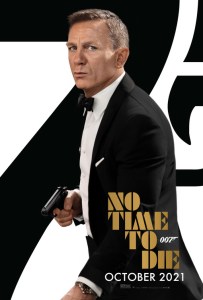 One cannot talk about No Time to Die without talking about finality. I’ll try and dance around significant spoilers but the movie by design is meant to serve as the capper to the Daniel Craig era filling out the world’s favorite martini-drinking British secret agent. I thought that 2015’s Spectre was the swan song for Craig as it brought back a famous franchise villain Blofeld (Christoph Waltz) made the man Bond’s secret half-brother, and it tried to explain how every bad thing that seemed to befall Bond was the machinations of an evil conspiracy, and then it literally ends with Bond driving into the sunset in his classic car with his girl (Lea Seydoux) by his side. It felt like the end, and it felt very much like everyone was just done and tired. And then the Bond producers wanted one more shot, or more likely one more lucrative franchise entry, to send an even older, battle-tested Craig on his way. I was wary of another Spectre-like entry, one that was tying back to the elements of decades-old for empty homage. Does anyone really care that the villain is meant to be Blofeld who means next to nothing to audiences in this era? After watching all 160 minutes of the longest Bond on record, for an actor who has portrayed 007 for 15 years, I have to say that No Time to Die is a terrific action movie and a welcomed second chance at a sendoff for the modern era of Bond that has gone through great artistic rebirth.
Bond’s cozy retirement is short-lived. Spectre agents have found him and Madeleine (Seydoux) and now Bond is forced to ship off his love for her safety. Years later, Lyutsifer Safin (Rami Malek) is determined to take down the last vestiges of the Spectre organization, the same group responsible for murdering his family. Bond is recruited by the newest 007 agent, Nomi (Lashana Lynch), to help MI-6 locate a kidnapped scientist with a powerful nanobot poison that can be genetically targeted to a specific person. Bond agrees especially once he realizes that Safn and his dangerous organization are targeting Madeleine, who has a big surprise of her own.
 As an action movie, I will argue that No Time to Die is better than 2012’s Skyfall, the Bond film that is widely seen as the high point of Craig’s tenure but one I find overrated. Director and co-screenwriter Cary Fukunaga, the second director ever given a writing credit for a Bond film, has crafted a beautiful movie with a real sense on how to showcase the majesty and suspense. Nothing will likely rival the superb cinematography by the legendary Roger Deakins on Skyfall, but this movie gets as close as you can get. It’s a remarkably beautiful looking movie. I mean that not just in the exotic locales and scenic vistas but simply in its depiction of action. The visual arrangements are noticeably several levels higher in quality, elegantly composed and lit to make each scene so pleasing to the eyes even before the information of the scene translates. Fukunaga (True Detective) frames the action in clear shots and clean edits so the audience is oriented with every shot and each patient edit point. For an era that began by trying to adopt the Paul Greengrass-style of docu-drama edits popularized with the Bourne sequels, it’s quite a welcomed change. I appreciate that action directors have creatively gone more in a direction of longer takes, wider shots, and a conscious effort to showcase the ingenuity and skills of its action choreography. Let us enjoy watching the masters of action operate at their highest level. Fukunaga understands this, and while the action might not be the best in the series, it is lovingly orchestrated and displayed.
There is a delightful mid-movie set piece that deserves its own attention mainly because of how actress Ana de Armas (Knives Out, Blade Runner 2049) steals the show. She plays Paloma, a CIA agent working in coordination with Bond, and the two of them wreak havoc across a Cuban neighborhood while wearing their finest evening wear. She immediately leaves a favorable impression and struts her stuff while operating heavy machinery with confidence. This part feels the most aided by co-screenwriter Phoebe Waller-Bridge’s contributions. Craig personally requested that Waller-Bridge, best known for award-winning TV like Fleabag and the first season of Killing Eve, come aboard and help polish the script, including characterization and dialogue. This sequence feels the most in keeping with her past spy thriller work and penchant for strong female characters who are meant to take the lead. de Armas is so memorable, and her segment so self-contained, that it feels like a backdoor spinoff to set up her own character’s franchise, and one that I wouldn’t hesitate to watch.
 If you thought Spectre was getting convoluted with how it tried to bend over backwards to explain how one man and one villainous conspiracy were manipulating all of Bond’s many miseries and setbacks, well then things are going to get even worse for you to keep up with. I’ll credit returning screenwriters Neal Purvis and Robert Wade, who have been with the storied franchise even before Craig’s 2006 debut, with attempting to make the continuity matter for a franchise that often throws up its hands at continued emotional stakes. By stretching backwards with ret-cons and added flashbacks, every new Bond movie tries to better evaluate the previous ones including the poorer movies, like Spectre and 2008’s Quantum of Solace. It’s like saying, “Hey, you didn’t like those bad guys in that movie? Well, these are the real bad guys,” or, “Well, maybe you didn’t like them, but their heinous actions gave rise to these new bad guys.” However, a consequence of continuing to add further and further clandestine machinations, and spiraling consequence from those machinations, is that Bond has now become a tangled web that is more convoluted without offering much in the way of payoff. I don’t think much more is gained introducing a new villain saying, “It was me all along,” when we don’t have an established relationship or interest with these new villains. Imagine introducing the Emperor back in Episode 9 of Star Wars and saying he was secretly behind everything… oh wait.
There are also benefits to this approach and No Time to Die crafts a sendoff unlike any other final entry for a Bond actor. This is a franchise going back sixty years, but the 007 brand has endured because no one actor is bigger than the brand. The franchise is regularly resetting with each new addition. The hyperbolic bombast and tongue-in-cheek frivolity of the Pierce Brosnan years (1995-2002) was replaced with a more grounded, gritty, and psychologically wounded Bond, made even more so by giving him personal attachments and then taking them away. I would argue this decade-plus with Craig (2006-2021) has involved the most mature and personal movies of the franchise;s history. It’s fitting then for the final film to pay service to that elevated take on the character. If you’re treating the secret spy as more of a person than a suit and a gun and a wisecrack, then that character deserves an ending that stays true to prioritizing more human elements of the character. To that end, No Time to Die works as a final sendoff, and I feel pretty confidant saying Craig is officially done now.
After a year and a half of delays from COVID, as well as its parent company, MGM, being bought for billions by Amazon, we finally have the final Bond movie in Daniel Craig’s successful run, and it’s a worthy finale for an era of the franchise becoming relevant again. I don’t know if that many people are emotionally attached to the character, likely more so just the nostalgia and the franchise, but if ever you were going to tear up from a James Bond thriller, this would be the one. It’s an exceptionally strong visual caper, with smooth and steady direction from Fukunaga, and while overly long and convoluted and a dull villain, it comes together for a worthy and celebratory conclusion that stands with the best of Bond. I’ll still cite 2006’s Casino Royale as the best Craig Bond, and one of the best ever, but No Time to Die is a solid second-place entry, and it does what few other Bonds ever could: fitting finality. Until, naturally, the popular series inevitably reboots with the next handsome leading man sipping a signature vodka martini (shaken, not stirred).
Nate’s Grade: B+
Share this:

Venom: Let There Be Carnage (2021)
 Whatever feelings you may have had for 2018’s Venom, I imagine they will only be magnified with the sequel, Let There Be Carnage, where it appears that the filmmakers took the goofy, campy elements from the original and magnified them exponentially. This is a silly, dumb movie that seems almost too aware of its existence as a silly, dumb movie; it reminded me of what a Roger Corman movie might feel like as a modern-day superhero blockbuster. This movie is ridiculous, and that will either be its major selling point of its point of condemnation. I was not a fan of the 2018 predecessor but I found myself enjoying the goofier aspects of Tom Hardy’s performance as journalist Eddie Brock after he shares his body with an alien symbiotic goo. This time we have a second alien symbiotic goo, which is actually what the villain of the first movie was, but this time it’s red and extra trendril-y! The appeal for any viewer is going to be the bonkers buddy film at its core, Eddie Brock and his living id personified as the Venom alien that keeps asking to be allowed to eat people. The movie is almost sitcom-level in it’s portrayal of the two butting heads and going their separate ways to prove they don’t need the other only to learn they were really meant to be. There are some comedic moments that just keep doubling down on silly jokes at the expense of everything else, like the “Not you, Father, you, father” bit that actually made me laugh out loud. Under the guise of actor-turned-director Andy Serkis (Mowgli), the movie is simply a broad cartoon that manages to walk a line between good-bad and laughably bad. It doesn’t always keep that balance but it’s sure entertaining to watch its goofball energy and it’s only a merciful 90 minutes long (almost one half of Eternals). I can’t really tell if everyone attached to the movie is trying hard or really just goofing off on the company’s dime. Regardless, if you were not a fan of Venom before, this movie won’t convince you there’s a compelling character or universe here. Michelle Williams (Manchester by the Sea) is pitifully wasted as Eddie’s ex-girlfriend. The accents are terrible all around. The new villain is a scenery-chewing serial killing dullard and then transforms into a goop monster. The love story with Woody Harrelson (Zombieland) and Naomie Harris (Moonlight) made me think if someone combined Natural Born Killers with X-Men but short-changed us on both counts. What works in this movie is what worked for me in the previous film, but now all elements feel more in alignment with the goofy energy of star-producer-and-credited-“story by”-writer Hardy. I don’t know if this franchise will ever qualify as traditionally good no matter how successful it proves to be. Maybe what the people really want is a screwball comedy with Hardy mugging alongside a wise-cracking, homicidal alien goo suit. Bon appetite, fans of expensive trash.
Nate’s Grade: C
Share this:

Mowgli (2018)
 Sometimes second place might as well be last place in the film industry. Pity Andy Serkis and the years he spent making a live-action, mo-cap enhanced version of The Jungle Book only for Disney to scoop him years in advance and deliver a billion-dollar hit. It’s impossible not to compare the two and unfortunately Serkis’ passion project is found wanting in many areas. For starters, there’s far less Shere Khan (voiced by Benedict Cumberbatch), which is a shame. He’s really only in the film for very little. I think Cate Blanchett is miscast as the voice of the snake, Kaa, who acts like a grand keeper of the jungle’s history and future. I’m not sold on Serkis as Baloo, a grumpy paternal figure present from the beginning that trains the wolf pups so they can join the pack. The middle half-hour Mowgli spends in the company of man with a kindly poacher also feels like the movie is spinning its wheels. It keeps the rest of the jungle on hold. There are some rather dark asides that can be quite surprising, from wolf pups plummeting to their doom, bloody scars, cute severed heads to haunt your dreams, and three separate occasions where characters will watch the light vanish from a dying animal’s eye. It’s definitely a more brutish, cruel, and dangerous world, but at what greater expense? The characterization doesn’t add up to much. The character relationships are minimal. The CGI creatures and settings look unfinished. The whole enterprise feels rushed even though it’s been on the shelf for some time, which may be why the studio was eager to sell it to Netflix for a cool $90 million. You’ll watch Mowgli and nod, generally entertained, but questioning whether it’s 90-million worth.
Nate’s Grade: C+
Share this:

Rampage (2018)
 Rampage is exactly as advertised, a big, dumb monster movie based upon a flimsy premise of an arcade smash-‘em-up, and it’s also just about everything you’d ask it to be. This movie is ridiculous, no question, but I walked away feeling like the filmmakers recognized this and embraced its ridiculousness.
Davis Okoye (Dwayne “The Rock” Johnson) is a primatologist at the San Diego Zoo. His prized primate, an albino gorilla named George, is undergoing very dramatic changes. A canister of secret genetic-altering gas has fallen from a scientific space station, landing in George’s gorilla pen, the hills of Montana, and in the Everglades. Separately, a wolf and a crocodile are rapidly growing in size, as is George, who is also becoming more aggressive and violent. Dr. Kate Caldwell (Naomie Harris) is a disgraced scientist who may know how to reverse the changes. The U.S. government, lead by Harvey Russell (Jeffrey Dean Morgan), relocates George to a government lab; however, he breaks loose midair. He and the other monstrous animals are heading to Chicago, lured by a signal intentionally staged to draw them in one very smashable location.
 It’s not exactly a winking, satirical statement on the monster movie genre, but I think Rampage is still self-aware. Take for instance what befalls The Rock. His character is literally shot in the gut (no exit wound) and miraculously recovers and runs through crumbling buildings, leaps over rubble, tussles with giant monsters, and even outruns them on the ground, and is thrown this way and that. This happens for the entirety of the last act while, and I don’t think I can stress this enough, A BULLET IS STILL LODGED INSIDE HIS CHEST CAVITY. However, he is The Rock, our modern equivalent to a living Superman, so the movie shrugs and asks us to just go along with it, and because I was entertained I did. There were several moments where I just shrugged and said, “Sure, let’s do that,” but usually these decisions were in the service of the blockbuster elements that I would want to see with this kind of premise. It’s silly and stupid and baffling at times, but Rampage knows what elements to pump up and what elements an audience won’t really care about. The villain’s plot is completely nonsensical and amounts to, “Step 1) lure the giant monsters to one central tower in Chicago, Step 2) ?, and Step 3) profit.” I have no idea what they were hoping to accomplish but their lamebrain thinking efficiently facilitated the monsters getting closer to peak smashing form.
You can look at three performances to get a sense of those who understand the big, dumb, fun movie they’re in, and those who have misjudged what kind of movie they’re in. Jeffrey Dean Morgan (TV’s Walking Dead) knows exactly what kind of movie he is starring in and has the time of his life as a scenery chewing, gun slinging, folksy quipping cartoon. Every scene he slides into, the man has a gleeful glint in his eye at what he gets to do. You almost expect like a musical motif to accompany him every time on screen. It’s enough that you think he might just strut off into another movie all his own. On the opposite end are the film’s villains, callous, rich, and almost bumbling in their sense of evil. To their credit, Malin Akerman (TV’s Billions) and Jake Lacy (TV’s I’m Dying Up Here) are mostly meant to verbalize their villainy for the audience. Whenever we cut back to them, the brother and sister are helpfully explaining the lengths of their scheme. Lacy is goofy dumb and relatively useless outside of deliverer of exposition. Akerman fares worse trying to be a no-nonsense bitch of business and is far too serious. When both of these actors are onscreen, the movie powers down, sapping its fun. When Morgan appears, it’s like Rampage can once again be the big, dumb, fun movie we crave.
 Unexpectedly, the best relationship in the movie is that of The Rock and a giant CGI albino ape, proving once again that Johnson’s charming bonafides know no limits. George the gorilla is given far more nuance than any of the other supporting characters, which isn’t saying much, yet Johnson’s charisma is able to lift all on screen partners. Their funny, warm-hearted relationship may actually stir some emotions in you come its heroic climax, and that by itself is astounding. Johnson’s character back-story is kept to a relative minimum as not to gum up the narrative expediency (he prefers animals over people, but not in… that way). He’s a reliable anchor for audience engagement that he can sell the most ridiculous, as detailed above. It’s been quite an ascent for Johnson over the course of the last ten years, and my pal Dan Nye observed that he’s now been playing actual characters rather than recognizable versions of himself. Davis Okoye is more or less The Rock: Zoologist, but it’s still a welcomed development. The Rock could star alongside an actual rock and glue your eyes to the screen.
The special effects are also quite good for this sort of brainless caper. George comes across as a genuine creature, not necessarily with the depths of say Andy Serkis’ Caesar, but what CGI-performance does? The computer effects do an excellent job of communicating actor Jason Liles’ (Death Note) mo-cap performance and make the big guy sympathetic even as he rages out. I enjoyed that, much like Alex Garland’s Annihilation, the animals are not necessarily demonized for behaving like nature intended. They’re creatures undergoing a change they cannot understand and acting accordingly like animals would. The crocodile is impressive for its evolutionary mutations and textured, especially when we see its gaping mouth open.
 As far as its stated mission, Rampage smashes things up but good. Director Brad Peyton showed with 2015’s San Andreas that he’s essentially the diet version of Roland Emmerich, and that’s okay. The action is fun above all else and Peyton prefers long visible shots. If we’re going to see a bunch of monsters, let’s actually see them (ahem, 2014 Godzilla). I felt like Peyton was far more invested in this movie and his shot selections finding interesting arrangements, like a slow-mo shot of jaws snapping together on a passing fighter plane. Peyton understands the significance of scale, letting the sheer size of the monsters communicate the immeasurable danger. There’s an early confrontation with the giant wolf in a Wyoming forest that’s chaotic, suspenseful, and demonstrates how freaking fast these creatures can be at their size. A prologue in space is genuinely thrilling and the zero gravity aerobatics provide an extra feeling of helplessness against a mutant attacker. By the end, when all three monsters descend on Chicago, Rampage becomes the popcorn movie experience that it has promised.
Nobody is going to label Rampage as a smart movie but it is aware of what it is. This is a big, dumb movie that aspires to merely be an awesome big, dumb movie, and that prioritized sense of fun pervades the relatively fast-paced film. The Rock is running around with his hulking ape-bro and wrecking havoc. This is the kind of movie where a giant gorilla mimes the universal physical symbol for sexual congress. This is the kind of movie where they feed a person to that giant gorilla. This is also the kind of movie where The Rock has a bullet lodged in his gut for the entire climax. This is a movie that has no airs about it and simply wants to entertain a mass audience. The Rock is a consistently charming and very capable action lead, and the relationship he has with his giant ape-bro is surprisingly chummy and sweet. If you’re looking for a monster movie that has no embarrassment about what it is, let alone being based on an arcade game, then Rampage is going to be a stupidly enjoyable time out at the movies.
Nate’s Grade: B-
Share this:

Moonlight (2016)
 What Moonlight achieves is both something different and familiar and amounts to nothing less than watching the birth of human identity on screen. The film chronicles three formative experiences at three different times of a man’s life, each serving as its own one-act play examining our protagonist and his tortured sense of self. The results are breathtaking and deeply immersive, allowing the formation of a human being to take place before your eyes in such magnificent artistic strokes. This is a sensitive, sincere, beautiful movie that serves as an indie coming-of-age tale sliced into three significant parts. I was completely under its sway within ten minutes, finding its perceptive perspective and nuances to be convincingly naturalistic. I felt like I was watching a documentary of a young black man’s life told with ferocious realism, or at least a loosely fictionalized version of a life informed by fully authentic personal experiences. It’s a somewhat ineffable quality for slice-of-life movies but they live or die on whether the film carries an unforced sense of realism, telling larger truths with small details, each piece coming together to make the world and the character feel fully formed. Moonlight pulls you immediately into its orbit thanks to its authentic drama and observations.
The three segments compliment one another as they build toward a young black man’s understanding of his homosexuality. We’ve seen movies before where characters undergo sexual awakenings and from gay perspectives; it’s practically a cottage industry unto itself in independent film. However, rarely have we seen this story from people of color. The expectations of accepted masculinity are entrenched at a young age, where “Little” (Alex Hibbert) is chided by, among others, his own mother Paula (Naomie Harris) for the “swishy” way he walks. It goes without saying that being gay is not exactly widely accepted in the Miami projects of the 1980s. This conflict of what makes a man is wonderfully symbolized with Juan (Mahershala Ali), an unexpected father figure that takes “Little” under his wing along with his girlfriend, Teresa (Janelle Monae). The kid wants to know how he can know if he’s gay because it’s certainly something he doesn’t want. Juan doesn’t pressure the boy or make big speeches about what it means to be a young black man in America. Instead, he tries teaching him to accept himself and provides an alternative home that serves as a refuge during his mother’s long absences and crack-withdrawal tirades. There’s a lovely moment where Juan teaches “Little” how to swim, and it’s touching in how recognizably father/son the activity is, how much trust is involved and vulnerability, and how the film doesn’t need to oversell the subtext. Juan definitely becomes the father figure that Chiron lives up to for the rest of his life. This first segment is dominated by their relationship but also Juan’s sense of responsibility. He’s making a living through selling drugs, including to “Little”’s own mother. In a very memorable and heated moment, Paula angrily calls out Juan for thinking he would make a better parent given the moral culpability of his own actions to her habit.
 The second segment zooms ahead to when Chiron (Ashton Sanders) is a teenager in high school and subjected to hostile bullying. The schoolyard taunts from his youth have morphed into something more ferocious and toxic, as a collection of bullies torments Chiron and looks to rob him of his personal connections to others. The central focus on the middle segment is about the growing relationship with Kevin (Jharrel Jerome), the childhood friend who Chrion crushes on. Their closeness takes a leap one fateful night that Chrion will always remember. It’s an awakening and a confirmation of self, and it’s only after having this fulfilling outlet cruelly taken from him that Chiron finally lashes out, with lifelong repercussions. It’s an explosion we can see coming and one that feels fully set up. The second segment feels more familiar because of the age range and it’s the one with the dawning of sexual realization, a story situation we’ve seen before. What elevates it is that it’s a fairly direct carryover from the beginning segment, which means the personal issues have magnified for Chiron. His relationship with his mother has become even more frayed as he’s grown, and what once was name-calling and questions over his maturation has become confirmed. Her addiction has become even stronger and she’s harassing her own son for whatever meager money he’s given from Teresa, his surrogate mother figure. Chiron is struggling to make sense of his feelings in an upbringing lacking support and clarity. You could examine the conclusion of this segment as an empathetic cautionary tale, as we see the years of abuse and measured choices that lead to that confrontation.
The final segment is where Moonlight transforms into a late blooming unrequited romance that should steal your heart if it’s still functioning. “Black” (Trevanta Rhodes) is a fully-grown adult that has seemingly followed in the footsteps of Juan in a life of low-level crime. He’s hardened both emotionally and physically. The muscles will provide an intimidation factor missing during his youth if anyone questions his sexual leanings. He’s burrowed into himself and the role he feels he must accept, but all of that changes the instant he gets an apologetic and searching phone call from Kevin (Andre Holland). Now working as a chef at a diner, Kevin reaches out to his old friend though even he can’t fully explain why. This reawakens “Black”’s longing and he works up the courage to travel back to Miami to surprise the friend who meant so much to him. Their reunion is treated like the culmination of a romance that you may not have realized had you completely. After two segments of setup and years apart, you may find yourself projecting your thoughts to the screen, trying to compel these two men together. It’s an extended sequence that moves at a gradual pace, a fitting tempo for a character racked by insecurities and suppression. By going forward he’s taking a big risk, putting himself out there, and we desperately hope “Black” finds a sense of support. It’s the segment where “Black” finds resolution with the major conflicts that have defined his life, and the climax of the movie is a deeply tender moment where an emotionally reserved man reaches out to another and lets his firmly fixed guard down in the process.
 I don’t usually go into such a detailed plot synopsis with my reviews because I like to hit the basics and let the readers experience the story for themselves, but the pleasures and artistic triumphs of Moonlight are in how fully immersed and felt the movie becomes. By telling the story in three noteworthy sections, Moonlight provides an impressionistic statement about the formation of personal identity, specifically a young man growing up black and gay in a hostile environment to both. The movie also blows apart the argument made for 2014’s Boyhood about how truly necessary it was to watch one young actor play the same part for 14 years. Here we have six different actors playing two different characters at three different points in time and the impact is no less great. Here is a movie that doesn’t need a gimmick to have a larger emotional impact on its audience.
Director/co-writer Barry Jenkins has a marvelously fluid and natural feel for his camera, swinging around the parameters of a scene to make the world feel more charged with energy. Jenkins is a born filmmaker and knows how to squeeze the most out of his scenes with gorgeous cinematography and an eclectic musical score that feels traditional with classical orchestration like churning strings layered and rearranged into something arrestingly new and yet still personal. There aren’t many overly stylized choices, rather Jenkins tells his story with uncommon poise and treats one man’s life like an opera, like the greatest story never told on film, like a life of complexity worth the deep dive. There’s a classical lyricism to the presentation that reminded me of the works of Todd Haynes (Carol). There’s one scene where Paula is strung out on crack and finds her son in the middle of a joyous high. Her face fills the frame, absorbing all of Chiron’s world, and her euphoria is inter-spliced with jarring speed ramps in editing, meant to convey the mania and peace that pumps through her veins in this fleeting moment. It’s a stylistic device that isn’t overplayed and has genuine purpose. Jenkins is restrained from self-indulgences and keeps every aspect focused on reflecting the inner life of his lead.
The very talented company of performers makes the movie even more powerful. Ali (Hidden Figures, Luke Cage) is creating serious awards buzz and it’s deserving, though every actor in this movie is deserving of notoriety. Ali plays a man trying to do right by his own sense and he lets you see the troubles that wash over him. Should he insert himself into this young boy’s life? Is he in a position to set an example? Ali has such paternal strength and tenderness while still displaying doubts and regret, hardly deifying this found father figure. Harris (Spectre) is wonderfully horrifying and heartbreaking in her role and has some big moments that convey her given completely into desperation. She’s offended that others would deign replace her but does little to reclaim her title of mother and provider. Holland (Selma) has a world-weary smooth sense of wisdom to him, and his unassuming charisma helps unlock his friend’s true feelings. The three actors who portray “Little”/Chiron/”Black” are each exceptional, giving different performances and interpretations, further supporting Jenkins’ artistic thesis.
 Moonlight is a beautiful film told with such delicate care and a resounding sense of authenticity and personal detail. It swallows you whole and leaves you with the impression of a human life observed with tenderness, intimacy, empathy, and grace. It’s about the people and experiences that help guide us onto the paths we take, and while there’s a sense of heartache as we think of what might have been, there’s also the serenity of accepting what has been and what can still be. Jenkins proves himself a superb talent who doesn’t lose sight of his artistic goals with extraneous artifice. There’s a lilting, lovely lyricism to the movie that elevates Chiron’s life into feeling like poetry. This is a life we so rarely get to see given such an artistic and honest examination without condemnation or judgment. It’s the story of a man embracing his identity and overcoming isolation and suppression. This disadvantaged young man is worth your emotions, your sympathies, and your attention. Moonlight is an alluring and heartrending film that manages to be deeply personal and universal at the same time. It’s sublime.
Nate’s Grade: A
Share this:

Mandela: Long Walk to Freedom (2013)
 One of the most important figures in the twentieth century, you’d expect Hollywood to give Nelson Mandela his well-deserved close-up, and in 2013 we got a biopic on his wife and the man himself, with Mandela: Long Walk to Freedom. It is a respectful, reverent, and relatively inspirational biopic boasted by a pair of great performances. Idris Elba (Pacific Rim/everything cool ever) nails the voice but also inhabits the courage of the man, the toll of his decisions, and the doubt that crept in at his darkest moments. Harris (Skyfall) gives a fiery performance as Winnie Mandela. You may be surprised, as I was, how active she was in South Africa’s rebellion against the government. The problem is that the film plays like a greatest hits collection without much more insight than we could glean from a cursory new report. Cramming the man’s life into 140 minutes is obviously going to be insufficient, but the speedy narrative does little justice to the man’s hardships and the complexities of South Africa’s civil rights movement. The cradle-to-grave approach in biopics is somewhat passé now. Rather movies like Lincoln and Invictus, also about Mandela, focus on pivotal moments that encapsulate the person. I think I have the perfect rewrite of this movie: adjust the focus squarely on the series of meetings in the late 1980s Mandela had with the South African government about political reform. Let’s dig deep into the political conflicts, the government’s fear to equal rights and possible recriminations, the smoothing of tensions, the building of trust, the fragility of a country in the balance. It may seem like more of a stage bound approach, but I think it has more immediacy, nuance, and works to summarize his lifetime of struggle and the change of his country. Oh well. Mandela is a respectful biopic but the man and his legacy deserved something better than a speedy run-through of his life’s checkpoints.
Nate’s Grade: C+
Share this:

Skyfall (2012)
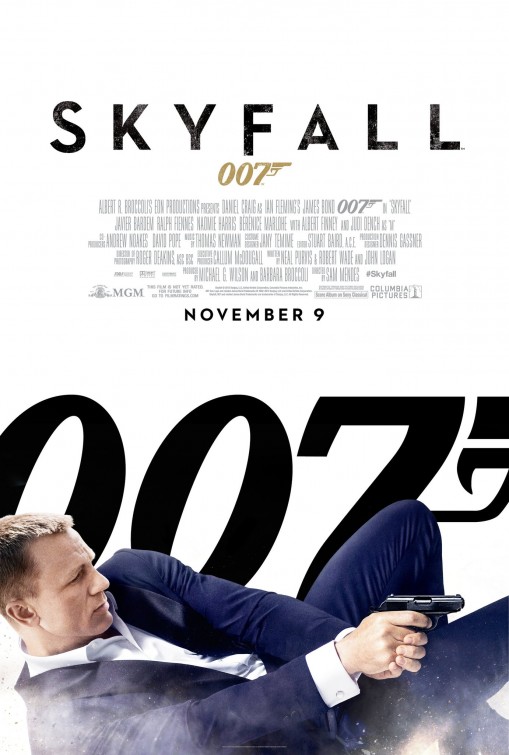 The James Bond franchise, one of the most enduring of all time, has been open to criticism since it came back in a big way with 2006’s Casino Royale. Fans have started to whine that the Bond movies are no longer the Bond they remember, and they’re probably right. In 2006, the producers decided to go back, reboot the series, and introduce a more grounded Bond, a man with more demons than quips. This backlash to a successful reboot seems so funny to me, especially considering the dubious nature of these older Bond movies. Can we all just take a moment and objectively admit that half of the Bond movies are absolutely awful? Skyfall is the third in the new Daniel Craig Bond era, and it’s received universally ecstatic reviews. It’s a fine work, surprising and satisfying in equal measure, but it’s no Casino Royale for me, but what can be?
James Bond (Craig) is recovering from a serious injury after a fellow agent, Eve (Naomie Harris), accidentally shoots Agent 007. In her defense, he was atop a speeding train battling a baddie and her boss, M (Judi Dench), ordered her to fire. In the weeks that follow, Bond is struggling to adapt. He’s lost a step physically and now has to deal with his own doubts. Naturally, this isn’t the most opportune time for crises of faith. MI6 is under attack by one of their own, a former agent turned powerful techno-terrorist named Silva (Javier Bardem). The man has a serious grudge against M and is exposing MI6 undercover agents to punish her. After an attack at MI6 HQ, the agency is left scrambling and sends Bond out to nab Silva, even if Bond isn’t physically ready to return to field duty. Silva is determined to kill M and destroy the agency that left him for dead.
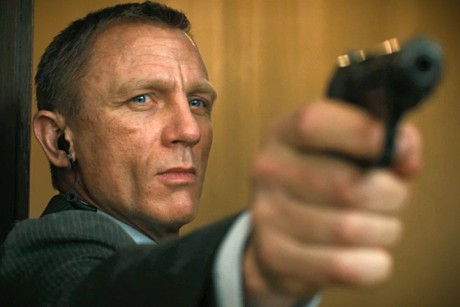 While Skyfall is indeed a good Bond movie and worlds better than 2008’s Quantum of Solace, it still cannot meet the rapturous applause it’s receiving among critical circles. It starts off strong with a nifty action sequence in Istanbul (the go-to action setting for 2012). Bond is chasing a bad guy, and we go from foot chase to car chase to rumbling on top of a speeding train. And there are natural complications that take advantage of geography! When Bond hops on the train, he climbs into a construction crane to fight back, smashing open the back of the train car. It’s a terrific opener that gets things starts briskly, and the sexual chemistry between Craig and Harris (28 Days Later) is palpable. Then the movie pretty much deflates in the second half. There’s a build-up to the villain and his master plot, but once that plot is revealed the film can’t live up to the hype. There are enough plot elements that feel important but eventually get discarded. Here’s a minor example: Bond is given a handgun programmed to his palm print, so it will only fire with Bond wielding it. It’s the only gadget in the movie, so you’d expect it to be utilized in a significant way. One nameless thug uses it then gets eaten by a Komodo dragon. That is it. Seems like an awful waste of funds for it to be thrown away so casually.
The last act has a protracted finale in Scotland, exploring Bond’s ancestral home and his tragic backstory. I’d like to think the insights we’re offered are important but I don’t believe they are. Bond was an orphan (the best recruits, says M) and Albert Finney (Big Fish) was his quasi-father figure/caretaker. It’s not enough to compensate for the slack pacing and encroaching boredom present. The good guys are holed up in an estate, waiting. And that’s what you want in a Bond movie, let alone any action film, for the heroes to sit and wait. An action movie should be building to a climax of intensity, thematically as well as plot-wise. Skyfall is that rare Bond film that flirts with coming undone; each passing action sequence seems less interesting than the one before.
With Mendes directing and Roger Deakens, the greatest working cinematographer, at his disposal, this has to be the best looking Bond movie. The shot compositions are often stunning, making fine use of the visual space and the balance of light and shadow. There are even some shots that might remind you of Mendes previous films like American Beauty or Road to Perdition. Added with some above average action, it makes the thrills an even better sight. There was a fight sequence in a Chinese high-rise almost completely in unbroken silhouette, with the neon tentacles of advertisements dancing in the background. It’s a wonderful image. Even when the movie was losing me at points, I could at least admire the visuals. I was worried that Mendes would not have a deft feel for action. After all, another indie director mostly known for dramatic work, Marc Foster, helmed Solace. That selection did not work out so well, though the script was notably weak. Mendes, on the other hand, can stage some pretty exciting action sequences with judicious editing, allowing the audience to follow along with ease. He’s not exactly a knockout when it comes to constructing action sequences, but the results are more than adequate for a guy whose last two movies were Away We Go and Revolutionary Road.
For the previous Craig entries, it feels like the movies have borrowed more from Jason Bourne than Bond. They’ve gone for a grittier, darker, more realistic portrayal. Skyfall takes a very interesting angle with the character, showing a Bond coming to terms with his physical limitations. It’s a Bond that has to confront his most nefarious foe: aging. Mallory (Ralph Fiennes) tells the agent that the whole spy business is “a young man’s game.” In the old days, you needed men with lairs in volcanoes and giant doomsday lasers. Now you can send the world into irreversible chaos with a laptop. Skyfall is at its most engaging when it confronts the old world of spies and the scary new world of technology. Can the Queen and MI6 compete or will they be left behind? Bond and his organization must confront their limitations and mortality, and this added dimension of vulnerability makes the series far more emotionally resonant.
 Here’s my main problem with the villain: it’s a bait and switch affair that leads to unfulfilled potential. Silva has been spoken of with such awe, a man who could bring governments to their knees with the click of a button. He’s made out to be this dangerous cyber-terrorist genius. So what happens for the second half of the movie? He chases people around and shoots guns. It’s like Skyfall completely forgets what made their villain special. Bardem gives a flamboyant performance with an extra dash of actorly nuttiness, but it’s nowhere near the memorable menace of 2007’s No Country for Old Men. That’s an unfair comparison, I know, but where the movie really starts losing it is when Silva loses it. He becomes just another garden variety psychopath, though one with a creepy oedipal complex. Psychopaths do not work in the James Bond universe. Agent 007 needs a foil that is smart, not crazy and a mad genius rather than mad. I recognize that Silva’s psychological shambles is meant to be a sign of the potential fate of all agents, let alone agents that are given up by M. That doesn’t mean you abandon all the traits that make the villain who he is. The problem with Silva, despite a rather jarring monologue about the effects of surviving a cyanide capsule, peaks with his first appearance. He has a grand entrance and places Bond in a very precarious position, forcing him to confront his physical failures. That’s the villain I want to see. And the awkward handsiness of Silva will also lead many to question whether he’s gay, which wouldn’t matter if the movie wasn’t so clunky.
It also feels like Skyfall may be the conclusion to this incarnation of Bond. I know Craig has been signed for two more films, and that’s great news as he’s fully made the character his own at this point, but the movie seems to setup the Bond we’re better acquainted with. We started from scratch with Casino Royale and now the familiar world, with the reemergence of familiar characters, is coming into focus. The scenes with the new Q (Ben Wishaw), a gangly whiz kid, are enjoyable and they contribute thematically to the old vs. new/age vs. youth conflict at heart. This feels like a transition film, meant to pass from the bruising realism into the polished pyrotechnics of the franchise’s past. There’s a reason the famous gun barrel shot happens to conclude the movie, because by the end of those 142 minutes, it now feels like the formation of James Bond has completed. There are also plenty of in-jokes and references for Bond aficionados to lap up. Even the (lackluster) title song by Adele is in the vein of the old Shirley Bassey numbers.
While not living up to the exultant hype machine, Skyfall is certainly a good Bond movie, though not nearly good enough to be in the conversation of the best. The action starts strong but is prone to diminishing returns especially as the movie transforms into a more ordinary action thriller. The most memorable sequence is in the opening, which isn’t a very good sign for the rest of the movie. It’s still a suitable action movie, and one that pays closer attention at character for a character that’s lived for 50 years in various film incarnations, but just because it pays more attention to character doesn’t mean it does it well. Perhaps I’ve just become spoiled after the artistic and commercial heights of Casino Royale. This is still an entertaining movie that often looks great and has some great actors doing suitable work. We’re still far and away from the loonier Pierce Brosnan episodes, so there is that. I imagine audiences will be more favorable than I am and make Skyfall the most successful James Bond film in history. That’s fine because it feels like, with everything established, that we’re about to hit a new and exciting phase with Craig’s version of the character, and that will leave me shaken and stirred.
Nate’s Grade: B
Share this:

Ninja Assassin (2009)
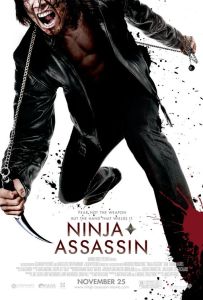 I never would have fathomed that a movie with both “ninja” and “assassin” in its title would barely hold my interest. This is a movie I got up and did the dishes through. Over-the-top never felt so boring, and perhaps it comes down to the flimsiest of stories strung together to connect the various ninja fights. It really does the bare minimum narrative-wise to get to the next opportunity for bloodletting, and oh what bloodletting! This is an extremely bloody movie but its power is undone because the violence is too stylized. Blood sprays like geysers and every slash of the flesh unleashes a balletic dance of painterly, soupy blood. The movie might work as disposable trash if only the action sequences were exciting. This isn’t a ninja movie but some half-assed video game. These aren’t Bruce Lee Ninjas, these ninjas can literally vanish into thin air before your eyes and they blend into the shadows. They are supernatural creatures that defy our traditional notions of what defines a ninja. This ain’t it. The characters all take such brutal beatings, and they spill tanker truckloads of blood, that it’s a wonder they can even stand let alone fight. There are a fee snazzy fight sequences but only thanks to choice in geography. The choppy editing only makes matters worse. I expected much more from the director of V for Vendetta. Ninja Assassin is just an un-engaging, hyper violent cartoon with a dimwitted story and little reason to care. The action isn’t even that good because the editing and lighting conspire to make sure you won’t be able to comprehend what’s going on. The best part of this entire damn stupid movie is the animated segment at the start of the closing credits. So have fun washing dishes until then, folks.
Nate’s Grade: C-
Share this:

Pirates of the Caribbean: At World’s End (2007)
 Shiver me timbers Jerry Bruckheimer. The Pirates of the Caribbean movies are taking no prisoners when it comes to money and fans. Ten months after 2006’s Dead Man’s Chest comes the concluding chapter to the Pirates saga. At World’s End is longer, bigger, and more expensive, but it is also the first Pirates movie that felt like a ride I wanted to get off.
The British navy, at the command of Lord Beckett (Tom Hollander), is eliminating all piracy once and for all. He now controls the heart of Davey Jones (Bill Nighy) and so controls Jones and the crew of the Flying Dutchman, the most fearsome ship run by cursed barnacle-encrusted crewmen. As the very busy hangmen will attest, it’s not a friendly time to be a pirate. The Black Pearl has set out to Singapore to find support from Soa Feng (Chow Yun-Fat), one of the nine pirate lords. The Pearl is now commanded by Barbosa (Geoffrey Rush) who was brought back from the dead thanks to the witchy Tia Dalma (Naomie Harris). They travel to the ends of the earth to Davy Jones’ locker to rescue Jack Sparrow (Johnny Depp), who was last seen in the belly of a beast. Elisabeth (Keira Knightley) and Will (Orlando Bloom) are both aboard and still bickering about their stalled romance. Once Sparrow returns to the land of the living, the group meets with the other pirate lords from all across the globe in an effort to pull together and stand against Beckett.
 As it turns out, the fear that Pirates of the Caribbean: Dead Man’s Chest was a 150-minute trailer for this movie was unfounded. That’s because the third movie in the Pirates of the Caribbean series completely ignores or messes up the many intriguing setups from the second film. Character motivations from Dead Man’s Chest are mostly unresolved and revert to stock generalizations. Jack Sparrow feels like he’s been grafted onto an unrelated storyline. Most disappointingly is what happens to Davy Jones, the greatest addition to the Pirates landscape. This awesomely-realized villain was scary and fascinating and looked fantastic thanks to Oscar-winning special effects. At World’s End takes such an intriguing villain and turns him into an impotent tool to Beckett. He’s been transformed into a houseboy who might as well fill people’s teacups. Yes Davy Jones thankfully figures into the climax but why in the world’s end must an audience wait that long? Davy Jones reminds me a lot of the ghostly twins from 2003’s The Matrix Reloaded who were completely dropped from the second Matrix film to the third.
But not only does At World’s End fumble the hand-off from the previous sequel, the movie itself establishes many setups with poor or unsatisfying payoffs. So much is made about the pirate lords from all over the world, and we see a colorful collection of international pirating groups that is fitfully amusing, but the whole section has no point at all. Chow Yun-Fat’s character is a non-starter; in fact none of the new characters introduced in At World’s End play any importance on the overall plot. The film is building to a final all-out battle between the united pirate lords and the British navy. We witness the awesome sight of the sea filled with vast armadas of ships, and as an audience we are getting hungry for some epic nautical action. Then At World’s End pretends that none of the other ships matter and sets its entire battle as one ship versus one ship inside a whirlpool. While this is admittedly exciting it isn’t anywhere near as exciting as an entire war amongst hundreds of ships. The filmmakers have all the money in the world and they couldn’t give us a little something bigger in scope? The pirate lords could have just as easily been cut from the movie if they were just going to stand on the sidelines and wave a flag.
The pirate lords make a big deal about their apprehension with releasing the sea goddess Calysto from her earthly prison. The pirates trapped her into the body of a human in order for them to gain control of the seas. They reckon she’ll be one very bitter sea goddess and take out some apocalyptic wrath out on the pirates. So the pirates release her, cowering in fear at her powerful reprisals and,,, nothing. Calysto vanishes, causes some mildly inclement weather, and is never seen again. Talk about a lot of pointless hot air.
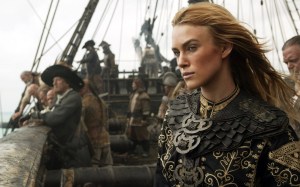 I think perhaps the clearest example of how the movie screws up is with the monstrous Kraken. This slimy beast got a ton of attention in Dead Man’s Chest and was a ferocious terror on the high seas. Now, I would expect that such a creature that played an integral role in Dead Man’s Chest would be back for the next sequel. Ignoring its prominence in the plot, the thing just looked amazing onscreen. But with At World’s End the giant monster is killed off screen and in between the movies. I felt insulted when I saw the mighty carcass washed ashore like a pathetic beached whale. What is satisfying about that? Why would Beckett make Davy Jones kill such a powerful weapon he could use for his own unseemly gain? It makes no sense. The Kraken isn’t the only character done a disservice by a plot stuffed to the gills. Some are killed in terribly pointless incidents and it just becomes irritating.
At World’s End is missing the high-flying fun of the first two Pirates movies, and this venture just feels draggy, tiresome, and far too dreary. You know you’re headed for some morose subject matter when a movie hangs an eight-year-old before the opening credits. This latest film is crushed to death by the weight of excess plot and confusion. There’s a damn near 20-minute section of the movie that’s nothing but characters double-crossing, triple-crossing, quadruple-crossing each other; it literally requires a character to spell out what has just taken place and set the record straight. I don’t think At World’s End ever recovers from this absurdly confusing miscue.
The film seems more interested in talking over an audience than delivering something genuinely thrilling and stirring. There’s a curious lack of action and nothing new matches the imaginative action set pieces of the previous films, like the duel atop the roving water wheel. Excluding a large melee between the Black Pearl and the Flying Dutchman as the climax, the action pops in and out in shortly timed bursts. For a movie within a hair or running three hours, there needed to be more action. Instead of derring-do, At World’s End spends interminable periods of people talking, usually in personal quarters, and explaining the increasingly laborious plot to each other. All of the Pirates movies are filled with false endings and heaping helpings of extra plot, but this is the first time I really felt the real drag of its running time. Director Gore Verbinski still knows how to keep things looking good but he can’t save the film from its anchor of a maddening and convoluted plot.
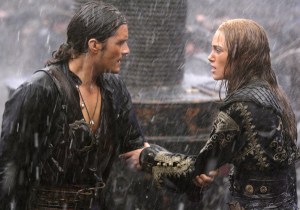 The movie is not without its due pleasures. Depp is always going to enchant with his now iconic character, but the true star of the film is Rush, who makes welcomed return. The special effects are still tops. The sequence rescuing Jack from the world of the dead provides many trippy moments that possess their own strange beauty, like when we watch the Black Pearl sail against the black, star-spotted sky. It’s fun seeing Keith Richards appear in cameo as Jack’s father and the stated inspiration for Depp’s performance. A small man and a large gun makes for one very funny sight gag. A Mexican standoff that actually involves an armed monkey is a comic high point. It’s just that all the fun or memorable moments seem to be the ones that matter the least. At World’s End still manages to do enough right to work, especially its Singapore opening. As far as a movie that upholds the quality of its franchise name, that’s a whole other matter.
Pirates of the Caribbean: At World’s End is a somewhat entertaining but heavily flawed final film to a trilogy. It’s the darkest and trippiest of the three movies, but it also makes the least amount of sense and has the least amount of action. That doesn’t seem like a good exchange in my book. There are not enough important events to justify the bloat. At World’s End has a hardcore case of butterfingers when it comes to handling plot and character setups from earlier films, and as a result almost nothing and no one ends in a satisfying fashion. The effects are still eye-popping and Depp will always be a comic treasure, but this lackluster movie feels like tripping at the end of a marathon. I had so much hope for At World’s End after how gratifying I found the other two movies but I cannot quell my disappointment. This is not a fitting conclusion. This feels more Matrix Revolutions than Return of the King. Of course it’ll make tremendous amounts of booty at the box-office, but will demand for a fourth be as rabid after this muddled and murky capper?
Nate’s Grade: B-


 nathanzoebl
You must be logged in to post a comment.