Blog Archives
Inferno (2016)
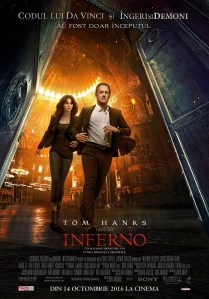 You know it’s a bad sign when the best part of your movie is the scenery. Inferno is the third in the Robert Langden series where Tom Hanks stars as the world’s foremost symbologist that traverses old European museums and cathedrals to solve mysterious puzzles. The Da Vinci Code was pretty bad, its sequel Angels & Demons was a marked improvement, and now Inferno is a depressing step backwards. Langden has to stop a madman (Ben Foster) from releasing a super virus that will kill half the world’s population. The villain’s plan requires him to wait and he has no reason to do so. Waiting only needlessly delays his goal and makes it more likely for him to get caught or fail. His plan is stupidly convoluted, but I didn’t expect that the good guys’ plan was also stupidly convoluted, relying upon fake blood squibs and disguises and for what? There are three competing, stupidly convoluted storylines that smash together. I simply could not engage with what was happening and felt I had little reason to care. The mystery aspect is pretty tame and the thriller set pieces are unmemorable save for a climax that at least feels like the highpoint. There was one interesting aspect that never fully gets developed and that’s the idea that Langden can’t trust his senses. He’s a man who relies on his arcane intellect and to turn that against him, as well as possibly draw in hallucinatory visions, was a smart move. It’s only more disappointing when they fail to do anything with this possibility. The myriad plot holes were clearer to me than the hackneyed plot itself. Inferno has some very nice footage as Hanks and Felicity Jones scamper from one Florence site to another and that’s the best thing I can offer about this mess.
Nate’s Grade: C-
Share this:

The Girl on the Train (2016)
 Consider it Gone Girl lite. The adaptation of the mega best-selling thriller The Girl on the Train seems to be on a runaway collision course with irony-free, amped-up melodrama and sundry “adult” sensuality reminiscent of the 90s boon of erotic thrillers like Jade and Sliver. The book by Paula Hawkins had three strong female lead characters each telling their own miserable worldview of trying to live up to social standards of motherhood and marriage. The movie seems to have shorn most of the focus on character and included every twist and turn, no matter how absurd. Take for instance just how insular this world is: Rachel (Emily Blunt) is the ex-wife to Tom (Justin Theroux) who left her for Anna (Rebecca Ferguson) who has a nubile nanny Megan (Haley Bennett) who is unhappy with her controlling husband Scott (Luke Evans), who happens to be the couple that Rachel voyeuristically observes and fantasizes domestic bliss. Megan goes missing and Rachel cannot account for her whereabouts because she has become a blackout drunk to kill her self-loathing and sense of internalized failure. The whodunit aspects of this movie can come across as rather hokey and overblown, but lacking the nasty nuance and subversive gender politics of the far superior Gone Girl. Every single person in the film has to come across like a suspect (Megan’s husband, Megan’s therapist, some guy in the road?) and talks in a curiously oblique style. The attempts at sexy lack heat but more than that they lack conviction. Director Tate Taylor (The Help) seems to think he’s directing a Hitchcockian thriller one minute and a tawdry art film the next. The screenplay is also unhelpfully nonlinear, frivolously jumping around in time and point of view and muddling the overall timeline. Anna and Megan are drastically underwritten; Megan is a sex kitten with a dark secret that’s trying too hard to be provocative, and Anna is an even more thankless role as the stand-in for Rachel’s swirling antipathy. The concluding moment of girl power feels unearned, and the answers to the mysteries leave a lot more lingering questions about train platform-sized plot gaps. The best thing this Girl has going for it is Emily Blunt, who delivers a better performance than the film deserves. She’s unrestrained, red-eyed, sloshing, and disturbing as a drunk. She’s wounded and lashing out ferociously at the world, at her self, and it’s fascinating and heartrending to watch. I bet it would be even better to read.
Nate’s Grade: C+
Share this:

Inherent Vice (2014)
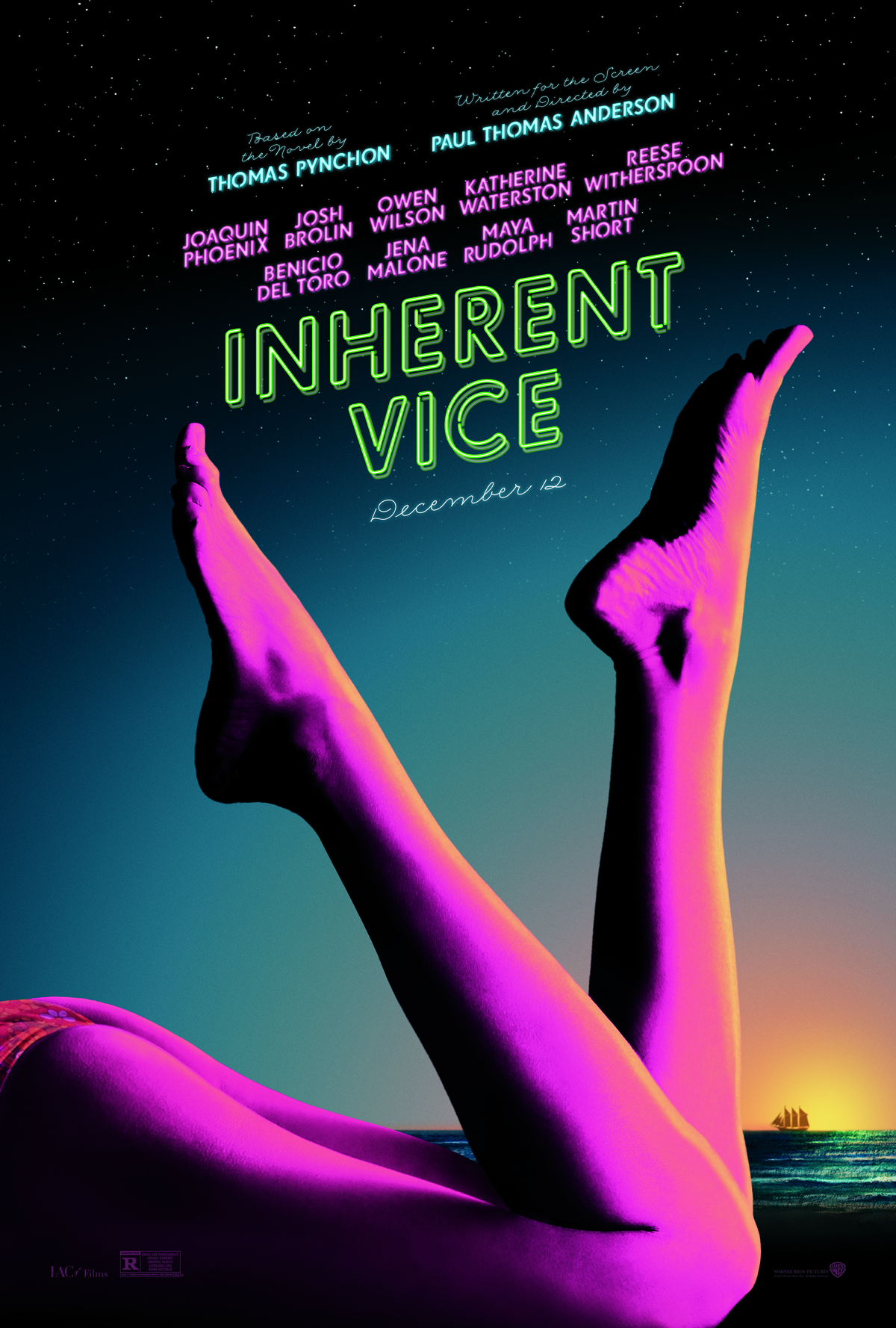 This is one of the most difficult reviews I’ve ever had to write. It’s not because I’m torn over the film; no, it’s because this review will also serve as my break-up letter. Paul Thomas Anderson (PTA), we’re just moving in two different directions. We met when we were both young and headstrong. I enjoyed your early works Paul, but then somewhere around There Will be Blood, things changed. You didn’t seem like the PTA I had known to love. You became someone else, and your films represented this change, becoming plotless and laborious centerpieces on self-destructive men. Others raved to the heavens over Blood but it left me cold. Maybe I’m missing something, I thought. Maybe the problem is me. Maybe it’s just a phase. Then in 2012 came The Master, a pretentious and ultimately futile exercise anchored by the wrong choice for a main character. When I saw the early advertisements for Inherent Vice I got my hopes up. It looked like a weird and silly throwback, a crime caper that didn’t take itself so seriously. At last, I thought, my PTA has returned to me. After watching Inherent Vice, I can no longer deny the reality I have been ducking. My PTA is gone and he’s not coming back. We’ll always have Boogie Nights, Paul. It will still be one of my favorite films no matter what.
 In the drug-fueled world of 1970 Los Angeles, stoner private eye Doc (Joaquin Phoenix) is visited by one of his ex-girlfriends, Shasta (Katherine Waterston). She’s in a bad place. The man she’s in love with, the wealthy real estate magnate Mickey Wolfmann (Eric Roberts) is going to be conned. Mickey’s wife, and her boyfriend, is going to commit the guy to a mental hospital ward and take control of his empire. Then Shasta and Mickey go missing. Doc asks around, from his police detective contact named Bigfoot (Josh Brolin), to an ex (Reese Witherspoon) who happens to be in the L.A. justice department, to a junkie (Jena Malone) with a fancy set of fake teeth thanks to a coked-out dentist (Martin Short) who may be a front for an Asian heroin cartel. Or maybe not. As more and more strange characters come into orbit, Doc’s life is placed in danger, and all he really wants to find out is whether his dear Shasta is safe or not.
Inherent Vice is a shaggy dog detective tale that is too long, too convoluted, too slow, too mumbly, too confusing, and not nearly funny or engaging enough. If it weren’t for the enduring pain that was The Master, this would qualify as Anderson’s worst picture.
One of my main complaints of Anderson’s last two movies has been the paucity of a strong narrative, especially with the plodding Master. It almost felt like Anderson was, subconsciously or consciously, evening the scales from his plot-heavy early works. Being plotless is not a charge one can levy against Inherent Vice. There is a story here with plenty of subplots and intrigue. The problem is that it’s almost never coherent, as if the audience is lost in the same pot haze as its loopy protagonist. The mystery barely develops before the movie starts heaping subplot upon subplot, each introducing more and more characters, before the audience has a chance to process. It’s difficult to keep all the characters and their relationships straight, and then just when you think you have everything settled, the film provides even more work. The characters just feel like they’re playing out in different movies (some I would prefer to be watching), with the occasional crossover. I literally gave up 45 minutes into the movie and accepted the fact that I’m not going to be able to follow it, so I might as well just watch and cope. This defeatist attitude did not enhance my viewing pleasure. The narrative is too cluttered with side characters and superfluous digressions.
The plot is overstuffed with characters, many of which will only appear for one sequence or even one scene, thus polluting a narrative already crammed to the seams with characters to keep track of. Did all of these characters need to be here and visited in such frequency? Doc makes for a fairly frustrating protagonist. He’s got little personality to him and few opportunities to flesh him out. Not having read Thomas Pynchon’s novel, I cannot say how complex the original character was that Anderson had to work with. Doc just seems like a placeholder for a character, a guy who bumbles about with a microphone, asking others questions and slowly unraveling a convoluted conspiracy. He’s more a figure to open other characters up than a character himself. The obvious comparison to the film and the protagonist is The Big Lebowski, a Coen brothers film I’m not even that fond over. However, with Lebowski, the Coens gave us memorable characters that separated themselves from the pack. The main character had a definite personality even if he was drunk or stoned for most of the film. Except for Short’s wonderfully debased and wily five minutes onscreen, every character just kind of washes in and out of your memory, only registering because of a famous face portraying him or her. Even in the closing minutes, the film is still introducing vital characters. The unnecessary narration by musician Joanna Newsome is also dripping with pretense.
 Another key factor that limits coherency is the fact that every damn character mumbles almost entirely through the entirety of the movie. And that entirety, by the way, is almost two and a half hours, a running time too long by at least 30 minutes, especially when Doc’s central mystery of what happened to Shasta is over before the two-hour mark. For whatever reason, it seems that Anderson has given an edict that no actor on set can talk above a certain decibel level or enunciate that clearly. This is a film that almost requires a subtitle feature. There are so many hushed or mumbled conversations, making it even harder to keep up with the convoluted narrative. Anderson’s camerawork can complicate the matter as well. Throughout the film, he’ll position his characters speaking and slowly, always so slowly, zoom in on them, as if we’re eavesdropping. David Fincher did something similar with his sound design on Social Network, amping up the ambient noise to force the audience to tune their ears and pay closer attention. However, he had Aaron Sorkin’s words to work with, which were quite worth our attention. With Inherent Vice, the characters talk in circles, tangents, and limp jokes. After a protracted setup, and listening to one superficially kooky character after another, you come to terms with the fact that while difficult to follow and hear, you’re probably not missing much.
Obviously, Inherent Vice is one detective mystery where the answers matter less than the journey and the various characters that emerge, but I just didn’t care, period. It started too slow, building a hazy atmosphere that just couldn’t sustain this amount of prolonged bloat and an overload of characters. Anderson needed to prune Pynchon’s novel further. What appears onscreen is just too difficult to follow along, and, more importantly, not engaging enough to justify the effort. The characters fall into this nether region between realism and broadly comic, which just makes them sort of unrealistic yet not funny enough. The story rambles and rambles, set to twee narration that feels like Newsome is just reading from the book, like Anderson could just not part with a handful of prose passages in his translation. Much like The Master, I know there will be champions of this movie, but I won’t be able to understand them. This isn’t a zany Chinatown meets Lewboswki. This isn’t some grand throwback to 1970s cinema. This isn’t even much in the way of a comedy, so be forewarned. Inherent Vice is the realization for me that the Paul Thomas Anderson I fell in love with is not coming back. And that’s okay. He’s allowed to peruse other movies just as I’m allowed to see other directors. I wish him well.
Nate’s Grade: C+
Share this:

Gone Girl (2014)
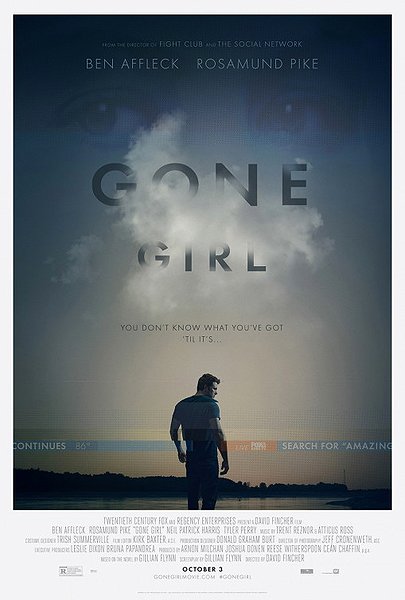 Rest easy fans of Gillian Flynn’s runaway bestseller, because Gone Girl the movie is pretty much exactly Gone Girl the novel. There were rumors that Flynn and director David Fincher had drastically retooled the controversial ending, but this was only premature speculation. Fun fact: it’s easy to tell the people who didn’t read the book in your audience because they will more than likely be the ones who groan once the end credits kick in. The fealty to the book is a relief because, as we book readers know from those late nights compulsively turning Flynn’s pages, the real star of the movie is the story, which was ready-made for a grand, pulpy thriller, and that is Gone Girl the movie. Whether it’s anything more than an exceptionally well made thriller is up for debate
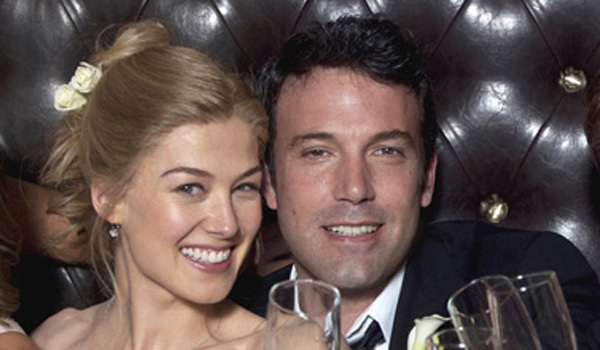
Amy Dunne (Rosamund Pike) has gone missing from her supposedly perfect life. Her husband, Nick Dunne (Ben Affleck), starts off as the tortured, grieving husband. He comes home one day to find his home wrecked and his wife missing. The police (Kim Dickens, Patrick Fugit) are worrisome about Nick’s abnormal reaction to his wife’s disappearance. He doesn’t seem to know much about his wife. He seems like he’s hiding something. Even Nick’s twin sister Margo (Carrie Coon) has her doubts that Nick is telling the full truth. Amy’s diary paints a different portrait of her husband, a man prone to increasing anger, mostly stemming from the loss of his job and a relocation from New York City to Missouri. Most of Nick’s anger is focused squarely on Amy, enough that she fears for her life. As various clues keep piling up and Nick’s public behavior appears suspicious, the media spotlight transforms him from victim to prime suspect.
 No question having an artist of Fincher’s caliber raises the quality level to its highest degree, but it’s the perfect marriage of filmmaker and material that allows this movie to soar. Both Fincher and Flynn have a cold manipulative streak that twists an audience into knots. It’s a terrific whodunit with several booby-trapped surprises that only make you dig in more. It seems like every few minutes we’re learning more about Nick and what he’s been hiding from others. Flynn, who also adapted the screenplay, does a terrific job of playing with our loyalties, getting us to doubt what we see and who these people really are, and she does this even to the final minute, leaving us with no clear-cut answers to wash away our reservations. Flynn’s strengths as a writer are how she reveals her tale over time, how she makes us rethink the past and the characters and their sincerity. It’s a patient film, and just under two and a half hours perhaps too patient, but it’s not the least bit lackadaisical. Flynn’s story is wrapping a web around Nick and watching him get caught, and every perfectly timed reveal only widens that web. Gone Girl is a film bursting with intrigue. It snares you and then fiendishly plays with your expectations.
Affleck (Argo) was an obvious choice for the role of Nick Dunne, the charming man whose self-effacing smile rubs people the wrong way. He’s rarely been better onscreen, giving strong life to all the conflicting parts of Nick, from his calm aloofness at his wife’s disappearance to his cunning way with his own truths. He gets way in over his head, and watching Affleck navigate the tenuous situation is one of the film’s many twisted pleasures. Pike (The World’s End, Pride and Prejudice) is going to be an unfamiliar face to most American audiences but not for much longer. This is the biggest role of Pike’s career and much like Fincher’s other “find” Rooney Mara in Dragon Tattoo, she knocks it out of the park. In just a look she conveys Amy’s upper-class upbringing, her icy demeanor being interpreted as disdain. Through Amy’s journals, the character opens up to us, becoming better defined, making us fear for her, and Pike sells it. Hers is a performance of layers; it’s like she gets to play several Amy’s in this movie. Her demeanor is always so composed, so modulated and controlled, so the big moments that draw out her anger and horror register even more. It’s too early to determine what kind of awards buzz Gone Girl will have through the season, but if anyone has a chance, it’s her.
From top to bottom, the supporting cast adds great value to the film. Most surprising is Tyler Perry (yes, that Tyler Perry) as Nick’s high profile, slick, morally flexible defense attorney. It is no stretch to say this is Perry’s finest acting ever put to film, in or outside a dress. I wanted more of him, and that’s not something I’ve ever said before. Dickens (TV’s Treme, Footloose) would ordinarily be the best performance in most movies; smart, empathetic but no-nonsense, and wryly funny. In an ordinary crime thriller, she’d be our lead character. Coon (the breakout actress from HBO’s The Leftovers) is the audience’s voice of sanity, providing necessary gallows humor to punctuate all the discomforting dread. Casey Wilson (TV’s Marry Me) is a suburban housewife send-up and provides some laughs too. Even Emily Ratajkowski, otherwise known as one of the topless models in the “Blurred Lines” video, is pretty good as a naive coed. Thus is the power Fincher wields as a director of actors, a quality often overlooked by his technical prowess. The one casting question is Neill Patrick Harris (TV’s How I Met Your Mother) as Desi, Amy’s creepy ex-boyfriend who still very much clings to the notion they should be together. Harris tries too hard to be creepy, concentrating too much that his style becomes mannered and halting.
 With Fincher’s name attached it’s almost redundant to talk about the technical superlatives of the movie; it goes without saying. One of the finest visual stylists of his generation, Fincher impeccably composes his shots. The man finds a kindred spirit with Amy and her color-coded meticulous organization. The cinematography is crisp and suitably eerie and dreamlike (or nightmarish), the mood always pulsating with a beautiful dread to tap into the unsettling unease of Nick’s dire situation. The editing is rock-solid, keeping the audience guessing with the balance of Amy and Nick perspectives. There is a chilling sequence late that involves a mass amount of blood, but it’s made even more unnerving thanks to the judicious edits and fade outs, heightening the horror. The only technical aspect I found wanting is the same with Fincher’s Dragon Tattoo, namely the score by Atticus Ross and Trent Reznor. Twice now I’ve labored through musical scores of theirs that could best be described as ominous ambient noise. You keep expecting it to build but it doesn’t. Perhaps it’s just the change of material, as it’s also been two films in a row based upon dark and grisly crime paperbacks, but consider me disappointed yet again. There’s nothing memorable here and that’s a shame considering how buoyant their Oscar-winning score was for the still amazing Social Network.
But even with that Fincher polish and the sinister snap of Flynn’s plot, I can’t say that Gone Girl the movie rises to the level of its lofty ambitions. Much like Dragon Tattoo, this is a skillfully made crime thriller, but is it anything beyond that description? That’s not to say there’s anything particularly wrong with being a skillfully made thriller; Fincher’s Seven is one of my favorite films of all time, and yet despite its end-of-times philosophy about the dark hearts of man, it’s really nothing more than a exceptionally made thriller, and that’s fine because that movie is near perfect. With Gone Girl, the stabs at deeper analysis and social commentary feel just out of grasp. The tabloid news fixation, a landscape littered with missing wives and presumably guilty husbands, is ripe for satire, but it feels always on the peripheral, like Fincher is checking in to take the temperature and then going back to the muck. There’s much more that could have been done, but that’s fine. The larger missed commentary is with marital relationships. This is not, as some critics have labeled, a How We Live Now kind of film, a jarring wake-up call that human beings more or less suck. Nick and Amy are far from being relatable analogues for the masses, and that’s fine. They are allowed to just be interesting characters, which they are, rather than stand-ins for searing social commentary. The fact that five years into their marriage they’re both still strangers says something about them, but does it say something novel about marriage itself or human relationships in the twenty-first century? The idea of people wearing false masks isn’t exactly new. The average couple is not probably going to go to bed thinking, “Who is the real person I’m with?” The average couple is just going to go along for the ride and think, “Wow, these are some messed up characters.”
 And now some spoilers as I delve into Gone Girl’s ending, so if you choose to remain clean please skip to the next paragraph. The ending is unsettling and disappointing for people because the only person who gets what she wants is our main antagonist, Amy. The final shot, a replay of the opening image but with clarifying context, is her triumph, staring coldly, head atop her husband, as if she were a cat purring. She has won. And this ending pisses people off. For my money, this is the absolute perfect ending for a story about toxic relationships and a morass of a marriage. Nick is rescued by Amy’s reappearance, engineered through some canny media manipulation by Nick, but now he’s stuck, and stuck with his lovely psychopathic wife. The police know she’s guilty but won’t proceed further thanks to looking inept on a national stage. Nick can’t leave because then his child will be raised by Amy, twisting him or her into mommy’s little psychopath. The only way he saves that child is by staying, by sacrificing his own freedom, to become prisoner to his wife, to play the part she has wanted him to play, and he does it. He is condemned. I find that to be poetic and darkly satisfying, and it’s very true tonally for this sort of sordid tale, but I understand why people hate it. I just think a happy ending or one where the villain is vanquished would feel trite.
Gone Girl is a toxic relationship movie, an involving and pulpy suspense thriller, a rewarding character study that plumbs some pretty dark depths, and most of all a sickly entertaining movie with excellent craftsmanship. It is everything fans of the novel could have hoped for with Fincher attached. As our tormented husband and wife, Affleck and Pike deliver career-best and career-making, in her case, performances. The ending will divide audiences sharply just as it did readers but I consider it the correct denouement. The movie doesn’t provide much in the way of stinging, applicable social commentary or media satire that hasn’t already been covered by the likes of Jon Stewart and Stephen Colbert. But does it have to be anything more than a terrific thriller? An exceptional thriller can be entertainment enough, and Gone Girl is definitely that.
Nate’s Grade: A-
Share this:

Veronica Mars (2014)
 More people know the name Veronica Mars now than probably combined from its short-run on TV from 2004-2007, and that’s squarely because of its record-breaking haul brought in through the fundraising site, Kickstarter. Within hours, the project had already raised two million dollars, on its way to over five and a half million, enough for a long-awaited movie that fans have been teased with ever since the series cancellation. Creator Rob Thomas and his actors were beside themselves in gratitude to their fans (dubbed “marshmallows”). Fueled by the eager hopes of its fans, the movie went into production and is now available for digital download to many of its donors and in a handful of theaters.
Veronica Mars (Kristen Bell) has left behind her hometown of Neptune, California. She’s on the verge of signing with a major New York law firm, and an old friend comes calling. Veronica’s former flame, Logan (Jason Dohring), has recently lost his pop star girlfriend, also a Neptune graduate. He’s suspected of being the killer but he swears his innocence. With the promise of her assistance only lasting a few days, she flies back home and reunited with her old friends (Mac, Wallace, Weevil, Dick) and her father, private investigator Keith Mars (Enrico Colantoni). Veronica should go back to New York with her boyfriend Stosh “Piz” Piznarski (Chris Lowell), she should accept the job offer from the firm, but she can’t help herself fall back into old patterns. She misses the danger, the intrigue, and maybe enough, Logan himself.
 The curious case of Veronica Mars: The Movie is that it was truly made for the fans, those 90,000 people who contributed to their Kickstarter goal. It’s not made for the casual moviegoer who has no foundation with the television series. That’s not to say that Thomas doesn’t try and make the film more inclusive. The neophyte could reasonably follow along, and there is a fast-paced prologue to catch the audience up on the major developments of the series, though almost all from season one. A non-fan could watch this movie but I have no idea what they would get out of it because they would be missing all the connections and context that provide the depth. In a way, this situation reminds me of David Lynch’s Twin Peaks: Fire Walk with Me. Unless you were a fan of Lynch’s iconic thought short-lived TV series, there was no way you were going to follow along or be interesting in following along. It was a movie made for its fan base, and there’s nothing wrong with that though it always helps to provide enough entertainment to prove to the newbies why they should be fans in the first place. I don’t think the Veronica Mars film is able to achieve this. Sure, I enjoyed myself but that was because of my pre-existing fan club and my years-in-the-making desire to finally see proper closure to the characters I came to care about. I feel like someone without that devotion would watch the 105 minutes of Veronica Mars and question what all the fuss was about.
That’s because at feature-length, Veronica Mars is really more of an extended episode of the TV show, and not one of the top tier episodes. As a debut film director, Thomas does a serviceable job of recreating the series noir visuals. The mystery is sufficient if a little dull, lacking a strong sense of urgency throughout most since Logan is already walking around free of charges. The real anchor of the story is bringing Veronica back to Neptune and bringing her back into the family business. The class injustice was a hallmark of the TV series but it’s merely one more slightly malnourished storyline cluttering up the narrative. There are no real reasons to check in on so many characters beyond the fact that it provides resolution for fans. A ten-year high school reunion seems engineered just for this purpose, allowing the new old faces to all reappear again and catch us up. There are characters that appear in near-cameo form (though the surprise celebrity cameo is quite amusing). Even the romance feels mostly grafted onto the story because the core audience demands Veronica and Logan reunite, in all senses. It just becomes a matter of time waiting for the inevitable, as it is with all romantic comedies, except the romance is sidelined here until it isn’t. As a film, it doesn’t feel organically handled that Veronica would leap back into Logan’s arms, and so soon, unless, of course, you are one of those fans (I know MANY) who have been waiting seven years for that moment. Fan service is one thing but it shouldn’t detract from the internal logic of the featured story.
 What does still work are all the hallmarks of the TV show, even if they are less effectively showcased for first-timers. The plucky, sarcastic nature of Veronica still turns her into a heroine worth rooting for, a force of will that has her flaws as well. Bell (Frozen, TV’s House of Lies) can just about do it all, from goofy to heartfelt to ferocious. It’s clear how much she adores this character she helped bring to life ten years ago. The father/daughter relationship is warmly affectionate without dipping into sappy territory. The dialogue is still snappy, though having late twenty-somethings saying it rather than high schoolers has dulled some of the edge. There’s also the sleazy addition of older men hitting on Veronica now that she’s officially out of high school, so hooray. The season-long mysteries of the series, while satisfying and twisty, were secondary to the characters, and watching the overall jovial camaraderie of the cast, is a reminder at how much fans adore these people.
I can objectively critique the faults in the film, as I’ve tried to do for a couple paragraphs, but this is a movie where I set aside my critic hat and merge with the fans. I too contributed to the Kickstarter because I’ve been dying for a sense of closure for one of the best TV shows in the mid-aughts. The finale of season three left much of the show in doubt; Thomas was not counting on cancellation. While fan fiction can run rampant in these circumstances in order to cater to fan demands, it doesn’t compare to the creator being given a reprieve to tie up as many loose ends as possible. That’s the greatest accomplishment of the Veronica Mars movie is that it feels like a genuinely satisfying sense of closure for the fans. While not every storyline is wrapped up, like for instance Weevil’s path, it ends on a point where you can reasonably guess where the characters would continue from here onward if we were never to check in with them again. This is a good resting place. But given the runaway success of the Kickstarter campaign, maybe Warner Brothers could be convinced there are more stories to be told here. I’m cautiously optimistic but really Thomas has already given the fans just about everything they could want, unless they were the Veronica/”Piz” minority of shippers.
Whatever you think of the final product, Veronica Mars: The Movie has changed the way movies can get financed. Smaller boutique films with a passionate fanbase can now get the ball rolling, putting their money into a down payment on seeing their dream movie becomes a reality, convincing studio heads to roll the dice with less risk. I invite all newcomers to watch the series, since that is where it was best. As a film, it’s enjoyable enough and satisfying for the fervent fans, supplying needed closure. However, for people that don’t already have connections to these characters and this world, I don’t think there’s enough going on in the movie to attract a larger discipleship.
Nate’s Grade: B
Share this:

Prisoners (2013)
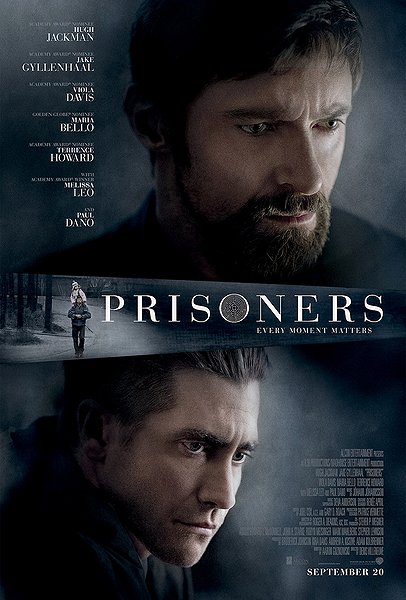 One rainy Thanksgiving day, two little girls go missing. Keller and Grace Dover (Hugh Jackman, Maria Bello) and their neighbors, Franklin and Nancy Birch (Terrence Howard, Viola Davis), discover their two young daughters have gone missing. A manhunt is underway for a suspicious RV, spearheaded by Detective Loki (Jake Gyllenhaal). The RV is found with Alex Jones (Paul Dano) inside. The problem is that there is no physical evidence of the missing girls inside the RV and Alex has the mental capacity of a ten-year-old. He’s being released and Keller is incensed. He’s certain that Alex is guilty and knows where his missing daughter is being held. One night, Keller kidnaps Alex and imprisons him in an abandoned building. He beats him bloody, demanding Alex to tell him the truth, but he only remains silent. Loki has to deal with finding the girls, finding a missing Alex, and trailing Keller, suspicious of foul play.
This is a movie that grabs you early and knows how to keep you squirming in the best ways. The anxiety of a missing child is presented in a steady wave of escalating panic. The moment when you watch the Dover and Birch families slowly realize the reality of their plight, well it’s a moment that puts a knot in your stomach. Prisoners is filled with moments like this, that make you dread what is to come next. The crime procedural elements of the case are generally interesting and well handled to the point that they feel grounded, that these events could transpire, including police mistakes. The central mystery sucks you in right away and writer Aaron Guzikowski (Contraband) lays out clues and suspects with expert pacing, giving an audience something new to think over. At 153 minutes, there is a lot to chew over in terms of plot developments and character complications. It’s a compelling mystery yarn and shows such promise, though the last half hour cannot deliver fully. Fortunately, Prisoners is packed with terrific characters, a real foreboding sense of Fincher-esque chilly atmosphere from director Denis Villeneuve (Incendies) and greatest living cinematographer Roger Deakens (Skyfall). The film’s overall oppressive darkness is also notable for a mainstream release. The darkness doesn’t really let up. It’s hard to walk out feeling upbeat but you’ll be thankful for those punishing predicaments.
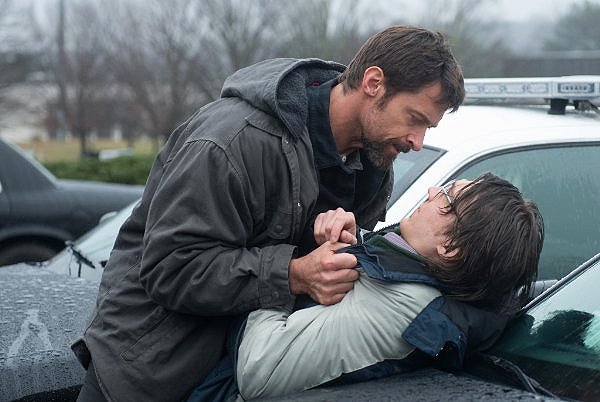 By introducing the vigilante torture angle, Prisoners is given a dual storyline of suspense and intrigue. How far will Keller go? Will he get caught? What will his friends think? Will they be supportive or will they crack? How does this change Keller? That last question is the most interesting one. Others tell us how Keller is a good man, and he’s certainly a devoted family man, but does a good man imprison and torture a mentally challenged man? Does a good man take the law into his own hands? If it meant the difference between your child being dead or alive, how far would you go? These are the questions that bubble up and the movie makes you deal with them. The torture segments are unflinching and challenge your viewer loyalty. You will be placed in an uncomfortable moral position. Then there’s just the what-would-you-do aspect of the proceedings. Could you torture someone, possibly to death? Fortunately most of us will never have to find out. I do wish, however, that the movie had gone further, complicating matters even more severely. It becomes fairly evident halfway through that Alex is innocent. It would have been even more interesting to intensify Keller’s legal troubles. If the police have their man, what does Keller do with Alex? Does he let him live after everything Keller has done? I think it would have worked as a logical escalation and put the audience in an even more uncomfortable position, forcing us to question whether Keller deserves to get away with what he did or pay a price.
What separates Prisoners from other common thrillers, and what must have appealed to such an all-star cast, is the raised level of characterization on display. Jackman’s (Les Miserables) intensity is searing, as is his character’s sense of pain and futility. By all accounts, this is the best acting work Jackman has done in his career. Keller’s determination is all consuming, pushing away his doubts with his reliable pool of anger. Everyone is failing him so he feels he must take matters into his own hands, and the film does a fine job of relating his frustrations and urgency. But Keller is also in danger of derailing the ongoing investigation, becoming a liability to finding his daughter. This predicament pushes Loki into the tricky role of having to defuse parental intrusion, pushing him into a role he loathes, having to tell a harrowed father to back off. Loki is also consumed with the case, causing plenty of internal tumult and chaffing with the inefficiency and miscommunication of the police force. Gyllenhaal (End of Watch) doesn’t play his character big; he keeps it at a simmer, with hints of rage below the surface. His character is certainly richer than the Driven Cop we’ve often seen. His character is given less moral ambiguity but you feel his frustration working within the system and hitting dead ends. These two performers are both ticking time bombs.
The rest of the supporting cast has a moment or two to shine, though the characters are given less to work with. Bello (Grown Ups 2) is hastily disposed of from a plot standpoint by making her practically comatose with grief. Davis (The Help) knows how to make the most of limited screen time (see her Oscar nominated performance in 2008’s Doubt as evidence), and she’s heartbreaking in her moments of desperate pleading. Howard (Lee Daniels’ The Butler) is meant as the foil to Keller, a voice of moral opposition, but Howard lets the gravity of his involvement in horrible acts hit you hard. Dano (Ruby Sparks) has the toughest part in many ways because of his character’s brokenness and the fact that he’s being tortured so frequently. It’s hard not to sympathize with him even if part of you suspects his guilt. Naturally, Dano is adept at playing weirdos. Melissa Leo (Olympus Has Fallen) is nearly unrecognizable as Alex’s older aunt caring for him. She’s prepared for the worst from the public but has some nice one-on-ones where she opens up about the difficulty of losing a child herself.
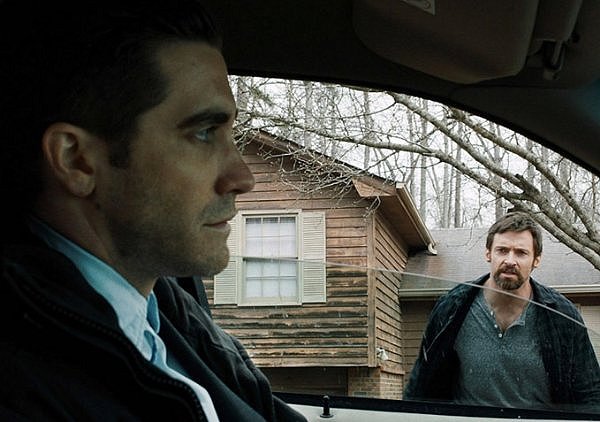 Prisoners is such a good mystery that it works itself into a corner to maintain it, ensuring that no real answer or final reveal will be satisfying, and it isn’t. I’m going to tiptoe around major spoilers but I will be delving into some specifics, so if you wish to remain pure, skip ahead. The culprit behind the child abductions, to put it mildly, is underwhelming and rather obtuse in their wicked motivation. The specified reason is to test people’s faith and turn them into monsters by abducting their children. This comes across as an awfully nebulous philosophical impetus, and it’s a motivating force that I find hard to believe even in the grimy, dark reality the movie presents. It just doesn’t feel grounded, more like a last-ditch conclusion to a TV procedural. However, what makes this ending worse is the false turns and red herrings that Prisoners utilizes. Every mystery requires some red herrings but they need to seem credible, and if executed properly, the characters will learn something useful through the false detour. The issue with Prisoners is that it establishes a secondary suspect that is so OBVIOUSLY the guilty guy, compounded with plenty of incriminating evidence including the missing children’s clothing covered in blood. When this suspect comes undone, his sketchy behavior starts to become a series of contrivances. They introduce a character that is too readily the guilty party, and then they just as easily undo him. And here’s another character of questionable motivation. Plus, there’s the central contrivance of having two characters that remain mute under all torturous circumstances unless the plot requires them to say something that can only be interpreted in an incriminating manner. These mounting plot contrivances, and an ending that wants to be ambiguous but in no way is, rob Prisoners of being the expertly crafted thriller it wants to be. It still hits you in the gut, but you’ll be picking it apart on the car ride home.
Grisly, morally uncomfortable, and genuinely gripping, Prisoners is a grownup thriller that isn’t afraid to go to dark places, with its characters and its plot. It hooks you early and keeps you on the hook, pushing its characters to make desperate decisions and asking you to think how you would perform under similar pressure. It’s a fascinating meta game and one that also adds extra intrigue to a rather intriguing mystery. It may not be revolutionary, but Prisoners is an above-average thriller with strong suspense and characterization. Where Prisoners stumbles is how it brings all this darkness to a close. The ending is rather perfunctory and not terribly satisfying; perhaps no ending would have been truly satisfying given the setup, but I’d at least prefer an alternative to the one I got, especially since it feels less grounded than the 140 minutes or so beforehand. It’s an ending that doesn’t derail the movie, but it certainly blunts the film’s power and fulfillment. Then again perhaps a word like “fulfillment” is the wrong term to use on a movie that trades in vigilante torture and the cyclical nature of abuse. In pursuit of perceived justice, what are we all capable of doing? The answer is likely surprising and disheartening for many, and Prisoners deserves credit for pushing its audience into uncomfortable positions and reflections.
Nate’s Grade: B
Share this:

Tinker, Tailor, Soldier, Spy (2011)
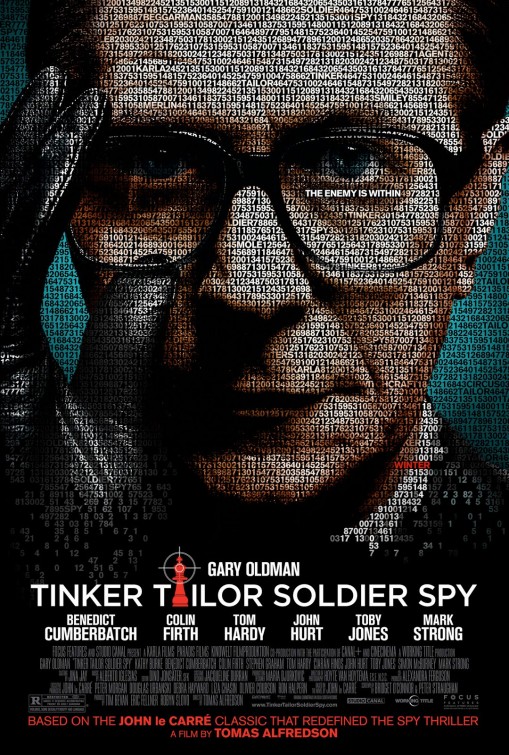 Billed as one of the most dense films of the holiday season, I was startled to discover that Tinker, Tailor, Soldier, Spy is not nearly as puzzling as people have protested. The adaptation of John le Carre’s famous novel follows retired British spy George Smiley (Gary Oldman) performing a clandestine investigation to flesh out a mole in the highest level of the agency. Directed by Tomas Alfredson (Let the Right One In), condensed form a 7-hour BBC miniseries, and stuffed with a wealth of terrific Brits, the movie is tricky, clever, and rather brainy, ultimately coming to the conclusion that these little communities of intelligence knew little. The movie has a rich array of characters and teases out back-story in flashbacks, meaning the film hops around time wise and will also take turns with different perspectives. It demands your attention but, honestly, I found it easy enough to follow. But in the end, what does all that narrative trickery and obfuscation get you? It’s a fairly dispassionate film about dispassionate people played out in a dispassionate manner. For some this will be hailed as a virtue, communicating the duty-first sacrifices and compartmentalization of these secret spies. For me, that just sounds like a cop out. Beyond the mystery, it’s hard to get involved in the movie. The reveal of the mole is anti-climactic, though the resolution, set to the tones of Julio Iglesias, is aces. The meticulous production design is stellar, including an agency meeting room that looks like it was wallpapered with checkerboards. The details of the ins and outs of the agency are absorbing. I’m debating whether I should watch the movie again, looking for nuance I must have missed. Tinker, Tailor, Soldier, Spy is an espionage thriller with a bit too many stiff upper lips.
Nate’s Grade: B
Share this:

The Girl with the Dragon Tattoo (2011)
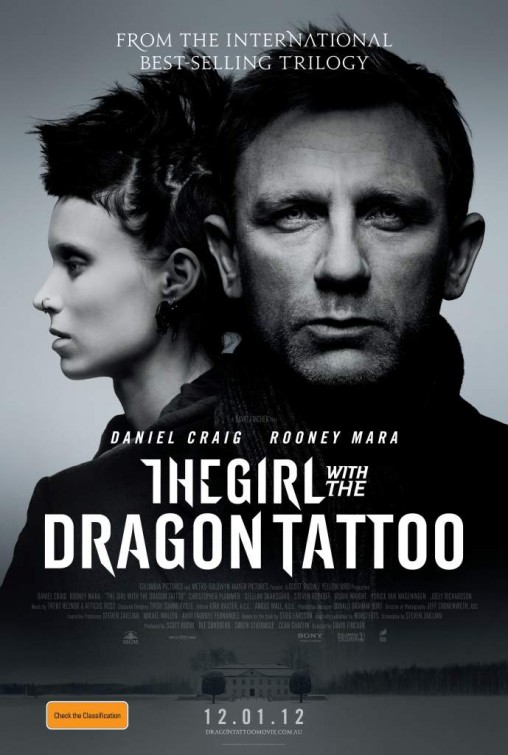 Nothing says holiday treat for the whole family like a nearly three-hour movie about rape. Late author Stieg Larsson’s best-selling trilogy made three very successful Swedish films, all released last year in indie theaters. It was only a matter of time before Hollywood optioned The Girl with the Dragon Tattoo, benefiting those averse to reading subtitles. At least they hired the right director in David Fincher, a man used to plumbing the depths of human depravity in films like Seven, Fight Club, and Zodiac. Fincher’s take is pretty dark and hardcore, but once you wash all that perfectionist grime off, I prefer the Swedish film in just about every way.
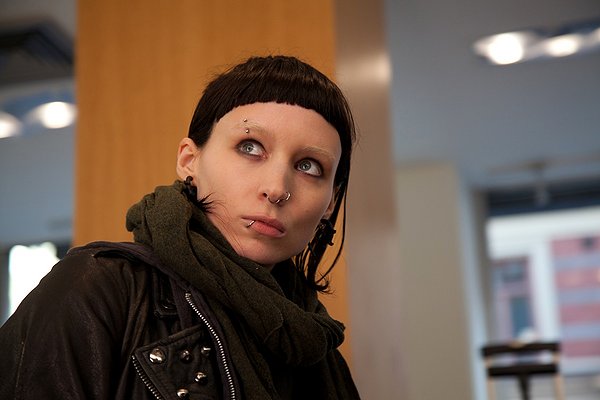
Crusading journalist Mikael Blomkvist (Daniel Craig) is smarting from a court case that found him guilty of libel. He’s commissioned by a wealthy businessman Henrik Vagner (Christopher Plummer) to investigate the 40-year-old disappearance of his granddaughter, Harriet. Henrik strongly believes she was murdered by one of the sinister members of his extended family, a group of shady characters with some allegiance to Nazism. Mikael is assisted by the unorthodox computer hacker Lisbeth Salander (Rooney Mara), a rail-thin Gothic gal clad in tattoos and piercings. Their partnership sometimes gets blurry as they grow closer over the course of the investigation. Together the pair investigates a series of grisly, ritualistic murders related to Harriet’s disappearance, and the closer they get to discover the truth the more dangerous things get.
 So the burning question: is Fincher’s take better than the original Swedish version? Well, in some areas yes but in many areas I’d have to say no, that I prefer the lower budget, no-name Swedish version. Obviously a director of Fincher’s caliber is going to significantly raise the quality of a production, and the technical merits of Fincher’s Dragon Tattoo are without question. This is a seedy, grimy, prurient, and very dark (in both lighting and thematic material) little movie. There’s always been an eerie beauty to Fincher’s cool aesthetics, and it’s on display here as well. Many of Fincher’s Social Network crew carried right over to Dragon Tattoo, so the editing is crisp, the cinematography sleek, and Trent Reznor and Atticus Ross’ score is a storm of ominous tones. Their plaintive score is actually a fairly unmemorable muddle, never approaching the energy, intricacy, or diversity of their Oscar-winning score for The Social Network. However, the extra polish and the glut of familiar actors takes away from the intrigue of the movie. When something meant to be gritty is too artistically stunning, it detracts from the thematic intent of the story. That sounds like a contrary way to insult Fincher for making his movie look too good, but perhaps that’s the best way of stating the point. Niels Arden Oplev is nowhere near the filmmaker that Fincher is, nor did he have the budget or creative freedom afforded Fincher, but perhaps someone of lesser talents was better suited to best tell this tale. By all means, the American Dragon Tattoo is a more visually alluring film, but Oplev’s film is more fully felt. I recently rewatched the Swedish version again for points of comparison and found myself much more involved in the characters, the story, and the actors, even though I had already seen the movie. Fincher’s version may be the better-looking movie, but surprisingly Oplev’s is just the better movie, period.
The adaptation by Steven Zallian (Schindler’s List) actually hews closer to Larsson’s book than the Swedish film, though Zallian redirects the film into a new ending. But the additions don’t seem to add anything of substance to the narrative (Blomkvist’s teenage daughter; dead cat), and the new ending feels more confused than helpful. Most of all, Zallian’s script devotes less time to the characters of Lisbeth and Blomkvist. I had a better understanding of these characters and their complicated, shifting relationship in the Swedish film. That narrative was much cleaner with helpful, clarifying procedural details and a dose of ambiguity. Simply put, the story just flowed better in the Swedish film. The personal connection Blomkvist had to Harriet (she was his babysitter long ago) has also been severed. Many of the story’s problems are still the same regardless of language or adapter. There is a clear disparity when it comes to audience interest in the two leads. What’s more interesting, a punky, bisexual, computer hacker or a disgraced, somewhat bland journalist? Exactly. Also, the story takes far too long to put our lead characters together, over an hour at that. The murder mystery is filled with murky plot points, pieces that seem like they might be integral but then turn out to be incidental. It takes a good while to process and familiarize oneself with the expository details of the case, but under Zallian’s draft, the mystery is given less room to breath. For a movie clocking in at 150 minutes, things feel untidy and rushed. The resolution feels drawn out to ungodly Lord of the Rings-lengths; I swear there must be a solid 20 minutes after the eventual serial killer is dealt with. It just feels like it goes on forever. Still, the characters are what ultimately makes Dragon Tattoo engaging, and Zallian’s efforts cannot dampen the captivating, curious nature of Lisbeth Salander.
Both Craig and Mara give fine performances but I prefer both Swedish actors to the A-listers. Craig is certainly a better actor than his Swedish counterpart, but the role is a middle-aged journalist and not James Bond, and thus a better fit for the unknown Swedish actor, Michael Nyqvist (Mission: impossible: Ghosts Protocol). Blomkvist isn’t supposed to be an ass-kicker. As a result, you don’t feel his terror as he gets in deeper and lands in serious physical jeopardy. Likewise, following in Noomi Rapace’s (Sherlock Holmes: A Game of Shadows) shoes was going to be a difficult feat for any actress, but Fincher got the girl he wanted, Mara, who tore down Mark Zuckerberg with precision in The Social Network. Mara commits herself completely to the role and undergoes a severe physical transformation (bleached eyebrows, wiry frame, nipple piercings), but she lacks the intensity of Rapace, the spiteful attitude, the recklessness and the resourcefulness. Rapace felt like a caged animal that could explode at any moment; Mara feels more like a lost puppy. I’m being intentionally cavalier with my word choice. Mara is quite good as Lisbeth; it’s just that Mara can’t quite measure up to the preceding tattooed girl. It feels like there’s a lot more going on with the Swedish Salander, whereas the American (still Swedish) Salander is waiting for her cue. It’s like Mara has dressed the part and waits for the character to just click over.
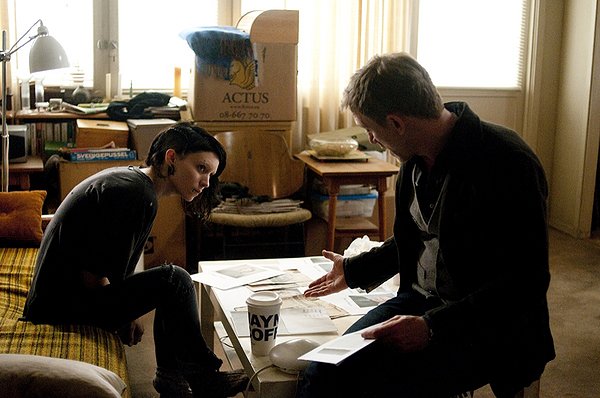 I’m not one for lazy analysis, but I feel like the uncomfortable issue of sexual violence/ voyeurism needs to be addressed, and I find that everything I wrote a year ago in my original Girl with the Dragon Tattoo review could readily apply to its Hollywood counterpart. So here goes: “The book’s original title was ‘Men Who Hate Women’ and that seems apt given what occurs on screen. Sure there’s a serial murderer on the loose but that’s par for the course. Even the grisly ritualistic killing stuff. But Lisbeth encounters a lot of malice and hostile male aggression, some of it very sickening. There’s a startlingly extended rape sequence, followed by some sadistic, if justifiable, revenge. It all contributes to an overall tone of queasy misogyny that seems to waver between intentional and unintentional. I’m not sure tone-wise whether the movie ever creeps into unsettling voyeurism at the behest of women in explicit sexual peril, but it certainly is a distraction. It can get pretty hard to watch at times in this disturbing thriller. I hope the eventual sequels don’t follow this same queasy, upsetting tone but I also worry that this may be unfortunately part of the books/movies’ appeal.”
For those new to Lisbeth and Larsson’s sordid saga, The Girl with the Dragon Tattoo will more than likely play well, a squalid thriller with the nicest coat of gloss you could ever hope for given the material. This is dark, rape-heavy stuff, and an odd adult drama to position as a Christmas release, but the collective appeal of the best-selling books should guarantee so many butts in the seats. It’s likely a safe bet that a high majority of those paying customers are unfamiliar with the Swedish version of the same story, which is a shame because, short of a few technical advances, I believe the Swedish film to be the superior movie. It had better acting, more appropriate casting, a rounder narrative that fleshed out the characters, their relationships, and their histories better, and a better score (sorry Trent, better luck next time). It’s still a movie that registers a “good” on most critical accounts, and Lisbeth Salander is still a fascinating person, a wounded warrior that catches the imagination. I’ll be curious to see if the subtitle-free Girl with the Dragon Tattoo does well enough at the box-office to warrant filming the next two decidedly lesser books. Whatever the case, there will always be the Swedish films and Ms. Rapace’s star-making performance.
Nate’s Grade: B
Share this:

Sherlock Holmes: A Game of Shadows (2011)
 Delivering pretty much more of the same, Sherlock Holmes: A Game of Shadows isn’t exactly an improvement over the classic detective’s first foray into out-and-out Hollywood action cinema. The real treat of the budding franchise is the comic interplay between Holmes (Robert Downey Jr.) and Watson (Jude Law). Their harried banter makes for the best moments. Once again the plot is overwrought, the side characters underdeveloped (poor original dragon tattooed girl, Noomi Rapace, given absolutely nothing to do but run in a gypsy skirt), mysteries that you give up and just wait for Holmes to explain, and a villain that proves to be lackluster. For Moriarty (Mad Men’s Jared Harris) to be the nemesis, the intellectual equal of Holmes I’m going to need to see much more than this. There is a fine sequence at the very end where Holmes mentally envisions the steps of his attack and then Moriarty joins in: “You think you’re the only one who can do that?” They hold an entire duel fought step-by-step in the imagination. I wanted more experiences like this, but director Guy Ritchie (Snatch) falls back on his signature stylized action sequences of fast whooshing and quick spinning. The action is a step up from the first Holmes, and that will be enough for most ticket-buyers. I’ll admit there is a certain meta-literary charm at watching Arthur Conan Doyle’s signature detective fighting his way through an armed body of baddies. Whatever your feelings were for the 2009 Sherlock Holmes, I’m fairly certain you’ll revisit them in their entirety with Game of Shadows. I know I did.
Nate’s Grade: C+
Share this:

Source Code (2011)
 Captain Colter Stevens (Jake Gyllenhaal) awakes on a train. His mind has been transplanted into the body of Sean Fentress, a doomed train passenger. Fentress, along with 200 others, were killed in an explosion on a commuter train heading in to Chicago. But this has all happened in the past. Colter has been quantum leaped into a top secret government program known as the source code. It uses people’s brain waves to simulate a recorded reality. The last thing Colter can remember is a firefight in Afghanistan, and now he’s aboard a train looking for a mad bomber. Whatever info he can retrieve will help the officials (Vera Farmiga, Jeffrey Wright) prevent a second terrorist bombing scheduled that day. Colter only has eight minutes to interact with the train passengers and deduce who the bomber is. After eight minutes, the train explodes and the reality resets itself again. Things get even more complicated when he falls for Fentress’ fetching female friend Christina (Michelle Mongahan). Can he save her? Can he save anyone? Can he get out of the source code?
Source Code manages to be a twisty, trippy little film that doesn’t so much knock you out but definitely packs a bit of a punch. Its simplicity is its very best asset. There’s a bomb on a train (ignore the questionable movie sci-fi physics). Colter has exactly eight minutes to learn what he can before he and everybody else blows up. Then the fun starts anew. The movie is less a time-travel flick than an alternate reality sort of experiment. Personally, I love movies that present a timeline and then slowly thumb away at the edges, stretching the narrative space, showing the audience the various intricacies of this tiny world. Whether it’s Pulp Fiction, Groundhog Day, or the propulsive fun of Run Lola Run, I enjoy a story that expands outward into a greater foundational complexity. I enjoy the clockwork of a story that shows me how the different pieces work together. I enjoy that through the variations I can experience a richer world, seeing what happens to a passenger as they leave the train, seeing how a character’s actions can impact another, seeing how altering that character’s action alters other forces in the story. That kind of narrative trickery, perfected in Groundhog Day, makes the story feel like a living creature because you witness the interconnected relationships of everything and everyone. It also makes it pretty fun to watch.
 Director Duncan Jones makes slick use of tight spaces like he showcased in 2009’s celestial sci-fi thriller, Moon. The quick pacing and collective rhythm of the movie helps contribute to its entertainment factor. Source Code is playful enough in design and execution. It remains consistently clever with its plotting, but what’s really surprising is that Jones is able to find a personal human story inside all the thriller trappings. Colter is trying to make sense of his situation, but he’s also trying to reconcile the idea of life, death, fate, and getting to speak with his parents who assume he was killed in Afghanistan (he’s been with the source code project for over two months). There’s a human face to all this, and while the love story feels tacked on and underdeveloped, Colter’s emotional turmoil and existential struggles to reassert his identity and find some peace from his life ring true. Gyllenhaal (Prince of Persia) is an ever capable lead who takes a near Hitchcockian leading man role and plays it straight to fine effect.
At the same time, Source Code tries to have it all with an ending that I don’t truly believe it pulls off. Spoilers will lurk, so skip the next two paragraphs those who wish to remain pure and chaste. The film does a fairly nimble job of setting up an appropriate, if mostly downbeat, ending. Colter doesn’t want to be a brain in a box; he doesn’t want the government using him as their newest tool for the rest of his unnatural days. He was pulled from the brink of death and he now just wants to die in peace. In the recorded reality of the source code, he’s allowed the chance that most of us will never have – he can find closure. Whereas he would have died on a desert battlefield, now Colter has an opportunity to speak to his father one last time, to say goodbye. The entire denouement of Source Code seems to be establishing a memorial for the people who were lost on that train, because once the source code is erased so too will they be. They’re electronic recreations but in the end it reminds you that they were real people, and now they get something of a proper sendoff, a fairly touching memorial to the people who will just be seen as numbers in a news report.
 And then… just as Colter makes peace with passing over, he passes over into another reality. The train doesn’t blow up. The people are able to get off. He gets to walk hand-in-hand with his new sweetheart. Jones doesn’t make it clear what really happens, which can lead to some mounting confusion. Did they really alter the past? Did they create a parallel dimension? In one dimension is everyone on the train dead whereas in another everyone lives, short of Sean Fentress? And how crappy is that? Yes, Gyllenhaal is a charming and terrific looking guy, but does no one shed a tear for the fact that he stole another man’s body? Sean Fentress may not have had the courage to ask out his pretty friend, but that doesn’t mean he deserved to have his identity hijacked and his existence more or less erased from time and space. It’s a weird blemish that the filmmakers don’t truly want to address, and why would they? The ending lacks commentary of any sort strictly because the movie wants to have it all. It wants the sad, mournful ending, it wants the happy “Everything’s gonna be okay” ending. It almost let’s you choose. But Source Code doesn’t come across so much as a film that begs to be opened for different interpretations so much as a film that didn’t want to upset anyone by picking an ending.
Source Code is nicely paced, nicely plotted, and it produces just as many intriguing questions as it does substantial thrills. Jones finds interesting ways to make the same material different. The various characters, converging storylines, and science-fiction mumbo jumbo are all nicely woven into a satisfying bite-sized sci-fi thriller. It fumbles with the landing, in my view; it seems like a pandering appeal to please every faction of the audience, or at least to confuse them with the illusion that they have gotten what they wanted. This is an intellectual sci-fi potboiler in disguise as a thriller. Roll with it, play along, don’t think too hard about the moral implications of its murky ending, and enjoy the ride.
Nate’s Grade: B+


 nathanzoebl
You must be logged in to post a comment.