
Blog Archives

Glitter (2001)

It must be seen to be believed. A new college crap-fest drinking game has begun. Begin the Glitter midnight shows! A new age is upon us! Here are a few handful of Glitter‘s bon-mots it serves up to its audience:

-Mariah Carrey is shown leaving her real mom at age 8 with her kitten. Somewhere through Glitter she has a fight with her boyfriend and takes her cat (yes the very same immortal cat that must have been pushing 20) and leaves.
-She has a fight with said boyfriend and they both try and write a love song to show their remorse. Except they BOTH come up with the EXACT same song word for word, note for note, and NO ONE thinks this is the creepiest thing ever.
-The movie freakin’ ends with Carrey’s boyfriend getting shot and killed. Yes, this is truly how the thing ends. Oh, like any of you cared about plot spoilers anyway.
-Da Brat is in it for “comic relief.”
-The movie is inexplicably set in the 1980s for no reason.

Anyone would have to be crazy thinking Glitter ever remotely resembled art. It’s so bad it’s awesome to watch. Bring some friends over, open up some alcohol, and let the fun times begin.

Nate’s Grade: F, like it matters though

Reviewed 20 years later as part of the “Reviews Re-View: 2001” article.

Moulin Rouge! (2001)

Director Baz Luhrmann’s last project was the MTV-friendly William Shakespeare’s Romeo + Juliet (like someone else has a Romeo and Juliet) which was adored by the under 15 set that now buy N*SYNC merchandise. Luhrmann waited a long time for his follow up with Moulin Rogue, a manic musical that seems like candy for the eyes. It may have been a long time but it was well worth the wait.

The sparkling world of Moulin Rogue is around turn of the century France. Christian (Ewan McGregor), an aspiring writer, has traveled to this place against his father’s wishes. Christian believes in the beauty of love and the pull of the heart. Within minutes of setting foot in France he gets wrapped up into a production by a dwarf (John Leguizamo) and his cadre of assistants. Christian is sent to the most provocative club in town, the Moulin Rogue. Here he attempts to persuade the most famous showgirl Satine (Nicole Kidman) to help push for their musical to get financial backing. Satine inadvertently confuses Christian for the man she is supposed to seduce for a large some of money, the Duke (Richard Roxburgh). And thus the merry band of misfits get their play the backing while Christian blossoms a love for Satine. But their love must remain hidden for the Duke is led to believe that Satine is his and his alone.

Kidman owns this movie, plain and simple. From her first shattering entrance being lowered from the ceiling to the last scene, she is absolutely magnificent. McGregor gives a nice performance as the dough-eyed lover. Jim Broadbent plays the Moulin Rogue’s owner, Zidler with howling delight in all his manic expressions. Even Roxburgh gives an underwritten antagonist the right amount of weasely twitch.

One of the more surprising features is how well the two leads can actually sing. Kidman gives a soft and sexy take on “Diamonds are a Girl’s Best Friend” and McGregor can belt out a tune with some admirably throaty pipes. As these two veer in and out of songs it’s a pleasure to watch and hear.

Luhrmann has crafted a musical with ADD, but I say this as a compliment. Moulin Rogue‘s pace is fast and pounding. People twirl above the sky, the camera zooms wildly through town streets, and dump trucks worth of confetti fly through the air. Moulin Rouge is exploding with glitz and never lets up. The editing and visual artistry is stirring. By about ten minutes into the proceedings when a green fairy starts singing a seductive version of “The Hills are Alive” you know you are in for something else. And what a something else the film delivers. There was not a moment I didn’t have a smile glued to my stupid face.

Moulin Rogue could be described as a musical for people who dislike traditional musicals. In traditional musicals people go along stuffy formula, then break out into great choreography song-and-dance. With Lurhmann’s musical is a breakneck of pomp where the characters zip around to exaggerated Hanna-Barbara sound effects and start chiming away with 70s and 80s pop songs that we all know. After the initial shock/humor of hearing characters belt out renditions of “Roxanne” and “Like A Virgin,” a familiarity sets in and it blends in to produce a surprising artistic addition.

The story of the movie is nothing new or extraordinary; it’s well worn territory. But where Moulin Rouge breaks apart and shines are with its style and exposure. The visuals are astoundingly lush and lively, the music is game and pumping, and the movie is just screaming to be seen. This was a true work of love.

The movie is bursting to the seams with life. I loved every single second, every single frame, every single moment of Moulin Rouge. I can’t wait to go see it again.

Nate’s Grade: A

Reviewed 20 years later as part of the “Reviews Re-View: 2001” article.

O Brother, Where Art Thou? (2000)

Loosely based on Homer’s The Odyssey comes the latest from two of the most talented and imaginative minds working in the business. ‘O Brother’ has all the things that go into making a good Coen brother film. It’s full of Coen regular like John Turturro, John Goodman, and Holly Hunter among others. It includes elements of wackiness like a KKK color Guard rally where they march into spelling KKK. It even has the great wit with dialogue being handed over to the overly verbose leader of the gang on the run Ulysses Everett McGill (George Clooney looking and sounding like Clark Gable). On top of this you get a wonderful blue grass soundtrack that is selling surprisingly phenomenal, and cinematography that is astonishingly beautiful. Yet, with all these positives, O Brother Where Art Thou? is a mid-level Coen movie. The comedy of the film is missing a lot when it should be there, replaced with pretty images or very pretty songs. Still, a mid-level Coen brother’s movie is much better than most anything out there today. It seems to aim to be a pleasant movie, and it achieves that finely. O Brother is a fun experience with the right person but not necessarily something that has a lot of rewatchability. Especially if you have bought the soundtrack.

Nate’s Grade: B

Dancer in the Dark (2000)

Lars von Trier’s latest shaky video opus is likely the most unique movie going experience you’ll have all year. Dancer in the Dark is a clever, heartfelt, and achingly beautiful tale of sorrow and redemption. Dancer stars Iceland’s version of Madonna in the elfin Bjork. She plays Selma, quite possibly the nicest but also most stubborn person in the world. She’s an immigrant in 1960s America working long and odd hours to ensure that she can raise enough money for her son. You see Selma is slowly going blind but continuing to work so she can make sure her son will not have to suffer the same inherited illness. So she works late on heavy industrial machinery causing accidents as her condition worsens all to stop her son’s genetic curse she will give to him. Selma’s escape has always been musicals. In life she hears music in unusual places and visualizes life stopping to burst out into a vibrant fully choreographed musical number. Selma’s life continues to degenerate along with her vision as events pile on worse and worse until they all come crashing together.

Dancer in the Dark is no picnic in the park. The movie is haunting but incredibly depressing. Lars von Trier’s previous film (Breaking the Waves) was another wrenching drama with good people going through rough times with no fraction of light at any end of a tunnel. His jerky handheld video work is back capturing the life of Selma and seemingly framing it in a more realistic sense. The video images are edited to look like a documentary and the whole feel is one of raw power. You aren’t merely watching a film, it’s like you are in it witnessing the actions from the sidelines. The escapist musical numbers are shot in glorious still film to contrast the drab realism of video. The colors are bright, the faces are happy, and the cinematography is a wonder to envision.

Bjork soars and delivers what should be an Oscar-caliber performance. I never knew the queen of alt-rock had such emotive powers. Selma’s innocence is keenly expressed in Bjork and her glassy eyes. Her love for her son is no more evident then all the suffering and tragedy she goes through. All of the suffering and tragedy could be avoided – except her son would not be helped.

The ensemble around Bjork work fantastic magic as well. Peter Stormare is a sad figure trying to just get a glimpse of Selma’s attention. David Morse is a down-and-out policeman who is Selma’s landlord and in need of some cash. He’s afraid to tell his bourgeois wife they’ve run empty with money. Catherine Deneuve turns in the brightest supporting performance as Selma’s co-worker and friend Kathy. She’s torn between trying to stop Selma from continuing on her acts that could cause her harm and helping her along her determination. A great scene as example of her care for Selma is when the two of them are in a theater watching an old Hollywood musical. At this point Selma is completely blind and can’t see what’s going on, so Kathy takes Selma’s palm and dances her fingers in correlation with the actions on screen to Selma’s delight. A simple scene yet so elegant and beautiful.

Dancer in the Dark is a wonderful piece of original film making that gives us the escape of hope and the crush of despair. Selma’s love of musicals and their role in life is perfect symbolism for discussion. Dancer will leave you with a distinct feeling by the end credits. Whether it’s sorrow or bewilderment Dancer in the Dark is a film not to miss.

Nate’s Grade: A

Reviewed 20 years later as part of the “Reviews Re-View: 2000” article.

Almost Famous (2000)

Cameron Crowe’s semi-autobiographical 70s rock opus is like a gigantic hug. It’s warm, engrossing, feel good, and leaves you with a smile wishing for more. Almost Famous may be the best movie going experience of the year. You likely won’t have a better time from a movie.

Fresh-faced newcomer Patrick Fugit plays the 15 year-old version of Crowe who is a budding writer for Rolling Stone. He’s tapped to tour and send in a story on the fictional band Stillwater fronted by singer Jason Lee and guitarist Billy Crudup. Stillwater is everything the typical early 70s rock band was and should be: long hair, tight pants, and continuous inner turmoil and squabbling. Little Fugit captures all of this with wide-eyed exploration as he stretches away from his overprotective mother played by the lovely Frances McDormand. Phillip Seymour Hoffman also pops in to do a brilliant portrayal of music critic Lester Bangs. Kate Hudson shines in a break-out performance as a “band-aid” to Stillwater; which is an uncertain mix of naive groupie and musical muse. She’s together with fellow “band-aids” Anna Paquin and Faruiza Balk.

The writing of Almost Famous is textured and fully satisfying. The turns it takes down the road are expert and you know you are in the hands of a true artist. Crowe’s direction again makes leaps and bounds in improvement with every new feature. He and his wife wrote all of the songs the fictional band performs and it sounds like, to my ears, he had a few more job offerings he could have easily been suited for.

The acting is phenomenal with every cast member contributing nicely to the fold. Crudup is the anchor, Hudson is the gleaming star, Fugit is the tender surprise, Lee is the emotional lightening rod, and Frances is the mother that we all would love to have deep down inside. She is at the level that is most difficult for a parent: she must begin to let go so they live their own life, yet she’s raised him from harm since he could spew mashed carrots. Surely, if the world had justice Frances will be winning her second Oscar.

Almost Famous is a breathing work that borderlines perfection. It’s a great time to be had just sitting and experiencing what the movie has to offer.

Nate’s Grade: A

Reviewed 20 years later as part of the “Reviews Re-View: 2000” article.


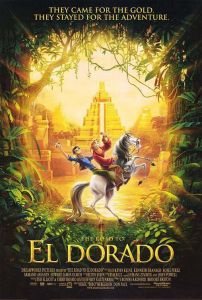
The Road to El Dorado (2000)

Tulio (Kevin Kline) and Miguel (Kenneth Branaugh) are two 16th Century Spanish con men who somehow speak in English accents and appear to have a secret gay relationship. I calls ’em as I see ’em people. Through a strange comedy of errors the boys end up marooned on a far off land with a horse in their possession as well as a mysterious map. The map leads to the unfold treasures of the mysterious fable of the city of El Dorado. They partner with a saucy native (Rosie Perez) with hips bigger than shoulders and a pining to be taken away.

Dreamworks has scored big with previous strong ink and paint outings, but El Dorado seems to be a disappointment. At times the banter between Kline and Branaugh is lively and humorous but the energy is never sustained for long. El Dorado lulls unexpectedly quite often. Katzenberg created the very successful Disney animated formula, and still sticks by it regrettably. The Iron Giant showed originality can work, so why is no one listening?!

The animation is surprisingly shoddy at times. The contrast between 3-D and 2-D animation is easily noticeable, unlike the work in Prince of Egypt. Perez seems miscast, what with her Puerto Rican accent, and close to all the characters are poorly underwritten, even the damn horse.

Elton John and Tim Rice buddy up after their successful pairing with the Diz blockbuster The Lion King to unleash wave after wave of senseless drivel. None of the monotonous songs are memorable, or even downright humable. After seeing these pop regurgitation it’s easy to see that everyone makes a bad step. Consider this one.

El Dorado is an animated attempt toward the bumbling road pictures of Hope and Crosby, but this tank is too low on gas for the entire trip.

Nate’s Grade: C+

Topsy-Turvy (1999)

Mike Leigh’s latest might prove to be the old Brit’s most daring and ambitious spectacle of memory. It’s the tale of English musical maestros Gilbert and Sullivan chronicling their rocky yet firm relationship and the bustle of theater life. The period is set down exquisitely with massive amounts of elegant costumes and set designs, all of whom do well to distract you from the plot. Oh I forgot, there isn’t one. The drawback to Leigh’s Topsy-Turvy is that it is less a movie and more of a recreation of Gilbert and Sullivan musical numbers. Each musical piece lasts in its enduring entirety unyielding to be edited in the least. Thus in between each interlude is a snippet of theater life and the insanity displayed much more fluently by 1998’s Shakespeare in Love. Topsy-Turvy degenerates into a Fantasia style movie — a musical number here, a snippet in between, then another musical number, and repeat for two hours and forty minutes. To theater lovers, and especially Gilbert and Sullivan enthusiasts, Mike Leigh’s celluloid account should prove a triumph and brilliant in its startling recreation of 1880s English life. But to any other audience members out there, boredom will set in quickly enough and you’ll be asking yourself when you leave if you bought a movie ticket or a theater ticket.

Nate’s Grade: C

Fantasia 2000 (2000)

The first updating of long gone Walt Disney’s dream anthology hits the IMAX screens in a resounding fury of classical music and first rate animation. Like its predecessor though, it’s uneven in its quality. Some segments are more impressive or creative than others. In the 2000 redux the best of the best would be characterized by “Rhapsody in Blue,” a Gershwin blues number brought to stunning life by characters of simplicity yet definition. The animation on each is commendable and different from the next segment to follow it. “The Sorcerer’s Apprentice,” the only segment from the original to be included, shows its wrinkles and grain more than ever when blown to IMAX’s wide canvas. The standout, to me anyway, was clearly the final segment closing the just-over-an-hour animated orchestra called “The Firebird.” The imagery and animation are so sleek and beautiful that I thought I was going to break down by how stupendous the artwork was. This is a tale that leaps from the screen and lets you share some of the beauty with it – further enhancing the festival of the Mouse. Without these stand alone segments this ballet of song and ink would be rather adequate and nothing more, but with the addition of these two marvelous segments it becomes something worthwhile… at least for 20 minutes. Hey, it’s the most exposure classical music will get on the youth of today.

Nate’s Grade: B

The Prince of Egypt (1998)

Holy Moses, a Bible story made for a mass audience? The first animated feature from the folks at Dreamworks is ambitious, and crazy enough… it just might work. I’ll start right off by saying hands down this is great animation. The scenes are constructed with beauty and at certain times I did had something stirred inside me from the wondrous eye-candy. People look like people, not sketched cartoons. The animation and movement are so lifelike and fluid that you’ll easily be lost inside it and forget you are indeed watching a film people drawn by hand.

But while the visuals are lavish and splendid and just about every other adjective you can think of, the story suffers. The head folks had difficulty using the story of Moses because three separate religions use that story for their own purposes and beliefs. The trick is not pissing off any of the religions, and the end product is a very vague and gentile Sunday School lesson. They give you the message to believe, but believe in what? It’s never explained. The main characters tread over the thin ice of religious ire, and because of that intimidation they are often vague in descriptions and purpose. The idea of faith is pretty much gagged and taken away to be replaced with the supposedly more noble (and note; more universally agreed upon) issue that slavery is bad. You can’t help but feel a little like the producers chickened out with the material and hid behind the idea of slavery to not rise anyone’s blood pressure over a cartoon tale.

By making Ramses (Ralph Fiennes actually getting his second chance this decade to persecute Jews in a movie) and Moses (Val Kilmer, who also surmises the voice of God, but if God were Kilmer don’t you think he would’ve passed on The Saint?) not so black and white you have established that they are indeed people and both have their reasons for what they each do. You can see the motives and understanding for each, plus the tension and drama gets a shot in the arm.

While the music and message can be easily passable they can’t detract from the greatness that this movie projects with its simple and marvelous visions. You may gasp when the Red Sea is parted. I must confess though after multiple viewings on DVD the story and songs are indeed growing on me as is my impression of the film. This movie is more effective on your TV screen than the big screen.

Nate’s Grade: B

Tarzan (1999)

The next installment in Disney’s stranglehold on children is strikingly beautiful in its fluid animation, color, picture, and at times true excitement. But again it’s just more of the same.

Despite its rich animation, the story is again the lacking problem ringing in Disney’s big ears. Every word and action falls under the strict Disney formula code, which is restraining imaginative thought more than helping it. But that’s what you gotta’ do I guess if you wanna’ sell a billion of Tickle me Tarzan merchandise.

The plot is like a ghost of what Burroughs’ novel was originally, but with the typical Disney formula points; there’s the hero suffering from an identity crisis wanting something more, the fawn-like love interest who will eventually fall in love with the only available white man in central Africa, the treacherous one-note villain, and of course the bumbling sidekicks with comic relief and one-liners of slapstick and amusement for the kids. None of this was in The Iron Giant and it still managed to be a great film. Can we at least drop some of the items on the list?

The movie can get overly pretentious at times with the hammering of the ideals that nature… good, animals… good, man… bad. I’ve heard it all before, do I need it set to Phil Collins’ monotonous radio-friendly pop songs as well now?

Despite some flaws and the worse villain in a Disney movie of recent memory (a poor man’s Gaston) it is still enjoyable and worthwhile even with the creative constraint of the Mickey Mouse. Sure it’s already made millions but for my money Mulan was better.

Nate’s Grade: C+