Blog Archives
Guillermo del Toro’s Pinocchio (2022)/ Pinocchio (2022)
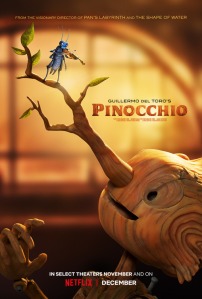 It seems 2022 has unexpectedly become the year of Pinocchio. The 1883 fantasy novel by Carlo Collodui (1826-1890) is best known via the classic Walt Disney animated movie, the second ever for the company, and it was Disney that released a live-action remake earlier in the year on their streaming service. Now widely available on Netflix is Guillermo del Toro’s stop-motion Pinocchio, so I wanted to review both films together but I was also presented with a unique circumstance. Both of these movies were adaptations of the same story, so the comparison is more direct, and I’ve decided to take a few cues from sports writing and break down the movies in a head-to-head competitive battle to see which has the edge in a series of five categories. Which fantastical story about a little puppet yearning to be a real boy will prove superior?
1. VISUAL PRESENTATION
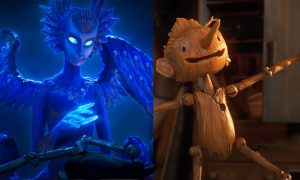
The Netflix Pinocchio is a lovingly realized stop-motion marvel. It’s del Toro’s first animated movie and his style translates easily to this hand-crafted realm. There is something special about stop-motion animation for me; I love the tactile nature of it all, the knowledge that everything I’m watching is pain-stakingly crafted by artisans, and it just increases my appreciation. I fully acknowledge that any animated movie is the work of thousands of hours of labor and love, but there’s something about stop-motion animation that I just experience more viscerally. The level of detail in the Netflix Pinocchio is astounding. There is dirt under Geppetto’s fingernails, red around the eyes after crying, the folds and rolls of fabric, and the textures feel like you can walk up to the screen and run your fingers over their surfaces. I loved the character designs, their clean simplicity but able readability, especially the sister creatures of life and death with peacock feather wings, and the animation underwater made me question how they did what they did. del Toro’s imagination is not limited from animation but expanded, and there are adept camera movements that require even more arduous work to achieve and they do. I loved the life each character has, the fluidity of their movements, that they even animated characters making mistakes or losing their balance or acting so recognizably human and sprightly. There’s a depth of life here plus an added meta-textual layer about puppets telling the story about a puppet who was given life.
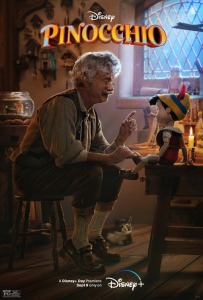 In contrast, the Disney live-action Pinocchio is harsh on the eyes. It’s another CGI smorgasbord from writer/director Robert Zemeckis akin to his mo-cap semi-animated movies from the 2000s. The brightness levels of the outside world are blastingly white, and it eliminates so much of the detail of the landscapes. When watching actors interact, it never overcomes the reality of it being a big empty set. The CGI can also be alarming with the recreation of the many animal sidekicks of the 1940 original. Why did Zemeckis make the pet goldfish look sultry? Why did they make Jiminy Cricket (Joseph Gordon-Levitt) look like a Brussel sprout come to life? It might not be the dead-eyed nightmare fuel of 2004’s The Polar Express, but the visual landscape of the movie is bleached and overdone, making everything feel overly fake or overly muddy and glum. The fact that this movie looks like this with a $150 million budget is disheartening but maybe inevitable. I suppose Zemeckis had no choice but to replicate the Pinocchio character design from 1940, but it looks remarkably out of step and just worse. When we have the 1940 original to compare to, everything in the 2022 remake looks garish or ugly or just wrong. The expressiveness of the hand-drawn animation is replaced with creepy-looking CGI animal-human hybrids.
Edge: Netflix Pinocchio
2. FATHER/SON CHARACTERIZATION
The relationship between Pinocchio (voiced by Gregory Mann) and Geppetto (David Bradley) is the heart of the Netflix Pinocchio, and I don’t mind sharing that it brought me to tears a couple of times. As much as the movie is about a young boy learning about the world, it’s also about the love of a father for a child. The opening ten minutes establish Geppetto’s tragedy with such surefooted efficiency that it reminded me of the early gut punch that was 2009’s Up. This Geppetto is constantly reminded of his loss and, during a drunken fit, he carved a replacement child that happens to come to life. This boy is very different from his last, and there is a great learning curve for both father and son about relating to one another. This is the heart of the movie, one I’ll discuss more in another section. With del Toro’s version, Geppetto is a wounded and hurting man, one where every decision is connected to character. This Pinocchio is a far more entertaining creature, a child of explosive energy, curiosity, and spitefulness. He feels like an excitable newborn exploring the way of the world. He’s so enthusiastic so quickly (“Work? I love work, papa!” “I love it, I love it!… What is it?”) that his wonder can become infectious. This Pinocchio also cannot die, and each time he comes back to life he must wait longer in a netherworld plane. It provides even more for Pinocchio to understand about loss and being human. This is a funny, whimsical, but also deftly emotive Pinocchio. He points to a crucifix and asks why everyone likes that wooden man but not him. He is an outsider learning about human emotions and morals and it’s more meaningful because of the character investment.
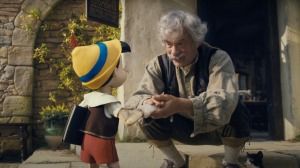
 In contrast, the Disney live-action Pinocchio treats its title character as a simpleton. The problem with a story about a child who breaks rules and learns lessons by dealing with the consequences of his actions is if you have a character that makes no mistakes then their suffering feels cruel. This Pinocchio is simply a sweet-natured wannabe performer. He means well but he doesn’t even lie until a sequence requires him to lie to successfully escape his imprisonment. The relationship with Geppetto (Tom Hanks) is strange. This kindly woodcarver is a widower who also has buried a son, but he comes across like a doddering old man who is quick to make dad jokes to nobody (I guess to his CGI cat and goldfish and multitude of Disney-tie-in cuckoo clocks). I don’t know what Hanks is doing with this daffy performance. It feels like Geppetto lost his mind and became stir crazy and this performance is the man pleading for help from the town, from the audience, from Zemeckis. It’s perplexing and it kept me from seeing this man as an actual character. He bounces from catalyst to late damsel in distress needing saving. The relationship between father and son lacks the warmth of the Netflix version. Yet again, the live-action Pinocchio is a pale imitation of its cartoon origins with either main character failing to be fleshed out or made new.
Edge: Netflix Pinocchio
3. THEMES
There are a few key themes that emerge over the near two-hours of the Netflix Pinocchio, which is the longest stop-motion animated film ever. Sebastian J. Cricket (Ewan McGregor) repeats that he “tried his best and that’s the best anyone can do,” and the parallelism makes it sound smarter than it actually is. The actual theme revolves around acceptance and the burdens of love. Geppetto cannot fully accept Pinocchio because he’s constantly comparing him to Carlo. When he can fully accept Pinocchio for who he is, the weird little kid with the big heart and unique perspective, is when he can finally begin to heal over the wound of his grief over Carlo, allowing himself to be vulnerable again and to accept his unexpected new family on their own terms. There’s plenty of available extra applications here to historically marginalized groups, and del Toro is an avowed fan of freaks and outcasts getting their due and thumbing their nose at the hypocritical moral authorities. By setting his story in 1930s Italy under the fascist rule of Benito Mussolini, del Toro underlines his themes of monsters and scapegoats and moral hypocrites even better, and the change of scenery really enlivens the familiar story with extra depth and resonance. All these different people want something out of Pinocchio that he is not. Geppetto wants him to strip away his individuality and be his old son. Count Volpe (Christoph Waltz) wants Pinocchio to be his dancing minion and secure him fame and fortune. Podesta (Ron Perlman) wants Pinocchio as the state’s ultimate soldier, a boy who cannot die and always comes back fighting. When Pinocchio is recruited to train for war with the other young boys to better serve the fatherland’s nationalistic aims, it’s a far more affecting and unsettling experience than Pleasure Island, which is removed from this version. In the end, the movie also becomes a funny and touching exploration of mortality from a magic little child. The Wood Sprite (Tilda Swinton), this version of the Blue Fairy, says she only wanted to grant Geppetto joy. “But you did,” he says. “Terrible, terrible joy.” The fleeting nature of life, as well as its mixture of pain and elation, is an ongoing theme that isn’t revelatory but still feels impressively restated.
 I don’t know what theme the Disney live-action movie has beyond its identity as a product launch. I suppose several years into the Disney live-action assembly line I shouldn’t be surprised that these movies are generally listless, inferior repetitions made to reignite old company IP. For a story about the gift of life, the Disney Pinocchio feels so utterly lifeless. I thought the little wooden boy was meant to learn rights and wrongs but the movie doesn’t allow Pinocchio to err. He’s an innocent simpleton who gets taken advantage of and dragged from encounter to encounter like a lost child. The Pleasure Island sequence has been tamed from the 1940s; children are no longer drinking beer or smoking cigars. They’re gathered to a carnival and then given root beer and told to break items and then punished for this entrapment. The grief Geppetto feels for his deceased loved ones is played out like a barely conceived backstory. He’s just yukking it up like nothing really matters. By the end, when he’s begging for Pinocchio to come back to life, you wonder why he cares. If you were being quite generous, you might be able to uncover themes of acceptance and understanding, but they’re so poorly developed and utilized. That stuff gets in the way of Pinocchio staring at a big pile of horse excrement on the street, which if you needed a summative visual metaphor for the adaptation, there it is.
Edge: Netflix Pinocchio
4. EMOTIONAL STAKES
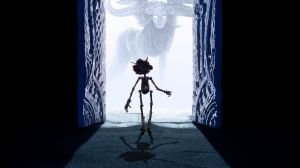 One of these movies made me cry. The other one made me sigh in exasperation. The Netflix Pinocchio nails the characterization in a way that is universal and accessible while staying true to its roots, whereas the Disney live-action film feels like a crudely packaged remake on the assembly line of soulless live-action Disney remakes. By securing my investment early with Geppetto’s loss, I found more to relish in the layers of his relationship with Pinocchio. In trying to teach him about the world, Geppetto is relying upon what he started with his past son, and there are intriguing echoes that lead to a spiritual examination. Pinocchio is made from the tree from the pinecone that Carlo chased that lead to his death. Pinocchio hums the tune that Geppetto sang to Carlo. Is there something more here? When he visits Death for the first time, the winged creature remarks, “I feel as though you’ve been here before.” These little questions and ambiguity make the movie much more rewarding, as does del Toro’s ability to supply character arcs for every supporting player. Even the monkey sidekick of the villain gets their own character arc. Another boy desperately desires his stern father’s approval, and he’s presented as a parallel for Pinocchio, another son trying to measure up to his father’s demands. Even this kid gets meaningful character moments and an arc. With this story, nobody gets left behind when it comes to thoughtful and meaningful characterization. It makes the movie much more heartwarming and engaging, and by the end, as we get our poignant coda jumping forward in time and serving as multiple curtain calls for our many characters, I was definitely shedding a flurry of tears. Hearing Geppetto bawl, “I need you… my boy,” to the lifeless body of Pinocchio still breaks me. Under del Toro’s compassionate lens, everyone is deserving of kindness.
As should be expected by now, the Disney live-action movie is lackluster at best when it comes to any kind of emotional investment. The characters stay as archetypes but they haven’t been personalized, so they merely remain as grubby facsimiles to what we recall from the 1940 version. Jiminy Cricket is meant as Pinocchio’s conscience but he vacillates from being a nag to being a smart aleck who even breaks the fourth wall to argue with his own narration. I hated every time he called the main character “Pee-noke” and he did it quite often. He’s far more annoying than endearing. There’s also a wise-cracking seagull that is just awful. The Honest John (Keegan Michael-Key) character is obnoxious, and in a world with a talking fox who dresses in human clothing, why would a “living puppet” be such a draw? He even has a joke about Pinocchio being an “influencer.” The only addition I liked was a coworker in Stromboli’s traveling circus, a former ballerina who injured herself and now gets to live out her dancing dreams by operating a marionette puppet. However, the movie treats the puppet like it’s a living peer to Pinocchio and talks directly to the puppet rather than the human operating the puppet, and the camera treats her like she’s the brains too. Safe to say, by the end when Pinocchio magically revives for whatever reason, just as he magically reverted from being a donkey boy, I was left coldly indifferent and more so just relieved that the movie was finally over.
Edge: Netflix Pinocchio
5. MUSIC
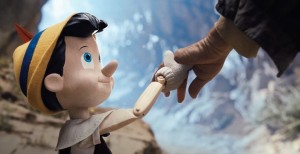 This was one area where I would have assumed the Disney live-action film had an advantage. Its signature banger, “When You Wish Upon a Star,” became the de facto Disney theme song and plays over the opening title card for the company. It’s still a sweet song, and Cynthia Erivo (Harriet) is the best part of the movie as the Blue Fairy. It’s a shame she only appears once, which is kind of negligent considering she sets everything in motion. The Netflix Pinocchio is also a musical and the songs by Alexandre Desplat (The Shape of Water) are slight and low-key, easy to dismiss upon first listen. However, the second time I watched the movie, the simplicity as a leitmotif really stood out, and I noticed the melody was the foundation for most other songs, which created an intriguing interconnected comparison. While nothing in the Netflix Pinocchio comes close to being the instantly humable classic of “When You Wish Upon a Star,” the songs are more thoughtful and emotionally felt and not just repeating the hits of yore, so in the closest of categories, I’m going to say that Netflix’s Pinocchio wins by a nose (pun intended).
Edge: Netflix Pinocchio
CONCLUSIONS
One of these Pinocchio movies is a visual marvel, heartfelt and moving, wondrous, and one of the best films of 2022. The other is a hollow vessel for corporate profit that copies the imprint of the 1940 animated film but only more frantic, scatalogical, and confused. In the year of our lord Pinocchio Two Thousand and Twenty-Two, there is only one movie you should see, and at this point ever see as it concerns this old tale. Guillermo del Toro has harnessed magic, and we are all the better for his bayonet imagination and enormous heart for his fellow outsiders.
Nate’s Grades:
Guillermo del Toro’s Pinocchio: A
2022 Pinocchio: C-
Share this:

Mowgli (2018)
 Sometimes second place might as well be last place in the film industry. Pity Andy Serkis and the years he spent making a live-action, mo-cap enhanced version of The Jungle Book only for Disney to scoop him years in advance and deliver a billion-dollar hit. It’s impossible not to compare the two and unfortunately Serkis’ passion project is found wanting in many areas. For starters, there’s far less Shere Khan (voiced by Benedict Cumberbatch), which is a shame. He’s really only in the film for very little. I think Cate Blanchett is miscast as the voice of the snake, Kaa, who acts like a grand keeper of the jungle’s history and future. I’m not sold on Serkis as Baloo, a grumpy paternal figure present from the beginning that trains the wolf pups so they can join the pack. The middle half-hour Mowgli spends in the company of man with a kindly poacher also feels like the movie is spinning its wheels. It keeps the rest of the jungle on hold. There are some rather dark asides that can be quite surprising, from wolf pups plummeting to their doom, bloody scars, cute severed heads to haunt your dreams, and three separate occasions where characters will watch the light vanish from a dying animal’s eye. It’s definitely a more brutish, cruel, and dangerous world, but at what greater expense? The characterization doesn’t add up to much. The character relationships are minimal. The CGI creatures and settings look unfinished. The whole enterprise feels rushed even though it’s been on the shelf for some time, which may be why the studio was eager to sell it to Netflix for a cool $90 million. You’ll watch Mowgli and nod, generally entertained, but questioning whether it’s 90-million worth.
Nate’s Grade: C+
Share this:

The Adventures of Tintin (2011)
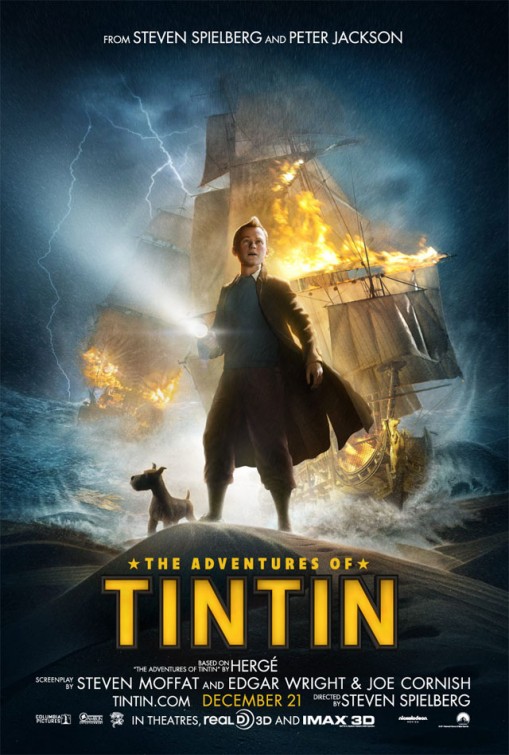 It may not be fair, but I was never expecting to like Steven Spielberg’s first foray into animation, The Adventures of TinTin. It just looked so busy and I’m still on the fence when it comes to motion-capture technology. So imagine my surprise when I found myself not just enjoying the movie but also actively loving it. This rollicking adventure practically hums with energy and imagination. It’s easy to get lost in its sweep. The action sequences, of which there are several, are terrific, breathlessly paced but showing great fair and imagination. It comes to the closest of any imposter to replicating the magic of Raiders of the Lost Ark. Give great credit to Spielberg but also his team of terrific Brit writers (Dr. Who’s Steven Moffat, Edgar Wright, and the man behind Attack the Block, Joe Cornish). The characters don’t feel like soulless androids, the adventure is lively, the immersive visuals are gorgeous to behold, and the scale of some of these action set pieces is just massive, in particular a chase through a Moroccan city that is performed in one unblinking take (although does it matter when it’s animated?). I felt transported while watching Tintin, back to a time of childhood awe and excitement. Some will find the movie wearisome and vacant, but I’m prone to shaking off my adult quibbles when a movie can make me feel like a kid again
Nate’s Grade: A-
Share this:

A Christmas Carol (2009)
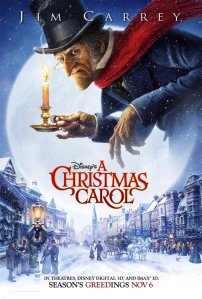 I still am at a loss over the appeal of the motion-capture system that director Robert Zemeckis fancies as of late. The creative mind that gave us classics Back to the Future and Who Framed Roger Rabbit? has embraced a technology that straddles the middle between live-action and outright animation. Motion-capture attaches electronic nodes to actors and digitizes their movements and facial features to later be conceptualized by computer wizards. And to this I say… so what? It seems like a whole slew of unnecessary work that adds little else than a vague starting point. Why not let the animators start from scratch? Why hamstrung creative professionals because Cary Elwes was feeling like making a certain gesture as “Portly Gentlemen #1?” I just don’t get it. To me, the motion-capture system is stranded in some artistic netherworld where it isn’t live-action and it isn’t animation. Zemeckis has cranked out his third mo-cap baby this decade, a retelling of Charles Dickens’ famous Christmas Carol. Why Zemeckis thought an old holiday chestnut would work best in this format, I’ll never know.
Cold-hearted Scrooge (Jim Carrey) is set to be visited by three spirits on a very magical Christmas Eve. The old man goes through Christmas past, present, and future to reevaluate his life and the true meaning of “peace on earth and good will toward men.” You know the drill, folks.
I like A Christmas Carol. I do. So do plenty of nice people. There’s a reason this oft-told tale still manages to resonate with generation after generation and that?s because it’s a good story. Of course it’s also an extremely familiar story to just about anyone outside of a womb at the moment. I expected Zemeckis and his crew to use their technology to jazz up the old story and give it a fresh new life on the big screen. Despite a handful of excursions flying through ye olde London, the extra slathering of special effects doesn’t enliven this holiday tale. I remember having great fun with Zemeckis’ previous motion-capture movie, 2007’s Beowulf (which does not play nearly as well in 2-D). That movie played around with the 3-D environment to great effect and made you feel apart of the experience. In contrast, A Christmas Carol does shockingly little with its depth of field, rarely placing distance between the foreground and the background. It’s a fairly lackluster 3-D experience. Maybe I wasn’t relaxing my eyes the right way, though I did notice how conscious I was of trying to elevate the 3-D experience myself. My disappointment is magnified by the fact that Zemeckis has been a pioneer for the 3-D playbook that Hollywood has now dubbed as the savior of the theater going experience.
 I wonder if Disney execs imposed limitations on the use of the 3-D immersion, not wanting to scare children by making them feel like they’re in the middle of a ghost story (there are some spooky moments already). The whole draw of motion-capture, and animation, is to transport an audience untethered by the limits of traditional practical filmmaking. This newest incarnation of A Christmas Carol fails to justify its existence. Why should I pay to see the most familiar story of modern day if there isn’t any new offering? At least The Muppet Christmas Carol gave me something different. And it had Muppets.
When I was younger in the mid 90s I was a huge fan of Carrey’s rubber-faced antics. I quoted Ace Ventura verbatim with my fellow seventh graders in 1995. So I understand the attraction of having him play multiple parts, but why exactly in a Dickens story? It’s not a comedy unless it’s adapted into one, and Zemeckis hews very close to Dickens and mostly recites the tale word-for-word. Scrooge isn’t funny, the ghosts aren’t funny, so why hire a renowned comedian to portray them all? This is a straight-laced adaptation and as such not the best use for Carrey’s talents. Is the move any better because Carey played all three ghosts? Is the movie any better because Gary Oldman gets to play Bob Cratchett and voice Tiny Tim? Is the movie any better because Elwes is credited for five inconsequential roles? Celebrity vocal casting is rarely effective in animation and so it seems the same in motion-capture.
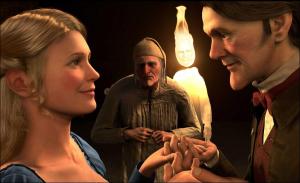 The technology has improved from the dead-eyed zombie children days of Polar Express, but it still seems like little more than less refined animation to my eyes. The movements are more fluid but the color palate is subdued into amber hues and candlelit locales. It doesn’t exactly use all the technological tools in the toolbox. It’s like a five-star chef toasting a Pop Tart: a waste of potential. I didn’t care for the skewed proportions on people either. Scrooge has a wiry frame with long spidery limbs and a triangular torso, and his character design kept reminding me of Jack Skellington. It’s too otherworldly considering nobody else comes across as a garish caricature in design form. The character designs for the three spirits are also fairly underwhelming. The Ghost of Christmas Past is a wispy flame. The Ghost of Christmas Future is nothing but a shadow. Is there a connection here? Otherwise, a shadow is pretty lame for the one ghost that can get really inventive and scary. Really, a shadow? I can do that myself without the aid of computers. And was it Carrey’s shadow to make it officially motion-capture? Because God forbid no other shadow could do or give the same performance of being draped over shapes.
I actually had to vehemently fight the urge to nap during A Christmas Carol. Maybe it was my poor sleep from the night before, maybe it was the fact that the 3-D glasses make everything darker (they still manage to hurt my eyes after prolonged use), but it was likely due to the fact that Zemeckis added a coat of polish to a holiday classic but declined to find purpose for doing so. Does this story get better with zooms through London, or Scrooge being shrunk and chased by demonic horses? It all seems like folly to me, like somebody’s idea to goose literary classics. Can you imagine Jane Eyre being shrunk and climbing through the walls of her Victorian era home? It all seems like an annoying distraction. Zemeckis? A Christmas Carol is exactly what you’d expect, which means you’d be just as well to flip through the TV channels and find any number of Christmas Carol versions. The Muppet Christmas Carol might even be on. Give that one a try instead. It even has some nice songs. And it’s got Muppets.
Nate’s Grade: C
Share this:

Beowulf (2007)
 Taking note of director Robert Zemeckis’ new motion-captured animated version of Beowulf, I began to wonder what other classic works of literature could use a good CGI sprucing up. Dusty old tomes would have greater relevancy to the youth of today if they were coated in animation and presented in a 3-D format. Just think of the works of Jane Austin with a flying, zooming camera and the aristocratic families repeatedly jutting marriage contracts toward an audience. This might be the only way to make The Great Gatsby tolerable.
The 1000-year old story begins in the dining hall for King Hrothgar (Anthony Hopkins). Their loud and drunken reverie is interrupted by the monstrous creature Grendel (Crispin Glover). The creatures rips men apart, lays waste to the hall, and munches on a few heads for the long journey back to his cave. The King offers a reward for anyone who can slay the monster and bring peace to the Danish lands. Enter Beowulf (Ray Winstone), a determined warrior and competitor who seeks eternal glory. He brags that he will kill their monster and then kill Grendel’s mother (Angelina Jolie) next. However, the slinky lass offers a tempting promise that she can make Beowulf the greatest story in all the world.
 This is not the same Beowulf you were forced to read in high school English. I confess never having read the 3,183-line ye olde English poem, but I don’t think it had scenes of burping, public urination, a “coming” sexual joke, and some unexpected man-on-monster action (not the kind you’d readily think). This is a bloody and often exhilarating retelling intent on jazzing up a classic work for a younger generation. The action sequences have tremendous scope and can be relentless, and when witnessed in 3-D they are even more immersive and breathtaking. Stepping aside from the thrills and chills, Beowulf also works as a cautionary tale about the dangers of lust and particularly pride. Beowulf is a boastful and arrogant fellow, enough that he chooses to fight Grendel in the buff so that it will be even more challenging and thus ego stroking (as they battle, objects conveniently obscure the audience from seeing Beowulf’s manhood). The main deviation from the poem, connecting the various characters on a much more personal level, works with he context of the story and the overarching theme about the costs of vanity.
I encourage all potential Beowulf ticket-buyers to seek out where their nearest 3-D screening resides and to plan and, if needed, carpool to that theater immediately. This thing is meant to be seen in three dimensions, and in that environment Beowulf is amazing to behold. This is my first encounter with the next generation of 3-D and it is a giant leap beyond the funny glasses with blue and red lenses. Hollywood has hopes that this technology will be the next great invention that drives people to the movies and turn it into a unique experience that cannot be duplicated in the quiet privacy of your own home. I must say I was thoroughly impressed with how immersive the process becomes. Beware, though, because of the deep focus your eyes will dart around the screen resting from object to object, marveling at the different planes of depth; you may feel some strain and a headache after awhile. Objects keep sneaking into your peripheral vision and the movie takes many opportunities to hurl things at the screen, and thus the audience, be they coins, swords, arrows, limbs, heads, pots, and blood splatters. The CGI animation coupled with the 3-D technology makes for a compulsively stunning first-rate spectacle.
The visual look is a great step forward from 2004’s The Polar Express, the first time Zemeckis used his newfangled motion-capture toys. I really disliked the look of Polar Express, and the kids and their dead, glassy eyes creeped me the hell out. I’m still not entirely sold on what motion-capture even brings to the world of animation; to me, it seems like animators can dictate movement just as well as copying from an actor. Where the animators do make strides is in their depictions of real people. It’s not photo-realism, in fact sometimes the characters look like plastic dolls, but you can see all the pores in the skin and follicles of hair in bristling detail. The look of the movie reminded me a lot of the video game God of War, especially when Beowulf is slicing and dicing one-eyed sea monsters. I think that’s a pretty fair assessment ultimately, that the film better resembled a slickly produced video game cut scene than reality.
 In the end credits, I noticed that someone is specifically singled out and credited for the design of Grendel’s mother. I’m all for credit where it’s due, but Grendel’s mother was simply designed as Angelina Jolie with a tail coming out of her head. The character design looks remarkably like its big name actress and she struts around mostly naked, though her body drips with a melting gold finish that stops the nudity from having any real definition (it’s kind of like she’s in a melty candy shell). This may be enough for frisky moviegoers that must have missed out on the other movies Jolie bares her flesh for, or perhaps the head-tail fetish folk will finally have their day. It makes a lot of sense for Zemeckis to choose Jolie for the seductress role. It seems that mortal men just can’t help themselves around her and they end up doing the nasty, which produces little nasty creatures. If there were anyone in today’s world that could make men weak with overwhelming lust, it would be Jolie. Just ask Brad Pitt.
The character work on Grendel, however, is fascinating and startlingly grotesque. He resembles a cross between Frankenstein, Dobby the elf, and a coffee pot, all covered in rotting, patchy skin. The amount of detail is amazing and simultaneously stomach-churning. Glover offers a magnificently eccentric frame to build from. Grendel comes across less like a monster and more like a misunderstood wretch that just wants some peace and quiet by any means necessary. The screenplay gives Grendel some deeper backstory and a motivation for his murderous rampages (the poor guy is hyper sensitive to music, which blares in his head and causes agony).
Beowulf does have some slow moments and a noticeable lag in the middle before it sets up a climactic dragon battle. I was actually starting to nod off somewhere along the middle. The screenplay, adapted by Neil Gaiman and Roger Avary, squanders a load of underwritten characters, like a queen, a young concubine, and a religious advisor that asks if they should also pray to this new Roman God, Jesus something or other. Zemeckis is too enamored with the 3-D technology at his fingertips and clutters his screen too often to play around with the depth of field. I cannot fathom how this movie would play out in a regular 2-D environment, but needless to say, I’m sure the constant barrage of things pointing at the screen would get old quick.
Beowulf is a rousing and thrilling experience when seen in its intended 3-D format, otherwise it might get a tad tiresome and the visuals would come across as less accomplished. Zemeckis is getting better acquainted with the limitless freedom his motion-capture technology afford him and his imagination, however, I mourn the loss of Zemeckis ever directing another live-action film again. He seems to be completely taken with his technology and while it will improve with age I just wish the man who gave me so many wonderful movies like Back to the Future and Who Framed Roger Rabbit? would just go back to basics.
Nate’s Grade: Movie itself: B
3-D presentation of film: A-


 nathanzoebl
You must be logged in to post a comment.