Blog Archives
The Bikeriders (2024)
 For a four-year period, writer/director Jeff Nichols is a filmmaker who appeared on my Best of the Year list three years, including making my top movie of 2011, Take Shelter. He’s a filmmaker I highly prize, so an eight-year gap from Nichols is an extended leave that makes me personally sad, though his latest movie, The Bikeriders, was delayed by a year after Disney decided to sell it rather than release it for the 2023 awards season. It’s a pretty straightforward drama about a Chicago motorcycle club in the 1960s. It’s all about a group of men that really don’t know how to express their feelings, so it comes out as drinking and fighting and general rebellion against outside authority. These social outsiders find kinship under the leadership of Johnny (Tom Hardy), an unstable man with his own code of honor and retribution. Our narrator is Kathy (Jodie Comer), a plucky woman who falls for a reckless biker, Benny (Austin Butler). There are plenty of interesting moments and sequences, like the rejection of wannabe new members too eager for approval for institutional violence. The changes the club undergoes through the mid 1970s are interesting, especially as the rules of the club begin to fray with the influx of new members and drug addictions, and the challenges to leadership we know will eventually end in tragedy and a betrayal of what the club was intended to be. Regardless, it feels like the movie has all the authentic texture and period details right but is missing a stronger sense of story. It’s more a collage of moments that doesn’t add up to a much better understanding of the three main characters. It’s more like a mood mosaic than engrossing drama, so if you have a general interest in retro motorcycle culture or the time periods, then maybe it will cover the absences in character. I found The Bikeriders to be a good-looking coffee-table book of a movie, more recreation than investment.
Nate’s Grade: B-
Share this:

The Flash (2023)/ Spider-Man: Across the Spider-Verse (2023)
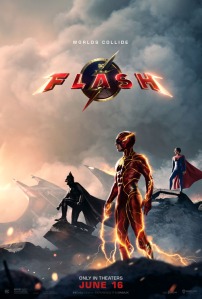
Released within two weeks of one another, two big summer movies take the concept of a multiverse, now becoming the norm in comic book cinema, and explore the imaginative possibilities and wish-fulfillment that it proposes, but only one of them does it well. Spider-Man: Across the Spider-Verse is the sequel to the Oscar-winning 2018 revolutionary animated film, and it’s a glorious and thrilling and visually sumptuous experience, whereas DC’s much-hyped and much-troubled movie The Flash feels like a deflated project running in place and coming apart. Let this be a lesson to any studio executive, that multiverses are harder than they look.
Barry Allen (Ezra Miller) has the ability to travel at fantastic speeds as his superhero alter ego, The Flash. He’s tired of being the Justice League’s errand boy and still fighting to prove his father is innocent of the crime of killing Barry’s mother. Then Barry discovers he can run fast enough to actually travel back in time, so he returns with the intention of trying to save his mother. Except now he’s an extra Flash and has to train his alternate self (also Miller) how to control his powers. In this different timeline, there is no Justice League to combat General Zod (Michael Shannon, so thoroughly bored) from destroying the planet for Kryptonians.
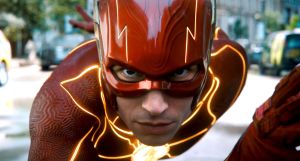
This is the first big screen solo outing for The Flash, and after none other than Tom Cruise, Stephen King, and James Gunn calling it one of the best superhero movies of all time, it’s hard to square how trifling and mediocre so much plays out as an example of a creative enterprise being pulled in too many directions. Miller was cast as the speedster almost ten years ago, and this tale has gone through so much tortured development, leaping through numerous filmmakers and writers, that its purpose has now gone from being a pillar of the expanding DC cinematic universe began with Zack Snyder’s Man of Steel in 2013 to becoming the Snyderverse’s death knell. The premise of traveling back in time is meant for Barry to learn important lessons about grief and responsibility and the limits of his powers, but it’s also intended as the reboot option for the future of these cross-connected comic franchises. It allows Gunn, now the co-head of the new way forward for DC movies and TV, to keep what they want (presumably Margot Robbie and Jason Momoa) and ditch the rest (Henry Cavill, Ben Affleck, Black Adam, Shazam, and Zack Snyder’s overall creative influence). So reviewing The Flash as only a movie is inadequate; it’s also a larger ploy by its corporate overlords to reset their comic book universe. In that regard, the quality level of the movie is secondary to its mission of wiping the creative slate clean.
Where the movie works best is with its personal stakes and the strange but appealing chemistry between the two Millers. It’s an easy starting point to understand why Barry does what he does, to save his mother. This provides a sturdy foundation to build a character arc, with Barry coming to terms with accepting his grief rather than trying to eradicate it. That stuff works, and the final talk he has to wrap up this storyline has an emotional pull that none of the other DCU movies have exhibited. Who wouldn’t want one last conversation with a departed loved one, one last opportunity to say how you feel or to even tell them goodbye? This search for closure is a relatable and an effective vehicle for Barry to learn, and it’s through his tutelage of the other Barry that he gets to see beyond himself. The movie is at its best not with all its assorted cameos and goofy action (more on both later) but when it’s a buddy comedy between the two Barrys. The older Barry becomes a mentor to himself and has to teach this inexperienced version how to hone and control his powers as well as their limits. It puts the hyper-charged character into a teaching position where he has to deal with a student just like him (or just him). It serves as a soft re-education for the audience alongside the other Barry without being a full origin story. The impetuous young Barry wanting to have everything, and the elation he feels about his powers, can be fun, but it’s even more fun with the older Barry having to corral his pupil. It also allows the character an interactive checkpoint for his own maturity and mental growth. Miller’s exuberant performances are quite entertaining and never fail to hit the comedy beats.
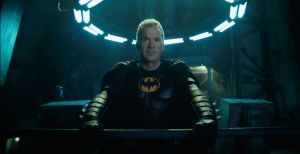
The problem is that the movie puts so much emphasis on too many things outside of its titular hero. Much was made of bringing back Keaton to reprise his Batman after 30 years. I just wish he came back for a better reason and had legitimate things to add. His role is that of the retired gunslinger being called back into action, and there’s an innate understanding with Barry wanting to go back in time and save his family, but too much of this character’s inclusion feels like a stab at stoking audience nostalgia (the callback lines all made me groan). I highly enjoyed Keaton as Batman and appreciated how weird he could make the billionaire-turned-vigilante, but he’s no more formed here than a hologram. The same thing happens with the inclusion of Super Girl a.k.a. Kara Zor-El (Sasha Callie). In this universe, there is no Superman, so she’s our requisite super-powered alien that Zod is hunting to complete his plans for terraforming Earth. She’s an intriguing character as a tortured refugee who has lingering doubts about whether humanity is worth the sacrifice, but much of her usage is meant only to make us think about Superman. She’s not given material to make her own impression, so she simply becomes the imitation of the familiar, the shadow to the archetype already being left behind. But these character additions aren’t even the worst of the nostalgia nods, as the final climactic sequence involves a collision of worlds that harkens to just about every iteration of the famous DC heroes, resurrecting several with dodgy CGI and uncomfortable implications (spoilers… the inclusion of George Reeves, when he felt so typecast as TV’s Superman that he supposedly killed himself because he thought his acting career was over, can be galling).
The action of The Flash is mostly fine but with one exceptional example that boggles my mind. In the opening sequence, no less, Barry is trying to help clean up a crumbling hospital when it collapses and literally sends a reign of babies falling through the air. I was beside myself when this happened, horrified and then stupefied that this absurd action sequence was actually happening. Barry goes into super speed to save the day, which more or less reverts the world into super slow-mo, though he needs to power up first, so we get a quick edit of him stuffing food into his face to load up on calories. We go from Barry breaking into a falling vending machine, stuffing himself in the face with snacks, getting the green light from his suit which I guess measures his caloric intake, and then grab a baby and literally put it in a microwave to shield it from danger. Just describing this event makes me feel insane. I figure the filmmakers were going for an over-the-top approach that also provides light-hearted goofiness to separate the movie from the oppressively dark grist of Snyder’s movies. However, this goes so far into the direction of absurdity that it destroys its credibility. It’s hard for me to fathom many watching this misguided and horrifying CGI baby-juggling sequence and say, “Yes, more please,” rather than scoff and shake their head. It’s not like the rest of the movie keeps to this tone either, which makes the sequence all the more baffling. There are Flash rules that are inconsistently applied to the action; Barry’s caloric intake is never a worry again, and the effects of moving a person during super speed don’t ever seem to be a problem except for one spewing gross-out gag.
While not being an unmitigated disaster, it’s hard for me to see the movie that got so many figures in the entertainment industry raving. The Flash has some notable emotional stakes, some amusing buddy comedy, and some goofy special effects sequences that run the gamut from amusing to confounding, but it’s also quite a mess of a movie, and too many of its nods to the fandom feel like empty gestures of nostalgia compensating for imagination. For all it gets right, or at least keeps interesting, it seems like another cog in a multi-billion-dollar machine, a stopping point also intended to be a reset and starting point. It feels like the character wasn’t trusted enough by the studio to lead his own solo movie even after years of buildup with Miller, nine seasons of the popular TV series, and 80-plus years of prominent placement in DC comics.
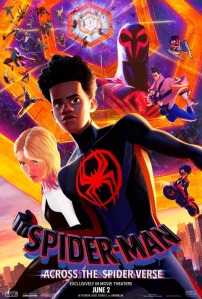
Conversely, Across the Spider-Verse is a sequel that expands an already stuffed story but knows what stories and themes to elevate so they don’t get lost amidst the fast-paced lunacy. Taking place a year later, Miles Morales (voiced by Shameik Moore) has grown into his role as the new Spider-Man for his world. He strains to meet the expectations of his parents, and keep up his grades, while fulfilling the duties of a superhero jumping into danger. When Gwen Stacey (voiced by Hailee Steinfeld) reappears to discuss joining the multiverse police, Miles jumps at the chance, having genuinely missed his other Spider friends, especially Gwen. There are countless Spider people in countless worlds, even including a Spider-T. Rex and a Spider-Car (Peter Parked Car, I believe the name was). Miguel O’Hara (voiced by Oscar Isaac) is the Spider-Man tasked with keeping order across the many interconnected multiverses, and he insists that sacrifice is essential to maintain balance, one that hits too close to home for Miles to abide.
The 2018 original is a hard act to follow, and while Across the Spider-Verse doesn’t quite overrule its predecessor it is a more than worthy sequel that has everything fans loved about the first trip. The visual inventiveness has been taken even higher, with the mixture of even more different animation and art styles. I loved seeing each Spider person and how they fit into their unique art style of their world, like the living water colors of Gwen’s world and the punky paper collage style of Spider-Punk (voiced by Daniel Kaluuya). There’s a villain that comes from a paper universe, so he resembles a three-dimensional paper construction with hand-scribbled notes appearing around him like Da Vinci’s commentary. There is something to dazzle your senses in every second of this movie. The visuals are colorful, creative, and groundbreaking with the level of detail and development. There’s probably even too much to fully take in with just one viewing. I want to see the movie again not just because it’s outstanding but so I can catch the split-second vernacular asterisk boxes that pop up throughout the movie. Going further into living comic book aesthetics, new characters will be introduced with boxes citing their comics issue reference point, and certain names and vocab will get their own citations as well. These are split-second additions, nothing meant to distract from the larger narrative. Simply put, this is one of the most gorgeous looking movies of all time, animated or live action. It’s bursting, thrumming, nearly vibrating with life and love stuffed into every nook and cranny, and it’s exhilarating to just experience a vivid, thriving world with animators operating at peak talent.

However, the movie has an engrossing story to better position all those eye-popping visuals. The worry with any modern multiverse story is that the unlimited possibilities of variations and opportunities for characters to do just about anything will overwhelm a narrative, or like The Flash, become a checklist of overburdened and empty fan service. The screenplay by Phil Lord, Christopher Miller, and Dave Callaham is all about relationships. If Miles’ relationship with his stern police lieutenant father (voiced by Brian Tyree Henry) wasn’t such an important focal point, then the emotional stakes of the movie would be meaningless. We see a relatable struggle from both sides, the parents trying to connect with their growing child and give him enough space to find himself, and the child who clearly loves his parents but doesn’t fully appreciate or understand their concerns. They worry about Miles leaving them and whether others will love and support him like his parents. Miles has to experience a wider world of possibility, but these experiences make him appreciate what he has at home, and what could be permanently lost. I don’t mind saying there were more than a few moments that caused me to tear up. I found Gwen’s storyline equally compelling, and her turmoil over keeping her secret identity and then coming out to her father was rather moving. The family bond resurfacing will get me every time, and the simple action of a hug can be as heartwarming and fulfilling as any romantic ode. Across the Spider-Verse makes sure we care about the characters and their personal journeys.
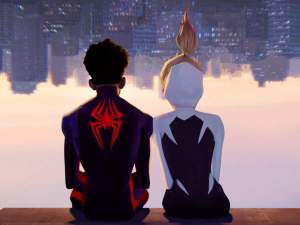
At a towering 140 minutes, this is the longest (American) animated movie ever, and it’s still only one half of a larger story. I knew ahead of time this was only the first part so as soon as we entered Act Three I kept gearing up for the cliffhanger ending. Every five or so minutes I thought, “Okay, this is going to be the end,” and then it kept going, and I was relieved. Not just because I got to spend more time in this unique universe but each new moment added even more to raise the stakes, twist the intrigue, and make me excited for what could happen next. I was shaking in my seat at different points, from the excitement of different sequences to the emotional catharsis of other moments. I cannot wait to experience this same feeling when the story picks back up reportedly in March 2024, though I fear it will get delayed to late 2024.
Even with the unlimited possibility of jokes and silly mayhem, the filmmakers keenly understand that it doesn’t matter unless we care about the characters and their fates. I am shocked that a goofy character I thought was going to be a one-scene joke, The Spot (voiced by Jason Schwartzman), could end up becoming the ultimate destroyer of worlds. I think this reflection nicely summarizes the impeccable artistry of Across the Spider-Verse, where even the moments or characters misjudged as fleeting or inconsequential can be of great power. It’s a movie that is full of surprises and thrills and laughs, all in equal measure, and a blessed experience for a movie fan. In the crush of comic book multiverse madness, Across the Spider-Verse is a refreshing and rejuvenating creative enterprise, one that builds off the formidable talent of its predecessor and carries it even further into artistic excellence that reminds us how transporting movies can be. If you see one superhero multiverse movie this summer, the choice should be as obvious as an inter-dimensional spider bite.
Nate’s Grades:
The Flash: C
Across the Spider-Verse: A
Share this:

Amsterdam (2022)

It’s been seven long years since writer/director David O. Russell made a movie. He was prolific from 2010-2015, making four movies, which were nominated for a slew of Oscars, especially in multiple acting categories. Three were also nominated for Best Picture and Russell was nominated for Best Director three times as well. It was quite a vaunted run of mainstream and critical success, with devoted actors like Christian Bale and Jennifer Lawrence eager to sign up for Russell’s quirky ensembles (it helps when both won Oscars playing Russell roles).
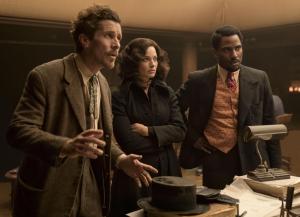
It’s natural to want to take some time off after such a busy creative period, but as the years stretched on, and after the Me Too accountability movement, Russell’s on and off-set behavior gathered more scrutiny and rebuke. His volatility had been known, like his screaming fit he had on the 2004 I Heart Huckabees set with Lily Tomlin. Even George Clooney recounts stepping up to Russell’s bully behavior on the set of 1999’s Three Kings (rumor has it Clooney was the one who released the Huckabees footage). On 2013’s American Hustle, Amy Adams said she cried repeatedly from Russell’s bullying and felt intimidated and isolated. Then there were the renewed revelations from Russell’s own niece who had been transitioning and accused Russell of inappropriate touching when it came to her changing body. Russell even admits to this, though he defends his actions by saying he was given tacit permission, or so he says. With all of this controversy and harassment swirling around Russell, it’s a wonder who would want to continue working with this kind of person. I guess as long as he was producing at his peak level, studio execs would excuse his bad behavior and keep funding his ballooning budgets. Well Amsterdam might just be the end of Russell’s star-studded big studio ride.
In 1933 New York, Burt Berendsen (Bale) is a WW1 veteran making ends meet as a doctor who specializes in veteran care. He and his best friend Harold Woodman (John David Washington) are framed for a murder and on the run, and the only way to clear their good names is to uncover a conspiracy that leads to a possible government coup. Helping the fellas out is Valerie Voze (Margot Robbie), a nurse who makes art from the shrapnel she recovers from inside war vets, and a wealthy socialite who also happens to be in love with Harold. Together, the three friends bumble their way through danger and mystery and crazy mishaps.
This is a mess of a movie, a waste of its top talent, and an excess of Russell’s excesses. The director has established a certain style since 2012’s Silver Linings Playbook, a movie I still to this day genuinely love (it was my top movie for that year). It’s a style that communicates mania, a nervous energy, and it made sense for Silver Linings Playbook as the movie was following a bipolar protagonist given to uncompromising bouts of mania. It makes less sense with each additional movie, but this improv-heavy, experimental, loose sensibility has become the default style for the director, and it feels misapplied. It leads to Russell bombarding his actors with questions or different requests in the moment, keeping them guessing, and actors have gone forward saying they never knew what they were shooting on the day and the shooting never stopped. This indulgence leads to stories that feel like a lot of elements are sloppily thrown together with the undying hope that somehow it will all come together in the end. With Amsterdam, it doesn’t.
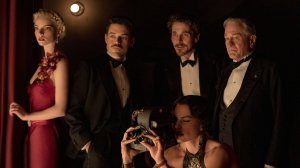
It’s not a great sign when I can say that the entire first hour could be jettisoned. There’s little sense of urgency for far too long, and what is presented feels almost comically unrelated, like even Russell can’t believe his silly characters are in real danger. The uneven pacing creates many dead spaces that feel like an awkward improv detour that you wish could have been avoided. We’re introduced to Bert as a drug addict, and then as a World War One veteran helping other veterans with facial scars and wounds, Bert’s relationship with his pal Harold, then their history in France during the war, then their introduction to Valerie and their kinship, then we have a mysterious death that also leads to a secondary love interest, which requires more setting up of the first love interest and her disapproving family, and then we get police investigating and warning about the first death and then a second murder, this time blamed on our characters, and they’re off to clear their names by… reuniting with Valerie and then bumbling through more characters before, finally the movie presents what it’s actually about well after a full hour-to-80 minutes of movie. It is exhausting and feels like a meandering alternative story that was clumsily grafted onto the Business Plot of 1933. The first half of the movie feels like a slipshod screwball comedy, and then once the particulars of a fascist conspiracy to overthrow the president are introduced, it’s like watching Looney Tunes characters try and foil Adolf Hitler. It just does not tonally work.
The Business Plot is a lesser known event in history, glossed over by the fact that the chief perpetrators more or less got away with their insurrectionist planning. They never did succeed in overthrowing FDR and installing their puppet, but they also did not get prosecuted in the end and most of the media dismissed the scheme as hogwash. It’s undetermined how advanced this plot eventually got but a coup was discussed by a consortium of business leaders. It feels like Russell is applying what he learned from 2013’s American Hustle, which introduced a crazy group of fictional criminals and then, in its last hour, explored the real Abscam criminal sting of the 1980s. I can see themes that Russell thinks are still prescient today, like a dark element desiring to overthrow the U.S. government because it didn’t get its way, as well as the collusion of big business in political king-making, seeking shells that will do what their benefactors demand. The problem is the themes behind this scheme are too serious for Russell’s trifling antics. Think about retelling the insurrection on January 6th but for the first hour it’s two bumbling bank robbers who keep finding themselves in the worst possible situations, ending at the U.S. Capitol. If you’re going to treat the rise of fascism, assisted by corporate overlords, as a serious threat, and something relevant for today, then maybe don’t have most of the movie be wacky nonsense.
Russell’s past films have often glided on energy and in-character authenticity, but this one feels so grasping and desperate. When the master plan to reveal the conspiracy and its shadowy participants is throwing together a big veteran’s show, I was reminded of the movies of young Mickey Rooney and Judy Garland where the solution to any dilemma was to put on a show. Then at one point the literal Nazis are singing loudly in German and are being confronted by our characters and the good patriotic Americans counter by singing “America (My Country ‘Tis of Thee)” and I had to stop the movie and just let out a deep sigh. I think Russell was going for the famous reference in Casablanca, also against Nazis, but it just flounders into unintentional comedy, accentuated by the antsy energy that treats it like camp. There are a couple of spots that I laughed out loud, though I doubt that was the intended response, like watching Taylor Swift abruptly run over by a car. The attempts at actual humor are winding and often lead to little, and the characters feel like more of a collection of quirks than firmly established personalities and perspectives to anchor a movie. What does Bert having a false eye add besides something for Bale to fidget with? What does Chris Rock have to do here? What does Anya Taylor-Joy have to do here? Most egregiously, what does John David Washington have to do here? It feels like Russell just wanted a character for Bert to talk to. The screenplay is overstuffed and polluted with all these minor and underwritten characters that could have been better consolidated.

I suppose you can still have fun with Amsterdam and engage with it on a light-hearted level, smiling as you watch the many big stars having a good time messing around with accents, props, and wacky character traits and tics, like a bunch of kids with a dresser of costumes (maybe it is a throwback to those corny Rooney/Garland kids pictures after all). With other Russell movies, I’ve felt invigorated by the energy and artistry, encouraged to sit a little closer and be more attentive of the character turns, and dig into the actors making three-course meals of their roles. With Amsterdam, I felt the desperation to recreate the success of old patterns but the creeping realization that it wasn’t going to materialize. It’s just a big mess of a movie, not without interesting ideas or moments or good acting, but too much feels resoundingly and frustratingly frivolous. You could ditch entire characters, entire subplots, even entire hours of this movie. Amsterdam cost Disney/Fox $80 million dollars, the biggest of Russell’s career, and only earned a pittance, so I think there is a retraction in due order. Begin with not watching Amsterdam yourself.
Nate’s Grade: C
Share this:

Bullet Train (2022)/ The Princess (2022)
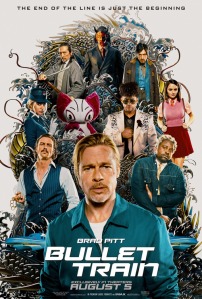
Bullet Train and The Princess are two recent releases that could serve as a double feature for all they have in common. Both movies prioritize fun above all else, both of them feature stylized violence and bloodshed, both of them have a perverse sense of humor, and both of them feature young actress Joey King (The Kissing Booth, Wish Upon), coincidentally playing the listed roles of Prince and The Princess. What more do you need for this combo? If you are a fan of Bullet Train, you’ll likely be a fan of The Princess, and vice versa, because both of them are exactly as advertised. They’re wild, whimsically violent, but succeed with nimble action construction, bizarre and engaging characters, and high energy that sparks fun escapist entertainment.
Bullet Train is set almost entirely on a speeding bullet train in Tokyo, and we follow a group of hired killers, mercenaries, and generally nasty people all sharing one very fast locomotive. “Ladybug” (Brad Pitt) is a reformed hitman who only takes snatch-and-grab gigs as he’s trying to better himself with therapy and meditation. He’s meant to grab a briefcase of money and get off the train. Naturally, things don’t go as smoothly as planned. Onboard the train are “Lemon” (Brian Tyree Hill) and “Tangerine” (Aaron Taylor-Johnson), who have the briefcase in their possession along with the prodigal son (Logan Lerman) of a scary Yakuza boss known as “The White Death.” Also on board is Kimura (Andrew Koji) seeking to find the person responsible for pushing his child off a rooftop, Prince (Joey King) using her diminutive stature to trick unsuspecting men, the Wolf (Bad Bunny) seeking out the person responsible for the death of his bride, and several other masked killers looking to up the ante. Characters will clash, many will die, and “The White Death” will be appeased by the end, coming to collect a blood debt from all. 
Bullet Train was, blissfully, everything I was needing it to be. It’s a universe familiar to fans of Quentin Tarantino and especially Guy Ritchie, with colorful and threatening characters with large personalities and quirks colliding in unexpected and violent ways. I’ve seen so many Tarantino knock-offs, and Tarantino knock-off knock-offs, so I appreciate when someone is able to understand what it takes to succeed on this unique playing field. Screenwriter Zak Olkewicz (Fear Street: 1978) knows how to sharpen the kind of off-the-cuff banter that makes these movies excel, with space given for the characters to make a sizable impression. There needs to be time to get to know them, their quirks and faults, and then send them all running at one another at cross-purposes, interacting in fun ways that lend to one character screwing something up for another. There’s about a dozen characters dropped upon us, and just about everyone gets a flashback or introduction set piece, sometimes more, sometimes extensions of previous flashbacks, sometimes extensions from alternate perspectives. Part of the fun is just seeing how the different characters relate to one another, so there is a period of time where the mask has to eventually drop, and the reveal needs to be worthwhile. It’s a lot, and Bullet Train gleefully trades in excess upon excess all in the name of chasing after a good time, and if you connect on its zany and breezy wavelength of reckless violence and dark humor, then you shall be happy for the ride.
The movie is constantly reshuffling and transforming, allowing it to hyperextend into whatever shape it necessitates before contorting back to its next phase. This malleability makes the movie far more responsive, sometimes overlapping, and it provides an extra level of energy. It’s reminiscent of Snatch, my favorite of the Ricthie cockney crime capers, where the story zigged and zagged through linear time, providing answers to different stacked questions. I won’t say the characters are as distinct as Snatch, but Olkewicz takes his time to introduce each with relish. Pitt may be the marketable star of the movie, at least as far as advertising is concerned, but it’s really much more of an ensemble, and one anchored by Lemon and Tangerine. Their droll, snappy banter really cements their long-term relationship almost like a screwball romance. They end up becoming, strangely, the heart of the movie, if one were to suggest a movie with an entire wedding party vomiting their guts to death had a beating heart. Their exact connection and genuine affection for one another, even when they’re driving one another mad, is one of the film’s many surprises as it zooms ahead. There are fun cameos, and some unexpected abrupt deaths, but Bullet Train works because of the entertainment of the kooky killer characters. I enjoyed that one character’s obsession, namely likening people to Thomas the Tank Engine avatars, has a personal connection but actually leads to some ironic turns. Not every set-up has the best payoff (Chekov’s toilet snake comes to shockingly little) or resolution (why wasn’t the snooping conductor thrown back in or given a revelation?) but with so many characters criss-crossing, so many goofy asides and cul-de-sacs, and so much bloody mayhem, there’s a steady stream of fun, satisfying payoffs and retribution until the mid-credits sequence. 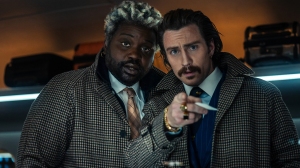
To me, the water bottle symbolizes Bullet Train at its best and worst. After two hours of multiple characters and their out-of-order flashbacks shuffling for dominance, we get an inanimate object with its own flashback. It’s a goofy and superfluous addition, as the water bottle has served as a plot device but has served its ultimate plot purpose already, so seeing its entire history offers no new information that the audience didn’t already have. However, what it does is show the movie from the perspective of this bottle, and many sequences are reframed from the bottle’s rigid point of view. It made me think about how after they got their shot setups, someone on staff would then call out, “Okay, we need the water bottle POV shot now,” and they would film that. I appreciate the effort for something this fleeting and silly. They didn’t need to put in this flashback or this level of attention to an object that ultimately just gets thrown at a guy’s head. However, it’s the misdirect, the ridiculous inclusion on top of the others, and the ramping of energy that made me smile, even as little else came out of it. I appreciated the showmanship. For me, this is emblematic of the movie as a whole, an overload of style and energy just for the fleeting hell of it.
Under the direction of David Leitch (Atomic Blonde, Deadpool 2), the action is as fun and energetic as the colorful characters. Leitch has become one of the best modern directors of action movies. The hand-to-hand combat is refreshing and makes use of close quarter combat demands. I enjoyed that the two participants in a fight are trying to sneak in quick moves without getting caught by an older lady who demands quiet in the quiet train car. I enjoyed the zany flashback where Tangerine and Lemon recount to the camera and dispute the number of men killed on a previous job. With a character cursed with bad luck, it provides opportunities to have fun with accidents and bad timing, which Leitch works into different action set-ups and setbacks. Even when the movie literally goes off the rails and becomes a big cartoon, Leitch finds ways to marry the big tone in such a manner that the ridiculous doesn’t prove off-putting. When characters are swinging samurai swords in slow-mo, while a Japanese version of “Holding Out For a Hero” is pumping on the soundtrack, I just sat back and soaked up the deliciously disposable fun times. 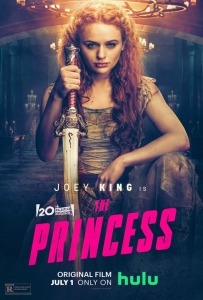
The plot of The Princess is as straightforward as Bullet Train is knotty. The Princess (Joey King) of a fantasy kingdom is chained at the very top of a castle tower. Her captor, Julius (Dominic Cooper), has imprisoned her family and plans to wed the princess and become king. The princess, however, has other plans. Thanks to her martial arts and weapon training, she breaks free and becomes a one-woman wrecking crew as she descends the tower floors to freedom.
I was genuinely surprised at how well developed and exciting the action sequences were. The Princess shares more in common with The Raid than anything by the Grimms. The script by Ben Lustig and Jake Thornton follows the model of a video game; every new floor is a literal new level with a new boss or new objective to be achieved to advance to the next level. The simplicity of the premise is refreshing, and the movie doesn’t waste any time ramping things up. Blood is shed within the first few minutes and it doesn’t let up. What I really appreciated was how well constructed each new action set piece was. There’s variety and specification that challenges our heroine, who is powerful but still not all-powerful and bereft of vulnerability. Each new encounter forces our protagonist to think through a different application of skills. There’s a situation that involves overpowering a larger and stronger man, a situation trying to wound a fully armored man, a situation battling two men, then even more, a situation with men charging into the battle and having to escape to a safer environment, a situation where she has to swing along the outside of the castle to enter a different room, a situation involving stealth, and many others, but each requires something different and thus each proves to flesh out our main character and her capabilities and problem-solving acumen. It’s always a pleasure to watch smart people overcome challenges in fun and smart ways, and The Princess has this formula down. I was worried the movie might get repetitive with its video game level design, but each new challenge is an opportunity to dazzle and enlighten us about our John Wick-esque fighter.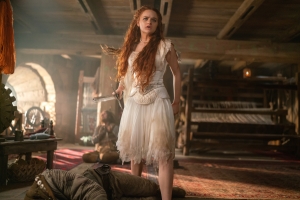
That’s probably the best comparison, the John Wick franchise, because it’s a series of movies that is defined by the thrills of its fight choreography and action set pieces. That’s it. The world has some interesting flourishes but the draw is the fight scenes and the pleasure of watching professionals operating at such a high level and with demonstrations that allow us to better immerse and appreciate the artistry of the fighting. And it’s good here. The impressive choreography has a really nice A-to-B propulsion, with each move connecting to the next to tell its own story of countermoves and adjustment. I really appreciated how the specific geography of each location is incorporated into the action, whether that be as a hindrance or an assistance to the fighting. It makes the sequences more meaningful and better developed. It’s also a movie that understands that if you give your villains specialized weapons, they better use them in fun or nasty ways. If all you’re looking for is imaginative, bloody, and brutal fighting, The Princess delivers it all. Credit also to King for throwing herself completely into the role. She effortlessly executes complicated fight moves and swordplay during long takes. You can tell she’s having a blast being a badass. Think of The Princess like a feminist version of The Raid or an upside-down version of Dredd (“Instead of fighting up, this character fights her way… down.”).
The Princess could have made more social statements but its very conceit is a feminist reworking of outdated fantasy tropes, so I don’t mind that it’s a streamlined action movie with a blunt yet obvious point. The familiar story tells us that these damsels in distress are the maidens in need of rescuing (“Sorry, our princess is in another castle” and the like), so just having the princess be her own champion is a simple yet satisfying subversion. This is an action movie and less one on politics; however, it’s a movie that cannot help from being political because it’s upsetting the expected social norms, that women are docile and weaker and at the whims of men. The Princess isn’t breaking new ground here. There have been plenty of movies that re-contextualized the feminine roles of old legends and folk tales and made them more capable and strong and fierce. That doesn’t mean there’s any less enjoyment watching our princess take down one leering man after another. It’s the appeal of the underdog who makes men pay dearly for underestimating her. These repeated interactions and bloody comeuppance speak about as well as necessary for this kind of movie. I doubt things would have radically improved if one of the characters broke into a treatise on the misapplication of gender roles. It’s a woman beating the stuffing out of creepy and lascivious misogynists. For this movie, that’s more than enough to keep me watching. 
Where The Princess starts to lose itself is once it shifts into its final act and abandons its formula. I can understand wanting to shake things up so the viewer doesn’t get lulled into complacency, but because the sequences were, beforehand, varied, my interest was not lagging. During this final stretch, the titular princess leads a squad to take down the baddies, and the movie becomes any other number of similar fantasy action movies. The enjoyable fight choreography is still present, but it feels like a rush to clear everything in comparison to the methodical floor-by-floor clearing from before. I wish the filmmakers had merely held steady with their plot rather than throwing things out and relying upon a grand team-up revolutionary raid. There’s also a sudden shift that throws out the rationale for keeping the princess alive. The bad guy just shrugs and says, “Forget it, I’ll find a replacement,” and it feels too arbitrary of an escalation. If he could do this, why was he so insistent for the first hour that she not be killed? It’s not a bad ending or one that ruins the movie but it’s definitely a downshift from the action excitement highs from before.
The Princess and Bullet Train are both frantic, over-the-top, cartoonishly violent, while still understanding how to effectively sell their escapist mayhem. We need to be dazzled by the action sequences and have them be meaningful (check), we need weird and interesting characters that we want to root for or watch bumble onscreen (check), we need payoffs that feel rewarding (check), we need an onslaught of style and attitude (check), and we need, above all else, fun and surprises (check). Neither of these movies is going to qualify as one of the best movies of the year. That’s just not the kind of experience either is shooting for. However, they may be some of the best fun you have with movies for 2022, and in a world in short order of fun, that’s plenty.
Nate’s Grade’s:
Bullet Train: B
The Princess: B
Share this:

Vanilla Sky (2001) [Review Re-View]
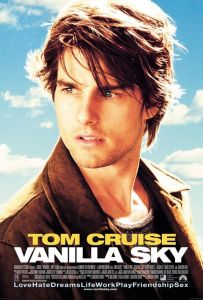 Originally released December 14, 2001:
Talk about a film’s back story. Tom Cruise signed on to do a remake of the 1997 Spanish film Abre Los Ojos (Open Your Eyes) which was directed by Alejandro Amenabar. During the filming the romance between Cruise and Penelope Cruz (no relation) got a little hotter than expected onscreen and broke up his long-standing marriage to Nicole Kidman. At the time she was finishing filming The Others which is the second film by Amenabar. This, by the way, is much more interesting than Vanilla Sky unfortunately.
Cameron Crowe’s remake starts off promising enough with Tom Cruise running around an empty Times Square like a Twilight Zone episode. Afterwards the film begins to create a story that collapses under its own weight. David (Cruise) is a rich boy in control of a publishing empire inherited through his dear old deceased dad. He has the time to throw huge parties where even Spielberg hugs him, and even have crazy sex with crazy Cameron Diaz, whom he tells his best friend (Jason Lee) is his “f*** buddy.” David begins to see a softer side of life with the entrance of bouncy and lively Sophia (Cruz) and contemplates that he might be really falling in love for the first time. But this happiness doesn’t last long as jealous Diaz picks up David in her car then speeds it off a bridge killing her. Then things get sticky including David’s disfiguration, his attempts to regain that one night of budding love and a supposed murder that he committed.
 Crowe is in over his head with this territory. His knack for wonderful exchanges of dialogue and the perfect song to place over a scene are intact, but cannot help him with this mess. Vanilla Sky is an awkward mish-mash of science fiction. The film’s protagonist is standoffish for an audience and many of the story’s so-called resolutions toward the end are more perfunctory than functional. The ending as a whole is dissatisfying and unimaginative. By the time the wonderful Tilda Swinton shows up you’ll likely either be asleep or ready to press the eject button yelling “cop out!”
Seeing Vanilla Sky has made me want to hunt for Amenabar’s Abre Los Ojos and see what all the hype was about, because if it is anything like its glossy American counterpart then I have no idea why world audiences went wild for it.
Nate’s Grade: C
——————————————————
WRITER REFLECTIONS 20 YEARS LATER
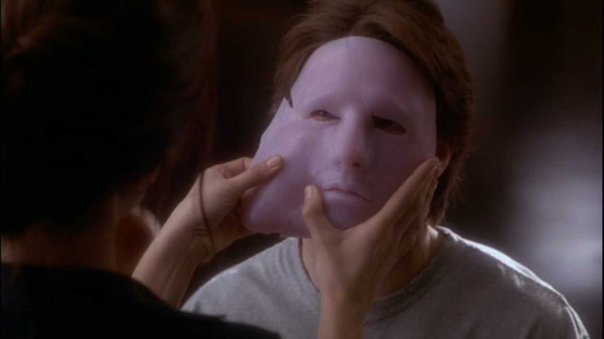
Movies have long resorted to being interactive puzzles, inviting audiences to unravel the mystery and hunt for clues as detectives. That’s essentially what Vanilla Sky is at its best, a messy mishmash of a movie that aims a little too high and pins its hopes with a generally unlikeable lead. This psychodrama is meant for dissection, not in a dreamy, obtuse way that David Lynch films invite but more in a canny re-calibration of pop-culture homages and fantasies. The big twist of the movie is that David (Tom Cruise), a rich publishing scion recovering from a savage accident, has elected to live in a simulation, a lucid dream that has been his home for the last hundred-plus years (how kind of the multiple generations of knob-turners to keep things operating). Other stories have followed a similar Twilight Zone-esque twist on the same territory, including the beloved “San Junipero” episode of Black Mirror (that’s right, spoilers, spoilers all around for older sci-fi). Writer/director Cameron Crowe has stated there are over 400 pop-culture connections and references to be had with this movie. The movie is wall-to-wall cultivated jams, as expected from a Crowe picture, but the homages and recreations go beyond simply placing a piece of music to a scene or name dropping an artist. The visual language of the movie is intended to be deconstructed, built upon twentieth-century album covers, music, movies, and plenty more. It’s a dense artistic gamble and, ultimately, I question who is even going to care enough to dive into this movie? Who is going to want to watch Vanilla Sky as a detective?
 This American remake of a 1997 Spanish movie was, in hindsight, the beginning of the end of Crowe’s career as a major director of studio movies for adults. Crowe had just experienced the apex of his career with 2000’s luminescent Almost Famous, a warm hug of a movie, and he had won the Oscar for Best Original Screenplay. It makes sense to try for something big, reunite with his Jerry Maguire star, and go outside his comfort zone with a wide artistic berth of freedom. The 2001 movie just did not work, though not strictly because of Crowe’s game efforts. This is not a miscalculated folly, an artist flying too close to the sun and getting burnt by their arrogance. I think the major flaw comes down to pinning the mystery on the recovery of the romantic and social life of a disagreeable lead character. Early on, David is established as rich, careless, and smug. He keeps his responsibilities as fleeting as his relationships with women. When his on-again-off-again paramour, Julie (Cameron Diaz), drives off a bridge with David inside, part of you might be thinking he deserves what he got for being so callously indifferent with other people. That’s harsh, I realize, but people will not like David, and this is amplified by the general public’s diastase for Cruise himself. Therefore, watching a movie where he tries to overcome him disfigurement and disability and stop being a jerk to everyone in his life is not a journey that invites the viewer to come aboard. He’s just not that interesting as our centerpiece. What’s happening to him can prove interesting, especially as the movie plays with our mind, but at no point will the extended pity party for poor rich David feel compelling as its own drama.
This is the problem with movies that are built around Big Twists: limited replay value. After you know the super twist, very often these movies fail to justify another two-hour investment. Take for instance 1997’s The Game, the forgotten David Fincher movie. It’s a thriller where Michael Douglas is on the run and doesn’t know who is responsible for chasing him. Then the movie says, “Surprise, it’s [blank],” and then it ends. Not every twist unlocks a new and exciting prism of how to view the preceding hours, like a Sixth Sense or Fight Club. Most movies built upon a big reveal as their conclusion tend to deflate immediately. There’s no real reason to watch The Game a second time if you already know what is happening. There’s no real reason to watch 2003’s Identity again once you know all the ridiculous secrets. There’s no real reason to watch Vanilla Sky once you know the explanation for all the strange little hiccups along David’s fraying mental state.
 Look, tons of movies are built around extended mysteries, from Agatha Christie to Knives Out, but the pleasure goes beyond simply solving of the puzzle. It’s the characters, the red herrings, the inspectors or detectives or chief solver of mystery. There is more there for entertainment. With Vanilla Sky, what we’re left with is a lackluster romance of a former pretty boy moping over his slightly adjusted privilege. It’s not like David’s character arc is illuminating or insightful. It’s not like we’re watching the battle over his soul here. He’s just kind of an affable jerk, and then David becomes a scarred jerk, and then he decides to wake up and be a jerk in real life. Progress?
There is a discussion to be had about how much of the movie is a dream, or where real life ends and the dream begins, and apparently even Crowe has determined there are six general interpretations, from the movie’s true and when Tech Support (Noah Taylor) says he switches over is when the dream occurs, to the unfulfilling “it was all a dream” interpretation. I suppose this could be fun for others but again I don’t think there are enough enjoyable components in the movie to incentivize the debate.
In some ways, this is one of Cruise’s most vain-free performances, yet there is an undercurrent that only seems even more vain. First the obvious; he plays a womanizer who also wears a mask for half of the movie to cover his scarred Phantom of the Opera visage. There’s a lack of vanity playing an annoying, arrogant, unpleasant person, something Cruise has done before and quite well, especially in his extraordinary Oscar-nominated turn in 1999’s Magnolia. He’s even played characters with physical disabilities before, like 1989’s Born on the Fourth of July. However, this “lack of vanity” really plays out as a vain attempt to be even more impressive as a respected thespian. The movie was positioned for a mid-December release, and with Crowe and Cruise on board, it seemed like a legitimate awards contender, until that is it opened wide. While Cruise’s performance is fine, his time under the mask doesn’t proverbially unmask his character for our better consumption.
 Vanilla Sky is mostly known as the big American debut of Penelope Cruz. She was already a muse for Spanish director Pedro Almodóvar and known well in the indie circuit, but from here she became Hollywood’s newest It Girl, only to be stranded in mediocre studio movie after mediocre studio movie (Does anyone remember Captain Corelli’s Mandolin?). It wasn’t until Almodóvar’s 2006 film Volver that studio execs seemed to finally understand how best to utilize her great talent. She won an Oscar for 2008’s Vicky Christina Barcelona and was nominated the following year for the musical Nine. She recently reunited with Almodóvar for 2021’s Parallel Mothers and again is wowing audiences. From early on, she definitely has a spark, an effervescence to her performance in Vanilla Sky. She’s also fighting against being forcibly elbowed into the swampy Manic Pixie Dream Girl category, a term that was originally coined for Crowe’s follow-up film, 2005’s Elizabethtown. Crowe loves writing women under these quirky conditions, however, the movie is told from a flawed male dream perspective, so it also makes sense if its portrayal of David’s idyllic dream woman happens to flatten her down.
It’s true that the story behind the scenes of Vanilla Sky proves more intriguing than the film itself. Cruise and Nicole Kidman were the Hollywood power couple. The ensuing tabloid feeding frenzy over their breakup and Cruise/Cruz relationship outlived the legacy of Vanilla Sky. This was the most ambitious and experimental movie in Crowe’s tenure as a writer/director, and he would never again return to science-fiction as a genre, keeping to the familiar lane of prestige dramas declining in prestige with each new film. My original review in the closing weeks of 2001 was pretty minimal in analysis. I knew this movie didn’t quite work then and it still doesn’t work now. If you’re eager for a dissertation-level analysis on its pop-culture fantasia, then God’s speed to you and your infinite free time.
Re-View Grade: C
Share this:

Pearl Harbor (2001) [Review Re-View]
 Originally released May 25, 2001:
It turns out we went to war in 1941 not because of Japanese aggression, Hitler’s dominance in Europe, or the protection of freedom and democracy. Sorry kids. The real reason we went to war was to complicate and then clear up Kate Beckinsale’s love life. At least that’s what director Michael Bay and screenwriter Randall Wallace would tell you with their indulgent epic Pearl Harbor.
We open in Tennessee in the 20s with two boys who dream of being pilots. Rafe (Ben Affleck) and Danny (Josh Hartnett) grow into strapping young lads who flash their hot dog flyin’ skills at basic training, which brings them chagrin from superiors but admiration from peers. Rafe falls in love with a young nurse named Evelyn (Kate Beckinsale), who goes against ARMY rule and passes Rafe in his eye exam portion when he has a slight case of dyslexia. But he’s just so cuuuute. The romance builds but Rafe feels like he’s grounded when all he wants to do is fly, and volunteers to fight in the RAF over in Europe. He promises he’ll be back to see his lovely Evelyn. Of course he gets into an accident and everyone assumes that poor dyslexic Rafe is fertilizing a lawn somewhere with his remains. Hence Danny slowly but surely develops something for Evelyn in their periods of mourning, and the two consummate their puppy love with a tango in parachute sheets.
All seems well until Rafe returns back from the dead throwing a wrench into Evelyn’s second date parachute plans. Thus the Hollywood favorite of the love triangle endures until the end when the two fly boys enlist in the Doolittle attack against Japan, months after the ferocious attack on Pearl Harbor. The real purpose of the Doolittle attack was not militarily but merely for morale. The real purpose it serves in the movie is to shave off an end on our love triangle.
 Pearl Harbor allows us to follow a group of youthful and innocent starry-eyed kids from training to combat. Each seems pretty much exactly the same to each other. It’s near impossible to distinguish which character is which. It’s like the screenwriter didn’t even have the gall to resort to cliche supporting character roles, and he just made one character and duplicated it. The only one who was noticeable for me was the character of Red (Ewen Bremner, julien donkey boy himself), but that was simply because the man had a speech impediment. We also have our handful of young nurses alongside Beckinsale, and I had an easier time distinguishing between them; everyone had different hair colors.
If you look in the pic, or the credits, you’ll see that two of the nurses would turn out to be Jennifer Garner (Alias) and Sara Rue (Less than Perfect), both stars of ABC shows, and ABC is owned by, yep, Disney. Coincidence? Probably. When they ran this on TV they actually advertised Jennifer Garner above Kate Beckinsale. That reminded me of when Seven ran on TV shortly after Kevin Spacey had won his well-deserved 1999 Best Actor Oscar for American Beauty, and they gave him second-billing in the advertisement over Morgan Freeman, the movie’s true main character.
Affleck has a hayseed Southern twang, but seems to mysteriously disappear for long stretches. Hartnett seems to talk with a deep creak, like a door desperately trying to be pushed open. Beckinsale manages to do okay with her material, but more magnificently manages to never smear a drop of that lipstick of hers during the entire war. We could learn a lot from her smear-defying efforts. Gooding Jr. is pretty much given nothing to work with. I’m just eternally grateful he didn’t go into a usual Cuba frenzy when he shot down a Zero.
Michael Bay has brought us the ADD screenings that are the past, loud hits of The Rock and Armageddon. Teamed up with his overactive man-child producer Jerry Bruckheimer once more, Pearl Harbor is less Bay restrained to work on narrative film as it is Bay free-wheeling. His camera is loose and zig-zagging once more to a thousand edits and explosions. Bay is a child at heart that just loves to see things explode. When he should show patience and restraint he decides to just go for the gusto and make everything as pretty or explosive as possible. This is not a mature filmmaker.
Despite the sledge hammer of bad reviews, Pearl Harbor is not as bad as it has been made out to be. The love story is inept and the acting is sleep-inducing, unless when it’s just funny. It doesn’t start off too badly, but twenty minutes in the movie begins sinking. The centerpiece of the film is the actual Pearl Harbor bombing that clocks in after ninety minutes of the movie. The forty-minute attack sequence is something to behold. The pacing is good and the action is exciting with some fantastic special effects. The movie is bloated with a running time a small bit over three hours total. Maybe, if they left the first twenty minutes in, then gave us the forty minute attack sequence, followed by a subsequent five minute ending to clear up our love triangle’s loose ends… why we’d have an 80 minute blockbuster!
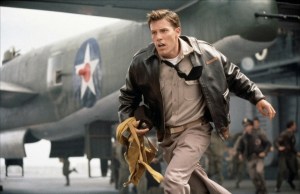 Pearl Harbor doesn’t demonize the Japanese, but it feels rather false with their open-minded attempts to show both sides as fair minded. It gets to the point where they keep pushing the Japanese further into less of a bad light that it feels incredibly manipulative and just insulting. It seems like the producers really didn’t want to offend any potential Pacific ticket buyers so the picture bends backwards to not be insulting. The only people who could be offended by Pearl Harbor are those who enjoy good stories. Oh yeah, and war veterans too.
The cast of Pearl Harbor almost reads like another Hollywood 40s war movie where all the big stars had small roles throughout, kind of like The Longest Day for the Pepsi generation. Alec Baldwin plays General Doolittle and is given the worst lines in the film to say. Tom Sizemore shows up as a sergeant ready to train the men entering Pearl Harbor. He has five minutes of screen time but does manage to kill people in that short window. Dan Akroyd is in this for some reason or other, likely because Blues Brothers 3000 has yet to be green lighted. John Voight is easily the most entertaining actor to watch in the entire film. He gives a very authentic portrayal of President Roosevelt. I still find trouble believing it was Voight under the makeup.
The blueprint for Pearl Harbor is so transparent. They took the Titanic formula of setting a fictional romance against a disaster, with the first half establishing characters and our love story, and then relegating the second half to dealing with the aftermath of the disaster. It worked in Titanic (yes, I liked the film for the most part), but it doesn’t work here. Pearl Harbor is a passable film, but the mediocre acting, inept romance, square writing, and slack pacing stop it from being anything more. Fans of war epics might find more to enjoy, especially if they don’t regularly have quibbles over things like “characters” and “plot.” To paraphrase that know-it-all Shakespeare: “Pearl Harbor is a tale told by an idiot. It is full of sound and fury, signifying nothing.”
Nate’s Grade: C
——————————————————
WRITER REFLECTIONS 20 YEARS LATER

Believe it or not, there was a point in time where people actually considered the possibility of Michael Bay making an Oscar contender. It seems mostly absurd now but at the time there was a benign sense of hope with the production of Pearl Harbor, the most expensive movie greenlit at the time ($140 million) and whose ultimate costs would exceed $200 million. The blueprint for the movie is easy to spot, borrowed heavily from the success of another risky and very expensive movie about sinking ships, James Cameron’s Oscar-winning blockbuster Titanic. If you’re looking for a movie to follow, you could certainly do worse than the highest grossing movie ever (at the time). There was great speculation and buzz about the movie, for its immense production scope, for the reported ambitions, for the prospect of Bay trying to make a serious movie, albeit a serious movie that still included a healthy helping of his usual explosions. There were similar rumors of disaster courting Titanic, then the first production to go over $200 million, and that turned out fine. Well, as should be obvious especially twenty years after its initial release, Michael Bay is no James Cameron in the realm of filmmaking and action storytelling.
Upon its release Memorial Day weekend in 2001, Pearl Harbor opened to a critical drubbing and general audience indifference. It failed to live up to whatever hype or hope had been attached, though it did snag a Guinness World record for most explosions if you value that honor. Bay has never since attempted a “prestige picture” again, resorting to the comfort of doing what he knows he can do well, showcasing large robots punching each other in between pretty explosions. I don’t know what the real legacy of the Pearl Harbor movie should be but I think, twenty years later, it’s a mediocre attempt to recapture something of a past, whether that was the movies of the 1940s or a very very specific movie from 1997 that rhymes with Smitanic. It’s too bad Pearl Harbor is still a three-hour shrug of a movie.
 A full 90 minutes is devoted to setting up the nascent characters and history before that fateful attack on the Pearl Harbor naval base in Hawaii on December 7, 1941, and that’s the first major misstep for the film. Much of the emotional involvement is built upon a romance that simply does not work in any capacity. Ben Affleck plays Rafe, a dyslexic pilot who charms Evelyn (Kate Beckinsale), a nurse who decides to help him cheat his medical exams. The first 45 minutes demonstrates their abbreviated courtship and romance through a series of cute moments that fail to coalesce into something more meaningful. And if you think that was rushed and abbreviated, after Rafe is believed to be dead, it’s about ten minutes before his best friend and fellow fighter pilot Danny (Josh Hartnett) is starting to fall in love with her and impregnating Evelyn in no time at all. Then Rafe returns, shocker, and everyone is upset with each other and confused, which is exactly what the Japanese military was waiting for, now knowing this is the ultimate time to strike its big assault.
I read that Bay rebuffed some of the more persistent criticism about the fetid romance, saying he and screenwriter Randall Wallace (Braveheart, We Were Soldiers) were aiming to replicate the romances of 1940s movies. To me this sounds like an inartful dodge. The romance in Pearl Harbor is not a throwback to a decade of movies that brought us Casablanca and The Shop Around the Corner and The Lady Eve, classic romances that knew how to pull your heartstrings and still register emotions to this day regardless of being over 70 years old. I think when Bay says he intended the romance to be older, nostalgic, he means simpler, and that’s just an insult to modern audiences as well as film audiences from the 1940s. This romance is just poorly written, not simple. Part of it relates to the chemistry between the three actors, which seems waterlogged, but most of the failure falls upon the shoddy character interactions. This is a movie devoted to having characters exclaim and explain things on screen rather than show you. Instead of watching characters fall in love over time, loosening and relaxing, flirting and deliberating, we just have characters declare feelings over the course of a few months of time. We’re supposed to feel conflicted when Evelyn finds comfort with Danny, but why should anyone care? Was anyone deeply invested in the relationship she had with Rafe? The other problem is that Danny is never even given a chance. His courtship is ridiculously short on time, and in fact his character drops out of the movie for what feels like twenty minutes before coming back to mourn Rafe’s loss. One of the guys says about Evelyn, “She’s got to be with someone, so it might as well be you.” Not exactly a ringing endorsement there, and also that’s pretty misogynistic thinking, my man.
 So much hinges on the romance and yet so little of it seems to carry as soon as the explosions kick in. Once the Japanese aerial assault begins, it’s all chaos until it’s over, and then it becomes about getting some measure of retaliation with the Doolittle raid for Act Three. The romance is, for all intents and purposes, put on hold for over half of the movie. It’s like the movie cannot make up its mind so it leaves it to the Japanese to clarify who Evelyn should end up with. When the entire emotional investment of the movie is predicated on a romantic triangle, and you don’t feel any semblance of human emotions for any combination, you might as well scorch the whole thing and have every participant make the ultimate sacrifice for God and country. This is why Pearl Harbor staggers because its love story does not put in the necessary work. I felt no more tension for Rafe or Evelyn in the bombing than any other nameless extra running for their lives.
As far as spectacle, Pearl Harbor can keep you entertained. Bay still knows intimately well how to stage scenes of multitudinous violence and chaos (his real lifelong romantic partner). The Pearl Harbor bombing is the absolute highlight of the movie and impressive in its scale. The shot of the bombing of the six American warships took six months of coordination to merely rig the 700 sticks of dynamite and cord for a shot that lasts all of 12 seconds. The production built the world’s largest gimble to simulate the top of the U.S.S. Oklahoma capsizing. The scale and scope of the attack is impressively massive and gives a real sense of how overwhelming this surprise attack was on the isolationist American military. The chaos that normally follows a Michael Bay action scene, where geography and mini-goals are lost, can actually be a virtue when communicating the surprise attack. You can get lost in all the noise and smoke. There are some moments that are just strictly movie silly, like a squadron of Zeroes chasing after individual people to shoot, or Tom Sizemore firing a shotgun while fighter planes zoom overhead. It’s little reminders that you’re watching a big screen entertainment of war rather than a realistic and jarring portrayal of the horror of combat. Bay only has one viewpoint when it comes to the military, to sacrifice, and to masculinity, so the tragedy of lives lost is only ever served upon the altar of a jingoistic reverence for military power. I would have preferred an entire half of the movie following the plight of the nurses trying to triage all the wounded and save who they could with dwindling supplies and even less time. That movie doesn’t get made by Bay. There aren’t enough explosions in that kind of movie and too much emphasis on realistic human suffering.
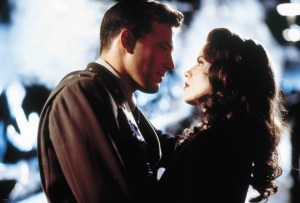 I’m also confused about the movie’s political apprehension. It bends over backwards to portray the Japanese generals as honorable and morally conflicted, which is better than mustache-twirling stereotypes, but this is still the aggressor country that had already invaded and occupied China. All of the good intentions of being more even-handed with the Japanese, perhaps to fight against anti-Asian demagoguery or even solely from money reasons, get supremely muddled when Bay decides to make the Pearl Harbor bombing even worse than it was in reality. The Japanese took great offense that in the movie their planes are seen attacking hospitals and civilian targets, something that never happened according to history and witnesses on both sides. Bay reportedly included the extra attacks because he wanted the attack to seem more “barbaric.” What is the point of better trying to represent a group of people and make up extra barbarism?
Looking back at my original review from 2001, I believe this was a watershed review for me. I wrote over 1200 words and it’s more in keeping with my current reviews than my early reviews. I find the analysis to be more critical than my early reviews where I was more likely to settle for puns and scant broadsides. This review has a few of those, but I also found myself nodding along with much of it even twenty years later. There are some marvelous turns of phrases, like “A Longest Day for the Pepsi generation” and Harnett’s voice sounding like a stubborn door refusing to stay open. There’s a punchiness to the writing that I recognize and admire, and it’s like I can see myself developing and finding my critical voice at this early juncture, which was almost two years into my beginnings as a fledgling film critic in Ohio. This one feels like a step above. I couldn’t end this analysis better than I did back in 2001, so I’ll quote my then 19-year-old self to close out both reviews: “To paraphrase that know-it-all Shakespeare: ‘Pearl Harbor is a tale told by an idiot. It is full of sound and fury, signifying nothing.’”
Re-View Grade: C
Share this:

The Current War (2019)
 The Current War has been on the shelf for two years and now finally getting a release, strangely subtitled “The Director’s Cut.” Can a movie that has never been released to the public, outside of some festival screenings, really declare its first impression a director’s cut? Aren’t these supposed to be different, and generally longer versions of the original edit? Regardless, the movie acts like a 19th century version of The Social Network with the battle over the nation’s electrical grid up for stakes between Thomas Edison (Benedict Cumberbatch) and George Westinghouse (Michael Shannon). You may think Nikola Tesla (Nicholas Hoult) is a big player in this game, but you’d be mistaken as he’s more a glorified cameo. I appreciated how the history came alive under director Alfonso Gomez-Rejon (Me, and Earl, and the Dying Girl) and his overwhelming sense of style. This is a period film that feels excitedly modern in its presentation, with lots of clever transitions, stylish camera angles, and wide angle photography to go along with a churning score that even reminded me of Trent Reznor and Atticus Ross’ Oscar-winning music. The characterization of these Great Men of Industry also finds ways to humanize them, especially Westinghouse who shuffled his employees into his burgeoning and debt-ridden electrical gambit so he wouldn’t have to fire anyone. Edison’s portrayal is decidedly charitable, positioning him as a principled family man who rebuffed a shameless J.P. Morgan (a great movie bastard) and easy money for military contracts because he refused to participate in any endeavor that would take life. There’s an ironic subplot where Edison, forced into desperation, cooperates with New York state’s implementation of a new “more humane” way of executing prisoners, and pinning the deadly results on Westinghouse’s alternating electrical current. This is certainly not the Edison of litigious infamy. I enjoyed immersing myself in this older world where the men of science and vision were akin to magicians creating miracles that dazzle. Their competitive race is doomed to be a bit one-sided if you know the history of AC versus DC (it’s hard to compete when one option is both better and cheaper) but I was still entertained by their tit-for-tat and how each man responded to pressure and expectations. The screenplay by Michael Mitnick is judicious with its information and very accessible for a lay person. The acting is solid even if many side characters are glorified extras (Tom Holland, Katherine Waterston, Tuppence Middleton). The Current War has been getting some pretty dim reviews, with even dimmer puns, and I don’t quite follow why critics are turning out the lights on this movie (sorry). It might not have the stuff of greatness but it’s a perfectly enjoyable period piece with attention to character and a panache of style to liven up the dustiest of history.
Nate’s Grade: B
Share this:

The Shape of Water (2017)
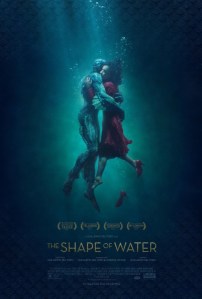 You haven’t seen a romance like director Guillermo del Toro’s latest monster mash (monster smash?), The Shape of Water. del Toro, an aficionado of cinematic creepy crawlies, has swerved from big-budget studio fare into a smaller, stranger period romance between a woman and an amphibious creature who already arrives pre-lubricated (I apologize already for that joke). I was compelled to watch The Shape of Water twice to better formulate my thoughts, mostly because I was not expecting the movie to be so enthusiastically whimsical, adult, and romantic, and the best beauty and the beast tale of this year.
Elisa (Sally Hawkins) is a lonely mute woman working on the cleaning staff at a classified government laboratory. Her neighbor, Giles (Richard Jenkins), is a hopeless romantic trying to find his place in the world as a gay man. Her best friend, Zelda (Octavia Spencer), is supportive but thinks they should mind their own business. An Amphibian Man (Doug Jones) from the Amazon is confined to a cell and repeatedly beaten by Richard Strickland (Michael Shannon), the vile head of security at the station. They believe the creature’s ability to breathe underwater and on land will be the key to winning the space race. The scientist in charge, Dr. Hoffstetler (Michael Stuhlbarg), is secretly a Russian spy, though his allegiances are more to the fragile creature than any country. Elisa teaches the creature sign language, the joys of hard boiled eggs, and lots of cheery music. She also falls in love with the creature and grows determined to save the Amphibian Man by breaking him loose.
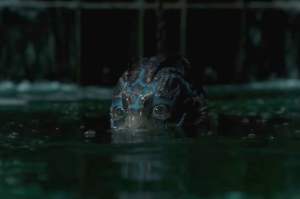 From the get go, del Toro drops us into a world that is not our own, as he’s so skilled at doing. This version of 1960s Baltimore feels as though it’s the twentieth century equivalent of a fairy tale village, and our monster is also the princess in need of rescue. Our heroine has a strange scar that foreshadows her place of belonging. The entire film bristles with a sense of expertly curated magic realism even though there isn’t anything explicitly magical. The supernatural and fantastical are met with a casual acceptance, as they would be in any storybook legend of old. When Elisa discovers the Amphibian Man in his tank, it’s literally at the ten-minute mark or even earlier, and she is unfazed. She immediately accepts the existence of this scaly mere-man, establishes a line of communication, and befriends the creature. It’s as if del Toro is trying to prime the audience for what’s to come and hoping to skip over the intermediate waiting period of incredulity. For del Toro, the real fun is once the characters connect, and belaboring that necessary connection is not in the audience’s best interests or time.
The movie glides by on effusive outpouring of charm, given such vibrant, sweeping life thanks to del Toro’s repertoire of pop-culture influences and his passionate love of cinema. The Shape of Water feels like del Toro and co-writer Vanessa Taylor (Hope Springs) took one of the old Universal horror B-movies and decided to make it into one of the most personal, delightful, and curious filmgoing experiences of the year. It’s film as escape for society’s outsiders. The sense of whimsy is ever-present without being overpowering or diluting the drama. It never feels quirky for its own sake of satisfaction. You’ll recognize several of del Toro’s artistic references, the re-purposing of cultural artifacts, but the magic suffused within every frame is thanks to del Toro and his team of filmmaking artists. If Amelie was going to fall in love with a sea creature, it might look something like this The Shape of Water.
The movie is also surprisingly, refreshingly adult in its depiction of human beings. Again the opening minutes set a standard of what to expect. We get a sense of Elisa’s daily routine before leaving for work, and one crucial component involves furious masturbation in her bathtub (set to an egg timer for sport?). This is a far more sensual movie than I was ever anticipating. There are multiple sequences of Hawkins disrobed and offering herself to the Amphibian Man. We never see any underwater action but we do hear about some of the mechanics of how the coupling is even remotely possible physically (“Never trust a man,” Zelda chuckles upon hearing those dirty details). It’s not all sexy time indulgences. There’s a sharp undercurrent of very real and very upsetting violence, typified by Strickland’s ruthless determination to break the creature. He’s a Bible-thumping sadist generally dismissive of those he finds different and lesser and yet he’s drawn to Elisa. Why is that? Because she’s a diminutive woman who cannot talk, and this sexually excites him like nothing else. He even comes on to her, thinking his interest is a form of masculine charity. There are some shocking moments of very real violence and its lingering effects. Strickland’s on-the-job injury becomes a metaphorical moral gauge for the putrid character’s state of being. The Shape of Water is a movie that does not blunt anything, whether it’s the sexuality or violence of its story (beware pet lovers: this is the second 2017 entry where an amphibian being hidden from the government eats somebody’s house cat). This is a fable for adults, a grimy Grimm’s tale with a sprinkle of Old Hollywood sparkle.
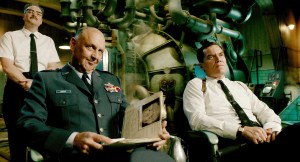 The Shape of Water is also a deeply romantic and earnest love story about two outsiders finding a connection in the most unlikely of places. Engineering a story that pushes two oddball characters together, each finally finding a kindred spirit, is an easy recipe for a satisfying conclusion; however, their romantic connection has to feel rightly earned. If we don’t believe the characters have fallen for one another, that this potential relationship elevates their existence, that the colors of the world seem brighter when around this person, then it doesn’t work. You have to buy the love story and it must be earned. Amazingly, del Toro is able to craft a love story with a mute woman and an Amphibian Man that checks most of the boxes of Hollywood romantic escapism. Elisa has an openhearted way of looking at the world, and her acceptance provides her with a bravery few others have. The creature presents somebody who views her not as a woman with a disability, as something lesser, but as something whole and wholly fulfilling. Everyone wants to be truly seen by someone for who they are rather than what they’re not.
While del Toro is supremely skillful at making Elisa’s romantic yearnings felt, there is one inherent weakness in this girl-meets-fish dude tale of love. The Amphibian Man isn’t really much of a character and far more of a symbol to the other characters. To Elisa, he’s her hope. To Giles, he’s a wild animal. To Strickland, he’s a defiant challenge to be tamed. To Zelda, he’s the questionable new boyfriend for her pal. To Hoffstetler, he’s a beautiful creature. To the U.S. government, he’s a potential scientific breakthrough. To the Soviets, he’s a liability and a potential future weapon. We’re told the indigenous people of the Amazon worshiped the Amphibian Man as a god but ultimately he remains a cipher others project onto. The love story feels a little too one-sided from an audience investment perspective. Still, the romance works and that fact alone is incredible considering the unique pairing.
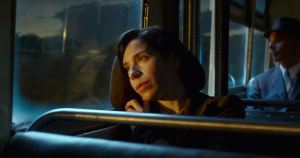 Hawkins (Maudie) is the beating heart of the movie and delivers a wonderfully expressive portrait of a woman finding her voice, so to speak. She’s relatively upbeat and that fits the whimsical tone of the picture. Hawkins plays a woman excited by the possibilities of the world. She reminded me of Bjork’s tragic heroine from 2000’s Dancer in the Dark, a woman who saw the extraordinary in ordinary life, who could perceive a symphony of music just on the outer edges of everyone else’s hearing. Going completely wordless for the movie, save for one very memorable fantasy sequence, requires a lot of daunting physical acting from Hawkins, and she’s more than up to the task. I guarantee a scene where she tearfully forces Giles to say out loud her signing will be her Oscar nomination clip.
When we talk about the weird and wild promise of cinema, it takes a controlled, assured vision and precise execution to bring together the dispirit elements and allow them to coalesce into something that feels like a satisfying, mesmerizing whole. The Shape of Water is del Toro’s gooey love letter to monster movies while stepping outside of homage and into the realm of something daring and different. I could talk about the Busby Berkley musical number as declaration of love, or that the story is told from socially marginalized voices finding an affinity together, or the small character moments that give generous life to supporting figures like Zelda and Hoffstetler, or that it leaves implied stories to be chewed over for extra richness like Giles likely being outed at his work to the dismay of his closeted superior, or the perfect casting for secondary antagonists, or the exquisite cinematography that seems to utilize every shade of green the human eye is capable of seeing, or the stunning production design, or the sweetly eccentric whistling musical score by Alexadre Desplat, or the grace of Doug Jones’ performance in the amphibian suit, or just how funny this movie can be, even the sadistic villain. I could talk about all that stuff but I’ll simply condense it all to a plea to give The Shape of Water a chance. It’s rare to see a storytelling vision this precise that’s also executed at such a high degree of difficulty. In other hands, this could have been an unholy mess. With del Toro, it’s a lovely mess.
Nate’s Grade: A-
Share this:

Nocturnal Animals (2016)
 Fashion designer Tom Ford made a big splash with his debut film, 2009’s A Single Man. It was a gentle and introspective character study of a middle-aged gay professor determined to end his own life. It was lush, full of feeling, and anchored by a deeply humane performance from Colin Firth. In short, it is everything that his follow-up Nocturnal Animals is not. This is a movie overflowing with vacant artifice that is mistaken for profundity.
Susan (Amy Adams) is an art gallery owner and living a posh life with her second husband, Hutton Morrow (Armie Hammer). She gets an unexpected present in the mail from her ex-husband Edward Sheffield (Jake Gyllenhaal). He’s sent her his newest manuscript, a departure from his usual works. It’s dedicated to Susan. With Hutton away on business, and philandering with a mistress, she dives into the story. It tells the story of Tony Hastings (also Gyllenhaal) and his wife (Isla Fisher) and teen daughter (Ellie Bamber) traveling through west Texas. They run afoul of some contemptuous locals lead by the sadistic Ray (Aaron Taylor-Johnson), who kidnaps Tony’s wife and daughter. Left for dead, Tony teams up with a terminally ill police officer, Bobby Andes (Michael Shannon), to hunt down Ray and make him suffer for his crimes. As Susan continues reading, she goes through a mixture of emotions trying to determine what her ex-husband is trying to communicate to her within the subtext and metaphor of his sordid story.
 I grew increasingly restless with Nocturnal Animals because it failed to justify its excessive dawdling and vapid artistic pretensions. This is a movie that doesn’t really know what it wants to be so it dabbles in many different genres, none of them fully convincing or worth the effort. It’s a high-gloss erotic thriller, it’s a gritty exploitation film, it’s a morally compromised revenge thriller, and it’s a subtle relationship drama amidst the upper crust of the L.A. art scene. It’s none of these. It’s two primary stories, neither of which justifies the amount of time spent on what amounts to so little. The worst offender is the frame story with Susan, which amounts to watching Amy Adams read for two hours. She takes a lot of baths and showers in response (symbolism!) but most of the cutaways and time spent with Adams is to merely watch her react. It’s like she’s a nascent studio audience handcuffed to tell us how to feel with her reactions. Would you have known that you should feel bad during onscreen death if we didn’t cut back to Susan also feeling bad and concerned? It amounts to emotional handholding and it’s grating, also because Susan is an terrible character. She’s conceited and thinks she is owed better, which is why her mother successfully pressured her to dump Edward, a man well below her self-styled station in life. Her second marriage is crumbling apart and part of her sees Edward’s out-of-the-blue note as a potential romantic rekindling. That’s right, this is a person who reads a revenge opus that may be all about seeking cosmic vengeance against her, and she thinks to herself, “Ooo, I think he like likes me after all.” Her self-involvement is rewarded in the end but the ambiguous ending is more just missing in action. Ford’s film just peters out and leaves you hanging, just like its heroine.
Edward’s manuscript is easily the best story and even that is only by default. It’s an easier story to get involved with because of the simple story elements that naturally draw an audience in, namely a revenge fable. The initial altercation with the family and Ray’s crew lasts almost a half hour. Specifically the roadside confrontation itself is a solid ten minutes and it just goes round and round, repeating its overdone sense of menace. I wasn’t dreading the horror to come but more so getting impatient for it to be over. Without depth to the characters or escalating stakes and complications, it all just amounts to a Texas hillbilly repeatedly threatening a cowering family for ten solid minutes. The vengeance in the second half of the movie is just as predictable and too drawn out. Edward schemes with Bobby Andes to take justice into his own hands, but the movie takes far too long to reach its predictable conclusion, which still manages to be so drawn out that I was screaming at the screen for the inevitable to finally happen. When the movie ended I felt a rush of relief to go along with my general sense of perplexity.
Nocturnal Animals has the illusion of highbrow art mixing with lowbrow thrillers but it lacks the substance of the former and the courage of its convictions for the latter. Ford’s mercurial taste in costuming and set design shows in every moment with Susan, as the sets feel exquisitely designed and the cinematography designed to encapsulate this. It’s a good-looking movie but there’s not enough under the surface. It’s all empty window dressing to disguise the vapid whole at its center. Let’s tackle the opening credits, which will most certainly capture your undivided attention. It’s a foursome of overweight women dancing naked and in slow motion, their large bodies bouncing and jiggling to the self-serious musical score. Eventually it’s revealed that these women are part of an installation exhibit in Susan’s art gallery, and that’s when you get a tip-off just how hollow and attention seeking the movie will be. The gallery consists of overweight women lying face down on raised platforms. That’s it. No wonder her gallery isn’t doing that well (note: not a fat-shaming comment but more a comment on the lazy application of its sense of “art”). You get a sense that Ford comes most alive in the scenes where he can arrange figures and images, not so much the demands of storytelling.
 I can already hear supporters saying I just don’t get it; no, I got it because there’s very little to understand with Nocturnal Animals. It’s a story-within-a-story so we’re already training our brains to look for parallels but they aren’t obvious so they’ll be more metaphorical. I kept waiting for it all to tie together in a substantial way by film’s end, and sorry but it just doesn’t (spoilers ahead). Edward has a whammy of a day when he discovers 1) his wife is pregnant, 2) she’s aborted his child, and 3) she’s in the arms of her new boyfriend, and he discovers all of this standing in the rain for further symbolism. He has a grievance against Susan, though we’ve been suspecting it for some time. His manuscript is a revenge thriller about a family murdered and how a weak man finds the strength to seek justice and retribution. The parallels are fairly obvious there, and the fact that there are only so many characters in the story-within-a-story means there are few options to play the analogue guessing game. I’ll just claim that Ray is meant to represent Susan since he/she is the murderer of Tony/Edward’s family. There’s a reason that Tony’s family all share Susan’s red hair. He dedicated the book to her, after all, and said she was who made it all possible. From there you could argue whether Tony represents Edward’s real past, weak and remorseful, whereas Bobby Andes is meant to represent how he wishes he could be, decisive and strong (end spoilers). That’s about all the parallels you’re going to find because the story-within-a-story only involves a very tiny number of characters. There just isn’t much to go on here and yet Ford’s movie stretches and drags and just keeps going until it reaches its predictable destination. There isn’t any more depth here than straightforward avatars and even those are lean.
I was debating a question with my friend Ben Bailey while we watched this movie, and that’s whether the stakes are removed somewhat when you know that a storyline within a movie is fictitious. Knowing that Tony is a pretend person, does that eliminate some of the tension and investment in his storyline? I recognize this is a distinctly meta question considering that a majority of film characters are fictitious by nature, but I do think there’s a different set of standards for the people of the story-within-a-story. I don’t remember feeling less for the characters in A Princess Bride, The NeverEnding Story, or Adaptation. My only conclusion is that I just did not care a lick for any of the characters in Nocturnal Animals, whether they were fictional or twice fictional. They didn’t deserve my attention just because pretty people were playing them. They didn’t deserve my attention because Big Bad Things caused them to experience Big Emotions. Combined with the ponderous plot and the emaciated substance, the dull characters and the overwrought acting they inspire are a recipe for audience detachment. I can’t help but shake my head as other critics trip over themselves to shower this film with overly enthusiastic plaudits. Nocturnal Animals is a tiresome exercise in lazy symbolism, patience-demolishing pretension, and emptiness masquerading as contemplation.
Nate’s Grade: C-
Share this:

Midnight Special (2016)
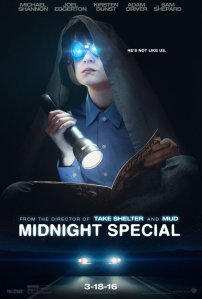 Jeff Nichols should already be a household name after Mud and Take Shelter, and with his new movie Midnight Special, the man has done nothing to break his incredible record of success with making deeply personal, ruminative, thrilling, and brilliant films. Midnight Special is a better and more earnest love letter to the cinema of Spielberg than Super 8 was. A young boy exhibits strange and supernatural powers. The religious compound he came from looks at him as a prophet. The government thinks he might be a weapon. Two different groups are on the hunt for this boy, and that’s where Nichols drops us right into the middle of, respecting the intelligence of his audience to catch up and figure things as they develop. In some ways it reminds me of Mad Max: Fury Road, an expert chase film that establishes its characters naturally as it barrels onward. The acting is wonderful all around and Nichols does a great job of finding small character moments that speak volumes, giving everyone time in the spotlight. The various twists and turns can be surprising, heartwarming, funny, but they stay true to the direction of the story he’s telling and grounded in the simple, unyielding anxiety and love of parents for their child. Michael Shannon (Nichols go-to collaborator) is directly affecting as a humble but determined father risking everything for the well-being of his son. The concluding act left me awed and felt something akin to what I think Brad Bird may have been going for with Tomorrowland. This is a thoughtful science fiction movie that allows its characters space to emote, its plot room to breathe, and yet still thrills and awes on a fraction of a Hollywood budget. It shouldn’t be long before some studio finally taps Nichols to jump to the big leagues of a franchise film, but if he wanted to keep making these small, character-driven indies on his own terms, I’d die happy.
Nate’s Grade: A


 nathanzoebl
You must be logged in to post a comment.