Blog Archives
Beetlejuice Beetlejuice (2024)
 Usually sequels over thirty years later reek of desperation, trying to rekindle the past while usually only hoping to tickle people’s fading sense of nostalgia. Rare is the 30-year-plus sequel that excels by breaking free of its imitator and making us see the original in a new light. It helps to keep your expectations in check, especially for a project that is so miraculous as the original 1988 Beetlejuice. What a wild movie that was, an introduction to horror comedy for a generation, and a near-perfect balance of creepy, silly, and imaginative. From director Tim Burton’s career-launching sense of style, to Michael Keaton’s electric comedic performance, to Danny Elfman’s outstanding score, to the stop-motion visuals, fun and freaky makeup effects, and you had a madcap movie that felt like a unique discovery. Recreating that is near impossible, but if Beetlejuice Beetlejuice can recreate some of the elements and feelings that made the original what it was, then it can be considered a modestly successful late-stage sequel.
Lyrdia Deetz (Wynona Ryder) has become a long-running host of a paranormal TV talk show connecting people with messages from loved ones from beyond the grave. Her teenage daughter, Astrid (Jenna Ortega), is moody and embarrassed by her mother, feeling that she “sold out.” Mother and daughter return back to Connecticut to attend the funeral of Charles Deetz, Lyrdia’s father. Her pretentious and snippy stepmother, Delia (Catherine O’Hara), is trying to better commune with his spirit, and the entire town has become famous for its spooky seasonal history. Meanwhile, Beetlejuice (Keaton) is trying to avoid his former wife, Delores (Monica Bellucci), who naturally is seeking to obliterate him to ectoplasm. He’s still got his sights set on Lydia, who spurned his marriage hopes, and might be able to manipulate the Deetz family back into his control.
 Beetlejuice Beetlejuice gets the closest to rekindling that lightning-in-a-bottle alchemy from the 1988 original, serving as an appealing and enjoyable sequel. Nothing will ever be as original and wild and such a discovery as that first movie, which serves as a point of entry for many a Millennial fan who discovered that irresistible Tim Burton Neo-Gothic aesthetic. However, it recreates enough of the qualities that stood out about the original. The skewed sense of humor and surreal visuals, as well as goofy slapstick and vibrant imagination about life after death, it’s all such a fertile playground for Burton’s visual charms. The genius of the original was telling a ghost story from the ghost perspective as they learned about how to be better ghosts to try and scare their new living owners away. Given the world of the dead, there’s such tremendous storytelling and world-building possibilities here, explored richly in the animated 90s series for kids. Further stories in this universe have an automatically appealing power, and it’s just nice to watch Burton apply his specific aesthetic again, something fans haven’t really seen since 2007’s Sweeney Todd. I appreciated the weird morbid details and the practical production values; the Alice in Wonderland movies have shown that the “Burton look” isn’t best complimented by massive green screen sets. Having Burton, the “Burton look,” the original actors, with some exceptions (more on that later), and enough of that offbeat, chaotic, morbid tone return is a victory.
Beetlejuice Beetlejuice doesn’t so much alter our understanding of the world of the dead as established; it doesn’t radically rethink the landscape but it doesn’t repeat the same plot events either. I really liked the evolution of the adult Lydia as a jaded TV host. There’s a real dramatic punch to the reality that she sees the dead but has yet to see her deceased husband. She is incapable of reuniting with the man she misses the most, and she doesn’t know why. That yearning, paired with a lingering thematic mystery, can be a palpable storyline to explore. Pair that with some three generations of Deetz women trying to understand one another and work through personal resentments and we have fertile narrative ground. The three women were my favorite part of the movie, and their interactions and reflections on parenting and the challenges of trying to better understand one another are the foundation of the movie’s sense of heart. I really enjoyed the dynamic between the three, significantly upping Delia’s screen time and finding room to give her more dimension, an artist struggling in the wake of her grief. I’m a bit surprised that Ortega’s character isn’t more central to the drama. For all intents and purposes, she’s Lydia 2.0, so butting heads with Lydia 1.0 I guess feels redundant, so the story sends her off to find a cute boy in town and use that as an excuse for several unexpected needle-drop song use. There’s something inherently wrong watching a Tim Burton movie and hearing contemporary music. Imagine the Beetlejuice “Day-O” singalong but to, say, Sabrina Carpenter instead. No.
 Beetlejuice, as a character, is such an exciting agent of chaos, a horny ghost who operates on the same tonal wavelength as a Looney Tunes cartoon character. Even though the original movie is named after the guy, he’s only in the film for approximately twenty percent. Keaton was absolutely incredible in his comedic bravado, creating much of the character through his ad-libs and hair and makeup choices. Keaton is still fantastic in this go-for-broke sort of performance, a performance we’ve seen far less as he’s settled into a respectable dramatic acting career. It’s hard to remember, dear reader, but when Keaton was initially cast for Burton’s Batman, the fan base at the time was up in arms, considering Keaton more of an un-serious funnyman. It would have been easy to have Beetlejuice front and center for the movie, so it’s admirable that Burton and Keaton decided to keep his on-screen appearances short, leaving people wanting more. There’s a late turn of events that pairs Lydia and Beetlejuice together, and I wish this fractious pairing had been the bulk of the movie. The whole enemies-to-uneasy-allies would have put much more emphasis on their character dynamic and the comic combustibility. Still, seeing these characters come back and retain their appeal and personality without obnoxious pandering is welcomed.
The screenwriters find a clever solution for the Jeffrey Jones Dilemma. For those unaware, Jones, who portrayed Lydia’s father in the original, and best known for pugnacious supporting roles in movies like Ferris Bueller’s Day Off, Howard the Duck, and HBO’s Deadwood, was charged with soliciting a child for sexual exploitation. The movie continues with the character of Charles Deetz but without the involvement of Jones. The character gets his top eaten by a shark, so for the rest of the movie he’s a walking half of a corpse with a mumbly voice. It’s a clever way to include the character without the need for the actor.
With that decision to limit the Beetlejuice quotient of Beetlejuice Beetlejuice, it makes for a sloppier movie juggling a few underwritten subplots and side characters. The biggest non-factor is the return of Mrs. Beetlejuice. Here is a powerful antagonist who has the literal ability to suck out the souls of the recently dead and turn them into shriveled husks. She’s seeking vengeance against her ex and tracking him down through the netherworld. And yet, she could be completely eliminated from the movie without really affecting the other storylines. The whole Mrs. Beetlejuice/vengeful ex-wife character feels like a holdover from a different sequel script, clumsily grafted onto this other project, a vestigial artifact of another path not taken. There’s plenty of potential with the concept of the past victims of Beetlejuice coming back to seek retribution, and especially a trail of angry former lovers. It would explore the character’s history more meaningfully than an albeit amusing silent film interlude about how he married her during the era of the Bubonic Plague. We see how he died as a human, but there’s hundreds of years that can be illuminated from his failed schemes and odd jobs. Certainly there could be a whole club of ax-grinding malcontents sharing their mutual hatred of the Ghost with the Most. This character should better reflect Beetlejuice, and instead she’s just a monster on the prowl that eventually gets indifferently cast aside. It feels like Burton was looking for something for Bellucci to portray (Burton and Bellucci have officially been dating since 2023).
 She’s not alone as an antagonistic villain that pops up to provide momentary danger but is also hastily resolved to the point that it raises the question why they were even involved. There are three antagonists, not counting Beetlejuice, that appear throughout to threaten our Deetz family members in Act Three, each of them individually interesting and targeting a different member of the family for ill-gotten gain. Yet each one of these characters is conquered so easily that it nullifies their importance and overall threat. If Beetlejuice could, at any moment, just open a trapdoor to hellfire at a moment’s notice, what danger does any other character pose then? If a sand worm can just appear from nowhere and consume our pesky antagonist, then why can’t this be a convenient solution earlier? The defeats feel arbitrary, which make the antagonists feel arbitrary, which is disappointing considering that we have the full supernatural arsenal of undead possibilities to tap into. I enjoyed these characters for the most part, but it’s hard not to feel like they’re tacked-on and underwritten. The same can be said about Willem Dafoe’s police chief, a former actor who played a chief on TV and now tries to fill the role for real after death. I’m always glad to have more Dafoe in my movies (woefully underrepresented in rom-coms, you cowards!) but he’s just mugging in the corner, waiting for some greater significance or, at minimum, more memorably morbid oddity to perform.
Beetlejuice Beetlejuice is better than a desperate sequel cash-grab, though there are elements, ideas, characters, and jokes that could have been smoothed out, better incorporated, and developed to maximize the potential of the undead setting. It’s an enjoyable throwback for the fans of the original that does manage to tap into enough of those potent elements that made the original so memorable. It’s definitely less edgy and transgressive, maybe even a little too safe given the territory of spooky specters; the entire Soul Train bit felt like a bad Saturday Night Live sketch from the 1980. However, it’s still got enough of the charm and silliness to leave fans, old and new, smiling and wondering where it might go next in its wild world.
Nate’s Grade: B
Share this:

The Flash (2023)/ Spider-Man: Across the Spider-Verse (2023)
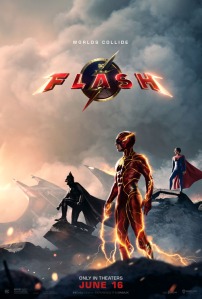
Released within two weeks of one another, two big summer movies take the concept of a multiverse, now becoming the norm in comic book cinema, and explore the imaginative possibilities and wish-fulfillment that it proposes, but only one of them does it well. Spider-Man: Across the Spider-Verse is the sequel to the Oscar-winning 2018 revolutionary animated film, and it’s a glorious and thrilling and visually sumptuous experience, whereas DC’s much-hyped and much-troubled movie The Flash feels like a deflated project running in place and coming apart. Let this be a lesson to any studio executive, that multiverses are harder than they look.
Barry Allen (Ezra Miller) has the ability to travel at fantastic speeds as his superhero alter ego, The Flash. He’s tired of being the Justice League’s errand boy and still fighting to prove his father is innocent of the crime of killing Barry’s mother. Then Barry discovers he can run fast enough to actually travel back in time, so he returns with the intention of trying to save his mother. Except now he’s an extra Flash and has to train his alternate self (also Miller) how to control his powers. In this different timeline, there is no Justice League to combat General Zod (Michael Shannon, so thoroughly bored) from destroying the planet for Kryptonians.
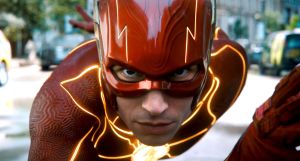
This is the first big screen solo outing for The Flash, and after none other than Tom Cruise, Stephen King, and James Gunn calling it one of the best superhero movies of all time, it’s hard to square how trifling and mediocre so much plays out as an example of a creative enterprise being pulled in too many directions. Miller was cast as the speedster almost ten years ago, and this tale has gone through so much tortured development, leaping through numerous filmmakers and writers, that its purpose has now gone from being a pillar of the expanding DC cinematic universe began with Zack Snyder’s Man of Steel in 2013 to becoming the Snyderverse’s death knell. The premise of traveling back in time is meant for Barry to learn important lessons about grief and responsibility and the limits of his powers, but it’s also intended as the reboot option for the future of these cross-connected comic franchises. It allows Gunn, now the co-head of the new way forward for DC movies and TV, to keep what they want (presumably Margot Robbie and Jason Momoa) and ditch the rest (Henry Cavill, Ben Affleck, Black Adam, Shazam, and Zack Snyder’s overall creative influence). So reviewing The Flash as only a movie is inadequate; it’s also a larger ploy by its corporate overlords to reset their comic book universe. In that regard, the quality level of the movie is secondary to its mission of wiping the creative slate clean.
Where the movie works best is with its personal stakes and the strange but appealing chemistry between the two Millers. It’s an easy starting point to understand why Barry does what he does, to save his mother. This provides a sturdy foundation to build a character arc, with Barry coming to terms with accepting his grief rather than trying to eradicate it. That stuff works, and the final talk he has to wrap up this storyline has an emotional pull that none of the other DCU movies have exhibited. Who wouldn’t want one last conversation with a departed loved one, one last opportunity to say how you feel or to even tell them goodbye? This search for closure is a relatable and an effective vehicle for Barry to learn, and it’s through his tutelage of the other Barry that he gets to see beyond himself. The movie is at its best not with all its assorted cameos and goofy action (more on both later) but when it’s a buddy comedy between the two Barrys. The older Barry becomes a mentor to himself and has to teach this inexperienced version how to hone and control his powers as well as their limits. It puts the hyper-charged character into a teaching position where he has to deal with a student just like him (or just him). It serves as a soft re-education for the audience alongside the other Barry without being a full origin story. The impetuous young Barry wanting to have everything, and the elation he feels about his powers, can be fun, but it’s even more fun with the older Barry having to corral his pupil. It also allows the character an interactive checkpoint for his own maturity and mental growth. Miller’s exuberant performances are quite entertaining and never fail to hit the comedy beats.
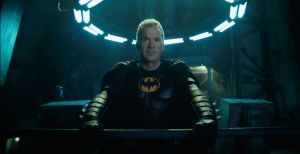
The problem is that the movie puts so much emphasis on too many things outside of its titular hero. Much was made of bringing back Keaton to reprise his Batman after 30 years. I just wish he came back for a better reason and had legitimate things to add. His role is that of the retired gunslinger being called back into action, and there’s an innate understanding with Barry wanting to go back in time and save his family, but too much of this character’s inclusion feels like a stab at stoking audience nostalgia (the callback lines all made me groan). I highly enjoyed Keaton as Batman and appreciated how weird he could make the billionaire-turned-vigilante, but he’s no more formed here than a hologram. The same thing happens with the inclusion of Super Girl a.k.a. Kara Zor-El (Sasha Callie). In this universe, there is no Superman, so she’s our requisite super-powered alien that Zod is hunting to complete his plans for terraforming Earth. She’s an intriguing character as a tortured refugee who has lingering doubts about whether humanity is worth the sacrifice, but much of her usage is meant only to make us think about Superman. She’s not given material to make her own impression, so she simply becomes the imitation of the familiar, the shadow to the archetype already being left behind. But these character additions aren’t even the worst of the nostalgia nods, as the final climactic sequence involves a collision of worlds that harkens to just about every iteration of the famous DC heroes, resurrecting several with dodgy CGI and uncomfortable implications (spoilers… the inclusion of George Reeves, when he felt so typecast as TV’s Superman that he supposedly killed himself because he thought his acting career was over, can be galling).
The action of The Flash is mostly fine but with one exceptional example that boggles my mind. In the opening sequence, no less, Barry is trying to help clean up a crumbling hospital when it collapses and literally sends a reign of babies falling through the air. I was beside myself when this happened, horrified and then stupefied that this absurd action sequence was actually happening. Barry goes into super speed to save the day, which more or less reverts the world into super slow-mo, though he needs to power up first, so we get a quick edit of him stuffing food into his face to load up on calories. We go from Barry breaking into a falling vending machine, stuffing himself in the face with snacks, getting the green light from his suit which I guess measures his caloric intake, and then grab a baby and literally put it in a microwave to shield it from danger. Just describing this event makes me feel insane. I figure the filmmakers were going for an over-the-top approach that also provides light-hearted goofiness to separate the movie from the oppressively dark grist of Snyder’s movies. However, this goes so far into the direction of absurdity that it destroys its credibility. It’s hard for me to fathom many watching this misguided and horrifying CGI baby-juggling sequence and say, “Yes, more please,” rather than scoff and shake their head. It’s not like the rest of the movie keeps to this tone either, which makes the sequence all the more baffling. There are Flash rules that are inconsistently applied to the action; Barry’s caloric intake is never a worry again, and the effects of moving a person during super speed don’t ever seem to be a problem except for one spewing gross-out gag.
While not being an unmitigated disaster, it’s hard for me to see the movie that got so many figures in the entertainment industry raving. The Flash has some notable emotional stakes, some amusing buddy comedy, and some goofy special effects sequences that run the gamut from amusing to confounding, but it’s also quite a mess of a movie, and too many of its nods to the fandom feel like empty gestures of nostalgia compensating for imagination. For all it gets right, or at least keeps interesting, it seems like another cog in a multi-billion-dollar machine, a stopping point also intended to be a reset and starting point. It feels like the character wasn’t trusted enough by the studio to lead his own solo movie even after years of buildup with Miller, nine seasons of the popular TV series, and 80-plus years of prominent placement in DC comics.
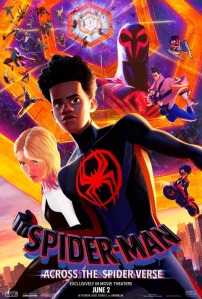
Conversely, Across the Spider-Verse is a sequel that expands an already stuffed story but knows what stories and themes to elevate so they don’t get lost amidst the fast-paced lunacy. Taking place a year later, Miles Morales (voiced by Shameik Moore) has grown into his role as the new Spider-Man for his world. He strains to meet the expectations of his parents, and keep up his grades, while fulfilling the duties of a superhero jumping into danger. When Gwen Stacey (voiced by Hailee Steinfeld) reappears to discuss joining the multiverse police, Miles jumps at the chance, having genuinely missed his other Spider friends, especially Gwen. There are countless Spider people in countless worlds, even including a Spider-T. Rex and a Spider-Car (Peter Parked Car, I believe the name was). Miguel O’Hara (voiced by Oscar Isaac) is the Spider-Man tasked with keeping order across the many interconnected multiverses, and he insists that sacrifice is essential to maintain balance, one that hits too close to home for Miles to abide.
The 2018 original is a hard act to follow, and while Across the Spider-Verse doesn’t quite overrule its predecessor it is a more than worthy sequel that has everything fans loved about the first trip. The visual inventiveness has been taken even higher, with the mixture of even more different animation and art styles. I loved seeing each Spider person and how they fit into their unique art style of their world, like the living water colors of Gwen’s world and the punky paper collage style of Spider-Punk (voiced by Daniel Kaluuya). There’s a villain that comes from a paper universe, so he resembles a three-dimensional paper construction with hand-scribbled notes appearing around him like Da Vinci’s commentary. There is something to dazzle your senses in every second of this movie. The visuals are colorful, creative, and groundbreaking with the level of detail and development. There’s probably even too much to fully take in with just one viewing. I want to see the movie again not just because it’s outstanding but so I can catch the split-second vernacular asterisk boxes that pop up throughout the movie. Going further into living comic book aesthetics, new characters will be introduced with boxes citing their comics issue reference point, and certain names and vocab will get their own citations as well. These are split-second additions, nothing meant to distract from the larger narrative. Simply put, this is one of the most gorgeous looking movies of all time, animated or live action. It’s bursting, thrumming, nearly vibrating with life and love stuffed into every nook and cranny, and it’s exhilarating to just experience a vivid, thriving world with animators operating at peak talent.

However, the movie has an engrossing story to better position all those eye-popping visuals. The worry with any modern multiverse story is that the unlimited possibilities of variations and opportunities for characters to do just about anything will overwhelm a narrative, or like The Flash, become a checklist of overburdened and empty fan service. The screenplay by Phil Lord, Christopher Miller, and Dave Callaham is all about relationships. If Miles’ relationship with his stern police lieutenant father (voiced by Brian Tyree Henry) wasn’t such an important focal point, then the emotional stakes of the movie would be meaningless. We see a relatable struggle from both sides, the parents trying to connect with their growing child and give him enough space to find himself, and the child who clearly loves his parents but doesn’t fully appreciate or understand their concerns. They worry about Miles leaving them and whether others will love and support him like his parents. Miles has to experience a wider world of possibility, but these experiences make him appreciate what he has at home, and what could be permanently lost. I don’t mind saying there were more than a few moments that caused me to tear up. I found Gwen’s storyline equally compelling, and her turmoil over keeping her secret identity and then coming out to her father was rather moving. The family bond resurfacing will get me every time, and the simple action of a hug can be as heartwarming and fulfilling as any romantic ode. Across the Spider-Verse makes sure we care about the characters and their personal journeys.

At a towering 140 minutes, this is the longest (American) animated movie ever, and it’s still only one half of a larger story. I knew ahead of time this was only the first part so as soon as we entered Act Three I kept gearing up for the cliffhanger ending. Every five or so minutes I thought, “Okay, this is going to be the end,” and then it kept going, and I was relieved. Not just because I got to spend more time in this unique universe but each new moment added even more to raise the stakes, twist the intrigue, and make me excited for what could happen next. I was shaking in my seat at different points, from the excitement of different sequences to the emotional catharsis of other moments. I cannot wait to experience this same feeling when the story picks back up reportedly in March 2024, though I fear it will get delayed to late 2024.
Even with the unlimited possibility of jokes and silly mayhem, the filmmakers keenly understand that it doesn’t matter unless we care about the characters and their fates. I am shocked that a goofy character I thought was going to be a one-scene joke, The Spot (voiced by Jason Schwartzman), could end up becoming the ultimate destroyer of worlds. I think this reflection nicely summarizes the impeccable artistry of Across the Spider-Verse, where even the moments or characters misjudged as fleeting or inconsequential can be of great power. It’s a movie that is full of surprises and thrills and laughs, all in equal measure, and a blessed experience for a movie fan. In the crush of comic book multiverse madness, Across the Spider-Verse is a refreshing and rejuvenating creative enterprise, one that builds off the formidable talent of its predecessor and carries it even further into artistic excellence that reminds us how transporting movies can be. If you see one superhero multiverse movie this summer, the choice should be as obvious as an inter-dimensional spider bite.
Nate’s Grades:
The Flash: C
Across the Spider-Verse: A
Share this:

Morbius (2022)
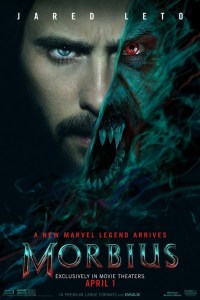 Not the train wreck the advertising made it seem, Morbius is merely a bland superhero retread that reminded me of the early 2000s superhero output like Daredevil and the Tim Story Fantastic Four. Having been delayed almost two years thanks to COVID-19, the film was released on April 1 for full unintended irony, and it’s a silly mess but also nothing worth getting too worked up over. Method actor extraordinaire Jared Leto (Suicide Squad) plays Dr. Michael Morbius who is suffering from a rare disease and finds a solution via a serum mixing vampire bat DNA but it has some consequences. He has super powers but needs to feast on blood every six hours and is dreading the point where he may not be able to resist the allure of feeding on humans. It’s a very Jekyll/Hyde concept, man trying to control his inner demons made literal, and once again we have a villain that essentially has the same powers as the hero. Matt Smith (Doctor Who) play’s Morbius’ childhood friend who also suffers from the same rare blood disease, but Dr. Morbius refused to share the cure because he explains it’s a “curse,” although maybe let the man suffering make that personal health choice. Bless you, Matt Smith, because you’re the only one having any fun with this movie, and that includes in the audience. Leto is actually fine though not much about the Morbius character is really imparted. The action sequences are erratic and the stylistic flourishes, like the “look at me” slow-mo ramps and the inexplicable wispy colorful smoke clouds trailing Morbius in action, hamper the ability to even discern what is happening onscreen. Maybe that’s on purpose after two years delay. The movie establishes a basic structure, series of goals, antagonist, and problems efficiently enough to make it to the end credits after 90 minutes. It’s just that we’ve come to expect better from our super hero cinema by now. As a disposable monster B-movie, Morbius is okay. It’s not recognizably campy, it’s not so-bad-it’s-good, it’s just a generic origin story/Dr. Jekyll and Mr. Hyde territory with a lot of dropped subplots and subpar CGI. I have my serious doubts about Sony’s plan to hatch solo movies for all these different Spider-Man villains, and the creakiness of this plan is even more evident with their contrived post-credit scenes trying to awkwardly establish their retinue of villains to confront Spider-Man. Does Morbius know who Spider-Man even is? Morbius the movie and character just feels too half-hearted for anyone to care.
Nate’s Grade: C
Share this:

Trial of the Chicago 7 (2020)/ Borat Subsequent Moviefilm (2020)
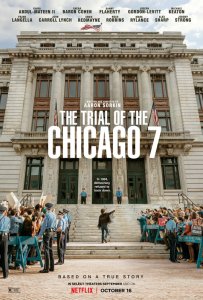 Two new movies have been released for streaming, both coincidentally starring Sacha Baron Cohen, and both are highly political, one by design and the other through fortuitous circumstances of history regrettably repeating itself, and both are simultaneously everything you would expect from their creative forces and worth watching in our tumultuous times.
The Trial of the Chicago 7 is a courtroom drama depicting the injustices applied to a dispirit group of anti-war activists who were charged with inciting a riot at the 1968 Democratic National Convention. The various men of different backgrounds and affiliations had their reasons for being there to protest, whether it was building public support to end the Vietnam War, to gain personal publicity, or to get laid, and tensions mounted inside and out the group as the police plan to send a message, harassed protesters, and in one amazingly prescient moment, remove their badges and name tags to then inflict state-sanctioned violence. This is an Aaron Sorkin movie through and through, and his second offering as a director after 2017’s Molly’s Game, and the best thing about the Oscar-winning wordsmith is that watching one of his movies feels like you’ve just downloaded a complete syllabus. The sheer audacious density of information can be overwhelming, but when Sorkin is able to get into his well-established rhythms, the actors feel like wonderful pieces in an orchestra playing to its peak. The real-life story of the activists has plenty of juicy drama and intriguing characters and intra-group conflicts breaking open, mostly between the divided poles of political leaders Tom Hayden (Eddie Redmayne) and counter-culture prankster Abbie Hoffman (Cohen). Bobby Seale (Yahya Abdul Mateen, HBO’s Watchmen) could have gotten his own movie and suffers many of the worst indignities as a member of the Black Panthers who was grafted onto the case in order to make the rest of the indicted men seem scarier by association. The consistent interference by the trial judge (Frank Langella) is shocking. It’s so transparently biased, racist, and unprofessional that I have to believe that many of these anecdotes actually happened because otherwise they seem so absurdly prejudicial that nobody would believe this happened. For a movie with such a sizeable cast of trial litigants, lawyers on both sides, friends and family, and maybe every police officer in Chicago, it’s impressive that Sorkin is able to provide so many with great Sorkin moments, meaning those grandstanding speeches, cutting one-liners, and intensive cross-examination. Not everyone is on the same level of importance. Several of the Chicago 7 are merely bodies on screen, two of the guys serve as little more than a quip-peddling Greek chorus. You sense there’s more being left out to fit into a crammed yet tidy narrative that plays to our demands for satisfying character arcs, reconciliation, and a morally stirring final stand. As a director, Sorkin doesn’t distinguish himself but he lets his meaty script and the performances of his actors get all the attention. The editing, like in Molly’s Game, can be a bit jumpy but it’s to serve the sheer size of information being downloaded during the 129 minutes. The political parallels for today are remarkable and a condemnation of our modern times. The Trial of the Chicago 7 is an invigorating and, at points, exhausting film going experience that can feel like a retro, overstuffed special episode of The West Wing. It’s everything you should expect and want in an Aaron Sorkin courtroom drama, so if you’re already in that anxious camp then this Netflix original will be preaching to the overly verbose choir.
 Secretly filmed over the past year, Sacha Baron Cohen reprises his outlandish Borat character to once again lampoon people’s not-so-hidden prejudices, anti-Semitism, xenophobia, and misogyny, which seem to have only gotten worse since the first Borat movie in 2006. The flimsy story follows international journalist Borat returning to America to help improve the standing of his home nation Kazakhstan by offering his daughter Tutar (Maria Bakalova) to the Trump administration. It’s really just a platform for Cohen to adopt a series of disguises (his Borat is too recognizable) and dupe some rubes while exploiting their ignorance and patience. Much of the entertainment comes from the cringe-inducing interactions of how far Cohen and Bakalova will go, marveling at their improvisational skills and also dreading what lines they might cross next. I was laughing fairly consistently, though the schitck naturally won’t be as funny the second time around, even with a 14-year gap in movies. I was really impressed by Bakalova and her own commitment and quick-thinking, keeping pace with a pro like Cohen and really stealing the show because Borat can’t go out in public as before. There are some outrageous moments that work, like Cohen imitating a country singer leading an anti-masking crowd into a singalong with ridiculous verses, and some that simply don’t, like an ongoing stretch where Bakalova explains the appeal of masturbation to a gaggle of deadly silent Republican ladies. Sometimes the comedy seems so broadly caricatured that it’s questionable whether its helpful or harmful, especially the anti-Semitic tropes that Cohen embraces as means of satire. Saying something outrageous to an outraged or shocked party isn’t quite enough. When compiling these hidden camera comedies, they thrive on the oxygen given to them by the targets of the prank. If they don’t really engage, it can feel a bit tired and desperate. I’d say the ratio of hits-to-misses is about half and half but the movie has enough big moments to keep fans happy. The most notorious moment has already been widely disseminated through social media and serves as the climax of the movie, strangely both as the high-point of pranks with big names but also as the emotional catharsis. Tutar poses as a foreign journalist and interviews Trump surrogate Rudy “America’s mayor” Giuliani, who drinks, goes into a hotel bedroom alone with Bakalova, and then lays on the bed while slipping his hand down his pants (like a gentleman does). Borat realizes he doesn’t want to offer his daughter to this creepy, sleazy man and rescues her because he truly does care about her. Borat 2, or Borat: Subsequent Moviefilm, takes a scattershot approach to satire and squarely aims at the science-denying MAGA crowd celebrating the excesses of their leader (who doesn’t sound that different from Borat, come to think of it). It might be more admirable in intent than execution but the new Borat can provide a few belly laughs and a more than a few groans as Cohen attempts to make American funny again.
Nate’s Grades:
Trial of the Chicago 7: B+
Borat: Subsequent Moviefilm: B-
Share this:

Dumbo (2019)
 Director Tim Burton has always been attracted to the weirdos, the outsiders, the freaks, so it seems fitting that he attached his name to a big-budget, live-action remake of Disney’s 1941 animated film of the flying pachyderm, Dumbo.
Shortly after World War I, Holt Farrier (Colin Farrell) is returning home and reuniting with his two children, Milly (Nico Parker) and Joe (Finley Hobbins). They’re rebuilding in the wake of their mother’s loss and Holt’s war amputation. He and his horse-wrangling wife used to be the star attraction for their traveling circus run by Max Medici (Danny DeVito). The circus is on hard times until Max purchases a pregnant elephant that gives birth to a big-eared baby with a special ability to fly. Suddenly the crowds come pouring back and a bigwig like V.A. Vandevere (Michael Keaton) sees a big opportunity. He offers the circus to move to his state-of-the-art theme park, Dreamland, and for Dumbo to perform with his famed trapeze artist, Colette (Eva Green, seeming to take the mantle of Burton’s Raven-Haired Muse, after Helena Bonham Carter, and before her Lisa Marie, and before her Wynona Rider — seriously, look it up, there are only four movies in his whole career that don’t feature these actresses). The big new stage only serves as a reminder of how lonely Dumbo is and the family plots to reunite him with his mother.
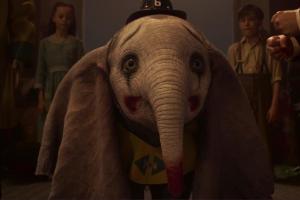 As we enter a precipitous new age of Disney live-action over saturation, each new remake must be asked the question, why does this film need to exist? I feel like we can classify the glut of live-action remakes into two categories, namely the older, less revered films and the newer, more revered. Take for instance two 2016 remakes, The Jungle Book and Pete’s Dragon, as both films felt enough distance from their sources’ release that they had the comfort to be different. In the case of both movies, especially the beautifully lyrical Pete’s Dragon, I’d say they are improvements. But those movies are old and the nostalgia for them is minimal. That’s the not the case for films like Beauty and the Beast and Aladdin and The Lion King, where the originals are beloved by an audience that still remembers them fondly and vividly, now slightly older, and looking for fidelity rather than artistic invention. When the live-action 2017 Beauty and the Beast, an otherwise dreary and pointless remake of a new classic, makes a billion dollars, Disney has a pretty clear indication of what the wider audience wants with their remakes. Dumbo is a movie that actually has some room for new artistic life, especially with a talent like Burton adding his own signature dash of razzle-dazzle. There are some things from the source material that could use further examination, like animal abuse, and some things from the 1941 original that could deservedly be eliminated, like the racist “Jim Crows.” It may be early but I think Dumbo will be my favorite of the 2019 Disney remakes.
There’s an enjoyable sense of whimsy and wonder to the film that also belies a darker underbelly, something that Burton has featured since Beetlejuice and Edward Scissorhands. Early on, Burton and screenwriter Ehren Kruger (Ghost in the Shell, The Ring) establish the world by returning dear old dad back but with one less arm. It undercuts the reunion and also leads to a crossroads of mounting questions about his viability as a performer and adaptability. The children and the father are the real stars of the film, a family trying to reconfigure their new identity in the absence of their mother and the readjustment of their father after he can no longer be a headliner. It’s enough to ground the movie emotionally and provide a sense of stakes. The motley crew of circus performers and sideshow acts serves as a non-traditional family unit, a found family, and one fighting for their own slice of dignity. I’m likely reading more into this than intended but the fact that I can shows that Burton and company at least put in solid efforts to stake a foundation. The wonderfully macabre, askew Burton elements are present as well, especially in the production design for Dreamland, which looks like another fantasy neighborhood straight out of Halloweentown in Nightmare Before Christmas. The presence of Eva Green is another enjoyable highlight as a French acrobat that becomes close to Dumbo and the Farrier family as a whole. It’s sweet with a little touch of the eccentric, which is another fine way of describing Max Medici and DeVito’s affectionate performance. There is an offbeat sense of humor to and visual whimsy to the film that works with the standard heartwarming family elements rather than against it. It’s a movie that can hit you in the gut and then make you smile the next minute.
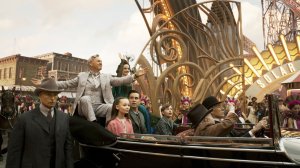 Dumbo is less a character than he is a symbol, but it works for the most part even if it hampers the larger storytelling prowess of the film. He’s a symbol for every person to import their own feelings, an outsider who feels like they do not belong. He’s also a symbol of innocence as a gentle animal, something to tug at the heartstrings when he’s mistreated or separated from his mother. It’s hard not to feel something when the camera gets the special close-up for his big, soulful eyes. He’s even more sad looking in garish clown makeup. The animal rights angle isn’t heavy-handed but enough to get you feeling sympathy for poor creature. It sets up a big escape to reunite mother and son and free them from captivity that reminded me of a 90s kids movies, but not necessarily in a negative way. I think that’s one of the achievements of Burton’s movie is that he has reshaped an older children’s movie model with his unique touches. It’s a far more successful alchemy than 2010’s dull Alice in Wonderland.
I also have to call special attention to Michael Keaton’s villainous character specifically because it is an obvious stand-in for Walt Disney. Not only does he own a theme park, where the customers come to him rather than the other way around, but also he’s a showman who’s underhanded, greedy, and backbiting, ready to cut anyone loose. There’s even a scene that shows him comically inept when it comes to actually performing any actual practical skill, like controlling an electrical panel (Keaton’s exaggerated movements made me think of a child pretending to be an adult at work). Keaton is also wonderfully daft as the blowhard. He feels like he’s in a very different movie that only he knows about, and while it didn’t exactly fit it made every one of his scenes more entertaining. Burton and his team were biting the hand that feeds them, calling into question the intentions and actions of the man that gave birth to the empire, and Disney miraculously approved of this. Maybe they felt they had gotten so big (sayonara, 20th Century Fox) that criticism didn’t matter, or maybe it somehow slipped under their collective radar, I cannot say, but its inclusion is both welcome and fascinatingly bizarre for a 2019 Disney release.
At its core, Dumbo is an enjoyable if limited remake, a movie that sets its ambitions low but sets out to try a few different things with modest success. There are some scenes that go too far, whether it’s the extended reaction shots of crowds vocally heckling… an elephant, or a pretty lazy message that we can all be special because of what we have inside, that reminded me what the finished film could have been, namely far worse. It doesn’t quite soar but it does rise above my expectations and kept me pleasantly entertained.
Nate’s Grade: B
Share this:

Spider-Man: Homecoming (2017)
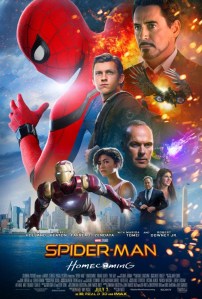 15 years. 6 movies. 3 different lead actors. 2 reboots. I wouldn’t be surprised if a majority of the American public likely knows more about Spider-Man than their relatives. In 2002, the first Spider-Man movie kicked off the new century by affirming to studios that superhero movies are a sound financial investment. Director Sam Raimi and Tobey Maguire kicked off the glut of superhero cinema, paving the path for the massive Marvel Cinematic Universe (MCU) and its own unparalleled run of financial and critical success. Then the overreach killed off Raimi’s Spider franchise in 2007 and overreach again killed off Sony’s Spider reboot in 2014. Sony wisely sought out an assist from the gurus of Marvel, striking a deal and having the web-slinger return to the MCU. Fans rejoiced. Spider-Man: Homecoming announces itself as a brash, exhilarating, hilarious, and amazingly assured film that immediately lines up with the upper tier of the MCU. Marvel should use this as Exhibit A, submit it to Fox, and say, “Here’s how we can do your franchises better.”
Peter Parker (Tom Holland) is your ordinary 15-year-old from Queens, New York who was given amazing powers after being bit by a radioactive (or genetically modified) spider. It’s been weeks since he was called into action by Tony Stark (Robert Downey Jr.) to thwart Captain America (Chris Evans). Now Peter is back home and waiting for his literal call to adventure, for Stark to officially call him up to join the Avengers. Peter anxiously waits for school to end so he can don his Spider-Man suit, modified by Stark Industries, and fight local crime and injustice. This mostly amounts to stopping bicycle thieves, helping old ladies with directions, and other inglorious tasks. Peter’s Aunt May (Marisa Tomei) would prefer he focus on his studies rather than the time he’s been spent on the “Stark internship” (his fib to cover said crime-fighting). New weapons begin appearing on the streets, built from the discarded alien technology from The Battle for New York. Spider-Man investigates the source, Adrian Toomes (Michael Keaton), a pilot who adopts the moniker of The Vulture while in the sky with his winged jet pack. The formidable weapons pose a real pressing danger to society, and Peter pushes further, at his own peril, to confront the Vulture and stop the flow of high-tech weapons.
 For many fans of the webhead, this will feel like the first time they’re watching the Spider-Man of the comics on screen. This is the first film incarnation where Peter remains in high school for the entire duration of the movie, and it’s also thankfully the only telling that eschews an origin story. He just is Spider-Man, however, the arc of the movie is him settling into that identity. It’s in many ways a coming-of-age story for the superhero set, as Peter has to come to terms with his earnest desire to help others and his own maturation, both as Spider-Man and as a high school sophomore. He’s learning just as much to be Peter as he is Spider-Man. Just because he has these powers doesn’t mean he’s ready for the rigors of the world. Homecoming is very much a high school movie. There are familiar John Hughes influences throughout, and the film smartly subverts certain high school tropes (driving lessons, prom dad from hell). It presents our hero struggling with asking the cute upperclassman (Laura Harrier) to the dance just as much as the demands of being a fledgling local superhero. His interior life is much more available and relatable but he’s still a teen navigating the world. Also, by having Peter be the youngest film incarnation yet, it allows for the satisfying indulgence of superhero wish-fulfillment. Whereas the X-Men powers are naturally linked to the progression of puberty, those are usually portrayed as a curse, something that ostracizes, confuses, and produces great anxiety and fear. With Spider-Man, being a superhero is the coolest thing in the world. He’s not consumed with angst like Andrew Garfield’s broody Peter Parker and his weirdly special DNA (what was the deal with his parents and that conspiracy? Oh well). Watching this exuberant Peter Parker embrace his new abilities with glee is a great way to keep the movie light and bouncy.
This is also, bar none, the funniest film yet in the MCU (yes, even dethroning Guardians of the Galaxy). With the lighter tone, the movie finds consistent opportunities to inject comedy, from the irony of Peter trying to lead a normal life, to the awkwardness of Peter’s attempts at crime-fighting, to his over eager demeanor, to misunderstandings and hasty excuse-making to conceal his double life, to the sterling supporting cast of characters that contribute different flavors of jokes when called upon. If anything there is so many talented supporting players I wanted even more time with them (Donald Glover, Hannibal Buress, Martin Starr). This cast is a comedic embarrassment of riches.
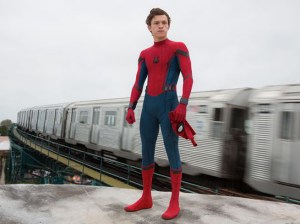 I was laughing pretty much from beginning to end with Homecoming. Just thinking back on the school’s morning announcements (complete with anchor Betty Brant) makes me giggle. Peter’s best friend Ned (Jacob Batalon) is the movie’s chief source of comic relief, and in less careful hands he would become rapidly annoying. Instead, he’s a reliable presence and given a character arc with a payoff of his own, his desire to be Peter’s “guy in the chair.” It’s genuinely impressive screenwriting when even the comic relief sidekicks have arcs. Zendaya does an impressive job of selling every one of her jokes, which traffic in a very specific smart-aleck, apathetic tone. She’s graduated from the Disney Channel to the bigger leagues. There’s a hysterical series of inspirational education videos featuring Captain America, and if you stay past the end credits there’s a great payoff for that. There’s even some sly meta jokes calling back to Raimi’s Spider-Man. Every joke at least lands and most of them hit hard, benefiting from strong development and timing.
Nevertheless, just because it happens to be one of the funniest movies of the year, Spider-Man: Homecoming still finds plenty of space to be dramatic and thrilling. The comedy doe not tonally detract from the other elements. This is not an insubstantial movie just because it knows how to have some fun (take notes, Zack Snyder and DC). This is not a flippant movie because of tone or the heavy joke quotient. There are sincerely sweet moments born out of the characterization, like when Aunt May takes it upon herself to teach Peter how to dance (this would not be possible with a geriatric Aunt May). Director Jon Watts (Cop Car) has a steady command with his high-flying visuals and maintains the tight walk of tone that allows all the elements to work together as a blissful whole.
There are superb action sequences that advance the story forward and allow for the characters to grow. It’s exactly what good action is supposed to do, besides, you know, quicken the pulse. The humor can also arise naturally from these set pieces. Take for instance Peter suiting up while attending a suburban house party. He spots some alarming energy discharges on the other side of the suburb, but without any tall buildings for him to latch onto, he has to hoof it the whole way on foot. It’s a smart comedic aside and it helps to remind us that this Spider-Man isn’t an instant pro after getting his powers. It all comes together best in a D.C. rescue at the Washington Monument. It bridges the personal with the action. The bifurcated ferry set piece serves as the Act Two break and it’s a killer segment that pushes Peter to his limits to solve a dilemma that seems incapable of being fixed. There may not be any action scene to rival Raimi’s finest but the character-centric action and the organic development of the complications lays a foundation for a consistently entertaining film littered with joyful payoffs.
 The biggest fear I’ve read from Spidey fans was that the involvement of Robert Downey Jr. would tip the scales, turning a Spider-Man movie into a defaco Iron Man sequel. Considering America loves Iron Man, I don’t see how his inclusion is a problem. Civil War was still very much a Captain America film even though Iron Man was the co-lead. Tony Stark represents a distant mentor for Peter and also the gatekeeper. Peter is anxious to become an Avenger and looking for Stark’s approval, which brings an enjoyably unorthodox paternal side from Downey. If there is a complaint I can foresee, it will be that Spider-Man is too similar to Iron Man thanks to the special suit. Spider-Man’s suit has its own Jarvis-style A.I. program (adeptly voiced by Jennifer Connelly, wife to Paul Bettany, former voice of Jarvis) and extra special gadgets including a spider drone and unusual web shooting options. It provides a new sense of discovery for the character since we’re already starting with him powered. The second act is Peter getting accustomed to the boost his suit gives him, becoming reliant upon them, and then having it stripped away as a natural Act Two break so that the conclusion has even more stakes without the security of the suit. It makes Peter much more vulnerable. The Iron Man parts are more a background motivational force and this is still very much a Spider-Man film.
Holland (The Lost City of Z) is already my favorite Spider-Man. Period. He made such an immediate and strong impression in Civil War that I was greatly looking forward to his first big starring venture, and Holland does not disappoint. This is the first Spider-Man that doesn’t feel crushed by the heavy burden of being a superhero. He’s a kid eager to grow up and join the world of other caped crusaders, but he’s modeled his crime fighting from what he’s seen on TV. He doesn’t really know what he’s doing. He’s still an awkward kid, and Holland brings great authenticity to the smaller character moments and the bigger heroic strides (while maintaining a convincing American accent). This is a more relatable, vulnerable, and interesting Peter Parker. Even though he thinks he should be beyond the mundane life of high school, he doesn’t ever act pompous or look down on other characters, which is endearing. At times Holland feels like he’s going to explode with energy, as if life is too much to process in the intermediary. He’s a teenager and the world feels so big and open. It’s an instantly engaging and likeable portrayal that wonderfully capitalizes on the introduction from Civil War. This is a Spider-Man, and his spider world, that I want multiple sequels to further explore and challenge.
 Keaton’s Vulture already ranks as one of the best villains in the MCU (a low bar, I admit), and that’s because the movie humanizes him and gives him significant moments. He’s just a regular working-class man trying to provide for his family. In fact the first five minutes of the movie focus exclusively on Toomes and explains his sticky situation. He feels cast aside by those in the upper echelons of power. His eventual “you and I are the same” speech to Spider-Man has credible points. You can see, from his perspective, how he’s an underdog sticking it to the rich elites. Shockingly, there’s only one death in the entire movie and even that is an accident. Toomes is not your standard comic book villain, and there’s a brilliant third act twist that makes him even more centrally involved in the narrative. That opens a delicious sequence of dramatic irony. Keaton has a quiet menace to him that’s very unsettling. It’s all in the lower register. His character doesn’t blow up. He just narrows his brow and intensifies that scary stare. I’m glad the filmmakers realized that more Keaton was an asset to the film.
Let’s also take some time to celebrate the sixth Spider-Man movie for having a diverse population of characters that would actually represent Queens. Peter’s best friend is of Filipino descent, the girl he crushes on is biracial, the loner girl is biracial, and even the high school bully, Flash Thompson, is Hispanic, played by Tony Revolori from The Grand Budapest Hotel. This might be Marvel’s most diverse cast yet, though “yet” being the operative word considering that Black Panther is arriving in early 2018.
This movie is a total blast. Spider-Man: Homecoming actually manages to give new life to a character that has already appeared in five other movies. That’s an amazing feat. Another amazing feat is that six different screenwriters, including the director, are credited with this movie, yet it feels fully coherent in its vision and presentation. This is Peter Parker, the teenager struggling with self-doubt, hormones, and an eagerness to grow up, and the movie feels much more human-scaled, forgoing giant CGI smash-em-ups for something more grounded, personally involving, and ultimately successful. Just because Homecoming is fast-paced and funny doesn’t mean it lacks substance. I was elated during long portions of this movie, impressed by the steady stream of setups and payoffs, the incorporation of the many characters and comedic voices, and the varied action set pieces that were focused on character progression. If you are tired of superhero stories, I’d still heartily recommend this movie. Dear reader, I feel like I’m failing you and turning into a frothing fanboy because I can only think, at worst, of negligible quibbles against the film. Everything in this movie works. Everything. It’s everything I was hoping for and then some.
Nate’s Grade: A
Share this:

The Founder (2016)
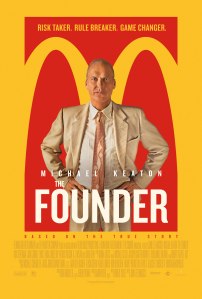 The Founder aims to be The Social Network of hamburgers and milkshakes, a warts-and-all biopic of a huckster who glommed onto other’s success and transformed it into an empire, a pragmatically ruthless entrepreneur run rampant with ambition and leaving behind a trail of lawsuits and disgruntled little people. Michael Keaton, on a roll since Birdman, teams up with screenwriter Robert Siegel (The Wrestler) and director John Lee Hancock (Saving Mr. Banks) to bring to life the story of the man behind the ubiquitous golden arches. The details are routinely fascinating and the movie presents a larger thesis on shifting and conflicting concepts of the American Dream and whether a ruthless yet victorious huckster is to be celebrated, pitied, scorned, or all of the above.
In the mid 1950s, Ray Kroc (Keaton) was a struggling milkshake mixer salesman striking out with just about every drive-in and dinner in the Midwest. His wife Ethel (Laura Dern) is exasperated by Kroc’s flights of fancy, shilling whatever new product might be his ticket to riches. His life changes thanks to one very efficient hamburger stand in San Bernardino, California. The McDonald brothers, Mac (John Caroll Lynch) and Dick (Nick Offerman), have ordered eight of Kroc’s milkshake mixers because they can barely keep up with demand. Kroc travels out West to see for himself and discovers a tasty and speedy hamburger assembly line that nobody else is doing. He pushes the McDonald brothers to franchise their model with him in the lead. They’re wary but agree with a strict contract that still gives full executive decision-making to the brothers. Kroc languishes at first but finds growing success, barely able to keep ahead with the mounting overhead costs. Kroc wants to keep going but the McDonald brothers are unyielding over their terms of business. Kroc schemes to push them out of their own business, establish himself as the founder, and take their very name for himself.
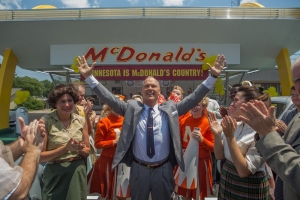 Firstly, the story of the formation of McDonald’s is probably far less known than the formation of Facebook, and this provides plenty of opportunities for illumination. It is an inherently interesting story. There’s the invention of the modern-day fast food assembly line and the difficulty in perfecting this process and getting customers acquainted with the new reality. Initially, after years of drive-in service, customers are befuddled that they have to physically walk up to a window and order and throw away their own trash. The early history, hiccups, and adjustments are interesting, but it all gets more engrossing once Kroc comes aboard. It’s here where the film becomes very business-like in its examination of Kroc’s ruthless business tactics that lead to his ascent. Without Kroc’s intervention, perhaps the world would never have known the name McDonalds. He’s not an instant success either. He’s already middle-aged when he comes across the McDonald brothers. He’s not a brilliant salesman by nature. He’s cunning and doggedly persistent, the key he tells us since the world is rife with talented, educated, and good people who go nowhere. Kroc is a constant motor that can never be satisfied. Ethel asks him if anything will ever be enough, and after a short pause he replies without pretense, “Probably not.” He cannot enjoy success because he always feels he should be entitled to more. It’s the kind of unmoored ambition that leads him to throw his litigious weight around, knowingly breaking legal contracts and handshake deals to get exactly what he wants. Kroc’s business triumphs will remind certain viewers of Donald Trump, a man who uses similar advantages of wealth to exploit others and force them into advantageous deals. Even when explicitly in the wrong he just rolls along undeterred.
It is Keaton’s (Spotlight) movie and he more than delivers under pressure. Keaton adopts a speaking affect that makes the character weirdly magnetic without being wholly charming, an interesting combination that reflects the conflicted nature of Kroc. He’s a fast-talking salesman who enjoys the sound of his own voice but he doesn’t fool himself. He’s a man who knows what he wants and it just happens to be everything. He knows his limitations but he strides forward. He is bursting at the seams to get out from under the thumb of the McDonald brothers, who he sees as limiting the growth of a company that is more his than theirs. Kroc delights in being treated to the upper echelons of power. He loves having people proverbially kiss his ring and lavish his greatness. It’s the story of a man who scraped by his entire life until stumbling upon someone else’s genius idea. Keaton plays the man with a wily canniness that is always entertaining, channeling the actor’s natural oddball energy and style into a Midwestern McBeth. He says if he saw his competitor drowning he’d “shove a hose down his throat.” He’s generally cold but Keaton and Siegel don’t present him with a standard redemption arc. He’s kind of a hapless jerk at the start and becomes a powerful, egotistical jerk by the end. Keaton’s layered performance gives the film a solid anchor to keep viewers invested in the film.
 If only the other parts of The Founder had as much nuance and care as Keaton’s role. The supporting characters have flashes of interest but are too relegated to be much more than symbols or less developed foils to Kroc. The McDonald brothers have a poignant level of tenderness to them but they’re set up to be symbols of American values that will inevitably be trampled upon by Kroc’s corporatist version of the American Dream. Mac is the hopeful and trusting brother, Dick is the no-nonsense devote to quality and ethics, and together they could use additional ambiguity or depth. They’re meant to represent an older way of doing business, the familiar edict that hard work, dedication to customers, and quality will pay off. The brothers are successful and content at their level of success; they lack the naked ambition of Kroc and his disregard for the rules. They’re set up to be defeated and swindled and victims of Kroc’s tactics, which limits them as characters. There’s a sliver of detail with Dick’s concern for his brother’s diabetes threatening him, but the brothers are more martyrs than anything else. You anticipate their defeat with slight dread but more a sense of impending inevitability. Their good-natured values are no match for the winner-takes-all mentality of a man on a mendacious mission.
Similarly, Kroc’s wife is another figure set up from the start to be trampled upon. She’s supportive but not supportive enough Kroc feels. Like the McDonald brothers, she’s too content within her station and what she deems a good existence, a life of dinners at the club with a retinue of upper middle class friends. Ethel is a plain looking woman of simple pleasures. You already know that there’s a ticking clock before Kroc will trade up. With these expectations, more could have been done to establish her character. Too often Kroc’s selfish, indifferent, or casually hurtful broadsides are treated with silent suffering from Ethel. She’s set up as a walking pained reaction shot. It almost gets to comical levels as the pattern repeats itself and you anticipate a slightly elongated, wounded reaction shot. Kroc’s second wife, Joan Smith (Linda Cardellini), is a sweetly smiling prize but proves herself more than a pretty face. She shares Kroc’s ambitions and proposes swapping real milk for instant milk mix to save refrigeration costs. There’s obviously more to this woman, who we meet already married to a business associate of Kroc’s, but the movie keeps her as a mostly symbolic, almost Fitzgerald-esque trophy. The other side characters that come into Kroc’s orbit, B.J. Novak’s scheming real estate fixer, Kate Neeland’s esteemed secretary, Justin Randell Brooke’s loyal lieutenant, are clipped so that they only appear in the film when they offer some service or advice useful to Kroc. Perhaps there’s a meta level here exploring how Kroc views those seemingly closest to him in strict transactional terms, or perhaps I’m just reaching for more.
 The other liability from an otherwise still entertaining script is the director. Hancock is better known for softer, feel-good films about American values. The Founder is a story that subverts all of those notions and Hancock doesn’t seem to master the skills in order for the satirical and darker implications to land. The onscreen visuals seem to clash with the movie’s overall disquieting tone. The colors are bright and the musical score by Carter Burwell seems curiously jolly at points, confusing the tone of darker scenes. It just doesn’t feel like Hancock had a good feel for the material and how best to execute it. It feels like he’s missing the layers of potential with Siegel’s screenplay. I’ll readily credit Hancock for part of Keaton’s terrific performance but Hancock’s touches are best realized in the art direction details recreating a bygone era. I feel that somebody like a Steven Soderbergh would have tapped more into this story’s satirical potential.
The Founder is an entertaining biopic of a scoundrel who ran roughshod over others dreams and turned their success into his own. It’s anchored by a complex performance from Keaton. It’s a rags-to-riches story that doesn’t tell the audience how to think about its centerpiece character. He’s underhanded, sure, but he’s also got everything he wanted and his tactics proved successful. Is this an ends justify the means story to rationalize the power of avarice, or is this an exploration of the darker undercurrents of the passing American Dream usurping others’ dreams and accomplishments (closing text informs us that McDonald’s feeds one percent of the world’s population every day)? The movie doesn’t seem to take a stand, neither fully condemning nor excusing Kroc’s actions. The tale behind the worldwide fast food giant is full of supersized drama and interesting procedural details about the rise of the most recognizable name in burgers. It’s unfortunate then that the movie struggles to reach the same heights as Keaton. The supporting characters are tragically underdeveloped and kept as figures for comparison to chart Kroc’s ascendance. Director John Lee Hancock also feels like an poor fit for the material, his instincts seemingly at odds with the film’s tone and intentions. The Founder is an interesting movie with a strong central performance but it can’t help but feel like its destiny was far greater, that it’s not meeting the full potential of the material.
Nate’s Grade: B
Share this:

Spotlight (2015)
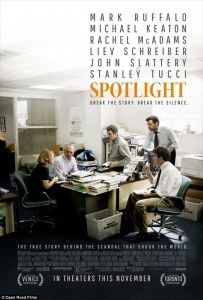 Spotlight is the true-story behind the 2002 expose into the Catholic Church’s cover-up of decades of sexual abuse and it is unflinching in its focus and animated by its outrage, which is the best and worst part of this awards-caliber movie. Writer/director Tom McCarthy (The Station Agent, Win Win) is a splendid curator of unlikely movie families, and with Spotlight he follows the titular investigative team (Michael Keaton, Rachel McAdams, Mark Ruffalo, Brian d’Arcy James) at the Boston Globe as they go about their jobs. That’s really about it. Over the course of two tightly packed hours, we watch as the Spotlight team chases down leads, goes through archives, interview subjects and know when to push harder and when to fall back, and day-by-day build their case to expose the massive corruption within the Church. It’s invigorating material and worthy of the careful and sincere reverence that McCarthy and co-writer Josh Singer have afforded, though the flurry of names can be difficult to keep track of. However, that’s about the extent of the movie. We don’t really get to know any of the journalists on much of a personal level or as a character; they are defined by their tenacity and competence. We don’t get much time for reflection or contemplation on the subject, especially its psychological impact on a majority Catholic city/staff, and the culpability of those within systems of power that chose to ignore rather than accept the monstrous truth. I don’t need more “movie moments” or emotionally manipulative flashbacks, per se. With its nose to the grindstone, Spotlight is an affecting and absorbing news article given life but it feels less like a fully formed movie of its own. It’s confidently directed, written, acted, and executed to perfection, and I feel like a cad even grumbling, but the ceiling for this movie could have been set higher had the filmmakers widened its focus.
Nate’s Grade: B+
Share this:

Birdman or (The Unexpected Virtue of Ignorance) (2014)
 Expecting a comedy from Mexican director Alejandro Gonzalez Inarritu would have preposterous. The man was known for his cinema verite of suffering, notably Babel, 21 Grams, Biutiful, and his best film, Amores Perros, roughly translated to Love’s a Bitch. Perhaps there isn’t much of a shift going from tragedy to comedy. Inarritu’s newest film, Birdman or (The Unexpected Virtue of Ignorance), has been wowing critics and audiences alike, building deafening awards buzz for its cast, Iarritu, and the superb cinematography, but will it fly with mainstream audiences? This may be one of the weirdest Oscar front-runners in some time.
Riggan (Michael Keaton) is an actor best known for playing the superhero Birdman in the early 1990s and walking away from the franchise. He’s still haunted by that role (sometimes literally) and struggling to prove himself as an artist. He’s brokered all his money into directing, adapting, and starring in a theatrical version of Raymond Carver’s short story, “What We Talk About When We Talk About Love.” The show is in previews and about to open its run on Broadway but it’s already got a rash of problems. The leading man needs to be replaced immediately. The supposed savior is famous actor Mike (Edward Norton), an undeniably talented but temperamental actor who pushes buttons to find some fleeting semblance of “truth.” Mike’s girlfriend, Lesley (Naomi Watts), is growing tired of his antics and desperate for her own long-delayed big break. Laura (Andrea Riseborough) is Riggan’s “girlfriend” and co-star and may be pregnant. Sam (Emma Stone), Riggan’s personal assistant and also his detached daughter, is fresh from rehab, and spiteful against her neglectful dad. Toss in Riggan’s best friend/manager/play producer (Zach Galifianakis), Riggan’s ex-wife (Amy Ryan), and a feared theater critic (Lindsay Duncan) who is determined to kill Riggan’s show to send a message to the rest of Hollywood polluting the integrity of the theat-tah. Oh, and throughout all this, Riggan hears an ominous voice that alternating encourages him and humiliates him.
 It’s an industry satire, a bizarre comedy, a father/daughter drama, an examination on identity and the complicated pulls of affection and admiration, and a stunning virtuoso technical achievement. As a movie, Birdman is hard to pin down or categorize. It’s a movie that you definitely need to experience on your own rather than have described (don’t stop reading, come back…), and that is a reason enough to see the film, a rare aspect among modern movies. It’s an artistically offbeat movie and yet it ultimately is about one has been actor looking back on his career and coming to terms with his own impact with pop-culture, art, and his family. It’s about a man struggling to find his place in his own life, beset at all odds by doubters and traitors and obstructionists. The refreshing aspect about Riggan is that he’s a has-been but not a sad sack; he’s fighting from the beginning, sometimes pathetically and sometimes in vain, but the man is always fighting to regain his dignity, to reclaim his life’s narrative, and to fight for his legacy. Riggan, after all, set the stage for the modern superhero industry that currently dominates Hollywood bean counters. He was too just soon, and the parallels with Keaton (Batman) are superficially interesting but there’s more of an original character here than a reflection of the actor playing him. He’s neurotic, egotistical, hungry, and fighting for respect, like many actors, and the film flirts with the façades people inhabit. Many of the characters are emotionally needy, desperate for validation wherever they can find it.
Another strength of the film is that it finds a moment for each of its talented ensemble players to shine, chief among them Keaton. The actor hasn’t had a showcase like this in some time and he is a terrific guiding force to hold the entire story together. Whether it’s marching in his tighty whities or working through his complicated degrees of neuroses, Keaton is alive in a way that is electrifying. We see several highs and lows over the course of two hours, some moments making us cheer on Riggan and others making us wince, but he comes across more like a person than just the butt of a joke. It’s also just fun to watch him adopt different acting styles when he steps on stage, including one early on where he’s purposely too stilted. It’s so comforting to watch Norton (The Grand Budapest Hotel) get to be great again, not just good but great. Early on, you see the appeal of Mike, his allure, and Norton keeps pushing the audience, as well as the characters, back and forth with his wealth of talent. Stone (Amazing Spider-Man 2) spends most of the film as the sulky daughter but she gets to uncork one awesomely angry monologue against her loser dad. The thawing father/daughter relationship ends up supplying the film with its only degree of heart. Watts (The Impossible) is comically frazzled for the majority of her time but gets a memorable character beat where she breaks down in tears, realizing her dream of “making it” might never materialize. Riseborough (Oblivion) also has moments where he sadness and vulnerability cut deep. The supporting characters aren’t terribly deep but they all have a moment to standout.
It’s a decidedly offbeat film that dips into the surreal though never dives completely inside. The movie is rather ambiguous about whether or not the fantastical flourishes are a result of Riggan being mentally ill, or at the least overtaxed with stress. Is there really a Birdman or is it a voice in his head, a manifestation of his ego or a ghost to remind him of the past when he was a star? Does Riggan really have the powers he seems to believe he does, including the ability to make objects move with his mind? Innaritu playfully keeps the audience guessing, treating the bizarre in an offhand manner reminiscent of magic realism. The bizarre embellishments blend smoothly with the film’s darkly comic tone. It’s a funny movie but one that you laugh at between clenched teeth.
 Is it all the unblinking camerawork a gimmick? I don’t think so. While the story can engage with its weirdness and surreal unpredictability, the long tracking shots bring a heightened reality to the unreal, they bring a larger sense of awe to the proceedings, watching to see the magic trick pulled off to the end. If anything, it’s an extra thrill to the script and greatly compounds the artistic audaciousness of the film, but I think it also channels the live-wire energy of theater, of watching actors have to walk that tightrope of performance and blocking, weaving together to pull off the ensemble. It makes the film medium feel more like live theater. Thematically I think the style also connects to the anxious mentality of Riggan. In the end, I don’t truly care that much whether it’s a gimmick or not (though I vote it is not) because the camerawork is rapturous. Made to resemble an entire two-hour tracking shot, it is a joyous thrill to watch these technical wizards do their thing, to watch the best in the business perform a visual magic trick over the duration of two hours. Even if you don’t care for the overall movie you can at least be entertained by the imaginative and thoroughly accomplished cinematography by Emmanuel Lubezki, fresh from his Oscar for Gravity and who should be clearing shelf space for the next bushel of awards he’s destined to win with this film. It’s an intoxicating experience to behold, though the film is structured into 10-minute or so chunks for feasibility. If you want to watch a real cinematic magic trick, check out the film Russian Ark, which is an entire movie, performed in one uncut single tracking shot.
I’m still wrestling with the debate over whether Birdman is an artistically ambitious romp or a truly great movie. Much like the characters in the film, I’m wrestling with whether I have confused my admiration with adoration. It’s a movie that I feel compelled to see a second time, and maybe a third, just to get a handle on my overall thoughts and feelings. That may be a sign that Birdman is a film for the ages, or maybe it’s just a sign that it’s not as approachable and denied a higher level of greatness by its obtuseness. Inarritu’s surreal showbiz satire is plenty entertaining, darkly comic, and a technical marvel thanks to the brilliant camerawork. The percussion-heavy musical score is another clever choice, naturally adding more urgency and anxiety to the proceedings. Birdman is a strange and beguiling movie, one that deserves to be seen, needs to be experienced, and stays with you rolling around in your brain. That sounds like a winner to me.
Nate’s Grade: A
Share this:

The Other Guys (2010)
 Surprisingly consistent in its belly laughs, The Other Guys proves that Will Ferrell is at his best when he re-teams with his greatest collaborator, co-writer and director Adam McKay (Anchorman, Step Brothers). The duo takes on the cop genre with a loving parody that manages to send up the genre while celebrating its excesses. Ferrell and his partner (Mark Wahlberg) stumble onto a mostly convoluted financial scam with banks, traders, and the police. The movie takes scene after scene and gives it a little twist for the self-aware characters to comment, usually to great comedic effect. There were some stretches that I was near tears from laughing so hard (the tuna vs. lion argument is an instant classic). I expected to be amused by the movie since nobody does silly smarter than Ferrell with McKay, but I was not prepared for how much I genuinely liked this movie. From scene to scene, I found something different to laugh at. There’s an undercurrent of rage from McKay concerning the economic stickup Wall Street got away with in 2008. The end credits are an animated statistics presentation on how large Wall Street firms screwed over the American public and are still profiting off of pubic misery. It’s a bit odd tonally to cover at the end of the film, like McKay wanted his legions of fans to get some morsel of education by the end of a film with goofy action and juvenile sex gags. The joke is on us all.
Nate’s Grade: B+


 nathanzoebl
You must be logged in to post a comment.