Blog Archives
Captain America: The Winter Soldier (2014)
 A welcome addition to the Marvel Cinematic Universe, the second Captain America film brings the square superhero to our modern-day and presents a complicated national setting where the enemy is the U.S government. The challenge with a Captain America (played by Chris Evans) movie is just how outdated his whole sensibility seems, an irony-free nationalistic hero. Smartly, the filmmakers have pushed his loyalties to the test, and the movie transforms into something along the lines of a Jason Bourne thriller, where the government is hunting down a rogue fugitive. It’s certainly the most timely superhero film since 2008’s The Dark Knight, and the political commentary on the NSA spying and drones is a welcome big screen subversion. But the action is still what people come for and in that the Winter Soldier is quite an entertaining movie. Directed by the Russo brothers, known mostly for their comedy work in TV like Community, the movie packs quite a punch with a variety of action/thriller sequences, each well staged and well developed. My favorite might be Nick Fury under assault and desperate to escape in his car from overwhelming enemy forces. An opening sequence rescuing hostages on a boat serves as a great reminder why Captain America is indeed so super. The movie does have some issues but nothing so large as to derail the enjoyment. First off the villain is way too obvious, but also the movie lets the U.S. government off the hook, falling back on a select evil group that has been undercover perverting the government. Secondly, the Winter Soldier of the title is one plotline that doesn’t feel needed or well integrated. It’s another super soldier for Cap to combat and this guy has a mysterious link to our hero. It feels like one plotline too many, a story that deserves better attention on its own. Still, Captain America: The Winter Soldier is an engaging, thrilling, intelligent, and altogether entertaining addition into Marvel’s sprawling cinematic canvas.
Nate’s Grade: B+
Share this:

Thor: The Dark World (2013)
 Loosely based off the Norse mythology, Marvel’s hammer-wielding hero isn’t exactly the easiest character to relate to even as a superhero. Thor is a god after all. Not to be outdone, the man is also royalty, next in line to be king, so he’s in a special class of privilege. And yet 2011’s Thor was a pleasant surprise, a superhero movie that didn’t take itself too seriously, had modest aims, and embraced its sci-fi fantasy mélange. It was a movie where the sillier it got the better it worked. Now Thor: The Dark World, a.k.a. Thor 2, is ready to dominate the fall box-office and prove that Joe and Jane Popcorn can cheer for a pagan god.
Following the events of The Avengers, Loki (Tom Hiddleston) is taken back to his home world of Asgard and put in prison. Loki’s brother, Thor (Chris Hemsworth), is trying to get back to Earth to reunite with his love, scientist Jane Foster (Natalie Portman). Thor is being groomed for the throne of Asgard by his father, Odin (Anthony Hopkins). Meanwhile, the nine worlds are nearing a convergence and dimensional gateways are opening, including one that infects Jane with an ancient biological weapon, the aether. The aether was used as a weapon by the dark elves, a race of creatures that was long ago defeated but its general, Malekith (Christopher Eccleston), has been dormant and in hiding. Alterted, he assembles his surviving army to attack Asgard, kidnap Jane Foster, retrieve the aether, and destroy all life in the universe.
 Thor is still a second tier character when it comes to Marvel superheroes (the guy just isn’t that interesting) but his franchise has, in only two starring films, become the most interesting. The scope of the Thor movies seems infinite. Whereas the other Marvel heroes are Earthbound and straightforward, Thor transports an audience to all sorts of alien worlds/cultures/conflicts, all of which open up more tantalizing storytelling avenues. Nothing seems out of place in a setting such as this, and so the surprises are more satisfying. I thought the best parts of 2011’s Thor were the Asgard moments, less the strained fish-out-of-water comedy of Thor assimilating on Earth. Thankfully, almost all of Thor 2 takes place off Earth save for a rousing, creative, inter-dimensional hopscotch of a climax. The realm of Asgard is given suitable scope thanks to the screenwriters and first-time feature film director Alan Taylor, who worked in TV for years. Taylor’s notable work on HBO’s Game of Thrones is probably what got him this gig, and his vision with fantasy is given significant breadth here. The Thor universe is an interesting mix of fantasy and sci-fi, reminiscent of Star Wars, and Taylor provides the necessary sweeping visuals, exciting action, and glorious shirtless close-ups we come to expect from our fantasy vistas. I was consistently impressed with Taylor’s command of visuals and shot selection, particularly how the man was able to juggle the various tones and needs of the script while still keeping an exposition-heavy film fun and light.
With rainbow bridges, dark elves, and enchanted hammers, thank goodness that Thor 2 keeps a steady and welcome sense of humor, never getting too serious even with the end of existence on the line. This jovial tone is refreshing when properly executed and contributes to the overall fun of the picture. We’ve had such sturm und drang when it comes to our superhero movies, particularly last summer’s Man of Steel misfire. I appreciate a dark and gloomy superhero tale like Nolan’s Batman films, or a satirical swipe like the original Kick-Ass, but we need stories that fit with their tone. When it comes to Thor, he’s still saving the world, rescuing his damsel, but the attitude, while on its face regal and serious, is anything but. The Thor movies accept the absurdities of its setting and just shrugs, plowing along. And now with Jane on Asgard, the fish-out-of-water comedy gets a different perspective. She gets to meet Thor’s parents (awkward) and an Asgardian who has a thing for the hunky Norseman (double awkward… I’ll stop the 90s catch phrases now). Thor 2 also gives Jane Foster much more to do, placing her front and center as a person integral to the stability of the universe. During the snazzy climax, she gets to run around and contribute in a meaningful manner. The there’s the plucky Kat Dennings (TV’s 2 Broke Girls) who gets to rattle off one-liners like a pro, many of them grounding the elevated levels of silliness. Much of the humor comes from the cocksure characters and their quips, particularly Loki.
And that’s as good as any place to interject my notion that Thor isn’t truly the main character in this film, despite what the title preceding the colon may lead you to believe. That honor goes to Loki, the greatest villain in any modern Marvel movie by far. He’s got the clearest arc in the movie, going through arguably the most personal pain, coming to a crossroads, and his conclusion certainly sets up sizable ramifications down the road for the presumptive Thor 3. Played by Hiddleston (War Horse), the character draws you in, even when he’s throwing his self-aggrandized temper tantrums you want to spend more time with him. He’s far and away the most developed and interesting character onscreen, and Hiddleston has such a gleeful malevolence to him that makes the character all the more electric and unpredictable. Thor 2 is really the story of Loki coming to terms with his life’s choices, the choices his adopted parents made, his sense of self and birthright, and moving forward, becoming his own man again. This is why Thor 2 ascends another entertainment rung by tying Loki into the main story, forcing him and Thor to work together against a common enemy.
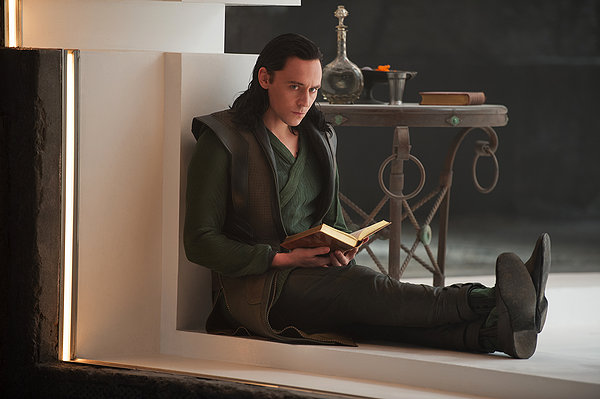 In a film dominated by a charismatic Loki, it’s no wonder that Thor 2’s real bad guy falls woefully short. Malekith is a confusing and altogether lackluster antagonist in every conceivable way. He has no personality to him; he’s simple-minded with the goal of eradicating the universe. I don’t know about you, but my bad guys better have a pretty good reason for destroying the universe since they kinda live there too. This is one of the lazier villain plot devices because it has no nuance, no shading. Apparently before there was a universe there were dark elves. I don’t want to get caught in a chicken-egg paradox here, but was there a universe before the universe, cause I look at the universe like existence’s garage. The cars inside may change but the garage was standing before it all. Anyway, Malekith wants to destroy all life because he wants to, because certainly you’d think there would be enough space in space. He’s not even that threatening or given any particular advantage beyond some firepower. It’s no wonder that Loki runs circles around this chump in the villain department. Eccleston (Unfinished Song) is not at fault. The heavy makeup he’s under smothers the actor’s ability to polish this terrible character.
The rest of the acting fares better. At this point, we know what we’re getting with Hemsworth (Snow White and the Huntsman) as the title character. He’s a sturdy leading man with just enough appeal to satisfy, though part of it is that Thor is just dull as a hero. He was more entertaining when he was cocky and irresponsible. Portman (Black Swan) holds her own though the romance between her and Thor feels more forced. Hopkins (Red 2) strikes the right mix between regal and camp. While their roles aren’t exactly integral, it’s nice having a superhero movie stuffed with great actors like Idris Elba, Ray Stevenson, Adewale Akinnuoye-Agbaje, Clive Russell, and there’s even an amusing appearance by Chris O’Dowd, who effortlessly oozes charm (take note, Thor).
This a superhero movie that separates itself by its sheer sense of fun. Thor: The Dark World takes what worked in the previous movie and provides more of it. The campy, silly Asgard stuff is given even more time, the mischievous sense of humor is renewed, the fantasy worlds given more depth and better action/effects, and fan favorite Loki gets a big starring role this time with extra brotherly bickering. It’s not the best superhero movie, nor is it the best Marvel film of recent years, but Thor 2 knows what kind of movie it wishes to be and how to best achieve this. It’s a loopy, droll, and rather imaginative big-budget superhero film, while still finding ways to be somewhat generic with its overall plotting and character turns. While the action is suitably epic, it’s the character interactions that are the most enjoyable aspect. It seems excessively lazy to say that if you enjoyed the first Thor, you’ll probably enjoy the second one as well, but there it is. Perhaps next time the storyline won’t be as convoluted and we can get even more Loki. Barring that, I’ll accept additional Chris O’Dowd screen time.
Nate’s Grade: B
Share this:

Iron Man 3 (2013)
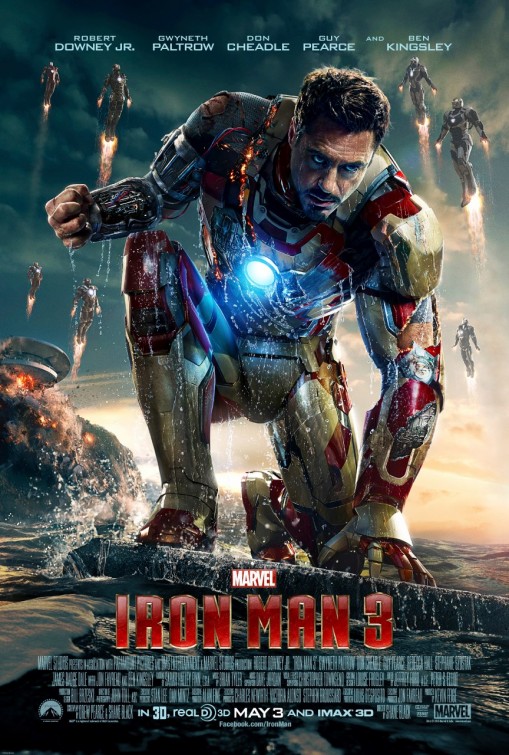 Third movies in superhero franchises always seem to be a precarious proposition; X-Men 3, Spider-Man 3, Superman 3, all graveyards of rushed productions, artistic compromises, and general complacency. Usually the third movie is when the hero has what he or she (but mostly he) has built up stripped down. It’s the same case with Iron Man 3, which short of a noisy finale has a surprisingly small amount of actual Iron Man, much like the scant amount of Batman in last year’s The Dark Knight Rises. That’s fine with me because the appeal of this franchise has been Tony Stark the character, not the mechanical heroics. Iron Man 3 is co-written and directed by super Hollywood scribe Shane Black, the man who gave us Lethal Weapon, The Last Boy Scout, The Long Kiss Goodnight, and the 2005 gem that resuscitated Robert Downey Jr.’s career, Kiss Kiss Bang Bang. It was this fact alone, especially after how disappointing Iron Man 2 was, that got me jazzed about a third outing. Black’s characteristic sense of humor, genre blending, and mass appeal thrills helps to make Iron Man 3 an enjoyable if flawed movie-going experience and a suitable kickoff to the summer movie season.
Tony Stark (Downey Jr.) is having trouble sleeping, haunted by the near world-ending events in New York City from his time with the Avengers. Pepper Potts (Gwyneth Paltrow), head of Stark Industries and Tony’s main squeeze, wants her man to take a mental health break. He’s spending as much time as possible in his lab, concocting a whole army of different Iron Man suits. His latest invention allows him to control a suit prototype with his body, compelling pieces of his amour to his person with a wave of his arms. He’ll need the help because the Mandarin (Ben Kingsley), a fearful terrorist leader, is staging a series of bombings around the United States, leaving behind videos taunting his foes. After an attack that hits close to home, Stark challenges the Mandarin and the bad guy brings the fight to the man of iron, decimating his home and forcing Stark to flee. In Tennessee, Stark unravels the mystery behind the Mandarin, which involves a brilliant scientist (Rebecca Hall), a nefarious biotechnology businessman (Guy Pearce), and even the president of the United States himself.
 The best part of the first film was watching a brilliant guy become Iron Man; sure the superhero stuff was fun but it wasn’t what made the movie special. Downey Jr. as a charismatic, egotistical, self-involved but ultimately redeemable middle-aged playboy is what made the movie special. With Iron Man 3, he has to rely on his wits for large portions, which are still considerable. It’s a clever way to make a billionaire playboy with out-of-this-world technology empathetic. He’s never going to be an everyman but that doesn’t mean we can’t empathize. With that said, I still find his whole PTSD ordeal after events from The Avengers to be shaky. He’s already had near death experiences before so unless we get a bigger explanation (proof of alien existence and superiority? Knowing a return is inevitable?) I find it hard to fathom that a guy as outwardly unflappable as Tony Stark would be hobbled by his super team-up activities. Also, now that we exist in a post-Avengers universe, wouldn’t the ongoing attacks by the Mandarin warrant some sort of S.H.I.E.L.D. response or monitoring?
Likewise, I really appreciated how Black developed his action sequences, routinely giving Stark limitations. The concept of a suit that can assemble by itself and fly hundreds of miles is silly, sure, but it also opens up fun possibilities and questions of identity. At one point, Stark has one arm and one leg of his suit, allowing him to fight back but having to get creative with his moves. A fight while he’s handcuffed also provides enjoyable thrills. During the home attack, Stark’s suit is a prototype and will not allow him to fly, so he has to get inventive, literally shooting a grand piano at a helicopter. The best action scene is when Iron Man has to save a dozen people from plummeting to their deaths after being sucked out of Air Force One in midair. I wish the solution hadn’t been so quick but it’s a thrilling sequence with terrific aerial photography.
Until the finale, which is all-robot action, you could accuse the film of being too shrift in its action sequences, rarely lasting longer than a few brief minutes. They’re still quite entertaining, and well directed, with Black nicely drawing out organic complications and making good use of geography. We know that Black can write a glorious action sequence, but unless you were one of the lucky souls who saw Kiss Kiss Bang Bang, it’s a surprise that the man can direct one so well. There’s a nice sense of style on display but it never becomes overpowering, and thankfully it’s presented in a manner that you can, shocker, tell what is happening onscreen. Black definitely has a good eye for visuals and scene compositions but he also knows how to deliver great crowd-pleasing moments that we want in our summer movies. The climax is pretty busy with lots of keen Iron Man suits that you just know are there to be purchasable toys first and foremost. The sustained action is pretty involving, and Black is an expert at establishing mini-goals and developing naturally. Even as it starts to devolve into a hectic video game-like frenzy, there are enough changing goals and reversals to keep you satisfied for the long haul.
The movie’s villains are somewhat nebulous and employ an Evil Plot that is too convoluted by half. The Mandarin is an intriguing figure but undergoes some changes that will surely leave fans of the comic steaming mad. I accept that movies are an adaptation from the source material, and have no real personal affinity for Iron Man or his rogues’ gallery, so I wasn’t bothered by the notable change. It fits the tone of the movie as well as becomes another plot point in a convoluted Evil Plot. I will agree with detractors on this point: after the invasion in The Avengers, alien technology, the source of the Mandarin’s powers in the comic, is credible. I don’t really understand the political commentary at play with the Mandarin either. More so, and I’m trying to be delicate with spoilers, Iron Man 3 is really a movie about Tony Stark versus… lava people. Sure they have superhuman brains that provide regeneration and superior human ability. It just seems that all these super humans decide to do is… heat things up. They glow red, melt through walls, and are essentially lava creatures. Apparently Tony Stark needs to take some cues from that old U.S. Marines ad where the guy fights a giant lava monster (“Have you been attacked by a lava monster recently? No? You’re welcome – signed, the Marines”). The villains, while weak, are still probably the best in the series. It’s been a fairly weak franchise for antagonists.
 Coming from Black, you’d expect an increase in the implementation of comedy, though Iron Man 3 probably walks just up to the line. It almost gets too jokey but pulls back enough. Adam Pally’s (TV’s criminally underseen Happy Endings) small bit as an obsessed fan of Stark is probably the testing point. Tony Stark has issues sure, especially if Disney will ever let the movies explore his history with alcoholism, but the man is never going to challenge Bruce Wayne for the brooding loner throne. Stark is a quipper, a loudmouth who uses humor as a weapon and a shield, and brought to vivid life by Downey Jr., the man will always be a comedian. That’s not to say that the drama lacks proper seriousness. However, Black pushes a lot more comedy into the film than we’ve seen in the earlier installments. Most of it is welcome and even when the movie goes into mass appeal mode, especially in Act Two when a plucky kid aids Stark, Black covers the familiar without losing his edge. You’ll likely recognize the buddy cop patter from Black’s other movies but it still works. There are several setups that look like we’re getting Big Hero Moments, and then Black decides to undercut them for a good laugh. Iron Man 3’s consistent sense of humor makes the movie feel even faster paced.
Downey Jr. (The Avengers) is still the MVP of the modern Marvel-verse in my eyes, and even two years removed from 50, he’s still got enough energy to power a small army. He’s still pulling the same schtick so to speak, which may wear thin for others after four starring appearances as Tony Stark, but I still find him naturally appealing. Paltrow (Contagion) gets a chance to do more than the standard damsel in distress that the women function in these movies. I regret that after being given a tantalizing new direction the movie reverts her back to standard damsel sidekick so speedily. Ho hum. Kingsley (Hugo) just seemed wrong for the part from the start, never mind the nebulous ethnicity issues. His vocal fluctuations and strange emphasis proved too distracting for me. However, he proves to be a better match after the Mandarin’s twist. Pearce (Lawless) is a pretty solid, smarmy bad guy and man has he got an impressive physique going on. It’s just nice to see great character actors from Hall (The Town) to Miguel Ferrer (Traffic) to Dale Dickey (Winter’s Bone) in a high-profile mega blockbuster. Even little Ty Simpkins (Insidious) is pretty good as the kid who helps out Stark. My tolerance for child acting has gone downhill as I have gotten older, but the kid is genuinely good without falling into the common trappings of being cloying or overly precocious.
Iron Man 3 is a definite improvement over the overstuffed, undernourished 2010 sequel. It ends on a moment that feels like something close to closure, but you know, as the credits helpfully indicate, that Tony Stark will appear again, at least in 2015’s Avengers 2. The bigger question is can this franchise exist without the participation of Downey Jr.? I’m sure we’ll all find out eventually considering the character is too profitable to simply retire once Downey Jr. decides he’s had enough. We’ve had five Batmans after all, not counting Adam West. However, never has a character seemed so intrinsically linked with an actor before. Downey Jr. just is Tony Stark, and while some capable young male lead out there in Hollywood will put up a valiant effort, it will never be the same. Iron Man 3 is further proof that the appeal of the franchise is not the explosions and action set pieces, which it does a fine job with; it’s the man inside the suit and the formidable actor that gives this franchise its juice. Spending more time with Stark is a bonus, and Black’s zippy sense of comedy and acute knowledge of the architecture of popcorn thrills allows the movie to fly by with ease. While the first film reigns supreme, Iron Man 3 is a fitting and pleasurable enough blockbuster that reminds you why we still love this guy.
Nate’s Grade: B
Share this:

The Avengers (2012)
 For the past four years, Marvel has been seeding its all-star super hero collective in the storylines of its summer blockbusters. And with six super heroes, The Avengers carries some super expectations. The creative mind behind the film is none other than Joss Whedon, best known for creating and shepherding cult TV shows like Buffy the Vampire Slayer, Angel, and Firefly. Not exactly the first name you’d think Marvel would assemble to front a $200 million movie. For geeks, Whedon has become a reliable standard of quality (the patchy TV show Dollhouse notwithstanding). Here is a man who can marry big ideas with sharp characterization and delightfully skewed dialogue. In Whedon, geek nation has a savior, and Marvel knew this. The Avengers is 142 minutes of geek arousal stretched to orgasmic heights.
Nick Fury (Samuel L. Jackson), head of the agency S.H.I.E.L.D., has a dire need for Earth’s mightiest heroes. Loki (Tom Hiddleston) has traveled through a portal and plans on conquering Earth thanks to an approaching alien army. Fury has tasked Tony Stark (Robert Downey Jr.) a.k.a. Iron Man, Steve Rogers (Chris Evans) a.k.a. Captain America, and special agent Natasha “Black Widow” Romanof (Scarlett Johansson) with stopping Loki and rescuing one of S.H.I.E.L.D.’s own agents, the skilled marksman Clint “Hawkeye” Barton (Jeremy Renner), who is under Loki’s devious mind control. Loki’s brother, Thor (Chris Hemsworth), would like to cite jurisdiction and bring his wicked brother back to his home world. The only person who may be able to locate Loki’s path is Dr. Bruce Banner (Mark Ruffalo), a guy with his own anger issues. With this many egos, it’s bound to get dicey. As Banner puts it, “We’re not a team. We’re a time bomb.” Can they put aside their differences to unite to save the Earth? Does a Hulk smash?
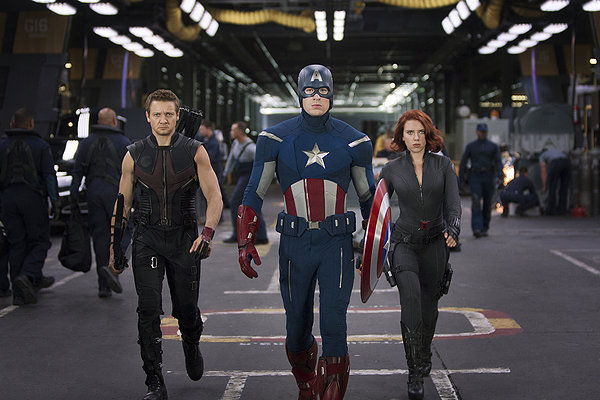 Whedon, the king of clever genre deconstruction last seen in the excellent meta-horror film Cabin in the Woods, plays it relatively straight, giving his big, effects-driven film a straight-laced sense of sincerity. It’s not making fun of these sort of big-budget, effects-driven smash-em-ups, it just wants to deliver the biggest smash-em-up yet. To that end, The Avengers achieves maximum smashitude (trademark pending). By its rousing finish, the movie has become so massively entertaining that you forget the draggy first half. The scope of this thing is just massive. The last thirty minutes is solid action across miles of crumbling, just-asking-to-be-exploded city landscape. But the trick that Whedon pulls off is how to orchestrate action on a monumental scale without losing sight of scale, pacing, and character. You’d think with a full deck of superheroes that somebody would be shortchanged when it came time for the rough and tumble stuff. Not so. Instead of fighting one another, the prospective Avengers work together in all sorts of combinations. The characters are well integrated into the fracas, making particular use of their abilities, and finding new locations of focus every few minutes. This expert hero shuffling keeps things feeling fresh amidst the constant din of chaos.
In fact, the movie finds time to give every hero his or her due, finding a small moment to reveal some characterization. I thought Whedon’s biggest challenge was going to be the juggling act of balancing so many heroes and so much screen time, but the man found a way, like he regularly does, to squeeze in character with ensemble action. The Hulk fares the best. After two movies, it feels like Whedon has finally nailed the character; granted, this success may be credited to the fact that Bruce Banner (all hail Ruffalo) is kept as a supporting character. The struggle of the character being likened to a recovering addict is a smart way to present the character without getting too morose (I enjoyed the revelation that the “Hulk” half prevented Banner from killing himself). When he’s told his mission is to smash, you can feel the exuberant joy of an unleashed Hulk id. The Hulk had two great audience-applause moments that made my theater go berserk. I also really liked the attention given to Black Widow and her lonely back-story. Hawkeye was a complete badass, though he only gets to do fun stuff in the madcap finale. The trouble with the hero team-up franchises is that not everyone’s on the same level of power. Thor is a god for crying out loud, Iron Man has super weapons, Hulk is Hulk, Captain America at least has superhuman strength but what do Hawkeye and Black Widow bring to the team? When you’re competing with all that power, being good with guns or a bow seems pretty puny. And with Hawkeye, there’s going to be a limit to his effectiveness unless he has a magic bag of replenishing arrows. Still, Whedon finds ways to make the heroes badass and humane in equal measure, and surprisingly funny, which is welcomed.
It’s hard to believe that Whedon had only directed one feature film before (2005’s Serenity, based upon Whedon’s canceled Firefly show) being given the keys to the Marvel universe. He’s directed several TV episodes of his signature shows but the man has never produced anything on this scale before. Given a gigantic canvas, Whedon delivers the goods. His action sequences are rollicking and fun and, best of all, shot and edited in a fashion where you can understand what is happening (take some notes, Hunger Games franchise). The action is well choreographed and elevated with organic complications and particular attention paid to location, like the Nicky Fury airship. Whedon is a master of the plot payoff, setting up his elements and then piloting the narrative to satisfying conclusions and integrations (Cabin in the Woods is also a pristine example of this gift). If you’re going to introduce an airship, you better believe that sucker is going to threaten to crash. I’m glad that Loki was brought back as he was the best Marvel big screen baddie yet, though I’m disappointed they essentially put him on ice for an hour.
 The technical elements are ably polished even for this kind of film. The cinematography by Seamus McGarvey (Atonement) is terrific, utilizing bright color in a way that the visuals pop. The special effects are top-notch and you just feel immersed into the action. The destruction is cataclysmic but rarely does the movie feel phony. I was impressed by the Hulk designs and the sequences in inky space with our alien adversaries. For that matter, are these aliens robots? It’s unclear whether the giant flying centipede-like ships are creatures. The 3D conversion is one of the better outings due to the fact that it doesn’t keep throwing stuff in your face. Plus, viewing Johansson’s leather-clad assets in 3D certainly has its own appeal, as does Gwyneth Paltrow in jean shorts. Hey How I Met Your Mother fans, Cobie Smulders looks practically smoldering in her S.H.I.E.L.D. agent outfit too. Okay, I swear I’m done with the female objectification.
I hesitate calling The Avengers the greatest super hero/comic book movie of all time, as the teaming hordes of Internet fanboys foaming at the mouth are wont to do. If your definition of a comic book movie is a giant sandbox with all the coolest toys, then this is your film. This is a comic book turned flesh. The Hulk and Thor fight and prove who is the strongest Marvel man, that’s got to be a geek’s wish come true. Many of the infighting sequences felt like, servicing the tastes of the fanboys, and after a while the constant hero on hero action felt tiresome. I get that we have a clash of egos going on here, but the movie suffers from a lack of narrative cohesion, by which I mean that the first hour of the movie feels like a series of guest appearances by heroes on loan. The movie doesn’t fully come together until the point where the team comes together; I doubt Whedon intended that symbiotic relationship. The movie feels more like a patchwork of standout scenes and memorable moments that a fully formed and cohesive story. If you haven’t seen the previous four Marvel movies (Iron Man, Iron Man 2, Thor, Captain America), you’ll be pretty hard-pressed to follow the story. Loki’s motivation and plan seems rather sketchy other than causing discord amongst the heroic ranks. His powers seem inconsistent and vague. Also I found the musical score by Alan Silvestri to be bland and unworthy.
The Avengers is sure to be geek nirvana for many of the comic book faithful. It’s an audience pleaser of mass scale, and I’m sure that your theater will be cheering in abundance. Whedon has pulled off the near impossible. The movie is a thoroughly entertaining, exciting, and witty popcorn spectacle of the first order. But where the movie hits the ceiling, at least for me, is that it ONLY wants to be the best super hero movie and this seems like limited ambitions. It’s like making the very best possible women in prison movie (great, but is this really all you set your sights on?). I had a great time watching Whedon’s handiwork but I wish it mined the outsized territory for bigger themes, a little more than audience-satisfying pyrotechnics, something I feel that X-Men: First Class did a better job of handling. Don’t get me wrong, I greatly enjoyed The Avengers and it’s a fantastic start to the summer movie season, but by no means is it The Dark Knight or even aspiring to be, and that’s okay. Enjoy the busy escapades of Marvel’s next smash franchise. Who knows when they’ll be able to wrangle everyone together for another adventure, but judging by the sounds of ringing cash registers, the answer is sooner than we think.
Nate’s Grade: B+
Share this:

Captain America: The First Avenger (2011)
 In the summer of superheroes, you’ll be excused for feeling some fatigue when it comes to men in tights. Captain America: The First Avenger is a surprisingly enjoyable sepia-tinted action film that flexes enough might to pleasantly hark back to the days of 1940s adventure serials. Taking place almost entirely in the era of World War II, the film, and its hero, and unabashedly square and earnest. Steve Rogers (Chris Evans) begins as a 90-pound weakling determined to fight for his country and gets transformed into a behemoth of beefcake by the Army. Captain America is devoid of the dark brooding that has come to encapsulate modern superhero movies, but it’s also playing its B-movie silliness straight. The flick has more in common with Raiders of the Lost Ark and Sky Captain than most other superhero product. Better yet, the movie finesses the in-your-face patriotism of the title character. I mean the guy is called Captain America. Yet the film finds a way to resonate a sincere nationalistic pride without falling back into Michael Bay-level jingoism. And who’s going to make for better villains than Nazis? Director Joe Johnston (The Rocketeer, Jurassic Park 3) turns out to have been the perfect choice to helm this rah-rah retro enterprise. The pacing is swift, the acting is engaging, the special effects are terrific particularly Evans’ transformation into a weakling, and the film is unexpectedly emotional at points. This is a comic book movie that would appeal to an older generation not normally interested in superheroes, namely people like my dad.
Nate’s Grade: B
Share this:

X-Men: First Class (2011)
 Marvel’s X-Men franchise had some serious damage it needed to undo. The once mighty superhero series had been harmed by that age-old foe – bad sequels. The collective stink from 2006’s X-Men: The Last Stand and the 2009 Wolverine debacle, the franchise had lost some serious luster. While the recovery was not nearly as deep and cataclysmic as what the Batman franchise had to deal with in the wake of 1997’s Batman and Robin, a film that flirted with salting the earth, the X-Men needed some kind of facelift. Enter director Matthew Vaughn (Kick-Ass, Stardust), the man who was going to save the series back in 2006 when original director Bryan Singer flew away to direct a different man in tights. Vaughn was originally tapped to direct Last Stand but he dropped out and was replaced by the hack Brett Ratner (Rush Hour). Thus began the slide toward mediocrity. Now Vaughn is back to tidy up unfinished business, taking the series back to its historical roots in the 1960s. It seems that a trip back in time was just what was needed to make the X-Men fresh.
Back in 1944, Erik Lehnsherr is a prisoner in a Polish concentration camp when Dr. Schmidt (Kevin Bacon) discovers the young boy’s great potential. When enraged, Erik can control anything metallic. In upstate New York at the same time, young Charles Xavier discovers a young shape shifter named Raven. She’s blue from head to toe and afraid. They’re delighted to find one another, fearing they were the only ones “different” in the world, children of the “atomic age.” All three of these people are headed for a collision course. In 1963, Charles (James McAvoy) has become an Oxford professor, Raven (Jennifer Lawrence) has followed him to England, and Erik (Michael Fassbender) has been systematically hunting down the Nazis responsible for his pain and suffering. Dr. Schmidt has now become Sebastian Shaw, a younger-looking playboy with the intent to push the Soviets and Americans to nuclear war. Shaw has his own team of mutant henchmen, including telepath Emma Frost (January Jones, proving once again that she can really only ever be good as Betty Drapier) who walks around in white lingerie the whole movie. Together with CIA agent Moira MacTaggert (Rose Byrne), Charles and Erik assemble their own team of young mutants to thwart Shaw.
Similar to 2009’s Star Trek, this film provides the opportunity to reboot a franchise by going back in time. It transports the series back to the beginning of the friendship between Charles and Erik, and spends the next 130 minutes filling in the rationale for the “why” of their varying personal philosophies. By dialing back, we’re able to play around with 40 years of back-story and histories. While we know the end results, that these two giants will become enemies, that Charles will lose the ability to walk, and that Raven/Mystique will eventually side with Erik, that doesn’t mean there isn’t pleasure to be had in watching the journey. There are all sorts of self-aware in-jokes for fans and a few nifty cameos that left me howling with glee. The script, credited to Vaughn, his writing partner Jane Goldman (Kick-Ass), and four others, smartly moves the film forward; no scene seems at a waste. Even better, the film strikes a tone that manages to take its real-world implications seriously (nuclear brinksmanship, Holocaust, and fighting for equality and acceptance) without diminishing its popcorn thrills.
As a summer movie, X-Men: First Class has enough razzle-dazzle to compliment its intelligent social pontification. Vaughn and his screenwriters have composed action sequences that neatly incorporate the mutant abilities of its subjects while building the tension and smartly utilizing the contours of geography. I hate action sequences that don’t play to the potential of location and subject. An evil teleporter (Jason Flemyng) finds a fiendishly clever way to dispatch 20 CIA agents. Magneto efficiently takes out former Nazis residing in Argentina in one chilling sequence (“I’m Frankenstein’s monster,” he tells one man). Shaw makes for an actual formidable opponent for our fledgling heroes. The personal connection he has with Erik, on top of Bacon’s devilish glimmer of villainy, makes Shaw a strong antagonist that the audience can rally against. Vaughn has a splendid reveal with Shaw. Back when he was a Nazi doctor, he asks young Erik to move a coin with his abilities. The shots consist entirely from one side of his office, showcasing it to be a bookish study. Then when Shaw calls the Nazi guards to bring in Erik’s mother for a little more direct incentive, the camera flips position. We see the opposite side of the room, a medical station on the other side of large glass panels. Inside is a torturous display of medical cutlery. It’s a fantastic reveal that kicks up the tension while adding to the terrifying character of Shaw. The action highpoint, a mutant vs. mutant battle amidst the Soviet and American naval fleets, provides plenty of parallel action to follow that keeps the movie alive and kicking.
The film mixes a frothy, James Bond-esque spy thriller feel in production design and whatever-goes plot savvy, but then recomposes real life events as mutant enhanced. Alert the history textbooks, because the Nazi scientists experimented on mutant children and that mutants averted World War III. Some will chafe at the alternative history approach, but I find it to be more interesting, suspenseful, and a natural fit with the overall Cold War paranoia feel of the setting. Melding the X-Men into history makes for a more intellectually stimulating adventure, tipping its hat at various historical revisions that payoff as small rewards for a well-informed audience. I’m not saying that the movie is like Noam Chomsky’s take on X-Men by any means, but it’s certainly the most heady film in the series since the departure of Bryan Singer (he serves as producer on this flick). Indeed, this is a rather talky X-Men adventure with plenty of philosophical debates and speeches. But then it’s got naked women in blue too. But you see, it’s not just naked women in blue, it’s that a naked woman in blue can become a political statement – man!
And it’s on that note I’d like to say a few words. Mutants have always been a central metaphor for the oppressed, be they Jews, African-Americans, homosexuals, whatever minority group you’d like to slot in. That’s been one of the secrets to the continued success of Marvel’s flagship series – anybody can identify with the fear of being judged, feared, and despised because of who you are. That’s why the character of Raven/Mystique, short of Magneto, is the most fascinating character in the movie. Her true form, scaly and blue, is what keeps her feeling like an outcast. She doesn’t have an invisible power like her surrogate big brother, Charles. She constantly disguises herself in order to fit in, albeit her disguise is the alluring natural figure of Jennifer Lawrence (Winter’s Bone). “Mutant and proud,” she says in disdain when she stares at her bluish reflection in the mirror. It is through Erik hat she begins to believe in this mantra, gaining pride that “blue is beautiful” and she need not even wear clothes to cover who she is up. Raven/Mystique is the figure torn between the two philosophies argued by Charles and Erik. She is the central figure that has to struggle with reality vs. idealism. It’s also a little funny that a movie piggybacking the civil rights movement of the 60s (mutant rights!) also trades in the casual misogyny of the 1960s (women in lingerie as outfits, regularly practiced sexism). I suppose some of this is intentional. I guess the women’s movement will be saved for a sequel.
While the retro setting ties in nicely with the series’ core metaphor about being different/disenfranchised, the dichotomy of ideas presented by Charles and Erik are not given equal measure. That’s because, quite frankly, Erik is a much more powerfully interesting character and more sympathetic than a rich kid who can read people’s minds. Charles Xavier and Magneto have always represented a comic book version of Martin Luther King Jr. and Malcolm X when it came to the ideas of integration, equality, and representation. Charles believes that mutants should assimilate and that humanity will accept in time; peaceful and hidden. Magneto, on the other hand, takes a more militant stance and feels that mutants need not hide who they are out of fear or shame, that they are the dominant species and should not be threatened by the weaker Homo sapiens. But where X-Men: First Class runs into some trouble is that the ideological deck is completely stacked in Magneto’s favor. He’s the one who suffered through concentration camps, Nazi experimentation; he’s seen the worst of what mankind of capable of. He’s a tormented man seeking vengeance, which is character motivation that is easy for an audience to fall behind. Then, even after the mutants save mankind’s bacon during the Cuban Missile Crisis (the first person who tells me this is a spoiler gets a history book thrown at them), they still get treated as the enemy. Almost everything that plays out onscreen aligns with Magneto’s ideology, which makes it hard not to be on Team Magneto as the movie draws to a close. I suppose the film utilizes our knowledge of future events to counterbalance Magneto’s pessimistic world philosophy.
The other issue that lends more credibility to Magneto than perhaps the filmmakers were hoping for is the fact that he’s the most interesting character in the movie, easily. The X-kids are a pretty bland bunch of boys and gals. This is the first class the filmmakers chose? Did they have recruiting violations at the school? Havok (Lucas Till), a goy who can shoot energy beams, Banshee (Caleb Landry Jones), a guy who can scream loudly and fly, somehow, Angel (Zoe Kravitz), a gal with fairy wings and an acid tongue, and then Darwin (Edi Gathegi), a guy who… adapts? Darwin’s power is so obtuse to explain, it’s no wonder he doesn’t last long in service to his country (it’s a bit tacky that when one character says “slavery” the edits have to cut back to the one black mutant for a reaction shot). Each one of these teenagers has a different reaction to their powers. Some are ashamed, some are afraid, others proud or apathetic. But they are all singularly uninteresting. Once they establish their power, they become less a character and just another piece on a game board to be positioned. And Lenny Kravitz’s kid in fairy wings? Plus she spits little fireballs? I’m sorry but that should have been the first thing removed from rewrites. This crew makes it sure that we empathize even more with Magneto as he refines his powers to reach his personal vengeance, which is the film’s pre-designed payoff. We’re not really looking for the team to band together, which they inevitably do, but we’re awaiting that splash of vengeance. And when it does come, it’s satisfying, stylish, and dramatically fitting (“At the count of three, I’m going to move the coin.”). The fact that the movie still has like 15 minutes of material afterward is almost inconsequential.
Vaughn certainly delivers the spectacle, it’s the actors that produce the real fireworks. This is a vehicle for McAvoy (Atonement, Wanted) and Fassbender (Ingloruious Basterds, Jane Eyre), and both men provide admirable gravitas. McAvoy’s role offers a more jocular performance, showing Charles to be a bit of a lady’s man in his younger years, harnessing his telepathic powers to bed him some beauties. Then again, as I’ve been told from my female friends, looking like McAvoy will certainly also help matters. But this is Fassbender’s show. He has a chilly intensity to him, rather than just being cold and indifferent like January Jones. His performance captivates you from the start, and his slow-burning hatred consumes the man. It’s a dramatically rich performance given the material. After being discriminated against for being a Jew, than a mutant, he has to sell that his character, haunted and rage-filled, would ironically follow the same social Darwinism that his Nazi tormentors evoked. And Fassbender sells every bit of an iconic Marvel villain coming into his destiny. However, his Irish accent slips out in the film’s final reel, and I’m really curious why the studio couldn’t have shelled a few bucks to fix that with ADR. Rushed for time, or revealing that Magneto has unheard of Irish lineage?
Going back in time manages to open up all sorts of possibilities for the X-Men franchise. There could be a whole slew of sequels that play around with the rich, complex back stories of the X-Men without having to serve the aging stars of the original trilogy. Vaughn keeps the proceedings amazingly fluid, stylish without being overtaken by visual artifice, and the swinging 60s provides a groovy backdrop. The action delivers when needed, the smart script doesn’t downplay the clash of ideas to go along with the clash of fists, and the special effects are relatively up to snuff as summer escapism goes. The movie is not without its misses, including a cadre of lackluster junior mutants. But Vaughn has re-energized a flagging franchise and given hope for a future (past?). In the pantheon of X movies, I’d place X-Men: First Class as an equal to X2, the best in the series. It may not be at the head of the class, but this superhero flick earns is stripes with a solid effort and strong potential.
Nate’s Grade: A
Share this:

Thor (2011)
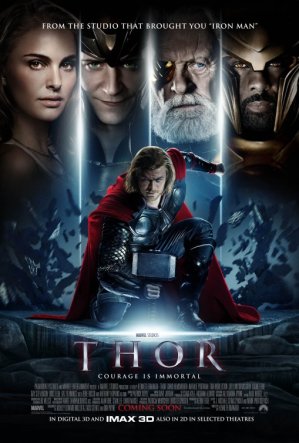 I had strong misgivings going into Thor. How was a powerful Norse god going to seem remotely relatable? How was the most improbable member of Marvel’s Avengers ensemble going to be explained in a way that didn’t feel like a ton of cheese richly slathered in hokum? I was expecting this movie to be a silly, trippy, LSD-enhanced flashback (rainbow bridges! Pass the bong!) that could barely strain any sense of believability. It’s one thing to have stories about super heroes who have gotten their powers via genetic defect, scientific accident, or act of God. But what about when your character happens to be a god? It just seemed too goofy for it all to be pulled off with any conviction. A Thor movie seemed destined for some Xanadu-level of camp. Get a load of the blonde with the big hammer, boys. Not every super hero flick has to be as brooding and dark as The Dark Knight. Marvel’s own Iron Man was a great example of a briskly entertaining movie. Now that I’ve prefaced my experience, let me publicly admit that Thor is indeed a somewhat silly but mostly fun entry in the mighty realm of summer blockbusters.
Thor (Chris Hemsworth) is the god of thunder on Asgard, a distant planet populated by the Norse mythical figures (apparently, they visited Earth and the Scandinavian amongst us worshipped these… space aliens?). Thor waits to inherit the throne from his father, Odin (Anthony Hopkins), a wise king who has kept a tenuous truce with the fierce Frost Giants, inhabitants of another planet. But Thor is not ready to assume the responsibilities of leadership. He’s quick to action and temper, arrogant, and defies his own father’s orders by trying to start some intergalactic conflict with the Frost Giants on their home turf. Thor is robbed of his powers, his mighty hammer, and banished to Earth to walk amongst the smelly Earthlings. He crashes in the New Mexico desert and is retrieved by a team of scientists (Kat Dennings, Stellan Skarsgard) led by Jane Foster (Natalie Portman). The group wants to learn where exactly this man from the sky came from. So does the government, led by the S.H.I.E.L.D. agency who takes possession of Thor’s hammer. Thor thinks if he can reunite with his beloved hammer, then he can go home. But for a thunder god, he’s got a lot of lessons to learn. While Thor is out of the picture, his younger brother, Loki (Tom Hiddelston), plots to take what he feels he is owed – the kingdom of Asgard.
 The biggest surprise for me was that the Asgard sequences are the best part of the movie; thankfully the majority of the running time is spent in this fantastic realm. I credit Kenneth Branagh’s direction, which neither hides the silliness of the material nor fully acknowledges it. By the time Thor hurtles to Earth, I was completely engaged in the operatic tale of fathers and sons, gods, jealousy, hubris, intergalactic conspiracies, you know, the stuff of juicy drama. It jus so happened that these characters wear funnier costumes. The family dynamic between Thor and Loki, the infighting and the scheming, intrigued me. Some critics have thrown around the word “Shakespearean” to describe the movie’s outsized family conflict, but I think that’s just the critical community getting lazy. Would they even approach that term is Branagh was not the director? This opening section of Thor effectively explains the history of Asgard as well as its place with the other eight worlds, the shaky relationship with the Frost Giants, the family responsibilities at play as Odin must decide the future of his ABBA-infused nation, as well as the various mechanics of how this different world operates, like Idris Elba (The Wire, Luther) stationed at the end of the rainbow as a gatekeeper to the other worlds. I liked discovering how all the pieces of this world fit together. If analyzed out of context, any part of the Asgard section just seems stupid. But taken in the film, Thor‘s crazier, more fantastic elements come together and spark genuine interest. I wanted to spend more time in this magical realm. The more ridiculous and fantastical that Thor got the more interesting it became.
But unfortunately Thor was sent tumbling to our ordinary planet. It is the Earth section that seriously deflates the movie’s vibe. It’s a relief that the fish-out-of-water comic relief is kept to a minimum, because the character of Thor isn’t an idiot, just an arrogant brat. But it’s the period on Earth where the God of Thunder learns his Really Important Lessons and finally understands what it means to be a good leader. It’s all very expected and the execution is less than inspired. The trio of scientists that Thor encounters (Portman, Skarsgaard, Dennings) could easily have been consolidated into one character. Their contributions to the story are weak. Skarsgard is mostly there for fatherly advice and the occasional expository ejaculation. As a gawky little sister scientist, I don’t even know why Dennings is in this film other than to make my eyes happy. I anticipated that Portman would assume the “love interest” spot in comic book movies that we now reserve for Oscar-winning actresses, and I assumed that role would be underwritten. But I never expected Portman’s part to be this underwritten. She’s practically nonexistent except for that winning smile of hers. Over the course of… two days, she falls in love with our banished brute. But to be fair, it’s not every day that a guy looking like Hemsworth falls out of the sky. New Mexico isn’t exactly looking like a great singles mingles hotspot. Anyway, their relationship is supposed to be the trigger that makes Thor realize he’s been a selfish and reckless fool. But their scenes lack any tension, any charm, anything of interest. They feel like two actors sitting in chairs telling stories. You don’t feel any romance between them. The drabby Earth sequences only serve as a losing contrast to the crazy Asgard territory. You can’t compete with rainbow bridges (imagine the tolls on those suckers).
 Branagh has never directed anything of this magnitude in size before, and it shows at parts. While none of the action sequences are particularly bring, none of them are particularly thrilling. The beginning battle between Thor and his pals on the Frost Giant planet (Jotunheim) is so poorly lit that the darkness forces you to squint to focus on what’s happening. Why spend $150 million on a super hero flick and shoot a dankly lit action scene? What’s the point in that? The choppy editing can also be too hectic to follow with all the quick-cuts that fail to orient the action geography. Really, there are only three serious action sequences in Thor, but then again I remember Iron Man having a light load when it came to on screen action. That film was devoted to character and performance. This film, under Branagh’s watch, is devoted to just making the entire universe of Thor credible. It’s a lot to take in, and Branagh’s biggest accomplishment is producing a sense of grandeur to the film that saves it from falling into the sticky clutches of camp. The world of Asgard feels convincing in production design and infrastructure; the cities look like pipe organs. Branagh’s film expands the Marvel universe significantly, broadening the scope for future installments. Mercifully Thor does not hard sell the upcoming Avengers movie as appallingly as Iron Man 2.
The acting in Thor is as splashy as the Asgard scenery. Hemsworth gave a notable performance as the doomed father of James Kirk in 2009’s Star Trek. He as only in the film for that ten-minute prologue, and yet the actor found a way to do much with what he was given. You got to see his character hurdle through a gauntlet of emotions: fear, duty, relief, desperation, and acceptance. His sacrifice still can make me tear up, and Hemsowrth deserves some of that credit. However, Thor is a different matter entirely. Obviously it’s going to be a more challenging role to play a buff cocky god with a magic hammer. Buff he does quite well. Cocky he does fairly well, but this is not a great starring vehicle for the actor. Hemsworth looks too self-satisfied, like he’s playing his character as an intergalactic hotel heiress. In sharp contrast, Hiddelston (Wallander) commands your attention. Those penetrating eyes, the cold yet calculated demeanor, this is an actor who feels like he walked off a Shakespeare production and just changed his headgear. You want to spend more time with Loki than watch Blondie futz around on Earth. Loki has much more depth to him than Thor; he feels betrayed by his family and an outcast to his society. I’m glad that we’ll be seeing more from this trickster in future Marvel movies (have I said too much?). Hopkins knows how to sell silliness like few other actors. And for those who have been wondering where Renee Russo has been for the last six years, well here she is, as Thor and Loki’s mother, a role that’s best suited to confirm that she is still alive.
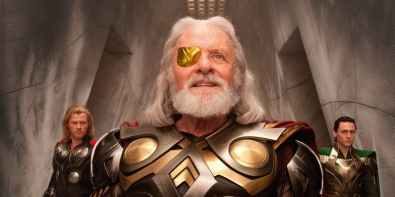 I was expecting far worse judging upon the scraps I had seen from the Thor advertising campaign. So I suppose that beating my low-flying expectations might not necessarily be something to champion. Thor is an inherently goofy, yet mildly satisfying and credible action film. It doesn’t have the style or panache of other heroes, but the fact that Branagh could make a two-hour Thor film that didn’t cause me to laugh derisively from start to finish is an accomplishment. Again, that sounds rather dismissive. I’m just very surprised that this movie works. Because if you take it apart, it doesn’t seem like it should. The acting ranges wildly in quality, with Hiddelston outshining everyone else. Thor is a solid if inconsistent start to the summer season of blockbusters. If you must turn your brain off for some movie, you’d do far worse than Thor. It has pretty colors.
Nate’s Grade: B
Share this:

Iron Man 2 (2010)
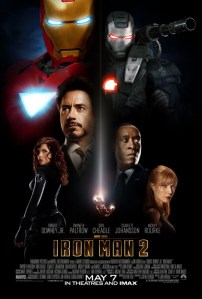 Iron Man was a fresh surprise in the summer of 2008, offering a superhero movie dominated by a middle-aged man’s personality and not the special effects. The story was not overwhelmed by all the demands of what we expect in a glorious summer popcorn experience. Marvel was smart to sign on the same team behind the first film, including director Jon Favreau, but setting a deadline exactly two years after the first film made me worry. There wasn’t much time to get everything together, and it should be no shock that Iron Man 2 feels rushes and absent the finesse of the first film. As much as it pains me to say it, Iron Man 2, while fun in spots, doesn’t come close to the original. You can trace much of it back to the sequel ethos that you take what worked in Part 1, make it much, much bigger and louder, and now you have Part Two. But what worked so exceptionally well in the first Iron Man movie was not the action sequences but the characters, so guess what happens when you pollute the narrative with more characters and disposable action sequences?
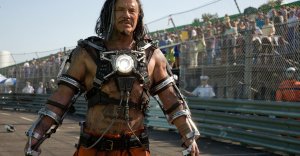
Tony Stark (Robert Downey Jr.) is a self-made superhero and now the world knows that he is indeed the metallic warrior, Iron Man. Stark refuses to hand over his technology to the government, saying he has “successfully privatized world peace.” He appoints his girlfriend/loyal assistant Pepper Potts (Gwyneth Paltrow) to CEO so he can devote his time to ridding the world of evil and lapping up the fame that goes with being Iron Man. Lt. Col. James Rhodes (Don Cheadle replacing Terrence Howard) is concerned for his buddy but also eager to help play around with that super suit. But not everybody loves Tony Stark, notably Justin Hammer (Sam Rockwell), a rival weapons dealer aiming for a Pentagon contract, and Ivan Vanko (Mickey Rourke), a Russian scientist who blames his father’s exile from America and Siberian internment on the Stark family. When Hammer sees Vanko’s attack at a Monaco speedway, he knows he has found an ally against Stark. Hammer whisks his newest Russian friend to New York and enlists his expertise in creating an army of super mechanical fighting suits.
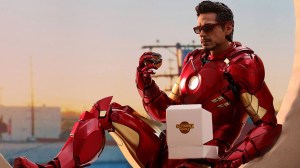 The screenplay by actor-turned-writer Justin Theroux (Tropic Thunder) is overstuffed with people and events all fighting for screen time and narrative dominance that it starts to become unintentionally comical after a while. There are too many storylines jostling for control when any one of them could have comprised a whole movie: military demands to have the suit, Tony deals with blowback from being the most famous man in the universe, and escalation (others trying to top Stark). Don’t even get me started on how Iron Man 2 bends over backwards to advertise that future Marvel Avengers movie lead by Nick Fury (Samuel L. Jackson). I mistakenly believed that the trailers ended before my movie started. There’s a storyline where Tony’s blood is becoming infected with a dangerous chemical every time he uses the Iron Man suit, so being a superhero is literally killing him. You can work with that for some pathos, debating the needs of one man vs. the needs of society and the greater good, personal sacrifice, mortality, legacy, but it all gets way too easily resolved in an absurd way (all I’ll say is, thanks Mad Men‘s Roger Sterling!). It tries to up the ante when less would have been considerably more.
Most of the new characters feel poorly integrated, further causing distraction to any attempts at narrative cohesion. Iron Man 2 also pushes Johansson into the mix so that she can shake up the Tony/Pepper relationship and, plus, she looks good in a skintight cat suit. But her third wheel/love triangle status is barely touched upon and Johansson gets one solid action sequence where she takes out a litany of goons in a hallway with the amazing power of her spinning thighs. Johansson is mostly just another assistant to take notes in the background, although she does it beautifully. The Rourke scenes are few and far between. They establish him as an intimidating force and then he pretty much sits in a room tinkering with stuff, garbling Russian, and feeding his cockatiel for the rest of the movie. He never feels like a real threat or a true match for Tony. Rockwell is the more appealing, slimy villain of the duo, aided by Rockwell’s exasperated bellowing and desperation for the spotlight. Hammer is more interesting to me than a Russian ex-con that rarely speaks, let alone speaks in English. He’s given so little opportunity to develop Vanko as a character. And yet Gary Shandling, as a smug senator trying to make Stark accountable to the U.S. military, might be the film’s best villain of the bunch (curious side note: Shandling and Rourke look oddly similar).
 The personal relationship between Tony Stark and Pepper Potts was the heart of Iron Man. They had that snappy, droll, screwball comedy-esque give-and-take, with hints of something more underneath. This time, the movie doesn’t even speak about their relationship at all, like it never happened in the first film. That scene where she kisses his Iron Man helmet, tosses it out the belly of a plane, and he dives off uttering, “You complete me”? Not in the film. You start to wonder why the movie is being purposely vague and it gets maddening. Their relationship lacks the frustration tinged with flirtation and replaces it with agitation. Both Tony and Pepper are harried and on each other’s last nerve, which doesn’t make for much romantic traction. Their chemistry seems to have dampened. I’m kind of with Pepper on this one because Tony Stark might be even too obnoxious in this movie. Following the sequel-it is code, Tony’s egotistical behavior is expanded and he becomes prone to self-destructive behavior, getting riskier and riskier, pushing others away including, perhaps, decent portions of the audience. He’s stopped being the cocky, likeable arrogant playboy and transformed into a bit of a rich douchebag. Part of this is related to the storyline about the suit literally killing Tony, and his character’s alcoholism featured heavily in the comic books, but it’s just another plot element that feels like it was put in for momentary conflict and then easily resolved or dropped. I understand Tony will be his biggest antagonist but that didn’t stop the first Iron Man film from flying high in entertainment.
The first Iron Man had an unexpected low level of action for a summer movie, but because of the characters you didn’t care. It was that rare comic book movie where you wanted more dialogue and fewer sound effects. To be fair, Favreau and crew saved a pretty nice Iron Mano y Iron Mano fight sequence at the end. Following that narrative lead, Iron Man 2 is structured pretty much like the first when it comes to action. There’s the attack at the Monaco raceway, which features an unrealistic, cartoonish tone that conflicts with the rest of the flick. But the film’s biggest moment of sustained action is the climax involves Tony Stark versus a bunch of silly killer robots. Soulless robot drones don’t get very compelling, plus haven’t we seen a thousand movies where people combat killer robots? What’s more disappointing is that Favreau incoherently stages the action. It’s not due to any sort of hyperactive editing, no, the culprit is that the onscreen action is just moving way too quickly. As a result, much of the action feels like whooshes of color. It’s hard to adjust your eyes to the rapid movement and process what exactly is going on. Because we can’t follow the action the whole thing lacks tension, danger, and drama. I wanted to be blown away by the action, which has several trailer-ready moments of awesome, but mostly I just wanted to be able to understand what I was watching.
 Despite all my complaints, Iron Man 2 still manages to be a fun time out at the movies. Downey is always immensely talented and brings great amounts of energy to the role, centering the movie on his witty charms. While his character is less engaging this go-round, Downey is still on top of his game. Rourke, Rockwell, Paltrow, and Johansson all contribute fine performances when they’re on screen. The low output of Iron Man in suit is compensated by having TWO Iron Men, thanks to Rhodes donning the metal gear and fighting alongside his pal. The opening of this movie captures your interest fairly well, though it loses it again thanks to slack pacing and an influx of new faces. The tone of the movie takes a cue from Downey and the movie as an agreeable, comedic feel without seeming overly glib. And hey, the special effects are pretty nice, too. Iron Man 2 is an adequate popcorn movie but the tragedy of the movie is that the first film was much more than adequate. I think the Iron Man film franchise is in need of a slight upgrade.
Nate’s Grade: C+
Share this:

X-Men Origins: Wolverine (2009)
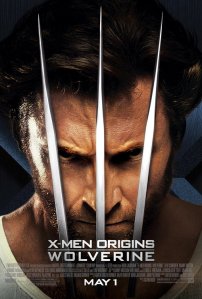 X-Men Origins: Wolverine has been slashed from all sides. First, the movie has not been able to shake bad buzz, from extra reshoots to rumors about conflicts between the studio and the director. There was even one rumor that the head of 20th Century Fox Studios ordered a wall repainted a happier color. Then in early April it got even worse. A DVD-quality print of Wolverine was leaked onto the Internet and spread like crazy, and once something finds itself inside the realm of cyberspace it cannot be put back. The reaction to the leaked copy was mixed, at best. The studio went into damage control mode, stating that the leaked copy was an unfinished work print, that they too were not thrilled with this version and paid millions for reshoots, and the final version that would be released in theaters had 20 minutes of new stuff and 10 minutes additionally edited out. But guess what? The wolverine’s out of the bag, it’s the same exact version minus some completed special effects shots. What amuses me about this whole situation is that the studio is on record trashing the movie, saying they were unhappy with this version, and yet this is the final release. After having seen Wolverine, at least I can say that those Fox execs know mediocrity when they see it.
We get to witness the storied history of Wolverine (Hugh Jackman), which goes all the way back to the pre-Civil War era. Born James Logan, and a mutant, the kid had the unusual ability to produce three jagged bone claws from his knuckles. Logan also had the ability to miraculous heal like his older brother, Victor “Sabertooth” Creed (Liev Schreiber). The two of them make use of their primal, animal instincts and near invulnerability by fighting in every major U.S. war, from Civil to Vietnam. Eventually that kind of thing gets noticed, and General Stryker (Danny Huston) recruits the brothers to be apart of a mutant mercenary group. The group also includes the likes of William “Deadpool” Wade (Ryan Reynolds), “The Blob” (Kevin Durand), and some other unimportant mutants (one of them played by a Black Eyed Pea, will.i.am). Wolverine walks away from the group when he decides that he isn’t cut out for a cutthroat life.
The man finds a quiet place to live along the Canadian Rockies. He’s found a hard-working job, lumberjack, and a good woman, Kayla (Lynn Collins), who loves him. All of this is ruined when Sabretooth comes back around, intent on eliminating the former mercenary members one by one. Stryker appeals to Wolverine to apply for the Weapon X program. He says he can give Logan the tools for his revenge. Wolverine then undergoes the famous procedure that bonds his skeleton with adamantium, an unbreakable metal, and his bone claws become extra sharp metal. Stryker has other plans, naturally, and Wolverine breaks out of the facility. Stryker tells his assassin, “Bring me back his head.” Sorry pal, but you’re the one that just spent half a billion dollars giving Wolverine an unbreakable spinal column.
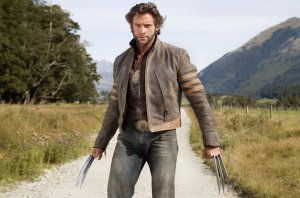 Is this origin tale worth telling? Short answer: no. The mysteries behind Wolverine’s back-story aren’t too involving and the answers make the character less interesting. I don’t really care why Wolverine got his metal skeleton or how he came to be an amnesiac, I just accept that the man has some mystique to him. I care even less that one of the answers to those mysteries is a murdered lover. The plot is incredibly thin; Wolverine meets one mutant who tells him to meet another mutant who tells him to meet another mutant, etc. Eventually the film heads for a mutant showdown that plays out like a lame video game, specifically the mid-90s Mortal Kombat (the Final Boss super villain resembles the blade-handed Baracka). What are Gambit (Taylor Kitsch) and Emma Frost doing in this? That?s not the end of the mutant cameos, either. I feel like the only thing we learn about Wolverine is that his super sense of smell cannot detect the difference between real blood and stage blood. The filmmakers think character development involves someone saying no to slaughtering innocents, and then other characters keep telling him, “You’re not an animal.” The movie meanders from one unimaginative special effects set piece to another, stopping at points to shove in various mutants that serve little purpose to the story other than diehard comic fans will be more forgivable.
Oh, but what to do when your main character is indestructible, your main villain is also indestructible, and your other lead villain cannot be killed because he?s due for an appearance in X-Men 2? Why you bring in a third, nigh indestructible being into the stakes, however, this being doesn’t already play into the established X-Men onscreen mythos, so this guy’s okay to kill off, that is, until he too gets a movie built around his character and then that movie has to backtrack to fill in on time before its capped ending. We already had a healing ability mutant with super claws vs. a healing ability mutant with super claws smackdown in X-Men 2, where Lady Deathstrike fought Wolverine. That fight was brutal and well staged. The fights in Wolverine’s big show are uninspired; how much stabbing can you watch between people who instantly heal? Also, apparently another side effect of the Weapon X program is that these metal claws are self-cleaning, because every single damn time Wolverine stabs someone there isn’t a droplet of blood to be found on his claws. It?s hard to get emotionally involved in characters that are fearless and have little at stake. Which, of course, is why Logan had to be given a cruddy romance where he gets to hold his dead lover?s body in his arms and bellow to the heavens for what feels like the 80th time. Seriously, twenty percent of all the dialogue in this movie is some combination of growling, spitting, and bellowing.
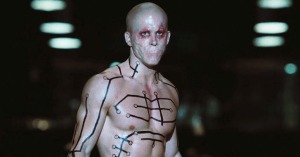 Wolverine isn’t a terrible movie but it’s rather shoddy and thoroughly mediocre. I never thought I’d see this character do the beyond-cliché action movie motif of strutting in slow-mo while an explosion sizzles in the background. This is the kind of film that involves a super team standing shoulder-to-shoulder to walk down like they’re from The Right Stuff. This is the kind of movie that opens with a needless family squabble about Logan finding out the pointless identity of his real father. What was that about? (After killing his father, I remarked to myself, “I guess that he gets that whole healin’ thing from his mother’s side of the family.”) This is the kind of movie that hires Ryan Reynolds and then disarms the man of his greatest asset, his smart mouth. This is the kind of movie that theorizes the only thing to kill an adamantium-skeleton man is with an adamantium bullet, like a sort of werewolf. This is the kind of movie that sends a super assassin, with super bullet-bending powers, out to kill Wolverine but does not arm the super assassin with those special adamantium bullets. Why not shoot this guy in the eye? That is an open body cavity. This is the type of movie where the final super villain is controlled by, get this, key commands like “Engage.” This is the kind of movie where an assortment of characters refrain from killing super bad murderers out of the morally pretentious idea that they, too, would be no different from the super bad murderers. Excuse me, executing super bad murderers would be doing the world a favor here. This is the type of movie that fills the running time with pained dialogue like, “You wanted the animal, you got him,” and, “Nobody gets to kill you but me,” and the best line of them all: “I thought you were the Moon and I was your Wolverine. Turns out you’re the Trickster and I’m just the fool who got played.” Top that, screenwriters.
Whatever the budget was for this movie, well, apparently it wasn’t enough. The adamantium effects looked perfectly reasonable in the first X-Men film and that was nine years ago, so I cannot understand why the claws look astoundingly fake this go-round. They look like direct animation, like Wolverine is holding cartoon claws a la Who Framed Roger Rabbit? When did they become so thick too? These claws are like the size of the steak knives you get at restaurants.
Jackman deserves some of the blame here since he is listed as a producer and he hand selected director Gavin Hood (Tsotsi, Rendition) who does not have the interest or the eye for this kind of material. Hood lacks the finesse and vision to stage exciting action sequences, which explains why he falls back on tired genre tropes like the slow-mo strut in front of fireballs. I am dead certain that this stupid super assassin was pushed into the movie after film producers saw how much money the bullet-curving Wanted made the previous summer. The movie borrows heavily from recent Marvel Origin comics, or so I’m told, which is where the whole “Wolverine through the ages” storyline comes from. Personally, I don’t much care for the idea that Wolverine’s healing ability also deters aging until you hit that agreeable, desirable Hugh Jackman age range, but fine, whatever. The movie takes great effort to showcase Jackman’s flawless physique, and this dude is ripped to the point that you can see bulging veins. I just wished Jackman made more use of his acting muscles in this movie. He snarls and glares, and even has a softer moment or two with Collins, but rarely does Wolverine get to prove why he is such a beloved comics character.
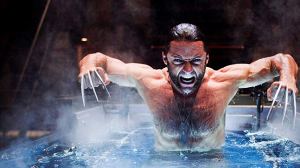 Thank goodness for Liev Schreiber (who actually also co-starred with Jackman in the forgettable romantic comedy, Kate & Leopold) because this man entertained me from start to finish, which is more than I can say about his movie. Schreiber has fun with his role and totally buys into the character’s animal instincts. He relishes the kill. The bizarre sibling rivalry between he and Wolverine is the best part of the movie, and the interplay between the two actors is when the movie has its few moments of life. Like Watchmen, the film finds its creative peak during the opening credits, as we watch Jackman and Schreiber claw and bite their way through American battlefields.
Here’s an easy solution to the Wolverine amnesia issue that doesn’t involve the use of admantium bullets. Kayla (Silverfox) has the power of hypnosis through touch, so why not in the emotional climax have her touch her dear lover Wolverine and wish, “Forget me. Forget all about me.” There, problem solved, and this way it works emotionally and organically with the story. It took me an hour after seeing X-Men Origins: Wolverine to come up with a better ending, so just imagine what more time will allow. Jackman and company are lost thanks to a mediocre script that sacrifices character for action beats, and even then the action is fairly mundane. There are a handful of cool moments, like Wolverine propelling himself onto a helicopter from an exploding car, but after four movies nothing has come close to producing the adrenaline rush that was the X-Men 2 sequence where Logan unleashes his berserker rage on the commandos in the mansion. By the end of his first solo outing, Wolverine is left without any memory. I won’t say we should all be so lucky but the X-Men filmmakers would be better off paying little attention to this origin tale, unless they want to bring Schreiber back, which they should do at all costs.
Nate’s Grade: C
Share this:

The Incredible Hulk (2008)
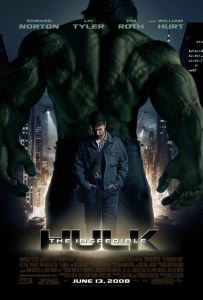 Maybe the American public just doesn’t care for the jolly green giant. The second incarnation of a big screen Hulk flick is better paced, with more action sequences and better special effects, but I just kept shrugging my shoulders the whole time. I was never truly engaged by the movie at any point. Edward Norton fills the role of Bruce Banner for the second go-round and does an admirable job. The climax involving one giant CGI monster battling another giant CGI monster gets tiresome. This is a fairly middle of the road movie that might pass the time but does little else with style.
Nate’s Grade: C+


 nathanzoebl
You must be logged in to post a comment.