Blog Archives
Mickey 17 (2025)
 Bong Joon Ho is one of those filmmakers that has earned the right to make any movie he wants. Hollywood might not feel the same, but the filmmaker behind Snowpiercer, The Host, and the triumphant Oscar-winning Parasite, the first time an international movie won Best Picture, is an amazingly versatile storyteller who seamlessly blends different genres and tones into unique and mesmerizing film experiences. If he’s interested in telling a story, then that guarantees I’m interested in watching it. This is especially true if he steps into the realm of science fiction. After the worldwide success of Parasite, Bong Joon Ho was given $100 million dollars and final cut from a big studio to make whatever he wanted, and he chose an adaptation of Edward Ashton’s novel, Mickey 7, telling the story of the world’s most/least fortunate expendable in a fledgling space colony. I read the book last year and it was quite good, so my anticipation was even higher for the feature film Mickey 17, especially after Warner Brothers delayed the movie an entire year. Now, after the long wait, we can all finally enjoy Bong Joon Ho with peak artistic freedom, a position that will likely not be repeated. It’s a grand movie with big ideas, vision, satire, and also enough underutilized ideas and distracting characters and performances to quibble over “what if’s.”
In the distant future, Earth is overrun in population and low on natural resources, so the next space race is to find habitable colony worlds. Mickey (Robert Pattinson) gets in over his head to shady loan sharks and looks for any possible way off of the planet. The only position he can sign up for is that of an expendable, a person who can be cloned from a biological printing machine. These expendables are put in dangerous jobs and different science tests because, well, if they die, you can start over. It’s a terrible job, one that involves dying repeatedly, and Mickey agrees to be the human crash test dummy. He’s on a multiyear colony ship traveling across space to find a habitable world. The planet they land on is bitterly cold, impossible to farm, and crawling with its own crawly wildlife. Mickey 17 is left for dead after falling down a chasm but he survives, trudges back home, only to discover another Mickey in his bed. They’ve assumed Mickey 17 died and already printed out his replacement. There’s a rule about there not being multiples and, if discovered, both expendables would be killed. They have to hide their secret and work together while still vying for dominance over one another and staying out of the crosshairs of buffoonish yet powerful political leaders Kenneth Marshall (Mark Ruffalo) and his wife, Yifa (Toni Collette).
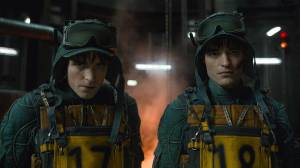 Mickey 17 is a smart, weird, and consistently fun and thoughtful movie. It doesn’t waste any time getting started, literally with Mickey 17 on the cusp of dying with his looming interaction with the aliens. Bong Joon Ho adapted the screenplay and has a nimble way of dealing with the conflicts and setting. I appreciated that he doesn’t prolong different storylines beyond their point of interest. He’s always got another development or joke or set piece to provide. There’s a fun sense of discovery with the movie as well as satisfaction to watch how he slides all the pieces into place. I appreciated how he imbues character notes so easily with supporting characters, giving this universe a larger personality that resonates. I love the setting and the reality it presents of a long-voyage space colony fighting for resources and struggling to keep the lights on. The sets and photography are gorgeous to behold but also filled with details to help make the world feel lived-in. I loved that even in the far-flung future, technology can still work in fits and starts, like watching Mickey slide out of the printer conveyor belt only to lurch backwards before going forward again, like the printers of the 1980s. I love the alien creature design that resembles an armadillo crossed with the subterranean worms from Tremors. I loved how they were able to defend their queen/mamma in Act Three. I love the goofy comic flourishes too, like the fact that there’s a guy just walking around in like a pigeon mascot costume that is never really explained. This is also the same movie where characters constantly ask Mickey what it’s like to die and you realize that every version of Mickey doesn’t know because he’s never experienced it personally, only born from the aftermath. The way this movie is capable of marrying big ideas with silly visual jokes and slapstick and explosions is impressive and a reminder that certain artists will prosper on big stages when given ultimate freedom. Come for the star power and slapstick, stay for the existential dread.
Pattinson presents another wildly weird performance that reminds me how exciting he is as an actor. He’s got these movie star good looks but he really wants to play all the weirdos he can with the most eclectic filmmakers, and I love it. His Mickey 17 and Mickey 18 may be constructed from the same DNA but they come across as vastly different iterations of our hero. This provides a more assertive version of Mickey to try and shape up our more passive Mickey into standing up for himself, taking chances, and taking charge when the situation calls for it. He’s like a mentor. Mickey 18 isn’t featured that often in the story, and truthfully he wasn’t featured that often in the book as well. It’s mostly the story of the hapless and whiny-voiced Mickey 17 and his journey of self. It’s a familiar yet enticing formula to watch a character gain agency and go from pushover to defender of the vulnerable. Pattinson finds little sparks to grab onto with the character, little pieces of weirdness that really help crystalize our understanding of Mickey. Of course the human lab rat would have the fight bred out of him through resignation, and it’s still gratifying to see him stay who he is while also rising to the challenge of the moment. In interviews, Pattinson has said that he modeled his two Mickey performances after the cartoon characters Ren and Stimpy. This actor is perfect for the wacky, tone-blending worlds of Bong Joon Ho. He’s game for everything.
 It’s not hard to see the entire enterprise as a crafty critique of capitalism, not exactly a new point in the Bong Joon Ho movie universe. Mickey’s value to his mission is the literal exploitation of his body. He’s callously tested upon for vaccines and weapons and whatever the scientists may cook up. Because they know they can download another Mickey, it changes how they view the current iteration: he’s not a person, he’s only whatever they want him to be at whatever moment. His value is what he can offer to them as a test subject, as a pile of flesh to be experimented upon. Therefore, the casual cruelty in the name of science and “progress” is yet another example of how we can easily dehumanize our fellow man in a system that profits from their labor and exploitation. Bong Joon Ho also provides a more compassionate view of the downtrodden Other, in particular the indigenous alien species on the colony world (to be fair, as is pointed out by another character, the humans are the actual aliens in this scenario). The creatures are viewed as unworthy of co-existence, in the way of man’s intergalactic manifest destiny, and so they must be wiped out for greater conquest. It’s not a huge surprise that the aliens might not be the stupid and scary creatures that they’ve been projected to be, and this is revealed very early when a collective herd saves the wounded Mickey 17. He views this as an insult, that he’s not even seen as worth eating, but the reading should be obvious to everyone in the audience. Thus we spend the rest of the movie for the other characters to realize the reality of these strange creatures. I did appreciate that the end of the movie coincides with a battle for primacy versus cooperation and compassion, which centers some of the major themes and ties the movie’s character arcs and significant messages together. Plus there’s also explosions.
And yet, there are ideas that could have been explored for even more depth and contemplation. There’s a very intriguing question concerning the different personalities of Mickey 17 and Mickey 18, which begs the follow-up question whether or not they are indeed one hundred percent replicas. Their personalities are such wild swings away from one another, with one being much more the laconic pushover and the other being the aggressive and assertive ideal Mickey. The next Mickey is built upon the recorded memories of the previous memories, so in theory there wouldn’t be many significant differences. However, the big personality differences are not explored or even questioned. This is a missed opportunity that could have gotten to something deeper philosophically and with the revelations of its world-building tech. Perhaps the cloning device doesn’t actually work as advertised and each new Mickey is a close proximity but there are minute yet distinct differences, meaning each new Mickey is his own person deserving of identity. This could then also further connect with the religious objection to cloning that one body should only have one soul. This could lead to Mickey 17, and even 18, debating whether or not they have souls of their own and their conception of life and sacrifice, being more than just the living equivalent of a punching bag. It could also bring into a spiritual element about possibly having a celestial reward after their extra-solar toils, at least the hopeful belief. There were real thematic qualities to explore and provide meaningful texture to the whole movie, and yet they’re disappointingly ignored.
 The Trump buffoonery avatar stuff is a little harder to take in early 2025 with the fallout of a second Trump presidency still having its far-reaching, chaotic, despotic consequences. The character and his wife are invented entirely for the movie by Bong Joon Ho, and clearly he had some things he wanted to say about the former and now-current president (there are even followers wearing those signature red caps). I just don’t know if there’s anything of real substance to this portrayal. He’s a cartoonish idiot villain overcome with vanity, ego, overconfidence, and craven manipulation, but there’s not much that is gained from his multiple appearances. Ruffalo is doing fine work jutting out his jaw and making sure to show those upper teeth as often as possible. It’s just that the character is an exaggerated all-purpose blowhard villain, and it makes for a character you desperately want to see brought lower, to be exposed as a fraud, to get their cosmic comeuppance. The problem is that the appearances are all hammering away at the exact same point that I began to tune Marshall out. In our current political landscape, with the intended target taking up every iota of oxygen in the public sphere, it just becomes another reflection point of the exhaustion felt from the Trump administration. One character verbally lambastes the political bully as a world-class idiot and says, “That’s why you lost the elections.” Plural. It’s then I recalled Mickey 17 was delayed a year, and this would have played differently for me in early 2024 than 2025.
There’s also a very late sequence I would like to analyze why it doesn’t quite work as conceived, but this will enter into some spoilers, so skip to the next question if you’d like to remain pure, dear reader. During the epilogue or coda, Mickey is seemingly remembering something from his past until it’s revealed to be a nightmare and thus having little consequence beyond insight into Mickey’s subconscious anxiety. In this nightmare, Mickey stumbles upon Yifa in the midst of her printing out a new version of her husband through the cloning machine. We’d been previously told that after her husband’s death that Yifa had been locked away and supposedly slit her own wrists. This raises the question whether the Yifa that we see at the machine is her or a clone, and that tantalizing possibility unlocks a new world of story for the movie that seems completely natural and essential. It’s the kind of twist hiding in plain sight that could have worked, that there were two Yifas at the same time there had been two Mickeys or long predating. This is because once you start thinking of this possibility it’s too obvious that it would happen. Of course the rich and famous blowhards who regard themselves as more important than others would see the expendable process as a means of living forever, or at least having a back-up plan. Of course the Marshalls would be hypocrites about their moral righteousness against cloning being an affront to God and creation. Of course these people would use whatever means they could to extend their power and their lives. Just like that, the very end of the movie has an extra layer to it that also provides more purpose for Yifa as a character. Then, just like that, it’s revealed as a nightmare, and all that intriguing possibility is wiped out, and I was left wondering why even produce this moment after the duplicating machine has been destroyed?
 Mickey 17 is an engaging, funny, enraging, and silly example of what science fiction can do. It can explore existential and essential questions about what it means to be human while also employing cartoonish slapstick, as well as cartoonish political satire. Not everything comes together smoothly; it’s a true jumble of tones and ideas, a Bong Joon Ho staple, but he’s typically so skilled at hiding the transitions and seams so you don’t even notice the genre movement until it’s already happened. There are intriguing directions and ideas I wish the movie had explored more, and the climax is a little conveniently tidy but suitably fitting as an invention for a showdown. As a reader of the novel, I can say that it’s an entertaining and fitting adaptation but also one that works on its own while I can still encourage people to read the novel. Mickey 17 is ambitious and messy and also very human, finding grace inside the darkness and absurdity. It’s not perfect but it is worth celebrating, just like each of the put-upon Mickeys.
Nate’s Grade: B+
Share this:

Eternal Sunshine of the Spotless Mind (2004) [Review Re-View]

Originally released March 19, 2004:
No other movie this year captured the possibility of film like Michel Gondry and Charlie Kaufman’s enigmatic collaboration. Eternal Sunshine was a mind-bending philosophical excursion that also ended up being one of the most nakedly realistic romances of all time. Joel (Jim Carrey restrained) embarks on having his memories erased involving the painful breakup of Clementine (Kate Winslet, wonderful), an impulsive woman whose vibrant hair changes as much as her moods. As Joel revisits his memories, they fade and die. He starts to fall in love with her all over again and tries to have the process stop. This labyrinth of a movie gets so many details right, from the weird physics of dreams to the small, tender moments of love and relationships. I see something new and marvelous every time I watch Eternal Sunshine, and the fact that it’s caught on with audiences (it was nominated for Favorite Movie by the People’s friggin’ Choice Awards) reaffirms its insights into memory and love. I never would have thought we’d get the perfect romance for the new millennium from Kaufman. This is a beautiful, dizzingly complex, elegant romance caked in visual grandeur, and it will be just as special in 5 years as it will be in 50, that is if monkeys don’t evolve and take over by then (it will happen).
Nate’s Grade: A
——————————————————
WRITER REFLECTIONS 20 YEARS LATER

“How happy is the blameless vestal’s lot!
The world forgetting, by the world forgot:
Eternal sunshine of the spotless mind!
Each prayer accepted, and each wish resigned;”
-Alexander Pope, Eloisa to Abelard (1717)
“Go ahead and break my heart, that’s fine
So unkind
Eternal sunshine of the spotless mind
Oh, love is blind
Why am I missin’ you tonight?
Was it all a lie?”
-Kelly Clarkson, Mine (2023)
This one was always going to be special. Eternal Sunshine of the Spotless Mind is not just one of my favorite movies, it’s one of those movies that occupies the place of Important Formative Art. It’s a movie that connected with me but it’s also one that profoundly affected me and changed me, that inspired me in my own creative ventures. With its elevated place in my memory, I’ll also admit that there was some mild trepidation about returning to it and having it not measure up to the impact it had all those twenty years ago. It’s impossible to recreate that first experience or to chase after it, but you hope that the art we consider great still has resonance over time. This happened before when I revisited 2000’s Requiem for a Dream, a movie that gobsmacked me in my youth, had such innate power and fascination, and had lessened over the decades. It was still good art but it wasn’t quite the same, and there’s a little tinge of disappointment that lingers.

When I saw the movie for the first time it was at a promotional screening. I was a senior in college and had dyed my hair bright red for the second time. After marveling over my first encounter with 1999’s Run Lola Run, I was determined to have hair like the titular Lola. My parents were hesitant and set parameters, like certain grade achievements, and I met them all. Afterwards they had nothing left to quibble so I dyed my hair red, as well as other colors, my sophomore year and then again my senior year. At the screening, a publicist for the studio asked if I wanted to compete for a prize. I demurred but then she came back and asked again, and sensing something to my advantage, I accepted. It turns out the pre-show contest was a Clementine (Kate Winslet) look alike contest and my only competition was a teen girl with one light swath of blue hair. The audience voted and I won in a landslide and was given a gift basket of official Eternal Sunshine merchandise that included the CD soundtrack and a bright orange hooded sweatshirt modeled after the one Clem wears in the movie. That sweatshirt quickly became one of my favorite items of clothing, something special that nobody else had from a movie I adored. I wore it everywhere and it became a comfort and a confidence builder. Back during my initial courtship with my wife, in the winter months of 2020, she held onto the orange hoodie as a memento to wear and think of me during our time apart. She said it even smelled like me, which was a comfort. It had meaning for us, and we cherished it. I had to marry her, of course, to ensure I’d eventually get the sweatshirt back in my possession (I kid).
The lessons of Eternal Sunshine run deep for me. On the surface it’s a breakup movie about an impulsive woman, Clem, deciding to erase her memories of her now ex-boyfriend Joel (Jim Carrey). Out of spite, he elects to have the same procedure, and from there we jump in and out of Joel’s head as a subconscious avatar experiences their relationship but in reverse. It’s the bad memories, the hurt and ache of a relationship nearing or past its end, but as each memory degrades and Joel goes further into the past, he discovers that there are actually plenty of enjoyable memories through those good times, the elation and discovery, the connections and development of love, that he doesn’t want to lose. He tries to fight against the procedure but it becomes a losing battle, and so he gets to ride shotgun in his cerebellum as this woman vanishes from his life. What began out of spite and heartache ends in mourning and self-reflection.
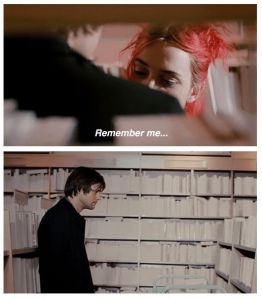
At its heart, the movie is asking us to reflect upon the importance of our personal experiences and how they shape us into the people that we are. This includes the ones that cause us pain and regret. The human experience is not one wholly given to happiness, unfortunately, but there are lessons to be had in the scars and pain of our individual pasts. I’m not saying that every point of discomfort or pain is worthwhile, as there are many victims who would say otherwise, but we are the sum total of our experiences, good and bad. With enough distance, wisdom can be gained, and perhaps those events that felt so raw and unending and terrible eventually put us on the path of becoming the person you are today. Now, of course, maybe you don’t like the person you are now, but that doesn’t mean you’re also a prisoner to your past and doomed to dwell in misery.
After my divorce from my previous wife in 2012, I wrote a sci-fi screenplay following some of the same themes from Eternal Sunshine. It was about two dueling time travelers trying to outsmart one another, one hired to ensure a romantic couple never got together and one hired to make sure that they had. The characters represented different viewpoints, one arguing that people are the total of their experiences and the other arguing people should be capable of choosing what experiences they want ultimately as formative. Naturally, through twists and turns, the one time traveler learns a lesson about “living in the now,” to stop literally living in the past and trying to correct other people’s perceived mistakes, and that our experiences, and our heartache, can be valuable in putting us into position to being the people we want or living the lives we seek. It shouldn’t be too hard to see that I was working through my own feelings with this creative venture. It got some attention within the industry and I dearly hope one day it can be made into a real movie. It’s one of my favorite stories I’ve ever written and I’m quite proud of it. It wouldn’t exist without Eternal Sunshine making its mark on me all those years ago.
It’s an amazing collaboration between director Michel Gondry and the brilliant mind of Charlie Kaufman. The whimsical, hardscrabble DIY-style of Gondry’s visuals masterfully keeps the viewer on our toes, as Joel’s memories begin vanishing and collapsing upon one another in visually inventive and memorable ways. There’s moments like Joel, after finding Clem once she’s erased her memory of him, and he storms off while row after row of lights shuts off, dooming this memory to the inky void. There’s one moment where he’s walking through a street and with every camera pan more details from the store exteriors vanish. A similar moment occurs through a store aisle where all the paperbacks become blank covers. It’s a consistent visual inventiveness to communicate the fraying memories and mind of Joel, which becomes its own playground that allows us to better understand him. The score by Jon Brion (Magnolia) is also a significant addition, constantly finding unique and chirpy sounds to provide a sense of earned melancholy. By experiencing their relationship backwards, it allows us to have a sense of discovery about the relationship. This is also aided by Kaufman’s sleight-of-hand structure, with the opening sequence misleadingly the beginning of their relationship when it’s actually their second first time meeting one another. The pointed details of relationships, both on the rise and decline, feel so achingly authentic, and the characters have more depth than they might appear on the surface. Joel is far more than a hopeless romantic. Clem is far more than some Manic Pixie Dream Girl, a term coined for 2005’s Elizabethtown. She tells Joel that she’s not some concept, she’s not here to complete his life and add excitement; she’s just a messed up girl looking for her own peace of mind and she doesn’t promise to be the answer for any wounded romantic soul.

The very end is such a unique combination of feelings. After Mary (Kirsten Dunst) discovers that she’s previously had her memories of an affair with her boss erased, she takes it upon herself to mail every client their files so that they too know the truth. Joel and Clem must suffer listening to their recorded interviews where they are viciously attacking one another, like Clem declaring Joel to be insufferably boring who puts her on edge, and Joel accuses her of using sex to get people to like her. Both are hurt by the accusations, both shake them off as being inaccurate, and yet it really is them saying these things, recorded proof about the ruination of their relationship. Would getting together be doomed to eventually repeat these same complaints? Clem walks off and Joel chases after her and tells her not to go. Teary-eyed, she warns that she’ll grow bored of him and resentful because that’s what she does, and she’ll become insufferable to him. And then Joel says, “Okay,” an acceptance that perhaps they may repeat their previous doomed path, maybe it’s inevitable, but maybe it also isn’t, and it’s worth it to try all the same. Maybe we’re not destined to repeat our same mistakes. Then it ends on a shot of our couple frolicing in the snow, the descending white beginning to blot out the screen, serving as a blank slate. It’s simultaneously a hopeful and pessimistic ending, a beautifully nuanced conclusion to a movie exploring the human condition.
Winslet received an Oscar nomination for her sprightly performance, and deservedly so, but it’s Carrey that really surprises. He had already begun to stretch his dramatic acting muscles before in the 1998 masterpiece The Truman Show and the far-from-masterpiece 2001 film The Majestic. He’s so restrained in this movie, perfectly capturing the awkwardness and passive aggressive irritability of the character, a man who views his life as too ordinary to be worth sharing. Clem begs him to share himself since she’s an open book but he’s more mercurial. She wants to get to know him better but to Joel there’s a question of whether or not he has anything worthwhile getting to know. Carrey sheds all his natural charisma to really bring this character to life. It’s one of his best performances because he’s truly devoted to playing a character, not aggressively obnoxious Method devotion like in 1999’s Man on the Moon.
Eternal Sunshine of the Spotless Mind is a messy, enlightening, profound, playful, poignant, and mesmerizing movie. A perfect collaboration between artists with unique creative perspectives. I see something new every time I watch it, and it’s already changed my life in different ways. I used to see myself as Joel when I was younger, but then I grew to see him as self-pitying and someone who too often sets himself up for failure by being too guarded and insular. It’s a reminder that our cherished relationships remain that way by allowing ourselves to be vulnerable and open. We are all capable and deserving of love.
Re-View Grade: A
Share this:

Poor Things (2023)
 Poor Things is going to be a lot to many people. It is a lot, and that’s kind of the larger message because ultimately, for all its peculiarities and perversions, the movie is also an inspiring fable about living one’s life to the fullest and embracing the choices that make us happy and content. It’s a feminist Frankenstein allegory as well as an invitation to see the world with new eyes and a fresh perspective, to embrace the same hunger for a life that defines the journey of Bella Baxter from woman to child to woman again. Under the unique care of director Yorgos Lanthimos and screenwriter Terry McNamara (reuniting after 2018’s triumphant and irreverent The Favourite), Poor Things proves to be an invigorating drama, a hilarious comedy, a stunning visual experience, and one of the year’s finest films.
Bella (Emma Stone) lives a life of solitude with her caregiver, a brilliant but disfigured surgeon named Dr. Godwin Baxter (Willem Defoe), who Bella refers to as “God,” and for good reason. Bella is herself one of the doctor’s experiments. Her body belongs to an adult woman of a different name who killed herself. Her mind belongs to the baby that had lived through its mother’s suicide. “God” resuscitated the body of the mother by giving her the brain of her child. She’s curious and defiant and soon yearns for independence and discovering the outside world. A caddish lawyer, Duncan Wedderburn (Mark Ruffalo), is drawn to Bella and offers to take her on a grand adventure to parts of the world. She agrees, and from there Bella gets an education on the plentiful pleasures and pains and puzzles of being a human being. In many ways, Poor Things serves as a fish-out-of-water fairy tale that invites the audience to question and analyze the Way Things Are. Bella’s childlike perspective allows her to strip away the assumptions of adulthood and the cynicism of disappointment. Everything is new and potentially exciting, but she can also cut through the cultural hang-ups and repressive rules of polite Victorian society. This is expressed perhaps most memorably in her embrace of sexuality and the pursuit of physical pleasure. She’s told not to seek out this pleasure except for very specific settings and situations, and this confounds her. Why aren’t people doing this all the time, she asks after an extensive session of vigorous sexual activity. She is a person incapable of shame during a modest time of conditioned shame. This brashly hedonistic reality might prove too morally demented for many viewers uncomfortable with the premise. In context, it is a grown woman’s body being operated by the mind of a child. We are told that she grows and matures as she accumulates her worldly experiences, but the movie keeps it purposely vague how analogous her brain-age might be and whether that maturation is of a pace with traditional aging. It’s a reverse of 1979’s The Tin Drum, a German movie where a child refuses to grow up once he hears the drudgery of the adult world, and so he remains three years old in appearance but continues maturing intellectually and emotionally. There’s a cliche about looking at the world with a child’s unassuming eyes, and that doesn’t necessarily mean only looking at the things that are safe and appropriate for children.
Bella responds with wonder to the many pleasures of being human, but, sadly, it’s not all puff pastries and orgasms. The world is also filled with horrors and injustices, and Bella’s personal journey of discovery is also one discovering the human capacity for cruelty and selfishness. Some of this is a response to Bella wanting to assert herself and independence, as she very reasonably doesn’t understand why all these men get to tell her what to do or expect that they should. At one point, Duncan literally hurls her books into the sea so that she will not continue educating herself. This extends to later in the movie when Bella looks at prostitution in a Parisian brothel as a means of earning a living. Her same sexual appetites, that were enthusiastically encouraged by Duncan, are now paradoxically looked at by the same man as wicked. Absent riches, Bella is treated as a disposable commodity and she’s trying to make sense of why one version of her receives respect and adoration and another version is looked with disgust. It seems that an essential part of maturation is acknowledging the faults of this world and its entrenched systems of thought, but does giving in to these systems make one more human or merely more cynical? Is it a matter of learning or is it a matter of giving up on changing the status quo? These are many of the questions that the movie inspires as we join Bella on her fantastic journey of self-discovery. This movie would not work nearly as well without the fearless performance from Stone (Cruella). She gives everything of herself for this role and rewires the very movements of her body to better portray such a unique elding of a character at so many crossroads. Her early physicality is gangly like she’s learning how to operate this adult body of hers that appears too ungainly, and her expressions are without restraint, as if she’s peeled back every acting impulse to instead find a purity of perception. There is a transparent and transcendent joy in her performance as well as an ache when Bella discovers the awful shortcomings of this world. Lanthimos movies exist in a different world than ours, a cracked mirror universe of deadpan detachment and casual cruelty, so it requires a commitment to a very specific tone of performance. And yet, the requirements of this role work against that Lanthimos model of acting because Bella cannot be detached from this world. As a result, there is the same matter-of-fact reaction to the world but channeled through an idealistic innocence rather than the sarcastic skepticism that can dominate the director’s oeuvre.
The supporting cast contributes wonderfully. Dafoe (The Lighthouse) is a natural at being a weirdo, but he exhibits a paternal love for his creation that is surprisingly earnest. I laughed every time he went into one of his extended wails when he was disconnecting himself from a machine to handle his bodily gasses. Ruffalo (The Adam Project) is devilishly amusing as he abandons all pretense of likeability to play a deeply manipulative but fascinating louse, a character that is almost as transparent about his desires as Bella. His faux elitism is a constant source of comedy. Kathryn Hunter (The Tragedy of Macbeth) has a memorable and sinister turn as the brothel madame who teaches Bella about the nature of capitalism and socialism. Christopher Abbott (Black Bear) appears late as a privileged man from Bella’s past reappearing with his own demands, and his is the most terrifying portrait in the entire wacky movie, an antagonist that’s all too real and scary in a movie given to such brilliantly quixotic flights of fancy.  Under Lanthimos’ direction, the movie presents the world as an awesome discovery and the lurches into the surreal allow the viewers to see the marvels of existence with the same awe as Bella. The movie feels like it takes place in a science fiction universe of crazy visuals and the avant garde incorporation of past, present, and future. It makes every scene something to behold. This is his most visually decadent film of his career. The musical score by Jerskin Fendrix, a first-time film composer, and it works on a thematic level as trying to discover new kinds of sounds along with the journey of its heroine. However, there are sequences where the music feels like an assault on your ears. While intentional, the detours into abrasive dissonance can make one long for something less experimental and more traditional at least for the sake of your own sensitive eardrums.
Life can be decadent, it can be confusing, it can be ridiculous, it can be heartbreaking, it can be terrifying, but it’s an experience worth savoring and embracing, and this ultimately is the message of Poor Things. Stone is brilliant as she confidently carries us along for every moment of an exploration of what it means to be human, and with an ending that is so fitting and satisfying that I wanted to stand and applaud. For those squeamish from the heavy amounts of sexuality, Poor Things is at its core a very pro-life movie. It’s an inspiration to make you think one minute while making you snort laughing the next. May we all see the world with the voracious hunger and curiosity and boldness of Bella Baxter with her second chance at this one life.
Nate’s Grade: A
Share this:

The Adam Project (2022)
 Watching the trailer for Netflix’s The Adam Project, I wasn’t too impressed. It felt like a combination of familiar and popular movies like Back to the Future, E.T., and Looper. It seemed like another assembly of popular sci-fi movie tropes and I wasn’t expecting much else. Then as I watched the movie, I realized how enjoyable and engaging this original story by writer T.S. Nowlin was and what must have attracted Tom Cruise to want to star and produce this project in 2012. It met a long developmental hell, as is common in the industry, before being given a second life at Netflix with Ryan Reynolds as star and director Shawn Levy (Free Guy). It kind of muffs the action and sci-fi spectacle, but The Adam Project is a movie that’s big where it counts.
Adam (Reynolds) is a pilot in 2050 who is fighting against a corporate evil that uses time travel to enshrine its power. Adam’s own wife (Zoe Saldana) crash landed in 2018. In desperation, he travels back in time to find her and team up against their future foes, except he lands not in 2018 but in 2022, and he meets his younger, twelve-year-old self (Walker Scobell). It so happens that Adam’s ship is marked to respond only to his DNA, so he needs his younger self to help while he recovers from his injuries. Unfortunately, the future is antsy to eliminate Adam and sends killer super soldiers and missile-launching spaceships. Both Adams come to the conclusion the only way to prevail is to stop the initial first steps of the invention of time travel, meaning going back further to see their departed father, Louis Reed (Mark Ruffalo), the inadvertent creator of time travel.
 Where The Adam Project really shines is with its core ideas and relationships, which is the emotional heart of a movie. It’s peculiar because we’re so used to seeing the other half, the sci-fi action spectacle, prioritized at the expense of story and characterization. Usually a studio puts much more emphasis on a movie looking good, or at least passably entertaining, and less on the substance that would make it meaningfully so. Credit to the filmmakers that they understood what the core appeal of this movie was and that is the idea of characters out of time getting a chance to interact, learn, and reconcile. Who among us wouldn’t want another opportunity to talk with a loved one before they are gone? Who among us would not be hesitant to eliminate the special confluence of events that lead a special someone into our life? The idea of two different aged versions of one character butting heads is inherently fun but also meaningful, because every one of their squabbles or disagreements is telling from a character standpoint. We’re learning about the differences between these two versions and two different timelines. The older Adam is resentful of his younger self, of his naivety, and looking to toughen him up or settle some scores he thinks will be cathartic. The younger version resents his older self for being so domineering, for being so cynical, and for pushing him into uncomfortable situations to relieve long-standing grudges that he hasn’t dwelled over yet. It also allows older Adam to remember things that he has forgotten from the perspective of his younger self. The buddy banter is capable and spry but it’s also revelatory about the characters, which makes every interaction more important.
Adam’s father doesn’t come back until the second half of the film, and then the movie transforms into a real family affair and takes on extra pathos. Dear old dad is the square pushing back against the ethical implications of knowingly participating with time travel. Here we have three different characters, all related, but each has a different perspective and competing goals: Younger Adam wants to beat the bad guys but also is freshest in his grief over his dad and wants to save him; Older Adam wants to rescue his wife but also has a score to settle with his departed father; and Dad gets a chance to see his grown son, something he will never otherwise witness, but is adamant about refusing to help and prosper from time travel foreknowledge shenanigans. That’s a good combination of conflicts and personality differences, and through the relatable lens of broken relationships repairing between two sons and their father, it elevates each routine action moment later.
 My other surprise was how mundane the action plays in The Adam Project. I started to notice how the action was usually pretty small-scale with only a handful of future soldiers fighting in relatively open and empty spaces. The big future addition is an electrified baton that older Adam utilizes, as younger Adam gushes, much like a lightsaber. It has the power to propel enemies in a force blast that launches out in a circumference, but I kept questioning why Adam wasn’t knocked over by this force as well? It’s a cool device but little else is utilized to separate the past and future. When the characters murder people, they vanish in fiery clouds, free of blood, and we’re told this is what happens when a person is killed outside their timeline. I think it was meant to make the audience forget the mechanics or downplay that all these vanishing soldiers are actually being murdered from existence. The younger versions of these characters are still present but it’s not like there’s another version that will take their place. Their lives ended in this moment as they traveled back in time to this final fate. No do-overs for them. The finale of The Adam Project is a mess of bad CGI and a world-destroying machine; both it and the plot are on apocalyptic autopilot at this point. The preceding movie was much better to simply fall victim to such a dumb climax. It’s not enough to dent the positives that came before it, but the movie succumbs to the pressures of big blockbuster silliness it had avoided.
Here is a vehicle that makes perfect use of the charms of its leading man. Reynolds (Free Guy) has always been a charismatic performer, a fast-talking rogue you can’t help but fall for, but not every movie role allows him to play to his strengths, Sometimes he’s just on quip overload and can come across like the overly ironic, insincere, vacuous version of his motormouth persona. His glib demeanor has a way of eating him whole. Here, the actor gets to essentially be playing off himself, and it works so much better. Reynolds is also a natural with kids (see 2008’s Definitely, Maybe) and there’s an inherent big brother/little brother vibe to the Adam interactions that makes them heartwarming while also amusing. Newcomer Scobell is able to hold his own with Reynolds, no small feat. He has a vibrant, excitable energy that feels youthful without getting into annoying Anakin “yippee” Skywalker territory. Reynolds may be the star but you’ll enjoy spending time with young Adam too, and this is also a credit to Scobell and his performance. Ruffalo and Jennifer Garner (a welcomed 13 Going on 30 reunion) are enjoyable if extremely under utilized; each could have had a whole movie from their vantage point.
 The Adam Project is an action movie that looks like typical pandering studio junk at first glance but gets the hard stuff right, namely the reasons why you should care about any of the flying bodies, explosions, and world-ending CGI. It’s about the characters, and here we have a dynamic that keeps things interesting and fun while also making the dilemma personable and emotional. The same stakes given to saving the world are also given to having one more conversation with a departed father or with trying to get things right in your past while time is still ahead of you. The Adam Project might be overlooked or discounted because of how its parts appear to be generic and stale, but it’s the care with which they are assembled that won me over. I’m just amazed that, for once, a Hollywood big-budget tentpole release emphasized the right stuff.
Nate’s Grade: B
Share this:

You Can Count on Me (2000) [Review Re-View]
 Released November 17, 2000:
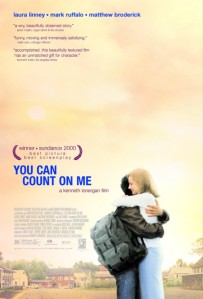
Kenneth Lonergan has had quite an up and down year. He started the year co-writing the atrocious What Planet Are You From? and writing The Adventures of Rocky and Bullwinkle to ending it with the character ensemble piece that ran away with an armful of awards at Sundance. Lonergan uses subtle moves to create a vivid mosaic of small town America and family relationships with You Can Count on Me. In film, quite often do we see the relationships of sisters or brothers (maybe too often). Rarely, though, do we see a thorough drama hinged upon the relationship of a brother and sister. Both torn by their genders yet always drawn together. You may kid, and get angry, but when danger arises you will always come to the defense of your sibling. It’s this seperational friction yet togetherness that creates the brother-sister bond.
Laura Linney and Mark Ruffalo are brother and sister who years ago lost their parents to a horrible automobile accident when they were young. Forced with the battle of growing up with grief, each goes their separate way. Ruffalo is branded the “difficult” rebellious one, yet deep down he knows that his publicly deified sister is just as much the rebel. Linney is a single mother dealing with the pressures of raising her son (a Culkin kid) and working in her town’s bank branch headed by her new boss (Matthew Broderick). Her brother reappears in her life suddenly and the two learn a little form each other. With her brother she can rely on someone else to watch her child and experiences another flash of the mischief that she had to forfeit from her childhood in order to raise her younger brother. Ruffalo provides the male figure her son is lacking and begins to shed the boy’s over protection and opens him up to the world. One experiences responsibility, one experiences release. but do either learn? That is a good question.
 Lonergan crafts a subtle texture that allows his characters to breathe and grow but not necessarily learn. His modest character-driven picture may make you think of Made for TV but its a slice of life that’s immersible. It’s hard to find a film that is subtle, at its own pace, and restrained when it needs to be.
Linney is fantastic as the sister that breaks loose and winds up sleeping with her boss with reckless childish rebellion. Her performance is an Oscar nomination lock as her character runs the emotional gamut. Ruffalo is amazing and establishes himself as one to surely look out for. his mannerisms and expressions are wonderful and his demeanor is reminiscent of Marlon Brando.
You Can Count On Me is a wonderfully affecting story about people who are more complicated then simple plot synopsis will allow. Lonergan has crafted something of an anomaly in modern cinema: a film that takes its time, doesn’t answer any questions, but makes us feel all the better after seeing it.
Nate’s Grade: B+
——————————————————
WRITER REFLECTIONS 20 YEARS LATER

You Can Count on Me was a breath of fresh air in 2000. It was an impressive star-making performance for Mark Ruffalo, who would go onto three Oscar nominations and be the Hulk people actually wanted to see. It was a showcase for Laura Linney, her biggest big screen role to date and earned her an Oscar nomination, her first of three. It was the first personal movie by writer/director Kenneth Lonergan, a playwright who had become one of Hollywood’s popular writers for rewriting studio projects trapped in hell. Lonergan was nominated for Best Original Screenplay, losing to Cameron Crowe’s Almost Famous, and then finally winning the same award for 2016’s emotionally devastating Manchester by the Sea. It’s strange to recall that the biggest name involved with this small, character-driven indie wasn’t any of these three but Matthew Broderick, drafting off his mordant turn in Alexander Payne’s Election. This is one of those slice-of-life movies where the characters are the driving force of the plot, where the small connections and mistakes are the ones that resonate most. And yet, I didn’t see it back in 2000 but I did upon my re-watch, there’s a degree of broad sentimental contrivance as well, an element missing in Lonergan’s latter efforts, including possible masterpiece, 2011’s Margaret.
 We follow the lives of two very different and not so different siblings coming back together. They’ve been orphans since they were children and had to rely upon one another. Sammy (Linney) is the responsible one with the good job and a young son she’s raising on her own. Terry (Ruffalo) is the irresponsible one who gets into fights, can’t keep a job, and served a little time in jail he was embarrassed to tell his sister about. He comes back initially for some quick money, to the disappointment of Sammy, and then sticks around longer and longer, bonding with his nephew and going through old and new arguments with his sister over his life decisions and direction.
It doesn’t take long to realize Lonergan’s striking ability to compose naturalistic dialogue that has pinpoint precision when it comes to characterization. Watching any pairing of characters has the wonderful effect of the best plays, where that intriguing combination of character interactions is like an exciting chemical reaction, creating something new and welcomed. Every conversation then takes on meaning to see how the character interactions change or influence the participants. It means that Lonergan is generous and judicious with his details. A dinner meant to be celebratory can become a re-airing of grievances and disappointments. A night out hustling pool can go from being a bad idea to becoming a male bonding experience that has to stay a secret. The characters are so richly observed and developed that You Can Count on Me is implicitly saying to its audience, “Hey, no matter the scene, you can count on me.”
The relationship between Sammy and Terry is the most emotionally resonant and complex, with each of them defying the easy characterization they’ve been assigned as Good Kid and Bad Kid. He’s resentful of his sister and her judgement when he thinks she can be just as irresponsible. She’s resentful of her brother and his immaturity and inability to put down roots, bumming around and getting into the same old scrapes. Coming back together, each reconnects on a personal and family level where they may be combustible but they realize how much they need and love one another. A final heartfelt goodbye between them, while waiting for a bus to take Terry away, becomes an awkward but affecting moment because they really don’t know when their paths will cross once again. Sammy sure hopes it’s sooner, as her young son has grown attached to Terry. I think deep down Terry hopes it is as well and likes the comfort and support offered from this family that has an open spot in waiting for him on call. He’s ostensibly leaving to make things right with his girlfriend (or ex-girlfriend? It’s unclear since he’s been away) and has grown as a person from the experience of being an uncle. He’s not at the end of his arc, wherever that may eventually lead, but he’s moved closer on that journey. That’s a good summation for all the characters. There aren’t clearly designated arcs but nudges along a very human path to growing and learning.
 Ruffalo (Spotlight) instantly grabs your attention. His performance almost has a shy obstinance, like he doesn’t want to be seen by the viewer, tired of the judgement he knows is coming, and he’s constantly retreating inward in defense and score-settling. He’s so immersed in the character that the actor dissolves entirely. His commitment to character is immediate. There was a reason he was drawing comparisons to Marlon Brando upon release. Linney (Love Actually) is terrific as well as the flabbergasted older sibling tired of having to play parent to her rebellious brother. She has many moments of exasperation with her brother, the men of this small town, her ineffectual boss she has a short-lived affair with. She’s drifting just like Terry but doesn’t realize it; Sammy vacillates between wanting to settle down with a nice boring guy who says he loves her. She’s been stuck fulfilling responsibilities for so long that her brother’s return allows her to cut loose a little bit, to be bad again, to make careless and selfish choices. Linney serves as a strong anchor for us as well as an example that being an adult doesn’t mean being in control.
Where You Can Count on Me slightly falters, and not by much, is the inclusion of storylines that feel a bit too maudlin and TV-movie-of-the-week. There are two tracks of emotions in the movie, subtle and overt, and it’s become clearer which is which upon re-watch twenty years later. I almost feel like Lonergan included some of these parts because they made selling his indie easier to studio executives. The affair Sammy has with her boring yet sleazy boss (Broderick) offers no real insights beyond Sammy’s capacity for self-destructive whims. She keeps coming back to this weak man, maybe because there’s no future with him since he’s married and his wife is pregnant, and maybe because she knows she can drop him. I started groaning whenever her boss called again, so desperate for one more last time, and that is likely the point. It’s watching someone continue down a path we all know should be avoided. It also explains how she might have ended up with her son’s father, played by Josh Lucas (villain in 2003’s first Hulk movie). Terry decides the little kid deserves to see his father and the unannounced visit doesn’t end well. The bad dad denies he is even the father, they get into a fistfight, and the little kid gets to feel abandoned all again. These broad dramatic moments stick out amidst the more subtle and naturalistic movements throughout. It’s not enough to drag down the whole of Lonergan’s enterprise but they feel like discordant notes in an otherwise sumptuous symphony where all the players are working in impressive synchronicity.
 Looking back at my original review in 2000, it hits a lot of the same observations that came to me in 2020 re-watching the movie. The complexity of the characters, the unobtrusive direction, and the naturalism of top performers is as evident back then as it is now. It’s easy to see what drew such celebrated actors to bring life to these people. Lonergan gained confidence as a writer/director and held true to his visions, including a five-year struggle with producers over his ambitious artistic intentions for Margaret that brought in none other than Martin Scorsese to play as elder statesman deal-breaker. His works have become more intimate and insular. Looking back on his first film, which Lonergan even has a small acting role as the town pastor, is like watching the first steps of an artist who would later sprint. You Can Count on Me is a funny, poignant, and engrossing character piece on sibling rivalry and small-town conformity, but it’s also got a few issues that Lonergan would shed later in his career. Come to see a young Ruffalo tear through scenes and Linney match him moment-for-moment.
Re-View Grade: B+
Share this:

Avengers: Endgame (2019)
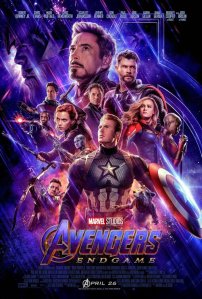 This may prove to be the most difficult review I’ve ever written in my twenty years (!) of reviewing movies. How do I ever begin to describe the events of Marvel’s culminating blockbuster Avengers: Endgame without stepping too far into the dark and dangerous territory of the accursed spoilers? I thought it would be difficult talking about last year’s Infinity War considering the shocking plot events and general secrecy, but this concluding chapter to a 22-movie journey is even more secretive (the trailer accounts for only footage roughly from the first twenty minutes). I’ll do my best, dear reader, to give you the clearest impression I can of this unique experience while respecting your need to be un-spoiled. In short, Avengers: Endgame is unparalleled in our history of modern popular blockbusters because it needs to work as a clincher to a decade-plus of hugely popular blockbusters for the Marvel Cinematic Universe (MCU), and boy do they ever stick the landing.
The film picks up with our surviving Avengers picking up the pieces following the events of Infinity War, namely Thanos (Josh Brolin) eliminating half of life throughout the universe. The original six Avengers are all suffering through guilt, depression, and degrees of PTSD following their failure to defeat Thanos. Scott Lang a.k.a. Ant-Man (Paul Rudd) arrives after having spent time in the quantum realm and has a potential solution that will involve traveling through time to correct the mistakes of the past and bring everyone who vanished back to life. The remaining teammates assemble at the behest of Steve Rogers a.k.a. Captain America (Chris Evans), including Bruce Banner a.k.a. Hulk (Mark Ruffalo), Black Widow (Scarlet Johannson), Thor (Chris Hemsworth), Hawkeye (Jeremy Renner), Rocket Racoon (voiced by Bradley Cooper), Nebula (Karen Gillan), and War Machine (Don Cheadle). However Tony Stark a.k.a. Iron Man (Robert Downey Jr.) needs the most convincing, as he is most afraid of making things even worse and losing more people he feels are too precious to be casualties to their failures once again.
 The thing to know ahead of time is that Endgame is not for the casual fan. This is a long love letter to the fans that have pored over all 22 preceding films, not just a scant one or two. Infinity War was accessible to relative newcomers because of the structure and focus on Thanos as the main character, providing a self-contained arc that lead up to his finger-snapping triumph. It also benefited from the fun factor of simply watching a bunch of popular characters interact and team up for the first time in MCU history. Now that a majority of those characters have turned to dust, the emphasis falls back on the original core of the Avengers, bringing things full circle. In several ways, Endgame is about bringing to a close this mammoth project that began with Iron Man, this decade of storytelling ambition that has stretched out into multiple inter-connected franchises. If you love these characters, then Endgame is a movie made specifically for you. There is a long stretch in Act Two that relies upon a decent amount of fan service and sentimentality, but I don’t think either is an automatically negative attribute. Before we reach the finish line it’s important to take stock of how far we’ve come and this goes for the essential characters and their long arcs. There are several fun cameos strewn throughout and the filmmakers even take an interesting tack of trying to reclaim and re-contextualize the MCU movies that fewer people enjoyed. It makes for a filmgoing experience that is heavy in references, in-jokes, Easter eggs, and cozy nostalgia, which will confuse and frustrate those not well versed in this big world.
The other thing to know, especially if you’re a long-standing fan, is that there will be tears. Oh will there be tears. I lost count of the amount of times I was crying, which was pretty much on and off nonstop for the final twenty minutes. I was even tearing up for supporting characters that I didn’t know I had that kind of emotional attachment for. The film is done so well that the first third actually could play as the MCU equivalent of HBO’s The Leftovers, an undervalued and elegant series about the long-term recovery of those that remain in a post-rapture world. The opening scene involves a character having to go through the loss of loved ones via Thanos’ snap, and it’s brutal as we wait for what we know is coming, dread welling up in the pit of your stomach. The Russo brothers, the returning directing team from Infinity War, know what scenes to play for laughs (the line “That’s America’s ass” had me in stitches), what scenes to play for thrills, what scenes to play for fist-pumping cheers, and what scenes to play for gut-wrenching drama. They allow the movie to be an existential mood piece when it needs to be, actually dwelling on the repercussions of a life post-universe culling. There’s a character who frantically searches to see if a loved one was among the missing, and that eventual reunion had me in tears. With the three-hour running time, the Russos have the luxury of allowing scenes to naturally breathe. This might be the most human many of these characters have ever seemed, and it’s after recovery and grief. Needless to say, the conclusion feels very much fitting but also unabashedly emotional, unafraid of diving deep into its feelings. I sobbed.
 I was worried once the film introduced the time travel plot device that everything was simply going to be erased and invalidate the struggles that came before. The worst use of time travel is when it eliminates any urgency or danger, allowing an endless series of do-overs to correct the past. Fortunately, returning screenwriters Christopher Markus and Stephen McFeely (Civil War, Winter Soldier) realize that in order for there to be a reversal, a glint of a happy ending, there must be a cost or else it all meant little to nothing. There are finite events in the movie that cannot change (as of now) and losses that will be permanent (as of now, if they don’t want to cheapen the journey). People died with Infinity War but we all knew, at least when it came to its dreary conclusion, that it wasn’t going to be too long lasting, which allowed the communal grief to be short-lived. After all, there’s a new Spider-Man film coming down the pike two months from now, so it’s highly unlikely the teenage web-head will remain dead. However, with Endgame, the deaths serve as the cost for resurrecting the MCU, and they will be felt for years. The screenplay provides limitations to the time travel mechanics, though I don’t think the collective hand-wave to the nagging paradoxes was as successful as the movie thinks it was. The film barrels ahead, essentially telling you to forget about the paradoxes and enjoy the ride, focusing on the characters and remembering what is really important.
Suffice to say Downey Jr. is once again his charming, self-effacing, and enormously entertaining self. The MCU began with this man and his contributions cannot be overstated. He is the soul of this universe. Evans is compelling as the straight-laced inspirational figure who takes stock of what he’s sacrificed over the years, Hemsworth showcases a potent mixture of comedic and dramatic chops, Johannson is definitely the Avenger going through the “bargaining” phase to try and make things right and she has some subtle emotional moments that belie her desperation and guilt, and Renner makes a welcomed return in a way that made me appreciate Hawkeye like I never had before. Brie Larson does reappear as Captain Marvel but the movie smartly puts her back on the sidelines protecting the many other worlds in the universe needing assistance because of how overwhelmingly powerful she can become. Larson filmed her scenes for Endgame before her own solo movie, released a month prior, so forgive the different hair and makeup, Twitter nit-pickers. I will say there is one scene that is a bit convoluted how it gets there but is destined to make women in the audience cheer with excitement as the MCU says, “Hey, that whole ‘strong female character’ thing? Yeah, we’ve had all that for years, and here you go.”
 How does one properly assess a movie like Avengers: Endgame, a conclusion not just to an Infinity War cliffhanger but to a twenty-two movie prelude over the course of eleven years? The emotional investment in these characters, their journeys, has to come to something to be ultimately meaningful when it’s time to close the chapter on one massively ambitious story before starting the next. And there will be a next chapter; the MCU’s unparalleled financial success assures the fanbase they’ll have plenty more high-flying and wild adventures to come in the years, and more than likely, decades to come. Marvel had the unenviable task of wrapping up a major narrative in a way that would prove satisfying without devaluing the individual films and overall time investment. Hollywood is filled with trilogies that messed up their conclusions. Nailing the ending is just as important as getting things going right, because without a satisfying conclusion it can feel like that level of emotional investment was all for naught. Endgame reminds you how much you’ve grown to love these characters, what fun you’ve had, and genuinely how much you’ll miss these characters when they depart for good. It’s hard not to reflect upon your own passage of time with the ensuing eleven years, how you’ve changed and grown from the MCU’s humble beginnings in the summer of 2008. These heroes and anti-heroes can begin to feel like an extended family for many, and so fans desperately need the ending to do them justice. Avengers: Endgame is the ultimate fan experience.
Nate’s Grade: A
Share this:

Avengers: Infinity War (2018)
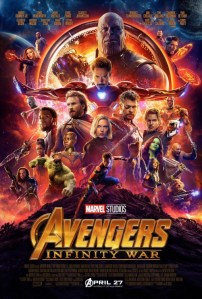 It’s hard to draw comparisons to the major commitment to long-form storytelling that the Marvel Cinematic Universe (MCU) has dabbled with over the course of ten record-shattering years of success. I can think of movie franchises that have been popular over long periods of time, like James Bond, but rarely do they keep to continuity. It’s been 18 movies and ten years since the caddish Robert Downey Jr. first stole our hearts in the original Iron Man, and its stable of heroes and villains has grown exponentially. Looking at the poster for Avengers: Infinity War, it’s hard to believe there’s even enough space just for all of the actors’ names. Infinity War feels like a massive, culminating years-in-the-making film event and it reminded me most of Peter Jackson’s concluding Lord of the Rings chapter, Return of the King. After so long, we’re privy to several separate story threads finally being braided as one and several dispirit characters finally coming together. This is a blockbuster a full decade in the making and it tends to feel overloaded and burdened with the responsibility of being everything to everyone. It’s an epic, entertaining, and enjoyable movie, but Infinity War can also leave you hanging.
Thanos (Josh Brolin) has finally come to collect the six infinity stones stashed around the universe. With their power, he will be able to achieve his ultimate goal of wiping out half of all life in the universe. Standing in his murderous way is a divided Avengers squad, with Tony Stark (Downey Jr.) still on the outs with a wanted-at-large Captain America (Chris Evans) and Black Widow (Scarlett Johansson). One of the in-demand infinity stones resides in the head of the Vision (Paul Bettany), who is in hiding with his romantic partner, Scarlet Witch (Elizabeth Olsen). They know Thanos will be coming for Vision eventually. On the other side are the Guardians of the Galaxy who have a few personal scores to settle with Thanos, the adopted father of Gomora (Zoe Saldana) and Nebula (Karen Gillan). Elsewhere, Thor (Chris Hemsworth) strikes out looking for the key to defeating the big purple menace. Thanos’ loyal lieutenants attack Earth to gather the remaining infinity stones, drawing the attention and push-back of Doctor Strange (Benedict Cumberbatch) and Peter Parker (Tom Holland). The various heroes of Earth and space unite to eliminate the greatest threat the universe has ever known.
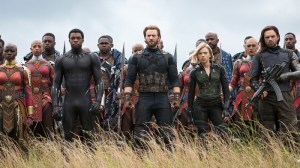 Avengers: Infinity War serves not as much a series of payoffs as it is climaxes, with climactic event right after another, and this time it’s for keeps (more on that below). There are moments that feel like major payoffs and moments that feel like shrug-worthy Last Jedi-style payoffs. Infinity War is the longest MCU movie yet at 149 minutes but it has no downtime. That’s because it has to find room for dozens of heroes across the cosmos. With the exception of three super heroes, everyone is in this movie, and I mean everyone. This is an overstuffed buffet of comic book spectacle, and whether it feels like overindulgence will be determined by the viewer’s prior investment with this cinematic universe. If this is your first trip to the MCU, I’d advise holding off until later. Any newcomer will be very lost. I’ve deduced the seven MCU movies that are the most essential to see to successfully comprehend the totality of the Infinity War dramatics, and they are Iron Man, The Avengers, Captain America: Winter Soldier, Guardians of the Galaxy, Captain America: Civil War, Doctor Strange, and Thor: Ragnarok. Naturally, being intimately familiar with the previous 18 movies will be best, but if you don’t have thirty hours to spare then please follow my seven-film lineup and you’ll be solid.
As far as the stakes, the MCU has been notoriously reluctant about killing off its characters, but Infinity War is completely different. I won’t spoil circumstances or names, of course, but the march of death happens shockingly early and carries on throughout. There are significant losses that will make fans equally gasp and cry. This is a summer blockbuster that leaves behind an impressive body count across the known universe and ends in a downbeat manner that will naturally trigger reflexive Empire Strikes Back comparisons. It’s hard to feel the full impact of the drastic decisions, and the grief over their losses because I know there is a Part Two coming summer 2019, and with that comes the almost certainty that several important events will be diminished or straight-out reversed. After all, in comics, nobody is ever really dead, though with movies the heroes have the nagging habit of aging. With that said, you better believe I was holding my breath during some standoffs, tearing up at some sudden goodbyes, and reflecting upon journeys shared.
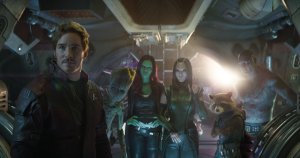 This is very much Thanos’ movie, which was one of the bigger surprises for me. Beforehand, our exposure to the big purple guy has been relatively minor, a brief moment here or a cameo there during a post-credit scene. Considering Thanos is supposed to be the universe’s biggest bad, it makes sense to finally give him his due, and that is what Infinity War does. Thanos gets the most screen time of any character and is given an honest-to-God character arc. He’s a villain who goes on an actual emotional journey as he follows a path that he feels compelled to even as it tests him personally. He finally opens up as a character rather than some malevolent force that is oft referred to in apocalyptic terms. We get his back-story and motivation, which is less a romantic appeal to Death like in the comics and more a prevention of the apocalypse reminiscent of the Reapers in the Mass Effect series. Thanos sees himself as a necessary corrective force and not as a villain. He’s never portrayed in a maniacal, gleeful sense of wickedness. Instead he seems to carry the heaviness of his mission and looks at the Avengers and other heroes sympathetically. He understands their struggle and defiance. Having an actor the caliber of Brolin (Deadpool 2) is a necessity to make this character work and effectively sell the emotions. Thanos is the most significant addition to the MCU appearing the latest, so there’s a lot of heavy lifting to do, and Infinity War fleshes him out as a worthy foe.
 As an action spectacle, however, Infinity War is good but not great. The action sequences are interesting enough but there’s nothing special and little development. There’s nothing that rivals the delirious nerdgasm of the airport battle in Civil War pitting hero-against-hero to dizzying degree. The characters are separated into units with their own goals leading to a final confrontation that feels more climactic conceptually than in execution. That’s because this is an Avengers film that falls into some of the trappings of the glut of super hero cinema, namely the army of faceless foot soldiers for easy slaughtering, the over exaggerated sense of scale of battle, the apocalyptic stakes that can feel a bit like a bell rung too many times, and even minor things like the lackluster supporting villains. Thanos’ team of lieutenants are all the same kind of sneering heavy with the exception of one, a sort of alien cleric heralding the honor of death from Thanos. Carrie Coon (HBO’s The Leftovers) is generally wasted providing the mo-cap for the Lady Lieutenant That Sounds Like a Band Fronted by Jared Leto, a.k.a. Proxima Midnight. There are far too many scenes where characters reluctantly strike a deal to give up an infinity stone if Thanos will spare the life of a beloved comrade. The film’s greatest point of entertainment isn’t with its action but the character dynamics. The fun is watching years-in-the-making character interactions and seeing the sparks fly. There’s more joy in watching Downey Jr. and Cumberbatch try and out smarm one another than with any CGI collision of a faceless army of monsters. There are so many characters that few are given fully defined arcs. Most are given beginnings and stopping places. Though the eventual sequel will have fewer characters needing to share precious screen time.
The standouts on screen are Hemsworth (12 Strong) carrying a large portion of the movie and not missing a beat of his well-honed comic rhythms from Ragnarok, Bettany (Solo) brings a sad soulfulness to Vision as a man who knows fate is likely unavoidable, and Dave Bautista (Blade Runner 2049) is perfectly deadpan as Drax and has the funniest lines in the movie followed closely by the exuberant Holland (Lost City of Z). To even say which characters deal with more complex emotions might be a spoiler in itself but there are several actors showing an emotive level unseen so far in the bustling MCU.
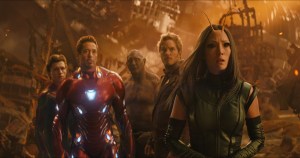 Avengers: Infinity War marks a significant concluding chapter for one of cinema’s most popular series, until at least the next movie possibly makes it feel less conclusive. I pity Marvel because expectations are going to be astronomical for this climactic showdown. There are so many characters, so many crossovers, and so much to still establish, like Thanos as a character more than a spooky force of annihilation, that it feels rather breathless even at nearly two-and-a-half hours. You may be feeling a rush of exhilaration on your way out or an equally compelling sense of exhaustion. Infinity War doesn’t have the imaginative highs of a Dcotor Strange, the funky personality and style of a Guardians of the Galaxy, the wonderfully thought-out structure of a Spider-Man: Homecoming, the adroit weirdness of a Thor: Ragnarok, or even the hero-against-hero catharsis of a Civil War (still my favorite). What it does have is a sense of long-gestating finality, of real stakes and dire consequences. It’s not all pervading doom and gloom; this is still a fun movie, buoyed by crackling character team-ups and interactions. While, Infinity War won’t be all things to all people, myself included, it will please many fans, casual and diehard alike.
Nate’s Grade: B
Share this:

Thor: Ragnarok (2017)
 With the continued runaway success of the box-office juggernaut that is the Marvel Cinematic Universe (MCU), it becomes more and more preposterous just how strange and unique it can be. You would think a mega franchise this valuable would be more prone to playing it safe, hiring established visual stylists who can produce product. Instead, the MCU finds interesting creative voices that can succeed within their very big sandbox. Enter New Zealand actor and quirky director Taika Waititi (What We Do in the Shadows), one of the most surprising directorial hires in a decade of blockbusters. The Thor movies are generally considered some of the weakest films in the MCU, so there’s already plenty of room for improvement. With Waititi, Thor: Ragnarok is easily the best Thor movie and one of the funniest to date for the MCU. It’s finally a Thor movie that embraces its silly, campy, ridiculous world and finds space to cram in more eccentricity.
Thor (Chris Hemsworth) has returned to his home world of Asgard to find it in great peril. His brother Loki (Tom Hiddleston) has been ruling in their father’s stead, and that’s not even the worst part. Thor’s heretofore-unannounced older sister Hera (Cate Blanchett) has been unleashed from her prison and is seeking the throne she feels is rightfully hers. She is the goddess of death and chafes at Asgard’s revisionist history, trying to paint over its history as conquerors for something kinder and gentler. Thor is banished to an outlying planet, Sakaar, that’s essentially a junkyard for the universe. He’s captured by Valkyrie (Tessa Thompson) and sold to fight in the Grandmaster’s (Jeff Goldblum) arena. Thor is trained to fight in gladiatorial combat, and his opponent and reigning champion is none other than the Hulk a.k.a. Bruce Banner’s (Mark Ruffalo) alter ego. Thor must break free, convince the Hulk for help, get off this planet, and save Asgard before it’s too late.
 Waititi has acclimated himself extremely well in the large-scaled world of blockbuster filmmaking, and yet his signature quirky sense of style and humor are still evident throughout, making Ragnarok the best Thor film. Let’s face it, the Thor films are completely ridiculous and trying to treat them as anything but is wasted effort. These movies involve alien Norse gods traveling by rainbow bridges and even though they can traverse the cosmos in spaceships they still sling giant broad swords. The more the films embrace the inherent silliness of the series the better. Ragnarok is the Thor movie that gets all the serious stuff out of the way in the first act, tying up loose ends from 2013’s Dark World, checking in with Anthony Hopkins’ Odin and the requisite MCU cameo (a superfluous Doctor Strange), and then introducing Thor’s long-lost twisted sister. From Blanchett’s intro, the movie becomes what it was set out to be, a lavish and consistently funny buddy comedy. Gone are all the Earthly constraints from the prior two films. It’s all aliens from here on out. Thor has everything stripped from him, his hammer, his family, his hair, and becomes an underdog once again. It’s a surefire way to make a living god more relatable. Fighting from the ground up, Thor makes all sorts of new friends and enemies, and it’s this evolution into an ensemble comedy where Waititi’s film shines. There’s a jovial touch to the world building that extends from the visuals to the variety of odd characters. Thor has never been more entertaining as Hemsworth (Ghostbusters) is able to stop being so serious and embrace his underutilized comedic chops. The man has a stunning sense of comedic delivery and a dry wit that’s right at home for Waititi. Hemsworth and his daffy sense of humor have never been better in the MCU.
Even with the added comic refinery, Thor is still the most boring of the Avengers, so Ragnarok solves this by introducing a new bevy of side characters that steal the show. The wacky world of the Thor universe was always its best aspect, and each new film pushes the boundaries a little further out, revealing more weird and wild planets and creatures. It feels like a Star Wars where we spend our time with the weird, scuzzy part of the universe. Ragnarok pushes those boundaries the furthest yet and introduces an entire cadre of loveable supporting players that you want to spend more time with. Tessa Thompson has a wonderful and intimidating introduction as she swoops in on a spaceship, makes her badass claim of her prized bounty, and then trips and falls, as she is quite tipsy from drinking. She regains her literal footing and still seems a bit out of it, but the ensuring process she goes through to claim what is hers is thoroughly impressive. As a Valkyrie, this is one tough woman, and Thompson (Creed) has great fun playing bad. She really reminded me of a female Han Solo. Thompson has a wily screwball chemistry with Hemsworth, and both actors elevate the other with lively give-and-take. Thompson is a terrific new addition. She has an enticing, irascible appeal without overt sexualization that sometimes befalls the Marvel female sidekicks (Black Widow, Pepper Potts).
 Another character you’ll fall in love with is Korg, a rock monster gladiator played in motion-capture and drolly voiced by director Waititi himself. My question: is it possible for a director to steal his own movie? This is a character that feels stripped from one of Waititi’s dry, absurdist comedies and placed into the MCU. Korg is a would-be revolutionary but really he’s a joke machine and just about every line is gold. By the end of the movie, I needed a Korg spin-off series to further explore this unusual character.
The requisite villains of the film definitely play their roles to full camp, enjoying every moment. Blanchett (Carol) is like a Gothic Joan Crawford, marching with a slinky step and a sneer. Her multi-antler helmet completes the operatic sweep of the character. You’ll forgive me for my above comment on recognizing female characters independent of their sexuality, but man oh man does Goth Blanchett make me happy (especially with her hair down). It’s a shame that the movie doesn’t really know what to do with Hela though. Every time we cut back to her I found myself getting somewhat impatient. I wanted to return back to the weird and wild world Thor was on. Blanchett is entertaining but her character can’t help but feel a bit shoehorned in (“Hey, you had a long-lost sister, and oh by the way, she’s basically Death itself, and she’s coming by to retake everything, so have fun with that and sorry for the short notice”). Goldblum (Independence Day: Resurgence) is left to his Goldblum devices and it’s everything you would want. His signature stuttering deadpan is just as potent in the MCU, and the film finds strange little asides for him to make him even more entertaining. Karl Urban (Star Trek Beyond) has a plum role as Hela’s second-in-command who doesn’t really want the job. They actually gave this guy a character arc. It’s simple, sure, but it was more than I was expecting.
 Ragnarok is a swan dive into a stylized, candy-colored explosion of 80s album covers come alive. The visuals and action feel inspired as much from the art of Jack Kirby as they do the pages of Heavy Metal. The overwhelming feel is one of irresistible fun, something you lean back, soak up, and smile from ear to ear in between handfuls of popcorn. The final battle feels suitably climactic and revisits Led Zeppelin’s immortal “Immigrant Song” once the action peaks, coalescing into a crescendo of cool. The trinkly 80s synth score from Mark Mothersbaugh (The Lego Movie) is fantastic and helps to achieve an extra kitschy kick. This movie is just flat-out fun throughout. It finds fun things for the characters to do, like when Banner has to not Hulk out on an alien world filled with stressors to trigger such an occurrence. That sequence almost feels like the grown-up, polished version of Adam West desperately running around as TV’s Batman in need of trying to find a place to dispose of a lit bomb. There’s an archness to the action and character interactions that is playful without being obnoxiously glib. I also enjoyed a climax that involved more than just out-punching the villains. Some might even charitably read it as a commentary on the over reliance of apocalyptic grandeur.
Playing from behind because of its hero’s limitations, Thor: Ragnarok finally embraces the silliness of its franchise, opening up more comic channels and vastly improving its entertainment quotient. The weird word and its collection of odd and oddly compelling characters is the best feature, and though it takes Ragnarok a bit of time for house cleaning, it becomes a steadily amusing big-budget blockbuster that maintains a cracked and lively sense of humor. It’s allowed to be strange and silly and campy. Waititi’s imaginative voice is still very present throughout the film, pushing the movie into fun and funny directions while still delivering the sci-fi action spectacle we’ve come to expect from the MCU. Ragnarok isn’t as deep as Civil War, as perfectly structured as Homecoming, or as subversive and different as Guardians of the Galaxy, but with a droll creative mind like Waititi, it becomes about the best possible Thor movie it can be.
Nate’s Grade: B+
Share this:

Now You See Me 2 (2016)
 The first Now You See Me was a pleasant surprise that took a simple concept (magician heist) and injected enough sly fun, style, and humor and made a memorable action thriller. As success demands, a sequel was commanded, but I had hopes considering the blueprint of its success could be repeated because those core elements were strong. We all love heist movies, we all love to be fooled, we all love to watch a smart people befuddle those in power, and the reveals made it even more enjoyable. I wasn’t expecting Now You See Me 2 to drop much of what made the first film appealing and shamble through its set pieces with a disinterested sense of sequel duty. The magic is gone.
The Four Horsemen magic act (Jessie Eisenberg, Woody Harrelson, Dave Franco, Lizzy Caplan) has made quite a few enemies. They’re a group that attacks the fraud, exploitation, and greed of those rich and powerful who feel untouchable. This merry band of Robin Hoods is transported against their will to Macau, China by Walter Mabry (Daniel Radcliffe). Walter lost a lot of money from the Horsemen’s antics in the first film and demands they steal a super microchip that will allow him to erase his identity and stay private permanently. Meanwhile, the Horsemen’s handler, Agent Dylan Rhodes (Mark Ruffalo), is blackmailed by famous and currently incarcerated Thaddeus Bradley (Morgan Freeman). Bradley has a score to settle with the Horsemen and uses Rhodes to escape from prison. All forces are headed to Macau and much more will be learned of the Horsemen’s behind-the-scene organization, The Eye.
 It feels like the filmmakers aren’t even trying to keep one foot in reality this time. It’s not like the first Now You See Me was a deeply grounded movie but it took pains to at least offer varying explanations for how these illusions were accomplished. Some of the answers were clever and some were preposterous, but at least they tried to show you their work, which made the Horsemen even cleverer, in my book. Understanding the preparation for the illusions and the execution of them adds to their impressive aura. The characters in the sequel don’t even attempt to explain the far majority of their tricks, and it’s simply not as fun. The opening job is a fun refresher because we see the different characters working together but also because we can see how they’re getting away with their shenanigans. As the movie continues, those magic acts get bigger and bigger and more ludicrous and harder to explain and then the movie just stops trying to explain. At this point magic might as well be real and the Horsemen are wizards. There’s suspension of belief and then there’s simply obliterating all connections to reality. When Eisenberg can control the direction of rain itself without any explanation, it cheapens the thrill. Because if there isn’t some level of limitations, requiring the tricks to be based in reality, then the on screen efforts lose their appeal because it doesn’t matter. It’s like haphazardly just writing, “The Horsemen do some magic junk and get away.” It’s just not as satisfying when it feels like the trick is ultimately on the audience.
Another complaint I have is that the scattered script seems littered with missed opportunities. One of the bigger misses that comes to mind is Harrelson’s twin brother, an obvious Matthew McConaughey impression from his True Detective costar. The character isn’t nearly as funny as Harrelson or the producers believe. He isn’t particularly memorable or necessary to the plot at all, but that’s not even his biggest offense. In a movie about magicians playing sleight-of-hand trickery, how in the world do we not have a switcheroo with the twins? That would justify his existence for the plot. I was shocked this never happened because it seemed so obvious. Why is he a twin? What does being a brother to Harrelson have to do with anything related to the plot? The script also gets overcrowded with antagonists, introducing Radcliffe and then bringing back Michael Caine and Morgan Freeman. The characters don’t so much compete with one another as they operate in separate spheres until a “twist” reveals more about their connections. Their agendas are too opaque. Radcliffe wants them to steal a super microchip so he can fully be “off the grid.” A man of his means shouldn’t have a problem with this. It’s not like he’s hiding out from the law for some kind of corporate espionage. It’s a convoluted reason to bring the Horsemen to his hiding spot in Macau. It’s just one in a long line of ideas that never feel fully developed. Even the magic set pieces don’t feel as fun. Seriously, one of the climactic magic set pieces is a human game of three-card Monty.
 Director John M. Chu (G.I. Joe: Retaliation, Jem and the Holograms) has worked with action before and certainly knows his way around choreography, but he feels too hesitant this time. The action scenes are rare and the chase sequences are muted. Outside of the tricks, there isn’t a standout action scene in the whole movie. In the first film we had a pretty fun magic fight that was wild and surprising and loaded with small payoffs. In this movie we have a motorcycle chase that plays out as expected. We have a foot chase that plays out as expected. You have professional illusionists at your disposal; action set pieces should not play out as expected. The most fun sequence is fairly straightforward but easily the best developed, and that’s the Mission: Impossible-esque heist of the microchip that is outfitted onto a playing card. It’s also clearly the most visually inventive sequence as the Horsemen play a game of keep away and the camera literally at times tumbles into their clothes. I think what makes this easily the best sequence in the movie is because it’s moderately grounded, the stakes are explained, and the audience is in on the trick, enjoying all the flimflam obfuscation. It also means when there are complications to the plan the sequence generates suspense. When you don’t know what’s going on and don’t know when things are going wrong, or how they could go wrong, it’s hard to generate genuine suspense. Being involved in the action is much more fun.
The actors all seem on autopilot, falling back to the broader descriptions for their characters. Eisenberg is a smug and cocky. Harrelson is smooth and shrewd. Franco is awkward and insecure. Isla Fisher is replaced by the capable Lizzy Caplan (TV’s Masters of Sex) as the requisite Female Horsemen. She makes a good impression but part of it is that Capaln seems to be the only member allowed to be comedic. It feels like there are three straight guys to her comedy cut-up. She’s good but without variation it also starts to lose its appeal when only one character seems to be trying. Ruffalo (Spotlight) seems too often unrelated the Horsemen story as he discovers more info about his father. He’s the only character that actually has something of a storyline, though his playing of both sides and attempts to hide his role to the FBI is just another ludicrous element. I miss Melanie Laurent too.
Now You See Me 2 (how could this not be called Now You Don’t?) is a lackluster sequel that seems to have forgotten what made the first film the enjoyable caper that it was.
Nate’s Grade: C+
Share this:

Spotlight (2015)
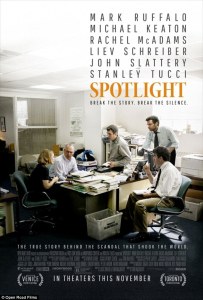 Spotlight is the true-story behind the 2002 expose into the Catholic Church’s cover-up of decades of sexual abuse and it is unflinching in its focus and animated by its outrage, which is the best and worst part of this awards-caliber movie. Writer/director Tom McCarthy (The Station Agent, Win Win) is a splendid curator of unlikely movie families, and with Spotlight he follows the titular investigative team (Michael Keaton, Rachel McAdams, Mark Ruffalo, Brian d’Arcy James) at the Boston Globe as they go about their jobs. That’s really about it. Over the course of two tightly packed hours, we watch as the Spotlight team chases down leads, goes through archives, interview subjects and know when to push harder and when to fall back, and day-by-day build their case to expose the massive corruption within the Church. It’s invigorating material and worthy of the careful and sincere reverence that McCarthy and co-writer Josh Singer have afforded, though the flurry of names can be difficult to keep track of. However, that’s about the extent of the movie. We don’t really get to know any of the journalists on much of a personal level or as a character; they are defined by their tenacity and competence. We don’t get much time for reflection or contemplation on the subject, especially its psychological impact on a majority Catholic city/staff, and the culpability of those within systems of power that chose to ignore rather than accept the monstrous truth. I don’t need more “movie moments” or emotionally manipulative flashbacks, per se. With its nose to the grindstone, Spotlight is an affecting and absorbing news article given life but it feels less like a fully formed movie of its own. It’s confidently directed, written, acted, and executed to perfection, and I feel like a cad even grumbling, but the ceiling for this movie could have been set higher had the filmmakers widened its focus.
Nate’s Grade: B+


 nathanzoebl
You must be logged in to post a comment.