Blog Archives
Play Dirty (2025)
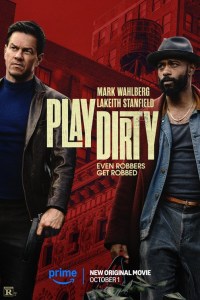 Shane Black is one of the best known writers in Hollywood across three-plus decades. His brand of witty, self-referential genre writing became its own appealing sub-genre of action cinema from the 1980s into the 90s. He resurrected Robert Downey Jr.’s career with Black’s directorial debut, the rollicking and immensely entertaining Kiss Kiss Bang Bang. Downey returned the favor by getting Black the gig writing and directing Iron Man 3. It’s been eight years since Black’s last directing effort, 2018’s messy and ultimately disappointing Predator reboot (Black actually had a small acting role in the original film). Shane Black movies are never ever boring even when they’re not completely working. Play Dirty is based on the Parker book series, a character portrayed by six other actors including Mel Gibson, Jason Statham, and Jim Brown. There are 26 of these Parker books, but after watching Play Dirty, by far Black’s worst movie, I don’t even understand what the appeal would be. This character just plain sucks.
Parker (Mark Wahlberg) is a slick professional criminal trying to score big and get his revenge. In the opening sequence, one of his heist crew, Zen (Rosa Salazar), betrays the group, steals the money, and kills everybody except Parker. He tracks her down and she’s in the middle of an even bigger scheme, one involving billions of dollars from uncovering literal sunken treasure on the ocean floor. He doesn’t like her or trust her but he sure could use his cut of a billion dollars. He taps old colleagues from other old jobs, the colleagues who haven’t been killed, and they must all work together to get their next big score.
 I was blown away by how powerfully unlikable the main character comes across. I don’t need characters to all be beholden to my opinion of likeability, but deficits in this matter are typically offset by writing the character with some degree of personality, menace, or intrigue, something that makes you want to keep watching them onscreen even if you don’t agree with everything they’re doing. However, this Parker guy, as portrayed by Wahlberg, is a big dumb guy who doesn’t recognize he’s a big dumb guy. As a result, he’s beholden to impulsive decisions that come across as cruel to the point of being sociopathic. Again, we’re used to criminal characters being flippant or prone to violence in other stories, but the introductory presentation of this character simply befuddles me and rubbed me the wrong way throughout.
Take for instance the literal opening minutes of Play Dirty. It’s in the middle of a heist but the story doesn’t start us off with the perspective of our thieves collecting their loot. It starts instead with a security guard stumbling onto their heist. He’s with his wife and child in the car and decides, rather than intervening, he’s going to use this opportunity to steal himself some of their ill-gotten loot. Right there, we’re starting with a character making a consequential choice, and our perspectives are not aligned with the robbers but with the robber of the robbers. I wanted him to get away, and frankly, following his story could have proven compelling as well, as someone who gets in over their head and tracked down by professional criminals who want what was taken. Parker gives chase through a race track and eventually shoots this man dead in front of his wife and child. Lest you think Parker is an irredeemable, unfeeling cretin, he takes stock of this woman’s grief and trauma and offers her ten thousand dollars of their loot, to bribe her silence and make amends for the murder of her spouse (that’s not even a good life insurance payout). I don’t know why Black wanted us to begin empathizing from the perspective of some guy who was only intended to be unceremoniously killed, in front of his wife and child. This move made me immediately dislike Parker, and then his little gift for the wife’s trauma felt completely insulting.
 This incident isn’t the only example of Parker being a shoot-first-ask-questions-never brute of limited intelligence. When he reunites with Zen, she’s talking with some guy who planned her new big scheme. Parker doesn’t know anything about this guy other than his physical proximity to Zen. He shoots him dead. For what reason? I don’t know what he was trying to accomplish except an expression of his impatience and hatred for life. I wonder if an elderly nun had been standing next to Zen at this moment and would Parker have committed the same rash act of violence. What about if it was his own mother? To make matters even worse, Parker accompanies Zen to break the news to the dead man’s boyfriend, and it’s in this moment of shock and grief that Parker harasses this bereaved man that Parker berates for crying. He seems to take amusement in how bluntly he informs the other man that his love is never coming back, though leaving out the key part where he carelessly murdered the man. He also shoots Mark Cuban in the leg while he dines in a restaurant for no reason other than being near the guy that he wanted. Again, much of this could be workable if the character of Parker was… anything. He’s not funny, he’s not charming, he’s not really clever or good with plans; he’s just a big dumb guy prone to violence, scowling, and deep sighs. Wahlberg looks bored throughout the whole movie and it makes the character even harder to entertain. If this guy doesn’t want to be here, can we select someone else to be our requisite protagonist?
We might have a leaden dud of a lead, but what about the rest of our enterprising team of thieves and conmen? Do we have any winners here to compensate? Sadly, the team is just as listless. Take Grofield (Lakieth Stanfield) who fraternizes as a theater owner, one who is constantly losing money. That setup has some interest, a criminal who possibly longs to be more of a professional actor, perhaps that eagerness even pushes him into suggesting different covers and roles he could play in their heists. Perhaps he might even see himself above the others since he feels like he is trying to promote the arts. There’s all kinds of ways this introduction could better shape his personality, interests, and contrasts with the other crew. For the rest of the movie, Grofield is just another guy on screen, just another guy driving a car or shooting a gun. There is one brief moment that takes advantage of his interest in acting as he poses as a drunk on a rooftop threatening to jump. After a security guard arrives on the scene, he and Parker subdue the guard, coat him in the same outfit Grofield was wearing, and then toss him off the roof to his death (ho ho). There’s a husband and wife team of crooks (Keegan-Michael Key, Claire Lovering) and that could be interesting, especially if they’re mixing professional and romantic squabbles, or maybe working together is the thing that keeps their spark going, the showcase for their real teamwork. They have one scene with some passing bickering but otherwise they too are just more indiscriminate people onscreen, another person to hold a gun or drive a car. Even the bad guys are boring. Who should I actually care about? I was rooting for that grieving mother and the one guy’s sad boyfriend to team up and punish Parker’s crew.
 Part of the fun of heist crews and con artists are the colorful personalities, the peculiarities, the intra-group conflicts and dynamics, but this movie gives us so little. It’s almost as if the characters are merely meant to trick the brain of a viewer barely paying attention, providing an assurance, “These are the guys,” without forcing thinking over differentiation. It’s like the film equivalent of not wanting to arouse like your elderly grandfather with conflicting evidence contrary to his memories. It’s like accepting defeat.
So the characters are lousy, are there any outstanding or fun caper or action scenes? Black is known for his snappy style and pulpy sensibilities across genres. He hasn’t made a boring movie yet, so I had hoped that even if Play Dirty ultimately proved lackluster, at least it would provide some flash and fun. Nope. Many of the action scenes are Parker and company just throwing caution to the wind and shooting a bunch of guys. There’s one sequence in the middle that involves actually planning and steps to draw our interest, it’s a ridiculously over-the-top plan that shows once again the crew’s disregard for collateral damage. Their valuable cargo is being shipped through the city on an elevated train, so the team decides to derail the train in the middle of the city. Not in a deserted area unpopulated by civilians, in the middle of town. As expected, the train careens off the tracks and through the city, likely causing the deaths of dozens of innocents we’ll never know because their existence is unworthy of the movie’s attention, much like the suffering of that widow and child in the opening sequence. The sequence is the equivalent of killing a mosquito with a flamethrower, and while overkill can certainly be cinematic and pleasingly entertaining, just ask Michael Bay or James Wan, it needs to exist in a world where that overkill is normalized. Otherwise, it just stands out as excessive and causes us to poke holes at the baseline reality.
Play Dirty is astoundingly dull and witless, lacking any of the spark and personality flair I expect from a Shane Black vehicle. Mark Wahlberg’s somnambulist performance is the best symbol for this entire enterprise, a crime thriller going through the motions but with its mind elsewhere. I know I certainly felt my mind going elsewhere while watching. Not just dull and tedious, Play Dirty is also just an uncomfortable experience because we’re stuck watching a group of unrepentantly amoral characters endanger and kill innocent lives in the pursuit of ill-gotten gains, but these characters aren’t intriguing, complex, memorable, or even cool, so the whole movies feels like you’re watching a pack of dude bros just randomly terrorize anecdotal characters out of sheer detached boredom and nihilism. It’s not fun, it’s actually quite the opposite of fun, and I wish Black had put more of himself into this enterprise (hey, the Christmas setting is present). Who wants to play with characters this boring and repulsive for two hours?
Nate’s Grade: C-
Share this:

Wonka (2023)
 Was there anyone out there wondering how a young Willy Wonka could have gotten his start as a cutting-edge candy maven? It’s an unnecessary back-story for a kooky character that most will just accept as is. The invented story of Wonka is one of an upstart entrepreneur (Timothee Chalamet) proving a danger to the established corporate oligarchy’s vice-grip on the local confectionery industry. They use the levels of corrupt power to scheme and block Wonka from getting started, but his charms and optimism are just too much, and he wins over the town with his candied delights that provide revelry to the people’s humdrum lives. As a candy-colored musical following an underdog triumphing from the power of friendship and integrity and imagination and good will, it mostly works on a fizzy cloud of its own manufactured whimsy. It’s all highly silly stuff and working very hard to be light-footed and whimsical. There are moments that made me smile and tohers that made me chuckle, like one rich man who gags whenever somebody ever says the word “poor.” The new songs are fairly forgettable except when they’re making you remember the dreamy 1971 numbers. I also think Chalamet (Bones and All) is painfully miscast as our young Wonka. I don’t think his broody-moody acting style works shifting over to manufactured quirk. His performance is just so off from the beginning. Wonka would have been exceedingly better as an original musical without trying to retrofit into the world of Willy Wonka, although that would mean losing Hugh Grant as our first specimen of Oompa Loompa, and he is a droll delight. It’s just weird for a movie to work this hard to tell us how Wonka got his start and to end on uplift when we know in the future he grows up to be a sad middle-aged loner who has to resort to a scam to find a successor, as well as the town becoming an impoverished slum to Wonka’s oppressive factory. My pal Ben Bailey reasoned it would be like a prequel to Death of a Salesman where a younger Willy Loman starts his career as a door-to-door salesman, so chipper and eager to make a name for himself. Wonka is a sugar rush designed as an origin story.
Nate’s Grade: B-
Share this:

The Super Mario Bros. Movie (2023)
 Colorful and eminently pleasant, The Super Mario Bros. Movie is about everything you would expect from an Illumination project. To begin with, there’s not a lot of story in the 30-plus years of Mario video games, so it’s not surprising that the story is kept relatively familiar with characters each inhabiting simple motivation (Mario wants to impress his dad, Luigi wants to be brave, Peach wants to protect her people, Bowser wants to be accepted by his unrequited love). Much of the movie is establishing a new location and giving some moment of fan service before moving on, like an extensive Mario Kart Rainbow Road sequence or Mario meeting Donkey Kong. It feels like the risk-averse creative process started with a list of characters, levels, and references and then how to squeeze them in. This is a movie kept at a kiddie level, which is fine even for adults to enjoy, but it means there is a lowered ceiling of ambition (so… many…. needle-drop song selections…). Much of the movie is fleeting and fine, with highlights including Jack Black’s performance as the love-struck Bowser, the training sequences making use of the bizarre physics and accoutrements of the Mushroom Kingdom, and a delightfully nihilistic little blue star with a cheery child’s voice. The movie is earnest to the point of being a little corny, which might be refreshing for parents and children used to a recent slate of overly glib kid’s movies trying to act smarter than they are. This movie is cute and harmless and a sugar rush to be forgotten after it wears off. Now re-watch the 1993 version that attempted to take the same source material and make a parallel world Blade Runner with Dennis Hopper as King Koopa. There’s also one hundred percent less Chris Pratt.
Nate’s Grade: B-
Share this:

Guillermo del Toro’s Pinocchio (2022)/ Pinocchio (2022)
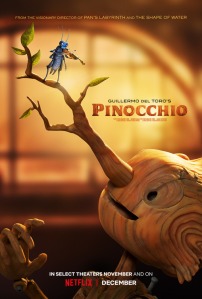 It seems 2022 has unexpectedly become the year of Pinocchio. The 1883 fantasy novel by Carlo Collodui (1826-1890) is best known via the classic Walt Disney animated movie, the second ever for the company, and it was Disney that released a live-action remake earlier in the year on their streaming service. Now widely available on Netflix is Guillermo del Toro’s stop-motion Pinocchio, so I wanted to review both films together but I was also presented with a unique circumstance. Both of these movies were adaptations of the same story, so the comparison is more direct, and I’ve decided to take a few cues from sports writing and break down the movies in a head-to-head competitive battle to see which has the edge in a series of five categories. Which fantastical story about a little puppet yearning to be a real boy will prove superior?
1. VISUAL PRESENTATION
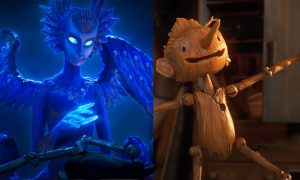
The Netflix Pinocchio is a lovingly realized stop-motion marvel. It’s del Toro’s first animated movie and his style translates easily to this hand-crafted realm. There is something special about stop-motion animation for me; I love the tactile nature of it all, the knowledge that everything I’m watching is pain-stakingly crafted by artisans, and it just increases my appreciation. I fully acknowledge that any animated movie is the work of thousands of hours of labor and love, but there’s something about stop-motion animation that I just experience more viscerally. The level of detail in the Netflix Pinocchio is astounding. There is dirt under Geppetto’s fingernails, red around the eyes after crying, the folds and rolls of fabric, and the textures feel like you can walk up to the screen and run your fingers over their surfaces. I loved the character designs, their clean simplicity but able readability, especially the sister creatures of life and death with peacock feather wings, and the animation underwater made me question how they did what they did. del Toro’s imagination is not limited from animation but expanded, and there are adept camera movements that require even more arduous work to achieve and they do. I loved the life each character has, the fluidity of their movements, that they even animated characters making mistakes or losing their balance or acting so recognizably human and sprightly. There’s a depth of life here plus an added meta-textual layer about puppets telling the story about a puppet who was given life.
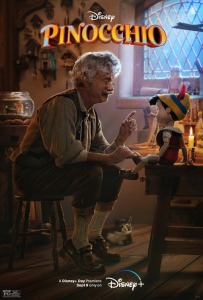 In contrast, the Disney live-action Pinocchio is harsh on the eyes. It’s another CGI smorgasbord from writer/director Robert Zemeckis akin to his mo-cap semi-animated movies from the 2000s. The brightness levels of the outside world are blastingly white, and it eliminates so much of the detail of the landscapes. When watching actors interact, it never overcomes the reality of it being a big empty set. The CGI can also be alarming with the recreation of the many animal sidekicks of the 1940 original. Why did Zemeckis make the pet goldfish look sultry? Why did they make Jiminy Cricket (Joseph Gordon-Levitt) look like a Brussel sprout come to life? It might not be the dead-eyed nightmare fuel of 2004’s The Polar Express, but the visual landscape of the movie is bleached and overdone, making everything feel overly fake or overly muddy and glum. The fact that this movie looks like this with a $150 million budget is disheartening but maybe inevitable. I suppose Zemeckis had no choice but to replicate the Pinocchio character design from 1940, but it looks remarkably out of step and just worse. When we have the 1940 original to compare to, everything in the 2022 remake looks garish or ugly or just wrong. The expressiveness of the hand-drawn animation is replaced with creepy-looking CGI animal-human hybrids.
Edge: Netflix Pinocchio
2. FATHER/SON CHARACTERIZATION
The relationship between Pinocchio (voiced by Gregory Mann) and Geppetto (David Bradley) is the heart of the Netflix Pinocchio, and I don’t mind sharing that it brought me to tears a couple of times. As much as the movie is about a young boy learning about the world, it’s also about the love of a father for a child. The opening ten minutes establish Geppetto’s tragedy with such surefooted efficiency that it reminded me of the early gut punch that was 2009’s Up. This Geppetto is constantly reminded of his loss and, during a drunken fit, he carved a replacement child that happens to come to life. This boy is very different from his last, and there is a great learning curve for both father and son about relating to one another. This is the heart of the movie, one I’ll discuss more in another section. With del Toro’s version, Geppetto is a wounded and hurting man, one where every decision is connected to character. This Pinocchio is a far more entertaining creature, a child of explosive energy, curiosity, and spitefulness. He feels like an excitable newborn exploring the way of the world. He’s so enthusiastic so quickly (“Work? I love work, papa!” “I love it, I love it!… What is it?”) that his wonder can become infectious. This Pinocchio also cannot die, and each time he comes back to life he must wait longer in a netherworld plane. It provides even more for Pinocchio to understand about loss and being human. This is a funny, whimsical, but also deftly emotive Pinocchio. He points to a crucifix and asks why everyone likes that wooden man but not him. He is an outsider learning about human emotions and morals and it’s more meaningful because of the character investment.
 In contrast, the Disney live-action Pinocchio treats its title character as a simpleton. The problem with a story about a child who breaks rules and learns lessons by dealing with the consequences of his actions is if you have a character that makes no mistakes then their suffering feels cruel. This Pinocchio is simply a sweet-natured wannabe performer. He means well but he doesn’t even lie until a sequence requires him to lie to successfully escape his imprisonment. The relationship with Geppetto (Tom Hanks) is strange. This kindly woodcarver is a widower who also has buried a son, but he comes across like a doddering old man who is quick to make dad jokes to nobody (I guess to his CGI cat and goldfish and multitude of Disney-tie-in cuckoo clocks). I don’t know what Hanks is doing with this daffy performance. It feels like Geppetto lost his mind and became stir crazy and this performance is the man pleading for help from the town, from the audience, from Zemeckis. It’s perplexing and it kept me from seeing this man as an actual character. He bounces from catalyst to late damsel in distress needing saving. The relationship between father and son lacks the warmth of the Netflix version. Yet again, the live-action Pinocchio is a pale imitation of its cartoon origins with either main character failing to be fleshed out or made new.
Edge: Netflix Pinocchio
3. THEMES
There are a few key themes that emerge over the near two-hours of the Netflix Pinocchio, which is the longest stop-motion animated film ever. Sebastian J. Cricket (Ewan McGregor) repeats that he “tried his best and that’s the best anyone can do,” and the parallelism makes it sound smarter than it actually is. The actual theme revolves around acceptance and the burdens of love. Geppetto cannot fully accept Pinocchio because he’s constantly comparing him to Carlo. When he can fully accept Pinocchio for who he is, the weird little kid with the big heart and unique perspective, is when he can finally begin to heal over the wound of his grief over Carlo, allowing himself to be vulnerable again and to accept his unexpected new family on their own terms. There’s plenty of available extra applications here to historically marginalized groups, and del Toro is an avowed fan of freaks and outcasts getting their due and thumbing their nose at the hypocritical moral authorities. By setting his story in 1930s Italy under the fascist rule of Benito Mussolini, del Toro underlines his themes of monsters and scapegoats and moral hypocrites even better, and the change of scenery really enlivens the familiar story with extra depth and resonance. All these different people want something out of Pinocchio that he is not. Geppetto wants him to strip away his individuality and be his old son. Count Volpe (Christoph Waltz) wants Pinocchio to be his dancing minion and secure him fame and fortune. Podesta (Ron Perlman) wants Pinocchio as the state’s ultimate soldier, a boy who cannot die and always comes back fighting. When Pinocchio is recruited to train for war with the other young boys to better serve the fatherland’s nationalistic aims, it’s a far more affecting and unsettling experience than Pleasure Island, which is removed from this version. In the end, the movie also becomes a funny and touching exploration of mortality from a magic little child. The Wood Sprite (Tilda Swinton), this version of the Blue Fairy, says she only wanted to grant Geppetto joy. “But you did,” he says. “Terrible, terrible joy.” The fleeting nature of life, as well as its mixture of pain and elation, is an ongoing theme that isn’t revelatory but still feels impressively restated.
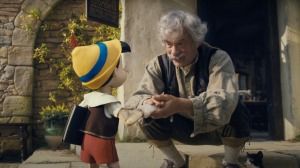 I don’t know what theme the Disney live-action movie has beyond its identity as a product launch. I suppose several years into the Disney live-action assembly line I shouldn’t be surprised that these movies are generally listless, inferior repetitions made to reignite old company IP. For a story about the gift of life, the Disney Pinocchio feels so utterly lifeless. I thought the little wooden boy was meant to learn rights and wrongs but the movie doesn’t allow Pinocchio to err. He’s an innocent simpleton who gets taken advantage of and dragged from encounter to encounter like a lost child. The Pleasure Island sequence has been tamed from the 1940s; children are no longer drinking beer or smoking cigars. They’re gathered to a carnival and then given root beer and told to break items and then punished for this entrapment. The grief Geppetto feels for his deceased loved ones is played out like a barely conceived backstory. He’s just yukking it up like nothing really matters. By the end, when he’s begging for Pinocchio to come back to life, you wonder why he cares. If you were being quite generous, you might be able to uncover themes of acceptance and understanding, but they’re so poorly developed and utilized. That stuff gets in the way of Pinocchio staring at a big pile of horse excrement on the street, which if you needed a summative visual metaphor for the adaptation, there it is.
Edge: Netflix Pinocchio
4. EMOTIONAL STAKES
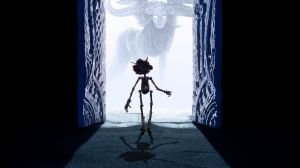 One of these movies made me cry. The other one made me sigh in exasperation. The Netflix Pinocchio nails the characterization in a way that is universal and accessible while staying true to its roots, whereas the Disney live-action film feels like a crudely packaged remake on the assembly line of soulless live-action Disney remakes. By securing my investment early with Geppetto’s loss, I found more to relish in the layers of his relationship with Pinocchio. In trying to teach him about the world, Geppetto is relying upon what he started with his past son, and there are intriguing echoes that lead to a spiritual examination. Pinocchio is made from the tree from the pinecone that Carlo chased that lead to his death. Pinocchio hums the tune that Geppetto sang to Carlo. Is there something more here? When he visits Death for the first time, the winged creature remarks, “I feel as though you’ve been here before.” These little questions and ambiguity make the movie much more rewarding, as does del Toro’s ability to supply character arcs for every supporting player. Even the monkey sidekick of the villain gets their own character arc. Another boy desperately desires his stern father’s approval, and he’s presented as a parallel for Pinocchio, another son trying to measure up to his father’s demands. Even this kid gets meaningful character moments and an arc. With this story, nobody gets left behind when it comes to thoughtful and meaningful characterization. It makes the movie much more heartwarming and engaging, and by the end, as we get our poignant coda jumping forward in time and serving as multiple curtain calls for our many characters, I was definitely shedding a flurry of tears. Hearing Geppetto bawl, “I need you… my boy,” to the lifeless body of Pinocchio still breaks me. Under del Toro’s compassionate lens, everyone is deserving of kindness.
As should be expected by now, the Disney live-action movie is lackluster at best when it comes to any kind of emotional investment. The characters stay as archetypes but they haven’t been personalized, so they merely remain as grubby facsimiles to what we recall from the 1940 version. Jiminy Cricket is meant as Pinocchio’s conscience but he vacillates from being a nag to being a smart aleck who even breaks the fourth wall to argue with his own narration. I hated every time he called the main character “Pee-noke” and he did it quite often. He’s far more annoying than endearing. There’s also a wise-cracking seagull that is just awful. The Honest John (Keegan Michael-Key) character is obnoxious, and in a world with a talking fox who dresses in human clothing, why would a “living puppet” be such a draw? He even has a joke about Pinocchio being an “influencer.” The only addition I liked was a coworker in Stromboli’s traveling circus, a former ballerina who injured herself and now gets to live out her dancing dreams by operating a marionette puppet. However, the movie treats the puppet like it’s a living peer to Pinocchio and talks directly to the puppet rather than the human operating the puppet, and the camera treats her like she’s the brains too. Safe to say, by the end when Pinocchio magically revives for whatever reason, just as he magically reverted from being a donkey boy, I was left coldly indifferent and more so just relieved that the movie was finally over.
Edge: Netflix Pinocchio
5. MUSIC
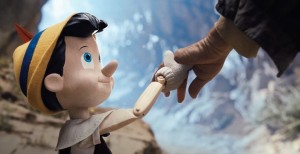 This was one area where I would have assumed the Disney live-action film had an advantage. Its signature banger, “When You Wish Upon a Star,” became the de facto Disney theme song and plays over the opening title card for the company. It’s still a sweet song, and Cynthia Erivo (Harriet) is the best part of the movie as the Blue Fairy. It’s a shame she only appears once, which is kind of negligent considering she sets everything in motion. The Netflix Pinocchio is also a musical and the songs by Alexandre Desplat (The Shape of Water) are slight and low-key, easy to dismiss upon first listen. However, the second time I watched the movie, the simplicity as a leitmotif really stood out, and I noticed the melody was the foundation for most other songs, which created an intriguing interconnected comparison. While nothing in the Netflix Pinocchio comes close to being the instantly humable classic of “When You Wish Upon a Star,” the songs are more thoughtful and emotionally felt and not just repeating the hits of yore, so in the closest of categories, I’m going to say that Netflix’s Pinocchio wins by a nose (pun intended).
Edge: Netflix Pinocchio
CONCLUSIONS
One of these Pinocchio movies is a visual marvel, heartfelt and moving, wondrous, and one of the best films of 2022. The other is a hollow vessel for corporate profit that copies the imprint of the 1940 animated film but only more frantic, scatalogical, and confused. In the year of our lord Pinocchio Two Thousand and Twenty-Two, there is only one movie you should see, and at this point ever see as it concerns this old tale. Guillermo del Toro has harnessed magic, and we are all the better for his bayonet imagination and enormous heart for his fellow outsiders.
Nate’s Grades:
Guillermo del Toro’s Pinocchio: A
2022 Pinocchio: C-
Share this:

The Bubble (2022)/ Moonfall (2022)
 What to do with a comedy that just isn’t that funny? I come to co-writer/director Judd Apatow’s The Bubble with a rhetorical surgeon’s scalpel ready to figure out this conundrum. There are plenty of funny people involved with this Netflix project. Apatow has been an industry unto himself in developing comedic talent going back to his Freaks and Geeks TV days and with such heralded twenty-first century comedies to his credit like The 40-Year-Old Virgin and Knocked Up. The cast assembled for The Bubble has great comic potential. Even the premise is fun, a group of spoiled actors trying to film a bad sci-fi action movie under the challenges of the COVID-19 quarantine. So what went wrong here and why is The Bubble Apatow’s least engaging and least funny movie to date?
We follow the Hollywood production of Cliff Beasts 6, filming in rural England under the supervision of studio execs trying to keep the secluded production as problem-free as possible under the 2020 COVID outbreak. Karen Gillan (Avengers Endgame) plays Carol Cobb, an actress returning to the franchisee she had once left behind to star in a misguided Oscar bait movie where she, a white woman, was the solution to solving the Israeli-Palestinian conflict. She’s hoping to save her career, while her coworkers are just hoping not to go insane with the forced isolation and new safety protocols during their film shoot.
 So let’s circle back to the central question of why The Bubble isn’t funny, and I think I have some theories. First, we can acknowledge comedy is subjective but at the same time also acknowledge that the construction of good comedy can be academically identified and appreciated, that there are tenets that hold and maintain, like setups and payoffs, rules of threes, etc. I think one of the big problems is that nothing is really that surprising throughout the protracted and unfocused duration of The Bubble.
The characters are intended to be shallow but are too shallow to even register as distinct comedy types played against one another. There are levels of general buffoonery, but so many of these characters are missing out on a more definite angle or perspective. Take for instance the smug movie star (David Duchovny) who takes it upon himself to rewrite the script. This should be an obvious route where the story comes undone or character actions are inconsistent or that other characters, especially those who had larger roles, become subservient to the star and his ballooning ego. There needs to be distinct differences for the comedy to land and be an indication of his ideas about what he thinks would be an improvement. This doesn’t really happen. Take the recent Oscar winner (Pedro Pascal). He’s not haughty and pompous, thinking himself beneath this kind of genre filmmaking. He’s simply a dumb hedonist who is seeking out pleasure he is denying himself. That’s fine, as at least one character is set up to be more of a wild card to stir trouble. This character spends the entire movie whining and having unfunny fantasies when they should be the one causing havoc and unexpected consequences from their behaviors. What a waste. Every character falls into this nebulous underwritten area without being distinct enough to be considered stock and ultimately useful for comparisons and generating comedic conflicts.
Another lack of surprise is how every character is exactly how they are presented, so with no points of change it all gets very redundant. If this was going to be the case, Apatow needed to be far more exacting with his satirical barbs. If he wants to really send up the industry and self-absorbed actors, we need something akin to 2008’s Tropic Thunder, which, by the way, had very distinct character differences it used for maximum comedy. This movie feels more like an extension of the privileged world populated by the bourgeoisie characters from 2012’s This is 40, a marked misstep for Apatow and his idea of recognizable midlife struggles (“Oh no, we’ll have to move from our ridiculously large house to… just a very large house!”). It’s the same pitiable rich people whining about their lives while they quarantine in luxury. Watching montage after montage of them being bored in their private hotel suites is not funny. It doesn’t even work as a criticism of the characters on display. They aren’t doing anything out there or particularly telling, they’re just being bored, and just watching bored people is boring.
 The moviemaking process and the film-within-a-film itself is also shockingly unfunny. Apatow has worked in Hollywood for decades, so I was expecting harder-hitting satire of the moviemaking industry and the way that films are continuously compromised. As another example of shallow character writing, take the director (Fred Armison), a Sundance award-winning indie artist tackling their first studio project. The expected route would be to start with this character having big ideas about a grand artistic vision, taking real chances, and trying to do something different and compelling within the realm of giant dinosaur action movies, and then little by little, they have to compromise and delete this grand vision, taking studio notes, limitations from the actors, and bad luck. This would provide a foil for every bad item complicating the production, the artist struggling to watch their dream die piece-by-piece. This doesn’t happen and the director’s indie background is never utilized as a contrast for comedy.
Apatow plays the same trick over and over with the film-within-a-film. It will be a dramatic sequence and then cut to the actors running on a treadmill or swinging behind a green screen, the same undercutting gag on repeat. It’s not funny and, frankly, gets tiresome. The ridiculous nature of blockbuster filmmaking should be ripe for satire (again, Tropic Thunder did it) but Apatow never pushes too hard, settling on the same soft-pedaled jokes on simple characters. Pascal is left to practice funny accents, but none of what they say within the movies is funny-bad; it’s just tin-eared dialogue that is merely bad only. The only segment that genuinely had me laughing was when the young actress (Iris Apatow) teaches a raptor how to do the latest TikTok dance. This is the only moment that feels biting on the out-of-touch desperation of modern moviemaking to chase and incorporate vaporous youth trends to remain hip. The Hollywood film gone awry should feel like a mess, it should be getting progressively worse or more out of control or at least something so outlandish it separates itself from its targets. I suppose shooting the CGI genitals off dinosaurs is something you don’t see every day but it too gets old fast.
 Fortunately, these actors can still be charming even with lesser material, but you’ll simply walk away feeling enormous sympathy for them. Everyone is trying to do so much with so very little, and it can get painful at points, like Pascal’s character clinging to an amorphous evolution of an accent. There are very funny people here. Keegan Michael-Key is very funny, but he gets nothing here, especially with a ripe subplot where he might be starting a self-help cult. Maria Bakalova is very funny, and was even nominated for an Oscar, a rarity for a comedian, but she gets nothing here, being a horny hotel worker. Gillan is very funny, but she too gets nothing here as a slumming actress desperate to rehabilitate her career. It’s remarkable considering she’s the main character but really just an insecure straight man role. The main character needed to be Gavin (Peter Serafinowicz), the producer on location doing his best to herd all these spoiled and irresponsible people into getting this movie made and on time. You want to focus on the character with the most chaos to try and control, and that’s him. It just feels criminal that a cast this good, with fun supporting players like Samson Kayo (Our Flag Means Death) and Harry Trevaldwyn (Ten Percent) to round out the more famous faces.
This also made me think to reflect on the recent release of Moonfall, which looks like the big, schlocky sci-fi disaster movie that Judd Apatow would be satirizing with The Bubble. It’s a Roland Emmerich disaster movie where he does exactly what Roland Emmerich does best: expansive scenes of cataclysmic destruction on the biggest scale possible. It was believed by industry watchers that Moonfall would be the kind of epic that people would go back to the movies to experience, watching the scale of destruction on the biggest screen and cheering along. It didn’t work out that way and Moonfall reportedly will lose over a hundred million dollars for its investors. It seemed like a smart bet as disaster movies have performed well for Emmerich, like 2012 and The Day After Tomorrow. In times of struggle, human beings enjoy fantasies about surviving fantastic odds, or at least that was the established way of thinking. After two years of life during COVID-19, maybe our idea of sci-fi escapism isn’t quite what it used to be.
I watched Moonfall with general indifference. It felt like a mediocre hodgepodge of other Emmerich disaster movies and veered into campy nonsense at many points. It’s the kind of movie that demands you shut off your brain and just go along with the scientific gobbledygook, especially once the moon begins making Earth’s gravity go all haywire. At that point the movie becomes an inconsistent video game with its liberal use of physics. It doesn’t seem like it matters, but watching characters do Super Mario Brother-level jumps has a fun appeal as well as being impossibly goofy. One character says, “The moon can’t do these things,” and another character waves away that pertinent thought and says, almost directly to the audience, “Yeah, but this isn’t a normal moon, so forget everything.” The special effects are also quite hit or miss. Plenty of the larger effects are quite awe-inspiring and suitably terrifying in depicting an awesome reality, and then others look like they didn’t quite have enough money when it came time to render. Some of the CGI reminded me of moments from 2008’s Torque, where the high-speed backgrounds resembled badly composited video game texture blurs. If your movie is going to exist primarily in a junk food realm, then you need to either have as minimal distractions as possible to rip you from the believability of this world, or you simply need to veer into it and accept that the instability and chaos will be part of the general appeal. Provide the goods, and Moonfall just doesn’t.
 The movie also takes an inordinate amount of time to get back to space after a prologue, almost halfway through its two hours. This first half stalls with setting up so many characters to follow that you simply won’t care about. I didn’t care what happened to anyone back on Earth. When the rednecks found our party (again!) in a petty car chase, I literally laughed out loud. The alien/moon mythology is also convoluted and vague enough to simply apply a good versus evil designation for technology, and the big sacrifice doesn’t feel so big when you find that character to be annoying for the duration of their grating screen time. It’s another movie tipping you off about a possible linked sequel and one that appears more appetizing than the film we just witnessed (just like Emmerich’s 2016 Independence Day sequel). In short, Moonfall is a bit of a mess, a mess I can imagine others enjoying and laughing with, but definitely one of the lower outputs in Emmerich’s long career of destroying global landmarks and formerly pristine vistas.
I found Moonfall and The Bubble to both be poor examples of what Hollywood thinks audiences will desire as escapism in the wake of COVID-19 disrupting routines and lives. Each of the movies is disappointing because it doesn’t fulfill what it promises. The Bubble has a bunch of combustible characters in a combustible scenario and squanders its time with weak satirical gags and lazy characterization. Moonfall wants to be the big, fun epic of Emmerich’s past, but it takes its sweet indulgent time with uninteresting characters, convoluted and underwritten lore, and a plot that would have been more entertaining had it better embraced the absurdity of its implications. You may likely have an enjoyable time watching either movie, and they’re almost the same length too, but I found both to be middling examples of Hollywood’s attempt to try and give the people what they think they want and missing the entertainment mark.
Nate’s Grades:
The Bubble: C
Moonfall: C+
Share this:

The Prom (2020)
 It’s full of big feelings, declarations of self-identity, an unabashed love of the transformative power of theater, and its power of positivity can be a balm to many during this holiday season. The Prom is based on a short-lived Broadway musical about a girl in Indiana who wants to bring her girlfriend to the school prom and the ensuing media controversy that erupts. A team of out-of-work theater actors (Meryl Streep, Anthony Rannels, Nicole Kidman, James Corden) see publicity value in rallying to her cause, so they decamp to Indiana and challenge the homophobic PTA leader (Kerry Washington) who refuses to hold an inclusive prom. Director Ryan Murphy’s style and sensibilities work well within the realm of musical theater; a decade of television curation for FX and now Netflix has made him an expert on camp and flash. The man loves applying slick gloss to trash. His camera is constantly, uncontrollably moving during the numerous musical numbers, attempting to compensate for the generic quality of the majority of them. There are two standouts. The first is when Corden’s character takes our lesbian teen to the mall for a makeover. It’s got a catchy hook and one that becomes a reoccurring theme for the show. The second is when Rannels’ character is pointing out the hypocrisy of local Christians decrying homosexuality but falling short of other Biblical teachings. The story is sweet but un-challenging. The plot exhausts so quickly that I was amazed at one point to discover there was still an hour left in the over two-hour production. Each member of the squad gets a signature number to varying degree of success. The happy ending is affirming and heartfelt but also quite easy and kind of unearned. The amount of catharsis and reconciliation doesn’t gel with the emotional investment and development of these characters. They’re nice but relatively dull, and the industry satire only goes so far to chide the out-of-touch Broadway elites for their own prejudices of Midwest life. The Prom is disposable fluff that will pacify an afternoon.
Nate’s Grade: C+
Share this:

Dolemite is My Name (2019)
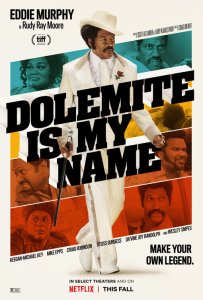 I’m a sucker for behind-the-scenes movies on scrappy genre indies, following a band of creatives come together, build camaraderie, and serve as the underdogs we root for as they put on their fun show, so Dolemite is My Name is right up my alley. It’s a biopic on Rudy Ray Moore (Eddie Murphy), who by the 1970s rebranded himself in his 40s when he began performing as an outrageous, rhyming pimp character named Dolemite. He recorded crude comedy albums, sold them out of the back of his trunk, and reached a new level of fame, but he sought a blaxploitation movie to get him to even further heights. This movie is akin to The Disaster Artist where we watch a lot of artists pull off a bad movie with little money, as well as 2004’s Baadasssss!, where Mario Van Peebles recreated the making of his father’s 1971 blaxploitation hit, Sweet Sweetback’s Baadasssss Song. Chances are, if you enjoyed either of those two movies, or the hilarious blaxploitation spoof Black Dynamite, you will be smiling aplenty with this new Netflix movie (given a short theatrical run and soon to be widely available via streaming). The movie belongs to Murphy, who hasn’t had a part in three years, and he comes roaring to life as Moore, a man who won’t let anything stand in the way of his dreams. Murphy is fully captivating in every scene as he turns the Dolemite persona on and off, sharing moments of personal insight and fear, like when he’s nervous over his physique with an upcoming sex scene for his movie. He’s a determined hustler and it’s hard not to fall for his grinning charm. The Dolemite movie has a special appeal because it was intended as a comedy, so the shoestring, scrappy nature of it works nicely with the good intentions of simply making a big, silly, kung-fu-filled action comedy with what audiences want. I’ll confess I never found any of Moore’s standup to be funny as the audiences at the time. However, the filmmakers have already answered this, as Moore and pals go see The Front Page, a movie dubbed by critics as a laugh-out-loud comedy, and the men sit stone-faced and confused throughout the pithy, erudite comedy that seems to be amusing the largely white, WASP-y crowd. Humor is subjective, but not only that it’s the kind of entertainment with the shortest shelf life. It’s naturally going to expire quickly. Comedy routines we found hilarious decades ago might not still be funny today, and that’s okay. Dolemite came out at the right time and influenced other artists and filmmakers. A behind-the-scenes film is destined to be a movie with a definite ceiling. Moore is an interesting success story but there’s only so much to be gleaned from this underdog tale. Thanks to writers Larry Karaszewski and Scott Alexander (Ed Wood, The People vs. O.J. Simpson) and the energy of Murphy, Dolemite is My Name is a fun two hours with a bunch of cut-ups.
Nate’s Grade: B
Share this:

The Lion King (2019)
 Ever since the run-up of Disney’s live-action remakes, I’ve been predicting what would happen with the newer films, and it all seems to be coming true. The problem with Disney remaking hit animated movies from the 80s and 90s is that there hasn’t been enough distance. The immediate audience is going to demand their nostalgia exactly as they remember it, and they will not be happy with anything less. It’s not like a scenario where the original movies could be improved upon, like 2016’s beautifully tender Pete’s Dragon. What these live-action remakes offer is an uglier, inferior version of an animated classic. There’s no reason for most of them to exist. They won’t be different; they won’t be interesting. It’s a sludgy, auto-tuned cash grab that shows no end in sight. Before this year, I did not expect Tim Burton’s Dumbo to be the best of the three 2019 Disney live-action remakes, but here we are. I guess the concept of Disney eating its own tail with these live-action remakes is symbolic of the studio “circle of life,” and the perfect segue way to The Lion King, a remake missing the wonder and magic of the 1994 original.
King Mufasa (voiced by James Earl Jones again) rules over an African prairie and preparing his young son Simba (JD Mcrary and Donald Glover as an adult) for his eventual rule. Mufasa’s scornful brother Scar (Chiwetel Ejiofor) conspires to have Mufasa killed and Simba banished. Blaming himself for his father’s death, Simba runs away and finds kinship with a meerkat named Timon (Billy Eichner) and a warthog named Pumba (Seth Rogen). They preach a carefree life of “no worries.” This new life is interrupted when Nala (Beyoncé Knowles), Simba’s childhood friend, returns seeking help to remove Scar from the throne. Simba must confront his fate and treacherous uncle and bring balance back to his ailing homeland.
 The biggest appeal of director Jon Favreau’s Lion King remake is the stunning special effects. It’s been ten years since James Cameron brought to life a photo realistic alien world that dazzled audiences, and the advances have only made the professional fakery more startling. This movie was completely “filmed” inside a computer. Every single shot, every blade of grass, every pebble, every photo realistic morsel onscreen is the result of digital wizards. In 2016’s The Jungle Book, there were still some physical elements filmed, chief among them the human boy, but now it’s all done away. The remake looks like an HD nature documentary. One could question the use of the technology, $250 million to recreate what ordinary cameras on location could achieve, but I’ll choose to congratulate Disney and Favreau on the remarkable technical achievement. The Jungle Book was a big leap forward and The Lion King is that next step. However, the special effects are ultimately the only selling point. Come see how real it all looks, kids. The rest of the remake left me feeling unmoved and occasionally perplexed.
This is an almost exact shot-for-shot recreation of the original movie. It made me think of Gus van Sant’s 1998 Psycho remake and why anyone would go to this much trouble to make a copy. You’ll feel a tingle of recognition with different shots and scenes and then that feeling will transition to disappointment and lastly resignation. It’s the same, just not as good.
So what exactly is different with the live-action Lion King of 2019? Very very little. Despite totaling a half hour more movie, it really only has one added incidental Beyoncé song, a small character beat where Timon and Pumba explain their philosophy on more fatalistic terms, an explanation how Nala left the pride lands, and more poop and fart jokes. The filmmakers have added realism in appearance but also added more scatological humor, which seems like an odd combination. There is a literal plot point attached to giraffe poop. Instead of a whispery feather, petal, whatever finding its way to the baboon Rafiki to let him know Simba is still alive, now we watch the life of a tuft of fur as it travels from creature to creature, at one point being consumed on a leaf by a giraffe. The next image is a ball of poop being rolled by a beetle with our tell-tale tuft of lion fur. I guess it’s more emblematic of the whole “circle of life” theme, but I didn’t think Disney was going to literalize the poop aspect. The new Beyoncé song is fairly bland and unmemorable. That’s it, dear reader. Lion King 2019 is 95 percent identical to Lion King 1994 in plot, and yet the original writers do not earn a screenwriting credit thanks to arcane animation writing guild rules, and that is madness. It’s their story, it’s their characters, and it’s almost entirely their dialogue, and to not have their names rightfully credited where they belong is wrong.
 There are some definite drawbacks to that photo realism as well. When lions and other animals are photo realistic, they have facial structures that don’t exactly emote, so it looks like all the animals often just have their jaws wired shut. You’ll listen to the vocal actors go through a range of emotions and watch these plain, unmoved faces that you start to wonder if maybe all of the dialogue should have just been voice over. As soon as I saw Mufasa speaking, I was immediately shaken by the image and longed for the expression of the animation. I never got over it and it made me feel removed from the film, even more so. This is the trade off of realism; animals don’t actually speak, you know. Another trade off is that the film becomes much more intense especially for younger kids. I would not recommend parents take the littlelest ones to this movie because now, instead of watching a traditionally animated band of characters brawl, you’re watching realistic lions and hyenas scrape, claw, and hurl one another to their deaths. If kids were traumatized by parts of the original movie, I can only imagine the nightmares that await. Strangely, the photo realism also mitigates the film’s sense of scope and impact. The stampede sequence feels far less dangerous because the camera doesn’t pull back that far, showing a massive herd from a distance. Subsequently the sequence loses some of its urgency. Then there’s also simply identifying who may be who when those fights come, because you’re trying to pick out realistic animals instead of distinct creatures with specific character designs.
The aspects you enjoyed with the 1994 Lion King will still be enjoyable, even if they suffer in direct comparison. Hans Zimmer’s score is still magnificent. The songs are still catchy, though some of the arrangements are a bit under-cooked, like the speak-sung “Be Prepared.” The song “Can You Feel the Love Tonight?” occurs absurdly early in the Simbla/Nala reunion and takes place in the sunny afternoon. So much for “tonight” (the famous Nala “bedroom eyes” moment is also quite diminished from a real lion’s face). The jokes are still funny because they were funny the first time. The things that worked the first time will still work to some degree, even if the presentation leaves something to desire. Several of the vocal artists just sound flat, especially Ejiofor (12 Years a Slave) who comes across so blasé. I missed the casual menace of Jeremy Irons. The best vocal performances belong to Eichner (Difficult People) and Rogen (Long Shot), maybe because they’re already broad personalities, or maybe because they felt the most comfortable to occasionally steer away from the original script, finding small room to roam. Florence Kasumba (Black Panther) also delivers a snarling and effective performance as one of the hyena leaders, Shenzi. They’re the only vocal performances that fare well in competition.
 I need to defend the art of animated films. There is nothing wrong with animated films simply because they are animated. A live-action version is not better simply because it’s more “real.” I hear this same argument when it comes to making a live-action anime. Animation is a wonderful medium and has a magic all its own that often live-action cannot emulate. The animated Lion King is beautiful with bold colors, strong visual compositions, and emotive characters with specific designs. The live-action Lion King is missing much of that, at least when it’s not recreating exact shots from its predecessor. I don’t know who this movie is going to appeal to. Parents will be better off just playing the original for their children at home. Die-hard fans of The Lion King might enjoy seeing their favorite story told with plenty of cutting-edge special effects magic. I would have been happier had the filmmakers attempted something like Julie Taymor’s transformative and ground-breaking Broadway show. I would have been happier had they just recorded the Broadway show. The new Lion King is a lesser version of the 1994 movie, plain and simple, and if that’s enough for you, then have at it. For me, these Disney live-action remakes are making me feel as dead in the eyes as a photo realistic lion.
Nate’s Grade: C
Share this:

Toy Story 4 (2019)
 The Toy Story franchise has been the gold standard for Pixar with three excellent movies, the last of which was released back in 2010. When the Pixar bigwigs announced they were making a fourth entry, I felt some degree of concern. The hidden world of toys still felt like an interesting world with more stories to be told, but did we need to revisit Woody and Buzz and the gang? Everything ended so beautifully and perfectly with the third movie, with the toys getting their sendoff from their original owner and a new life in the possession of a new child, little Bonnie. I’ve been more wary about this movie than just about any other Pixar film because the audience had something that could be lost, namely closure. If they harmed that perfect ending in the crass desire to extend the franchise for an extra buck, it would have been aggravating and depressing to disturb something that felt so complete. It’s like when Michael Jordan came out of retirement (the second time) to be a shadow of himself for the Washington Wizards in order to sell tickets for the team he was part owner of. Nobody wanted that. I’m happy to report that Toy Story 4 is a treat of a movie and a worthy addition to the franchise.
Bonnie is gearing up for kindergarten and nervous about the change. She isn’t allowed to take toys with her to school, though that doesn’t stop Woody (voiced by Tom Hanks) from tagging along. In her desire for a friend, and with a little assist from a certain cowboy, Bonnie creates a fork-figure named Forky (Tony Hale), and amazingly it comes to life. Woody tries valiantly to convince Forky that being a toy to a child is the greatest gift but he’s also really reminding himself now that he sees his influence waning with Bonnie as he’s selected for play time less and less. During a family road trip, Forky escapes and Woody leaps to find him, both of them coming into the clutches of Gabby Gabby (Christina Hendricks), an antique doll missing a functional voice box who has her sights set on Woody’s voice box. It’s at this small-town pit stop for a carnival that Woody discovers Bo Peep (Annie Potts), an old flame he never thought he would see again. She’s assured, happy, and preaching a life of being independent from a kid. Woody has defined himself for so long by one identity, and now he must decide which to follow.
 In many ways, Toy Story 4 takes themes and questions from the third movie and improves upon them, making what could have been a retread feel like a do-over you didn’t know you desired. It’s been many years since I saw the third film but I recall the major themes being the fear of change, reconciling one’s self-identity, and the courage of letting go and starting over. The toys had to recognize that their owner was growing up and their old place wasn’t going to be the same. This same issue finds new life in Toy Story 4 primarily through the lens of Woody, who finds himself on the decline with his kid’s interest. He’s not offended or upset by this but is still trying to provide what assistance he can as a beloved toy, even if that relationship becomes more and more one-sided. His identity is in selfless sacrifice for another, but with the re-emergence of Bo, he is now contemplating a life on his own, a life without a kid. This alternate path never seemed a possibility until his former flame stepped back into his life. It challenged Woody in a way that feels more personal and more relevant than it did with 3, especially with the removal of a larger external threat to occupy the attention of our main characters. This places a renewed focus on Woody’s internal dilemma beyond his role as leader and protector.
Toy Story 4 might also be the weirdest movie of the franchise, which really elevates the comedy into another realm. I thought the characters played by Jordan Peele (Us) and Keegan Michael-Key (Predator) were going to quickly wear out their welcome; they seemed to be a heavy part of pre-release teaser trailers. The filmmakers don’t overdo them and use them in clever ways, which is a compliment that can be applied to every new character in this sequel. The plushies by Key and Peele have a hilarious running gag of their increasingly absurd plans to attack a woman, and one instance deliciously prolongs the eventual punchline, becoming more bizarre and macabre to the point that I lost control from laughter. Keanu Reeves (John Wick 3) is fun as a very Canadian Evel Knievel motorcycle driver, and the weird references to the Canada-ness of it are played completely straight, making it even funnier (his laments with the French-Canadian boy’s name made me snicker every time). There’s a trio of action figures, Combat Carls, and one of the three is always left hanging for high-fives and he just leaves his arm up waiting, silently pleading, and then lowers it in defeat, and it’s hysterical even just as a background gag. The ventriloquist dummies are routinely played for creepy laughs and physical humor. There’s a running joke where Buttercup, the unicorn voiced by Jeff Garlin, is always suggesting getting Bonnie’s father sent to jail no matter the circumstances. It’s these touches of weirdness that make the movie stand out that much more from the three others.
 The villain of Toy Story 4 is given a surprising sense of poignancy, enough that I genuinely sympathized with her plight. She’s a damaged doll used to being behind glass, isolated and separated from the children she wishes to be part of. She views her salvation in fixing in her damaged voice box, her perceived disability. She’s after what Woody has physically, the voice box, but it’s a means to an ends to have what Woody has had emotionally, the love of a child in need, the connection she yearns for. I won’t spoil what happens with her but even when there are setbacks the film and the characters don’t give up on Gabby Gabby. Her perspective and desires are still seen as valued, and the eventual resolution of her character put a lump in my throat. She wasn’t really the villain after all. She was just another toy in pain looking for acceptance and having to adjust her identity. I feel like there is a conscious disability empowerment message implanted in Toy Story 4, namely that those who are disfigured, disabled, or seen as “broken” can continue to be valuable and that their lives don’t end.
If this serves as the finale of the franchise, it will end on a fitting and resonant high-point. As much as Toy Story 3 was about change and acceptance, this sequel does a very respectable effort of personalizing that message even more to one central character’s dramatic arc. It also works wonderfully playing off of our collective investment in the character over the course of four movies and twenty-four years. There are some drawbacks to this approach. It makes the majority of the other toy characters feel like they have little to do on the sidelines, other than fret about retrieving Woody and Forky. Buzz is given a cute joke about listening to his inner voice but it doesn’t amount to much more than a cute joke. The inclusion of Forky feels like an exciting and even daring addition, tackling some existential questions and how and when toys are “made” and brought into being, and he presents these for a while. Once we get to our carnival setting and Forky is captured, he seems to be forgotten about. He’s more a motivation point for Woody than overtly anything else. I suppose you could make the analysis that Forky represents how Bonnie is moving on even with invented toys at the expense of Woody. However, these are minor quibbles considering the quality and emotional involvement of what Pixar has produced.
It goes without saying that the animation is beautiful but what amazed me is how expressive the faces of the characters could be, even when they were relatively inflexible toys. The relationship between Woody and Bo actually has a surprising amount of nonverbal dramatic acting to communicate nuance. As the years go by, I continue to be further and further amazed at the Pixar animators and their abilities.
 As protective I was over Toy Story 3’s perfect ending, I am happy to say that Toy Story 4 more than justifies its own existence in this hallowed franchise and even improves from the third film. The themes are something of a repeat but the filmmakers have elected to focus almost entirely on Woody and his personal journey, and it makes the loss and possibility more robustly felt. In many ways the film is an exploration on relationships and the need to redefine ourselves, to move onward when the time is right, and to try something new even if things get scary. Between Woody and Gabby Gabby, ostensibly the hero and villain of the piece, they’re looking for meaningful connections where they can. They may be secondhand, they may be disabled, but that doesn’t mean they aren’t worthy of affection. This is a joyous movie that finds time to be wonderfully weird and often funny. It might not have the set pieces or ensemble showmanship of the prior Toy Story tales, but what it does have is a character-based emphasis on the most complex figure in this universe of toys. The conclusion is moving and satisfying and I don’t mind admitting that tears were shed. I even teared up at different other earlier points. Toy Story 4 could have gone a lot of different ways but I’m relieved and appreciative with this new sendoff we’ve been granted.
Nate’s Grade: A
Share this:

The Predator (2018)
 It’s been 31 years since the first Predator strutted its camouflaged self onto the big screen and bedeviled Arnold Schwarzenegger and company. Since then the dreadlock-sporting intergalactic sportsman has become a familiar vaginal face to movie audiences around the world. One of those company deaths in the original movie was none other than Shane Black, years before the writer/director became a bankable Hollywood commodity. Black is going back home to revive the dormant franchise with The Predator, a big-budget sequel/reboot that aims for the stars and falls far, far too short.
An alien spaceship belonging to a rogue Predator crashes on Earth, scattering important debris. Quinn McKenna (Boyd Holbrook) is a black ops sniper and the only surviving member of his team who happened to be on site when the ship crashed. The government says he’s crazy and transfers him onto a bus filled with other mentally disturbed military vets who call themselves “the Loonies” (Trevante Rhodes, Keegan-Michael Key, Thomas Jane, Alfie Allen, Augusto Aguilera). A tough-talking government agent, Traeger (Sterling K. Brown), seeks out a biological specialist, Dr. Brackett (Olivia Munn), to examine their interstellar prize. At the secret lab, the Predator breaks free, Dr. Brackett chases after the specimen, and she teams up with the “Loonies” to track down the alien. After his initial Predator encounter, Quinn mailed the alien helmet and other evidence to his son, Rory McKenna (Jacob Tremblay), a young boy with autism who cracks the alien code and becomes the target of a Predator, a Super Predator, and the government.
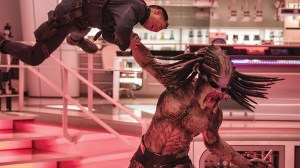 The Predator is a supremely messy movie, often feeling like two separate screenplays inelegantly stitched together, one a big bloody action thriller, the other a winky Shane Black vehicle with a cavalier, macabre sense of humor. It doesn’t quite work because the movie can’t fully settle on a tone, or a direction, and thus it keeps providing glimpses of the many versions of the kind of movie it could have been instead. I’ll openly admit to being a Shane Black fan when he embraces his sly instincts, command of genre, and ribald wit (Kiss Kiss Bang Bang is a modern comic masterpiece; The Nice Guys is… pretty good), so the Black touches were my favorite part especially because they stood out the most. I enjoyed the characters entering into scene-breaking asides, like Dr. Brackett questioning why the alien would be named a “predator” given its behavior is more akin to a hunter or a fisherman, and Traeger shrugging, “Yeah, well, we took a vote and ‘predator’ was cooler. Right guys?” Or when a character is being held at tranquilizer gunpoint and mocks the danger, only to be tranqued point blank in the eye, killing him. Or a bully suddenly getting drilled by the defense mechanisms of the Predator helmet and murdered. It’s these moments that kept me most entertained, demonstrating Black’s unique voice that can take genre filmmaking within a studio sphere and turn it on its head with a devilish grin. If The Predator had been more a Shane Black vehicle than a Shane Black studio reboot, then perhaps the final product would have risen above the mediocrity that sinks it.
Much of that mediocrity comes from the middling plotting, mostly after the first act. For a solid half hour, I think Black has something promising, having set up the various characters and gotten them to intersect and go on the run together as a merry band of outlaws and amateur alien hunters. Once the “Loonies” break free with Dr. Brackett is where the movie loses its sense of direction. The plot just stumbles from one set piece to another, rarely with good reason. One minute they’re running away from a Predator creature and the next they run into an apparently unlocked high school building rather than flee in cars and RVs. Most of the plot movement follows little Rory, first reaching him before the bad men do, then rescuing him from Predator dogs, and Predator, and then he’s kidnapped by the bad guys, then he’s hunted by the Super Predator and I’m tired. This kid is a spectrum-walking, spectrum-talking plot device (more on that below). It feels decidedly odd to have a super sniper paired with a renegade group of mentally disturbed and dangerous military castoffs and instead of them primarily hunting and killing a space alien they are rescuing a little boy with special needs. It would be like having a Tarantino rouges gallery teaming up to teach a child how to read. It feels like a misapplication of the character dynamics onscreen, which again gets to my central criticism of the final film feeling too much like separate movies in conflict. The studio elements (supportive yet feisty ex-wife, autistic savant, Predator dogs) feel too obvious.
 The action is serviceable with a few dandy practical gore effects. There’s a nasty, visceral quality of the action that proudly wears its R-rating as a badge of honor, as a PG-13 Predator movie would be a disservice to the universe’s most fearsome hunter (the first Alien vs. Predator was PG-13; I suppose acid and florescent blood are less traumatic to be seen gushing from hacked limbs?). The action gets a lot more boring once the Super Predator is introduced, an eleven-foot all-CGI monstrosity that needed a bit more work. Beforehand the Predator is a combination of makeup and practical effects, allowing longer interaction with its environment. I enjoyed the Predator breaking out of the lab. I did not enjoy the team taking on the Super Predator at night in the middle of the woods because it decided to go… sporting. Seriously, the second-to-last action set piece has the flimsiest formation. Rather than accomplish its mission, the Super Predator invites all the humans to one more game, though the alien acknowledges that “McKenna” is their only true champion. It devolves to jump scares in the spooky woods, but hey, at least characters can start being eliminated (some of them so abruptly that it’s a blink-and-you’ll-miss-it exit). There are touches throughout the action that keep things lively before ultimately succumbing yet again to the freefall of the project’s creative dissonance.
The actors are enjoyable but I felt bad they weren’t given more. Holbrook (Logan) is consistently upstaged by his eccentric band of compatriots, but only Jane, Key, and Rhodes get any personality. The other guys are just kind of there. I don’t think I laughed once at Key’s (Netflix’s Friends from College) many, many wisecracks. The Tourette’s syndrome tic given to Jane (TV’s The Expanse) is rarely funny, and yet Black goes back to it again and again (the adolescent kid behind me in my theater thought every profanity was the funniest thing ever committed to film). The actors glide by on Black’s signature macho, cocksure style, clinging to every new quip like a lifeline. Munn (X-Men: Apocalypse) has a few fun, feisty moments but is still basically featured as The Girl. Tremblay (Wonder) is making me rethink my evaluation of him after Room. The best actor in the movie, by far, is Brown (Black Panther) who has a malevolent charm that connects most fluidly with Black’s sensibilities. Even his self-satisfied laughter made me laugh.
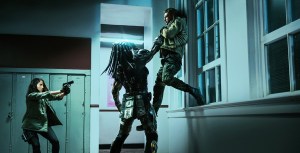 We need to talk about the film’s views on autism (there will be some spoilers in this paragraph, so skip ahead if desired). Rory McKenna is of that kind of Hollywood Autism, the kind we see on TV (The Good Doctor) or of classic movies (Rain Man). It’s the designation of autism as a gateway to super powers (never mind that having savant abilities only impacts ten percent at best). Whatever, it’s an unrealistic depiction in an age of better, more nuanced depictions of mental health and disabilities. Where The Predator gets crazy is when Dr. Brackett offers this nugget: “You know many people think autism is just the next step in human evolution.” No. Nobody thinks this. As someone who has worked extensively with children with autism, this is not a thing. I’m not saying by any rationale that those with autism are lesser by any means but they’re no more the next stage in human evolution than any other condition. Ask a person with autism if they feel like the next stage in human evolution, like an X-Men mutant. What makes matters worse is that Black confirms this strange notion when the Super Predator, surprise surprise, was most impressed with Rory McKenna and not his big bad dad. The Super Predator plans to take the kid back to, presumably, harvest his autism DNA so the future predators will… know how to fly their spaceships that they already know how to fly? I don’t know.
The Predator is part sequel, part reboot, part Shane Black genre riff, part muscular R-rated action movie, part chase movie, and part Hollywood mishmash. Apparently the film underwent extensive reshoots as well, retooling the entire third act, which seems obvious in hindsight and only magnifies the disconnect between the central story elements. Shane Black’s signature elements are but glimmers of what could have been. It needed to be more of a genre send-up of 80s-action farce, or a more straight-up action movie, or something where the plot generally made sense and had characters we liked. Was Shane Black playing a joke on the studio? The Predator will probably be most known for editing out a real-life sexual predator, or from its dreadlocked alien dog being domesticated after getting shot in the head, or its depiction of autism, or anything that isn’t really the entertainment level of a mediocre rehash. Check out Predators instead.
Nate’s Grade: C


 nathanzoebl

You must be logged in to post a comment.