Blog Archives
Beetlejuice Beetlejuice (2024)
 Usually sequels over thirty years later reek of desperation, trying to rekindle the past while usually only hoping to tickle people’s fading sense of nostalgia. Rare is the 30-year-plus sequel that excels by breaking free of its imitator and making us see the original in a new light. It helps to keep your expectations in check, especially for a project that is so miraculous as the original 1988 Beetlejuice. What a wild movie that was, an introduction to horror comedy for a generation, and a near-perfect balance of creepy, silly, and imaginative. From director Tim Burton’s career-launching sense of style, to Michael Keaton’s electric comedic performance, to Danny Elfman’s outstanding score, to the stop-motion visuals, fun and freaky makeup effects, and you had a madcap movie that felt like a unique discovery. Recreating that is near impossible, but if Beetlejuice Beetlejuice can recreate some of the elements and feelings that made the original what it was, then it can be considered a modestly successful late-stage sequel.
Lyrdia Deetz (Wynona Ryder) has become a long-running host of a paranormal TV talk show connecting people with messages from loved ones from beyond the grave. Her teenage daughter, Astrid (Jenna Ortega), is moody and embarrassed by her mother, feeling that she “sold out.” Mother and daughter return back to Connecticut to attend the funeral of Charles Deetz, Lyrdia’s father. Her pretentious and snippy stepmother, Delia (Catherine O’Hara), is trying to better commune with his spirit, and the entire town has become famous for its spooky seasonal history. Meanwhile, Beetlejuice (Keaton) is trying to avoid his former wife, Delores (Monica Bellucci), who naturally is seeking to obliterate him to ectoplasm. He’s still got his sights set on Lydia, who spurned his marriage hopes, and might be able to manipulate the Deetz family back into his control.
 Beetlejuice Beetlejuice gets the closest to rekindling that lightning-in-a-bottle alchemy from the 1988 original, serving as an appealing and enjoyable sequel. Nothing will ever be as original and wild and such a discovery as that first movie, which serves as a point of entry for many a Millennial fan who discovered that irresistible Tim Burton Neo-Gothic aesthetic. However, it recreates enough of the qualities that stood out about the original. The skewed sense of humor and surreal visuals, as well as goofy slapstick and vibrant imagination about life after death, it’s all such a fertile playground for Burton’s visual charms. The genius of the original was telling a ghost story from the ghost perspective as they learned about how to be better ghosts to try and scare their new living owners away. Given the world of the dead, there’s such tremendous storytelling and world-building possibilities here, explored richly in the animated 90s series for kids. Further stories in this universe have an automatically appealing power, and it’s just nice to watch Burton apply his specific aesthetic again, something fans haven’t really seen since 2007’s Sweeney Todd. I appreciated the weird morbid details and the practical production values; the Alice in Wonderland movies have shown that the “Burton look” isn’t best complimented by massive green screen sets. Having Burton, the “Burton look,” the original actors, with some exceptions (more on that later), and enough of that offbeat, chaotic, morbid tone return is a victory.
Beetlejuice Beetlejuice doesn’t so much alter our understanding of the world of the dead as established; it doesn’t radically rethink the landscape but it doesn’t repeat the same plot events either. I really liked the evolution of the adult Lydia as a jaded TV host. There’s a real dramatic punch to the reality that she sees the dead but has yet to see her deceased husband. She is incapable of reuniting with the man she misses the most, and she doesn’t know why. That yearning, paired with a lingering thematic mystery, can be a palpable storyline to explore. Pair that with some three generations of Deetz women trying to understand one another and work through personal resentments and we have fertile narrative ground. The three women were my favorite part of the movie, and their interactions and reflections on parenting and the challenges of trying to better understand one another are the foundation of the movie’s sense of heart. I really enjoyed the dynamic between the three, significantly upping Delia’s screen time and finding room to give her more dimension, an artist struggling in the wake of her grief. I’m a bit surprised that Ortega’s character isn’t more central to the drama. For all intents and purposes, she’s Lydia 2.0, so butting heads with Lydia 1.0 I guess feels redundant, so the story sends her off to find a cute boy in town and use that as an excuse for several unexpected needle-drop song use. There’s something inherently wrong watching a Tim Burton movie and hearing contemporary music. Imagine the Beetlejuice “Day-O” singalong but to, say, Sabrina Carpenter instead. No.
 Beetlejuice, as a character, is such an exciting agent of chaos, a horny ghost who operates on the same tonal wavelength as a Looney Tunes cartoon character. Even though the original movie is named after the guy, he’s only in the film for approximately twenty percent. Keaton was absolutely incredible in his comedic bravado, creating much of the character through his ad-libs and hair and makeup choices. Keaton is still fantastic in this go-for-broke sort of performance, a performance we’ve seen far less as he’s settled into a respectable dramatic acting career. It’s hard to remember, dear reader, but when Keaton was initially cast for Burton’s Batman, the fan base at the time was up in arms, considering Keaton more of an un-serious funnyman. It would have been easy to have Beetlejuice front and center for the movie, so it’s admirable that Burton and Keaton decided to keep his on-screen appearances short, leaving people wanting more. There’s a late turn of events that pairs Lydia and Beetlejuice together, and I wish this fractious pairing had been the bulk of the movie. The whole enemies-to-uneasy-allies would have put much more emphasis on their character dynamic and the comic combustibility. Still, seeing these characters come back and retain their appeal and personality without obnoxious pandering is welcomed.
The screenwriters find a clever solution for the Jeffrey Jones Dilemma. For those unaware, Jones, who portrayed Lydia’s father in the original, and best known for pugnacious supporting roles in movies like Ferris Bueller’s Day Off, Howard the Duck, and HBO’s Deadwood, was charged with soliciting a child for sexual exploitation. The movie continues with the character of Charles Deetz but without the involvement of Jones. The character gets his top eaten by a shark, so for the rest of the movie he’s a walking half of a corpse with a mumbly voice. It’s a clever way to include the character without the need for the actor.
With that decision to limit the Beetlejuice quotient of Beetlejuice Beetlejuice, it makes for a sloppier movie juggling a few underwritten subplots and side characters. The biggest non-factor is the return of Mrs. Beetlejuice. Here is a powerful antagonist who has the literal ability to suck out the souls of the recently dead and turn them into shriveled husks. She’s seeking vengeance against her ex and tracking him down through the netherworld. And yet, she could be completely eliminated from the movie without really affecting the other storylines. The whole Mrs. Beetlejuice/vengeful ex-wife character feels like a holdover from a different sequel script, clumsily grafted onto this other project, a vestigial artifact of another path not taken. There’s plenty of potential with the concept of the past victims of Beetlejuice coming back to seek retribution, and especially a trail of angry former lovers. It would explore the character’s history more meaningfully than an albeit amusing silent film interlude about how he married her during the era of the Bubonic Plague. We see how he died as a human, but there’s hundreds of years that can be illuminated from his failed schemes and odd jobs. Certainly there could be a whole club of ax-grinding malcontents sharing their mutual hatred of the Ghost with the Most. This character should better reflect Beetlejuice, and instead she’s just a monster on the prowl that eventually gets indifferently cast aside. It feels like Burton was looking for something for Bellucci to portray (Burton and Bellucci have officially been dating since 2023).
 She’s not alone as an antagonistic villain that pops up to provide momentary danger but is also hastily resolved to the point that it raises the question why they were even involved. There are three antagonists, not counting Beetlejuice, that appear throughout to threaten our Deetz family members in Act Three, each of them individually interesting and targeting a different member of the family for ill-gotten gain. Yet each one of these characters is conquered so easily that it nullifies their importance and overall threat. If Beetlejuice could, at any moment, just open a trapdoor to hellfire at a moment’s notice, what danger does any other character pose then? If a sand worm can just appear from nowhere and consume our pesky antagonist, then why can’t this be a convenient solution earlier? The defeats feel arbitrary, which make the antagonists feel arbitrary, which is disappointing considering that we have the full supernatural arsenal of undead possibilities to tap into. I enjoyed these characters for the most part, but it’s hard not to feel like they’re tacked-on and underwritten. The same can be said about Willem Dafoe’s police chief, a former actor who played a chief on TV and now tries to fill the role for real after death. I’m always glad to have more Dafoe in my movies (woefully underrepresented in rom-coms, you cowards!) but he’s just mugging in the corner, waiting for some greater significance or, at minimum, more memorably morbid oddity to perform.
Beetlejuice Beetlejuice is better than a desperate sequel cash-grab, though there are elements, ideas, characters, and jokes that could have been smoothed out, better incorporated, and developed to maximize the potential of the undead setting. It’s an enjoyable throwback for the fans of the original that does manage to tap into enough of those potent elements that made the original so memorable. It’s definitely less edgy and transgressive, maybe even a little too safe given the territory of spooky specters; the entire Soul Train bit felt like a bad Saturday Night Live sketch from the 1980. However, it’s still got enough of the charm and silliness to leave fans, old and new, smiling and wondering where it might go next in its wild world.
Nate’s Grade: B
Share this:

Mulholland Drive (2001) [Review Re-View]

Originally released October 19, 2001:
Mulholland Dr. has had a long and winding path to get to the state it is presented today. In the beginning it was 120 minutes of a pilot for ABC, though it was skimmed to 90 for the insertion of commercials. But ABC just didn’t seem to get it and declined to pick up David Lynch’s bizarre pilot. Contacted by the French producers of Lynch’s last film, The Straight Story, it was then financed to be a feature film. Lynch went about regathering his cast and filming an additional twenty minutes of material to be added to the 120-minute pilot. And now Mulholland Dr. has gone on to win the Best Director award at Cannes and Best Picture by the New York Film Critics Association.
Laura Harring plays a woman who survives a car crash one night. It appears just before a speeding car full of reckless teens collided into her limo she was intended to be bumped off. She stumbles across the dark streets of Hollywood and finds shelter in an empty apartment where she rests. Betty Elms (Naomi Watts) is a young girl that just got off the bus to sunny California with aspirations of being a big time movie star. She enters her aunt’s apartment to find a nude woman (Harring) in the shower. She tells Betty her name is Rita after glancing at a hanging poster of Rita Hayworth. Rita is suffering from amnesia and has no idea who she is, or for that fact, why her purse is full of thousands of dollars. Betty eagerly wants to help Rita discover who she is and they set off trying to unravel this mystery.

Across town, young hotshot director Adam Kesher (Justin Theroux) is getting ready to go into production for his new film. He angers his mob producers by refusing to cast their chosen girl for his movie. After some harassment, threats, and a visit by an eyebrow-less cowboy assassin (God bless you David Lynch), he relents.
In the meanwhile, people are tracking the streets looking for Rita. Betty and Rita do some detective work and begin amassing clues to her true identify. As they plunge further into their investigation the two also plunge into the roles of lovers. Rita discovers a mysterious blue box and key in her possession. After a night out with Betty she decides to open it, and just when she does and the audience thinks it has a hold on the film, the camera zooms into the abyss of the box and our whole world is turned upside down.
David Lynch has made a meditation on dreams, for that is at the heart of Mulholland Dr. His direction is swift and careful and his writing is just as precise. The noir archetypes are doing battle with noir expectations. The lesbian love scenes could have been handled to look like late night Cinemax fluff, but instead Lynch’s finesse pays off in creating some truly erotic moments. Despite the population of espresso despising mobsters, wheelchair bound dwarfs, and role-reversal lesbians, the audience knows that it is in hands that they can trust. It’s Lynch back to his glorious incomprehensible roots.
Watts is the true breakthrough of Lynch’s casting and she will surely be seen in more films. Watts has to play many facets of possibly the same character, from starry-eyed perky Nancy Drew to a forceful and embittered lesbian lover.
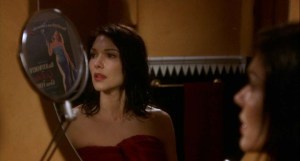
One scene stands out as a perfect example of the talent Watts possesses. Betty has just been shuffled off to an audition for a film and rehearsing with Rita all morning. She’s introduced to her leathery co-star and the directors await her to play out the audition scene of two kids and their forbidden love. As soon as the scene begins Betty vanishes and is totally inhabited by the spirit of her character. She speaks her lines in a breathy, yet whisper-like, voice running over with sensuality but also elements of power. In this moment the characters know, as the audience does, that Betty and Naomi Watts are born movie stars.
It’s not too difficult for a viewer to figure out what portions of the film are from the pilot and what were shot afterwards. I truly doubt if ABC’s standards and practices allows for lesbian sex. The pilot parts seem to have more sheen to them and simpler camera moves, nothing too fancy. The additional footage seems completely opposite and to great effect. Mulholland Dr. has many plot threads that go nowhere or are never touched upon again, most likely parts that were going to be reincorporated with the series.
The truly weirdest part of Mulholland Drive is that the film seems to be working best when it actually is still the pilot. The story is intriguing and one that earns its suspense, mystery, and humor that oozes from this noir heavy dreamscape. The additional twenty minutes of story could be successfully argued one of two ways. It could be said it’s there just to confound an audience and self-indulgent to the good story it abandons. It could also be argued that the ending is meticulously thought out and accentuates the 120 minutes before it with more thought and understanding.
Mulholland Dr. is a tale that would have made an intriguing ongoing television series complete with ripe characters and drama. However, as a movie it still exceeds in entertainment but seems more promising in a different venue.
Nate’s Grade: B
——————————————————
WRITER REFLECTIONS 20 YEARS LATER
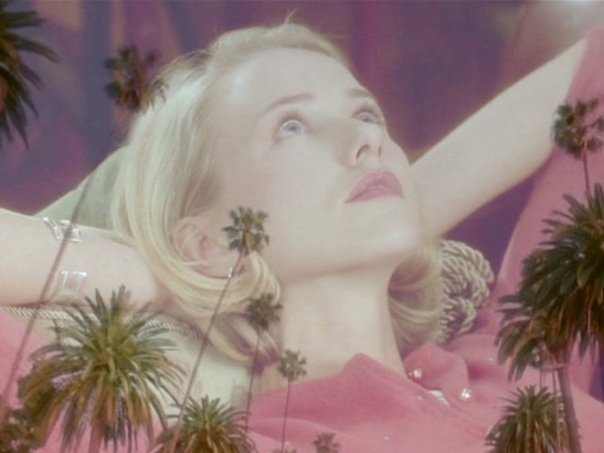
How much is a dream worth to you? That’s my main takeaway re-watching David Lynch’s surreal indie Mulholland Drive twenty years later from its release. Lynch has had plenty of his own run-ins with the dream makers of Tinseltown, from the difficulty to see his admittedly weird projects off the ground to the swift cancellation of his once zeitgeist, and deeply weird, TV series, Twin Peaks. It’s common knowledge now that Mulholland Drive began as a 1999 TV pilot that Lynch re-conceived as a movie, shot 30 minutes of additional footage, and earned a 2001 Best Directing Oscar nomination for his perseverance and creative adaptability. The movie has since taken on quite a reputation. The BBC and Los Angeles Society of Film Critics have both hailed it as the best film of the twenty-first century (so far). Lynch has retreated back to his insular world of weirdness with hypnotic, over-indulgent retreads, Inland Empire, and bringing back his signature TV series for a Showtime run in 2017. In 2001, Mulholland’s Drive’s success seemed to be the last point with Lynch working with the studio system he so despised. In a way, this is his farewell letter to chasing his own dreams of stardom, at least as far as a director can have creative control and a steady supply of protection and money to see his vision through. Watching Mulholland Drive is like stepping through a dream, which has been the hallmark of Lynch’s more celebrated, obtuse filmography from 1977’s Eraserhead onward. The movie is meant to operate on a certain dream logic, sustained with choices that seem artistically self-destructive, but the journey might feel as emotionally or intellectually fleeting as a dream as well, so I ask you, dear reader, to think as you continue, how much is a dream worth?

The failed pilot serves as a majority of the film’s running time and it’s filled with peculiar beginnings that will never pay off. There are actors like Robert Forster (Jackie Brown) and Brent Briscoe (Sling Blade) who show up for one whole scene and then are never seen again. Presumably, the roles would have been more significant as detectives snooping around from the peripheral. There are mysterious forces chasing after “Rita” (Laura Harring), an important-looking woman who has conveniently lost her memory and adopted her name after seeing a poster of Rita Hayworth. She’s got a bag filled with money, a gun, and blue key. One would assume over the course of a network season that we would get closer to discovering the real identity of our amnesiac leading lady. There are also scenes that seem to exist as their own short films, like the darkly comedic hapless hitman and the scared man detailing his spooky dream to a concerned friend in a diner. These characters, presumably, would come back for more significance or at least larger interplay. The same with the mysterious locked box and key. You can practically identify the J.J. Abrams “mystery box”-style of storytelling for future intrigue. The role of a TV pilot is to serve up a storytelling engine that can keep churning, as well as ensuring that there’s enough curiosity to hook an audience through commercial breaks. Lynch is used to inserting strange symbols and starts in his movies that potentially go nowhere, so the difference between a Lynch pilot and a Lynch movie aren’t terribly noticeable. These characters, clues, and moments were perhaps intended to be developed further, or perhaps they never were. It’s as if the movie itself is a nightmare of different television programs colliding incoherently.
There does seem to be a consensus interpretation for Mulholland Drive, one that synchs up the various doubles and symbols. For two hours, we’re riding along with Betty (Naomi Watts) as she moves to L.A. with big dreams and perky naivete. She finds the amnesiac Rita in her aunt’s apartment and takes it upon herself to give her a home and investigate her identity. They grow close together, Betty nails her big acting audition, and then Betty and Rita become lovers. They go to a club (Silencio) where performance artists insist “everything is recorded,” and thus already happened, phony, and a replication of memory, and then Rita inserts that mystery blue key into the mystery box and mysteriously vanishes. We next return to the scene of Diane, who at first was a dead body that Rita and Betty found during their investigation. Now it’s Betty, or at least Watts playing her, and she’s a struggling actress who is jealous of the success and favor her girlfriend, Camilla (also played by Harring), is indulging in from their seedy director, Adam (Justin Theroux). Overcome with torment, she hires a hitman to kill Camilla. From there, she’s attacked by a homeless monster, tiny versions of the people portraying Betty’s parents in the first part, and she takes her own life in grief and guilt. The most common interpretation is that the final twenty or so minutes with Watts as Diane is the real story and that the proceedings 110 minutes was Diane’s dream trying to process her guilty conscience and mixed emotions. The blue key, the symbol from Diane’s hired hitman of a job completed, is the point of transportation between the dream and returning to a living nightmare of regret. Adam’s prominence in the first two hours is explained as punishment from Diane’s mind, so this is why he is emasculated repeatedly, from being robbed of control over his movie, his marriage, and ultimately his future.
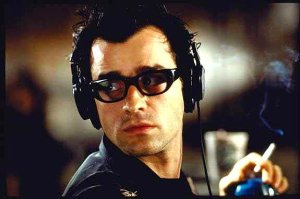
Just because this is the most prominent interpretation, and even perhaps the author’s intended one, doesn’t mean other viewers cannot find equally valid and differing interpretations. That’s the appeal or point of frustration with Lynch’s most Lynchian work. However, the problem with asserting that the first two hours of your two-hour-plus movie were all a dream can make it feel overindulgent and unsatisfying. The TV pilot segments are shot in a way that evokes the cliché storytelling stye that prevailed at the time, with overly lit scenes and flat acting. I cannot say for certain but it feels like Lynch purposely told Watts (King Kong) to try and be hammy. Lynch has been known to purposely ape the style of prime-time soaps to provide subtle satirical contexts. Is Watts doing a bad job with the purpose of making us think of other bad actors from soaps? The one scene Betty comes alive is during her audition scene. We’ve already seen her act it out once so we’re expecting more of the same, but in that moment, she comes alive with sensuality, taking control from the aged acting partner who was just there to exploit some young new starlets. The intensity she unleashes, a mixture of carnal desire and self-loathing, is nothing like bright-eyed Betty. Is the irony that when Betty is pretending to be someone else that’s when the performance excels? You can see the points for interpretation, especially considering the ending thesis, but if so, it’s such a bold gamble by Lynch that could prove so alienating. You’re deliberately having your lead actress act in a cliched and stilted manner to perhaps make a point fewer will grasp? Obviously, the ending wasn’t intended to pair with the pilot parts, so it feels like projecting an unintended meaning onto the intentions of acting decisions, but dreams are murky that way.
I wouldn’t be surprised if just as many people are tested by Mulholland Drive as they are mesmerized. It’s a combination of different genres and film iconography, from Manning as a living-breathing femme fatale, to dark whimsical comedy, to surreal mystery, to tawdry erotic drama, to industry-obsessed soap. As much as it feels like a pilot retooled into a new beast, it also feels like a collection of genres being retooled for whatever intended association Lynch wants to impart. It’s ready-made for dissection and ready to take apart the Hollywood studio system. I enjoyed some of the strange moments that felt most ancillary, like the mobster with the extremely refined taste for espressos, and the eyebrow-less cowboy assassin threatening Adam. That scene in particular still has an unsettling menace to it, as Lynch takes what could have been absurd and finds a way to make this man overtly threatening without ever explicitly doing anything threatening. His browbeating to Adam over the difference between listening and hearing is well written and ends perfectly: “You will see me one more time, if you do good. You will see me… two more times, if you do bad. Good night.” I wish more sequences like this could stand on their own. So much of Mulholland Drive seems intended to provide a skeleton for meaning to be provided later as the added meat that Lynch didn’t value as highly.
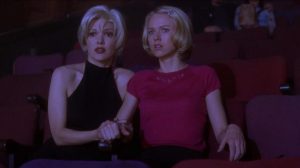
Watts became a star from this movie and was taken to another level with the success of 2002’s The Ring. From there, she was in the Hollywood system of stars and after toiling for ten years from rejected interviews to rejected interviews. She was thinking of quitting acting and going back to her native Australia at the time she got asked to play Betty/Diane. The audition scene, the later distraught and frail Diane, as well as the mannered Betty served as an acting reel for every casting agent that had rejected her. Here was Watts, capable of doing it all and then some (she was nominated for two Oscars – 2003’s 21 Grams and 2012’s The Impossible).
My original review in 2001 is also wrestling with the question over interpretation versus intention, with the genre mash-ups as symbolic satire or as laborious TV pandering. Mulholland Drive is like watching a dream and trying to dissect its many meanings. Some people will relish the puzzle pieces that Lynch has provided and finding further hidden mirrored meanings, and other people will throw up their hands and ask for a road map, or lose interest by then. I don’t think this is the best film of the first twenty years of this new century. I don’t even think it’s close. I think at its best it can be hypnotic and intriguing; it’s a shame that these are only moments for me, and twenty years later these moments felt even further spaced apart. I just didn’t find Lynch’s movie quite worth the long, surreal drive into the dark of his imagination.
Re-View Grade: B-
Share this:

American Psycho (2000) [Review Re-View]
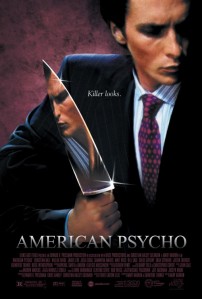 Originally released April 14, 2000:
American Psycho is based on the controversial 1991 best seller by Bret Easton Ellis though it got old fast. One can easily grasp how the lead connects with brand names on page one, but repeat it for 300 more and you’re tempted to add the book to your collection of firewood. Ellis’ novel was sadistically perverse, but director Mary Haron (I Shot Andy Warhol) has somehow managed to pull out an entertaining social satire from the pages of blood and name brands.
Christian Bale, mainly known as the boy-next-door in period piece films, plays Patrick Bateman with ferocious malevolence and vigorous life. Teen scream Leo was once considered for the part but after seeing Bale’s startling performance it should prove why he’s on screen and Leo’s swimming in The Beach. Bateman is an up-and-up Wall Street yuppie who glosses over appearance more than anything else. The only outlet it appears for our sinister shark from the soulless decade is by random acts of gruesome violence.
If Bateman blows off steam by blowing off companion’s heads than it only becomes more frustrating when no one believes his random confessions. Haron takes the grisly material of Ellis’ novel and mines it for pure 80s pulp. It only gets better the further it gets as you have so many points to discuss: Is Bateman acting out to prove his existence in a world that doesn’t humor him or others? Is he acting out deep-seeded rage from the actions of the decade on its people? Is he desensitized and so jaded that death does not even fracture him anymore? The questions are boundless.
The hit list of stars in Psycho includes Chloe Sevigny as a nailed home addition, Willem Dafoe as an investigative detective, Jared Leto as an axed co-worker, and sweet Reese Witherspoon as the apple of Bateman’s twisted eye. Everyone has fun in their tongue-in-cheek nostalgia romp through the absurd.
American Psychoshould not be confused with the successful teen sex farce American Pie. The only desserts in this film are just, and they’re usually left of the mayonnaise and behind the frozen head in the refrigerator. American Psycho is the thinking man’s slasher movie. A flick that slices, dices, and always entices. It only gets better after you’ve seen it. One of the best films of 2000 for now.
Nate’s Grade: A
——————————————————
WRITER REFLECTIONS 20 YEARS LATER

American Psycho was a literary sensation upon its initial publication in 1991 and was deemed shocking, grotesque, perverse, and all those splashy adjectives that made it guaranteed Hollywood would turn Bret Easton Ellis’ novel into a film. Every young actor in Hollywood in the 90s was rumored to play narcissistic serial killer Patrick Bateman. By the late 90s, director Mary Haron was attached with Christian Bale as the intended Bateman on the condition that other name actors could be brought on (Haron secured Willem Dafoe and Reese Witherspoon for supporting roles). The producers kept pushing for their number one target, Leonardo DiCaprio as Bateman, and Haron said she would walk if he was hired over Bale. The producers went ahead and DiCaprio was hired for several months, with the budget ballooning to over $40 million, half of which was slated just for DiCaprio’s payday. Months later, DiCaprio left to film Danny Boyle’s The Beach, and the producers went back to Haron and her top choice, Bale, who was so determined to play Bateman that he didn’t take any other acting gigs for nine months just in case (new total film budget: $7 million). Looking back again twenty years later, it’s difficult to imagine late 90s DiCaprio in the part that became the first of many star-making performances for Bale, one of the most chameleon-like actors of his generation. Haron’s tenacity and instincts proved correct and the film still stands tall as a dark comedy and a character study of a compulsive narcissist.
 The novel was set in the 1980s and intended to satirize the soulless suits of Regan’s America that made their ill-gotten gains on Wall Street, and the satire has only become more relevant after the 2008 financial meltdown and numerous white-collar scandals. The perception of Wall Street as predatory and vampiric and roiling with sociopathic greed has only become more pronounced, which makes the intended satirical targets even more worthy of their take-downs.
I initially wondered in my original review in 2000 whether, among other interpretations, Bateman was lashing out in a world that didn’t care about him in order to make himself feel heard, and that is exactly the opposite response. Bateman is acting out because he can and because he no longer cares about following rules. It may be a metaphorically simplistic application to make a Wall Street trader a serial killer but that doesn’t make it any less appropriate and resonating. The iconic business card scene still sends me howling, as Bateman and his colleagues (Justin Theroux, Josh Lucas, Matt Ross) compete for supremacy with who has the most accomplished little square of cardboard with their name on it. The hushed and awed voices, the detailed micro-analysis, the slow motion and beauty shots of the cards, it’s played to such wonderful heights of absurdity. When Bateman hires two call girls for a threesome, he spends more time flexing and admiring his own image in the mirror. He spends more time on his daily beauty care rituals than he does on introspection. For these hollow men, status and appearance is the only thing that matters in a world of imposters and transitory pleasures.
Bateman is meant to serve as a character study for a man who declares there isn’t anything there underneath him. It’s an expose of vanity in an era of venal excess and it’s also an indictment on privilege. As depicted on film, and later revealed why with an ambiguous conclusion, Bateman gets away with his wild and increasingly murderous antics because of his position. He’s a rich white Yuppie during 1980s New York City. He can get away with anything, which is why he can run around screaming, flailing a live chainsaw, wearing nothing but socks and blood, and nobody seems to be the wiser. It’s why he can go back to his own crime scenes to leave even more of his evidence, and DNA, around the premises. It’s why he can pose as Paul Allen (Jared Leto) even after he has hacked Allen into tiny little Yuppie pieces. It’s why he can hilariously wax on like a Rolling Stone essayist about musical artists like Phil Collins and Whitney Houston as he prepares to slice and dice his victims. As his actions become more and more blatant, the satire rises with Bateman to blanket his reckless impulses (these crooks can get away with anything, Haron seems to be whispering in your ear while elbowing you in the ribs). After two more decades of Wall Street scandal without consequence or credible jail time, as well as a president who is convinced rules do not apply to him, the satire has approached an even darker laugh-because-otherwise-you-might-cry territory than it was back in 2000 (“This confession has meant nothing.”).
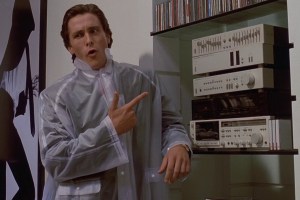 With no one able to tell him no, how far will Bateman go? Haron and her co-writer Guinevere Turner (who also appears in the film as Elizabeth, a drunk friend of Bateman’s who becomes another victim) smartly dialed into the themes they wanted to send up and dialed down the grisly gratuitous details. In the book, Bateman’s depravity is described in as much detail as he gives to his rampant consumerism. We don’t need pages upon pages of description to understand that Bateman is sick in the head, and we don’t need examples such as torturing a prostitute by trapping rats inside her vagina. The grisly overkill of the book is smartly pulled back to its essentials, and an oft-reviled work deemed misogynistic by many critics has been transformed from a deep dive into rape, dismemberment, and cruelty into a satire on the men who aspire to commit such awful acts. There’s a noticeable difference there that some will miss. One perspective focuses on the actions and the other focuses on the meaning. Bateman is a privileged, entitled, and alienated white man teeming with unprovoked rage, a figure we’ve seen more often in the news in the ensuing decades. The American Psycho movie takes aim at the fragile male egos of past and present. Haron would later go on to write and direct other indies (2006’s The Notorious Bettie Paige) but she never seemed to get that career boost after American Psycho. Ellis decried the movie adaptation and later said he felt female directors were unable to accurately translate the male gaze, which is dubious when the starting point for Hollywood filmmaking is preset at “male gaze.”
Bale is phenomenal in what proved to be his breakout role. It was only a few years later that he nabbed Batman for Christopher Nolan. According to interviews, Bale modeled his performance after what he saw during a Tom Cruise appearance on David Letterman’s talk show. Bale says he saw an “intense friendliness with nothing behind the eyes,” and he then knew how to play the part. It was also the beginning of Bale’s trademark method transformations, becoming the muscled figure of Bateman’s desire, the only thing that ever truly mattered to the man. Bale’s thinly veiled contempt for everyone and ironic detachment are constantly entertaining and provide great laughs (his go-to excuse for departing, “I have to return some video tapes,” made me laugh every time). There’s a late scene where Bateman calls his lawyer to confess to his litany of sins, feeling cornered, and it’s a spellbinding performance all in one take where he approaches mania as he finally unburdens himself (“Tonight I, uh, I just had to kill a LOT of people. And I’m not sure I’m gonna get away with it this time.”). It’s a tremendous moment in a tremendous performance. The movie is filled with familiar faces (Chloe Sevigny! Samantha Mathis! Reg E. Cathy!) that it becomes fun to realize just how many great actors and future stars contributed to the movie. For trivia buffs, it also features Batman (Bale) killing the Joker (Leto).
 My original review attempts many turns of phrase, like “blowing off steam by blowing off others’ heads,” but the core points are still viable: the satire improves from the book, Bale delivers an amazing performance, and there are many ways to interpret the film. The ending isn’t quite as ambiguous as perceived but it makes sense with the outlandish escalation of events, a point where even Bateman looks at his own power with befuddled curiosity. Back in 2000, I called American Psycho the “thinking man’s slasher movie” and I think that title still applies. It’s a vicious movie but the satire is just as vicious. Weirdly, there was a direct-to-DVD sequel that just went the “non-thinking man’s slasher” route by featuring Mila Kunis (Black Swan) as a criminal justice coed who embarks on her own bloodbath, including killing William Shatner as a professor. It’s like unintended satire on Hollywood itself; follow a cerebral and daring artistic work with run-of-the-mill slop under the same name, co-opting the appeal of a “brand” to make a buck. Much like Wall Street, Hollywood doesn’t know when to stop.
Re-View Grade: A
Share this:

On the Basis of Sex (2018)
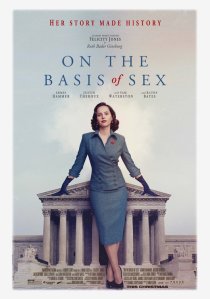 Given the high-profile treatment of a popular documentary and an awards-bait caliber feature, you’d be forgiven for thinking that people either thought justice Ruth Bader Ginsberg was due for recognition or was about to die. On the Basis of Sex takes more than a few nods from 2012’s Lincoln, showcasing its subject trying to pass key reforms/legislation as a means of better insight into his or her lasting legacy. To that end the film is a success. It’s an intelligent legal procedural taking time to find judicial footholds, craft compelling arguments, and the back-and-forth challenges of overturning hundreds of years of precedent that viewed women as essentially lesser. If you enjoy rhetorical debates on legal minutia, this might be the movie for you. However, if you wanted to get a better understanding of Ginsburg (Felicity Jones) the person, then you’re out of luck. She’s more or less the vessel for social justice and the film keeps her more as a lionized symbol for change than as a person. Her frustrations, such as being denied the same opportunities as men, are meant to serve as a reminder of the frustrations of the many. There are a handful of scenes with dismissive, doddering middle-aged men that feel too stagy, and yet I’m sure that these same curt comments and patronizing behaviors were a daily affair (and still are). Jones doesn’t feel like she has a full grasp on the character beyond as symbol (her Brooklyn accent is a bit slippery as well). You also get to process the reality of Ginsburg as a sexual being as she initiates PG-13 sex with her supportive husband (Armie Hammer). It’s kind of like thinking about your parents having sex. On the Basis of Sex feels a bit, ironically enough, too old-fashioned. It’s got dramatic courtroom showdowns, including an eleventh hour speech, and all the old Oscar bait tropes we’d expect from this sort of movie. It plays to every expectation of its audience. Beyond learning about the legal arguments, there’s nothing new or insightful here. Stick with the RBG documentary and hear the same stories from the real deal herself.
Nate’s Grade: B-
Share this:

Iron Man 2 (2010)
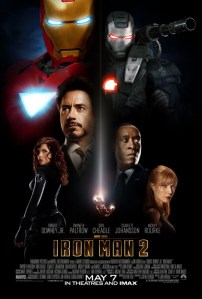 Iron Man was a fresh surprise in the summer of 2008, offering a superhero movie dominated by a middle-aged man’s personality and not the special effects. The story was not overwhelmed by all the demands of what we expect in a glorious summer popcorn experience. Marvel was smart to sign on the same team behind the first film, including director Jon Favreau, but setting a deadline exactly two years after the first film made me worry. There wasn’t much time to get everything together, and it should be no shock that Iron Man 2 feels rushes and absent the finesse of the first film. As much as it pains me to say it, Iron Man 2, while fun in spots, doesn’t come close to the original. You can trace much of it back to the sequel ethos that you take what worked in Part 1, make it much, much bigger and louder, and now you have Part Two. But what worked so exceptionally well in the first Iron Man movie was not the action sequences but the characters, so guess what happens when you pollute the narrative with more characters and disposable action sequences?
Tony Stark (Robert Downey Jr.) is a self-made superhero and now the world knows that he is indeed the metallic warrior, Iron Man. Stark refuses to hand over his technology to the government, saying he has “successfully privatized world peace.” He appoints his girlfriend/loyal assistant Pepper Potts (Gwyneth Paltrow) to CEO so he can devote his time to ridding the world of evil and lapping up the fame that goes with being Iron Man. Lt. Col. James Rhodes (Don Cheadle replacing Terrence Howard) is concerned for his buddy but also eager to help play around with that super suit. But not everybody loves Tony Stark, notably Justin Hammer (Sam Rockwell), a rival weapons dealer aiming for a Pentagon contract, and Ivan Vanko (Mickey Rourke), a Russian scientist who blames his father’s exile from America and Siberian internment on the Stark family. When Hammer sees Vanko’s attack at a Monaco speedway, he knows he has found an ally against Stark. Hammer whisks his newest Russian friend to New York and enlists his expertise in creating an army of super mechanical fighting suits.
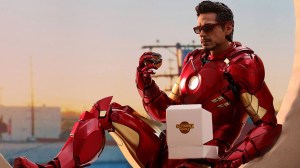 The screenplay by actor-turned-writer Justin Theroux (Tropic Thunder) is overstuffed with people and events all fighting for screen time and narrative dominance that it starts to become unintentionally comical after a while. There are too many storylines jostling for control when any one of them could have comprised a whole movie: military demands to have the suit, Tony deals with blowback from being the most famous man in the universe, and escalation (others trying to top Stark). Don’t even get me started on how Iron Man 2 bends over backwards to advertise that future Marvel Avengers movie lead by Nick Fury (Samuel L. Jackson). I mistakenly believed that the trailers ended before my movie started. There’s a storyline where Tony’s blood is becoming infected with a dangerous chemical every time he uses the Iron Man suit, so being a superhero is literally killing him. You can work with that for some pathos, debating the needs of one man vs. the needs of society and the greater good, personal sacrifice, mortality, legacy, but it all gets way too easily resolved in an absurd way (all I’ll say is, thanks Mad Men‘s Roger Sterling!). It tries to up the ante when less would have been considerably more.
Most of the new characters feel poorly integrated, further causing distraction to any attempts at narrative cohesion. Iron Man 2 also pushes Johansson into the mix so that she can shake up the Tony/Pepper relationship and, plus, she looks good in a skintight cat suit. But her third wheel/love triangle status is barely touched upon and Johansson gets one solid action sequence where she takes out a litany of goons in a hallway with the amazing power of her spinning thighs. Johansson is mostly just another assistant to take notes in the background, although she does it beautifully. The Rourke scenes are few and far between. They establish him as an intimidating force and then he pretty much sits in a room tinkering with stuff, garbling Russian, and feeding his cockatiel for the rest of the movie. He never feels like a real threat or a true match for Tony. Rockwell is the more appealing, slimy villain of the duo, aided by Rockwell’s exasperated bellowing and desperation for the spotlight. Hammer is more interesting to me than a Russian ex-con that rarely speaks, let alone speaks in English. He’s given so little opportunity to develop Vanko as a character. And yet Gary Shandling, as a smug senator trying to make Stark accountable to the U.S. military, might be the film’s best villain of the bunch (curious side note: Shandling and Rourke look oddly similar).
 The personal relationship between Tony Stark and Pepper Potts was the heart of Iron Man. They had that snappy, droll, screwball comedy-esque give-and-take, with hints of something more underneath. This time, the movie doesn’t even speak about their relationship at all, like it never happened in the first film. That scene where she kisses his Iron Man helmet, tosses it out the belly of a plane, and he dives off uttering, “You complete me”? Not in the film. You start to wonder why the movie is being purposely vague and it gets maddening. Their relationship lacks the frustration tinged with flirtation and replaces it with agitation. Both Tony and Pepper are harried and on each other’s last nerve, which doesn’t make for much romantic traction. Their chemistry seems to have dampened. I’m kind of with Pepper on this one because Tony Stark might be even too obnoxious in this movie. Following the sequel-it is code, Tony’s egotistical behavior is expanded and he becomes prone to self-destructive behavior, getting riskier and riskier, pushing others away including, perhaps, decent portions of the audience. He’s stopped being the cocky, likeable arrogant playboy and transformed into a bit of a rich douchebag. Part of this is related to the storyline about the suit literally killing Tony, and his character’s alcoholism featured heavily in the comic books, but it’s just another plot element that feels like it was put in for momentary conflict and then easily resolved or dropped. I understand Tony will be his biggest antagonist but that didn’t stop the first Iron Man film from flying high in entertainment.
The first Iron Man had an unexpected low level of action for a summer movie, but because of the characters you didn’t care. It was that rare comic book movie where you wanted more dialogue and fewer sound effects. To be fair, Favreau and crew saved a pretty nice Iron Mano y Iron Mano fight sequence at the end. Following that narrative lead, Iron Man 2 is structured pretty much like the first when it comes to action. There’s the attack at the Monaco raceway, which features an unrealistic, cartoonish tone that conflicts with the rest of the flick. But the film’s biggest moment of sustained action is the climax involves Tony Stark versus a bunch of silly killer robots. Soulless robot drones don’t get very compelling, plus haven’t we seen a thousand movies where people combat killer robots? What’s more disappointing is that Favreau incoherently stages the action. It’s not due to any sort of hyperactive editing, no, the culprit is that the onscreen action is just moving way too quickly. As a result, much of the action feels like whooshes of color. It’s hard to adjust your eyes to the rapid movement and process what exactly is going on. Because we can’t follow the action the whole thing lacks tension, danger, and drama. I wanted to be blown away by the action, which has several trailer-ready moments of awesome, but mostly I just wanted to be able to understand what I was watching.
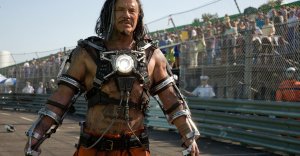 Despite all my complaints, Iron Man 2 still manages to be a fun time out at the movies. Downey is always immensely talented and brings great amounts of energy to the role, centering the movie on his witty charms. While his character is less engaging this go-round, Downey is still on top of his game. Rourke, Rockwell, Paltrow, and Johansson all contribute fine performances when they’re on screen. The low output of Iron Man in suit is compensated by having TWO Iron Men, thanks to Rhodes donning the metal gear and fighting alongside his pal. The opening of this movie captures your interest fairly well, though it loses it again thanks to slack pacing and an influx of new faces. The tone of the movie takes a cue from Downey and the movie as an agreeable, comedic feel without seeming overly glib. And hey, the special effects are pretty nice, too. Iron Man 2 is an adequate popcorn movie but the tragedy of the movie is that the first film was much more than adequate. I think the Iron Man film franchise is in need of a slight upgrade.
Nate’s Grade: C+
Share this:

Tropic Thunder (2008)
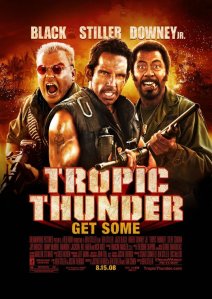 Ben Stiller has been kicking around the idea for Tropic Thunder for nearly 20 years. It took a lot of time to get the script in fighting shape, but the time was well worth it. Tropic Thunder is tasteless and occasionally appalling but it is also wickedly, deliriously funny.
Set inside modern-day Vietnam, Hollywood is filming another epic war movie but this one’s in trouble. It’s over budget, behind schedule, and the first-time director (Steve Coogan) can’t control his actors. Tugg Speedman (Stiller) is a fading action star looking for another hit. Jeff Portnoy (Jack Black) is a crass comedian who’s after some real acting credibility. He’s also addicted to heroin and worries that people will only ever see him as a funny man who farts. Kirk Lazarus (Robert Downey Jr.) is a five-time Oscar-winning actor who, thanks to makeup and a lot of hubris, is playing the film’s African-American sergeant. Alpa Chino (Brandon T. Jackson) is a rapper breaking into acting and is steamed that the Hollywood producers gave the sizeable black role to a white guy.
The director is at his wit’s end and being bullied by producers back in America. He is advised by “Four Leaf” Tayback (Nick Nolte), the Vietnam vet whose story the film is based upon. Tayback says to get real emotion and real fear that the actors should be stranded in the jungle without their precious handlers and demands. So the director takes Speedman, Portnoy, Lazarus, Alpa, and newcomer Kevin Sandusky (Jay Baruchel) in a helicopter and out into the wild. Trouble is, the actors have been left in the middle of an actual drug war, except they think it’s all apart of the script.
 Tropic Thunder is all things to all comedies. It could be tagged as being a bit incoherent but that’s because the movie has so much going on. It’s a sharp satire of Hollywood moviemaking and the raging egos of actors, it’s a send-up of Vietnam war movies and their bloody clichés, it’s a fairly worthwhile action film, and it’s a stupendously politically incorrect comedy with plenty of crude humor mixed side-by-side with genuine wit. It’s a comedy that has the potential to leave you aching from slapstick humor one second and biting satire the next. This feels like a complete comedy and not merely a series of sketches. Every character has an arc, some great moments, and each actor brings something different and something wonderful to the fray. This is clearly Stiller’s greatest achievement as a director.
The focus of Tropic Thunder is all over the place, and no one is safe from Stiller and his co-writers Etan Cohen and actor Justin Theroux. This is a brutal insider satire that plays it broad and loud. There are great jokes that ridicule the pomposity of the entire movie industry and the pitfalls of celebrity as a whole. I loved the jabs at celebrities going overseas and adopting children like they’re souvenirs. The movie has caught flak from disability groups that are mad about the movie’s liberal use of the term “retard.” I don’t want to say these people are missing the point of satire, or the fact that an R-rated comedy should offend on some level, but the joke is clearly on Hollywood and how movies exploit those with mental handicaps under the guise of telling their harrowing and inspiring stories. Movies have long been chronicling the adventurous lives of those with disabilities, which also has the side effect of making these people seem less like, well, just people. In the film, Speedman stared in a movie called “Simple Jack” about a mentally challenged boy who thinks he can talk with animals. Then the character has to pop up later in the film, complete with hysterical dialogue that blows apart just how exploitative these movies are (“I’ll see you in my head movies, but this is one head movie that makes my eyes rain”). It’s performed in just the right tone to make you laugh at the industry and the individual and not because of any disability.
The way the film establishes character back-story is genius. Tropic Thunder introduces all four major characters through fake commercials and trailers, like Grindhouse. The trailers are hilarious and a great way to kick off the movie. Stiller stars in a sinking action franchise where the world keeps being overtaken by fire (“Now, the one man who saved the world five straight times — will have to do it again”). The action franchise’s idea is to just reverse the scenario and, as sequels do, make everything bigger. Black’s trailer revolves around an obese family of super flatulent idiots all played by Black. The sequence is constant farting but it’s so over-the-top and pumped with contempt for lame-brained Hollywood comedies. The best trailer is the one that gives us Downey Jr.’s character, the esteemed Kirk Lazarus. Set in an Augustine monastery around the Middle Ages, Downey plays a monk who finds that he must conceal his inflamed passions for another man of the cloth (a figure I won’t spoil). Think of it as a 12th century Brokeback Mountain, and Stiller and company know exactly where to hammer Hollywood: the go-go eye stares, the hesitant naughtiness, and the ridiculous marketing angles – the title is inexplicably Satan’s Alley. The opening collection of fake trailers serves as perfect comedy bon mots for the feast that is to follow. They whet your appetite and may be the greatest opening 10 minutes of any comedy in memory.
 Downey Jr. gives an unforgettable performance comprised of sheer brilliant comedic bliss. I loved every second he was onscreen and I fully expect the man to get an Oscar nomination for his work here. Now, the role of a Method actor playing a black actor naturally presents a tightrope that needs to be walked just the right manner to maintain a satiric tone that doesn’t turn ugly. Let me state clearly that blackface is never funny. It is repugnant and Hollywood has a rather depressing history with the unsavory practice (Gene Kelly and even Bing Crosby sadly did it). Tropic Thunder is not a Stepin Fetchit-style minstrel show where Downey makes eye-rolling racist stereotypes. The joke is not that Downey is playing a black man, the joke is that he is such an arrogant and egotistical actor that he thinks he can play anyone. Besides, Jackson chides him throughout the film for his unorthodox portrayal, which tells you where the filmmakers stand. Downey elevates every scene he steps into and gives a performance, like the film, that is densely layered with comedy. He never breaks character even when the cameras aren’t filming and even when he’s alone. He’s two steps removed; channeling a performance as a heralded Australian actor playing his idea of a 1970s black male. When Alpa derogatorily drops the N-word, Lazarus slaps him and then begins a speech with, “For over 400 years they have been using that word to keep us down,” and ends it reciting the lyrics to the theme song from The Jefferson’s. In that span of time, Downey takes you along on every stop in the dense, hilarious mind of Lazarus.
While the rest of the actors don’t ascend to Downey’s heights (years ago this would have doubled as a drug reference), the ensemble of Tropic Thunder works together smoothly and they help make the film so much more enjoyable. Black is great when he’s trying to be seen as a “serious” actor when they are filming. I love his rushed and hushed line deliveries. But he’s even funnier after going through the wringer of heroin withdrawal. A sight gag involving Black digging through his speedo had me in stitches. Stiller is playing his usual dimwitted blowhard but propels the plot forward. He knows exactly how to oversell for laughs, like when he’s being riddled with bullets in dramatic slow-mo or when he’s playing Simple Jack. Baruchel is a nice counter foil to the uncheck bravado and craziness of the other actors. Jackson has fun voicing his mounting vexation with Lazarus. Coogan and Nolte provide good small moments, and Danny McBride steals his scenes as a pyrotechnic special effects expert that wants to “make Mother Nature piss her pants.”
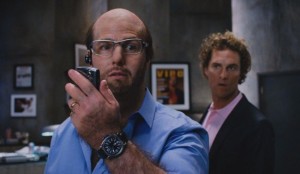 By now you’ve likely heard all about Tom Cruise’s small role in the movie as an irate, bald, fat, extremely hairy studio executive. It’s nice and amusing but I could have done with something different. Downey is unrecognizable in both physical appearance and through his speech; he fully inhabits a character that fully inhabits characters. Cruise, on the other hand, is instantly recognizable even with glasses, a paunch, and a shiny dome. It’s Tom Cruise playing a profane asshole but the joke wears thin. Cruise either needed to do something different or just be seen less, including his hip hop dance moves. And yet, Tropic Thunder has a running joke about Hollywood taking its beautiful A-listers and thinking that, through the power of makeup and superficial physicality, they can play any role. We’ve had a streak of Best Actress Oscar winners that have won accolades by stripping away their beauty and packing on the pounds (check out Charlize Theron in Monster). It seems like even the pretty girls are getting the ugly girl roles now; what’s a homely actress to do nowadays? So, in a way, Tropic Thunder is making fun of this line of thinking, that fat suits and some makeup are the great equalizer, but then it has Tom Cruise more or less falling into the same trap. He puts on a fat suit, a bald cap, but it’s still him and you hear Tom Cruise in every utterance. Maybe it would have been funnier if Cruise were playing a parody of himself since he is a studio executive at United Artists.
Tropic Thunder is a wildly funny movie that takes no prisoners when it comes to its sprawling satire. Stiller and company cut down the self-absorbed lifestyle and mentality inside the film industry and insecure actors. The film really shares the spotlight and each actor provides something different and welcome, and there isn’t a weak link in the bunch. Downey Jr. gives a brilliant comedic performance that will be long remembered. The movie is rude, crude, stupid, smart, and all over the place thanks to such a broad comic canvass. It took many years for Stiller to finally get Tropic Thunder off the ground but the wait was worth it. This is a rare comedy that eels loose, hits hard, and may warrant multiple viewings just to catch all the jokes-within-jokes. This is a movie with plenty on its mind, perhaps too much, but I wish more comedies were as well executed and skillful in their gags about gas passing.
Nate’s Grade: A
Share this:

Charlie’s Angels: Full Throttle (2003)
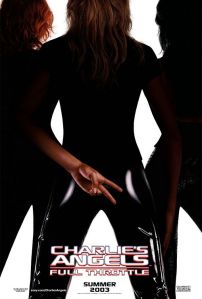 More of the same, except this time all the verve and invention seems stale and reheated. This sequel subscribes to the bigger-better train of thought, so as it continues to get more and more outlandish and the girls become invincible super heroes on par with Neo, the movie tanks hard. Much has been made about Demi Moore’s “comeback” but apparently she wasn’t sharpening her acting muscles during her hiatus. No one said the first Charlie’s Angels movie was within the realm of reality, but in the sequel apparently the Witness Protection Agency has decided to store all their valuable information not in a computer mainframe, a system of files, no, on two magic decoder rings. What the hell? McG returns as director and cranks the style into overkill, set to a radio-friendly soundtrack, but it all seems so ho-hum and excessive at the same time. Quite an accomplishment. No more please.
Nate’s Grade: C
Share this:

Mulholland Drive (2001)
Mulholland Dr. has had a long and winding path to get to the state it is presented today. In the beginning it was 120 minutes of a pilot for ABC, though it was skimmed to 90 for the insertion of commercials. But ABC just didn’t seem to get it and declined to pick up David Lynch’s bizarre pilot. Contacted by the French producers of Lynch’s last film, The Straight Story, it was then financed to be a feature film. Lynch went about regathering his cast and filming an additional twenty minutes of material to be added to the 120-minute pilot. And now Mulholland Dr. has gone on to win the Best Director award at Cannes and Best Picture by the New York Film Critics Association.
Laura Harring plays a woman who survives a car crash one night. It appears just before a speeding car full of reckless teens collided into her limo she was intended to be bumped off. She stumbles across the dark streets of Hollywood and finds shelter in an empty apartment where she rests. Betty Elms (Naomi Watts) is a young girl that just got off the bus to sunny California with aspirations of being a big time movie star. She enters her aunt’s apartment to find a nude woman (Harring) in the shower. She tells Betty her name is Rita after glancing at a hanging poster of Rita Hayworth. Rita is suffering from amnesia and has no idea who she is, or for that fact, why her purse is full of thousands of dollars. Betty eagerly wants to help Rita discover who she is and they set off trying to unravel this mystery.
Across town, young hotshot director Adam Kesher (Justin Theroux) is getting ready to go into production for his new film. He angers his mob producers by refusing to cast their chosen girl for his movie. After some harassment, threats, and a visit by an eyebrow-less cowboy assassin (God bless you David Lynch), he relents.
In the meanwhile, people are tracking the streets looking for Rita. Betty and Rita do some detective work and begin amassing clues to her true identify. As they plunge further into their investigation the two also plunge into the roles of lovers. Rita discovers a mysterious blue box and key in her possession. After a night out with Betty she decides to open it, and just when she does and the audience thinks it has a hold on the film, the camera zooms into the abyss of the box and our whole world is turned upside down.
David Lynch has made a meditation on dreams, for that is at the heart of Mulholland Dr. His direction is swift and careful and his writing is just as precise. The noir archetypes are doing battle with noir expectations. The lesbian love scenes could have been handled to look like late night Cinemax fluff, but instead Lynch’s finesse pays off in creating some truly erotic moments. Despite the population of espresso despising mobsters, wheelchair bound dwarfs, and role-reversal lesbians, the audience knows that it is in hands that they can trust. It’s Lynch back to his glorious incomprehensible roots.
Watts is the true breakthrough of Lynch’s casting and she will surely be seen in more films. Watts has to play many facets of possibly the same character, from starry-eyed perky Nancy Drew to a forceful and embittered lesbian lover.
One scene stands out as a perfect example of the talent Watts possesses. Betty has just been shuffled off to an audition for a film and rehearsing with Rita all morning. She’s introduced to her leathery co-star and the directors await her to play out the audition scene of two kids and their forbidden love. As soon as the scene begins Betty vanishes and is totally inhabited by the spirit of her character. She speaks her lines in a breathy, yet whisper-like, voice running over with sensuality but also elements of power. In this moment the characters know, as the audience does, that Betty and Naomi Watts are born movie stars.
It’s not too difficult for a viewer to figure out what portions of the film are from the pilot and what were shot afterwards. I truly doubt if ABC’s standards and practices allows for lesbian sex. The pilot parts seem to have more sheen to them and simpler camera moves, nothing too fancy. The additional footage seems completely opposite and to great effect. Mulholland Dr. has many plot threads that go nowhere or are never touched upon again, most likely parts that were going to be reincorporated with the series.
The truly weirdest part of Mulholland Drive is that the film seems to be working best when it actually is still the pilot. The story is intriguing and one that earns its suspense, mystery, and humor that oozes from this noir heavy dreamscape. The additional twenty minutes of story could be successfully argued one of two ways. It could be said it’s there just to confound an audience and self-indulgent to the good story it abandons. It could also be argued that the ending is meticulously thought out and accentuates the 120 minutes before it with more thought and understanding.
Mulholland Dr. is a tale that would have made an intriguing ongoing television series complete with ripe characters and drama. However, as a movie it still exceeds in entertainment but seems more promising in a different venue.
Nate’s Grade: B
Reviewed 20 years later as part of the “Reviews Re-View: 2001” article.
Share this:

American Psycho (2000)
American Psycho is based on the controversial 1991 best seller by Bret Ellis though it got old fast. One can easily grasp how the lead connects with brand names on page one, but repeat it for 300 more and you’re tempted to add the book to your collection of firewood. Ellis’ novel was sadistically perverse, but director Mary Haron (I Shot Andy Warhol) has somehow managed to pull out an entertaining social satire from the pages of blood and name brands.
Christian Bale, mainly known as the boy-next-door in period piece films, plays Patrick Bateman with ferocious malevolence and vigorous life. Teen scream Leo was once considered for the part but after seeing Bale’s startling performance it should prove why he’s on screen and Leo’s swimming in The Beach. Bateman is an up-and-up Wall Street yuppie who glosses over appearance more than anything else. The only outlet it appears for our sinister shark from the soulless decade is by random acts of gruesome violence.
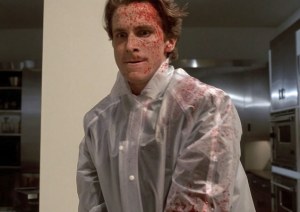 If Bateman blows off steam by blowing off companion’s heads than it only becomes more frustrating when no one believes his random confessions. Haron takes the grisly material of Ellis’ novel and mines it for pure 80s pulp. It only gets better the further it gets as you have so many points to discuss: Is Bateman acting out to prove his existence in a world that doesn’t humor him or others? Is he acting out deep-seeded rage from the actions of the decade on its people? Is he desensitized and so jaded that death does not even fracture him anymore? The questions are boundless.
The hit list of stars in Psycho includes Chloe Sevigny as a nailed home addition, Willem Dafoe as an investigative detective, Jared Leto as an axed co-worker, and sweet Reese Witherspoon as the apple of Bateman’s twisted eye. Everyone has fun in their tongue-in-cheek nostalgia romp through the absurd.
American Psycho should not be confused with the successful teen sex farce American Pie. The only desserts in this film are just, and they’re usually left of the mayonnaise and behind the frozen head in the refrigerator. American Psycho is the thinking man’s slasher movie. A flick that slices, dices, and always entices. It only gets better after you’ve seen it. One of the best films of 2000 for now.
Nate’s Grade: A
Reviewed 20 years later as part of the “Reviews Re-View: 2000” article.


 nathanzoebl
You must be logged in to post a comment.