Blog Archives
The Watch (2012)
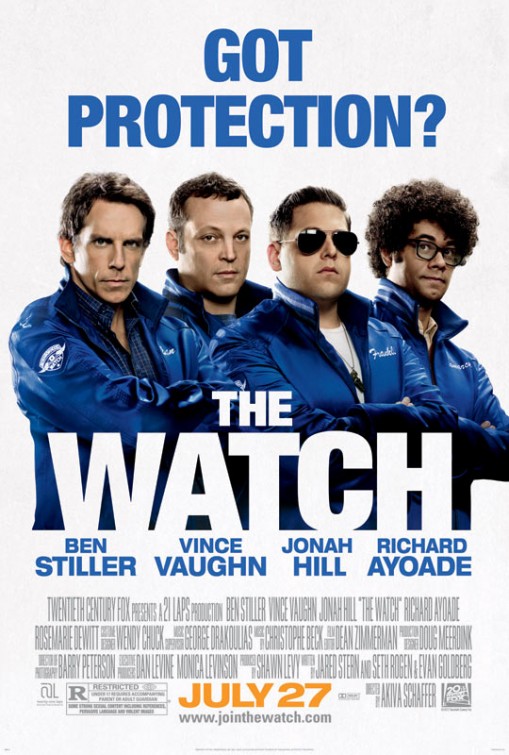 If scientists could take time away from, you know, curing diseases, and craft the perfect blend of “meh” in a lab, it would be The Watch. It’s not particularly offensive or terrible but it’s certainly not good. The humor of boys misbehaving and talking tough doesn’t ever seem to get further than the initial concept. The movie ends up becoming a more crass version of Ghostbusters, with a special fascination for the male member. This is a very penis-obsessive movie. Usually guy-centric sex raunchy comedies will definitely feature strong discussion/comedy revolving around male genitalia, but this is one of the few movies where complete storylines hinge upon penises (weird imagery, I’ll admit). Ben Stiller, Vince Vaughn, and Jonah Hill are more annoying than anything else. Poor Rosemarie DeWitt as the underwritten wife role in what is essentially a boys-behaving-badly movie (also her second 2012 movie where she’s trying to get pregnant). When the movie goes full-force into action mode, it loses just about any semblance of comedy. I laughed about three times, and that was thanks to Richard Ayoade (TV’s The IT Crowd) and, believe it or not, Will Forte (MacGruber). Sitting through 105 minutes with little laughs, irritating characters, and poorly conceived action in place of genuine comedic payoffs, well it’s not exactly a recipe for a successful summer comedy. And yet, with all its obvious faults, I couldn’t hate the movie as others have. It’s certainly not likeable but it does go about its business with a certain swagger, albeit misguided. Cocky loudmouths failing at entertainment are still marginally better than artists who don’t even try. It sounds like I’m reaching, and I am, but The Watch, certainly a bad comedy, may eventually be worth a watch when, you know, it’s on TV and you can half-heartedly pay attention to it while you go about your day.
Nate’s Grade: C-
Share this:

21 Jump Street (2012)
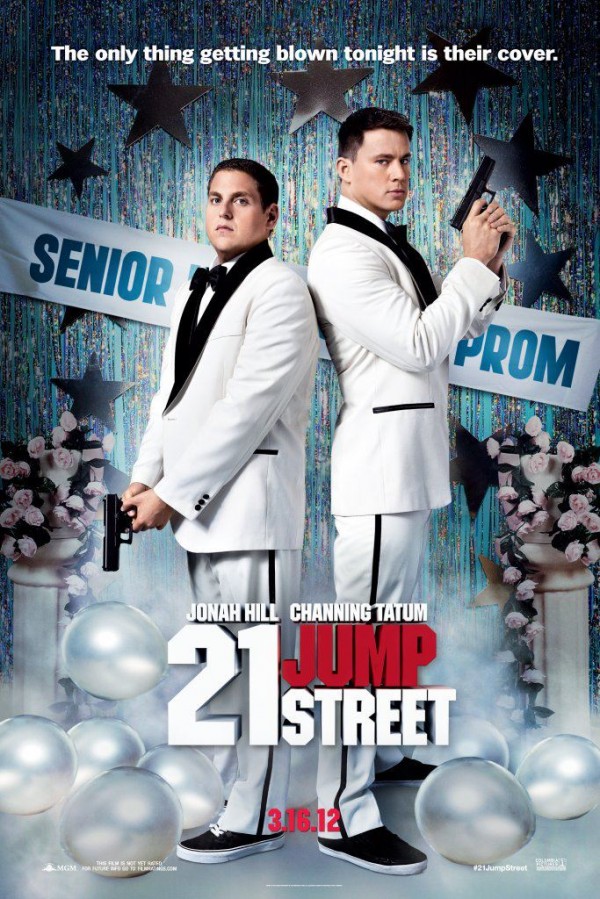 21 Jump Street ran on TV from 1987-1991 and is mainly known as serving as a launching pad for eventual mega movie star Johnny Depp… and Richard Greico too. Youthful looking police officers infiltrated high schools and tackled topical issues of the day (what snap bracelet goes best with my high-waisted jeans?). Why would anyone want to make this movie, let alone comic actor Jonah Hill? Surprising in just about every way, especially when it comes to overall quality, the 21 Jump Street movie is not just a great comedy but also a great movie. How the hell did this happen, Movie Gods?
Officer Schmidt (Hill) is smart but shrimpy (which is saying something considering how dangerous Hill’s weight has been before). Officer Jenko (Channing Tatum) is a stud but pretty dimwitted when it comes to tests. The two form a partnership and get assigned as bicycle cops, not exactly the position of command and authority they were expecting. After a few screw-ups, including failing to read a suspect his Miranda rights (“You… have the right… to be an attorney”), the duo gets bounced to an old undercover program at, you guessed it, 21 Jump Street. The pair is supposed to pose as high school students and find out who’s supplying teenagers a dangerous new club drug. Much has changed since Schmidt and Jenko were in high school together, and both of their profiles were accidentally swapped, meaning Jenko is given AP chemistry and the higher level classes, and Schmidt is given gym and acting courses, where he’s supposed to work his way into the popular circles. Molly (Brie Larson) is a gal in that popular inner circle and Schmidt struggles to accept that a pretty, smart, popular girl might actually “like like” him.
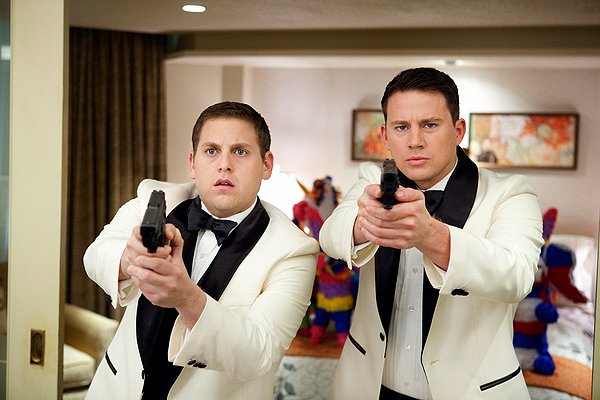 I knew I was in for something special when the movie itself lambastes the very idea of a 21 Jump Street movie, with the police chief (Parks and Recreation’s Nick Offerman) ridiculing the idea of unoriginal nitwits recycling something old that has name recognition and hoping the public will be too dumb to care. The movie beats the audience to the punch every time, mocking the absurdity of its own premise and plot points (many characters note how old Jenko appears). I should have expected more from screenwriter Michael Bacall (co-writer of the Scott Pilgrim movie adaptation) and especially from directors Phil Lord and Chris Hill, the same pair whose rambunctious comedic verve radiated from every frame of Cloudy with a Chance of Meatballs and their brilliant short-lived animated MTV show, Clone High. This movie had me laughing a lot and had me laughing hard, doubling over, with-tears-in-my-eyes laughter at points. Dickson spouts, “Some kid overdoses on drugs. And because he’s white, people actually give a shit,” showing that a movie with a mind-blowing number of male genitalia jokes can provide a few shrewd jabs of social commentary. There’s a great bit where on their first day back in school, Jenko points out the various school cliques. Then he gets to a group of students in skinny jeans, thrift store clothes, and floppy hats, and he looks puzzled. “I don’t know what those kids are?” Ha, because hipsters didn’t exist back in his (my) day.
21 Jump Street is cheeky, rowdy, quick-witted and playful in the best sense of an action comedy. It’s got fish-out-of-water moments as the duo struggle to fit in with a different high school setting. The one-liners and riffs can be gut-busters, but the film does an even better job layering oddball gags (Korean Jesus), loony slapstick, fun but telling character moments (Schmidt not knowing how to end a prayer: “The end, right? ‘The end’?”), strong setups that have stronger payoffs (using the reading of Miranda rights as a genuine emotional climax), and an overall raucous, anarchic spirit.
Here’s one sequence in particular that shows off the film’s clever comedic chops. The film finds a way to satirize the tropes of action movies, particularly buddy cop movies, with such nimble precision. Schmidt and Jenko are on the run but their car chase keeps butting heads with the fabricated reality of Hollywood movie chases. For one, they keep finding themselves getting stuck in traffic on the highway. This forces them to have to keep abandoning cars and finding a new set of wheels ahead of the gridlock. Then, as the bad guys chase them down on motorcycles, the chase causes all sorts of chaotic collateral damage, including oil trucks riddled with bullet holes and dripping the flammable substance all over the road. Then one of the motorcycles skids into the flammable muck, and our heroes wince in preparation of the expected explosion, and then nothing happens. “Huh. I really thought that was going to explode,” one of them remarks casually. And this setup is repeated again, denying us the explosive equation that action movies have pummeled into our brains (car + any tap of force = humungous fireball), and there is a payoff to this comedic tweak on the cliché, and it is silly and terrifically funny. Plus, I haven’t even mentioned that both Schmidt and Jenko are dressed in silly outfits and begin their car chase in a driver’s ed car. This sequence is just one example of the anarchic, robust, and self-aware comedic attitude that the movie flaunts.
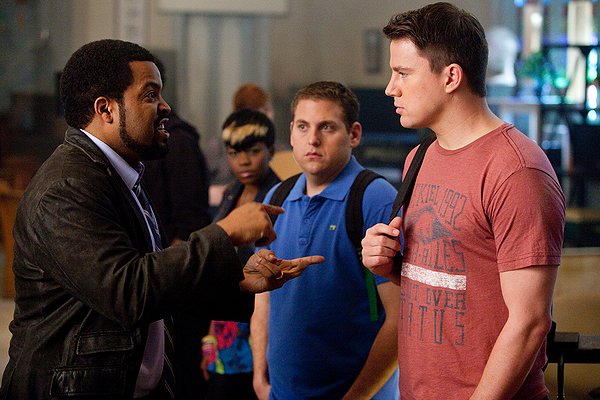 But more than being a hysterical action picture, 21 Jump Street works even better because at its core is a level of sweetness, a satisfying mixture of lewd and heart like the best Judd Apatow ventures. It’s a bromance of epic proportions even by buddy cop standards, the old school bromance vehicle of its day. The guys go back to high school and the movie’s bright switcheroo puts the characters in opposite social spheres, with Schmidt with the cool kids and Jenko struggling with the social misfits and bottom-dwellers, a.k.a. nerds. Of course the whole class assignment also shows the façade of being cool in high school. The movie could have mined this well-worn stereotypical class conflict with ease, but instead it decides to use its contrived scenario as a jumpstart for the guy’s emotional growth. The lessons may be simplistic (perils of ego, believe in yourself, teamwork, personal responsibility) but that doesn’t make them bad lessons, and the fact that the flick seriously uses covalent bonds as a metaphor, and does so in an almost poignant fashion, is worth applauding. The relationship between Schmidt and Jenko engages the audience, and we root for them even when they’re behaving like jerks. They’re misfits who are doubted and reprimanded, which make us hope for their eventual success even more. Refreshingly, the movie doesn’t put them in opposing camps in high school. Schmidt was a dweeb and Jenko was a dumb jock, but that doesn’t mean they needed to be adversarial. When they regroup in the police academy, they form a genuine partnership, realizing they can assist one another. They form an actual friendship and they’re both better cops, and better characters, together.
Hill and Tatum have preposterously good chemistry together as a comic duo. Hill, a co-writer himself, reportedly had to remain steadfast to convince Tatum to join forces, and thank god he stuck it out. Hill’s (Moneyball) already a comic pro at this point, though this role tones down his comical rancor and ups the spaz awkwardness. Tatum (The Vow) is the true revelation. Man does this guy have really great comedic skills; a sharp, instinctive sense of timing, a pliable physicality, and a genial charisma that doesn’t demand solo attention. He’s good at playing dumb without going overboard. He’s not just good, he’s flat-out terrific. Larson (Scott Pilgrim vs. the World) is an adorable and plucky love interest, sure of herself, down to earth, and accessibly quirky. The supporting cast shines in their small roles, notable Ice Cube (Lottery Ticket) as the typical brash and loud police captain, Ellie Kemper (Bridesmaids), in her randiest roll yet, as a chemistry teacher awkwardly flirting with the hunky Jenko, Dave Franco (Fright Night) as an eco-friendly drug dealer, Rob Riggle (The Other Guys) as an aggressive gym teacher, and a special cameo that’s worth leaving unspoiled.
21 Jump Street has some weaker points, namely when the action ramps up it’s pretty mundane when it’s not being funny, but the faults are minor. This is a silly, shrewd, salacious, and outright thrill of giddy entertainment, a comic blast. Hill and Tatum have a wonderful comedic dynamic and the clever screenplay gives them plenty to do with their talents. I didn’t think it was possible to adapt the cheesy TV show into a worthwhile studio comedy, but Hill and company have exceeded every expectation. 21 Jump Street isn’t the most nuanced or subtle comedy, though I will argue spiritedly that it has plenty of smarts in all the right places, but it’s an affectionate, witty, and rambunctious night out at the movies that will be hard to beat this spring.
Nate’s Grade: A-
Share this:

Moneyball (2011)
 Moneyball, based on the non-fiction book by journalist Michael Lewis (The Blind Side), finds a new way to reinvent the David v. Goliath tale with a man who reinvented the business model of baseball.
In 2001, the New York Yankees (team payroll: $125 million) have just knocked the Oakland As (team payroll: $41 million) out of the playoffs. Oakland General Manager Billy Beane (Brad Pitt) also has to suffer a summer where his biggest players leave the team to sign hefty free-agent contracts with bigger teams. He’s left with sizeable holes, a meager payroll, and the expectations to carry on winning. Beane is convinced that his group of paid scouts will be of no help. They’re men of an older era, sticking to the old ways of selecting talent (why the hell do these guys even calculate stuff like “good face” and “ugly girlfriend”?). Beane finds a kindred spirit in Peter Brand (Jonah Hill), a Yale grad with a degree in Economics. Brand’s mathematical data focuses on one all-important stat – on-base percentage. Without getting on base a player can’t score runs, and no runs make it hard to win a game. Brand and Beane calculate a series of players undervalued by other teams. Their more cost-efficient model for success becomes known as “moneyball.” Together they put together a team of castoffs and misfits to contend for a championship against teams that have three times the Oakland As’ payroll.
Moneyball could be described as a baseball movie for people who don’t like baseball, but that’s a little too glib by half. It’s very much a sports film but it takes the underdog approach in a new, sleekly modernized manner. It’s about a guy bucking the traditional mode of thinking, the established order, and the chaffing and nay saying of those entrenched in the traditional, outmoded, establishment. There’s always something inherently entertaining about an innovator fighting the system and eventually being proven right after all the trials and tribulations. And with Pitt, a major movie star, giving a movie star-caliber performance, self-effacingly charming with a twinkle and a swagger, Moneyball just seems to fly by like a spirited caper. We’re watching a smooth operator work the room, playing other general managers off one another and secretly accruing his talent while duping his peers. At its best moments, Moneyball feels almost like a breathless con game. The intelligent, stats-heavy dialogue doesn’t stoop for much exposition. The stats and acronyms whiz by, with Social Network-style crispness thanks to Oscar-winning screenwriters Steven Zallian and Aaron Sorkin. It’s a pleasure listening to top actors savoring the smart dialogue. You just want to kick up your heels and relax like you’re watching a game at home, rooting for your team to pull out an unlikely coup. Moneyball plays best for baseball fans who won’t bat an eye at the stat-heavy chat. For non-fans of the game, well, you can watch Pitt spit chewing tobacco into a cup a lot.
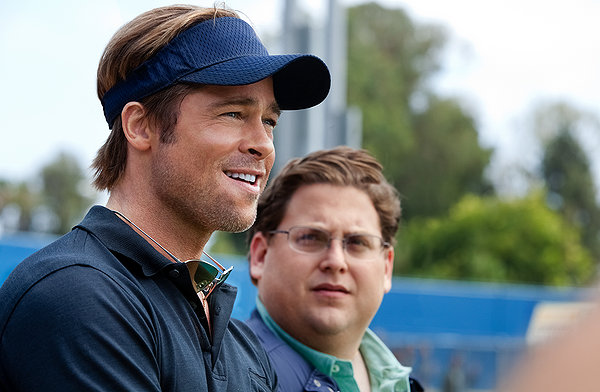 Beane chooses not to get to close to his players so that eventual roster cuts and trades will be all the easier without emotional involvement. The movie kind of follows suit. The characters are kept at a surprising distance. The movie seems practically ambivalent about people. Moneyball seems to lack an emotional center; and people thought The Social Network was cold. Beane is given flashes of back-story about his flameout in the majors, which supposedly provides the guy a motivation to prove himself against his legion of detractors. But these flashes are not enough. Director Bennet Miller (his first film since 2005’s Capote) incorporates way too many scenes where we watch Beane driving, silently contemplating his life-changes. The feud between Beane and his curmudgeon manager, Art Howe (Phillip Seymour Hoffman with the unkindest of haircuts), never comes to a head. Howe is upset at the thankless job of corralling a team of misfits and cast-offs into a competitive team. But like many other conflicts, the movie ducks from finding a real purpose for its integration. Howe just seems to be another naysayer who shakes his head at Billy. Surely the relationship between GM and manager should be more complicated than as presented. The Beane family flashbacks and his scenes with his daughter (the adorable Kerris Dorsey) are attempts to further humanize a man who has abandoned the advice of people for spreadsheets.
It’s easy to get caught up in the romanticism of the nation’s oldest sporting games, but Moneyball’s tone seems to toggle between reality and romanticism. For Beane, there are no small victories. Even success is deemed failure under the metrics of championship-or-nothing. “People only remember your last out,” he says despondently. So when the Oakland As fail to make a run into the playoffs (is a 2002 playoff series considered a spoiler?) the movie is left with a listless conclusion. Brand tries to prove to his boss the significance of what they have accomplished on their meager payroll, at one point winning a record 20 games in a row. But a winning streak of 20 games is not the same as a championship. Moneyball rightly proclaims the game of baseball as a rigged sport, where the divide between “haves” and “have nots” is vast. It is the only major league sport without a salary cap. The teams with the big pockets can afford the marquee talent. There’s a reason Lewis’ book has the subtitle “The Art of Winning and Unfair Game.” The implications of Beane’s accomplishments are unclear. His cost-efficient, stat-heavy approach was co-opted by the Boston Red Sox and turned into championships in 2004 and 2007. Is that a real vindication for Beane? It seems to me that the game’s issue of wealth disparity is still in full effect. Even if teams follow Bean’s approach, it still means that the bigger city, wealthier teams like the Red Sox or the Yankees can still outspend their competition. So it seems like to me that Bean’s moneyball approach simply meant that the focus changed on less costly talent. It did nothing to alter who could outbid their peers for the now-cheaper talent. It’s hard to squeeze a happy ending out of a story that concludes with the rich getting richer.
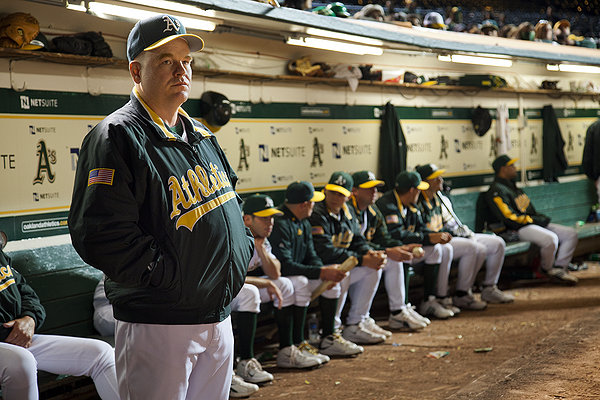 The movie is pretty much a buddy comedy, granted Beane is a much more dominate personality. Pitt feels like he’s coasting on charisma, though the actor gives a greatly entertaining performance. It’s not so much nuanced but he’s enjoying himself. The man looks eerily to be aging into Robert Redford, which begs the question about the nature of time travel. Hill (Superbad, Get Him to the Greek) gives a surprisingly adept dramatic performance. The comedic actor seems subdued next to the charisma of Pitt, like the character is continually awed by Billy. The Oscar-talk for the comedian seems a tad premature. He’s good but just because Hill delivers a good dramatic performance does not mean people should automatically start fielding his name as an award contender. That’s like saying let’s give an award to Paris Hilton because she could remember her lines. It’s also fun watching actors like Chris Pratt (TV’s Parks and Recreation) portray players that are still recognizable.
Moneyball says that baseball is not a game about heart, sweat, or the love of the game. It’s about numbers. That’s something of a cold message but Billy Beane is not one for false comforts. At its best, the film is a breezy caper with crisp dialogue and slick editing, but it’s also hamstrung by an inconsistent tone, a methodical pacing (133 minutes!), and a dearth of strong characterization. Beane was destined to be a baseball star but it wasn’t to be. Baseball is the most mental of all national sports, and it’s hard to crack such an insular model of play. That’s why baseball movies resort so much to romantic staples about the lore of this game. This is not a romantic movie; it toys with romanticism but ultimately sides with the science and number crunching. The emotion seems to have been squeezed out of the story thanks to the statistics. Moneyball is a baseball movie that fantasy baseball nerds have been waiting for. I’m not particularly a baseball fan (too slow), but I still found the movie to be a rewarding night out sans crackerjacks.
Nate’s Grade: B+
Share this:

Megamind (2010)
Y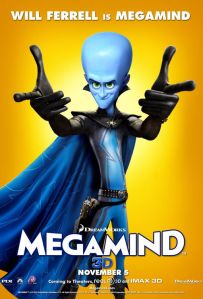 ou’ve seen this movie before, and pretty recently too given in the influx of superhero tales in the last decade. Megamind recycles heavily from numerous other super forbears, and yet this animated tale about a tired hero (voiced by Brad Pitt) and his inept nemesis (Will Ferrell). While it’s never as funny as its premise and cast should make it, the movie does pack a lot of fun and even a little bit of heart. The action sequences are inventive enough and the movie has a tone that drifts from sincere to self-conscious satire, while never settling down but doing enough right not to inflame your sense of irritation. The concepts of identity, good and evil, the duality of man, striking a life for your own… they’re all here. It’s a sloppy message that feels copied out of a plot playbook. Ferrell is funny but a bit more restrained than I like him. I think he works best when he cranks up his absurdist tendencies with a jolt of enthusiasm. Megamind doesn’t come close to approaching the magic, thrills, and emotions of How to Train Your Dragon, but it’s still many ways better than stuff like Monsters vs. Aliens and Shark Tale. It’s overly familiar story given a super spit shine.
Nate’s Grade: B
Share this:

Get Him to the Greek (2010)
 How many scene-stealers get spin-offs? That sounds like something you’d more likely find in the realm of TV, but it does happen occasionally in cinema. In 2008’s Forgetting Sarah Marshall, comedian Russell Brand played British rock star Aldous Snow. He stole Sarah Marshall and he also stole the movie. Now the stringy Brit with the crazy hair gets is own movie, Get Him to the Greek, a semi-sequel to Sarah Marshall.
Aldous Snow (Brand) has had his career hit a bit of a snag. His latest album, and lead single, “African Child” has been met with a tidal wave of bad press. Critics are calling it the worst thing to strike Africa after famine, war, and apartheid. His longtime girlfriend and fellow recording artist, Jackie Q (Rose Byrne), has dumped him and gotten full custody of their son. His life, and he, has gone off the wagon. Music exec Sergio (Sean “Puff Daddy” Combs) is desperate for ideas to help make money for his company. Aaron Green (Jonah Hill) suggests to the boss man that it will be the 10-year anniversary of Snow rocking out at the Greek Theater in Los Angeles, a seminal concert event. The boss tasks Hill with traveling to London, retrieving Snow, getting him to a Today Show performance in New York and then to the Greek in L.A. for an anniversary concert. Of course babysitting a drug-addled rock star and getting him places on time is easier said than done.
 Get Him to the Greek is ultimately a buddy movie. Brand and Hill play off each other so well. In fact, I might say that Hill’s character is a tad too dull when he’s not around the hyperactive and impulsive Snow. You sort of feel for the guy and you’d like life to turn out well for him and his girlfriend, but you’re not completely committed to the character. However, when he’s bouncing off Brand, the movie transforms into a wild comedy with many funny moments and a few that miss the mark. Green has been entrusted to handle his high-maintenance rock star and this presents a few stellar comic setups. Green has to make sure that his star is not impaired when he performs on the Today Show, so he steals Snow’s flask of booze and joint and downs them both to protect his star. The resulting appearance on the Today Show then flips the script, having the flaky star be the straight man to the highly impaired handler. The funniest sequence for my taste involves a drawn-out drug trip in a Vegas hotel. Things spiral out of control and involve furry wall groping, mass amounts of property destruction, and Snow stabbing Green in the chest with an adrenaline needle, then being chased by an incensed Sergio who will not be stopped even after being hit by a car. It’s an exhilarating, madcap sequence that picks up comedy momentum and plows ahead. You may not be able to relate to either character, but when you put them together the movie comes alive with comic mischief and misfortune.
Being a Judd Apatow (Knocked Up, Superbad) production, Get Him to the Greek has got to bring the heart with the raunch. Even though we spend the majority of the running time with two characters, the film is less character-based than other Apatow-produced products. The sentiment slips in at the end. Obviously, given the setup, you expect Green to become more aggressive motivated, Snow to become more mellow and conscientious, and we’re all better for it in the end. The two characters do begin to bond in their unusual way, which elicits much of the film’s enjoyment. I enjoyed spending time with these two guys, especially when they were together. That likeability factor got the film through some of its rough patches. As far as supporting casts, a hallmark of an Apatow-produced film, Sean “P. Diddy” Combs is the movie’s scene-stealer, mostly through sheer force of will. He’s not the funniest guy but man does he chew scenery with gusto. He’s so loud and crazed that he practically scares you into laughing as a defensive impulse.
 Brand is a terrific comedy discovery. He has such an electric energy and his wild-eyed hijinks and deadpan delivery had me in stitches. I was worried that a full movie for Aldous Snow would wear thin, but Stoller and Brand have deepened the character. It would be extremely easy, and almost understandable, for Snow to just be this caricature of the rock and roll lifestyle, an easy send-up for easy jokes. But just like with Sarah Marshall, the more time you spend with Snow the more you start to like him. He’s genuinely charming. His onstage persona evokes memories of Mick Jagger, Led Zeppelin, and Freddie Mercury. He’s self-destructive and egotistical but he’s not as shallow as he may appear to be (his vocabulary is a notch above, too). He’s unpredictable but he’s not stupid. He’s fairly vulnerable with some real feelings, lamenting his failed relationship with Jackie Q and yearning to be the father for a son that may not even be his. His life is filled with hangers-on and leeches, including his own parents. Brand can be good at being ridiculous but he can also be very good at being miserable. His vulnerability and attempts to be something more than the sum of his lifestyle allows for some tender moments between the babes and booze.
Hill has graduated from supporting player to “regular dude” lead in the Apatow Academy. He’s presented almost as a brazenly average everyman, albeit one who appears to be dangerously overweight (seriously, Hill has ballooned like a blowfish and I worry for the guy). This role allows Hill to showcase the most range he ever has yet. He believes in the power of music and has a personal stake in what goes down at the Greek. He sells his dramatic parts better than expected. He and his girlfriend, Daphne (Elizabeth Moss from TV’s Mad Men), make for an unconventional couple via Hollywood’s superficial standards. It’s an interesting match and somewhat refreshing that Hill isn’t dating some knock-out (Moss is quite fetching, don’t get me wrong).
Greek doesn’t measure up to Sarah Marshall and part of that is because the story is a bit too shaggy, housing gags but lacking a stronger driving plot. Many of the scenes don’t connect so much as independently exist. Also, writer/director Nicholas Stoller (who also directed Sarah Marshall) sometimes doesn’t know when to leave well enough alone. The drug-addled sequences tend to get a little tedious after the third or fourth time. Granted, drugs and alcohol are all apart of the modern rock and roll experience, but watching people act weird on drugs can get tiresome unless given a different context to work with. Some of the comic setups are a tad lazy but are saved by the efforts of Brand and Hill. When Aldous orders his lackey to smuggle heroin in his rectum, it feels strained even by the standards of wacky comedies. It feels like one episode that doesn’t lead to anything other than a quick, almost absurd, comedy dead-end. And for a movie with a ticking clock constantly running down the hours before Snow needs to be at the Today Show and then the Greek Theater, there sure is a strong lack of urgency. When they run late or miss planes, you don’t really care because you know it’s a matter that will be easily solved.
 A fact I really enjoyed with Sarah Marshall was that the girls were given something to do — they were allowed to be more than the joke, they could be in on the joke. Mila Kunis and Kristen Bell’s characters were allowed to be nuanced, mature yet able to make mistakes, and both were funny while being central to the story. With Greek, the female characters are mostly one-note and then given a little polish. Jackie Q is all brash sexuality and Daphne is prim and constantly exhausted. They’re extremes made for easy laughs. When Jackie Q tries to get serious, we don’t really buy it because she seemed rather pleased to soak up the unhealthy riches of fame. Her behavior is inconsistent. With Daphne, her wet blanket personality is supposed to be the joke, and then when she cuts loose toward the end, requesting a three-way between her, Green, and rock star Aldous Snow, it feels wrong for her character and weirdly reminiscent of Chasing Amy. I know Get Him to the Greek is primarily a boys movie, but it lacks the same generosity of character that aided Forgetting Sarah Marshall.
Get Him to the Greek is a solid comedy helped by two strong lead performances. It’s a nice addition to Apatow’s family of character-based comedies even if it doesn’t live up to its ambitions. The movie is consistently funny throughout, which is integral to being a comedy. The character dynamics lead to some entertaining comic set-ups and sometimes some lazy ones, but the troupe of actors makes it all work. Brand and Hill are a fine team and the movie has plenty of surprises and cameos to keep things fresh when a gag misfires. I wouldn’t mind seeing the further exploits of Aldous Snow, or even listening to some of his recordings (his Sarah Marshall tune “Inside You” was criminally left off the Oscar nominees in 2008). But this movie just made me realize how much more I appreciate Sarah Marshall, and how that movie has grown on me over time. I suppose like Hill’s character, it took an extended detour with Aldous Snow to make me realize what I truly appreciate in life.
Nate’s Grade: B
Share this:

The Invention of Lying (2009)
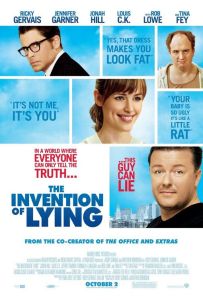 Imagine a world where people could only tell the truth. Sounds scarier than anything in horror movies today.
Mark (Gervais) is trying to romance Anna (Jennifer Garner) but even the waiter tells him she’s out of his league. She tells him upfront that she finds him unattractive and he will never have any hope of having sex with her. She’s more interested in Mark’s snide but handsome co-worker, Brad (Rob Lowe), who she feels is a better genetic match. Mark is about to be fired from his job, writing historical screenplays about the 13th century, and his secretary (Tina Fey) delights in telling him that she loathed every minute they spent together. This is a world without a filter. Until one day Mark goes to take out money from the bank, and something inside his brain switches. His balance is $300 but he asks for $800, and the bank teller apologizes for the computer error and gets Mark his full $800. He explains to his barfly friend Greg (Louis C.K.) that he said something that wasn’t. Nobody understands. “I’m a black Eskimo,” Mark says. Everybody takes him at his word. Mark is the only human on earth who has the ability to tell a lie, which he uses to his great advantage whether it be gambling, getting out of a traffic ticket, or unearthing a “lost” historical chapter about ninjas and aliens that makes for a stirring “non-fiction” film. Mark can’t even explain what he’s done, since the world lacks even a word for “lie.”
Gervais and co-writer Matthew Robinson concoct some interesting and inspired ideas of what a world bereft of lying would be like. Naturally, advertising would be completely different if people had to tell the truth, the whole truth, and nothing but the truth; imagine prescription drug ads that only said, “This is a placebo. Your penis won’t ever grow bigger.” The slogan for Coca-Cola is, “It’s very famous,” and the slogan featured for its rival, Pepsi, is, “When you can’t have Coke.” No one has any concept of fiction, of people pretending to play parts, so movies only consist of an older man sitting comfortably and reading a historical account with some minor dramatic inflection. Movies have become book reports. The sign in front of a retirement center says, “A Sad Place for Hopeless Old People,” and a motel sign reads, “A Cheap Place to Have Intercourse with a Near Stranger.” However, I’m puzzled by how forcefully open every person is. Just because you can only speak the truth doesn’t mean you have to be talking constantly. I understand Gervais’ point about the need for lies to protect people’s feelings, but just because you think someone looks fat doesn’t mean you have to blurt it out. When Mark greets Anna at the door for their date she reveals, “You’re early. I was just masturbating.” It’s funny, sure, but did she feel compelled to link the two statements? It seems in this world, everyone is incapable of keeping their mouths shut.
 The premise of the movie is terrific, and I’m honestly shocked no one has thought of it before. But the premise wears a little thin after the first 30 minutes of people speaking with no filter. You begin to expect outrageous comments that will be hurtful and blunt, and because you expect them it takes away the shock value and lessens the humor. But then The Invention of Lying takes a sharp right turn at about minute forty and becomes a radical and subversive and much funnier movie. Mark is comforting his dying mother (Fionnula Flanagan) who is afraid of leaving existence. She’s afraid of a cold nothingness. So Mark explains to her that there is an afterlife, a world beyond our own, where everybody gets to be around their loved ones in a mansion, and there’s no pain. She closes her eyes and dies in peace with this new knowledge. The doctors and nurses are amazed and beg to know more. Mark has created the idea of religion and God! He’s mobbed by people and camera crews demanding him to explain what he knows. Mark then works up the courage to establish a system of 10 rules to follow, which he tapes onto old pizza boxes. He then addresses his flock and has to explain the complicated minutia of religion, with hilarious questioning from the acolytes. Mark explains that there is a “man in the sky” who watches everything we do and is responsible for everything that happens. “Does that mean the Man in the Sky gave my sister cancer?” someone asks. Mark tries to explain the nature of a loving, all-powerful deity who willingly allows bad things to still happen. “Screw the Man in the Sky,” someone yells, “He’s going to kill us all. We need to fight back!” You try explaining the nature of the unknown to people.
It’s at this point that the movie transforms into a biting satire on belief and belief. I was cackling but I noticed that my theater seemed to get awfully quiet the longer the religious satire went on. I almost spat out my drink when I saw a spinning newspaper headline that said, “Man in the Sky Continues to Give Children AIDS.” It’s offensive but completely within the bounds of religious questioning. Gervais and Robinson aren’t ridiculing religious belief; in fact they seem to prove that it has a definite place of significance within society and can be beneficial psychologically. The satire isn’t savage and still manages to play with the amiable, fable-like nature of the story. Gervais isn’t laying out an argument that believing in an unforeseen deity is stupid. The movie isn’t condescending or hectoring, like Bill Maher’s anti-religion documentary Religulous, but it does take some slyly subversive swipes at the nature of faith and its reliance upon the unproven.
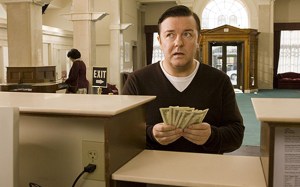 The Invention of Lying suffers from trying to be a romantic comedy. Too much of its conflict is spent on whether the chubby guy can get the pretty girl. The movie gets a tad sentimental for dealing in bitter-truths, and Gervais and Robinson steer the film to the ultimate romantic comedy setting: objecting at a wedding. I wouldn’t have minded the rom-com asides if they didn’t feel like they kept striking the same chord. Mark wants to be in a relationship with Anna. She points out that he’s fat, has a snub nose, and not a good genetic match. He persists. She points out that he?s fat, has a snub nose, and not a good genetic match. This goes on and on until the inevitable break at the end. Mark, and especially Gervais, is an appealing guy, self-effacing and witty, even downright cute at turns, but when Anna keeps repeating the same looks-first mantra, it makes her seem increasingly shallow and him seem like a glutton for punishment. Garner is a fabulous comedic actress and packs a lot more emotion into her character than I would have expected given the conceit.
Ricky Gervais is catching fire as of late, and it seems that America is finally waking up to the charms and brilliance of this squat comedian. He created The Office, the standard for squirm-based comedy, and appeared in the underrated supernatural comedy Ghost Town last fall. Gervais shows the necessity of lies in our world, from sparing hurt feelings to making mass-market entertainment. The world needs dishonesty. When The Invention of Lying is on-target, it is a hilarious, almost brilliant, comedy, with its best gags saved for taking on “the Man in the Sky.” It’s too bad then that the entire movie doesn’t live up to these flashes of comedic brilliance. Still, the movie is sweet enough and ends on a satisfying level, even if The Invention of Lying begins as one movie and ends as another. Gervais is an appealing lead, though he doesn’t prove much in the way of a director, and he has some real dramatic acting chops too, nicely put to use during his mother’s deathbed scene. I hope more Americans wake up to this man’s charms. Gervais continues to show audiences the sharp wit that has made him one of the world’s foremost funnymen.
Nate’s Grade: B+
Share this:

Funny People (2009)
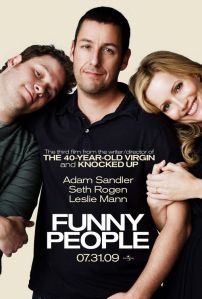 In two short years, Judd Apatow has become the king of comedy. He’s co-written and directed two bona fide hits that will go down as comedy classics (40-Year-Old Virgin, Knocked Up), and produced gut-busters with heart, like Superbad and Forgetting Sarah Marshall. The Apatow brand of comedy centers on characters and less on contrived set pieces. He’s built up enough comedy capital in Hollywood that he felt he could write and direct a project less ideally commercial, something tagged as being more personal and serious like in the James L. Brooks mold. Funny People is the mixed results. I applaud Apatow for trying to grow as an artist, but as the saying goes, if it ain’t broke don’t fix it. Funny People is a broken movie that isn’t funny enough to be fully redeemed.
George Simmons (Adam Sandler) is a famous comedy actor that has made several hit Hollywood comedies. He may live in a giant mansion but his life is extremely isolated and lonely. He has no real close friends and years ago he drove away the love of his life, Laura (Leslie Mann). He has no one to comfort him in his time of need. This prickly man has been informed that he has a terminal blood disease. Simmons decides to go back to his comedy roots, to stand-up, and it is there that he meets the young comedian Ira Wright (Seth Rogen). Ira has grown up with the comedy of George Simmons, so he is flabbergasted when the man himself asks Ira to write jokes for him. Ira’s roommates, fellow stand-up comic Leo (Jonah Hill) and crappy sitcom actor Mark Taylor Jackson (Jason Schwartzman), can’t believe his dumb luck. Ira and Simmons build an unorthodox friendship, and Ira is the only person George has confided in about his disease and his fear of dying. And then something amazing happens. George Simmons gets better. He’s got a new lease on life and he aims his attentions on the girl that got away. Laura is married to Clarke (Eric Bana), a handsome Australian businessman, and she has two adorable kids (Apatow’s own girls), which makes it a very poor time to restart her romance with George.
 Funny People is the first Apatow-helmed film that feels sadly incomplete, even at two and a half hours. The movie is staggeringly sloppy when it comes to plot structure and character work. First off, when a character is informed that he has a terminal illness at minute three, it doesn’t have the impact that it would if the audience got to know and feel for that individual. In fact, the first half of this movie feels like, and this may get confusing, the second half of another movie. It centers on a selfish character coming to grips with his choices in life, mostly wrong, and beginning to reconnect with people once more, building a mentor friendship and finding the “one that got away.” But there are segments during this first half of Funny People where the impact just cannot be felt because the dramatic legwork has not been achieved. Watching Simmons’ estranged family berate him through tears doesn’t have much of an impact when they discover the news. Seeing George Simmons spend his potential last days jamming with Jack White and other musicians is cool, but it doesn’t come across as anything but another indication that the fake George Simmons is famous in this alternative Los Angeles. It doesn’t have setup, like Simmons talking about one of his life’s pleasures is strumming the guitar or playing before things got complicated. So it’s basically just another celebrity cameo snapshot. While I’m on the topic, the multitudes of celebrity cameos are strangely unfunny, save for a bit where Sarah Silverman describes her lady parts.
This is also the first Apatow comedy where it feels like twenty percent of what I saw promised from TV spots, trailers, making-of specials (there was a good one on Comedy Central to check), the advertising unit if you will, was not in the movie. This gave me the distinct impression that even at a lengthy 150 minutes that Funny People feels misshapen, that there are swaths of material on the cutting room floor that would have assisted the narrative and sad amount of underwritten supporting characters. I’m not saying Funny People would necessarily be a better movie at three hours length, but it would at least feel more fully formed and satisfying.
 The main problem with the film, outside of the reverse plot structure, is that everything just goes slack during the uneven second half. George and Ira spend about an hour of the movie with Laura and her family, and it feels like one long uncomfortable detour. Part of the squirmy feeling is intentional, as the audience is supposed to be in Ira’s shoes and see George’s homewrecking as the bad decision train wreck it is. But I also felt uncomfortable because George kept extending his stay day after day and I was getting impatient. I wanted these characters to head back to L.A. and deal more with the Ira/George relationship. During this second half, Ira becomes a background figure that is good for nervous reaction shots. This stalls all the character work that had been done up to this point and Ira goes to pause mode for an hour. This second half section isn’t particularly funny, it isn’t romantic, and it gives little insights into the past between George and Laura. She has established a nice living for herself, with two cute kids and a hunky husband who seems to be a good father when he’s around. In fact, despite the movie’s insistence that Clarke is a cheater (thus ensuring the movie law that it is then acceptable to cheat on him), I found myself liking the hyperactive and sensitive lout. Every plot movement in this second half feels wrong, some of it intentional, but it makes Funny People feel like it has been hijacked and taken hostage. Where did the movie I was kinda liking go? What happened here? This hour feels like a separate movie and one that Funny People would have benefited from simply being dropped entirely.
Perhaps I’ve been watching too much Mad Men in anticipation of its third season, but this movie also disappoints by failing to delve into the creative process of comedians. Despite its running time and subject matter, there isn’t that much standup witnessed. Usually the movie will display about one line or one bit and then cut back to the characters offstage again. We don’t get to see the evolution of comedy or the professionals talking shop about what makes a good joke. There isn’t even much collaboration, so we don’t get to see multiple minds banging out jokes together. There’s a comedian named Randy (Aziz Ansari) who is popular with audiences because he’s loud and spastic, and all the other comedians hate him, but then the movie doesn’t return to this. Go back to this topic. I want to hear more about the divisions within the comedy world, the people that feel like they are more pure or textured in their funny compared to the people that play to the crowd and lap up the easy yuks. Ira’s character work is mostly explored through his changing standup persona, where he seems to gain more confidence and a voice. But there’s this whole other storyline where Ira is a “joke thief” and takes other people’s material and repackages it as his own. This is an interesting story and provides conflict and glimpses into the character of Ira as an insecure and ethically challenged opportunist in a competitive field. It makes him a more dynamic character. I saw more of this storyline in the making-of special for Funny People, and sadly it is only hinted at in the final product. The other comedy players, like Ira’s roommates and his quasi-love interest (Aubrey Plaza), are barely explored as people and professionals.
Apatow comedies are notable for being character-based, but Funny People doesn’t seem too concerned with establishing characters that you want to be around. I found little reason to care. I found most of the characters to not be engaging; some were unlikable but most were simply flat. George Simmons is supposed to be a selfish man, though there’s something inherently selfish about being famous in Hollywood. Comedy itself is inherently selfish, where individuals guard their observations and exploit personal stories for the endorphin highs of audience approval. Is successful comedy linked to selling out? Funny People occasionally visits the dark recesses that comedians utilize for material, like self-lacerating humiliation and family trauma that gets aired out as a means of therapy. Simmons is a selfish and lonely guy and the point of the whole movie is that even after a near-death experience, he’s still selfish and lonely. He’s said he’s changed but has he really? That seems to be the movie’s cosmic joke. This is clearly a personal movie for Apatow, which might explain why it has less resonance for an audience that isn’t as steeped in the history of comedy or the rigors of fame. I just don’t have the same point of interest.
 Sandler revealed his acting talent in 2002’s beguiling Punch-Drunk Love, and in Funny People he plays a completely different character than his other adolescent roles. He doesn’t pander to be likable at any point, and he’s generally standoffish from beginning to end. He hasn’t done a lewd, crude movie in over ten years, and this return to raunch rekindles the Sandler I remember listening to constantly in the mid 1990s. This role isn’t as taxing for him as an actor, nor is he given too many chances to reveal deeper layers to George Simmons. I think this is by design from Apatow. Rogen is less his charming self and during the second half of the movie he pretty much shifts his eyes and makes pained faces. He feels at ease in the stand-up sequences, probably because Rogen performed stand-up comedy when he was 13. Mann gets her biggest acting role in years and cries enough, but it made me realize that she works best as an actress that can steal scenes rather than an actress who has scenes built around her. I think Bana (Star Trek) actually comes off the best. He showcases an exuberance for comedy not seen before, and when his character gets emotional it still manages to be funny and believable.
In the end, Funny People just isn’t that funny. There aren’t any particularly clever comedic setups, the characters don’t get many chances to be humorous even as comedians, and the movie just goes slack during its uncomfortable and uneven second half. The Hollywood satire lacks bite, and the best bits are saved for the scathingly unhip and formulaic “Yo, Teach!” sitcom of Schwartzman’s. Apatow is more interested in purging a personal tale onto the screen rather than fashioning a relatable mainstream comedy. I feel that the salutations that Funny People is “more challenging” and “serious” are unwarranted. This is certainly a different movie but is it any more serious than navigating the uncertainty and awkwardness of an unplanned pregnancy or beginning sexuality at middle age? I don’t think so. Beyond this, the movie doesn’t establish its plot well and spends far too much time in side diversions, failing to round out characters and ignoring intriguing premises and storylines. Even the camaraderie, usually a hallmark of Apatow productions, feels lost as the characters have much more friction. On a personal note, I saw this movie while I was on vacation in the Outer Banks. On our car ride back to our beach house, my then-partner and I got into a car accident. We were both physically fine but her little Ford Focus was totaled. I will now forever associate Funny People with a car accident. If that isn’t enough of an on-the-nose metaphor, while we waited along the hot road for police and tow trucks, I thought to myself, “I just wish the movie was worth this.” It wasn’t.
Nate’s Grade: C
Share this:

Forgetting Sarah Marshall (2008)
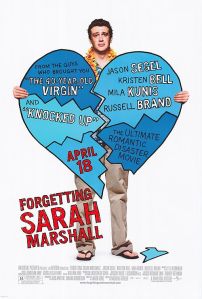 So much ink has been spilled on Jason Segel’s full-frontal nudity that you would think the public has never known that penises have appeared on film before. It seems that female nudity is used to titillate and male nudity is used for awkward laughs, and this is the case with Forgetting Sarah Marshall, which Segel stars in and wrote. His character Peter is humiliated by a breakup, even more so because the man is breaking down while in the buff. He even states at one point the naive belief that as long as he doesn’t put clothes on reality cannot hit. It’s funny and sad and he’s completely vulnerable, but Forgetting Sarah Marshall is much more than the story of one slightly doughy man and his penis. This is a story from producer Judd Apatow (The 40-Year-Old Virgin, Knocked Up) about heartache and mending and the struggle it takes to keep a relationship healthy. But it is also about a man and his penis.
Peter (Segel) is dating TV actress Sarah Marshall (Kristen Bell), star of the brilliantly reflexive title Crime Scene: Scene of the Crime. Peter provides the music for the TV show, which he laments is nothing more than “ominous tones.” Then one day she has some bad news. She’s breaking up with him (this is where Segel loses it, both emotionally and from a clothes perspective). Peter mopes and cries for days, goes out to clubs with his step-brother (Bill Hader), and tries to engage in meaningless sex but that too leads to crying and moping. Peter takes a vacation to Hawaii in order to forget his ex, but as chance would have it Sarah is already there with her new man, British rocker Aldous Snow (Russell Brand). Peter is stuck in the same hotel as his ex and her new lover. The hotel staff takes pity on Peter and they all seem to look out for him, setting him up in a $6,000 suite, involving him in hotel activities, and feeding him drinks. Rachel Jansen (Mila Kunis) works at the front desk and takes a special interest in Peter and his woes. She helps Peter get over Sarah and fin
 Forgetting Sarah Marshall is another hit from the Apatow brand. It features another leading man with an unorthodox physique and a healthy interest in geek culture. However, Peter doesn’t need to learn to be responsible, or outgoing, or to transition from boy to man. He’s actually fairly well adjusted and even has a job that suits his composing talents. His dilemma is heartbreak, a universal affliction if ever there was one. He’s a little frumpy and has a thing for puppets, but Peter is really a sweet guy who is working through the pain of a breakup. He was together with Sarah for over five years, so it feels strange when the characters keep harping on him to get over it in the span of a few weeks. He is awash in self-pity and wails so loudly that other guests complain about a woman crying in his room. He makes for a capable lead and his budding romance with Rachel allows him to heal. The romance is strongly felt and I was completely absorbed by wanting Peter and Rachel to have a happily ever after.
Segel is a charitable screenwriter. The could have easily become a vanity wish-fulfillment project, but instead he rounds out the main characters and builds a deep supporting cast that add delightful additions that enrich the narrative. I admire Segel’s decision making when it came to fleshing out his characters instead of writing them off as stock types. In an ordinary romantic comedy, the beautiful girl that dumps the lead is a bitch. It would have been extremely easy for Segel to demonize Sarah and keep her as an established antagonist, but instead he makes her feel real. She has real, solid reasons for her breakup with Peter, and she has several revealing moments that open her character up and humanize her. Aldous is another pristine example of Segel’s screenwriting skill. In an ordinary romantic comedy, the girl always dumps the nice guy for the douchebag, and Aldous starts in that territory. But a magical thing happens and as the film continues Aldous becomes very charming; he’s unpretentious and is the same transparent and genial man to everybody. He appreciates Peter’s music and gets him and Peter’s passions. Peter says at one point, “This would be so much easier if you weren’t so cool.” It would have been easy and even expected for Segel to cast both the ex-girlfriend and her new boyfriend as evil cretins. Instead, he broadens and rounds out all the central characters to the point that they feel like real people and not just comedy types.
 The movie is resolutely pleasant and amiable, lacking gut-busting laughs but offering plenty of cringe comedy. It’s not as outrageous as other Apatow comedies, or as good, but it is completely entertaining. There is one terrific sequence that stands out in my memory. It involves the two couples sitting at an awkward dinner. Then they comment on how awkward it is, then they comment on commenting how awkward it is. The dinner bathes in unease but then as it carries on you see the different tensions. Aldous and Peter hit it off discussing their dislike for a terrible horror script offered to Sarah that involved a killer cell phone (sounds like One Missed Call). They are genuinely bonding. Sarah hides her growing dissatisfaction with the decisions she’s made, but Rachel catches on. She kisses Peter long and hard and shoots Sarah a very knowing glance that all women know as “back off.” This dinner packs all of the different tensions of the movie into one well-written, expertly performed scene. The characters aren’t shouting their feelings point-blank but you can follow along to the conversations that are unsaid.
I love comedies that involve deep supporting casts, where a supporting player can enter at the right moment and deliver a perfect in-character addition. I was delighted at how wide Segel cast his net of characters and yet how well incorporated they are. There’s a newlywed couple (30 Rock‘s Jack McBrayer, Maria Thayler) that haven’t mastered the art of sexual intercourse. They’ve waited until marriage and know are wondering what all the fuss is about. Hearing McBrayer’s amped-up frustration is funny, but it’s even better when he solicits advice from Aldous on pleasing a woman. The tutorial between the two left me in stiches and made me like Aldous even more. I enjoyed spending time with all of these characters. Apatow regulars Jonah Hill and Paul Rudd pop up in hilarious cameos. Rudd is a super stoned surf instructor and Hill is an obsessed Aldous Snow fan who creepily doesn’t abide touching boundaries. The supporting players never outstay their welcome and add great splashes of variety to the story.
Forgetting Sarah Marhsall continues the Apatow tradition of mixing raunch with sentimentality. There’s plenty of dirty humor but it’s the little touches that won me over. I loved the title of Sarah Marshall’s TV show, perfect references to movies like The Buena Vista Social Club, Rachel reflecting Peter’s romantic advances only to initiate the first kiss, the brilliant music video for Aldous Snow where he carries an earnest sign that reads, “Sodomize Intolerance,” the flashbacks to Peter and Sarah’s relationship, the helpful advice of Dwayne the bartender and his great knowledge of fish native to Hawaii, and a vocally competitive dual of sexual intercourse. This is a comedy that works because even they details have been looked after with care.
 Segel easily conveys his character’s sweetness; the man can’t help but be sweet even in anger. Bell is given complexity with her role and nails bitchiness and tearful regret with the same skill she radiated on her defunct TV show, Veronica Mars. I never thought Kunis was capable of playing more than a shrill ditherhead thanks to her role on TV’s That 70s Show but she nicely handles the drama. She makes the romance more than believable but desirable. The actors all do a great job but it is Brand that steals every single scene he is in. His carefree demeanor and hysterical physical gyrations cast him early as one type of character, but his charisma rules the day and will win over audiences.
This is all familiar romantic ground covered by countless other movies. Boy loses girl, boy meets new girl, boy gets new girl, but Forgetting Sarah Marshall adds the Apatow touch. Another Freaks and Geeks alum writes another male-centric but hilarious comedy that deals with mature themes in untidy ways. The movie takes place in a world that resembles ours, where people are not cast in black and white, good or bad, victim and victimizer. Segel’s screenplay lets the audience empathize with a wealth of characters, and the humor is bittersweet but mostly on the sweet side. Any film that ends with a puppet musical about Dracula has to be seen as special.
Nate’s Grade: B+
Share this:

Superbad (2007)
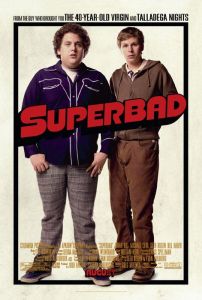 Seth Rogen makes me feel like a slacker. I’m two months older than him, but already he’s broken out as a comic actor on great-but-cancelled shows like Freaks and Geeks and Undeclared, and now he has risen to headlining star thanks to the runaway success of Knocked Up. Now here comes Superbad, a comedy he’s co-written with his friend Evan Goldberg, and I haven’t even gotten one movie off the ground or, for that matter, a starring role in any TV series, canceled or on the air. Oh well. At least Rogen’s consistent attachment to quality projects makes me a happy, if marginally envious, moviegoer.
Seth (Jonah Hill) and Evan (Michael Cera) are high school seniors looking to score with the ladies. Their nerdy friend Fogell (Chistopher Mintz-Plasse) has a scheme to get himself a fake ID, and the trio seizes upon this opportunity to become important figures in the teen circuit. With the promise of the fake ID, Jules (Emma Stone) has asked Seth to provide all the alcohol for a house part that she’s throwing that night. Not only that, Evan’s unrequited crush Becca (Martha MacIsaac) is going to be there. Seth and Evan figure that this party will be the best chance they have ever had to get lucky thanks to the miracles of what some would call, “liquid panty remover.” They just have to get the booze first. Fogell’s ID lists him as simply as McLovin. He is set back when his attempt to purchase alcohol is interrupted by a robber. He’s interviewed by Officers Michaels (Rogen) and Slater (Bill Hader) who take a shine to McLovin (“It sounds like a sexy hamburger”). The threesome spend a madcap night drinking, busting crime, sharing worldly wisdom, and running away at the faintest sign of other police officers.
 First off, Superbad is raucously funny. It’s plenty profane and has several memorable moments, like Seth’s imaginative scenarios for buying alcohol and a dance that goes in a very unexpected direction. The humor is timeless and built around the nervous interaction between the sexes; there are very few jokes that reference pop culture or dependent on a specific context. I imagine what makes Superbad hilarious will still make it hilarious in 20 years to a new audience that can relate to the same trials and tribulations of teen life, though perhaps at that point we will be replaced by robots.
What separates Superbad from other offensive sex comedies is that it’s really a story about male friendship. I don’t mean in the tacky, Hollywood vein of working together for a common goal, which is commonly to lose one’s virginity. Superbad is another entry into the Judd Apatow (40-Year Old Virgin, Knocked Up) school of comedy that professes that a comedy should be character-based and that those characters should be painfully human. This is no mere genre movie. Underneath all the boobs and booze discussion is the pain and worry of a long-standing friendship being able to survive. Seth and Evan have been close friends all of their lives, but many good friends have grown apart in time thanks to their lives moving in different places. There’s unspoken tension between the two of them and Seth is concerned he’s about to be abandoned by the person that means the most to him. Many films touch upon the indelible companionship between men but few can accurately articulate the authentic love that can foster bonds of friendship. Superbad explores the exploits of real friendship, and while it’s chock full of funny the film also has its fair share of moderately touching moments. You really do care about the characters and want them to triumph. Fogell’s ascension to becoming a confidant, cool lady’s man is one of the summer’s true pleasures. Apatow’s fingerprints are all over this, and that is a glorious thing.
But this isn’t some phony Porky’s-style high school sex comedy with male fantasy set pieces and lots of dunderheaded beauties prone to bouts of frequent nakedness. Superbad is a relatively realistic portrayal of high school life in the world of movies. This isn’t a school ordered by cliques of entrenched stereotypes like the jocks, the Goths, etc. In fact, I don’t think Superbad makes any social distinction between the students.
 Superbad is a celebration of the glories and anxieties of the male members’ member. Even for a teen sex comedy, the film is very phallus-centric, complete with a hilarious anecdote about a “treasure chest of dick drawings.” It seems Seth, at a young age, was stricken with the unique compulsion to draw a phalanx of penises. The anecdote is quite unexpected and funny and underscores how often the penis prevails in the minds of young men. The boys discuss at length the life and times of the penis, especially how women can compliment this. The constant dick-chat may get old after a while for most of the female audience in attendance (a.k.a. those without), and I can’t exactly blame them, but Superbad does convey, in a convincing manner, how much teenagers think about sex (“You know how many foods are shaped like dicks? The best kind”). Some have argued that there’s an undercurrent of misogyny with Superbad, but I feel like those detractors are missing the deeper point. These guys are totally terrified of women and go through one wild night just to avoid actually confessing their feelings to the objects of their affection. These guys don’t hate women, they’re just frightened and utterly bewildered by them, and so they rely on what pop culture and their peers have taught them is the way to a woman’s heart: booze.
The movie is taken to an extra level of excellence thanks primarily to the outstanding comedic performances by its cast. Cera was a star of brilliant understatement on TV’s Arrested Development, and when it comes to portraying awkwardness, Cera is king. The gangly teen is a textbook example on high school awkwardness; he feels uncomfortable in his own skin. He seems antsy to leave most scenes. His self-effacing smile, wide-eyed gawk, and nattering stutter are spot-on signals of clumsy, confused, and embarrassed teen life. Cera is a master with impeccably punctuated line deliveries. The kid could make any line funny by flawlessly placing a pause in the right place. Arrested Development was a great showcase for Cera’s comedic chops, and now Superbad is a juicy platform for the funniest straight man on the planet (and he’s only 18 years old).
 Hill has been a supporting player in previous Apatow productions, but this is his first major role. Hill is the loud, boorish, vulgar, and more outlandish half of the duo. When he gets worked into a frothy rage you can practically feel his indignant teen spittle. What makes Hill special is that, in an instant, he can go from foul-mouthed cretin to a vulnerable buffoon. In the end, when the police bust a party, Seth runs on instinct and his instinct is to save his friend. It’s the versatility of Hill that allows Superbad to channel the sweet, gooey center behind all the sex-obsessed hijinks.
Not all the different elements of Superbad seem to fit together. The cops subplot is played very broad and relies on a lot of physical comedy; it feels at odds with the genuine teen comedy that is the heart and soul of the movie. The subplot is indeed full of laughs and it turns McLovin into a legendary teen character, but it feels like a separate movie, albeit an interesting one. For a male-dominated comedy, the female roles are pretty sparse but even those take heed not to slip into empty stereotypes. Becca and Jules are portrayed as sensible and approachable.
In short, Superbad is super good, and it’s thanks to relatable characters, a sweet sensibility, plenty of raunch, and some excellent performances. Apatow has opened the 2007 summer with a winner and now he closes it with another one.
Nate’s Grade: B+
Share this:

Knocked Up (2007)
 Judd Apatow scores again. The man has a long history of creating memorable and heartwarming character-based comedy, and Knocked Up is another winner. This man creates thoroughly human and engaging stories that focus on our own foibles and triumphs. Apatow wrote and directed yet another poignant, clever, and uproarious comedy that has so much more below the surface and becomes universally appealing.
Alison (Katherine Heigl) is out on the town celebrating her promotion at the E! Entertainment Channel. She’s going to go from behind the camera to in front of the camera. It’s at this Los Angeles club where she meets Ben Stone (Seth Rogen), a doughy Jewish slob of a man content to drift through life penniless and high. Their night of partying leads to a drunken one-night stand. Eight weeks later Alison is going through extreme nausea and can’t figure out what kind of flu bug she has, that is, until she remembers her one night out. She locates Ben and informs him that she is pregnant and, yes, he is the father. The two decide to try and make it work, forging a relationship as they plan on becoming parents. Alison’s sister Debbie (Leslie Mann) and her husband Pete (Paul Rudd) and their two kids are a potential glimpse into the future. Pete and Ben hit it off real well, to the point that Alison feels like her mate might not be the one for her even if his DNA is growing inside.
 Naturally, this is a comedy where sex is at its very inception. The humor is ribald and playfully profane. I believe one of the greatest compliments you can give a comedy is when you cannot single out a single set piece or moment as an instant standout. Knocked Up is packed with many wildly funny scenes but it also has killer one-liners from start to finish and sharp pop-culture references (Ben on an exercise bike: “Matthew Fox? From Lost? You know what’s interesting about that guy? Absolutely nothing.”). Ben credits the flick Munich for the ability to get Jews laid. Ben watches the 2003 version of Cheaper by the Dozen with horror, saying that 12 kids is no laughing matter. The roommates are plotting a flesh-friendly website that notes the time and location of celebrity nudity in films. This commercial venture plays right into the frat house lifestyle for this band of stoners that bet their friend not to shave his beard for a year for free rent.
Knocked Up is bawdy and hilarious, sure, but it’s also far more realistic and a lot more emotionally involving than any romantic comedy Hollywood has offered in years. Apatow seems to have mined his personal parental experiences for a lot of hard-earned truths. The film is most natural when it showcases the male perspective of prolonged adolescence and an unplanned pregnancy, but Knocked Up also has a mature and thoughtful view on marriage and feminism. We see the array of personal challenges a woman would go through but the movie still manage to slip in humor amidst the uncertainty. There’s a montage looking for the right gynecologist. The gauntlet of sexual positions is explored while pregnant, with Ben afraid that his child’s first impression will be daddy’s manhood constantly poking it. When Alison and Debbie go shopping for pregnancy tests we see them fill their cart with every kind of tests, and then test after test comes back positive. “Hey this one has a smiley face,” says Debbie, before realizing, “Oh, that’s not a good thing.” Debbie then tests the reliability of the tests herself and for a brief moment panics when she thinks she may be pregnant for a third time. She then calms down and says, sarcasm-free, “Whoa, that would have sucked.” The inclusion of Debbie and Pete offers a whole other relationship viewpoint, something that Alison and Ben can learn from. She’s paranoid and blunt, and he’s apathetic and passive-aggressive, and Alison is terrified that she and Ben are doomed to a similar fate. The insights into marriage and secrecy are realistic and give the film so much more meat to its bones. This isn’t just a movie about what to do with an unplanned pregnancy; it’s fully about male-female dynamics and what it takes to make a family work.
 In the end, you really care about these characters because Knocked Up is a raunch-fest that has a sweet gooey center of sentiment. Ben is pushed into adulthood by this unexpected development and, as they say, puts away childish things after a lot of trial and error. There’s an undercurrent of emotional vexation under most of the comedy, like when Pete confesses that he doesn’t know if he can accept love, and Ben cannot pity this because he sees his love being rejected. Alison doesn’t quite have as big of an arc, but she never gets callously cast to the side and forgotten. She too has a lot of growing up to do very quickly, and when both characters welcome their newborn into this world it’s rather moving and exciting to experience it alongside them. Ben’s confesses to his child that not putting a condom on was the best decision he ever made. In any other movie this ending conversation might seem trite or hokey, but Apatow has paid so close attention to his characters that the emotional payoff is earned and rewarding.
Another hallmark of an Apatow production is how perfect the cast seems with one another. There’s a real camaraderie with the actors and it produces natural onscreen chemistry and amusing improvisation. Rogen and Rudd, teaming again after 40-Year Old Virgin, can riff off one another for a whole movie and I would gladly pay to watch. I loved when the two boys go to Vegas, take mushrooms, see Cirque Solei, and then freak out in their hotel room (“There are five different kinds of chairs in this room”). I was laughing so hard I had tears in my eyes, and I’m sure the crux of this moment was born from the freestyle exchange between the actors. Ben’s roommates have a believable kinship to them as a collection of amicable oddballs and stoners. Mann and Heigl also seem believable as sisters, much more so than would Anne Hathaway, who was originally cast as Alison but left due to creative differences (I guess the difference was she didn’t wish to be apart of a good movie). The Knocked Up cast work together like a truly wonderful team that appreciates the material and each other.
Rogen is destined for stardom after this movie. He can make anything funny with exceptional comic timing and line delivery that never feels forced. Hearing his unique giggle at the end of jokes, you can sense that this sweet and amiable guy would crack himself up and for good reason. Rogen was great in 40-Year Old Virgin and is even better in a bigger dose. Heigl gets to play more familiar notes, from stressing that work will discover her little bun in the oven to the expected birthing scream session. She has a good rapport with Rogen and brings a lot of warmth to her role. Rudd is so effortlessly charming and easy going. Mann plays a perfect bitch, but she also has a nice scene where she explodes at the realization that her days of youth are finally behind her. Special mention must go out to Kristen Wiig. She steals every scene she’s in as an E! Channel employee that makes plenty off-the-cuff passive insults against Alison during two staffer meetings.
 I’ve read online that several leftist bloggers are angry and flabbergasted that Alison does not get an abortion. They argue Ben is a fat and unappealing slob, she’s an attractive career woman, and not having an abortion in this situation is, as one put it, “stupid.” Excuse me, but this may be the first mainstream comedy that actually discusses the prospects of an abortion (or as one character deems it, a “smashortion,” as not to offend the delicate sensibilities of his roommate). I also take umbrage to anyone saying 1) choosing not to have an abortion is a bad decision, and 2) that these critics would be so daft to miss the point that if Alison had an abortion there would be NO MOVIE.
Knocked Up is a very funny and very wonderful sex comedy for adults, but it also happens to be an endearing and heartfelt romance. The cast is excellent, the comedy rarely misses a beat, and Apatow is a instant classic hitmaker. Just like The 40-Year Old Virgin, Apatow has explored a deeply personal topic for all the comedy and pathos he could wring from the material. Knocked Up is nothing short of a knockout. I hope you’re happy with your decision Anne Hathaway. I know I am.
Nate’s Grade: A


 nathanzoebl
You must be logged in to post a comment.