Blog Archives
Pirates of the Caribbean: At World’s End (2007)
 Shiver me timbers Jerry Bruckheimer. The Pirates of the Caribbean movies are taking no prisoners when it comes to money and fans. Ten months after 2006’s Dead Man’s Chest comes the concluding chapter to the Pirates saga. At World’s End is longer, bigger, and more expensive, but it is also the first Pirates movie that felt like a ride I wanted to get off.
The British navy, at the command of Lord Beckett (Tom Hollander), is eliminating all piracy once and for all. He now controls the heart of Davey Jones (Bill Nighy) and so controls Jones and the crew of the Flying Dutchman, the most fearsome ship run by cursed barnacle-encrusted crewmen. As the very busy hangmen will attest, it’s not a friendly time to be a pirate. The Black Pearl has set out to Singapore to find support from Soa Feng (Chow Yun-Fat), one of the nine pirate lords. The Pearl is now commanded by Barbosa (Geoffrey Rush) who was brought back from the dead thanks to the witchy Tia Dalma (Naomie Harris). They travel to the ends of the earth to Davy Jones’ locker to rescue Jack Sparrow (Johnny Depp), who was last seen in the belly of a beast. Elisabeth (Keira Knightley) and Will (Orlando Bloom) are both aboard and still bickering about their stalled romance. Once Sparrow returns to the land of the living, the group meets with the other pirate lords from all across the globe in an effort to pull together and stand against Beckett.
 As it turns out, the fear that Pirates of the Caribbean: Dead Man’s Chest was a 150-minute trailer for this movie was unfounded. That’s because the third movie in the Pirates of the Caribbean series completely ignores or messes up the many intriguing setups from the second film. Character motivations from Dead Man’s Chest are mostly unresolved and revert to stock generalizations. Jack Sparrow feels like he’s been grafted onto an unrelated storyline. Most disappointingly is what happens to Davy Jones, the greatest addition to the Pirates landscape. This awesomely-realized villain was scary and fascinating and looked fantastic thanks to Oscar-winning special effects. At World’s End takes such an intriguing villain and turns him into an impotent tool to Beckett. He’s been transformed into a houseboy who might as well fill people’s teacups. Yes Davy Jones thankfully figures into the climax but why in the world’s end must an audience wait that long? Davy Jones reminds me a lot of the ghostly twins from 2003’s The Matrix Reloaded who were completely dropped from the second Matrix film to the third.
But not only does At World’s End fumble the hand-off from the previous sequel, the movie itself establishes many setups with poor or unsatisfying payoffs. So much is made about the pirate lords from all over the world, and we see a colorful collection of international pirating groups that is fitfully amusing, but the whole section has no point at all. Chow Yun-Fat’s character is a non-starter; in fact none of the new characters introduced in At World’s End play any importance on the overall plot. The film is building to a final all-out battle between the united pirate lords and the British navy. We witness the awesome sight of the sea filled with vast armadas of ships, and as an audience we are getting hungry for some epic nautical action. Then At World’s End pretends that none of the other ships matter and sets its entire battle as one ship versus one ship inside a whirlpool. While this is admittedly exciting it isn’t anywhere near as exciting as an entire war amongst hundreds of ships. The filmmakers have all the money in the world and they couldn’t give us a little something bigger in scope? The pirate lords could have just as easily been cut from the movie if they were just going to stand on the sidelines and wave a flag.
The pirate lords make a big deal about their apprehension with releasing the sea goddess Calysto from her earthly prison. The pirates trapped her into the body of a human in order for them to gain control of the seas. They reckon she’ll be one very bitter sea goddess and take out some apocalyptic wrath out on the pirates. So the pirates release her, cowering in fear at her powerful reprisals and,,, nothing. Calysto vanishes, causes some mildly inclement weather, and is never seen again. Talk about a lot of pointless hot air.
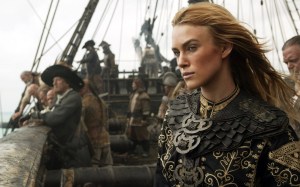 I think perhaps the clearest example of how the movie screws up is with the monstrous Kraken. This slimy beast got a ton of attention in Dead Man’s Chest and was a ferocious terror on the high seas. Now, I would expect that such a creature that played an integral role in Dead Man’s Chest would be back for the next sequel. Ignoring its prominence in the plot, the thing just looked amazing onscreen. But with At World’s End the giant monster is killed off screen and in between the movies. I felt insulted when I saw the mighty carcass washed ashore like a pathetic beached whale. What is satisfying about that? Why would Beckett make Davy Jones kill such a powerful weapon he could use for his own unseemly gain? It makes no sense. The Kraken isn’t the only character done a disservice by a plot stuffed to the gills. Some are killed in terribly pointless incidents and it just becomes irritating.
At World’s End is missing the high-flying fun of the first two Pirates movies, and this venture just feels draggy, tiresome, and far too dreary. You know you’re headed for some morose subject matter when a movie hangs an eight-year-old before the opening credits. This latest film is crushed to death by the weight of excess plot and confusion. There’s a damn near 20-minute section of the movie that’s nothing but characters double-crossing, triple-crossing, quadruple-crossing each other; it literally requires a character to spell out what has just taken place and set the record straight. I don’t think At World’s End ever recovers from this absurdly confusing miscue.
The film seems more interested in talking over an audience than delivering something genuinely thrilling and stirring. There’s a curious lack of action and nothing new matches the imaginative action set pieces of the previous films, like the duel atop the roving water wheel. Excluding a large melee between the Black Pearl and the Flying Dutchman as the climax, the action pops in and out in shortly timed bursts. For a movie within a hair or running three hours, there needed to be more action. Instead of derring-do, At World’s End spends interminable periods of people talking, usually in personal quarters, and explaining the increasingly laborious plot to each other. All of the Pirates movies are filled with false endings and heaping helpings of extra plot, but this is the first time I really felt the real drag of its running time. Director Gore Verbinski still knows how to keep things looking good but he can’t save the film from its anchor of a maddening and convoluted plot.
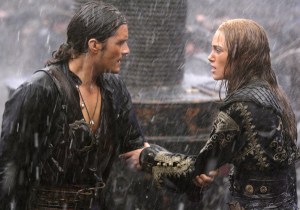 The movie is not without its due pleasures. Depp is always going to enchant with his now iconic character, but the true star of the film is Rush, who makes welcomed return. The special effects are still tops. The sequence rescuing Jack from the world of the dead provides many trippy moments that possess their own strange beauty, like when we watch the Black Pearl sail against the black, star-spotted sky. It’s fun seeing Keith Richards appear in cameo as Jack’s father and the stated inspiration for Depp’s performance. A small man and a large gun makes for one very funny sight gag. A Mexican standoff that actually involves an armed monkey is a comic high point. It’s just that all the fun or memorable moments seem to be the ones that matter the least. At World’s End still manages to do enough right to work, especially its Singapore opening. As far as a movie that upholds the quality of its franchise name, that’s a whole other matter.
Pirates of the Caribbean: At World’s End is a somewhat entertaining but heavily flawed final film to a trilogy. It’s the darkest and trippiest of the three movies, but it also makes the least amount of sense and has the least amount of action. That doesn’t seem like a good exchange in my book. There are not enough important events to justify the bloat. At World’s End has a hardcore case of butterfingers when it comes to handling plot and character setups from earlier films, and as a result almost nothing and no one ends in a satisfying fashion. The effects are still eye-popping and Depp will always be a comic treasure, but this lackluster movie feels like tripping at the end of a marathon. I had so much hope for At World’s End after how gratifying I found the other two movies but I cannot quell my disappointment. This is not a fitting conclusion. This feels more Matrix Revolutions than Return of the King. Of course it’ll make tremendous amounts of booty at the box-office, but will demand for a fourth be as rabid after this muddled and murky capper?
Nate’s Grade: B-
Share this:

Pirates of the Caribbean: Dead Man’s Chest (2006)
 America loves its pirates, plain and simple. We as a nation are infatuated with the characters and the high-seas adventure of 2003’s Pirates of the Caribbean: Curse of the Black Pearl. We?re starving for more, and when the first in a two-part sequel was released it only became one of the biggest movies of all time. Pirates of the Caribbean: Dead Man’s Chest has shattered box-office records, rolling up $100 million in two days and a record $135 million weekend gross, easily surpassing former champ Spider-Man‘s supposedly invincible $118 weekend tally. America loves its pirates more than Spiderman, Star Wars, and who knows, maybe even Jesus. After all, Dead Man’s Chest did just kick out The Passion of the Christ from the top ten all-time grossers. Mel Gibson sure has a lot of grief at this moment.
Jack Sparrow (Johnny Depp) is a wanted man on the high seas. The East India Company, whose emissary now controls the Caribbean town of Port Royal, is after Jack and his special compass. But Captain Jack has bigger fish to fry. Davey Jones (Bill Nighy), ruler of the seas, wants what was promised to him: Jack’s soul. Jack made a bargain with the sea creature and now his time is running out. He must assemble a crew and track down the whereabouts of a buried chest. Inside this chest is the still-beating heart of Davey Jones, and he who controls the heart controls Jones, and thus the seas. That is why the East India Company is so interested in Jack. They’ve made an arrangement with groomis interuptis Will Turner (Orlando Bloom), who had his wedding hijacked and his bride (Keira Knightley) locked away. If he can retrieve Jack’s compass, then he and Elizabeth will be pardoned for aiding and abetting a known pirate. Will and Elizabeth each set off to find Jack Sparrow and to gain their freedom.
 The filmmakers have taken notes in the school of sequels from The Empire Strikes Back. Like the second Star Wars chapter, we’re left with the heroes separated and licking their wounds, evil appears to have the upper hand, and the lives of some beloved characters are left in doubt. Just as long as there’s no Ewoks, Disney has guaranteed my place in line on opening day 2007 for Pirates 3.
It?s hard to fully judge this Pirates sequel because it’s part one of a two-part story. I’m holding out my final say, especially if this movie just turns out to be an expensive 150-minute teaser trailer for Pirates of the Caribbean 3. I can?t fully judge many story and character arcs because we don?t know where movie #3 will carry them. Maybe it’ll end up being like the middling Matrix sequels, where subplots and characters were dropped as if the Wachowski brothers had screenwriting butterfingers (it’s a film critic’s unwritten duty to deride the Matrix sequels at any chance). At least this movie ends with a jolt that I did not see coming.
Most surprisingly, Dead Man’s Chest suffers little from the creative deadlock of sequels. Dead Man’s Chest is more a sci-fi monster fantasy than a swashbuckler. The supernatural edge has swallowed the series whole. Take for example Jack’s broken compass. What once was an oddity befitting its owner is now seen as another element of magic. Some of the interest seems lost if things are simply explained away as being magical. The story, unlike the Matrix sequels (See: above), expands and enriches its universe. Some leftovers from the first film made me cringe. I thought we were headed for a bad track, where the movie uses the audience’s memory as a cheap storytelling device. Familiar characters might pop up every which way, smiling, and saying, “Hey ho, remember me?” Miraculously, the leftovers are integrated so well with the new tale that they really do matter and don’t come across as cheap shortcuts. Norrington (Jack Davenport) and the two comic relief cursed pirates are all smartly woven back into the troupe, and each impacts the story in a non-obtrusive manner. Even the undead monkey is used well.
I made it a point to keep my expectations in check for Pirates of the Caribbean: Dead Man’s Chest. It would be naive to think that you could catch lightning in a bottle again. Yes, now with audience expectation we lose the originality and unpredictability that made the first Pirates adventure so joyously delicious. And yet I found myself getting riled up just the same and being whisked away by spirited entertainment. My expectations may have been tempered for Dead Man’s Chest but I still greatly enjoyed the ride. It seems that my opinion sharply differs from my overly negative critical colleagues; my own sister said Pirates 2 was one of the worst movies she’s ever seen. That seems a bit rash. She hasn’t even seen any Uwe Boll movies.
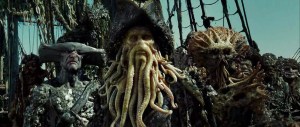 There are moments that seem to stretch the credibility of the story. It’s been said before that it’s not the impossible that bugs you but the improbable, and this holds true for Dead Man’s Chest. I’m able to believe Davey Jones and his creepy crawly crew, but I’m not able to believe that Elizabeth Swan could single-handedly best them all at once in sword fighting. The movie becomes dangerously close to eye-rolls in parts, but generally steers clear of moments that rip you out of the story. Of course a Pirates film would be nothing without Johnny Depp. He’s the main reason the first film was so memorably embraceable and entertaining. It?s not every day someone gets nominated for a Best Actor Oscar playing an addled, swishy comic pirate. He’s truly the star and has been one of our finest actors long before he had any box-office clout. He’s created a character so beloved that he’s crossed over into the cultural lexicon. How many Jack Sparrow outfits do you see come Halloween? I had a friend directing a high school performance of A Midsummer Night’s Dream and every young actor wanted to audition as Captain Jack interpreting Shakespeare. Come to think of it, Jack Sparrow would certainly liven up some of the bard’s dusty works.
Depp is still hilarious and likeable even when he’s being a scoundrel. We simply love this character; I love this character. The unpredictable nature of Jack feels squeezed dry by the demands for familiarity with sequels, but Depp finds new ways to enthrall in Dead Man’s Chest. Some people are going to be uncomfortable with Jack being more dastardly, willing to trade others’ lives to save his own hide. I think desperation is an interesting place to put this character. Besides he has his big hero moments as well.
New dimensions are added to the other characters. Knightley gets to be shrewd and try her hand at pragmatic treachery. It eats her up inside at the end and Knightley, a nice comedic actress, allows us to see the rough seas of guilt within her. Bloom will always be Bloom, meaning he’ll be handsome, British, and seemingly too little for grownup movie stuff. Will is given a whole new set of daddy issues when he actually gets to spend time with dear departed dad (Stellan Skarsgard). Best of the rest (“the rest” being everyone other than Depp) is an unrecognizable Nighy, who saunters his deck with the fiery air of a preacher. Nighy manages to make Davey Jones even more interesting. Naomie Harris (28 Days Later) makes her presence felt as a witchy woman responsible for Jack’s compass.
The action sequences are gigantic and well constructed. They expand with organic complications and a lively, graceful sense of humor. An already fun sword fight atop a watermill wheel gets even more pleasing when the giant wheel breaks free and the fight continues. Three characters climb inside and out, all vying for a key that keeps changing hands thanks to gravity. A human-sized fruit-kabob tied to Jack has a wonderful payoff for something that seemed completely random. The special effects are gorgeous. You can practically taste the slime and sea salt from the creatures. Davey Jones is a fantastic design and I’m dying to know how they did his tentacle beard. Whether it be motion capture, CGI, or puppetry (was someone billed in the credits for “operating” Bill Nighy? Does that sound like a fluffer?), it’s all dazzling to behold. The Kraken is ferocious and so well designed that it’s destined to give an entire nation?s children nightmares for weeks. Coupled with the equally super expensive Superman Returns, it seems that nowadays if you want special effects that will retain their wow-factor, it helps to have a $200 million dollar budget. Director Gore Verbinsky has a terrific eye for shot compositions; I am convinced that if you give this man good material then he will give you popcorn gold. If you give him bad material, well, then you get shiny but pointless stuff like The Weather Man.
 I know this movie, at its center, is empty. It’s grand throwaway entertainment, a true popcorn romp, but yes, when you get down to it the film has little to it. It’s an explosion for the eyes and has some great characters and action choreography, but Dead Man’s Chest is nothing more than very pricey, very tasty cotton candy.
Pirates of the Caribbean: Dead Man’s Chest feels less like a rehash and more like the start of an exciting new voyage. It’s darker, bigger in scale, scarier, louder, brasher, but still barrels of fun. Time will tell whether the back-to-back sequels will support enough intrigue to cover two very long, very expensive action movies. But Dead Man’s Chest has the key Pirates ingredients returning: clever screenwriting duo Terry Rossio and Ted Elliott, and, naturally, the irreplaceable Johnny Depp. An early eye gouging might set the icky tone, but this is one sequel that compares favorably to its source. We’re left in a very Empire Strikes Back position, but not after running out of breath keeping up with the many treasures of Dead Man’s Chest. Nothing will recapture the magic of the 2003 original but this is one summer sequel that delivers without letdown. Then again, after Pirates 3, it could all be for naught. See you in 2007!
Nate?s Grade: B+*
*Final grade pending the outcome of Pirates of the Caribbean 3.
UPDATE: Having just seen the third film, I’m somewhat conflicted. Many items from Dead Man’s Chest have little payoff in the third film, At World’s End. So while I wouldn’t grade Dead Man’s Chest any higher after seeing where it concludes, I still find it to be too fun to rate any lower. Its final grade stands.
Share this:

Charlie and the Chocolate Factory (2005)
 The visuals by Tim Burton are suitably lavish but it’s missing the heart of the 1971 film. I never thought I’d say a movie worked despite Johnny Depp’s performance, but that’s the case here. It was far too off. Whereas Gene Wilder had the dichotomy of warmth and madness, Depp was just the kooky Michael Jackson-esque weirdo in a bobbed haircut (I thought Neverland had been found). Perhaps the added Michael Jackson vibe makes the premise a lot darker, what with luring children into a chocolate factory. Charlie is a really boring character lacking definition beyond his “goodness.” Once they get to the factory he?s basically wallpaper, watching his peers fall one by one to their vices. I’m not sold on a Wonka back-story. I don?t need to know why he is as he is; I need no tormented childhood and daddy issues. This new film has more polish but the old film has more togetherness and lasting power.
Nate’s Grade: B-
Share this:

Corpse Bride (2005)
 Not as good as Nightmare Before Christmas, but really, what can be? Tim Burton second stop-motion animated film is beautifully crafted and emotionally involving. It’s interesting because all three characters in the movie’s love triangle have really done nothing wrong, and our sympathies are stretched to all three. The contrast of the world of the living (drab, formal) and the dead (colorful, lively) is stark, and death in Corpse Bride is presented as simply another stage of living. Therefore, you don’t have to worry about scaring the kids with this one. The ending is a bit too conventional and the songs are all lackluster, nothing ever as remotely hum-able as Danny Elfman’s masterpieces in Nightmare Before Christmas. Despite the unfair comparisons, Corpse Bride is easy on the eyes, amusing, and nicely romantic.
Nate’s Grade: B
Share this:

Finding Neverland (2004)
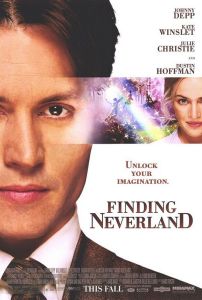 My friend George Bailey and I came to a similar conclusion during a recent conversation. There are a handful of movies, usually released around this time of year, that are packed to the gills with awards hype and general goodwill. Then I see them and feel underwhelmed for whatever reason and I walk out and feel that I should like the movie more than I do (if I do at all). I don’t know what to call it, societal guilt, elitism, but this is exactly what I felt when I left Finding Neverland.
J.M. Barrie (Johnny Depp) is in search of his next play. It?s 1903 London, and the financier (Dustin Hoffman) of his last play has taken a financial bath. Barrie’s also emotionally closed off from his wife (Radha Mitchell). One day in the park, Barrie stumbles across Sylvia (Kate Winslet), a widow managing four boys by her lonesome. Barrie takes a shining to her children and delights in spending long days with Sylvia and her boys. From his encounters with Sylvia and the boys, Barrie works up the inspiration to write a new story, called Peter Pan. Of course the public has its own gossip about a married man gallivanting about with a widow and her boys (think recent Michael Jackson scandals). Then there?s Sylvia?s mother (Julie Christie), who is set to put her house back in order starting with removing Barrie from their lives.
 The message of the movie is about the need for adults to slow down, open their imagination, and become bewitched by the power of believing. Because it’s not like there aren’t any other Hollywood movies out there that teach us to loosen up and enjoy life. Thank you Finding Neverland, I never would have found this out by myself. The message of belief overpowering all is also a bit naive, but then it works into the whole cross-stitching of sap the movie is generating.
Not even Depp can save the film. Long established as one of the most versatile and exciting actors, Depp finds ways to disappear into his oddball characters. In Finding Neverland, Depp sports an impressive Scottish brogue, but, sadly, this is the most impressive aspect about his performance. There had been much talk about Finding Neverland being Depp’s next opportunity at finding Oscar, but it would be a shame if Depp won for such a lackluster, artificial performance especially when he’s been brilliant so consistently in other movies. J.M. Barrie was somewhat eccentric, but in Finding Neverland he comes off as mostly vacant. The film tries to show that Barrie didn’t really fit in, but instead of becoming a showcase for Depp’s acting it becomes a showcase for Depp’s silence. The performance is so subtle that it doesn’t even come off as a performance. If Depp stood in the background of a movie, it would be akin to this performance.
Winslet has also been a very versatile actor. Her role in Finding Neverland never really deepens beyond Disadvantaged Woman. She’s been hit by adversity, she’s beset by four rambunctious kids and an icy mother, but that’s about all the film does for her characterization. Winslet is a tremendously talented actor, as evidenced by her Oscar-worthy performance in this year’s Eternal Sunshine of the Spotless Mind. So why strand her in a role where her character’s greatest acting moment is coughing fits?
Director Marc Forster (Monster’s Ball) has the frustrating habit of having two shot styles he shoots in. He decides between medium shots which usually involve two or three people, or large close-ups. While I was watching Finding Neverland I never once thought to myself that something was filmed in a visually interesting way. Some of Forster’s decisions seem unnecessary, like when he has to visually show us scenes of imagination instead of allowing the audience to, gasp, use their own imagination (hey, isn’t that the message of the movie?).
Finding Neverland tries so hard to be a three-hanky movie (and truth be told I heard a lot of sniffling in my theater during the last half hour), but what stops the film short is how unbelievably transparent everything is. Finding Neverland could have explored the rich complexity of an enigmatic figure like J.M. Barrie, but instead it settles for goopy sentimentality at every opportunity. Barrie becomes sugar-coated into an earnest father figure, and in the process key facts are sugar-coated as well. What do you mean? Well, Sylvia’s husband didn’t die until several years after Barrie wrote Peter Pan. Barrie’s wife didn’t have her affair until long after Peter Pan. Also, the original Peter threw himself in front of a train because of how upset he was about his connection to the famous character. I guess that’s why this is a biographical movie merely “inspired” by true events, much like Hidalgo.
The filmmakers rely on cloying tricks to make an audience care about its characters. The movie paints in very stark black and white tones, mainly “adults = shortsighted” and “children = special.” This is a film that is proud to take the easy road and makes little effort to cover its pride. It plays toward audience expectation and thus loses any long lasting magic.
Finding Neverland takes the easy road for audience-friendly sappiness. Barrie insists that 25 orphans be strategically placed around the theater on opening night of Peter Pan. Sure enough, the theater is full of old white men with monocles, and apparently they just don’t get the spirit of theater. The orphans laugh and squeal from the stage antics, and somehow this triggers all those old curmudgeons to learn to laugh once again. You see, all it takes is strategically placed orphans to make us laugh at life again.

When Sylvia is hanging laundry she starts to gently cough. If you’re smart, you’ll instantly figure out what trajectory is in store for her, but even if you miss this single cough don’t worry, because Sylvia will be doubled over with coughing later to spell it out for everyone. You can all but see the strings being pulled (the audience will cry… now!). All can be overcome in the end, those who didn’t understand will, and we’ll all be happier and live life to the fullest, in theory of course.
Finding Neverland wants to be Shakespeare in Love, another whimsical movie that shows how a writer utilized the people and events around them to pen a masterwork. Except in Shakespeare in Love there was a romance to fall back on, as well as some ripe comedy, but with Finding Neverland there isn’t anything to fall back on. It’s a Hallmark card mass-marketed to the largest possible audience.
Everything about Finding Neverland is disappointingly under whelming. The direction is shabby, the actors are marooned by their weak roles, and nothing is sacred in the film’s pursuit of that tearjerker ending. This is a movie for people that ask little of their movies, and yet I can reasonably see Finding Neverland becoming an audience favorite and riding good word of mouth all the way to awards season. Finding Neverland is a film that never takes flight because it’s too content to stay grounded by going the easy route.
[Nate’s Grade: C
Share this:

Once Upon a Time in Mexico (2003)
 Robert Rodriguez (From Dusk Till Dawn, The Faculty) wrote, directed, produced, photographed, edited, and scored Once Upon a Time in Mexico. I’m sure if you look further this jack-of-all-trades also provided coffee and donuts. Coming off his third Spy Kids feature, Rodriguez seems like the hardest working man in showbiz. Mexico, a sequel to 1995’s Desperado, is one tasty burrito of stylish action, vigorous energy and the immensely appealing Johnny Depp.
Depp stars as Sands, an amoral CIA agent who calls Mexico his beat. Through the help of a one-eyed flunky (Cheech Marin), he recruits a mysterious gunman, El Mariachi (Antonio Banderas), to thwart a coup being lead by Marquez, a military general, and paid for by a drug cartel run by Barillo (Willem Dafoe, a.k.a. the Creepiest Man Alive). Then theres also a retired FBI Agent (Ruben Blades) looking to settle a personal score with Barillo, a Federale (Eva Mendes) looking for some action, a nasty hired gun (Danny Trejo) itching to off a certain Mariachi, Mickey Rourke with a Chihuahua, Enrique Iglesias with a mole, and also the fact that Marquez, who Banderas has been assigned to kill, murdered Banderas wife (Salma Hayek) and daughter. Ill stop so you can catch your breath. Ready? Okay.
 You better think ahead and bring a second pair of pants because Depp will charm them right off as he plays yet another oddball. We are delighted with Sands and his multitude of fake mustaches, tacky T-shirts (one actually says CIA) and method of paying people through cash-filled nostalgic lunch boxes. Despite plotting near a Machiavellian level and shooting innocent chefs, the character settles into a lovable anti-hero that transforms into a blind reaper of vengeance. Depp is one of the best, if not the best, actors on the planet. Once again as he did in Pirates of the Caribbean, Depp gives life to a character and nourishes the film every time hes onscreen. This is Depp’s show. Mexico does have a noticeable lull whenever Depp is absent. I don’t know anyone else that could actually become cooler AFTER what he goes through. Possession is nine-tenths of the law, and Depp totally owns this movie and the 2003 year.
Banderas is smooth and has never looked better than playing the role of the silent-but-deadly musician. Hayeks role amounts to little more than a cameo. Shes witnessed through flashbacks, but she still has a healthy smolder to her. Blades has the most integrity of all the characters. Most of the actors have fun with their roles, especially the ones that are bad (which accounts for most everyone), but you can’t help but get the feeling that theyre being wasted for the most part.
Rodriguez’s overstuffed film is so delightfully over-the top and loopy that it crackles with an infectious kind of energy. Once Upon a Time in Mexico is a wild and lively cartoon of an action movie with a very healthy sense of humor. Its action relies low on CGI and high on inventive, if slightly self-aware, camera angles and furious gun fights. A sequence involving Banderas and Hayek chained to the wrist and swinging one-by-one down the levels of a building is breathtaking.
 What this spaghetti western below the border could have used is a little less of its myriad of twists, double-crosses, triple-crosses, and character subplots. By the time the Day of the Dead rolls on, you might need note cards to keep everything straight. Rodriguez’s earlier Mariachi films were lean on plots which allowed for fun and grandiose action sequences. Perhaps Mexico could have shaved some of these needless characters (cough, Eva Mendes, cough) from its convoluted plot and drawn out its sometimes too quick bursts of stellar action.
Once Upon a Time in Mexico is a bloody good time. Depp amazes yet again in this bombastically silly yet undeniably fun south o the border shoot-em-up. If Rodriguez has any plans for an additional sequel (and he might given his insane work ethic) I’d recommend following Depp’s Sands character wherever the sands take him. To witness this incredibly cool, whip-smart character cut up in any land would certainly be music to my ears.
Nate’s Grade: B
Share this:

Pirates of the Caribbean: The Curse of the Black Pearl (2003)
 Johnny Depp is THE MAN. But then, we already knew this. Can’t wait to see more.
Nate’s Grade: A
Share this:

Lost in La Mancha (2003)
Poor Terry Gilliam. One of the best visual directors today hardly ever gets a break. If there was justice in the world (a rhetorical question) Gilliam would be directing a Harry Potter movie. Just imagine t he greatness of something like that. But Gilliam is seen as an eccentric who doesnt keep good track of his budget, as evidenced by the inflating costs of his Baron Munchausen effort. As a result of making classy yet quirky pictures his way Gilliam has become a director that works on the fringe. His last effort was a delirious retelling of the Don Quixote tale. When it came time to film The Man Who Killed don Quixote it seems everyone, even God, was against Gilliam realizing his dream.
Lost in La Mancha is a fascinating and equally heart breaking documentary following the making of and, more so, the breaking of Gilliams movie. For starters the location for a pivotal scene in the desert is located near a Spanish air force base and fighter jets roar overhead. Then theres a flash food that destroys equipment and a set. Then theres the star of the picture that may or may not have cancer but sure cant ride a horse. Its enough to pull your hair out. Lost in La Mancha is like the cinematic version of the highly entertaining, and addictive, HBO series Project Greenlight: witness movie making first hand and witness one catastrophe after another! The two directors of Lost in La Mancha are the same people that created the nearly 90 minute documentary on the trials and tribulations of making 12 Monkeys (and this documentary is by far the best special feature on any DVD ever released). The two have a certain fondness for Gilliam but push the Gilliam-as-Quixote image way too much.
The really sad part about this documentary is that the glimpses it does show of the film (when it is working and not going into devastation) prove it could have been a wonderful and whimsical fantasy. Heck, he even got Johnny Depp to be in it! Gilliam will move on as will everyone else involved in this aborted film but there will now be a lasting mark. Whether it serves as an open sore or a Band-Aid is a different matter.
Nate’s Grade: B+
Share this:

Blow (2001)
 The tale of Blow follows a kid named George Jung (Johnny Depp) as he travels to the sunshiny coasts of California. Here he finds everyone with a David Cassidy haircut and an insatiable appetite for pot. He strikes a small scale dealing business with some help from a flamboyant hair dresser (Paul Rubens) and rocket in riches. They eventually discover the powers of cocaine, a.k.a. blow to the uninitiated, and set it loose upon 1970s America. Jung becomes the top trafficker of cocaine and practically single-handily leads to its explosion. And of course, these good times can’t last as Jung’s life falls apart as the 80s go.
 Blow is too stylistically similar to earlier 70s epics of violence and music like Boogie Nights and Goodfellas. The same moves and looks are evident, even the same overall tone, but it is missing all of the feel. Blow moves along and feels like something is missing as it continues to ape the flavor of those earlier excellent films. There’s a distinct feeling while viewing that you aren’t viewing something complete. The sense of loss permeates the screen with Blow.
Depp uses a subtle acting approach making Jung one real mellow dude man. One can never feel a connection for any of the characters because the plot is not interested in the characters and only a masochistic orchestra of bad events that happens to Depp. You feel unattached to the characters as a whole, but you do manage to feel a level of sympathy for Jung. His mother is a card to watch, and it seems history repeats itself when it comes to family squabbles.
Penelope Cruz plays one spoiled hell-cat of a drug lord’s girl, who later becomes Depp’s wife. Cruz’s character is possibly the most horrible love interest I have ever seen on film. She shrieks about money and wealth, acts apathetic to their innocent daughter, and single-handily gets Depp busted a few times without guilt. Upon deeper reflection she seems (if she happened not to actually exist, which she does) like a cheap foil to make the audience sympathy sway dramatically to our “tryin’ to do good” flawed hero in Jung. It almost seems insulting.
 Ray Liotta (who was IN Goodfellas by the way) gets the pleasure of aging through the years with makeup, which basically consists of slapping gray and more skin to his neck. It’s rather humorous that Liotta is playing Depp’s father in the flick when in reality they are roughly the same age. Though I guess it’s better for Liotta to age after seeing Depp’s character age drastically and gain twenty pounds all in his neck. Older Depp looks like a zombie Ludwig von Beethoven.
Blow is written and directed by Ted Demme and is based on the memoirs of Jung while in prison. It is fairly entertaining in its own right but you can’t help but feel you’ve seen it all before and better. Still, with this lackluster year as it is Blow is a decent pic to sit down and chew through a box of overpriced popcorn. Any movie with Franka Potente (my titular hero in Run Lola Run) and Paul Ruebens is worth the price of admission.
Nate’s Grade: B-
Share this:

Sleepy Hollow (1999)
 Tim Burton’s latest is a ravishing world of intrigue and brooding awe. The action is note-for-note in Washington Irving’s classic revamped into a Burton Murder She Wrote episode. Sleepy Hollow has plenty of mystery to its credit as well as suspense and fantastic staging. The sets and mood will draw the viewer into a luscious world of cinematic delight. Beautiful to watch, and Burton scores again, though it lacks the depth his other movies had. And what the hell is with Walken’s teeth?
Nate’s Grade: B


 nathanzoebl
You must be logged in to post a comment.