Blog Archives
Rebel Ridge (2024)
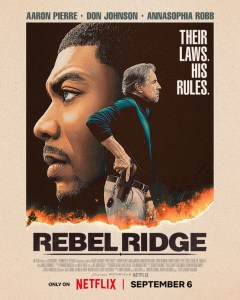 It only took minutes for me to be both engrossed and enraged by Rebel Ridge, the latest film from Jeremy Saulnier, a master of genre elevation. The scene begins with Terry Richmond (Aaron Pierce) riding his bike down a country road. A police cruiser appears behind him impatient to get around, and eventually the officer decides to use his vehicle to ram the bicyclist off the road. Afterwards, the officer tells Terry to stay on the ground and, upon a search of his belongings, discovers a stack of cash. Terry explains he cashed out his ownership in a restaurant and he’s on his way to do two things: buy a truck, and post bail for his cousin who was recently arrested for a minor drug possession. The police confiscate the money, accuse Terry of being involved with a drug conspiracy, and tell him that if he wants to fight for his money back, he’ll need to hire a lawyer and petition the court. Oh, and also the casual racism of the police officers is galling. With just his opening scene, Saulnier and his actors have made me feel vivid emotions and given me an underdog who I’m pulling for, a man who will come to serve as an honorable wrecking ball to this small-town police force who think they are above the law as it suits them. Saulnier’s movie tackles pertinent social topics with great care and detail, but it also delivers a masterful and satisfying action-thriller that knows how to entertain first and foremost rather than just incite.
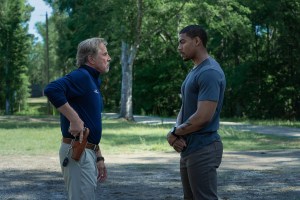 There are some serious criminal justice topics here dealt with unusually convincing clarity and accessibility, and that proves to be the ethos of Rebel Ridge, a message movie that knows it needs to be a movie first and a good one. Saulnier’s prior film work just oozes with dread and menace, though Blue Ruin and Green Room and even 2018’s Hold the Dark, by far the lesser work, dwell in bleak human outlooks. Very bad things will happen to people who stumbled into situations beyond their control, and usually by the end of the movie, there’s no recompense and we’re left to wonder about the empty cost of suffering. With Rebel Ridge, it feels like Saulnier has taken an assignment, like Netflix said to make one of your movies with your level of craft and thought, but also make it so the underdog is a badass and wins. I suppose one could argue that it’s turning a formula meant to defy convention back to convention, but by providing a crusader, we’re given a champion to root along that we can share confidence with. Terry isn’t invincible, some fearless behemoth who goes unopposed at every turn. He’s a formidable force but he’s also one man fighting against the forces of injustice and one black man fighting against racist white men in authority (superbly epitomized by Don Johnson’s good ole’ boy chief). Even with the power at his disposal, there are still limitations, which still makes the movie thrilling even if we ultimately suspect good might win out at the end. There’s nothing wrong with a triumphant ending as long as the work before establishes it as a fitting conclusion; tragedy and misery are not somehow more meaningful endings just because they are more serious or subversive. More people will learn valuable lessons about civil asset forfeiture and bail reform from this movie because it has a stirring and accessible story for a mass audience. The genuine thrills allow the messages to prosper.
And what thrills there are. There’s a staggeringly taut sequence where Terry is racing against time to get his cousin’s bail money deposited to prevent him from being transferred to prison. He’s checking the clock, looking down the small courthouse hallways, waiting for the officers he indisposed to come rushing back to arrest him. If only he can get this money deposited first. Saulnier does his own editing and creates a masterful sequence that left me nervously tapping my foot and awaiting the worst. The later confrontations with the police have a deeply satisfying turnabout, as these bullies come to realize far too late that they picked on the wrong man. Terry is an ex-Marine who taught martial arts and hand-to-hand combat to the Corps, but the most dangerous weapon he has is his mind. He’s constantly thinking about plans and implementation and adaptation. He’s intimidating already, but then when he starts to adapt, the sheer force of what this man is capable of makes him that much more incomparable. Even as a man on a mission, he’s still one black man fighting against a system of entrenched power that doesn’t like to bend when it comes to compromise or imposed oversight. He’s still got institutional power against him, and in one of Sauliner’s other movies, he probably would end with Terry winning a Pyrrhic victory but with the system ultimately standing, readjusting to maintain its dominance against further reforms. Here, that may still be true in a larger sense, but at least this one man can make a difference and bust a few racist bullies.
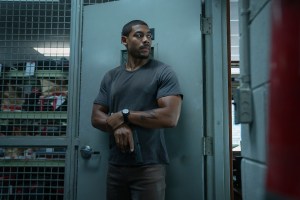 This experience wouldn’t be nearly as awesome without the commanding presence of its leading man. Pierce has had some noteworthy roles in Krypton and The Underground Railroad (he was also the amazingly named rapper “Mid-Sized Sedan” in M. Night Shyalaman’s Old). Originally, John Boyega (Star Wars: The Rise of Skywalker) was the lead role of Terry but Boyega bowed out weeks into filming in 2021 reportedly for “creative differences.” I cannot fathom any other actor in this role now that I have seen how thoroughly magnetic Pierce comes across. He’s a future star in the making and this should serve as a showcase for Hollywood. I like Boyega as an actor and have since 2011’s Attack the Block, but Pierce is a far more intimidating presence and likely candidate for action retribution. I cannot overstate how much better this movie is because it found the perfect leading man for its hero. Saulnier’s excellent command of the genre and tension is made even more compelling because of Pierce being our vehicle for comeuppance. His smooth intensity beautifully amplifies Saulnier’s percolating dialogue, finding the exact right tone and presence to make the challenges to power feel oh so combustible.
I wish the second half of Rebel Ridge was as perfectly structured and executed as that first scene. The second half gets a little lost in the details of its overarching small-town conspiracy. The momentum of the movie starts to slag a bit, and the clear connection of cause-effect plotting gets bogged down. There’s still important revelations and you get nice moments from the likes of James Cromwell as a judge and Steve Zissis as a courthouse clerk trying not to make waves within a system he acknowledges is unjust. The real significant supporting character is Summer (AnnaSophia Robb) as a lawyer with a past of drug addiction that she’s still trying to put behind her to earn back parental rights to her kids. She’s a good foil for our crusading hero, and her storyline also smartly allows for more social-political tangents to be hit about the difficulty of addicts and ex-cons to try and start over in the workforce. I wish she was more involved in the climax, as she’s relegated to being mostly a damsel needing to be saved after she proved so capable and cunning throughout the rest of the movie assisting Terry. The second half just isn’t as strong as the first half because the movie overextends with its conspiracy and history without the same tremendous clarity and urgency that drove the first hour of Rebel Ridge. The ultimate conclusion, while still satisfying, lacks the fireworks that we crave. It’s more a race against time and hoping that certain elements finally stand up against the corrupt police forces. It’s a solid ending, enough for a catharsis that Saulnier so rarely allows, but it’s not quite the release we might want, and maybe that’s the ultimate point.
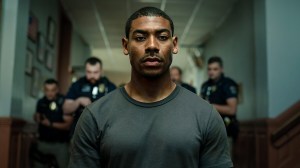 Rebel Ridge is a great genre movie that flirts with true excellence. It’s Jeremy Saulnier’s most accessible and crowd-pleasing movie, an action-thriller that executes its sequences of tension and retribution with as much care as it incorporates its Big Ideas for viewers to think over. Genre movies have long tackled relevant social and political topics, sometimes in ways that are far more meaningful and impactful than message movies that get bogged down in didactic dogma. But if you can link a relevant social issue to a story that grabs us and makes us want to inch closer to the screen, something that links a larger problem to a personal story, then you’ve found an accessible illustration that people will actually want to see. Rebel Ridge stands out among the Netflix house of action movies and proves that even a mainstream Saulnier can deliver the goods. Just because he’s working with a more conventional formula doesn’t mean that he hasn’t put thought and care into his characters and action. Rebel Ridge may leave you wanting a little more with its ending, but what it supplies is so engaging and entertaining that I’m happy to report Saulnier hasn’t lost his edge. Keep ‘em coming like this, Jeremy.
Nate’s Grade: B+
Share this:

Jurassic World: Fallen Kingdom (2018)
 There has always been an element of suspension of disbelief with the Jurassic Park films even with the hubris-pushing premise, but the sequels specifically have had to manage a rising tide of incredulity and sense of dumb. You can only keep going back to a dinosaur-infested island or thinking this time mucking with the DNA of large, extinct, highly advanced killing machines will be different. Jurassic World: Fallen Kingdom may be the dumbest yet, and while it does have moments of fun and excitement, the dumb outweighs all else.
Years after the deadly attacks at Jurassic World, the volcano on the island has reactivated and the remaining dinosaurs are in imminent danger of another extinction (except for the flying ones, but whatever). Claire (Bryce Dallas Howard), with sensible footwear this go-round, is looking to raise money and awareness to save the thunder lizards. A wealthy magnate (James Cromwell) wants to save the dinosaurs and whisk them to a wildlife preserve far from mankind, but first they must secure the raptor Blue, and in order for that to happen Claire needs to convince her former flame and co-worker Owen (Chris Pratt) to go back. They venture back to the endangered island only to run into more trouble from stampeding dinosaurs, new super predators, and a plot to house and sell the creatures off the island.
 Maybe it’s just a side effect of being the fifth movie in a generation-spanning franchise, or maybe it’s a holdover effect of the 2015 film’s meta-commentary about audiences becoming complacent with what used to inspire awe, but it feels like returning screenwriters Colin Trevorrow (The Book of Henry) and Derek Connolly (Safety Not Guaranteed) couldn’t be bothered picking a tone or developing their plot. It reminds me of the seventh season of HBO’s Game of Thrones, specifically the back half of episodes. It felt like the creators had certain conclusions in mind and rather than smartly develop storylines that would naturally reach those conclusions, the “how” of the narrative became jumbled, confounding, and frustrating. I felt the same way while watching Fallen Kingdom; the stylish set pieces were likely established first and foremost and the stuff in between, you know the story and characters and their interaction, was given far less attention. It didn’t matter how we got from one set piece to another. This lack of consideration leads to many moments that keep you from fully engaging with the movie, namely dumb and/or awful characters doing dumb things for dumb reasons. The conclusion of Fallen Kingdom seems meant to leverage interest in a third movie, which is already scheduled for release in 2021. Was this 128 minutes the best way to get there?
When people repeatedly do stupid things, it tests your limits of empathy. This happens to me with horror movies and it happened for me with Fallen Kingdom. It’s the kind of movie where a little girl runs into her bedroom and hides under her covers from an approaching hungry dinosaur. The ensuing image of the stalking beast entering the bed with the claws is a killer image, but what did we lose getting here? This little girl was not established as some dumb kid either. The preceding hour showed her as resourceful and plucky, so this just erases all that. There’s another moment where characters have to choose between escaping through an ordinary door or an open window and crawling along the edge of the roof… and guess what they choose. This is the kind of movie where characters will be in danger and then, hooray, another character arrived in time to save the day, and then another character arrived to save the shortly-after next day. Then there’s a bad guy who enters a dinosaur cage simply to retrieve a dino tooth for his personal necklace of dinosaur teeth. I’ll repeat that. He’s not extracting them to sell to another bio-engineering company for its DNA (the opening scene presents this very example). He’s removing dinosaur teeth for his own personal decorative hobby. My preview screening groaned in unison loudly at how stupid all of this was. How am I supposed to even enjoy this dumb character’s inevitable death when they’re this dumb and undefined?
 The dumbest action of all is tied to its central premise of saving the dinosaurs. When Jeff Goldblum’s Ian Malcolm (relegated to a two-minute cameo, don’t expect much) was championing letting the dinosaurs go extinct again and the folly of mankind playing God in the realm of genetics, I was right with him, and I’m no GMO spook. Bringing gigantic, killing machines back to life was clearly a mistake as five movies have now shown in great, bloody detail. At some point a lesson must be learned. I know that Fallen Kingdom is meant to imbue the dinosaurs in an animal rights lens, with Claire trying to atone for her time shaping and selling these creatures for public consumption. The animal rights angle never clicked for me. There are moments the film really tries, wanting you to shed a few tears for the fate of these gigantic creatures. Maybe you will, and there are a few shameless sequences to make you (the child sitting next to me was losing it at points). That’s why it’s not enough to have the bad guys have bad guy plans but they also have to be cruel and abusive in their treatment of the dinosaurs. The multi-million dollar ploy to weaponize the dinos also baffled me. Are they going to be that much better than firepower? There’s a reason we don’t just drop hungry lions into our war zones.
The new characters fail to add anything of merit to the story and larger Jurassic world. Cromwell’s Benjamin Lockwood is basically just a John Hammond stand-in (“Oh, there were TWO super rich dudes who funded the research and park now”). He’s confined to a bed for most of the movie and adds little besides his bank account. Then there are the two main team members, computer whiz Franklin Webb (Justice Smith) and med vet Zia Rodriguez (Daniella Pineda). He’s only here for comic relief and to do computer magic whenever called upon, and she’s only here for spiky attitude (she gets called a “nasty woman” for commentary?) and to do medical magic when called upon. Each of these characters is less a person than a handy plot resolution. When the movie transitions into its second half, both of them are kept on the sidelines. Then there’s little Maisie (Isabella Sermon) who has her own secret that really doesn’t come to much of anything and begs further examination. I suppose her perspective relates to a difficult moral choice at the end over the value of life, but she still felt underdeveloped. Even the villains are disappointing with the exception of Toby Jones (Atomic Blonde) as a slimy, one percent businessman looking for new thrills. I wish the screenplay had devoted more time to establishing the rich’s entitled sense of privilege even as it comes to a new world with living dinosaurs as the next big, commoditized play thing to buy and sell.
 With all that said, there are moments of enjoyment and excitement to be had with Fallen Kingdom. Director J.A. Bayona (A Monster Calls) has a great gift for finding the right image and holding onto it for maximum impact. He showcased this in his crafty, brooding, and highly effective ghost story The Orphanage and in his emotionally uplifting and harrowing tsunami survival drama The Impossible. With his first crack at a major studio movie, Bayona comes most alive in its second half when the movie transitions into a haunted house thriller in a mansion of secrets. His command of visuals and mood comes into sharper focus and there are some tense, delightful sequences. As much as I wrote about Fallen Kingdom being a movie of set pieces and little else, those set pieces are actually pretty entertaining. The island material only lasts about a half hour, wasting little time in getting the important pieces in play. There’s one long take inside a submerged capsule taking on water that keeps spinning and ratcheting up the tension that reminded me a bit of Alfonso Cuaron’s Children of Men. There’s another sequence involving a blood transfusion that I thought married comedy and tension better than anything else in the film, and it served a purpose that was credible.
If you can shut off your brain and stuff your mouth with a steady supply of popcorn to thwart your incredulous grumbling, there might be enough to enjoy with Jurassic World: Fallen Kingdom. It’s technically well made and the special effects are pretty good, the photography is evocative, and there are potent set pieces and imagery to stimulate the pulse. It’s loud, dumb fun, but for me, this time, the dumb outweighed the fun.
Nate’s Grade: C
Share this:

Noirvember: L.A. Confidential (1997)
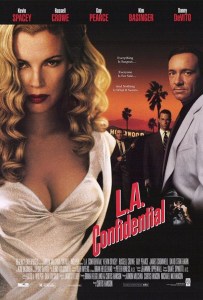 There was no stopping Titanic in 1997, iceberg be damned. James Cameron’s epic disaster movie had all the momentum of the times, and yet it’s a smaller movie that captured more of the critics and was far more deserving of the ultimate Oscar prizes that year. L.A. Confidential was based upon a James Ellroy novel that many argued was unfilmable. Enter journeyman director Curtis Hanson and novice screenwriter Brian Helgeland, and the pair stripped the book down from eight main characters to three, kept the spirit and essence of the book alive while rearranging the storylines for large-scale popcorn thrills. It’s been nearly twenty years since L.A. Confidential first seduced big screen audiences and its powers are still as alluring to this day. It’s a neo noir masterpiece.
In 1950s Los Angeles, not all is what it seems. The captain of the police, Dudley Smith (James Cromwell), is looking to keep the peace in the City of Angels as outside criminal elements are looking to fill the void from Mickey Cohen going to prison. Three police officers of very different stripes find themselves on the edges of a complicated murder case stemming from a massacre at the Nite Owl cafe. Ed Exley (Guy Pearce) is the son of a famous police captain and wants to rise up the ranks as quickly as possible. He’s a political animal and unafraid of ruffling feathers. Bud White (Russell Crowe) is a bruiser of a man who enforces his own level of justice when it comes to men who beat or harass women. Jack Vincennes (Kevin Spacey) is a happily shady officer who serves as a consultant for a hit TV police procedural. The Night Owl case takes them into many sordid corridors of sex, money, and power, including Lynn Bracken (Kim Basinger), part of Pierce Pratchett’s (David Strathairn) stable of prostitutes meant to look like movie stars, the mysterious self-serving sources to tabloid journalist Sid Hudgens (Danny DeVito), and good cops and bad cops on the controversial L.A. police force.
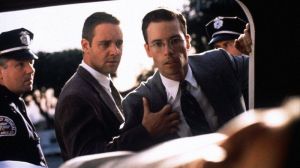 This movie is a master class in plotting and structure, enough that it should be taught in film schools. By nature noir plots are meant to be busy and mysterious, and a guarantee for mystery is a Byzantine plot full of plenty of suspects, dispirit elements, and strange coincidences that eventually coalesce into a larger picture. The beauty of what Hanson and Helgeland have done is that they have made the script complex yet accessible, able to lose one’s self in the tangled web of intrigue but still able to see how all the myriad pieces fit perfectly together by the conclusion. There is an efficiency to the screenwriting that is mesmerizing. It all seems so effortless when you’re with storytellers this gifted or who have a divine connection to the source material. Forgoing the customary slow builds of recent film noir like the oft-cited Chinatown, L.A. Confidential just moves from the opening narration. Within the first 25 minutes, the movie has expertly set up all three of its main characters, what defines them, their separate goals, the obstacles in place, and previews how they will intersect into one another’s orbit, and then the Nite Owl case explodes. Every scene drives this narrative forward. Every scene reveals a little more depth to our characters or fleshes out a superb supporting cast. Every scene cements that contradictory theme of the glitzy allure and unseemly darkness of the post-war City of Angels. My only quibble is that before the truncated third act the movie resorts to a few easy shortcuts but by that point Hanson and Helgeland had more than earned their paces. This is one of the greatest modern screenplays, period (WGA listed it as #60 all-time).
There are so many remarkably assured sequences but I want to emphasize one in particular – Exley’s interrogation of the three Nite Owl suspects. “Oh I’ll break him,” Exley promises his superior before entering into the first interrogation room. At first you’re with the other officers and morbidly curious with his arrogance. By the end, your jaw hangs in amazement at the intuitive pressure this man is expertly applying. It’s a terrific moment that allows Exley to masterfully manipulate three different men, taking pieces and running toward accurate insinuations, building momentum and clarity. Each man is different and each man offers a new piece of the overall puzzle. A slight reference by one unlocks another’s confession. An overheard sound byte pushes another into self-defense. I’m convinced it was this scene that ensured robust and thorough interrogation was a crucial element of the gameplay for the 2011 video game L.A. Noire, a noble misfire that definitely looked to replicate Hanson’s film as a user experience.
 Noir is one film genre with a visual code that can get the best of directors, but Hanson played this to his advantage. Classic noir is filled with criminal activity and the allure of sex and violence, typified perhaps best in the position of the untrustworthy but oh-so-sexy femme fatale. Yet the majority of film noir was produced in an era of censorship thanks to the implementation of the notorious Hayes Code, making sure that audiences didn’t enjoy the sordid elements too far. Free of these restrictions, some modern filmmakers take the opportunity to revisit the noir landscape and fill in the blanks of old, furnishing an outpouring of unrestrained exploitation elements. Brian DePalma’s 2006 film The Black Dahlia (also based on an Ellroy novel) gets drunk on this mission, though “restrained” has never been a word I would associate with DePalma’s filmmaking anyway. My point, dear reader, is that it’s easy to get lost in the superficial trappings of the genre: sexy dames, corrupt lawmen, temptation, shootouts, schemes, and chiaroscuro lighting. It’s easy to dabble in these elements because they’re so nostalgic and celebrated.
Hanson did something different with his 1997 masterpiece. He builds upon the audience expectations with noir but he doesn’t let his complex story and characters come second to the visual spectacle of the famous genre. L.A. Confidential is in many ways a movie that straddles lines; old and new, indie and Hollywood classicism, and film noir and drama. It’s an adult film that doesn’t downplay its darkness, brutality, and moral ambiguity, yet when it comes to those exploitation elements, especially sex, it’s almost chaste. The relationship between Lynn and Bud seems refreshingly square, like it was pulled from Old Hollywood. The entire movie feels that way, an artifact that could exist any decade.
Hanson was something of a journeyman for most of his career, directing competent thrillers like The Hand That Rocks the Cradle and The River Wild. As Variety film critic Owen Gleiberman wrote in his eulogy for Hanson (he died in September 2016, a fact I shamefully didn’t know until writing this review), after 25 years in the industry the man became an earth-rattling auteur after the age of 50. That is a rarity. Who knew the guy had something this singularly brilliant within his grasp his entire career? The care he puts into the screen is evident from the opening montage onward. There’s an elusive magic to the filmmaking on display, a bracingly divine sense of how to move the camera for best effect, how to escalate and deescalate audience nerves. He knows his story structure and characters inside and out, but he also knows how to play an audience. His time making serviceable studio thrillers certainly helps him during the film’s climax, a bloody shootout that’s also a mini-siege thriller.
 Hanson also assembled an incredible crew to enable his vision. The technical elements recreate the early 1950s L.A. time period with beguiling immediacy; the cinematography by Dante Spinotti (Heat) gives a sense of the darker elements just under the surface without having to overly rely upon the film language of staid noir visuals. Peter Honess’ sharp editing provides a downright Thelma Schoonmaker-esque musical orchestration to the proceedings, especially as the multiple storylines and developments spill onto one another. Speaking of music, the score by Jerry Goldsmith (Star Trek) is thick with the jazzy overtones of the genre. It’s a score that simmers with sexual tension and malevolence. The casting director deserves a lifetime free pass. There are a whopping 80 speaking parts in the movie, and each person is a great hire that builds a richer film.
While the plot of L.A. Confidential sucks you in right away, its characters take hold the strongest. Film noir is one genre that has a codified cheat sheet of character archetypes, and this movie fulfills and subverts them, finding surprising and gratifying ways to further round out these figures into complex and nuanced human beings. The three main characters all provide a different approach to law enforcement and when we see them start to work together it’s a wholly wonderful turn of events. Bud is the muscle, Exley is the brain, and Vincennes is the charm, and each one attacks the Nite Owl case and its subsequent leads from different angles that best apply to their set of skills. Each of the three characters discovers new pieces of evidence, new contacts and suspects, and when they start to work together it not only provides a payoff with the combined evidence but with the satisfying nature of their teamwork. That’s because they become better people when they work together and each moves closer to some moral redemption.
Bud is the loyal cop with a hair trigger and a penchant for being a white knight to abused women. His personal history of abuse makes him seek justice, often by his own fists. He has a rigid moral code of right and wrong and isn’t afraid to cross lines to achieve it. He’s also tired of being a bully and wants to be more than just the muscle. Exley is a straight arrow with a strong sense of moral righteousness and a mind for politics. He knows how to play sides for his own gain. He’s not afraid of making enemies within the department, and his opportunistic choices create many. He’s trying to forge his own path outside the shadow of his father, a famous lawman who was gunned down by a random purse-snatcher (“Rollo Tamassi”). He has to learn that he can’t do everything on his own. Finally, Vincennes is in many ways the face of the department as an ambassador to the world of TV and film. He’s succumbed fully to the glamour of Hollywood but he’s also full of profound self-loathing, trying to count how many compromises he’s made in life and where it’s gotten him. The appeal of the old life is crumbling and his detective instincts are reawakened, spurring Vincennes into the fray and surprising even himself. It’s extremely rare for any movie to successfully develop more than one protagonist, let alone three, and yet L.A. Confidential achieves this milestone so that when we alternate perspectives there isn’t a drop in viewer interest. Each man brings something different and interesting, each man reveals new hidden depths, and each character is fascinating to watch in this setting.
 The gifted actors take the already excellent written material and elevate it even further, turning an already sterling movie into one of the all-time greats. Almost twenty years later, it’s fun to see these famous actors when they were young and, arguably, in their prime. Spacey (House of Cards) was on a tear at this point in his career, between his two well-deserved Oscar wins, and having the time of his life in every role. His character seemingly has the least complexity, a man who knows he’s sold out but believes himself to be enjoying the ride, but Spacey offers poignant glimpses of the man behind all that oily charm and sly glances. There’s a scene where he stumbles across a mistake of his making and the subtle, haunted expression playing across his face is amazing. The man was capable of expressing so much, and still is. Crowe was still a couple years from his big breakout in 2000’s Gladiator but he put himself on the Hollywood map as Bud White. He’s a coil of anger and pain looking for an outlet, and Crowe is magnetic as hell. His glowers could burn right through you. Pearce (Memento) was another knockout that solidified leading man status thanks to his performance as the rigidly self-righteous Exley. He’s a character that thinks he’s above moral reproach, and his humbling is a necessary part of solving the case. Exley is constantly surprising his peers and it feels like Pearce does the same, showing exciting new capabilities from scene to scene, from his stirring hire-wire act with the interrogation scene to his understated glimmer of fear through a poker face. These three performances are golden.
Nobody better represents sleaze than Danny DeVito’s character and the man brings a merry lechery to his tabloid journalist/exposition device. His unquenchable thirst for the worst in humanity to sell more papers feels even more sadly relevant given the media climate that contributed to the recent presidential election. Kim Basinger (Batman) won an Oscar for her somber performance, which reinvigorated her career. She’s good but I can’t help but feel that she won the Oscar in a weak field (my choice would be Julianne Moore for Boogie Nights). David Strathairn (Good Night, and Good Luck) is enjoyably nonplussed as a man who specializes in delivering vice. James Cromwell used every bit of audience warmth associated as the loveable farmer from Babe and used that to his advantage. His pragmatic police captain is a father figure for Exley and the audience and perfectly sets up a turn that leaves the audience spinning even twenty years later.
There are little details the could go unnoticed but confirm for me just how much thought was put into L.A. Confidential. Exley is chided by his superiors for wearing glasses as they think it makes him look weak. As the film develops and he gets more immersed in the Nite Owl case, his compulsions against violence and rash judgment start to waver about the same time he stops wearing his glasses, a subtle symbol of his difficulty to see things for what they truly are. I enjoyed that our introduction to Lynn is in a liquor store and she’s wearing a winter cloak that strongly resembles a nun’s habit. It’s a memorable costuming choice and also suggest Lynn’s penchant for straddling the line of devotion. The Patchett “whatever your heart desires” line of high-class prostitutes has allusions to our current media culture of celebrity worship and personalized sexual fantasies. It naturally ties into the exploitation of the dream factory of Hollywood that takes young ingénues with dreams in their head and squashes them pitilessly. It’s not the first film to explore the darker side of the film industry but that doesn’t make its themes lesser.
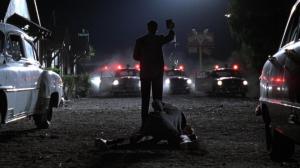 L.A. Confidential feels like the noir thrillers of old but stripped down to its essentials and given a new engine. It’s something that celebrates noir thrillers of old and Old Hollywood but it isn’t so lavish to either the genre or older time period that it loses sight of its own storytelling goals. The elaborate plot is complex and intensely engaging while still being accessible, populated with memorable and incredibly well developed characters, each given their own purpose and own insights that contribute to the larger whole. Hanson’s lasting accomplishment is a near-perfect masterpiece to the power of story structure and characterization. The three lead detectives are compelling on their own terms and the movie keeps them separate long enough that when they do come together it feels like a payoff all its own. Hanson recreates the world of classic film noir and makes it his own, using new Hollywood to lovingly recreate Old Hollywood. It’s the kind of movie I can watch again and again and discover new depths. It gave way to a wave of success for its participants. Hanson never quite delivered another movie on the level of L.A. Confidential, though I’ll posit that In Her Shoes is an underrated character piece. Helgeland has become a go-to screenwriter for many projects low (The Postman) and high (Mystic River) and became a director for A Knight’s Tale and 42. It’s a movie that plays just as strongly today as it did almost twenty years ago, and that’s the mesmerizing power of great storytelling and acting. L.A. Confidential is a lasting achievement that proves once more the power of our darker impulses. It’s stylish, seductive, smart, subversive, and everything you could ask for in a movie.
Nate’s Grade: A
Share this:

Big Hero 6 (2014)
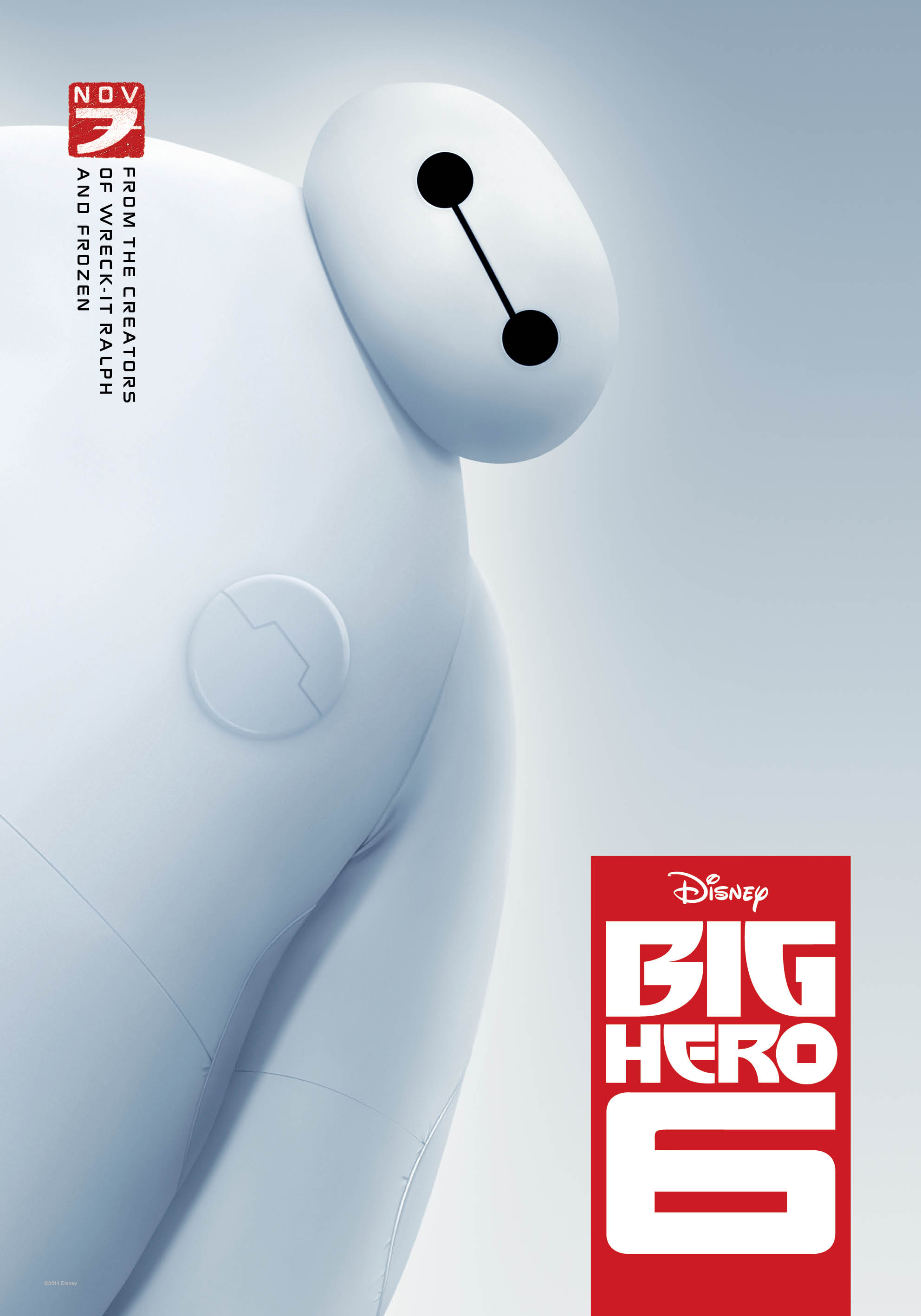 Disney’s first adaptation of a Marvel property, it’s essentially a superhero origin tale mixed in with the “boy and his robot” formula borrowed from The Iron Giant. The story is fairly predictable but charming and unafraid to deal with loss and grief. The real star, though, is the inflatable robot Betamax (voiced by Scott Adsit), whose unfailingly optimistic and helpful nature is a loveable addition to a genre plagued with doom and brooding. The action sequences are colorful and well developed and paced. It’s an agreeable pilot film for a new animated franchise, and the characters are likeable and fun while still having enough emotional resonance to make the hard choices of sacrifice hit you in the gut. It’s a welcome change of pace to have a character interested, first and foremost, in the mental health of others. You just want to hug Betamax (parents, your children will be begging for the toys). The plot does follow many similar plot beats of the superior Iron Giant but this film is still enjoyable enough on its own terms.
Nate’s Grade: B
Share this:

Surrogates (2009)
 Surrogates feels either like an early first draft or maybe one half of a discarded final draft; this half-baked, shrift movie is not complete by any means. It’s too streamlined following the most obvious plot beats imaginable and adding nothing new to the sci-fi genre. In the future, people don’t go out, they just sit back and experience the world through the eyes of their surrogate robotic person. This plot device is ripe for social commentary but instead it just becomes the starting point for a snoozy detective story destined to climax in “My God, what have we done?” territory. There is too many interesting avenues the story could have gone but it doggedly sticks to the well-tread main road of sci-fi: technology will turn against us. The movie comes across like one long allegorical jab against people devoted to technology, namely the Internet, and the end might as well carry big flashing letters that spell, “Got outside and play, you nerds!” The action and special effects are listless, and director Jonathon Mostow (Terminator 3) waited so long to make this movie but you never feel his interest in a single frame. I suppose, in the end, there is no surrogate for good writing.
Nate’s Grade: C
Share this:

W. (2008)
 Director Oliver Stone’s first draft at history is never boring but it’s rarely insightful. The film portrays George W. Bush (Josh Brolin) as a stubborn and simple man trying to live outside his abilities and the long shadow of his successful and emotionally distant father. George W. was not the favored son, as he is routinely reminded, and Ma and Pa Bush express their frustration. And yet the son who did not have his family’s support and acumen accomplished what no one else in the family had. He won reelection. He toppled Saddam Hussein. And then it all came crashing down. Ultimately, who was this movie made for? The detractors of Bush will view the film being too light, providing a psychological context that humanizes the man amongst his mistakes. You may even feel some sympathy as George W. repeatedly tries to earn his father’s approval. The movie is not a partisan or mean-spirited skewering. The fans of Bush will consider the film to be a cheap shot that restrings famous blunders and transplants Bush malapropisms into new settings. People may take offense at the idea of the current Iraq War being a result of unresolved daddy issues. Seriously, for a two-hour movie spanning the life and career of the most reviled modern day president, did Stone need to include the moment where Bush almost choked to death on a pretzel? Over the 2000 election debacle? Over the Air National Guard? Over 9/11?
W. lacks a strong point of view and the film’s timeline closes too soon, only going so far as January 2004, not even the halfway point for a two-term president who has only sunk lower in national approval from that moment. A miniseries would be a better medium to explore the failures and calamities and personalities of the Bush Administration. Brolin is terrific in the title role and he never dips into parody. The rest of the actors are hit-or-miss and the movie becomes somewhat of a game of identifying famous historical figures in their one-scene appearances. My biggest surprise was how much I felt emotionally connected to the first President Bush, played by James Cromwell in a performance that doesn’t even attempt to imitate the real-life figure. Stone and screenwriter Stanley Weiser (Wall Street) certainly don’t hide the characters they connect with (Colin Powell, often the voice of reason, is given a stirring speech calling for caution). Certain creative license is taken to provide dream sequences that can point toward the inner turmoil of Bush, like when his father admonishes him for destroying 200 years of the family’s name over the Iraq War. Overall, W. is an empathetic and sometimes dithering portrayal of the 43rd United States’ president that could have succeeded if it had more to say.
Nate’s Grade: B-
Share this:

The Queen (2006)
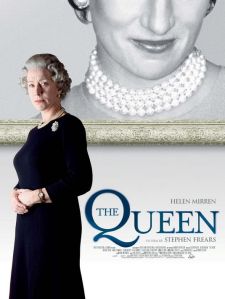
Long live the queen. In this instance Helen Mirren. After giving a majestic performance of Queen Elisabeth on HBO?s 2006 miniseries, here she is at it again this time as Queen Elisabeth II. Mirren is utterly magnificent in the role and burrows her way deep into her character, completely losing herself. Director Stephen Frears’ The Queen is a docu-drama examining the royals’ response to the tragedy of Princess Di’s death. It’s both a comedy of culture clash between the tradition-oriented world of the royals and the modern world that has moved beyond figureheads and symbols of monarchy and a drama exploring the grieving process. Frears and screenwriter Peter Morgan build great sympathy for the queen and the rest of these nutty royals, all stuck in a different age and hesitant and confused about mounting outcries for change. The royal family doesn’t understand the public’s demand to fly the flag over the palace at half mast in honor of Di’s passing; it hasn’t flown at half mast for over 400 years for anybody, kings and queens, let alone someone no longer part of that family. Even Prince Charles comes across remorseful, heartfelt, a little strange, but very identifiable. Plus, the actor looks a lot better than his real-life counterpart. It’s funny but also sad when the Queen Mum is hurt when her own funeral arrangements, the ones she picked out, will be used in a hurry for Di. The film pays equal attention to the rise of the new Prime Minister Tony Blair (Michael Sheen) and his frustrated relationship trying to save the royal family in a PR nightmare. Mirren, though, is absolute royalty. She plays a character prided in her decades-long approach to shielding emotion, to stoicism, to stiff upper lips, and Mirren displays the flashes of grief, befuddlement, and tenderness that register through that tricky prism. Queen Elisabeth II figures the public doesn’t want someone all weepy. She did, after all, begin her service around World War II when Winston Churchill was her first Prime Minister. The world has changed, she fears, and wonders if she’s fit to lead her people when she doesn’t even know what they want. The Queen is a sterling character piece with excellent direction and great performances. It’s quiet and moving but also a deeply fascinating behind the curtain view at a moment in time. And yet… I cannot help but feel some distance to the movie; I cannot put my arms around it just quite yet. The Queen is a very good film, of course, with an Oscar shoo-in performance by Mirren, but the free-floating plot and the intentional repetition and disconnect kept me from embracing this movie totally.
Nate?s Grade: B+
Share this:

The Longest Yard (2005)
 Does anyone else remember an episode of South Park from the 2004 season where Eric Cartman dresses up as a robot named AWESOM-O? The best part of the episode came when Cartman stumbled into a Hollywood meeting and they asked the robot to pitch a movie idea. He came up with idea after idea of Adam Sandler in some wacky yet predictable situation, each a slight variation from the last. The Hollywood execs ate it up and scribbled everything down, chanting, “Goldmine!” I imagine The Longest Yard remake, the latest Sandler comedy vehicle, came about through similar creatively bankrupt circumstances.
Paul Crewe (Sandler) is at a low point in his life. The once star quarterback has been banned from football for throwing a game. His girlfriend (Courtney Cox) thinks they should split, and after being chased by police for drunk driving, he?s been sent to prison. The warden (James Cromwell, your go-to guy if you need someone old) has big plans for Crewe. He wants the young stud to organize an all-inmate football team to play against the cruel guards. Crewe gets help from a fellow inmate Caretaker (Chris Rock) and they set about finding the right men for their team. A former Heisman-winning football player (Burt Reynolds), who happens to be in the same prison, becomes the coach. Slowly but surely the group becomes a team united to get some revenge on their tormentors.
The Longest Yard is an Adam Sandler comedy in the worst way possible. The film is sloppy and sophomoric but generally unfunny. It sets its comedy heights on kicking people in the nuts and making fun of gay people. Mission accomplished. The sex jokes, while in abundance, generally fall flat because the movie is so ineptly transparent when it comes to comedy. It lets all the air out of the supposed punch lines. The humor is typically homophobic but infuriatingly also anti-women. You see, one of the guards is taking steroids in a bottle with a giant label that says, “Steroids?”(so much for keeping a low profile). The boys replace the steroids with -hee hee- estrogen pills. And in three days time, which would of course have no effect in such a short period, the guard is now crying, and overly emotional, and empathetic, and he has hot flashes, though I don’t know how in the world a man comes to that conclusion. Apparently it’s funny because women are weak and care about each other. I would be offended by this whole joke if it wasn’t so incompetently done. The Longest Yard exists in its own inept world where inmates have cells within arms reach of each other and there’s a prison football league. Lest we forget, this prison also keeps a star system to rank its inmates. Little did you know of Roger Ebert’s unorthodox side projects.
 Sandler plays Adam Sandler as he does in most of his Hollywood flicks. He’s likable, he’s a goofball, and it all works out. I wonder if we’ll ever see the true thespian side of Sandler again, like in Paul Thomas Anderson?s deconstructionist Punch-Drunk Love. Rock’s abrasiveness is toned down but he also loses his comedic edge. He’s basically another stereotypical black character in a movie making tired jokes about the difference between black people and white people. Cromwell and Reynolds both appear to be having fun mucking it up with the youngins. The rest of the supporting cast have their moments but aren’t very memorable. The movie fills out the athletes by having real football players and wrestlers.
What’s worse is that The Longest Yard wants to also be taken as a serious movie. This causes some intensely jarring scenes intended for dramatic impact but they just stick out sorely and are misplaced. Every time the movie goes from kicking people in the nuts to dealing with something like racism or death, the movie flounders from the tonal whiplash. The original movie was more of a prison drama than a sports movie, let alone a comedy. The Sandler remake wants to be all three and isn’t good at any of them.
This movie is so formulaic that it could have been written on a string of napkins, likely only totaling three. The Longest Yard feels like 2005’s greatest example of a cut-and-paste studio approved movie. Of course the embattled hero will once again face his demons and his past. Of course the motley crew of idiots and convicts will come together for something greater than themselves. Of course the evil guards will all get their comeuppance in appropriate ways. I expected all this from the start, but where The Longest Yard goes terribly wrong is when even the details can be correctly guessed. I watched the film with a couple friends and we accurately guessed every character move, scene transition, character development, and sadly, every punch line. This is a film that spells everything out, including the jokes. Here’s an example of the film’s shortsighted thought process: the dastardly warden soaks the player’s field and makes it all muddy with the intention of demoralizing the team. What? These are prisoners, and you think mud is going to demoralize them? Don’t even get me started on how insane it is sending Burt Reynolds into the game as a running back. There’s more attention spent on the limp football scenes than the story or the comedy.
 Another example of how weak the comedy is comes during the football game. It’s being telecast on ESPN and Chris Berman is providing the play-by-play. His sidekick in the booth is an inmate who doesn’t say anything. Berman even broaches this fact on air. Now, if The Longest Yard knew the facets of comedy, the natural payoff for this sequence would be for the silent inmate to say something at the very end, something funny or unexpected or even verbose. Instead, the film has the inmate talk two or three times and he adds no comedy. That’s The Longest Yard in a nutshell: all set-up and no return. And seriously, stop with the Rob Schneider cameos already.
The humor is a cocktail of physical slapstick and the occasional one-liner. There just isn’t anything satisfying to the comedy The Longest Yard has to offer. The jokes typically don’t build to anything greater and the humor is simply immediate with no lasting results. There’s nothing that will make you keel over with laughter, nothing that rises above a smirk or a slight giggle. The jokes are way too predictable and there’s nothing funny about the expected. That’s why most people don’t chuckle when the mail arrives. This just isn’t an entertaining comedy, plain and simple.
The Longest Yard is a tirelessly formulaic affair that is so ham-fisted with comedy it can’t even deliver jokes properly. This is a dumb, sanitized, audience-friendly easily digestible piece of puff that will get caught in your throat. This is a Franken-movie, with various parts crammed together for the best possible results by some studio overlord. The Longest Yard‘s comedy is sophomoric and generally insipid, the drama is a complete misstep and tonally out of place, and the football scenes are vapidly jazzed up. This is a sports move that doesn’t work as a comedy and a comedy that doesn’t work as a sports movie. Sandler’s devout army of fans will likely be satiated with this latest effort, feeling the flick to be stupid fun. For me, it was just stupid. Very stupid.
Nate’s Grade: D
Share this:

I, Robot (2004)
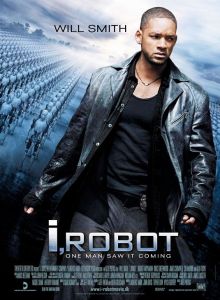 No doubt about it, Will Smith is the best hope our planet has in the face of adversity. He’s taken down aliens three times, foiled one conspiracy, stopped the South from rising again, and the man still finds the time to help Matt Damon with his golf swing. I fear we almost may be taking Smith’s world-saving exploits for granted. Smith’s newest chance to save the world arrives in I, Robot. Can Big Willie save the world yet again, or has he punched his time card one too many times?
In 2035, man has a new class of immigrants to do all the menial tasks no one wants to do – robots that look like crash test dummies. U.S. Robotics (USR) wants to push their new fall line of robots and make sure every happy home has a happy robot. Del Spooner (Will Smith) is a detective wary of our robotic friends. His colleagues laugh at his paranoia, remarking that no robot has ever committed a crime. This is thanks to the three laws hard-wired into every robot: 1) A robot cannot harm a human being, 2) A robot must obey a human beings order as long as it does not conflict with Law #1, and 3) A robot can do whatever to survive as long as this does not conflict with the other laws.
 This sounds great, except the robot creator (James Cromwell, always there if you need an old guy role) has apparently plummeted to his death from his USR office and the circumstances involving his demise are dubious at best. Spooner works alongside a robot technician/shrink (Bridget Moynahan) to find out more about what exactly is going on within USR and its suspicious CEO (the always shady Bruce Greenwood). Spooner discovers that a robot, who wishes to go by the name of Sonny, may have sent his creator to his death and may also be the first step toward uncovering the truth behind a grim conspiracy.
Smith has never really been a great actor but he is likable and charming enough, so that gets him through the day. The problem is that when hes saving the world in summer blockbusters he has a tendency to go into Will Smith Mode, which plays out like hes on auto-pilot. His stares, awkward mannerisms and aw shucks humor seem to be the same in every film. This isn’t to say that Smith cannot be a capable actor, but it seems that when a movies budget goes over a certain amount he resorts to playing Will Smith: World Saver and not so much a character of real value.
The other actors are more so playing vague archetypes than they are anything else. Greenwood is the sneaky, oily executive; Moynahan is the cold scientist learning how to be human once more; the invaluable Chi McBride is the no-nonsense police chief who rolls his eyes at Spooner’s crazy theories; and Shia LeBeof actually shows up for all of three minutes playing some kind of juvenile delinquent that is wholly unnecessary to the film.
The movie’s greatest accomplishment is the character of Sonny, modeled after a physical performance by actor Alan Tudyk. Sonny’s calm line readings, bursts of emotion, and questions on humanity make him a character the audience connects with, especially with the detached nature of Smith and Moynahan’s acting. Bet you never would have guessed this is from the same guy who played Steve the Pirate in Dodgeball.
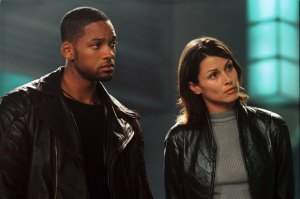 I, Robot isn’t exactly going to establish new ground in the world of science fiction. Its mostly a detective story with some twinges of sci-fi philosophy. As a detective story it adheres to the laws of detective movies, like how NO ONE ever believes the hero on his hypothetical assumptions and paranoia, which will of course always be right, and how the hero can only solve the case after he is thrown off it and gives up his badge. For two thirds of I, Robot we get an amiable, if average, detective story set in the future. Then we get a slightly incoherent final act where robots go all-out crazy.
Director Alex Proyas takes a step back from the grim, noir-ish worlds he worked with so effectively in The Crow and Dark City, and presents a cleaner and more sterilized world. His technical elements, like cinematography and musical score, are still well above par for the summer blockbuster. Proyas is a gifted visual tactician that knows how to wow an audience.
The sleek production design, fancy special effects, and strong visionary directing help lift an average story. Some of the story elements may not all work -like Spooner’s flimsy reason he hates all robots, and Moynahan’s character being very cold because she works around robots (get it? get it?)- but the professionalism of the people behind the scenes help make a rather exciting and occasionally thoughtful movie. Sonny’s questions about life and death as hes near termination are a nice addition to add something more to a summer blockbuster than explosions and car chases. Of course I, Robot also has some exciting car chases and action sequences. Certainly other, better sci-fi movies have dealt with these issues much deeper, and I, Robot seems to only skim the surface of intellectual debate, but at least it’s something (though this sounds really defeatist).
Bearing little resemblance to Asimovs collection of short stories, I, Robot is more a stream-lined sci-fi action flick, but its still a satisfying and stylishly entertaining diversion. Sci-fi fans may grumble at the notion of transforming a complex novel into a watered down action film, but I, Robot is a crowd pleaser that delivers the thrills when it needs to. If Will Smith keeps up this world saving pace he may get a little haggard and start turning into Danny Glover’s Lethal Weapon character: I’m getting too old for this aliens/robots/other aliens/more aliens/giant mechanical spiders shit. Well, at least Smith’s good at it.
Nate’s Grade: B
Share this:

The Green Mile (1999)
 A prison in the heart of the deep South during the era of the Great Depression is not usually the locale you’d find a somber tale of earnest discovery and passionate awareness to the follies of life. Yet here arrives the long anticipated The Green Mile, the second in tag-team efforts from director Frank Darabont and novelist Stephen King in their own genre creation of nostalgic feel-good prison flicks. All the swelling hype could manage to make the movie seem overbearing, but if you’ve got a free afternoon and a butt made of steel then try The Green Mile.
Darabont seems like the perfect visual interpreter to King’s epic narrative spinning of good, evil, and all that fall between. The movie moves at the pace of molasses and clocks in at over three hours in length. Not exactly audience friendly fodder but one and all will be grateful for the decisions taken to build character development and tension instead of blindly rushing through.
Tom Hanks plays a prison guard on the Death Row block of a Southern penitentiary. Despite the bleak and grim surroundings his humanity still shines through. He escorts and oversees the final moments of many men’s remaining breaths along the final walk of green linoleum tile to the electric chair. Enter one mysterious morn John Coffey (Michael Clark Duncan), a towering giant that seems to break all the rules each of the guards on cell block E has come to realize through their years. Coffey has been convicted of the rape and murder of two little girls, but as Hanks soon learns things aren’t always what they seem. The 7-foot miracle worker displays scenes of empathetic healing like to Christ himself. Hanks views are turned and his eyes open, and that’s just the beginning of the heartstrings being pulled. To release anymore of the plot would be a crime punishable by Ole’ Sparky himself in the Green Mile.
 The pacing is smooth and wrings out every droplet of mystery and drama needed. The Green Mile‘s comprehensive fable quality transcends the period just like The Shawshank Redemption did as well prior. ‘Mile’ should be expected to be a front-runner for Oscars when balloting begins.
The ensemble acting is magnificently eclectic and truly inspiring. Hanks’ name is so synonymous with Oscar that he might as well shave his head and paint his body gold because come nomination time this man’s name is going straight to the ballot. Other stars give thoughtfully deep and refreshing performances guaranteed to turn a few heads. Duncan’s gentle child-like giant is serene and a benevolently touching figure of innocence and warmth. But one can not forget the presence of a very special rodent by the name of Mr. jingles that deserves billing above the credits itself for the quality performance it puts on.
The Green Mile is a sad, touching ,and rather powerful movie that speaks to the viewer’s emotions and gladly earns every one of them. In the end The Green Mile is nothing beyond a long yarn of a fairy tale; but one told so exceptionally, one performed so extraordinarily, and one directed so deftly that you’ll gladly journey down that mile with ease.
Nate’s Grade: B


 nathanzoebl
You must be logged in to post a comment.