Blog Archives
Beasts of the Southern Wild (2012)
 After months of rapturous praise from Sundance and Cannes, allow me to be the wet blanket of the critical community, because Beasts of the Southern Wild is one big helping of “meh.” I didn’t enjoy this movie at all and its mixture of strange fantasy elements and a hellish childhood reminded me of another misfire, 2009’s Where the Wild Things Are.
Six-year-old Hushpuppy (Quvenzhane Wallis) lives on a spit of land off New Orleans and below the levy. This tucked-away land is nicknamed by its colorful, besotted residents as the Bathtub. Hushpuppy lives with her father Wink (Dwight Henry) in large shacks elevated high off the ground. This comes in handy because after a disastrous flood, Hushpuppy and her father have to navigate the waters to find others and scramble for some return to their life and culture. The residents must also make sure to be cautious because the U.S. government, which is evacuating all flood-devastated areas, is looking for survivors to forcibly remove. Wink is sick and has to impart the ways of his family and culture to young Hushpuppy, who sees herself as one piece in a big puzzle.
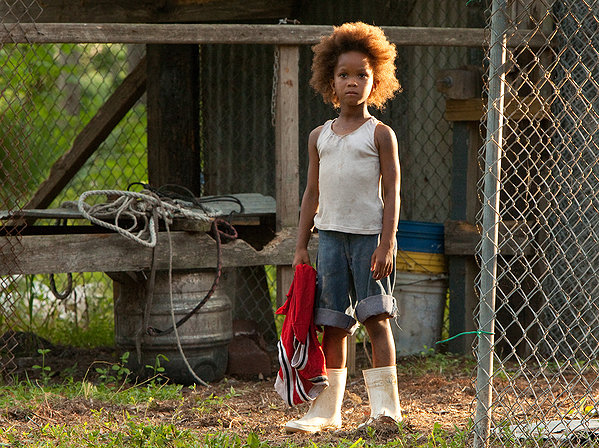 This movie is awash in all sorts of tones and storylines, failing to cohesively gel together or form some kind of meaningful message. I could have sworn that the fantasy elements, namely the giant thundering pack of large boars, were just going to be a visual metaphor for Hushpuppy’s journey. And then they actually show up and every person can see them. So, now what? The boars are one of many ideas that the movie just sort of toys around with before losing interest. This is not a film of magic realism. This is not a film about the escapes from a hard reality. In a way, this movie plays out like if Terrence Malick had made Gummo, and if you know me, you know I loathe both Gummo and Terrence Malick movies. Beasts constantly flirts with pseudo-intellectual pabulum, trying to reach something profound but instead settling for confounding. Hushpuppy’s curlicue unnatural narration talks about being a little piece in a big universe and the interconnectedness of all things, but by film’s end you get no dynamic sense of this. What I got was a little kid’s poor life getting worse, and that’s about it. If the film has anything larger to say about the world, Katrina, human connection, then I’m at a loss as to explain what that may be. Beasts offers half-formed ideas, strange, conflicting imagery, and characters that are rather thinly written and barely register. I never found Hushpuppy an engaging protagonist and felt like her very age and the heavy burdens she is forced to carry were manipulative substitutes for actual characterization. I cannot understand the love here.
The movie is something of a wild stew of Southern folklore and coming-of-age tropes and plenty of indie trappings, like weak political allegory, roaming handheld camerawork, and sacrificing story to the altar of realism. So much of this movie feels like it was made to give a sense of how an overlooked life in poverty is lived. From that standpoint the film does a commendable job of showing everyday life and the struggle to feed and survive. There’s a certain sense of ingenuity at work. But all of these setting details do not take the place of an involving story and characters we should care about. I felt sorry for the various residents of the Bathtub and their lot in life, but I never felt attached to any of them. That’s because, as mentioned before, they’re bland and simplistically drawn, but also because Beasts doesn’t bother to do anything else other than create its rich, tragic, harsh world. It’s authentic all right, but what does all that authenticity have to add to genuine character work? Artistic authenticity is not always synonymous with telling a good story. The Bathtub feels real, got it. So now what?
Hushpuppy lives in squalor and the movie has a disquieting romanticism of abject poverty. To the residents of the Bathtub, they are living in some forgotten paradise away from the concerns of the mainland. They refuse to leave their homes and their lives, even though there isn’t much of a home to call one’s own. We wade in this horrible existence and are meant to pretend like it’s an idyllic lifestyle, you know, with all the creature comforts of child abuse thrown in for extra measure. While Beasts looks entirely authentic with its impoverished, junkyard-esque production design, the overall mood and atmosphere hardly seems worth celebrating. Now, I’m not saying that characters can’t make the most of whatever life has given them and meet the implacable with fearless optimism. These characters would likely shun our pity; they reject any government assistance after the great flood and just want to sneak back to their simpler lives. This is not an enviable life, and the fact that the movie tries to romanticize it feels deeply irresponsible. At least with a film like Winter’s Bone, where you felt the crushing existence of systemic poverty, the filmmakers didn’t try and put a smile on all the drudgery. In that movie, you felt the trappings of poverty and how it can sink into your soul. On some level perseverance in the face of adversity is noble, but so would escaping poverty. Regardless, this is not worthy of romanticizing or fetishizing.
 Little Wallis is certainly getting her fair share of attention for anchoring the film. She’s six years old so it’s hard to assess her full acting potential, but the kid looks to have some fire in her. However, it is not a performance that leaves a lasting impression. I realized that much of her performance was long reaction shots and that ponderous voiceover narration. True, she does get some dramatic sequences and lets loose a few tears, but it feels like the movie didn’t want to push her too far and settled on a barrage of shots of Hushpuppy being stoic. I was more impressed with Henry, he too an acting novice making his debut. His character is more complex than an innocent naïf we have as our protagonist. He’s clearly dying and trying to quickly get his daughter prepared for a life of independence. He’s also quick to anger and you can feel the heavy weight of his life and his fledgling mission. In fact, I think Beasts would have been better if it had been told from the father’s perspective rather than our child trying to understand the great big scary world. There’s certainly a lot more drama and an easier route for sympathy, even if he could be accused of being cruel and neglectful.
I’ll admit that Beasts of the Southern Wild is different, daring, and fitfully imaginative, as well as benefiting from strong production design and special effects work. But “different” and “daring” doesn’t always mean good. I cannot in good faith say I enjoyed this movie, especially with its freeform plot, messages, tones, and occasional garish imagery. The plot seems desperate for some form of greater meaning, defaulting to ponderous poetry rather than supply a workable narrative and characters that are developed. Then there’s the whole romanticizing of systemic poverty that I find off-putting and wrongheaded. This is just a swampy mess of a movie, one that sinks under the weight of its own pretensions. It’s admirable from a technical standpoint but as a movie, Beasts of the Southern Wild is an exercise in eclectic navel-gazing.
Nate’s Grade: C+
Share this:

Safety Not Guaranteed (2012)
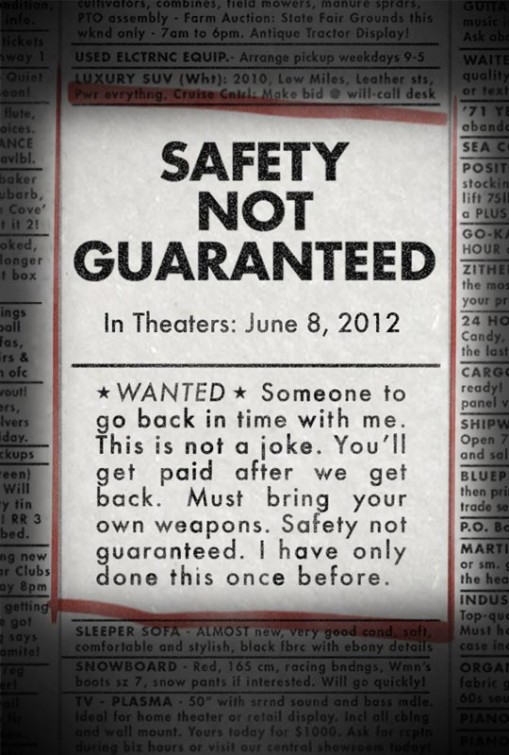 A man puts a classified ad in the newspaper asking for an unusual companion. No, it’s not some weird sex thing. Kenneth (Mark Duplass) intends to travel back in time to correct a few regrets. He’s looking for a partner, though he specifies his traveling companion must bring his or her own weapons and that safety is not guaranteed. This quirky ad grabs the attention of Jeff (New Girl‘s Jake Johnson), an egotistical writer for a Seattle magazine. He takes along a pair of interns, the surly Darius (Aubrey Plaza) and the nerdy Arnau (Karan Soni). Together, the gang heads out of town to seek out Kenneth and determine whether or not he is for real. However, Jeff’s real intention for this “work vacation” was to travel back to his hometown and try and score with Liz (Jenica Bergere), an old high school flame he is horrified to discover has… aged. Darius is the only one who can get close to Kenneth, but what starts as an opportune assignment into investigating a weirdo becomes something more. The guy, sweet if a little off, may be on to something… big, and Darius may be falling for him despite her own misgivings.
Safety Not Guaranteed is a modest film but does it ever sneak up on you and deliver an emotional wallop. I’m a romantic at heart, and so I’m generally affected by seeing two lonely people find their special something in the world reserved for them, and it’s even more affecting when these people are oddballs, and thus it’s even more resonant and meaningful for them to find that connection so elusive before. At its heart, Safety Not Guaranteed is a quirky yet naturally developing love story, and those are my favorite kind. I found my heart melting every time Darius couldn’t help herself and smiled. Perhaps it’s because Darius is our outside heroine or that Plaza is best known for her stone-faced deadpans on TV’s Parks and Recreation, but every one of those smiles felt so richly earned and rewarding. These aren’t the typical rom-com characters that are going to lapse into great speeches about love at key clichéd moments; while dabbling in some fantastical elements, Safety Not Guaranteed exists in our own recognizable world. And with that established, the unguarded moments of genuine happiness for characters we care about translates into a surprisingly touching experience. My heart felt so full at different points, melting and swelling and doing other non-medically accurate things. I honestly had tears in my eyes at different points. By the perfect end, I was so hopeful and overjoyed and left the theater soaring on my good vibes. I can’t guarantee everyone will find the same level of engagement in the romantic relationship, but I believe that the movie is inspired, clever, and authentic enough to deliver a crowd-pleasing finish. It’s earnest without being hokey.
 I’m trying to tiptoe around spoilers, though for those critical readers out there I’m sure you can infer a thing or two about the end of the film given my positive, beaming response. I’m sure my reaction would have been quite different if, say, Darius and Kenneth died in a horrible fireball because he was criminally insane from the start. All I’ll say is pay attention to certain discrepancies and see if they might prove to be a conversation-starter when you leave the theater.
Have I mentioned how truly funny this movie is? I’ve been talking all about the “rom” portion of the equation, but Safety not Guaranteed is a consistently funny movie, with a few big laughs. The movie’s sharp sense of comedy is more than everyone simply derisively laughing at the nutball. To be sure, Kenneth provides plenty of comedy in his super serious demeanor, and the movie doesn’t overplay the idea that he may be mentally unbalanced. The jokes come from the character interaction more than any contrived set piece, and the pleasure is in watching conflicting personalities bounce off one another. Every character contributes nicely to the comedic rhythms of this picture, adding a line here, a reaction there, to assemble one very funny movie. In movies where one character enters a relationship under initial false pretenses, usually you just keep waiting for that particular shoe to drop. You wait for the truth to come out and then deception reconciliation dominates the third act. Thankfully, the movie speeds over this narrative trap and gets us to the good stuff. We don’t need an entire act for people to be contrite and prove their love when what we see onscreen is obvious enough.
What elevated Safety Not Guaranteed for me was that beyond the oddball romance, there’s careful and compassionate attention paid to a slew of supporting characters. Now with a scant 80-minute running time, and the attention-grabber of a guy who thinks he can travel through time, naturally the supporting characters have minimized roles, but what I enjoyed was that they were not just relegated as stock players. The film has two stock roles, Nerd and Jerk, and fleshes them out further (though, to be assured, those are still defining characteristics). Arnau is a guy who is convinced any interaction with girls will ultimately lead to personal embarrassment. He’s only focused on the future and what he needs to get there, barely living in the present. It’s nice to watch him grow some confidence, albeit a small amount, and find some degree of enjoyment. And then there’s self-described asshole Jeff, who only submitted the story so he could come back and bang his old high school girlfriend. Some will find Jeff’s minimal personal growth to be disappointing and stagnate, but I thought anything substantial for this character over a three-day period of time would be unrealistic. Jeff is chasing his past memories, a faded time that had so much possibility when he was a stud in high school. The movie explores this notion of returning to a period of innocence as well. Going back to a time before overwrought cynicism, before settling, before compromising, before life became work, it’s something of a wish that the characters seem to be chasing. Jeff realizes how truly empty his life is, yet he’s probably too set in his ways to alter his path, which is a shame because Liz certainly seems like a lovely, caring, and capable romantic opportunity. Hey, she bakes, too (Bergere is great and easy to fall for). The unlikely friendship that emerges between Jeff and Arnau is also quite enjoyable and disarmingly sweet.
 I also need to single out the score from first time composer Ryan Miller, the lead singer and guitarist for one of my favorite alternative rock bands, Guster. The music has a lilting, dreamy quality to it but then follows a steady melodic rock path, reminiscent of the melancholic score for Little Miss Sunshine. The strumming guitars, plinging pianos, and swelling violins come together in harmony with little sci-fi touches. The score gives the film another sense of enchantment. I’ve been listening to “Big Machine,” the song Kenneth plays for Darius, on a loop for over an hour, if that gives you any indication on how much I enjoyed the original tune. The fact that “Big Machine” plays over the end credits when the movie meets its perfect end has got to account for some of my positive association. I think Miller has a bright future in crafting film scores.
Plaza (Funny People) deserves to break out in a big way after this film. She’s the heart of the movie and deeply vulnerable, covering it up with nonchalant cynicism. Darius is well within her surly comfort range so it’s no surprise that she excels with the hipster character, but the moments of dramatic weight are not given flippant treatment. Duplass (TV’s The League), just about everywhere in 2012, delivers a committed performance, though it seems mostly committed to the goofiness of his character. Yet when Duplass is able to show you some of the edge to his character, that’s when the performance walks a line between dangerous and exciting. The movie hinges on the two actors working together and they have good chemistry; the goofball and the cynic.
It’s so nice to discover a movie that lifts your spirits, that touches your heart without reaching for the treacle, and delivers a funny experience without compromising its modest aims and modest tone. Safety Not Guaranteed obviously plays a deliberate dance with the audience, vacillating between moments that make Kenneth seem crazy and moments that make you question whether he’s legit. The movie reminded me in a lot of ways of the underrated 2000 flick Happy Accidents, which featured Vincent D’Onofrio as a romantic suitor who also might be a time traveler or just plain nuts. Safety Not Guaranteed is a charming movie that seems to work a spell on you while watching; you get so invested in watching lonely people find meaningful human connections that you are compelling the movie to end under some happy scenario. Director Colin Trevorrow and writer Derek Connolly deserve to make waves in Hollywood with what they’re able to accomplish with a tidy budget and some clever yet earnest writing. This beguiling love story is all about stretching out of your comfort zone and taking a plunge into the unknown. Just like Kenneth, we’re all looking for a partner worthy of that plunge (not necessarily a romantic partner, mind you). Take the plunge and go see Safety Not Guaranteed, one of the best movies of the year. Not bad for a movie potentially based upon an Internet meme, huh?
Nate’s Grade: A
Share this:

Moonrise Kingdom (2012)
 It feels good to be a Wes Anderson fan once again. The indie auteur has a very distinctive style that he seems to have little regard in altering. I’ve been critical of Anderson’s idiosyncratic style, comparing it to crafting wonderfully composed, intricate dollhouses minus compelling or relatable characters to inhabit these artfully constructed mini-worlds. Without that necessary element, it’s all just fancy window dressing. Finally, Anderson, with Moonrise Kingdom, has concocted another movie where the characters grab more of your attention than the backgrounds.
Set in 1965 on a small island just off the New England coast, the movie follows the adventures of Sam (Jared Gilman) and Suzy (Kara Hayward), both twelve years old. Sam has run away from his summer camp, the Khaki Scouts, led by Scout Master Ward (Ed Norton). Suzy has run away from her parents (Bill Murray, Frances McDormand). The small island’s one police officer, Captain Sharp (Bruce Willis), enlists the help of several Khaki Scouts he deputizes to find the missing duo. It’s revealed through a serried of letters, and flashbacks, that Sam and Suzy have been plotting their escape for over a year. They’re in love, and they’re going to make sure nobody interferes.
 What more relatable than young love? Sam and Suzy just want to be together and the rest of the adult world seems intent on keeping them apart. Right away you’re pulling for these kids, rooting for their triumph, and the movie does a fantastic job of replicating the innocence of young love without overly romanticizing a very nervous, awkward time in life. When Sam and Suzy practice kissing, for what is obviously the first time, I defy anyone sitting in the audience not to feel a recognizable pang of insecurity. The experimentation is a tad more realistic than you might expect with the PG-13 rating but still nothing to shatter the youthful innocence of the picture. There is not a tawdry moment in Moonrise Kingdom. It’s a time in life when the knowledge of sex existed without a keen understanding of sensuality, like in Miranda July’s Me, and You, and Everyone We Know. It’s more like fumbling around with what you think is appropriate activity. Still, the fact that the movie features twelve-year-olds in their underwear dancing and mildly experimenting means Moonrise Kingdom might draw a swath of ticket-buyers for the wrong reasons (beware the patron in a raincoat).
The scrupulous attention to detail is the same obsessive quality you come to expect from a Wes Anderson movie. He builds living worlds and his color schemes and shot arrangements add much texture to this idiosyncratic landscape. Unlike Life Aquatic and Darjeeling Limited, these artistic elements work in harmony rather than conflict; Anderson actually seems to care about the people here. Chances are if you’re not a Wes Anderson fan, Moonrise Kingdom will probably not be the movie to win you over. The whimsical, storybook nature of the film actually accentuates the broader themes; bright-eyed exploration, the magic of possibility with love, and an unyielding hope. The movie feels like one of Suzy’s storied adventures come to life but without compromising the relatable character conflicts. The movie does build a nice head of steam thanks to the pursuit of our runaway romantics. There’s also a palpable sense of danger lurking, as the kids risk life and limb and even experience death, albeit a dog (Suzy: “Was he a good dog?” Sam: “Who’s to say?”). It’s a poignant tale of childhood but it doesn’t feel childish, a family film meant for people probably too young for families.
Moonrise Kingdom walks a fine line between whimsical and overly precious. Less skilled filmmakers haven fallen suit to making insufferably twee film productions consumed by their own indulgent sense of preciousness. Moonrise Kingdom is full of the typical Anderson quirk but it doesn’t overpower the narrative or define the characters in such limited personal scopes. There’s plenty of laughs to be had with the film, most in the wry chuckle variety; I was laughing throughout, finding those staple peculiar touches to be the most amusing, from the Scout Master reading a magazine titled “Indian Corn,” to Bob Balaban’s questionably omniscient narrator, to some improvised natural earrings.
The movie is consistently funny but also far sweeter than I would have imagined given the detached, arch nature of Life Aquatic and The Darjeeling Limited. Again, the kids are precocious and the adults act more like children, but everyone is really hurting and lonely and looking for a means of coping or persevering, with the biggest source of pain being love; the longing, the ache, the uncertainty of when and if it will return. Usually Anderson’s films involve dysfunctional families mending some degree of their brokenness by film’s end and formulating a connection. With Moonrise Kingdom, the plot is on two kids falling in love and their will to endure. I appreciate that Anderson and co-writer Roman Coppola (Darjeeling Limited) do not trivialize or look down upon the relationship between Sam and Suzy (“Oh, it’s just puppy love you silly, naïve, waifs.”). To them it feels like everything. The tender approach to young love opens the film up to a broader audience without compromising the director’s unique vision. I’d hardly say the film approaches overt sentimentality. What’s there feels earned and more reserved than what we might expect from burgeoning romance. When the expressions of affection occur, they have greater weight and make a greater impact charming the audience.
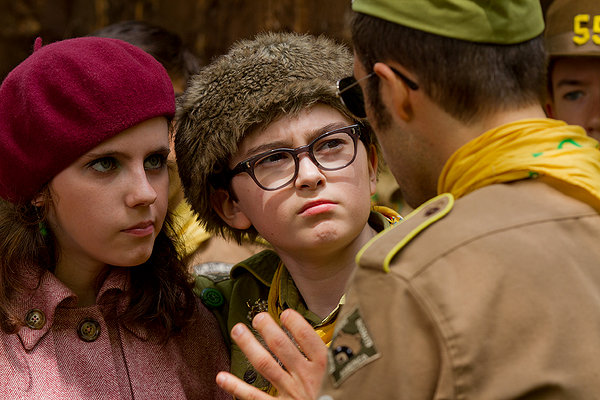 The first-time child actors do a credible job with carrying the film. Hayward and Gilman are charming and easy to like, though I wish Anderson had pushed his young actors a tad harder. They seem stiff at times and a little above-it-all in attitude. I applaud the kids for acting somewhat reserved rather than going crazy with their budding hormones. Both characters are also characterized as “emotionally disturbed,” though this seems like another of the film’s damning details about the out-of-touch adults dictating their lives. I just wished we sensed a greater degree of urgency from them about this whole adventure and the possibility of losing one another. They feel a tad blasé, all things considered.
The bigger celebrity names in the cast assume smaller roles, and many of the supporting characters are thinly sketched with personal conflicts mostly kept at a simmer. These are grownups that, at their heart, don’t know what to do with their feelings. Sam and Suzy feel liberated by their feelings. I found Murray’s blustery sense of anger amusing, and Willis does some subtle work to give you a sense how truly lonely his character is to the core, but it’s Jason Schwartzman (Scott Pilgrim vs. the World) who steals the show in my book as the fast-talking, mercurial, scheming Cousin Ben who seems to have whatever somebody needs. When he agrees to marry Sam and Suzy and acknowledges that their marriage will not be deemed official under any court whatsoever, you get a sense that Moonrise Kingdom has been missing a propulsive and delightful character like Cousin Ben. I wish he had been inserted earlier, but this is Sam and Suzy’s movie, after all.
It’s not on the same level as Rushmore of The Royal Tenenbaums (my favorite Anderson films), but it’s a film that feels a lot more alive and emotionally resonant. It feels like a return to form for Anderson, remembering that the characters and their drama need to be as engaging as the set design. The turbulent young love of Sam and Suzy is sweet and leads to some tender yet poignant moments that warm the heart without making you overdose on cheap sentiment. The idiosyncratic touches are all there, the ironic humor, and the stellar soundtrack selection (Benjamin Britten’s deconstructive orchestral marches stand out as a thematic core), everything you’d expect from a Wes Anderson movie, except this time you’ll find the characters recognizable, their struggle compelling, and the end rewarding. Moonrise Kingdom isn’t the most substantive film playing in theaters but damned if it isn’t the most alluring, amusing, and affectionate, yet all on its own terms. Who would have guessed that a pair of twelve-year-olds would help us show what real love is in 2012?
Nate’s Grade: A-
Share this:

We Need to Talk About Kevin (2011)
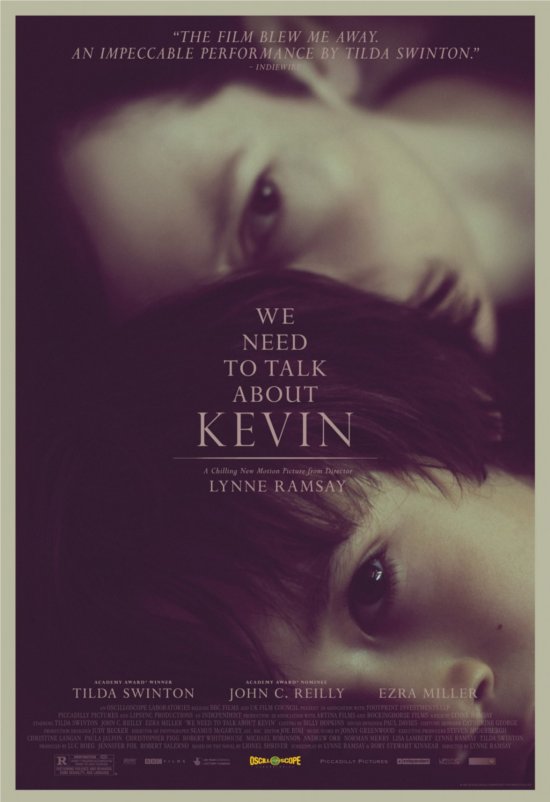 If you’re contemplating having children, then We Need to Talk About Kevin may not be the movie for you at this moment. It takes a stab at the nature/nurture debate and proposes that some children are just born broken and beyond the reach of even the most dedicated parent. It’s not exactly the cuddly message we get from most stories about the joys of parenting, but We Need to Talk About Kevin is a startling, provocative, and powerful portrait of grief, aggravation, and slowly dawning horror. Can even a mother love her monster?
Motherhood has not been the rewarding venture as promised for Eva (Tilda Swinton). Kevin (Jasper Newell at a child; Ezra Miller as a teen) wails so incessantly as a baby that she seeks out the sweet sounds of a jackhammer to drown out her shrieking babe. Even as a toddler, she knows there’s something just not right about her sullen, uncommunicative son. He seems to deprive her of any affection or attention she might find gratifying. Truly it seems much of Kevin’s motivation in life is to humiliate and torment his mother. It starts with being deliberately unresponsive as a child, and turning on a dime when in the presence of his father, then to delayed toilet training because he seems to enjoy making his mother clean up his mess (metaphor?), to the unexplainable massacre at her son’s hands. We Need to Talk About Kevin is an immersive experience, occasionally piling on how irredeemable Kevin is as a character. It also speaks to the unreliable nature of our shell-shocked point of view. It’s a disquieting film to say the least but I found it riveting and compelling at every second, artfully exploring a form of grief and social isolation that few will ever be able to fully understand.
 There’s tremendous psychological detail to this nightmarish parenting tale, and it’s those details that make the film feel eerily authentic and not exploitative. I found it fascinating to be drawn into this world, like I was watching an intimate, illustrated case study come alive. I found it very telling that after Eva accidentally injures her son in a fit of frustration, she apologizes but can only bring herself to do so under the shield of third person, saying, “Mommy shouldn’t have done that,” rather than, “I shouldn’t have done that.” And then when they get home, little Kevin unspools a perfectly believable story to cover-up what really happened. Even at six this kid is a shockingly adept liar, possibly because he’s a budding sociopath. Horror movies have been bringing us little pint-sized terrors for decades, from Bad Seed to the Village of the Damned, but those wicked kids seem like child’s play compared to Kevin, a startling, vacant child who is the scariest of the bunch exactly because he feels completely real. No Satanic imagery, glowing red eyes, or over-the-top associations needed; this is one messed up kid.
Watching this tumultuous and combative struggle for domination is equal turns compelling and terrifying. In many ways Eva adopts the role of Cassandra, the Greek figure cursed with visions of the future that nobody believed; Eva warns the people in her life that Kevin isn’t right, that he’s entirely capable of great evil, yet everyone ignores her dire warnings, and even Eva is culpable to some degree of enabling. Rather than discipline Kevin or stick to her principles, she passively accepts the situation and carries on with full knowledge that Kevin is going unchallenged. To everyone else he seems like a bright, helpful, normal teenage boy, which is why dear old dad (John C. Reilly) is so condescending and dismissive when Eva voices concern. Parenting is supposed to be instinctive, right? Eva feels like a failure, that this young soul has been steered to the dark side under her watch, and I think her hesitation to continue ringing alarm can be summed up by the fact that she’s just exhausted, tired of fighting a fight that everyone else ignores. I think she may also be desperately hopeful that she can ride this out, that it’s only a phase for her son, that somehow he’ll grow up to be a normal, loving child through some miracle, like a switch will be flipped. The only time Kevin ever shows his mother compassion is when she reads him a bedtime story involving archery, a hobby that would prove deadly.
The film is told non-linearly as we observe the fragmented memory of Eva. We have to pick up the pieces of life much like Eva recovering from her son’s destruction. It’s interesting to discover the symbolic connections between scenes, the connective tissue binding the memories together, and director/co-writer Lynne Ramsay (Ratcatcher) does an exceptional job of filling in key details to enrich this woman’s horrid life. The scenes don’t seem to last long, but Ramsay and her team provide all the meaning and weight we need so that the scenes matter. There’s a heavy amount of dread suffused into every scene in this movie, as the totality of events starts to become clear. The metaphors aren’t subtle but they are effective. Prepare for a lot of red in the color palate: squashed tomatoes, strawberry jam, splattered paint across Eva’s front porch as an act of vandalism. She spends the rest of the movie trying to clean away the red stains on her home (see what I mean about subtlety?). The splintered narrative also serves as a statement on Eva’s frame of mind, trying to move forward but haunted by a tragedy that goes down to the marrow.
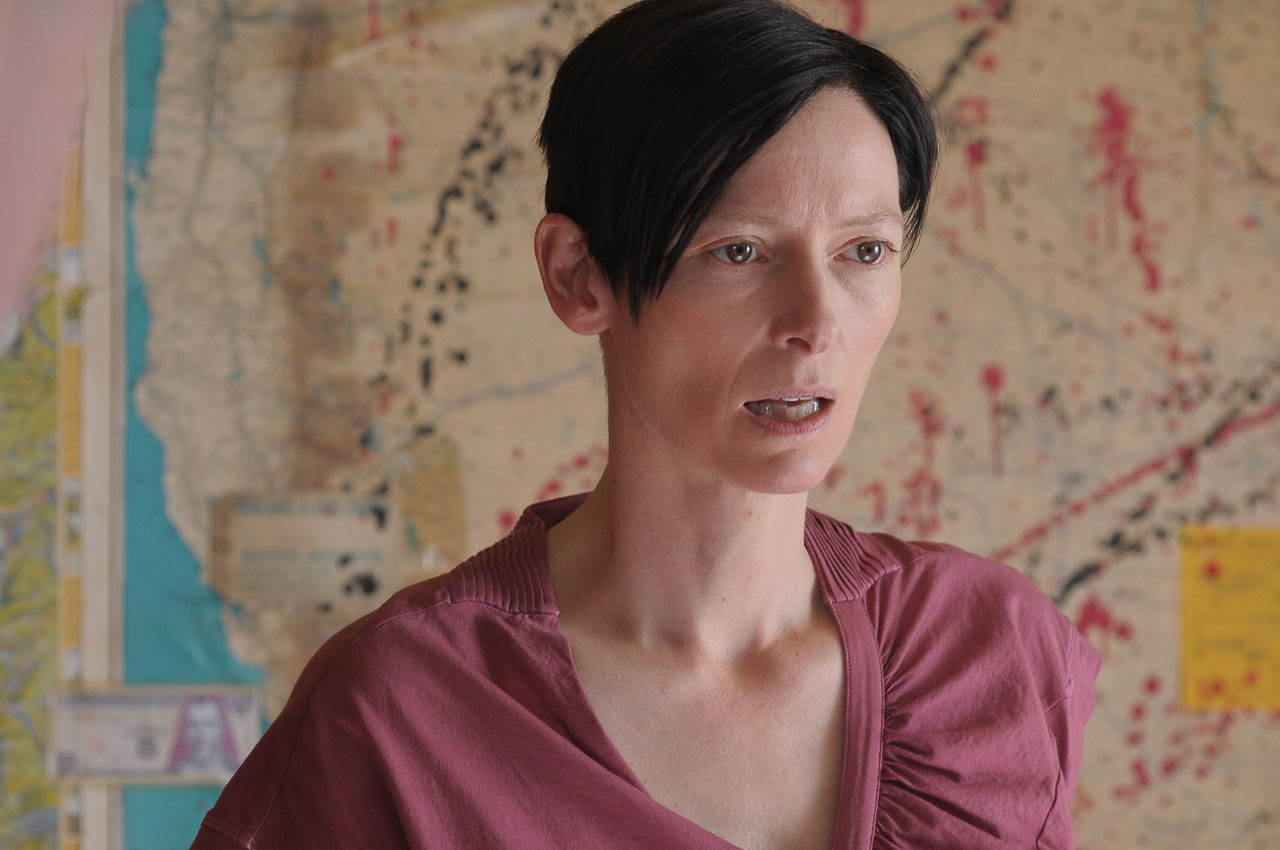 And of course all praise of the film needs to also be placed at he feet of versatile actress Tilda Swinton (Michael Clayton). She’s not given many lines of dialogue but what she is able to do to make her character feel fully lived-in is astonishing. There are so many different points of her life to play, from young exuberance to growing disdain to zombie-like pariah, and Swinton doesn’t strike one false note. Even during her grief and guilt she doesn’t go into hysterics. This is a woman that simply wants to waste away and be forgotten. Even when it looks like she might find some small measure of satisfaction or affection from another person, the movie sucker punches you. You realize that her son may be in jail but she’s serving a sentence all her own. Swinton is heartbreaking and subtle and nuanced even when it appears she’s simply staring off into space. You don’t really want to be in this woman’s head, and yet Swinton’s performance puts us there, hence all of my analytical assessment above. She’s a mixture of self-loathing, denial, bitterness, and penitence, and Swinton gives us telling glimpses of the storm below the surface. Her guilt is eating her away from the inside out. I’ll go on record and say it’s a crime that Swinton wasn’t nominated for a Best Actress Oscar (I personally apologize for not nominating her for the PSP Silver Cines).
I feel the need to talk and talk about We Need to Talk About Kevin, to sing its despairing praises, to encourage lovers of challenging, complex, and emotionally devastating film to experience this exceptional movie. It’s psychologically rich, bold, and revealing with even the smallest details to round out this hellish family scenario. It’s not an easy two hours to sit through, not by a long shot, but there are certain rewards for those who choose to wade through the darkness, Swinton’s haunting performance among them. This is a difficult subject and it’s produced a difficult film, but sometimes we need to be put in uncomfortable circumstances to get at a greater truth. What is the greater truth of the film? Maybe that parenting is really, when it’s all said and done, a leap of faith, maybe that avoidance of hard decisions is no solution, and maybe that some people are just beyond redemption. A movie that makes you think? Somebody ought to talk about this one.
Nate’s Grade: A
Share this:

Hysteria (2012)
 The birth of the vibrator doesn’t seem like a tale that demands telling until you realize that the most prolific sex toy of all time started during one of the most sexually repressive cultures, Victorian England. In 1880, the plague of the era was a malady known as “hysteria.” Half the women in London seemed to suffer from this condition where, as the doctors of the times believed, a woman’s uterus had become unaligned and needed to be properly readjusted; the readjustment produced a “paroxysm” of relief. To treat hysteria, these trained professionals would oil their hands, insert them inside a woman’s vaginal canal, and apply alternating pressure. They were getting these women off. Hysteria presents a charming document about the invention of the vibrator, a miracle of modern science. However, I wish the movie had taken a more mature approach to the material.
The alignment process was an arduous one, and Dr. Robert Dalrymple (Jonathan Pryce) needs a new set of hands. Enter Mortimer Granville (Hugh Dancy), a crusading young doctor who butts heads with the medical establishment over things like washing hands and germs. Under Dr. Dalrymple’s tutelage, the practice is never busier, relieving upper class women of hysteria. It’s going so well that Dr. Dalrymple would like to eventually pass the practice on to his young protégé, as well as his proper young daughter, Emily (Felicity Jones). Then there’s the doctor’s other daughter, Charlotte (Maggie Gyllenhaal), who clashes with authority, is outspoken about women’s suffrage, is critical of the limited role women play in society, and devotes her time to a lower-class shelter to provide refuge and education to those in need. She represents a brand-new kind of woman in time, and Mortimer cannot get a handle on her. Mort is suffering some pretty serious hand cramps from his line of work when he gets a splendid idea from his childhood friend and amateur inventor, Edmund St. John-Smythe (Rupert Everett). It seems with a quick fix, the electric feather duster may have other more scandalous uses.
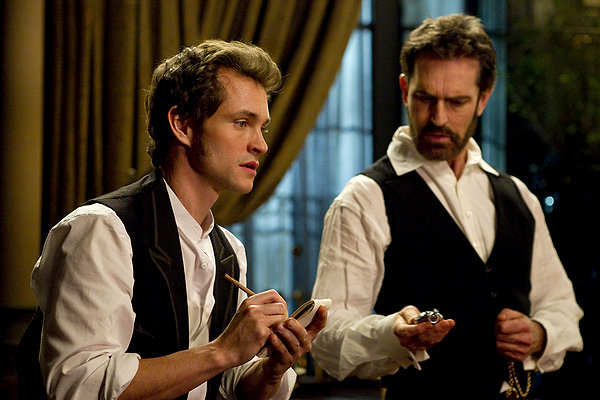 Hysteria is short of being hysterical but it’s certainly charming and provides an interesting history lesson with a light touch. The very nature of women’s hysteria is a fascinating moment in history where men were bending over backwards to find medical assessments for what is, in essence, horniness. The fact that these women’s doctors were getting carpal tunnel from all the manually stimulation of their clients has got to be one of the strangest workplace hazards. In certain regards, the invention of the vibrator has saved lives, or at least the hands of medial practitioners. It’s probably also made a whole lot of women a whole lot happier. Feminine sexuality was just an obtuse concept to the well-educated men in charge. One character says, with absolute certainty, that women cannot achieve sexual pleasure unless through insertion. As another fun historical note of male ignorance when it comes to female anatomy, when Deep Throat was being banned in the U.S., the federal judge who deemed it obscene cited, in his writing, that one of the many dangers of the provocative flesh film was that it mistakenly exposed women to the idea of an orgasm without insertion. This is almost 100 years later and yet men in high places of power are still carrying on complete ignorance of something they very literally know very little about. In that regard, Hysteria is jolly fun as we watch women get their jollies. There’s always something fun about watching uptight characters cut loose, especially when they find pleasure that has been denied them.
Having a talented cast is also a benefit when you’re working in comedy. Dancy (Adam) plays our straight man with fine properness. He has a few moments where he gets to delightfully squirm thanks to bold women and bold topics. He’s got some solid chemistry with Gyllenhaal (Crazy Heart), who is the feisty spitfire we expect in this sort of movie. Gyllenhaal is charming without being obnoxious, and her English accent is impeccable. Pryce (G.I. Joe: Rise of Cobra) and Jones (Like Crazy) are funny in their understated, stuffy British formal way, while Everett (Stardust) provides a great comedic jolt as the self-possessed, blithe technophile, ready at a moment’s notice for a good wisecrack. Sheridan Smith (How to Stop Being a Loser) also deserves special mention as a maid who was formerly employed as a prostitute. Her randiness is a nice counterpoint to all that Victorian repression and she pushes the movie further into sex farce.
While amusing, I wish the filmmakers would have taken a, dare I say it, more mature approach to a very interesting subject of history. The structure and very aim of the movie is that of a typical romantic comedy, which is a shame given the atypical subject matter. It’s pretty much a romantic comedy transplanted to merry old England. Much of the humor of the movie is divided into two camps: 1) watching the uptight Victorian-era Brits cut loose with decorum, or, 2) self-aware humor about the ignorance of the age. The first is always fun since we’re watching people sneak their true feelings through the wall of social repression. Director Tanya Wexler makes sue of a lot of sight gags and heartily enjoys cutaway reaction shots of ladies going orgasmic. It’s enjoyable but the fact that Wexler has to keep going back to the reaction shots for jokes, it loses its effect. Then there’s the self-aware humor built entirely upon dramatic irony, where the writers tweak the knowledge of a bygone era with all of our clever foresight: “Oh those stupid Victorians, not believing in things like germs and female orgasms.” After a while, the self-aware humor becomes tiresome. We get it; these silly Brits did not understand female health and proceeded to rule in their ignorance. I wish the movie left behind the easy jokes for some stronger social commentary. To this very day, we have men legislating women’s bodies and their reproductive rights (see: Oklahoma saying life begins weeks before conception, or Virginia demands medically-unnecessary vaginal probes for no other purpose than to shame women, and so so much more…). Ignorance knows no end, and one imagines the rom-com that makes fun of our current social mores and understanding.
 It’s during the last act where Hysteria really starts to come apart at the seams. Beforehand, it’s been a fairly light comedy with some punctuations of commentary from Charlotte and her idealistic desire for equality. But then, and spoilers will follow, the movie suddenly transforms into a courtroom drama with Charlotte on trial. Her very mental health is on trial and if she’s found to be a hopeless case of incurable hysteria, then she’ll be shipped to a sanitarium and have her uterus forcibly removed. Wow. That is some heavy stuff for a movie that spent an hour making sex jokes. The courtroom setting leads to some pretty transparent speechifying; any subtlety goes out the window and we listen to messages about women’s suffrage, equality, and empathy. This conclusion feels like it was ripped from another movie. It’s tonally jarring. Then, after our lead takes his moral stand and confesses to his belief that there is no such thing as hysteria, that women are just stuck in sexually unfulfilling relationships in a sexually repressed age, everyone goes home to think about life. Then, thirty days later when Charlotte gets out of prison, she’s met by Mortimer where he, I kid you not, proposes to her on the spot. For a movie about breaking misconceptions about women, tying things up with a marriage proposal seems almost hypocritical. It also marks a pretty big leap in the burgeoning romantic relationship between Charlotte and Mort. It seems rushed and a strange way to end a movie about female empowerment. The rom-com elements have won out over any higher messages.
Hysteria starts strong but goes limp. Hysteria runs out of juice. Hysteria is a pleasant experience but doesn’t deliver a proper climax. Hysteria is not the feel-good movie of the year. The very nature of the movie lends itself to all sorts of innuenduous critical blurbs. It’s a rom-com transplanted to Victorian England and I wish that it tried a little harder with the material rather than settling for easy jokes relying upon the ignorance of the age. The cast is superb and the movie is certainly fun, but it falls apart in the end when the messages overtake the narrative. So what is the best Hysteria blurb? I’ve had better.
Nate’s Grade: B-
Share this:

Like Crazy (2011)
 The prevailing thought I kept having while watching the twee indie romance (?) Like Crazy was that this is like silly. I spend fifteen minutes with the young happy couple, Jacob (Anton Yelchin) and Anna (Felicity Jones), and then there’s already trouble. Rather than have to wait two and a half months to see one another again (a.k.a. eternity), Anna decides to overstay her visa because it’s not like that would be taken seriously in a post-9/11 world. Naturally, there are repercussions and Anna is banned from reentering the U.S., effectively putting a hitch in her romance. It’s such a short-sighted, impulsive, boneheaded decision, and it’s one that completely made me lose all sympathy for a couple that couldn’t bother to be apart for a mere two and a half months. Jacob and Anna try and hold it together but the constant starting and stopping, as well as the comforts of people closer, provide major roadblocks. I’m not a hardhearted person; I’m a sucker for a good romance. Many of my favorite movies of the past few years have strong romantic elements (Eternal Sunshine, Once, Moulin Rouge, WALL-E), but I felt next to nothing for this whiny, pitiful couple. First off, they’re only together for fifteen minutes before being ripped apart, which doesn’t exactly allow me enough time to emotionally engage. And then there’s the fact that these “crazy kids” have absolutely no passion between them, no spark, no nothing that would compel them to be together against all odds. You don’t feel anything approaching romance. And to top it off, Jacob has a perfectly lovely, charming, and available alternative played by the lovely and charming Jennifer Lawrence (The Hunger Games). She even makes this doofus breakfast in bed. This movie felt like an entire montage of small moments that never accumulated into anything believable or compelling. I’ll take Lawrence and breakfast in bed and be grateful.
Nate’s Grade: C
Share this:

Bernie (2012)
 The last person the residents of small town Carthage, Texas would expect to be tried with murder would be Bernie Tiede (Jack Black). He was an assistant funeral director, a “born natural” we’re told at comforting others, but he was really the everyman glue of the town. He lead the choir at church functions, loaned his time and money to those in need, directed the town’s fledgling drama productions, coached the Little League team, and went out of his way to spend time with the town’s lonely little old ladies. It was a shock then, in 1996, to find out that Bernie had shot one of those little old ladies, Marjorie (Shirley MacLaine), the meanest one of them all, and stuffed her body in a freezer and kept it all a secret for nine months. During that time, Bernie used Marjorie’s considerable fortunes to help every community project he could. Despite the macabre nature of the crime (she had to thaw out for two days before an autopsy could be performed), the residents of Carthage rallied around their boy, Bernie. District attorney Danny Buck (Matthew McConaughey) had to move the trial to a different venue, not because the accused couldn’t get a fair trial, but because everyone in town wanted Bernie free.
Bernie is Richard Linklater (School of Rock, Dazed and Confused) returning back to his local color roots. The man is excellent at taking the natural peculiarities of regionalism and credibly establishing a slightly skewed yet authentic portrayal of small town Middle America that feels like it was lifted straight from the pages of Mark Twain. Aiding Linklater is the fact that the movie is composed like a true crime special replete with on camera interviews from many of the real townsfolk of Carthage who knew the real Bernie and Marjorie (what a strange experience it must have been acting with the fictional counterparts). They are all amusing, unassuming characters in their own right, many natural scene-stealers, and they’re still fiercely protective of Bernie 15 years after the events of the movie. The town’s unswayable loyalty and adulation for Bernie pretty much becomes the film’s own point of view. Despite confessing to murder, we find ourselves liking the guy. It’s hard not to love the guy when we see him lift the spirits of the bereaved, volunteer around town, and bring so much pride and joy to the citizens of Carthage. When forces are circling around him, we want him to escape. We want him to keep the illusion of Marjorie being alive just a little bit longer, especially when, in death, she is helping so many more people. Even when we reconcile the facts our gut still wants him to get slapped on the wrist for what is, after all, a capital crime. It’s a fascinating emotional journey for the audience in that regard, to ignore the reality of the offense because of how genuinely nice Bernie is, except for that time he killed an old lady and stuffed her in the freezer.
 Black (Tropic Thunder) does something completely different from his usually manic routine. By God, the man inhabits this character. The part plays to his strengths as a performer, his energy and natural likeability, but allows him to mellow out and try a very different tact. For the first time in perhaps his acting career, he’s not playing some variation of Jack Black. He’s playing a real-life person, though that doesn’t necessarily mean the actor is indebted to completely mimicking the living inspiration. Told from the perspective of fawning townsfolk, and one completely mystified prosecutor, Bernie remains something of a mystery as a character. He’s deeply repressed, probably closeted as well, and it’s that distance that keeps us from better understanding him. For all intents and purposes, the people of Carthage loved Bernie, but did any of them really know him? He was a genial presence, charitable and kind, but could anyone really say they truly knew him? Who is the real Bernie, the guy who would break his back helping his neighbors out of the good of his heart, or the guy who shot a little old lady four times in the back? Black doesn’t overplay the fey mannerisms or go to camp levels; he hides behind his friendly veneer and hints at more at work. Bernie’s canny salesmanship with funerals, as well as his lavish spending when he got in control of Marjorie’s finances, give a glimpse at a darker side of Bernie. It’s subtle work for a role that tempts him to go larger. I have no reservations when I say that Black’s controlled yet charismatic performance is worthy of Oscar attention. He’s that good, folks.
Supporting Black are two other great performances from established stars. MacLaine (Valentine’s Day) hasn’t had a role this good since the underrated In Her Shoes. She has great fun as the old sourpuss in town, but she too shows us glimpses of the real Marjorie, the one behind the wall of negativity. There’s a scene where she’s watching Bernie’s musical practice and she can’t help herself but smile. The very act has to break through the scowl that she has so permanently etched into her face, but break through it does triumphantly. MacLaine could have easily been portrayed as a caricature of the grouchy rich old lady, but she’s better than that. You don’t exactly sympathize with her but you do feel Marjorie’s budding comfort, even if it’s slathered in her usual contempt, and you feel her desperation at clinging to the one person who has shown her any personal interest. Likewise, McConaughey (The Lincoln Lawyer) could have been the one-note daffy lawman, and he’s certainly presented as such early on with his attention-seeking theatrics. We don’t really like Danny Buck, but from an objective standpoint he is the voice of reason. He counters the easily forgiving townsfolk, “If he killed you and stuffed you in a freezer, would you not want him to go to jail?” We know he’s right. And yet, strangely, we don’t seem to mind that much. It’s nice to see McConaughey flourish in a role that shows you he can be a real fine actor instead of just a real fine shirtless torso.
 Linklater balances a lot of different tones here but manages to find a satisfying middle ground. Bernie is a chuckler, a movie that will continuously make you laugh but leave your sides safe from splitting. I chuckled and guffawed my way through from beginning to end with great amusement. The comedy is dark but not unrepentantly (hence the PG-13 rating) or mean-spirited. Linklater doesn’t make light that a real woman was murdered, but his film raises a cracked mirror at the absurdities of our culture and the power of charisma/celebrity. There’s a mordant amusement to the entire movie, and you know you shouldn’t be laughing but you cannot help the urge. The constant interviews with the actual Carthage townsfolk add a nice color commentary to the proceedings, filling in the edges of the blanks left over by the screenplay. Some may feel that the constant commentary undercuts the movie, interrupts its flow and turns the movie into one of those grisly TV true-crime specials gussied up for the big screen. The movie does follow a similar trajectory but Linklater balances the small-town satire, tragedy, courtroom drama, and general morbid curiosity into one persuasive, cohesive whole.
Bernie is one of those stories that are so bizarre that it could only come from real life. Buoyed by strong comedic performances, a mordantly compelling story, and some rich supporting turns from real-life witnesses, Bernie is an amusing breath of fresh air amidst the summer movie-going extravaganza. It’s gentler than I would have anticipated, and funnier, and Black’s wonderful performance is worthy of serious awards attention, though I know it will be long forgotten come the fall. I don’t think Linklater was trying to make some kind of larger statement about the powerful allure of charisma, or our malleable sense of what constitutes right and wrong, but Bernie the movie is all about the fronts people put out there and the human willingness to be deceived. Or it’s just a really fun, country-fried slice-of-life comedy. Why not both? Bernie is worth discovering.
Nate’s Grade: B+
Share this:

The Raid: Redemption (2012)
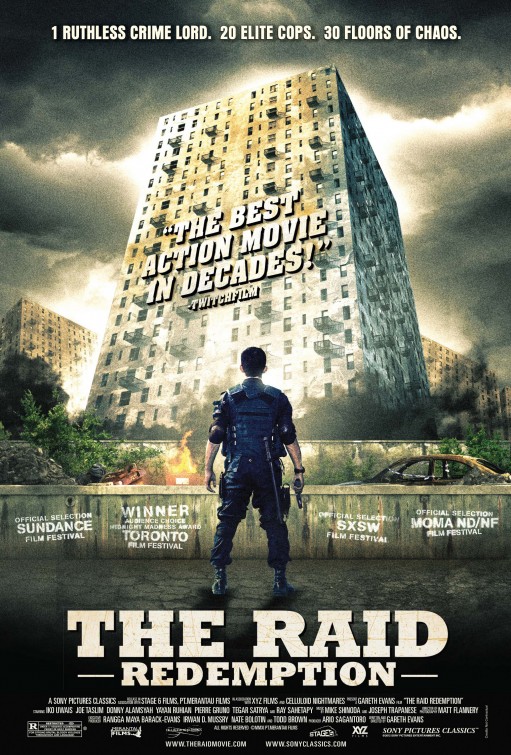 If you’ve been let down by flaccid Hollywood blockbusters in the action department, then give Indonesia’s The Raid: Redemption (part one of a planned trilogy) a try. The movie is like 90 minutes of getting kicked in the face, but in the best possible way. The flimsy premise almost seems like that of a video game. An elite forces police team storms the tenement building of a crime lord. He traps them inside and alerts the unruly residents there will be a reward for whomever takes out the cops. Each floor presents a new level of danger, from machete-wielding gangs to thugs that could show Bruce Lee a thing or two when it comes to wizardly martial arts. When the action is pumping, you feel every electric second of it. Writer/director Gareth Evans uses every part of the buffalo when it comes to action cinema. He kills guys in ways you didn’t know existed. The action is brutal and often relentless, but Evans draws out scenes organically, making fine use of geography. Guys will break through walls, jump down floors, blow up gas tanks, and use everything from filing cabinets to broken doorframes to and florescent light tubes as weapons. It’s a thrill to be able to take in the beautifully balletic choreographed fight sequences; there one that goes on for seven minutes and should already be considered an all-time Top 5 contender in movie history. There’s a fairly pedestrian plot about police corruptions and some family connections, but that’s just gristle. The real meat is the action. It’s so exhilarating and gratifying that the rest is meaningless. The Raid is the best video-game-turned-movie ever, and I don’t even care that it was never a video game. Have you seen these special movies?
Nate’s Grade: B+
Share this:

October Baby (2012)
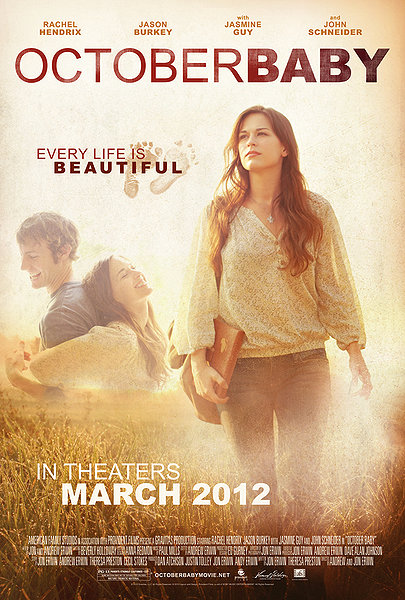 Abortion and the rights of choice are topics that inspire intense feelings on all sides. October Baby is the latest evangelical movie to be funded by Provident Films, who gave us Courageous and Fireproof. The directing tandem of Andrew and Jon Erwin take a more melodramatic approach, focusing on the aftereffects of not just abortion but also the aborted.
Hannah (Rachel Hendrix) is a 19-year-old college student who collapses during the opening night of her big play. She learns from her family doc that her parents (Jennifer Price, John Schneider) have been keeping some pretty major secrets from her. She was adopted. She was the survivor of a failed late-term abortion. Also, she had a twin brother who did not survive the abortion. Suddenly Hannah’s physical and mental maladies make sense, and she’s determined to seek out her biological mother and find out more about whom she is. Her lifelong best friend, Jason (Jason Burkey), invites her on a road trip to New Orleans, and the two of them veer off to Mobile, Alabama to look for her mother. Over the course of Hannah’s journey, she will come face-to-face with the mother that tried to abort her.
 Like other heavily funded Christian productions, this is more of a message than a movie, which is a shame because it had the potential to rise above. I guess there are no spoonfuls of sugar accountable when you’re dealing with a subject as painful and raw as abortion. I’ll give October Baby credit for being less interested in sermonizing. Oh sure, you’ll never doubt where the movie stands on the issue and where it wants its audience to go. The fact that a former clinic nurse can recall, in graphic detail, a procedure that was done over 20 years ago seems a tad suspicious, but credit actress Jasmine Guy (TV’s A Different World) for nailing this scene. The movie makes a more sincere, modest approach and sidesteps the overt proselytizing of the Kendrick brothers’ pictures like Fireproof and Courageous. It’s a fervent melodrama, yes, but it doesn’t push its message in your face. The issues of faith are seemingly kept to a minimum. Though soft-pedaling the admittedly traumatic story of abortion into a dewy coming-of-age movie seems like a disservice to the drama at play. This is more than one girl just finding out where she came from. This is more than just a routine road trip. This is more than tropes and clichés. This is about the pain of making agonizing decisions and living with them. What about Hannah’s biological mother? There’s a wealth of dramatic potential there as mother comes face-to-face with the teenage daughter she decided to abort. Just having her reject Hannah all over again to later cry against a doorway seems like a lousy use of screen time. Clearly this woman did not come to this decision impulsively. And yet, October Baby is less interested in exploring the realities of abortion than ascribing psychological torment to all parties (the mother, the baby, the nurse, etc.) and providing a clear, and somewhat contrived, road to redemption and forgiveness.
If we’re going to feel for these people, they need to feel like recognizable people and not as mouthpieces for message points. We’re told via Hannah’s journal that she’s deeply depressed and contemplating suicide. However, this mental misery does not match the Hannah we have seen on screen at all. I also find it really hard to believe some of her ailments. I’ll buy that she has long-lasting physical problems from the failed abortion, including asthma, seizures, and hip issues that require surgery. What I don’t buy is that somehow the act of abortion left a psychic scar on this girl and she has gone her entire life feeling unwanted, which is more than a little specious considering her adoptive parents have been unwavering in support and paid for all those costly operations. It’s not too long before we realize that Hannah is really just the formless mass of producer ideology. She makes weird decisions, like forcing her platonic friend to sleep on the floor when they have to share a hotel room, and then after blurting out, for no reason, that she is a virgin, she leaves the room that she paid for to sleep on a couch in the lobby. And her platonic friend joins her, so it’s acceptable for them to sleep side-by-side on a couch rather than a bed? That makes no sense. Hannah doesn’t feel like a person, more like a series of plot points in human form, and her ridiculously happy ending seems a tad disingenuous given the dramatic reveals this woman has endured. Her anger would feel more justifiable if she were more represented as a character.
Let me deal with the romantic relationship with Hannah and Jason. They’re life-long best friends and the movie even opens with them as smiling children, holding hands and racing to jump into a lake. You can only imagine where the two of them are destined to end up. He even has a standoffish girlfriend (Colleen Trusler) that doesn’t like the amount of time Jason spends with his “friend” Hannah. I believe that her resentment is well deserved considering how Jason dances around the truth of spending time with Hannah, often falling back on the shady vague rationalizations, “hanging with… a friend… doing… nothing.” As much as Hannah lacks proper characterization, besides being victimized, Jason is also every sweet, nice, good guy trope rolled into a human being. He’s less a person than a human-sized version of a loyal puppy ready to lap at her face. He never seems to have any interests or desires or goals other than being there for his dearest platonic pal, and even when she’s behaving like a mad woman, he sticks by her. Their eventual coupling is so chaste and passionless that, while inevitable from the opening image, makes little in the way of payoff. Both of these people are rather bland and nice, so why not be bland and nice together and have bland and nice children who will marry their spouses before they sleep in the same bed together (couches are another story). For a story about teenagers ignoring their parents’ wishes and getting into trouble with the law twice, including breaking and entering (because really abandoned hospitals leave behind all their patient info), there’s nary a hint of danger or excitement.
 October Baby looks a lot more professional than the other notable Christian releases that have found themselves in the mainstream marketplace. The photography is actually quite good, bathing Hannah’s journey in an amber, honeyed glow, and the Erwin brothers have a knack for visually pleasing compositions. Their background in music videos really shows, especially during the movie’s montage sequences. The music, on the other hand, is horribly redundant; lots of twinkling pianos and soft acoustic guitar. Former 2007 American Idol contestant Chris Sligh contributes several low-key tunes to the soundtrack and actually plays the overweight driver for the road trip. He’s fat, so you know he’s going to be a source of comedy, though you’ll be hard-pressed to realize it.
Acting-wise, October Baby is also a step up from what we’ve seen recently. Hendrix (Alumni), despite a somewhat surly characterization, is quite able to handle the many, many crying moments she’s run through. She’s got a fresh face and hopefully she’ll find her footing in the film world. She at least deserves to have as big a career as Kirk Cameron. Burkey (For the Glory) does earnest well and that’s about the only note he gets to play. Schneider (TV’s Dukes of Hazard) provides a calming presence, even though his beach bum haircut felt off-putting for a surgeon. I kept staring at Schneider onscreen and thinking how strangely he resembled Beau Bridges (The Descendants). The best actor in the movie is Hannah’s biological mother played by Shari Rigby (Easy Rider: The Ride Back). Sure she gets a crying jag all her own, but the actress underplays the mixed emotions upon the confrontation with her past. I wish the movie had concentrated more on this storyline, and more with this actress. The closing credits include a touching interview with Rigby where she confesses relating to her character and the abortion she had in her youth. Those brief couple minutes come across as more honest, engaging, and moving than any of the fictional drama that preceded it.
When the topic concerns abortion, it’s always going to be a controversial movie no matter the stance. October Baby is not exactly nuanced but it’s a lot gentler than I ever would have imagined. The entire movie takes a cue from its bland but pleasant leads and produces an overwhelmingly bland but pleasant enough experience. There’s no demonization of pro-choice people and few scenes of absolute sermonizing. Clearly the movie has an agenda but it doesn’t feel so overwhelmingly dogmatic. It’s not exactly going to make people rethink their political stances on a hot-button issue, but then again a rather humdrum story with characters that don’t feel recognizably human is only going to affect the audience members who are there for the message, not the movie.
Nate’s Grade: C
Share this:

Jeff, Who Lives at Home (2012)
 This lumpy, amiable shaggy dog story from the Duplass brothers is another earnest, warm-hearted comedy that marries their signature family dysfunction, mumblecore quirk to a larger, more mainstream setting. The Jeff (Jason Segel) in question is a 30-year-old slacker, who indeed lives at home, and awaits signs from the universe to guide his decision-making. Incidentally, his favorite movie we learn in a monologue set on a commode, is Signs. His older brother, Pat (Ed Helms), is a selfish twit and embarks on a quest, with Jeff, to discover if his wife (Judy Greer) is cheating on him. The boys mother (Susan Sarandon) also has a nice storyline where an anonymous admirer is sending her flirty instant messages at work. Watching her face light up as she processes being wanted, it’s a thing of beauty. The characters are all flawed, and for some they may be too annoying to sit through. The film has been accused of being aimless, but I was engaged with its plot, which kept ping-ponging from one cause to another effect scenario. The movie is really more a drama with some comedic asides, mainly due to Jeff’s stoner zen and Pat’s aggressive dickishness. Greer has an outstanding moment where she lets her character’s deep reservoir of unhappiness come out in a blinding moment of honesty, and it rang true to my ears. In fact, the entire movie feels true enough. And then it appears destiny reveals its master plan with an ending that makes your heart warm all over, championing Jeff’s mantra of optimism and interconnectedness. The simple, good-natured, sweet little movie is worth checking out.
Nate’s Grade: B


 nathanzoebl
You must be logged in to post a comment.