Blog Archives
Worst. Christmas. Ever. (2020)
 I implore all filmmakers to be cautious about titling your movies. When you use absolutes in your titles, it’s laying forth a claim that you better be able to back up, and when you also present easy-to-apply summations of your movie in the title, it’s another dare I hope you’re capable of meeting. Nobody should name their movie Waste of Time and make a pointless and lazy movie because you can already see the summary blurb that awaits. In the case of the new low-budget Ohio-made comedy Worst. Christmas. Ever., you better be plenty funny to avoid the obvious put-down, “Worst. Christmas. Movie. Ever.” Unfortunately, while this low-budget movie has energy and bad taste to spare, it’s woefully short on ideas, jokes, characterization, and fun.
It’s Christmas Eve in East Jesus, Ohio and Sophia (Raychael Lane) has learned that she is pregnant. Her loser boyfriend Trey (Leonardo Mancini) is the father, though he doesn’t seem like a good prospective parent as he’s shiftless and cheating on her with Madison Fatcheck (KateLynn Newberry). Sophia doesn’t know what to do and definitely can’t tell her mom and stepdad. We interact with different bizarre locals, drug dealers, trigger-happy cops, crazy relatives, and an ex-con mall Santa (Craig Brophy) who breaks into homes. Over the course of one long crazy night, Sophia must decide what she wants to do with her life and the possible new life inside her.
 There is a grand tradition of the irreverent anti-Christmas comedy, a holiday setting brimming with sentimentality. Whether it’s A Christmas Story or Gremlins or Bad Santa, there’s something appealing about undercutting all that holiday good cheer with a little irreverent fun. The problem with Worst. Christmas. Ever. is that writer/director Johnny Chechitelli (a credited writer for FOX Sports and UFC fights) settles too often on the easiest joke, that is, when there are jokes. Sometimes it feels like the film has just gone on auto-pilot, like an improv session gone awry. That drifting, directionless feel pertains especially to the characters, which are uniformly boring. There are some strong archetypes that have potential, especially a lecherous Santa up to no good. There are just too many disposable characters cluttering this narrative that seem to exist in their own alternate universe movies with too few jokes. The world of East Jesus, Ohio feels wacky but without forethought. This is the kind of movie where a former overweight girl has the last name Fatcheck, and apparently this factor is what defines her character. There are small moments of satire but they’re never really honed into a more coherent or clever message. The stepfather plays a violent video game as an armed Jesus shooting Santa Claus to death. A rap song about a bad Santa seems to revel in gaudy cliches without providing commentary or entertaining contrasts. The treatment of African-American characters seems to play tragedy as cheap comedy, setting them up for traumatic police encounters that lack commentary on racism or ignorance. Sophia goes off on a team of carolers for their religious beliefs, but the movie seems too timid to go further with mocking Christmas rituals or religious hypocrisy. There are ideas here, not all of them good, but rarely do the ideas evolve into sustained plot beats or jokes.
Let’s analyze one scene in particular and why it doesn’t work from a comedy standpoint and what could have been done with a little more attention. Sophia and her pal Noah (Chase Crawford) go to her boyfriend’s house. Sophia is defending him but Noah says he’s likely just sitting around and getting high. When they peek through the window, they find Trey sitting around with marijuana, and Sophia tries to excuse it, not wanting to admit that Noah’s negative characterization was correct. Then he smokes a pipe and a scantily clad Madison Fatcheck comes in and nuzzles up beside him. Trey sees Sophia watching and freaks out. I ask you, dear reader, where was the joke? The fact that Trey is a loser is already assumed, so that reveal isn’t enough. What could have happened was Sophia’s pained attempts to continue denying the obvious reality. Rather than catch her bad boyfriend with drugs and then a new girl, this scene could have been extended to make things even more ridiculous. He had drugs, but Sophia was saying maybe he was just sorting it, and then he’s using the drugs, and Sophia says well at least it’s not hard stuff, and then he breaks out a hypodermic needle and she says, well maybe he just needs an insulin shot. It’s a comedy scenario that prospers from escalating desperation and absurdity. It could have been funny. Instead, we’re given maybe one joke, which is obvious, and little else. There is a lack of creativity when it comes to the comedy construction throughout Worst. Christmas. Ever.
 There is a difference between a gross-out gag and something that is simply gross. Making your audience experience discomfort can be a useful resource for comedy, but you have to be aware of what the returns are for the indulgence. I’m reminded of a scene in Seth MacFarlane’s A Million Days to Die in the West where Neil Patrick Harris defecates into a cowboy boot. He’s humiliated, it’s extended, and the joke lands, but then McFarlane cannot help himself and has to show a two-second insert shot of the messy feces inside the boot. The joke would have worked best without literally getting into the muck. Think back on Dumb and Dumber with Jeff Daniels and his epic diarrhea sequence atop that unfortunate toilet. It’s all in the performance and the cascading and noxious sound effects. The Farrelly Brothers didn’t need to put us in the bowl. This brings me to our Worst. Christmas. Ever. because I think its uses gross shock humor to cover for its poor comedy efforts. This happens early with Sophia throwing up in a Salvation Army collection bucket. That alone works as a joke, but then the director puts us in the vomit and uses this image to put his credit onscreen. There it is, he seems to say, I’m the guy responsible for this mess. There’s another scene where a character pees into a toilet and we just watch multiple seconds of a stream of urine and then on the floor as well. I kept thinking that maybe the movie would come back to this, that taking so much time to set up pee on the floor would lead to an accident later, but nothing happened. I guess just the sight of urine was supposed to be funny, just like the sight of vomit in a bucket was supposed to be funny. This lazy ethos pervades the movie and is dispiriting.
There are crude animated sequences in Act One that I initially had hopes for. It’s a stylistic touch to separate the movie but it could also have been a smart way around larger set pieces that would have been too expensive. These are mostly confined to Sophia’s flashbacks about her dead father and then this device is never seen again after the 20-minute mark. The six-minute segment about her bad drug addict father using the last of his money on drugs, then robbing a convenience store to also use on drugs is simply not a story demanding six minutes of our time. It’s not funny and it’s not informative and it gets tiresome and repetitive. This same information could have been conveyed with Sophia through a monologue of why she hates the holidays and it would have had a more immediate and lasting emotional impact than an animated interlude. The animated segments reminded me of MS Paint but with more detail. The style is fine but the purpose is questionable. The story we get through the animation isn’t necessary other than it provides an additional six-plus minutes of running time to desperately get us to a feature-length.
 This brings me to the fact that this 80-minute movie is really only a scant 63 minutes long. The end credits begin shortly after the one-hour mark and from there we’re treated to short additional scenes for resolution and then bloopers and then an extended music video of our rapping Santa. The actual credits move at a snail’s pace to reach that magical 80-minute runtime. This is the problem with a scattershot narrative that doesn’t seem like it’s going anywhere. One could argue that Worst. Christmas. Ever. is not the kind of movie beholden to character arcs and great strides in personal growth but you still need to do something with the time you have as a storyteller. For a comedy, we need more escalation than some dead bodies by the end. There needs to be amusing complications, there needs to be struggles, and there needs to be variation. Worst. Christmas. Ever. has the feeling of watching several short films that have been stitched together with minimal care. The consequences feel as throwaway as everything else in this movie. There is a dearth of satisfaction by the end because it’s missing all the important things like clear goals, meaningful character development, and culminating gags built around careful setups and escalation. I was a bit flabbergasted by the movie essentially giving up at 63 minutes but also grateful for the end.
It’s my duty to find some highlights to praise for Worst. Christmas. Ever. and I think the cast is generally a strong asset. Given the low-budget nature, not everyone is quite so polished, but the amateurism actually adds an authenticity to the proceedings of making a real small-town indie in Youngstown, Ohio. Lane (To See the Moon in the Morning Sky) has a wholesome appeal as our protagonist. Brophy creates a welcomed impression as a sleazy Santa, and his rap skills aren’t too shabby either. The entire rap video sequence is actually one of the best in the film. The song production is more accomplished than I would have expected given the low-budget. By far the actor I enjoyed the most was Wantatah (The Con) as the stepfather. His performance is the one where the actor melts into the character and you see the least amount of “acting.” He just is, and it’s entertaining to watch his grumpy incredulity and then inebriated disasters. I hope Wantatah can get even more work from here that takes advantage of his fine comedy instincts and commitment.
 I’m not going to lie, Worst. Christmas. Ever. was a difficult movie for me to watch. Even at little over an hour, I struggled to keep my attention and I rarely laughed. More often I was befuddled at the sloppy attempts at comedy that too often settled on shock value and bad taste because it couldn’t be bothered to actually think about jokes. There’s a difference where poop is a funny joke and when it’s just gross, and this movie doesn’t quite comprehend that distinction. Frankly, there just isn’t enough going on here to merit your time. From a comedy standpoint, there’s little to leave you satisfied. I laughed more from Killer Raccoons 2. From a character standpoint, there are weirdos who get their individual scenes but the main character’s unplanned pregnancy feels like an afterthought for how little it pushes the other characters. Imagine Juno if nobody paid attention to Juno’s pregnancy. From a production standpoint, there are definitely limitations given the lower budget and the wintry Midwestern climate but this doesn’t lead to necessary creative ingenuity. This is more a premise and an attitude than it is a full-fledged movie. Worst. Christmas. Ever. peaks at its poster.
Nate’s Grade: D
Share this:

Moondance (2020)

I didn’t even plan on writing this review. I knew of the indie musical Moondance because I was familiar with several crew members who worked on the $500,000 project and watching their pictures on social media, but when I discovered it had been filmed entirely outside the state of Ohio, primarily in Kalamazoo, Michigan, I decided to exclude it from my mission to professionally review Ohio-made indies. As of this writing, it was available on the website Tubi for free with ads, so I started it on a whim to show my girlfriend what I had intended to watch, and then I kept watching, and then I didn’t want to continue but I felt compelled to, and now I feel compelled to dissect this movie as best as I can, even with its tangential connection to the Ohio indie film scene. Moondance is a confounding experience for a lover of big screen musicals because it’s a musical that doesn’t really want to be a musical, a comedy that doesn’t know how to do comedy, and a drifting drama bereft of characters to root for and reasons to cheer.
The story is familiar. We have our boy, in this instance Oscar (Jonah Robinson), a composer suffering writer’s block, and he meets our girl, Abby (Carolyn Rabbers), a dancer. Oscar is instantly smitten and tries tracking Abby down, while his “best friend” Pat (Sam Jones) schemes with his very David Rose-esque assistant Sean (Brandon Stewart) to have her for his own. In between these shenanigans, Cooper Flannigan (credited as “Self”) appears to be a hipster friend of Oscar but also the god of this universe as he routinely breaks the fourth wall and is played by the actual writer/director.
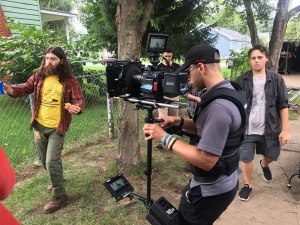
I have to give credit for anyone having the gumption to try and create a low-budget musical. That’s a tall creative order and unfortunately Moondance can’t quite match its toe-tapping ambitions. There are only four songs in the entire musical before the end credits (I’ll get to those later). By the 45-minute mark, I had only experienced one legitimate song-and-dance number and I was wondering if the reality of this movie had simply abandoned being a musical. There are a couple additional dance numbers as one would expect with Abby being a dancer, some set to performances from musicians, but for the first hour there are only two honest-to-goodness moments where characters break out into song. Why is there no opening musical number that introduces the different characters and their different perspectives, stations, plights, goals? That would be an economical way to establish the world and its players. There seems to be real hesitancy onscreen with embracing its musical identity. The musical numbers are meant to give us insight into the characters who can’t help but blurt out their feelings, and yet during the requisite boy-and-girl-on-the-outs part, there is no musical number. There isn’t even a musical number for their growing affection for one another. We’re missing a love theme, and for a romance-heavy musical that’s meant to evoke the feeling of Old Hollywood, that seems like a massive oversight.
The staging and performance of the musical numbers, when they do appear, can also be underwhelming and counter-productive. From a choreography standpoint, much more emphasis is placed on the background players including a superfluous “intermission” dance. There is one number where the key characters do little more than literally ride a bicycle in a circle, and I would argue this is the best number in the film. There is more dancing than singing and that seems the primary reason why Rabbers was chosen as the lead female role. She certainly has talent as a dancer. As a singer is another matter. I feel unkind even articulating this but for a musical it needs to be said: Moondance would have been better off dubbing Rabbers. Her singing voice is just not there. I don’t see any harm to the production if the filmmakers had dubbed her singing. Another issue is that Abby’s dancing feels a bit too chaotic and chaotically edited. There’s a moment of sorrow where she dances out her feelings, but the choreography isn’t conveying the emotions of the scene any differently than a previous dance for us to compare with, and the editing isn’t helping, until it concludes with her pounding a wall in frustration and falling into a crumple on the floor. The camera could have locked onto her face, so as she moved and performed the emphasis was on her emotional state and what the dancing signifies. Whether it’s the lackluster songs, singing, and the nascent choreography that needs to communicate more personality for the big players, Moondance stumbles as a musical.

From a comedy standpoint, let me focus on one small scene that I think exemplifies the pitfalls of comedy construction that Moondance suffers from throughout. We start a scene with Oscar and Cooper at an ice-skating rink watching a curling team practice. Oscar opens the scene by declaring, “22 dance studios!” to tell us he has struck out trying to find Abby, and then for good measure he repeats the line to better establish his bafflement. “What am I supposed to do now?” he asks Cooper, who asks whether Oscar has considered the possibility his dream girl doesn’t exist. “No, I haven’t considered the possibility she doesn’t exist,” Oscar replies, weirdly echoing the exact wording just to hammer this home for the audience. He sees Cooper distracted, sighs, and says, “I’m going to go to the bathroom, or the parking lot or… something.” He then leaves and then Cooper addresses the camera and informs us on the mechanics of the sport of curling. This will never come up again in the entire movie. So, dear reader, let’s deconstruct this scene. It begins with Oscar stating his futility. He repeats his line twice. His friend offers no help, makes a reference to Oscar’s mental state, not a joke but a reference, to which Oscar simply repeats the assertion rather than supply a joke response or anything that can be constituted a response. Because of this, Cooper has nothing funny to build off from, so he asks a simple “what next” and rather than supply a joke that showcases Oscar’s pitiful state, he offers two suggestions, neither of them funny, then doesn’t even provide a third suggestion, instead giving up and not even following the age-old comedy rule of three. From there, Cooper informs us about something that will not matter and is not funny. Why does this scene even need to exist if even the characters can’t be bothered to come up with jokes?
I was dumbstruck by the ineffectual comedy throughout Moondance. This is the kind of movie that has characters devise a stakeout and disguise themselves in bear costumes for no reason. Do they do anything in these costumes? No. The joke, I assume, is that they’re in funny costumes. This is akin to a character walking into a room with a silly hat, and the director saying, “Hey you, look at this comical hat being worn. Isn’t it so unlike normal hats? A normal person would never wear a hat like this. What a cut-up to wear this hat. Are they going to do anything differently because of this hat? Well, no, but what a silly hat, right? Please laugh.” Just stopping at this conception and doing nothing else is not comedy. There need to be setups, payoffs, subversion, running jokes, subversion of running jokes, something, anything. There is a stark sense of desperation throughout Moondance when it comes to its sense of humor. Take for instance a dinner where the group is hob-knobbing but then the girls meet below the table to share their real thoughts under the excuse of retrieving a fallen fork. Why not repeat this setup, making it more outlandish and obvious as you go? Why not present one perception, above table, of the girls, and one below where they are their true selves and confessing distaste? There are moments where it feels like the writer/director just had little grasp on humor and lost track of opportunities. The jokes are rarely accessible; it feels like you’ve entered into a private conversation and are left to put the pieces together. Sean is definitely slotted as “comic relief” but he feels overexposed. I was confused what his relationship was supposed to be with Pat. Is he the assistant, lover, or friend? Eventually I learned that he was Pat’s brother, but why did I have to fight so hard to understand this fact? The writing doesn’t make it easy for the audience to follow along, and this extends to its comedy writing. The fourth wall breaks are tone-breaking but, again, not funny. They feel included just as a fun way to include the crew in the movie, which, again, feels like a private party indulgence. The comedy of Moondance is primarily dormant. It’s over-compensating a lack of funny on the page by asking its actors to dial up their performances, so all the unfunny dialogue and antics now just seem like they’re being performed by crazy people on illicit substances.

If this movie was going for satire, I think it missed it by a wide margin. I don’t know why we have a character with godlike powers and this is treated like a lame party trick. Why not refocus the entire movie from this perspective and have Cooper be the god of a rom-com musical universe, and he’s the only one who knows he’s in a movie, and he’s pulling out every stop to get his chosen guy and chosen girl to get their big happy ending. That way it would play upon our knowledge of genre tropes and bring something fresh, while utilizing the fourth wall breaks as essentially strategy planning and introducing a team of helpers that would see through his efforts. Instead, we get the jovial character of Cooper who strolls around and offers few insights into the nature of romance or the nature of romance movies and our association of them. He feels like a magic hobo. I sense the homage to the Old Hollywood musicals and the big band accompaniment for all those jazz hands and hoofing, but it’s more intention than actuality. It’s going through the motions, and without enjoyable characters and an engaging story, it’s an homage that ends up empty.
My final criticism might be the one that made it the hardest for me to embrace Moondance, and this is how aggressively unlikable nearly all of the characters come across. In a romantic musical, you can have less than stellar singing, dancing, and even songs but your audience needs to care about the people onscreen. You need to feel the desire for them to get together, find their happiness, and at a basic level, you have to enjoy spending time with your core group of characters. Otherwise you’re stuck, and dear reader, stuck is what I felt with these people. I never cared about Abby and Oscar getting together because I never found them to be remotely interesting. Oscar is a bland protagonist. The only thing we know about him is that he writes symphonies. He immediately becomes obsessed with Abby to the point that, even before he ever speaks his first word to her, he declares Abby “his girl” in a creepy act of possession. He’s in love with her but cannot explain why. Would have been perfect for a song there to articulate his new feelings, right? We know even less about Abby. She’s a dancer and wants to save an old dance studio, but anything else? Well during a scene where she lunches with a friend, she has a giant burger as her meal. Does she eat it? No, but just being seen with this pound-plus of beef is meant to do the work the screenplay hasn’t and imbue useful characterization. She’s not some prim “just east a salad” kind of girl, oh no, give her a honking burger. To my best estimation, Abby and Oscar go on two dates (one of which she apparently has harassed a waiter, and this is supposed to be endearing?) so when they part ways before Act Three, this short-lived breakup doesn’t exactly feel as earth-shattering as the characters try to convince us. We’re simply not invested. Rabbers and Robinson (Jack Jonah) don’t have strong chemistry together but it’s not their fault. The script gave them nothing to work with and no points of characterization to better define them as people or make either of them interesting to watch.

The character of Pat is pompous and entitled and I don’t know how anyone would remotely take his involvement in what is angled as a love triangle with any seriousness. He is a terrible character and a terrible person and he just seems to exist in a daydream of privilege. What does he do all day? He buys expensive paintings for his… Rubens parties (again, another point of accessibility made challenging for the audience when this is referenced without context and it took my third stab at understanding what it meant to gain clarity). Later in the film, he monologues to his paintings before setting them ablaze, and it’s played like the mental break of a serial killer, and it’s so tonally off to induce whiplash. Pat’s the cartoonish fop character that would be presented as the rich buffoonish bad boyfriend in any other movie, and yet here he’s supposed to be the best friend to Oscar, yet we see no behavior that communicates their close personal relationship. This is a trenchant problem throughout Moondance, the screenplay constantly having to tell you of something rather than show you. It’s like watching characters thrown into an improv game and grasp for any fragile means of escape from scene to scene.
With all of these words spent in constructive critique, it might seem like Moondance is without notable artistic merit and that is not the case. The photography by Greg Kraus (The Curse of Lilith Ratchet) is well lit and at its best when it has plenty of movement to give a sense of energy that is usually flagging from the page and performances. The smoky jazz number makes fun interplay with shadow to better establish an evocative mood. The musical productions are heavy with big band sounds and brass instruments, enough so that I started wondering if anyone has done a ska indie original musical. The opening segment involves a band performing in a studio space and it was a pleasant experience to set a tone. The musical performances are solid. The musical compositions are competent if unmemorable. I don’t know why the production didn’t just fully go the jukebox musical route with local artists if we were only getting four original songs (though the titular “Moondance” song lyrics were a bit childish, reminding me of the Hokey Pokey). Hey, they got TV’s Adam Conover (Adam Ruins Everything) to be a brief narrator, a role that seems even less necessary when Cooper is breaking the fourth wall repeatedly as a would-be guide for the audience since he’s already our stand-in god.

Moondance ends on a two musical numbers, the first a kind of curtain call on a theater stage that allows every character, including the dry cleaner guy, to get a sendoff and also break the fourth wall. Afterwards, Cooper addresses the audience and acts as emcee through the various departments and crew members who worked on the movie, with the camera moving in and out of rooms with an impressively agile tracking shot, and ending on several spirited dances, one of which serves as the still image on the Tubi page. The problem is that this is, easily, the most involved musical number and it’s reserved for the end credits. I can imagine Cooper and the filmmakers thought they were ending on a high note to say a fun goodbye to their audience, but by reserving it for the end credits that roll over the scene, it makes it harder to read the credits that are spaced so far apart and it makes it harder to pay attention to the song and dance because of the rolling credits. Why not go split-screen? For me, this sums up the misapplied application of Moondance and its throwback ambitions. It’s not whimsical. It’s not charming. It’s not funny at all. There aren’t characters to care about. The musical numbers are too few and far between. The potential hook to separate this, its satirical behind-the-scenes god at play in a musical world, is not incorporated in a vital and clever manner. Moondance is a strange passion project because it’s hard to feel any passion for this story and characters. It pains me to be as blunt as I am but there are too many issues to go ignored. I wish everyone with the production good luck in the future. This will stand as an artifact of bewilderment for me. See it for yourself on Tubi and whether it casts a bewitching spell on you, dear reader, or leaves you just as confused and disappointed.
Nate’s Grade: D+
Share this:

Dancer in the Dark (2000) [Review Re-View]
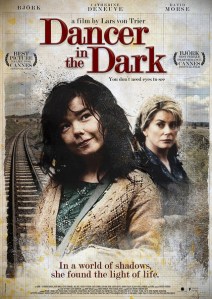 Originally released October 6, 2000:
Lars von Trier’s latest shaky video opus is likely the most unique movie going experience you’ll have all year. Dancer in the Dark is a clever, heartfelt, and achingly beautiful tale of sorrow and redemption. Dancer stars Iceland’s version of Madonna in the elfin Bjork. She plays Selma, quite possibly the nicest but also most stubborn person in the world. She’s an immigrant in 1960s America working long and odd hours to ensure that she can raise enough money for her son. You see Selma is slowly going blind but continuing to work so she can make sure her son will not have to suffer the same inherited illness. So she works late on heavy industrial machinery causing accidents as her condition worsens all to stop her son’s genetic curse she will give to him. Selma’s escape has always been musicals. In life she hears music in unusual places and visualizes life stopping to burst out into a vibrant fully choreographed musical number. Selma’s life continues to degenerate along with her vision as events pile on worse and worse until they all come crashing together.
Dancer in the Dark is no picnic in the park. The movie is haunting but incredibly depressing. Lars von Trier’s previous film (Breaking the Waves) was another wrenching drama with good people going through rough times with no fraction of light at any end of a tunnel. His jerky handheld video work is back capturing the life of Selma and seemingly framing it in a more realistic sense. The video images are edited to look like a documentary and the whole feel is one of raw power. You aren’t merely watching a film, it’s like you are in it witnessing the actions from the sidelines. The escapist musical numbers are shot in glorious still film to contrast the drab realism of video. The colors are bright, the faces are happy, and the cinematography is a wonder to envision.
 Bjork soars and delivers what should be an Oscar-caliber performance. I never knew the queen of alt-rock had such emotive powers. Selma’s innocence is keenly expressed in Bjork and her glassy eyes. Her love for her son is no more evident then all the suffering and tragedy she goes through. All of the suffering and tragedy could be avoided – except her son would not be helped.
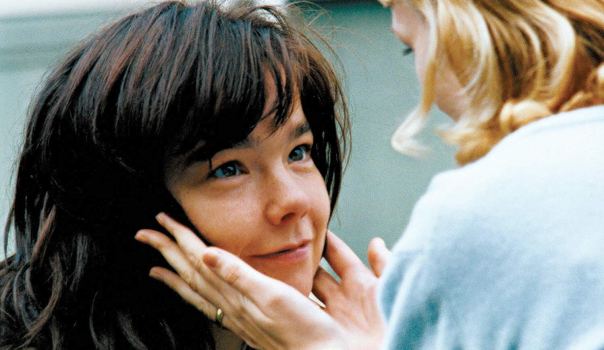
The ensemble around Bjork work fantastic magic as well. Peter Stormare is a sad figure trying to just get a glimpse of Selma’s attention. David Morse is a down-and-out policeman who is Selma’s landlord and in need of some cash. He’s afraid to tell his bourgeois wife they’ve run empty with money. Catherine Deneuve turns in the brightest supporting performance as Selma’s co-worker and friend Kathy. She’s torn between trying to stop Selma from continuing on her acts that could cause her harm and helping her along her determination. A great scene as example of her care for Selma is when the two of them are in a theater watching an old Hollywood musical. At this point Selma is completely blind and can’t see what’s going on, so Kathy takes Selma’s palm and dances her fingers in correlation with the actions on screen to Selma’s delight. A simple scene yet so elegant and beautiful.
Dancer in the Dark is a wonderful piece of original film making that gives us the escape of hope and the crush of despair. Selma’s love of musicals and their role in life is perfect symbolism for discussion. Dancer will leave you with a distinct feeling by the end credits. Whether it’s sorrow or bewilderment Dancer in the Dark is a film not to miss.
Nate’s Grade: A
——————————————————
WRITER REFLECTIONS 20 YEARS LATER
I knew going back to my first Lars von Trier film was not going to be a pleasant experience, and oh what an understatement that turned out to be. von Trier has compared himself to a Nazi, his intense methods have driven his actors to the brink, including Dancer in the Dark’s Bjork who swore off the entire profession of acting after her experiences working with him. I am not surprised by this response because his movies have famously followed a formula of a woman being tortured by men, by society, by forces outsider her control, and then she suffers for two hours and dies, a victim of the cruelty of the universe. Repeat. It’s a formula that I’ve since grown weary of and after 2018’s The House That Jack Built I contemplated not watching another von Trier movie again. He just can’t help himself and his nihilistic, heavy-handed impulses handicap his genuine artistic abilities and the merits of his storytelling. Back in 2000, it all felt relatively new. von Trier was the biggest name of the Dogme 95 movement, a Danish collective of filmmakers who swore to adhere to digital video and other aesthetic rules to better replicate reality as it was, ripping away the glossy artifice of Hollywood fantasy. von Trier was subversive, provocative, and exciting, and since then I’ve broken free from the von Trier spell. I was questioning whether I would share Requiem for a Dream or Dancer in the Dark with my girlfriend, who had seen neither, and in hindsight I’m glad I picked Requiem instead (think about that, yikes).
Dancer in the Dark is a powerful experience and one that is unfortunately smothered by von Trier’s heavy hand. It’s easy to root for Selma (Bjork), a Czech transplant in small-town 1960s America (the movie was filmed in Sweden because von Trier is afraid to fly). She already has so much going against her: 1) she’s a woman, 2) she’s an immigrant, 3) she’s poor, 4) she’s suffering from a degenerative disease that will rob her of her sight. Even worse, her son will suffer the same fate unless Selma raises enough money for an operation. She takes on extra work at her factory, even if she’s not exactly qualified, and she’s a hopeful yet stubborn woman who says what she means, earning friends who will champion her. She’s also a lover of old-fashioned Hollywood musicals, as they presented an escape to her as a little girl growing up in poverty. America was the land of opportunity, where everyone dances all the time, sings their hearts out, and gets the girl or the guy by the conclusion of the finale. That dichotomy, between reality and fantasy, and all the cultural and psychological commentary within, is the strongest aspect of the film and a peak of ambition that von Trier never really got close to again with his later punishing dramaturgy. The first musical number doesn’t come until 45 minutes into the movie, and by that time we have had our heroine, her plight, and the first markers of a looming tragedy efficiently established.
 Jeff (Peter Stormare), a lovesick co-worker who shows up every day to maybe drive Selma home, cannot understand musicals, saying people just burst out into song and how unrealistic this is, and Selma agrees, but for her it’s wonderful. She hears music in the world around her and it gives her life, especially as her vision deteriorates. As injustice after injustice falls upon her, Selma uses extravagant musicals as an escape, where everyone is a friend waiting to jump into the number and work together. A common refrain she sings is “there’s always someone to catch me,” referencing the choreography of musicals where the dancers frolic together but it’s also her request to the universe for a little help, for someone to catch her when she stumbles and provide that level support a woman of her means and background lacked in this landscape. The musical numbers staged by von Trier have a chaotic energy to them, assembled from dozens and dozens of sporadically placed cameras. They feel like a burst of imagination while keeping an improvisational feel; less drilled than managed. The first musical number “Cvalda” is a delirious daydream where Selma imagines the various sounds of the work machines creating a percussive symphony and she’s a Mary Poppins conductor. After Bill (David Morse) dies, she retreats to “Scatterheart” to make sense of her actions, with her son telling her she only did what she had to do and Bill rising from the dead to beg her forgiveness. When she’s in solitary confinement and can’t hear any sound, Selma goes into despair. She shouts the lyrics to selections from The Sound of Music to bring music back into her isolated world. Even on her march to execution, Selma copes by turning the “107 Steps” to the noose into a song. Her last words are her singing her final goodbyes to her off-screen son, so until the end musicals were how this woman chose to compensate for the rotten luck of her life. And oh boy was it ever rotten.
There’s one scene in the second half begging for symbolic unpacking where Selma is in the middle of her trial and the prosecution calls a famous Czech film actor and dancer to the stage. It’s none other than Oscar-winning theater legend Joel Grey (Cabaret) and his character doesn’t know who Selma is, even though she told the court she had been sending money to him (she listed her son’s account for his operation under a pseudonym to not risk it being derailed). This famous actor starred in movies in her native Czechoslovakia and crossed over to American cinema. He was an idol for young Selma and another figure to encapsulate the promise of America. Then as he’s testifying on the stand is when Selma drifts back into another rendition of “In the Musicals” and Grey joins her in tapping, and he confesses, “I didn’t mind it at all / That you were having a ball / at my musicals / And I was always there to catch you.” He understands and empathizes. This scene alone is just packed with so many layers of metaphor and projection and symbolic subtext and commentary and you could probably write an entire Master’s thesis on its myriad meanings. At its best, that’s Dancer in the Dark, when von Trier is using the language of musicals to subvert their form, to lay commentary on the un-reality is a rejection of the cruelty of real life, of finding order in disorder, finding community amid a nest of selfish vipers competing for dominance. It’s when von Trier uses our understanding of musicals to really make us think about the associations and contradictions that makes this movie a stirring and sometimes sensational experience.
 Alas, the artistry is seriously wounded by von Trier’s heavy-handed approach to all drama. This has become even more pronounced after where von Trier has obliterated the entire world (2011’s Melancholia) and ruined a four-hour movie with a last-second dumb joke of an ending (2014’s two-part Nymphomaniac). Subtlety is not one of the tools von Trier prefers to dabble with. It’s a shame because he’s a natural storyteller when it comes to establishing vulnerable characters in fraught scenarios and slowly raising the temperature, organically transforming allies into enemies and friends into abusers. This is done very well in 2004’s Dogville as well, a movie I would argue both plays into and succeeds his tortured-woman formula of drama and political allegory. I would say Dogville is his second-best film precisely because I was expecting another unrelentingly unjust ending for another anguished woman. However, where a lighter touch could accomplish his points, von Trier instead brings out a bazooka. Selma’s deadly encounter with Bill happens at the halfway point in the film. From there there’s still another 65 minutes of her suffering to drag out to preposterous proportions. We go through the trial, her cross-examination, her willfully keeping secrets that will only make her look guilty to maintain a promise to a dead man, and then there’s her visitations in jail, her appeal, her rejection of her appeal because the costs will empty the fund’s for her son’s operation, the realization of her impending execution, the march to the execution, her being bound to a board because she cannot stand straight because she’s so scared, her rejection of the hood, her last song while she waits for the governor’s call, and then her abrupt death. There were several points where I was just pleading, “Enough already,” because it was so thoroughly exhausting.
Selma is served to be a martyr of an unjust system that looked suspiciously on immigrants, and Selma elects to accept her fate because anything less would endanger losing what she has set up for her son’s well-being. This woman takes all this punishment and that’s the story, America. That’s the story of America, America. That’s what von Trier is getting at, but the 140-minute movie is so overdone and so drawn out to obsess over the wrongs inflicted on this poor woman that it unintentionally blunts the message. The second half becomes a passion play where we watch our poor Selma elect to accept tragedy and self-sacrifice and endure all the injustices. It’s harrowing and upsetting but would still be so if we didn’t spend half of the movie dwelling on a litany of examples of her fated misery. I’m sure others will argue the crushing nature of the injustice is meant to convey for the viewer the feeling of aggravation and outrage. I would agree that outrage is sought, but when von Trier doesn’t let up, it tilts into overwrought self-parody.
 Dancer in the Dark resonates as strongly as it does because Bjork gives every ounce of herself in this performance. She was originally just going to write songs but von Trier chased her for a year to convince her to also star as the lead. There are moments of awkwardness where it feels like maybe she’s confused in the scene with what her lines are supposed to be, but then her lack of polish is revealed for its true strength. It’s a deeply, deeply felt performance, stunning in how raw and empathetic she gets, subsuming herself into the character and her tribulations. You don’t see the craft so much here as you do sheer, undiluted passion and ferocious naturalism. She doesn’t hold anything back and gives the best performance in any von Trier movie. In my mind, she had been nominated for a Best Actress Oscar that year but this was not the case; she was only nominated for Best Original Song (“I’ve Seen It All”) where she wore her famous swan dress that became a go-to punchline. She was, and continues to be, an eclectic artist and a really weird person, but man could she be a tremendous actress given the right circumstances. It’s a shame that von Trier’s sadistic directing style lead her to quit the entire profession.
Looking back on my original review, I remember seeing Dancer in the Dark with my freshman pal Kat Lewis, who was just the biggest Bjork fan you could find in all of Ohio in 2000. We were both floored by the movie, and Bjork, and cited it as uniformly brilliant. With twenty years of distance, I can say some of the ironic commentary of undercutting musical escapism feels too easy now, seeking credit for daring to ask, “Hey, what if musicals weren’t so happy, huh?” It’s still a worthwhile subversion to explore but simply presenting it as a subversion isn’t enough for a satisfying thematic focus. It’s funny that the moments that stood out to me as an 18-year-old, like Catherine Deneuve dancing her fingers on Selma’s palm to communicate the onscreen dance routine she can no longer see, are the same ones that stood out to me as a 38-year-old. Good writing will still make itself known and felt. There’s plenty to admire and, paradoxically, enjoy about such a depressing movie, but von Trier’s inability to self-edit and hold back his condemnation of humanity is what truly oppresses his movie.
Re-View Grade: B
Share this:

Requiem for a Dream (2000) [Review Re-View]
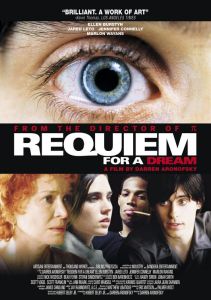
Released October 6, 2000:
Rarely does a movie today affect you that when the end credits roll you’re left silent and unable to speak. Requiem for a Dream is an unforgettable and intensely harrowing experience. You can’t take your eyes away from it. Afterwards you’re left in disarray and unable to think straight for most of the day.
Requiem chronicles the lives of four individuals and their spiraling addictions and missed choices. Harry (Jared Leto) is a small time coke dealer along with his friend Tyrone (Marlon Wayans) who can’t help to taste their merchandise and eventually end up broke again. Harry has gotten into the habit of routinely pawning his elderly mother’s TV set for some quick cash to score with. This happens so often that the pawn broker has a special folder for Sarah Goldfarb (Ellen Burstyn) and her televison. Harry is in love with his more positioned girlfriend Marion (Jennifer Connelly). She’s given an annual allowance of money from her wealthy folks to spend in her own fashion, but she’s denied love or attention. It’s between these four main characters that we will go through hell with.

Ellen Burstyn shows her grace with age and utterly blows your mind with her jaw-dropping performance as the lonely and strung out Sarah. Sarah has no husband anymore or a son to look after. She is alone and old, and those are two bad ingredients. She lives in an apartment complex overlooking the decaying ruins of Coney Island. Sarah has a different addiction than her child, she is addicted to food and is overweight. One day she mistakes a random junk phone call as her ticket to appear on television. She daydreams about gliding across the stage in her red dress that she doesn’t be able to properly fill anymore. With her elderly peers aflutter she tries her best to stick to a diet to fit into her slender dress. When the temptation becomes overwhelming she consults a friend’s doctor for some special “pills” to suppress her appetite.
Harry and Tyrone are embarking on their own dealing dreams to eventually move up the ladder and score some pure coke. Marion and Harry experience their love through simultaneous shoot-ups that space them out and turn them into romantic philosophers. Harry speaks of great dreams he has and the yearning to be something. Tyrone is haunted by thoughts of himself as a child and disappointing his sweetly loving mother who was proud of her son no matter what.

The film starts off in the summer and we are in the good times for all four characters. Harry and Tyrone are successful and racking up profits. Sarah has an unusual amount of energy through her prescribed pills and feels good about herself when she sees actual results as the pounds begin to melt away. Marion dances in her love of Harry and is ambitious with plans for her own design store. Things never are as good as they are again. Fall rolls along and Tyrone and Harry lose their money and lose their ability to secure drugs to sell. Sarah is noticing her pills are not having the same effect they were earlier and decides to ignore guidelines and take them like M&Ms. Marion starts to lash out at Harry’s ineptness at scoring and begins to tear at their relationship. She gets pushed to the brink to score that she resorts to the practice of using her body to secure what she needs. This isn’t even the beginning of how dour and horrible events will become for these four.
One of the strengths of Reqiuem is the treatment of these characters. The film shows sympathy for them and their situations but never condone them. Harry and Sarah are a family that have much love between them they just don’t know how to express it. When Harry discovers his mother is on essentially speed when he pays her a visit he’s left a shattered and crying mess. Only an injection into his veins in that cab ride saves him from his emotions. The relationship between Harry and Marion is initially seen as puppy love or people brought together through a love of drugs, but there are moments where you see the true beauty they have. In the end when Harry is out of state and dramatically in the need of hospitalization he calls Marion just as she’s doing her make-up for a “special” get-together. In a hushed tone she asks when he will be coming home, to which he responds in a mix of pain that it will be soon. She then so sincerely and beautifully asks if he can come back today – to which through an array of tears he agrees. Her sincerity and emotion in this sequence is a powerful glimpse at the love that does exist between the two of them. The second time I watched this film I started crying at this moment.

Burstyn is the stand-out star and if she doesn’t at LEAST get an Oscar nomination then that is the most unjust crime of them all. It’s been some time since her roles in The Exorcist and Alice Doesn’t Live Here Anymore but she still shines like a true gem. She magnificently portrays Sarah’s descent into madness and chemical dependency and leaves us with a chilling and haunting figure. Leto and Connelly show that they aren’t merely pretty faces and deliver their best performances of their lives. Both show incredible warmth and emotion.
Requiem was directed and adapted for the screen by Darren Aronofsky who gave us the head trip that was Pi. Here he uses camera trickery like speed up and slowed paces to show Sarah’s journey through her drugs. Other items include cameras mounted on the actors, split screens, and hyper edits to show the process of every drug shoot-up. His camera moves and tricks are never out of place though, as many gimmicky video director’s are. Each effect has a specific purpose. Aronofsky brilliantly uses a scene where Leto and Connelly are lying in bed besides one another but split screen to show the closeness they can strive but the distance that still exists. While each talks we see shots of the other’s hand carefully caress the other’s body. It’s a scene that’s as powerful as it it thematically romantic.
The tragedy of this is this film has been rated NC-17 by the MPAA and of course anyone who sees it knows the exact scene. The film is being released unrated by Artisan because NC-17 is a commercial kiss of death. The shame is this movie needs to be seen. Make it mandatory in schools. DARE isn’t working but this film will. No one with an urge to use drugs will have that same urge after seeing this harrowing film.
Nate’s Grade: A+
——————————————————
WRITER REFLECTIONS 20 YEARS LATER
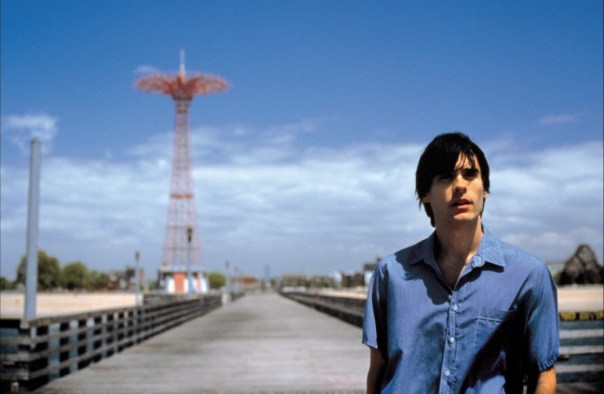
Requiem for a Dream was a seminal event for me. It floored me when I originally saw it during the fateful fall of 2000. I can still vividly recall wandering out into the daylight after the movie and feeling like a zombie, just left to walk aimlessly and mumble to myself. I remember my friend Kat Lewis and I were unable to even articulate sentences other than, “Wow,” and, “Ooof,” for like an hour as we processed the drug-fueled descent into madness and hell. It was a movie that struck me dumb and left a mark. I became a lifelong fan of writer/director Darren Aronofsky afterwards and haven’t been disappointed with his movies yet (his 2014 biblical epic Noah is criminally underrated). At the end of 2009, I declared it the second-best film of the decade. Requiem for a Dream is the kind of movie you can admire for its craft and crushing emotional impact but also one you may never want to watch a second time. I haven’t gone back to it for at least 15 years for that same reason, the hesitation to get back into the morass and experience the tumultuous tumble all over again. Except when I did sit and re-watch it for my twenty-year review, I was amazed how many moments felt strikingly familiar. I was anticipated specific actor inflections (“I’m lonely. I’m ollllld”), gestures, and even sound cues. It was a strange experience because it was like re-awakening dormant memories I had papered over. I thought I had forgotten the movie but, in reality, I must have watched it enough in those early 2000s days to commit so much to memory. I was afraid to dive back because of the depressing subject matter that I expected to rightfully wreck me. Instead I experienced a different sort of awakening, and that was my question whether the movie’s highs might be over inflated and whether the younger version of myself was dazzled by a movie with more evident problems.
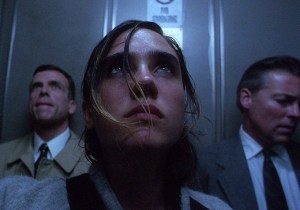
This is not a subtle movie in the slightest, not in subject matter, form, or style, and I’m sure that was part of what 18-year-old me so valued. It’s a movie dripping with style and wild imagination with how best to visualize the elation and instability of drug abuse. The editing by Jay Rabinowitz (8 Mile, The Tree of Life) is abundantly hyperactive, amassing over 2,000 cuts over the course of only 95 minutes (an average “non-Michael Bay” film running the same length has maybe 700 edits). It is all deliberately overwhelming to convey the frenetic energy of the junkie, and the repetition of edits and structures creates visual routines that Aronofsky then escalates or deconstructs brilliantly, using the language of film to immerse the viewer in this world and blend our senses together into a rapturous contact high. It’s not hard to see the inspiration for Edgar Wright’s own hyper-kinetic visual style here. The entire movie becomes a visceral reflection of the characters’ physiological state. The photography by Matthew Libatique (Black Swan, Iron Man) can be alienating, disquieting, but also vibrantly alive and excitedly inventive. This is the first feature film I can recall that used Steadycam cameras and attached them to the actors so that as they moved through their world they remained our stable focal point. It’s such a great and unsettling convergence of perspective. We are attached to the actor close-up. The musical score by Clint Mansell (Black Swan, Moon) is instantly iconic thanks to its sense of foreboding and the central haunting theme from the Kronos Quartet that was used in a thousand trailers afterwards because it’s that gob-smackingly, recognizably brilliant. These talented men were the essential wingmen for Aronofsky to achieve his beautifully horrible vision.
The 90s indie scene and well into the early 2000s was an audacious time that pushed the limits of film style, reshaping our sensibilities of what movies could accomplish, and Aronofsky is a world-caliber stylist. After two low-budget indie films, it’s clear why Hollywood came knocking and offered the man many high-profile titles like rebooting the inactive Batman franchise. There are entire complicated setups devoted to capturing single shots, and there are so many stylish choices that come flying that part of the appeal of the movie is simply lying in wait for what Aronofsky will deliver next, like a magician that keeps you asking for the next trick and the next trick. Some highlights include Sara (Ellen Burstyn) being taunted by her fridge and the hunger pangs she feels, including a delusion where the household appliance comes alive like a monster from an early Peter Jackson horror flick. The use of split-screen is stunning to convey coordination and also disconnect. There’s a lovely scene where Marion (Jennifer Connelly) and Harry (Jared Leto) stare at one another, their fingertips stroking different portions of their bodies, and the editing jumps around from close-up inserts to their slightly disjointed alignment face-to-face. It’s both sensual and romantic. They’re close but also far away. This is the kind of move that attaches a camera to a bungee cord and throws it off the rooftop just for a couple second shot of free fall. It’s the kind of movie that seems to test every visual and audio setting of cinema. I admire the sheer gusto of Aronofsky as a filmmaker and his drive to push himself and his story to the limit.

However, at a super-charged 95 minutes before end credits, Requiem for a Dream is just too much. Its sledgehammer approach to drama had an odd effect on me as a 38-year-old versus than as an 18-year-old. My younger self was dazzled and left profoundly affected and devastated. My current self felt empathy for the suffering of the characters but I wasn’t emotionally connecting with them in the same way I did back in 2000. After some reflection, I think this is because the movie is just trying so hard that it feels like it’s speaking in nothing but exclamation marks, all capital-D drama, that it has its own numbing effect. Things do get considerably worse for our quartet of characters as they go through hell, but because the pacing is so amped, speeding along to get to its next fix, it doesn’t ever let the movie breathe and linger before hitting you again. It’s so fast-paced that the tone becomes more overtly theatrical, and I found myself less able to connect with the characters on a deeper and meaningful level. The limits of characterization were really felt with my recent re-watch, and the love story of Harry and Marion, which felt tragic for me in the early 2000s, now feels empty. Maybe that was the point and it took me decades to see it through, that the two of them are caught under the spell of infatuation but cannot fully grow together from a co-dependent relationship built around self-destruction. Or maybe they’re just underwritten tragic bohemians. The only character that really gets worthy consideration and nuance is Sara. If the movie had slowed down, or even been 20-30 minutes longer, I think it would have more room to make its drama felt in a way that didn’t feel so anxious to the point of bordering on desperation. There are points where Requiem for a Dream feels like an overblown indie version of an after-school special on drugs.
The real heart of the movie is with Burstyn who delivers a career-best performance (she lost the Best Actress Oscar that year to Julia Roberts). Sara Goldfarb is the kind of person everyone might know, an older retiree who feels overlooked, afraid of pushing too hard against a son she can’t control, and someone who wants to feel special one more time in her life. She doesn’t see herself as an addict and the movie portrays her struggle as being analogous to the cocaine and heroin abuse of the other users. Sugar, caffeine, starch, red meat, all common items that can be just as addictive to the brain and body, and Sara’s struggles to lose weight are relatable and take on a horrifying transformation after she starts using prescription drugs as a quick solution. Burstyn is the definition of heartbreaking here and that’s even before she starts popping pills. She delivers one hell of a monologue about her sad state of needing something, anything to cling onto to give her life a glimmer of needed hope. It was the moment that made me instantly recognize the levels of sadness we’re working with. I enjoyed the little burst of happiness she felt when the other neighborhood ladies admired her for her chance of being on television. for her, this was everything. Burstyn goes through a physical transformation, from padded body suits to emaciated and sweat-stained (this is a very very sweaty movie; you can practically taste the grime coating the actors). She’s unrecognizable by the end. Burstyn is so devastatingly good as her character literally loses her mind, becoming one of those crazy people on the street. You feel such a reservoir of grief knowing what drugs have done to demolish this woman’s identity and transmute her into a living phantom.

The social commentary isn’t prevalent, beyond the universality of personal addiction, but it has one major critique and it’s the indifference of the system to those in need. Three of these characters are living through poverty and limited means of self-sufficiency. Marion has a trust fund but has to jump through hoops to maintain it, including at different points selling her body. When Sara visits her doctor to inquire about possible medicine, he never looks at her once and quickly writes her a prescription. When she’s admitted to a psychiatric ward, the orderlies barely even view her as a human being and threaten her with physical harm if she will not swallow her food. The ward doctor can clearly tell she’s not of sound mind but gets her to “sign” her permission for dangerous, experimental electroshock therapy. These are bureaucrats, professionals, and people of means that simply don’t care. The institutions of this country are geared to let people down, to slip between the cracks, and the supports are insufficient. In this regard, Requiem for a Dream is a condemnation for the system and its lack of real compassion.
The closing montage of degradation is so gut-punching, so expertly edited together for maximum symmetry, and so disturbing that I can completely understand if nobody would ever want to watch Requiem for a Dream again. Early on, while re-watching this movie alone, I thought, “My girlfriend would really be intrigued by this and appreciate the style and verve,” and then by the end I reconsidered whether or not it all might be too much to endure. You feel a little dirty by the time it’s all over. I think this time, in 2020 as opposed to 2000, it was too much for me because I was feeling less attachment to the characters and more removed from their drama because everything was so operatic and going by so fast. The movie still has so much technical and artistic ambition to drop my rating too low, but this is not the near-perfect A+ movie I highly regarded in my youth. This is not the second-best films of the 2000s. It’s still a good movie and one that will be felt and remembered long after. It’s hard to shake off its effect which are still felt even if you have difficulty engaging with the people beyond a general level of human empathy. My original review consisted of mostly reciting the plot, an aspect of my reviews I’ve tried to steer away from. I hate reviews that are 80 percent plot synopsis and then only a paragraph or two of critical analysis and deliberation. Requiem for a Dream is still a powerful and immersive movie that masterfully uses the full gamut of film tricks as its disposal. While it might not be a personally-defining movie for me any longer as an adult, it still was for years in my youth, and while it shattered me and left me a shambling mess, it also made me realize just what movies can do.
Re-View Grade: B+
Share this:

Spontaneous (2020)
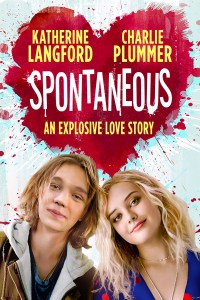 Spontaneous is a movie that grabbed my attention immediately, made me laugh quickly, and then made me fall in love over the course of its explosive 100 minutes. The more I think back about this bizarre little movie, based on the YA novel by Aaron Starmer, the more affection I have for it and its messy accomplishments. Writer/director Brian Duffield has been one of the most exciting screenwriters for years, penning highly inventive stories that have a distinct, vivacious comedic voice that leaps off the page and smacks you across the face with how good it is, and then you ask for more (check out The Babysitter for the closest representation of what a Duffield screenplay delivers; skip the sequel though). This is Duffield’s debut as a director and I feel like he’s a natural fit for the quirky, blood-soaked material. Spontaneous is a dark comedy that can also make you feel something because it doesn’t simply treat its characters as disposable punchlines.
So the senior class of Covington High School has a serious problem. They’re spontaneously exploding. Nobody knows why, nobody knows who will be next, and even after a government quarantine, the answers aren’t any clearer. Mara (Katherine Langford) just wants to live to grow into a badass older lady who lives on the beach with her best friend Tess (Hayley Law). Her dreams of a life after graduation might never come true. Dylan (Charlie Plummer) introduces himself to Mara and they begin a tender courtship, falling in love during a precarious time where either of them could explode and soak the other in gore and viscera. Can these two crazy kids make it and grow up when their own bodies might betray their fleeting happiness?
 Almost instantaneously I was drawn into the romance between Mara and Dylan, and I enjoyed deeply how each helps to shape the other, finding a sincere connection in the most extreme and unexpected of circumstances. Their budding romance dances with tragedy and dread as we worry over the fate of our lovers; surely, with this horrific premise, they won’t end happily ever after, or could they? Every time another student exploded, I winced. I laughed a few times, I’ll admit, because the context can become darkly hilarious and absurd, but it’s also a natural human reflex to relieve tension. Each one of these kids is a potential suicide bomber and they don’t know it. It’s sudden and something that you, even as a viewer, will never get used to. What you will do is start to dread who is next and whether that explosion sound was someone you liked. With an omnipresence of tragedy, it pushes the characters to make the most of their potentially short lives and that brings a greater significance to their next steps, the little attempts to “feel like an adult,” to reach for their desires, and to declare who they are while they are still standing to do so. It takes the coming-of-age setup and deftly dials up the emotional stakes.
Make no mistake though, Spontaneous is an uproariously funny movie. We’re primarily seeing the world from the perspective of Mara and her narration and occasional fourth-wall breaks. There are some fun asides where other characters take over narration duties, but this is chiefly her movie and she’s delightfully odd, prickly, and worthy of our attention. Duffield’s screenplay is brimming with wit and the conversational banter flows with such a confident cadence, all while not being overly mellifluous and self-satisfied. I adored just spending time with the characters because I was anticipating what they would say and do next. The social satire is present but not as substantial as I would have thought. The film trades in familiar stereotypes we’ve come to associate with high school movies, yet it can take some interesting detours, like when the football team cheers in support about their fellow player for coming out as gay. This is a high school movie mixed with a horror movie, where a big party to cut loose could become the latest crime scene. Most of the adults are simply scared and don’t know what to do, and that helpless vulnerability extends outward and keeps going. Just because you may be older doesn’t mean you know what you’re doing. I cackled plenty from the physical humor, slapstick gross-out gags, but when Duffield wanted to be serious, you better believe I shut my trap and pulled up the blanket.
 I think it’s worth acknowledging, and I don’t consider this a real spoiler, that the cause of the spontaneous combustion is never resolved. There is no explanation, and if that’s a deal-breaker for you then I think you’re prioritizing the wrong parts of what Spontaneous is offering. It doesn’t really matter why it’s happening because the movie isn’t a scientific mystery. As much as it might seem bizarre to declare, this is far more than the “kids blown into bloody bits” movie. It’s not about what is happening per se but how it emotionally affects the characters. The unknown bodily explosions could serve as a gory metaphor for modern-day threats of school shooters, terrorism, or even our current pandemic (pick your metaphor, anything really works). Students don’t know who will be next, when their time will be up, and an anxious pall hangs over their day-to-day lives as they trudge onward trying to regain a sense of normalcy during a troubling and uncertain time of numbing trauma. That’s really the core of the movie, the response to inexplicable trauma. Some characters maintain a blasé, nihilistic attitude, questioning whether their minute remaining time has value. Others look at the random threat of exploding as a motivator to overcome the obstacles that kept them from achieving their goals, ignoring social hang-ups and personal misgivings. It’s the proverbial kick that Dylan needs to finally talk to the girl he’s been crushing on. He elects to live with his remaining time on this planet, no matter how brief, and elects to be happy, which is about one of the bravest things a person can do. That’s why the combustible student body doesn’t need an explanation, and to be fair what possible explanation would ever have been truly satisfying (“Oh, we all just ate too many carbs. Huh.”)?
If she hadn’t already established herself from Netflix’s somber soap 13 Reasons Why, this would have been a star-making role for Langford (Knives Out). She’s captivating from her first moment onscreen when she discusses the mundane details of her day at school right before the girl in front of her explodes. Her sardonic and spiky attitude permeates the movie and gives the film an energetic jolt, amplified by Duffield’s stylish flourishes that reminded me at points of Edgar Wright with how playful and involved the visual transitions could get. Our leading lady is a force of nature, and after enough time, you can understand why Tess wants to be her bestie, why Dylan would fall in love with her, and why other students would be afraid of Mara. There are moments where Langford can be silly and diverting, like dressing in mourning over the 2016 election, and others where she feels like she’s harnessing the totality of youthful feminine rage (I loved a late declarative statement directed at our current president) to be a symbol. The “same old” just isn’t going to cut it when the stakes are this high. Langford isn’t just the too-cool gal spitting pithy insults from a safe distance. There’s some heavy-duty existential drama here that she carries while through the prism of her eccentric teenager’s attitude. Her romance with Plummer (All the Money in the World) is sweet and affecting and feels entirely genuine.
 Sticky, sweet, and wickedly funny, Spontaneous is obsessed with death, the uncertainty of knowing when your time is up, and yet I came away feeling ultimately uplifted and moved. There are some jolting moments, both funny and heart-breaking, and Duffield wants you to take the time to feel the full experience of being young and angry and hopeful and anxious and in love and feeling weird. In a disastrous year of worldwide calamities, Spontaneous is a bright spot, and given the bloody premise, that should tell you everything you need to know about the year 2020. This is a delightful, heartfelt, and surprisingly mature teen drama that also happens to have people bursting like balloons. Duffield even touches upon the profound at points, which is hard to do with any filmmaker, let alone one playing with these crazy genre elements. Spontaneous is a coming-of-age drama with equal parts ache and warmth, gallows humor and personal insight. Find this movie, devote 100 minutes of your time, and wear a poncho if necessary.
Nate’s Grade: A
Share this:

Evil Takes Root (2020)
 A new horror movie was filmed around Columbus, Ohio by a fledgling studio, Genre Labs, and a group of filmmakers who have made other successful Ohio thrillers and is now available for digital viewing on multiple platforms. Evil Takes Root is the most impressive looking and sounding Ohio indie I have seen yet. I mean this in all sincerity when I say it “looks like a real movie.” Even the poster art looks snazzy.
Dr. Thane Noles (Sean Carrigan) is still mourning the loss of his wife Mandy (Constance Brenneman) from mysterious circumstances (vague voice mail, hanging from a tree, black eyes, etc.). His daughter Sarah (Stevie Lynn Jones) is struggling with her grief and befriends a girl, Christina (Reagan Belhorn), going through a similar loss. Christina is desperate to bring her mother back and is doing the bidding of a supernatural presence to make this wish come true. The result is that Sarah becomes the vessel for this evil spirit, a Baitbat, a mythological figure from Philippines’ culture. Felix Fojas (Nicholas Gonzalez) is back in town to investigate the death of Mandy, the woman he still loves after an affair many years ago. Felix is a professor and a big believer in the supernatural, and he strongly believes evil is present and busy in Ohio.
 The production is glowing with professionalism that we associate with larger-budget studio ventures. Sure, you still slightly sense its lower budget in how much bang for your buck we get onscreen, but there are more than enough moments that impressed me from the technical aspects of moviemaking. The sound design is sensational. This has often been the biggest hindrance with local indies, and wow what a difference a professional sound design team can have on a horror movie. The creeping and scratchy noises of the Baitbat and its demonic intonations are unsettling and worthy of a few jumps. A great sound design team can goose any moment into being scarier. The spooky set pieces on their own weren’t imaginative or innovative but the sound design and photography elevated them. On the other side, this is a great looking movie, even with the drained color wash I usually dislike. Director and co-writer Chris W. Freeman (Sorority Party Massacre) knows how to make a horror movie with plenty of pleasing visual compositions by cinematographer Roy Rossovich (Union Furnace). Freeman is ready for a bigger stage, folks. There are a few instances of sweeping camera movements that made me go, “Whoa.” One involves a chase scene in the woods where naked witches run from their bonfire into the dark of the woods to kill an interloper, and the camera moves over the terrain with smooth velocity, and the way the fire illuminated the bodies as they went from one light source to another is simply stunning to watch. If it wasn’t for the topless women, I would expect a shot like that to be in the trailer. The focus levels, the way the camera movements enhance the frame and tension, even the use of a rain machine for mood, it’s all superbly impressive. The editing by Jason Heinrich and Jamie Marsh is great as well and makes the movie feel even more indistinguishable from Hollywood genre fare.
That impressive level of professionalism doesn’t extend to the story, sadly. Evil Takes Root is a very generic story told with very generic characters. I kept waiting for little moments to round them out, little moments to make me think differently about a character, to bring their conflicts into a new focus or coalesce their themes into the obstacles they’re confronting. I was simply looking for more personality than the five stages of grief at work. I can tell you what the characters do, as well as their larger plot designations, but I can’t tell you about who they are as people. There really isn’t one thing terribly interesting that any character does onscreen. They go about the discovery of the supernatural haunting, and then it’s concluded in a way that is anticlimactic in how easy it seems to be resolved. I read on another review that, according to the director’s commentary, that the movie underwent a troubled production and worked to fit footage that was shot many years apart. In that regard, it feels like a consistent product. I can’t see any obvious seams that show I’m watching a movie with significant scheduling gaps. Congratulations. But it also feels like any other small-scale Hollywood genre horror thriller, something like 2009’s The Unborn. Do you remember The Unborn? Do you remember it actually co-starred Gary Oldman? All that technical acumen put toward a mediocre story overstuffed with redundant characters (more on that below) and it’s a shame. The spooky set pieces are too short-lived and lack anything particularly memorable as well. Too much about this movie makes it burdensome to attempt to remember because it’s skating on generic and familiar tropes without leaving its stamp.
 This is disappointing considering I haven’t really seen too many American horror movies tackle the mythology of the Philippines. There must be plenty of fun choices to select for a big screen fright fest and for a majority of Western viewers, it would be a new kind of monster. I desperately wanted to learn more about the Baitbat and what made this creature unique. However, we don’t even know what this malevolent creature is until literally the last ten minutes, and I have no idea why the filmmakers held that from the audience for so long. The Baitbat is the lone thing to better help separate this movie from the glut of other possession/demon movies, so I don’t know why you wouldn’t make it more of a feature and try and tap into that potential and history. The viewer needs to know specific rules related to this spirit and it’s only a hasty exposition drop at the very end where we learn what the spirit is and what it wants. Imagine The Exorcist if you never knew what was going on with Regan until the last ten minutes. The Baitbat is our chief antagonist. We need to know more and earlier in order to make the movie more interesting. The tree root-tenatcle design of the creature is creepy and lends itself well to low-light silhouettes, which makes sense why it was chosen for a cost-conscious production. Other wicked cool Philippines monsters deserving of horror spotlights include a manananggal, a creature that separates its torso to fly, and a tikbalang, a creature with the head of a horse, the body of a man, and the feet of a horse.
There is a shocking amount of redundancy in this story best exemplified by the glut of characters. We have two grieving fathers raising teenage girls, we have two men who loved the same woman who was killed in the opening scene, we have two spiritual figures trying to combat evil possession, we have two teenage girls struggling with their loss of their mothers, we even have three authority figures (doctor, cop, pastor) all inserting themselves into this strange case. There’s so much crossover with these characters and their comparative stories that I’m quite surprised the filmmakers didn’t do some serious collapsing to better prune their narrative. If you’re going to have such character redundancy, you would think you’d highlight their parallel journeys as well as whatever can separate them. This is done to some extent but the differences are usually superficially one-note and never really affect the plot. Take for instance the commonality between Felix and Dr. Thane Noles. Felix was the “other man” in an affair and never lost his feelings for Mandy, though she lost hers for him. Felix blames himself for Mandy’s death but he’s still hung up on her after nine years since their tryst. A smart screenplay would really dive into this character dynamic, two men who shared the love of the same woman, but each should be able to provide insight into creating a bigger picture of this woman. The kind of woman she was with Felix should be different than who she was with her husband, not necessarily better but different. This would then provide a bridge for both men to find a level of understanding through these trying circumstances, not bonding per se but each discovering a little more about the woman they loved, getting to learn something new in her absence. Unfortunately, the film leaves all this drama unfulfilled, using the shared love as merely an excuse why Felix sticks around and why Dr. Noles doesn’t quite like him. Why do we need two spiritual warriors too except for maybe some sort of Exorcist homage? Make these character points matter more.
 The same scrutiny could be applied to both daughters as well. Why do we need both girls vying for screen time and going through the paces of the same story? Because of the juggling, they drop out for long stretches of the movie’s 95 minutes, like right after Sarah gets possessed. You would think that lost time experience, as well as her involvement in a murder, would be an enticing thing to further explore. You would think a spirit taking over her body and getting more oppressive would be a natural escalation with urgency to watch. We’d witness Sarah freak out as she wakes up from more and more shocking behavior. It’s an easy story because it makes sense, watching our possessed schoolgirl lose her mind and body. However, Evil Takes Root only tags in Sarah when it wants to, and this means her ongoing development as a demon vessel is curiously left underdeveloped. In contrast, Christina is immediately the more interesting character because she has a hearing disability and a lingering resentment over her father. Christina is even willing to explore with dark arts to bring her mother back from the dead. Dear reader, I ask you why can these two characters not simply be combined? If one girl is stepping into the supernatural, why not have her as the own affected? Why do her actions need to be carried out on a different character who has a similar back-story but who happens to not personally involve the supernatural to try and bring her dead mom back? Why have Sarah volunteer at a hearing-impaired school when we could just follow Christina at that same school from the point of view of someone who is already hearing impaired? These are the central relationships and characters and yet they could have been streamlined or retooled for more concise and developed drama.
Evil Takes Root is a horror movie that makes me feel stuck in the middle of praise and shrugging. It looks and sounds like a professional movie with real technical acumen, but it’s also a lot of effort to tell a deeply generic story with deeply generic characters and no standout set pieces. The sound design, editing, cinematography, and spindly special effects are impressive and seamlessly blended together. The monster needed more screen time. Nobody should be ashamed to have this movie on their resume, though the screenwriters (the director and the producer) might not feel that same degree of pride. Perhaps the mediocre story is a result of the production problems trying to make dispirit pieces come together into a meaningful and cogent whole. I cannot say. Whatever the reasons, Evil Takes Root is a very good-looking yet methodically generic horror movie.
Nate’s Grade: C+
Share this:

Darkest Edge (2020)
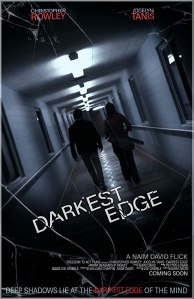 My pal Ben Bailey hates me reviewing Ohio-produced indie films. To be fair, he doesn’t have anything against the idea of providing critical and professional analysis to local filmmakers on their cinematic offerings. What he laments is how mediocre many of the finished projects end up being and how, in his view, it’s establishing a negative impression that Ohio movies suck. Truth be told, I haven’t found that one Ohio-made indie that has completely floored me. I’ve found several that I enjoyed and others that had elements to be proud about. The thriller Darkest Edge was filmed throughout Ohio and Kentucky and features Ohio talent in front and behind the camera. It’s the feature debut for director Naim David and screenwriter Joe Gribble. It’s a movie that aims beyond its own restricted reach but proves one of the less successful thrillers I’ve seen.
Mark (Christopher Rowley) is a Chicago journalist who is still reeling from his sister’s suicide. He’s on the verge of divorce and never seeing his daughter again, never mind his obsessive drinking. He’s given one final assignment, the closing of a notorious mental asylum in Dayton, Ohio, the very place that his departed sister spent time within. Ellen (Jocelyn Jae Tanis) is his assistant who insists upon being his camera operator. The two travel to Dayton and investigate the asylum, interview wary doctors, and Mark unlocks memories and secrets of his past.
Why is this thing in the middle of the screen?
Where this movie runs most adrift is with mood and execution. Look at that poster at the top of the review, check out the description of the plot setup, even judging by the spooky yet unmemorable title (I kept thinking “Dark Edge,” “Dark Corners,” “Darkest Corner” in my head). Even the tagline says, “Deep shadows lie at the darkest edge of the mind.” All of this is setting you, the viewer, to expect a creepy psychological thriller in a creepy asylum and for creepy things to happen. There have been horror movies that have been little more than watching wayward characters haplessly explore a haunted old locale, uncovering its secrets and perhaps its residents, living or dead. This simple plot setup can work as long as the filmmakers can execute their intended mood with aplomb. Unfortunately, Darkest Edge makes a critically fatal error in choosing its creepy locations. To put it simply, this soon-to-be-closing sanitarium is not scary looking in the slightest. The outside looks like a high school building from the 1960s. The inside looks very non-intimidating. There are doors labeled with pieces of paper and an accessible exit door literally within feet of “patient rooms.” While watching, my girlfriend pointed out this very problematic design flaw for a mental institution and I was aghast with that slip-up. The inside of this asylum is also practically abandoned. It’s supposed to be closing soon but there’s still supposed to be patients, evidenced by our characters randomly walking around the facility and finding doors obviously locked. This sense of emptiness will be a prolific problem with the movie (more on that later), but the asylum could have always been closed down and emptied already upon investigation. Another killer error is that almost the entire movie takes place during the day, which only further hampers the scare factor of this already ordinary looking building. It’s like watching people explore an office park and finding nothing. If Darkest Edge was going to hinge so much over a singular creepy location, oh is this place a big miss.
 With the location not exactly hitting the intended mood, I held hope that the central mystery tying to the protagonist’s memory, his occasional alcohol-induced blackouts, and hazy memories of this particular asylum could generate the intrigue that the setting was not. Mark is torn over the suicide of his sister, he’s been drinking so heavily he reeks at work, and this asylum might be the very same one that his sister was held at during both of their youths. Surely there has to be a dark secret afoot, or we’re being set up for some last-minute twist. I started guessing what the twist would be within ten minutes, because Darkest Edge seemed overwhelmingly like the kind of thriller that would roll out a last-minute twist. I thought maybe Mark’s daughter was really dead. My most outlandish, hacky guess was that Mark was really still in the asylum and that everything outside was a figment of his fevered imagination. Admittedly, that would have been an awful ending but it would have tapped into the psychological thriller context of its genre. There isn’t really any sort of mind-bending twist here. There is a revelation but, shockingly, the movie goes down a sentimental route that feels unearned and tonally ill-suited for the prior 75 minutes. It’s such a curious ending and goes against the very setup of this kind of movie. You’re expecting the story to end in a dark, desolate, traumatic place. If you want catharsis, you got to put in the work as a storyteller.
Unfortunately, a word I seem to find myself using often here, Darkest Edge doesn’t provide a compelling personal mystery for the audience. Mark is a boring character. He’s troubled and haunted in a general sense but the screenplay doesn’t give us anything too specific. Yes, his sister kills herself and he feels some guilt over this, but the entire movie doesn’t provide insight into the sister character or their relationship. If he’s so hard up over her death, you don’t feel why. He’s a sloppy drunk, and if you made a drinking game where you took a drink every time you saw Mark drinking, or holding a bottle, then you would black out just like Mark. It’s his lone defining characteristic and it is given again and again and again. Strangely, Mark will black out and find himself transported to distant locations, like thirty miles away from where he was (the movie, weirdly, makes sure we know the mile distances between specific Ohio cities). You would expect this would be a clue about some larger context, a deeper meaning for the torment plaguing our protagonist. Well your guess is as good as mine because ultimately those blackout long-distance travels don’t get clarified at all. For Mark to function as a character, he needs more specifics, especially when it comes to a trauma. He needs a specific fear or tragedy that haunts him and resurfaces with his trip to the asylum. We get what appear to be flashback snippets of a little boy exploring the interior of the asylum (apparently it was also just as easy to wander back then too). It’s all too vague and poorly explained, forcing the viewer to extrapolate connections and meaning. By providing a specific trigger and goal at the start, a viewer could watch Mark journey through his trauma rather than having to guess at it and its implications. I assume this was designed to make Mark’s personal history more enigmatic, but mystery only really works when you’re invested; otherwise it’s just obtuse, and that’s what we have here with Mark and Darkest Edge.
 The reality of Darkest Edge is hard to take seriously, and part of this is affected by the limitations of the low budget and certain filmmaking choices that accentuate those. Just because a movie has a low budget doesn’t mean it can’t succeed or utilize a clever creative ingenuity to tell its story and entertain. If you want to tell a creepy story about exploring a creepy location, choose a genuinely creepy location, and shoot it during night time to build an effective atmosphere. Use shadows to your advantage and play up the worry of what may be around the corner next. Build that sense of compounding dread. Walking ordinary hallways during daylight hours is not making your movie scary unless people are encountering weird events or threatening folk, neither of which happens here. There are some doctors hiding extreme methods but these methods are questionably vindicated by the end. There needs to be a clear threat and for the far, far majority of Darkest Edge there isn’t and this results in the movie feeling meandering.
The technical elements can be distracting and disappointing. The fuzzy sound design is a noticeable shortcoming, often dampening from shot-to-shot. The extreme lack of background noise is unmistakable and makes the movie feel like it was filmed in a space capsule. This, coupled with the lack of background activity and extras, makes the movie feel borderline like a Twilight Zone episode where there are only five or six people left on Earth. The limits of the reported $7500 budget are also felt with the shot selections; frequently a scene will just bounce between two set shots, locked into a plodding shot-reverse shot rhythm. There are dramatic moments that are kept at a distance when a closer shot was begging to showcase the actor’s emotive powers. It leaves an impression that the production was pressed for time to get editorial coverage, and it feels like actors were often filmed at different times and cut together for conversations. There is very limited lighting overall and the photography quality is also a step removed, so why not make this entirely a found footage film? That would have allowed the limitations of the production to be an acceptable part of the presentation. The music is also far too loud at points, drowning out the dialogue, and far too generic without establishing a sense of foreboding. I kept scratching my head at the artistic choices, which routinely magnified the budget shortfalls rather than making decisions that would better compensate instead.
 The acting is mostly fine especially since the actors haven’t been given much to work with. The characters are boring and have one trait they get to rub down to its nub. Rowley (Primordial) has a beaten down, hangdog expression that works well. Most of the times he’s either playing hungover or short-tempered, and without a stronger personality, it’s easy to start mentally checking out with his character. Tanis (Lilith, Cinestudy) delivers a performance that manages to mingle ambition, naivete, and a barely concealed contempt for her colleague. She had so much more potential to explore and I wish we spent more time with Ellen rather than watching Mark get drunk for the twentieth time. Anthony Panzeca (Dodging the Bullet) plays an orderly at the asylum and makes a warm impression. His performance is the closest to unveiling charm in a cast regularly acting confounded or irritable. There’s a Dayton journalist that is such a confusing character for me. She buddies up with Mark by opening up her archives of news collections on the asylum. She then asks Mark what he’s found… in her own news archives? Shouldn’t she already be familiar with what she has?
Darkest Edge is not the movie the poster, tagline, or even setup proclaim it to be. It’s not really a thriller, let alone an accessible psychological thriller, and it’s not really a horror movie. It should be creepy given the setting and its supposedly sordid history, but too much of this movie is kept vague and obtuse, failing to give the audience a reason for watching. The characters aren’t that interesting or complex or compelling and their traumas are kept too unspecified to engage. If it was going to focus on the mental torment and troubled history of a troubled man, the script needed to make him more dimensional and his issues more central to the events unfurling. Tone-wise the movie doesn’t work or build a sense of momentum. It’s hard to make a scary thriller/horror movie when nobody looks like they’re scared, and that’s for good reason considering the settings are more mundane and plainer than skin-crawling and disturbing. I feel bad saying so but Darkest Edge is really a boring jaunt along empty hallways. Even if you’re an overly generous fan of this sub-genre, there is little to engage with during the padded 80 minutes. The most frightening aspect isn’t the haunted asylum but botching a go-to scary setting.
Nate’s Grade: D+
Share this:

I’m Thinking of Ending Things (2020)
 I expect strange from a Charlie Kaufman movie; that goes without saying. I also expect some high concept turned inward and, most importantly, a humane if bewildered anchor. His other movies have dealt with similar themes of depression (Anomalisa), relationship entropy (Eternal Sunshine), identity (Being John Malkovich), and regret from afar (Synecdoche, New York). However, no matter the head-spinning elements, the best Kaufman movies have always been the ones that embrace a human, if flawed, experience with sincerity rather than ironic detachment. There’s a reason that Eternal Sunshine is a masterpiece and that nobody seems to recall 2002’s Human Nature (ironic title for this reference). 2015’s Anomalisa was all about one man trying to break free from the fog of his mind, finding a woman as savior, and then slowly succumbing to the same trap. Even with its wilder aspects, it was all about human connection and disconnection. By contrast, I’m Thinking of Ending Things is all about a puzzle, and once you latch onto its predictable conclusion, it doesn’t provide much else in the way of understanding. It’s more a “so, that’s it?” kind of film, an exercise in trippy moments intended to add up to a whole, except it didn’t add up for me. I held out hope, waiting until the very end to be surprised at some hidden genius that had escaped me, for everything to come together into a more powerful whole, like Synecdoche, New York. It didn’t materialize for me and I was left wondering why I spent two hours with these dull people.
A Young Woman (Jessie Buckley) is traveling with her boyfriend Jake (Jessie Plemons) to meet his parents for the first time. It’s snowy Oklahoma, barren, dreary, and not encouraging. In the opening line we hear our heroine divulge the title in narration, which we think means their relationship but might prove to have multiple interpretations. It only gets more awkward as she meets Jake’s parents (David Thewlis, Toni Collette) and weird things continue happening. The basement door is chained with what look like claw marks. People rapidly age. The snow keeps coming down and the Young Woman is eager to leave for home but she might not be able to ever get home.
 The title is apt because I was thinking of ending things myself after an hour of this movie. Kaufman’s latest is so purposely uncomfortable that it made me cringe throughout, and not in a good squirmy way that Yorgos Lanthimos (The Lobster) has perfected. Kaufman wants to dwell and drag out the discomfort, starting with the relationship between Young Woman and Jake. She’s already questioning whether or not she should be meeting his parents and their inbound conversations in the car are long and punctuated by Jake steering them into proverbial dead ends. He’s a dolt. You clearly already don’t feel a connection between them, and this is then extended into the family meet and dinner, which takes up the first hour of the movie. I’m Thinking of Ending Things tips its hand early about not trusting our senses and that we are in the realm of an unreliable narrator. Characters will suddenly shift placement in the blink of an eye, like we blacked out, and character names, professions, histories, and even ages will constantly alter. The Young Woman is a theoretical physicist, then a gerontologist, then her “meet cute” with Jake borrows liberally from a rom-com directed by Robert Zeemckis in this universe (my one good laugh). Jake’s parents will go from old to young and young to old without comment. All the surreal flourishes keep your attention, at least for the first half, as we await our characters to be affected by their reality, but this never really happens. Our heroine feels less like our protagonist (yes, I know there’s a reason for this) because her responses to the bizarre are like everyone else. The entire movie feels like a collection of incidents that could have taken any order, many of which could also have been left behind considering the portentous 135-minute running time.
There are a lot of weird moments and overall this movie will live on in my memory only for its moments. We have a lengthy choreographed dance with doubles for Jake and the Young Woman, an animated commercial for ice cream, an acceptance speech directly cribbed from A Beautiful Mind that then leads directly into a performance from Oklahoma!, an entire resuscitation of poetry and a film review by Pauline Kael, talking ghosts, and more. It’s a movie of moments because every item is meant to be a reflection of one purpose, but I didn’t feel like that artistic accumulation gave me better clarity. There’s solving the plot puzzle of what is happening, the mixture of the surreal with the everyday, but its insight is limited and redundant. The film’s conclusion wants to reach for tragedy but it doesn’t put in the work to feel tragic. It’s bleak and lonely but I doubt that the characters will resonate any more than, say, an ordinary episode of The Twilight Zone. Everything is a means to an ends to the mysterious revelation, which also means every moment has the nagging feeling of being arbitrary and replaceable. The second half of this movie, once they leave the parents’ home, is a long slog that tested my endurance.
 Buckley (HBO’s Chernobyl) makes for a perfectly matched, disaffected, confused, and plucky protagonist for a Kaufman vehicle. She has a winsome matter of a person trying their best to cover over differences and awkwardness without the need to dominate attention. Her performance is one of sidelong glances and crooked smiles, enough to impart a wariness as she descends on this journey. Buckley has a natural quality to her, so when her character stammers, stumbling over her words and explanations, you feel her vulnerability on display. After Wild Rose and now this, I think big things are ahead for Buckley. The other actors do credible work with their more specifically daft and heightened roles, mostly in low-key deadpan with the exception of Collette (Hereditary), who is uncontrollably sharing and crying. It’s a performance that goes big as a means of creating alarm and discomfort and she succeeds in doing so.
I know there will be people that enjoy I’m Thinking of Ending Things and its surreal, sliding landscape of strange ideas and images. Kaufman is a creative mind like few others in the industry and I hope this is the start of an ongoing relationship with Netflix that affords more of his stories to make their way to our homes. This is only the second movie he’s written to be produced in the last decade, and that’s far too few Kaufman movies to my liking. At the same time, I’m a Kaufman fan and this one left me mystified, alienated, and simply bored. I imagine a second viewing would provide me more help finding parallels and thematic connections, but honestly, I don’t really want to watch this movie again. I recall 2017’s mother!, an unfairly derided movie that was also oft-putting and built around decoding its unsubtle allegory. That movie clicked for me once I attuned myself to its central conceit, and it kept surprising me and horrifying me. It didn’t bore me, and even its indulgences felt like they had purpose and vision. I guess I just don’t personally get that same feeling from I’m Thinking of Ending Things. It’s a movie that left me out cold.
Nate’s Grade: C
Share this:

She Dies Tomorrow (2020)
 She Dies Tomorrow has unwittingly become a movie of the moment, tapping into the encroaching anxiety and paranoia of our COVID-19 times in a way where the horror of newspaper headlines and existential dread has been transformed into a memetic curse. The new indie thriller is an uncanny and unexpected reflection of our uncertain times and it makes She Dies Tomorrow even more resonant, even if writer/director Amy Seimetz (Upstream Color, 2019 Pet Sematary) doesn’t fully seem to articulate her story. We’ve dealt with curses in films before and we’ve dealt with foreboding omens of impending death, but how would you respond if you knew, with certainty, that you were going to die the next day? How would you respond if you knew that your existence was itself a vector for this mysterious contagion and that by telling others you are dooming them to the same deadly fate, as well as their loved ones, and so on? Sure sounds similar to a certain invisible enemy that relies upon communal consideration to be beaten back but maybe that’s just me.
Amy (Kate Lyn Sheil) is a recovering alcoholic who knows, with complete certainty, that she will die the next day. Her boyfriend killed himself after saying he was cursed to live one last day, and now she’s convinced the same fate awaits her. Her sister Jane (Jane Adams) is worried about her mental state and then becomes obsessed with her warning. Jane then believes she too will meet the same fate, and discusses this to her brother (Chris Messina) and his wife (Katie Aselton) and two of their dinner guests. Each comes to believe that this deadly declaration is true. They must decide how to spend their remaining hours and whether the curse spreads beyond them.
 It seems like with Color Out of Space and The Beach House, 2020 is the year of movies where characters slowly succumb to forces beyond their understanding and that they cannot overcome. Halfway through She Dies Tomorrow, we have a half dozen characters that have been infected, and we watch how each respond to the recognition of their impending doom. One man wants to take care of personal decisions he’s been postponing. Another decides to come clean about wanting to end their relationship. Another debates whether it’s more humane to allow their child to pass in her sleep rather than rouse her to expire aware and conscious. That’s the kind of stuff that is intensely interesting, allowing the viewer to question what their own decisions and thoughts might be under these unique circumstances. I also liked that Seimetz keeps some degree of ambiguity (though perhaps too much for her own good). The curse is never fully confirmed. Could it simply be people going crazy and giving into a mental delusion that their fate is decided beyond their governance? Could they all be hypochondriacs giving into their worst fears and finding paranoid community? Is there a relief is adopting self-defeating fatalism?
The slow, fatalistic approach of the storytelling and the spread of the curse channels the crushing feelings of depression and helplessness, an emotional state many can identify with right now. There’s a heaviness throughout the movie that feels like an oppressive existential weight. As soon as these characters recognize the truth of the “I’ll die tomorrow” creed, they don’t fight. They don’t run. They don’t even rage against the unfair nature of their imminent demise. There isn’t a cure or even a mechanism for delay. The rules of the curse are fairly vague but it seems to follow the specifics of once you’re been exposed to an infected individual, and they mention their own impending death, that this starts the clock for your end. The characters lament how they’ve spent their lives, what they might like to have done differently, and come to terms with some marginal level of acceptance. Amy wants her body to be turned into a leather coat after she’s gone. Another woman opines how much she’ll miss trees, something that she took for granted. Another character marvels at the beauty of the sunset, which will be his last, drinking in the natural splendor with a new appreciation that he never had before. One woman says she regrets spending so much of her days talking about dumb nonsense, and then her firend disagrees, saying he enjoyed her nonsense and it brought him laughter. Taking stock of a life, there will always be regrets that more wasn’t accomplished or appreciated, and many of these same characters are determining how to spend their last hours, whether they prefer a partner or going it alone. In that sense, She Dies Tomorrow reminds me of the mopey indie version of Seeking a Friend for the End of the World or the more palatable, less operatic version of Melancholia.
 At barely 90 minutes, this is also a very slow and meditative movie that will likely trigger frustration in many a viewer. I’ll admit that my mind wandered from time to time with some of the, shall we say, more leisurely paced segments or redundant moments. There is a heavy amount of ennui present throughout here, so watching a woman listen to the same classical record, or laying on the floor in a catatonic daze, or staring off uninterrupted into the middle distance adds up as far as the run time. There isn’t much in the way of story here to fill out those 90 minutes. Amy infects her sister, who infects her brother and his wife, and from there they all deal with their new reality. From a plot standpoint, that’s about all She Dies Tomorrow has to offer. It has flashes of interesting character moments, like the couple who talk about their long-delayed breakup, or the couple discussing the ethics of letting their child die in her sleep, but too often the movie relies on mood over story, letting a numbing futility wash over the characters and conversely the audience. I’m not saying that mood can’t be the priority. It feels like apocalyptic mumblecore but with a screenplay with too much internalization to really take off. It can seem like an overextended short film. I can’t help but feel that Seimetz is just scraping the surface of her story potential and that these characters could have been even more compelling if they were given more than resignation.
Sheil (Equals, House of Cards) gives a suitably withdrawn and shell-shocked performance. She reminded me of a cross between Katherine Waterston and Dakota Johnson. The other actors, including familiar faces like Josh Lucas and Michelle Rodriguez, all adjust their performances to fit the tone and mood of this world, which means much is dialed back. I wish I had more moments like when Aselton (The League) viciously unloads what she really thinks about her aloof sister-in-law. The cast as a whole feel overly anesthetized, a bunch of walking zombies bumbling around the furniture, and while it’s within Seimetz’s intended approach, it does drain some of the appeal from the film.
Given the overwhelming feeling of daily unease we live with during an ongoing pandemic, I can understand if watching a movie like She Dies Tomorrow doesn’t exactly seem desirable. It can prove engaging while also airy, navel-gazing, and adrift. It’s several big ideas spread thin with overextended melancholy and nihilism. In a way it reminds me of 2016’s A Ghost Story, another indie reaching for some big statements about the human condition and grief and our sense of self and legacy. But that movie didn’t quite have enough development to make those ideas hit. Instead, I’ll remember it always as the Rooney Mara Eats a Pie For Five Minutes movie. There’s nothing quite as memorable, good or bad, here with She Dies Tomorrow. It’s mildly affecting and generally interesting, though it can also try your patience and seems to be missing a whole act of development. If you only have one more day to live, I wouldn’t advise using your remaining hours on this movie but you could do worse.
Nate’s Grade: C+
Share this:

The Curse of Lilith Ratchet (2018)
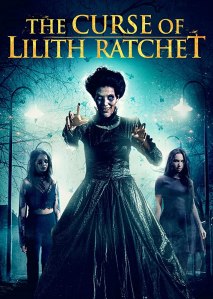 At its core, The Curse of Lilith Ratchet is a low-budget horror movie stuck between two paths of entertainment and sadly reaching neither. It could have been a genuinely good horror movie, one where its concept begets creative ingenuity, like a Lights Out or Final Destination, where the set pieces are well developed, the characters are interesting and meaningful, and there are pertinent themes linked to character to make the horror more immediate and impactful. Or it could have gone a completely different route and declared itself a schlocky horror movie, owning a trashy flair of fun while doling out exploitation elements of sex and violence to provide the prurient thrills of genre satisfaction. Unfortunately, Lilith Ratchet isn’t good enough to be legitimately good and it’s not knowingly bad enough to be particularly entertaining. It’s just another disappointing low-budget horror movie with too little thought given to its story and characters and horror sequences.
A group of friends steal a shrunken head belonging to the notorious Lilith Ratchet, a Civil War-era woman who murdered her cheating husband with an axe and was then killed herself. She would curse anyone who would say her name and attached nursery rhyme. Alice (KateLynn Newberry) and her pals offer the famous head to popular paranormal radio host, Hunter Perry (Rob Jaeger). He broadcasts from a dance club for a special Halloween show and brings in volunteers for a game of hot potato with the shrunken head (again, this is designed for an auditory medium, which doesn’t seem wise). The evil spirit roams the Earth, striking down in order those who held her shrunken head, and Alice scrambles for a potential way out.
 Here’s an example that hits both areas I cited above as it concerns that middle ground between well-developed horror and schlocky camp (mild spoilers I guess). Our first Lilith Ratchet victim, after the prologue, is abruptly run over by a car. This news does not reach his girlfriend, Lauren (Brianna Burke), until Alice delivers it in person, which seems beyond bizarre to me. Side note: cell phones do not seem to really exist in this universe. They do appear every so often, but when it comes to reaching others during times of crisis, or distributing key information, nobody picks up their phone to dial or text. They instead wait to hear face-to-face, and that consistent delay of communication breaks the tenuous reality of the movie. Writer/director Eddie Lengyel (Scarred, Mother Krampus 2) might as well have set the film during the 1980s or beforehand if modern technology matters so minimally. These characters are still talking about a popular radio show; not a viral podcast but, an alternative radio show. It doesn’t quite feel of today.
Back to my example, Lauren is informed her boyfriend has died. She retreats indoors to take a long bubble bath. She doesn’t exactly seem too broken up after her immediate response but hey we all grieve in different ways. Now, considering we’re dealing with a supernatural presence, why not take the form of the dead boyfriend? This would make the encounter more personal; the spirit could dig into Lauren’s suffering and perhaps any feelings of guilt, it would be an opportunity to open her more up as a character before her inevitable death, and it would simply be more interesting. Sadly, the film doesn’t go this route. Instead, she lounges in her bathwater and oblivious to the Big Scary Lady walking around the room. Then she’s violently pulled into the water and released, and this happens maybe four times. I don’t know about you but if I’m being yanked by a malevolent spirit in my bathtub, I’m getting out of that tub quick. Lauren leisurely tries to catch her breath. So, if we weren’t going with the more character-focused and developed death, then we should go for something memorable or truly horrifying. Instead, we get a woman being pulled under her bathwater and it happens three to four times. It’s not interesting and it becomes repetitious to the point of unintentional comedy. It’s also a bathing kill that veers away from T&A or anything too tawdry, which means it fails to register either as effective, engaging traditional horror and as schlocky, fun, campy horror. It just made me think of the obvious homage to Nightmare on Elm Street and then it didn’t offer anything more.
 Even with its low budget, that didn’t consign The Curse of Lilith Ratchet to certain doom. The problems begin early when it comes to establishing its universe and its rules in a way that feels consistent and credible. The script requires plenty of sloppy exposition and a questionable structure of this information. We should know the rules of Lilith Ratchet early to play along. It isn’t until over an hour into the movie where the characters even piece things together. There are also scenes that have no need to exist or their placement is questionable. Do we need a scene where the characters chat with a local shop owner who warns them about his open “not for sale” display? If we cut that scene, then it presents the characters as more devious when they explain how they obtained the shrunken head. When we do get the Lilith Ratchet back-story, we get it twice, first when Hunter is presented with the shrunken head and then second on his paranormal radio broadcast. Why not condense this into one experience? Why not even open with the back-story, then pull back and reveal him on his radio broadcast, and then from there have the characters on his doorstep with the shrunken head, knowing from the broadcast he was a fan? That’s a cleaner structure. There is a weird plurality of scenes of people consoling Dylan (Roger Conners), but it’s always someone informing you after-the-fact about relationships. I didn’t know he was best friends with a murder victim, and now everyone on the street wants to console him like he’s an unofficial mayor of the city. It’s storytelling that’s trying to fill you in on significance after it matters. If you’re going to be late giving us information to understand the characters’ emotional states, don’t bother.
As a horror movie, there are too many moments that are expected. It feels like we’re running through the motions to include certain moments because they’re expected. The opening prologue introduces a threat and some mild gore, but the massacre of this sorority doesn’t have any larger ramifications for the entire story. We see some of the dead girls, which means that Lilith Ratchet can indeed take the form of the dead, but they don’t act too suspiciously. It’s simply a quick visual cue for the audience not to trust these onscreen women. If she can take this form, I wish she had done it more often, especially as people started getting dispatched. The opening also has what might be the funniest moment in the entire film. One of our sorority girls sees the evil spirit, runs upstairs, hides in her bathroom without locking the door, climbs into the shower as a meager form of protection, and this is even funnier because the shower is a clear glass door. I don’t know what she was expecting hiding behind a completely transparent cover in an accessible room. Are we supposed to ridicule this person? I don’t get the sense anything is done for laughs. Likewise, there’s a preponderance of jump scares in place of cleverly designed set pieces of terror. There’s nothing tailored toward Lilith Racthet’s personal history to make it her feel more than a generic haunt.
 The real star of the movie is Lilith Ratchet and the actress behind the spirit, Crissy Kolarik (Mother Krampus 2). It’s rare for a horror movie to not just create a spooky creature but to even create an affecting silhouette, something easily identified and quickly felt. Lilith Ratchet is a great looking creation. She’s in a flowing Gothic gown, her clawed fingernails stretched at her sides, her Victorian era hairstyle and pale face. It’s a creepy image and Kolarik has a really strong sense of poise and presence as she patiently stalks the sets, enough that I was reminded of The Nun, another immediately creepy specter with a clearly identifiable silhouette. The backlit moments that highlight Lilith’s shape also have an unsettling impact. I wish that this evil spirit had a more interesting story to utilize this actress and setup. While the movie never calls for her to do anything terrible different, Kolarik excels at being the big bad boo and glaring menacingly.
Under its DVD release title, American Poltergeist: The Curse of Lilith Ratchet is a bit misleading considering she’s not a poltergeist. Or a demon. Or much of a ghost really. She’s kind of a walking idea, a version of the Bloody Mary urban legend. This lack of clarity and personal alignment is symptomatic of the movie as a whole. It’s certainly not a bad looking movie for its reported $15,000 budget. It has professional lighting that establishes a mood and solid makeup and gore effects, and even the score can have its draw. The acting is acceptable even with characters absent goals, dimension, or general points of interest. I have seen far worse movies with far bigger budgets. What I’m getting at is that The Curse of Lilith Ratchet had effective and appealing technical merits and a capable cast that could convey dismay and confusion. It had a starting foundation that could have delivered had they been given a good and interesting story. Alas, the screenplay feels too unfocused, sloppy, overcrowded, and lacking in direction and escalation and personal stakes beyond the obvious. We’re talking about stuff like an extended sequence of hot potato with a shrunken head for a radio show. If you’re not going to make smartly designed scary sequences, then perhaps try your hand at making a campy, gory, silly, knowing movie. The tongue-in-cheek version of this movie could have been a blast. The Curse of Lilith Ratchet is a middling horror movie that just comes and goes, leaving little impression other than a lingering sense that somehow it should have been better.
Nate’s Grade: C-


 nathanzoebl
You must be logged in to post a comment.