Blog Archives
Zootopia (2016)
 I may be the last person on the planet to have finally watched Zootopia, Disney’s first quarter hit of the year, and I am very glad that I did. I was expecting something cute with the premise of a plucky rabbit (voiced winningly by Ginnfer Goodwin) joining forces with a wily grifter fox (Jason Bateman) in the sprawling animal metropolis, but what I wasn’t expecting was a fully thought out and stupendously imaginative world and a message that is just as thought out and pertinent. The anthropomorphic animal land is filled with colorful locations and plenty of amusing characters. It’s highly enjoyable just to sit back and watch. I knew I was in for something radically different and dare I say more ambitious when there was an N-word approximation joke within the first ten minutes. This was not a movie to be taken lying down. My attention was rewarded with an engaging relationship between the two leads, careful plotting, endlessly clever asides without relying upon an inordinate amount of pop-culture references, and ultimately a noble and relevant message about the power of inclusion, tolerance, and rejecting prejudice. The larger metaphor seems slightly muddied by the late reveal of who is behind the conspiracy to make the animals go feral, but I wouldn’t say it undercuts the film’s power. The characters charmed me and I was happy that each ecosystem factored into the story in fun and interesting ways. There are plenty of payoffs distributed throughout the movie to make it even more rewarding. Zootopia is a funny, entertaining, heartfelt, and immersive movie with great characters and a world I’d like to explore again. Given its billion-dollar success, I imagine a return trip will be in short order and we should all be thankful. Something this spry and creative needs to be appreciated.
Nate’s Grade: A
Share this:

Star Trek Beyond (2016)
 With J. J. Abrams’ departure from the franchise for the greener space pastures of Star Wars, there was a creative void to fill, and in stepped director Justin Lin (Fast and Furious series) and co-writer/star Simon Pegg, acclimating to the established new movie universe and providing a Trek movie that proves to be the most “recognizably Trek” in the series thus far. The crew of the Enterprise is stranded on an alien world after being attacked by a hive-like armada of ships. It’s a somewhat familiar formula, a distress call that ends up being a trap, from an unknown entity that is harboring vengeance against the Federation. This allows for several dispirit storylines to explore the surroundings but also the enjoyable character dynamics of the crew; the casting department hit the jackpot with this franchise, and it’s just satisfying to watch the actors deliver solid, satisfying character moments. The new character Jaylah (Kingmen’s blade-legged Sofia Boutella) is interesting, kickass, and a source of deadpan comedy conflicts with others. There’s a genuine sense of discovery that’s patiently paced, not so much the set-piece-every-ten-minutes of the Abrams films. Idris Elba (The Jungle Book) makes for an intimidating villain and I’m happy to report he doesn’t get lost under gobs of makeup. He becomes more Elba as it goes, and he’s given a credible motivation and back-story to explain his actions. The action is a bit less exciting than I was hoping for from Lin, whose special blend of crazy has been somewhat dampened as he adopts the house visual style of the franchise. Pegg and co-writer Doug Jung have steered the franchise into safer territory but also put the focus on the crew and their bonds, which is the secret weapon of Trek. You sense that Pegg and Jung are fans, and they even provide greater context and justification for the new Trek elements that drew earlier complaints, like the use of the Beastie Boys song which now becomes a fun moment of fist-pumping triumph. Star Trek Beyond (no colons necessary, apparently) doesn’t quite hit the same highs as the previous two films, but it’s a solid movie overall and might be the best movie for the most ardent fans of classic Trek. My last piece of advice: go into space construction in the future. The way they go through starships, you’ll always have a job.
Nate’s Grade: B
Share this:

Finding Dory (2016)
 Victims of their own meteorically raised expectations, there’s still never been such a thing as a “bad Pixar” movie, and yet that doesn’t stop a growing lower tier from emerging, mostly the non-Toy Story sequels. I was wary about their latest, Finding Dory, mostly because I wasn’t completely enamored with its predecessor and also because it felt like writer/director Andrew Stanton was resorting to safe territory after helming the high profile flop, John Carter. It’s an amusing, cute, and effortlessly beautiful movie to watch but the threadbare plot reminds me of those direct-to-DVD sequels that were born from many a Disney animated classic from the 1990s. This is simply a story that didn’t need telling, much like Monster’s University, Cars 2, and The Good Dinosaur. This narratively fishy fish tale is firmly in that lesser league of Pixar cinematic adventures. I laughed here and there and there are some emotionally resonant moments as Dory looks for her missing parents, but so much of the plot feels transparently utilitarian, moving pieces around, and without the imagination and wonder the original provided. Hank the octopus feels less like a fully defined character and more a merchandizing opportunity. The majority of the plot takes place at a marine park, which limits the discoveries. Where are the narrative payoffs and economical storytelling of Stanton’s masterpiece, WALL-E? There’s an emotional lesson during the third act that would have hit harder had the filmmakers had the courage to see it through. I was picking up a heavy parallel with Dory and raising children with special needs. I would imagine much like the brilliant Inside Out that parents might get more out of the film’s emotional relationships than children. Finding Dory is fun and difficult to dislike, what with its loveably optimistic lead character; however, it does too little thematically to separate itself from a sea of imitators.
Nate’s Grade: B
Share this:

The Jungle Book (2016)
 It seemed like only a matter of time before those in the Mouse House started looking through the back catalogue of hits for inspiration. The Jungle Book is a live-action remake of the 1967 Disney animated film, but it’s only the first of many such translations to come. A live-action Beauty and the Beast is being filmed currently and plans are underway for a possible live-action Aladdin as well, though I pity the actor with the unenviable task of replacing the beloved Robin Williams. I was wary of director Jon Favreau’s (Iron Man) version just because it seemed, on the surface, like a quick attempt to fleece the public of their hard-earned money with a repackaged movie. What I got instead was a brilliantly executed adventure story with a beating heart, amazing special effects, and ultimately an improvement on the original. Imagine that.
Mowgli (Neel Sethi) is a boy raised by a pack of wolves. He tries to fit in with his pack but he grows a bit too slow and he can’t help himself with “tricks,” making tools. During a drought that signals a jungle wide peace between predator and prey, the feared tiger Shere Kahn (Idris Elba) lets the rest of the animals know his demands. The “man cub” is to leave or Kahn will hunt him down. The mother wolf, Raksha (Lupita Nyong’o), refuses to part with her child but Mowgli volunteers to leave to keep his pack safe. Kahn chases him deeper onto the outskirts of the jungle where Mowgli teams up with Baloo (Bill Murray), a lackadaisical bear who makes use of his partner’s affinity for tools and building contraptions. Mowgli’s new life is interrupted when he learns Kahn has attacked the wolf pack with the desire for Mowgli to return and face his wrath. Mowgli must team up with the friends of the jungle and use all his bravery and skills to defeat the ferocious Shere Kahn who has been lusting for vengeance for years.
 Favreau’s version of The Jungle Book is a thrilling and thrillingly immersive visual experience that opens up the big screen as an exciting canvas. The visual wizards have made an entire ecosystem look photo realistic to the point that if somebody said offhand that Jungle Book was shot on location in India, I wouldn’t think twice. The environments are entirely CGI and they are brilliantly brought to life in a seamless recreation I haven’t seen so effective since 2009’s Avatar. It’s stunning what can be accomplished with modern special effects, and then there’s Favreau’s smart decision not to radically anthropomorphize his animal cast. These are not some hybrid human-animal combination but rather flesh-and-blood wild creatures that just happen to speak English when they open their mouths (depending upon your territory). The animals don’t fall into that pesky uncanny valley where your brain is telling you what you’re watching is fake and unsettling to the senses (see: The Polar Express). The animals and behave like the real deal and further cement the exceptional level of realism of the movie. From a purely visual experience, The Jungle Book is a feast for the eyes that helps raise the bar just a little bit higher for the special effects industry and its proper application.
The movie would only succeed so far if it weren’t also for its engaging story. Let’s be honest about the 1967 Disney animated film: it’s not really a good movie. It’s fun and has some memorable songs (more on that below), but as a story it’s pretty redundant and flimsy. Mowgli bounces around one potential animal group to another trying to find a home only to move on to the next prospective foster situation. I never made the connection before but in a way the movie North is this plot, minus the talking animals and general entertainment value. There are long segments of the original Disney film that coast just on the charisma of the vocal actors and the animation. Certainly the Beatles parody characters haven’t aged well. There was plenty that could have been added to this story and screenwriter Justin Marks does just that, making the characters far more emotionally engaging. I felt a swell of sadness as Mowgli is separated from his wolf family, his mother declaring that no matter what he still is her son. Marks also personalizes the stakes between Mowgli and Shere Kahn. Each side has a grudge to settle when it comes to vengeance rather than Kahn rejecting the “man cub” out of general fear. This Mowgli is also a much more interesting protagonist; he’s plucky and uses his “man cub” other-ness as an asset when it comes to problem-solving. We have a better hero, a better villain, wonderfully brought to life through the velvety roar of Elba, and a small band of supporting characters that are more emotionally grounded. The wolf pack feels like a genuine family, a community. The relationship between Mowgli and Baloo becomes the backbone of the second half of a briskly paced movie, and the predictable narrative steps feel earned, from Baloo’s con job to caring for his lil’ buddy. The attention to the characters and their relationships provides a healthy sense of heart.
The vocal cast is expertly matched with their jungle creatures, notably Elba (Beasts of No Nation) and Murray (St Vincent). Murray has an innate way to make his lazy character endearing. Nyong’o (12 Years a Slave) gives a much better motion capture performance as a wolf than whatever the hell she was in The Force Awakens. Scarlet Johansson (The Avengers) is a nice addition as Ka the serpent, and as fans of Her can attest, her breathy voice can indeed be quite hypnotizing. Even the small comic relief animals are well done including the brilliant Gary Shandling in his last film role. Motion capture for non-primates seems like an iffy proposition considering that you’re either forcing the human actors to physically walk on all fours and pretend to be animals, which can be silly, or just copying the direct movements of animal models, which seems redundant then with the technological advances. I don’t know how they did it but it seems like The Jungle Book found a working middle ground that still showcases actor performances.

I think this picture cures infertility.
With a movie that works so well on so many levels, the few faulty areas tend to stand out, and I feel like somewhat of a cad to say that one of the biggest problems is the acting from its child star. I’ll give Sethi some leeway here considering he was never interacting with much more than a giant warehouse of blue screens, which I think we’ve shown doesn’t exactly lend itself toward the best live-acting performances (see: Star Wars prequels). When Sethi is in more action-oriented scenes, like running and jumping and generally being physically mobile, his performance improves. However, when he has to shift to portraying emotions beyond fight-or-flight that is where Sethi has trouble. When he’s playing “happy-go-lucky” early on with his wolf brethren, he’s way too animated in that way that unrestrained child actors can be without a proper anchor to moor their performance. There were moments that made me wince. I see no reason why an actor under ten should be immune to criticism when warranted. We live in an age of amazing child acting performances, notably evidenced by the incredible Jacob Tremblay in Room. We should expect better from our smaller actors. Unfortunately for Sethi, the visual spectacle is so luscious that the one human element sticks out more when he is also delivering a mediocre to poor lead performance.
The other minor detraction for Jungle Book is the inclusion of the two songs that really anyone recalls from the original Disney version, “I Want to Be Like You” and “The Bear Necessities.” I’ll even charitably give “Bear Necessities” a pass as it involves a moment of levity and bonding between Mowgli and Baloo and they’re simply singing to themselves as they relax down the river. It’s also the most famous song and if you think about it the “Hakuna Matata” of its day. “I Want to Be Like You” does not deserve the same consideration. It comes at an awkward time and undercuts the build-up of tension and does nothing short of rip you out of the world of the movie. At this point, we’ve been introduced to the hulking presence of King Louie voiced by Christopher Walken. The giant ape is portrayed like a mafia don and his sit-down with Mowgli has a real menace to it as he wants to provide “protection” for the man club at a price. It’s a moody moment and then this big orangutan starts singing and dancing. The illusion and reality of the movie is broken. At no other point does The Jungle Book come close to breaking its reality and it’s all for such an extraneous moment. There’s nothing conveyed in this song that couldn’t have simply been communicated through speech. Instead, the live-action movie makes a tortured homage to the older Disney source material, and it’s the one major misstep in its approach.
The Jungle Book is a magical movie that actually improves upon its cinematic source material. It’s a visual stunner that is completely transporting and another high-level achievement for the art of modern special effects as well as the proper usage of them in connection with fundamentally good storytelling. Favreau is able to open up a new yet familiar world and allow the viewer a renewed sense of awe. We also get characters that we care about, a strongly grounded sense of emotional stakes, and some thrilling action to go along with the CGI playhouse. I only have a few misgivings with Disney’s new Jungle book and one of those is really a function of its homage to the older Jungle Book. I’ll take the rare step and advise moviegoers to seriously consider seeing this in 3D (I did not). It’s a great visual experience, however, that would only take the movie so far if it wasn’t for Justin Marks screenplay adaptation and Favreua’s skilled direction. Now The Jungle Book can be a great visual experience, a great story, and, simply put, a great movie.
Nate’s Grade: A-
Share this:

No Good Deed (2014)
 Truthfully, I likely never would have seen No Good Deed in the theater if it weren’t for two events. It’s not that it looked especially heinous, just ordinary and not worth rushing out to see. The first event was my father’s newfound love of Idris Elba (Pacific Rim, Mandela) as an actor, an appreciation I too share for the charismatic leading man. The other event is a tad uncommon. Being part of a critics group, I regularly get e-mails from publicists about upcoming screenings. At the last minute, I received an e-mail informing me that an advanced screening was canceled, but what piqued my curiosity was the stated reason: there was a late twist/reveal that the studio did not want getting out. Really? What appeared on the surface like an ordinary home invasion thriller suddenly became a tad more intriguing, tempting my mind with possibilities. And so, with all of this achieved, I watched No Good Deed waiting to be surprised. My lack of surprise was the only real surprise, because just as I believed, this is your standard home invasion thriller that wastes the talents and time of just about everyone on screen.
Colin Evans (Elba) is a very bad man serving a five-year prison sentence for assault, though it’s believed he’s responsible for several missing women and former girlfriends. During his parole hearing he escapes and heads to his ex-girlfriend’s (Kate del Castillo) home. Colin doesn’t appreciate that she’s moved on to another man, and so he strangles her to death. He then leaves and drives off the road, an accident as the result of a powerful thunderstorm rolling through Atlanta. He comes to the door of Terri (Taraji P. Henson), a mother and wife whose husband is away. He asks to use her phone and then take shelter from the storm. She lets him inside. Big mistake.
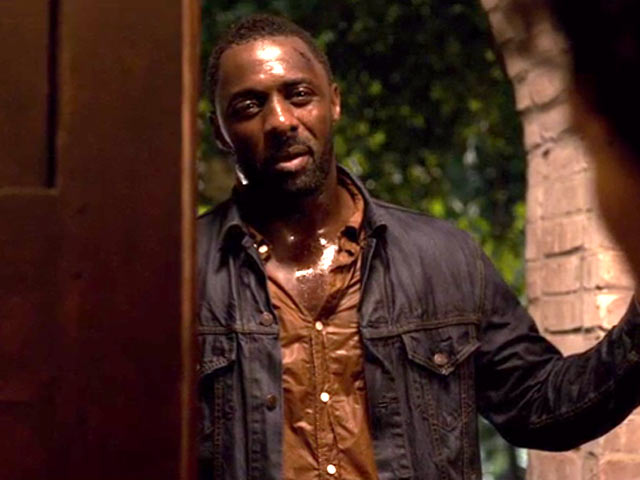 Doggedly formulaic, there is nothing about this story that separates it from the rest of the tired, dim-witted thrillers that prey upon fears of home invaders. If you removed the high-wattage stars from the film it would be completely at home on the quality-starved Lifetime Network, another poorly made suspense thriller about a bad man stalking a woman with subtle allusions to punishment for viewing the man as a sensual, dangerous opportunity. I was able to accurately guess every step of this story and I imagine you will have no problem with it as well (more on that “twist” later). How come there are no news stories about an escaped and violent convict? Colin severs the phone cords… but does nobody have cell phones in the neighborhood? In the opening credits, both Elba and Henson are listed as executive producers, which means that they attached themselves to this project because they wanted it to get made. They used their collective power to ensure this story would leap ahead of the thousands of other notable and compelling scripts in Hollywood (ahem). And the big question is why? I suppose there may be some fun from an acting standpoint to play such stock thriller roles as brooding boogeyman and bewildered ingénue. Except there’s nothing to these one-note characters. The screenplay does the minimal amount of effort to establish them as victim and victimizer, but you’ll never care about them or find them slightly interesting. Terri keeps making dumb decision after dumb decision; when you bash the bad guy in the head, you don’t stop after one blow. She’s a former prosecutor who worked in the homicide division, and yet she seems absentminded when interacting with mysterious strangers that appear in the dead of night at her doorstep. She’s lacking all street smarts. There’s nothing that sets apart Colin either (that name is a non-starter as far as striking fear). For a supposedly charismatic and brilliant narcissist, he doesn’t do anything that smart.
I’ll highlight the small handful of moments that stood out to me, which will include the ending and that presaged “twist.” Henson is 44 years old and a very good-looking woman, though it’s a tad odd when the movie contorts to place her in a T&A scenario. Colin, covered in fire hydrant discharge, insists she get in the shower with him so he can get clean. For the remainder of the sequence, the terrified Henson is shaking in her white tank top, her body alerting us to her cold. When was the last time a woman six years away from 50 was purposely squeezed into a moment of gratuitous titillation, let alone a non-white actress? Another part about Terri is that she’s a mother, a fact that Colin routinely relies upon with veiled threats of harm to her little ones. The funny part about all of this is when she has to sneak around the house that Terri has to grab her 4-year-old with one arm and the baby carriage with another, creating an awkwardly comical image. And it happens again and again. She sets the kids down, then goes back to carry them out, and then repeats. It made me laugh every time because it’s just so unwieldy. Another example of the botched screenwriting: Terri has a baby and at no point in the film does the conflict of keeping the baby quiet surface. She has to quiet the child or else Colin will find them. It’s a natural setup with such a young baby. Instead the baby is completely silent for the entire movie, peacefully sleeping though lots of physical activity, screaming, gunshots, a thunderstorm, and tree branches smashing through windows. This baby is unreal. How could this never be utilized? Again, more wasted potential, whatever slight potential there was to start with.
 But this brings us to the so-called twist, which I will obligingly refer to with spoilers but rest assured, if this is the working definition of twists nowawadays, we’re all getting a little too carried away. When Colin takes Terri and her kids back to his dead ex-girlfriend’s home, the recently murdered woman’s phone rings. Who’s on the other end? Shocker, it’s Terri’s husband, who has been having an affair with this same woman. And… that’s it. That’s the twist, which is really more of a plot reveal but nothing along the magnitude of a “Bruce Willis is dead” revelation. As it happened, I thought, “Okay, that can’t be it, can it?” Oh, it was. What’s even more frustrating is that No Good Deed doesn’t build off this reveal. Colin was headed over to Terri’s address to make her husband suffer, but then what? Afterwards, Terri runs around the house and eventually dispatches Colin, and the movie ends with her moving out on her own, essentially the least complicated and most boring ending it could formulate. My father had a far more morbid rewrite that I’ll share with you, dear reader. His version would climax with the husband coming home and Colin casually murdering Terri and both of her young children, leaving bad hubby to forever suffer with guilt over the repercussions of his infidelity. While this ending would be controversial, it makes more sense in connecting the plot beats and at least stands on its own. At least it would be memorable.
No Good Deed isn’t a horrendous movie. It’s just dull from start to finish, never attempting to be anything beyond a mediocre thriller. Its complete lack of ambition is even more upsetting with the quality of actors who helped to get this film made. The direction is hackneyed, the visuals are poorly lit and clumsy, and the thrills are too generic and often stupid to be entertaining. The characters are dumb, the story is dumb, and the movie is dumb. Worst of all, it’s boring, the ultimate sin for a thriller. Unless you’re hard up for some precious Taraji P. Henson T&A (and no judgment, she’s a very beautiful woman), there’s no good reason to venture out and catch No Good Deed.
Nate’s Grade: C-
Share this:

Mandela: Long Walk to Freedom (2013)
 One of the most important figures in the twentieth century, you’d expect Hollywood to give Nelson Mandela his well-deserved close-up, and in 2013 we got a biopic on his wife and the man himself, with Mandela: Long Walk to Freedom. It is a respectful, reverent, and relatively inspirational biopic boasted by a pair of great performances. Idris Elba (Pacific Rim/everything cool ever) nails the voice but also inhabits the courage of the man, the toll of his decisions, and the doubt that crept in at his darkest moments. Harris (Skyfall) gives a fiery performance as Winnie Mandela. You may be surprised, as I was, how active she was in South Africa’s rebellion against the government. The problem is that the film plays like a greatest hits collection without much more insight than we could glean from a cursory new report. Cramming the man’s life into 140 minutes is obviously going to be insufficient, but the speedy narrative does little justice to the man’s hardships and the complexities of South Africa’s civil rights movement. The cradle-to-grave approach in biopics is somewhat passé now. Rather movies like Lincoln and Invictus, also about Mandela, focus on pivotal moments that encapsulate the person. I think I have the perfect rewrite of this movie: adjust the focus squarely on the series of meetings in the late 1980s Mandela had with the South African government about political reform. Let’s dig deep into the political conflicts, the government’s fear to equal rights and possible recriminations, the smoothing of tensions, the building of trust, the fragility of a country in the balance. It may seem like more of a stage bound approach, but I think it has more immediacy, nuance, and works to summarize his lifetime of struggle and the change of his country. Oh well. Mandela is a respectful biopic but the man and his legacy deserved something better than a speedy run-through of his life’s checkpoints.
Nate’s Grade: C+
Share this:

Thor: The Dark World (2013)
 Loosely based off the Norse mythology, Marvel’s hammer-wielding hero isn’t exactly the easiest character to relate to even as a superhero. Thor is a god after all. Not to be outdone, the man is also royalty, next in line to be king, so he’s in a special class of privilege. And yet 2011’s Thor was a pleasant surprise, a superhero movie that didn’t take itself too seriously, had modest aims, and embraced its sci-fi fantasy mélange. It was a movie where the sillier it got the better it worked. Now Thor: The Dark World, a.k.a. Thor 2, is ready to dominate the fall box-office and prove that Joe and Jane Popcorn can cheer for a pagan god.
Following the events of The Avengers, Loki (Tom Hiddleston) is taken back to his home world of Asgard and put in prison. Loki’s brother, Thor (Chris Hemsworth), is trying to get back to Earth to reunite with his love, scientist Jane Foster (Natalie Portman). Thor is being groomed for the throne of Asgard by his father, Odin (Anthony Hopkins). Meanwhile, the nine worlds are nearing a convergence and dimensional gateways are opening, including one that infects Jane with an ancient biological weapon, the aether. The aether was used as a weapon by the dark elves, a race of creatures that was long ago defeated but its general, Malekith (Christopher Eccleston), has been dormant and in hiding. Alterted, he assembles his surviving army to attack Asgard, kidnap Jane Foster, retrieve the aether, and destroy all life in the universe.
 Thor is still a second tier character when it comes to Marvel superheroes (the guy just isn’t that interesting) but his franchise has, in only two starring films, become the most interesting. The scope of the Thor movies seems infinite. Whereas the other Marvel heroes are Earthbound and straightforward, Thor transports an audience to all sorts of alien worlds/cultures/conflicts, all of which open up more tantalizing storytelling avenues. Nothing seems out of place in a setting such as this, and so the surprises are more satisfying. I thought the best parts of 2011’s Thor were the Asgard moments, less the strained fish-out-of-water comedy of Thor assimilating on Earth. Thankfully, almost all of Thor 2 takes place off Earth save for a rousing, creative, inter-dimensional hopscotch of a climax. The realm of Asgard is given suitable scope thanks to the screenwriters and first-time feature film director Alan Taylor, who worked in TV for years. Taylor’s notable work on HBO’s Game of Thrones is probably what got him this gig, and his vision with fantasy is given significant breadth here. The Thor universe is an interesting mix of fantasy and sci-fi, reminiscent of Star Wars, and Taylor provides the necessary sweeping visuals, exciting action, and glorious shirtless close-ups we come to expect from our fantasy vistas. I was consistently impressed with Taylor’s command of visuals and shot selection, particularly how the man was able to juggle the various tones and needs of the script while still keeping an exposition-heavy film fun and light.
With rainbow bridges, dark elves, and enchanted hammers, thank goodness that Thor 2 keeps a steady and welcome sense of humor, never getting too serious even with the end of existence on the line. This jovial tone is refreshing when properly executed and contributes to the overall fun of the picture. We’ve had such sturm und drang when it comes to our superhero movies, particularly last summer’s Man of Steel misfire. I appreciate a dark and gloomy superhero tale like Nolan’s Batman films, or a satirical swipe like the original Kick-Ass, but we need stories that fit with their tone. When it comes to Thor, he’s still saving the world, rescuing his damsel, but the attitude, while on its face regal and serious, is anything but. The Thor movies accept the absurdities of its setting and just shrugs, plowing along. And now with Jane on Asgard, the fish-out-of-water comedy gets a different perspective. She gets to meet Thor’s parents (awkward) and an Asgardian who has a thing for the hunky Norseman (double awkward… I’ll stop the 90s catch phrases now). Thor 2 also gives Jane Foster much more to do, placing her front and center as a person integral to the stability of the universe. During the snazzy climax, she gets to run around and contribute in a meaningful manner. The there’s the plucky Kat Dennings (TV’s 2 Broke Girls) who gets to rattle off one-liners like a pro, many of them grounding the elevated levels of silliness. Much of the humor comes from the cocksure characters and their quips, particularly Loki.
And that’s as good as any place to interject my notion that Thor isn’t truly the main character in this film, despite what the title preceding the colon may lead you to believe. That honor goes to Loki, the greatest villain in any modern Marvel movie by far. He’s got the clearest arc in the movie, going through arguably the most personal pain, coming to a crossroads, and his conclusion certainly sets up sizable ramifications down the road for the presumptive Thor 3. Played by Hiddleston (War Horse), the character draws you in, even when he’s throwing his self-aggrandized temper tantrums you want to spend more time with him. He’s far and away the most developed and interesting character onscreen, and Hiddleston has such a gleeful malevolence to him that makes the character all the more electric and unpredictable. Thor 2 is really the story of Loki coming to terms with his life’s choices, the choices his adopted parents made, his sense of self and birthright, and moving forward, becoming his own man again. This is why Thor 2 ascends another entertainment rung by tying Loki into the main story, forcing him and Thor to work together against a common enemy.
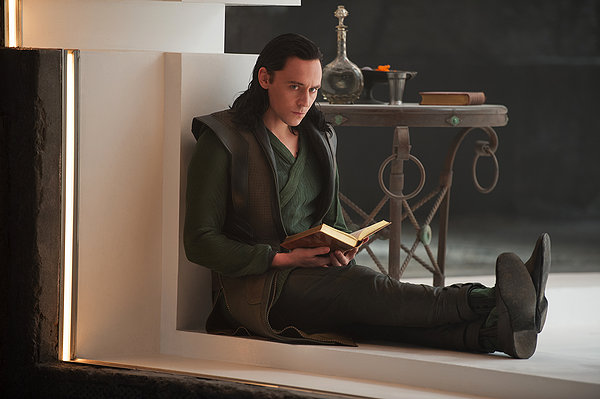 In a film dominated by a charismatic Loki, it’s no wonder that Thor 2’s real bad guy falls woefully short. Malekith is a confusing and altogether lackluster antagonist in every conceivable way. He has no personality to him; he’s simple-minded with the goal of eradicating the universe. I don’t know about you, but my bad guys better have a pretty good reason for destroying the universe since they kinda live there too. This is one of the lazier villain plot devices because it has no nuance, no shading. Apparently before there was a universe there were dark elves. I don’t want to get caught in a chicken-egg paradox here, but was there a universe before the universe, cause I look at the universe like existence’s garage. The cars inside may change but the garage was standing before it all. Anyway, Malekith wants to destroy all life because he wants to, because certainly you’d think there would be enough space in space. He’s not even that threatening or given any particular advantage beyond some firepower. It’s no wonder that Loki runs circles around this chump in the villain department. Eccleston (Unfinished Song) is not at fault. The heavy makeup he’s under smothers the actor’s ability to polish this terrible character.
The rest of the acting fares better. At this point, we know what we’re getting with Hemsworth (Snow White and the Huntsman) as the title character. He’s a sturdy leading man with just enough appeal to satisfy, though part of it is that Thor is just dull as a hero. He was more entertaining when he was cocky and irresponsible. Portman (Black Swan) holds her own though the romance between her and Thor feels more forced. Hopkins (Red 2) strikes the right mix between regal and camp. While their roles aren’t exactly integral, it’s nice having a superhero movie stuffed with great actors like Idris Elba, Ray Stevenson, Adewale Akinnuoye-Agbaje, Clive Russell, and there’s even an amusing appearance by Chris O’Dowd, who effortlessly oozes charm (take note, Thor).
This a superhero movie that separates itself by its sheer sense of fun. Thor: The Dark World takes what worked in the previous movie and provides more of it. The campy, silly Asgard stuff is given even more time, the mischievous sense of humor is renewed, the fantasy worlds given more depth and better action/effects, and fan favorite Loki gets a big starring role this time with extra brotherly bickering. It’s not the best superhero movie, nor is it the best Marvel film of recent years, but Thor 2 knows what kind of movie it wishes to be and how to best achieve this. It’s a loopy, droll, and rather imaginative big-budget superhero film, while still finding ways to be somewhat generic with its overall plotting and character turns. While the action is suitably epic, it’s the character interactions that are the most enjoyable aspect. It seems excessively lazy to say that if you enjoyed the first Thor, you’ll probably enjoy the second one as well, but there it is. Perhaps next time the storyline won’t be as convoluted and we can get even more Loki. Barring that, I’ll accept additional Chris O’Dowd screen time.
Nate’s Grade: B
Share this:

Pacific Rim (2013)
 Pacific Rim is director Guillermo del Toro’s (Hellboy, Pan’s Labyrinth) giddy ode to the great monster movies of his youth, and if you’re fond of men in suits and large-scale cardboard destruction, then this movie is definitely for you. The word “awesome” seems too inadequate to describe the rock ‘em sock ‘em action of this picture. This is likely the most realistic and serious this concept will ever be realized, with a gargantuan budget and some top-notch special effects. del Toro, already something of a god in fanboy circles, will get his chiseled bust alongside Joss Whedon. Pacific Rim is a transporting blockbuster that doesn’t pull its punches, at least when it’s dealing with robots fighting monsters. If this is why del Toro dropped out of directing The Hobbit then I think it’s a good trade off.
In the near future, a rift opens at the bottom of the Pacific Ocean that opens a gateway to another dimension. Through this portal, giant horrifying monsters the size of skyscrapers appear to wreck havoc on coastal cities. The monsters, known as kaiju, take a whole lot of work to go down. “To battle monsters, we had to make monsters, “ say a character in the prologue. The world unifies and responds with a program where two people pilot giant mechanical robots known as jaegers (yes college kids, you read that right). These pilots are psychically linked via a process known as the Drift; they work in tandem, sharing one mind. Raleigh (Charlie Hunnam) is a former jeager pilot recovering from the loss of his co-pilot/older brother in battle. Stacker Pentecost (Idris Elba) recruits him back to the final days of the jaeger program, a defense that has fallen out of favor with world leaders once the kaiju started winning again. Stationed in Hong Kong, Raleigh is looking for a new co-pilot and by all accounts it seems Pentecost’s diminutive assistant, Mako Mori (Rinko Kikuchi), is the best candidate, though Pentecost won’t allow it. Add some wacky scientists (Charlie Day, Burn Gorman) and an underground monster parts trader (Ron Perlman). The last days of the beleaguered jaeger program are all that stand between mankind and annihilation from giant beasts.
 It’s undeniable how well Pacific Rim taps into your inner ten-year-old, the kid who crashed his toys together imagining larger-than-life battles. Truthfully, if I were ten years old, I’d likely declare Pacific Rim the greatest movie of all time, that is, until I saw one with boobs in it. Conceptually, this feels like just about every anime brought to life, and fans of anime, as well as monster movies in general, should be in heaven. It’s so much fun to watch but it also doesn’t get lost in the cacophony of special effects like many modern blockbusters. del Toro has a wonderful way of showcasing his action without losing track of the scale or the destruction. Unlike Man of Steel, we have city-wide devastation that feels like devastation. Giant monsters are a state of life for the world and so is the day-to-day anxiety that one’s coastal existence is about to be in ruins. The movie doesn’t get bogged down in post-9/11 solemnity, but at the same time I appreciated that del Toro makes his violence feel significant and the loss feel real.
The action onscreen is often exciting and screenwriter Travis Beacham (Iron Man 3) employs a nice system of escalating the stakes by applying a category system to the kaiju, rating them on a 1-5 scale. It provides a natural progression of opponents. Plus, besides the inherent excitement with the premise, Beacham and del Toro drop us into the middle of this story, years after the jaegers have fallen out of favor as a means of defense, thus providing another hook – underdogs. Our heroes don’t just control giant fighting robots, they are also underdogs and have to prove their mettle to dismissive authority figures. I was hooked.
del Toro has always been a man who can create living, breathing worlds that you just want to explore, and Pacific Rim is the same. I loved immersing myself in the minutia of this world, learning the different fighting techniques of the robot designs, the cultures that harvest the kaiju bodies (there are monster groupies as well), the rock-star status of the jaeger pilots, and most of all, the Drift. Psychically linking the pilots is an ingenious way to add to the emotional investment of what are otherwise fairly clichéd character types. They have to be in synch mentally, which requires a whole other level of trust and connection. The tragic back-story of Raleigh is given even more weight knowing that not only was he witness to his brother getting eaten alive by a giant scary monster, he was psychically linked and felt his brother’s overwhelming fear and pain. That would definitely shake me. The Drift also provides a unique way to include back-story without feeling like forced exposition. Seeing Mako’s horrifying childhood survival account is quite affecting, but it works even better knowing this is also a chance for Raleigh to understand and bond with her. That sequence, Mako as a child, is stunning, staying with her pint-sized perspective as she tries to outrun a ferocious monster bearing down on her. It slows things down and allows the true terror of the situation to seep in. Beacham and del Toro have put a great amount of thought with how this world operates, and it’s appreciated as seemingly every detail adds to a richer big picture.
Naturally, the special effects are just about every positive accolade you can put together. It’s a CGI heavy film that doesn’t look like a cartoon; something Michael Bay’s Transformers have difficulty overcoming. The robot designs aren’t overly busy. In fact, the main robot reminds me a lot of Metroid’s Samus suit (anybody?). The monsters are all a bit too similar in design though. They all start to bend together making it hard to differentiate them from one another, especially when they’re supposed to be getting bigger and badder. Part of my lukewarm reception with the monster designs, besides from del Toro’s sterling past reputation when it comes to creature designs, is that so many of the epic fight scenes happen with some level of visual obfuscation. They fight at night, they fight in the rain, they fight in the fog, they fight underwater, but rarely will they fight in a setting where you can clearly focus on the fighters. This very well could be a budgetary decision, allowing less work for visual effects artists so they can cover the scope of del Toro’s imagination. Still, it’s hard for me to compose an argument that a $200 million-dollar movie needed just a bit more money to properly show off the goods.
 When it’s not wrecking havoc onscreen, the story can drag and you’ll notice how thin the characters are developed. It’s another reluctant hotshot and learning to get over a personal tragedy, trusting a new co-pilot, and taking stern advice from a begrudging father figure. That doesn’t mean they don’t work within the framework of the story; Hunnam (TV’s Sons of Anarchy) is solid if unspectacular, Elba (Thor, TV’s Luther) is the universe’s most authoritative badass, Day (Horrible Bosses) and Gorman (The Dark Knight Rises) provide a nice array of comic relief, and Kikuchi (Babel, The Brothers Bloom) makes for a formidable upstart hero. The character roles are familiar and thinly sketched but they come together in a satisfying manner, each contributing to the mission, and each finding a moment to make you care. When the fate of the world is at stake, it’s hard not to feel some investment in our ragtag assembly of heroes. With that being said, you will still feel drag in the middle, waiting for the next attack and for our heroes to suit up and do what they do best. The extended second act involves denying Raleigh and Mako the opportunity to do what we all know they need to do – man a jaeger. It can get restless as we keep getting roadblocks to something that seems inevitable. It’s akin to waiting too long for John Reid to accept his outlaw status in The Lone Ranger. I will give Beacham and del Toro extra credit for not leaving themselves open for an immediate sequel. Also, do stay through the credits for a nice treat.
I can easily recommend Pacific Rim with minor reservations, and if giant fightin’ robots and monsters is your thing, then the reservations won’t even matter when you get a movie this entertaining, fun, and skilled at providing the gee-whiz factor. I wish all summer movies were this fun. I was squealing with glee watching a giant robot drag a cargo ship across the streets of Hong Kong, gearing up to beat down a huge monster. The movie is packed with little moments like that. As with other del Toro productions, the world feels nicely realized, lived in, and sprawling with detail, even if the monsters all start looking the same (monster racism?). The plot does suffer a bit when it refocuses on the humans, but then again what plot wouldn’t suffer when it takes you away from giant robots fighting aliens? Pacific Rim isn’t the first of its kind. Besides the anime, Godzilla, and even Power Rangers influences that spring to mind, there have been numerous movies that follow a similar premise of Giant Thing A squaring off against Giant Thing B. What sets Pacific Rim apart is del Toro’s innate ability to channel your childlike glee at the concept, turning something monstrous into something fun while still giving respect to the weight of the moment. This is not a dumb action movie. del Toro’s sprawling artistic sensibility takes on summer blockbuster filmmaking and shows you how it can be done right for optimal effect without making your brain hurt. Now I need round two.
Nate’s Grade: B+
Share this:

Prometheus (2012)
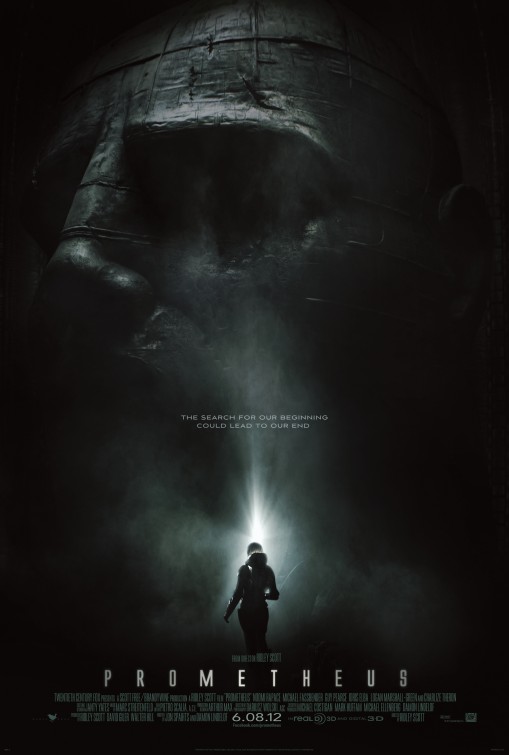 Ridley Scott has always wanted to go back to the Alien franchise that began with his 1979 sci-fi staple. There have been a lot of coy discussions over whether his big-budget sci-fi spectacle Prometheus is indeed an Alien prequel or not. Scott keeps hinting it has the DNA of the franchise but exists on its own. This movie has some Big Questions on its mind, like where did we come from, but the biggest question out there is whether it really is an Alien prequel or not. Well rest assured, that question will be sufficiently answered. Now if you have more than that, you will be left empty-handed with this gorgeous but ultimately confounding sci-fi thriller.
In 2089, a team of archeologists, lead by Elizabeth Shaw (Noomi Rapace), discover an ancient star map from 30,000 years in mankind’s past. This is not the only ancient illustration displaying the same constellation. Sure enough, in every ancient civilization across the globe, the same star pattern. Shaw believes it is an invitation and th key to finding the “engineers” who may be responsible for life on Earth. Four years later, the wealthy Peter Weyland (Guy Pearce) has funded a trip to that exact point in space, which harbors a moon that seems extraordinarily like Earth and capable of sustaining life. The ship is run by Meredith Vickers (Charlize Theron). who keeps asserting her company’s authority on this mission. Along for the ride is a cocksure pilot (Idris Elba), an android named David (Michael Fassbender), and Shaw’s own lover, a scientist in his own right, Charlie Halloway (Logan Marshall-Green). When the gang gets to that moon, they uncover large buried structure with some nasty surprises inside. Suffice to say, they should have stayed home.
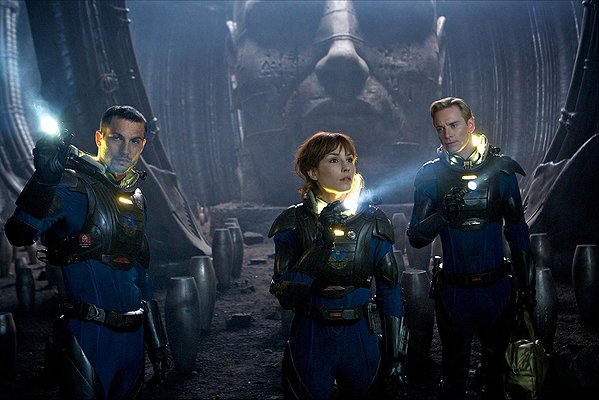 You can always count on Scott to deliver a visually extravagant picture, and Prometheus is packed with stunning, arresting visuals that fill up the big screen with lovely detail. The scale of some of these sets is massive, and your eyes just want to soak up every detail. The alien world is vast and eerie and you just want the characters to spend the rest of their lives exploring it (Scott shot in Iceland but it looks remarkably like a whole different world). The interior sets on the space ship are also sleek and cool. There’s a terrific sense of immersion in the movie. Scott has always done a great job at building worlds that feel completely lived-in, and Prometheus is another example of his talents. The special effects are astonishing but best when not dealing with the biological life forms. The giant spaceship is incredible; its inhabitants? Not so much. Apparently our DNA grandfathers looked like giant Michelin men (thankfully we take more after our mother’s side). Prometheus demands to be seen on the biggest screen possible.
Prometheus harkens back to the original Alien in its suspenseful “haunted house in space” setup. The movie has some terrifically taut moments and a great overwhelming sense of dread. The scientists let curiosity get the better of them, so they poke their heads in dark corners, touch unknown alien material, and get up close and personal with things better left unmolested. If slasher movies elicit a “Don’t go in there” audience response, then Prometheus certainly elicits a “Why are you touching that?” reaction. And yet, deep down, we want them to keep pushing further because like the best suspense films, we can’t stand the tension but we really want it to keep going. Probably the most memorable scene of them all involves Shaw performing her own hurried abdominal surgery to remove an alien from inside her. It’s creepy and caused me to wince repeatedly, but man is it fun and gruesome and a nice payoff to an earlier setup. The rest of the movie is pretty standard with its thrills, including the canon fodder supporting characters getting picked off unceremoniously, and the large-scale devastation climax. The movie delivers the goods when it comes to entertainment and suspense, though mostly in the first half. It’s almost like the movie is awed by the visuals as well, and then halfway in remembers, “Oh yeah, we got to do more than just poke at things,” and then it’s a rush to the end with a cascade of conflicts that don’t seem properly developed.
The film lays out a very essential question about the origins of mankind and plays around with theological concepts but it only plays in the shallow end of the philosophical pool. The screenplay by Jon Spaihts (The Darkest Hour) and Damon Lindelof (co-creator of TV’s Lost) deals with the conflicting origin stories via religion and observable science but never goes into specifics. “Religion” is always symbolized as a cross necklace that Shaw wears and her falling back point upon what she “chooses to believe.” The discovery that our alien forefathers have a similar appearance would be a huge revelation, except the movie spoils it with a clumsy prologue that shows us right off the bat what the “engineers” look like. Prometheus actually posits an Intelligent Design argument for human existence, albeit one the Raelians have been promoting for years, the idea that intelligent life outside our galaxy seeded Earth. Yet the one scientists on the crew, the one who objects to 300 years of evolutionary evidence, remains mum on the matter. I suppose the filmmakers didn’t want their monsters-in-space movie to be bogged down with that much pithy philosophy, but I would have appreciated some meatier conversations other than, “Should we touch this?” It’s not nearly as thought provoking or as compelling as it thinks it is.
As I sit here and I write this, the plot becomes a wispy memory of strong set pieces and eerie mood, but I cannot connect the story. It makes little sense and by the end of its 124 minutes we’re left with hardly any more answers than we started with (some spoilers to follow). Our genetic “engineers,” as they call them, remain pretty nebulous. I suppose one could argue that it would be impossible to fully understand an alien race’s habits and purposes without resorting to pandering, but that strikes me as a cop out (I’m reminded of Spielberg’s similar approach in Kingdom of the Crystal Skull, where the characters that wanted to know were punished for their intellectual curiosity by alien forces). Why did these super aliens create life on Earth and leave maps to a planet that was little more than a weapons depot? Why would these superior beings create life hundreds of thousands of years ago and then leave clues 35,000 years ago that would lead to the destruction of their little experiment? The motivation seems rather hazy. It’s not like the aliens created life on all these planets and waited to be contacted so that they knew their little biological Easy Bake oven was done and then they could reclaim a new planet. It’s not some imperialist empire or colonization scheme; it appears to just be wanton destruction. That seems like a waste of effort. Did these aliens keep checking back, see our ancestors hunting and gathering and go, “Oh my Space Deity, I can’t believe we created life on this planet? We were so wasted. Well, just wait until they conquer space travel and then we’ll kill them with a weird biological weapon.” If your desire is to destroy life, why even have a waiting period? If these “engineers” wanted to destroy Earth why not do it when there was far less clean up? Is there some kind of parent-child relationship I’m just not getting here?
 Fassbender (X-Men: First Class) makes the biggest impression as the fastidious android, David. He’s by far the most interesting character and he’s not even human. It doesn’t take long to figure out that David has his own agenda, and Fassbender plays the character with this eerie passive-aggressive arrogance. You get the sensation that he looks down on his human clientele, but you don’t know what lengths he will go. “How far will you go to get your answers?” he asks before doing something very not nice. He makes statements like, “Who doesn’t want to kill their parents?” and there’s an icy placidity to him; he’s just off enough to be menacing and unsettling without going overboard. Fassbender is excellent.
The rest of the cast cannot be at fault for failing to measure up to Fassbender (is that a Shame joke I stumbled upon?). Rapace (Sherlock Holmes: A Game of Shadows) is given top billing and does an admirable job of being a kickass heroine, which we already knew she was fully capable of in the Swedish Girl with the Dragon Tattoo trilogy. She even has a Ripley-esque haircut, which I doubt is a coincidence. Theron (Snow White & the Huntsman) gets to once again practice her ice queen routine, but I wish she had more to do than occasionally glower and bark orders. Her character’s secret background should be obvious to anyone well versed in the film economy of characters. Elba (TV’s superior Luther) tries to stick it out with some twangy Texas accent but can’t make his way through. His natural British accent pokes through routinely. Then there’s Guy Pearce (Lockout) as the wealthy benefactor who bankrolled the whole project. Apparently he was hired to film viral videos as himself, because in the movie he’s like a 100-year-old man in some pretty poor makeup (he resembles old Biff in Back to the Future: Part 2). Why hire an actor of Pearce’s caliber if you’re just going to hide him under a veil of old-age makeup? The actors do what they can but the film doesn’t give them much to work with. They’re stock roles and absent development. You don’t notice for a long while because you’re so caught up in the exploration and the gorgeous visuals, but when the end comes you realize that you hardly knew these people.
After all the pre-release coyness about whether this belonged in the Alien universe, Prometheus seems to be a victim of its own sky-high hype. The movie is moody and dark and intriguing and visually magnificent, but the plot does not hang together at all. The central mystery of the origins of mankind is given a face to start with, but that’s about it. The confusing story tries to mask its plot holes but eventually they just overtake the movie. It’s an entertaining movie in the moment but Prometheus pretty much evaporates as soon as you leave the theater and start thinking, “Hey wait a minute, that didn’t make any sense.” Why are mankind’s “engineers” a regretful bunch of jerks? Scott’s visuals are impressive, the film has a killer mood that’s hard to shake, but the plot is pretty shaky and reliant on supposedly smart people making pretty dumb decisions (why yes, I’ll try and touch the alien snake monster thing). That’s fine for basic thrills but it doesn’t elevate the movie into something headier, meatier, and more satisfying, like the original Alien. Prometheus was never going to meet the unattainably high expectations of fans stoked by tremendous trailers and the promise of Scott’s triumphant return to sci-fi, but much like the characters in the film, I was glad to go on this journey but wished I had more to take home with me.
Nate’s Grade: B
Share this:

Thor (2011)
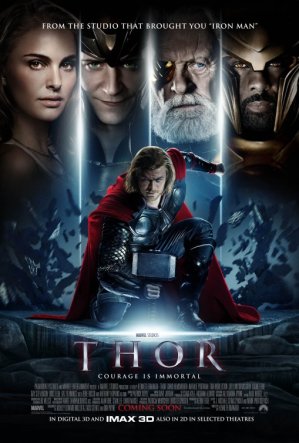 I had strong misgivings going into Thor. How was a powerful Norse god going to seem remotely relatable? How was the most improbable member of Marvel’s Avengers ensemble going to be explained in a way that didn’t feel like a ton of cheese richly slathered in hokum? I was expecting this movie to be a silly, trippy, LSD-enhanced flashback (rainbow bridges! Pass the bong!) that could barely strain any sense of believability. It’s one thing to have stories about super heroes who have gotten their powers via genetic defect, scientific accident, or act of God. But what about when your character happens to be a god? It just seemed too goofy for it all to be pulled off with any conviction. A Thor movie seemed destined for some Xanadu-level of camp. Get a load of the blonde with the big hammer, boys. Not every super hero flick has to be as brooding and dark as The Dark Knight. Marvel’s own Iron Man was a great example of a briskly entertaining movie. Now that I’ve prefaced my experience, let me publicly admit that Thor is indeed a somewhat silly but mostly fun entry in the mighty realm of summer blockbusters.
Thor (Chris Hemsworth) is the god of thunder on Asgard, a distant planet populated by the Norse mythical figures (apparently, they visited Earth and the Scandinavian amongst us worshipped these… space aliens?). Thor waits to inherit the throne from his father, Odin (Anthony Hopkins), a wise king who has kept a tenuous truce with the fierce Frost Giants, inhabitants of another planet. But Thor is not ready to assume the responsibilities of leadership. He’s quick to action and temper, arrogant, and defies his own father’s orders by trying to start some intergalactic conflict with the Frost Giants on their home turf. Thor is robbed of his powers, his mighty hammer, and banished to Earth to walk amongst the smelly Earthlings. He crashes in the New Mexico desert and is retrieved by a team of scientists (Kat Dennings, Stellan Skarsgard) led by Jane Foster (Natalie Portman). The group wants to learn where exactly this man from the sky came from. So does the government, led by the S.H.I.E.L.D. agency who takes possession of Thor’s hammer. Thor thinks if he can reunite with his beloved hammer, then he can go home. But for a thunder god, he’s got a lot of lessons to learn. While Thor is out of the picture, his younger brother, Loki (Tom Hiddelston), plots to take what he feels he is owed – the kingdom of Asgard.
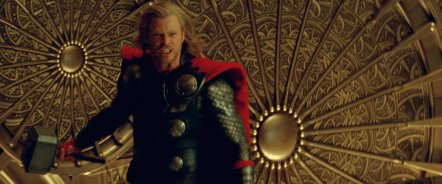 The biggest surprise for me was that the Asgard sequences are the best part of the movie; thankfully the majority of the running time is spent in this fantastic realm. I credit Kenneth Branagh’s direction, which neither hides the silliness of the material nor fully acknowledges it. By the time Thor hurtles to Earth, I was completely engaged in the operatic tale of fathers and sons, gods, jealousy, hubris, intergalactic conspiracies, you know, the stuff of juicy drama. It jus so happened that these characters wear funnier costumes. The family dynamic between Thor and Loki, the infighting and the scheming, intrigued me. Some critics have thrown around the word “Shakespearean” to describe the movie’s outsized family conflict, but I think that’s just the critical community getting lazy. Would they even approach that term is Branagh was not the director? This opening section of Thor effectively explains the history of Asgard as well as its place with the other eight worlds, the shaky relationship with the Frost Giants, the family responsibilities at play as Odin must decide the future of his ABBA-infused nation, as well as the various mechanics of how this different world operates, like Idris Elba (The Wire, Luther) stationed at the end of the rainbow as a gatekeeper to the other worlds. I liked discovering how all the pieces of this world fit together. If analyzed out of context, any part of the Asgard section just seems stupid. But taken in the film, Thor‘s crazier, more fantastic elements come together and spark genuine interest. I wanted to spend more time in this magical realm. The more ridiculous and fantastical that Thor got the more interesting it became.
But unfortunately Thor was sent tumbling to our ordinary planet. It is the Earth section that seriously deflates the movie’s vibe. It’s a relief that the fish-out-of-water comic relief is kept to a minimum, because the character of Thor isn’t an idiot, just an arrogant brat. But it’s the period on Earth where the God of Thunder learns his Really Important Lessons and finally understands what it means to be a good leader. It’s all very expected and the execution is less than inspired. The trio of scientists that Thor encounters (Portman, Skarsgaard, Dennings) could easily have been consolidated into one character. Their contributions to the story are weak. Skarsgard is mostly there for fatherly advice and the occasional expository ejaculation. As a gawky little sister scientist, I don’t even know why Dennings is in this film other than to make my eyes happy. I anticipated that Portman would assume the “love interest” spot in comic book movies that we now reserve for Oscar-winning actresses, and I assumed that role would be underwritten. But I never expected Portman’s part to be this underwritten. She’s practically nonexistent except for that winning smile of hers. Over the course of… two days, she falls in love with our banished brute. But to be fair, it’s not every day that a guy looking like Hemsworth falls out of the sky. New Mexico isn’t exactly looking like a great singles mingles hotspot. Anyway, their relationship is supposed to be the trigger that makes Thor realize he’s been a selfish and reckless fool. But their scenes lack any tension, any charm, anything of interest. They feel like two actors sitting in chairs telling stories. You don’t feel any romance between them. The drabby Earth sequences only serve as a losing contrast to the crazy Asgard territory. You can’t compete with rainbow bridges (imagine the tolls on those suckers).
 Branagh has never directed anything of this magnitude in size before, and it shows at parts. While none of the action sequences are particularly bring, none of them are particularly thrilling. The beginning battle between Thor and his pals on the Frost Giant planet (Jotunheim) is so poorly lit that the darkness forces you to squint to focus on what’s happening. Why spend $150 million on a super hero flick and shoot a dankly lit action scene? What’s the point in that? The choppy editing can also be too hectic to follow with all the quick-cuts that fail to orient the action geography. Really, there are only three serious action sequences in Thor, but then again I remember Iron Man having a light load when it came to on screen action. That film was devoted to character and performance. This film, under Branagh’s watch, is devoted to just making the entire universe of Thor credible. It’s a lot to take in, and Branagh’s biggest accomplishment is producing a sense of grandeur to the film that saves it from falling into the sticky clutches of camp. The world of Asgard feels convincing in production design and infrastructure; the cities look like pipe organs. Branagh’s film expands the Marvel universe significantly, broadening the scope for future installments. Mercifully Thor does not hard sell the upcoming Avengers movie as appallingly as Iron Man 2.
The acting in Thor is as splashy as the Asgard scenery. Hemsworth gave a notable performance as the doomed father of James Kirk in 2009’s Star Trek. He as only in the film for that ten-minute prologue, and yet the actor found a way to do much with what he was given. You got to see his character hurdle through a gauntlet of emotions: fear, duty, relief, desperation, and acceptance. His sacrifice still can make me tear up, and Hemsowrth deserves some of that credit. However, Thor is a different matter entirely. Obviously it’s going to be a more challenging role to play a buff cocky god with a magic hammer. Buff he does quite well. Cocky he does fairly well, but this is not a great starring vehicle for the actor. Hemsworth looks too self-satisfied, like he’s playing his character as an intergalactic hotel heiress. In sharp contrast, Hiddelston (Wallander) commands your attention. Those penetrating eyes, the cold yet calculated demeanor, this is an actor who feels like he walked off a Shakespeare production and just changed his headgear. You want to spend more time with Loki than watch Blondie futz around on Earth. Loki has much more depth to him than Thor; he feels betrayed by his family and an outcast to his society. I’m glad that we’ll be seeing more from this trickster in future Marvel movies (have I said too much?). Hopkins knows how to sell silliness like few other actors. And for those who have been wondering where Renee Russo has been for the last six years, well here she is, as Thor and Loki’s mother, a role that’s best suited to confirm that she is still alive.
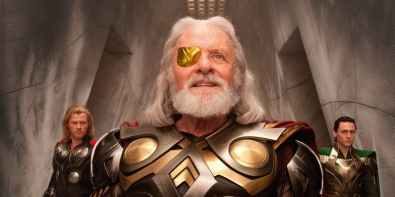 I was expecting far worse judging upon the scraps I had seen from the Thor advertising campaign. So I suppose that beating my low-flying expectations might not necessarily be something to champion. Thor is an inherently goofy, yet mildly satisfying and credible action film. It doesn’t have the style or panache of other heroes, but the fact that Branagh could make a two-hour Thor film that didn’t cause me to laugh derisively from start to finish is an accomplishment. Again, that sounds rather dismissive. I’m just very surprised that this movie works. Because if you take it apart, it doesn’t seem like it should. The acting ranges wildly in quality, with Hiddelston outshining everyone else. Thor is a solid if inconsistent start to the summer season of blockbusters. If you must turn your brain off for some movie, you’d do far worse than Thor. It has pretty colors.
Nate’s Grade: B


 nathanzoebl
You must be logged in to post a comment.