Blog Archives
Mortal Engines (2018)
 Mortal Engines is a confusing movie. I mean what does the title even mean? I was all but certain somebody would explain what it meant during the two-hour-plus movie, but nope. My best guess is that it refers to the people operating the roaming cities of the future, the tiny instruments of flesh and blood that have become the gears to these monstrous mobile cities. That’s only the start and it’s simply the title. Mortal Engines is the latest in dystopian YA to make the leap to the big screen, but this time with the guidance of Oscar-winning blockbuster maestro, Peter Jackson. If anyone could elevate a YA novel into big screen eye candy, it has to be Jackson and company, right?
In the distant future, the world we know it was decimated by a war that took all of 60 seconds. In the ensuing years, cities have taken on a new life. They have become mobile and roam the land, swallowing and attacking other smaller cities, and the most notorious is London. Tom (Robert Sheehan) is living a blissfully ignorant existence on London until he runs into the scarred, feisty Hester Shaw (Hera Hilmer) who attempts to kill Valentine (Hugo Weaving), accusing the leader of London of killing her mother. Tom hears too much and Valentine tries to dispose of both of them while he can also assemble a weapon from the old world to gain total supremacy.
 I think the good slightly outweighs the bad when it comes to Mortal Engines, but this is definitely a sci-fi action blockbuster where the sum fails to weigh more than its moving parts. The world building on display is more imaginative and intriguing than I was expecting. I was expecting a PG-13 steampunk Mad Max and I got a larger, more developed, weirder and wilder world. Early on, the opening sequence gives a sense of the dangerous reality of predatory cities, and it’s thrilling and large-scale. Immediately you understand why Jackson and company wanted to tell this movie on a big canvas. From there, we get a better sense of how the world has rebuilt itself in the ashes of our civilization and how others have adapted. If London is the scourge of this new world, others have taken to hiding, eking out fragile lives on the fringes of this society. That leads to smaller moving buildings designed to hide. This leads to the skies being an escape from the earthbound cities. This leads to outer reaches where slave auctions occur. This also somehow includes zombie cyborgs, which I don’t quite follow how a world of giant cities that covets “old tech” somehow has conquered life and death, but hey. With each new location, the world got a little bit bigger, and it was already plenty big to begin with. That’s something that Mortal Engines has in spades – a sense of scale and scope. The visual grandeur of the film is expansive and richly detailed, pushing the outer boundaries just a little bit further. There’s a fun chase scene through a city as it’s sliced and diced into smaller parts by grinding gears and sparking saws. The budget was only $100 million but it looks like it could have easily been double that. Even at its worst, Mortal Engines is a visual treat that surprises with ingenuity and terrific special effects.
The good is drowned out by the messy, bombastic, ridiculousness that takes flight. This is a big, dumb movie that readily announces itself as big and dumb. The dialogue is often cheesy and occasionally painful, with characters spouting self-parody lines like, “I’m not going to tell you my sad story,” and then 30 minutes later, “So that’s my sad story.” It’s the kind of movie where every character seems to be angling for that movie quip. One character says, “I’m not known for subtlety,” which could have been the message of the movie as a whole. Another character says her name relates to her desire to have her ashes scattered by the wind upon her death. Guess what doesn’t happen at all? My friend Cat McAlpine wrote in her notes for the movie, “Why is the dialogue so bad?” four separate times. There’s one moment late where a character with a bowler hat is shown and it’s meant to be played like some big moment of leverage or betrayal (“Oh no, not Bowler Hat Man!”) but I don’t recall any scene establishing who this man was or his connection to the Mayor of London. It’s just like a man in a bowler hat appears and the movie treats it ludicrously seriously, and I wanted to laugh uproariously. It was not the only time I felt this impulse.
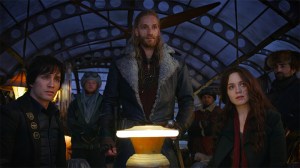 It’s never boring even when it’s being patently ridiculous and dumb. The main characters are powerfully bland, and they also give way to bland supporting friend characters who serve no purpose other than to be the eyes needed to oversee certain villainous revelations. The romance between Hester and Tom is nonexistent and painfully contrived. Much like the equally bonkers Jupiter Ascending, the main characters and their story are the least interesting parts of the world. Sheehan (TV’s Misfits) seems a bit too old to be playing a 16-year-old. Hilmar (DaVinci’s Demons) has little to work with but is very leaden and flat. There’s no spark of charisma between the two of them. Hugo Weaving (The Hobbit) is clearly enjoying himself as the hammy villain bent on bringing back old imperialism into this brave new world. The entire population of London is only seen cheering in reaction shots, which makes it harder to believe when characters talk about innocents amongst this throng of happy imperialist cheerleaders. I was happy to see Frankie Adams (TV’s The Expanse) as a do-nothing role as Revolutionary Fighter Pilot #3.
There is a massive plot hole in the second act that Mortal Engines cannot recover from (minor spoilers). The entire motivation for Hester is her vengeance against Valentine, enough so that she’s willing to risk her life by running out on her zombie Terminator surrogate father Shrike (Stephen Lang, in CGI mode) to see this through. But if Hester has a zombie Terminator surrogate father, why doesn’t she simply say, “Hey new dad, help me kill this one evil guy, and I’ll happily do whatever you want after”? In flashbacks, we see her open to the idea of transforming into some form of a robotic hybrid, shedding her humanity and losing the ability to feel any pain. It makes no sense why she wouldn’t use this new asset to her advantage, especially when the second act is mostly spent proving how formidable a threat he can be. This plot turn is further evidence at how sloppily the storytelling can get with character choices. Shrike is introduced as another antagonist to chase our heroes, but by introducing him at all, it makes me wonder about the better version of this movie, the Leon: The Professional version where a young girl teams up with a zombie Terminator father figure for vengeance. Don’t you, dear reader, want to see that movie too? It already sounds far more interesting and a better use of the unique story elements.
 Here’s another example of how confusing this movie is – the poster image. Go back to it in this review and study it, then ask yourself why the marketing team decided to put the visual emphasis on a woman’s face covered by a bandanna. It’s a movie about giant cities on wheels attacking each other and it also has a zombie Terminator… and the emphasis is on a bandana? If all you saw about the movie was the title and that key poster image, you would never suspect what kind of movie you were in store for, which seems like the exact opposite purpose of advertising. What’s the hook of this image? What’s underneath that bandanna (spoilers: a second smaller bandanna)? What about the tagline which talks about her scar? Did the marketing team actively try and hide the buzzier genre elements?
Mortal Engines feels assembled from the many scattered pieces of other, better movies. I wish we spent more time in this world and less time with the bland assembly of characters not played by Hugo Weaving. I wish we saw more about the intricacies of life on the move and the working infrastructure of these new environments. I wish we had more importance with the Anna Fang (Jihae) character where she didn’t feel like she just ported over from a Matrix sequel. I wish a lot of things were different about Mortal Engines and yet even when it’s bad, even when it’s dumb, and even when it’s insane, the movie is always worth watching and fairly entertaining, for a variety of reasons. I could see a select group of audiences enjoying this for ironic and non-ironic purposes. It’s a big shambling mess of a movie but it puts on a solid show.
Nate’s Grade: C+
Share this:

Cloud Atlas (2012)
 Most people regarded David Mitchell’s 2004 sprawling novel Cloud Atlas was unfilmable. It has six different stories each set in a different time period, slotted into a different genre, and each a variation on storytelling. Mitchell’s tome was structured like a series of nesting dolls, each narrative pulling back to reveal a character reading the previous manuscript, and eventually the direction was reversed. We go from the mid-nineteenth century to post-apocalyptic and back again. I read the book over the summer and found it to be enthralling, especially because each storyline was written so distinctively in a different writing style. The post-apocalyptic linguistics definitely took some getting used to. How could you turn this unwieldy book into a workable movie?
The Wachowski siblings, Andy and Lana, teamed up with German director Tom Tyker (Run Lola Run) to try and find a way. They decided to split up the stories into a musical syncopation, with stories blending into one another. As a result, Cloud Atlas is six different movies for the price of one but it’s far more than the sum of its parts. Cloud Atlas coalesces, bleeds, and bends, becoming a Mobius strip of causality and courage and love. The trio of directors, who shot simultaneously with two separate film crews, has done the impossible and translated Mitchell’s brilliant novel into a soaring, compelling, and multifaceted epic on hope and humanism.
Where to begin with this one? Well, in 1849, Adam Ewing (Jim Sturgess) is traveling across the Pacific back to his home in San Francisco. He’s fallen ill on the ship and keeping the secret of a stowaway in his chamber, a Moriori slave named Autua (David Gyasi). In 1931, Robert Frobisher (Ben Whishaw) is a penniless gay musician looking for refuge. He offers his services to the aged but still famed composer, Vyvian Ayers (Jim Broadbent). Ayers will dictate and Frobisher will assist in writing. In 1971, Luisa Rey (Halle Berry) is a reporter investigating a series of murders tied to a nuclear facility and a report the head honcho (Hugh Grant) doesn’t want exposed. In 2012, Timothy Cavendish (Broadbent) is a small-time publisher who mistakenly checks himself into a nursing home that won’t allow him to leave. In 2140, a new working class is grown from the lab. Somni 451 (Doona Bae) is one of these fabricants. With the help of a revolutionary (Sturgess), she escapes her confines and learns the horrors of the totalitarian world and becomes part of the rebellion. And 100 winters after “The Fall,” mankind has descended into agrarian tribes. Zachry (Hanks) is a goat herder who reluctantly agrees to take Meronym (Berry) to a hallowed mountain. Meronym belongs to the last group of technology-abled civilization, the Prescients, and Zachry mistrusts her and is tempted to kill her to protect his people. Just describing this stuff is tiring and could take up two reviews.
 This is going to be a very divisive movie, this much I can tell. It’s so powerfully earnest that you either embrace its mushiness and ambitions or you smirk and mock its New Age philosophy and optimism. There will be no middle ground with this film. We’re talking about transmigrating souls over the course of 500 years, Tom Hanks as a post-apocalyptic goat herder, and an evil presence known as Old Georgie, who looks like the forgotten cousin to the Wicked Witch of the West. There is some stuff in this movie that is plenty goofy, especially when seen on the surface. It takes a while to ease into the film, adjust to its tempo and accept the context of those goofy elements. But once that’s established then it feels like you can handle anything. There’s such an overflowing of feeling in this movie that it’s easy to make fun of it, to dismiss it under the safety of ironic detachment. It would be easy to decry the Cloud Atlas team for being self-indulgent or pretentious. What they are doing is far from normal, but the achievement of Cloud Atlas is the graceful way it finds to connect the rhythms of a deeply felt humanity. It has its stirring moments and memorable scenes, but when compacted and collected into a beautiful whole, that’s where the movie transcends. When an authoritative character barks, “You are but a drop in an ocean,” and our hero responds, “What is an ocean but a series of drops?” you either roll your eyes or you cheer. This is an earnest movie that wears its humanism on its sleeve. You either roll with that or you don’t, and I decided to embrace the big, messy, mushiness of the whole project and was swept away.
For a three-hour movie, the time flew by, and by the end I knew I had to see Cloud Atlas again. The first viewing requires much in the way of processing. You’re stringing together the disparate strands of the narrative, you’re listening hard to decipher the post-apocalyptic tongue of Zachry and company, and then you’re also keeping track of what actors are playing what characters, crossing lines of race and gender. The disguised actor factor is something of a fun ”who’s who” party game throughout the movie; initially distracting and somewhat questionable (especially the cross-racial makeup). I think seeing Cloud Atlas a second time will allow me to immerse myself further, finding new depths and connections. The pacing is surprisingly swift for a three-hour movie. You barely notice the time is gone, and honestly I could have done with even more movie, especially during the Neo Seoul segment. Given the six segments, some stories are going to be more compelling than others. I don’t think too many people are going to be as compelled with Frobisher’s creative sessions as they are Somni’s escape from enslavement. Initially, you’ll be scratching your head what they all have in common, and the lighthearted segments seem to clash with the more severe segments of systemic abuses. But then the big picture starts to eventually emerge and you see the parallel themes of oppression, bondage, rebellion, sacrifice, abolition and the yearning for freedom at all costs. The filmmakers find clever ways to thematically link their different tales. The movie starts to become a musical experience, much like Frobisher’s central melody, the overlapping notes of repetition and the swelling movements of human life in minor and major.
 As anyone who endured the Matrix sequels will attest, the Wachoswkis are film theologians and Cloud Atlas is unabashedly spiritual. The filmmakers openly favor examining the spiritual side of Mitchell’s novel rather than the political. I found the results to be intriguing but short of profound. From a philosophical/theological standpoint, Cloud Atlas is not breaking new ground or even going into great depth. We’ve got some basic Eastern notions like reincarnation and trying to improve upon one’s soul through various lifetimes. There’s also the notion that death is just a transitional phase and not the end. The film is also very interested in the transcendentalist interconnections of human history. “With each crime and each act of kindness, we give way to our future,” says Somni at one point. I like this; it’s essentially karma in its purest form but it also denotes that every choice gives ways to multitudes of possible futures (perhaps pedestrian but I still like it). I feel that human kindness is long-reaching and casts out many ripples, and Cloud Atlas is a film all about the ripples, seeing the long-reaching effects to causes, and discovering that individuals can become movements and movements can become inspiration. I also like the relatable debate over religious belief in the far-flung future; the Valley people worship Somni as their gracious Goddess, but the more advanced Prescients view her as a person, noble and with strong and important ideas but flesh and blood. And yet the film doesn’t look down on Zachry and his people for their beliefs; Somni inspires them to do good. Do the details matter when the results are positive? Cloud Atlas has plenty of intriguing questions roiling around, moments of pause worthy of post-screening debate. It’s not too deep but it’s far from shallow (the Wachoswkis love their Christ-like imagery, don’t they?).
From a filmmaking craft standpoint, Cloud Atlas is often breathtaking. In some respects it feels like something radically new, a $100 million dollar art film. The visuals are wonderful and the different time periods all come across handsomely mounted, perfectly realized, the details vivid and period appropriate. The future worlds are easily the most engrossing just because of how different they are. You’re never spoon-fed the answers in this movie, so we’re left to put together what lead to each future. I would have loved to have gotten even more details about Somni’s world, a time where democracy has been replaced by “corpocracy,” a world run by corporations. The ambitious story structure of Cloud Atlas could have easily become confusing, but the filmmakers smartly give each segment its own little undivided period to set up that world and its unique tone. They even provide date stamps. Then things get more spliced together, the different storylines cascading and braided together. Some of the storylines have to wrap up early and others are saved for heartbreaking finales of tragic resonance. The elliptical romances spanning centuries provide nice counterpoints and satisfying out-of-time conclusions for storylines that don’t always end cheerful. The movie is often thrilling, intellectually stimulating, disturbing, and poignant, though to be fair it comes up short when it comes to emotional involvement. Like the stunted depth of its philosophy, the movie has a way of drawing you in but never fully; it’s all about a wealth of human feelings and the nature of humanity yet it quixotically comes up short emotionally.
With up to six roles to play, the actors are given plenty to work with. It would be redundant to say you’ve never seen many of these actors like they are in Cloud Atlas (has anyone ever seen Berry in whiteface?). Every actor gets to play heroes and villains, saints and sinners. Only Weaving (The Matrix) and Grant (The Pirates! Band of Misfits) play antagonists in just about every story, and when you have Weaving at your disposal you have to give the man a role with menace. Grant gets to play a post-apocalyptic marauding cannibal. You won’t see him eat anybody’s face in one of those Bridget Jones movies. Like the filmmakers, the actors display full commitment to their varied roles no matter how silly some of the future diction may sound (“for true-true”). Hanks instantly anchors your empathy as Zachry and grounds a storyline that has the biggest danger of slipping into silliness. Readers will know I’m not the biggest Berry fan, and that is probably being charitable. However, I was truly impressed with her work in Cloud Atlas and would easily classify this as her best work since her Oscar-winning turn in Monster’s Ball. Her portrayal of Luisa Rey has such fire and her Meronym has such melancholy. Broadbent (The Iron Lady) is still highly enjoyable as a pompous sort, I’m always happy to see Keith David, and Weaving is delightful in his venomous villains, as a devil, a hit man, and most vividly as the Nurse Ratchet-style sadistic head nurse antagonizing Cavendish. The real breakaway star is Bae (The Host), who also benefits by having the most involving storyline. Her gradual awakening is just about note-perfect, alternating between curiosity, horror, amazement, and finally anger. All of those emotions need to be free of histrionics but if too underplayed then Somni seems like a walking zombie. Bae finds the right somber middle ground and her journey is the most emotionally rewarding.
 In the end, there’s so much to unpack, dissect, discuss, debate, and contemplate with this movie, and every hour I think of some new connection that dovetails the plots. Cloud Atlas is a thrillingly artistic mosaic, a giant puzzle that begs for closer examination. Unlike the films of Terrence Malick, this is a dense, challenging work that is also accessible and, here’s the heretical part film snobs, entertaining. We get a kaleidoscope of the human experience told in beautiful flourishes. There are a lot of demands with Cloud Atlas, and ultimately it may demand multiple viewings to completely sort out one’s opinion on this gigantic picture of gigantic feeling. I’m still uncertain whether I really enjoyed it or loved it, nagging doubts concerning the limited emotional attachment to consider. I’m curious what a second viewing, stripped of analyzing which actor is in what body, will allow me to further appreciate the scale and scope of the film’s achievement.
The individual stories of Cloud Atlas may not be terribly profound but collectively this movie is something special. I anticipate it will be trendy to mock its sincerity and ambition and New Agey spirituality (not that a negative opinion is automatically invalid). We live in a cynical world. It’s rare to find a movie that has so many things to say with such intense earnestness. It’s even more rare for that movie to be good. Due to the sci-fi elements and time hopping, The Fountain and 2001 will be natural film comparisons, but In some ways Cloud Atlas reminds me more of another divisive film, 2001’s Moulin Rouge!. Both were sincere movies about the genuine power of love and human connection, told with such artistic flair, drive, and ambition, and both attempt to transform the traditional tropes of storytelling and drama into a brave new 21st century collage of sight and sound and sprawling spirits. Simply put, you’ll never see a movie like Cloud Atlas again. So do yourself a favor and see it already, then find someone to talk about it and compare how fast the time goes. Then, if you’re like me, see it again.
Nate’s Grade: A
Share this:

Captain America: The First Avenger (2011)
 In the summer of superheroes, you’ll be excused for feeling some fatigue when it comes to men in tights. Captain America: The First Avenger is a surprisingly enjoyable sepia-tinted action film that flexes enough might to pleasantly hark back to the days of 1940s adventure serials. Taking place almost entirely in the era of World War II, the film, and its hero, and unabashedly square and earnest. Steve Rogers (Chris Evans) begins as a 90-pound weakling determined to fight for his country and gets transformed into a behemoth of beefcake by the Army. Captain America is devoid of the dark brooding that has come to encapsulate modern superhero movies, but it’s also playing its B-movie silliness straight. The flick has more in common with Raiders of the Lost Ark and Sky Captain than most other superhero product. Better yet, the movie finesses the in-your-face patriotism of the title character. I mean the guy is called Captain America. Yet the film finds a way to resonate a sincere nationalistic pride without falling back into Michael Bay-level jingoism. And who’s going to make for better villains than Nazis? Director Joe Johnston (The Rocketeer, Jurassic Park 3) turns out to have been the perfect choice to helm this rah-rah retro enterprise. The pacing is swift, the acting is engaging, the special effects are terrific particularly Evans’ transformation into a weakling, and the film is unexpectedly emotional at points. This is a comic book movie that would appeal to an older generation not normally interested in superheroes, namely people like my dad.
Nate’s Grade: B
Share this:

Legend of the Guardians: The Owls of Ga’Hoole (2010)
 This lushly animated tale about good owls, and bad owls, but mostly owls feels indebted to Don Bluth’s The Secret of NIHM. There’s a legendary story about the guardians who would save the… remaining owls? The plot doesn’t ever really leap beyond the basic fantasy concepts of good and evil, heroic and manipulative. It’s hard for the tale’s drama to reach grandiose heights because, well, it’s owls. Not anthropomorphic owls, pretty much plain old owls. Some characters were just hard to distinguish between. I can firmly say that some things work better on page than screen, and descriptions of grand owl societies and owl-on-owl combat are definitely items that, when fully realized in such a literal fashion, just come across as goofy. Being directed by Zack Snyder (300, Watchmen), the movie looks gorgeously rendered but fails to leave any emotional mark for anybody who has ever seen a scrappy band of misfits topple the mean bad guys. The action follows the Snyder fast-slow-fast visual motif, which allows the audience opportunities to drink in the visual effects work. The mostly Australian vocal cast, plus Helen Mirren, provides some levels of amusement, but it’s the story that ultimately disappoints. Legends of the Guardians looks fantastic, but it’s story is far from legendary. And they needed to have a pop song by Owl City because the man has “owl” in his name, apparently.
Nate’s Grade: C+
Share this:

The Wolfman (2010)
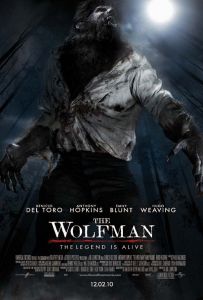 After re-shoots, reedits, a second director late in the process, and delayed release dates, it’s no surprise that The Wolfman is a bit of a shaggy mess.
In 1880, Lawrence Talbot (Benicio Del Toro) is an actor who returns home to England when he learns that his brother has been killed. Gwen (Emily Blunt), the fiancé to Talbot’s dead bro, writes that the departed brother was mauled, which points toward some kind of vicious creature roaming the woods. Inspector Aberline (Hugo Weaving) has been called in to clear the matter. Talbot’s father, Sir John (Anthony Hopkins), welcomes his prodigal son back but warns him of the dangers lurking in the countryside. The villagers are ready to blame the gypsy caravan and their chained bear when the feral creature strikes again, thus exonerating the bear. Talbot is bitten by the beast but survives only to transform into the cursed werewolf once every full moon.
Structurally, this movie feels like it’s all Act 1 and Act 3 with about ten minutes in between. By that I mean it’s all protracted setup and climax and little to connect the two. The beginning takes so long, with characters walking around like zombies who have no sense of wonder or fear given the extravagant circumstances. This is a movie that confuses set changes with plot advancement. Dour characters enter half-lit rooms and say little that isn’t cryptic or terse about the unusual happenings. This is what you have to look forward to for about an hour. The central mystery of who is the initial Wolfman is pretty easy to figure out when you play the economy of characters, which only compounds the movie’s sluggish pacing problems. You’re going to have definite pacing issues when your monster can only appear once a month, so say hello to massive time-lapse montages with the moon. It makes it hard to keep track of how much time is actually elapsing.
 There is little cogent explanation for why anything happens and the movie does an extremely poor job of maintaining a credible suspension of disbelief. What exactly are the rules here? What are the limitations for the Wolfmen? How far back does this whole thing go? The movie traces it back to an Indian kid, who looks like Gollum, in a cave, but where did he get it from? What is the history of this lycanthropy illness? When you turn into the monster, do you have any control? Are you a slave to your animal impulses? Are you culpable for what happens? Is it more like having multiple personalities except one of them is harrier? Nothing is really made clear and the movie just plows along while the unanswered questions continue to pile up, never to be addressed.
The Wolfman does a fine job of establishing an ambiance that feels ripped right from the old Hammer horror films, but fog and shadows and art direction can only take you so far. Every room looks like it’d be a prize-winning example of how to build a haunted house, though the lighting tends to be overly murky. Danny Elfman also provides a darkly lush score that mingles well with the onscreen atmosphere. But the refined sets only tease a better movie. An attack at the gypsy camp can get interesting. The beast flaring up at an insane asylum calls for something wickedly entertaining and scary, but everything is over before it really gets going, and we’ve moved on to the next scene of character sitting glumly in the dark. There’s nothing to startle beyond some overused jump scares. The movie lacks good scares because the film fundamentally can’t sustain a mood because the plot is never elaborated.
The character work is exceedingly shallow. Talbot is the main character but what do we learn about him? He’s an actor, he left town, he gets bit by a wolf, he skips stone’s with his dead brother’s girl, and that’s about it, folks. There’s an entire back story about Talbot spending time in a mental ward, which could prove to be fascinating but it’s just another set piece and nothing more. Talbot is pretty much a placeholder for a character; he’s the dude that has to get bit for there to be a story. He’s more catalyst than character, and you can feel that painful realization in how Del Toro (Traffic, Che) plays his non-character. Del Toro is a truly capable actor but he sleepwalks through the entire movie and mumbles most of his lines. Despite being a dead ringer for Lon Chaney Jr., he brings no energy to his role, nor does he ever seem truly concerned with his beastly transformation. You got more reaction and contemplation from Michael J. Fox in Teen Wolf.
The rest of the actors try and make good with the parts they’ve been tossed. Blunt (Sunshine Cleaning) can be a very good actress but she’s playing the thankless task of the underwritten love-interest-to-monster part. She’s no more fleshed out than the blonde damsel that screams and faints in the old classic monster movies. Blunt has the annoying habit of her voice turning into this simpering whine when she’s distressed. Hopkins (Fracture) pretty much gives the plot away with his maniacal cackling and incessant ear-to-ear grinning. You can pretty much faithfully assume where his character is going from the first malevolent twinkle in his eye. The screenplay exerts no effort to disguise its easily telegraphed character reveals. The person who comes out best is Weaving as the inspector, but that may be directly linked to the fact that he has the least amount of screen time of any of the main characters.
The special effects are fairly good and the practical makeup effects by screen legend Rick Baker are even better. The actual Wolfman is a snarling, spooky creature, but I wonder why we don’t get more shots allowing us to fully view the makeup work. Director Joe Johnston (Jurassic Park 3, Jumanji) seems to be more of a proponent of CGI, which means that we get scenes of Wolfie jumping from ye olde rooftop to rooftop like he’s any sort of wily creature. There’s nothing in the movie that really makes use of the specifics of being a Wolfman. We get a few POV shots of the Wolfman running extremely fast, but little else takes advantage of what makes the Wolfman a creature to be reckoned with. We only get a slew of decapitations and sliced innards that display the ferociousness of those wolf claws. Johnston isn’t afraid of gore but he doesn’t help his case when he fails to create any feeling of dread. It’s hard to dread what you can barely understand and with people you don’t really care about. Consider me stubborn, but when I got to a movie called The Wolfman I want some attention paid to the title animal.
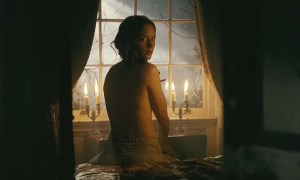 As I was watching The Wolfman I began to disassemble it in my head and piece together my own version of the film, an infinitely better version. For the sake or argument, I’ll explain my version and you can tell me which seems like the superior product. In my imaginary version, I completely eliminated Blunt, Hopkins, and most of the other side characters. I focused on Talbot and the Inspector and their relationship. Talbot has known about his lycanthropy for some time but he’s been able to control it for the most part, until recently. It haunts him, his inability to stop the sinister urges inside him that take over. The inspector is called in after the mysterious murders have picked up and they resemble some equally gruesome murders from 20 years prior (when Talbot first grappled with his hairy alter ego). The bent of the plot would then be on the relationship forged between the two men, how it turns into mutual affection and admiration all the while Talbot is trying to stay one step ahead of the investigation. Then my Act 2 break would be the Inspector finally realizing who is responsible for the murders (his friend!) and struggling with his own moral obligation to meet justice. Maybe this sounds too much like a crime thriller, but to me that sounds like a better film than watching two CGI werewolves claw at each other and spit.
The Wolfman is yet another misguided remake in a genre being gutted by horror remakes. The old monster movies of old were more than creature features and deserve better treatment than this bloody mess. I suppose few films can survive given the retooling process this one went through. This super serious monster movie has terrific production design, some alluring atmosphere, and a whopping void where a story should be. Characters will bumble about and the plot hums along with no explanation or elaboration given, meaning that setup often immediately crashes into climax. That’s not a satisfying recipe for a moviegoer. The Wolfman is mostly suspense-free and the actors are phoning it in; Hopkins is a kook, Blunt trembles her lower lip, and Del Toro seems to be drugged. This is mostly a costume drama with a little gore splashes in for good measure. It’s boring and half-baked and the best attribute is the scenery. If I wanted to watch scenery I’d flip through a Home and Gardens magazine. I was expecting entertainment here but instead it’s just another reminder to stick with the original.
Nate’s Grade: C
Share this:

Transformers: Revenge of the Fallen (2009)
 Transformers: Revenge of the Fallen pretty much sells itself. More giant freaking robots. That was enough to make the first movie a worldwide blockbuster. My own teenaged brother-in-law, when he first saw the first Transformers movie, declared it his favorite live action film. Director Michael Bay completely empties his creative cupboard into a bladder-unfriendly two and a half hour endurance test. It’s too bad that that cupboard was bare when it came to story.
Sam (Shia LaBeouf) is headed off to college, and he’s leaving behind his girlfriend Mikaela (Megan Fox) and robot guardian, Bumblebee. Optimus Prime and the other Autobots have been working with the U.S. government to hunt down Decepticons around the globe. There?s a war on the horizon, and weasely U.S. bureaucrats want the Autobots to take a hike. Sam discovers a tiny shard from the super Cube, which was the source of life for the alien robots. His brain is zapped with an alien language that will lead him to a secret location to a secret ancient machine. The Decepticons want this info and chase after Sam and Mikaela. The biggest bad of them all, The Fallen, is sitting at home waiting to return to Earth and exact interstellar vengeance. The Fallen was foiled in 17,000 B.C. by the Prime family line, and only a Prime can kill him. The Decepticons resurrect their leader Megatron and go about trying to snatch Sam, kill Optimus Prime, and destroy man’s planet.
Bay has been condemned for his erratic ADD-shooting style, and this was the first film where I really felt pounded and punished. To contest that this movie is just “a popcorn summer movie” is just making excuses. What the hell was going on? The movie is simply a blur of colors and noise. Transformers 2 is entirely incoherent, both from a story standpoint and simply from a visual standpoint. Bay at least pulls back his camera so that the audience can identify the fighting robots easier this time; this time it’s not like deciphering scrambled porn. It’s the rest of Bay’s characteristically bombastic display of carnage that suffers. Bay is a man that doesn’t know the meaning of the word “small,” and so nonstop explosions and massive destruction litter the movie. Sam is always running or riding in his car to escape. At one point, Sam and his posse hide in a campus library only to have the building turned into cinders (showing Bay’s opinion on what books are really good for). But what exactly is happening? Why does it matter? What are the obstacles? Everything is way too busy and accomplishing so little. Half of the movie consists of the human character running and screaming. It’s excessively excessive and taxingly so.
 A strong example of the film’s incoherence is the 40-minute climax set amidst the pyramids of Egypt. At no point does Bay establish the geography or bother to let the audience follow along. The stakes and parameters have not been made adequately understandable. Ordinarily, in large action sequences there will be different groups of segments and we’ll watch each progress. Here we disjointedly cut back and forth between the groups but I have no idea what?s going on, where the characters are, where they need to be, and what is stopping them. Megatron calls down 13 different evil Decepticon robots to take part in the climactic battle but Bay never introduces these new figures; they get no setup to explain each of their unique weapons systems or general appearance. We see them only at a distance walk through wafting smoke clouds. So when they do pop into battle in quick blurs it’s just another point to be confused about. If you’re like me, you can only endure so much confusion before your brain just gives up. Bay is a fantastic visual stylist, but his action sequences are poorly developed and poorly staged. He needs to check out The Hurt Locker and take notes. Transformers 2 is nothing but non-stop careless mayhem. For what it?s worth, the special effects are incredible at every stop.
The highly ramped-up action would have been acceptable if we knew what the hell was going on and we actually cared about the story. Transformers 2 makes the first film look like poetry in comparison. The story for this movie is simply atrocious and it’s made worse by the merciless attempts at comedy. This movie is stuffed with tin-eared exposition, so our only break to try and assess what the hell we just saw is when the characters take a breather and rapidly spout more plot vomit. It’s like listening to a homeless man shout nonsense for an hour. After a while you just tune out the crazy. If the Decepticons can construct a robot that has the ability to take human form, why the hell aren’t they doing this all the time? Why aren’t they infiltrating government offices instead of prancing around colleges in hot pants? Why in the world would an 18-year-old boy leave the mega hot Megan Fox and his TALKING ROBOT CAR? Why would anyone leave these two to live in a dorm and shower in flip flops? What universe does this college that Sam attends exist in? The place is crawling with leggy, waif-thin bombshells. The movie doesn’t even resort to college stereotypes; there isn’t a single gal that doesn’t look like a magazine cover girl. The Fallen is kind of like the evil leader of the Decepticons and he’s, what, confined to sitting in his robo La-Z-Boy on his home world like Archie Bunker? Get up and do something. The Transformers fought ages ago amidst man?s loin-clothed hunter and gatherer ancestors but leave no record? You’d think some caveman type might consider that worthy of painting on a wall. Why is Megatron even in this movie? What was the point of bringing him back alive if he’s just another lackey to The Fallen guy? Why does no one consider turning over Sam to the Decepticons if it could save the planet? In the big Egyptian battle sequence, where is the Fallen the whole time? He just kind of lazily shows up at the end. Also, ancient robots made a special key to jumpstart an ancient planet-destroying machine, but then we are informed when Sam visits, no joke, Transformers heaven that this key does not work unless the holder has earned the right to use it. It’s like some high tech moral barometer. Why didn’t these alien robots say anything about this? It would have spared a lot of time and energy trying to make sure the Decepticons never got a hold of it. How does a dead human end up going to robot heaven anyway? Does that mean there’s a robot God? Was robot God created by our God? Is there a robot Devil? Does Bay do the work of the robot Devil?
 This time the comedy is puerile and embarrassing. The jokes make this movie tonally feel like a cartoon strictly for snickering adolescents. In the span of 150 minutes we’re given dogs humping twice, a tiny Transformer humping Megan Fox’s leg, Sam’s mother going berserk from ingesting pot brownies, a Transformer testicle joke (why would a robot even need genitals?), and let us not forget John Turturro in a thong. The humor aims low and still finds a way to be even worse. To save you the trouble, I am going to spoil the only two good jokes in this self-indulgent, bloated mess. Here there are, enjoy:
1) Sam is at a frat party, and it’s a frat party unlike anything ever seen unless modern fraternities can afford expensive interior decorators. One unamused frat guy asks Sam what he’s doing. Sam responds, “Going out to get you a tighter shirt.” The frat guy’s flunky clarifies: “There isn’t a tighter shirt. We checked.” I laughed. Sue me.
2) Sam and the gang at one point talk to a Transformer that’s thousands of years old. Apparently the guy is being housed at the Smithsonian Museum, which means that this is the second summer movie that is trying to inform the public that there’s something weird over at the Smithsonian. The old Transformer even has a robot cane, which is too bizarre. He rambles about the old days like Grandpa Simpson, and then finally gave this gem: “My father was a wheel. The first wheel. You know what he could transform into? Nothing! And he did so with honor.” This made me want to think about a period Transformers costume drama, where they exist as textile steam engines and phonographs and Model Ts. Would that not be a vastly more entertaining movie?
Despite all the painfully juvenile attempts at comedy, by far the biggest eyesore would have to be Bay’s Sambot twins, Mudflap and Skids. To say that these two irritating robots are politically incorrect does not go far enough. It’s one thing to reflect a cultural or ethnic stereotype, and it’s another thing entirely to keep digging deeper and deeper. These robots talk in eye-rolling faux gangster street talk, one of them has a big gold tooth, and these robots admit to being illiterate. It’s practically breathtaking to watch how racially insensitive and appalling these characters become. It’s essentially a robotic minstrel show. I’m surprised Bay stopped short of having Mudflap and Skids eat a big bowl of watermelon. This got me thinking about what other highly insensitive Transformers characters that didn’t make the cut over these two. Was there an Asian bot that turned into a car that didn’t drive well? Was there a Jewish bot that chided Optimis Prime to settle down and quit running around with those shiksa sports cars (“You know those aren’t her original parts?”). Bay can dismiss these characters as merely dumb robotic comic relief, except for the fact that these two bumbling, detestable heaps of scrap metal are never, ever funny.
 The actors have little impact in this type of movie. I like LaBeouf (Eagle Eye) but he’s got little to do but stretch his legs. Fox became a star thanks to the previous Transformers flick, and she hasn’t gotten any less attractive. Amazingly enough, she manages to lose more clothes the more she runs in slow-mo, allowing the male audience members to follow the nuance of her bouncing breasts. She’s clearly not the next Meryl Streep but this girl deserves more than being wordless arm candy. Many words have been spilled about the quasi-racist twin robots, but I’m disappointed that people aren’t as equally up in arms over the film’s blatant misogyny. Women don’t seem to exist in the Michael Bay world, only parts and pieces of women. They are all like Alice, the robot programmed to do nothing else but seduce the men. All of the special effects and noise just overwhelm the other actors. The robots themselves have no personality to offer, good or bad.
Transformers: Revenge of the Fallen is an obnoxious block-headed mess that feels like it’s being made up as it goes along. It’s sensory overload without a lick of sense, clarity, wit, and general entertainment. This sequel takes everything that was good about the first Transformers film and undermines it, and it takes everything that was awful and magnifies that awfulness. The first Transformers movie was fun. This is just work to sit through. Apologists will try and rationalize their disappointment, decrying anyone who hoped for something more than a big dumb summer blockbuster about rock’em, sock’em robots. Bay wants to show you everything and as a result you rarely get a chance to process little in this movie. There is absolutely nothing more than meets the eye here. It’s all arbitrary and tedious and it goes on for what feels like an eternity. It’ll make a gazillion dollars at the box office but will anyone remember a single moment from this exhausting junk? Make sure to bring the earplugs and aspirin in abundance.
Nate’s Grade: C-
Share this:

Transformers (2007)
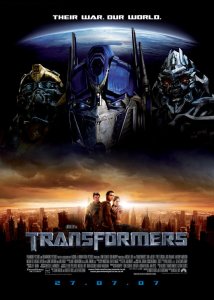 Once again Hollywood is quick to prove that if any television show emits some level of nostalgia, or merchandising potential, it is only a matter of time before it finds itself reconfigured as a big screen blockbuster movie. In all honesty, I was never a huge Transformers fan; I was more into Ghostbusters and then transitioned into Teenage Mutant Ninja Turtles. It may be sacrilegious, but I thought the knockoff cartoon/action figures, The Go Bots, were just as good. Steven Spielberg and critically derided director Michael Bay (Bad Boys II, Armageddon) have teamed up to bring the world a lengthy and noisy Transformers feature film. I can’t wait for the Go Bots to get their own equally pricey close-up.
Sam Witwicky (Shia LaBeouf) is your typical teenager obsessed with getting his own car. He can only afford an old Camaro at a used car lot, and his dreams of impressing the hot girl in school (Megan Fox). But Sam’s car isn’t just any old busted jalopy, no sir, it is really a robot in disguise from another planet. Sam’s car, codenamed Bumblebee, is apart of a robotic race known as the Autobots, led by their leader Optimus Prime (Peter Cullen returning to voice with gravitas). They can transform into vehicles that they scan with their optical sights. The Autobots are trying to save the planet from their evil counterparts, the Decepticons, who have already infiltrated our world in search of their fallen leader, Megatron. It seems Sam holds the key to the survival of Earth. His great grandfather was an Arctic explorer and happened upon the frozen sight of Megatron. He left behind an artifact that reveals the location of the chilled robot as well as a source of unparalleled power known as the Allspark. Needless to say, the military and the Secretary of Defense (John Voight) are a little aghast at how their weapons stack up to big bad robots.
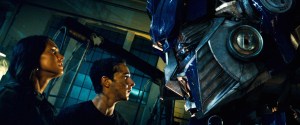 Michael Bay was born to direct a live-action, ultra expensive Transformers movie. The testosterone is through the roof and the film worships everything shiny, fast, and automotive. This is the kind of movie that fits exactly into the artistic parameters of Bay. The film is one gorgeous product placement orgy that is all about the eye candy; the cars are hot and desirable, the car chases are cool, the explosions are a lovely shade of orange, and Megan Fox is quite hot and desirable too (engaged to a 90210 actor? Why oh why, Megan?). The special effects are downright flawless and the action sequences are enormous. The scale of destruction is, like most aspects of Transformers, cranked to such a high degree that summer satisfaction can only ensue. Everything is bigger in Michael Bay world. Transformers is Bay’s best movie so far and it delivers the goods when it comes to hyper-kinetic action and plenty of thrills.
While the movie runs on silliness it also keeps its wits about it and delivers solid and exciting action with a breathless pace. What really surprised me about Transformers is how much humor they squeezed into 143 minutes of loud and hyper bombast. Screenwriters Alex Kurtzman and Roberto Orci (The Island, Mission: Impossible 3) have a great economy to their storytelling. They also have created a wacky teen comedy that just so happens to also be inhabited by giant robots. Much of the first hour is spent with Sam and his attempts to look cool with his new ride and impress the pretty girl. Sam is hocking his family wares on eBay and the Decepticons are on the hunt for… LadiesMan217. There’s a lengthy sequence where five Autobots have to duck and hide outside Sam’s house so he doesn’t get in trouble with his parents. Ma and Pa Witwicky look out the windows, and the robots dodge getting caught, and it’s like a classic bumbling slapstick comedy. A good action movie can become a great one when aided by well-timed humor, and Transformers has so many quips, sight gags, and goofy sidesteps (“Mountain Dew machine must destroy all humans!”) that is could be considered the most expensive comedy of all time (take a seat, Evan Almighty).
 There is, however, a price to be paid for all this comedy and that is that no one acts with any true sense of awe. They are witness to large walking and talking monsters of metal that are out to enslave the planet – there has got to be some wonder there, but the film doesn’t treat anything seriously. Its jokey nature keeps the film from being anything more than disposable, throwaway entertainment. I mean, I find it difficult to take any movie seriously that features a robot “relieve” itself on John Turturro.
Shia LaBeouf (Disturbia) carries the film on his sturdy shoulders. The shape of Transformers has more to do with his horny, smart allecky character than the robots that fight. Normally the only thing required in an effects-heavy action flick are some fast legs and a healthy set of lungs, but LeBeouf has charisma to spare. He has a young Tom Hanks everyman feel to him. The greatest compliment I can give him is that he is the most memorable figure in a movie with big brawling robots. Fox is pretty easy on the eyes. Voight is adept at playing government figures in times of national peril. If you need a guy to stare at something massive, or formative, or formatively massive, and utter, “My God,” then Voight is your man. Kevin Dunn and Julie White provide nice comic additions as Sam’s mother and father.
Transformers may be a perfect slice of summer thrills, but unlike its titular gigantic robots, it’s little more than meets the eye. The movie loses steam whenever it deters from its main story involving Sam. I understand that the filmmakers were trying to widen their story scope, but nothing is gained by the inclusion of such useless characters like the overweight super computer hacker who lives at home with his mom. There’s an elite team of national security analysts and they all happen to be scruffy multi-cultural hippies. We have a blond Aussie (with a nose ring, oh so rebellious) who discovers the Decepticon signal and then, well, she sits in a room for a long while and then mostly sits on her hands during the climax. The opening follows a band of soldiers in the Middle East (which the film reminds us is where Qatar is, because apparently it does not feel that your core Transformers fan has a basic grip on geography) who also must reach the bigwigs in Washington with important info on these killer robots. These dangling storylines could be lost and little momentum would be lost. None of these extra characters are given a lot of attention. Most of them will vanish for long stretches so that when they do reappear you’re reminded how much you did not miss their absence. You’re going to need stock roles, like military men and tech geeks, but Transformers has cast its lot with the simple story of a boy’s first car and his unyielding teenage hormones. Transformers could use a good pruning for balance.
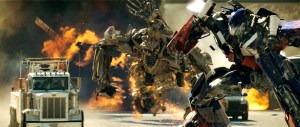 The robust action sequences are somewhat hampered by the typical Michael Bay ADD edits, but what really hurts the action sequences are the robots themselves. The original Transformers were designed smoothly, because in all reality they were animated toys and needed to function for kids. These 21st century Transformers have parts all over the place. There are gears and wheels and who knows what sticking out everywhere. They look far too cluttered, like a little kid’s art project where he keeps slathering on more junk. As a result of this robo design, when it comes to action you may not have a clue what’s actually happening. When the big robots wrestle you’ll be left trying to piece together in your mind which part is the robot mouth, the robot head, the robot fists/claws/drill/whatever. I suppose in a way this kind of demanding user activity is similar to watching scrambled porn; both involve trying to dissect the image into something workable and, thusly, satisfying to the senses. That’s right, I compared Transformers to scrambled porn, which is also quite more than meets the eye.
Obviously, with a film about powerful robots from space, there is going to be a stopgap of logic. If you can accept interstellar robots that arrived from a robotic planet, oh and by the way, they learned English from the Internet (it’s a wonder they speak in full sentences), then you should be able to shrug off any other shortfalls in logic. Transformers was never too deep a subject to being with; every episode of the cartoon revolved around the Autobots and the Decepticons battling over new energon cubes, and that was all the plot needed for a show about robots that fight.
There could be 20 minutes sliced out. Lots of ancillary characters are just dropped. There may be too much humor. The climax is way too long. The dialogue is corny. And yet with all its flaws considered, Transformers is an exhilarating entry into the world of summer smashups and blown eardrums. Michael Bay may never stretch his creative wings with a Victorian costume drama, but the man does what he does well. Transformers is a perfect match for Bay’s noisy and boisterous sense of action and his love of things fast and expensive. There isn’t much below the surface when it comes to Transformers, but it’s such a fun and exciting popcorn movie that it’s hard to argue with the results.
Nate’s Grade: B
Share this:

V for Vendetta (2006)
 Legendary comics author Alan Moore has a particular disdain for Hollywood adaptations. They just haven’t gone so well for this scribble scribe. There was 2001’s From Hell (I may be the only one in the world that actually likes it, Heather Graham’s atrocious cockney accent aside) and 2003’s The League of Extraordinary Gentleman. Moore is even responsible for the creation of the John Constantine character, who had his own 2005 big screen venture. I suppose you could see why he has certain contempt for the movie versions of his much-heralded stories. Now comes V for Vendetta, based on Moore’s 1988 comic and adapted into a screenplay by the Wachoswki brothers. While I may have no idea how close V for Vendetta is to Moore’s graphic novel, I can say that the movie is a smart, superb thriller that dares you to think while you?re stuffing popcorn into your mouth.
“Remember, remember, the fifth of November, gunpowder treason and plot. I see no reason why the gunpowder treason should ever be forgot”
In the future, America has lost its super power status after overextending itself in war. Britain has turned into a hostile totalitarian government, led by chancellor Sutler (John Hurt). Evey (Natalie Portman) works for the state-controlled TV station. One night, while walking out past curfew, Evey is attacked by some undercover cops looking for a good time. A mysterious masked man named V (Hugo Weaving) comes to her rescue. His grinning, bearded mask resembles Guy Fawkes, a revolutionary that tried to blow up the British Parliament 400 years ago on November 5th. V starts taking out high profile government figures and then infiltrates the government airwaves, asking others to rise up against the corruption they see around them. He promises to blow up parliament one year to the day of this message. Finch (Stephen Rea, so expressive with his hangdog demeanor) is assigned to find out who this V is and how to deal with him. In reality, Finch discovers a lot more troubling information about his own government. Evey is linked with V and tracked down for interrogation and potential execution. As the date approaches, Evey must battle her own loyalties and strike out against what she feels is right and just.
 What makes V for Vendetta so exciting is its playground of ideas. This is a dynamically intelligent, complex movie but it never lets the smarts get in the way of a rousing good time. This is a very political movie that’s very relevant today, like the exchange of freedom for security and the use of fear mongering to serve an agenda. I love that the government’s leaders were a rogue?s gallery of corruptible figures; the Bill O’Riley-like TV pundit blowhard, the church leader who just happens to be a pedophile, the scientist whose good intentions justify the worst in human experimentation. V for Vendetta is a thinking man?s comic book movie, one that actually has actual respect for its audience and refuses to dumb down its message. The movie starts at a gallop and never lets up intellectually, and that’s so wonderfully refreshing from a film of any stripes. While I would not classify myself in the camp that views V for Vendetta as an anti-Bush administration screed, I’d have to say the movie does stir people out of a sense of apathy. I was even moved by the film’s hopeful conclusion, which is more than I can say about any other comic book movie (yes, even Elektra).
Director James McTeigue has previously served as the Wachoswki brothers’ assistant director. V for Vendetta is his debut as a director and what an auspicious debut it is. The movie is visually lush thanks to Aliens cinematographer Adrian Biddle (sadly, he died December 2005), but the smartest notion McTeigue accomplishes is putting story above special effects (ahem, George Lucas?). The command McTeigue has as a first-time director is impressive; how many people would be this restrained with all the fancy tools Hollywood has to offer? It’s his restraint and priorities that allow V for Vendetta to excel. And when the film does call for action, McTeigue judiciously uses visual trickery to enhance the scene. A late scene involving slow-mo V taking out a cadre of soldiers while they reload is amazing both in its “hey, look at this!” visual acuity and that it fits perfectly within the narrative. Nothing is self-consciously showy for the sake of wowing an audience, and every beat of action feels organic to the storyline. V for Vendetta is a terrific debut with some great set pieces.
Weaving is awesome as our hero. Since at no point does V ever take off his mask, it wouldn’t have been unheard of to simply hire a stunt guy to play the part and dub Weaving’s voice in later. But no, Weaving decided to be the part and adds so much to the character. He knows when to turn his head, nod, lean to a side, just like a silent film star interpreting the moment through action; it sounds ridiculous but it definitely helps paint a clearer picture of V. Then there’s Weaving’s incredible voice, making V sound like the world’s craziest, coolest Shakespearean lit professor.
Portman has finally made me appreciate her as an actress. She had a long winter between 1994’s The Professional and her 2004 one-two punch of Garden State and Closer, but I now finally see that Portman is a fine actress and not just a promising talent. She’s the heart of the film, the focal point for the audience to journey along, and she’s excellent at every point. I also give her props for having her head shaved on camera (I can only imagine what the eventual porn version will do with this scene).
 I’m left in the cold by this over inflated discussion on how “daring” V for Vendetta is by having the hero of a major Hollywood movie be a terrorist, one that says things like, “Violence can be used for good,” and, “Sometimes blowing up buildings can change the world.” Yeah, sure, but it’s a well-mannered, well-read, cultured terrorist versus a giant evil totalitarian government that kidnaps people, strips them of their rights, and enforces cruelty and prejudice. So exactly how daring is that? Of course audience sympathy is going to fall to the little guy, in this case a terrorist, which is the only hope of shaking things up and righting wrongs in the system. That doesn’t exactly strike me as subversive. This movie isn’t promoting terrorism any more than Munich was when Spielberg allowed the Palestinians to have a voice. The movie is anti-oppression if anything.
My only complaints are minor. The movie gets a bit repetitious in its windup to the climax (oh look, we’ve cut again to the Big Brother round table), and that somewhere along the middle V for Vendetta gets log-jammed with subplots. Everyone has a story to tell in V for Vendetta and we see every personal tale, and after a while it kind of grinds the flow of the story down. However, this problem is sidestepped after awhile and V for Vendetta gets back on track, driving full-force toward its conclusion like a runaway train.
What sounds on paper as something incredibly silly, including a kissing scene involving a motionless clay mask, V for Vendetta plays out with such excitement, visual prowess, and vibrant intelligence; this is a very political movie that?s very relevant today and I loved it all the more for it, but V never forgets to be entertaining at the same time. McTeigue has fashioned together a stirring and fascinating directorial debut, and even though the Wachowski brothers have their fingerprints all over this film, the pretension is kept to a minimum. V for Vendetta is exactly what the Matrix sequels should have been: a pulpy mix of brains and action, not a snore-fest that beats you down before putting on a show. It’s a shame Moore didn’t want his name attached to the finished product, because V for Vendetta is 2006’s first great movie of the year.
Nate’s Grade: A-
Share this:

Lord of the Rings: Return of the King (2003)
 To all those hairy-footed Tolkien geeks that chewed me out for having the audacity to call 2002’s Two Towers, of all things, boring, let me say this: while I still find the second entry of The Lord of the Rings to be disappointing and pretty flawed, the final chapter, Return of the King, is a glorious and satisfying conclusion. Instead of doing a usual review (plot synopsis, strengths/weaknesses, etc.), I’m going to bring back the charges I had against Two Towers and explain why Return of the King does not suffer from these ills. Will the defendant please rise as I read aloud the charges.
Charge Number One: Two Towers has nothing going on for its majority except hyping an oncoming battle.
And I still feel this way. Short of the great Helms Deep battle, there was oh so little going on in Two Towers that they could have easily trimmed an hour away from it. And don’t give me this crap about the whole kingdom of man subplot or Aragorn (Viggo Mortensen) realizing his eventual responsibilities. Whatever. Now, in Return of the King, there is so much going on and the pacing is so tight, that despite being the longest film by far (3 hours and 20 minutes), this is the FIRST Lord of the Rings films that has not put me to sleep in the theaters. The nearly hour-long battle involving the 200,000 Orc army with its huge elephant creatures is mesmerizing and visually stunning. But even after the battle and before, unlike Two Towers, there is plenty going on that actually matters, not just three characters running around endlessly.
 Charge Number Two: Despite nothing going on except waiting for a battle, Two Towers has little characterization of any of its characters.
So even though little is going on, Two Towers still doesn’t use all this free space to deepen characters. But in Return of the King, the characters come through and shine. The hobbits are back to the front burner and the film is better for it. Sam (Sean Astin, in the finest performance of the film) and Frodos journey becomes increasingly important and the strain and deception of Gollum puts a wedge between their friendship. When Frodo (Elijah Wood) looks scornfully at Sam and dismisses him from their journey, it’s heartbreaking. Why? Because after two years we as an audience have come attached to these characters and do feel for their struggle. When Sam, toward the climax, says, “I may not be able to carry the ring, Mr. Frodo, but I can carry you!” I dare anyone to try not choking up. We also get deeper moments of character with peripheral characters, like Faramir realizing he can only satisfy his father by a suicidal mission. Even the smaller characters from the second film, like Eowyn (Miranda Otto) and her kingly father Theoden (Bernard Hill), have wonderful moments where the emphasis is on characterization. Return of the King is filled with rich character moments that remind us how much we enjoy and feel for these people … uh, and hobbits.
Charge Number Three: Most of the characters from Fellowship of the Ring have scant appearances in Two Towers.
This still holds true. Gandalf (Ian McKellen, brilliant) returned from the dead but had about three minutes of screen time. The elves (Liv Tyler, Hugo Weaving, Cate Blanchett) were given the amount of screen time most people would consider cameos. And then the hobbits were left alone for the overlong subplot involving Theoden and his clan. What Two Towers really was was the dwarf, elf, and Aragorn movie. And I like each of those characters but this story is not theirs its the hobbits. So the disproportionate amount of time spent with Gimli (John Rhys-Davies), Legolas (Orlando Bloom) and Aragorn felt like what would happen if, in Star Wars, C-3PO and R2D2 had their own film. It wasn’t as interesting and it wasn’t right. But with Return of the King, the attention is back to the hobbits, and all of the characters in the entire film have at least one stirring moment of quality time. Gandalf is back in a big way and its welcomed. What else is welcomed is the increasing attention Merry (Dominic Monaghan) and Pippin (Billy Boyd) have. They started as merrymakers, but by this trilogys end they are desperate to join the ranks and fight. The shared moments between Merry and Eowyn in battle are great. The moments between Pippin and Gandalf are even better. And even though the elves still get the short end of the stick, they make lengthier appearances that are more satisfying. It appears, though, that Cate Blanchett’s longest amount of time in this whole trilogy was narrating the opening prologue.
 Charge Number Four: Excessive dwarf jokes.
Even if you disagree with me on the previous three charges, you must agree with me that Two Towers had about a million dwarf jokes too many. Return of the King, to my knowledge, doesn’t even have ONE dwarf joke. Fabulous. This is not to say I want less Gimli. The subplot involving the Two Towers trio seeking an army of the dead (a tad deus ex machine) is intriguing, and his competitive banter with Legolas is still ripe (Bah! That still counts as one!).
Return of the King is an amazing experience and one that is a fully satisfying conclusion, unlike say, I don’t know, maybe the last two Matrix films. The danger feels more abundant now that the end is near and the tension mounts. The payoffs are rewarding and the climax is fittingly climactic. However, the 20-minute resolution is a bit drawn out. It seems director Peter Jackson can give us three hours of fast-paced action but cant speed through a medley of hugs. You think its over…. and then theres more, then you think its over…. then there’s more. This is a small quibble for such an epic trilogy, and Return of the King proves that it’s really one large triumphant film, with a bit of a sag in the middle. What? Did you think I’d get through all this Lord of the Rings love-fest and not take one last jab at Two Towers? Though I still prefer Fellowship of the Ring out of the three, Return of the King cements the trilogys cinematic greatness in our time. Oh yeah, and the cinematography, special effects, production design, makeup, and score are magnificent too.
The defendant is cleared of all charges.
Nate’s Grade: A
Share this:

The Matrix Revolutions (2003)
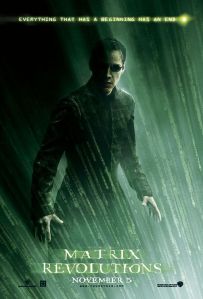 Four years ago the Wachowskis revolutionized the world of cinema, with their surprise sci-fi opus, The Matrix. Their mixture of philosophy, kinetic visuals, and inventive action with style to spare laid waste to all inferior action movies and gave birth to a cult of fan boys. Now six months after the second installment, The Matrix: Reloaded, were left to supposedly close the chapter on Matrix land.
Neo (Keanu Reeves) is caught in a strange limbo between the machine world and the real world. The only passage back to either is through the Merovingians chief hobo, the Trainman (seriously, he’s a hobo with teeth like a jack-o-lantern). Trinity (Carrie-Anne Moss) and Morpheus (Laurence Fishburne) travel to the most spastic fetish club imaginable for negotiations with the Merovingian. He agrees to give them back Neo if they will bring him the eyes of the Oracle, the prophet of the Matrix.
The rest of Revolutions takes place within two storylines. The first involves Morpheus and his former flame Niobe (Jada Pinkett Smith, finally getting a sizeable role she deserves) flying the last remaining ship of the human fleet back to Zion, the last remaining free human city, before the tunneling army of the machines breach the city walls. The other storyline involves Neo and Trinity flying a ship to the heart of Machine Town to have a face-to-face with The Wizard. They want to negotiate a peace between the two factions and put a stop to the increasingly uncontrollable rogue program, Agent Smith (Hugo Weaving), who, left unchecked, could destroy both the human and machine world.
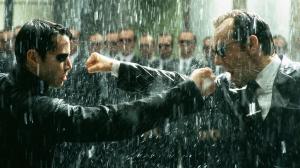 Reeves has never been confused with a serious actor, or even much of an actor for that matter. And sure, he has a penchant for being out-acted by inanimate objects, but his stint in Revolutions is stiff and wooden, like he’s just punching the clock to get through another day. It doesn’t help his case that half of his scenes involve the woefully inept romance between him and Moss.
The only person that seems to be having any fun in this overly serious melodrama with guns is Weaving. His Agent Smith character has morphed into the true star of the Matrix trilogy. Hes charming and even more likable than the dull-witted Neo. Weaving seems to love the drawn out line delivery, so much so he might be accused of abusing anti-depressants. His insidious cackles are a delight.
The plot of The Matrix: Revolutions has several head-scratching moments. Like the kid who yearns to be in the fight but is too young and clumsy. Anyone who’s ever seen any movie ever will know how that plot point turns out. Then there are questions like, why do people far in the future still use wheelbarrows to lug ammo around? Why, during a shoot-out at the fetish clubs gun check room, do people jump on the ceiling? Why would being on the ceiling make you any more difficult to shoot? The whole sequence comes off like a poorly done rip-off of the Wachowskis’ own bank lobby shoot-out from the original Matrix.
Revolutions is the least densely plotted of the three films. Now, one would think this would be a godsend, especially after the pretensions and bloated mess that was The Matrix: Reloaded. But theres nothing at all memorable in this third installment, and perhaps this is because everything but ten minutes of it takes place in the dingy real world. Who cares about a post-apocalyptic universe where the surviving subterranean humans wear rags and pull all-night raves? I’ve seen that stuff in a thousand other movies (maybe not the raves part, though). Everything is better within the virtual reality Matrix world; from the clothes to the gravity-defying cool acrobatics to the cinematography to, God help me for saying it, the acting and dialogue. At least Reloaded gave us the stylish goods when it came to that heart-thumping freeway chase.
Although Revolutions is a slight improvement over the tedious Reloaded, this is only because after seeing the third and final leg of this trilogy, it makes the second film look worse. The intriguing new elements of Reloaded, like the French Merovingian and his wife (the lovely Monica Bellucci), are now seen to be nothing more than dropped subplots. Even the coolest additions to the Matrix universe the ghostly twins- don’t even show up. Sigh. Now that I know where the story ends, the loose ends of Reloaded don’t justify themselves nearly as much as I would have liked.
 The showpieces of Revolutions are two long battles in its final act. The first is a near-20 minute assault by the Sentinels, resembling flying mechanical octopi, against the defenses of Zion. It’s exciting for a while but battle fatigue settles in quickly. You can only watch so many CGI robo-exoskeletons shooting CGI machine guns at CGI flying machines as they explode in CGI explosions and CGI shrapnel. The effects are nice, and seem more polished than Reloaded, but the sense of imagination seems to be entirely absent. The second battle is the final fist-fight between Neo and Agent Smith in the pouring rain. Smith has duplicated himself enough to cover miles upon miles of high rises. The fight sequence is impressive and beautifully filmed, but it amounts to a big shoulder shrug after watching Neo battle 100 Smiths in Reloaded. The final confrontation in Revolutions is adequately satisfying if a bit under whelming and unmemorable.
The need for corporate coffers to ring has turned what was a great stand alone film into a mediocre franchise, one whose diminished hopes and lowered expectations can only be judged on par with the Star Wars prequels. My friend Colin equated watching The Matrix: Revolutions to a wet dream: momentarily satisfying but leaving one with nothing but pangs of emptiness. The Matrix trilogy doesn’t end with any sense of urgency; instead it draws to a close with a half-baked artificial fulfillment. The journey of Neo and Trinity and all the rest has come to a whimpering end.
Nate’s Grade: C


 nathanzoebl
You must be logged in to post a comment.