Blog Archives
Deadpool & Wolverine (2024)
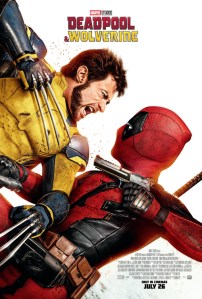 Thanks to some release shuffling, there was only one Marvel movie being released in 2024, the fewest since 2012 (excluding the COVID punting of 2020). There’s been a lot of ink spilled over “superhero fatigue,” especially the recent downturn of certain Marvel movies like Quantumania and The Marvels, though as I’ve written before, I don’t think audiences have become sick of superhero cinema, they have become more demanding from mediocre superhero cinema. Audiences just want something more than the same old same old. Enter Deadpool & Wolverine, resurrecting one of the greatest Marvel heroes and transplanting the first new Fox hero into their new corporate landscape. It’s the least serious Marvel movie yet by design and, judging by its runaway box-office success, that was what the people wanted in a summer blockbuster that made them remember the escapist joys of men in tights with anger issues.
Wade Wilson (Ryan Reynolds), a.k.a. the merc with the mouth Deadpool, is a man out of time. His universe is scheduled for elimination by the Time Variance Authority (TVA) because of the demise of Logan (Hugh Jackman) who served as an anchor being. Apparently, for reasons that don’t seem to make sense if you think of universes lasting longer than one human lifespan, once the anchor being goes, the universe dies out. Wade is thus in search of another Wolverine, but the one he finds is “the worst Wolverine,” a tragic hero drowning his sorrows and refusing to help. The two bickering mutants get cast to a dimensional dumping ground where they run into all sorts of castoffs and forgotten figures, chief among them Cassandra Nova (Emma Corrin), the twin who ate Professor Xavier in the womb rather than the other way around. She holds dominion in this strange realm, and Wade has to appeal to her, or eliminate her, to get out of this ashy purgatory and convince this wounded Wolverine to be a hero.
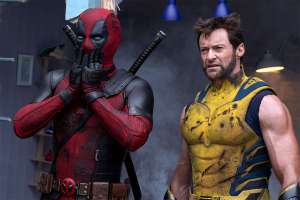 The Deadpool half of the title means that this movie is interested in serving as a meta-satire of superhero cinema, which means its breezy, surface-level charms can feel after a while like a fanboy sugar high. It’s hard to maintain the novelty of a fourth-wall breaking vulgar superhero with the third movie, but now we have Deadpool closing the book on the Fox era of twenty-first century superhero cinema as well as getting to play in a new sandbox of pop-culture references and superhero cliches. Welcome to the Marvel Cinematic Universe (MCU), Wade Wilson, though, as stated on-screen, you’re entering at a bit of a low point. For a while, at least, the movie can get by by having its resident prankster mug his way through the MCU catalog, fawning like the biggest fanboy (he did unsuccessfully audition for the Avengers). The opening sequence literally involves Deadpool digging up the adamantium corpse of Logan and using his unbreakable bones to inflict bloody carnage. It’s quite an attention-getter as well as something of a promise: we’re not going to undo the dramatic conclusion of 2017’s Logan, and even though this is the MCU, this movie isn’t going to go soft as it wades in its signature off-color comedy and bloody chaos.
Your mileage will vary depending upon what the hit-to-miss percentage is with the comedy. I found a lot of the homoerotic/homophobic banter to be dull and repetitive, but this kind of comedy ethos has been present from the first movie, the more-is-more approach. There’s an extended series of cameos that are fun castoffs from Fox comics universes, and the actors are definitely having a blast reliving their characters, or in one very special case, getting to live it once and for all. I wish there was more specific MCU commentary, but I cackled loudly when Reynolds turns to Jackman and taunts, “Disney’s going to make you keep doing this until you’re 90!” I really wish there was an extended critique of the state of post-credit scenes introducing new characters that we all know will never be seen again (remember Harry Stiles or Brett Goldstein?). Deadpool could have gotten stuck in an endless loop of end credit sequences. I enjoyed that a car’s product placement was subject to constant abuse and destruction, while still trying to maintain that sleek car commercial framing. The angry/shouty dynamic between Wolverine and Deadpool makes up for a lot, so even if the jokes are less than stellar, the cranky buddy dynamic still delivers.
 However, much like the 2022 Multiverse of Madness, the actual multiversal trips are quite few and quite disappointing. There’s a silly montage of Wade approaching the different Wolverines of different universes (no Dougray Scott, huh?) but almost all of the movie is spent between a dusty netherworld and a subway station. Again, with the promise of great possibility, these movies seem to say, “Will you settle for maybe TWO gray locations?” I was let down by the main setting reminding me of 2009’s Land of the Lost dumping ground for the nexus of discarded universes. When this whole multiverse phase comes to its inevitable conclusion, it’s going to feel like a promised epic family vacation that went about an hour down the road, visited two gas stations, a McDonalds, and then hastily turned around.
On the other side of the titular ampersand, Jackman is acting in a completely different movie, perhaps giving one of his most dramatically rich performances as the superhero. This is a different Wolverine than the one we saw in 2017’s Logan, so it allows Jackman the freedom to be able to hit some of the essential elements of the character while also getting a new opportunity to follow a different direction. This is a Wolverine haunted by his own sense of cowardice and blaming himself for the death of his X-Men. This is less the grumpy antihero we’ve grown to love over twenty years and more akin to the main character in 2023’s Godzilla Minus One, a war veteran who folded under pressure and attempts to live through their guilt and shame, ultimately finding solace in seeking the noble sacrifice but on the bigger stage now. This is a genuinely traumatized character working through the different dimensions of his trauma, and Jackman doesn’t for a second treat it like a joke. He’s set up to be the cranky straight man to Reynolds’ chatty goofball, and there is comedy to be had with that dynamic, but Jackman is so convincing with his portrayal, again twenty-four years into this character, that he made me tear up at a few points. That’s right, dear reader, Hugh Jackman is so great in his role, that he almost made me cry. Yes, in a third Deadpool wankathon movie. And that is why Jackman is such an incredible actor. The attempt at heart has never felt authentic for me with Deadpool, no matter how many side characters he collects and assures us that they “mean something.” However, by including Wolverine, the filmmakers allow the viewers to import our decades of accrued feelings onto him. It’s a cheat, but it works with an actor of Jackman’s caliber. Plus, who wouldn’t want to see more of this man in the role that he defined for a generation?
 Look, the movie operates more so than any other MCU enterprise on an expectation reflection system, likely supplying what you want out of a project like Deadpool & Wolverine. If you’re looking for a darker, sillier jaunt, there’s probably enough to serve as a diversionary change-of-pace. If you’re looking for a low-stakes reset, you’ll likely find it, though much depends on Where We Go From Here. If you’re looking for the same brash sense of humor and vulgarity from the two previous Deadpool movies, you’ll be satisfied. If you’re looking for something a little more thematically rich and rewarding, well this is the third Deadpool movie and I would ask why that’s a priority, but Jackman practically delivers just that. If you’re looking for a movie that rewards impish fan service, then here’s your winner, rewarding viewers who can even recall the vague minutia of the rise and fall of studio projects of old. I’ll always wish that more of the jokes hit their marks, or that the action could be a little more stylish, or that Reynolds and company had more trenchant satire for their corporate overlords rather than an occasional naughty tweaking that feels pre-approved, like writing a roast of a host. I would say it’s no more than the sum of its parts, but it almost made me cry and ended in such a jubilant fashion that I didn’t really care about the wishy-washy timey-wimey nonsense that the movie barely wants to pay attention to as well. Deadpool & Wolverine is an unexpected elegy for the Fox universe but also a reminder of the appeal of both of its titular stars.
Nate’s Grade: B
Share this:

Van Helsing (2004) [Review Re-View]
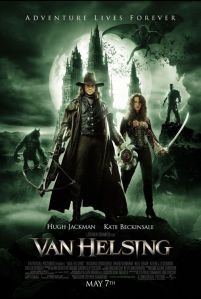
Originally released May 7, 2004:
Crossover movies have a distasteful history in the world of cinema. Some movie exec gets the notion, “Hey, why can’t two great tastes taste great together?” But what we’re left with is usually uninspired (The Flintstones Meet the Jetsons notwithstanding). Crossovers for horror movies are the worst of the lot. For every Freddy vs. Jason there’s a dud, like 1966’s Jesse James meets Frankenstein’s Daughter. That year went down in the annals of cinematic history, however, as it also gave us Billy the Kid versus Dracula, marking two entries in the expanding genre of cowboys battling famous monsters (as far as I know, this genre still stands at two movies). So what can one expect from Van Helsing, a big-budget creature feature that includes Dracula, Frankenstein, and the Wolfman?
Van Helsing (Hugh Jackman and a really big hat) is a secret soldier for a covert order of the Vatican. This covert order dispatches monsters and creepy-crawlies the world over. He’s been ordered to assist Anna Valerious (Kate Beckinsale), the last in a Romanian family line that has sought to kill the infamous Dracula (Richard Roxburgh). It seems that their family line is dwindling. And Anna’s brother being turned into a werewolf doesn’t help the situation. If her family line dies before Dracula then they cannot enter heaven. Van Helsing comes to town to help out the locals who are terrorized by Dracula’s flying brides. Van Helsing effectively kills one of the vamp ladies and is celebrated as a hero by the village. As he gets closer to Anna he also learns more about his own mysterious past and his connection to a certain figure with big teeth.
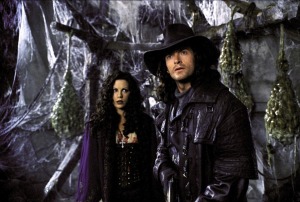
The Big D has a dastardly plan. He wants to find Frankenstein’s monster (Shuler Hensley) to channel enough power through him to awaken zillions of goo-sacks harboring the vamp’s undead brood. Of course, Frankenstein’s monster isn’t too keen on this. Together, he and Van Helsing, with the help of Anna as well as a comic relief monk, battle to stop Dracula from unleashing his children of the night.
Van Helsing is stupid, stupid, stupid. Director Stephen Sommers exists in his own indulgent world where bigger is better and some CGI spackle will fix any plot holes. He makes check-your-brain-at-the-door popcorn movies, but a “popcorn movie” is no excuse to forgive a rambling, incoherent, loud, stupid mess. I liked the first Mummy flick and even found some good with the second, but Van Helsing is Sommers at his rock-bottom worst, gorging on a trough of special effects and vomiting the results onto the big screen. Sommers’ idea of character development is knocking people through walls like they were in a Looney Tunes cartoon.
Van Helsing raises some interesting questions, like why do Dracula’s brides morph into flying demons that are conveniently genitalia-free? Why does a werewolf rolling over the top of a carriage somehow cause it to catch on fire? Why does Dracula keep his magic lycanthropy cure in the open? It doesn’t matter. Van Helsing is so straight-laced about its absurdities that questioning them will just get tiresome.
Not that you would expect much, but the acting in Van Helsing is bad. Beckinsale’s accent couldn’t be less convincing if her role were played by Charo. The trio of Dracula’s brides are played by swimsuit models and let me just say their performance is on par with what you would expect from swimsuit models. Roxburgh is quite possibly the worst vampire in the modern history of vampires, and that includes Blacula, Count Chocula and Tom Cruise. He couldn’t look any less sinister if he was in a diaper and bonnet. What’s up with those strands of hair that dangle in his face? Why do the Van Helsing creators want their Prince of Evil and son of Satan to look like he was the keyboardist for some 80s pop synth band?

This overly long film feels like a seven-year-old’s book report that he hasn’t read: it’s like a child is making this up as they go. “And then … a werewolf pops up … and then Dracula’s flying brides … and then they all need Frankenstein’s monster ….” Seriously, were the penning this script on the fly? It’s a $150 million improv film. The reels of the film could be switched around and no one would be able to tell the difference. Van Helsing is one long, exasperated action sequence that drags its heels instead of wowing. It beats the audience into submission with its stupidity and redundancy.
The entertainment level of Van Helsing is exceedingly weak. It runs an eternity, which wouldn’t be a problem if one were intrigued by the story, the characters, or the action sequences. The action could have been suitable but Sommers has gotten less reliant on the physical and more superfluous with his CGI. Watching a CGI monstrosity smash into a CGI monstrosity before a CGI background where no semblance of reality is present grows tiresome after 130 minutes. The effects are passable, but they overload the viewer and numb whatever slight interest may have existed for the classic monsters.
What should have been a clever homage turns instead into a hollow marketing ploy that’s so frenetic and tireless with its manic pacing and bad special effects. Even the many attempts at humor are flat. It has to be some kind of apocalyptic sign that Hellboy and now Van Helsing have been unleashed unto the innocents of this world. Some will find Van Helsing decent popcorn entertainment, but most will grow weary of its sloppy design and wafer-thin substance. For me, this is one to avoid, period. There isn’t an ounce of fun to be had while sitting through the painful pair of hours that is Van Helsing. This is one monster mash that’s a real monster mess.
Nate’s Grade: D
——————————————————
WRITER REFLECTIONS 20 YEARS LATER
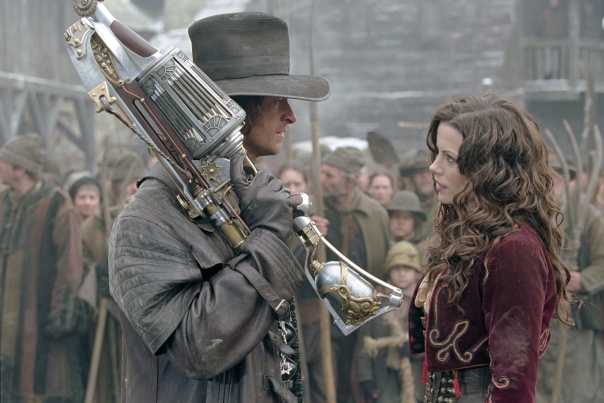
In 2004, Van Helsing was being primed to be not just a blockbuster but the forerunner for a new interconnected franchise revitalizing the classic Universal horror icons. Director Stephen Sommers was hot off the success of the first two Mummy movies, Hugh Jackman had become a household name playing everyone’s favorite growling superhero, and Kate Beckinsale had proven her own box-office mettle fighting vampires and werewolves in the Underworld series. The studio was expecting so much that it planned a sequel, a TV series on NBC called Transylvania, an animated prequel, a clothing line, a video game, maybe even theme park additions, and to maintain the Eastern European sets so that they could be utilized for the eventual show and sequels. Obviously, this never came to pass, and Sommers’ last big Hollywood action movie was the 2009 G.I. Joe movie, and he hasn’t directed a movie since 2013’s Odd Thomas adaptation. He chose not to direct the third Mummy movie in 2008, but it seems like this man’s career has never been the same since Van Helsing cratered in the summer of 2004. It began as the studio asking Sommers for even more monster movies, Sommers pitching them all together as an Avengers-style super movie, the studio getting carried away with larger plans of franchise dominance, and then when it didn’t materialize, a promising popcorn filmmaker in the highest blockbuster sphere just vanished in a poof of overzealous CGI.
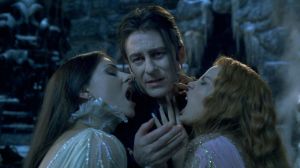
Me wife’s crush circa 2004
In 2004, I did not like Van Helsing. That might be too charitable a description. I wrote in my original review, “Van Helsing is stupid, stupid, stupid. [Sommers] exists in his own indulgent world where bigger is better and some CGI spackle will fix any plot holes. He makes check-your-brain-at-the-door popcorn movies, but a ‘popcorn movie’ is no excuse to forgive a rambling, incoherent, loud, stupid mess.” It was one of my worst movies of 2004, and twenty years later, I’ve mostly come around on the movie. I won’t tell you that it’s a great movie, or even achieves that same magic alchemy of action-adventure swash buckle that The Mummy brought back to major studio filmmaking in 1999, but Van Helsing is enjoyably ridiculous schlock nonsense. It was also one of my wife’s favorite movies growing up, and she reminded me that her teenage self had a big crush on Richard Roxburgh’s version of Dracula, not Hugh.
I now view Van Helsing less as a horror monster action vehicle and more of a spy vehicle in a strange world. The titular Van Helsing is our secret agent complete with spy gadgets with his comedic relief sidekick, and he’s got his important missions and the sexy Bond Girl, and the villains and betrayals and added back-story that doesn’t seem even necessary. It’s Sommers taking the structure of a spy thriller and supplanting it onto a Victorian-era monster steampunk universe of demons and centuries-old church conspiracies. Jackman is enjoyably suave as the Vatican’s favorite killing machine learning his own life lessons about the nature of legacy. I even enjoyed the villain’s motivation for Dracula; he’s trying to learn the secrets of Dr. Frankenstein’s reanimation to ensure that his vampy babies survive. Here is a Dracula who is bereft because he cannot father living children. I suppose there could be further discussion over the different forms of life as converting humans into vampires is itself a rebirth. Perhaps the distinction is like the difference between having biological children and adopted children. Maybe dear old Drac just wants to have a bundle of joy he can call his own. That’s more interesting than versions that make him out to be some stalker ex-boyfriend. Likewise, the role of Anna (Beckinsale) is given more pathos than simply being the Strong Romani Badass. While her wardrobe consists of corsets and teased hair to appeal to a young male demo, her character’s mission is powerful and personal. Anna needs to kill Dracula not to save herself but to ensure the rest of her deceased family members can enter heaven. Talk about cumulative family guilt. That’s heavy. When her face appears in the clouds at the end like Mufasa, it’s a confirmation of generational rest. That’s an arc that’s more fulfilling than being any love interest that would be discarded later.
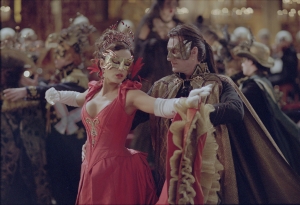
As soon as it got rolling, I said to my wife that this was going to go one of two ways: Van Helsing will learn that his organization is not as righteous as he believed them to be, manipulating him to eliminate threats to the organization’s standing rather than threats to humanity; or Dracula and Van Helsing have a personal connection that hasn’t been fully examined. Dear reader, it went in both directions because Sommers is slapping so many plot elements to make this movie feel full to bursting like a bloated tick. There’s ideas stacked upon ideas here, references and unexplored plot points for an untapped universe (vampires started werewolves?). An hour in, all of Dracula’s bats, a.k.a. his children have been slain, and you may erroneously think the movie is over. Well, there’s a whole other castle to explore with even more baby bats to kill. The last hour operates on pure video game mechanics of, go here, grab this item, battle this mini-boss. There’s definitely a level of redundancy and a “more is more” kitchen sink excess philosophy, but the bombast is part of his general appeal. There’s a touch of Sam Raimi here, a touch of Michael Bay; schlock with sheen. Maybe it was my nostalgia goggles, or maybe I was just attuning to Sommers’ wavelength, but the movie worked for me much better in 2024 as I was now charmed by its goofball sensibilities and less irritated by its over-plotted script.
You feel the admirable passion that Sommers has for this universe, adopting stylish pastiches to celebrate the older movies and lore, but definitely bringing his more modern sensibilities to the forefront. There’s a certain chaotic energy that animates Sommers big movies, bringing these classic characters together to run amok and crash into each other. That little kid’s imagination given the whole sandbox to play in can be enviable and lively, and it can also lead into unexpected directions that unexpectedly go nowhere. The incorporation of Frankenstein’s monster (Shuler Hensely) is more a plot device than a thoughtful character to bring to the team. He’s the magical MacGuffin both sides are fighting to claim for their own. Van Helsing’s major crime is trying too much and being too straight-laced about its silly. It’s not winking to the audience, it’s not self-commenting on its absurdities, it’s just living them lavishly. In 2004, I couldn’t appreciate that and this movie, and now I can find a place in my heart for such fun.
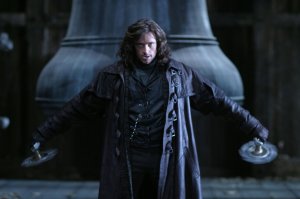
My original review in 2004 is scathing, with ready-to-blurb snark trying to communicate the intensity of my distaste. The line that Sommers is “gorging on a trough of special effects and vomiting the results onto the big screen” sticks with me. I’m surprised I restrained myself from making a “Van Helsing sucks” comment. Several of my criticisms about the acting, the confusing rules, the convoluted storytelling are entirely valid, but they just don’t bother me enough twenty years later. I can relax and enjoy the movie because it is a mess. That doesn’t mean every flawed movie deserves kindly dismissing its faults if it doesn’t aspire to anything other than mass entertainment. Big movies for big audiences can still be big bad. I think Van Helsing’s appeal is how sloppy it is and how excessive every element plays. In another universe, a… “dark universe” to borrow a phrase that came to me for no reason, this could have kicked off the interconnected Universal monster movies (any reference to Egyptian mummies is absent, implying perhaps that Sommers earlier movies exist in a shared world). It was not to be, and Sommers’ career has never been the same since, which is a real shame. The blockbuster space needs a filmmaker like Sommers, a man nimble enough to juggle tones and childlike glee with darker humor. Come back, Stephen Sommers, and maybe try your hand at the Creature From the Black Lagoon while you’re at it.
Nate’s Grade: C+
Share this:

Reminiscence (2021)

Reminiscent of other moody sci-fi/noir mashups like Dark City and The Thirteenth Floor (oh the 1990s), I mostly wish that Reminiscence had been less devoted to film noir trappings and explored more of its intriguing sci-fi setting and implications. Set in a future where seas have covered much of Miami, Hugh Jackman plays a memory specialist who helps clients/nostalgia addicts find peace by reliving their past experiences through tech tanks. It’s an interesting start and of course, as per noir rules, he’ll stumble across a mysterious woman (Rebecca Ferguson) with a troubled past that he can’t help but fall in love with even as it becomes clear she had ulterior motives for meeting our hero. There’s an obvious and potent commentary at play about worshiping the past at the expense of the future and the consequences of our actions, played on a personal level and a larger ecological warning. The problem is that it takes far too long for me to care about the movie. As expected, the mysterious woman vanishes, and Jackman is determined to find her, but I didn’t care about their relationship nor find this woman charming or anything other than a plot catalyst. We needed a more urgent sense of stakes to increase audience engagement. It wasn’t like she framed Jackman who then had a certain amount of time to clear his name with bad people or the police. There’s no real reason to root for Jackman to find this missing woman besides that he’s sad. This Chinatown-meets-The Cell movie is written and directed by Lisa Joy (co-creator of HBO’s Westworld), and there are interesting ideas to go along with its near-future world, and yet it all feels like a few drafts away from honing its real potential. I feel that the noir trappings strangle the storyline as far as what its ultimate imagination can be as it tries to fit into a familiar formula. Jumping into people’s memories as an investigation seems far more exciting than pounding the flooded pavement for answers. Reminiscence is a bit more conceptional than what it can deliver. It’s not terrible but it’s not terribly interesting either. Why isn’t there more with the police utilizing this technology to solve crimes or invade people’s privacy? That seems like a better starting point for conflict than “mysterious woman comes into shop.” There are some stunning visuals and points of excitement, like a fistfight that tumbles into a sunken concert hall. The ending is fitting and slightly poetic though heavily predictable given the preoccupation with repeating select conversations about the tragic nature of love stories. The problem with Reminiscence is it’s too reminiscent of too many other genre influences without providing enough of a story or characters or mystery or world to stand apart. If you’re a fan of Dark City, you might want to check out another stylish sci-fi/noir mashup, or you could just re-watch Dark City.
Nate’s Grade: C+
Share this:

X-Men (2000) [Review Re-View]
 Released July 14, 2000:
Take a storied franchise that has long been the backbone of Marvel comics and develop it into a feature film where the last superhero movie was the purple-spandex-in-the-jungle The Phantom and you’re just asking for trouble. A nation of fans is breathing down the neck of the film crew nitpicking every fine detail. Studio execs want the film done as fast as possible and under budget regardless of the numbers of effects needed. Despite what would seem like a cataclysmic set-up, X-Men proves that Hollywood can occasionally take a comic book and get it right. For the most part.
X-Men is basically the pilot for a movie franchise. It sets up characters, conflicts, origins, but periodically forgets its audience. Numerous people are introduced and then given a grocery list sized amount of dialogue to read. Some even have atrocious John Watters-like wigs they are forced to wear. It’s a good thing then that the film centers mainly around Wolverine (Hugh Jackman), Rogue (Anna Paquin) and Magneto (Ian McKellen), the three most interesting characters.
 Often times the action in X-Men is surprisingly lackluster and contained. The battle royale finale atop the Statue of Liberty might induce more than a few eye rolls. I can’t help but hope that with all the groundwork laid out with this film that the eventual sequel will be more efficient with its action set pieces.
For the most part the dialogue in X-Men is passable and it even has a few rally snazzy sound bites. However, there is that ONE line delivered by Ms. Berry (“You know what happens when a toad gets struck by lightening? The same thing that happens to everything else.”) that is groan-worthy and destined to be notorious.
It may sound like I’m coming down hard on X-Men, but for a comic adaptation it got a whole hell lot more right than wrong. I want to congratulate director Bryan Singer (The Usual Suspects) for the amount of pressure he had looming over his head and what he pulled through with. X-Men is no campy nipple-plate festival but an attempt at possibly serious drama with tortured characters. The whole mutant/racism metaphor may be a little bludgeoned at times but for the most part is handled very well. The best aspect X-Men has is its patience. The film is in no rush and takes its time even if it is only like an hour and 40-some minutes. Still, it’s a welcome change in the summer action.
 Singer’s direction is smooth and well executed. The casting of the movie is near perfection with some minor exceptions. Stewart and McKellen were born to play their dueling think tank leaders. Jackman is an exciting breakout in a role that was supposed to be occupied by Dougray Scott (thank you MI:-2 delays). I look forward to more from this actor. And does anyone know when young Oscar recipient Anna Paquin became so attractive? Someone buy this casting director a fine steak dinner.
X-Men may have its flaws, one of which is an absolute mundane score, but the film is one of the better summer entries into the world of explosions and noise. I just hope the sequel(s) will be a tad better.
Nate’s Grade: B
——————————————————
WRITER REFLECTIONS 20 YEARS LATER

It’s hard not to understate just how eventful the first X-Men movie was back in 2000. Beforehand, the public’s conception of super heroes was that they were kids’ stuff, fed by recent duds like Batman and Robin and Steel. Then came X-Men and it changed everything. There wouldn’t be a Spider-Man without X-Men. There wouldn’t be a Marvel Cinematic Universe (MCU), arguably the defining cultural franchise of the twenty-first century, without X-Men. It was an immediate hit with audiences and would go onto spawn two sequels, four prequels, three direct spinoffs, and two indirect spinoffs (Deadpool) over the course of 19 years. It’s a franchise that has made over $6 billion dollars worldwide and will soon be intermingled into that MCU, re-imagined with new actors filling out the famous names for the first time in decades. I can recall the importance of the X-Men in my own maturation and love of comics. I grew up adoring the animated series in the early 90s, and this began my relationship with the Marvel universe. I have boxes filled with old comics and I even started one of my own in my junior high school years (it’s unfinished and about 160 pages). I fondly recall seeing X-Men opening weekend with my pal Kevin Lowe and both of us just being relieved. A big studio had done it justice. They got it right.
Twenty years later, one must remember how different X-Men was with the super hero landscape. The more grounded, more political, and more reverent take on splash pages and spandex was in direct contrast with the cheesier, dumber, and more slapstick-heavy comics movies. Sure, you’d have your occasional hit like Blade, but the vampire genre inoculated it from larger scrutiny as a “comic book venture.” Director Bryan Singer wanted to make a brooding, serious version of the X-Men, a fact bolstered by his opening a summer super hero blockbuster with a Holocaust flashback. The mutant metaphor inherent in the X-universe has always lent itself to broad social commentary, easy to apply to any disadvantaged and targeted group for simply being different. It had men and women, and aliens and robots and more, doing amazing feats of derring-do, but it also featured these same characters fighting for equality with a public that increasingly feared and despised them for their gifts. Singer recognized this greater political allegorical relevancy and wanted his foray into blockbusters to be more meaningful than another disposable punch-em-up to consume mass quantities of popcorn. The X-Men franchise might not have ever been as successful without Singer’s early vision, and of course, many years later upon its demise, the producers might wish differently given the director’s righteous career reckoning.
 But let’s talk about the movie first before we get into the controversy of the man in the director’s chair. I haven’t watched the original really since the superior X-2 came out in 2003, and I was amazed at how patient and assured the movie plays. For a super hero action movie, there really isn’t that much action until the final act. There are confrontations and what I would call “action beats” but nothing lasting longer than a minute in conflict. In its place is a patient movie that takes its time to establish its world, its ideological counterpoints, and its characters and their relationships. We have two entry point characters with Wolverine (High Jackman) and Rogue (Anna Paquin) being hunted and taken in by Charles Xavier (Patrick Stewart). Even though the final movie is barely longer than 100 minutes, it doesn’t feel rushed in its pacing. It has a lot to do in establishing a new world but by grounding it with a scared runaway and a lonely drifter followed by trouble, the movie taps into Western archetypes to act as a helpful surrogate guideline. Fortunately, screenwriter David Hayter (and un-credited writers Ed Solomon, John Logan, Christopher McQuarrie and a heavily rewritten Joss Whedon) anchors us with the most interesting characters who have the most to fear and rebel. Wolverine and Rogue are an excellent pair and Jackman and Paquin have a real nurturing onscreen connection that provides an emotional investment. By taking its time to set up characters and their internal conflicts, X-Men makes a wide audience care about what’s to come.
When it does transition to action, you can see the beginnings of something great tempered with the growing pains of staking out new territory. The special effects are still relatively good, especially Rogue’s life-draining powers on the human body. That’s another thing the screenplay does well is finding ways to demonstrate and then incorporate every mutant’s special ability. We learn about Wolverine’s metallic claws through him being antagonized, and his healing ability from going headfirst through a windshield after Rogue admonishes him about wearing his seat belt. Later Rogue uses her powers to tap in Wolverine’s healing ability to save herself, setting up the Act Three climax where she is the key to Magneto’s (Ian McKellen) evolutionary-charged scheme. One more note on that (I apologize for the deluge of digressions) because Magneto’s big evil scheme is really about empathy. He plots to turn the world’s leaders into fellow mutants so they can understand the plight of a subjugated minority class, and yes, sure, some of them will not survive the genetic re-calibration, like the prejudiced firebrand Senator Kelly (Bruce Davison), but it’s not like Magneto wants them all dead. He wants them to understand (at least until the next sequel where he welcomes an opportunity to kill all non-mutant humans). Thanks to Singer, the movie has plenty of dynamic visual compositions and a few wow-moments to pack a trailer. I was reminded what an excellent visual artist Singer can be as he stages his scenes. The placement of figures, the depth of focus, the fluidity of his camera movements. He was certainly one indie darling ready for a bigger stage, at least in an artistic sense and not necessarily a personal one.
 It’s impossible to think of any other actor than Jackman as Wolverine but it almost never happened. Dougray Scott was in place but because of Mission: Impossible 2 delays which themselves were previously affected by Eyes Wide Shut delays, the role had to be recast already weeks into filming. Jackman entered the picture per a suggestion from Russell Crowe, to our collective pop-culture elation. Jackman is rugged, rebellious, funny, gruff, secretly warm-hearted yet clearly still the enjoyable F-You anti-hero, and watching him inhabit what, in comics lore, was a short, stout, hairy Canadian grump is a reminder that you can still recognize star-making performances when you see them. He fully inhabits the character and brings him to startling life. Jackman would become indispensable to the X-Men franchise and earn three spinoff movies, culminating in 2017’s R-rated and Oscar-nominated neo-Western, Logan. It’s only a matter of time before the MCU reboots this character because he, like Batman, is simply too valuable an IP to keep on the sidelines. It feels like heresy to consider another actor in this role, much like it will if anyone other than Robert Downey Jr. steps into the role of Tony Stark/Iron Man. This is a role defined by its signature actor where possible early choices now seem offensively wrong (like Tom Selleck as Indiana Jones, or Christopher Walken as Harrison Ford, or John Travolta as Forrest Gump).
The ensemble was extremely well cast with Oscar-winners and nominees past (Paquin, McKellen) and future (Halle Berry, Jackman). Stewart (Star Trek: The Next Generation) was born to play Professor X, enough so that when he first viewed X-Men comics he said, “What am I doing on this cover?” McKellen brings a gravitas to his villainous role as well as a smirky flair that makes him hard to hate. He had his shooting schedule re-arranged to accommodate the Lord of the Rings shoot in early 2000. Most people can only hope for one generational, pop-culture defining role, and McKellen had two after the age of 60. Paquin was making her transition from child-actor to adult, which was further solidified with HBO’s bloody and steamy vampire series, True Blood. Marsden was filling out his fledgling leading man potential, though he’s always been more appealing to me as a charming comedic actor (27 Dresses, Enchanted). Supermodel Rebecca Romijn (Femme Fatale) made a favorable impression as the shape-shifting Mystique thanks to low expectations and a costume made of 100 scales covering her nearly nude body that took nine hours to apply. The only real miss for me was Berry (Monster’s Ball) because I always envisioned Angela Basset (Black Panther) as my Storm. This is also the only X-Men where Berry adopts her character’s Kenyan accent.
 Looking back over 19 years of movies, the wonky timelines of the X-Men world begin to break apart if given even cursory contemplation. Given what happens in the prequels set in the 1970s and 80s, including Apocalypse (Oscar Isaac) launching all of the world’s nuclear missiles, it certainly seems like the worldwide perception of mutants would be more pronounced. Then there’s characters being alive, like Mystique, when she dies in the 1990s in the last X-Men film, 2019’s Dark Phoenix. The back-story of Jean Grey (first Famke Janssen, later Sophie Turner) and her Phoenix powers got two big screen showcases that also happen to be two of the worst movies. The biggest issue was the prequels arbitrarily following a movie-a-decade model, hopping from the Cuban Missile Crisis in 2011’s X-Men: First Class to the 1990s three films later. That means that somehow within less than ten years that Michael Fassbender (12 Years a Slave) and James McAvoy (Split) were going to resemble old men McKellen and Stewart. Do they get exposed to radiation? The conclusion of X-Men: Days of Future Past was meant to rewrite the timeline miscues, erasing the bad X-Men movies at that point from existence (2006’s Last Stand and 2009’s first solo Wolverine). Instead, the producers then followed with two more of the worst films of the franchise. You tried.
And now it’s time we discuss the controversy that has followed Singer for decades from film set to film set. There have been uncomfortable rumors and allegations that have surfaced ever since 1998’s Apt Pupil when Singer filmed a high school shower scene and insisted two underage actors be physically naked during the onset filming. Seems pretty questionable, right? This was eventually settled out of court, as were other allegations of abuse. According to a revealing Hollywood Reporter article, the teen who played Pyro, Alex Burton, was personally flown from L.A. to the Toronto X-Men set. This is quite bizarre considering he doesn’t have any lines and the part is a glorified cameo. Burton said he was held hostage by Singer and his wealthy friends for months and was repeatedly raped. Singer has been out as a gay man in Hollywood early into his career, and he would host regular all-male parties that reportedly descended into lurid bacchanals. Ironically, his status as a prominent and out gay director in the industry might have afforded him an aura of perceived protection, the idea that any journalist snooping too closely would be accused of homophobia or a double standard. It wasn’t just Singer but also the company he kept. Several associates of Singer have been accused of sexual abuse and against underage men that have led to undisclosed settlements.
 These allegations of abuse continued when Singer rejoined the X-universe again in 2014’s Days of Future Past but he weathered it out, and then again during the filming of 2018’s Bohemian Rhapsody, and this time he wouldn’t be able to weather it out. He was fired with a month left to film and Dexter Fletcher (Rocketman) was brought onboard to finish directing the eventual Oscar-winning and shockingly successful Queen blockbuster (nobody seemed to cite Singer by name in their acceptance speeches). Singer also built a reputation of showing up to his sets extremely late, sometimes impaired, and for sudden and unknown disappearances. It’s amazing that with all of this chronic misbehavior he was still getting big studio offers, but the man kept producing hits, including the long-running TV show House, and so his shady behavior was overlooked until, finally, it wouldn’t be in a post-Me Too world. Even after he was attached for a Red Sonja remake for a time until another round of accusations made him too radioactive for the time being. I would not be surprised if in a few years some production company happily offers him another project. Singer seems like a new test subject as far as what can be forgiven for the hitmakers.
So, what do we as viewers do with this damning profile of Singer? It’s become a regular habit now of re-examining an artist’s legacy in light of new or old allegations of wrongdoing. I personally have no interest in ever listening to a Bill Cosby comedy album again or watching any of his many heralded TV shows. I feel different listening to Michael Jackson’s music now. I wince when I watch Kevin Spacey in performances now and try to only see the character instead (Spacey won his first Oscar for 1995’s Usual Suspects, directed by… Bryan Singer). Can you watch the early X-Men films, or the later sequels, and still enjoy them knowing that Singer has been repeatedly accused of sexual misconduct including against minors? I have no answer. This is a deeply personal call for every person. I have too much personal attachment to 1999’s American Beauty to cast it aside, and that’s a movie that prominently features Spacey lusting after an underage girl. I’ll never look at the film the same but I cannot discard the whole. X-Men might mean too much to too many to disregard as well.
Looking back on my original review in 2000, I’m genuinely a little stunned because it’s almost word-for-word my assessment upon re-watching in 2020. It does feel more like a pilot to a franchise, laying the groundwork for the world and character relationships. The action is surprisingly contained. The “toad struck by lightning” dialogue line did become notorious. The casting was marvelous. The score was weak, greatly improved by the addition of John Ottman as editor and composer in the sequel (that Nightcrawler assassination attempt scene is a matserclass of editing and shot design). I even note the patience. I even think my original grade is fair. The original X-Men is a perfectly good movie but it led the way for great movies to come.
Re-View Grade: B
Share this:

Missing Link (2019)
 The stop-motion animation wizards at Laika have made some of the most charming and visually impressive movies of the last few years, including The Box Trolls, Kubo and the Two Strings, and ParaNorman. They’ve built up enough trust that I will see anything that they attach their name to. Missing Link is probably their least successful big screen effort yet, though that still means it’s only perfectly fine rather than great-to-amazing. It’s a heartfelt buddy comedy about a Bigfoot creature (voiced by Zach Galfianakis) that seeks out mentorship from a dashing adventurer (Hugh Jackman). It’s a sweet story but not fully emotionally engaging because the characters are fairly simplistic. There isn’t a lot of depth here and, surprisingly, more crass jokes aimed at a younger audience than their earlier output. From a visual standpoint, it’s beautiful with vibrant colors and fluid animation that has become indistinguishable from CGI nowadays. The action set pieces, usually appearing at a regular clip with each new location change, are fun and have their clever moments, like a capsizing ship that reminded me of the spinning Inception hallway. It’s an amusing, lower tier animated movie for Laika, but I’m worried that there might not be more of these movies the way they’re going at the box-office. Laika was treading financial water with excellent movies, and anything “less than” seems like it could possibly tip the independent animation production company over for good. Missing Link is a cute, mostly harmless, mostly entertaining movie that just doesn’t have the same ambitions and level of execution that previous Laika films have had. With that being said, it’s still worth a watch on the big screen for any animation aficionado.
Nate’s Grade: B
Share this:

The Front Runner (2018)
 In 1987, former Colorado senator and governor Gary Hart (Hugh Jackman) was the leading Democrat in primary polling and a sure bet to take on George H.W. Bush for the White House. In three weeks time, his campaign was in tatters and he folded. It all stems from a supposed affair he was conducting with Donna Rice (Sara Paxton). They deny anything but Gary acts like he has something to hide, evading the media’s questions about his marriage and his past history with infidelity. Enough time has passed in the political landscape to take a deeper dive into Gary Hart’s disintegration in the spotlight, and the moment serves a tipping point for changing media coverage. Journalists talk about the “old days” where candidate infidelity and ailments were just ignored as a gentleman’s agreement of sorts between the gatekeepers, but should they have? While a candidate’s martial relations are significantly less important than policy and governance, they do reflect character and what he or she (but, let’s face it, mostly he) acts with authority. Strangely, The Front Runner wants to paint the hungry journalists digging into Hart’s past as the real enemy, going above and beyond the bounds of ethics for crass sensationalism. This is directed and co-written by Jason Reitman (Tully, Up in the Air), a shrewd storyteller with a knack for human drama, which makes the “both sides are bad” equivocation all the more curious. Jackman is strong and has several scenes of righteous speeches talking about how he didn’t sign away his privacy, except when you run for president, you kind of do, and the American public deserve to know if their leaders abuse power. The movie favors long takes with a wide supporting cast of players that speak like they stepped out of an Aaron Sorkin workshop (an exchange celebrating the “integrity” of news anchors wearing bad suits feels ripped right from Sorkin’s unguarded typewriter). The film is nicely sympathetic to the “other woman” in this scenario and treats her like a human being with dimension. The PR recovery and shady deeds of Hart’s team reminded me of the Chappaquiddick, which placed an unfavorable scrutiny on Ted Kennedy and his team of political spin masters after his deadly car accident. It all makes for an entertaining movie with solid performances and interesting character shading, but its perspective is too wobbly, trying to lay the blame on everyone it can find.
Nate’s Grade: B
Share this:

The Greatest Showman (2017)
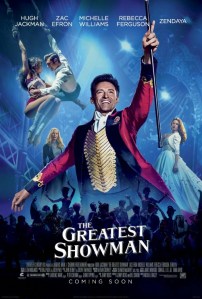 It’s rare to see an original musical given this sort of stage and attention. We usually reserve this space for tried-and-tested properties from Broadway or whatever animated film Disney has deigned to remake for an extra billion dollars in goodies. Another question is whether the movie will make the use of its big screen potential, as we’ve been inundated with smaller-scale musicals that are satisfying but lacking in an awe-inspiring sense of scale. The Greatest Showman is a big, splashy, 80s-styled Broadway musical that deals with big moments, big characters, and big emotions. It wears its mighty sincerity on its sleeve and challenges you not to get swept away with all of its charming pomp and circumstance, and for the most part I did just that.
P.T. Barnum (Hugh Jackman) is an unemployed salesman trying to provide a life of luxury and imagination to his wife Charity (Michelle Williams) and two daughters. He opens a theater in New York City and hires folks with unique appeal, a bearded woman (Keala Settle), a little person dressed as Napoleon, other so-called “freaks” and several trapeze artists. The show garners some controversy but still attracts a crowd. He reaches out to a rich playboy Phillip Carlyle (Zac Efron) to better shore up the finances. Phillip is reluctant but eager to step away from the pull of his parents, which includes falling in love with Anne (Zendaya), a trapeze performer. Barnum achieves enough success to force his way into the moneyed world of New York high society but he doesn’t feel they accept him, so he reaches out to renowned opera singer Jenny Lind (Rebecca Ferguson) and convinces her to come to America. Barnum plans a cross-country tour for his newest star and plans on going with, soaking up every standing ovation from the upper class. With his focus distracted, Barnum is in danger of losing those closets to him.
 This is a loving throwback to those old Broadway days and it succeeds admirably on the big screen, taking its circus setting and opening up the space. There’s a rooftop dance among hanging sheets that reminded me of classic Rogers/Hammerstein. I was particularly fond of the choreography of two duets, both with Efron. The first, “The Other Side,” he is being wooed by Barnum in a bar and the two men circle each other in negotiations, eventually jumping on tables, the bar top, and pounding and sliding shot glasses to naturally match with the percussive elements of the catchy song. The “Rewrite the Stars” lovers’ duet is playful and romantic as envisioned in its location, the center ring of the theater . Zendaya swings along ropes, rings, and weights, making their “will they won’t they” song a literal flirtatious dance, their orbits getting closer to one another, and the staging makes the emotions of the song feel even larger and more resonant. If you’re a fan of the unabashed, big audacious musicals of old with a sincerity that could approach mawkish, then you’ll definitely be in for a treat with what The Greatest Showman offers.
Reading that the Oscar-winning musical team behind the listless tunes from La La Land was the ones cooking up the original Showman songs did not inspire me with confidence. Well, apparently what they really needed was people who could sing and a canvas that allowed for a wider array of musical instrumentation. The songs mimic the movie in its presentation of exploding emotions and earnestness, and the big group numbers have a habit of feeling very kitchen sink in their melisma. It’s all the notes, all at you, with a thundering backbeat, and it can be a little overpowering at first to process, but eventually you adjust to its ecstatic rhythms. The opening number “The Greatest Show” threw me for a loop, with quick audience foot stomps cut with a millennial whoop and then laid over a dozen other musical tracks. It hits you hard but serves as a fine introduction, teasing you about the world to come and Barnum’s showcase. The song is also emblematic of my biggest quibble with what is otherwise rousing musical numbers insofar that it’s overproduced. There are solid melodies with each song and its reprise; however, it feels like the arrangements cannot settle on when to stop adding stuff. The songs can feel cluttered, weighed down by the added production. Barring that, it’s 39 minutes of original music that puts the Oscar-winning La La Land to shame.
 With any musical, different numbers will strike people differently, so I’ll highlight some of my favorites. The aforementioned “The Other Side” has a playful jaunty beat that builds and builds, nicely lending itself to showoff moments for Jackman and Efron as they try and outsmart and eventually out dance (the musical equivalent of persuasive speaking?) one another. the lyrics are also sharp (“I live among the swells/ We don’t pick up peanut shells”). It’s also a nice change of pace from the anthems and ballads that populate much of the soundtrack. Speaking of ballads, “Never Enough” might come from the least important character in the overall story but my goodness does Voice alum Loren Allred, providing vocals for Ferguson to lip synch, give it such a wallop. The emotion in the singing is crystal clear and made me wince because it’s so good. I’m one of those crazy people who care more about the performances in my big screen musicals than hitting all of the correct notes (see: Les Miserables), but it’s nice when a performer can grant you both. There’s no shame in lip-synching, La La Land. “Tightrope” is Williams lamenting her martial changes but the real revelation is her singing. She takes a fine song and makes it better. The song getting the most awards attention is the anthemic “This is Me” about accepting one’s self like a “Let it Go.” Keala Settle takes complete ownership with her booming vocals and passionate intonation. It’s a calling for all outcasts and delivers the inspirational groundswell into a millennial whoop pinnacle. There wasn’t a song that didn’t engage me at some level, either musically, performance-wise, or even presentation, and that’s one of the most important aspects for a musical.
Jackman (Logan) might just be blessed with more charisma than anyone on the planet, and so when he has that twinkle in his eye, you’re willing to go on whatever journey with the man. This has been a passion project of his for years and Jackman and he puts his all into being a captivating conman who can get high on his own hokum. He’s leaping off the screen to entertain and his dexterity and natural showmanship parlay well into bringing great, bustling life to his character. Efron (Baywatch) is an appealing actor who can so easily pull you in with his adeptness at comedy, acting, dinging, and dancing. It’s been a while since Efron hoofed it up on the screen and he hasn’t missed a step. Zendaya (Spider-Man: Homecoming) is a born star. She has a moment late in the film where her hoarse voice repeats the chorus of “Rewrite the Stars” and she pushes it from being cheesy into being touching. Williams (All the Money in the World) is better than her underwritten material affords and brings warmth to her understanding, doting wife. For fans of the excellent Netflix series GLOW, which is also all about showmanship, that’s Sheila the She-Wolf as a young Queen Victoria (Gayle Rankin) greeting Barnum.
 Now, the direct sincerity of the entire production is somewhat called into question by its very sanitized approach to P.T. Barnum. One way of looking at his “freak show” was that he was empowering the less fortunate and providing a safe space for them to call a community and earn a wage in a discriminatory job market. Barnum gave them a sense of dignity. Another way of looking at it is that Barnum was exploiting people who had no other options and selling tickets for the public to indulge its morbid curiosities. Barnum is a fascinating figure before he even conjures up the idea for his circus. He was an abolitionist who dropped out of school at fifteen, owned and operated a newspaper by age 21, was jailed for libel, exposed a credit scheme to gain his theater, four in the Civil War, and was a purveyor of any ridiculous and ghastly theatrical stunt, including an enslaved African woman’s autopsy to prove she was really 160 years old. Barnum is a complicated historical figure with a wealth of anecdotes that would make great storytelling potential.
The movie invents a Barnum for an invented tale, which isn’t necessarily a problem except that what we get is absurdly simplistic in comparison to the complex source. Barnum becomes a poor kid with great aspirations, most of which seems to be either joining the rich elites or sticking it to them and their snooty sensibilities. Likewise, being a champion of the “freaks” is naively unsophisticated for a man as craven for publicity as Barnum. The simplicity also extends into the supporting characters that have meager morsels to work with considering the considerable attention Barnum draws. An interracial romance between Phillip and Anne has tremors of importance but falls back on easy signifiers lacking greater examination, like Phillip’s agog family response to him being interested in “the help.” It’s a shame because Efron and Zendaya are terrific together and a simple gesture like reaching out to hold hands can have such power. Charity is the put upon wife we see all-too often in the stories of Great Men, and her domesticity represents the source of Barnum’s true happiness. You see, dear reader, Barnum’s character arc is that he wants to stick ti to the rich elites, than he wants to be accepted by them, and then he learns the errors of his ways and goes back to appreciating his family and life’s smaller pleasures, those pleasures are still living comfortably. It’s a strange stop-and-smell-the-roses sort of lesson, and it’s even weirder when Barnum seems to lose interest in his community of performers he’s gathered. The subplot where Barnum abandons his theater to tour with Jenny Lind feels both obvious and unnecessary. The only tension is whether or not there will be an affair, and the impact of Jenny Lind seems overall fleeting, forcing conflict in contrived fashions. For a man whose life story was writ large and fascinating, The Greatest Showman conjures a sedate replacement.
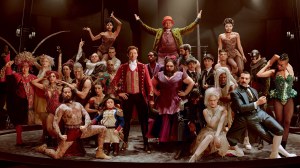 As I was watching and smiling to the soaring emotions and tunes, I kept thinking how 17-year-old me would have likely tore this movie to shreds, lambasting its earnestness as a mawkish attempt to wring out a feel-good story from a questionable source. 17-year-old me would have snickered about how gloriously unhip The Greatest Showman is. Mid-30s me has a much easier time not just accepting sincerity but also appreciating it. The performances are charming, the performers able, and the songs slyly catchy. The story of P.T. Barnum is sanitized with mixed results but the ebullient feeling coursing through this film is undeniable and worked its magic over me. If you’ve been missing the big Broadway musicals of old, The Greatest Showman will be a three-ring treat.
Nate’s Grade: B
Share this:

Logan (2017)
 The Wolverine solo films have not been good movies. The 2008 first film was widely lambasted and while it made its money it was an obvious artistic misfire. The second film, The Wolverine, directed by James Mangold was an improvement even though it had its silly moments and fell apart with a contrived final confrontation. The Wolverine movies were definitely the lesser, unworthy sidekick to the X-Men franchise, and this was a franchise that recently suffered from the near abysmal Apocalypse. Mangold returns for another Wolverine sequel but I was cautious. And then the cheerfully profane Deadpool broke box-office records and gave the Fox execs the latitude needed for a darker, bloodier, and more adult movie that’s more interested in character regrets than toy tie-ins. Thank goodness for the success of Deadpool because Logan is the X-Men movie, and in particular the Wolverine movie, I’ve been waiting for since the mutants burst onto the big screen some seventeen years ago. It is everything you could want in a Wolverine movie.
In the year 2029, mutants have become all but extinct. Logan (Jackman) is keeping a low profile as a limo driver and taking care of an ailing Charles Xavier (Patrick Stewart) south of the border. Xavier is losing his mind and a danger to others with his out-of-control psychic powers that need to be drugged. Caliban (Stephen Merchant) is also helping, a light-sensitive mutant with the ability to innately track people across the globe. Logan is ailing because his healing power is dwindling and he can’t keep up with the steady poison of his adamantium bones. A scared Mexican nurse tries to convince Logan to help out the little girl in her care, Laura (Dafne Keen, feral and a better non-verbal actor). She’s an angry, violent child and built from the DNA of Logan. She too has unbreakably sharp claws and a healing ability. Bounty hunter Pierce (Boyd Holbrook) is trying to recapture the runaway merchandise/science experiment, capturing Caliban and torturing him to track his prey. Logan goes on the run with Xavier and they try to make sense of what to do with Laura, a.k.a. X-23. They’re headed north to Eden, a hypothetical refuge for mutants to sneak over into freedom in Canada, and along the way are deadly hunters who aren’t afraid of leaving behind a trail of bodies to get their girl back.
 It feels like it shouldn’t haven taken Jackman’s reported final outing for the execs to realize that a guy with freaking knives attached to his hands might be a concept that would work in the more grisly, more adult territory an R-rating creatively affords. It’s about time this man got to fully use his claws, and it was a joyous explosion of violence and gore built up for fans such as myself for a long time coming. It feels like Fox has been planning for this event as well, as if they stationed a production lackey to devise all sorts of grotesquely fun ways that Wolverine might skewer his competition in bloody beauty (“Finally, your preparation will not be in vain, Ronald”). There’s one scene in particular where a bunch of armed henchmen are psychically frozen in place and Logan struggles to move past each, and we get to anticipate just how each one will be viciously stabbed. For a series that has shied away from overly gory violence, Logan certainly celebrates its new opportunities with bloody glee. The fact that the first word spoken is an f-bomb and there’s a gratuitous moment of drunken sorority girl boob flashing is like the producers trying to directly communicate to the millions of ticket buyers and saying, “Hey, we’re sorry it took so long. Hope it was worth the wait.” Oh dear reader, it was worth the wait.
It’s not just the action that’s invigorating but the emotional core of the film is deeper and more compelling and ruminative than ever before, and finally these great actors are given material to deliver great performances worthy of their talent. Stewart and Jackman have never been bad in their respective roles even if and when the movies have been. They just have never been called upon for much more than genre heroics, anguish, and pained moral dilemmas. With Logan, both actors are finally given meaty material that affords nuance and ambiguity, and they are excellent. Charles Xavier is losing his battle with Alzheimer’s and ALS, which is a major concern when his mind is considered a weapon of mass destruction by the government. He’s going through his own end of life deliberations (“You’re waiting for me to die,” he groans at Logan) and it brings out a far different Xavier than we’ve ever seen, even with the youthful cockiness from James McAvoy. This is a cranky, defiant, and doddering Xavier, someone who is barely outpacing his sense of grief, guilt, and depression. There’s a tragic back-story we only get a glimpse of but it’s suitably devastating for a man who has devoted his life to others. He’s looking for a few last moments of grace and looking to hold onto something by journey’s end.
 Thanks to his healing ability and the star wattage of Jackman, there was little fear that anything serious would ever befall Wolverine in his many previous film appearances. Sure bad things happened to him and he lost plenty of female love interests, but you never feared that he wouldn’t be able to ultimately handle himself. That’s not the case in Logan, which opens with a Wolverine who has clearly lost more than a step or two. He’s tired, rundown, and his adamantium skeleton is slowly poisoning his body. His healing powers are slowing down and he’s not as berserker fast and agile as he used to be. For once there’s an uncertainty attached to the character and a vulnerability. This turn greatly increases the intensity of the fight sequences and the greater stakes of the drama. The comparisons of the samurai were rife in The Wolverine and now the comparisons to the aging, lone gunslinger are ever-present in Logan. He’s drawn into a conflict that he was not seeking and he’s found a little bit of his remaining humanity and compassion to do right in the face of overwhelming odds and near certain destruction. There’s a subtle moment that the film doesn’t even dwell on that stuck with me. It’s after an accident, and in the thick of confusion, Logan is trying to save his mentor but he’s also worried that Xavier will think he betrayed him. “It wasn’t me,” he repeats over and over, not wanting this man to suffer more. It’s a small moment that doesn’t get much attention and yet it really spoke of their relationship and the depth of feeling during these fraught final days. This is the first Wolverine movie that feels like the characters matter as human beings just as much as purveyors of punching and kicking (now with gruesome slashing at no extra cost). Jackman showcases more than his impressive physique this go-round; he delivers a wounded performance that’s built upon generations of scars that he’s been ignoring. It’s the serious character examination we’ve been waiting for.
I also want to single out Merchant (Extras) who gives a performance I never would have anticipated from the awkwardly comedic beanpole. He even gets a badass moment and I never would have thought Stephen Merchant would ever have a badass moment in life.
Mangold’s film plays as a love letter to Western cinema and uses the genre trappings in ways to further comment on the characters and their plight. This is a bleak movie. It’s not a dystopia. In fact it resembles our own world pretty closely with a few technological additions; automated machines and trucks, the common knowledge that mutants have been wiped out like the measles. Knowing that it’s reportedly the end for Stewart and Jackman playing these characters, I was anticipating the film to strike an elegiac chord. His past and legacy are catching up with Logan. He becomes an unlikely guardian to Laura and explores a fatherhood dynamic that was never afforded to him before. The unlikely partnership, and it is a partnership as she’s a pint-sized chip off the block of her tempestuous father, blossoms along a cross-country road trip for a paradise that may or may not exist, while desperadoes and powerful black hat villains are out to impose their will upon the weak. This is explored in a leisurely pit stop with a working class family (welcome back, Eriq La Sale) that welcomes Logan and his posse into their home. We get a small respite and learn about greedy landowners trying to pressure them into giving up the family farm. It’s completely reminiscent of something you might see in a classic Western of old, just transported to a new setting. There’s even an extended bit where Laura watches 1953’s Shane on TV, and when those final words come back in expected yet clunky fashion, I’d be lying if they didn’t push the right emotions at the right time.
 But when it comes to action, Logan more than satisfies. The action is cleanly orchestrated by Mangold in fluid takes that allow the audience to readily engage. The film doesn’t go overboard on the Grand Guignol and lose sight of the key aspects of great action sequences. There’s a refreshing variety of the action and combat, and the action is framed tightly to the characters and their goals. It makes for an exhilarating viewing. If there is anything I would cite as a detriment for an otherwise incredible sendoff, I think the movie peaks too soon action-wise. The emotional climax is definitely where it ought to be (tears will be shed whether you like it or not) but the third act action doesn’t have quite the pop. Also, while Holbrook (Narcos) is an entertaining and slyly charismatic heavy, the villains in the movie are kept relatively vague as is their overall plan. The vacuum of villainy is kept more one-dimensional, which is fine as it allows more complexity and character moments to be doled out to our heroes, but it is a noticeable missing element.
One of the best attributes I cited from last year’s Captain America: Civil War is that the full weight of the character histories was felt, giving real emotional stakes to all the explosions and moralizing. When our characters went toe-to-toe, we felt a dozen films’ worth of setup that made the conflict matter. Logan carries that same emotional weight. We’ve been watching Wolverine and Professor Xavier for almost two decades and across nine films. These characters have gotten old, tired, and they carry their years like taciturn gunslingers looking for solitude and trying to justify the regrets of their lives. It’s a surprisingly emotional, serious, and altogether mature final chapter, one that provides just as many enjoyable character moments and stretches of ruminative silence as it does jolts of gritty, dirty, hard-charging action and bloody violence. It’s as much a character study as it is a superhero movie or Western. I cannot imagine this story as a watered down, PG-13 neutered version of what I saw on screen. This is a movie for adults and it pays great justice to the characters and the demands of the audience. The final image is note-perfect and can speak volumes about the ultimate legacy of Wolverine and by extension Xavier and his school for gifted youngsters. Logan is the second-best X-Men movie (First Class still rules the roost) and a thoughtful and poignant finish that left me dizzy with happiness, emotionally drained, and extremely satisfied as a longtime fan.
Nate’s Grade: A-
Share this:

X-Men: Apocalypse (2016)
 “We all know the third movie is the worst,” says young Jean Grey (Sophie Turner) in a curious moment that is too meta for its own good. It’s meant to be an in-joke, and possible a jab at 2006’s heavily derided X-Men: The Last Stand, but it ends up summarizing more than one X-Men movie. Easily the weakest of the prequel series, X-Men: Apocalypse is a muddled super hero movie that marginalizes its interesting characters, lacks a thematic linchpin, pushes a new batch of boring and often superfluous new mutants, and feels like everyone is running through the paces of what they think an X-Men movie should be. It’s not Last Stand, the near franchise-killer that Days of Future Past had to wipe out of existence, but this movie is a dull and clear example of the lousy mediocrity of compounded missed chances suffered at the expense of loyalty to formula.
In 1983, Charles Xavier (James McAvoy) is running his school for gifted youngsters, a.k.a. mutants, and has a new class of students including Jean Grey, Scott “Cyclops” Summers (Tye Sheridan), Kurt “Nightcrawler” Wagner (Kodi Smit-McPhee). Magneto (Michael Fassbender) is trying to live a simple life and exclude himself from a larger fight between humans and mutants. Mystique (Jennifer Lawrence) is crossing the globe and discovering new mutants to rescue. Everything changes when an ancient mutant is awakened in Egypt. Apocalypse (Oscar Isaac) is thousands of years old and is rumored to be the first mutant. He collects four mutant helpers he deems his Horsemen, and in 1983 it happens to be a young Storm (Alexandra Shipp), Psylocke (Olivia Munn), Archangel (Ben Hardy), and Magneto. Apocalypse promises a world built for only the strongest mutants and will wipe the planet with those found lesser.
 Let’s start with the empty void that is the titular super villain; Apocalypse is a complete waste and a complete bore. Oscar Isaac is a terrific and soulful actor who can be so malleable to roles as diverse as misanthropic Llewyn Davis to dreamy X-wing pilot Poe Damaron. He is buried under pounds of purple makeup that limit his expression, coupled with a heavy costume that also limits his movement. Apocalypse should have probably been a motion capture performance. Andy Serkis has proven that mo-cap performances can exhibit tremendous emotive qualities and the technology can support it. Mo-cap would have been better than staring at Ivan Ooze lumbering around. Then there’s his haphazard characterization. Apocalypse is both too all-powerful and shackled with powers that are too vaguely ill defined. He doesn’t seem like the kind of guy that needs an entourage for support despite the whole snazzy “Four Horsemen” backing band name. Apocalypse should be the solo act; he doesn’t need a backup band. You could have written Storm and Psylocke out entirely and had no impact on the plot whatsoever. My pal Eric Muller even jokes that Psylocke literally walks off the movie. Allow me to indulge my X-Men fandom a moment and just say how Apocalypse is my favorite X-Men villain and Psylocke was one of my favorite X-Men way back when I was reading the comics consistently in the 90s. I loved the psychic blade of Psylocke, though in this movie it’s pretty much just a laser arm sword, which is a underwhelming. Seeing both of these characters completely wasted is particularly disappointing to 90s me.
But back to Apocalypse, he seems too powerful to need to seek out a select group of super lieutenants and part of this is also because of how poorly the movie explains the specifics or limitations of his powers. He absorbs the powers of his host mutants but what are those powers exactly? The movie never specifies beyond the weird shifting-humans-into-walls thing that looks a bit too silly to be truly terrifying. Every time he displays a new fancy power we just have to accept it, but if he keeps unleashing powers we never know about then why does he even need assistance? We already see Apocalypse turning the world into dust clouds, so why does he need Magneto to, I believe, rip the metal core out of the Earth? It’s not like he has a meaningful relationship with Magneto, the only Horseman who truly matters. Apocalypse should be the mutant equivalent of a god, and credit to my pal Ben Bailey on this assertion, and the world of mutants should be forced to make a choice to follow this god who genuinely wants a new world consisting only of his “children.” Instead he’s just a bloviating and boring demagogue that makes a terrible lead villain. For a guy who might be the “first mutant” and inspire the Bible, it sure seems like squandered potential.
 The trio of the core characters of the prequels (Professor X, Magneto, Mystique) is largely sidelined and you can certainly tell that the actors are eyeing the exit door, no more than Lawrence. These are the characters we’ve gotten to know and the ones we’ve built up an emotional attachment to, so why not just push them to the outer edges of your story and shove some new even younger X kids in place to dominate the narrative? Lawrence and Fassbender especially are given the least to do. When Mystique has to become a de facto X-Men leader and teacher, you can feel like everyone is just going through the motions. They just look bored or at least unable to hide their ambivalence with the muddled screenplay. The new X kids are also fairly bland with little charisma. I think there’s an actual scene where Nightcrawler is walking around a mall in plain sight. The X kids are here to take over for the Magneto/Xavier/Mystique unit and provide a bridge to the original X-Men series. It is here where I must now gripe because First Class was set in 1961 and Apocalypse is set in 1983 and nobody looks like they’ve aged. Maybe that’s a mutant ability plot device but then Rose Byrne’s human character hasn’t aged much either. Her character is also completely pointless in this movie. She might not be as badly shoehorned into the action as Lois Lane was in Batman vs. Superman, but then again there still isn’t anything as terrible as anything in BvS.
The X-Men franchise from the beginning has been a super hero saga with subtext and social commentary. It might not be completely subtle but it was effective and brings greater relevance and emotional power to the struggles of our mutant heroes. The first prequel was about a core philosophical divide between Xavier and Magneto; the second movie was about the individual versus society and was personally exemplified by the moral crisis of Mystique’s hunt for vengeance that would lead to the downfall of humanity. This third movie has none of that. Magneto is suffering from a personal tragedy caused by prejudice and fear but the basic theme is the same from First Class just not nearly as well articulated. Here it’s more just blunt “kill ‘em all” vengeance, and he’s made to be a practically mute cipher until called upon at the very end for some tidy plot work. I haven’t even talked about the tacky return to a concentration camp. The characters are either fighting the bad guy or fighting with the bad guy. That’s it. There isn’t any major personal or philosophical conflict that is highlighted by the subtext of the plot. It’s all just more grist for world-ending CGI nonsense.
Apocalypse at best is a series of moments, and the overall quality level rarely rises beyond competently acceptable, not exactly a ringing endorsement. The movie’s action sequences are rather dull and visually repetitive, making poor use of geography and development. The entire third act is a blandly extended action sequence in the dusty ruins of Cairo. Things just sort of happen and then more things just sort of happen. The opening action sequence in Days of Future Past is better than 99% of the scenes in this movie. The clear highlight that everyone will rightly cite is Quicksilver (Evan Peters) showcasing the amazing potential of his super speedy powers, but even this is a repeat of a highlight from a previous movie. It’s like the producers decided to take the moment everybody loved and do it bigger and better. It was a real fun surprise in the first time, and now it’s become the newest part of the X-Men formula. Still, it’s a fantastic sequence with great visual panache and a lively sense of humor. When the world slows down and Quicksilver steps into the frame, it’s almost like a hero moment for the audience to cheer. He saves a school of mutants, and a dog, from a colossal explosion, but it too is just another moment that could have been cut from the movie entirely. It’s a fantastic moment, the obvious highpoint, and yet it’s still superfluous. The other highpoint is an extended cameo at Alkali Lake, and again it is superfluous and calls into question greater franchise continuity.
 Speaking of continuity, there are some major events in Days of Future Past but especially Apocalypse that make me question how the events in the 2000s X-Men still stand. According to the events of the prequels, Mystique “outed” herself to the world and proved the existence of mutants to the wider public when she tried killing Boliver Trask (Peter Dinklage) and infiltrated the Nixon White House. Cut to 1983 and Apocalypse broadcasts a message to every human and mutant on the planet. He launches the world’s entire arsenal of nuclear weapons into space. That seems like a big deal, the kind of deal that would dramatically alter the events in the 2000s to the point that a mutant registration act would seem hilariously quaint and far too late. The character relationships in the first X-Men movie must also be reassessed with the events of Alkali Lake. It’s hard for me to reconcile the earlier films matching up with these prequels at this point.
The studio execs and producers behind the X-Men series have already gone on record speculating that their next movie will take place in the 1990s and have Mr. Sinister as its chief villain. I think they’re getting a little too ahead of themselves with the larger franchise vision much like what happened to Sony after their 2012 Amazing Spider-Man reboot. They started plotting two sequels, a spin-off, and lost sight of simply making a good movie with characters you care about and memorable action sequences. They lost track and had to reboot their Spider-Man franchise yet again, this time with an assist from the Marvel bigwigs. I don’t need an X-Men-a-decade adventure. I just want good movies. Out of six movies, half of them are great and the rest are acceptable to terrible. Apocalypse won’t kill its franchise but I think the negative and indifferent response from the public, as well as less-than-robust box-office returns, will give the studio caution. Don’t just throw out an X-Men movie in order to lay the tracks for the next two X-Men movies. Make a compelling and entertaining X-Men film that stands on its own. If you can’t do that, then there won’t be too many more X adventures, period.
Nate’s Grade: C
Share this:

Pan (2015)
 Reminiscent of the Patton Oswalt bit concerning The Phantom Menace, often fans rarely need the “before” when it concerns the characters they love; did anyone really need to know what Peter and Hook were up to before they became mortal enemies? Pan attempts to tell the story before we know it about how Peter Pan became the character we know. It was originally planned for a summer 2015 release and was pushed back until the fall, ostensibly for more time to finish visual effects. the studio, Warner Brothers, pulled a similar move with Jupiter Ascending, and we know how that turned out.
Peter (Levi Miller) is an orphan living in London during World War II. He and a few of his best parentless pals are abducted in the middle of the night by a group of pirates and their flying pirate ship. He’s taken to Neverland to work in the mines belonging to Blackbeard (Hugh Jackman), who has an addiction to fairy dust. During a scuffle, Peter discovers he has the ability to fly, though he can’t exactly master it. There has been a prophecy that The One would be able to fly and they would topple Blackbeard. Peter and another miner, James Hook (Garrett Hedlund), escape, finding their way into the land of the “natives,” which includes Tigerlily (a miscast Rooney Mara). The “Pan” has been prophecized to help lead their people and discover the bridge into the world of the fairies, and Blackbeard won’t stop until he finds the source of his pernicious pixie smack.
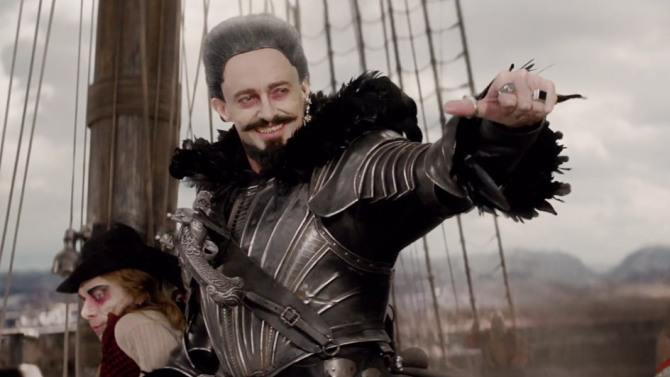 Who exactly is Pan intended for or what story needed to be told prior to our introduction to the world of Neverland? The first act sets the stage for the miscalculated tonal mishmash that never truly settles: we jump from a cruel orphanage, with Peter comically plucky, to the horrors of the London bombing during the Blitz, to a bunch of pirates kidnapping the orphans (tacitly with the approval of the evil head nun running the orphanage), and from there we’re whisked away across space to a mine of slave workers digging for pixie dust minerals who serenade their pirate slave lord with the lyrics to Nirvana’s “Smells Like Teen Spirit” for… some reason. Is this a movie intended for younger children and families? Is it intended for teenagers? The tone veers wildly, sometimes within the same scene, going from serious and gritty to colorful and ridiculous. It’s a campy experience that makes me wonder who exactly was supposed to enjoy an attempt to open the Peter Pan mythos, a world that is generally shallow.
At no point does Pan justify its existence beyond a flimsy corporate attempt to take a familiar world and expand upon it for sweet franchise money. When you get down to the world of Neverland, at least as represented on film, what exactly is there? There are pirates, “natives,” mermaids, and fairies, and that’s about it. They all kind of exist in their own individual movie that fails to blend together, making the new groups of characters feel like little more than a new theme park attraction before moving on to the next autonomous ride. The fantasy figures themselves just aren’t that interesting because there just isn’t much to them beyond superficial descriptions. I suppose then that this would allow plenty of opportunity at world building to take these familiar staples and give them greater depth, and that’s Pan’s biggest missed opportunity. Far too often, the movie feels on Fantasy autopilot and what we’re given is the old clichés of the Great Prophecy and the Chosen One meant to bridge worlds, etc. the events in the film do little to explain how Peter became Peter Pan, besides learn to fly. The problem with the prophecy trope is that it robs characters of agency in place of just accepting their capital-D destiny.
You learn nothing new about Peter or Hook as people, and the nods to the greater Pan lore are annoying at best with how unsubtle and clunky they are. The movie doesn’t even lay the groundwork to explain what conflicts will eventually drive Peter and Hook apart. Peter is a bland hero who is defined by the mystery of his absent mother and her own lineage. He’s special because his mom was special and if he just believes hard enough then perhaps he can be even more special. It’s pretty simplistic stuff. The references to the Pan lore always seem to stop the movie dead in its tracks. The relationship between Peter and Hook isn’t explored in any capacity other then they appear to have both escaped together and been running side-by-side. It’s a relationship not out of bonding but out of sheer proximity. The concluding lines are literally Peter saying, “We’re going to be friends forever,” and Hook replying, “What could possibly go wrong?” Oh my goodness is that one hacky groan-worthy wink to the future.
 Pan is made serviceably watchable from director Joe Wright and the campy performance of Jackman. Wright is a premier visual stylist in cinema though his artistic instincts can lead him to try and smash as many ill-fitting square pegs as he can into round holes, last evidenced by the 2012 Anna Karenina adaptation that made all the world a literal stage. The visuals are often splendid to behold and Wright has a wonderful feel for color hues. The final act feels climactic and visually alive in ways the movie doesn’t even deserve, and Wright’s vision, weird as it can be at points (Nirvana?) gives the movie an energy that keeps its worth an initial viewing. For a movie filed with fantasy realms, I enjoyed the scenes in the orphanage and with the wicked head nun the best (is she knowingly selling the boys into slavery on a magic pirate ship or is it just extreme negligence on her part?). The other aspect that at least held my attention was Jackman. In a movie filled with bland and the occasionally bizarre performance, Jackman offers an anchor to lean upon. It’s not a good performance by normal circumstances but it provides a sense of life and feels in place. Hedlund (On the Road) is amazing in just how strange his rakish Harrison Ford-esque performance persists. Why didn’t anyone tell him to stop? His speaking voice fascinated me and I spent the entire moving trying to figure what it sounded like and my best description is Heath Ledger’s impression of Al Pacino.
While not being a colossal disaster of artistic self-indulgence, Pan is a disappointing and mostly tedious experience because of its failure to capitalize on expanding upon the Neverland universe and exploring what should be formative experiences to central characters. If this was going to be a crazy artistic romp then it needed to be crazier. If you’re going to have two brief anachronistic songs, then do more or at least draw in more influences from other timelines. If you’re going to be a straight-laced pilot for a budding fantasy franchise, at least give us more flights of fancy and wonder. Make us fall in love with this world or at least some of the characters. Instead Pan uses the audience’s pre-existing association with the characters and the environment in place of doing anything meaningful with a story. Peter becomes Peter Pan, so he doesn’t have to be a character he just has to be the pre-Pan Peter. The same for Hook and Smee and Tigerlily and that’s really the only characters worth mentioning until those Darling children come visit. I thought I was going to ridicule Pan with the glee I had taking apart Jupiter Ascending but I couldn’t muster much effort. It didn’t feel like the Pan filmmakers did either.
Nate’s Grade: C


 nathanzoebl
You must be logged in to post a comment.