Blog Archives
Wanted (2008)
 Wanted isn’t so much a movie as a fetish vehicle for teen males, with sexy cars, sexy guns, and sexy tatted-up Angelina Jolie, daring the predominantly male audience to decide which is sexiest (I am not a car aficionado nor a gun person, so I’ll say that Jolie easily outpaced her competition).
Wesley (James McAvoy) is a pathetic office drone that sweats out his days never raising his voice. His best friend is constantly screwing Wesley’s bitchy girlfriend, his boss constantly harangues him into panic attacks, and, saddest of all, a Google search results in nothing for Wesley Gibson’s name. He tells us he has done nothing with his life. This all changes when a mysterious woman named Fox (Jolie) tells Wesley that the father he never knew has just died. Not only that, Wesley’s father was one of the world’s greatest assassins and he might just be a chip off the old block. Wesley is recruited into The Fraternity, a thousand year-old organization whose membership includes the best-trained killers. Sloan (Morgan Freeman) is the leader who assigns the targets. He gets his orders, literally, from the Loom of Fate, a weaving loom that writes binary letters via stitches. The Loom of Fate decides whom the planet would be better off without. Fox and her cohorts train Wesley to accept his destiny and avenge his father’s murder.
 The movie fails to establish any form of internal logic or continuity, so anything preposterous suddenly becomes accessible. That means people can jump from one skyscraper to another, you can outrun a moving train, cars will do the damndest things, and that you can curve a bullet simply by rotating your hand and shutting off that little part of your brain that says, “This is defying all laws of physics.” For some reason, people are able to shoot bullets down in mid-air as a defensive maneuver but they rarely take aim at the person, surely a bigger and slower target. It’s like The Matrix outside of the Matrix with no reason for being Matrix-y. The idea is that these super assassins have super hearts that beat like 400 times faster, which pumps more blood and allows their senses to heighten. This somehow allows them to slow down time, zoom in on subjects, and react extra fast. It doesn’t make any sense but then again this is a movie where the killers are taking orders from the Loom of Fate. While I’m on the topic, really, a loom that stitches targets in binary code? Isn’t there an easier way for fate to decree who should be bumped off than someone scrutinizing the stitch work of a rug? What happens when it lists a name with more than one owner? How many “John Smiths” must be killed to secure that the correct Mr. Smith has been erased? My father thought the Loom of Fate was the most bizarre and interesting aspect of the movie.
Despite the freewheeling action, there is something decidedly depraved about fully embracing Wanted. The premise of awesome killers demands awesome carnage, and Wanted dishes out violence as an act to be savored and glorified. Wesley’s self-actualization is linked with getting better at making others suffer, and in the end the film advances a questionable message to follow suit. The movie exists in a hyper-realistic video game universe devoid of consequences. I can see future news reports of idiot teenagers playing their own deadly game of curving bullets (they may have to establish a Wanted category for the Darwin Awards). But yet the most disconcerting feature of Wanted is its dismissive nature toward human life. I’m not even talking about the assassin premise, though trained killer flicks usually work better when the pros have some sort of personal code. Wanted is a fetishistic worship of human bodies being taken apart in loving, gory detail under the auspices of being “cool.” Innocent life barely merits a half-hearted shrug. When Wesley and Fox bring their fight on board a train the eventually force the vehicle off a cliff, and the movie makes no mention of all those innocent people plummeting to their doom. That would get in the way of the film being “cool.”
With all that said, Wanted can feel like a high-octane rush to the senses. This film is soaked in adrenaline. The stunt work is astounding and the action is ramped-up to ridiculous levels. I say ridiculous because the film never establishes any form of internal logic or continuity, but I also say ridiculous because the action can be tremendously exciting and embellished with stylistic flourishes. Wanted is a slick and imaginative action movie, and the fact that it often dances with satisfaction makes me sick for enjoying it so. Summer is the perfect opportunity for empty calorie movies with style to spare, and Wanted is a five-course meal of glossy, disposable artifice. Director Timur Bekmambetov previously directed the Russian vampire films Night Watch and Day Watch, but Wanted is a giant leap forward in budget and sheer scope. Life inside this man’s head must be crazy. He takes the outlandish and makes it seem common.
 The story is rather derivative and smashes the plots of Fight Club and The Matrix together, proving that not only were screenwriters Michael Brandt and Derek Haas alive in 1999 but they were also furiously taking notes. The whole notion has been done to death, a loser who secretly harbors superior talent and ability waiting to be realized. It still proves to be a popular and mostly pleasing storyline because it taps into a universal desire to be special. Brandt and Haas aren’t so much constructing a story as they are constructing a series of eye-popping moments. There is very little substance beneath all the fireworks (stand up for yourself and slay your antagonists?). Normally I’d take issue with a film’s trashy vapidity; however, when that film happens to be so good at being so good looking.
McAvoy is rather believable when he plays the dweeb eking out a miserable existence. He knows how to play meek and anxiety-riddled while maintaining a vulnerability that stops his character from coming across as a figure of annoying inaction. He sure gets beaten up a lot and I’m not quite sure why this is supposed to make him more inclined to join The Fraternity, but then again it hasn’t stopped thousands of college males from wanting to join their own fraternities. McAvoy is less believable when he suddenly transforms into a super soldier, like a pint-sized Rambo. Jolie relies on her exceptional sex appeal in lieu of acting, which is fine with me. It’s good to see her in a role where she can fully make use of her physical talents. Freeman is essentially in the Samuel L. Jackson role and even gets a chance to drop an MF-bomb.
Wanted is a crazy cool and mostly crazy action thriller that is more than a little sick in the head. Its video game universe covets beautiful bloodshed and exquisite carnage. It’s rather depraved and morally questionable not in approach but in execution (no pun intended, well maybe). Wanted is a gory, profane, darkly humorous action movie that secretes adrenaline with every frame. The imagination on display is impressive but you may wish that it had been used for better purposes.
Nate’s Grade: B
Share this:

Sweeney Todd: The Demon Barber of Fleet Street (2007)
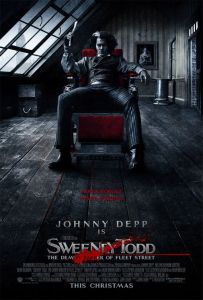 Famed musician/lyricist Stephen Sondheim’s tale of murderous barbers, cannibalism, and poisoned hearts first debuted on Broadway in 1979. Sondheim has been very protective of his material when it comes to film rights, but it wasn’t until the combination of visionary director Tim Burton and acclaimed actor Johnny Depp that Sondheim allowed his revered musical to be made into a movie. The result is faithful production that expands the scope of the musical while maintaining an intimate, chamber-music feel. Sweeney Todd flirts with being a masterwork but settles for being incredibly damn entertaining.
Benjamin Barker (Johnny Depp) returns to London after 15 years in prison on a flase charge. Judge Turpin (Alan Rickman, suitably creepy) wanted Barker’s wife for his own and conspired to have the barber sent away. Now under the auspices of Sweeney Todd, Barker has come back to seek his wife and daughter. He sadly learns that his wife is dead and his teenaged daughter, Johanna (Laura Michelle Kelly), is the ward of the Judge. Sweeney reopens his barber business above a flagging pie shop run by the eccentric Mrs. Lovett (Helena Bonham Carter). Sweeney plots his revenge against the Judge and his henchman, Beadle Bamford (Timothy Spall, suitable rat-like). Anthony (Jamie Campbell Bower), who traveled with Sweeney back to London, has set his sights on Johanna and intends to run away with her as soon as she can escape the Judge. Meanwhile, a rival barber named Pirelli (Sacha Baron Cohen) recognizes Sweeney from the old days and wants his silence paid for. It’s not too long before things get dicey, throats get cut, and people get turned into meat pies.
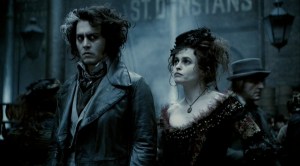 People unaware of the Sondheim musical are going to be in for a big shock. The film is about 80 percent sung, and the singing never rises to big, show-offery numbers of crescendo power vocals; the songs are more in the variety of speaking and vocals frequently overlap. The movie has greater clarity to the lyrics, and for the first time I as able to actually decipher Joanna’s words in the song “Green Finch and Linnet Bird.” Fans of traditional musicals, the kind that feature songs centered on female deer or large corn exporting states, may be aghast at how adult and violent the musical is. It’s just as much a grand horror movie as it is a musical. No doubt people are not generally accustomed to soaring medleys set to gashed throats and spurting blood. Sweeney Todd is captivating tale where almost all the characters are villains in some sense, and yet you do build sympathies even after innocents are killed and baked into flaky desserts.
Unlike other recent big screen versions of popular Broadway song-and-dance shows, Sweeney Todd is not simply the stage version transported to a bigger stage. This is a movie, through and through, and a perfect marriage. Burton is the perfect visionary to filter the twisted sensibilities of Sondheim’s masterpiece onto the silver screen. As a director, his work has been artistically backsliding since the start of this decade, but Sweeney Todd puts a firm stop to that. The technical aspects of Sweeney Todd are brought to life with great care and imagination. The Gothic sets are gorgeous and the costumes and cinematography are fitfully drab and dour, like everyone is living in a silent movie devoid of color; it takes a lot of hard work to create a near monochromatic playing field for the actors. And so when the blood does splash, and oh does it splash, the film pops with vivid color. Sondheim’s playful lyrics and rapturous music has never sounded better; it practically swoons.
The movie opens up the play in ways that a staged performance never could. Instead of keeping a distance from the bloodletting, usually something symbolic or as graphic as coloring a red line across a victim’s neck, Burton thrusts the audience right into Sweeney’s shop. The blood sprays in bright geysers and the violence is fully realized, fully felt, even if it’s never terribly realistic. The full weight of Sweeney’s vengeance and eventual destructive madness can be felt when the audience is witness to its wrath, and that includes the graphic murders. The medium of film ups the horror elements and transforms Sweeney Todd into a stronger work by amplifying the tension. The last scene with Mrs. Lovett is far more haunting than anything that could have been achieved on a stage. Burton also adds lots of dark humor thanks to his open visual palate, like during the song “By the Sea” where Mrs. Lovett fantasizes about her and Sweeney cozying up together in different scenarios. The film transports the viewer to the different pretend locales all the while Depp remains gruff and indifferent. He maintains the same curmudgeon from fantasy postcard after fantasy postcard. It’s the cheeriest segment in a grimly perverse musical that could rival Hamlet for dead bodies.
 In an effort to slice a three-hour musical to a manageable two-hour movie, screenwriter John Logan (The Aviator, Gladiator) has pruned the story down to the essentials, namely everything that impacts Sweeney’s ultimate pursuit of vengeance. Johanna and Anthony, the hopeful lovers, have been pared down the most. Their only scenes now revolve around intruding upon Sweeney or helping him meet his venomous goals. The lecherous songs the Judge sings to himself about his lust for Johanna has also been cut (my wife was severely disappointed by this cut, saying, “You’ve got the Rick, come on!”). The most notable omission is the opening medley “The Ballad of Sweeney Todd” that serves as a Greek chorus-like overview of the sordid tale ahead. The song provides a lot of back-story and exposition that can be more easily covered by Burton fashioning visual flashbacks of Sweeney’s former life. The ballad and other absent songs are still used instrumentally throughout the film. Logan has also turned Toby (Ed Sanders), Pirelli’s assistant, into a much younger character, turning him into an urchin boy with fresh memories of life in a workhouse. I’m not entirely sure Toby’s protective song to Mrs. Lovett “Not While I’m Around” becomes an ode to puppy love and loses some believability. Also, normally Toby is played as a man-child who isn’t entirely whole in his mental faculties; however, the movie version turns him into a plucky Oliver extra. It seems less devastating and tragic.
But what about the singing? Depp won’t be knocking down doors on Broadway anytime soon but he delivers a very satisfying baritone that, while lacking in power or refinement, delivers in spades with emotion. His singing is full of great texture. His song “My Friends,” an ode to being reunited with his razors, is full of brio and nuanced longing, but he really shows his talent when Sweeney loses it. He’s a man obsessed with vengeance and when it escapes his grasp he snarls with scary intensity. When he launches into “Epiphany,” where he determines the whole human race is fit to have their throats slit, he barks at strangers on the street and howls at the sky, smiling at his glistening razors in hand. What can be forgotten with musicals is that there is so much more to a performance than simply an adept ability to sing the right notes. With Sweeney, Depp spins an incredibly rich performance that plumbs the dark recesses of a man whose only purpose is vengeance. In the end, when he’s saturated in blood and the full reality of his actions is upon him, Depp goes from remorse to psychosis to horror to acceptance in, like, a minute flat. Seeing such a classic Broadway character done justice by an actor of Depp’s immense talent is thrilling and a bit of a relief to Sweeney fans.
 Carter has the weakest, thinnest voice of the cast. Mrs. Lovett is a larger than life figure that has been played on Broadway by the likes of Angela Lansbury and Patti LuPone. The role is usually played more boisterous, more comically broad. It’s a juicy part and full of brash bravado. Carter stumbles through “The Worst Pies in London” and she seems to step all over her lines, rushing through and losing the comedic flavor. But like I said before, a performance is so much more than singing, and it is here where Carter imbues great complexity to her role. Her unrequited love for Sweeney consumes her and her relationship with Toby places her in an awkward predicament. Carter flashes a wealth of emotions through the power of her eyes. It’s a battle between maternal and sexual urges. Stylistically she resembles a rag doll someone tossed in the trash but it all works.
It’s refreshing and exhilarating to see a perfect marriage of material and artistry. Burton has transported Sweeney Todd into a faithful and jubilantly dark movie that doesn’t shy away from the grotesque. It’s a stirring, wonderfully Gothic rendition of Sondheim’s masterpiece. Sweeney Todd is blissful, spirited entertainment that’s not exactly for the squeamish, but this is one musical that can simultaneously touch the heart while turning the stomach.
Nate’s Grade: A
Share this:

Grindhouse (2007)
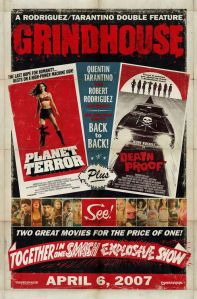 The movie going experience isn’t what it used to be, and Quentin Tarantino and Robert Rodriguez want to do something about it. There?s no denying that the joy of seeing a movie has been watered down a bit; there’s soaring ticket prices, floundering product, and let’s not forget the influx of teenagers with cell phones. Rodriguez and Tarantino grew up gorging upon the exploitation films at their neighborhood grindhouse, where they could see kung-fu, blaxploitation, gory Italian zombie movies, and nearly anything that promised to be titillating and shocking. These movies dealt in copious amounts of sex and violence on a shoestring budget and teenagers lapped it up. Grindhouse was designed to be a double feature with Rodriguez and Tarantino each writing and directing an 80-minute movie. This three-hour plus movie is stuffed to the gills with 70s reverence, right down to cheesy retro clips telling us the film rating via an animated cat. If Rodriguez and Tarantino could, they probably would make the floors stickier just to round out the experience. But that’s the marvelous thing about Grindhouse — it turns the filmgoing experience into an event once again.
First on the bill is Rodriguez’s Planet Terror. An outbreak is about to sweep across a small Texas town. A toxic green gas is causing people to break out in festering wounds that are spreading rapidly. Cherry Darling (Rose McGowan) is a go go dancer who runs into an old flame, Wray (Freddy Rodriguez), a badass drifter with a dark past. They get attacked by a group of “sickos” who take Cherry’s leg as a chew toy. At the hospital we’re introduced in rapid succession to Dr. Block (Mary Shelton) and her creepy husband (Josh Brolin) she plans on leaving for the lovingly massive cleavage of Fergie from the Black Eyed Peas (she gets eaten and can, one assumes, be described as being Fergilicious). The sheriff (Michael Biehn) has an unsettled score with Wray and refuses to trust him, even though the town is slowly being overrun by what appear to be zombies. The survivors take refuge at a Bar-B-Q joint, run by the sheriff’s brother J.T. (Jeff Fahey), located only two miles away from the military outpost that released the gas.
 Planet Terror is a great blast of fun, a perfect ode to schlocky B-movies. Rodriguez creates action movies closer to cartoons, and the more over-the-top and crazy things get the more joyous his films generally turn out. This is a gonzo world cranked up to a wonderfully weird wavelength, where Cherry can have a machine gun leg without any nagging question on how she even gets it to fire let alone why it would be more accurate. It doesn’t matter because this movie is all about 80-minutes of awesome, twisted, gloriously gory fun. Planet Terror isn’t the first zombie comedy, and its inspirations are quite plain, but the film establishes a wide-range of colorful characters effectively and then ramps up the chaos. Rodriguez amuses with even small touches, like a woman trying to operate a car with a anesthetized hands, a pair of skimpy babysitters who clobber a car with baseball bats, and a bio-chemical scientist (Naveen Andrews) that has a penchant for collecting and bottling the testicles of the men who fail him (hey, we all need hobbies). Even amongst an exaggerated canvas there’s still plenty of humor and adoration for the grindhouse experience, like when the beginning of a sex scene is interrupted with a “reel missing” sign. Rodriguez also intentionally downgrades the look of his film, adding hairs and scratches and pops in the film to look like it had been dragged across the floor. Planet Terror even has a dreadfully dated synth score to compliment the full-tilt celebration of splattery schlock.
Tarantino’s Death Proof is going to sharply divide audiences. The action in Planet Terror is relentlessly paced, which makes the adjustment to Tarantino?s half all the more hard. Rodriguez is all about genre relevance and making a film that would excel in the grindhouse era; Tarantino, on the other hand, is all about taking the genre and catapulting it into something ambitious and different and greater.
 Death Proof is Tarantino’s take on the slasher horror genre, with the unique twist being that Tarantino?s roving killer takes out his prey with his car. Stuntman Mike (Kurt Russell) is a stuntman of the old guard. The youth of the day have no idea of the TV shows he worked on or the celebrities he rubbed elbows with. The only lasting visages he has from those removed days are a long scar decorating the side of his face and his stunt car. The vehicle has been outfitted to be death proof, meaning that Stuntman Mike can get into any wreck and come out alive. A group of women are visiting Tennessee for a film shoot. Abernathy (Rosario Dawson) is a makeup artist, Lee (Mary Elizabeth Winstead) is an actress, and Zoe Bell (herself) and Kim (Tracie Thoms) are professional stunt women. The stunt ladies are interested in test-driving a Dodge Charger, the same iconic car used in Vanishing Point. Zoe wants to play a dangerous game known as “Ship’s Mast,” which entails strapping herself to the hood of the car as it speeds along. This is when Stuntman Mike comes roaring with his death proof material and plays an extreme game of chicken.
The narrative structure of Death Proof is deliberately slow. The focus is on a group of Texas girls (including Sydney Poitier’s daughter named, rather unoriginally, Sydney Poitier). They dance to jukebox jams and drink. And they talk, and talk, and talk, and talk. The dialogue is clever but you worry Tarantino has been hypnotized by his own pithy writing. The movie drags a bit but mostly because it follows a film that had the pace of a runaway train. The slow buildup is an intentional correlation to slasher films, which would spend their first half hour setting up characters for the eventual slaughter. I liked how Stuntman Mike was seen playing with his prey and interacting with them. The wait is worth it, though, but then Tarantino turns around and repeats this same setup with a new batch of girls. Many will grow impatient going through the same process all over again and become irritated that they have to endure another round of talky pop culture diatribes in order to get to some more vehicular manslaughter. And at this point, the only character the audience has any affinity for is Stuntman Mike, so it’s a little tough to wait so long for his reappearance. When he does appear, the movie takes some unexpected turns and transforms into a female revenge thriller that left my audience cheering by its conclusion. My wife loved it. I married the right woman.
The makeup work is outstanding. Most of the effect work gets its spotlight during Rodriguez’s half, and Greg Nicotero and KNB have created the most gut churning, sickeningly inventive makeup work since John Carpenter’s The Thing. Rodriguez’s Planet Terror is dripping in blood, and the gore is heightened to such an unrealistic, comical degree that it becomes more tolerable and, in the end, another element in the overall outrageous vibe of the film. Some memorable gore work includes makeup pioneer Tom Savini being ripped apart like a child’s jigsaw puzzle, soldiers whose faces undulate and bubble until they look like close relatives of the Elephant Man, and a truck smashing against bodies like they were made of paper and filled to the brim with Kool-Aid. This is the kind of movie where entire hoses of blood explode from single gun shot wounds. It is a gory, gruesome, sticky icky movie but that?s part of the fun.
 Whereas the makeup work shines in Planet Terror, the stunt work in Death Proof is stupendous. Bell was Uma Thurman’s stunt double in the Kill Bill tandem, so by writing a part specifically for her Tarantino knew he could get up close and personal during the scary moments. Seeing Bell struggling to stay atop the hood of a car zooming at 80 miles per hour is nerve-racking and exhilarating, and you know there isn’t any computer trickery given how Tarantino’s own characters bemoan how computers have blunted action cinema output. That really is Bell and even though it’s all a movie a part of you does think, “Oh my God, this woman is going to die for real.” This killer bumper-car sequence in Death Proof will have you holding your breath. It takes much longer for Tarantino to rev up his action, but when he does he puts the pedal to the mettle.
But don’t get up for pee breaks once Planet Terror is over, because you may miss some of the best parts of Grindhouse. In between the feature films are three fake trailers directed by friends of Tarantino and Rodriguez, who made a fake trailer himself for Machete, about a Federale (Danny Trejo) out for revenge. The Machete trailer gave me the everlasting gift of a line, “They f***ed with the wrong Mexican.”
The best trailer, hands down, is Shaun of the Dead director Edgar Wright?s trailer for Don’t, a Dario Argento style horror film where a narrator instructs the audience lots of items not to do (“If you are thinking about turning this door… DON’T! If you think about going into the basement… DON’T!”). What makes Don’t so wonderful is that the trailer builds a thick head of steam, to the point where all wee see are bizarre rapid-fire images and the announcing repeating the message, “DON’T!” The momentum builds to a great comic high that left me giggling.
Eli Roth, who gave us Hostel and Cabin Fever, one of my all-time favorite filmgoing experiences, runs a close second with his slasher trailer for Thanksgiving. The concept is rather straightforward, a person dressed as a Pilgrim picks off residents around Turkey Day, and a great showcase for Roth’s sense of tongue-in-cheek homage and his warped sense of humor. This trailer has some gasp-inducing moments, chiefly among them a topless cheerleader who performs the splits right onto a knife blade. Wow. Then there’s a guy humping a stuffed turkey with a human head attached. I’ve said it before and I’ll say it again, Roth is one sick bastard but he’s my kind of bastard.
 Rob Zombie’s trailer for Werewolf Women of the S.S. sounds better on paper than how it turns out. There’s a subgenre of Naziploitation films (did you know you could add “-sploitation” to damn near any word?), most famously popularized by Ilsa, She-Wolf of the S.S. Zombie’s trailer has got hairy wolf boobs, Nazis, shiny fetish outfits and S&M, but it feels too new and doesn’t work on the same vibe of Grindhouse. It feels too polished and too happy with itself; it spends more time telling you who’s in this fake movie than delivering anything juicy. The trailer is saved by a brilliant cameo by an actor whom I will not spoil, but suffice to say that I was left in stitches.
Honestly, I cannot say another movie released this year that provides more bang for your buck than Grindhouse. Tarantino and Rodriguez’s double bill will leave you giddy. This is the fastest 3 hours and 10 minutes of your life, folks. Unfortunately, the film hasn’t been doing as well at the box-office and this has caused the Weinsteins to contemplate splitting the films into two to make the most of their investment. I suppose Grindhouse was never going to have a 300-sized audience, since the idea of making a sloppy three-hour love letter to trashy cinema seems destined for a limited appeal. This is a high-art tribute to high camp, and you really do feel you get more than your money’s worth even if you pay, like I do, 10 bucks a pop for a show. I can’t imagine having a better time at the movies this year than the one I had during Grindhouse.
Nate’s Grade: A
Share this:

300 (2007)
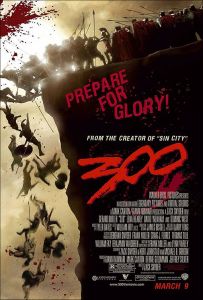 The story of the 300 is the story of the Battle of Thermopylae in 480 B.C, 150 years before Alexander the Great. Xerxes (Rodrigo Santiago) has deemed himself a “God king” and his Persian army has been conquering Asian nations and acquiring the most massive military force of its time. He sets his sights on conquering Greece, and to do so must go through the narrow passage of Thermopylae.
King Leonidis (Gerard Butler) assembles 300 of his finest Spartan warriors to thwart the Persian invasion. The Spartans were the super soldiers of their time, a society that valued brute strength and the honor of combat. Children born with imperfections were cast onto the rocks to perish; the society couldn’t afford a weak link in its protection. One day a Persian emissary rides into Sparta carrying the skulls of other kings and princes and a message from Xerxes: submit or you’re next. Well, after the emissary insults Queen Gorgo (Lena Headey), he refutes the message and kicks the emissary down a giant black pit in the middle of town (is this where they dump their garbage?). Thus, as they say, it is on. The Greek city-states have no sense of nationalism, so Leonidis commands little support to thwart the advancing Persian hordes. The Spartans have discipline and superior equipment, and because of these advantages they are able to hold back overwhelming numbers from the Persian army.
 Back at the home front, Queen Gorgo is wheeling and dealing behind the scenes to state her case to the Spartan assembly. She needs to shore support for more troops to help her husband. Theron (Dominic West) is a member of the priesthood that looks to sexually charged Oracles for guidance. However, he’s willing to drop his pacifist stance if the queen drops her robe and grins and bares it.
Xerxes is not a happy “God king.” He tries appealing to Leonidis, insisting that if he will simply bow down and relent than he will be spared. “Imagine what horrible fate awaits my enemies when I would gladly kill any of my own men for victory,” he threatens. Leonidas replies, “And I would die for any of mine.” The two men (well one man and one God king) go back to their corners ready for another round of this epic slugfest.
The action sequences are intense and director Zack Snyder (2004’s Dawn of the Dead) heightens their realities with surreal touches. He fondly gives life to the bloodshed and exaggerated combat popularized from Frank Miller?s graphic novel. The Sin City author has created another testosterone-soaked hyper-real adventure. The movie doesn’t even flirt with the notion of rigid historical accuracy (I doubt the Spartans fought rhinos, giant mutants, and were done in by a disgruntled hunchback); the film uses Miller’s artwork as a jumping point, which means that the Spartans fight in leather codpieces and red capes and that combat is more one-on-one even after we learn about the important of the phalanx. But quibbling over inaccuracies is a waste of time, because 300 is a pumped-up, super cool action movie that plays out in a vivid dreamscape. The movie was filmed with extensive green screen, much like Sin City was, and it feels like a direct transition of Miller’s pulpy comic book. Even the farewell sex between the King and Queen is stylized and seems to be snippets or panels from a comic book.
Let’s all be honest, there’s something undeniably homoerotic about 300. The movie worships the male form, with rippling abs and bulging biceps lovingly showcased in glowing, sweaty, fawning detail. The movie also focuses on manly men primarily spearing one another with phallic weaponry while the spurting blood dances across the camera in balletic CGI spasms. There?s a definite gay appeal to this film, not that there’s anything wrong with that. However, 300 also manages to curiously be homophobic at the same time (I swear this came to me independently, Phil). Xerxes is designed very as being very fey even at a massive height of eight feet. He lays his hands against Leonidis’ shoulders and asks for him to submit, and you can’t help but wonder what the teen boys in the audience are thinking. Xerxes also has a party tent filled with whores, the disfigured, transvestites, and the overall effeminate opposite of all those Greek macho muscle men the film postures as elite specimens.
 The acting is set to one tempo and that’s a mesmerizing use of yell-speak; it’s part guttural and part long-standing bellow that makes any piece of dialogue sound macho. King Leonidis growls, “SPAAAAAAAARTANS! TONIGHT WE DINE IN HELLLLLLLL!” After two hours of this primal style of speech, it becomes somewhat infectious and you want to try it in everyday situations in your life. Next time you’re out with friends at a fine dining establishment, I suggest asking for the salt thusly: “DINING PAAAARTNAAAAAH, COULD. YOOOOOOOOOU. PAAAAAAAAASS. THE SAAAAAAAAAAAALT?!” You’ll be guaranteed to get a reaction. It strains my throat even writing about the 300 yell-speak.
300 is a rousing movie going experience that plays out in a beautiful, pristine dreamscape that closely resembles our planet. The action is highly stylized and frenetic. It’s just that when the film stops to take a breath you start to look elsewhere, and when you do you realize there isn’t much below the blood-caked eye candy shell. 300 is grand spectacle that elicits thrills and chills, but the movie fails to touch on emotions beyond loyalty and courage. Both are essential for a soldier, and one as dedicated as a Spartan warrior, but the lack of substance keeps 300 from being anything other than a visually arresting, if ultimately disposable, two hours at the movies. There’s nothing wrong with a movie whose sole purpose is to quicken the pulse for a short supply of time, and 300 succeeds smashingly with this singular ambition. It is an ass-kicking history lesson that makes me wish I could learn more about Persian executioners with blades for hands at my local library.
Every culture has their own account of a last stand, a small group that heroically held off seemingly superior forces (remember the Alamo?). Snyder and Miller present an entertaining hack-and-slash primer through history that’s rarely dull and often enchanting to the senses. Deep down, there may not be much more to 300 than a lot of pretty pictures and a bunch of chiseled hunks, but that?s enough for most carnage fans with a free afternoon.
Nate?s Grade: B
Share this:

Apocalypto (2006)
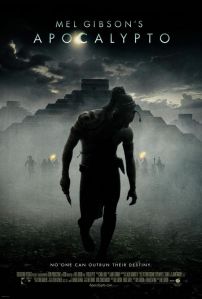 Apocalypto is an action movie set 500 years in the past with a cast of entirely unknown actors, some of who have never acted before. But what does everyone want to talk about? Mel Gibson hates Jews. He’s been in a heap of trouble ever since a DUI where he said some very unkind things about God’s chosen people. He’s made the apology tour and checked into alcohol rehab, the new go-to defense whenever a celebrity screws up. The public finds it hard to separate art from the artist; Frank “It’s a Wonderful Life” Capra was anti-Semitic but few seem to bring that up. Some people have sworn off Gibson thanks to this disgraceful incident. That’s a shame because Apocalypto is brilliantly filmed and Gibson’s finest directing effort yet.
The Mayans seem pretty at ease 500 years ago. We open on a hunting party dividing up a recent kill and playing a prank on one of their members that is having trouble making little Mayans with the wife. Jaguar Paw (Rudy Youngblood) is the son of the tribe?s leader. In the forest they encounter a group of survivors from a different village. They warn of a group of mercenaries that razed their town, killed their people, and took the rest. Jaguar Paw?s father warns not to speak of what they have seen to their people. Fear is contagious, we?re told. That night the same mercenaries attack Jaguar Paw?s village. He scrambles to lower his pregnant wife and young son into a cavern for safety. The surviving men and women are tied up and sent marching. The village?s children are left to fend for themselves and most likely perish without any adults.
 Jaguar Paw and his fellow captives are headed for a Mayan temple. The women are sold into slavery. The men are painted blue and guided to the top of the temple to become sacrifices to an unhappy god. The men are held on a slab, have their hearts cut out, finally then have their heads sliced off and kicked down the stairs. Through a fortunate set of circumstances Jaguar Paw breaks free and races into the forest to return to his family, who is in danger of drowning if the cavern fills with rain water. The mercenaries are not far behind and willing to go to any length to kill Jaguar Paw.
From an anthropological standpoint, Apocalypto is fascinating. Gibson has turned back time and immerses the viewer in a world unseen for 500 years. The details are astounding, and whether they are note-for-note historically accurate or not is inconsequential. You are seeing a living, breathing world right before your eyes. I loved soaking in the new-ness of the experience, seeing how this forgotten world operates, and the power struggles within. These people have great faces, great hulking muscular frames, and great expressions needing to be seen. Gibson has crafted a film that you’ve never seen before, at least with this kind of budget and filmmaking prowess. Apocalypto can quite often be breathtaking to behold. The production design and costumes (yes, there are more than just loin cloths) are incredibly rendered and add greatly to the authenticity and mood. I loved visiting the Mayan temple city (“down town” I guess you could call it) and seeing the different factions intersect, like green painted upper-class harpies being carried around the crowd.
The parallels Gibson puts out there seem tenuous at best. The Mayans have lived beyond their resources, experiencing plague, and feel that the need to pacify the masses, and turnaround their bad luck, is a whole slew of human sacrifices. There’s an Iraq War reference in there if you want to go looking for it and perhaps an ecological one as well. I don’t know if Gibson is using the Mayans as a cautionary example of a society that crumbled. We are treated to an opening quote detailing that no great society can be conquered from outside until it has become corrupt from within. Maybe this is Gibson’s way of telling America to sit up and fly right. Or maybe it’s just an intellectual glob toweled over the blood and guts to make everything seem more meaningful.
The acting is a surprise. Many of these people are really good, especially Youngblood who has a soulful face and a terrific presence onscreen. Gibson creates a great sense of community in the early moments. People feel natural and in touch with their surroundings. Their interaction and the visual shorthand feel like storytelling tricks from classic silent movies. Gibson manages to tell us a lot with little. There are some gut-churning moments, and some of them are because of character. A man from Jaguar Paw’s village hopes his wife did not give up fighting before she perished, because if she did then she will be sent to hell. He pleads that when he dies he might endure the tortures of hell, just so he can be with her again. That hits hard. A cranky mother-in-law also provides a shining emotional moment completely played in solemn silence. A little girl surrounded by crying children tries to assure the adult captives, “They are mine now. I will take care of them.”
 The last hour of the movie is a non-stop foot race as Jaguar Paw valiantly attempts to escape his enemies and return to his swatch of the jungle. There are some fantastic escapes and imagery, like Jaguar Paw outrunning an actual jaguar. The ending is fantastic and a fitting climax for the title. I would have enjoyed just a little shove further, like a new character marveling at some gold trinket Jaguar Paw had gotten from the Mayan temple. “This is gold. Can you tell me where there is more?” he would say. “Tell you?” Jaguar Paw would say in a hearty laugh. “I’ll SHOW you where to get more. Follow me.” The resolution is pretty obvious but left to the imagination. I guess after much derring-do I just prefer more finality with my comeuppance.
This may be about a dead culture and spoken entirely in a dead language, but Gibson’s bloody art house flick is a lively macho action movie at its core. It’s structured exactly like a typical Hollywood action movie, and I don’t know if this adds another level of brilliance to the final product or makes it seem more ordinary taken apart from its historical context. Gibson’s trade is misery. He’s been a martyr onscreen and he prefers to tell stories about the anguished and tortured. Jaguar Paw is beaten, wronged, and has to race against time to save his family. When Jaguar Paw moves onto his own turf he turns his knowledge of the land to turn the tables on his enemies. The movie presents familiar archetypes like the wise father, well-meaning oaf, and impetuous hothead villain, Super Biggest Bad Guy (he does wear the most skull trophies, that has to count for something). The villains are larger than life and have great menace to them. Even better, they’re highly memorable and despicable, and yet they seem to operate within a tribal code of their own honor. They scowl with the best of them.
This familiarity makes viewing Apocalypto less jarring, This is an independent movie high school jocks could enjoy. That may sound dismissive but it’s a compliment. Gibson has great technical skill and after decades of shoot-em-up pictures, he definitely knows how to build and sustain exciting and rewarding action sequences. You know when the bad guys with personality are going to have big deaths, and you know when you see a hunting weapon in Act One that it is going to be put to awesome use in Act Three. The lines of action are well structured and smartly played. When you boil it down, it may just be an action movie, but because of Gibson it’s a good action movie.
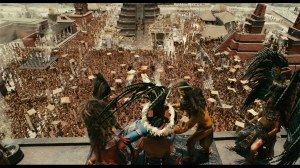 With The Passion of the Christ, I was appalled by the violence, more so how Gibson fell in love with the blood and gore, turning it into pornography. That was the message of The Passion — Jesus sure knew how to take a lickin?. But with Apocalypto, the violence is savage but the appeal of this project is on recreating a world, not sadism. Apocalypto is more interested in opening eyes than shutting them because of nauseating and relentless gore. This isn’t exactly a movie fit for nuns and missionaries, though. Gibson embraces the cruelty of man and showcases some real horrors. The temple sacrifices are fitting and gruesome, but never seem exploitative. There are moments that I wish Gibson would have pulled back, like an extended scene of a jaguar chewing a man’s head or a gusher of blood spritzing out of a man’s temple like a broken sprinkler. I think Gibson loses control of his story and gives in to his own bloodlust in these moments, which serve to take you out of the movie and go, “Ick.”
The violence is also easier to stomach because the audience is more invested in story and character. Everyone that paid a ticket in 2004 knew Jesus was going to die in the end, at least, I really hope they did. That might have been a shocker to a remote few. It was all about witnessing suffering and testing how much you could watch. You felt the pain, all right. Apocalypto, in contrast, is tame and more focused on escape than futility.
After The Passion of the Christ made heaven and earth move at the box office, Gibson can afford to make any movie he wants. If he wants to make a movie about Mayans in Mayan, so be it. At least Gibson knows how to tell a good action story. Apocalypto is beguiling and often breathtaking to behold. The details create a rich environment that feels wholly alive. It’s a typical action movie plucked down in a different historical setting, creating the most unique movie experience of the year. It’s a man’s man independent movie but also manages to hit key emotional notes. I don’t care what he thinks of Jews or anyone else. His art speaks for itself, and Apocalypto is fascinating. It’s an art film for jocks, it’s an action movie for science geeks. Bless you Mel Gibson, you’ve brought us all together in the weirdest way possible.
Nate’s Grade: B+
Share this:

Saw III (2006)
 Horror works in cycles and seems to ebb and flow every three years or so. The popular horror cycle right now is all about torture and realism. I guess people have had it with masked men with large pointy things. Pasty Asian children don’t seem as gloomy as they once did; in fact, in today’s world-on-the-go, who wouldn’t want an extra hand in the shower? In a world bombarded with carnage leading the six o’clock news, I guess American audiences desire something more universal than ghosts and boogeymen. The Saw franchise has exploded and seems destined to place a new entry every Halloween until the public looks to a new en vogue horror cycle. After seeing the loss of luster that is Saw III, I am already looking.
Jigsaw (Tobin Bell) is back with a fresh new batch of his twisted games. Unfortunately, he’s bedridden and dying. His serial killer apprentice, Amanda (Shawnee Smith), has to do the grunt work. She kidnaps a depressed doctor, Lynn (Bahar Soomekh), and orders her to keep Jigsaw alive as long as she can. Around Lynn’s neck is a crude explosive device that will detonate if Jigsaw’s heart flatlines. He has to stay alive just long enough to witness one final game. Jeff (Angus Macfadyen) is trapped in a typical Jigsaw-engineered series of traps. He has to pass through three tests of resolve and forgiveness, each involving someone related to his young son’s unexpected death.
 The Saw franchise seems to be losing momentum with each additional thrown-together sequel. I found the first film to be mostly entertaining and very inventive, but this was because of a smart narrative device: we wake up in the same dingy bathroom as our figures and must learn with them about what is happening. It plied some neat tricks and twists and was an altogether enjoyable horror movie that didn’t mind mucking around. But with all invention, if it sells then it becomes repeated in mass-market form, dulling the edges and losing the bite it once had. What once startled and amused is now the expectation. Just like the collapse of the Final Destination franchise, these movies started big but then bottomed out when their audiences had the rules memorized. At that point the only thing left is curiosity in what fiendishly outlandish ways people will get horribly killed. The Saw films still have more smarts to them than your typical man-chases-teens-with-axe slasher flick, but the franchise definitely seems, like Jigsaw, to be dying a slow death.
Saw III spends far too much of its time and energy trying to be a compendium to the franchise, filling in the blanks and the resolutions for Saw and Saw II. The film bends over backwards trying to tie up loose ends that didn’t really need tying up (Finally, now I know what happened to that foot that was cut off!). I don’t need to know how the incidents of the previous movies were set up, or who kidnapped who; the minute details are pointless in a horror film, especially one with such flights of frightful fancy. This movie spends too much time feeding the audience needless back-story. The film’s two major storylines are uneven in interest. There’s a real lack of danger and development for Lynn playing nursemaid to Jigsaw. We know the only time he may die is late in the movie, so her storyline becomes prime thumb-twirling time. We see some nifty medical procedures but I?d rather get back to Jeff’s descent into the funhouse of doom.
Saw III seems too concerned with how it fits within the framework of a trilogy when it should be worrying how it works as a movie. Saw III, for stretches, feels like it was cobbled together from the dull deleted scenes of previous films. And true to form, this Saw sequel ends with a familiar rush of twists, deaths, and a very nihilistic close. Let’s just say the inevitable Halloween 2007-bound Saw IV is going to have to go back to the ridiculous plot device drawing board. I truly wonder how many little tape recorders Jigsaw has stashed around and for what occasion (“Note to self: clean gutters.”).
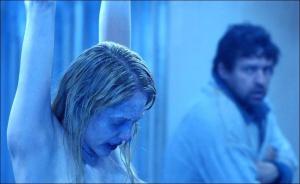 Some of the ingenuity is downright admirable; Jigsaw sure puts a lot of thought and care into his skin-crawling craft. Some notably gruesome torture tests include a naked woman being frozen to death by routine sprays of water, a man having his limbs twisted all the way around, and a man drowning in the slimy goo of ground up pig carcasses. Now that takes discipline just to plan, let alone fully stage. I’d like to see Michael Myers or Freddy Kruger try something like that. Part of the macabre fun of the Saw franchise was playing along, wondering what you would do in the situation and how far you?d go to save your own life. But in Saw III the deck is stacked for about half of the twisted games. There’s no way to win. A character goes through great lengths to free herself from a death trap but, alas, there is no escape and she gets her rib cage ripped out for the bloody hell of it. This … lack of sportsmanship, let?s say, does play a crucial part to the Saw III storyline, but it still knocks the film’s fun level down when you’re just waiting for the moment the person becomes a corpse instead of waiting to see what they do next.
It seems like the Saw movies become less engaging the gorier they get, and Saw III may be the goriest yet. These films have never been afraid to get messy, and Saw III has some squirmy moments, particularly a very protracted scene that involves the peeling, drilling, and scraping of the human skull. Horror fans should be happy with the results but there’s nothing that will make the squeamish cover their eyes (a bone snapping through a leg comes closest). Worst yet, despite the yucky credentials I’ve mentioned above, there really isn’t anything too memorable about the death traps this go-round, though the pureed pig entrails is certainly praise-worthy.
After three movies in three years, it feels time for a breather. The Saw movies are losing their sheen as their audiences become hungrier for blood and harder to fool. 2004’s Saw was clever and different, but like the demise of the Final Destination franchise, the sequels are victims of expectation. When the unexpected becomes the expected, then you may need to rework your scare formula. For whatever reason, Saw III feels compelled to be a refresher on the other films, devoting serious chunks of wasted time to clarifying loose ends that never mattered. I’d rather get to more sticky, icky death traps than examine the father-daughter-mentor relationship between Jigsaw and Amanda. Yawn. Saw III feels uneven, distracted, less fun, and a middling close to a franchise that began with wicked promise. This kind of movie just isn’t cutting it like before.
Nate’s Grade: C
Share this:

Final Destination 3 (2006)
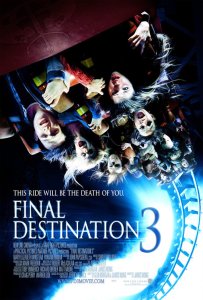 Isn’t the title Final Destination 3 itself problematic? How could it be final if it’s the third? It reminds me of 1998’s terrible I Still Know What You Did Last Summer, which wasn’t even correct with the film’s time setting (it must be stated that a 2006 sequel, and I’m not kidding, will be called I’ll Always Know What You Did Last Summer). Perhaps the best title comes from the worst movie of all time, Manos: The Hands of Fate, notoriously lampooned on Mystery Science Theater 3000. “Manos” is actually Spanish for “hands,” so the title is Hands: The Hands of Fate. Titles are fun. Oh yes. Final Destination 3, on the other hand, isn’t really fun.
A senior class is partying and enjoying the thrill rides of an amusement park. There’s an especially menacing looking roller coaster begging to be ridden by teenagers. There’s even a giant devil in front of the ride’s entrance. The ride fills up with your general high school characters (popular snots, Goth kids, cocky jocks, etc.) and then the safety bars become loose, flinging riders this way and that to splatter against broken rails and track. It’s all so horrifying … but it’s just a vision of Wendy (Mary Elizabeth Winstead). She goes into hysterics and gets off the coaster before it ships out. Other students follow her, including Kevin (Ryan Merriman), the boyfriend of Wendy’s best friend. Sure enough, the coaster crashes, those on it die, and death has been averted. For now. Just like previous installments, death seeks out the souls that escaped its cold clutches. Now death is taking out the survivors in the order they would have died and Wendy and Kevin must try and figure out a plan before it gets to them.
 Let’s not mince words, the true star of the Final Destination franchise is death itself. The appeal rests entirely on the fiendish, outlandishly complicated deaths and the misdirection over what will prove deadly. The audience is holding their breath for the next spectacular death. There’s a certain fatalism linked to this, knowing that the entertainment value is witnessing teens eventually get sliced and diced. But the franchise’s appeal also seems to be its downfall. The Final Destination films are stuck trying to out top themselves, and each film opens with a big centerpiece of disaster that inevitably serves as the film’s best moment. The rest of the movies never seem to match the opening melee, and it’s generally not a good idea for a movie to peek in the first reel.
Admirably, Final Destination 3 doesn’t even waste time with having its batch of characters theorize how to outfox the specter of death. We just watch, one after the other, the bloody, clever deaths like an assembly line of carnage. Final Destination 3 knows what its audience wants. Curiously, there’s no parental or police presence at all, even after the mounting coincidental deaths. Seriously, everywhere that Wendy and Kevin go, death is right beside them. Probably the funniest tidbit in Final Destination 3 is that shortly after another failed attempt to warn a doomed teen, Wendy and Kevin are in different, non-bloody clothes as they walk back to their car. They actually brought a change of clothes just in case. That’s hilarious. Little else seems amusing (the 9/11 reference is overwhelmingly tacky).
I once thought that the Final Destination concept could live forever in the annuls of horror, but the seams are definitely starting to show with this franchise. In 2000 it was fresh and unpredictable, and now it just seems exhausted and old hat. I thought the third film regaining the original writers and director would infuse Final Destination 3 with a bit more imagination. I was wrong. Glen Morgan and James Wong seem to go overboard to sate their blood-hungry audience, creating the most gruesome, torturous deaths yet. Seeing people eviscerated is one thing, but tantalizingly lingering on the sight of a busty teen being cooked alive, her skin boiling and exploding from the heat, is too much. It’s like this time death is really pissed, saying, “I gotta go through all this again!” The movie feels too mean-spirited, too vengeful, and a shade too cynical. I think the concept feels spent and even Morgan and Wong realize this, which is why they ratchet up the gore because the suspense is gone. The “gotcha” ending was pitch-perfect in the first Final Destination, but now it’s just another expectation feebly met.
 Of course, all the characters (with the possible exception of Kevin) are nitwits, horn dogs, jerks, and just plain unlikable, which make rooting for their demise easier. There’s no subtlety here either. The two shallow, popular girls are incredibly shallow and ridiculously stupid. The idiot pervert has a one-track mind that never takes a break. They’re all stock, they’re all one-note, and there’s even a moment where the token black character says, “That’s what I’m talkin’ about!” No wonder death is the star. At least in the previous Final Destination flicks you felt like the kids deserved a fighting chance.
There is one neat addition to the formula. On the night of the accident, Wendy took several pictures and each photograph predicts that person’s demise. This allows the audience to try to decode the clues they’re given and correctly guess the next horrific death. It’s the most fun aspect of the franchise.
Final Destination 3 knows exactly what its audience wants, which is more of the same preposterously complicated deaths. The concept once felt fresh but now it seems worn out. I doubt new blood could revive this franchise because audience expectation has become too demanding. We already know the rules and know the characters can’t really escape death, so the only lasting suspense is what will kill them, and even that is fleeting. The return of creators Glen Morgan and James Wong still can’t infuse the right touches of imagination. It’s more grisly teenage carnage, nothing more, nothing less, nothing special anymore. Fans of the previous Final Destination flicks will likely find some entertainment, but the movie feels creatively spent. It’s probably time for this sadistic peep show to bow out before things get even uglier.
Nate’s Grade: C
Share this:

Hostel (2006)
 Eli Roth is a name that excites me. After watching his 2003 debut Cabin Fever, it was love at first sight. My friends were skeptical but one by one I convinced them that Cabin Fever was a campy, jaunty, unapologetically hilarious good time. I’ve made Roth disciples out of my fellow human beings. Naturally, I was looking forward to Roth’s follow-up, Hostel. I had heard the rumors that the flick was based on a true story of a South East Asian website, though said site can no longer be confirmed. Whatever the muse may have been, Hostel‘s got the added cache of Quentin Tarantino’s name slapped aboard as a “presenter” thus ensuring to the young male demographic that Hostel should be, “frickin’ sweet.” While not reaching the rapturous entertainment heights of his debut, with the grisly Hostel, Roth proves that he’s no flash in the pan.
Over in Amsterdam, Paxton (Jay Hernandez, Friday Night Lights) and his best friend Josh (Derek Richardson, Dumb and Dumberer) are living it up. They’re on the hunt for pot, poontang, and an endless array of good times and cheap thrills. They’ve got big wallets and big appetites. They’ve befriended Oli (Eythor Gudjonsson), an Icelandic horn dog willing to be their guide throughout their most excellent European adventure. While locked outside their stay, the trio learns of a mythical youth hostel all the way in Slovakia. The girls are buxom, beautiful, and go absolutely wild for boys with foreign accents, particularly Americans. This is an opportunity worth salivating over for our trio. They book a train for Slovakia and it looks like this hostel could be the Playboy Mansion of the former Soviet bloc. The women are frequently naked, open to most any suggestion, and eager to please the American visitors.
 Ah, but things are not what they seem. The young Americans check in but they don’t check out, at least in one cohesive piece. Our Slovakian sirens are leading their horny backpackers to their doom. Tied with the hostel is a large, empty warehouse that a lot of high-pitched, ear-splitting screams seem to waft out of. Inside is a dungeon where those willing to pay the right price can torture, mutilate, eviscerate, and kill a person. Can Paxton, Josh, and Oli even hope of surviving such a place?
Even for a horror movie, Hostel has a lot of nudity. Normally this wouldn’t bother me but the film does seem to be topped with an incredible amount of sex scenes and nudity during its sloshy build-up to the horrors that await. Many will cry “exploitation!” or “gratuitous!” and, though I’d agree with both, I must remind all fans of the genre that the bedrocks of horror are exploitation and voyeurism. Let me theorize why Hostel‘s first half is as it is. Sex and violence in horror movies are always linked, particularly the violence as retribution for wayward sexual indulgences. So then, if the second half of Hostel is a sickeningly display of cruelty, torture, and mankind at its most heartlessly gruesome, wouldn’t it make sense, in retrospect, to up the ante on the debauchery in the first half to even out the tone?
One of the most interesting elements of Hostel is how it makes you root for the ugly Americans. The first half of the film shows Paxton, Oli, and to a far lesser degree Josh, as booze hound backpackers interested in tasting the wares, be it through illicit drugs or illicit encounters with the local ladies. They?re stomping through Europe in an arrogant, obnoxious, near-reprehensible fashion trying to score some cheap thrills. Eli Roth doesn’t intend for an audience to align themselves with these tail-chasing characters, except for the more sympathetic Josh. And then once the boys enter Slovakia and become the cheap thrills themselves, Hostel turns on the surprise factor. After profoundly disliking these misogynistic party animals, we root for them to survive. This goes against most modern horror, particularly slasher flicks, where the audience is rooting for the grisly demise of its empty-headed horny teenage cast. The audience hungers for death and titillation. In Hostel, we’re presented with boorish backpackers and, despite everything prior, we really want them to succeed and get rescued from their dungeon of horrors. The last act only confirms this further. I don’t know about your theater, but mine was rollicking and roaring as they rooted for the home team to pull it out.
 Truth be told, the set-up is a bit overly long, though nowhere near as boring and comatose as Wolf Creek (maybe Roth was smart to put in the nudity). In Wolf Creek, we watched a group of uninteresting “characters” drive around and get lost for a whole friggin’ hour. That movie went from boring to “oh, is something happening?” to over. At least Hostel had movement and relevance to its set-up, including characters and situations that will be repeated later. Some of it is a bit heavy-handed, especially with the sex/violence link and a blowtorch torturer repeating, “Get your own room,” but Hostel finishes with a grand flourish. Roth weaves back different storylines and characters in clever ways and serves the audience vengeance on a platter, and we just gobble it up. I was jumping in my seat, pumping my fist, and, forgive me, shouting at the screen during Hostel‘s final act. It’s somewhat paradoxical for me to be disgusted by violent retribution so recently with Spielberg’s Munich and then a week later to be relishing it. I credit the tones of the films. While Munich is contemplative and realistic, Roth’s Hostel is a squirmy, over-the-top, dark comedy with some moments of cringe-worthy horror. Hostel‘s fabulous finish may erase any lingering doubts you had over the very Euro Trip opening.
Roth has a great sense of visual flavor with his shot arrangements but he also knows when to draw upon our dread. Hostel is really more of a survivalist thriller than a horror movie. Sure, torture and gore is prevalent but a lot of the violence and gruesome makeup is unexpectedly played down in limited appearances. This isn’t the shocking sadistic movie that outcries have made it to be. Without a doubt, I think Eli Roth is the most promising name in horror. Cabin Fever is one of my all-time favorite good-time flicks, and now with Hostel, Roth has proven that he can work miracles with a small budget and a giant, depraved imagination. Hostel is more disturbing than horrific but Roth knows exactly what chord to strike, what scenes to hit, and what sounds to echo to make you want to cover your eyes.
Roth’s best attribute, besides a pleasing visual sensibility, is his twisted sense of humor. Cabin Fever was more humor than horror, and also took an extended set-up before the gore was unleashed, but Hostel makes the flip and is more horror than humor. That’s not to say Hostel is without its dark, jovial jollies. Roth seems to approach his gore, outside of the torture sequences, with a macabre absurdity, like a character slipping on dismembered fingers only to chainsaw their leg off, or a character pretending to be dead and gets a severed hand placed on his face. Somewhere, Peter Jackson and Sam Raimi are nodding their heads in approval. Surely Tarantino is amused. Granted, Cabin Fever was more of a tongue-in-cheek fever dream homage to 70s horror, but Hostel has its share of twisted humor which elevates it far above most recent horror, either the boring and meandering (see: Wolf Creek) or the single-mindedly shocking (see: High Tension). This is what excites me about an Eli Roth horror movie: his lively, warped, depraved sense of humor. If people claim that Roth is one sick bastard, then I must also be one sick bastard for finding his movie funny and highly amusing in spurts.
 There are so many moments that I loved, from the opening cleaning-up, to seeing the Slovakian sirens on their day off sans make-up and totally trashed, to the Bubblegum kid gang, to the Takashi Miike (Audition) cameo, to knowing that killing an American is the most expensive option, to seeing the ins and outs of a facility dealing in murder for money, to seeing the equivalent of the Dunkin’ Donuts guy (“Time to chop up the bodies…”), to the madcap, fist-pumping race to the finish. There?s so much Hostel does right, not just as a horror movie but simply as a movie itself. I wouldn’t mind taking another trip to Hostel with a big group of my less-than-squeamish friends. Oh who am I kidding, horror movies are more fun when you see them with the squeamish.
Eli Roth has crafted a dirty, depraved, but highly amusing horror film. Hostel is full of surprises, from an overly long set-up that couldn’t have more female nudity if it tried, and actually making an audience root for the survival of the ugly Americans when things get dicey. The premise may be sickeningly realistic but the rest of the movie is on an overdrive of macabre fun. Roth’s twisted yet gleeful sense of humor is what makes him unique, and his attention to atmosphere and compounding dread is what will make him successful. There’s no faster rising horror name, in my mind, than Eli Roth. Hostel may not fully be the down-and-dirty horror film its ads have made it out to be; it’s certainly more of a thriller with a heaping helping of gore. This is one experience well-worth booking, especially if you have a strong stomach and a dark sense of humor. I can only imagine that the tourism industry for Slovakia is about to drop precipitously.
Nate’s Grade: B
Share this:

Sin City (2005)
 Like film noir on steroids. Director Robert Rodriguez has made the most faithful comics adaptation ever; giving life to Frank Miller’s striking black and white art. The visuals are sumptuous but the storytelling is just as involving, a perfect mix of noir/detective elements and subversive, highly memorable characters. Sin City may be the most violent studio film … ever, but the over-the-top tone keeps the proceedings from becoming too nauseating, even after limbs are lost, heads roll (and talk), and dogs pick away at living bodies. This is a very ball-unfriendly movie; lots of castrations. The blood even looks like fluorescent bird crap. The stories become somewhat repetitious (anti-hero saves distressed woman), but Miller and Rodriguez keep their tales tight, pulpy, comic, and unpredictable. My friend turned to me after it was done and said, “That was a great movie.” I could not argue.
Nate’s Grade: B+
Share this:

Saw (2004)
 Saw was pieced together by two first-time filmmakers, director James Wan and writer Leigh Whannell. They envisioned that old movie favorite, the imaginative serial killer. Their killer would put people in horrific life-or-death situations, testing our will to live even if it meant rummaging around the intestines of a live human being for our key to freedom. With a budget of a mere million dollars, Wan and Whannell have executed a dark, slick, sometimes thrilling, sometimes laughable fright flick. The only question is if audiences are hungry enough for the splashes of blood Saw can deliver, or if they’d rather watch Sara Michelle Gellar turning Japanese.
Adam (Whannell), a private photographer, and Dr. Gordon (Cary Elwes), a workaholic surgeon, are in a very strange circumstance. They’ve both just awoken and find themselves chained by their feet at opposite ends of a bathroom with a dead body between them. Neither has any idea how they got there. Dr. Gordon theorizes that they’re the culprits of the Jigsaw Killer, a psycho that places his victims in elaborate death traps they must fight to get out of. In the pants pockets of Adam and Dr. Gordon are audio tapes from Jigsaw establishing the rules of this “game.” In eight hours, if Dr. Gordon does not kill Adam, his wife and daughter will be killed. Jigsaw has even left them clues to their escape, most notably a pair of rusty saws not strong enough to cut through their chains, but still plenty strong to slice through their feet if they so choose. Outside this game, Detective Tapp (Danny Glover) is closing in on the identity of the Jigsaw Killer and may be the only hope Adam and Dr. Gordon have.
 Saw is a grisly horror movie that hits the right macabre marks. Horror is such a tricky genre, and you can either build tension in an effective what’s-around-the-corner kind of way (The Ring, 28 Days Later), or, if that fails, and it often does (The Grudge anyone?), you can cut your losses by showing the gory goods (Texas Chainsaw Massacre, any slasher film). This isn’t to say one version is inferior to the other; sometimes we just want to be grossed out. Saw is a horror film committed to horror, sometimes to a rather unpleasant and sadistic point. In a way, the fact that Saw goes for broke in its depiction of the grotesque makes it more enjoyable than recent horror fair that tried to hedge their bets on jump scares and nosy cats.
In some manner, Saw is like a dumber, trashier Seven. They both involve serial killers with agendas and they both give the killer the upper hand. While Seven is a masterpiece of the thriller genre, Saw is a mostly entertaining horror entry. Its premise is razor-sharp and really hooks an audience. We know only as much as the characters do, so their discoveries work two-fold. The pacing is tight, the cinematography is exceptional for its budget, and the end had me jump out of my seat. I will say this; Saw reluctantly seems to think that it needs to reveal the identity of the Jigsaw killer, as well as his motives, to satisfy an audience. I think no answer could ever be satisfying; however, the actual reveal of Saw‘s true killer had me wanting to give the filmmakers a standing ovation. There are fleeting moments of greatness here among the misery. Whannell knows when to show which cards, and it makes the story more enticing.
There are glaring issues with Saw. The acting is one of them. Elwes is usually a stable character actor, but chain him to a wall and say,”Go!” and the man will overact as if his real wife and child depended on it. Whannell, a first time actor and the co-writer, goes deliriously over the top in some battle of scenery chewers. Don’t feel too bad if you feel like laughing during certain moments of “emotional turmoil.”
Saw seems to exist in that magical place known as It Could Only Happen in Movies World. For example, a serial killer designing highly elaborate, and personally clever, death traps could only happen in a movie. I love the fact that the film even shows evidence that the Jigsaw Killer builds dioramas of his future death traps. If he entered them in the Third Grade Sadistic Science Fair, I’m fairly certain he?d at least earn a blue ribbon or a gift certificate.
Yes, only in a movie are we expected to believe one man can kidnap people, lug them around, set up his elaborate Rube Goldberg puzzles, and then kick back and elude police capture. The entire premise of Saw is whole-heartedly ludicrous, and the plot turns are heavily contrived, but, as an audience, you must yield such ordinary eye-rolling to enjoy the pleasures of Saw. If you can swallow plot holes and just go with the film’s skewed logic, there is some enjoyment to be had.
 Wan can also be his worst enemy. Too often he punctuates chase scenes with pounding heavy metal, which does little more than numb an audience. Wan’s film loses some of its focus in the middle as the audience endures flashback after flashback. To goose up the viewing, Wan shoves in extraneous flashes of gore. Just like The Exorcist prequel, flashes of something horrific do little more than to cause an audience to yelp. They’re immediate. If you want true gut-churning reactions, you have to build, and in the end Saw remembers what it came to do and sprints to the finish line.
Saw also exists in the grimiest possible world. Whether it be parking garage, office, or even personal apartment, the characters of Saw exist in some netherworld of filth crying out for an army of scrubbing bubbles. I’m sure this was intentional, but can’t any place in horror movies afford a coat of paint nowadays?
Saw is a gruesome, twisted, sometimes sadistic horror movie with a knock-out premise, a moderately good ending twist (not the final end, though), and some lag time in between. Wan and Whannel really stretch their budget to impressive ends and imply more blood and guts than are shown. Fans of hardcore gore horror should be pleased with Saw, though they may find themselves giggling at it from time to time. I was hooked by its premise and found myself getting more intrigued as the revelations began to sift. Many will find Saw too ugly, gory, or stupid, but for fans of the genre, it should satisfy the itch recent PG-13 horror couldn’t efficiently scratch. Saw is violent, contrived, ridiculous, but also, in the end, gruesomely entertaining in parts.
Nate’s Grade: B-


 nathanzoebl
You must be logged in to post a comment.