Blog Archives
In a Violent Nature (2024)
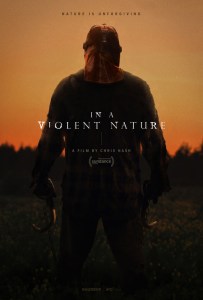 In a Violent Nature is going to be a very trying movie by design. Its entirety follows its very Jason-esque supernatural killer in near real-time as he goes through the woods and eventually kills several unlucky locals and partying teenagers. That means it’s several long sequences of watching the back of this hulking zombie killer walk through the woods and eventually get closer to victims. The actual kill scenes have some impressively nauseating gore, which might serve as a reward to the audience for enduring the lengthy walking. Seriously, this guy perambulates like a boss. He walks. And walks. And walks. Occasionally, he’ll kill someone in gruesome fashion, but most of his journey, and by extension the movie’s journey, is tagging along on his extensive nature hike. Is that going to be interesting to the average horror fan? Probably not. It’s designed to wear down your patience. The filmmakers clearly understand what effect their creative choices would have, and they went through with them anyway. It’s not like writer/director Chris Nash is lacking in style. His segment in 2014’s The ABCs of Death 2, “Z for Zygote,” is ingeniously horrifying. There is a great moment here where our killer’s hand is reaching toward the screaming face of his soon-to-be victim and then Nash performs a match cut with the same hand, now dripping with blood, reaching out for a desired necklace moments later. It’s quick and also subversive, denying the viewer our first opportunity at onscreen violence. This is a movie that works primarily in the realm of denying its target audience what it wants, and that is kind of fascinating to me. I don’t know if it’s enough to make me declare In a Violent Nature as good, but this movie seems destined to work on a different level than good/bad.
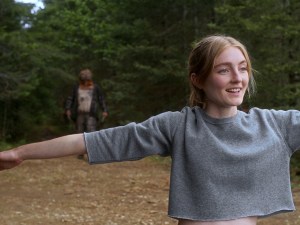 And yet, the movie invites a deeper contemplation through its very experimental nature. We’re walking side-by-side with this undead specter as he tromps through the woods looking to reclaim his special token, and it’s boring by design. I hate using that as an excuse because the movie does get rather tedious at parts, and yet it challenged me to engage more with the movie on an intellectual level, to examine its deliberate creative choices. Just about every slasher movie is designed around the clockwork killing of its easily disposable characters, usually dumb teenagers, by some powerful malevolent force. However, just about every slasher I can recall places the viewer in the perspective of the dumb teenagers engaging in dumb teenager antics, usually drinking and trying to engage in premarital sex. Let’s not pretend those characters are generally any more nuanced or well written than the villain stalking them. Instead of spending all our time with these character archetypes and the occasional pop-in from the villain, it’s reversed. It’s the dumb teenagers that pop-in while we’re on the journey with the slasher fiend. Does it make the kills hit harder because of the long stretches leading up to them because we see how many close calls there have been? Because this guy is trying his best? I don’t know, but the cries of In a Violent Nature being unbearably tedious makes me reflect on whether tedium is, by nature, part of the slasher genre, and perhaps we’ve all ignored the formula because of regular intervals of blood and boobs. Are dumb teenagers that much better company than a silent brute going for a walk?
It was around the halfway point where I began to question whether this approach was causing me to develop empathy for our supernatural killing machine. The back-story is tragic, being a young child tricked by kids he thought were his friends, only to plunge to his death from a water tower. Children can be cruel, and if this was one’s ever-lasting memory of human interaction, then I would understand coming back as a murderous revenant. He also didn’t ask to be brought back to life. The dumb teenagers stole his mother’s necklace and his goal is to simply reclaim it. Yes, he’ll kill plenty of people that had nothing to do with bringing him back, collateral damage from messing with forces that humans should never mess with. He’s just on the hunt for his dear departed mother’s keepsake. In essence, he is looking for the item to return back to the land of the dead, to end being pulled back into corporeal existence. When you look at that context, every dead teenager becomes one step closer to finding that necklace and going back to his eternal slumber. Perhaps our big bad is suffering and looking for that pain to cease. When you’re quite literally walking beside this figure for the duration of the movie, it sparks a personal reflection whether you may be unexpectedly developing empathy. Is it simply projection and all proximal, spending all this time with only one character? Is this a human byproduct of wanting to imbue emotional depth to characters for our sense of engagement? I cannot say. When you walk a mile, or more accurately several, in another (dead) man’s shoes, maybe you start to see the world in his weary, irritable perspective and want that big nap back.
 I have no idea how each viewer will respond to In a Violent Nature. I was wrestling with different mixed feelings, including boredom. I don’t think traditional fans of traditional horror will find the long slog worth taking its time to smell the proverbial flowers. I imagine most will grow restless, antsy, and maybe even angry, and that response is entirely valid and understandable. The novelty of watching the killer stalk his future victims in real time can be one of those ideas that, upon execution, feels better as a short film than as a feature experiment. I admire the gusto of embracing this approach and flipping the slasher script into what amounts to an unorthodox nature documentary between predator and prey. It’s an interesting approach that invites ongoing textual analysis with the genre, the depiction of the characters and their tired archetypes, as well as what makes these movies worth our time and passing investment. Likely there will be more people that shrug and deem In a Violent Nature a dull bore, but I’m also positive there will be people who find themselves unexpectedly thinking and feeling things they didn’t anticipate. Ultimately, it’s a movie I can begrudgingly admire more than engage with, but I appreciate taking the familiar and presenting it in a way we’ve seldom witnessed before.
Nate’s Grade: C+
Share this:

Winnie the Pooh: Blood and Honey 2 (2024)
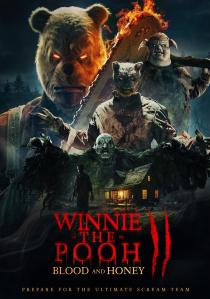 The first Winnie the Pooh: Blood and Honey was, unquestionably, my worst film of 2023. It wasn’t merely a bad horror movie, it was a depressingly cynical cash-grab with such little forethought of how to subvert the wholesome legacy of its classic characters. As I said in my review: “The startling lack of imagination of everything else is depressing, as is the fact that this movie has earned over four million at the global box-office, hoodwinking enough rubberneckers looking for a good bad time. The problem is that Winnie the Pooh: Blood and Honey is only a bad bad time.” Oh, dear reader, I wasn’t looking forward to the inevitable deluge of follow-ups, as writer/director Rhys Frake-Waterfield would resupply his surprising success with further sinister revisions to public domain properties. He’s planning on a “Poohniverse” crossover event with a combination of Pooh, evil Pinnochio, vengeance-fuelled Bambi, and a traumatized or villainous Peter Pan. Again, schlocky movies that lean into their schlock can be wonderful things, but a movie that does next to nothing with its subversive hook, with the history of its cutesy iconography, and could be easily replaced with any other menacing slasher killer is beyond lazy, it’s insulting. I figured there could be nowhere to go but up with a sequel, and while Blood and Honey 2 is an improvement in just about every way, it’s still not enough to qualify as a fun or ironic treat.
Wakefield and new co-writer Matt Leslie (Summer of 84) completely rework the mythology and history established in the first movie, which is now revealed to be the literal movie-within-a-movie of the account of the Massacre of the 100 Acre Wood where Pooh and Piglet slaughtered a troupe of bad-acting British coeds. In this prior film, it was established that Pooh and his buddies were angry with Christopher Robin (Scott Chambers, replacing Nikolai Leon) when he left for college. They felt abandoned and grew feral and monstrous, rejecting the ways of man (though still wearing the clothes of man and driving the cars of man). However, now in the sequel it’s revealed they were always feral and blood-thirsty and it was Christopher who incorrectly remembered them as cute and fluffy. This scene makes for the hilarious visual of a child waving innocently at a blood-strewn manimal lurking about. Also, Christopher had a young brother who was abducted by the creatures of the 100 Acre Wood and never seen again. Also also, there was a mad scientist who was creating human-animal hybrids from missing children, so the blood-thirsty animals might not be actual animals after all (can you see where this is going?). While the first Blood and Honey movie did nothing with the characters, this movie actively gives them a tragic history with some twists and turns, enough to lay a mythos. The use of hypnotherapy-induced flashbacks isn’t exactly smooth or subtle, but I’ll take it. At least this movie provides a distinguishing plot that makes some use of its particular elements. Don’t mistake me, dear reader, this is faint praise at best, but after enduring the creatively bankrupt first film, it’s like a desperately needed oasis. Ultimately, it might all just be a mirage but at least it’s something to those of us who suffered!
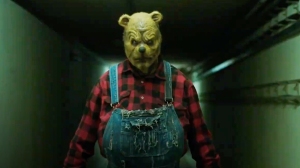 In the grand sequel tradition, bigger is better, and now instead of two ferocious beasts wreaking havoc, it’s four, with the addition of Owl (Marcus Massey) and Tigger (Lewis Santer). None of these monsters has a particular style or attitude that distinguishes them. I guess Tigger calls people “bitch” a lot and slashes people. There is one point where hapless cops are investigating a crime scene and say, “Let’s bounce,” and Tigger says from the luxury of the shadows, “Hey, that’s my line.” I figured they’d incorporate the signature Tigger bounce on his tail, but perhaps that was too expensive to perform or that bounce was more a byproduct of the Disney version of the character, still under copyright, and not the available A.A. Milne version. The animal costumes look better than the cheap Halloween masks of the original, though for my money Owl looks more like a turkey vulture wearing cray paper. I’m sure we’ll get Kanga in the inevitable third movie in 2025 where her zombie baby leaps out of her pouch to feed on brains. There is a snazzy addition late into the proceedings where Pooh is welding a fiery chainsaw. It makes little sense for the character but it’s cool, so it’s excusable in lapsed movie logic.
I was hoping for more unique kills, twisted takes related to the characters, like Pooh turning some poor soul’s head into a honeypot. The kills are just grizzly and extensive, favoring quantity over quality. There are plenty of decapitations, gougings, impalings, and other fraught and violent encounters, nearly all of them featuring squealing, terrified women. It’s always women that seem to get the worst in these movies, but of course this is a feature and not a bug of the genre back to its 80s heyday. It gets relentless but I suppose at least these girls aren’t having their tops mysteriously fall off while they’re being butchered. A third act rave set piece features maybe two dozen kills and risks becoming tedious slaughter. It got to the point where I was hoping not to see another cowering person hiding behind a corner because it meant the sequence was going to be even more unbearably long (I’m not personally cut out for the Terrifiers).
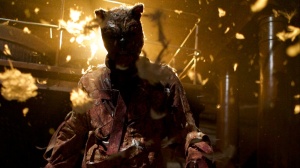 In between the spillings of blood and guts is the attempts at human drama, namely Christopher Robin trying to live a normal life while also re-examining his past. Apparently people think he’s to blame for the massacre from the 100 Acre Wood, and so he’s become a pariah, whose very presence unsettles others. He’s trying to find steady work in a hospital setting but he’s blacklisted from pursuing his career because of the negative attention his name generates. He even has a romance with a single mom so that when the Robin family is inevitably skewered we have other characters that can be personally threatened to provide meaningful stakes. The life of Christopher Robin and his discovery of repressed memories makes for a surprising story foundation for Blood and Honey 2, especially when the plot of its predecessor was mostly Christopher being held prisoner and the baddies casually roaming and killing coeds. I think Chambers is a better actor as well, and he’s posed to be the writer/director of Neverland Nightmares, which just began principal photography a month and a half ago as of this writing. Good luck, guy.
While the budget has increased tenfold, Blood and Honey 2 is still a scuzzy, sleazy slasher movie at heart. If you’re in the mood for a low-budget exploitation movie heavy with gore, there may be enough to qualify this sequel as moderately mediocre, which again is a marked improvement from what I declared the worst movie of 2023. I’ll credit the influence of co-writer Matt Leslie to try and put some standards in place for this runaway gravy train of IP allocation. What’s scariest of all is what Frake-Waterfield’s unexpected success has wrought, encouraging imitators to jump on his now proven novelty act. There’s a 2025 Steamboat Willie horror movie called Screamboat as Steamboat Willie has now entered the public domain (but not other versions of Mickey). Will it be any good? I sincerely doubt it. Will it make money from curious horror hounds looking for an ironic twist on a wholesome childhood fixture? Most assuredly. This is our present. This is our future, and it’s the legacy of Frake-Waterfield and his ilk that stumbled onto a lucrative novelty act. Winnie the Pooh: Blood and Honey 2 is just bad, and for that it’s an improvement.
Nate’s Grade: D+
Share this:

Scream 6 (2023)
 When horror franchises dramatically shift their locations to somewhere new, like New York City, it’s usually a bad sign that the series is desperately looking for new creative life. Not every franchise can rebound like a Leprechaun in Space. Most of them just become another Jason Takes Manhattan, where now instead of Character Group A running and dying from the masked killer, it’s now Character Group B running and dying from the same masked killer. It’s more reminiscent of cartoons where the backgrounds might change but the on screen events are stuck in the same drab routines. The Scream franchise was rebooted with 2022’s satisfying fifth installment, so I hoped that a sixth Scream could at least exceed where so many others have failed. Those hopes were quickly fulfilled in what I consider to be one of the best sequels of the seminal slasher series with all of its air-quote irony.
There are more than a few entertaining new turns as the bloody hi-jinks head to the Big Apple. It feels bloodier and gorier than most of the Scream movies, but it also has well-developed suspense sequences that work extremely well at making you squirm. Every brutal burst of violence elicited a “oomph” exhalation from me, and I found myself tensing up as the initial scene constructions transformed. I was quite enjoying myself from set piece to set piece. Take for instance an escape that requires the characters to flee from one high-rise window to another across an alley via a rickety ladder. Or take a subway escape packed with masked Halloween revelers to make you paranoid who among the many Ghostfaces might be the potential killer (I enjoyed the other costumes of horror old and new – I saw you Midsommar May Queen). Even a hide and seek sequence inside a convenience store can be thrilling. All credit to returning Scream 5 directors Matt Bettinelli-Opin and Tyler Gillet, the same pair that delivered 2019’s wonderfully twisted Ready or Not. These gentlemen have proven that they know how to squeeze the most tension from any scenario no matter how bizarre. I loved that the opening kill (Ready or Night alum Samara Weaving) goes in a different direction, revealing the culprit right away, and then it goes in even another direction. There are still some new cool tricks to be had with the sixth installment in a 27-year-old horror series.
 I was asked if you had to watch any of the prior Scream movies to enjoy Scream 6, and while it’s not necessary, you will be missing out on some of the larger connective tissue and themes. You should definitely have familiarity with Scream 5 since it’s a direct sequel and continuation of the core (four) characters. I was surprised how much more emotional resonance I found with the Carpenter sisters than any of the other characters, new or legacy, from the earlier movies. I think it was smart having Sam (Melissa Barrera) be the daughter of the first Ghostface as was her seeing visions of her late father, this time as an adult Skeet Ulrich, which might have been the wrong choice considering the character never lived to be this age (is her imagination doing one of those age approximations you see for runaway kids?). Our lead heroine is trying to navigate where her instincts are taking her, which might be a darker path that she feels trepidation about ignoring for only so long. Sam’s therapist balks when he discovers her actual parentage, which makes him maybe the worst therapist. Her relationship with her younger sister Tara (Jenna Ortega) is more complex than any of the close friendships of Sydney Bristow. Even with all the carnage and bloodshed, Scream 6 still finds breather moments to let the sisters react realistically to their dilemma and how it affects their own relationship. I’m glad these characters returned because they serve as the emotional focal point of an otherwise famously glib franchise.
The biggest drawback from Scream 6 is the tacit understanding that this will not be the final film in the franchise given its box-office success, the first film to cross the $100 million-dollar threshold since 1997’s Scream 2. This feels like a culminating climax as the characters now view their lives not as their own but as part of a “franchise,” which means the stories will keep going on beyond them and that nobody is safe, not even the “leads.” For a series entrenched in heavy meta-textual irony, it feels like it’s reaching the end of its genre self-awareness cycle when the movie acknowledges itself as its own IP. The scope of the movie is retrospective, not just reaching back and acknowledging the history of where things began for the legacy characters but for every movie. Each one of the former Ghostfaces is being collected and commented upon, with murder nerd Easter eggs left at each crime scene or in its contextual arrangement. It’s the kind of totality that I would expect from a movie franchise coming to an end, and nodding at its various twists and turns, finding places to even include elements from the lesser beloved Scream sequels. There’s even an unspoken satirical jab at the number of characters that miraculously survive, as if the film is throwing up its hands and saying why not, as if this is the last movie and the rules of who survives and who dies are inconsequential because we’re subverting expectations, as we’ve been explicitly told, so expect the unexpected.
 The other aspect of this drawback involves some slight spoilers but I’ll try and tread lightly. After our genre-savvy movie geek explains the stakes of this new episode, the characters start to review one another as potential suspects, and the new supporting characters even cast an accusing eye on the returning characters saying they could have cracked from their trauma. There’s emphasis on the drive to subvert expectations and break away from the patterns of old.
And here is where I’ll venture into some light spoilers so if you want to skip ahead to the next paragraph, please do so, dear reader. There is an ongoing thread where an Internet subculture has re-framed the Carpenter sisters as the real villains of their own horrendous story, and it’s an intriguing element that brings the echo chambers and confirmation bias and novice sleuths-in-the-making of the Internet to further examination. It’s reminiscent of any bottom-feeding conspiracy that asks people to pick apart their reality for “the real story” magically hidden in plain sight. The Scream franchise is famous for its fun guessing game of who the real killers could be from our gallery of suspects, and Scream 6 is no exception. However, the subversion that could have really separated this Scream from its elders is by having the killers actually be… nobodies (the Rian Johnson twist). What if the mask comes off and it’s a brand new character? I’m sure many viewers would feel like they had been betrayed, but then the point emerges that it’s simply some conspiracy theorist who has gone full-tilt crazy into the cult and taken matters into their own hands, attempting to hold “the real killers” to account or to prove they were truly guilty. And the larger point is that the “fake news” has already won out. It doesn’t matter what happens from here, what news coverage should stamp out ignorance, because you can’t pull every cult member out of their self-inflicted cocoon of delusion, which means there will always be more to take their place. That’s the legacy of what has transpired, that there will never be a real escape any longer. I thought that would be such a jarring and thematically intriguing and summative ending.
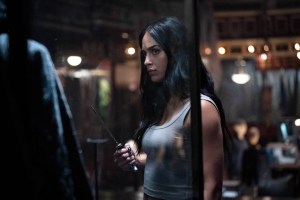 For the many fans of the slasher series, I believe Scream 6 retains plenty of the same pleasures of its prior movies while stretching out into new and interesting directions. It helps that I cared about the central sisters, at least enough by the low bar of horror movie standards. It’s bloody, fun, twisty, and satisfying enough that it could have served as a capper for the entire franchise. But it won’t be. I look forward to this new creative team re-evaluating trilogies better than Scream 3 did. In the meantime, this is a bloody good time to be had for long-term fans and newcomers from the 2022 reboot alike.
Nate’s Grade: B
Share this:

Cocaine Bear (2023)
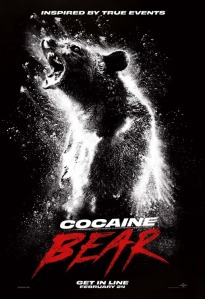 If you’re going to watch one movie with a cocaine-addled ursine killing-machine, it might as well be Cocaine Bear. In a lot of ways, this movie reminds me of Snakes on a Plane, a similarly deadly animal thriller sold on its bizarre concept and the promise of ironic entertainment, and both of the movies creatively peaked before anyone saw the movie. The true story is that in the 1980s, a drug-running plane dropped shipments of cocaine in Tennessee wilderness and a bear came across some cocaine, ate it, and died. The movie asks, “What if it became a coked-out slasher killer?” I wanted this movie to be more fun than it is, and I think the crux of my disappointment stems from the movie working one obvious joke into utter oblivion. The absurdity of a bear being high on drugs is about all you’ll get through 90 minutes. There are characters and subplots that you won’t care about, nor find terribly funny despite having Keri Russell, Alden Ehreneich, Brooklynn Prince, Kristofer Hivju, Isiah Whitlock Jr., Margo Martindale, and the final performance from the late Ray Liotta. It’s a lot of people, staring agog and saying, “A bear can’t do that,” and then we watch the bear do exactly that. There’s some impressive gore at turns and the CGI bear is workable for this kind of budget. The shame of it is too much just isn’t that funny. The movie is too content to rest upon its arch premise without adding enough additional comedy development to actively engage. If you’ve seen the trailer, you’ve seen the movie. This movie needed to be funnier, darker, weirder, or just anything in addition to the simple premise of a bear high on drugs and running a rampage. Is the joke ultimately on me for expecting more from a movie called Cocaine Bear?
Nate’s Grade: C
Share this:

Prey (2022)
 Prey is the kind of Predator movie I have been clamoring for years to make. The franchise was in some major need of a mojo rejuvenation, and instead of constantly repeating the same stories to lesser and lesser effect (see: 2018’s sloppy release), the filmmakers finally saw the obvious and exciting answer. By placing the Predator into different points and places in world history, the producers have finally tapped into the creative potential of the equation of [cultural warriors] vs. alien bounty hunter. Each new movie allows a new selling point jumping from famous warrior to famous warrior. Imagine samurai versus the Predator, or Crusaders versus the Predator, or Vikings versus the Predator, or a Wild West showdown against the Predator. It would be like an intergalactic Deadliest Warrior franchise. It’s a super advanced alien species, so why can’t we establish that they’ve been flying to Earth for centuries for their recreational sport? Each movie can establish a larger mythology, but it also just supplies the fun of seeing history’s greatest warriors and different settings and cultures versus a powerful alien monster. Prey is the best Predator sequel, by far, and arguably as entertaining and engaging as the 1987 original.
In 1719, we follow a tribe of Comanche in the Northern Great Plains. Naru (Amber Midthunder) wants to be a respected warrior like her big brother, Taabe (Dakota Beavers), who cautions her about the weight of responsibility. She discovers strange tracks and is convinced that their tribe is not safe from a new predator. How little does she know how right she is.
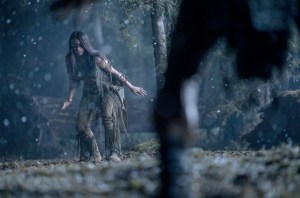 Within minutes, Prey had me. I’ve seen complaints that the first half is slow, but I think people are discounting the time needed to establish the ordinary baseline life of this community, their relationships and conflicts and goals and hopes, before introducing the change agent. That takes time if you want to be able to understand this different life but also if you want to really connect with the characters. The first half provides the foundation for the second half to run with and have bloody mayhem that counts as more than surface-level entertainment. The best compliment I could provide for screenwriter Patrick Aison (plus director Dan Trachtenberg) is that had the Predator never beamed down, I still would have found the story to be interesting. The details are rich and build an authentic picture of life 300 years ago before European colonists would completely upend indigenous life. The Predator series, at its core, has been a nativist underdog tale, where the primitive people of Earth have battled against the technologically superior alien warrior. The dynamic makes it easy to root for the Earthly heroes, but it’s even easier when you have a protagonist like Naru, fighting for respect as a woman already. The character is shown as headstrong but capable, and her mistakes provide opportunities for her to learn and better strategize later. I genuinely gasped when certain indigenous characters died. I’ve never had an emotional response to any Predator film.
The reveal of the Predator is cautiously handled, with the big guy taking time to explore his own surroundings. I enjoyed that this Predator also isn’t as advanced as his more modern ilk. He wears an intimidating alien skull mask and has more limited, though still high-tech, weaponry. I also enjoyed that this Predator feels like he has more of a personality. It’s not just a mirthless tall guy in a thick suit. The actor, Dane DiLiegro, is still providing a tactile, physical performance, and he has moments that reveal the cruelty of this alien but also its volatile temper, which is kind of hilarious. He encounters the wildlife and goes from snake to bear to man, right up the food chain, but some of his more violent kills demonstrate an almost petulant attitude. This is a Predator that doesn’t quite have it all together, and it makes the eventual battle with the Comanche feel like a conflict that has two sides that are worthy but also with their vulnerabilities. It makes the final showdown more interesting. It also allows us to take perverse pleasure in the big guy mowing down a team of predatory French fur trappers that imprison Naru and use her as bait. Oh boy, the gory comeuppance is fun.
 The action sequences are smoothly handled by Trachtenberg (10 Cloverfield Lane) who favors verisimilitude without sacrificing the visual artifice. The photography is gorgeous, and the emphasis on natural light and environments add so much the overall authenticity. Trachtenberg also knows what visual style will work best with which moments. There’s one scene where Naru sneaks back into the trapper camp and her vengeful fury is portrayed in a breathless long take to make the moment even more intense and enjoyable to appreciate the beat-by-beat fight choreography. The scenes with the Predator stalking in the fog play with claustrophobic suspense. The action has a very pleasing sense of construction that clearly presents the pieces that are needed for the scene-to-scene goals, and then the characters will adapt as necessary through organic complications. This is just good action construction, and Trachtenberg fields each like an expert.
Another fun addition with Prey is that they filmed it with two audio tracks, an English-language track and one fully in the Comanche language. It’s not the most necessary option since most viewers will likely simply watch it in English, or not know about the alternative until after watching, such as myself, but it’s an impressive addition that can make the movie even more immersive and authentic and generally considerate of another culture and language.
 Now, with all my points of praise for Prey, why oh why did Disney shunt this movie straight to its secondary streaming arm with Hulu? After the Fox merger, I understand that the Mouse House doesn’t quite see the same level of value in every Fox property not named X-Men or Avatar. This was restarting a franchise that still has some life in it, but even more than that, this is a good movie with plenty of artistic acumen that would have played splendidly on a big screen and an excellent sound system to really sell every fleshy slice and alien gurgle. It seems preposterous to me that a new Predator movie, let alone an actually great one, is denied theatrical release. I know the domestic box-office is still not what it was before the COVID-19 pandemic. I understand that Fox’s leftovers don’t have the same sexy appeal to the new bosses. It just puzzles me that nobody thought that they would make money off of Prey, which has proven to be a big hit on Hulu with critics and fans (ignoring cranky misogynists questioning the physical ability of women). Prey is a great action movie built upon solid characters and patient, clear plot and action development. When it comes to gore, I wish it wasn’t as heavily CGI and a more memorably gruesome, but that’s my only real criticism of what is fundamentally a fun and exciting movie. Give me more like Prey.
Nate’s Grade: B+
Share this:

The Northman (2022)
 Consider writer/director Robert Eggers’ bloody Viking revenge movie as a companion piece to 2021’s The Green Knight. Both movies take mythical, supernatural-aided tales of heroics and medieval masculinity and feed into the spectacle while also cleaving the legend to make way for a sense of humanity. We follow Amleth (Alexander Skatsgard) who is a displaced prince who has sworn to kill his treacherous uncle and rescue his mother (Nicole Kidman). It’s a tale so old that it inspired Shakespeare’s Hamlet, though that play could have benefited from a climax involving two hulking naked men dueling to the death atop an exploding volcano. The Northman reminds me a lot of Mel Gibson’s Apocalypto, a movie I described back in the day as “an art film for jocks.” It’s immersive and impressive down to the exact detail, and it doesn’t shirk on the blood and combat. It’s also unmistakably the work of Eggers, a very precise and idiosyncratic indie director whose prior movies felt like stylistic dares. The camerawork is often long with single takes, making all the visual arrangements and coordination that much more impressive. It’s staggering that a studio provided Eggers with $90 million to go make his version of Conan the Barbarian. At a lugubrious 140 minutes, there’s enough sticky carnage to satiate fans of brutish medieval action movies, but I appreciated how Eggers keeps his story purposely streamlined and simplistic until a few keen reveals force the audience and protagonist to re-examine the assumptions and fleeting honor of vengeance in this harsh, unfair environment of men out-killing one another. It’s a movie that provides the red meat and then makes you question whether you might want to go vegan. There’s more that can be unpacked but I wish Eggers had cut back at points. This is a slow movie, which does contribute to its mood and atmosphere, but I also wish Eggers had gotten to some of his plot points with a bit more haste and vigor. The Northman is transporting and bold and also more than a bit bloated. You could laugh at some of its over-the-top machismo but I feel like Eggers is inviting criticism of that very machismo, so enjoy the movie on one level where it indulges all the Old World violence, and then enjoy it on another level where it subverts and castigates the same Old World violence. Or you could just watch for the glistening muscles, famous faces, bad accents, bad wigs, guttural score, and weird imagery.
Nate’s Grade: B
Share this:

The Texas Chainsaw Massacre (2022)
 What are we doing here? This new Netflix Texas Chainsaw Massacre is part reboot and part distant sequel to the 1974 original, even bringing back sole survivor Sally Hardesty to get her very grizzled Jamie Lee Curtis-in-Halloween 2018 vengeance. There are a lot of bad sequels and remakes in this franchise’s history, blinked out of existence here with this ret-con, so keep your expectations pretty low. This is a 75-minute movie with a wisp of a plot, so much so that it doesn’t even wait until the twenty-minute mark for the conveyor belt of carnage to begin. I suppose that can be a virtue for genre audiences. This is a decidedly gory and crunchy horror movie, gleefully splashing in entrails and jump scares rather than taking the time to develop something more. If we’re upholding the original’s timeline, then this Leatherface is in his mid-seventies. We need fun slasher movies too (I enjoyed the fifth Scream), but this one just feels spiteful and creatively hollow. I don’t really even understand the premise, that a group of political activists are literally buying or auctioning a ghost town to turn it into a gentrified, liberal mecca in the Texas desert. Young liberals are removing racist Texans from their homes and Fyre Fest-chasing Zoomers are invading? What? Then there’s our Final Girl who herself is the survivor of a school shooting and working through her trauma, and flashbacks, to regain her control by literally learning to arm herself. Oh no. Elise Fisher (Eighth Grade), you deserve so much better. It’s fast-paced. It’s exceedingly bloody. It’s over quickly. I guess there are ways this new Texas Chainsaw Massacre could have been worse but there’s even more ways it could have been better.
Nate’s Grade: C
Share this:

Halloween Kills (2021)
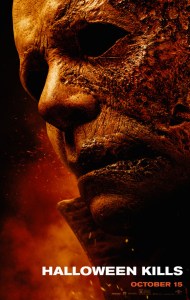 In 2018, versatile indie director David Gordon Green (Stronger, Pineapple Express) and actor Danny McBride (Eastbound & Down) rebooted the Halloween franchise with a monstrous box-office return for their efforts. From there, the studio planned two immediate sequels to cash in. Delayed by a year, Halloween Kills is the first sequel and coming out just in time for the spooky season. The problem is the only thing this movie is going to adequately kill is 100 minutes of your time.
Laurie Strode (Jamie Lee Curtis) and her daughter (Judy Greer) and granddaughter (Andi Matichak) have trapped Michael Myers into their basement and set the house ablaze. Unfortunately for everyone, a team of firefighters rescues the giant killing machine. Michael wanders the town of Haddonfield, killing whomever he encounters, eventually circling back to his childhood home, the site of his first murder. The townsfolk have decided that they are sick of living in fear from the legend of Myers. They form a violent mob, chanting “Evil dies tonight,” and break into armed clusters to snuff out Michael Myers and put him in the ground for good.
 There is one intriguing aspect of the movie that gives it some fleeting life. The 2018 predecessor tantalizing explored the idea of generational trauma from terror, with Laurie raising her daughter in a constant state of paranoia and anxiety to prepare her for the eventual return of the unstoppable menace. The fraught relationship between three generations of Strodes was deserving of far more attention than it ultimately received in the 2018 film, although at least the filmmakers were smart enough to realize having them join their multi-generational talents would be a natural payoff. With Halloween Kills, we get a similar concept of generational trauma but from the point of view the supporting townsfolk, many meant to resemble middle-aged versions of bit characters from the older Halloween movies from the John Carpenter era. That sort of dedication to furthering the mythology of this town seems misplaced for the fan base. I doubt many hardcore Halloween fans were chomping to find out what happened to the little kid Laurie babysat. However, these obscure Haddonfield characters become a support group for trauma, a lasting memory of the horrible history of their town, and when Myers returns, they’re the first to fight back and form a mob to round up the masked boogeyman. The town’s social order breaks down and people give into the mob mentality of ends-justify-the-means violence. Even though Halloween Kills was originally scheduled to be released a year ago, it has a different feel in a world after the 2021 U.S. Capital insurrection, watching a sea of angry, misinformed citizens run wild in misplaced fear and loathing. It leads to tragedy and mistakes as the Haddonfield mob sweeps up, gathers more momentum, and doesn’t stop to think who it may trample upon next.
It was enough that made me wish the entire movie had been told from this peanut gallery perspective. Rather than following the silent killer stalk and brutally slay, let’s focus on the lesser seen cost of terror. Let’s concentrate on the side characters, the kinds who would normally play out as Cop #3 or Concerned Mom #2 in a normal slasher movie. What if we elevated them and told a slasher story from their victimized perspective and we stayed with their fear and anxiety while they remained in the dark about a madman terrorizing their town? The earlier movie was about how trauma had racked Laurie Strode’s life and personal relationships. It’s fitting that a sequel would widen the scope and show how many others have also suffered and are still haunted by their own trauma and PTSD from their fateful experiences with homegrown evil. Maybe it’s the less cinematic approach, but it’s something new and different and looking at a more human perspective for a sub-genre better known as serving as a relentless conveyor belt for wanton vivisection.
 What I’m saying is that these standard genre slasher movies bore me unless they have some exhilarating style, fresh ideas, or clever perspective shifts. With Halloween Kills, I’m watching a dull silent killer slowly murder disposable supporting characters and none of it qualifies as interesting. I don’t care about these people. I don’t find Michael Myers to be interesting (even when Rob Zombie foolishly tried to establish a trashy childhood back-story). The only thing I found worthwhile from the 2018 movie was the mother-daughter drama with the Strodes, which has all but been sidelined for the 2021 sequel. Perhaps I’m not the right audience for these kinds of movies, or perhaps this one just simply isn’t trying hard enough where it counts. The kills aren’t particularly memorable, though several are quite brutal and even a bit mean-spirited. The suspense set pieces are rote. The movie just feels far too much like it’s on autopilot, trying to provide enough filler material until its eventual concluding chapter, 2022’s Halloween Ends (yeah, we’ll see about that, title). We’re still watching a man pushing 70 years of age defy multiple stab wounds, bullets, contusions and beatings, and any number of aggressive defensive violence. It gets irritating. He’s not some supernatural force back from the dead like a Jason Voorhees; he’s just a beefy AARP member.
Green has an affinity for the franchise and the gore can be downright gooey and wince-inducing. The opening segment is an impressive recreation of the filmmaking techniques John Carpenter used in the late 1970s, even down to the period appropriate synth score. It’s a fun inclusion that essentially gives added context to the adult versions of many supporting charterers, seeing their own youthful run-ins with Michael Myers that fateful Halloween night so long ago. It’s clever but it adds up to little else as the movie progresses. If these moments with these characters had been more meaningful, maybe their eventual deaths would have meant more, but just because we spent more time with Cop #3 doesn’t mean their ultimate demise feels more than the death of Cop #3. Ultimately, it feels like this early section, a superfluous reminder of the past, is just here as something to entertain Green as a returning director for a filler sequel to a so-so movie. The strange humor of the 2018 edition has been completely eliminated, so what we’re left with is a thoroughly redundant slasher movie with some intriguing ideas percolating but not coming to fruition.
 If you were a fan of Curtis (Knives Out) as the gritty survivalist, the Cassandra trying to warn others of the impending doom they seem so oblivious to, then you’ll be disappointed here. I don’t know if Green and his co-writers were making a purposeful homage to the 1981 sequel where Laurie keeps to a hospital for the entire movie. Either way, Laurie is stuck in a hospital bed because the movie only follows mere hours from the events of the 2018 movie and only goes forward mere hours from there. We’re stuck, and so is Curtis, as she practically sits this one out. Judy Greer is likewise wasted as Laurie’s adult daughter. If there’s a star of this 2021 sequel, it’s Anthony Michael Hall (Live by Night) as the leader of the town’s mob. He has an intensity to him that feels believable without crossing over into exaggerated cartoon zealot.
If you’re a sucker for the Halloween franchise, or the glut of slasher movies that have exploded in the age of streaming, then perhaps enough of the crimson stuff gets spilled to satiate your horror appetites. I’m just bored by another movie about another slow-moving guy in a mask at this point. I need more, anything more, and Halloween Kills gives me too much of the same old same dead.
Nate’s Grade: C
Share this:

Malignant (2021)

Thank goodness for James Wan. The horror hit-maker has earned enough creative cache in the industry after fostering three separate horror franchises (totaling near two billion dollars), plus two other high-profile action superhero blockbusters, that he can do whatever he wants and thankfully what Wan wants to do is make really weird movies that take tremendous risks. Malignant is a movie that starts slow, appearing to be another in the line of horror thrillers about a psychic connection between a troubled soul and the imaginary friend that seems to be coming back. The movie begins feeling like high-end camp in a flashback, takes a very serious and uncomfortable turn into domestic violence and miscarriages, and then builds into a psychic serial killer investigation where our main character (Annabelle Wallis) is having creepy visions of the killer exacting bloody revenge. For the first half of the movie, there’s a lot to keep up with and it’s easy to get confused with bland characters, their often baffling actions and decisions, and then it plops you down for heavy exposition via asylum VHS tapes. However, from that point forward, Wan lays out all his cards and it’s so absurd, so entrancingly weird, and so enthusiastic about all of it, that you may burst out laughing in the best possible way. Before its drunken rampage of schlocky delight, Malignant is a horror mystery and stylishly directed with some bravura shots and angles. It’s worth your time, but everything is in service to setting up the final act where it gets so much bigger, more bonkers, and deliriously more entertaining. Wan is clearly going for messy giallo horror camp and gives the audience permission to laugh along with the insanity. It acknowledges how goofy looking and bizarre its eventual monster looks, let alone the logistics and circumstances involved, and it all veers into that. Whereas Old felt like M. Night Shyamalan was trying to escape camp and kept falling back into its morass, Malignant feels expressly like the movie James Wan wishes to make. There’s even a spooky abandoned child experiment-heavy hospital on a cliff, and rather than have something spooky happen, the character then safely arrives back home with an armload of incriminating medical VHS tapes. The deliberate asides, misdirects, and eventual revelations feel so purposeful to yank around the audience and deliver a frantic and unpredictable ride of a movie that leaves the audience screaming and howling with laughter. I can understand people hating Malignant. I can understand people loving Malignant. I can understand people having trouble even making sense of Malignant. However, you cannot watch this movie and have a passive response. I wish I could have seen this in a packed theater pre-COVID. I think I figured out my inexpensive Halloween costume for 2021.
Nate’s Grade: B+
Share this:

The Suicide Squad (2021)
 When Disney foolishly fired writer/director James Gunn for offensive past tweets, tweets the studio had already known about before hiring him to helm the first Guardians of the Galaxy Marvel movie, the brass at DC was more than happy to pounce. They offered Gunn the opportunity to tackle any of their many superhero properties. Gunn had earned a reputation as a blockbuster filmmaker whose bizarre sense of humor and style made him just as much as selling point as the property itself. Gunn gravitated to the Suicide Squad, though he didn’t want to be beholden to the 2016 film from writer/director David Ayer. The studio gave Gunn free reign. He could do whatever he wanted creatively, which just happened to be an extremely violent, R-rated sequel that also serves as a soft reboot. Gunn was the perfect person to tackle a project like The Suicide Squad and even with all his goofy humor, gallons of gore, and slapdash dispatching of numerous big names, there’s a real affection for these scruffy characters. Not that there was a big hurdle to clear, but this is clearly the superior big screen Suicide Squad.
Amanda Waller (Viola Davis) has assembled another team of criminals and has-beens and tasked them with a mission. If they fail, or deviate from their orders, she will detonate an explosive placed within the skulls of Task Force X a.k.a. the Suicide Squad. Skilled marksman Bloodsport (Idris Elba) is extorted into being the defacto leader of a band of squabbling misfits that includes Harley Quinn (Margot Robbie), the patriotic warrior Peacemaker (John Cena), the vermin-controlling Ratcatcher (Daniela Melchior), and even a giant living shark, King Shark (voiced by Sylvester Stallone), with a voracious appetite. The squad must destroy a scientific station on an island nation that has undergone a military coup and great political instability. Within that station, run by mad scientist The Thinker (Peter Capaldi), is a threat that could doom the world. Enter the Suicide Squad, but can they even be bothered to save the day?
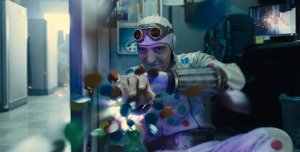
 It feels like Gunn wanted to take the most ridiculous, pathetic characters in DC cannon and then find a way to make them appealing and worth rooting for. There is a strategy to take the scraps of the comic book universe and to make gold out of them. Case in point, Polka Dot Man (David Dastmalchian), a figure easily ridiculed by fans and populating just about every list of the worst villains of comic book lore. Gunn takes the maligned character and says, “Yeah, I’m going to keep his dumb power of flinging polka dots, and by the end, you’re going to care,” and you do care, or at least I did over the course of the film’s 132 minutes. Gunn is drawn to strange, dysfunctional found families, the misfits of society who find an unexpected kinship with one another. You can tell that even when Gunn is at his most irreverent, he still has an acute sense of reverence. The team-comes-together aspect of these sort of movies plays as a predictable but satisfying formula, and while I wouldn’t say anything took hold of my emotions like the best of the Guardians entries, I did come to care about the core of the team. I cared about the father/daughter dynamic between Bloodsport and Ratcatcher. I cared about Polka Dot Man coming into his own as a hero. I cared about King Shark feeling like he had a group of friends. The fact that I typed those last two sentences, which would sound insane absent context, is a testament to Gunn’s strengths.
The climactic villain, whom I will not spoil, is the greatest example of making the most with the least. It is immediately goofy to the point of laughter but still threatening and creepy. Gunn has taken one of the weirdest characters in comics and given it its due. Even by the end, as this villain is vanquished (not a spoiler), the movie finds a small moment to re-contextualize this absurd character as another victim. It was happier before being kidnapped and experimented upon by its devious captors. Even that extra passing consideration is impressive.
The movie also lets its weirdos have their fun. Watching bad guys, who are somewhat bad at being bad guys, try their hand at being good guys, but badly, or at least not as well, has plenty of comedic possibility as well as setting up the redemption and community payoff. The opening beach assault sets the sardonic and sloppy tone. I consistently enjoyed the contentious banter between the different members of the Squad and the jockeying for position. The gag about Polk Dot Man envisioning every enemy as his abusive mother is enjoyably goofy when visualized from his perspective (Elba’s line reading for “It’s YOUR MOM!” is a delight). King Shark’s dullard nature is a routine source of comedy that almost wears out its welcome. Nothing seems out of bound for him to say or do, whereas the others have more defined comedy boundaries. I laughed out loud frequently though some of the comedy bits feel a bit too stale and juvenile even for Gunn (a 69 joke?). This all feels very much like this is Gunn’s $180-million-dollar Troma movie he miraculously got to make with a studio blessing. The violence is over-the-top, occasionally gasp-inducing and occasionally beautiful. That’s an odd but an adept combination for Gunn as a filmmaker, a man who digs into the grimy bins of exploitation cinema and elevates it upon a bigger stage while still managing to stay true to his own silly style.
 Gunn hasn’t dulled the darker reality of his rogue’s gallery either. Bloodsport and Peacemaker get into a macho contest of killing foot soldiers in increasingly theatrical and flamboyant ways where their flippancy and hostility toward one another is the joke. King Shark is portrayed as a dumb brute who also tries to eat team members. Many, many characters have similar back-stories where their parent or guardian or captor experimented on them and live with the lingering trauma, trying not to have their pain define them. The 2016 movie wanted you to see the Squad as PG-13-approved antiheroes. The 2021 movie wants you to remember that they are indeed crazy, demented, dangerous, and murderers. Even Peacemaker, meant to evoke shades of the patriotic Captain America, says he will ensure peace “no matter how many men, women, and children I have to kill.” Harley isn’t fetishized as a punky pinup in short shorts like in 2016 (digitally shortened), but she’s still a psychopath who makes impulsive decisions. Her recognition about always falling for the wrong kind of man is a mixture of sadness, character growth, and a clear reminder that you should not let down your guard around this woman.
Spending time with these characters is made even better from the superb casting. Elba (Hobbes and Shaw) is the biggest welcomed addition; his character was likely initially intended to be the continuation of Will Smith’s Deadshot. Elba is charismatic and self-effacing and handles the comedy and action with equal measures of confidence. When he loses his patience, or opens up about his hidden phobia, it’s even more amusing because of how it contrasts with how naturally suave he is as a default setting. I wasn’t missing Will Smith at all with Elba and his natural accent. Robbie (Bombshell) was born to play Harley Quinn and should hopefully get many more opportunities. Cena (Fast and Furious 9) is so natural at comedy and slides comfortably into a macho blowhard coming into conflict with the other alpha males on the Squad. I loved the simple visual of him strutting around in vacation shorts for a long period of the second act. Viola Davis (Ma Rainey’s Black Bottom) is always excellent and might be the scariest character of them all. There are many joke characters played by actors firmly in on the tongue-in-cheek game.
 As a second chance at franchise-making, The Suicide Squad is a brash, bloody, and irreverent retake and the best DCU movie yet from a studio that seems to be throwing anything at the wall to see what potentially sticks. That has its benefits, like allowing Gunn the creative freedom to make a movie this crazy and schlocky and entertaining. It’s a shame, then, that this Squad movie looks like it will make a whopping hundred million less in its opening weekend at the box-office compared to its 2016 predecessor. It’s a sign that the traditional theatrical market hasn’t quite rebounded from COVID-19 (even Marvel’s own doesn’t look like it will crack $200 million domestic). It may also be a sign that audiences are not terribly interested about a sequel to a movie they didn’t really care for five years prior. Beforehand, I would have bet even money that the studio would give a blank check to bring Gunn back for more after he fulfills Guardians of the Galaxy volume 3 for Marvel, but maybe that’s not the case. Maybe The Suicide Squad will be more of an entertaining one-off than the start of a new direction for this lagging franchise. Regardless, if anything good came of Disney firing Gunn on dubious terms, it’s the existence of this movie in the interim for the in-demand filmmaker. While not everything works in The Suicide Squad, and the emotional depth is sacrificed for giddy gory bombast, it’s what you would hope for with the combination of James Gunn, wacky superheroes, and a commitment to an R-rating.
Nate’s Grade: B+


 nathanzoebl
You must be logged in to post a comment.