Blog Archives
The Alto Knights (2025)
 The Alto Knights, from the creative team behind famous mafia movies like Bugsy and Goodfellas, feels like a dozen mob movies thrown into a blender: recognizable elements mashed together but lacking a cohesive vision and distinction. There’s also a major creative choice that makes little sense, mainly Robert De Niro plays two different roles. I assumed they would be twins or at the least brothers but no they are actually two different, unrelated people, Frank Costello and Vito Genovese. Why? I understand the appeal to De Niro fro an acting standpoint, as well as the potential marketing hook, but what about this makes sense for the viewer? What about this movie made it better by having one actor portray the two main characters? It made it harder for me to keep track, and that’s before there’s flash-forward interviews from an older Frank as well. The story is mostly set n the 1950s New York following the rivalry of two childhood friends-turned-mafia bosses but it feels so haphazard and jumbled, with story events crashing into one another but minus a clear sense of progression and consequence. It’s a strange experience to watch a movie with murders and marriages and the dissolution of personal relationships through paranoia and greed, and yet The Alto Knights lacks energy and direction. It’s hard to follow why these two guys are worthy of their own movie or even what their role in the larger mob ecosystem was, so watching scene after scene creates a “So what?” question. Unless you’re a non-discriminating fan of all mafia movies, The Alto Knights is the disappointing residue at the bottom of the mob blender. But hey you got extra De Niro!
Nate’s Grade: C
Share this:

Layer Cake (2005) [Review Re-View]
 Originally released June 10, 2005:
Layer Cake may be the least intimidating name ever for a crime movie. It conjures images of bridal showers, cooking shows, and birthday parties. It does not necessarily bring to mind thoughts of gangsters, assassins, drug trafficking, and the seamy underbelly of London’s criminal underground. Unless you’re watching some really awesome cooking show I don’t know about. The “layer cake” in question refers to the hierarchy of criminals. This isn’t unfamiliar territory for Matthew Vaughn, who produced Guy Ritchie’s Lock, Stock, and Two Smoking Barrels and Snatch. This time it’s Vaughn sitting in the director’s chair and the results are exceptionally entertaining. Layer Cake is a cinematic treat.
Daniel Craig (Road to Perdition) plays our untitled lead, referred to in the end credits as “XXXX.” He’s a cocaine dealer but not a gangster by any means. He wants to make his money, not step on any important toes, and then walk away on top and without any gaping holes in his body. Craig is summoned by his boss Jimmy (Kenneth Cranham) and given two missions, whether he wants to accept them or not. The first is to relocate the missing daughter of a very powerful friend of Jimmy’s. The second, and far more dangerous job, is to secure a package of millions of stolen ecstasy pills and make a profit. Complicating matters is the angry Serbian mob that the pills were stolen from. They’ve dispatched a deadly assassin known as Dragan to track down their stolen drugs and kill anyone involved. Craig is left to juggle the investigation, find a buyer, stay ahead of Serbian hitmen, get some time in with a hot new girl, and all the while keeping his higher-ups content enough not to kill him themselves.
 Layer Cake should be the film that makes Craig the star he so rightfully deserves to be. This man is a modern day Steve McQueen with those piercing blue eyes, cheekbones that could cut glass, and the casual swagger of coolness. Craig grabs the audience from his opening narration as he explains the ins and outs of his business. We may never see Craig sweat but he still expresses a remarkable slow burn of fear so effectively through those baby blues. He’s in over his head and the audience feels his frustrations. In an interesting character twist, when Craig does resort to killing, he’s actually tormented and haunted by his actions.
As with most British gangster flicks, there are a batch of colorful characters that leave their mark. Dragan (Dragan Micanovic) is a wonderfully enigmatic ghost of an assassin always one step ahead of Craig and the audience. Morty (George Harris) and Gene (Colm Meaney) add heart and bluster as Craig’s trusted right hand men. But the actor who steals the whole film with a malevolent glee is Michael Gambon (Harry Potter and the Prisoner of Azkaban). He plays Eddie Temple, the man behind the men behind the scenes. Gambon delivers the harshest of speeches with a velvety pragmatic calm. We don’t know what runs deeper with Eddie, his tan or his scheming.
Sienna Miller plays the thankless love interest to Craig. She’s pretty, sure, but there isn’t much acting ability on display in Layer Cake beside some smoldering glances. We never really know what Craig sees in her besides being another cute blonde to choose over. Miller isn’t alone in the “underwritten character department.” Layer Cake is crammed with secondary characters that pop in and out when it’s necessary. It’s not too annoying but it does mess around with an audience?s ability to follow along coherently.
Layer Cake is not one of the slick, whack-a-mole ventures Ritchie has given us (pre-Madonna). No sir, this is a brooding, serious and nearly terrifying look at the old adage “crime doesn’t pay.” Very few crime centered films express the day-to-day anxiety of just being a criminal. Jimmy reminds Craig that he’ll never be able to walk away because he’s too good an earner for his higher-ups. In Layer Cake, you can get killed for being too greedy, being too careless, being too good at your job, and even just being in the wrong place. Eddie sums it up best whilst describing Faust: “Man sells his soul to the devil. It all ends in tears. These things always do.”
 Vaughn has a polished visual sensibility that doesn’t overwhelm the viewer. He keeps the camera fluid and steady with a minimal amount of cuts. A nifty opening scene involves an imaginary drug store (stocked with pot, cocaine, and the like) melting into a real drug store (one hour photo, impulse items at the register). When the tension does mount Vaughn knows just how to turn the screws. A late sequence involving a chase between the SWAT team and our batch of criminals had me on the edge of my seat. For a first time director, Vaughn also has great patience. He doesn’t rush his storyline and he doesn’t suffocate his movie with visual flourishes. He also has a great deal of faith in his audience’s intelligence. This isn’t as lively as Snatch or Lock, Stock, but that’s because Vaughn’s film is also much more serious and dangerous.
This is an intricate and gripping film but it might be a little too complex for its own good. Twists and double-crosses are expected in this genre, but writer J.J. Connolly has so many characters running around and so many hidden agendas that it’s nearly impossible to keep track. Some of the subplots and back stories add very little like the inexplicable “Crazy Larry” flashbacks. I left the theater still confused about plot points but refreshingly satisfied nonetheless.
Layer Cake is the most thoroughly exhilarating time I’ve had at a theater this year. This pulpy daylight-noir caper is full of memorable hoods, plenty of twists and turns, and a star making performance by the steely-eyed wonder that is Daniel Craig (rumored to be the next 007, though in my heart I’ll always root for Clive Owen). Fans of Ritchie’s frenetic gangster flicks should be entertained. Anyone looking for a clever and exciting potboiler that treats violence and crime seriously should start lining up immediately. If you’re suffering from the cinematic wasteland that 2005 has shaped up to be so far, then have yourself a generous helping of Layer Cake and thank the Brits.
Nate’s Grade: A
——————————————————
WRITER REFLECTIONS 20 YEARS LATER

Back in 2005, Layer Cake was really a proof of concept movie for many items. It was proof that someone could take a Guy Ritchie-style crime pot boiler with colorful Cockney criminals and plenty of twists and unexpected violence and play it straight and serious. It was proof of Matthew Vaughn as a director, who had previously served as a producer of those early Ritchie films. It was proof of Sienna Miller as the next It Girl, a proclamation that carried her for years despite mixed results with the movies. Most of all, it was proof of its lead, Daniel Craig, as being so suave he should be considered the next possible 007. James Bond producer Barbara Broccoli has gone on the record saying this movie is what officially put Craig on their radar and got him the gig that has defined his career trajectory. Twenty years later, Layer Cake is still a potent and smooth little thriller that glides right by on its intelligence, sex appeal, and Craig’s charisma
I find myself agreeing with so many of my original points from 2005 so I don’t want this re-examination to be merely a “ditto” without some additional critical analysis. Even though it’s based on a book by J.J. Connolly, who adapted his own novel, the movie feels very much in the company of those early Guy Ritchie movies that Vaughn began producing. Ritchie burst onto the international scene with 1998’s Lock, Stock, and Two Smoking Barrels, a brash and stylish crime comedy with outlandish characters, violence that alternated between visceral and slapstick, and twisty plots that often left your head spinning. It was like a mixture of Tarantino and a more lewd Looney Tunes cartoon. While the early Ritchie films, including my favorite, 2001’s Snatch, have their share of characters with grounded stakes, the reality is exaggerated, with the appeal being these grandiose personalities butting against one another. No one would confuse one of these Ritchie movies with a realistic portrayal of London criminals. They’re fun. What Layer Cake does so well is take a Ritchie-esque premise with plenty of low-life screw-ups and hardasses and plays it straight. It takes this middle-level drug distributor and makes his life less a comedy of errors and more a never-ending anxiety attack about how he can become undone from any angle. The movie sure doesn’t make a life of crime look appealing.
 Craig’s character, named XXXX, is a smart guy just trying to keep his head down and do his job. The problem for him is that he’s too good at earning money for bad men who like money. In this life, you can get killed for any number of reasons, some of them logical and pragmatic, and others rash and illogical: not being a good enough criminal, being too good of a criminal, thinking he’s too good of a criminal, someone else wanting to make a name for themself and establish cred by going after you, dumb luck, etc. XXXX has his rules and standards to live by to ensure he limits his risk, but when your profession is literally dealing with money and unscrupulous types, there is no absolute zero in that risk. He may be smart and measured but he’s also working with plenty of stupid people who don’t know they’re stupid, and then you mix in vice and avarice with that, and it can be a combustible cocktail of dangerous idiots intruding on whatever peace and distance XXXX has cultivated for himself. In the movie, XXXX is burdened with competing tasks. He’s been offered a stash of stolen ecstasy pills, and his slimy boss wants them sold no matter what, but the assassin hired to retrieve them definitely wants them back too. Either way, our lead character is endangering himself by making someone unhappy. He’s dropped into the sticky morass of power plays and competing interests that will challenge his intended neutrality.
I think the ending for Layer Cake is brilliant and very fitting. For almost two hours, we’ve followed XXXX through hell and back and it looks like he’s found a way out, siding with the right hoodlums and eliminating different risky angles needing to be resolved. He’s kept to his stated retirement of not going out on top and instead going out while comfortable and capable. He’ll leave the business to his associates because he’s tired of looking over his shoulder. And as he walks out with his pretty lady (Sienna Miller) around his arm, that’s when he abruptly gets shot by Sidney (Ben Whishaw – yes, the future James Bond is killed by his future Q). This isn’t some tough or some hotshot; he’s a lanky nephew to another gangster, and he hasn’t exactly shown anything close to a killer instinct. In his brief appearances beforehand, he’s seemed out of place, like a latchkey kid who wandered into a criminal enterprise and everyone has been humoring him for good measure. The only thing he has is… was… the blonde girlfriend (Miller) who’s clearly not interested in him. After playing it so cool and calculated, he’s taken out by this twerpy nobody because he had the audacity to try and steal “his girl.” Even if you are the smartest guy in the room and you’ve made all the right moves, all it takes is one twitchy trigger finger and one grumbling grievance to take you from living to dead. Our hero is denied his happy ending driving off into the sunset with his modest sums of money and his newly acquired pretty woman. Try as he might, XXXX, gunned down mid-sentence as he reveals his real name, becomes just another unfortunate corpse.
 Vaughn’s skilled direction immediately made him an attractive target for bigger studio fare. He was originally attached to direct 2006’s X-Men: The Last Stand but left weeks before filming for stated “family reasons.” In 2023, Vaughn revealed that he left because of the tight production timeline, going from pre-production to a complete movie in under a year, but it was really the shady behavior of Fox execs that pushed him out the door. Apparently one exec put together a fake script to lure Halle Berry back, including scenes of her character Storm saving vulnerable children in Africa to appease Berry, scenes that were never intended to ever be filmed. It was a ploy to trick her into signing onto the film. After two more geek-friendly adaptations, 2007’s Stardust and 2010’s Kick-Ass, Vaughn was courted yet again back to the X-Men franchise. Once again there was a tight one-year turnaround deadline but Vaughn stayed on board and delivered what I consider to be the best X-Men movie, 2011’s First Class. It revitalized the declining franchise, enough so to lure Bryan Singer back. Singer had departed in 2005 to make his Superman movie, opening the door for Vaughn’s first foray with the world of mutants. Now that Vaughn had reinvigorated the franchise with a new cast of younger actors, Singer was ready to take it back to helm 2014’s Days of Future Past. Vaughn was rumored as one of the potential names to make the first new Star Wars movie in ten years. Instead, he made his own action franchise with 2015’s Kingsman. Granted it was based upon the comic by Mark Millar, the same author behind Kick-Ass and Wanted, but it was Vaughn’s signature all over this new spy franchise. Vaughn had constructed a new Bond for a new age. At this point, I was dubbing Vaughn the best working director to use studio money. Each movie was different but made with style and panache with great structure and payoffs. And then…
I think he got so enraptured with the world of Kingsman that he’s now trapped himself creatively. In the ensuing years, he’s made one Kingsman sequel and one prequel, both of them varying degrees of underwhelming, and another action spy-thriller that might as well be called Kingsman-lite, 2024’s Argyle. For an artist that was dabbling with so many genres beforehand and finding sure footing and a way to make his stamp within each, he now feels stuck, finding diminished returns with each iteration of yet another swanky spy action movie with snark. I’m not even an Argyle hater, a movie that appeared on numerous Worst of the Year roundups but one I consider perfectly fine as a TNT Sunday-afternoon kind of chill entertainment. I loved Kingsman when it was originally released in 2015, but looking back, it appears like this was Vaughn building his own prison brick by brick. Maybe he was too preoccupied with turning it into a franchise with many tendrils stretching all over. I truly wish Vaughn would hop genres once again and leave the realm of spy action to others at this point. Maybe he needs a return to something straight akin to Layer Cake without its tongue already so firmly implanted in-cheek.
 But this movie will forever be known as the movie that secured Craig as the next James Bond. He had been working in movies for a while with some high-profile supporting roles like 1998’s Elizabeth and 2001’s Tomb Raider and 2002’s Road to Perdition, but this was a platform that showcased the suave presence of this actor like nothing before. He was so magnetic and a perfect choice for this character, and just listening to him try and talk his way out of jams with so many loose canons was as impressive and entertaining as any high-stakes chase or shootout. These sort of star-making roles are rare and even more rare when they do indeed prove to be star-making. It becomes an artifact to analyze what qualities people with money and influence were won over by. It’s interesting that Craig’s character is so anti-guns and wanting nothing to do with the more unsavory and violent aspects of his profession. When he does hold a gun for the first time, one he compliments as being “really pretty,” he holds it out and strikes a pose, dashing through a hallway like he was James Bond, and it’s just especially funny with hindsight.
The movie is also filled with familiar faces that would become even more familiar over the years, including Tom Hardy, Sally Hawkins, Whishaw, Burn Gorman, and some Vaughn regulars, alums from Snatch and Lock, Stock, Jason Flemyng and Dexter Fletcher. Flemyng became Vaughn’s lucky charm, appearing in his first four movies in some capacity, much like Greg Grumberg does for J.J. Abrams. There you go, an SAT-style relationship sentence I never thought I’d write: Jason Flemyng is to Matthew Vaughn as Greg Grumberg is to J.J. Abrams. My original review in 2005 highlighted Michael Gambon as the biggest honcho, the top tier of this criminal layer cake. I wrote: “He plays Eddie Temple, the man behind the men behind the scenes. Gambon delivers the harshest of speeches with a velvety pragmatic calm. We don’t know what runs deeper with Eddie, his tan or his scheming.” He’s so good at being so malevolent without ever having to raise his voice or anything outwardly hostile.
 This movie has a personal factor for me because I was so highly anticipating it that, during a trip through the British Isles with my father in May 2005, I bought it on VHS overseas. I naively thought that while DVDs had different regions to thwart piracy, that VHS tapes would be rather universal considering it’s just tape being read. I got home, popped it into my American machine, and the thing wouldn’t work. This was one of the biggest souvenirs I got for myself during that trip, which my father wanted to embark as something memorable we could share together, and now that he’s recently passed, I do think back on those experiences and part of me wishes my 23-year-old self would have been more actively appreciative. So now with Layer Cake, part of me will always think about that VHS tape, and that trip, and my father, and it will make me miss him more, but I am glad we got to share that experience.
Ever since I’ve been doing this re-review project, now going on five years, it’s a relief to see my twenty-year-younger self having written a smart and articulate review, especially when I mostly agree with it even so many years later. Again, I find myself nodding along to just about everything I had written with my past critique, from singing the praises of Craig and the general examination of day-to-day anxiety, to shaking my head at the underdeveloped Sienna Miller character served as little more than a trophy for our hero to take with him into retirement. It still is a movie overstuffed with characters and storylines and antics that probably could have been trimmed around the edges, but that same burdensome feeling connects with the emotional state of our lead, the anxious feeling of having too much to do and not enough time to achieve it, so in a way, it’s excusable. I don’t know if I think the movie is quite at the same level, calling it “thoroughly exhilarating” seems a bit much, but Layer Cake is still a movie that proves fresh even twenty years later, and one worth a second helping.
Re-View Grade: A-
Share this:

Anora (2024)
 The critically-anointed Anora is the indie of the year, winning top prize at the Cannes Film Festival, the first for an English-speaking movie in over a dozen years, and poised to be a major awards player down the stretch, some might even say front-runner for top prizes. It starts like a deconstruction of Pretty Woman, with Mikey Madison (Scream 5) playing Anora, a stripper who recognizes the advantageous possibilities flirting with a young rich Russian scion, Vanya. He wants her to be his girlfriend, and over a sex-fueled week, he’s so smitten that he wants to make Anora his wife. This whirlwind relationship hits the wall, however, once Vanya’s family inserts themself into his life, determined to annul the hasty marriage at all costs.
The movie becomes infinitely better at the hour mark when the exasperated extended Russian family comes into the picture. You worry they might be menacing, as they don’t want this stranger with access to the family wealth, but they’re far more bumbling, and Anora transforms into an unexpected comedy. It certainly wasn’t an authentic romance. Clearly Vanya was a meal ticket more than a three-dimensional romantic interest. The kid is an immature, annoying dolt, so we know Anora isn’t legitimately falling in love with him. The scenes of them building a “relationship” could have been cut in half because we already understood the nature of the two of them using one another. The last hour makes for a greatly entertaining turn of events as the unlikely and bickering posse searches New York City for a runaway Vanya. The movie feels propulsive and chaotic and blissfully alive. Ultimately, I don’t know what it all adds up to. Anora isn’t really a sharply drawn character, but none of the characters are particularly well developed. The pseudo-romantic fantasy of its premise, becoming a “princess” of luxury, isn’t really deconstructed with precision. It’s an unexpectedly funny ensemble comedy at its best, but I’m left indifferent to what other value I can take away. It’s well-acted and surprising, but it’s a vacuous side excursion made into a full movie that somehow has bewitched movie critics into seeing more. Perhaps they too have become overly smitten with Anora’s surface-level charms.
Nate’s Grade: B-
Share this:

Joker: Folie à Deux (2024)
 Movie musicals can be sweeping, invigorating, and at their very best transporting, They mingle the high-flying fantasies and visual potential of cinema, and we’ve gone through many waves of kinds of musicals. Today, we’re in an outlandish world of the outlandish musical, an experience in ironic air quotes, where stories that you never would have thought could be musicals would then dare to be different and attempt to be musicals. The much-anticipated Joker sequel, Folie a Deux, dares to be a challenging jukebox musical of old favorites. The French movie Emilia Perez tells the story of a cartel leader that undergoes a sex change and tries to do good with her second life. Both movies are deeply interesting messes as well as experiences I don’t think actually work as musicals.
Joker 2, which I will be referring to it as for the duration of this review mostly because I don’t want to type out Folie a Deux, and not due to some explicit dislike of the French, is a fascinating misfire that comes across as downright disdainful of its audience, its studio, and its very existence. The last time I felt this way from a sequel was 2021’s Matrix Resurrections, another fitfully contemptuous movie that was alienating and self-erasing and also from Warner Brothers. The first Joker movie in 2019 was a surprise hit, grossing over a billion dollars, which meant that the studio wasn’t going to sit idly by and not force a sequel for a movie clearly intended to be one complete movie. While the first movie cost a modest $50 million, the sequel cost close to $200 million, with big pay days for Joaquin Phoenix, Lady Gaga, and co-writer/director Todd Phillips, who I have to remind you, dear reader, was actually nominated for a Best Director Oscar in 2019. Having gotten their paydays, it feels like Phillips and his collaborators have set out to scorch all available earth, going so far as to even insult fans of the earlier movie. Add the bizarre musical factor, and I don’t know how else to describe Joker 2 but as an alienating and miserable protracted exercise in self-immolating artistic hubris. It’s so rare to see this level of artistic clout used to proverbially stick a finger in the eye of every fan and studio exec who might have hoped there could be something of value here.
 Let’s tackle the plot first, as we pick up months after the events of the 2019 film where lowly Arthur Fleck (Phoenix) is being tried for the murders he committed, most famously on a TV talk show where he debuted his stand-up comedian persona as Joker in full regalia. There’s an (un)healthy contingent of the rabble that idolize Arthur, finding the Joker to be some kind of mythic hero of class-conscious revolution, pointing out how society is failing all the little guys getting crushed by the rich and powerful and privileged, like that dead Wayne family. One of those fans is Lee (Gaga), a.k.a. Harleen Quinzel, a disturbed young woman obsessed with getting closer to Arthur, and he is extremely appreciative of the fawning attention. The defense case hinges upon whether or not Arthur was acting on his own accord or had a psychotic break, disassociating as “Joker,” and thus cannot be held accountable for the murders. Except it seems “Joker” is all the people of Gotham want to talk about, whether it’s the media or the public, and what about poor lonely Arthur?
If I had to fathom a larger thematic point, it feels like Phillips is trying to put our media ecosphere and comics fandom into judgement. He’s pointing to his movie and saying, “You wouldn’t have cared nearly as much about this project had it just been some other spooky, disturbed man losing his sanity and lashing out. You only care because he would eventually become the notorious Batman villain or lore, and that’s why you’re back.” Well, to answer succinctly, of course. When your movie’s conceptual conceit is all about providing a gritty back-story for a famous supervillain, don’t be surprised when there’s more attention and interest. This would be the same if Phillips had made a searing drama about teenage nihilism and easy access to guns and then called it Dylan Klebold: The Movie (one half of the Columbine killers, if you forgot). Stripping back layers to provide setup for a famous killer will always generate more interest than if it was some fictional nobody. It’s an accessible starting point for a viewer and there’s an innate intrigue in trying to answer the tantalizing puzzle of how terrible people got to be so terrible.
I found the 2019 movie to be a mostly interesting experiment without too much to say with its larger social commentary. It felt like Phillips relied a bit too heavily on that assumed familiarity with the character to fill in the missing gaps of his storytelling. It was a proof of concept for that proved successful beyond measure (a billion dollars, 11 Oscar nominations, including THREE for Phillips). This time, Phillips is taking even less subtlety with his blowtorch as he actively annihilates whatever audiences may have enjoyed or appreciated in the first movie.
 And in order to fully appreciate the scope of this movie’s active distaste for its own existence, I’ll be treading into some major spoilers, so jump forward a paragraph if you wish to remain unspoiled, dear reader. The conclusion of this sequel is a miserable succession of hits that degrades Arthur. At the conclusion of the 2019 original, at least you could say he was becoming a more realized version of what he wanted to be, albeit a disturbed murderer, but one who became the face of a revolution and gained a legion of adoring followers that he desperately craved. At the end of Joker 2, Arthur pathetically admits in his trial there is no alternate Joker persona and that he’s just a sad loser. Then Lee admits that she was only ever interested in “Joker” and wants nothing to do with Arthur the sad loser. And then upon returning to prison, another inmate confronts Arthur, apparently feeling personally betrayed for whatever reason. This irate prisoner stabs Arthur to death and then laughs in a corner, slicing a smile into the sides of his mouth, Heath Ledger-style. The movie literally ends with Arthur laying in a pool of his own blood, staring dead-eyed into the camera, with Phillips metaphorically painting emphatically at his corpse and defiantly saying, “Look, he’s not even the Joker now! Do you still care? Do you?” These movies were designed to be the untold history of the man who would be Joker, and they now have ended up being four hours about the guy whose idea maybe inspired a criminal lunatic to improve upon what he felt was another guy’s brand. What’s even the point? We followed two movies about the guy who isn’t the Joker? Seems pretty definitive there won’t be a third Arthur Fleck movie, as there’s nothing left for Phillips and his anarchic collaborators to demolish to smithereens.
When I heard that Joker 2 was going to be a musical, I actually got a little excited, as it felt like Phillips was going to try something very different. Now the curse of many modern movie musicals is trying to come up with an excuse for why the world is exploding in song and dance, like 2002’s Chicago implying it’s all in Roxy’s vivid imagination. Joker 2 takes a similar approach, conveying that when Arthur is breaking out into song that it’s a mental escape for him, that it’s not actually happening in his literal reality. Except… why are there sequences outside Arthur’s point of view where other characters are breaking into song, notably Lee? Is this perhaps a transference of Arthur’s perspective, like he’s imagining them on the outside joining him in tandem? The concept fits with his desperate desire to forge meaningful human connections with people that see him for who he is, and having another character harmonize with him provides a fantasy of validation. Except… there’s no meaningful personal connection between Arthur and the allure of movie musicals. It’s not like he or his domineering mother, the same woman he murdered if you recall, were lifelong fans of musicals and their magical possibilities. It’s not like 2001’s Dancer in the Dark where our lonely protagonist dreamed of being in a movie musical as an escape from her depressing life of exploitation and poverty. It just happens, and you’re listening to Phoenix’s off-putting, gravelly voice straining to recreate classics like “For Once in My Life” and “When You’re Smiling (The Whole World Smiles With You).” It’s also a criminal waste of a perfectly game Gaga.
 Phillips’ staging of his musical numbers are so lifelessly devoid of energy and imagination. Most of our musical numbers are merely in the same setting without any changes besides now one, or occasionally two, characters are singing. There’s one number that becomes a dance atop a roof, and several duets that appear like a hammy Sonny and Cher 1970s variety TV show, and that’s all you’re getting folks in the realm of visual escapism and choreography. In retrospect, it feels like the musical aspect of the sequel might have been a manner to pad it to feature-length, adding 16 performances and over 40 minutes of singing old standards. There’s a good deal of repetition with this sequel, as much of the plot is restating the events of the first film; that’s essentially what the courtroom drama facilitates as it trots out all the previous characters to recap their roles and point an accusatory finger back at Arthur.
There is one lone outstanding scene in Joker 2, and it happens to be when Arthur, in full Joker makeup, is cross-examining his old clown entertainer work buddy, Gary Puddles (Leigh Gill). Arthur admonishes Gary, saying he spared him, and Gary painfully articulates how hellish his life has been as witness to Arthur’s killing, how little he sleeps, how it torments him and makes him so afraid. For a brief moment, this character shares his vulnerability and the lingering trauma that Arthur has inflicted, and it appears like Arthur is wounded by this realization, until he settles back into the persona he’s trying to put forward, the “face” for his defense, and goes back to ridiculing Gary’s name and turning the cross-examination into an awkward standup session. It’s a palpable moment that feels raw and surprising and empathetic in a way the rest of the movie fails to.
Is there anything else to celebrate with Joker 2’s troubled existence? The cinematography by Lawrence Sher can be strikingly beautiful, especially with certain shot compositions and lighting contrasts. It makes it all the more confounding when almost all the musical numbers lack visual panache. The Oscar-winning composer returns and while still atmospheric and murky the score is also far less memorable and fades too often into the background, like too many of the technical elements. Joker 2 has plenty of talented people involved in front of and behind the camera, but to what end? What are all their troubles adding up to? It practically feels like a very expensive practical joke, on the audience, on the studio, and that is genuinely fascinating. However, it doesn’t make the end product any better, and the film’s transparent contempt sours every minute of action. Even if you were a super fan of Joker or morbidly curious, steer clear of Folie a Deux, a folly on all of us.
Nate’s Grade: D
Share this:

The Outfit (2022)

What a disarmingly suspenseful movie this was. The Outfit flew under the radar when it was released in the early months of 2022, but it deserves better and is genuinely one of the best films of that year. It’s structured much like a stage play, based in one location with a group of characters under great duress. Set in 1956 Chicago, the movie takes place entirely within the tailor shop of Leonard (Mark Rylance), an expat from Britain’s famed Savoy Road who has a special arrangement with local gangsters. He lets them use his shop for their business and doesn’t ask questions. Then one fateful night a job goes wrong and the surviving criminals hide out in the shop, suspecting one among them is a traitor. Written and directed by Graham Moore (Oscar-winner for 2014’s The Imitation Game), the movie is an ever-shifting game of constant suspense, with new characters coming into the fray and with every person holding their own secrets. I was impressed with how the movie kept upending my expectations while holding onto clarity, as each new combination of characters onscreen meant a different dynamic of who knows what and what angle they’re gunning for. Rylance is our anchor of this shifting game and it’s an open question whether he is hapless victim or manipulative schemer. The writing is so sharp and the ensemble are so refined each in their role (Dylan O’Brien, Zoey Deutch, Simon Russell Beale) that you ignore the rather pedestrian direction by Moore. This little movie is such a sly surprise that can pack a wallop while keeping you entertained and duly satisfied by the end. The Outfit is is a well-made yet familiar story but told with pristine craftsmanship.
Nate’s Grade: A-
Share this:

Gangs of New York (2002) [Review Re-View]
 Originally released December 20, 2002:
Watching Martin Scorsese’s long-in-the-making Gangs of New York is like watching a 12-round bout between two weary and staggering prize fighters. You witness the onslaught of blows, see the momentum change several times, and in the end can’t really tell which fighter is victorious. This is the experience of watching Gangs of New York, and the two fighters are called “Ambitions” and “Flaws.”
The film begins in the Five Points district of 1840s New York among a vivid gang war over turf. Amsterdam (Leonardo DiCaprio) witnesses the slaying of his father, Priest Vallon (Liam Neeson), at the blade of William “Bill the Butcher” Cutting (Daniel Day-Lewis) and his “Native” Americans gang. So what does this son of a dead preacher-man do? Well he grows up, plots revenge by making a name under the wing of the Butcher becoming like a surrogate son. But will vengeance consume him?
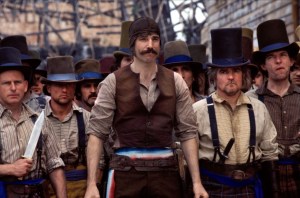 Watch Leo DiCaprio assemble toughs, rake heels, and ne’er do wells to his Irish gang of rapscallions with facial hair that looks to be tweezed! Witness a one-dimensional Leo suck the life out of the film like a black hole! See Leo become the least frightening gangster since Fredo. Watch the horribly miscast Cameron Diaz play pin-the-tail-on-an-accent! Witness as she tries to play a pickpocket with a heart of gold that falls hopelessly and illogically in love with Leo! Marvel how someone looking like Diaz would exist in a mangy slum! See the brilliant Daniel Day-Lewis upstage our stupid hero and steal every scene he inhabits! Witness one of the greatest villains in the last decade of movies! Watch Day-Lewis almost single-handedly compensate for the film’s flaws with his virtuoso performance! Admire his stove-top hat and handlebar mustache!
Witness a wonderful supporting cast including John C. Reilly, Jim Broadbent and Brendan Gleeson! Wish that they had more screen time to work with! Wonder to yourself why in all good graces this film took nearly two years of delays to get out! Speculate away!
Gangs has the sharp aroma of a film heavily interfered with by its producers. The whole exercise feels like Scorsese being compromised. Gangs is a meticulous recreation of 1860s New York that often evokes an epic sense of awe. The story has more resonance when it flashes to small yet tasty historical asides, like the dueling fire houses and the Draft Riots. But all of these interesting tidbits get pushed aside for our pedantic revenge storyline with Leo front and center. You know the producers wanted a more commercial storyline, which probably explains why Diaz has anything to do with this.
 The script is credited to longtime Scorsese collaborator Jay Cocks, Steven Zallian (Academy Award winner for Schindler’’s List) and Kenneth Lonergan (Academy award nominee for You Can Count on Me). So with all these writing credentials, don’t you think one of them would realize all of the dumb things going on with the story? The ending is also very anticlimactic and ham-fisted. Just watch as we segue from a graveyard to present day New York, all thanks to the Irish rockers of U2!
I know this much, Day-Lewis needs to stop cobbling shoes and act more often. Gangs is his first visit to the big screen since 1997’’s The Boxer. He spent part of this hiatus in Italy actually making shoes. I don’’t know about everyone else but this man has too much talent to only be acting once every five years. Somebody buy his shoes and get him a script, post haste!
Scorsese’s Gangs of New York is at times sprawling with entertainment in its historic vision and at other times is infuriating, always dragging behind it a ball and chain called “stupid revenge story/love story.” I’’m sure the film will get plenty of awards and Oscar nods in prominent categories, and this seems like the Academy’’s familiar plan: ignore a brilliant artist for the majority of their career and then finally reward them late for one of their lesser films. So here’’s hoping Scorsese wins the Oscar he deserved for Raging Bull and Goodfellas.
Nate’s Grade: C+
——————————————————
WRITER REFLECTIONS 20 YEARS LATER
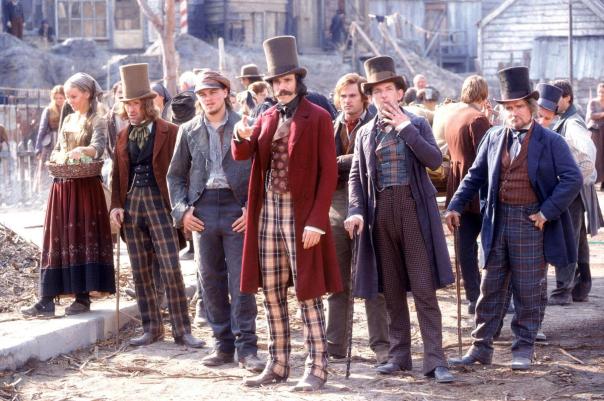
It is rare to find a movie that is almost exact in its percentage of good aspects and poor aspects. This 50/50 balance is best exemplified by 2002’s Gangs of New York. The ten-time Oscar nominated movie (and zero-time winner) was intended to be director Martin Scorsese’s epic, and twenty years later it’s still his biggest movie in size. Scorsese waited twenty years to tell this sprawling story of New York City’s early criminal underworld, so at 160 unwieldy minutes it’s no surprise how overstuffed and unfocused the finished product ended up. It’s a movie with so many engrossing historical anecdotes, amazing texture and supporting actors, and a stunning return to upper-tier acting by Daniel Day-Lewis, and yet it is hampered by Leonardo DiCaprio’s lackluster storylines, both for vengeance and for love (maybe a love of vengeance?). It’s so bizarre to watch this movie because there can be sequences where the movie just excels, and then there are sequences where I just want to sigh deeply. It’s like the movie is in conflict with itself, and you, the viewer, are ultimately the frustrated victim.
Let’s focus on the good first. Day-Lewis had essentially retired from acting and went to work in Italy as a cobbler until Scorsese appealed to him to reconsider acting. Every second this man is onscreen deserves your utmost attention. DiCaprio was the advertised star of the movie but Day-Lewis was the real star. The movie is almost a Trojan horse of sorts, luring you in with a standard revenge plot line only for you to lose all interest and root for the charismatic villain. Day-Lewis is so enthralling, so commanding as Bill the Butcher that every moment he is absent feels like an eternity. He remained in character for the duration of the shoot, spooking waitresses, and learned how to throw knives from circus performers and how to cut meat from an actual butcher. Considering the man’s famous Method-acting approach, I wonder just how many skills Day-Lewis has acquired over decades. This man could be the living embodiment of Michelle Yeoh’s character in Everything Everywhere All at Once, able to, at a moment’s notice, tap into a uniquely honed skill-set upon need. I wish that itself was a movie; Day-Lewis filming a role when terrorists invade the set, and now he has to utilize every lesson and skill of his past acting roles to defeat the baddies and save the day. He may be the most interesting man in the world. Since Gangs, Day-Lewis has only appeared in five other movies, and amazingly he has been nominated for Best Actor three times, winning twice (that averages an Oscar every 2.5 movie roles). This man has become like an acting Halley’s Comet, waiting for him to swing around again and burn brightly and then, just as suddenly, pass back into the lengthy waiting period.
I loved the historical asides in this movie. I loved the scene showing, in one unbroken take, Irish immigrants stepping off the boat into New York harbor and getting immediately signed into service, given a rifle and uniform, and lined up to board another boat to fight the Confederacy. I loved the entire character of Boss Tweed (Jim Broadbent) and how transparently corrupt he is, reminding me of Claude Rains in Casablanca. I loved him competing with the dozens of other firefighting units squabbling over turf while a house burned down to cinders. I loved him scrambling for some entertainment for the masses, and he asks Bill to gather up four nobodies that they can publicly hang, and then we cut right to these relatively innocent men saying their last words before being hanged, including one man’s young son watching. It’s an incredible sequence. The culmination of the 1863 Draft Riots is terrific and maximizes the messy nature of the movie best, communicating the many breaking points that lead to this notorious riot. The opening of this movie is wonderful and a terrific mood setter as we watch the members of the Dead Rabbits assemble for battle, with the rattling percussive score by Howard Shore (The Lord of the Rings), finally breaking outdoors and watching gangs advance like armies. I loved the narrated history of the different gangs settled in New York and their peculiarities and fixations. I loved the before and after stories of Happy Jack (John C. Reilly), who settled as a corrupt police officer, and Monk McGinn (Brendan Gleeson), a mercenary who tries to go straight through, of all things, politics. I loved that the movie reminds us that just because these people reside in the North doesn’t stop them from being racist (an archbishop is especially aghast at a black man being allowed in his church). I loved the occasional P.T. Barnum appearance. I loved the proliferation of so many tall hats amidst all the handlebar mustache-twirling villainy. I loved when the movie felt like a living documentary, soaking up the richness of the recreated history.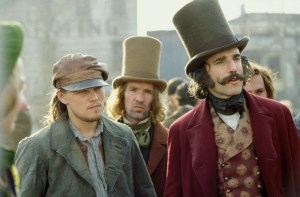
Where the movie sputters is with just about all that involves DiCaprio’s character, Amsterdam. The revenge storyline is just so boring compared to everything else going on, enough so that I think even the movie forgets about it. Amsterdam becomes Bill’s budding protege and literally saves his life at several points (if your goal is for him to die, why save the man?). He’s such a boring character because all he thinks about is vengeance, so every relationship he builds is only about how much closer to achieving his goal he can be. Amsterdam is a thoroughly dull character, and DiCaprio doesn’t come across as a credible tough guy yet, especially diminished in the large shadow from Day-Lewis’s Butcher. It wasn’t until 2006’s The Departed where I felt like he shed his boyishness fully to play a credible adult man. DiCaprio has been great with Scorsese, and this movie was the start of a decade of collaborations (four movies, two Oscar nominations), but he feels miscast here as a brooding hero given inordinate attention.
Worse is the romance with a pick-pocket prostitute played by Cameron Diaz. I pity Diaz. She’s been given the spunky love interest role in the Oscar-bait movie, which is generally underwritten and only viewed as aiding the hero’s journey of our male lead or being the offramp not taken (“Don’ get y’er refenge, Amsti’dam, ‘stead come wit me to San Fran in Calyfer’nia”). This is not a good character and she’s meant to give voice to the female underclass perspective, so it’s even more irksome when her headstrong, defiant nature gets sublimated as a rote romantic option. Diaz is also woefully miscast and my 2002 quip of her playing “pin-the-tail-on-the-accent” is accurate. I might argue that maybe dramas aren’t her strong suit, but she was great in Being John Malkovich and In Her Shoes and The Holiday, though all of those had notable comedy elements. She has the ability but this might just have been too unfamiliar for her, and so she struggles throughout with a character defined by her sexual connections to the villain and the hero.
While these characters and the performances are the biggest misses in Gangs of New York, there are other misguided or poor elements adding to that 50/50 margin. The opening sequence is great until the actual gang warfare begins and you realize that Scorsese, arguably the greatest living American director, cannot direct action to save his life. The action is choppy and lacking any of the kinetic qualities we associate with most Scorsese movies. Not even the talents of editor Thelma Schoonmaker can help save this deficit. The movie’s overall scattershot nature also makes it rather uneven and difficult to build momentum. The ending plays out like a footnote to the Draft Riots and robs the viewer of whatever catharsis could be granted from the long vengeance plot. If the whole movie has been leading up to Amsterdam’s vengeance, well robbing him of it could be meaningful, if the self-destructive nature of vengeance had been a theme. It’s not like Amsterdam has suffered at all, beyond the occasional stab wound or black eye, so him learning a lesson about the futility of vengeance would seem inappropriate and trite. I also want it known for posterity that there is an un-credited actor listed online as playing “Hot Corn Girl.”
”Twenty years later, Gangs of New York is still a frustrating and sometimes exhilarating viewing. It began a road for Scorsese that led to him finally winning his first, and still only, Oscar for directing The Departed. The sprawling nature of the movie is both a blessing and a hindrance. It allows for a wider scope and cast of characters but it also means that if you’re liking a subplot or a supporting character, you’ll have to wait your turn before they re-emerge. My old review back in 2002 perfectly sums up the majority of my feelings in 2022. There’s much to see and much to like with Gangs of New York but also too much to restrain its potential greatness.
Re-View Grade: C+
Share this:

The Female Hustler (2021)
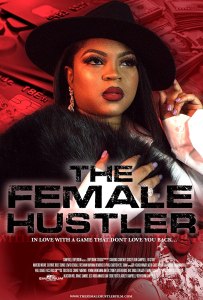
The Female Hustler is one of the top movies on the streaming site Tubi, which is available for free with minimal ad breaks. Anyone can check it out, and congrats to this Columbus, Ohio-made indie thriller written and directed by Columbus native Dom Campbell (Bad Business). He’s getting his feature film projects out into the world and a wider audience and that is definitely something to celebrate. However, I think considering a larger audience will do Campbell better, as The Female Hustler feels too inert to be more than the sum of its already familiar and genre-soaked parts.
Princess (Courtney Godsey) is struggling to save her friend from a pimp and help her brother get a better life. She’s looking for work when her chatty Uber driver, Omar (Campbell too), invites her into his multi-million-dollar identity theft scam network. From there, she rises through his ranks and becomes a threat to Omar’s leadership. We jump forward in time and Princess has become “The Female Hustler” and leading her own top-notch outfit. Omar is looking to take out his one-time protégé and regain his empire, but he might not be the only threat facing Princess.

Made for $50,000 and filmed throughout Columbus, as well as stops in Los Angeles, The Female Hustler has more than a few artistic merits. It’s a gangster genre movie that knows its audience well, which is likely why there are several close-ups of butts within minutes. Campbell recognizes that this movie is going to be less a complicated, nuanced, inter-textual crime story akin to something like The Wire and more like a knockoff of a knockoff of a blaxploitation film. I think a filmmaker knowing their genre and what makes it work is essential to playing to its strengths. The Female Hustler feels like it can walk its walk. I’ve watched enough lower-budget Ohio indies to tell when the photography is a step above, and the FIVE credited cinematographers for this movie at least deliver quality with their quantity. The grimy color grade is solid atmosphere but the crispness of the images and the use of lighting can actually be quite artistic for a lower-budgeted crime flick. The sequences outdoors at night were really good looking. I’ve watched enough barely-lit outdoor scenes that struggled to convey key info. These outdoor scenes have levels of clarity and color and even reminded me of Michael Mann’s digital video thrillers like Collateral and Miami Vice. That doesn’t mean all of the visual compositions feel dynamic; too many shots come across like they were clumsily composed on the spot. It works, but the skill of the camera quality, post-production, and/or camera operators are elevating the many perfunctory camera setups. The movie is packed with modern rap and its bouncy beats give a better sense of pacing and energy, especially when what’s happening onscreen is mostly people fronting poses. A lot of the acting is enjoyable too. I’m not going to say anybody is a star in the making, but the actors can be amusing or charismatic or intimidating when called upon, and Godsey is a worthy lead to build upon.
Where The Female Hustler doesn’t quite work is as a story with enough connective tissue and a satisfying conclusion. I was shocked that there is no ending offered at the conclusion of its 82 minutes. The entire back half of the movie is setting up a climactic confrontation between Princess and her former mentor, Omar, and they each bring their crews together for a fateful summit, and then everyone scatters, a betrayal is revealed from a supporting character, and the movie then rolls credits. I suppose maybe Campbell is intending to make this into an ongoing franchise, a move I would deem dubious given what we’ve been given in this first and so far only entry. However, given everything that transpired in this dawdling movie, there is no excuse to cheat your audience out of any ending. It’s not just that The Female Hustler has a bad ending; it doesn’t even have an ending. None of the storylines have been resolved, nobody has altered their standing, and no wrongs have been righted. It’s confounding that the movie just seemingly ran out of time after doing so little for forty-something minutes of characters making threats and bragging about their successes. The decision on the ending really harms the entire movie, looking backwards. It clearly feels like Campbell had an idea for a movie and little realization how to better develop and see it through. The concept of a woman rising to power through a criminal organization, a dangerous “man’s world” of intrigue and violence, is a fine dramatic template. Watching an underdog take out their obstacles and people doubting them is an inherently satisfying and engaging narrative. That is not really what we get with The Female Hustler, a movie too content to be a longer version of a trailer when it comes to minimal characterization, plot development, and surprising twists and turns.

I can summarize the main plot as three data points: 1) Princess is learning the criminal lifestyle, 2) Princess has become successful under Omar, and 3) Princess is even more prosperous as her own boss. You would expect there to be connective tissue and sequences that served as getting us from one station to another, scenes where Princess learned harsh lessons, or rose to the occasion and surprised her boss or herself, something to note the character development from a novice to a hard-edged leader. There are few of these sequences if any. The second half of this movie almost feels like a resume bragging about Princess’ accomplishments. It’s scene after scene of characters simply relaying the state of things. Naturally, I assumed these exchanges were to ground the audience so we could then chart later changes as what had been gained is now in jeopardy. However, this doesn’t happen and the movie is awash in wheel-spinning exposition. It’s almost comical how scene after scene involves this new character and that new character just telling Princess how good a job she’s been doing. Then we’ll have scenes of Princess nodding along. In some ways it’s reminiscent of little kids in role play, less worried about how things got to be and more about establishment (more “I’m the king of the universe,” and less how it got to be). That’s why this plot feels so bare-bones as to be mistaken as simply a larger version of its trailer. It just feels like we’ve dropped into three stagnant scenarios and stuck with repetitious scenes restating the status quo while we wait for some upheaval or climax that never actually arrives.
I felt that maybe the whole back half was leading up to the final confrontation between Princess and Omar, and when she kills her mentor, it would at least feel like she has moved forward. That’s the basic setup of this kind of story, where the mentor brings in the protégé, then they conflict and then the mentor has to be put aside permanently to fully achieve a higher level of success on their own terms, no longer held back by the definitions of the past. I just watched this basic narrative recently in House of Gucci with Lady Gaga as our change agent. That’s why I’m flabbergasted that The Female Hustler doesn’t so much end as implicitly say, “To be continued?” It doesn’t need to, especially when the movie is only 83 minutes long, especially when the movie hasn’t really done as much with those 83 minutes. We could have watched Omar, in his desperation, strike back at Princess’ empire, chipping away at her power, capturing and killing her valuable team members, and Princess having to process how far she’s willing to go to take out her competition, establishing lines only to question crossing them. It’s like Campbell has assembled his key characters for a crime epic and then merely given them place-holder dramatic scenes and rote dialogue bravado (“You should have had a crash course on me… now you’re a crash test dummy”). It’s a movie with nowhere to go in its imagination.

Why introduce members of Princess’ crew, one-by-one with flashbacks showcasing their skills, if the movie isn’t going to feature these characters outside of this scene? What does it matter to the audience knowing so-and-so is good with money or good with computer hacking if they don’t even contribute to the story afterwards? Why introduce the FBI agents following the criminal goings-on if these guys will never factor in again either? It’s like teasing future conflict that doesn’t ever materialize because Princess never feels in danger. Imagine watching a heist movie that is nothing but recounting 100 members of the crew, their unique skill set, and how they came to be recruited, and then they were never seen or heard again and the movie just ended. What would the point be? What have we accomplished moving a larger storyline forward?
This brings me to my biggest complaint with many Ohio indies, and sadly The Female Hustler appears to have fallen victim too: they are too insular and inaccessible that they seem to have forgotten about playing to an audience, thus only really prove appealing to friends and family of the production. There isn’t a thrilling story, or engaging characters, or a gritty, compelling world here to keep your attention through the overly padded 83-minute run time. I’m happy for local professionals when they can pool their efforts and actually put a movie together, but unless they want it to feel like an inside joke or something only intended for the most limited of viewing spheres, they need to constantly be thinking outside themselves and ask, “Why would anyone care?” The Female Hustler has some technical plaudits that allow it to rise above some of its fledgling peers. I think Campbell is a better director than a screenwriter and would benefit from collaborators in that field. He and his production company Emperium Studios have a spinoff with the brainy kid hacker character in the works, a TV series called A Kid Named Bug, and judging from early pictures, it looks like an entirely different tone for Campbell. Good for him. Keep hustling, young man, and remember to think about movies being intended for an audience, otherwise it’s a very expensive hobby for you and your closest friends.
Nate’s Grade: C-
Share this:

The Many Saints of Newark (2021)
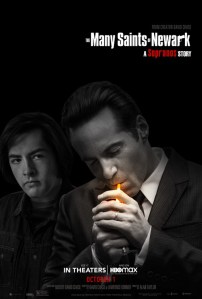 If you’re a fan of The Sopranos, I can’t say you’ll enjoy The Many Saints of Newark, and if you’re not a fan of The Sopranos, I can’t say you’ll enjoy The Many Saints of Newark. It’s a prequel set in the early 1970s, decades before an adult Tony Soprano was ruling his turf in New Jersey and going to therapy to deal with his rising panic attacks. The Sopranos was an era-defining, ground-breaking show for HBO and creator David Chase would captivate and infuriate audiences in equal measure, mixing shocking violence, twisted comedy, strange side steps, pessimistic psychoanalysis, and stubborn subversive storytelling to its very end with a polarizing finale that still elicits debate to this day (count me in the Tony-is-dead camp). It would be too much to expect a return to that world to pack in all the entertainment and enrichment of a peak TV series, but I was at least hoping that Chase’s return to his mobster magnum opus would present an engaging story that would add further insight or intrigue into the series and its characters. After two hours, I’m left shrugging like Silvio Dante and about as clueless as Paulie Walnuts.
As personal background, I watched all seven seasons of The Sopranos and eagerly anticipated its finale in 2007. I was one of those people that even questioned whether my cable had somehow gone out as the series suddenly shifted to a black screen without further warning. I enjoyed the show though I haven’t watched it since it originally concluded over ten years ago. It would be a worthy series to re-watch in our binge era, but I think I would keep my initial interpretation of the show and its self-loathing patriarch, Tony. I think over the course of 8 years Chase intended to demystify the perverse allure of organized crime and the glamor of Hollywood myth-making. I think he subversively took a familiar setup, a family man trying to fight for respect from his family and his Family, and knew many people would find themselves rooting for Tony Soprano and his underdog status and his potential redemption through therapy and self-analysis. Except, Chase’s point, is that these bad men are not complicated, they’re not geniuses, and they’re not capable of real empathy. Tony’s near-death experience and inevitable return to his old ways was proof of that. Chase created a vehicle where people sided with the anti-hero lead and he systematically provided more and more evidence that this man was cruel, impulsive, selfish, and incapable of redemption, and every episode, especially in that final season, pushed the viewer to ask, “How much longer can you look the other way? How many more excuses can you give?” It was Chase taking the appeal of mob movies and anti-heroes and testing viewer loyalty, making people question the appeal of these kinds of stories about these kinds of men. That’s my reading.
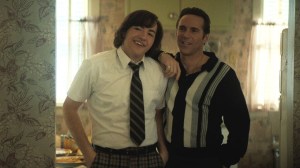 As a prequel, The Many Saints of Newark might appeal to the most diehard fans of The Sopranos who just want to have two hours more in this world, seeing these characters again one more time. Perhaps fans will thrill to see James Gandolfini’s son, Michael Gandolfini, play teenage Tony Soprano. Perhaps they’ll thrill to see Tony’s mother at a younger age but recognize some of her self-pitying and antagonistic quirks that would define her as an elderly woman. Perhaps they’ll thrill to watch Christopher Moltisanti’s father, Dickie (Alessandro Nivola), as Tony’s uncle, the man he said from the series who was so influential to him. In essence, this story, written by Chase and Lawrence Konner, is about how Tony got to be on his doomed path of crime. The fact that Tony is merely a supporting character in this tale is not a grievous structural fault. However, the fact that Dickie is such an uninteresting lead character in such an uninteresting and glum story is a significant fault.
The Sopranos was dark and frustrating too, though your emotional investment was grander, but it was rarely boring. The majority of my time with Newark was spent stooped and patiently waiting for something meaningful to happen. There were bloody murders and gunfights and love affairs, but I kept waiting for it to seem like it mattered to the overall bigger picture. Very little in this movie ever felt important, because the movie doesn’t invest in its own characters and its own story on their own terms, it merely coasts off the attached appeal of the TV show it’s meant to link up to and coasts off the good will of its audience. If you removed the names of the characters, thus denying its creative inheritance, then I doubt even the most ardent fans of mob movies would find that much to appreciate here. If this wasn’t a Sopranos movie, it wouldn’t have gotten this platform and attention, and that seems less a reason to run with an underdeveloped story with a dull protagonist stumbling through mundane mob cliches.
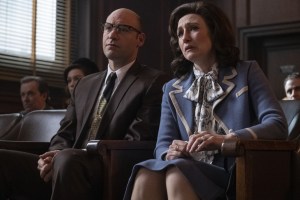 If Dickie is meant to be so influential, I don’t understand the appeal. I guess he’s slightly more emotionally stable than Tony’s father, played by Jon Bernthal, but that’s not saying much. Dickie violently confronts his father, “Hollywood Dick” (Ray Liotta), over his abuse of his young new bride from Italy, Giuseppina (Michela De Rossi), to defend her. That’s good? But when Dickie takes up an affair with the same woman, his stepmom, he proves just as depressingly violent. That’s bad. The problem is that Dickie is not a complex character to hang a movie upon. I thought there was going to be a slow temptation to begin an affair with his new stepmom, but that happens far too early, which places her as simply the “goomah” on the side he retreats to for sexual gratification and empty promises of building a life. She goes right from being a potentially interesting character, a woman with agency and danger, to another mob movie cliché, the arm candy waiting on her bad man to patronize her. Dickie says that his wife has had trouble conceiving, so I thought maybe this new stepmom would be revealed to be Christopher’s actual birth mother. That’s why she was here in this story. Nope, yet again this possibility is dismissed early. The Many Saints of Newark frustratingly takes every tedious story detour it can when presented.
The movie is set primarily in the late 60s and early 70s in Newark, barely tackling the riots of 1967 to use them as a cover for a storytelling choice for Dickie. The entire subplot featuring the struggles of the African American community feel tacked on to this movie, as if Chase is responding to criticisms that his series wasn’t diverse enough. The rise of Harold (Leslie Odom Jr.) as a gangster is given such little significance. He begins as an employee of Dickie’s and then becomes a rival, but this complicated relationship isn’t played like it’s complicated. Every time Odom Jr. (One Night in Miami) appeared I kept hoping that finally the movie was going to give him something to dig into, to really explore this perspective in a meaningful way. The rivalry between Harold and Dickie doesn’t even feel significant because both of these men are criminally underwritten. The Newark riots are played so incidentally and without consequence. Why begin to explore racial unrest and police brutality if you’re just going to ignore it after twenty minutes of movie?
 As a movie, The Many Saints of Newark did not work for me. As a Sopranos prequel, The Many Saints of Newark did not work for me. I had some mild amusement and intrigue with moments like Corey Stoll going full force in his impression of a young Uncle Junior, with Vera Farmiga chewing the scenery as Tony’s mother, and the impeccable resemblance of Gandolfini to his late father. I enjoyed the weirdness of Liotta playing twin brothers. I enjoyed the period appropriate production values and music choices. Unfortunately, it doesn’t add up to a vital experience that lends better understanding and insight into the Sopranos universe. Again, some fans may just be happy enough to exist in this universe for two more hours, to soak up even the most superfluous of details (I know I would be for my TV show favorites). That’s fine, but for me, what’s on screen barely resembles the daring and complex characterization of the series. Maybe a movie was always set up to fall short but this one falls short even as a mediocre mob movie.
Nate’s Grade: C
Share this:

The Tax Collector (2020)
 If you had told me that The Tax Collector was a parody of writer David Ayer’s hyper masculine, lurid, crime-ridden jaunts into the slums, police stations, and domestic lives of criminals, I would have completely believed you. We’ve been here before, with Ayer’s End of Watch, Street Kings, Harsh Times, Dark Blue, Training Day, even the fantasy-mingled Bright looked like an Ayer battleground of gangs, crooked cops, hypocritical politicians, and godly family men who someone can justify the heinous acts of violence they do. This time Ayer is following a pair of gangsters that make their monthly rounds to collect their dues from the other gangs. Their big boss, The Wizard, is rotting in jail, and a rival gangster, who also is literally a cannibalistic Satanist, takes the opportunity to make a violent power play. First off, this is nothing you haven’t seen before. It’s more bad men barking threats at those they feel are underneath their authority, then lots of driving banter meant to endear us to these bad men, and then professions of how much they love family or God. With the main villain being an avowed occultist, the battle-line takes on a biblical sense or good versus evil. The problem is that I didn’t care about a single character nor did I find them interesting. For a solid hour, we’re watching David (Bobby Sotto) and Creeper (Shia LaBeouf) go about their collections, argue about theology and diet, and reminisce. These guys are not interesting and more place setters for more compelling characters to be developed in later drafts that never took place. There’s a paucity of thrills and action and general tension to be had here. It’s shoddily paced. When things do pick up and The Tax Collector becomes a grisly revenge tale, the villains are so easily toppled, and in such unmemorable ways, that you understand why Ayer was putting all this off. During a bathroom brawl, the action stops for a pointless flashback to see Bobby in his martial arts class, but when he comes back he smashes a guy’s head with a toilet cover. That wasn’t a martial arts move he learned. It’s strange moments like that where The Tax Collector feels more like an old, incomplete screenplay Ayer had locked away in a drawer, a rough collection of his bombastic machismo crime thriller tropes that barely tops 80 minutes. The only passion on display is from LaBeouf, who reportedly got an entire chest tattoo for his character except his exposed chest is never clearly seen once on camera. I don’t even know why he wasn’t the main character. Bobby is boring as the humdrum hoodlum who wants out of the family business (Michael Corleone he is not). A late twist is meant to be revelatory but, beyond being predictable by the economy of characters, signifies little for Bobby. The Tax Collector is awash in the same grimy gangland stereotypes that have populated most of Ayer’s professional work, but rarely has his moral ambiguity, nihilism, and envelope-pushing “rawness” felt more like self-parody. This is a thriller bled dry.
Nate’s Grade: C-
Share this:

Capone (2020)
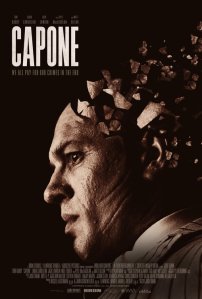 In 2012, after the found footage superhero movie Chronicle became a surprise smash, director Josh Trank was at the top of Hollywood’s hot new director list. Within three years, he was a pariah. The production behind 2015’s Fantastic Four was so troubled and fraught with reshoots, creative clashes, and secret edits that Trank was labeled as a malcontent who couldn’t be trusted with the big tentpoles. He was unceremoniously dumped by Star Wars and seemed to become the latest casualty of an industry that eats its own promising wunderkinds. I’d highly advise people read a very illuminating in-depth article from Polygon on Trank’s troubles and triumphs, including his insights on where Fantastic Four went awry. Trank spent years honing his next script, an Al Capone biopic of his late years, and waiting for star Tom Hardy to be available. Some critics have called Trank’s comeback movie a self-indulgent, surreal, campy mess, and indeed while I was watching I had visions of Mommie Dearest. However, that wasn’t a bad thing, at least for me. I cannot call Capone an unqualified success but I appreciated the bizarre lengths Trank goes to make a biopic that mocks and tears away the mystique of its macho idol.
Capone (Hardy), or “Fonze” as he’s referred to primarily, has been released from his prison sentence for tax evasion and living the rest of his days on his Florida estate. He’s suffering dementia from the effects of neurosyphilis, a condition he contracted as a teenager. His wife, Mae (Linda Cardellini), tries her best to keep him from harming himself or others. The F.B.I. is still listening, still watching, and newspaper reporters are still hiding along the bushes. Capone struggles to keep his mind from being completely lost but will lose, dying at age 47.
 First off, I think Trank’s initial creative approach is a genius way to explore a biographical film, running through the major points of a subject’s life in a hallucinatory, non-linear fashion that mixes fantasy and reality. From that standpoint alone, Capone is never boring because it can quite literally go anywhere as Capone retreats further and further into his fraying mind. That’s such a visually stimulating way of telling a story while also presenting a chaotic impression of a character’s perception, locking us into an empathetic experience with an unreliable guidepost. I think that alone makes Capone worthwhile, as does Hardy’s go-for-broke performance (more on that later). It’s a weird fever dream of a movie, constantly shifting between past and present, fantasy and reality, and I think this perspective adds much to the film’s appeal and ambition. One second the man is sitting down with FBI agents and the next he’s wandering a ballroom to go onstage with Louis Armstrong for a New Year’s Eve duet. It gets pretty crazy and that’s good.
I was wondering if Trank would glorify his title subject. I only had to wait for the first twenty minutes where Al Capone literally craps himself twice for my answer. This is not Capone at the height of his fearsome power where he ruled the Chicago ganglands; this is a decrepit, doddering middle-aged man, equally helpless and reckless, unable or unwilling to even control his bowels. He is rotten from the inside out, a vile human being whose own filth is leaking out to smother him. Gangster cinema has often glamorized the mafia and criminals as unorthodox folk heroes, like in 1967’s Bonnie and Clyde and the more recent Public Enemies in 2009. So, with all of that said, I enjoyed that Trank took a legendary figure of the criminal underworld and totally undercut his machismo power. He strips away the romantic notions of the man’s life. This isn’t the man on the pulpy radio dramas, this is a guy who craps the bed. Martin Scorsese’s The Irishman got plenty of acclaim for spending its final half-hour showing where a lifetime of crime leads its elderly protagonist, a sad, lonely life without any lasting personal benefit. Trank takes that much-heralded final half-hour and turns it into an entire 100-minute movie. I wish more movies would do this to deserving subjects.
 The biggest draw of the film is Hardy (Venom, The Revenant) who never met a film role he couldn’t grumble, mumble, growl, or unleash a funny voice for. To say he is committed does not to do the man justice. He is not only chewing scenery; he is rapidly inhaling it. He is playing to the cheap seats with this role, bloodshot eyes bulging out of his head with thousand-yard stares of confusion and paranoia. He’s barely intelligible at times, and that’s before he has a stroke that further impairs his ability to communicate. He can also be hard to recognize under layers of pock-faced makeup. The acting-with-a-capital-A style is so enthralling but perhaps not for the exact intended reasons. It’s fascinating to watch a highly respected, Academy Award-nominated actor just indulge every over-the-top impulse and tic, where each small decision feels like generating the question, “Really, you went with that choice?” The batty performance brought to mind Faye Dunaway’s breathtaking performance in 1981’s so-bad-it’s-good Mommie Dearest as Joan Crawford (she thought she was going to in awards for that performance!). It’s a level of camp with no earthly reservation, and it’s rare to see from such a famous actor, and I was spellbound. If you enjoyed Mommie Dearest for its unintentional camp hilarity, then Capone might be just for you.
While at turns confounding and fascinating, Capone falls short when it comes to examining the inner life of its title character. I assumed with the conceit of losing touch with reality that Capone would be experiencing some reckoning over his past misdeeds, and this happens to a very mild, opaque degree. There are some supporting characters that turn out to be, surprise, ghosts that Capone had killed in his past. But they stop there, failing to provide an opportunity for Capone to feel remorse and they don’t even push him on being guilty. You would think a man with a sizeable list of dead people he’s responsible for would be haunted by more ghosts from the past, forcing him to reconcile his idea of himself with his tortured deeds. Capone is also seeing images of a young boy that is meant to represent his poor youthful upbringing, but he doesn’t interact with this past representation other than look uncomfortable in his presence. The movie desperately needed more introspection with this man examining his sins and legacy and validations. A bad man coming to terms with the end and what it means has great dramatic potential. A bad man who bumbles around his luxurious home, sees some ghosts, and continues bumbling has less so. That’s where Trank’s screenplay really falters because it doesn’t push harder. Capone is too caught up in upending the image of Al Capone rather than digging deeper into the man himself and his inherent end-of-life drama.
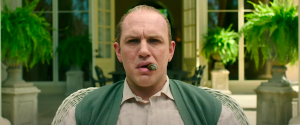 The supporting characters also do little to offer alternative sides to better know Capone. His long-suffering wife is nicely played by Cardellini (Green Book), brought to tears watching her strong man waste away, calling her an angel one minute and forgetting her face the next, but we don’t learn more about the central figure through her. He started poor. Got power. Now he’s incompetent (and incontinent). That’s it. There’s room for more here than a man physically and mentally falling apart. What about the other people in his life? What about plans for succession from those who spent their lives in his service? There’s even a storyline of a lovechild trying to get in contact with him and the movie miraculously does nothing with this abandoned son to add further dimension and insight.
I would be lying if I said I wasn’t laughing throughout Capone, though I think Trank is intending some degree of mockery with his biopic that plumbs the depths of the strange and grotesque. There’s a guy who gets stabbed in the neck maybe 50 literal times. There’s Capone shooting alligators, convinced they’re conspiring to munch on his testicles. There’s Capone applauding and singing along to The Wizard of Oz and arguing for the sake of the Cowardly Lion. There’s an ongoing subplot about different supporting characters trying to somehow sift the location of Capone’s hidden millions from his broken mind like a treasure hunt. There’s an entire sequence where Capone, with carrot-as-cigar in mouth, marches around firing a golden Tommy gun while his saggy adult diaper droops around his waistline. In short, there’s more than enough material here to enjoy on a strictly ridiculous, pulpy, heightened to the point of breaking campy variety. Hardy is fully unrestrained, for better and worse, but he’s always watchable, as I would say of the film itself. Even if it feels ultimately superficial and underdeveloped, Trank’s Capone is a mess of bad taste about a bad man going through some bad times and it just might be the good kind of bad.
Nate’s Grade: C+


 nathanzoebl
You must be logged in to post a comment.