Blog Archives
V/H/S (2012)
 The found footage subgenre seems ripe for overexposure at this point. Just this year we’ve had a found footage party movie, a found footage superhero movie, a found footage cop movie, and this week will open Paranormal Activity 4, the latest in the popular found footage horror series. I understand the draw for Hollywood. The movies are cheap and the found footage motif plays into our culture’s endless compulsion for self-documentation. There are definite benefits to the genre, notably an immediate sense of empathy, a sense of being in the fray, and an added degree of realism. There are plenty of limitations too, notably the restrictive POV and the incredulous nature of how the footage was captured. With that being said, I think the people behind V/H/S finally found a smart use of this format. V/H/S is an indie horror anthology that offers more variety, cleverness, and payoffs, than your typical found footage flick.
Normally, found footage movies consist of 80 minutes of drawn out nothing for five minutes of something in the end. Usually, the payoff is not worth the ensuing drudgery of waiting for anything to happen. Watching the Paranormal Activity movies has become akin to viewing a “Where’s Waldo?” book, scrutinizing the screen in wait. V/H/S has improved upon the formula by the very nature of being an anthology movie. Rather than wait 80 minutes for minimal payoff, now we only have to wait 15 minutes at most. I call that progress. I haven’t seen too many found footage films that play around with the narrative structure inherit with a pre-recorded canvas. I recall Cloverfield smartly squeezing in backstory, earlier pre-recorded segments being taped over. With V/H/S, this technique is utilized once and it’s just to shoehorn in some gratuitous T & A. Plus, the anthology structure allows for a greater variety. If you don’t like some stories, and chances are you won’t, you know another one’s just around the corner.
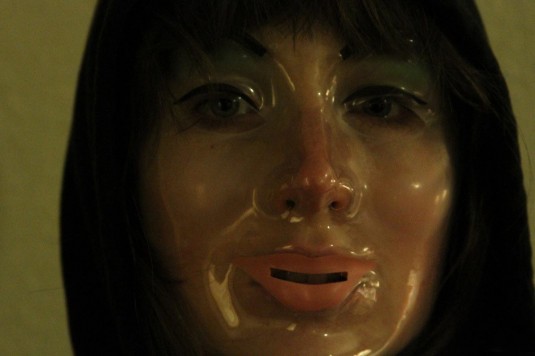 For my tastes, the stories got better as the film continued. I was not a fan of the first few stories. The wraparound segment (“Tape 51”) involves a band of delinquents who are hired to retrieve one VHS tape in a creepy home. The guys are annoying jackasses, and our opening image involves them sexually assaulting a woman and recording it to sell later, so we’re pretty agreeable to them being killed off one by one inside the creepy home. I just don’t know why anyone would record themselves watching a movie. It’s not like it’s Two Girls One Cup we’re talking about here. I found the wraparound segment to be too chaotic and annoying, much like the band of idiots. It ends up becoming your standard boogeyman type of story and relies on characters making stupid decision after stupid decision. Why do these idiots stay in the house and watch movies? Why do these people not turn on the lights?
The first actual segment (“Amateur Night”) has a solid premise: a bunch of drunken frat boys plan to make their own porn with a pair of spy glasses. They bring the wrong girl back to their motel room and get more than they bargained for. Despite some interesting commentary on the male libido (interpreting a woman’s spooky actions as being sexually aroused), this segment suffers from a protracted setup. There’s a solid ten minutes of boys being boys, getting drunk, that sort of thing. And when the tables are turned, the spyglasses lead to shakier recording, which is odd considering they are pinned on the guy’s nose. The horror of the ending is also diminished because it’s hard to make sense of what is literally happening. The weakest segment is the second one (“Second Honeymoon”), which is surprising considering it’s written and directed by Ti West, a hot name in indie horror after The Innkeepers. West’s segment is your standard black widow tale, following a couple on their vacation to the Southwest and their home movies. However, a stalker is secretly videotaping them while they sleep. Borrowing from Cache, this is a genuinely creepy prospect, and the sense of helplessness and dread are palpable. It’s surprising then that West concludes his segment so abruptly, without further developing the stalker aspect, and tacks on a rather lame twist ending that doesn’t feel well thought out. “You deleted that, right?” says one guilty character on camera washing away blood. Whoops.
The second half of V/H/S is what really impressed me, finding clever ways to play upon the found footage motif and still be suspenseful. The third segment (“Tuesday the 17th”) begins like your regular kids-in-the-woods slasher film. The very specific types of characters (Jock, Nerd, Cheerleader) are set for some frolicking when they come across a deranged killer. However, the slasher monster is a Predator-style invisible creature that can only be seen via the video camera. When recorded, the monster creates a glitch on screen. I think this is a genius way to cover the biggest head-scratcher in found footage horror: why are you still recording? With this segment, the video camera is the savior, the protector, the only engine with which they can see the monster. The fourth segment (“The Sick Thing That Happened to Emily When She Was Younger”) is shot entirely through Skype conversations on laptops. Emily is convinced her apartment is haunted and seeks support from her boyfriend, away on business. This segment’s co-writer and director, Joe Swanberg, is more known for being the mumblecore king than a horror aficionado, but the man makes scary good use of the limitations of his setup. The story might be a bit hard to follow, especially its ending, but there are some great jolts and boo-moments. There’s even a fantastic gross-out surprise as Emily shares her own elective surgery/exploration.
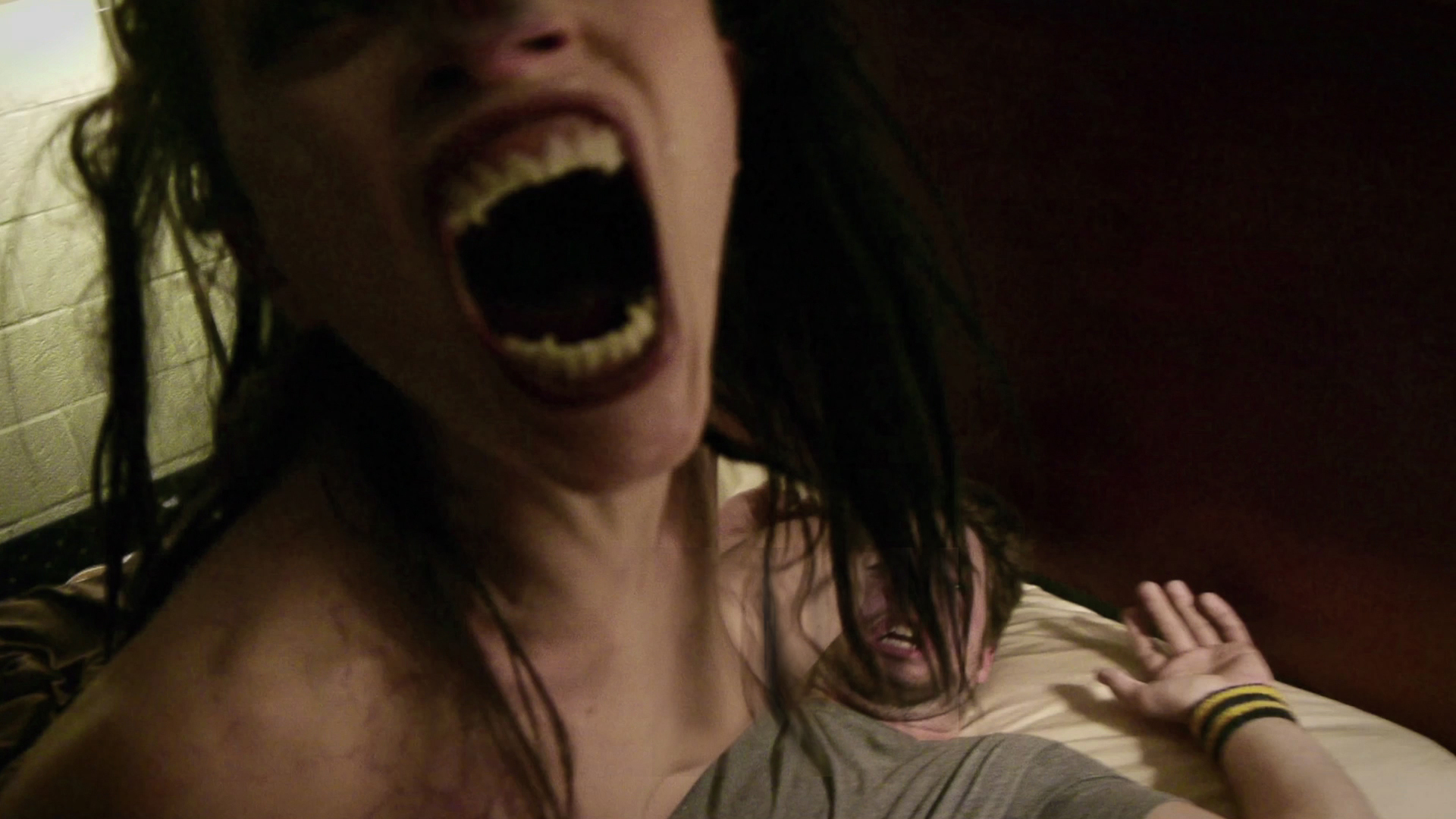 But it’s the last segment that takes the cake, ending V/H/S on a fever pitch of action. The wraparound segment isn’t even that, since it ends before the final segment, “10/31/1998.” It’s a haunted house story about a group of guys who stumble into the wrong house on the wrong night. Initially they think the human sacrifice in the attic is part of the show, but then weird things start happening like arms coming through walls and door knobs vanishing. This segment is a great example of how effective atmosphere can be aided by smart and selective special effects. When the madness hits the home, it feels just like that, and the rush to exit the house is fueled with adrenaline. You don’t exactly know what will be around the next corner. The CGI effects are very effective and the lo-fi visual sensibilities give them even more punch. The frenzied chaos that ends “10/31/1998” would be apt for a feature-length found footage movie, let alone a 15-minute short. It’s a satisfying climax to a film that got better as it went.
With all found footage movies, there’s the central leap of logic concerning who assembled this footage, for what purposes, and how they got it. With movies like the abysmal Apollo 18, I stop and think, “Why do these people assembling the footage leave so much filler?” V/H/S doesn’t commit a sin worthy of ripping you out of the movie, but when it’s concluded you’ll stop and ponder parts of its reality that don’t add up. The very idea of people still recording onto VHS tapes in the age of digital and DVD seems curious, but I’ll go with it. Several segments obviously had to be recorded onto a hard drive; the Skype conversations would have to be recorded onto two perhaps. So somebody transferred digital records… onto a VHS tape? And it just so happens that this tape then got lost.
While inherently hit-or-miss, V/H/S succeeds as an anthology film and generates new life into the found footage concept. Not all of the segments are scary or clever, but even during its duller moments the film has a sense of fun. There’s always something new just around the corner to keep you entertained, and the various anthology segments give a range of horror scenarios. The lo-fi visual verisimilitude can be overdone at times, but the indie filmmakers tackle horror with DIY ingenuity. I don’t know if anything on screen will give people nightmares, but it’s plenty entertaining, in spots. V/H/S is an enjoyable, efficient, and entertaining little horror movie just in time for Halloween. If you’re going to do a found footage movie, this is the way to do it.
Nate’s Grade: B
Share this:

End of Watch (2012)
 David Ayer has written seven movies and directed three, and almost all of them have followed the Los Angeles police department. The man wrote a character that got Denzel Washington a Best Actor Oscar, and from there it’s been all cops all the time, some dirty, some noble, but all residing in the LAPD. I suppose Ayer knows what he does best and is sticking to his wheelhouse. End of Watch is Ayer’s newest tale featuring one of the protagonists recording his activities on the force to put together for a documentary. And with that flimsy excuse, we have ourselves the first found footage cop drama.
Officers Brian Taylor (Jake Gyllenhaal) and Mike Zavala (Michael Pena) are two young police officers patrolling the mean streets of Los Angeles. Rather than dark and brooding, these guys are often quick with a joke and get along peachy. That doesn’t mean they don’t take their jobs seriously, and we watch them take down suspects, save children from burning buildings, and discover horrible mass slayings by Mexican cartels. During their off duty time, Taylor is dating a spunky woman (Anna Kendrick) whereas Mike has a wife (Natalie Martinez) and children of his own. The guys are honorable cops and run afoul of the local gang leader Big Evil (Maurice Compte), a man with connections to those dangerous cartels.
 The best reason to watch End of Watch is the ebullient yet natural chemistry between Pena (World Trade Center) and Gyllenhaal (Source Code). These guys really come across like partners that have been through thick and thin. Their interaction is arguably the best part of the movie, watching two guys who defy cop movie stereotypes. First off, neither is naïve or world-weary; they’re idealistic but grounded. Both men get to be complex individuals, each funny, each warm, each flinty when called upon, each dealing with the heavy toll of protecting and serving, each an honorable police officer trying his best. These guys feel like real-life partners and not just Movie Partners, and that is a great testament to Ayer’s script and the performances by Pena and Gyllenhaal. I also appreciated that the guys are presented as co-leads; I would have assumed Gyllenhaal was going to anchor the movie. These guys really love one another and you understand their camaraderie. The actors went on ride alongs for a solid five months before shooting, and that must have been an invaluable tool for an actor because these guys are so natural with one another. They can bicker but it’s mostly playful, and the dialogue feels authentic and crisp. The performances are measured and meaty and we emotionally invest in these characters and fear for their welfare. These guys are great together and so you worry that we may not see them both live by the end credits.
These guys are such pals, you’ll start to ask yourself, “Hey, shouldn’t there be like some conflict some time?” For almost tow full acts, we are immersed in police procedure details, routines, mundane realities, with the occasional burst of action. Except it takes until the very end of Act Two before there’s a real conflict, one that lasts beyond an individual sequence. These guys are so chummy, so lovingly buddy-buddy, so there’s no tangible conflict between the two of them. The LAPD seems mostly supportive despite some paranoid warnings that do not bear fruit. Even the local thug, Big Evil, doesn’t prove to be an active threat until the Mexican cartel pays him to kill our lead cops (the cartel also wants an expense report of the hit). But this threat doesn’t emerge until well into the film, so much so that the plot feels rather aimless, like we’re on one eternal ride along with our boys in blue. It’s a good thing I enjoy their company.
Here’s why I speculate why Ayer chose to tell his story through the guise of found footage. I don’t out rightly see it as a cash grab, Ayer’s attempt to repackage something old with something new (that is quickly becoming something old). Ayer is not particularly dogmatic about the found footage approach; often we’ll get first-person angles, gun POV angles, or just general angles that could not have been captured through the found footage mechanics. I think Ayer chose this route because he felt it afforded him greater latitude to craft a realistic depiction of the daily grind of the embattled LAPD officer. This approach allows Ayer more freedom to flout cop movie clichés we’ve become well accustomed to. There are no wildly mismatched partners, no long gun heroics, and no long-suffering personal relationships. Though I find it extremely unbelievable that the LAPD would be so casual and blasé about an officer recording his activities and internal workings. That seems like an open invitation for a lawsuit or a subpoena especially if a criminal attorney gets wind. To a degree, the found footage edict works and the authenticity of End of Watch is never in question, but it also seems like Ayer’s convenient go-to excuse when you’re looking for that missing conflict. It is a fictional movie after all.
 The visceral nature of the camerawork, and the extra emotional attachment we feel for the leads, makes for some pretty nail-biting suspense, though only after the cartel issues their hit. The movie teases you with a gutsy ending, one that exemplifies the men’s sense of brotherhood in arms and the fatalistic prospect of protecting the City of Angels. It felt fitting and poignant. I was surprised that Ayer was taking an audience in this direction… and then he didn’t. The film chickens out and gives us a miraculous plot turn that also reinforces the Hollywood pecking order of racial significance. It’s a misstep and one that costs End of Watch from being more emotionally resonant.
As a side note, I’m not a prude when it comes to the use of salty language. Films that reflect certain realities should not curtail the way people genuinely speak. Some people just have filthy mouths. However, the profanity level in End of Watch is off the chart, notably concerning the character of Big Evil. I am dead certain that every second or third word out of this guy’s mouth is some variation of the f-word. If you catalogued all of his dialogue, I bet over 75% of total words would be profanity. It starts to get ridiculous and even funny when you hear nothing but the same three words during an angry outburst. And this is no David Mamet or Kevin Smith poetic composition of vulgarity and the profane; this is just lazy dialogue, like Ayer told his actor that, when in doubt, let loose a litany of f-bombs. Perhaps Big Evil would be less evil if people just helped him with his limited vocabulary.
End of Watch is an involving police procedural with some gripping moments of tension thanks to the stellar performances from its pair of police officers, Pena and Gyllenhaal. Ayer’s found footage motif gets some visceral excitement out of an old story, but what really sucks us in are the emotional bonds we’ve forged with these two men over the course of an hour. That makes the danger feel very dire. The movie feels like a bromance at times. I wish Ayer hadn’t pulled back from his more dour ending but it’s not enough to spoil what is an above average genre film with a spiffy new visual polish. I don’t know how many films Ayer can keep cranking out about the LAPD but as long as he pays due attention to character, and gives us the occasional break from the ubiquitous antihero with a badge, then at least he’ll keep making compelling genre cinema.
Nate’s Grade: B
Share this:

Project X (2012)
 We’ve all had the fantasy of throwing an awesome party, a revelry of youthful exuberance, and cutting loose. The house party is a teenaged rite of passage. Project X is produced by Todd Phillips, the director behind The Hangover as the advertising would like to burn into your associative memory. You’d expect some wacky comedy and boorish behavior from boys living out their wildest fantasies. I felt a deep sadness watching the events of Project X. I won’t bemoan it as evidence of the decline of Western civilization but it’s certainly not helping matters.
Thomas (Thomas Mann) is a gawky, awkward, nice kid who’s celebrating his 17th birthday. His upper middle-class parents are going away for the weekend and trusting their only child with care of the home. Naturally, Thomas’ best friends, Costa (Oliver Cooper) and JB (Jonathan Daniel Brown), take this opportunity to stage a party. They invite all the popular girls at school, spread word via radio and Craigslist, and hundreds descend on Thomas’s family grounds with the intent of partying harder than Andrew W.K. Kirby (Kirby Bliss Blanton), long a friend of Thomas, is crushing on the guy and he doesn’t realize it. His attentions are on Alexis (Alexis Knapp), the school’s unattainable Hot Girl. As Costa clarifies, this party is meant to be a game-changer for their social lives. They’re supposed to reach for the stars tonight, which means groping strangers and puking in the bushes. Aim high, boys.
 This did not have to be a found footage movie, and Project X would have been better if stripped of this tedious gimmick. By making this a found footage movie, it roots the quickly escalating madness in a reality that cannot sustain it. The film’s credibility goes out the window without a thought. A wild party that rages out of control is a believable setup, but when you toss in so many out-of-nowhere outlandish elements, including an angry midget, a crazed drug dealer armed with a flame thrower, a high-story zipline (who put that there?), and the groundswell of a consequences-free riot, you strain all sense of believability. I also found it unrealistic how blasé people reacted to the presence of a camera in certain situations. I think people at a school might not want to be recorded for who knows what purpose. But easily the scene that stands out is a locker room with a bunch of guys in various states of undress. Seriously, not one character, not even a minor character, raises any issue with someone casually recording a place where men are undressing. I’ll grant the exhibitionist antics of the party (the courts of our land have ruled that flashing is not considered an “invasion of privacy”). Then there are also the lighting changes at Thomas’ house. All of a sudden certain rooms have very distinct, stylish blues and greens for lighting. Where did that come from? Did someone find a colorful bulb? These are the dumb questions that arise under the belabored pretenses of a found footage movie. There’s no reason this movie shouldn’t have ditched the found footage gimmick and simply played it straight.
Congratulations Project X, for it was you who cemented the death knell of my youth. I don’t have anything against party movies (Superbad is great, Can’t Hardly Wait ain’t bad either) and I don’t shrink from the presence of ribald, juvenile, inappropriate and/or illegal underage activity. Dazed and Confused is one of my favorite films of all time and that movie is nothing but kids getting drunk and stoned. But lo, Project X was the first party movie I’ve watched where my sympathies lay not with the party animals but with the annoyed neighbors and parents. Maybe it’s a sign of getting older; maybe it’s just the culmination of my upstairs neighbors playing heavy-bass electronica music at all hours of the night when I have to work in the morning. Or maybe it’s just a clear indication that this movie fails on any level to make me care about these moronic, annoying, unbearable characters. So when these twits are off celebrating the wanton hedonism unleashed in their backyard, I thought of the neighbor with a baby who just wants his kid to sleep. Is that an unreasonable request? The man isn’t presented as some incensed, dangerous madman, and what does he get for daring to question the noise level of this party? The man gets tazed. That’s what you get for expecting anyone to possibly be moderately considerate about their actions affecting others (I sense a God Bless America-style rant approaching). I just found this whole thoughtless, empty exercise to be exploitative, mean-spirited, and exhausting. Am I that old or is this movie simply that bad?
 You want to know how flimsy the plot is for this monstrosity? You could have written the entire thing on a napkin. Why bother with characters or story? This movie is seriously like someone took the Smashing Pumpkins’ music video for “1979” (possibly the best cruising song) and expanded it to feature length. Even at barely 80 minutes, this is one creaky movie that struggles to pad out its running time. The party mostly consists of two-second shots of people jumping around, girls shaking their asses, people smashing things, people vomiting, and the occasional boob flash to remind you how similar in tone the film is to the sleazy Girls Gone Wild series. That’s at least half the movie, if I’m being generous. What did I just describe? A music video! A music video is composed of, often, nonsensical images that serve little purpose other than to stimulate. There are plenty of segments that are nothing but pounding music and people dancing. If you buy the soundtrack (and why wouldn’t you since it’ll be ringing in your ears for days) and do some pseudo-inebriated dance movies, you’ve basically recreated the plot in your own living room. Project X is a music video writ large, not just in its style but in its single-minded execution to do nothing but string a series of rapid imagery. Good Lord, if this stuff made the final film what was left on the cutting room floor?
Project X also has the ignoble distinction of making me loathe a character not just in his very introduction but also in the very opening SECOND of the film. The first second I got of Costa told me everything I needed to know. His smarmy, irritating, faux “gangsta” machismo persona was enough. I knew this guy was going to be a douchebag. One second in, Project X, and you’ve already dug yourself a pretty significant hole. The Costa character is unfunny from beginning to end. There is not a single joke, a single one-liner, a single reaction of his that made me laugh. He is an insufferable character and a transparent combination of Superbad’s McLovin’ and Jonah Hill’s character. I hated every wretched second his face was onscreen. The other two friends didn’t make me want to punch my TV, which was the only positive thing I could say about either of them. Thomas is your typical mild-mannered, awkward teen (read: the Michael Cera role) who gets to cut loose and grow a spine of sorts. He has no personality and I couldn’t work up the effort to root for him. I can’t really say anything about JB because he adds absolutely nothing to the movie. He has no personality as well, other than his girth and desire to bed some ladies. It’s like the movie forgets he even exists. I know I did.
I know that making a feminist diatribe against this movie is a waste of time but indulge me for a moment, dear reader. I understand that this entire enterprise is untamed male fantasy and wish fulfillment. I don’t have a problem with this notion, on the surface. But why do all the women of this fantasy have to be reduced to, in Costa’s words, “drunk bitches” and “hos”? The women of this universe, which is supposed to be our own remember, are merely walking toys ready to be exploited for male entertainment. We don’t get characters; we get attractive women in great states of inebriation and exhibitionism. It’s ridiculous the amount of older, attractive women who would be enticed by… a high school party? Don’t these people have college parties they’d rather be attending? At one point JB identifies one of the girls at the party as a woman who posed for Playboy, because that’s all women are good for in this movie. Why would Alexis agree to bed Thomas just because it’s his birthday? We see no connection, and he’s certainly not a wealth of charisma. It doesn’t matter. Women are to be ogled. They are decorative furnishings.
 Then there’s the aggravating romance between Thomas and his best girl friend, Kirby. First off, if this is the quality you get with girl-next-door types then I am moving to that neighborhood. This woman is a bonafide hottie, so when the guys make dismissive comments that Kiby is just one of the guys, I question what criteria these men have for female beauty. Any of these guys would be lucky to ever interest a woman of this stature. And then there’s the fact that she so easily forgives Thomas after he makes an ass of himself and tries to hook up with another girl hours after sleeping with Kirby. It’s like the movie advertising that you, American teenage males, can have it all and with a minimum of humility and empathy.
I guess the real question is whether any of this gratuitous debauchery is fun. The whole movie runs on the caffeinated, fist-pumping highs of unchecked male ego and fantasy, but it’s trying so hard to be the most epic party ever, and that’s the only ambition the film has. This is one sleazy and off-putting movie. Even some of its egregious faults could be partially forgiven if the movie was any funny. It just isn’t. It’s loud and profane and anarchic but without interesting, relatable, or even defined characters, and the plot is so feeble I could sum it up thusly: Nerds throw party. Shit happens. They get to be cool. In between those momentous plot points is a lot of incoherent imagery of people dancing, women being objectified (by the camera, the filmmakers, the audience), and pounding music. The plot is so simplistic, so plainly an afterthought, that the entire hedonistic festivity reeks of lazy exploitation. Congratulations, Project X, you’ve turned me into my parents. Now get the hell off my lawn and get a job and make better movies!
Nate’s Grade: D
Share this:

Chronicle (2012)
 I’ve learned a valuable lesson when it comes to genre movies – do not trust the marketing department of 20th Century Fox. Every promotional clip, trailer, TV spot, even the notion that people were flying around in cities as an attempt at viral marketing, it all coalesced into making me turn up my nose at Chronicle. It just looked like a bad movie. Then the critical reception was rather glowing and I took a chance, pleasantly surprised by the skill and execution of the flick. What made this thought-process notable was that it was almost an exact repeat of what I went through with Rise of the Planet of the Apes. Every piece of promotion stoked my disinterest into outright loathing, and then after the positive press I saw the movie, begrudgingly, and was floored. I guess when it comes to future 20th Century Fox genre releases, I’ll try and figure out my reaction and then turn that upside down. If a movie looks like utter crap, then under this new value system it must be good. I’m sure my new cinematic equation will prove me wrong as soon as the latest Eddie Murphy family vehicle terrorizes theaters (“This fall, Eddie Murphy is… The Governor. And his political opponent? His wife! Also played by Eddie Murphy”). In short, the marketing department at 20th Century Fox sucks but Chronicle does not.
Chronicle is the chronicle (heh) of three high-school friends who contract telekinetic powers. Andrew (Dane DeHaan) is a social outcast, determined to videotape his life as a means of escape from his ailing mother, his violent, alcoholic father (Michael Kelly), and the torment of school bullies. His cousin, Matt (Alex Russell), is trying to read up on philosophy to impress Casey (Ashley Hinshaw), a blogger/amateur documentary filmmaker. He’s more than some dumb jock. Steve (Michael B. Jordan) is the popular athlete planning to run for political office one day. The three guys discover what looks to be an alien craft underground. After coming into physical contact, the guys discover they suddenly have the ability to control objects with their minds. They test out their new powers in small ways at first, stopping speeding balls, assembling Legos. Matt insists they establish some system of rules to ensure they use their new powers for good. Andrew chafes at the idea of holding back, especially since he is by far the most powerful member of the group and eager to settle a few scores.
 Just as the found footage motif is starting to get old along comes a movie that makes creative and clever use of the narrative structure. Documenting one’s life, including the endless trivialities, has become normal habit for a younger generation accustomed to Twitter-style instantaneous information dissemination. Given that Andrew is abused and harassed, it makes sense for his character to use his camera as a means of security physical and emotional: the promise of being recorded should at least keep some of the bullying and physical abuse at bay, and it also provides a barrier for him and the real world, letting him stand outside himself. As John Malkovich said in Shadow of the Vampire, “If it isn’t in the frame, then it doesn’t exist.” This is one of the few found footage films where I didn’t feel constrained by the limitations of its concept. I suppose it helps when your main characters have super powers and can fly into the sky for a game of pigskin. The climactic battle is plenty thrilling but also subtly ingenuitous, as we cut back from various camera footage to piece together our super smackdown; we jump from security cameras, police dashboard cams, helicopter cameras, to even personal video cameras of people doing what people do… document the strange and unusual (I’m just curious who assembled the footage, though I have my theories).
The key to Chronicle’s success is that it’s a well-written, character-based piece that just so happens to morph into a superhero cautionary tale. Andrew has a pretty hard life and it’s easy to see why this insecure, neurotic, and angry young man takes his new-found gifts as a cosmic opportunity for retribution. In a way, Chronicle is like an all-male version of Carrie for the digital age; incidentally, Andrew was set to perform in a school talent show and I was cringing, saying to myself, “Oh no, here comes the Carrie moment.” He’s a tragic figure and you feel for the kid, which gives him a little more leeway when he starts to veer to the dark side. Until the very end, you can follow Andrew’s motivation for every action, so when he dresses up in his father’s firefighter outfit to shake down the neighborhood bullies, you can justify it to yourself, saying, “Well, he’s desperate and needs to pay for him mother’s super expensive medication. Oh, and those guys had it coming. Jerk.” The power of empathy is a mighty one, and writer Max Landis (son of director John Landis) takes a measured amount of time to connect everything back to the character. The best compliment I can give Landis is that nothing feels out of place. The characters behave in a relatively believable manner, the action intensifies at a natural incline, and the characters manage to have some brainy, existential debates about power and responsibility in between typical teenage pranks/antics (it’s only natural that teen boys would somehow use telekinesis to improve their sex life). Sure these characters aren’t terribly deep and the multitude of Andrew’s misery heaped upon misery almost seems ridiculous. In another universe, perhaps Andrew uses his powers to lash out at his tormentors at school, though that approach would questionably glamorize school shootings. However, by the time the big action hits, we’re emotionally invested in the characters and have watched Andrew’s long fuse finally blow.
The special effects are even more impressive given the low budget and the found footage gimmick. The camera makes some nifty telekinetic moves, floating around and giving the film a bigger space to play within. The flying effects are pretty convincing, especially when one of our guys ends up tumbling back to Earth in one tense sequence. Whether it’s floating Pringles or cars crushed inside out, the effects are smooth and well integrated, and any noticeable lack of polish just fits in with the fuzzy nature of our video recording as lone record of the events. There’s a notable solution for sub-par special effects in movies: blame the nature of the movie (Uwe Boll, that suggestion is free of charge).
 But the best special effect is young actor DeHaan (HBO’s first-rate show, In Treatment). Looking eerily like a young Leonardo DiCaprio, the guy manages to channel pent-up rage, frustration, and helplessness in a way that doesn’t feel histrionic or twerpy. His character is the point of view for our tale given that it is Andrew’s camera after all; we’re mostly locked into his perspective. Good thing that the character is interesting enough and so well played by DeHaan that I didn’t feel stuck with a loser. He reacts like most teenagers would react when bullied and harassed, trying to be aloof and ambivalent but only able to hide the pain and resentment for so long. When Andrew does start to give in to the allure of his powers, DeHaan seems practically seduced by his sense of superiority. There’s a dangerous look in his eyes that turns on that cues the audience for trouble to come. Russell is an amiable actor even if his character is bland and somewhat inconsistent as a foil to Andrew. Jordan (TV’s Friday Night Lights) is a charming guy who finds the right balance of exuberance and sarcasm with his character. Together, the threesome of guys has a winning chemistry and character dynamic. When they’re getting along and the good times are rolling, you feel part of the gang.
Being a super hero has become a dominant male fantasy as of late in the movies, so it’s invigorating to see a movie that puts a fresh spin on what seems ad infinitum. Chronicle is something of a small wonder, bringing new life to the found footage concept, making smart use of its narrative confines rather than chained by its limitations. The story is just as involving from a character standpoint as much as its sci-fi genre elements and superhero wish fulfillment. Landis and debut director Josh Trank are talents that I have no doubt Hollywood will snatch up. They’ve given the super hero genre a necessary human element, too often lost in the splashes of action and merchandising. Along with its engaging character-work, Chronicle also happens to be a clever action movie with some soaring thrills. Ignore the shoddy marketing and take a chance on Chronicle.
Nate’s Grade: B+
Share this:

Apollo 18 (2011)
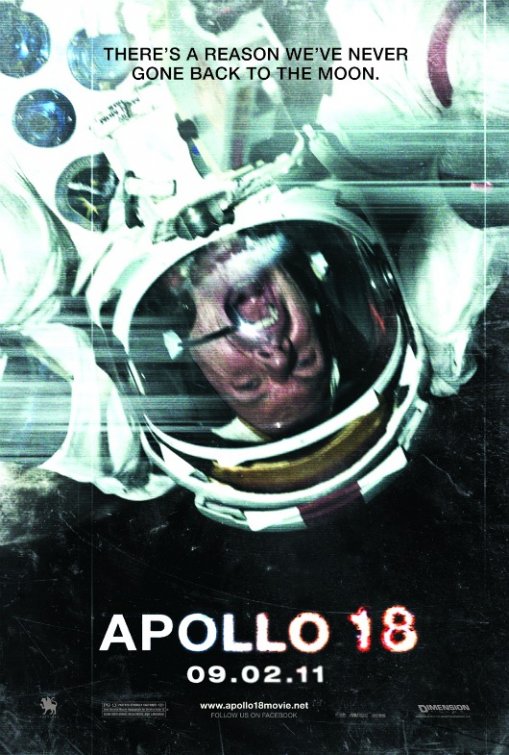 Apollo 18 is the latest in a swelling subcategory of films known as “found footage,” movies that purport to be discovered documents and aesthetically adhere to this premise. That means lots of handheld camerawork, selective editing, and other efforts meant to convey that what the audience is watching is not a movie made by professionals. It’s a professional attempt to look unpolished and amateurish, which is like having a four-star chef make you Taco Bell. 1999’s The Blair Witch Project popularized the found footage concept, and to this day there are still people today hoodwinked into believing it as unvarnished reality. Maybe that’s why NASA issued an actual press statement this week wishing to inform the general public that Apollo 18 is a work of fiction. I don’t think they have much to worry, because very few people will be seeing Apollo 18 and even fewer will enjoy it.
Apollo 18 concerns the failed secret mission of three astronauts (Warren Christie, Lloyd Owen, Ryan Robbins). The astronauts were sent to the moon for the Department of Defense, which means this is the second film of the year to concern a covert reason for landing on the moon. The two astronauts who actually land of the moon’s surface discover a dead Cosmonaut and some strange occurrences. They realize that they have been lied to by their own government and placed in a danger that few can comprehend.
But an intriguing premise can only get you so far and Apollo 18’s clumsy execution makes the movie disintegrate upon reentry, or, any critical thought. A secret NASA mission that went horribly wrong sounds like a great start to a conspiracy thriller, that is until you realize all you’re being presented with is the fake found footage. That means that we spend an eternity watching guys in suits float around, biding their time. Then they go outside and wander around the lunar surface. Then they hear an occasional noise. Or did they? Then they go back to floating around, to make up for the lost time they weren’t floating around. Really, this movie is an hour of nothing. It fails to create a sustainable atmosphere of dread or even basic curiosity. But when locked into the found footage concept, we are generally left with a lot of time on our hands. You would think that the basic premise that people have reassembled this footage would lead to cutting a lot of the filler and just getting to the good parts. It seems almost resentful that this hypothetical editor trying to showcase a long-buried truth would decide that the important stuff can wait. I was so thoroughly bored with Apollo 18 that I started counting stars.
 The structure of the story is just too insular and limited in scope. I strongly feel that Apollo 18 would have benefited greatly by opening up its storytelling parameters. It could have kept the found footage motif, but instead of being an entire 90-minute movie the found footage would be one component of a wider faux documentary. Interviews with science experts, conspiracy theorists, former NASA employees speaking under the protection of anonymity, and even family members, particularly the now grown-up son of one of the astronauts holding out hope, would add some balance. It would make the story feel larger and more authentic, let alone give the audience something new to watch. There could have been a parallel story of the discovery of this evidence, the process of getting it authenticated, and the potential dangers that would be exposed. It all seems a little too slapdash and simplistic to just say the footage was uploaded to a website. Anything, really, is what I’m looking for to broaden Apollo 18. There’s so much more that could have been added, but alas we’re stuck with three blander-than-bland, interchangeable characters collecting moon rocks and battling interstellar cabin fever.
Now I’m about to enter into the orbit of some serious spoilers concerning the ending to Apollo 18, so skip to the next paragraph if you wish to remain pure. The entire premise of this mission gone wrong (why did NASA create Apollo 18 uniform patches for a secret mission? It seems counterintuitive to create merchandise for something meant to be covert) is that there is something on the moon that the higher-ups in government want to investigate. This dangerous mystery claimed the life of a Russian cosmonaut, whose body is discovered by our American squad. When exactly the Russians put a man on the moon is never explained; yet another ingredient that would have worked better as a faux documentary. So you have one dead man on the moon, but soon the body count rises. It’s not some strange cosmic virus that infects the astronauts, leading them to psychotic episodes and murder. No, that would have been too plausible. You see, the villain of Apollo 18 is the moon rock. The rocks themselves somehow can transform into spider-like creatures that like to scurry around. Never mind the fact that we’re dealing with life that evolved in an environment without any atmosphere, but what have these moon rocks been doing for billions of years? It seems to me that after Neil Armstrong stepped onto the moon, the rocks must have been like, “There goes the neighborhood.” After twelve moon walkers, my only explanation for the motivation behind these killer rocks is that they just got sick and tired of being disturbed so often (“You stomp around like you own the place, you leave your trash behind, that’s it!”). A post-script tells us that these moon rocks were brought home and sent as “gifts” (their emphasis, not mine) to leaders and dignitaries of foreign countries. What are the implications with this? That the United States has kept its place atop the world because of the threat of moon rocks? Do the moon rocks even work on a planet with a vastly different climate than the arid moon? For that matter, since Apollo 18’s mission ended circling the moon, how the hell was any of the film footage retrieved? It wasn’t broadcast, so how did NASA or any truth-seeker come a hold of this damning evidence of killer lunar rocks? And to think we once thought that the moon was made of cheese. Oh how naïve we all were.
Apollo 18 is probably the most boring of all the found footage horror movies thus far. It does nothing to justify being 90-minutes, lacks any minor thrills or chills, and seems creatively stagnate. There are some cheap jolts, including having a character awake from a dream screaming twice. This Paranormal-Activity-on-the-moon fails to live up to the possibilities of its intriguing premise, instead settling for something aiming for slow-burn but achieves no-burn. The laughable conclusion is meant as a payoff but only for the nuttiest of geologists. Apollo 18 sticks with its core limited concept to the bitter end. This is a disappointment from all angles. It fails to scare, it fails to stimulate, and it fails to entertain big time. In space, no one can hear your boredom.
Nate’s Grade: C-
Share this:

Paranormal Activity 2 (2010)
 The real draw for the first Paranormal Activity was that it was a word-of-mouth secret that became a sensation. You just had to see what all the fuss was about. It was the super cheap little indie that could and took the nation by storm. Of course, with any product that makes money a sequel must come. But it’s hard to repeat a phenomenon, just ask the makers behind Book of Shadows: Blair Witch 2 (an odd, fascinating failure). Paranormal Activity 2 is a decent slow burn horror movie but it can’t escape the long shadow of its predecessor. There isn’t enough new or interesting to justify this redundant exercise in standard low-wattage terror.
The first film involved the haunted bedroom of a couple, Katie (Katie Featherston) and Micah (Micah Strout). They filmed their nightly haunted shenanigans and it all didn’t end so well. Now we have Katie’s sister and her husband. They’re welcoming home a brand-new baby boy, Hunter, when they find their home has been trashed. Rooms have been upended but no valuables are missing. The family gets a home security system installed with multiple surveillance videos to spy for intruders. Of course these cameras also begin catching strange occurrences in the house. It seems a sinister presence is after the baby. Apparently demons love children, did you know this? Hell has a really fantastic T-ball team.
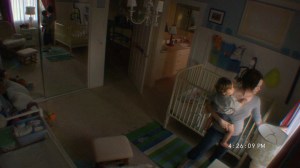 Like most other gimmick movies, duplicating the same effect leads to diminishing returns. Part of what made the first film work was its relative freshness and creative ingenuity. For a measly $11,000, director Oren Peli was able to fashion and sustain a mood of mounting dread that also stayed within the confines of the “found footage” concept. He built up suspense gradually and lead to some terrific “boo” moments. I’m still amazed how Peli was able to pull off some of his tricks sight unseen with such a minuscule budget. Part of the appreciation of Paranormal Activity was the level of skill for the craft. Now along comes a sequel with a $3 million budget, which is still chump change by Hollywood’s standards. However, it’s a large enough figure that I never once questioned how they were ale to pull anything off. I expected more from the sequel given the budget and the general nature of sequels to inevitably up the ante. You’ll still be scanning the frame of those surveillance camera angles, looking for any sign of something amiss or strange. The whole process can be maddening in both a good and bad way. Much of whatever tension does build is in these moments of uncertainty waiting with baited breath. It can seem like an interactive group game of Where’s Waldo. You’re sort of relieved when something actually does happen to break the nothingness.
As a whole, Paranormal Activity 2 doesn’t work as well when it comes to the construction of their scares. The first film primarily took place in one location, the bedroom, the sanctity of the modern man’s domicile. Whenever we got to beddy time we knew what waited. A visual vocabulary had been built to get the audience sweating as soon as the characters sleep. And isn’t disrupting our sleep the ultimate home invasion? With the sequel, there are multiple cameras to work through, always opening with the same shot of the pool cleaner busy at work. We start with pool cam, then after a while we add one more, kitchen came, then stair cam, etc., but we always cycle back to the original before moving forward. It can become an especially tiring pattern, especially when early camera angles prove to have nothing going on within. The pool-cleaning robot emerges as the breakout star of the film (evidently the first sign of a haunting is a dirty pool). There are some effective scares but it’s all in the jump scare/gotcha variety. The film toys with the possibility of a night vision mode for the ever-present camcorder tossed around the home. This possibility is woefully underutilized and only saved for a mad dash through the house at the conclusion.
 Repeating the same haunting elements may work in a narrative sense but it also mitigates the impact. You know what to expect. Hearing loud noises or watching doors slam shut does not offer the same jolt the second time around, especially on a larger budget. It’s unavoidable that Paranormal Activity 2 will become a victim of the first film’s success. Unless it raises the stakes, the movie is just going through the same paces with different faces. This time there’s a baby that’s being sought after by a malicious spirit. If all you’re doing is raising the “innocent quotient” of the victims then the film might as well be set in a impoverished Bangladesh orphanage where the kids all have terminal diseases as well. Paranormal Activity 2 tries to repeat the same tricks to mixed results. The scares are too few and far between and none have the same power as in the first film. The climax is lazily similar as well.
Unlike the first film, much of the movie feels like it’s just filling time to space out its scares. You won’t feel any true sense of attachment to these people nor will you get excited when they parcel out morsels of back-story (the first mom died and… what?). Instead of a young couple we now have a young couple… with a baby! And a teen daughter too but really it’s all about the baby. The family members sit and talk at length rationalizing the weird phenomenon. They even perform research on the Internet and make sure to record themselves with a camera they set down. Who does that? Who records simple conversations? The family’s main dilemma is that dad is unreasonably skeptical despite strong video evidence. Why do these people still let the baby sleep alone? Why haven’t they brought the baby’s crib into their own bedroom? The family pet, a trusted German shepherd, is good protection. The dog growls and barks because animals, just like Hispanic housekeepers the film asserts, innately know when evil spirits are afoot. Why do Hispanic women all have fine-tuned demon radar in the movies? Is this a feature that a Caucasian male can upgrade to? Apparently, the best protection you can afford your home is multiple dogs and multiple Hispanic housekeepers to stand guard.
Paranormal Activity 2 attempts to deepen the mythology of the franchise. It takes place both before and after the events of the first movie, providing some explanation as to what the demon is really after and how it came to terrorize Katie. It’s nice to watch how the two movies fold on top of each other and guess what areas will next connect. Katie makes numerous appearances and ironically offers the sage advice to her sister to just ignore those bumps in the night. When Micah makes an appearance he is accompanied by onscreen text that informs us that this is 3 weeks before his dead body is found. Why? We already know thanks to Katie’s early presence that the film is a prequel, so we already know the doomed fate of Katie and Micah. What does spelling it out have to offer the audience?
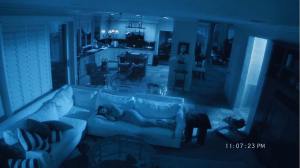 Paranormal Activity 2 runs into problems when it imitates what worked previously but doesn’t add any new flavor, escalation, or variety. The freshness of the concept is quickly turning stale. What was new and exciting is now being written into rote rules for the franchise. I can only surmise that the Paranormal Activity franchise will follow the same downward slide as befell the Final Destination franchise once the audience became hip to all the rules. Surprise goes out the window when films are made to meet genre expectations. You’re still relying overall on your imagination for much of the scares in Paranormal Activity 2, which will vary depending upon the individual. I just think it’s harder to trick you the second time around. My brain kept saying, “I’ve already seen this movie. Been there, done that.” I had no actual rebuttal for my brain, so I ate some popcorn and scanned the screen looking for more weird stuff.
Nate’s Grade: C+
Share this:

Paranormal Activity (2009)
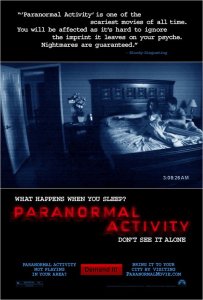 My eyes are bleary. I feel like a walking ghost. My body aches just a tad. I’m over responsive to sudden movement. Not only have I just seen Paranormal Activity, the small indie horror film that has been sweeping the nation, but also I’ve just endured my first post-Paranormal night of sleep. To say it was refreshing would be an outright lie. My then-partner was tossing and turning, routinely grabbing my arm to hold her, also sitting straight up to peer through the darkness of our bedroom, and occasionally she would request that our dog jump on the bed to sit with us for extra support. She and I have seen scary movies before but none have interrupted my sleep patterns like this low-budget sensation. That alone is the best blurb that I could possibly offer to the Paranormal Activity marketing gurus: this movie will make it difficult for you to sleep in your home.
The back-story to this Cinderella tale is that writer/director Oren Peli was hearing unexplained strange noises in his San Diego home. After some research he said, “Why don’t I set up a camera and make a movie about this?” He then hatched a plot involving a young couple, Katie (Katie Featherston) and Micah (Micah Sloat), who hear some bumps in he night while they sleep. Micah sets up a stationary video camera to record the strange happenings as a cool project. It begins with small, subtle noises, then the presence of something unwelcome becomes much more pronounced. Micah taunts the antagonistic spirit, coaxing some kind of response. Katie is terrified because, as they learn from a psychic, this is the same entity that has been following and haunting Katie her whole life; her family home burned down unexplainably when she was a child. It wants Katie. That was the story, though Peli says most of the dialogue was improvised (it shows). The actors doubled as camera operators, the movie was shot over seven days in Peli’s own San Diego home, and the total cost was $11,558, a pittance for a Hollywood movie. So how did this cheap home video haunting take the nation by storm, becoming the indie phenomenon of 2009 and one of the most profitable films in modern history?
 Let’s start with the fact that it’s actually scary. That’s likely what audiences have been responding to — competency. The film is presented as “found footage” much like the similar low-budget horror sensation, The Blair Witch Project (can you believe it?s ten years old already?). The story is presented as factual footage, and Peli makes a point of not breaking the terms of reality. Some of the spook stuff is easy to explain, like lights going on and off in the distance, but there are some moments that are more dramatic and give no hint of special effects. I am impressed by the ingenuity of Peli on his super low budget. I went from being startled to admiring the technical craftsmanship. Paranormal Activity isn’t a big scream movie, it’s more unsettling and the majority of its scary moments occur while the camera is on its bedroom tripod (the tripod should receive third billing in the credits, frankly). Sure, a creaking door or lights magically turning on doesn’t sound like surefire moments of blood-curdling terror, but the fact is that stuff is happening while this couple sleeps, a time when we are most vulnerable, is the point and why it’s scary. Peli structures the movie so that it fosters a slow burn of suspense. By making the camera the only viewpoint, we as an audience feel trapped, much like the characters. The idea that something will get us while we sleep isn’t new but it’s certainly creepy.
The actors work well enough not to betray the “found footage” motif as well. Neither gives a spellbinding performance, mind you, but Featherston and Slout are believable for almost every second onscreen. They’re a couple experiencing a home invasion of a different sort. Micah is more interested in his technical toys than the traumatic state of his girlfriend of three years, and Katie even admonishes him after a scare, “Did you actually run and get the camera first?” Featherston exhibits the most fear and trepidation, and her squeals and cries can be alarming. Their interaction and intimacy doesn’t really communicate a couple of three years time. However, this does not detract from the flick because the title isn’t Relationship Drama, now is it?
 So at this point I need to ask myself, why was I scared during Paranormal Activity and merely amused by the similar exploits in The Blair Witch Project? Maybe it’s the location. The bedroom is supposed to be your sanctuary, your respite. It’s a bit more universal than getting lost in the woods to make a movie. I also think the concept is responsible for my different reactions. In Blair Witch, they were being haunted by a forest ghost who had a thing for arts and crafts. Waking up to stone piles and stick figures just doesn’t resonate like footage of something happening to you while you sleep unaware. Peli does a fine job of making an audience dread what is to come next. Just as I wrote ten years ago for Blair Witch: “The anticipation of the unknown is far more frightening than being slowly chased by a man in a rain slicker. It’s no typical horror flick, it lets you create the fear in your head and let you drive yourself mad with it.” This is why Paranormal Activity works as well as it does. You can immerse yourself and then grip the armrest in fear and then laugh about it later. I also appreciate that Peli solved my number one problem with haunted house movies. You see, if your house is haunted then — MOVE! Simple, huh? Why try sticking it out to regain the resell value when the walls are dripping blood? At least in Paranormal Activity says that the evil spirit is attached to Katie.
Thanks to weeks spent at the top of the box office, even besting the lingering Saw franchise, it is inevitable that Paranormal Activity will balloon in hype that it cannot compete with. Rather than its budget limitations hindering the final product, Peli and his actors have embraced their low-budget aesthetics and produced something effectively eerie and occasionally ingenious. What these people have done with $11,000 (probably the budget for bagels on the pseudo true story, The Fourth Kind) is worth applauding. Like most horror movies, this one will play better with a full crowd ready to ride the roller coaster wave of screams and giggles. Paranormal Activity is proof that you don’t need stars and major budgets to get audiences scared. Your feelings of terror are the great equalizer, which is why cheap but smart and inventive horror movies can easily outpace their bigger budget brethren. Just be prepared for a few rough nights of sleep afterward.
Nate’s Grade: B+
Share this:

Cloverfield (2008)
 I can think of no movie that has come out of virtually nowhere to build tremendous hype like Cloverfield. Before the summer of 2007 this movie didn’t appear on anyone’s radar whatsoever, and then came a teaser trailer before Transformers. The tease was nothing but party footage of well-wishers when, all of a sudden, explosions are in the distance, people are fleeing, and the Statue of Liberty’s severed head rolls to a stop in a street. Bam. Release date. Nothing else, not even a title. All of a sudden the world had an insatiable appetite for everything Cloverfield. Mega-producer J.J. Abrams had done it again. In one fell swoop he took control of geek nation. I never expected Cloverfield to live up to the massive hype, but this modern monster movie delivers more bangs than whimpers.
The first twenty minutes of the film introduce us to our cadre of yuppy characters. Rob Hawkins (Michael Stahl-David) is leaving for Japan to take a business promotion. His friends throw him a surprise going away party to celebrate and wish him the best. Rob’s brother Jason (Mike Vogel) and his girlfriend, Lily (Jessica Lucas), start videotaping the party. Jason hands off the taping duties to Hud (T.J. Miller) who, thankfully, has a much steadier hand. Hud walks around the party gathering interviews and he zeroes in on Marlena (Lizzy Caplan), a gal he’s been nursing a crush on. Rob is nervous to see if Beth (Odette Yustman) will come to the party. Beth and Rob are long-standing friends that took the plunge and had sex a couple weeks prior. Now Rob is hoping for something more but Beth isn’t on the same page; she brings a date to the party. Interrupting all this twenty-something relationship drama is a giant monster attacking New York City and dropping little baby monsters to scurry the streets and feed.
 While not entirely unique, Cloverfield is certainly a reinvention of the dormant monster movie. By seeing its gimmick through to the very end, the film gives a perspective rarely seen in movies that involve cataclysmic disasters. Usually films that involve space aliens, monsters, or some form of incredible destruction follow the people in power, the Army generals, the politicians, the President of the United States as he solemnly looks out his office window and says “God help us,” under his presidential breath. Cloverfield, however, eschews all of that. This movie is all about people caught on the peripheral of a disaster and just trying to survive. They have no idea what’s happening, they have no idea when they will be in danger, they have no idea where to go, they have no idea how long they have, and they definitely have no idea what it is that’s obliterating the city. The film dares to place us in the shoes of ordinary civilians as they document the fantastic. The “found footage” concept and the ordinary perspective are interesting though some will quibble that staying inside one point of view is too limiting for the scale of Cloverfield. This film is more than The Blair Witch Project meets Godzilla; this movie is a collective manifestation of the nation’s 9/11 anxieties. Cloverfield is the first 9/11 disaster movie. The shock and confusion of the situation take on even more resonance by triggering some of the same emotions many experienced on that fateful day in 2001. And yet Cloverfield doesn’t feel exploitative or disrespectful as it draws upon our 9/11 memories and fears, which is saying something substantial about the filmmakers’ skill and the remarkable healing power of time. Some images are unmistakable, like a white cloud of dust that blows through the city and also helps to shroud the monster. People scamper around the city yelling for some kind of explanation when some character, offhandedly, says, “Do you think it’s another terrorist attack?”
The film is also got some fabulously frightening moments that are not related to 9/11 anxiety. Cloverfield is a great, old school horror movie on top of a subversive social experiment. Talented writer Drew Goddard has had experience building tension on some of TV’s finest shows, like Buffy, Angel, and Lost. Now with his debut screenplay, Goddard cranks up the suspense and creepiness to maximum effect. Part of the horror is trying to find meaning in the madness but another equally enjoyable part is walking into perfectly executed classic horror moments. You will be on edge about what could possibly be around a corner. Our band of survivors decide to walk through the subway tunnels and discover that Hud’s camcorder has night vision; sure enough, you are waiting with baited breath for the second that night vision is shifted on and something pops out in view. There’s a distinct difference between cheap jump scares and spooks that, as I say, earn their boo. This tunnel scare is catapulted to frightening from the ominous buildup that comes from seeing hundreds of rats running away. When I saw the fleeing rats, I knew something very bad was coming from behind. The structure is clever as Goddard gives us back-story on Beth and Rob via the original footage of them canoodling that cuts in here and there. Goddard earns his stripes with a script swiftly paced, filled with genuine scares, and smart enough to keep an audience laughing with gallows humor at key moments (“Okay, so our options are… die here, die in the tunnels, or die in the streets.”).
 You the viewer are in the middle of the action with this film and there’s no getting out, no distancing yourself from the chaos, no watching men in lab coats and military uniforms dissect the situation over large boards. The gimmick of Cloverfield is flawlessly executed thanks to director Matt Reeves, who spectacularly resurfaces from movie jail after writing duds like The Pallbearer and Under Siege 2: Dark Territory. Reeves explores some dark territory of his own but never breaks the tenuous tone needed for the movie to succeed. The movie is constructed with many long takes and it never exposes its secrets. I watched spellbound by the artistry of maintaining the illusion from beginning to end. Watching the Brooklyn bridge collapse from the inside is exciting and terrifyingly real. Reeves and Goddard smartly decide not to show their monster for as long as possible. Catching glimpses of a shadow or the flash of a tentacle-like appendage are enough to register goose bumps; the human imagination will always be more capable of engineering horror. Eventually the film does give its monster the proverbial close-up and the giant, skyscraper-sized beast looks a little familiar in design (think Vin Diesel sci-fi movie).
Cloverfield is a well-executed genre movie with a clever concept that is fully realized. The constantly bouncing and roving handheld camera might make an audience queasy, but the perspective of the end of New York City as brought to you via YouTube is stimulating and a comment on our self-absorbed culture. The film works as a finely tuned fright film elevated by its stylistic concept and the filmmaking skill to pull it off. Cloverfield being “found footage” and evidence from the Department of Defense doesn’t exactly bode well for the characters onscreen, and the film dispatches them with cool malice. No one is safe and no one can stop what’s coming. If that doesn’t sound like the perfect summation of 9/11 fears, then I don’t know what else is.
Nate’s Grade: B+
Share this:

The Blair Witch Project (1999)
 Who’s afraid of the big bad witch? Well apparently a nation of audiences and studio heads. I’ve heard all kinds of horror stories from people lying in the corners of theaters until the movie was over, to people running out screaming, to the distribution of barf bags by theaters (of course it might be due to the hand held camera and motion sickness). Well after all the hype I finally ventured out to see it after some failed attempts at evening shows that managed to be sold out. I’ll say right now that I was never very afraid. Of course there may have been some effect being that I saw it around three in the afternoon.
But I did come away with a great appreciation for what these kids have done. They themselves with a mere $100,000 budget have practically reinvented horror and given it a complete turn from where the Kevin Williamson post-irony pseudo hip teen slasher films were leading us. And I for one couldn’t be happier. The anticipation of the unknown is far more frightening than being slowly chased by a man in a rain slicker. That’s exactly what Blair Witch offers. It’s no typical horror flick. It lets you create the fear in your head and let you drive yourself mad with it. The tension is slowly building and building as the trio get even more lost, paranoid, and frightened. It really is a truly innovative effort and done so realistically that people still swear to their hearts it’s all true. I think more credit should go to the actors then the directors for how effectively real the movie was. When they’re not yelling profanity all the time they do manage to come off as very believable and we see how they are all slowly breaking down internally like a case study. Just remember people, money doesn’t equal scares.
Nate’s Grade: B


 nathanzoebl
You must be logged in to post a comment.