Blog Archives
War of the Worlds (2025)

It’s almost refreshing when you discover a movie that is so bad it becomes a feat of amazement. Pitching a War of the Worlds remake primarily starring Ice Cube staring at his work computer sounds akin to pitching a Pride and Prejudice remake starring Jojo Siwa and it’s entirely about her gardening. You could do something like that but why would you? It’s almost like some setup for a joke. This movie was originally made in 2020 and has sat on the shelf for five years, enough so to make one wonder why anyone felt like now was the time to release it, especially in this final condition. I’m dumbfounded simply thinking about this movie. It’s so misguided in about every creative decision, from its stylistic approach to its thematic emphasis and especially making what may be the most boring alien invasion movie into an afterthought about government surveillance laws. Sheesh.
Author H. G. Wells published War of the Worlds in 1898, and it’s since been turned into many popular radio serials, movies, and TV series, including the 2005 Tom Cruise-Steven Spielberg hit. Whenever a filmmaker or production company shakes the dust off a story that we already have many versions of, the question arises what this new version will bring to the table. How will this one stand out? How will it connect in a way that the other movies had not? In short, why do we need another version? Naturally, Hollywood doesn’t think about the creative necessity of movies, only their profitability. The core difference with the new 2025 movie is that it’s a “screenlife” movie where everything we see is meant to approximate a computer screen. It’s a variation on the found footage genre. This technique was used to great effect in 2018’s Searching where John Cho tried to uncover his missing daughter’s digital footprint. That was an inventive updating of the detective thriller. Here, I cannot imagine a more boring way to illustrate an alien invasion. We’re watching one man behind a computer screen react to the news and cycle through camera feeds for exposition, having Face Time conversations with loved ones and Zoom meetings with government officials, and he apparently seems to be the only guy capable of doing his job during this war of the worlds. It reminds me of 2010’s Skyline, a smaller alien invasion movie that tried to mask its limited budget by following a group of characters trapped in an apartment that would worriedly look out the windows. It’s a bad approach, making the events feel too limited and like we’re missing out on more interesting events. Suffice to say, when the world is going to war and aliens are destroying cities, you don’t want the focus of our movie to be Ice Cube staring at you and furiously typing key commands.

Another significant blunder was making this less an alien invasion movie and more about government overreach when it comes to data mining. There will be spoilers in this paragraph, dear reader, but honestly I would actively advise you to read them anyway to just better appreciate how ridiculous this all is. The powerful aliens aren’t here for our natural resources, for turning people into food, or even a hostile takeover of the planet as their new home world. Oh, it’s far worse than that. What these dirty dirty aliens are really hungry for is… our personal data. Yes, you read that correctly. The aliens literally consume electronic data. What dull lives these creatures lead. This is less an alien invasion and more a stark literalization of data mining. These aliens are advanced enough to travel through space but need to be in such close physical proximity to harvest our data? They can’t just hack the Pentagon wifi? It turns the aliens into big dumb technological mosquitoes who just need to be directed elsewhere. I’m astounded that War of the Worlds presents an alien invasion and says that nosy government is the real problem. The movie tries to argue that these advanced aliens wouldn’t even be here if Big Government wasn’t wantonly collecting our data for their nebulous spying purposes. It’s an attack on the post-9/11 surveillance state born of the Patriot Act, but it’s also 15-20 years too late for this to be politically relevant.
The movie also picks the wrong character to serve as its moral awakening. It’s nonsensical that Ice Cube could be a trusted DHS official and be unaware of these systems and their reach. He seems to be the guy that the FBI is waiting on for door-breaching warrants that he tidily uploads as PDF files. He’s the guy NASA wants to clue in on their latest reports. He’s the guy the Secretary of Defense calls directly. He’s not the head of Homeland Security; he’s just a guy in the office, and seemingly the only guy in the building (was it a holiday weekend?). Ice Cube plays a man with some extreme boundary issues. He’s literally using government surveillance to spy on his pregnant daughter, hacking into her fridge, and I think even installing cameras into her apartment. He’s using government resources to criticize his daughter’s grocery choices. He’s overstepping his bounds and taking full advantage of that same government surveillance state that he decries at the end of the movie. At three different points someone will say incredulously about the government spying on people’s “Amazon carts,” and it’s just remarkable that something like that would politically galvanize this man when he’s already spying on his kids with that same surveillance apparatus. He’s knowingly breaking into their messages and social media and personal data. This can’t be a “what have we become?” epiphany when he’s always been there.
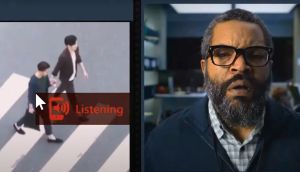
I like Ice Cube as an actor. He showed surprising depth in Boyz n the Hood, was hilariously applied in the 21 Jump Street movies as a stern sourpuss authority figure. There’s a natural intimidation factor, which was recently played for clever laughs with his appearance on The Studio. This is a performer that can be a great addition when aligned with his strengths. However, range is not a word one would readily use when describing the acting capabilities of Mr. Cube. Hinging this entire movie on Ice Cube’s emotional journey is too much of an ask. Having this man listlessly read gobs of exposition is not good for anyone. He doesn’t have that kind of arresting voice that could hypnotize us, like a Morgan Freeman or Jeremy Irons. It’s even worse when you feel the lackluster effort on his part. Strangely, despite his children being in direct danger, and the whole alien invasion backdrop, the moment that draws the most dramatic response from Ice Cube is when the aliens delete his deceased wife’s Facebook account (I would have accepted you consuming the planet, but when you delete Facebook pictures, now you’ve gone too far). The movie was filmed in the early days of the COVID pandemic and feels it, restricting everyone to their own little screens with nary the physical interaction. When you’re watching Ice Cube race through empty rooms of Homeland Security to insert a thumb-drive in the nick of time to save the world (along with shouting to the unconvincing alien special effects, “Movie bitch, get out the way”) it all just reminds you how painfully myopic and agonizingly restrictive this alien invasion approach ultimately proves to be.
Special mention needs to be made for the over-the-top Amazon product placement in this movie. The company is referenced several times, even used as a motivator for a homeless man (what computer?), but it’s much worse when one of the characters is a proud Amazon delivery driver and he’s going to use their cutting-edge drone delivery tech to make sure Ice Cube gets that all-important thumb-drive in record time. Amazon helps in saving the world thanks to their logistics in package delivery. Thank you corporate overlords, and please enjoy this movie on your life-saving Amazon Prime account, dutiful citizen.
War of the Worlds 2025 is a fascinating and maddening case study in bad adaptation choices. It feels more like an anti-government surveillance state thriller that got awkwardly grafted onto an alien invasion. The way the movie just abandons its larger scale drama for lessons in modern-day privacy laws is creatively criminal. This is an astonishingly bad movie that gets just about everything wrong at every turn. I’m almost tempted to recommend people watch it just to try and reconcile it for themselves. There have been dozens of adaptations of this classic science-fiction tale, and I feel confident in declaring this one the absolute worst even if I haven’t seen every one of them. There can’t be a worse one than this.
Nate’s Grade: F
Share this:

Late Night with the Devil (2024)/ Immaculate (2024)
 Late Nigh with the Devil is an intriguing novelty, a found footage item of 1970s late night talk show fame reportedly documenting the last show of Night Owls, a talk show hosted by a man who recently lost his wife to cancer and is also slipping in the ratings and losing his traction in the industry. So Jack Delroy (David Dastmalchian, best known as Polka Dot Man in 2021’s The Suicide Squad) gets the great idea to hold an exorcism live on stage or his big spooky Halloween show. What could go wrong, right? The movie is dedicated to upholding the style and awkward tone of 1970s talk show, and its commitment is by far its most interesting aspect to the found footage sub-genre. I wouldn’t classify the movie as necessarily scary, but it held my attention and I appreciated the corny little nuances of recreating an older form of television and comedy schtick, with a growing sense of foreboding as things start to get progressively worse and Jack pressures his new girlfriend, an occult writer, to bring out her possessed pupil. It takes a little long to get going, and the overall conspiracy of Jack’s connection to an Ilumminati-esque showbiz cult feels so tangential to be important, but I was objectively impressed with the overall recreation of an archaic form of TV. The conclusion, once all chaos is finally unleashed, breaks the rules of the found footage setup but at that point it’s welcomed and things can get a little more weird and visually audacious. Late Night with the Devil works more as a late-night curiosity than a boo-style horror thriller. I appreciated the committed efforts and artistry, as well as the game actors and some wicked gross-out makeup prosthetics, more than the overall movie.
 Nuns in Distress has long been a horror genre staple, as the mixture of Catholic imagery and overwrought religious themes proves an unbeatable mix with classic exploitation elements, the depraved and the sanctity. To this we have Immaculate with rising starlet Sydney Sweeney (HBO’s Euphoria) as an American nun traveling to a remote Italian convent and becoming an unwitting victim in a sinister ploy to gestate a new potential messiah. While very serious and broody in presentation, Immaculate is a pretty by-the-numbers mystery that goes to its most obvious route and becomes an overextended hostage thriller for Sweeney. The movie is at its best when it gets crazy, and that includes Sweeney, when she’s allowed to be all-out histrionic. For too long, the movie is too somber and simmering, which works best if the mystery is at least involving and surprising or we build to a great gonzo finish. I wish the movie was more wild. The ending is the best part of Immaculate, where Sweeney is pushed to the point of intense madness, while splattered in blood as per genre rules, and is forced to make extreme and personal choices. In that regard, perhaps Immaculate best operates on a metaphorical level about the horrors of pregnancy, more forced birth from oppressive leaders, and restricting women’s autonomy in a post-Roe v. Wade world. It’s a long wait to that worthwhile finale, and you might get restless from your unholy wait.
Nate’s Grades:
Late Night with the Devil: B-
Immaculate: C
Share this:

Missing (2023)
 If you were a fan of 2018’s Searching, the missing persons thriller told entirely from the point of view of a computer screen, then chances are you’ll fine enough to like about Missing, its found footage spiritual sequel. The co-editors from the first movie are now taking the reigns directing, and screenwriting, as we follow an 18-year-old June (Storm Reid) trying to track her mom’s (Nia Long) whereabouts after going overseas with her new boyfriend. It’s a reverse of the setup from Searching, the father desperate to locate his daughter, but under both scenarios the person doing the investigation comes to discover how little about their loved one they may have fully known, or at least how much they were keeping hidden. The creative constraints of keeping everything to a computer screen aren’t as limiting as you might think, especially with smart tech creeping into different aspects of home life and surveillance. The movie is well paced and still has a satisfying structure to its assembly of evidence and clues literally being in your face. The third act goes more than a bit overboard with outlandish twists upon outlandish twists, threatening to rip away whatever credibility the movie has earned to that point. It’s a bit much, but by that point most audience members will be onboard for the soap opera revelations. It’s not as fresh as Searching, nor does it have a lead performance as gripping as John Cho was as the frantic father, but Missing may be more of the same but that’s still enough to be a small-scale, fun, twisty little thriller to pass the time smoothly.
Nate’s Grade: B-
Share this:

False Flag (2019)
 Imagine the U.S. government is rounding up citizens, detaining them, and robbing them of their rights with the idea of installing a system of fear and compliance. No, it’s not the news on abuses of power via unchecked bodies like ICE, this is the plot of False Flag, a low-budget found footage action movie that happened to film in Ohio and is now widely available online as well as being carried on your friendly neighborhood Wal-Mart shelf. I congratulate them on getting their movie out there to the masses. The finished film has some narrative and execution issues but can still be an enjoyable experience, especially for genre fans of military thrillers. Strap in.
We open with a fringe conspiracy host as the frame story, telling his audience what they’re about to see is real footage compiled together to indict the U.S. government. In the small Ohio town of Madison, brothers Mark (Sean Mount) and Ash (Justin Rose) are feuding with old grievances and new, including Mark getting married to Stephanie (Olivia Vadnais). Ash has brought along his YouTube-eager pal Donny (Andrew Yackel), who is obsessed with recording everything for his fledgling channel. Then all of a sudden there is a high-pitched shriek, military vehicles roll into town, and citizens and protestors alike are rounded up and beaten. Ash, Stephanie, and Donny seek shelter with a conspiracy journalist (Jennifer Andrada) and some local militiamen armed and ready to combat what they viewed as the eventual tyrannical government takeover. Over the course of one long night, our people try and escape and get their story told.
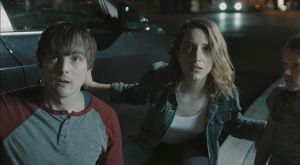 Before I go into further detail on some of the shortcomings of False Flag, allow me to highlight its positive aspects. This is a pretty good-looking movie for being a low-budget action thriller, and the cinematography has a nice color balance to many scenes. A race through a maze of school hallways at night is made all the moodier by the professional aesthetic, and many of the action scenes are pretty solid and staged well. The larger riot sequences and chaos that erupts are coordinated well with the background action giving way to whatever blocking our main characters need. The use of the military vehicles also helps lend to the credence of the “it could happen even here” reality. The acting overall is pretty solid without a bad performance. Surprisingly enough, writer/director Aaron Garrett (Foxcatcher) gives one of the more memorable performances as a local mechanic by day and would-be Rambo when called upon. The movie gets markedly more entertaining when he comes into the picture and is able to even the odds. He has a smoothness to his performance that grabs your attention. Yackel (Swamp Thing) has a pleasant presence and a squirrely demeanor that can be endearing. Andrada (Macabre Manor) stands out early as the on-location correspondent for the Alex Jones fringe TV show. She has an affectation that makes her talk very directly, quoting often, but it counts as a viable personality and a pointed perspective that helps butt up against others.
False Flag is the kind of movie that seems like its intended audience are the doomsday preppers and gun hoarders that envision themselves as a Hollywood action star waiting for the eventual government tyranny to give them their time in the spotlight. This premise can be done with skill but absent that it feels like a misguided wish fulfillment that encourages radical thinking in fringe people. I’m not saying the movie is irresponsible. I’m saying that False Flag exists in the same kind of universe of a “Jade Helm” takeover, where it only makes sense for the people who already think along these lines. At one point one character asks a prepper what’s in it for the government to perform its false flag operation, and he responds, “Global totalitarianism.” What does that even mean? Are the police acting in conjunction with the military? Have the military infiltrated the ranks of small-town police officers? It’s rather nebulous. All we know is that someone is taking over for vague reasons and there doesn’t seem to be enough of them.
Eventually it’s theorized that the government is doing this in a small-town to blame on terrorists and justify further military action. But… why is any of that necessary? The United States public has already accepted the idea of going after terrorists, especially on foreign soil and in the age of drone warfare. The U.S. military doesn’t need more public support to go after this already targeted target. If it’s to blame political activists as domestic terrorists, then this plan sure is sloppy. Nobody in Madison we see attempts to call for help, post their recordings, or even watch TV until seemingly hours after the start of the martial law, which is insane. It takes away from the seriousness if characters aren’t immediately trying to make outside connections. When the characters break into a school where prisoners are being detained in a cage (very reminiscent of our current concentration camps along the border) and there are NO GUARDS whatsoever in this room to watch. This is one incompetent government takeover. There is one moment that I had to stop the film and walk around my home because it simply astonished me (some spoilers to follow). The characters cut open a chain-link fence keeping people inside their detention cage… and the other people… stay put. I guess they realized what an important moment this would be to reunite the brothers and didn’t want to ruin it for the cameras. These people act with no urgency when they can flee, and I am still reeling from this moment.
 The very ending tries to flip the script but by that point it feels too late and too confusing. I’m at a greater loss what the whole operation was for, who benefited, and who was playing along. There’s some ire toward media manipulation but it feels too late to switch gears with who the recipient of the film’s condemnation is going to be. There’s a five-minute epilogue that throws everything in doubt and leaves you questioning what you saw, but I don’t know what the supposed agendas are and who is playing who and why. Good luck.
The dialogue is pretty plain, which is fine, but its use of exposition is heavy and rather inarticulate. Exposition is a tricky issue because any writer needs to make it as invisible as possible and think about what is essential and when it can unfold to the audience in a hopefully natural manner. There are easy ways around this like the ole answering machine message that fills in the blanks. Here is a sample from about a half hour into False Flag after the first big riot with police:
Stephanie: “…So your mom’s a doctor?”
Little Girl: “Yeah, so, she’s not home that much. But it’s okay I guess.”
Stephanie: “What about your dad?”
Little Girl: “John… I don’t know. He works for the government as a translator or something like that. He and my mom split up while I was young. We were actually on our way to DC to meet him before all this.”
Stephanie: “Sorry.”
Little Girl: “Don’t be.”
Stephanie: “Do you have any brothers or sisters?”
Little Girl: “Nope.”
Stephanie: “Must be tough being alone all the time.”
Little Girl: “Not really. I grew up pretty fast.”
Stephanie: “I can see that. You’re a pretty strong girl. How long have you lived in Madison?”
Little Girl: “I know you feel like you have some responsibility to keep me safe or keep my mind off what happened but you don’t. I can take care of myself.”
This example stunned me with how transparent the exposition was, which forced characters to speak like they were more machines built to espouse helpful context. Real people do not blab everything about themselves in case someone may be watching who doesn’t know the key parts of their background. Real people do not talk like every moment is a job interview. The problem with False Flag is that there are too many scenes likes the one above, where characters vomit out the necessary info in such a transparently clunky way that it further breaks the film’s reality.
The found footage conceit provides more problems that are not addressed. Firstly, the nature of found footage means there has been a hidden editor and this is all the more relevant because the showcase for this footage is the Alex Jones-style show, which means someone has intended for it to be broadcast for an audience. This brings up the same questions of why the mysterious editor elected to install a narrative. Why is it important to set up these people like they are characters when the important parts, the government’s supposed false flag entry, is the big deal? Furthermore, why is this mysterious editor splicing in flashbacks from an earlier recording of the two brothers running around in a park? This was cleverly done in 2008’s Cloverfield but that’s because it was taped over a previously existing recording, allowing for the good times of a former relationship to sneak in for contrast. But if the intent is the broadcast and to highlight government abuse, why has the mysterious editor chosen again to bend toward a narrative?
 Then there are things that simply break the reality of the found footage conceit, enough that they took me out of the movie and I had to start cataloguing them. The general idea is that we have Donny with a handheld camera and Ash with a body camera attached to his ear like a Bluetooth device, but you better believe every scene has the characters adequately framed, which means Ash is awfully cognizant of how he needs to turn and tilt his head in order to get a workable camera angle from his vantage point. When the camera gets passed to other characters, why do they continue recording? Ignoring even that since the movie needs it to carry on, there are moments that shatter the illusion of found footage, like one of those park flashbacks where we see Mark run into a clearing to help his brother and he sets the camera down not on the ground but on… something. When we saw him running there was no rocks, no trees, nothing to be seen, which means I have no idea what this camera is resting on. The most egregious is a conversation where the camera literally racks focus as the woman is talking. She doesn’t move out of her position and it happens even before she turns around, as if the camera KNEW the attention should be on the people in the distance who Donny was referring to. If you’re going to go the found footage route, things like this cannot crop up.
As far as low-budget action thrillers go, False Flag can sate your moderately checked expectations. It provides some thrills and with a professional presentation and uniformly solid acting. The story is pretty threadbare and the found footage conceit feels too minimally thought through, serving a larger point that ultimately is muddled by its rushed and twisty delivery. I think this premise and even the found footage approach could have been a dynamite combination, but it required a bit more development and consideration. False Flag is not a bad movie and I admire much of its technical grit but it is pretty standard thriller stuff, which means it’s hard for it to distinguish itself against the glut of other low-budget direct-to-DVD action lining the catalogues of streaming and shelves.
Nate’s Grade: C
Share this:

Unfriended 2: The Dark Web (2018)
 Ditching the supernatural threat for something even scarier, Unfriended 2 follows the original film’s found footage-as-computer screen storytelling model but takes a dark dive into the Dark Web of the Internet, a playground for all kinds of shady criminal activities. A group of ethnically diverse friends gathers online to play a cross-country game and run afoul of a very vengeful man who wants his laptop back. Apparently our protagonist, Matias (Colin Woodell), stole it at a lost and found to better work on his sign language reading app to communicate with his deaf girlfriend. It was touches like that where the movie felt far more developed than I was expecting. The movie builds a nice sense of momentum and dread as the friends get further and further into uncovering the Dark Web conspiracy of for-hire snuff films and sex trafficking, and at every point there are moments they could turn away and avoid their doomed fates. The suspense sequences are well thought-out, like where the group has to quickly adopt a façade playing a game while a wifi connection is in play, and as soon as it goes out they breathlessly communicate their next desperate plan of action. There is one great kill and a few nifty twists and turns, especially as things get even more dangerous for our characters. Writer/director Stephen Susco finds ways to keep his film visually engaging and still character-centric in the decision-making, avoiding the escalations from feeling contrived and artificial. I enjoyed myself right up until the end, though the film does become more preposterous as it goes. The Dark Web as a whole is vague enough to be whatever the horror audience needs. The movie doesn’t have much to offer in the way of online culture commentary beyond a pretty standard “be careful what you wish for” warning. The characters aren’t terribly dimensional but they held my interest and contributed in small but meaningful ways. With Unfirended 2, it’s a fitting and palpable story engine for a clever thriller. If you enjoyed the recent indie hit Searching, check out some of the Unfriended films too.
Nate’s Grade: B
Share this:

Searching (2018)
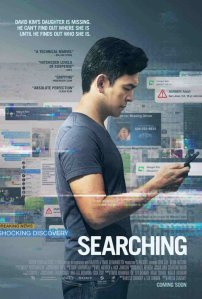 Searching is a clever, crafty found footage mystery told from the point of view of a computer screen. Unlike many found footage entries, writer/director Aneesh Chaganty has put considerable thought into the mechanics of his storytelling gimmick. The opening sequence even reminded me of Up as far as how deft it was with the economy of storytelling while providing an affecting emotional blow. In the opening, we watch a little girl grow up as computer technology and websites also advance documenting her life, culminating in her mother getting cancer and passing away, communicated via a “Mom’s Coming Home” date removed from a calendar. It was so well done I actually felt like I just might summon some tears for the passing of this woman. Right away I realized I was in for something special. Flash forward and the teen daughter goes missing and her stressed-out father (John Cho) dives into the investigation firsthand by looking through her online history and realizing how little he may have known his not-so-little girl. The movie illustrates nicely how easy it is to hide your real self online and how easy it is for others to find you and your digital impressions. Every time Cho is visiting a website, whether it’s Venmo or Instagram or Facebook or a webcam, there’s a solid reason for it and the movie has a satisfying step-by-step progression. The mystery has plenty of unexpected twists and turns and it’s anchored by a harried and distraught Cho (Star Trek Beyond), who does not look like he’s in his mid 40s at all (Kal Penn has also aged well, which makes me only want a cross-generational Harold and Kumar sequel more). The only knock on Searching is that there really isn’t a pressing need to see it on the big screen. After all, you’re watching a computer screen and typing for much of the movie. It will play just as well, if not better, on your home television or whatever smaller screen is at your discretion.
Nate’s Grade: B+
Share this:

The Visit (2015)
 For the past ten years, M. Night Shyamalan has been a figure of piñata-whacking derision, and yet the man has consistently been at work on films big and small. You would think a decade of duds would lead to Shyamalan being unable to direct more than a junior high theater production, and yet people like Will Smith were specifically seeking him out to direct inevitably terrible movies like After Earth (oh is that one bad). The association has been burned into our minds: Shyamalan and bad movies. Is it even possible for a man whose name has become a punchline to turn his career around? A low-budget lark like The Visit allows Shyamalan the freedom of risk. If he fails, he’s only made one more bad found footage horror movie in a near infinite sea of them, and the budget number isn’t one that will bankrupt his generous producers. Perhaps it’s through the benefit of low expectations cultivated over ten grievous years of filmmaking, but The Visit is a modest little thriller that has enough suspense and campy humor that it works, mostly. I walked out of the theater generally satisfied and entertained, which are two attributes that haven’t been associated with Shyamalan films since… Signs? Goodness, that was back when Mel Gibson was a box-office titan.
15-year-old Becca (Olivia DeJonge) and her 13-year-old brother Tyler (Ed Oxenbould) are visiting their grandparents for the first time. Becca is a budding documentary filmmaker and brings her camera along to make a movie about the five-day visit. Nana (Deanna Dunagan) and Pop Pop (Peter McRobbie) live deep in the woods of rural Pennsylvania (the local police force consists of one guy). Everything is warm and cozy until it’s nighttime and Pop Pop insists that, for their safety, the kids stay in their rooms after nine o’clock. The strict rules and forbidden areas of the home encourage the kids to go exploring. Their grandparents may just be more than weird and old.
 The premise is deceptively simple and yet perfectly relatable and dripping with potential. I heartily enjoyed the fact that for a solid two acts, The Visit is a horror film where the horror elements are old people. Nana and Pop Pop both display fraying mental states, and Nana has an unusual trance-like state that kicks in once the sun goes down. I was expecting something supernatural or vaguely related to fairy tales to emerge to explain the overall weirdness and creepy affectations, but it never does. For most of the movie, the ravages of aging provide the scary business, and I think that’s great. Telling the story from the perspective of Becca and her camera also reinforces the cross-generational peculiarities, where the elderly and their older system of rules and way of life seem even more alien and alarming. Shyamalan, to his credit, does a fine job of coming up with suspense sequences built around his premise. Watching Becca and Tyler debate opening their bedroom door at night, especially after a series of unsettling scratching noises, is a well developed moment that revs up the audience imagination. Of course they shouldn’t open that door but boy do we want them to and discover what is going on. The performances from Dunagan and McRobbie hint at something menacing lurking below the surface but in a casual way. Nana asking Becca to literally crawl inside the oven to clean it is the kind of memorable what-the-hell moment that makes a horror thriller.
The offhand comments from the grandparents and their occasional erratic behavior are also played for laughs thanks to the camp factor of the actors. There is a clear absurdity to the scares and tension, and Shyamalan smartly embraces this. The Visit encourages you to laugh. Apparently, Shyamalan delivered three different edits of the movie: one pure comedy, one pure horror, and one a mixture of the two. The horror/comedy edit was the one released to theaters, and the film is better because of the inclusion of its offbeat humor. Without it, the movie would risk being too serious. To be fair, the movie isn’t making fun of dementia or ridiculing the elderly just because they’re out of touch. When the kids first see signs of Nana and Pop Pop getting confused, they behave very compassionately, like when Pop Pop dresses for a costume party he doesn’t know anything else about. Strangely enough, my theater was mostly populated with people over the age of 50, which made me wonder if they were duped into what kind of movie they were seeing or relished the chance to be seen as the scary boogeyman to teenagers.
 Which leads me to the point of the review where I discuss the parts of The Visit that don’t work quite as well. I don’t think Shyamalan knows how to write for teenagers because Becca is far too precocious for her age (using terms like “elixir” and “mise-en-scene” as everyday vocabulary) and Tyler is just downright annoying. There are three separate incidents of Tyler free-style rapping and it’s about as successful as you would expect, though it provides me amusement thinking about Shyamalan writing free-style raps for a thirteen-year-old white kid from the suburbs. My engagement with The Visit was more tethered to a general sense of morbid curiosity than a concern for the teen characters. I would have been perfectly fine if the teens didn’t make it out alive. I knew that was never going to happen because of the PG-13 rating, which does put some limitations on just how far out there Shyamalan can go. Though it doesn’t limit a scant shot of elderly nudity used for comic purposes. There is a great reveal that leads into the third act that ups the stakes, but it also shifts the movie into a more definitive slasher territory, and a PG-13 rating is going to further limit that territory. There are plot holes (a disabled laptop Webcam; the fact that they don’t have cell phone service but can Skype with their mom) and several mysteries are short-lived and anticlimactic (What’s in the shed? Oh, it’s just soiled adult diapers – incontinence!). Like many found footage movies, the movie fails to justify or incorporate this forced narrative device. Becca is a teen with two cameras and yet she stages them so counter-intuitively. For her first meeting with her grandparents, she sets down the camera and then runs into the distance to hug them. Would it not make more sense to get a closer shot of this first meeting? The found footage structure also provides a coda that frustratingly undercuts the climax of tension and replaces it with a sentimental monologue. It makes sense as a movie-within-a-movie but it’s a poor choice to end a horror/comedy that just hit its peak with an unnecessary and tonally-unwarranted resolution meant to warm the heart.
Shyamalan has a long road ahead to atone for his cinematic sins, and while I wouldn’t call The Visit an outright success, the movie succeeds more often than it fails. I think more could have been done to subvert and push the premise further, but the limitations of the rating and the found footage structure keep the movie from getting too crazy. There are some well-drawn suspense sequences and the use of campy humor is a strong asset that allows the shortcomings to be more forgivable. It’s the best Shyamalan movie in over a decade, which is really saying everything you need to know. Who knows? Maybe the comeback starts here with a tiny horror movie with rapping kids and dirty Depends. Stranger things have happened in Hollywood.
Nate’s Grade: B-
Share this:

Project Almanac (2015)
 I’m going to take a stand right now and declare that Hollywood should simply stop making found footage movies. I don’t hate the subgenre itself, and in fact a found footage approach can be rather interesting if given proper attention and care, but that is just not happening nearly enough. Too often Hollywood execs view found footage as a hook and slap it onto a story that does not need to be told in this limited style. There’s no reason that a perfectly fine buddy cop movie like End of Watch needed a found footage angle, except that’s probably how it was sold. If you’re going to do found footage you better have a god reason why your characters are recording every moment, and most do not. You better stick to the principle that the only viewpoint is from the camera, and most do not. And you better stick to the limitations of this viewpoint, meaning who is editing these things after the fact and adding popular music to make montages? Found footage is too often underdeveloped in approach, a lazy selling point because “the kids” today like documenting themselves doing everything. But really, can you name the last found footage hit? The Paranormal Activity franchise is on the downturn and the last critically lauded one was 2012’s Chronicle. Don’t just stop making found footage movies because they’re too often lackluster; stop making them because the public has grown indifferent. Now, with all that being said, the time travel flick Project Almanac proves once again to be a film that never needed to be found footage to work. As far as January releases go (usually a dumping ground for studio bombs) it’s better than most, but the poorly titled sci-fi drama wastes its premise on the myopic doldrums of youth.
 David Raskin (Johnny Weston) wants to get into M.I.T. but his hard-working mother doesn’t have the money to make this happen. He discovers an old video of his seventh birthday party and is shocked to see an image in the background that resembles him as a teenager. He and his friends, Quinn and Adam, investigate the video. They enter the basement lab that used to belong to David’s father, until he died in a car accident shortly after that birthday recording. There they find plans for a time machine and the boys busily go to work assembling it, perfecting it, and charging it. Jessie (Sophia Black-D’Elia), a popular girl at school, stumbles into their first experiment and becomes part of the group. They have to keep this a secret and they must only travel back as a group. The freedom and possibilities are exhilarating, but soon enough David discovers a spiral of consequences that are difficult to correct without scrapping everything.
From a structural standpoint, this movie gets pretty lopsided and completely misuses the possibilities it established even as it arbitrarily throws its own rules out the window. Project Almanac takes far too long to get the time machine working. The teens discover the manual but it takes almost the complete first act before they successfully travel in time. Why do we have to wait a full 30 minutes and watch trial after trial? It’s not exactly like the audience demands a sense of scientific accuracy. Once the teens do travel through time, they set their sights very low: pass a test, get revenge on a bully, win the local lottery, and go to Lolapalooza. There is the limitation of only going back three weeks into the past, which eventually disappears, but could these kids not aim higher in their goals? When they do go to Lolapalooza, the movie drags and drags, and it’s here where I started to theorize what became of this film (more on that below). Once we come back from the festival, David decides to jump back alone to stop himself from blowing his opening with his crush, Jessie. However, there are disastrous consequences stemming from this and he has to debate whether to undo his good fortune with Jessie. Want to know what those consequences include? Seventy-seven people dying in a plane crash. Our main character seriously agonizes about keeping his new girl or the lives of seventy-seven people. And what would he lose? It’s not like he can’t be suave around Jessie ANY OTHER TIME. All he has to do is say something and kiss her. The hesitation and struggle over this is comically absurd, but the struggle illuminates where Almanac could have gone. These teens could have used time travel to save lives, but I guess that’s not as fun as seeing Imagine Dragons backstage and dancing.
Another problem is that, from a time travel standpoint, this stuff doesn’t really follow its own rules. The gang goes back at several points to repeat the same goal, but at no point do they run into different iterations of themselves. If they keep going back to fix things, and fail, and then go back again, that’s a continuation of one ongoing timeline, not a do-over. Time doesn’t reset. With every time travel story there’s the nagging nature of paradoxes but Project Almanac just ignores them, hence the lack of doppelgangers. At one point, Quinn even seeks out his past self to pull a prank, which sounds really stupidly dangerous from a space-time continuum standpoint to me. The movie ignores paradoxes… until it doesn’t. The entire third act is about the consequences of paradoxes, and now all of a sudden it matters. That doesn’t work. The main third act conflict is David not wanting to lose his girlfriend. He keeps jumping back to fix this and fix that but it’s all to save his girlfriend, which is pretty dumb, as I‘ve pointed out already that Jessie could still decide on her own at any point in the future to be his gal. Then there’s the conclusion, as we all know that we have to get back to that birthday party at some point. I consider myself a smart man but the end doesn’t make any sense because (spoilers to follow) it invalidates the timeline that we witnessed. David makes it so the events will not happen and the machine will not be constructed. But why is there evidence? Why is there still a tape detailing this whole process? It should be wiped.
Requisite found footage griping: why do they record every damn thing in this movie? The gang even breaks into their high school to steal hydrogen canisters from a locked science lab. Why would you record your crime spree? Why would you record people just driving in cars or walking up to school? Why would you record any of this? How do you clearly pick up audio from two people at a distance, mind you, at a freaking outdoor concert with lots of noise to cancel out any discernible dialogue?
 There are moments that I really liked, flashes that show how much fun or even clever Almanac could have been under other circumstances. One of these moments involves Quinn going back to save his grade. Originally he failed his chemistry presentation, so he thinks he’ll easily pass thanks to the foreknowledge that time travel offers. He goes back, lists the first ten elements on the periodic table, and then his teacher asks him another question he wasn’t prepared for. He goes back, prepared for the two, and then the teacher asks another he wasn’t prepared for. Over the course of going back, he is actually forced to study to prepare for this presentation, and so even though he thought he would use time travel to be lazy, it forced him into doing what he should have done in the first place. When they go back to win the lottery, they accidentally write down one wrong number, so their first jackpot prize isn’t the full amount. They bicker about going back, whose fault it was, and then the film cuts immediately to them holding the full amount in a novelty check. All the characters are devoid of excitement, because that excited moment of revelry already happened, and now this is just an exercise to get over. The photographer chides them to be more excited. That is a fun moment. The characters are rather likeable. There’s another moment where Jessie realizes that David went back to fix a slip-up so they would end up together. And she reacts exactly how she should, wounded and mistrusting. How can she trust what he says now? How can she not doubt every moment being carefully pre-programmed for a desired result? She was manipulated. This confrontation was missing from About Time where Rachel McAdams would have learned that her charming husband traveled back in time dozens of times to perfect his courtship, thus manipulating her own sense of choice. Poor Rachel McAdams never finds out, which seems like a completely blown dramatic development, and lives in cherished ignorance instead. At least Jessie gets to know the truth and behaves naturally. There are other little moments that are fun but they are distractions from what could have been.
Allow me to do some serious speculation about Project Almanac’s own past. This film was originally supposed to come out a year prior hence why every date is referenced as 2014. MTV Films expressed some interest in the movie and it was shelved and likely retooled. Except with time travel films, retooling can be pretty monstrous with its carefully placed plot beats. Here’s what I think happened. Originally, the third act was all about David going back to save his father from dying in that car crash. He likely does but there are dire consequences, and so he keeps going back to try and mitigate the negative repercussions while still keeping his father. Doesn’t that sound like a much more emotionally involving storyline? He’s got far more personal stakes in this scenario than simply losing his girlfriend who he can regain. He can’t regain dear old dead dad. It seems preposterous to me from a screenwriting standpoint that they would introduce a deceased parent and not use time travel to save said parent. It’s the ultimate setup. Instead, with MTV attached, we got to keep things lighter and more appealing to the carefree fun of youth, and so the gang goes to Lolapalooza instead where they can watch rock bands. I think MTV came in and jettisoned the third act and the direction of the script, imposing the festival, and reminding people how music is essential to being young and free and alive. I can’t say whether it’s MTV’s influence or producer Michael Bay, but there’s a slew of product placement from start to finish as well. I have no proof of any of this but I think there’s something to my conspiracy theory.
If you needed any other example of how close Project Almanac would uphold to its own sci-fi rule system, a character asks a good question about how they can understand something, and David says, “I’ll tell you later.” Hey, you want to know something important, just wait, where it won’t be answered. The found footage aspect brings nothing to the film, is poorly integrated throughout, and just plain unnecessary. The plot is too underdeveloped and lacking ambition, using the miracle of time travel to party in such limited ways. The concluding half feels too low in stakes and obvious in conclusion. Time travel is all about the untold possibilities, and Project Almanac will ultimately fall in that territory, a somewhat amusing but mostly unfulfilled sci-fi film that should have gone back to the writing stage a few more times.
Nate’s Grade: C+
Share this:

Best Night Ever (2014)
 There are no more reviled names in the world of comedy than the duo of Jason Friedberg and Aaron Seltzer. Together, these writer/directors have unleashed such loathsome films as Epic Movie, Meet the Spartans, and their most recent spoof, The Starving Games. Each film was further evidence that Friedberg and Seltzer had no grasp on the basic tenets of comedy. But, free of the shackles of a spoof formula, what could these two accomplish? That’s a question no one on the planet was seriously pondering but here comes Best Night Ever, a found footage comedy where four thirty-something female friends (Desiree Hall, Samantha Colburn, Eddie Ritchard, Crista Flanagan) travel to Las Vegas and get into oh so scandalous trouble. How original, right?
Being Friedberg and Setlzer’s first straight comedy, it’s fascinating how it fails in a completely different yet similar manner than their normal spoof monstrosities. The problem, among others, with their spoofs is that they are not structured for comedy but merely lame pop-culture references, with the reference standing in the place of what should be a joke. It’s a notable absence of comedy. With their first original work, Friedberg and Seltzer lose the references but forget to replace them with, you know, comedy. Take for instance a scenario where our four heroines hide in a dumpster. The police are outside and they don’t want to be caught. All right, this setup could afford some nice squeamish comedy. Instead, we hold onto the same painfully long night vision shot (4 minutes and 45 seconds – thanks Ignatiy Vishnevetsky at AV Club) with the ladies breathing heavily. It takes several minutes until this situation changes, when the girls start singing “What’s Up?” by 4 Non Blondes as a patented means of soothing a panicked friend, which itself isn’t any funnier. Let’s unpack this scene. They’re in an uncomfortable place and forced to be quiet lest they alert the police. Why set this up and do nothing with it? And the supposed payoff for the scene is more a jump scare than a joke, and it’s not worth the wait. There’s also a lengthy dialogue-free montage where the girls do a scavenger hunt of activities around Vegas, most of which are fairly innocuous for a sex comedy (rub a bald man’s head?). There’s no wilder escalation. When the girls put a blacklight to their seedy motel room, it goes as expected. Oh no, semen stains are everywhere, but you keep waiting for a capper. It’s got to be more than this, something different, something a little more bizarre, like perhaps someone spelling out their name in semen. Nope. And that’s Best Night Ever in a nutshell (no pun intended): a tediously long wait without payoff or jokes.
 Best Night Ever wants to pretend it’s intended for a female audience but the writing makes it seems like Friedberg and Setlzer don’t know women. It’s a girls’ night out, and from a male perspective, which means a lot of shouting, “woo,” dancing, drinking, and all sorts of tame activities. None of these people feel like human beings, let alone friends that we should care about. Being Friedberg and Seltzer’s first R-rated comedy, the guys should be embracing the tasteless possibilities, getting their ladies into crazy scenarios that spiral out of control. Instead, the whole sad affair has such a timid feel, as if Friedberg and Seltzer decided a largely female audience would be put off by too much crass content. There’s a sequence where the ladies take pills they found in am ambulance. All right, you’re thinking, this should lead somewhere. Oh how wrong you’d always be expecting something from these two filmmakers. We’re treated to an extended sequence of the girls just dancing for several minutes, in slow-mo no less, mouthing, “Best night ever.” That’s it. Why does the movie repeatedly pull its punches when it comes to the bridesmaids behaving badly? I think it’s the misplaced idea of not wanting to rankle its target audience, that women have a lower quotient for bad taste.
Let’s explore what happens in the lone sequences where Friedberg and Seltzer decide to indulge their R-rated crassness. The ladies kidnap the valet driver who they believe mugged them. Disguised in ski masks that can’t help but trigger associations with Spring Breakers, they break into his home, strap him to his bed, and then one of the ladies eventually urinates on his face. And if that wasn’t enough, she craps on him as well accidentally. Of all the directions this setup could have gone, a woman pooping on a man’s face just seems lame, having to settle for cheap shock value over jokes. The end gives us our first glimpse of nudity, as the ladies stumble into the wrong hotel room on an amorous interracial couple. Incensed, the naked couple couple chases after them. The chief threat is an overweight black woman and, apparently, her overweight nude body is meant to be the outlandish joke. Oh look, a fat woman chasing after our characters! And so, her nudity is allowed because it’s meant to be comical (visions of Borat dancing in my head). Like other sequences, this part is drawn out and exhausts whatever brittle comic potential it may have had. Then there’s the lingering thought that the only minority characters in the movie are presented in states of undress, their nudity meant to serve as discomfort.
I understand the sexy marketing hook of making a found footage movie, but does the entire film have to be stuck in this limited narrative constraint? Can a movie not just incorporate found footage elements but be free to break away on its own, like The Purge? Alas, Friedberg and Seltzer embark on found footage and can’t even adequately maintain that guise, often failing to produce reasons for why their characters are still filming. First off, why would anyone just film themselves introducing who they are on a bachelorette voyage when, presumably, the only people watching it will be close friends? Then there’s the pesky habit where people keep holding the camera out, framing all four ladies so carefully. Then there’s the fact that the footage is seen rewinding and fast-forwarding, presenting sequences out of sequence, some with intertitles added for dates because having a date stamp for a recording wouldn’t be good enough. So, the age old question, who did all this? Who added music to the sequences? Then there’s the fact that later on the camera cuts to reaction shots and different angles in single scenes, completely destroying the illusion of being found footage. Why blur nudity in an R-rated movie in general, but even more so, if this is found footage, what hypocritical hypothetical editor is blurring certain nudity and letting other nudity pass? Nothing of substance or humor is added to this film by forcing the prism of found footage. Instead it only makes the characters dumber and less realistic than the one-note placeholders they already are.
 Let’s talk about those characters. Comedies have a long history of putting together archetypes; take for instance The Hangover, a surefire inspiration for Friedberg and Seltzer. We’ve got the smarmy asshole, the uptight straight guy, and the goofy nutball, all classic comic archetypes that can bounce off one another. With Best Night Ever we have… the… mother… the slutty one… the… actually it doesn’t matter because the characters are so poorly written that they are indistinguishable. Not one of them has a personality or anything memorable to them. They’re all one type: bland. The only way I was keeping track of who’s who was by hair color, and even that is something of a challenge at times (two redheads?). Friedberg and Seltzer hastily throw in some “character details” for some, like one one just had her husband leave her for a man and another is a mother and has a breast pump. Okay, 1): why pump milk on a Vegas trip? Is that going to keep on the multi-hour car ride home? And 2): you’d expect with a detail like that there would be a later payoff…. Nope. Like most things in the movie, the details are just hastily thrown into the mix and readily discounted.
I was morbidly curious what Friedberg and Seltzer would set their sights on when not cannibalizing pop-culture in their spoof movies, and now I know. Best Night Ever is just as inept a comedy as their previous spoof atrocities. It irritates me even more that Friedberg and Seltzer could have done any comedy they want, and this is what they delivered, a tacky and too often timid sex comedy that has far too many drawn out sequences in place of actual humor. I don’t think found footage works in the context of comedies. It provides a sense of realism, and the long takes naturally build tension, but these aspects benefit the horror genre, not so much comedy. With comedy you still need to develop setups, complicate them, provide payoffs, and make sure to provide detours from the expected. There is nothing truly unexpected from this girls’ night out, and the cheap jokes rarely build or alter, so the pained setup at the beginning of the scene remains the same by the end. The simple premise of a bachelorette party gone wrong is ripe with potential, a potential that will never see any flicker of life under the guise of Friedberg and Seltzer. I never thought I’d write this but these two can just go back to their spoofs. Of course my first request would be never to make another movie again.
Nate’s Grade: D-
Share this:

V/H/S/2 (2013)
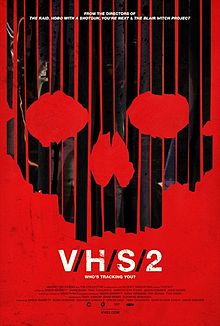 The second entry in the found footage horror anthology (and less than a year after the first to boot) is not as clever as V/H/S but more polished, better paced, and full of enough ingenuity to recommend, especially for horror fans. In my review of the first film I championed a shorter format, giving an audience the thrills they crave faster rather than slogging through an hour of slow buildup. The results are still fairly hit or miss, though none of the four segments is a misfire per se. The weakest is probably the last, “”Slumber Party Alien Abduction,” where the poor camera quality makes it hard to tell what is actually going on. The best, by far, is The Raid director Gareth Evans’ “Safe Haven” about a team of journalists picking perhaps the worst day to tour a creepy cult’s compound, notably during the apocalypse the cult predicted. This one takes a bit to wind up but when all hell breaks loose it goes nuts with glory. The wraparound segment tying everything together is more palatable and points to a promising mythology around the collection of these haunted VHS tapes that people keep watching and then dying over. All together, this is a concept that just works for horror and I’ll welcome presumed sequels as they come off the assembly line. This is found footage done right, with faster payoffs, more variety, and greater focus and ingenuity. If you enjoyed the first film, or are a fan of horror anthologies in general, then pop in V/H/S/2.
Nate’s Grade: B


 nathanzoebl
You must be logged in to post a comment.