Blog Archives
Moana (2016)
 The Polynesian-based animated musical Moana is a throwback to the Disney formula of the 1990s that became so familiar and entrenched. The time away has made it a welcomed return, especially when executed to this magnificent magnitude. A formula by itself is not a problem, in theory. Many of our favorite movies follow storytelling paths that others have trod well before, but it’s all about the level of execution, building characters that an audience cares about, a conflict that feels involving and escalating, and payoffs that are naturally setup throughout the plotting. With a formula, it’s not the song it’s the singer, and Moana is a splendid and delightful animated movie that should enchant all ages with colorful characters, catchy songs, and the familiar formula of old given surprising and rewarding depths. It’s a lovingly made movie I fell in love with.
In ancient times among the Polynesian islands, the demigod Maui (voiced by Dwayne “The Rock” Johnson) stole the literal heart of the goddess Te Fiti, a shining green emerald responsible for creating life. Many years later, Moana (voiced by Auli’i Cravalho) is a teenage girl next n line to be the chief of her people. Much is expected of her for the betterment of the island but Moana would rather be out there on the water, a passion that her father forbids. Her island is in dire trouble when the food supplies are rotting or disappearing. Moana’s eccentric grandmother (voiced by Rachel House) tells her what must happen: she must venture out to sea, find Maui, retrieve his magic fishhook, and force Maui to return Te Fiti’s heart to the source. Moana sneaks away and embarks on a great adventure that will test her skills and her sense of who she is and what her calling should be.
 With a few clever nods, Moana intimates to its audience that it knows what they expect and will be delivering the best of the old formula without being slavishly lockstep in its execution. The Disney formula of the hero or heroine yearning for something grander from their supposedly drab existence became a crutch after the apex of the Disney Renaissance in the mid 90s. The overprotective father who doesn’t want their daughter or son to break far from tradition will also be plenty familiar. With Moana, the masters who kickstarted that Renaissance, directors Ron Clements and John Musker, return to the formula but also know what to subvert, what to tweak, and what to dive right into. While it’s not as subversive as mildly revolutionary for a Disney movie as Frozen, this is still a movie that anticipates the connections an audience will make and knowingly tweaks them. On her island, Moana has a cute little pig sidekick who you expect to make the journey with her… except it doesn’t. Instead the brain-dead chicken, a reliable source of comic relief, is her traveling animal companion. Moana prickles at being called a princess; she’s the daughter of the chief and actually already functions in a ruling capacity. “If you wear a dress and have an animal sidekick, you’re a princess,” he nonchalantly retorts. There’s also a lesson in what constitutes good and evil as all the villains and reprobates of legend are far more ambiguous. There’s also a refreshing lack of a central romance. We have a strong heroine whose goal is completely unrelated to romantic love. This girl has bigger things on her mind than boys.
This movie is primarily a two-hander as we witness Moana and Maui interact, grow, and change, much to our amusement. I can’t recall another Disney film that had such a small focus on a limited number of characters and this decision pays dividends. While only 103 minutes, we really get to understand these two people and what drives them and what fears keep them from accomplishing their goals. Moana is a terrific character. She’s pulled in different directions from her sense of duty and her own ambition to explore the world outside. She’s feisty but still clumsy, empowered but still filled with doubts, independent but considerate of others. After all, her plight is to save her people. Pairing this character with Maui provides plenty of narrative sparks, especially as Maui is forced against his will by the power of the ocean to assist in doing right with Moana. Newcomer Cravhalo makes quite a debut. Her singing voice is flawless but I was highly impressed with the emotion she was able to convey through her vocal performance. She makes you care deeply for her character because she brings such life to the lively Moana. Johnson’s boundless charisma is amazingly channeled into the character thanks to the animators. Johnson isn’t lazily sleepwalking in his performance like so many celebrity vocal actors. Moana and Maui both intrinsically have their identities tied up in their sense of obligation to others, and this provides a common area for them to bond and also to stretch as characters. Theirs is a dual journey of self-discovery and defining themselves on their own terms. The actions of others and their demands do not have to define you. The charged interplay between Moana and Maui, two characters at cross-purpose in their goals, is a scenario that places them in our focus and endears them to us as they deepen.
 The fantasy setting also allows for plenty of fun and imaginative diversions and turns. The mingling of man and god with the whimsical and weird magical creatures made me think of the great Miyazaki (Spirited Away, Princess Mononoke) as a direct creative influence. There is a delightfully wonky sequence with a wild band of pirates that are best described as living coconuts from a Mad Max film. Their floating ships are patched together with ramshackle planks and pieces and a thunderous drumbeat for pacing. All that’s missing is a coconut with a flaming guitar. It’s such a visually delightful and daffy segment and it doesn’t wear out its welcome. Maui’s living tattoos (traditional hand-drawn animation) provide further personality and serve as his conscience. The underwater land of monsters is also begging for further exploration. Maui’s shape-shifting powers are brought to the forefront during key battles with the giant lava monster Te Ka. Even when the movie isn’t dazzling you with a song or its character development it can pull off inventive and visually gorgeous world building that sucks you in.
While not hitting the earworm heights of Frozen’s best, the songs in Moana are uniformly good and, even better, advance the story and give additional light to characters. Lin Manuel-Miranda is still a musical genius and imbues the sounds of Moana with Polynesian culture and history, lots of powerful percussion and harmonies. Moana’s personal theme of “How Far I’ll Go” has some wonderful melodic turns especially as it builds, and it’s a fine musical throughline for her journey with each repetition building in emotion. I enjoyed the Hamilton-style rhyming flourishes as well as the extended rap interlude on The Rock’s jaunty signature song, “You’re Welcome.” That tune is quite playful with a strong hook and it boasts all Maui’s accomplishments and his hefty ego, but it also has a narrative purpose. Maui uses the song to distract Moana and steal her boat. My current favorite might actually be the outlier on the soundtrack; “Shiny” is an absurdly enjoyable Bowie-esque glam rock number from a giant crustacean admiring his fascination for all things shiny. Jermaine Clement (Flight of the Conchords, What We Do in the Shadows) superbly sinks his teeth into such a theatrical and comical villain. It’s a short scene but Clemente’s impression is irresistible. His song is also a strategy, allowing Maui to steal back his fishhook while the opportunity for gloating distracts the giant crab. The songs are a reflection of the characters singing them and serve narrative purpose, which is a rarity in big-screen musicals. The musical score by Mark Mancini beautifully matches Manuel-Miranda’s songwriting themes and provides a lush sonic backdrop.
 This has been an absolute dream of a year for animated movies. From Zootopia to Kubo and the Two Strings to the heartwarming indie Life Animated, the movies have enchanted and entertained and also dared to challenge, uplift, and engage an audience. These are more than mere babysitting tools for exhausted parents to put on; these movies are some of the best of the year, animated or live-action. For my tastes, Moana is just a touch below Zootopia due to the latter’s complexly inventive world and articulate social commentary. However, Moana is a lavishly produced adventure with great characters, more than a few pleasant surprises, and an emotional core that becomes more evident as the two characters we’ve grown attached to come full circle. The visuals are lively and colorful, the plotting is carefully paced and comes to a meaty conclusion, and the emphasis is on the relationship of the two main characters and their function. There was nary a moment during Moana where I wasn’t smiling from ear to ear. Do yourself a favor and savor this second Disney Renaissance because since 2012’s Wreck-It Ralph the Mouse House has been on a near unprecedented creative tear. This is starting to get to peak Pixar levels, folks. What can I say except… you’re welcome?
Nate’s Grade: A-
Share this:

Kubo and the Two Strings (2016)
 At this point the Laiki studio (ParaNorman, The Box Trolls) has earned as much good will and credibility as Pixar in their pre-Cars 2 prime. I almost was going to write off their latest, Kubo and the Two Strings. For the first forty minutes or so I was somewhat indifferent to it. Sure the stop-motion animation was stunningly realized and the creation of the environments was very meticulous, but I just couldn’t connect with the movie’s story of a young boy, Kubo, and his quest to claim magic items to thwart the advances of his dangerous and estranged mystical family. Then the first big set piece happened and then the next, and then the plot made some deft reveals and provided a strong emotional foundation, and I was hooked. This is Laika’s first real action film and the wide shots and long takes do plenty to serve the action and allow you to further marvel at the painstaking brilliance of these hard-working animators. It’s a full-fledged fantasy epic that tickles the imagination and provides a poignant undercurrent of emotion especially during the final act. As Kubo declares his real strength are his memories of loved ones past, I was starting to get teary. It’s a lovely message to top off an exciting and involving action movie with creepy villains and side characters that do more than throwaway one-liners. Art Parkinson (Game of Thrones) gives a very expressive and emotive performance as our lead. Charlize Theron is outstanding as Kubo’s maternal protector who just happens to be a monkey. Rooney Mara is also genuinely eerie as an ethereal pair of flying sisters trying to snatch Kubo. Matthew McConaughey isn’t the best vocal actor due to the limited range of his vocal register but he’s still enjoyably daft. The Japanese setting and culture are recreated with loving touches that celebrate rather than appropriate. I still regard the arch silliness of The Box Trolls as my favorite film but Kubo is more than a worthy follow-up. The slow start is worth it by film’s end, so stick with it if you start to doubt yourself, because the emotional wallop of Kubo and the Two Strings, not to mention its creative high points, is well worth the invested effort.
Nate’s Grade: A-
Share this:

Fantastic Beasts and Where to Find Them (2016)
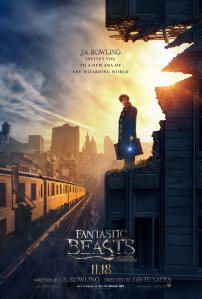 The Harry Potter publishing universe is almost twenty years old and has racked up more money than can be printed, so it was only a matter of time before some enterprising soul thought about expanding from author J.K. Rowling’s seven novels. I wasn’t anticipating that it would be Rowling as the one reopening her world for untapped franchise potential and financial windfalls.
Newt Scamander (Eddie Redmayne) is one of the world’s foremost experts on magical creatures and will one day write a definitive magizoology textbook for students to doodle inside while they sit bored in magic class. He’s traveled to New York City in 1926 and through a series of misunderstandings he exchanges briefcases with Jacob Kowalski (Dan Fogler), a factory drone trying to secure a loan to open a bakery. Inside Newt’s briefcase is a collection of colorful and unique magic creatures with goofy Dr. Suess-styled names, and they break free and need to be rounded up. Porpentina Goldstein (Katherine Waterston) is a disgraced magic authority agent who tries to regain her reputation by helping Newt gather his living contraband before they are discovered by muggles, or as the Americans refer to them, no-majs. Percival Graves (Colin Farrell) is a gravely serious magic official keeping a close watch on the alarming activity. He also has an unclear interest in a fringe political movement that believes witches are real and a real threat. If only they knew the full extent, as a mad wizard-supremacist is also on the loose.
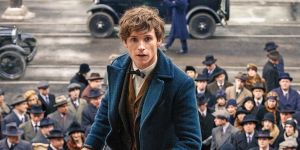 Fantastic Beasts and Where to Find Them is a better franchise catalyst than it is a movie, with several competing storylines that don’t really gel or feel properly developed. This feels like a series of set pieces in search of a movie to unify them. Much of the movie involves dueling storylines that dawdle until they are smashed together at the very end, much like Rowling’s storytelling habit of keeping so many characters and storylines on the fringes and simmering until they are called upon for revelatory disclosure. Storyline number one follows a daffy British magizoologist as he scours New York trying to retrieve his strange and adorable magical creatures. It’s relatively light and mostly fun. Storyline number two is a buddy movie with Newt and Jacob, which is also light and mostly fun. Then storyline number three is an abusive anti-magic movement that may be conspiring to kill wizards that stand in their way, revealing to the wider world the magical realm and the potential threat it poses. This storyline is much darker and adult and it contrasts sharply with scenes like Newt doing a silly dance to present himself for mating with a gigantic rhinoceros creature in heat. It’s hard to reconcile whimsical magic creatures one moment and stern child abuse the next. The varying tones don’t ever gel. The majority of the film is watching Newt scamper around trying to recapture his creatures and stumbling into bigger plot events that are kept on the edges of relevancy.
This movie is more about laying a foundation than telling a relatively complete and gratifying story. The narrative brick laying may be essential for future sequel success but it doesn’t make for the best experience in the theater. Rowling’s first crack at screenwriting has a few hallmarks of novelists-turned-screenwriters (cough, Cormac McCarthy, cough), namely the fuzzy narrative clarity and digressive asides that deter the film’s progressive momentum. It’s hard to critique certain themes and characters that feel useless (Jon Voight for starters) without knowing whether Rowling will decide they are secretly important three movies onward. I don’t know what this movie is about other than setting up lucrative sequels.
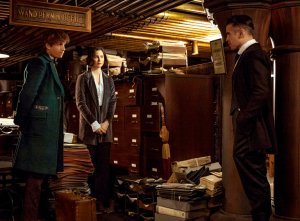 Another area of concern is whom Rowling has decided to be the leader of this voyage back in time; Newt Scamander is quite a lackluster lead character for one movie, let alone the prospect of up to five of them. I found this protagonist rather boring. He’s a kind figure and cares for his exotic animals but the man is pretty much the exact same person by the end of the movie as he is at the start and with only passing hints at a secret tragic past as something to enliven what is assuredly a dull, mumbling character. I’m not against Rowling’s decision to catapult a mild-mannered, shy, polite man as her main character especially in the face of paranoia and fear mongering, but the guy has to at least be interesting. There is not one interesting thing about this character outside of his briefcase full of magical creatures. He is a void of character, a blank slate that isn’t any more filled in by the conclusion. The lack of substance also allows Redmayne to retreat into his actorly tics playing up Newt’s social anxiety, almost to a degree that seems recognizably autistic (at least it was with my friend who saw it with me who is on the spectrum). He feels sensitive to the point that his body is going to collapse inwardly upon itself. I saw the same impulses with his overrated, overly mannered performance in The Danish Girl. When lacking significant depth to his character, or at least something of significant interest, he overcompensates with what he’s given and that’s not usually for the best. Just see Jupiter Ascending if you’re truly brave enough or equipped with enough liquor.
I think the stronger lead character would have been Newt’s buddy, Fogler’s no-maj Jacob Kowalski. He’s already our entry point into this older time period so why not make him the focal point? Jacob is a far more interesting character and he’s actually astonished by the revelations of a magical world right under his nose, adding to the general sense of discovery for himself as well as the audience. He’s the more relatable character as he discovers the world of magic and develops fluttery feelings for a magical lass (Porpetina’s psychic sister, Queenie, played by Alison Sudol). The sweet and flirty stutter-stops of a possible romance with Jacob and Queenie are far more heartfelt and engaging than whatever the film tries to pretend has been set up for Newt and Porpentina. By the very end, the movie expects a few smiles and arbitrary sexual tension to compensate for the rest of the film’s 133 minutes that did not establish one passing moment of attraction. Sorry, Rowling, but cinematic romance doesn’t work in spontaneous vacuums. If you want us to fee for the characters and compel them to get together, we need to see your work if you want the coupling to be remotely satisfying.
The rest of the actors do what they can with the thin scraps of characterization that Rowling provides. Fogler (Fanboys) is a reliable source of comic relief. His sincere pleasure from the magical world and its inhabitants makes him endearing, seeing this world through necessary fresh eyes. Waterston (Inherent Vice) is a screen presence that stands out from the pack, though her character is too muted to leave the same impression. Her character’s goal is to clear her name but she seems to readily forget this motivation. Until writing this review I had no idea that Sudol (Transparent) was the songstress A Fine Frenzy, an artist I’ve enjoyed for a decade. Her acting isn’t quite as accomplished as her singing but Queenie is something of a walking ethereal, sad-eyed psychic kewpie doll. Rowling treats her more as a handy plot device when she needs some item explained or intuited. Queenie’s budding relationship with Jacob makes her more interesting. There are plenty of familiar faces that are stranded in underwritten and confusing roles. The likes of Colin Farrell, Samantha Morton, Ezra Miller, Zoe Kravitz, Carmen Ejogo, Jon Voight, and Ron Perlman, as a mo-cap goblin, must have simply been happy to participate, and I can’t blame them considering the fortunes that await this franchise.
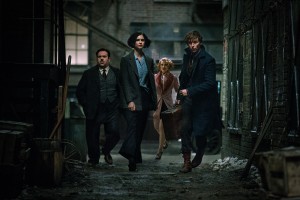 The world building is hazy yet the world of wizards in 1920s New York City is intriguing enough to keep me hopeful that a better movie could emerge later. We’ve never been stateside before in this universe so my first point of interest was the difference between the magical authorities from across the pond. Apparently the magic-inclined aren’t legally allowed to romantically mix with no-maj folks (call it muggle miscegenation laws). That’s interesting but we only get a glimpse. The Second Salem movement in the United States seems to believe that witches and real danger. They seem like a fringe political conservative movement. It’s interesting yet we only get another glimpse at best. Then there’s an evil wizard who wants to wipe the world of the unclean, surely a setup for You-Know-Who and his malevolent Death Eaters. He’s kept further to the background and only bookends the movie. I just looked it up and Voldermort was born in 1926, so expect even more foreshadowing in the future. I wanted to know more about the world inside the Magical Congress of the United States of America. Why do they have a killer magic tar pit and what does it really do to people? There are passing references to the pre-established Harry Potter universe, small morsels for the crowd to hold onto to get them through this muddled expository journey. Still, there is an undeniable entertainment value of seeing magic interact with a 1920s American landscape. A magic speakeasy is a delightful moment to open up this world in amusing historical ways. Newt’s suitcase and its vast interior world is also a great source of wonder and a potent highlight.
Fantastic Beasts doesn’t quite rise to the level of fantastic implied with its title, though if you’re a Potter fan it could be a welcomed and promising start. That’s really what this movie is, a start, and not so much a complete story. It’s a Potter prologue that provides just enough to get an audience interested but not enough to perhaps get them excited. The main character is a total washout and the varying tones and storylines fail to gel. Rowling has some screenwriting novice growing pains and her general world could use more texture amidst all the special effects sequences. Those magic critters are cute I’ll give them that. There just doesn’t seem like there’s enough here of genuine substance in any capacity, other than setting up a playpen for its four sequels. Director David Yates has shepherded the Potter universe for five movies now. The visual continuity from prequel to main story arc reminds me of Peter Jackson’s turn at reviving the Hobbit trilogy. Actually, Fantastic Beasts reminds me of the Hobbit films in more ways than one. They were both somewhat crass moneymaking ventures inarticulately stretched and padded to ensure more movies and more profits. They are also decidedly lesser than the main story arc. To my movie muggle tastes, Fantastic Beasts ranks toward the bottom of the Potter franchise, just a step above Half-Blood Prince. Too often it feels like textbook Potter stuff minus the character investments. It’s a series of set pieces and latent possibilities and less a full movie. Then again, take my so-so critique with a relative grain of salt, Potterheads.
Nate’s Grade: B-
Share this:

Miss Peregrine’s Home for Peculiar Children (2016)
 Miss Peregrine’s Home for Peculiar Children feels like Tim Burton’s X-Men franchise, and it’s just as awesome as that sounds. Burton has always had an interest in the outcasts and misfits of society and now he has his chance to leave an imprint on the ever-present superhero phenomenon. His own personal group of gifted youngsters is looking to form a funky family and fight against fearful forces that have their sights set on exploiting these special children or worse. It’s a natural fit for a man who has become a Gothic industry unto himself over three decades of peculiar and spooky filmmaking. This is Burton’s chance to flex franchise tentpole muscles with a subject matter perfectly attuned to his offbeat sensibilities, and watching the fabulous final product is akin to watching a master musician dive into Beethoven’s Fifth. This movie was flat-out delightful.
Jake (Asa Butterfield) is reeling from his beloved grandfather’s (Terrence Stamp) mysterious death. The old man loved sharing his stories about tending to the shape-shifting Ymbryne Miss Peregrine (Eva Green) and her wards, a group of children with special abilities including starting fires, controlling plants, invisibility, and being able to float lighter than air. On a trip to Wales to investigate grandpa’s stories, Jake discovers a time portal and is taken back to the WWII era where Miss Peregrine is waiting for him. She and her children relive the same day and will never age. They’re hiding from Barron (Samuel L. Jackson) and his group of scientists who wish to hunt the children. Jake is tasked with being the new protector, as he is the only one that can see an invisible band of slender monsters known as hollows that feast on the children.
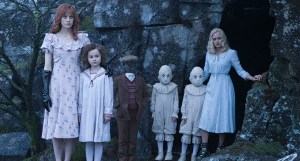 There’s a whimsical nature to the dark elements, and the script is rife with enjoyable payoffs and fun moments that cry out for a full visual immersion. This is Burton’s best film since 2007’s Sweeney Todd (I have a soft spot for that macabre musical), arguably best since 2003’s Big Fish, and maybe his most fun movie since his 90s heyday. If you’re a Burton fan, you’ll be tickled by all the imagination and humor. I grew up on the cinema of Beetlejuice and Edward Scissorhands and The Nightmare Before Christmas (yes, directed by stop-motion maven Henry Selick but still very much a Burton film), so I’ll admit that seeing Burton in high form once again warmed my little mischievous heart.
You get a sense just how involved Burton was in the filmmaking and its details, the degree of passion and involvement, and also his commitment to being a dark movie intended for peculiar children and adults with macabre interests all over the world. I kept thinking that the 12-year-old version of myself would have adored this movie, never mind the 34-year-old version of myself who greatly enjoyed it too. This feels like a natural evolutionary step for children and adolescents who gorged themselves on the works of Edward Gorey and R. L. Stine. It’s not a significant spoiler but it’s something I feel you, dear reader, need to know in order to properly assess just how wonderfully morbid the movie can come across. There is an entire visual feast of a group of villains dining upon the delicacy of… children’s eyeballs. You read that right. It’s a silver platter piled high with severed eyeballs, and they get slurped down like it’s spaghetti. I could only cackle to myself at the audacity of the movie to embrace the fun of the darkness rather than hiding from it, mitigating it, trying to be delicate with tone. The villains want to return to a normal state that can only be achieved by consuming the eyeballs of peculiar children, and so they are hunted not for sport or prejudice but for eyeballs. That’s wonderfully squirmy, and it definitely affected me, an avowed cinema patron who gets extra squirmy with any onscreen eye trauma. There are other creepy and memorable moments, like a dead child being used as a ventriloquist doll and the slenderman-styled hallows creatures. The moments are plenty but they don’t choke the story’s momentum, which hums along with great imagination and lucidity.
There’s a lot going on with Miss Peregrine, and Jane Goldman’s (Kingsmen) screenplay juggles a lot of rules and world building without losing momentum. I was intrigued early and the movie would widen its focus, providing more texture and connection to the world in calculated doses. It was enough that I always felt like I was learning something while still being able to see how the pieces snapped together in retrospect. There’s time travel that has to be done at a very specific point, the rules of who can travel back in time to these bubbles of safety, the history of this specific day stuck in time, the non-linear history of the protectors, the fact that the bubbles are also teleportation hotspots, the history with Jake’s grandfather, the history of the Ymbryne and their powers, the powers of all the peculiars, dream prophecy, mad scientists and their peculiar ailments, the differences between the hallows and the predatory scientists, and also establishing the character dynamics of several lost children and a budding YA romance. It’s amazing that Goldman’s script is as understandable as it is considering all that heavy lifting. It’s not completely free of muddled plot points and some hazy explanations, but those instances are a clear minority to what works so effectively. I wanted to know more about this world, and once they added time travel and teleportation, I was hooked. I enjoyed the movie so much that I’m considering reading the additional books for my next freaky fix.
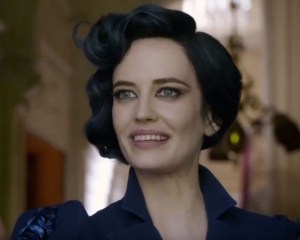 The acting ensemble is full of bright spots and none brighter than the new queen of genre gusto, Eva Green. I raved about Green’s magnetic performance in the considerably lesser 300 sequel. She was easily the best part of that movie and it suffered whenever she wasn’t on the screen. The same can be said for the too-long-in-the-making Sin City sequel. She was the best thing in Burton’s otherwise forgettable Dark Shadows feature. In short, this woman is incredible, and she digs into the vampy and ridiculous with the right degree of malevolence and glee. Green is a wonderful hostess into this magical world, and her foreknowledge gives her a caffeinated energy that makes her even a tad more peculiar. Her children are all fine actors who have uneven parts thanks to the unfair distribution of their powers. Not everyone gets super useful abilities. I felt sorry for the kid who projected his dreams from his eyeball especially during the third act scuffles. A mouth in the back of the head doesn’t seem very useful either. I enjoyed the idea that the invisible kid needs to be fully naked to be fully invisible, and everyone acknowledges this reoccurring fact with shoulder-shrug nonchalance. The standout amongst the peculiars is Ella Purnell as the winsome girl who will float away. She has an innocent and yearning quality that doesn’t sink her character. She’s more than just a love interest to Jake and Purnell helps channel great affection. Jackson (The Hateful Eight) is expectantly highly entertaining as the lead villain and Butterfield (Ender’s Game) is perfectly acceptable as an audience surrogate into this wild world.
I was duly impressed with just about every element, from the structure of the screenplay and its precision with information and intrigue, to the level of acting, to the dark and whimsical tone, to Burton’s own peculiar particulars that fill out the film with adoration. It may sound corny but there is an affection woven throughout the film, for its dispirit outcasts, for their strangeness, for the ardor of telling a spooky story that can appeal to children without pushing away adults. There’s a care that’s been absent Burton’s other recent films, especially Dark Shadows, which left me bewildered whether Burton had any genuine fondness for the source material. Miss Peregrine’s Home for Peculiar Children is a haven for fans of the peculiar, Burton’s oeuvre, and those looking for a quality children’s film that has some bite. I can only hope for more fantastical adventures.
Nate’s Grade: A-
Share this:

Pete’s Dragon (2016)
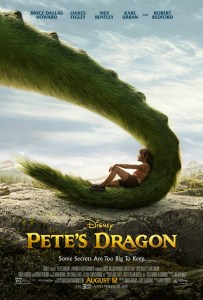 I have no personal love for the original 1977 Pete’s Dragon. I thought you, dear reader, deserved to know this morsel. I never felt a sense of wonder from the animated dragon creating mischief while a town tried to rid itself of an orphan and a bunch of hillbillies sang an ode to child abuse (it was a different time?). Disney has gotten into the self-cannibalizing habit of dipping into its own past and remaking its animated hits for a new generation of moviegoers. It worked splendidly with last spring’s Jungle Book, and the new version of Pete’s Dragon is further proof that when Disney aligns the right artist with a vision and gives them latitude to express that vision, rewards are generously reaped. This is a delightful, heartwarming, and enchanting summer movie that got me crying.
Pete (Oakes Fegley) is a young boy who lives in the wooded reservations with one very special friend, a furry green dragon he has named Eliot. He’s been living in the woods for six years after Eliot rescued him following a car accident that claimed the lives of Pete’s parents. One day a park ranger, Grace (Bryce Dallas Howard), comes across Pete and brings him back into town for medical evaluation. He’s a mystery child, a bit feral, and demands to return home into the woods. Grace incites Pete into her home and her family, but there are worries about the boy acclimating to society. All the while Eliot is looking for his best friend and mournful that they might have to part ways after all.
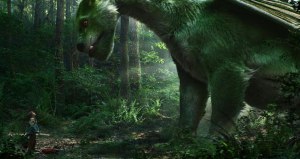 Pete’s Dragon is a simple story but this is not a detriment to its ultimate effectiveness. Rather the filmmakers take care to treat this childhood fable with enough heart and earnest emotion that the movie feels fully developed to its aims. The characters and their journeys aren’t exactly revolutionary, but I didn’t mind at all. This is an old-fashioned family film told without irony and set in a nondescript past that adds to the universal appeal of its message. It’s elegantly simple but there are poignant themes running under the surface, namely an unmistakable level of melancholy with Pete’s process of growing up. This feels like Disney’s version of Spike Jonze’s Where the Wild Things Are, a movie that examines the hard but necessary transitions of childhood and the acceptance of a sort of loss among the fantastic. This movie isn’t consumed with a dour interpretation of childhood as an oppressively hellish existence of misunderstanding (I didn’t connect with Where the Wild Things Are if you couldn’t tell) but it does acknowledge a loneliness of being absent a family to call your own. Pete’s life with Eliot is filled with boyish excitement and adventure but he knows he can’t hold onto that world much longer, and this realization magnifies the remaining time with Eliot. From start to finish, Pete’s’ Dragon is bursting with warmth and resonant emotions.
I was unprepared for the emotional wallop that this film delivered. Not since perhaps Pixar’s Up has a movie so effectively triggered my sympathies in its opening ten minutes. In a beautiful yet tastefully restrained sequence, Pete becomes an orphan and is rescued by Eliot, and the vulnerability and compassion of this moment already had me tearing up. Full disclosure: I’m a sucker for the “boy and his dog” stories, and while Eliot is a special dragon by design he is, at his core, a rendition of man’s best friend. Their relationship is one of love, companionship, and protection. They’re a pack. When Eliot spots Pete cozy in a family house, he’s crestfallen but accepts that a placement in the human world is where Pete belongs. And then at the end after a fraught situation, Pete instinctively runs to Eliot and leaps into his arms, and Eliot takes him in, holding him dearly, and it was at this point that I couldn’t stop the flow of tears even if I wanted to. Happy tears, people. The takeaway of the film is the formative bonds of family and the need to reach out for that nourishing companionship. While it’s highly emotional, it’s all earned and avoids cheap maudlin, manipulative theatrics, short of one extended sequence of Eliot’s capture.
I never would have expected such an old-fashioned yet preternaturally charming movie from the team responsible for the somber indie Western Ain’t Them Bodies Saints. Director/co-writer David Lowery is locked-in with its goals and finds ways to build its characters through small, cumulative actions. The film also has a marvelous sense of place as get a strong feel for everyday life in this foggy Pacific Northwest environment. Contributing to that sense is a terrific soundtrack of low-key folk songs that thrum with a lovely homespun gentleness that taps into the earthy magic of its setting. The score strings-heavy by Daniel Hart is perfectly attuned to the emotional rhythms of the film without becoming overbearing. The photography is often gorgeous and the editing near invisible with how effortlessly it presents its story with room to breathe. There’s a standout sequence that highlights just how well all of these individual elements come together to form a greater whole. Pete escapes from the town’s hospital and desperately runs outside. He is dazed by the activity of the modern world and the geography of the town, and the residents of this town are just as dazed about Pete, a wild child exploring his alien surroundings. He hops aboard a school bus and the children inside are amazed at Pete’s daredevil antics. The chase sequence is set to the Lumineers’ “Nobody Knows” and it builds upon the sense of discovery, community, and mutual awe. It’s a wonderful sequence that develops patiently.

Part of the success of the movie is also due to the skill and implementation of the special effects team. Eliot is a cuddly creature you want to take home with you yet he can still be intimidating under the right circumstances. He’s on screen a lot but his magical qualities don’t diminish. This is one highly communicative dragon and it’s easy to empathize with him (those exquisitely emotive canine eyes help). There’s a tenderness to him that convinces the audience early on to take a journey with Eliot and see what happens next.
The human specimens are heartfelt and enjoyable as well. Ostensibly the main character, his name is in the title after all, the role of Pete rests on the tiny shoulders of actor Oakes Fegley, and he aces the part, tapping into the rougher, wilder edge while also selling the dramatic moments in a clear relation to his interpretation of the character. The next main character is Howard (Jurassic World) and she’s quite good. She gives a maternal performance that doesn’t go overboard while still allowing her to come across as an independent, thinking woman with her own desire for proof of the fantastical. She has several tender moments with Fegley. The actors all perform ably. Even Wes Bentley (TV’s American Horror Story) works well in the movie, and when was the last time that could be said? Karl Urban (Star Trek Beyond) is enjoyably hammy as the villain who’s not much of a villain. I wish Redford (Captain America: The Winter Soldier) was in more scenes because his grandfatherly presence is so enjoyable to watch and he so easily slides into the part.
Disney is two-for-two when it comes to 2016 live-action remakes of its old catalogue, and if The Jungle Book and now Pete’s Dragon are any indication, then bring on the remakes. The original Pete’s Dragon was never a memorable or enjoyable film for me, so there was already much to improve upon, which is what the new version does in every way. It’s poignant, heartwarming, earnest, and bursting with feeling. It’s a simple story told exceptionally well with artistry and grace. There’s a dash of indie flavor to the mainstream filmmaking. I think this movie will appeal to people of all ages, grown ups that are looking for some magic in their movies, as well as families looking for a movie that will entertain children but won’t rot their brains. It’s fortunate that we can end such a mediocre summer at the movies on a high note, and Pete’s Dragon is a wonderful infusion of the old and new, magic and reality, heartache and triumph. It’s a movie dripping with purity, and one that demands to be seen and hopefully cherished.
Nate’s Grade: A-
Share this:

The BFG (2016)
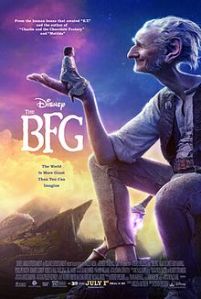 Roald Dahl is the kind of highly imaginative, inventive, and subversive children’s author that makes one wonder why more of his books don’t end up as movies. Charlie and the Chocolate Factory is the best known, and there’s Fantastic Mr. Fox, Matilda, James and the Giant Peach, and the rather spooky for kids 90s film, The Witches (it at least spooked me as a kid). For such a prolific author, it’s a little curious he has so few film credits. Steven Spielberg is one of the most successful directors of the modern era, so if anyone could wrangle Dahl’s wondrous worlds onto the big screen, he should. The BFG should be a transporting experience brought to vivid life with cutting-edge technology. All the special effects in the world, however, can’t solve a raft of nagging script problems that manage to take the fantastic and make it boring and predictable.
In 1980s London, little orphan Sophie (newcomer Ruby Barnhill) is abducted one night when she spots a giant blowing a mysterious trumpet into the windows of sleeping children. Fortunately for Sophie her captor is the BFG (Mark Rylance), which stands for Big Friendly giant, and he’s a vegetarian, having sworn off the bone-eating habits of his nastier giant peers. In Giant Country, the BFG collects and cultivates dream particles, concocting special mixtures that he then shares with sleeping children. The other giants bully and snidely dismiss the puny BFG. Sophie and the kindly BFG must work together to stop the larger giants from going back to London and dining on innocent children.
 The BFG has some pretty big friendly problems when it comes to its misshapen plot structure and its alarming lack of urgency or escalation. We’re all familiar, consciously or unconsciously, to the three-act story structure at this point, which is the principle formula for screenwriting. The BFG gets started pretty quickly, abducting Sophie and taking her to the land of giants by around the 15-minute mark, and from there the movie seems to take a leisurely stroll. I can’t really tell you where the act breaks are because the movie just sort of luxuriates in the meandering interaction between the BFG and his human pupil. There’s the initial threat that the other cannibalistic giants will discover her and this threat pops up in a handful of set pieces where Sophie has to constantly find new hiding places. Unfortunately, this threat never really magnifies or changes. She might get caught, and then she doesn’t. She might get caught, and then she doesn’t. There’s a repetition to this threat with our antagonists at no point getting more threatening. This is and a lack of a narrative motor make the movie feel rudderless, plodding from one moment to the next without a larger sense of direction. And then the third act comes (spoilers), presumably, when Sophie and the BFG travel back to London to try and recruit the Queen of England’s (Penelope Wilton) help. This sequence includes an extended breakfast that it punctuated by the memorable climax of watching the Queen fart and her little corgies fly around the room powered by their flatulence. It has to be the climax because what follows certainly doesn’t follow. Within five minutes, the BFG leads the Brits back to the land of giants and they restrain and airlift all the other giants in shockingly easy fashion. It’s a victory that feels relatively hollow because of its ease. These giants were never much of a threat to begin with, which is why we spent more time deliberating over dream ingredients than a retreat from man-eating colossuses.
Another aspect of Dahl’s novel that falls flat on screen is his verbal gymnastics and witticisms. It just doesn’t work with actors repeating the words without the text in front of your eyes. Listening to the BFG talk for any extended period of time is like being stuck with a crazy person muttering to him or herself. I would estimate that at least 60% of the BFG’s dialogue is folksy malapropisms. It’s not endearing and grows rather tiresome, especially with the unshakable stagnation of the movie’s plot. And so we get scene after scene of a big CGI creature talking verbal nonsense. Are children going to be entertained by any of this? Are they going to be engaged with the giant’s gibberish or will they find it one more impenetrable aspect of a movie and a story that seems to keep the audience at length? I couldn’t engage with the movie because it never gave me a chance to invest in what was happening. The BFG is a gentle soul and shouldn’t be bullied by his giant brethren, but that doesn’t mean I’m going to automatically love him. I didn’t.
 For a Spielberg movie this feels oddly absent his more charming and whimsical touches. There are scant moments where it feels like Spielberg is playing to his abilities in this fantasy motion capture world, like exploring the underwater land where the BFG gathers his dream ingredients, and in the narrow and messy escapes Sophie has not to be caught. It’s a shame that the creative highs of Spielberg in full imagination mode are too often absent the rest of the movie. He too feels like he’s coasting, allowing the technology and the fantasy setting to do the heavy lifting. The land of the giants is a bit too underwhelming as far as fantasy worlds go. It’s simply too recognizable except for slight peculiarities, like “snozcumbers.” It’s not an enchanting location and we’re not given enchanting characters, and with the little narrative momentum or escalating stakes. I experienced a lot more fun and whimsy from Spielberg’s other major mo-cap movie, the nearly forgotten 2011 Adventures of Tintin. The action sequences especially had such a lively sense of comic brio and imagination that was pure Spielberg. I get no such feeling from The BFG. If you told me that Robert Zemeckis had made this movie I wouldn’t have blinked. I don’t know if Spielberg was hoping to recapture that E.T. magic with screenwriter Melissa Mathison (who passed away in 2015) but this isn’t close.
I will credit the special effects department for the amount of work put into Rylance’s BFG visage, which looks eerily like the Oscar-winning actor. The range of the facial expressions is another sign that mo-cap performances are just as legitimate as live action flesh-and-blood performances. I can admire the technical feats of the character while not exactly feeling that much enjoyment from that character. The interaction between the computer elements and the real-life elements could be better, most bothersome with little Sophie interacting with the giant’s giant personal things.
I was left wondering whom The BFG is supposed to appeal to. I think kids and adults will be bored by its slow pace and stagnant, minimal stakes, weird and unengaging characters and their annoyingly impenetrable speech habits, and the overall lack of charm and wonder. It’s saying something significant when the most mesmerizing part of a fantasy movie is watching the Queen of England, her dogs, and a room full of her royal servants violently fart green clouds of noxious gas. That was the one moment in my screening where the kids in the room seemed to be awake. Otherwise the BFG character must have calmly put them to sleep with his prattling gibberish. It’s not an insufferable movie and there are fleeting moments of entertainment, but they drift away like a memory of a dream. There just isn’t enough going on in this movie to justify its near two-hour running time. Not enough conflict, not enough world exploration, not enough character bonding, not enough whimsy, and not enough entertainment. It feels too lightweight to matter and too dull to enchant. The BFG could have used more farts. That would be a sign of life.
Nate’s Grade: C+
Share this:

Finding Dory (2016)
 Victims of their own meteorically raised expectations, there’s still never been such a thing as a “bad Pixar” movie, and yet that doesn’t stop a growing lower tier from emerging, mostly the non-Toy Story sequels. I was wary about their latest, Finding Dory, mostly because I wasn’t completely enamored with its predecessor and also because it felt like writer/director Andrew Stanton was resorting to safe territory after helming the high profile flop, John Carter. It’s an amusing, cute, and effortlessly beautiful movie to watch but the threadbare plot reminds me of those direct-to-DVD sequels that were born from many a Disney animated classic from the 1990s. This is simply a story that didn’t need telling, much like Monster’s University, Cars 2, and The Good Dinosaur. This narratively fishy fish tale is firmly in that lesser league of Pixar cinematic adventures. I laughed here and there and there are some emotionally resonant moments as Dory looks for her missing parents, but so much of the plot feels transparently utilitarian, moving pieces around, and without the imagination and wonder the original provided. Hank the octopus feels less like a fully defined character and more a merchandizing opportunity. The majority of the plot takes place at a marine park, which limits the discoveries. Where are the narrative payoffs and economical storytelling of Stanton’s masterpiece, WALL-E? There’s an emotional lesson during the third act that would have hit harder had the filmmakers had the courage to see it through. I was picking up a heavy parallel with Dory and raising children with special needs. I would imagine much like the brilliant Inside Out that parents might get more out of the film’s emotional relationships than children. Finding Dory is fun and difficult to dislike, what with its loveably optimistic lead character; however, it does too little thematically to separate itself from a sea of imitators.
Nate’s Grade: B
Share this:

Warcraft (2016)
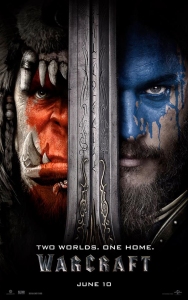 It’s been a long five years since we last saw a movie directed under the name Duncan Jones. He’s not just the son of David Bowie (R.I.P.) but also a talented and nimble director of science fiction thrillers with a rewarding intelligence and visual acumen. Moon and Source Code are two strong entries for anybody’s resume. After flirting with Hollywood franchises for a while, Jones latched onto a personal project, spearheading a Warcraft film adaptation based upon the popular online multi-player role-playing game that boasts over 12 million subscribers. Jones has gone on record saying he is a Warcraft player himself. He co-wrote the script and embarked on a long development process working with heavy use of special effects and actors in motion capture to bring to life the otherworldly fantasy races. It’s been a tumultuous road for the expensive final product, and Warcraft, as a movie, is proof that some concepts are best left to your home computer.
The orc race is in need of a new home because their old world is dying. Their leader, a wizard named Gul’dan (Daniel Wu), uses magic to open a portal to the peaceful world of Azeroth. The orcs invade and plunder although one orc, Daruton (Tony Kebbel), is wary of the motives of his leaders. He’s looking for stability rather than constant conquering. He finds an unlikely ally with Anduin Lothar (Travis Fimmel), a human warrior serving King Wrynn (Dominic Cooper) and his sister, Lady Taria (Ruth Negga). The humans seek help from their own wizard, the Guardian Medvih (Ben Foster). Someone must be collaborating with the orcs to allow the inter-dimensional portal to open. Medvih’s apprentice, the mage Khadgar (Ben Schentzer), teams up with Lothar to investigate and find a way to thwart the oncoming orc invaders.
 Unless you are a fan well versed in the lore and characters of the popular online game, Warcraft will leave you sputtering to construct cohesion from what seems like a lot of incidents without explanation, connective tissue, and a compelling reason to engage with this fantasy trope mess. It felt like every third page of the screenplay was ripped out of the shooting script; things merely just happen without proper setup and development. All of a sudden this character will be evil, or that character will have some prized piece of knowledge, or these two characters will be a romantic item. Things just happen in this movie and they are far too rarely given the context necessary to matter. This is less a story than a collection of ideas scattered onscreen. Take for instance our protagonists, or what you would assume are the protagonists, a pair of capable warriors trying to prevent mass causalities on both sides of the human/orc war. Except the orc character never really translates as an effective parallel to his human counterpart. You would naturally think they would be equal in significance as they try and steer their two warring sides to making less destructive decisions. I can’t tell you anything about the worlds we’re spirited to and from. We got elves and dwarves and mages and wizards and portals and dark magic and good magic and guns that feel entirely out of place in this universe and all sorts of names we’re expected to keep up with. There is little that leaves an impact, and after a while the movie ends up becoming the metaphorical equivalent of cartoon characters that run in place while the interchangeable backgrounds alternate behind them. Besides the fact that sometimes a guy wears a crown to help you realize he’s king, or a guy flashes a ball of energy in his hand, you’re left on your own to interpret the characters and why they are meaningful. The plot is simple, orcs versus humans and bad warmongering leaders at fault, but it’s the deluge of underdeveloped characters, subplots, and world building that make what was once simple hard to understand. I couldn’t tell you why anything was happening. There is no way the casual moviegoer will be able to keep up with the speed that Warcraft hurls information at them without careful setup and meaning. You need an instruction guide to make this stuff accessible.
Fantasy is a naturally transporting genre of storytelling but unless you actually develop and explain the worlds, the inhabitants, and perhaps some of the cultures, you’re destined to feel like a stranger bumbling through a most foreign and unfriendly place. Warcraft does a terrible job of making its worlds feel lived in, never mind accessible. Every new location should tell us more about the world and its characters, their interactions and conflicts, differences and similarities. This is just bad storytelling, people. Ultimately, it doesn’t matter where any of these locations are because they don’t impact the plot. The only story is about the conflict between the orcs and humans, but this could happen anywhere. There are some “important” characters on both sides of this battle but good luck trying to engage with any of these characters. The human characters are bland. I didn’t care about anyone and gave up trying. Cooper and Negga are both considerably more entertaining and effectively utilized on AMC’s Preacher. It takes an hour just for Warcraft to finally establish the relationships between its various stock characters.
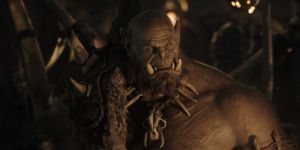
It’s the orc characters that showcase the most humanity, and credit goes more to the special effects artists and motion capture actors than the screenwriting. I appreciate how the movie devotes time to both sides of the conflict and finds figures of honor, and its best representation is Durotan. Kebbell seems like an actor who really feels a sense of freedom with mo-cap performances (he was excellent as the simian villain Koba in Dawn of the Planet of the Apes). I initially thought the creature design of the orc, what with their hulking underbites, was going to be hard to render emotive performances, but there were glimmers where you could witness the shadings of the actors beneath the underbites. It’s an impressive technical feat considering the obstacles that all parties had to overcome. Sadly, this only further exposes just how shoddy the storytelling is considering the technology was capable. Darotan is a loving husband and father who is leery of his leaders intentions, but this too is just a means to serve the ultimate ends of the plot. There isn’t a thoughtful moral anti-war argument to be had here. As a whole, the orcs are a rather personality-free race of creatures. Sure they talk a big game and have some curious decorative flourishes (tusk piercings!), but to this Warcraft layman, they come across like any other barbarian group. Early on I was mentally thinking of the Klingons from Star Trek and then I concluded that this was an inappropriate comparison because Klingons have memorable personality and culture.
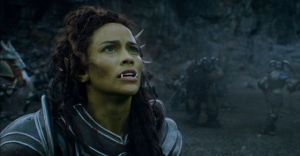 The actor who gets my greatest sympathy is Paula Patton (Baggage Claim) as the half-orc/half-human outcast, Garona. First of all, given the immense physicality of the orcs, I imagine any form of fornication with a human would prove highly fatal. It would be like an elephant mating with a labradoodle. Trapped between the two groups, Patton is painted green and given a lesser underbite that is reminiscent of snake fangs. When realized on an actual person, as opposed to a creation from the realm of computer effects, it’s not terribly convincing. Patton tries her best to speak all her gobbledygook lines of dialogue but the reverse vampire fangs make it awfully difficult for her to properly enunciate. She looks too ridiculous to be an effective character, and the fact that she is pushed into a romance with a human without any sense of setup beyond the universal law that pretty people should be together with pretty people is deflating. Why does the only female character of significance have to be shoved into a romantic subplot? Your poor poor jaw muscles, Paula Patton. At least you didn’t have to wear a metal bikini. Yet.
With all of this stated, Warcraft is not a horrible movie, and credit for that should go to Jones as a director. In the same token, Jones is also the co-writer so I guess he also deserves blame for the storytelling shortcomings. Jones very smartly limits his camera movements. Character will move within the frame but usually the camera point is fixed, which allows the focus to be more attuned to what exists within the frame. This is especially helpful during battles and with the multitude of CGI elements. This stylistic choice allows the film to be more visually immersive. The fighting sequences do get a tad repetitive as one guy with a sword or club runs at another guy. I saw Warcraft in 3D at my screening and I might actually recommend people see it this way, which is something I hardly ever do. It’s not that the 3D elements will compare to the experiences of modern standard-bearers like Life of Pi or Gravity, but it’s a pleasurable experience and the presentation of the visuals is crisp. I was worried about the usual effect of the glasses darkening the onscreen image and this was not the case at all. From a purely visual standpoint, Warcraft is worth watching at least once. The special effects vary between photo-realism and extended video game cut scene, but overall the visuals are colorful and fun and easy to discern. When the action heats up, you’ll be able to cleanly follow what is happening to whom. If only this same clean precision had been applied to the half-baked screenplay.
I will admit I have never played a single minute of the Warcraft game. I am not familiar with any of the worlds, characters, or races beyond what I have watched from other more popular fantasy films and series. I am not coming at this movie from the perspective of a fan who has been eagerly awaiting the holy grail of video game movies. If you’re willing to look past its flaws, mainly its bereft characterization and haphazard plotting, then I’m sure there is a forgivable and sporadically entertaining movie here. As a man who has reviewed over 20 films directed by notorious video game adapter Uwe Boll, this is no unbridled suckfest. However, it’s still too limited for its own good. The visuals can be immersive but the story is certainly not, and there are numerous points where the movie just actively forgets that an audience requires servicing. You need to introduce us to the characters, allow us to get a sense of who they are, their internal and external battles, their relationships with one another, their significance to the plot, and relevant history and culture as it relates to the larger story. In a rush to visit all the different game settings, the movie’s screenplay zips along when it should be building its narrative. At times it feels like a travelogue with very exotic locals. Warcraft is a repository of incidents and events, almost as if it were awaiting a user to plug in and control the storyline and provide the meaning. It’s no unmitigated disaster but I don’t believe this was worth the five-year price for Jones.
Nate’s Grade: C
Share this:

Pan (2015)
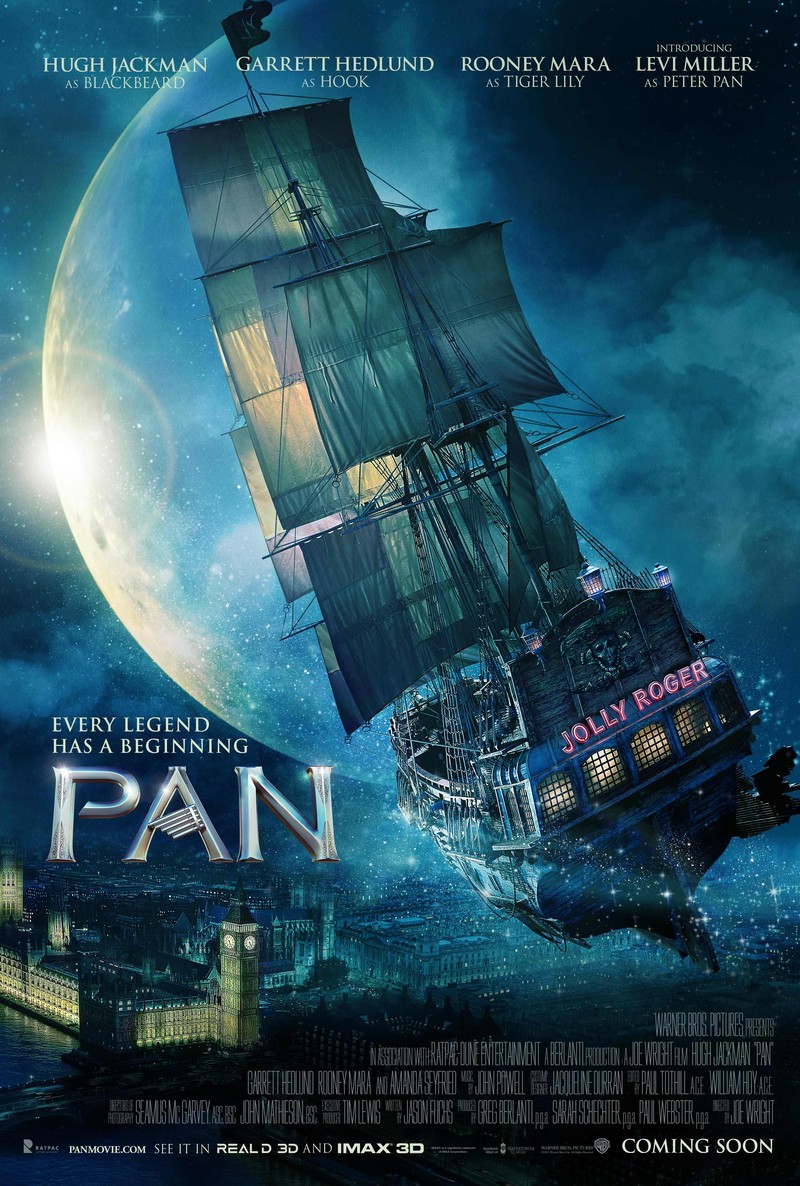 Reminiscent of the Patton Oswalt bit concerning The Phantom Menace, often fans rarely need the “before” when it concerns the characters they love; did anyone really need to know what Peter and Hook were up to before they became mortal enemies? Pan attempts to tell the story before we know it about how Peter Pan became the character we know. It was originally planned for a summer 2015 release and was pushed back until the fall, ostensibly for more time to finish visual effects. the studio, Warner Brothers, pulled a similar move with Jupiter Ascending, and we know how that turned out.
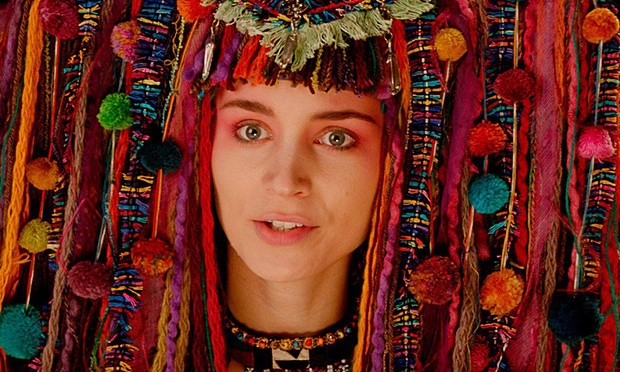
Peter (Levi Miller) is an orphan living in London during World War II. He and a few of his best parentless pals are abducted in the middle of the night by a group of pirates and their flying pirate ship. He’s taken to Neverland to work in the mines belonging to Blackbeard (Hugh Jackman), who has an addiction to fairy dust. During a scuffle, Peter discovers he has the ability to fly, though he can’t exactly master it. There has been a prophecy that The One would be able to fly and they would topple Blackbeard. Peter and another miner, James Hook (Garrett Hedlund), escape, finding their way into the land of the “natives,” which includes Tigerlily (a miscast Rooney Mara). The “Pan” has been prophecized to help lead their people and discover the bridge into the world of the fairies, and Blackbeard won’t stop until he finds the source of his pernicious pixie smack.
 Who exactly is Pan intended for or what story needed to be told prior to our introduction to the world of Neverland? The first act sets the stage for the miscalculated tonal mishmash that never truly settles: we jump from a cruel orphanage, with Peter comically plucky, to the horrors of the London bombing during the Blitz, to a bunch of pirates kidnapping the orphans (tacitly with the approval of the evil head nun running the orphanage), and from there we’re whisked away across space to a mine of slave workers digging for pixie dust minerals who serenade their pirate slave lord with the lyrics to Nirvana’s “Smells Like Teen Spirit” for… some reason. Is this a movie intended for younger children and families? Is it intended for teenagers? The tone veers wildly, sometimes within the same scene, going from serious and gritty to colorful and ridiculous. It’s a campy experience that makes me wonder who exactly was supposed to enjoy an attempt to open the Peter Pan mythos, a world that is generally shallow.
At no point does Pan justify its existence beyond a flimsy corporate attempt to take a familiar world and expand upon it for sweet franchise money. When you get down to the world of Neverland, at least as represented on film, what exactly is there? There are pirates, “natives,” mermaids, and fairies, and that’s about it. They all kind of exist in their own individual movie that fails to blend together, making the new groups of characters feel like little more than a new theme park attraction before moving on to the next autonomous ride. The fantasy figures themselves just aren’t that interesting because there just isn’t much to them beyond superficial descriptions. I suppose then that this would allow plenty of opportunity at world building to take these familiar staples and give them greater depth, and that’s Pan’s biggest missed opportunity. Far too often, the movie feels on Fantasy autopilot and what we’re given is the old clichés of the Great Prophecy and the Chosen One meant to bridge worlds, etc. the events in the film do little to explain how Peter became Peter Pan, besides learn to fly. The problem with the prophecy trope is that it robs characters of agency in place of just accepting their capital-D destiny.
You learn nothing new about Peter or Hook as people, and the nods to the greater Pan lore are annoying at best with how unsubtle and clunky they are. The movie doesn’t even lay the groundwork to explain what conflicts will eventually drive Peter and Hook apart. Peter is a bland hero who is defined by the mystery of his absent mother and her own lineage. He’s special because his mom was special and if he just believes hard enough then perhaps he can be even more special. It’s pretty simplistic stuff. The references to the Pan lore always seem to stop the movie dead in its tracks. The relationship between Peter and Hook isn’t explored in any capacity other then they appear to have both escaped together and been running side-by-side. It’s a relationship not out of bonding but out of sheer proximity. The concluding lines are literally Peter saying, “We’re going to be friends forever,” and Hook replying, “What could possibly go wrong?” Oh my goodness is that one hacky groan-worthy wink to the future.
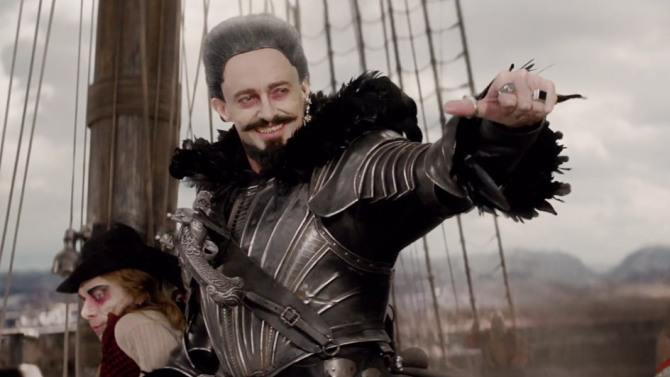
 Pan is made serviceably watchable from director Joe Wright and the campy performance of Jackman. Wright is a premier visual stylist in cinema though his artistic instincts can lead him to try and smash as many ill-fitting square pegs as he can into round holes, last evidenced by the 2012 Anna Karenina adaptation that made all the world a literal stage. The visuals are often splendid to behold and Wright has a wonderful feel for color hues. The final act feels climactic and visually alive in ways the movie doesn’t even deserve, and Wright’s vision, weird as it can be at points (Nirvana?) gives the movie an energy that keeps its worth an initial viewing. For a movie filed with fantasy realms, I enjoyed the scenes in the orphanage and with the wicked head nun the best (is she knowingly selling the boys into slavery on a magic pirate ship or is it just extreme negligence on her part?). The other aspect that at least held my attention was Jackman. In a movie filled with bland and the occasionally bizarre performance, Jackman offers an anchor to lean upon. It’s not a good performance by normal circumstances but it provides a sense of life and feels in place. Hedlund (On the Road) is amazing in just how strange his rakish Harrison Ford-esque performance persists. Why didn’t anyone tell him to stop? His speaking voice fascinated me and I spent the entire moving trying to figure what it sounded like and my best description is Heath Ledger’s impression of Al Pacino.
While not being a colossal disaster of artistic self-indulgence, Pan is a disappointing and mostly tedious experience because of its failure to capitalize on expanding upon the Neverland universe and exploring what should be formative experiences to central characters. If this was going to be a crazy artistic romp then it needed to be crazier. If you’re going to have two brief anachronistic songs, then do more or at least draw in more influences from other timelines. If you’re going to be a straight-laced pilot for a budding fantasy franchise, at least give us more flights of fancy and wonder. Make us fall in love with this world or at least some of the characters. Instead Pan uses the audience’s pre-existing association with the characters and the environment in place of doing anything meaningful with a story. Peter becomes Peter Pan, so he doesn’t have to be a character he just has to be the pre-Pan Peter. The same for Hook and Smee and Tigerlily and that’s really the only characters worth mentioning until those Darling children come visit. I thought I was going to ridicule Pan with the glee I had taking apart Jupiter Ascending but I couldn’t muster much effort. It didn’t feel like the Pan filmmakers did either.
Nate’s Grade: C
Share this:

Inside Out (2015)
 It feels immeasurably satisfying to finally have the Pixar we all fell in love with back and running. There’s been a sharp decline in the company’s quality since 2010’s Toy Story 3. Did we really need a sequel to Cars and a prequel to Monster’s Inc.? It started to look like Pixar was steering away from the kind of bold and brilliant storytelling that had earned its audience trust. With Inside Out, Pixar tackles the intricacies not of the secret world of toys, bugs, monsters, or sea life, but of the human brain itself and our embattled emotions, finding new ways to wow us once again and remind us just how magical the right combination of story and storyteller can be. Inside Out is a luminescent piece of filmmaking, brimming with intelligence, imagination, and it is powerfully moving while also being deeply relatable and entertaining. In looking inward, Pixar has found the path out of their recent rut, and Inside Out is a shining example of their ingenuity.
Inside 11-year-old Riley is a complex world. Five primary emotions help oversee her day-to-day functions; they’re the caretakers of Riley. Joy (voiced by Amy Poehler) is the effervescent leader of the bunch, along with Sadness (Phyllis Smith), Fear (Bill Hader), Disgust (Mindy Kaling), and Anger (Lewis Black). These five are entrusted with Riley’s well being and her memories. Riley’s core memories, the moments that make up who she is, help to form personality islands: honesty, hockey, goofball, and family. Riley and her family have recently moved from Minnesota to San Francisco, and Riley’s having a hard time adjusting. Her parents don’t know what’s happened to the daughter they knew. Sadness seems to be “tainting” Riley’s memories, and Joy tries her best to keep Riley happy at all times. Joy and Sadness get accidentally sucked away wrestling over Riley’s core memories. They’re sent to the outer reaches where the aisles of long-term memories are vast. The two emotions have to work together to get back to headquarters before the remaining emotions convince Riley to run away from home.
 Even just reading that again, it’s easy to see how complicated this movie can be with its world building and internal logic, and yet under the guidance of director Pete Doctor (Up) and his writers, the movie is at no point confusing. Pixar once again does an amazing job of guiding you through a new world and its various parts, all while expanding and complicating this environment while staying true to its internal logic and keeping an audience properly oriented. I can’t imagine many screenwriters would be able to tell this story while still being as clearly understood. The simplicity of the story, the ease to follow along, the natural development and connection of the storylines and characters coming together, is the greatest credit one can offer. It’s ostensibly a buddy adventure film like many Pixar tales, with the unlikely team of Joy and Sadness having to find their way back to headquarters and learning important life lessons along the way. It’s also a smart way to explore the various other elements at work in Riley’s brain. It’s not just an interesting descent but each new station further opens up Riley as a character. Her subconscious (and fear of clowns), her dream theater projections, her working abstract concepts, all tie back together in satisfying ways. Though the greatest side character is unquestionably Riley’s former imaginary friend, Bing Bong (voiced by Richard Kind). He’s wandering around her memories, and at first you have your suspicions, but then you realize, like the other characters, that he just wants what’s best for Riley. Coming to terms with the fact that Riley has moved on, and his time, while cherished, is now left behind, is a complete character arc, and that’s for a comic side character. Oh, and if you’re like me, Bing Bong’s conclusion just wrecked your tear ducts.
You know you’ve watched an impactful film when even thinking back on moments starts the process of tears welling in your eyes. It’s somewhat strange to think about characters as ephemeral as emotions and imaginary friends and the like, but they really work on two levels: the emotions themselves are exaggerated figures with distinct points of view but they also better inform the whole of Riley. There’s a depth there that gets even more impressive the more you analyze the creative process. What’s also impressive is the vital message of the movie, which is that growing up is hard and that being sad is okay. Seriously, the journey of Joy is to accept that being sad isn’t necessarily an emotion to minimize but a vital part of being human and an essential process. Much of the conflict that drives Riley is her avoidance of being sad, her postponement of accepting her real feelings and accepting that San Francisco is not going to be like her old home. It’s also a realization that to be a fully functioning person, you have to own the sadness in life. When Riley eventually unburdens herself of all her troubles and fears, and the tears flow, that’s when the healing can begin, and that’s when her parents swarm in for the group hug, and even now my eyes are starting to water. Damn you, Pixar.
 Don’t be mistaken by my words thus far, Inside Out is also a wonderfully funny and inventive comedy. The sense of discovery with the movie is alive and well, and each new revelation of Riley’s inner mind adds to the fun. The jokes are consistently paced. The vocal cast is expertly chosen and each emotion gets some good jokes. There’s a terrific running gag about a catchy jingle that the memory workers just enjoy kicking back and forth for their own impish amusement. The film dives into other minds other than Riley’s, including both parents trying to communicate during a family dinner meant to soothe their daughter. It doesn’t lean too heavily on tired gender stereotypes when it comes to the differing thought processes of men and women, which is a relief. During the end credits, we zoom into the mind of a schoolteacher, a bus driver, and a dog and a cat, and it’s an enjoyable way to leave the theater and gather yourself emotionally. The greatest comic asset is Joy, particularly as voiced by Poehler. As fans of TV’s Parks and Recreation can attest, Poehler can make insufferable optimism endearing, tip toeing around what should be annoying and instead finding stronger comic rhythms. If you’re looking for the closest thing to an antagonist, it’s Joy who got the whole mess started and yet we don’t ever really side against her. Part of that is because she’s not doing what she does as some weird power play but because she wants what, she thinks, is best for Riley. The other part is because Poehler is such a skilled vocal performer.
If I had to find some point to quibble, the world isn’t as beautifully realized in a visual sense as other Pixar classics. I think this was a deliberate decision to ground what is such an unusual environment into something a little more familiar and less flashy. I also don’t think that Disgust seems as well articulated as a necessary emotion. She’s well played by Kaling but her application seems lacking in comparison to the other four main emotions.
It’s remarkable that the summer is still young and already we have two instant classics in theaters; first Mad Max: Fury Road and now Pixar’s Inside Out. I’m still riding high from my screening, but I’d feel safe to call this a top-three Pixar film. I wouldn’t even begrudge those who cite it as their best. Far more than a big screen version of the 90s comedy Herman’s Head (anybody remember this one?), this is an exceptional animated film that will appeal to all ages but, I suspect, hit adults even harder than their little ones. It’s a wonderfully poignant film about the struggles of growing up, of holding onto your past definitions of yourself, of accepting the full barrage of emotions, including the necessity of sadness. It’s relatable in many aspects and this further compounds its power. It’s dazzling with its creativity, it left me cackling with laughter (a superb Chinatown reference almost had me fall out of my chair), and it left me weeping at various points. Inside Out is a return to form. This is the Pixar we remember.
Nate’s Grade: A


 nathanzoebl
You must be logged in to post a comment.