Blog Archives
Where the Wild Things Are (2009)

Studio execs are always seen as the bad guys, right? They meddle in the affairs of artists, more concerned about dollar signs and marketing potential than in lasting, authentic artistic achievement. Director Spike Jonze, the most lauded video music director of all time, has gone through five years of trials to bring the adaptation of Where the Wild Things Are to the big screen. He’s had his funding cut, he’s been dropped by one studio, and the second studio contemplated starting over from scratch after seeing an early cut of the movie. The studio heads were worried that Jonze’s take was too sullen and too scary for children. They asked for something a tad more uplifting about a boy that runs away to have adventures with giant monsters. Jonze and co-screenwriter Dave Eggers (Away We Go) insisted on their vision and stuck it out, and 18 months later, that vision is what made it to theaters. Having now seen Where the Wild Things Are, it pains me to accept that maybe those studio honchos had a point all along. Jonze’s film is eclectic and visually wondrous but this is not a children’s movie; this is a movie about childhood intended for thirty-something adults and film critics. And man, it’s a downer.
Based upon Maurice Sendak’s masterful 1963 book about an unruly child “sent to bed without supper,” we follow Max (Max Records), a nine-year-old on a tear through life. His older sister is growing up and hanging out with older friends, his dad is absent, and his mother (Catherine Keener) is trying to juggle work, kids, and having a life her own. One night she has a man over (Mark Ruffalo, in cameo form) and Max gets upset. His mother isn’t giving him the attention he feels he’s owed. So he acts out, bites his mother, and when she responds with genuine terror, he runs away. He finds a small boat and sails away across the ocean to a mysterious island. It is here that he encounters the titular wild things, giant beasts that act out in very similar ways. Max declares himself the king of the beasts and they accept. Carol (voiced by James Gandolfini, a fabulously warm performance) is the happiest to have somebody new to play and listen. There’s also the small goat-creature Alexander (Paul Dano), the eagle Douglas (Chris Cooper), the elusive KW (Lauren Ambrose), and the married monster couple, the pushy Judith (Catherine O’Hara) and the subdued Ira (Forest Whitaker). Together they form an unorthodox family that still falls prey to in fighting and jealousies.

First off, Jonze does a magnificent job of creating the world of the wild things. The cinematography by Lance Acord (Lost in Translation) uses a lot of handheld cameras to trail after Max, communicating the kinetic energy of youth. The movie looks gorgeous but doesn’t resort to a self-conscious gloss. Acord makes the wilderness look inviting and dangerous. The wild things are amazing creatures to watch, brought to startling life by Jim Henson’s creature shop and seamless CGI artistry to provide facial expressions. If these creatures were purely computer generated, they would lose a sense of magic. Watching the furry suits interact with the real world brings so much more enjoyment to the movie. These giant creatures look real and intimidating. I liked the fact that there’s one character, The Bull, who just stands in the background alone, and the other wild thing monsters make a point of not noticing him. He’s the weird disaffected kid on the outside. I also appreciated that the movie doesn’t pander to make the monsters cute and cuddly. They continue to be scary. At one point Carol even chases after Max with the intent to eat him. Jonze and Eggers have made a movie about childhood that doesn’t coddle children. The production design by K.K. Barrett (Marie Antoinette) is nicely imaginative, though it only deals with a handful of stick huts. The fort that the wild things construct is fantastical, like an alien structure but made completely out of twigs.
Jonze and Eggers have made a movie all about the feelings of childhood; however, it seems that almost all of those feelings are negative. Sure Max bounces around with youthful energy, and his imagination goes to exuberant places, but the movie paints a broad picture of how painful and disappointing childhood can be. The movie doesn’t capture the wonder and excitement and possibilities of childhood; it focuses on the somber realities of what it’s like to be misunderstood, lonely, and incapable of changing anything. What about the pleasures of childhood? Even when Max engages in his fantastic creativity it usually leads to destruction and hurt feelings; everyone ends up in a worse place. A great example is in the opening sequence where Max tries to snare his older sister and her friends into a snowball fight. He gets them to play along and then everything is great, until the older kids accidentally take it too far and Max is left embarrassed, hurt, scared, and incredibly angry, which leads to lashing out, which then leads to regret and attempts to rationalize it as not his fault. This pattern is repeated throughout, where Max will get scared or confused and this triggers bouts of physical violence, like literally biting his mother. You might think his time on the island would be an escape, but really all of the monsters are manifestations of Max’s fractured psychology. KW represents his older sister’s approval so deeply longed for; Judith represents his defensiveness; Alexander represents his feelings of marginalization and helplessness; and Carol most closely resembles Max’s id, concerned that his family is falling apart, prone to jealousy and sudden violent outbursts when he doesn’t get his way. It all can make for an interesting psychoanalytical experience but it also can get tiresome. Listening to needy, whiny, morose monsters can be exasperating after awhile when there isn’t anything else resembling a plot. Where the Wild Things Are feels somewhat like Jonze and Eggers are subjecting everyone to their own therapy.

This shaggy, somewhat draggy movie has little else going on, so we watch Max boss around the monsters, commission colossal forts, run around, sleep in a big pile, and more or less try and hold a family together when they are moving in different directions. Things slow down a lot on this island. Max himself is a polarizing figure. Some people find him relatable, his pain and fears, and still others find him to be a wild brat. His behavior seems to go beyond that of a normal child acting out. I’m not going to prescribe the kid but me thinks there may be something else amiss with Max (am I alone in my diagnosis, people?). My friend thought Max was an insufferable and unsympathetic brat who learned nothing by the end of the movie. I feel that Max has to have learned something, since his entire time spent on the island was him working out his troubles to gain a little more perspective. Records is a real find as a child actor, and he’s the only human onscreen for like 90 minutes. I thought he carried the movie ably enough and finely displayed the conflicting emotions of being nine years old.
Will you like Where the Wild Things Are? That’s difficult to surmise. It may depend upon whether you can identify with Max; I couldn’t for the most part. This is a much easier movie to admire than to like. There’s very little fun to be had. The movie has an implicit sense of loss and melancholy throughout. Children’s movies don’t need to be all happy endings and feel-good lessons, but then again they don’t also have to be densely Freudian. Childhood isn’t all innocence and rainbows, but it’s also not all rain clouds and emotional meltdowns and feelings of impotence. The movie presents childhood as an unyielding hell. I know other people love Where the Wild Things Are, and I respect that artistry Jonze and his crew brought to this movie, but I doubt I’ll ever watch this movie again in my life. For once, the studio execs had it right.
Nate’s Grade: B-
Share this:

Harry Potter and the Half-Blood Prince (2009)
 Not every film franchise gets to a sixth installment, although Police Academy and Friday the Thirteenth managed to. After over twelve hours of storytelling, is it even possible for non-fans to enter the Harry Potter world (only an idiot would begin a film series at number six)? I am a willful Muggle to this universe. I am content to wait for the movies, and it drives the readers nuts. “The books are so much better,” they all say. Then they tell me what was left out of the movies, and honestly it’s usually a good thing. Harry Potter and the Half-Blood Prince echoes the increasing darkness of the later books by author J.K. Rowling, but now I can finally walk out of a Potter film and know, without a shadow of a doubt, that the book must have been superior. Half-Blood Prince is a film adaptation that spends too much time in all the wrong places.
Lord Voldermort (Ralph Fiennes, seen only for literally a split-second) is back with a vengeance, and his followers, Death Eaters, are branching out and attacking the Muggle world as well. Headmaster Dumbledore (Michael Gambon) has asked Harry (Daniel Radcliffe) for help in recruiting a former Hogwarts professor. Horace Slughorn (Jim Boradbent) used to be an esteemed potions professor, and one of his bright students was none other than a young Voldermort (Hero Fiennes-Tiffin, Fienne’s real-life nephew). Dumbledore and Harry explore liquid memories that belong to the Dark Lord in hopes of learning how to defeat him. In the meantime, the kids are under attack not by Voldermort but by hormones. Harry’s friend, Ron (Rupert Grint) and Hermione (Emma Watson), are secretly in love but neither has the heart to say something. Ron uses his star Quidditch status to “snog” with the eager Lavender Brown (Jessie Cave), who’s infatuated with Ron. This infuriates Hermione and she seeks comfort in a studly student herself. Harry is starting to feel his heart go pitter-patter for Ron’s sister, Ginny (Bonnie Wright), which requires Harry to be very delicate in negotiating the “Can I snog your little sister?” portion of male friendship. Oh yeah, and apparently Harry is also using a potions textbook that used to belong to some whiz kid known as the Half-Blood Prince.
 The further I get away from Half-Blood Prince the more certain I am that it is the least involving film of the series. The plot is somewhat nebulous and unclear, and so much of the story is dominated by boring teenage romance. I understand that Hogwarts is swimming in hormones, but these kids spend the whole time making shifty doe-eyes at each other than doing anything substantial. That makes for a boring romance, and when the movie is dominated by this stuff for two hours it doesn’t make the movie too engaging. I understand that the Ron/Hermione courtship has been setup for some time, but it takes forever to move even incrementally closer to that coupledom. The Harry/Ginny material is lacking at best. She’s such an empty presence and they do so little with her character that I have no idea what would warrant Harry’s affections. There is no spark, no heat, no sexual tension, and no interest. I was actually relieved when Half-Blood Prince drops practically every storyline with twenty minutes left. Seriously, these plotlines aren’t resolved or capped or even addressed, they just don’t exist once Harry learns the word “horacrux.” And let’s talk about that subject just for a moment. Dumbledore lures Professor Slughorn back to Hogwarts so Harry can learn Voldermort’s secret of eternal life, a secret that Dumbledore already knows because he’s been taking leaves to locate and destroy Voldy’s horacruxes. I felt detached and disenchanted throughout Half-Blood Prince.
There are other plot holes and irregularities, and I wonder if writer Steve Kloves (who took the fifth movie off) is merely serving up 153 minutes of plodding prologue for the big finish. The drama is becoming more static and the supporting characters of previous installments reappear and do little but stand with hands in their pockets; they have nothing to do. The flashbacks to Voldermort as a child reveal relatively nothing new; only indicating her was a creepy kid. The two action sequences squeezed in are not from the book, meaning Kloves was trying to add some excitement to what is a rather sleepwalking storyline. The action sequences mean little; the opening attack on London’s Millennium bridge offers some nice sights but little consequence, and the destruction of the Weasely house comes across like Kloves was grasping for greater conflict. Too much of his film is the young love foibles with the occasional sideways glance at Draco (Tom Felton) brooding in the shadows. The ending, with its notable death, still strikes an emotional cord but it also comes across as rushed and without depth and resolve.
 What is the significance of the Half-Blood Prince in this adaptation? The mysterious figure was good in potions class and his old textbook helps Harry in class. That is it! The late reveal of the identity of the Half-Blood Prince is so incidental and off-the-cuff, that the actor practically has to say, “Hey, remember that whole Prince thing like an hour ago? That’s me. Yep. So see ya.” It’s such an indifferent plotline handled with such indifference. I had to ask my Potter-versed wife why Rowling would even bother naming the book after such a minor, irrelevant plot footnote. Kloves’ adaptation feels lost and mostly like filler.
So why does a slower, less coherent, less interesting Harry Potter rank better than the first two films? Because director David Yates takes an artistic step forward and this addition has style to spare. Returning to the Potter director’s chair, Yates has a stronger feel for the world and creates striking film compositions with the added help of noir cinematography by Bruno Delbonnel (Amelie, Across the Universe) and the foreboding production design by Stuart Craig. The sets have a grand Gothic appeal and help compensate in tone for what is lacking in the screenplay. The opening bridge attack allows for soaring flights through London and then into the magic world, and it’s a great opening visual rush. The memory flashbacks have splendid visual artistry to them as we watch inky brush strokes coalesce into solidified images. It’s a fantastic special effect and it is welcomed every time. This isn’t one of the more special effects heavy installments but the effects are as good as ever especially when seen through Delbonnel’s lens.
It’s interesting to have watched the three main actors grow up in their roles, which also gives them the ability to revert to autopilot when the movie lags. In the Half-Blood Prince, the trio burrows back into previous acting episodes. Radcliffe gets talked to a lot so much of his acting in this jaunt seems to involve intense bouts of nodding. He does have one sequence of exaggerated comedy when he swallows a luck potion, and the actor feels delightfully unrestrained. Grint gets the most screen time he’s had in ages and continues to dial up the daffy humor. As I stated with my review of Order of the Phoenix, I think Watson began as the best actor of the trio and is now on a fast-paced downward slide. Her character gets to experience jealousy and heartache, and Watson shows some ability to convey mixed emotion. The most interesting actor of all the kids is Felton, who I found to be surprisingly empathetic. He’s tortured over his fate, a mission given to him by the Dark Lord. He’s torn apart by moral indecision and a sense of duty. That’s way more interesting than watching Ron and Hermione try to make each other jealous. Why didn’t Kloves devote more time to the anguish of Draco? That’s where the drama is. There just isn’t much room for character growth and acting in the rest of Half-Blood Prince. The best acting award goes to Broadbent (Moulin Rouge, Hot Fuzz). He conveys the regret of Slughorn with every manner and gesture. His sad, poignant confession is oddly the emotional highlight in a movie that includes a momentous death later.
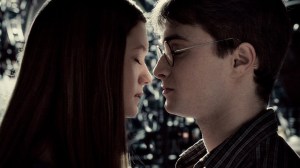 Harry Potter and the Half-Blood Prince feels like a half-hearted adaptation, with way too much time spent on tepid teen romance. This is the most visually arresting Potter film next to 2004’s Prisoner of Azkaban, but it just fumbles the storytelling. The sixth film is too often boring and inconsequential. Too much of the film feels like it was purely made for the die-hard Potterheads, and if any Muggles have questions of clarity they are required to seek out a friend to ask. This is just sloppy writing. It feels like everyone is just busying themselves before the sprint to the big finale. We’re just about at the end of the long winding road that is Harry Potter, though I’m sure the fact that the producers are splitting the final book into two movies likely will not mean that the individual movies can finally have a two-hour running time. Half-Blood Prince would have greatly benefited by being shorter, more precise, and more significant; the 16-year-old romantic squabbles seem so slight in the backdrop of Voldermort and his army on the rise. I’ll give everyone the benefit of the doubt, but this is not a Potter venture I’ll likely return to again. It just doesn’t measure up when it comes to movie magic.
Nate’s Grade: B-
Share this:

Coraline (2009)
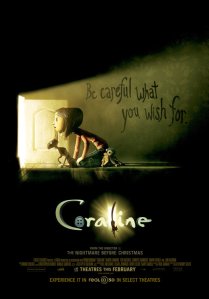 The beauty of stop-motion animation is that everything is painstakingly handcrafted so that it’s like watching a whole other world. Coraline is a wonder for the eyes and I loved just watching the movement of characters, their facial expressions, which were all done in great fluid motions. I loved that I could see Coraline thinking just through how her eyes were animated. The story, based upon the Neil Gaiman book, is about an alternative world where people have buttons for eyes provides enough eerie intrigue and some creepy imagery to spook younger kids. This is a fantasy film that doesn’t shy away from childhood scares. Coraline has an altogether pleasant feel with its spunky heroine and fine vocal cast (Dakota Fanning did not get on my nerves at all), but what’s most special is just watching the movie come alive; it’s enchanting to watch this world simply exist. There are some terrific displays of imagination in the alternative world, and it all looks even snazzier in 3-D where the world takes on further depth. Director Henry Selick (Nightmare Before Christmas) is the master of this peculiar art and thankfully Coraline follows its own visual style, never stooping to imitating Nightmare (like Corpse Bride). This is a visually stunning movie that may not leave much of an impression once it’s over (predictable story, thin plot, kind of slow ending). Coraline is a feast of artistic talent with something to discover in every awesome second.
Nate’s Grade: A-
Share this:

The Curious Case of Benjamin Button (2008)
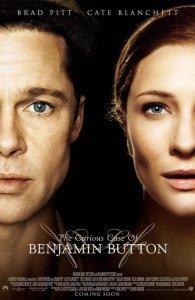 This lavish and long-winded spectacle is curious, all right. Director David Fincher (Se7en, Zodiac) has all the technical wizards at his disposal to produce a near three-hour fantasy about life, love, and death. The Curious Case of Benjamin Button works around the bizarre gimmick of a man going through the process of aging backwards. It’s loosely based on F. Scott Fitzgerald’s short story, adapted by Eric Roth (Forrest Gump), and the results are befuddling. Benjamin is a handsomely mounted and incredibly expensive work engineered for one purpose: to win Oscars. Benjamin Button is a film that strives for making grand statements and wringing a maximum amount of tears, but it’s also a film that lives more in a series of moments than as a cohesive whole. It’s a fine piece of work but feels overburdened by its urgent desire to be profound.
Benjamin Button (Brad Pitt) is born on the day the first World War ended in 1918. He is born as a small infant that better resembles an 80-year-old man (in Fitzgerald’s short story he is born as a full grown old man, which means it must have been fun for his mother). Benjamin is aging backwards but his mind is still as it should be, so while he is all wrinkly, arthritic, and covered in liver spots, Benjamin is like other small kids who want to make friends. Benjamin’s father (Jason Flemyng) is horrified by his son’s condition and abandons him at the steps of a nursing center. Queenie (Taraji P. Henson) raises Benjamin as her own child and he grows up (down?) surrounded by a colorful cast of elderly residents (one woman remarks that a young-old Benjamin looks just like her ex husband). It is here that Benjamin meets the love of his life, Daisy (played by Cate Blanchett in her older years). She’s enchanted by Benjamin’s condition but she has her youth to live and Benjamin is left behind. Daisy becomes a trained ballerina and tours the world. Benjamin goes on a series of escapades, like working on a tugboat, traveling to Russia and having an affair with a diplomat’s wife (Tilda Swinton), and discovering his biological father and the family business of buttons. But he’s always been waiting for Daisy, and eventually they “meet in the middle.”
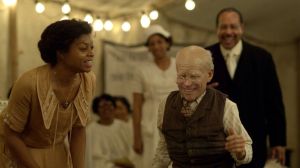 The very nature of the premise means that the movie isn’t going to have many pure, joyful moments. The idea of a romance that needs to take 40 years to connect, and even then has a limited shelf life before they go in their separate aging directions, is beautiful and heartbreaking. Waiting decades for a glimmer of your happiness with your mate, that’s a hard pill to swallow. Benjamin Button explores a similar situation covered by vampire-immortal romances, where you must endure watching your precious loved ones grow old and die. The entire movie radiates with an overwhelming sense of melancholy. The movie manages to find humor and grace amidst its melancholic dirge. The reflections on mortality are ever-present though rarely profound. It may not say anything new or original but it has many things to say about life, death, and the fleeting moments in between. By that notion, the film is structured so that the beginning, where Benjamin is a young old man, it’s more comic and beguiling, then as he and Daisy match up we finally get the pairing we’ve been pining for from the start. The pent-up passion provides great conflict, and then we barely get to enjoy the coupling before reality strikes. The final twenty minutes of the film, where old Daisy cares for old young Benjamin, are incredibly moving and have an indelible symmetry to them, watching an old lady lead a child by the hand.
 So then why do I feel so hesitant about fully accepting this movie? The story follows a similar Gump like pattern of incidents but the movie refrains from being mawkish. The main character is mostly passive with little personality; he’s nice but take away his unusual condition and not many folks would remember their time with Mr. Button. Before he gets with Daisy the film feels a bit episodic with the chapters of Benjamin’s life, and they are entertaining asides but they fail to amount to much more. Benjamin Button feels like something important is absent; it’s not cold as others have claimed but it feels, perhaps, remote, stopping just shy from being a full emotional investment by keeping the audience at a somewhat objective distance. This may be Fincher’s own design because Fincher ensures that a film about living life to the fullest doesn’t degenerate into sentimental claptrap. The end hits hard but not as hard as it could if I was more invested in Benjamin as a character. The Hurricane Katrina framing device seems tacked on, but then again the story mostly takes place in New Orleans and Katrina is rather noteworthy, you could say. The “elderly lady recalls her life story” is reminiscent of Titanic, and might not even be necessary though it offers Daisy the ability to look back over her years with added insight. The layers of realistic makeup piled onto Blanchett are impressive, though I worry what would happen if the actress had to go to the bathroom.
Technically, the movie is nearly flawless. The visual effects are astounding, seamlessly allowing Pitt to play the role even as a young child. The Curious Case of Benjamin Button is a glorious experience to watch but a mildly curious experience to register. The film is so meticulously crafted and it has all the right components of a tragic romance for the ages, but it somehow misses the mark. It’s an entertaining and moving film but it leaves something to be desired. The most resonant moments are also the ones that are the simplest, the ones that lack the window dressing of expensive special effects. I appreciated the film’s expressions of symmetry, but I have the nagging feeling that Benjamin Button both tries too hard and perplexingly doesn’t try hard enough. It keeps audience involvement at a distance, wishing to comment on humanity without embracing humanity. It is difficult for me to articulate what is lacking, because it is an enjoyable if overly long movie, but it falls into the “almost” category of poignant filmmaking. It’s almost a challenging movie, it’s almost an affecting movie, it’s almost a movie worth falling in love with. The film’s story and sensitivity and scope cannot match the technical audaciousness.
Nate’s Grade: B
Share this:

Hellboy II: The Golden Army (2008)
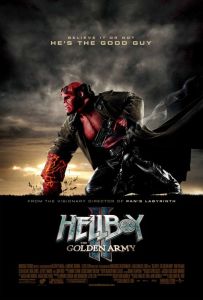 I disliked the first Hellboy, dubbing it the second worst film of 2004. The fact that I enjoyed the sequel is nothing short of shocking. Honestly, I think this mumbo jumbo is easier to swallow when it’s more fantasy based than science fiction based. I can accept an alternative magical world filled with elf princes, troll markets, and tiny “tooth fairy” creatures that act like piranhas with wings. Nazis and Zombie Rasputin trying to open a portal to giant squids? Hellboy II is even more imaginative and far more enjoyable. Writer/director Guilermo del Toro has refined the world and makes sure his story follows the rules it sets, which means that while the plot gets crazy it doesn’t feel cheap. I actually had some fun with Hellboy II and del Toro knocks out some pretty crafty action sequences. As expected, the makeup and creature designs are impeccable, which may explain why I had more fun watching the various magical creatures than following Nazis and slime wolves in the first flick. The lithe Angel of Death is particularly startling, with a head like a fried calzone and eyeballs dotted along expansive bird wings. This is a film that feels much more confident about its identity, thanks in part to getting rid of the rookie main character from the first film and focusing on the big red guy. If del Toro ever makes a third Hellboy film, I can honestly say I’ll be highly intrigued to see what weird wonders he cooks up. This statement is astounding considering I felt that there was only one 2004 film worse than the original Hellboy.
Nate’s Grade: B
Share this:

The Spiderwick Chronicles (2008)
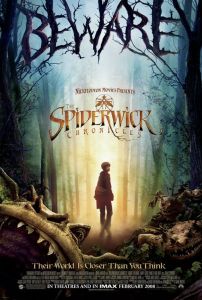 This imaginative fantasy family film is adapted from five books from the Spiderwick series, so you’ll be forgiven for thinking that it packs a lot of storylines at a brisk pace. This 97-minute film should appeal to all members of the family because, while derivative, it has plenty of action, interesting fantasy characters, and even some palpable thrills. The movie has a better handle over interspersing psychological real-world drama with the monsters. Freddie Highmore is the best special effect in the film as he plays two twins who are vastly different in personality and temperament. Director Mark Waters (Mean Girls) deals with the fantastic but also makes the film feel grounded, never letting the otherworldly elements to take over. The movie is a modestly entertaining escapade.
Nate’s Grade: B
Share this:

Son of Rambow (2008)
 The film takes a few notes from 2005’s Millions and presents an amateurish tale of English schoolboys making their own amateurish sequel to a Rambo film. From a visual standpoint the film looks great, it has a slightly offbeat appeal, but there just isn’t any substance here beyond the imaginative visuals. The friendship between the two boys, one a bully and the other a lonely kid apart of a strict religious sect, doesn’t draw much out of the characters or the actors. The kooky stunts and homemade moviemaking made me smile and gives the film a fun, quirky energy. But then Son of Rambow seems to butt heads when it enters more serious dramatic territory like family loss and betrayal. The tone is uneven and the mixture of slapstick and whimsy and real pain and suffering never fully works. Certain subplots like a cool French foreign exchange student (who may not be so cool after all) feel grafted onto a story that needs direction and depth. They feel like distractions. Writer/director Garth Jennings (The Hitchhiker’s Guide to the Galaxy) tries to imbue the project with a childlike spirit but the story needs a whole lot more emotional focus and a whole lot more work. This ain’t no Millions.
Nate’s Grade: C+
Share this:

In the Name of the King: A Dungeon Siege Tale (2008)
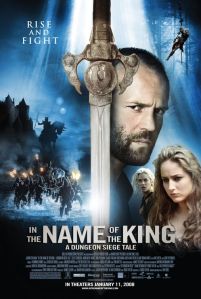 I have no idea how it happened but someone gave infamously reviled director Uwe Boll a bunch of money to adapt a fantasy video game called Dungeon Siege into a star-laden movie. In the Name of the King: A Dungeon Siege Tale seemed to be Boll’s stab at achieving mainstream credibility. He assembled his best cast yet with plenty of recognizable stars. At one point, I remember reading that Boll wanted to divide this film into two, Kill Bill-style, or release a 180-minute version. Until this movie, no Boll film had ever gone over barely an hour and a half. After seeing a slimmed down version that runs a little over two hours, I honestly have no idea what more Boll could have. In the Name of the King struggles to fill two hours worth with crap.
In a far off land, there lives a farmer named, coincidentally enough, Farmer (Jason Statham). His world is turned upside down when his family is killed by a band of creatures known as the Krug. He and his friend (Ron Perlman) must track down Farmer’s captured wife (Claire Forlani) and inflict some peasant vengeance of their own.
Evil wizard Gallian (Ray Liotta) was the cause of the attack. He has built up a whole army of Krug to challenge the King (Burt Reynolds) for the throne. Gallian also has two unwitting allies. The King’s nephew, the Duke (Matthew Lilard), wants to rule and is willing to plot with the evil wizard to achieve this goal. Muriella (Leelee Sobieski) is secretly sleeping with Gallian; he says he is teaching her how to use her blooming magical powers (remove your mind from the gutter) but he is really stealing her powers.
Farmer reluctantly becomes a leader to protect the kingdom. Gallian is stupefied that this simple farmer is somehow beyond the control of his magic. That’s because Farmer should probably change his name to Prince because he is the long-lost son of the King and some stable girl. Merick (John Rhys-Davies) serves as the King’s most trusted advisor but he is also the father of Muriella. He scolds her for being so foolish and being used by Gallian. She suits up like Joan of Arc and wants to fight, but her father won’t allow it.
Eventually this all leads to a large-scale battle between the forces of good and evil where Gallian uses his magic powers to create a cyclone of books to stop Farmer. There you have it.
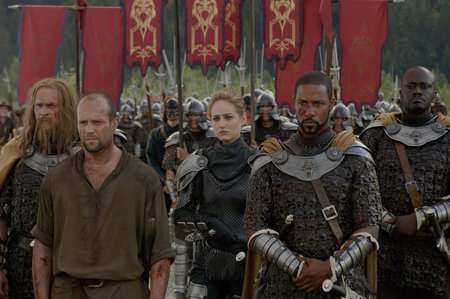 If I were Peter Jackson, I might consider a copyright infringement suit, because In the Name of the King is a sloppy Lord of the Rings rip-off through and through. The long-lost heir to the throne must accept his magisterial destiny … just like in Lord of the Rings. There is a 10-minute fight sequence that happens in a swath of woods … just like in Fellowship of the Ring. The villain relies on an army of stupid supernatural hordes … just like Lord of the Rings. There is a wizard-on-wizard duel … just like Lord of the Rings. A noble woman wishes to fight but her father does not approve, so she sneaks off in armor and does fight … just like in Return of the King. There is a shadowy “other” world that goes beyond our dimension … just like in Lord of the Rings. The eventual trek of our heroes leads to a volcano, but not just that, it’s also the villain’s lair … just like in Lord of the Rings. Bastian (William Sanderson, in his sixth Boll movie) serves no purpose other than to resemble Legolas. John Rhys-Davies you should know better; you freaking starred IN the Lord of the Rings trilogy.
So what does a $60 million budget get Boll? Lots and lots of crane shots. Boll relies on extended aerial photography and zooming, CGI landscapes that serve to remind you how much better Lord of the Rings was and that Vancouver is no New Zealand. There are some segments that lack a firm geographic bearing because Boll wants to jump from expansive crane shot to expansive crane shot. I get that he wants to showcase the depth of the battles, which do feature a fair amount of background action, but the repetition of any camera technique will always grow old if it doesn’t feel congruent to the onscreen drama. I’m happy that Boll wants to open up the scope, but when he relies on a multitude of high-angle crane shots in motion the effect becomes wearisome. The audience can never settle into the action because Boll is too forceful with wanting to demonstrate what he bought with his budget. The cinematography is a notable step up for Boll and longtime director of photography Mathias Neumann. Then again, if I had a $60 million budget I’m sure my movie would look good too, or at least better.
In the Name of the King is the biggest budget Boll has ever had, but it seems like proper costumes must have still been out of his price range. The marauding horde of Orcs, oh I’m sorry, the Krug look like cheesy low-rent Power Rangers villains in goofy rubber outfits. The camera never lets you get a good glimpse of these creatures because even Boll knows how crummy they look. You get another idea of how bad the creatures look when Farmer utilizes the familiar dress-in-other-guy’s-uniform-to-pretend-to-blend-in ploy that was perfected by the aging action stars of the 1980s. So Farmer knocks out a Krug creature, throws on its spongy armor, and is able to walk around the Krug camp.
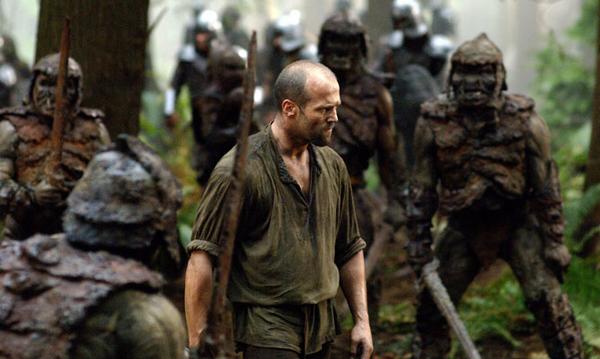 The special effects also seem to run the gamut. The green screen work is painfully ineffective and very transparent, like when Farmer is swinging down a rope across a gorge. When Boll tries to show large fields of soldiers it also exposes how fake the CGI work looks. The many battalions of soldiers look like a dated computer video game. The special effects for Alone in the Dark were better and that film had, reportedly, half the budget of this movie. Realizing all this, it’s no wonder that Boll tries to use as many real sets as he can.
And yet despite all of this, In the Name of the King is high-class camp. Boll achieves a workable level of derisive enjoyment that manages to keep the movie entertaining even while its spins into stupidity. The fight scenes are actually decent and Boll manages to compose a few shots here and there that look quite good, like when the camera scans over a field of dead bodies. During the action centerpiece, the 10-minute battle in the woods between man and Krug, Boll’s camera manages to frame some solid, if unspectacular, action with some good angles. It’s also cut to be mostly coherent. The fight choreography is credited to Siu-tung Ching who also did the choreography for Hero and House of the Flying Daggers. He must have procrastinated until the night before his choreography was due. It will pass but there’s little creativity there; however, Boll must have been flabbergasted. I think the true test for derisive viewer enjoyment will be when the ninjas come out of nowhere at the King’s disposal. All of a sudden in the middle of a medieval style fantasy fight there are flipping black-clad ninjas. I loved it for its sheer anachronistic absurdity. To me, it felt like Boll was trying to cram in everything that he thought was theoretically cool into one massive fight sequence. He just didn’t have the money to also include pirates and robots and hobos and vampires and bears and Batman.
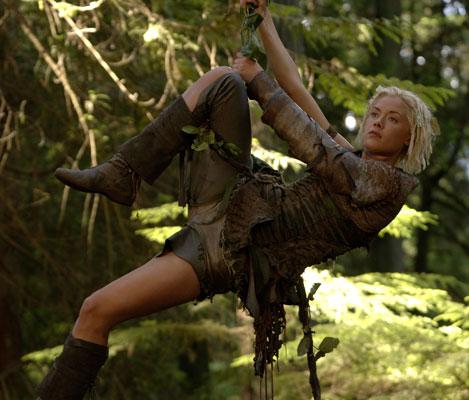
Fantasy is just not Boll’s preferred territory and it mostly shows. He really wants to make his own entry in the style of Lord of the Rings, but you can tell his mind is elsewhere. The plot is a mess but that isn’t indicative of Boll’s lack of interest with the film, it’s just indicative of a typical Boll movie. In the Name of the King feels like Boll is following a checklist of what is expected in a modern fantasy epic, except that Boll cannot provide the epic part. Here’s my proof: the vine-swinging tree nymphs led by Elora (Kristanna Loken). If Boll was really invested in this movie he would have paid more attention to these alluring vixens. These anti-war ladies have sworn off men (take that for what you will) and live their lives like Cirque du Soliel jungle performers. This stuff is right up Boll’s exploitation rich alley, and yet he and the film treat these women of the woods like afterthoughts. They show up and save the day when the film requires an inexplicable savior. I don’t know how helpful tree-dwelling women would be in a fight either unless it was fought in a well-forested area. Boll not capitalizing on these women warriors proves to me that his heart isn’t in this movie.
 Screenwriter Doug Taylor was clearly cobbling a story together by his fading memory of the Lord of the Rings trilogy, and yet this being a Boll movie, there are still plenty of head-scratching decisions that defy logic even for a would-be fantasy film. For instance, why does Farmer fight with a boomerang? How effective can a weapon be when it gets thrown and then needs to be picked up? The boomerangs that I know can hit people, sure, but usually hitting someone stops its path of movement. Then again, these could be magic boomerangs. How did Gallian raise such a massive monster army to rival that of the King’s without anyone noticing? I’m sure the excuse for that is also magic-related. The Duke takes out two legions of soldiers for his own purposes, and when one man asks where the commanding officers are the Duke, in front of everyone, stabs him. It seems like a lousy way to lead but I’m sure Joseph Stalin would approve. A telekinetic sword fight sounds cool on paper until you realize it is just actors standing passively while CGI swords clang around them. During the climactic battle it’s dark and raining (hey, like in Lord of the Rings) for the King’s army vs. the Krug, but then as Farmer and Elora race to the Volcano Lair it is light out. How many time zones does this kingdom have? Also during this climactic battle, the King’s army has the high ground thanks to a hill and the Krug race up the raised land. The archers atop the hill fire their flaming arrows at an angle pointing up, which would sail over the heads of all their targets. I suppose the King’s archery education program has been suffering some severe budget cutbacks.
The dialogue is pretty corny amidst all the sword-and-sorcery antics and induces its fair share of giggles. When Muriella asks Gallian if he always appears out of nowhere he responds, “No. I appear suddenly. Out of somewhere.” Thanks for clearing that semantic argument up. He also has a very icky conversation with his bedfellow Muriella dripping with double entendres: “I knew you would come,” “I told you I would,” “I felt it before you came,” “You told me I could come and go as I please.” I think my favorite moment is when the King is on his deathbed and addressing Farmer. He advises the man of agricultural means to try using seaweed to enrich his soil. “How do you know this?” asks Farmer. “Because I am king,” he replies.
The actors all feel like they are in separate movies on a collision course with one another. Boll has never had a firm command with actors. The big name actors feel their way around a scene with little guidance from Boll, which means they routinely experiment and play their roles like they were an exercise instead of a final performance. A fine example is a single line spoken at a family table; it’s just perfectly off enough to prick your ears to Boll’s tone-deaf direction. I think Boll either doesn’t care that much about performances or is easily cowed into submission by actors. Staham is recycling his glaring machismo that he’s turned into an action movie franchise, but he seems to me like a modern-day Steven Segal who dispatches foes in a monotone whisper. Luckily for Boll, Statham is adept at picking up fight choreography and so the movie benefits by watching the actor clearly in the middle of the fracas performing his own sword fights.
 Most of the actors also seem to be falling back on past performances as inspiration for what to do under Boll’s laissez faire direction. Perlman plays his standard gruff tough with a deadpan delivery. Sobieski hasn’t acted in a movie for some time. She comes across as her usual inexpressively empty self, which is her thing, along with being a physical clone of Helen Hunt. Loken shows she can swing from a vine but not master a vague British accent. Forlani gets to cower and weep. Burt Reynolds is playing Burt Reynolds, and Rhys-Davies falls back on his trademark gravitas. Only Lillard seems to find enjoyment out of Boll’s vacuum of direction. His accent mirrors his wildly over the top style of acting that sometimes feels like a fish flopping around for air. His physical mannerisms are uncontrolled and he sneers through much of his lines, but I’ll give it to Lilard, he is much more fun to watch than any of the other slumming stars.
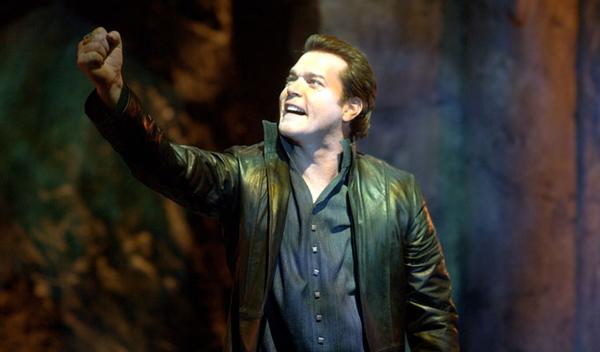
Special attention must be made to Liotta, who is on a different plane of terrible. It’s bad enough that he’s chewing the scenery in his typical manic, bug-eyed crazy yell-speak he refers to as acting, but the movie has to open on the discomfiting image of Liotta trying to suck Leelee Sobieski’s face inside out via kissing. Liotta’s character Gallian feels and looks out of place; he resembles a skuzzy Las Vegas magician with a pompadour and a long leather jacket and a button-down shirt. Where did this man come from? His performance is astonishing in how deeply the awful goes, and when he tells Farmer’s wife, “I feel him inside you,” try your best not to shudder.
After seeing eight of his films and writing 17,000 words on the man (including 2,600 for this review), I feel like I have a special connection to Uwe Boll. I just don’t sense that Boll’s heart was truly in this venture. In the Name of the King seems to be the last time I think we’ll see Boll flirt with mainstream Hollywood genre filmmaking. I think his time luring known actors has come to a merciful end. His next slew of films seem destined to all direct-to-DVD and feature no name casts that are mostly the same actors he has worked with before. In the Name of the King will stand as a ridiculous Lord of the Rings rip-off that has some workable action alongside its many laughably awful moments. It’s a lousy fantasy movie with too many extraneous characters and too familiar a plot outline. Even for a $60 million film, Boll finds new ways to prove that no matter what sized budget the man has he will always try to grasp something beyond his reach.
Nate’s Grade: D+
Share this:

The Golden Compass (2007)
 Beloved by many and condemned by others, Philip Pullman’s fantasy series, His Dark Materials, is widely popular. New Line Cinema placed an expensive wager in adapting the first book of the series, The Golden Compass, with the express desire of having their own Narnia-style franchise. Chris Weitz (American Pie, About a Boy) was hired to adapt and direct the enterprise. The final tally had the budget somewhere around $180 million, add in an extra $60 million for marketing, and New Line was pretty much banking their studio’s fortunes on this would-be fantasy blockbuster. Trouble is, there is not built in audience for a Golden Compass movie. The books are more popular overseas and less than ten years old, so there hasn’t been enough time to build a sense of lore or greater anticipation, like with Narnia. As of this writing, it looks like The Golden Compass is going to tap out at about $70 million domestic haul, and while I have no doubt that figure will be much higher overseas, I do not think it is a coincidence that soon after The Golden Compass fizzled New Line buried the hatchet with Peter Jackson and started the process on engineering two Hobbit movies. You see, that’s guaranteed money in the bank unlike The Golden Compass.
On a parallel Earth, people walk around with their souls in the form of animals known as daemons. These creatures serve as conscience, servant, and protector. Until a child reaches adulthood the daemon will often change form until it settles on one creature, be it a cat or a hawk or a toad. Lord Asriel (Daniel Craig) has discovered an inter-dimensional hole around the Arctic Circle, and a magical substance known as Dust is seeping through. The all-powerful Magisterium feels that they know best for others and that people need to be told what to do, and they most certainly do not appreciate Lord Asriel’s scientific discovery. They have decided to silence him permanently as he travels to the Arctic.
 Meanwhile, Lord Asriel’s niece Lyra (Dakota Blue Richards) is investigating poor orphans that seem to be vanishing around her school. The Magisterium has taken an interest in Lyra and “asked” that she accompany Mrs. Coulter (Nicole Kidman), an icy woman with a wicked monkey as a daemon. She has great hopes for Lyra, but soon the child realizes she is a prisoner in the care of Mrs.. Coulter and that the Magisterium is responsible for abducting children and conducting experiments to remove their daemons from them forever.
She escapes and heads to the North, and finds help amongst nomadic people known as Gyptians, an air cowboy (Sam Elliott), a group of flying witches led by Serafina (Eva Green, as lovely as ever), and a scarred and grumpy polar bear named Lorek (voiced by Ian McKellen) who has been exiled from the Ice Bear kingdom after losing in one-on-one combat with the cruel current king, Ragnar (voiced by Ian McShane). Lyra leads this motley crew to the Arctic where the Magisterium is keeping the absconded children for experiments.
Most noticeably absent is a sense of wonder. The Golden Compass kind of plods along, and when new magical creatures are introduced they’re done so with such matter-of-fact complacency. If they can’t pretend to be impressed then why should I? There’s a difference between playing the fantastic straight and just shrugging it off. The structure of the screenplay doesn’t help things much. Many subplots feel rushed or grafted on to a lumbering plot that collects minor characters like static cling; it isn’t until the climax that the whole slew of people combines forces. As a result, some subplots are far more interesting than others, like the world of armored polar bears. This imaginative diversion, like much of Golden Compass, reveals itself as simply a side step in a plot littered with nothing but side steps. Just as soon as the storyline has started it’s pretty much over and the movie has moved on to new ground.
The movie fluctuates between the silly and the confusing. The hardest part of any fantasy film is establishing the rules and laws of this new realm, and The Golden Compass seems a tad overburdened in trying to explain its world. Weitz’s adaptation is heavy in lugubrious exposition without the benefit of drawn-out explanation. Often some character will explain something briefly and then the audience is left to orient themselves with this new morsel of information. Cosmic dust, alternate dimensions, Magesteriums, daemons, Gyptians, polar bears, witches, prophecies, it’s a bit much to decipher for an adult let alone a child (I’m convinced that the sluggish pace and confusing jumble of a story will totally bore kids). The golden compass itself is a very awkward creation and really has little purpose or connection to the events of the film. First off, in order to pose a question a person must align three hands to varying pictures to best describe what they will ask (how many pictures do you need to ask where you left your keys?).
The book’s anti-ideology stance has been severely watered down and replaced with half-hearted euphemisms. Gone are any overt references to the church or Christianity, instead the movie couches its ire in vague authoritarian terms, a giant entity that wants to separate children from their daemons (souls) to purify them from Dust (sin). I do find it amusing that the villainess is a tall, thin blonde woman named Mrs. Coulter, though this seems more coincidence than indignation. There is a brief scene in the film where a bunch of frowning, older white men (one of them Christopher Lee) sit around a table clucking their tongues and talking up their evil scheme; that’s about as provocative as the movie gets. But by sanitizing the book’s provocative nature, Weitz has produced a movie adaptation that feels too silly to be taken at face value and too bland to be taken as anything but.
 From an effects-driven perspective, The Golden Compass is admirable even if few of the CGI works manage to truly dazzle. The special effects are sturdy for a tale with such demands as talking animals and winter icescapes. The bear battle is the film’s highlight but a climax involving a sprawling brawl, which visually indicates a person’s death by a daemon vanishing into a cloud of gold smoke, is fun to watch. Sadly, an ongoing sense of fun or enjoyment is missing from most of The Golden Compass. It feels more dutiful when it should be wondrous and timid when it should be exciting.
The Golden Compass is a less spirited fantasy adventure that skimps on what makes the genre special. It has no sense of awe and wonder, and even worse the movie is structured in a rush with little time for clarification and growing characters. The film is crammed with cheerless exposition and the bulk of the plot is built around a lame rescue attempt. Weitz has sanitized the intellectual and religious provocations of the book to appeal to greater mass audiences, but by doing so he’s robbed the audience of substantial subtext. The Golden Compass even ends on kind of an unresolved, Fellowship of the Ring, “Oh, it’s over” kind of way, finishing before even reaching the climax of the first book it’s based upon. I have read that the studio shot these scenes, and you can even see them in the original trailer and access them via the video game tie-in. They wanted to save them for the start of a second movie. It may be painfully obvious to most, but allow me to say it: there is not going to be a second movie. The Golden Compass is a slightly entertaining but mostly charmless fantasy film. Someone figure out the right three pictures to ask, “How could we have made this movie better?”
Nate’s Grade: C+
Share this:

Beowulf (2007)
 Taking note of director Robert Zemeckis’ new motion-captured animated version of Beowulf, I began to wonder what other classic works of literature could use a good CGI sprucing up. Dusty old tomes would have greater relevancy to the youth of today if they were coated in animation and presented in a 3-D format. Just think of the works of Jane Austin with a flying, zooming camera and the aristocratic families repeatedly jutting marriage contracts toward an audience. This might be the only way to make The Great Gatsby tolerable.
The 1000-year old story begins in the dining hall for King Hrothgar (Anthony Hopkins). Their loud and drunken reverie is interrupted by the monstrous creature Grendel (Crispin Glover). The creatures rips men apart, lays waste to the hall, and munches on a few heads for the long journey back to his cave. The King offers a reward for anyone who can slay the monster and bring peace to the Danish lands. Enter Beowulf (Ray Winstone), a determined warrior and competitor who seeks eternal glory. He brags that he will kill their monster and then kill Grendel’s mother (Angelina Jolie) next. However, the slinky lass offers a tempting promise that she can make Beowulf the greatest story in all the world.
 This is not the same Beowulf you were forced to read in high school English. I confess never having read the 3,183-line ye olde English poem, but I don’t think it had scenes of burping, public urination, a “coming” sexual joke, and some unexpected man-on-monster action (not the kind you’d readily think). This is a bloody and often exhilarating retelling intent on jazzing up a classic work for a younger generation. The action sequences have tremendous scope and can be relentless, and when witnessed in 3-D they are even more immersive and breathtaking. Stepping aside from the thrills and chills, Beowulf also works as a cautionary tale about the dangers of lust and particularly pride. Beowulf is a boastful and arrogant fellow, enough that he chooses to fight Grendel in the buff so that it will be even more challenging and thus ego stroking (as they battle, objects conveniently obscure the audience from seeing Beowulf’s manhood). The main deviation from the poem, connecting the various characters on a much more personal level, works with he context of the story and the overarching theme about the costs of vanity.
I encourage all potential Beowulf ticket-buyers to seek out where their nearest 3-D screening resides and to plan and, if needed, carpool to that theater immediately. This thing is meant to be seen in three dimensions, and in that environment Beowulf is amazing to behold. This is my first encounter with the next generation of 3-D and it is a giant leap beyond the funny glasses with blue and red lenses. Hollywood has hopes that this technology will be the next great invention that drives people to the movies and turn it into a unique experience that cannot be duplicated in the quiet privacy of your own home. I must say I was thoroughly impressed with how immersive the process becomes. Beware, though, because of the deep focus your eyes will dart around the screen resting from object to object, marveling at the different planes of depth; you may feel some strain and a headache after awhile. Objects keep sneaking into your peripheral vision and the movie takes many opportunities to hurl things at the screen, and thus the audience, be they coins, swords, arrows, limbs, heads, pots, and blood splatters. The CGI animation coupled with the 3-D technology makes for a compulsively stunning first-rate spectacle.
The visual look is a great step forward from 2004’s The Polar Express, the first time Zemeckis used his newfangled motion-capture toys. I really disliked the look of Polar Express, and the kids and their dead, glassy eyes creeped me the hell out. I’m still not entirely sold on what motion-capture even brings to the world of animation; to me, it seems like animators can dictate movement just as well as copying from an actor. Where the animators do make strides is in their depictions of real people. It’s not photo-realism, in fact sometimes the characters look like plastic dolls, but you can see all the pores in the skin and follicles of hair in bristling detail. The look of the movie reminded me a lot of the video game God of War, especially when Beowulf is slicing and dicing one-eyed sea monsters. I think that’s a pretty fair assessment ultimately, that the film better resembled a slickly produced video game cut scene than reality.
 In the end credits, I noticed that someone is specifically singled out and credited for the design of Grendel’s mother. I’m all for credit where it’s due, but Grendel’s mother was simply designed as Angelina Jolie with a tail coming out of her head. The character design looks remarkably like its big name actress and she struts around mostly naked, though her body drips with a melting gold finish that stops the nudity from having any real definition (it’s kind of like she’s in a melty candy shell). This may be enough for frisky moviegoers that must have missed out on the other movies Jolie bares her flesh for, or perhaps the head-tail fetish folk will finally have their day. It makes a lot of sense for Zemeckis to choose Jolie for the seductress role. It seems that mortal men just can’t help themselves around her and they end up doing the nasty, which produces little nasty creatures. If there were anyone in today’s world that could make men weak with overwhelming lust, it would be Jolie. Just ask Brad Pitt.
The character work on Grendel, however, is fascinating and startlingly grotesque. He resembles a cross between Frankenstein, Dobby the elf, and a coffee pot, all covered in rotting, patchy skin. The amount of detail is amazing and simultaneously stomach-churning. Glover offers a magnificently eccentric frame to build from. Grendel comes across less like a monster and more like a misunderstood wretch that just wants some peace and quiet by any means necessary. The screenplay gives Grendel some deeper backstory and a motivation for his murderous rampages (the poor guy is hyper sensitive to music, which blares in his head and causes agony).
Beowulf does have some slow moments and a noticeable lag in the middle before it sets up a climactic dragon battle. I was actually starting to nod off somewhere along the middle. The screenplay, adapted by Neil Gaiman and Roger Avary, squanders a load of underwritten characters, like a queen, a young concubine, and a religious advisor that asks if they should also pray to this new Roman God, Jesus something or other. Zemeckis is too enamored with the 3-D technology at his fingertips and clutters his screen too often to play around with the depth of field. I cannot fathom how this movie would play out in a regular 2-D environment, but needless to say, I’m sure the constant barrage of things pointing at the screen would get old quick.
Beowulf is a rousing and thrilling experience when seen in its intended 3-D format, otherwise it might get a tad tiresome and the visuals would come across as less accomplished. Zemeckis is getting better acquainted with the limitless freedom his motion-capture technology afford him and his imagination, however, I mourn the loss of Zemeckis ever directing another live-action film again. He seems to be completely taken with his technology and while it will improve with age I just wish the man who gave me so many wonderful movies like Back to the Future and Who Framed Roger Rabbit? would just go back to basics.
Nate’s Grade: Movie itself: B
3-D presentation of film: A-


 nathanzoebl
You must be logged in to post a comment.