Blog Archives
Immortals (2011)
 Director Tarsem Singh has only made two movies but is widely regarded as one of the finest visual artists working in the film medium. He’s made tons of commercials, which is apt because his first feature, 2000’s The Cell, felt like the world’s longest perfume ad. While amazing in its design, the movie was incredibly stupid. I haven’t seen his other feature, the more personal work The Fall, a movie that nobody wanted to make. It’s probably because they regrettably saw The Cell. Now the guy seems downright prolific, with a Greek mythology action movie in release and next year an update on the Snow White fairytale, the first shot in the Great Snow White Duel of 2012 (Kristen Stewart stars in the other, next summer’s Snow White and the Huntsman).
In 1200 B.C., King Hyperion (Mickey Rourke) is marching an army across Greece, laying waste to city after city. He’s looking for the mythical Epirus Bow, believed to be the only weapon capable of unleashing the titans, who were imprisoned after a war with the Olympian gods. Mankind’s only hope is Theseus (Henry Cavil), a strapping young lad born into low class. His real father is Zeus (Luke Evans) who keeps tabs on his spry son by posing as a wise old man (John Hurt). Phaedra (Freida Pinto) is a virgin oracle, a priestess who has been granted prophetic visions. Theseus rescues her and other prisoners of Hyperion. Together, they must find the bow and convince their countrymen to fight against the overwhelming forces of Hyperion. In the meantime, Zeus has sworn death to any god who interferes in the affairs of man and helps Theseus on his important quest.
 One word I feel accurately that sums up the experience of watching Immortals is… “viscera.” This movie is obsessed with filming the destruction of human bodies in the most gloriously beautiful ways possible. The violence and gore are given an intensely operatic boost. One moment involves a god zips around the slow-moving mortals, smashing one head after another with his humongous war hammer. The scene plays out at a slower speed, allowing the explosions of glistening blood and skull to fill the screen, each a mesmerizing fireworks display of human goo. The visuals are often a balletic, phantasmagorical, Grand Guignol display of human carnage. When you watch this at home, you may need a squeegee to clean your TV. It’s mesmerizing to watch, getting lost in the painstaking yet sumptuous visuals, even when it’s buckets of spaltterific gore. There’s one scene involving a sledgehammer that’s guaranteed to make every male in the theater uncomfortably cross his legs. The final image is also memorably striking – the sky filled with thousands of battling titans and Olympians, suspended high in the air and hacking and slashing away (Grecian weather report: 50 percent chance of blood showers. Bring an umbrella).
Tarsem never skimps out when it comes to the look of his movies. Immortals looks like a living Renaissance painting; the director of photography should be credited to Caravaggio. Unlike Tarsem’s earlier films, this movie does not take place within the realm of imagination, but that doesn’t hamper the movie’s aesthetics. Taking a cue from the golden-hued Greek/Roman epics of recent year, notably Zack Snyder’s 300, the film exists in a heightened reality. We’re dealing with mythology after all (more on the specifics of that later). The iconic imagery of Greek mythology is all there, stunningly realized in lavish CGI and a production design that is frequently jaw dropping. The action sequences are resolutely exciting, with special mention for the climactic gods vs. titans battle. The gods, decked out in spiffy gold armor and capes, bounce off the walls aided by Matrix-style moves and slice and dice their wicked immortal brethren in creatively gruesome ways. It’s a thrilling sequence that almost makes you forget the movie’s catalogue of sins.
The movie plays fairly fast and loose with the Greek lore. The Theseus of legend was mainly known for slaying the ferocious Minotaur, the guardian of a great labyrinth. His father was Poseidon, not Zeus. Some versions even have Phaedra falling in love with Theseus’ son from his first wife (Theseus was a busy boy, taking after his father). These details, and more, may seem inconsequential but if they’re going to be so loose in the adaptation, why even bother keeping the name Theseus? Immortals does have an interesting albeit brief bit where the Minotaur is seen as a human warrior wearing a bull mask made of barbed wire. Short of the gods and titans, there isn’t any depiction of the supernatural occurring on Earth. The monsters and mythic creatures are absent, leaving some Greeks to question the validity of the gods. The movie takes an unexpected twist early by declaring, in a self-serious tone, that immortals can… die. It seems that the gods just discovered one day that they could kill each other. I would have liked to be there for that discovery (“Yeah, go ahead and lick that electrical socket.”). The film lays out that the titans and the gods were one in the same, it’s just that the winners of the battle of the heaven called the losers “titans.” If they’re the same then why do the titans act like feral monkey creatures and look like ashen, Hindi gods (no disrespect, one billion Hindus)? Have they simply gone wild after being locked away in such a unique prison? When they fight, the titans move at the speed of mortals, not gods. I also believe the titans were supposed to be considerably larger.
 But as enchanting as the visuals are, there are still the other senses that are criminally malnourished. The screenplay by brothers Charlie and Vlas Parlapanides is about as bare-bones as you can get. It’s your basic hero’s quest, trusting young stud Theseus with finding a magic item and stopping a bad man. If that sounds plainly generic then congratulations, you’ve seen more than one movie with men in togas (Animal House does not count). Mysterious parentage? Check. Close relative that dies early to spur vengeance motivation? Check. Noble sacrifices by members of his team? Check. Eventual intervention of the gods? Check. What I just described could also have been the plot for 2010’s joyless Clash of the Titans remake. What’s up with Zeus and these noncommittal gods? He refuses to get directly involved in the affairs of man, but if King Hyperion releases the titans (should have gone the long route and unleashed the Kraken) then the Olympians are jeopardized. It seems like they have an interest in giving Theseus a mighty assist. The magic item, a bow that creates unlimited arrows when plucked back, is pretty much a forgotten relic. It gets used, I kid you not, exactly three times in the entire movie. All of this fuss over a super weapon that the characters can’t be bothered to utilize. They’d rather fight it out with a traditional bronze sword. What exactly does it mean to be immortal when even the gods can die? King Hyperion says he’ll be immortal by essentially raping a nation of women, keeping his bloodline alive for centuries (the Genghis Kahn defense, your honor). But if having kids is being immortal, I think we’re setting the bar pretty low.
The Phaedra character is so underwritten that she almost comes across as a parody of the role of women in these guy-heavy action spectacles. As portrayed, Phaedra is the definition of convenience. She doles out a prophetic vision to save the day, provides some grade-A eye candy thanks to the splendor of Pinto (Slumdog Millionaire), and even casually slips into Theseus’ bed for a deflowering (sorry guys, it’s clearly a body double). She will be haunted by visions of the future until the moment she loses her virginity. Let’s stop and think about this. Having one member of your team be able to SEE INTO THE FUTURE seems like a decisive tactical advantage. I understand the lure of a naked and willing Pinto, but Theseus needed to think beyond the needs of his little Greek. In an abrupt and off-putting turn, Phaedra is never really dealt with in any capacity after this seismic bout of lovemaking, nor do she or Theseus talk about what has transpired. She just provided some casual sex while the hero was recuperating and then checked out. Her major prophetic vision of Theseus and Hyperion joining sides is also just forgotten, turning out to be a letdown.
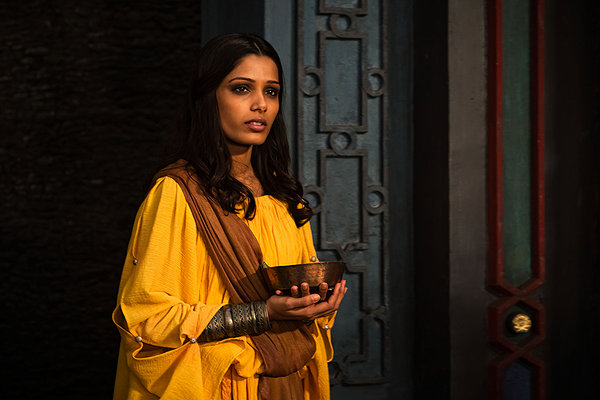 The actors were basically hired for their visual appeal, and to that end they succeed. Cavill (TV’s The Tudors), tapped to wear Superman’s cape in 2013 by Zack Snyder, is suitably buff and hunky. His performance is rather flat, no matter how many times he makes his eyes go big with anger. In contrast, Rourke (Iron Man 2) will chew whatever scenery he can find. His flamboyantly costumed villain at one point seems to wear a lobster claw on his head. He wants to punish the gods because they refused to intervene when Hyperion’s wife and child were slaughtered. When the gods do intervene to save Theseus, that’s when the character should go off the rails. Rourke just plays it in the same sleepy menace. Pinto gets to stare off into the distance regularly and pray. It’d be a stretch to say that the material challenges any of these actors.
Immortals is a testosterone-soaked action movie that feels like it minored in Art History. The production design, CGI, and practical special effects, all attuned to the extraordinary vision of Tarsem, makes for a brilliant looking movie with several sequences of memorable carnage. But we entered the age of “talkies” since 1927, and Immortals suffers when it concerns dialogue, story, characterization, and acting. The movie is a pretty loose adaptation of Greek mythology, falling back on a rote hero’s quest and leaving plenty of narrative dead spaces for the visuals to fill in the interest. Even a movie as visually resplendent as Immortals can only go as far as its story will allow. In this case, Immortals might just be the best-looking piece of borderline mediocrity you’ll ever see in your life.
Nate’s Grade: C+
Share this:

Season of the Witch (2011)
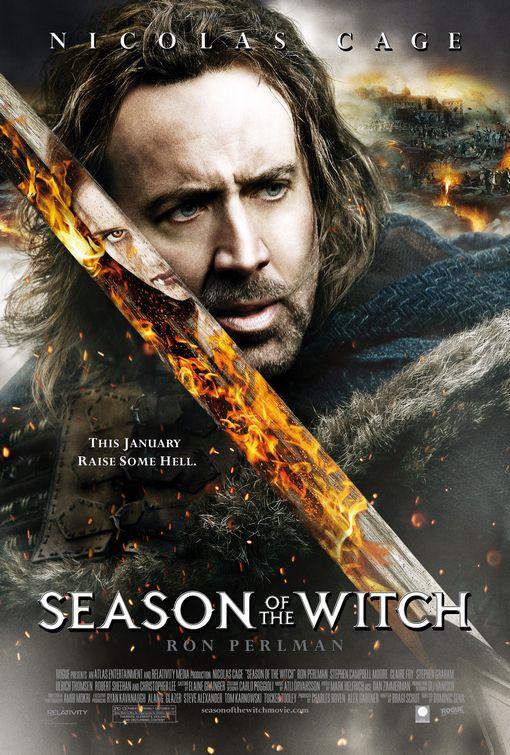 No actor has amassed a higher output of spotty choices than the reigning king of the paycheck film, Nicolas Cage. The man has a habit of appearing in mediocre trash, only notable because a star of Cage’s stature is participating. He’s in late Marlon Brando territory and Cage hasn’t even hit 50 (or blown up to 300 pounds). Every now and then he’ll make a movie that reaffirms how talented an actor he can be, like Adaptation. or Bad Lieutenant: Port of Call New Orleans. But mostly what we associate with Cage nowadays is tic-filled performances, exuberant weirdness, funny hair, and bad movies, two of which are so bad they’re skipping theatrical releases this year (Trespass and Seeking Justice). Season of the Witch will do nothing to change this association.
During the 14th century Crusades, warriors Behmen (Nicolas Cage) and Felson (Ron Perlman) are the best killing machines the Church could hope for. They desert their positions after becoming disillusioned with the Crusades. The duo ventures into a city where a girl (Claire Foy) has been chained in a dungeon. In an airtight piece of impenetrable logic, she’s being blamed for bringing the plague. Behmen and Felson, along with a former knight, a priest, and a young upstart, are tasked with bringing the girl to a monastery where she can be properly dealt with. This secluded monastery is the only place left with a copy of a rare manuscript that contains a spell that will end the pestilence. They put the girl in a cage with wheels and get rolling to that monastery, though not everyone is convinced that the girl is a witch.
 For the first ten minutes, you swear you’re watching a buddy comedy transported to the era of the Crusades. Cage and Perlman are in the front lines of “God’s army” but they’re trading competitive quips like, “You take the 300 on the right. I’ll take the 300 on the left,” and then they preposterously debate who is going to buy post-battle drinks while in the heat of battle. They’re literally slaying enemy soldiers and would rather be arguing over who buys. It’s like they have no attachment to anything happening. This opening Crusade sequence takes us through 12 freaking years of battle locations, but it’s only at the final battle that Cage and Perlman come to the realization that women and children might also be getting slaughtered as they siege city after city. It’s at this point that they get on their moral high horses and stick it to the Catholic leaders: “I serve God, not you. This is not God’s work.” Why did it take them 12 years of fighting to figure out that innocent people may die when you lay waste to cities? Naturally this epiphany only happens after they kill off a European looking innocent. The opening sequence is meant to introduce us to these characters, but it jars the viewer in mere minutes. These guys don’t feel a part of their place or time, and it only gets worse from there. Their nonchalant anachronistic behavior makes the movie seem like a Hope and Crosby vehicle.
This is one thunderously boring movie, putting me to sleep three separate times. I had to rewind what I had missed, and each time I came to the conclusion that I really had missed nothing at all. The problem with the plot is that it makes a mystery pretty obvious. The group is carting around a teen girl in a cage. You’d think this would be something of a conversation starter, perhaps even an opening for a critical analysis of the Inquisition and religious fanaticism at this perilous time. Nope. The whole of the Bubonic Plague is being blamed on a teen girl and nobody seems to bat an eye at this. Sure there’s a few passing references to how killing is wrong (again, remember this took at least 12 years of slaughter to sink in), but the movie’s central storyline seems to shift to a “Is she really a witch?” query. Judging from what kind of film this is, you’d probably be safe betting on “yes” and, well, you’d be partly right. The reason this is no spoiler is because it’s revealed at like halfway through the movie. The girl’s chief defenders suddenly jump on the “burn her” bandwagon. Strange things are following the troupe, so it’s pretty obvious who is at play. However, the girl is no witch but is inhabited by a demon, which seems like splitting hairs. When the super cheesy CGI demon/gargoyle shows its face, the creature actually speaks English but in a really speedy and comical voice that makes it hard to be taken seriously. An earlier cut of the movie did not involve this dumb CGI demon but the girl herself. At least that route would have saved the producers some money and unintentional laughter.
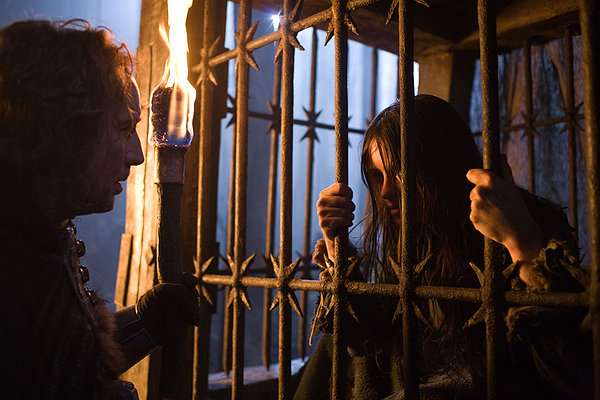 The movie should be far more entertaining, even in a dubious fashion, than it finally is. Season of the Witch flirts with some messages (religion can exploit, women were unfairly persecuted) and silly genre elements amidst a Medieval setting (witches, demons, plague). That sounds like the makings for a campy treat but that treat never materializes. The boring plot lumbers, with the company encountering some setback that picks off their numbers one by one. It’s hard not to feel the drowsy effects of the dull repetition. They encounter killer wolf creatures. Then they encounter a rickety rope bridge, and you better believe that there are rotting boards and fraying ropes. Who keeps building these rope bridges that appear in so many movies, and why do they keep getting hired after continually doing substandard work? Do the regulators get fat payoffs from the rope bridge lobby?
The road to the monastery is a long trek and the movie’s momentum seems to lag with every step. There should be more internal conflict rather than this superficial “killing is wrong” moral that every warrior seems tormented with. The premise should be a ripe opening for a discussion on the perversion of religion for political and personal gain, for the abuses of power, for the archaic view of women as subhuman beings who will seduce men to destruction. There’s even a priest along the way to provide a counterpoint. But alas, Season of the Witch goes hog wild for the cheesy supernatural spooks and even at that it fails miserably.
As of late, the saving grace in a Nicolas Cage paycheck movie is a gonzo performance and some wacky hairdo. We don’t even get that much with Season of the Witch. Cage is oddly subdued throughout the whole movie despite all the swords and witchery. Even his hair is subdued. Without Cage’s typical nutty antics, the movie loses any chance of entertainment it might have ever hoped to have. The shame is that Cage and Perlman both have an easygoing chemistry. You like the two of them together; you just wish they had a better reason to trade insults and one-liners.
Far from bewitching, this movie is ponderously dull. It misses camp by a mile and just lands on mediocrity. There’s nothing about this movie that will stand the test of time, good or bad. This is the definition of a paycheck movie. It flirts with going darker before it settles on a messy monster-heavy ending. The special effects are cheesy, the scares are cheap, the plot is repetitious, the characters feel wrongly transplanted from a modern movie, and Cage sleepwalks through his role. I can’t say I blame him. Season of the Witch put me to sleep and I only had to put up with it for 90 minutes.
Nate’s Grade: D+
Share this:

Rango (2011)
 It’s Chinatown remade with anthropomorphic desert creatures. It’s a Western by way of Hunter S. Thompson. It’s a loving parody of cinema’s wide canvas. It’s one of the most wild, anarchic, oddball animated films to ever be released by a major studio, and it is stupendous. Steeped in weirdness and bravado, Rango has a playful and occasionally macabre sense of humor that kept me in stitches. Director Gore Verbinski (the Pirates of the Caribbean flicks) translates his visual verve into a animated movie that dazzles the eyes with its magnificently drawn features as well as the pointed personality in every stroke. This is a movie with character, not to mention some pretty entertaining characters (including talking road kill). Johnny Depp delivers an idiosyncratic vocal performance for a household lizard that finds himself pretending to play sheriff for a town in need of a hero. When you think Rango will fade into familiar territory, or easy moral messages, the film keeps surprising, forging its own unique path. This is a lively, peculiar, and overall enchanting animated film that’s suitable for families but may well play better for adults with eccentric tastes. I’m still scratching my head, and celebrating, how something like this slipped through the system.
Nate’s Grade: A
Share this:

Red Riding Hood (2011)
 In risk-adverse Hollywood, everything old is new again, so why not remake classic fairy tales for a modern audience? After all, there’s no rights fee. While we’ll have to wait on the competing Snow White films until 2012, Twilight director Catherine Hardwicke unleashes her stylized retelling of the Red Riding Hood tale, titled easily enough, Red Riding Hood. This messy and incompetent movie may cause you to run away screaming into the woods all the way to grandmother’s house.
In a small village on the crest of the big bad words, Valerie (Amanda Seyfried) is betrothed to Henry (Max Irons), a hunky blacksmith that comes from a family of high standing. She’s rather run away with Peter (Shiloh Fernandez), the town’s resident moody guy who’s also her childhood friend. Valerie’s family is ostracized due to past indiscretions, so her grandmother (Julie Christie) lives in a cottage off in the woods. Valerie’s mother died when she was young and she’s been raised by her father (Billy Burke) and her step-mother (Virginia Madsen). This happy hamlet is gripped with fear after a series of violent wolf attacks. Father Solomon (Gary Oldman) ushers into town with a proclamation that he will find the wolf and slay it. But he clarifies that they are hunting for a werewolf among the townsfolk. During one attack, Valerie discovers that she has an odd telepathic link with the wolf, which makes her further question her identity. Naturally, this makes the town fear her and offer her as a red riding sacrifice. But who is the wolf and what is his or her plan with Valerie?
This is a disaster of epic fairy tale proportions. Red Riding Hood attempts to reshape the oft told tale into a palatable mix of sex and violence for today’s pre-teens (teenagers will surely be bored by this), somehow forgetting that the original tale is filled with macabre violence. The filmmakers have tried to make Red Riding Hood (RRH) hip to a younger generation; this ain’t your granny’s fairy tale, yo. But they’ve really turned the simple story into a lumbering, idiotic, grating, and nearly impenetrable movie. This youthful infusion of hollow artifice and misplaced attitude, as well as a fumbling attempt at ill-conceived edge, makes the movie a metaphorical bratty teenager. You get tired of its taxing nature and empty posturing. It’s trying to be cool with last year’s catalogue. Hardwicke is using every tool at her disposal to appeal to an easily bored teenage demographic, so the movie takes several sidesteps that are only justifiable because someone might think they are cool. The musical score includes grating, churning anachronistic electric guitars. It feels like your neighbors are throwing a party and the music occasionally drifts over. These visual and narrative flourishes only remind you how desperate and out-of-tune this whole lousy production is.
 Screenwriter David Johnson (Orphan) takes the familiar woodland frolic and turns it into the world’s worst Agatha Christie-styled guessing game. The wolf is now a werewolf and then the town undergoes a witch-hunt that would make Arthur Miller wince (“I saw Goody Red with the wolf”). It’s here that the movie preposterously attempts to become some sort of important statement on, I kid you not, the war on terror. Solomon brings a metal elephant that he sticks prisoners in to soften them up. He also lights a fire below the belly of the elephant to expedite the process of getting the truth out of a suspect. Solomon’s status as a cleric has to serve as some sort of biting criticism of church authority, especially after he wants to get an inquisition going. I appreciate the wholly misguided attempt at topicality and commentary, but this was not the movie to make statements. Anyway, the plot is convoluted and every scene seems to just further dilute the clarity of the narrative. The movie just descends into a manic game of “Guess the Wolf.” We literally go through just about every speaking part at some point as a potential werewolf suspect. That means every bit part is given due consideration, including the mentally handicapped child. I actively wanted the wolf to be the mentally handicapped kid just for the awkward discussions of what to do next (“We can’t kill the wolf. He’s… special.”). Red Riding Hood works so hard to make like 8 characters look alternatingly guilty. The town seems to be populated by red herrings and not people.
Red Riding Hood is a neutered horror movie and a rather bloodless romance; there’s a lack of blood pumping with either. For a movie about a killer wolf there is precious little blood or wounds even considering some people are mauled to death. It seems the filmmakers had a choice of going with mild gore or mild sensuality to stick the PG-13 landing and erred on the side of hormones. The romantic elements are kept at a pre-teen simmer. For only they will blush at the more suggestive elements, including the table-dance-in-slow-mo shimmy dancing that the town seems to favor during their festivals. At one point Peter unties one of Valerie’s bodice strands. To be fair, in mythical land/mythical time setting, that’s probably like their equivalent of third base. The romantic triangle is desperate to ape the Twilight model, and the male characters are pinup pinheads. They occupy types, one being the brooding “darker” guy who Valerie really wants to be with, and the other is a nice guy from a proud family (sound familiar, Twi-hards?). The movie goes to shoddy lengths to keep these two at odds, when it appears that, like Bella Swan, our Valerie is one flower not worth the trouble of plucking. It’s hard to get involved in a romance when you’d rather watch every participant getting eaten by a wolf.
 “What big eyes you have” is something of an understatement when speaking about the saucer-eyed Seyfried (Letters to Juliet). She gets to make good use of her ocular abilities, though who knows if it’s acting or just expressions of disbelief about what kind of movie she is trapped inside. Seyfried does her whole blasé shtick, which makes the character feel more like an annoying know-it-all even when she admittedly knows nothing. Oldman (The Dark Knight) inhales scenery at a dangerous pace, acting ferociously over-the-top and unrestrained. It’s like he’s trying to channel a wolf in his performance. At least he’s entertaining to watch, which cannot be said for the movie as a whole. Irons (Dorian Gray) is bland but Fernandez (Skateland) is laugh-out-loud awful at a few points. Clearly talking is not this guy’s strong suit. Neither is emoting. The weirdest part of Red Riding Hood is merely seeing Madsen’s face. Clearly this woman has undergone plastic surgery since her Oscar-nominated turn in 2004’s Sideways. She almost resembles a gentler looking Mickey Rourke at certain unkind angles. Another famous face goes to sad lengths to alter her looks to be seen as acceptably good-looking in ageist Hollywood.
Red Riding Hood is a tragic misjudgment on the part of just about everyone involved. The screenwriter thought he must have been making a serious allegory, Hardwicke thought she was making a wild and witchy cousin to Twilight, and the producers thought they were making a film that had genuine appeal. They were all categorically wrong. The reworking of the fairy tale elements is mostly mundane. She gets a red cloak from her granny but otherwise this story might as well just be about a girl and a werewolf. It’s not an imaginative update or a clever reworking, this is just a dumb werewolf story with extra dashes of Twilight for seasoning. The key to unlocking the Red Riding Hood story is not by introducing a sterile love triangle. This hyperactive hodgepodge mistakes setting for atmosphere and a high number of characters for mystery. I was astounded as I sat and watched this movie; turn after turn it veers wildly in tone and execution. I haven’t even talked about the special effects for the wolf, and there’s a reason I am leaving that unsaid. Red Riding Hood is a movie 12-year-old girls might fawn over. If you find yourself outside that marginal demographic, then you’ll likely find this movie to be an irritating, nonsensical, dopey, pitiful bore. You can stuff that in your picnic basket, Red.
Nate’s Grade: D
Share this:

Midnight in Paris (2011)
 Woody Allen hasn’t been this light-footed in a long time. Midnight in Paris is an effervescently charming film that flirts with overt sentimentality. But before you think Allen goes all gooey, the fatalist in him pulls back for some wisdom about the folly of nostalgia. Allen’s nebbish stand-in this time is Owen Wilson, assuredly better looking but on the same neurotic wavelength of his director. Wilson is a disgruntled Hollywood screenwriter visiting the City of Lights with his shrewish fiancé (Rachel McAdams) and her upper-class parents. One night a mysterious taxicab picks him up shortly after midnight. Wilson is transported back in time to his favorite era, 1920s Paris. He gets to rub elbows with literary and artistic giants, like Gertrude Stein (Kathy Bates), Ernest Hemmingway (Corey Stoll), Scott and Zelda Fitzgerald (Tom Hiddleston and Alison Pill), Salvador Dali (Adrien Brody), and others. He even falls for a lovely lady (Marion Cotillard) from that time period who served as a muse for several artists. Midnight in Paris is a far more enjoyable experience if you have a modicum of education in the humanities. Identifying the artists of old, albeit exaggerated cartoon versions of themselves, is part of the fun, fantasizing about interacting with the greats. But Allen is also playful with his storytelling, and for a while Midnight in Paris becomes a highly refined cross-time romance (think The Lake House written by Tom Stoppard). Midnight in Paris has been catching on with audiences, becoming Allen’s biggest hit in 25 years, and it’s easy to see why. It’s whimsical while being literate and romantic without being corny.
Nate’s Grade: B+
Share this:

Drive Angry (2011)
 Without a hint of self-awareness, and not nearly enough tawdry camp, this exploitation throwback manages to be completely serious with a ridiculous plot and a celebration of muscle cars, gory violence, and women in hot pants. And yet for a film about Nicolas Cage literally escaping from Hell to save his baby granddaughter at the hands of a Satanic cult leader (Billy Burke), it’s awfully complicated. The plot is hard to nail down, rarely does it spell things out, which means the audience is left trying to piece together the scraps of logic in between fetishizing cars and violence. Amber Heard (The Informers) and her cut-off high-waisted jeans becomes Cage’s sidekick and she gets to hold her own. The 3-D elements are mostly distractions flying at the screen, the violence is extreme but with a distasteful nihilistic edge, and the tone lacks any traces of irony or appreciation of genre. There’s more potential here that never feels tapped, like Cage’s special “God-killer” gun that spooks even the Grim Reaper/Angel of Death (William Fichtner, having a blast). At one point, Cage is locked in coitus with an overly animated waitress, and he kills an onslaught of goons while still engaging in sex. While Shoot ’em Up did it too, it’s a sequence that hints at what the film could have been had it given in to more crazy impulses. Instead, Drive Angry isn’t nearly passionate enough to register as anything but a mundane retro, country-fried rehash of 1970s action movies.
Nate’s Grade: C
Share this:

Pirates of the Caribbean: On Stranger Tides (2011)
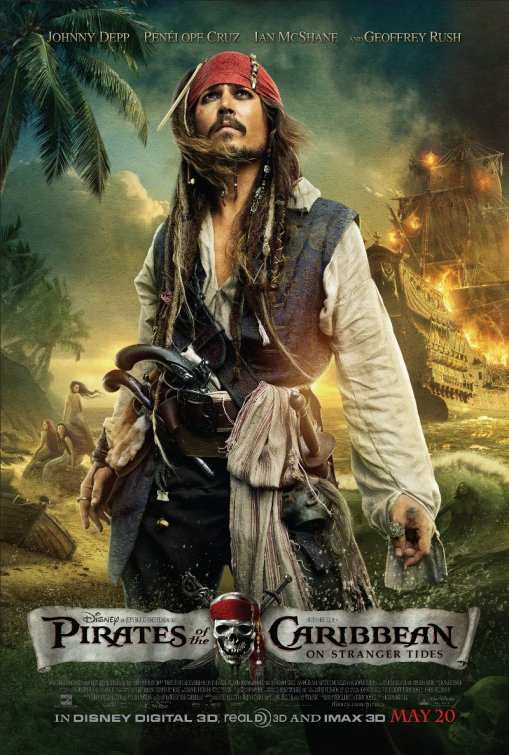 The public reaction to the two previous Pirates of the Caribbean sequels, 2006’s Dead Man’s Chest and 2007’s At World’s End, were decidedly mixed, though that didn’t stop them each from earning a bazillion dollars. Fans didn’t care for the darker tone, the confusing interlocking of the story, and especially the bloated running times. It feels like Disney’s uber-producer Jerry Bruckheimer must have taken notes from the sequel backlash and they amounted to: “Less of everything.” Welcome to less plot, less character, less involvement, and far less entertainment. Welcome to Pirates of the Caribbean: On Stranger Tides.
It’s been a few years since the non-world-ending events of At World’s End, and Jack Sparrow (Johnny Depp) has been in London putting a new crew together. Except, it’s a Sparrow imposter. Turns out it’s Angelica (Penelope Cruz), a former lover of Jack’s who woud still like to settle some scores. She and her father, the feared pirate captain Blackbeard (Ian McShane), force Sparrow to lead them to the Fountain of Youth. Apparently, Jack at one point had the map. King George II (a delightfully hammy Richard Griffiths in one of the film’s best scenes) is in a race against the Spanish crown. The English monarch hires Barbossa (Geoffrey Rush), Sparrow’s occasional enemy and ally, to find the fountain as well. It’s a race to see who can benefit from eternal youth first because, apparently, no one can share a source of water. Second grade teachers nationwide are very disappointed, Disney.
The entire enterprise just lies there on the screen, devoid of all energy or danger. The entire picture is just so shockingly inert, lazy, phoned in from every angle, missing any resonance of magic. Rob Marshall was the wrong man to be tapped as the new director of this series. Marshall has a fine eye for visuals, but the man couldn’t stage an action sequence to save his life. The Oscar-nominated director of musicals like Chicago and Nine stages his action sequences like dance sequences, which on paper don’t sound too far off. That’s until you realize action needs to incorporate story, location, build in tension, create organic obstacles, and be easy to follow. The action sequences in On Stranger Tides aren’t outlandish enough. It’s all so dull, a sword fight here a sword fight there. Short of a mermaid attack sequence, there’s no excitement to be found onscreen. That is disastrous for a franchise that has built a reputation for its anarchic, wild action and storylines. Marshall’s action angles and editing don’t communicate urgency. There’s no mood to these set pieces. The editing feels like it’s always catching up, always too late, needing a myriad of trims. Action cinema has been lambasted when it’s hyper edited and the audience cannot see what is happening; On Stranger Tides is not edited enough. One of the reasons these half-baked action sequences can never get going is because they always seem to be starting and stopping with the lackadaisical editing, always a step behind. The shots linger when they shouldn’t. The ingredients are there for a tasty meal but the chef (Marshall, screenwriters) doesn’t know what to do. The musical score by Hans Zimmer tries very hard to compensate and rattle the audience, compelling them to think what is transpiring on screen is exhilarating. It is not, and the music is just loud and annoying.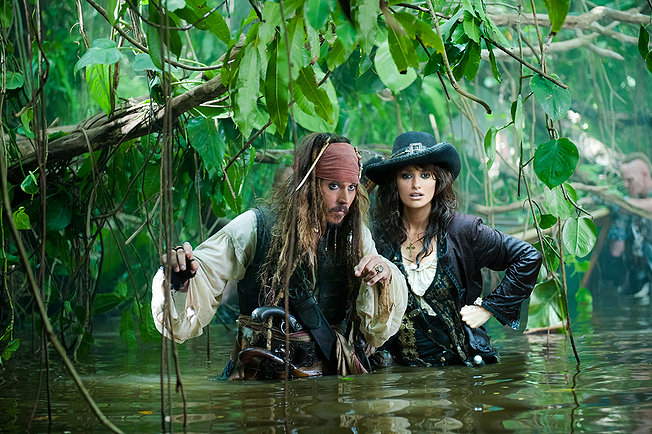
One of the chief criticisms of the two Pirates sequels were that they were overstuffed with storylines, characters, setups, and were just far too convoluted and confusing for their own good. So with On Stranger Tides we get a simplified, pared down one-off movie. Much of the film is just characters walking in circles and, likewise, talking in circles. Motivations are flimsy. The dialogue is stilted; Sparrow’s malapropisms and one-liners feeling sloppy (“I agree with the missionary’s position,” he quips. Groan). The entire premise is to get to the Fountain of Youth, and then they get there and, well, very little happens. The characters will talk about little, walk a few feet, talk about little more, and this process repeats. Barbossa should be an interesting foil, going from fop to pirate by film’s end, and yet his every appearance in the movie feels like when the next-door neighbor appears on a TV sitcom. It’s an intrusion meant to remind you that you, the audience, like this character, even if they don’t serve any point in the story. The plot lacks any twists and turns, ultimately having every competing force converge on the Fountain of Youth at exactly the same time for a slapdash climax that involves more lackluster sword fighting, just like all the other sequences. On Stranger Tides is a full half-hour shorter than the third movie, and yet it still feels like an eternity at two hours and seventeen minutes because it spends so much time doing so little.
At least the other three Pirates movies found clever ways to mingle their sci-fi mythology into an old-fashioned Errol Flynn swashbuckling adventure. With On Stranger Tides, the sci-fi fantasy elements are just as underdeveloped as the characters. The Fountain of Youth is another of those magic do-hickeys that involve gathering magic tokens and blah blah blah, mermaid tears, silver chalices. Hey, if you wanted to drink up some mermaid tears, have them watch 2009’s Oscar-winning best documentary, The Cove. That ought to do it (a scene driving the mermaids into nets oddly reminded me of The Cove). Blackbeard and Angelica have a Jack Sparrow voodoo doll, which is highly effective, and yet this plot device is nearly forgotten for the entire film. There is no clever application of this unique device. Blackbeard has a magic sword that makes ships come alive. Why? How? It’s just another magical Macguffin, like Jack’s compass. Man-eating mermaid temptresses is an interesting idea, and a great way to squeeze in a lot of obfuscated nudity in a Disney film for teen boys who have not discovered the Internet. Too bad the mermaids are confined to one scene, albeit the highpoint of an otherwise bad film. Their feeding frenzy is the only moment in the film that channels that high-flying sense of verve that made the original so memorable. Don’t even get me started on the fishy romance presented between the captive mermaid (played with all the acting capability of a French perfume model) and a missionary (Sam Claflin). The whole experience feels like a shambled, draggy, inarticulate rip-off of Last Crusade, complete with a climactic drink from a magic chalice. I appreciate Marshall’s emphasis on practical special effects but if these are the results then bring back the previous sequels’ CGI vomitorium. This franchise feels like every ounce of energy and danger has been squeezed out of it.
So does that means that this Pirates venture is more character-based now that it has jettisoned side characters and complex plots? Fat chance. The problem is that Jack Sparrow is not a good lead protagonist. He’s not meant to be a classic good guy. He’s a libertine, somebody who makes selfish choices but will revert to do something proper when his conscience nags him enough. Sparrow is more of the dashing rogue at best. Does anyone remember how he was going to trick doomed men into signing their souls to Davy Jones? He also needs a foil, a striaghtman to bounce off of. I almost miss the wooden performance of Orlando Bloom. Without a do-gooding striaghtman, Jack Sparrow plays like a man adrift, searching for his groove. Unfortunately, Sparrow never finds it in this vehicle, which just asks him to go through motions and mannerisms. Blackbeard makes for one very bland villain. McShane (TV’s Deadwood) can glower and chew scenery with the best of them, but his baddie never seems too menacing. He burns one guy alive and threatens to kill his own daughter in order to keep Jack in line. I’m sorry, but that doesn’t even compare after the previous films included a monstrous ship captain who would readily slice prisoners’ throats and a British bureaucrat who hanged an eight-year-old before the freaking opening credits. Blackbeard, in contrast, just comes off like a crusty old man in need of a shave.
 The film’s biggest addition was bringing in Jack’s former flame Angelica, a woman he robbed of her virtue and personally betrayed. But is there any tension? No, because Jack and Angelica don’t have any old feelings for one another they rehash (oh how I was even pleading for a trope like that), and the characters don’t really feel any antagonism either. Sure they will parry and threaten one another, but it’s so devoid of danger or tension or interest. This is no screwball romance. They feel like a couple that can’t be bothered working up any notable feelings toward one another. Therefore, all their shared scenes, and there are many, sink the film’s flow. Their bickering should bring some sparks. She should be exciting; she’s the daughter of a notorious pirate, she was going to be a nun until Jack Sparrow came sailing into her life. She should be sore. She should be angry. She should be a lot of things that ultimately the character is not. Cruz (Nine, Vicky Cristina Barcelona) doesn’t come across as an equal or love interest, she just feels like an annoying sidekick, harping on “Yack.” At one point, Jack tells her, “If you had a sister and a dog, I would take the dog.” When she’s got a personality like this, I’d agree.
Depp (Alice in Wonderland, Sweeney Todd) is obviously a comic gift and his Sparrow character will go down in the ages as one of the most universally beloved figures in cinema history. Everyone adores this character, a loveable scoundrel. But that doesn’t mean the screenwriters can just strand him in a crummy story with nothing to do. Depp will always be enjoyable when he puts on his Captain Jack eye liner and does that funky, swishy walk of his, but even he feels like he’s phoning this one in. He realizes that his character is trapped in a sodden adventure that offers little to do as a character and an actor.
I never thought I would say this, but On Stranger Tides makes me positively reevaluate the other Pirates sequels (I admit to being one of the few critics who liked Dead Man’s Chest a good deal). If this is what a simplified Pirates of the Caribbean film gets you, bring me back the messy, maddening plots of the previous films. Bring me back the scope, the danger, the clever mingling of genre elements, the adventure, the sizzle, the anarchy, and bring me back director Gore Verbinsky. Marshall has no feel for this material or how best to serve story. I never expected a movie with this kind of budget to be so lifeless. It all just sits there on screen, expecting the pieces to come together through ardent wishful thinking. On Stranger Tides suffers not because it strips away some of the excess and convolution that plagued the other films, it suffers because it gives no reason for its existence. It does not enrich the characters, the Pirates universe, or provide a rip-roaring story. Obviously, the film exists to line the coffers of Disney. It may earn plenty of booty this summer, but this is no way to rejuvenate a sinking franchise.
Nate’s Grade: C
Share this:

Sucker Punch (2011)

Director Zack Snyder (300, Watchmen) has been drubbed in many circles for being an empty visual stylist, someone in the Michael Bay camp that worships at the altar of style. Snyder is a nearly unparalleled visual stylist. If only he would use his considerable talents for the purposes of good. I’m not a Snyder basher by trade, and have enjoyed all three of his previous films to some extent, but it’s obvious that Snyder spends much of his time scribbling down imagery he thinks will be cool, and then figuring out how to connect it all at the last minute. So Sucker Punch gives us a bevy of highly stylized, anime-influenced imagery complete with a posse of full-lipped ladies with heavy fake eyelashes operating heavy weaponry in fetish-style clothing. If you were expecting much else, then you’re the one who’s been suckered.
Baby Doll (Emily Browning) is a 20-year-old sent to live the rest of her days locked away inside a dilapidated mental ward thanks to her wicked stepfather. He even makes arrangements with a dastardly orderly (Oscar Isaac) to lobotomize Baby Doll to shut her up for good. Then step dad can swindle the family estate for all its worth. While in this asylum, Baby Doll imagines she’s inside a different world to survive. Her fantasies offer her a world to escape to. Inside, she plots with a group of other patients, including Rocket (Jena Malone), her feisty take-charge sister, Sweet Pea (Abbie Cornish), Blondie (Vanessa Hudgens), and Amber (Jamie Chung). Together, along with the sage advice from a mysterious mentor (Scott Glenn) in her visions, they will collect four items to secure their escape. But time is of the essence. The lobotomy doctor, known as the “High Roller” in the fantasy (played in a major surprise by Mad Men‘s Jon Hamm), is scheduled to come do his needle through the brain trick in a matter of days. It’s up to Baby Doll to utilize the therapeutic techniques of Dr. Gorski (Carla Gugino) and retreat into her mind to find the key to save herself.

You can tell Snyder was trying to crowbar in a meek message about female empowerment, but I ask you: is it female empowerment when the women have to be reduced to pretty play things that still operate in the realm of male fantasy? Just because women fight back does not mean that you are presenting a feminist message. Baby Doll’s mode of power is erotic dancing? And her main outfit looks like a grown replica of Sailor Moon’s, which should be a dream come true for just about every male fan of the animated series. You think having characters in short skirts and names like “Baby Doll,” “Sweet Pea,” and Sucker Punch is no more about female empowerment than some ridiculous women’s prison movie where they all fall into long lesbian-tinged shower sequences. That’s female empowerment, right? It’s got women loving women, so what could be more empowering to women?
After Sndyer’s kitchen sink approach to storytelling, the one thing that Sucker Punch lacks, in abundance, is sense. There is no real connective tissue to anything happening onscreen. Snyder employs two different framing devices before slipping into the metaphorical delusions of a third. I felt like I was tumbling through the Inception dream levels without a roadmap or a competent guide. Considering that the first framing device, Baby Doll being locked away in a mental ward, is only featured onscreen for ten minutes, Snyder could have exercised the bit completely. The second framing device, that Baby Doll has imagined her institutionalized imprisonment into a vaguely 1920s-esque burlesque theater/brothel seems just as unnecessary, but whatever. But it’s the third metaphorical level that gave me a headache (more on that later). The premise alone, girls use fantastic imagination to escape from a cruel prison, is good enough to tell a compelling tale. But there desperately needs to be a connection to those images, a relationship between the fantasy and the movie’s reality. In Sucker Punch, there is no substantial relationship to anything. It is a barrage of images meant to arouse and entertain but little more. The different metaphorical levels are only metaphors for, well, hot girls kicking ass, which isn’t so much a metaphor as it is a literal translation. And when the girls are at play in those fantasy sequences, the movie drops all pretenses of any purpose. It’s not just reality defying, which is what movies were meant for, but it defies its own narrative. If I can just cram whatever cool junk I want then what purpose do I even need to set up characters or develop a plot. When the ladies are off on their fantasy tours, they’re invincible and no law of physics, or man, applies to them. It zaps all danger from the screen, and with that, all tension. They all become superheroes who just run around doing super heroic things. And I might have cared if I felt there was any real purpose for what I was watching other than Snyder wanting to scratch a few cinematic itches.

The girls’ quest to attain their needed items for escape is laid out in the most shockingly lazy manner. Snyder uses the power of dance, yes dance; you see, when Baby Doll starts movin’ them hips of hers, she plunges into a fantasy world of her own doing. And then we witness all sorts of crazy things, and she returns back from the fantasy and the mission is complete. The girls have stolen whatever item they were after. I was expecting the fantasy binges to have some direct correlation with the makeup of their world, so that, say, if they have to cross a massive bridge to gain their item, in the brothel they have to cross some massive barrier. It’s the height of indolence for Snyder to simply type “character dances” and then we get an indulgent fantasy sequence and the job is done. We don’t see the steps the girls had to do to win their freedom, the relationships between fantasy and reality, or any clever plotting along the way. There’s no cleverness at all to be had. The fantasy is not just an escape for the characters; it’s an escape from having to do any thinking when it came to storytelling. Imagine what would happen to other works of cinema if they followed this same approach. Why watch the back-and-forth arguments of a courtroom thriller when we could just have “prosecutor dances” and cut to the case being over? Or why bother watching the complicated struggles of a relationship drama when we can have “guy dances” and just cut right to the shot of the camera spinning around the couple kissing? It’s like a fast forward button that eliminates all plot development. Isn’t that much more satisfying? What, you mean it isn’t because it’s a self-indulgent diversion that has no connection to the main storyline and fails to add anything?
I think ultimately Snyder just really wanted to make the most expensive music video of all time. The dialogue is clipped and kept to a minimum, mostly of the expository “you need to do this now” variety. There are long stretches of full-length musical interludes by Tyler Bates (300) and Marius De Vries (Moulin Rouge). The duo orchestrates some uninspiring fuzzy alt covers of alt songs, so familiar tunes like Bjork’s “Army of Me” and the Pixies’ “Where is My Mind?” get a polish they didn’t need (how many times is that Pixies song going to be covered?). Worst of all is a bizarre mash up of Queen’s “I Want It All” and “We Will Rock You” with a rap track. And of course no film that aimed to ape the tropes of Alice in Wonderland would be complete without some version of Jefferson Airplane’s “White Rabbit,” this time covered by talented Icelandic singer Emiliana Torrini. The entire musical oeuvre is a bunch of distorted, loud, blaring guitars meant to amplify the visual noise.

Sucker Punch is not so hot in the acting department. Browning doesn’t particularly act well in the movie, but then again nobody does, especially Gugino’s awful accent. But this isn’t a film about acting so much as it’s looking the part. And Browning is a geek fantasy come to life, samurai swords, pigtails and all. She makes for a great moving poster.
Expect nothing more from Sucker Punch than top-of-the-line eye candy. Expect nothing to make sense. Expect nothing to really matter. In fact, go in expecting nothing but a two-hour ogling session, because that’s the aim of the film. Look at all those shiny things and pretty ladies, gentlemen. This is the perfect film for a 13-year-old kid fed on anime, comic books, and horror films and who don’t give a lick about things like plot, character, or substance. It’s like somebody combined One Flew Over the Cuckoo’s Nest with every single damn videogame cut scene in the history of time. I was waiting for the next dance/trance sequence where Baby Doll was going to start jumping on turtles and collecting coins. It’s a series of vignettes that have no connection whatsoever. Sucker Punch is really a live-action Heavy Metal, except with even less plot. This isn’t a fairy tale. This is a meth-fueled explosion of a Hot Topic store, captured in Snyder’s signature slow motion. Everyone is entitled to their own fantasies but not everyone gets a $100 million dollar check to throw them all together on screen.
Nate’s Grade: C+
Share this:

The Adjustment Bureau (2011)
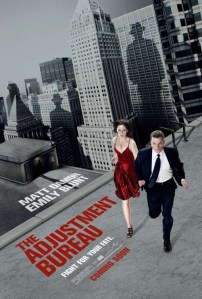 Gentlemen, if you were looking for an original excuse about not calling a girl back, try this one on for size: I couldn’t call because a team of men who control human destiny told me that if I did they would erase my memory and keep you from the fame that you are destined to achieve. She’ll probably at least give you points for originality before throwing a drink in your face (but it was all part of The Plan, or was it?).
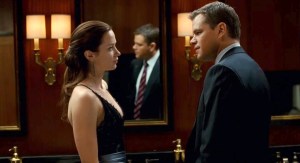
David Norris (Matt Damon) has just lost a New York congressional election thanks to his frat boy ways of old resurfacing. As he composes his concession speech inside the men’s restroom, he meets Elise (Emily Blunt), a ballet dancer hiding out. They have one of those crazy only-in-a-movie conversations that manages to feel authentic. Then they kiss. She inspires him to ditch his prepared remarks and speak from the heart to the national TV audience, which eats it up. David spends the rest of his days trying to meet the enchanting Elise again. Then he runs into a big stumbling block. He’s late to a meeting and catches a group of mysterious men in suits and fedoras fiddling around with people frozen like statues. They are the adjusters, the ones who ensure that the participants of mankind follow The Plan. These are the people responsible for the illusion of choice in our lives. If we deviate too far from The Plan, causing ripple effects that too need to be accounted for and adjusted, they step in. Richardson (John Slattery) is the spokesmen for the group and decides to just level with David. He is not supposed to be with Elise. He has a different future ahead of him, so sayeth The Plan. They will throw obstacles between the two of them. David seeks out Elise and fights against the whole universe for the two of them to make a future together.
 Horrible title aside, The Adjustment Bureau is a sometimes corny but often deeply satisfying movie. It may distract with some efficient and just-smart-enough sci-fi leanings and magic tricks, but it’s really a unabashed romance at its core. Not just that, it’s a good romance, once that flutter the heart and causes the ends of your mouth to do that thing, you know – smile. It helps when you have movie tars as gorgeous as Blunt and Damon, and are such good actors that they can fill their roles with dangerous amounts of charm, but let’s credit writer/director George Nolfi (The Bourne Ultimatum, Ocean’s Twelve). He takes a fairly routine concept (powerful forces control our lives and choices) and turns it into a finely tuned character-driven romance. Immediately from their first meeting in a men’s room, Blunt and Damon have that electric dynamic that you can genuinely believe in. Their chemistry will knock you over. You feel the spark between these two, which is essential because the two characters spend years apart at times, forever hoping to reunite. In that brief encounter, you fall in love as well and realize that this character, and this actress, is worth waiting for. I think people are going to be surprised that The Adjustment Bureau is a big gooey, stars-in-the-eyes love story, and it’s actually good. It’s a really enchanting love story, tackling the question of whether whom we love is a result of choice or destiny. This central concept is what every sci-fi element and thriller sequence is spun from. Here’s a funny thought: it’s all in service to the story.
It’s rare to see a studio movie that mixes so many different elements together to such effective, satisfying results. The film doesn’t get overly dark despite the cosmically long-reach and determination of the adjusters. There’s never any real threat of danger, only a broken heart or dashed dreams. The film has many light moments throughout, creating a rather bouncy tone that suits the romance angle nicely. The adjusters aren’t very menacing, more so comically perturbed. John Slattery, all silvery Mad Men appeal, is a perfect foil as the face of the adjusters. He feels like an exasperated parent baffled by the thought-processes of his youthful charge. It helps that these cosmic accounting agents have a finite level of power. If they had unlimited power then the film would fail to have any hope for David and Elise. But we learn that there are only so many adjusters that there are limitations to their powers, and that they can be outsmarted with enough gumption. Mingling with that light touch is enough whimsical science fiction to engage your brain. The concept of the adjusters and their supernatural abilities is nicely teased, setup, and then developed, making sure never to rock the audience with too much weirdness at one time. It’s a gradual process of discovery and it leads to a somewhat goofy, but infectiously amusing, climax that involves multiple doorway portals and magic hats. Yes, I said magic hats, which means there is an honest to God good reason why that stupid fedora hat, seen so prominently in advertising that it feels like the third-billed star, is featured. Admittedly, a concept like a magic hat that allows you to teleport through doorways would seem silly, but Nolfi makes it all work. The hardest aspect to believe (in a film with, I repeat, magic hats) is that Blunt could be a ballet dancer, let alone a future star of the medium. I’m by no means saying that the British beauty has anything to worry about in appearance, but she does not have a ballet dancer’s dangerously minuscule physique. Natalie Portman in Black Swan looked like a real-deal ballerina of fragile frame. Blunt doesn’t have the movement or the physique.
 In his directorial debut, Nolfi does enough good things, and does them with a smooth sense of style, to impress. The visual trick of going in one door and opening to another world walks a dangerous line of over saturation, but it’s playfully utilized enough to forgive. Nolfi is not perfect with his plotting, falling to misstep that can push back momentum. Characters will be chatting, and then they’ll walk away and we’ll get a title card that says something like, “Three years later,” and it sort of makes it feel like we have to start all over again. The fact that this happens more than once means that Nolfi might have wanted to plot his story around a series of events that occurred more often than Senate election terms. If we have to begin with David losing one campaign at the start and then zoom ahead at several points through another campaign, then perhaps the timeline could have been condensed a bit in retrospect. The film manages to be religious and faith affirming without pushing an agenda or overstating its romantic cause. The ones behind the plan are only referenced in oblique business terms, never confirming a certain high power but definitely nodding in that general direction.
Damon and Blunt are a terrific team. This is easily Blunt’s finest role as an actress since breaking out in 2006’s Devil Wears Prada. The actress has taken many a role that makes use of her large crystalline eyes and her sometimes go-to acting response of simpering. But in this film, she finally finds that perfect role that makes use of Blunt’s modest, goofy charm. She’s never been a leading actress in a traditional set; there’s always been a delightful goofy appeal that set her apart. When Blunt offers her playful smiles and asserts those glassy eyes of hers, you too will be smitten. Her character is a charming woman thanks to Nolfi’s writing, but having an actress of Blunt’s ability fill her out is a blessing. Damon is at a point in his career where he just grinds out good-to-great performances that manage to be convincing in unassuming, dignified ways. Damon has never been an actor given to the superfluous. His character feels like a sincere sport, which is amazing considering he’s supposed to be playing a politician. He’s the kind of guy you’d actually stand in the rain to vote for, and you understand why Elise would keep a place tucked away deep in her heart for the dashing Damon.
While the movie hinges on the coupling of Damon and Blunt, the rest of the supporting cast does fine work matching tone and making the most of their roles. Actors like Anthony Mackie (The Hurt Locker), Terrence Stamp (Valkyrie), and Michael Kelly (Changling) can make any movie better.
 The Adjustment Bureau, on paper, should not work. A sci-fi fantasy that’s unapologetically grounded in romance. A tone that nestles firmly in a safe, bubble-wrapped whimsy. And those magic hats, need we forget them? On paper this should be one overly silly, dumb, tonally disjointed, cornball movie worth venomous mocking. And yet it works; it does better than “works,” it succeeds. Blunt and Damon are terrifically charming together and imbue the movie with a sense of cheerful optimism in the face of uncertainty (and perhaps heaven itself). You desperately want these two crazy kids to get back together; they’re good, decent, charming people, winning personalities apart and even better together. What might have fallen apart in other hands becomes this endearing, fizzy piece of studio entertainment that fulfills and exceeds most expectations. I was really taken by this movie, won over by its effusive charm offensive, and left buoyant with happiness by the time the tidy, perhaps too tidy ending, came rolling. The Adjustment Bureau is hooey but it’s my kind of hooey.
Nate’s Grade: A-
Share this:

Shrek the Fourth (2010)
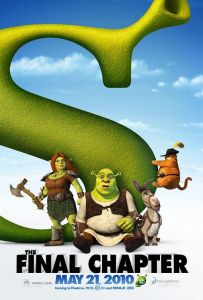 By taking a page, or even the entire script from It’s a Wonderful Life, Shrek tackles a mid-life crises and wonders how life would be if he had never saved his lovely wife Fiona from her tower (hint: it sucks). He wants his life back and makes a deal with the devious Rumplestiltskin. Except Shrek wakes up in a world where he was never born. While generally better than the third feature, this is still a noticeable step below the first two Shrek features. The tiresome plot device feels more like material for a lazy direct-to-video sequel rather than the (supposed) final chapter to the series. The film wants to be reflective and tap into our inventory of attachment to these characters, but time and again the movie doesn’t go far beyond the “don’t know what you got until it’s gone” cliché. Gags still feel too safe, the energy feels too loose, and the overall feel of Shrek 4 is casual. The novelty is gone. This is a rather middling trip to that big happily ever after. The story, with its reflexive moralizing, just makes the whole film feel slight; Rumplestiltskin is a villain of wasted potential, the characters feel poorly incorporated, and the general time-travel concept implies that the filmmakers have run out of stories to tell. As expected, Shrek 4 looks great, but that’s the only thing great about this once vaulted fractured fairy tale franchise. If this is the final chapter, then let it go with some fading sense of dignity.
Nate’s Grade: B-


 nathanzoebl
You must be logged in to post a comment.