Blog Archives
Gangster Squad (2013)
 It’s hard to mention the action thriller Gangster Squad without a passing reference to the Aurora, Colorado movie theater shooting in the summer of 2012, the reason for the film’s five-month delay and reshot action sequence. Gone is a shootout at the movies and now we have a confrontation in the streets of Chinatown. I wish they hadn’t stopped there. If given the opportunity, and remember they did have an additional five months, I would have scrapped Gangster Squad almost completely and started fresh.
In 1949, former boxer Mickey Cohen (Sean Penn) has seized control of Los Angeles organized crime. His influence extends even into a police, which forces Chief Parker (Nick Nolte) to go to desperate measures. He asks Sgt. John O’Mara (Josh Brolin) to assemble a team of enforcers to fight back. They won’t have badges but they will be pushed to use whatever means necessary to carry out their mission, which means blurring the line between what is considered lawful. O’Mara assembles a super group of former officers and one of them, Sgt. Jerry Wooters (Ryan Gosling) gets into even deeper danger when he starts seeing Mickey Cohen’s main squeeze, Grace Faraday (Emma Stone).
This movie is like if The Untouchables and L.A. Confidential had an illegitimate child and then abandoned it in a sewer where degenerate hobos raised it. Gangster Squad rips off other gangster movies with liberal abandon that I can’t even begin to list the lifts. I’d be less offended if I felt that the movie had more on its mind than just replicating the tone and look of noir cinema. Actually, it feels more like what they want to replicate is the tone or style of the video game L.A. Noir.
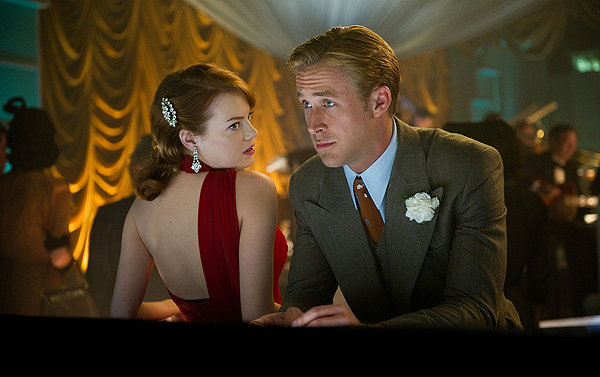 The main problem is that Gangster Squad really only has the skeletal outline of a plot. It’s missing any essential character and plot development. Here, I’ll summarize the barebones plot for you: Mickey Cohen is a bad guy. O’Mara forms a team. They have a montage taking out bad guys. Mickey takes out one of them. They have a showdown. That, ladies and gents, is it. There really aren’t any scenes that diverge from those scant descriptions. It felt like only five minutes passed from one of O’Mara’s guys getting killed (and just like The Untouchables, it’s the nerdy one) to them descending on Cohen’s headquarters and duking it out. Why does the film introduce the conflict of Wooters seeing Cohen’s girl if he never finds out? There isn’t even one scene presented to take advantage of this conflict. It just ends up being another half-baked plotline. It feels like the only development we get with Gangster Squad is through montages. What is also apparent is that O’Mara and his team really don’t have anything resembling the faintest notion of a plan. We watch them take out some bad guys via fights and shootouts but there’s no higher plotting to it. You get a sense that these former cops are just playing it by ear, looking for a fight every night. It’s hard to imagine that these people, even with their law enforcement and war experience, could be effective in the long term. Without any formative organization or greater planning, these guys just seem like dull bruisers bouncing from fight to fight with no sense of direction.
Then there’s the paucity of character work, relying solely on genre archetypes to do its work for the movie. O’Mara is the determined family man but his team can best be described by one-word classifications: The Black Guy (Anthony Mackie), The Nerdy Guy (Giovanni Ribisi), The Mexican Guy (Michael Pena), The Young Guy (Gosling), The Old Guy (Robert Patrick). That’s about it, though I suppose they do have different weapon preferences meant to supply all that missing characterization. Oh look, Officer Harris (Mackie) brings a knife to gunfights. That’s pretty much the beginning and end of his character. Wooters is so lackadaisical he feels like he’s on drugs, and Gosling’s soft-spoken, mealy-mouthed line delivery only adds to the effect. It feels like Gosling, in a stretch to find something interesting out of the mundane, said to himself, “I wonder if I could give a whole performance where I only speak under a certain vocal register.” Then there’s the woefully miscast Stone (The Amazing Spider-Man) as the femme fatale/mol to Mickey. I love Stone as an actress, but man-eater she is not and sultry seductress doesn’t fit her well either. Perhaps with the aid of a sharper script and a greater depth of character she could rise to the challenge. At no point does Gangster Squad really even attempt to make these people multi-dimensional. They never reflect on the moral turpitude of their own vigilante justice or the ramifications of their actions. There’s no room for ambiguity here.
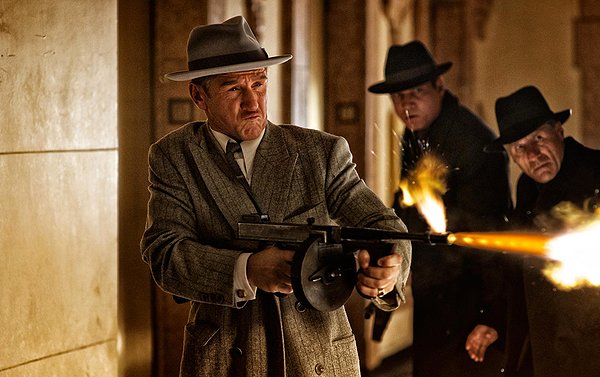 Finally, we must speak of Mr. Sean Penn (Milk). The man’s actorly gumbo goes into campy overdrive. In these rare circumstances, you aren’t watching Sean Penn Esteemed Actor so much as Sean Penn Human Vortex of Overacting. Normally I would criticize Penn for going over the top but over the course of 110 minutes, he single-handedly becomes the only entertaining thing in the movie. He’s chewing scenery up a storm, yes, but at least he’s channeling the pulpy silliness of the whole movie. I came to enjoy his antics and outbursts and thus became more empathetic of Mickey Cohen and his efforts than I did with O’Mara. Such is the danger screenwriters run when they spend more time crafting an interesting villain than a hero.
Gangster Squad is what happens when a movie is sold on title and genre elements. To be fair, it’s a bang-up title. The plot is half-baked at best, really only serving as a thin outline of a gangster movie, but instead of adding complexity and intrigue and characterization, they just ran with it. The actors are either camping it up or out of their element, the action and shootouts are pretty mundane, and the story is just uninvolving, even for fans of film noir like myself. It’s a good-looking film from a technical standpoint, but that’s as far as I’ll go in my recommendation (it could be an odd pairing with Milk considering the two shared actors). It feels like it just wants the setting elements of film noir, the atmosphere, and then figures just having good guys and bad guys shoot it out will suffice. That glossy, high-sheen period look just seems like a cool façade, and a cool façade seems like the only ambition of Gangster Squad. I can’t really recall any signature action sequence, snappy quote, plot development, or peculiarity worthy of remembering. It may be one of the most forgettable gangster movies Hollywood has produced.
Nate’s Grade: C
Share this:

The Amazing Spider-Man (2012)
 It’s only been a mere ten years since Marvel’s signature web-shooting, wall-crawling super hero leaped onto the big screen and smashed box-office records, and yet he’s already getting the reboot treatment. Usually we reserve reboots for movie franchises that ended in colossal artistic failure. I don’t know anyone that will ardently defend director Sam Raimi’s Spider-Man 3, but I know of no one that puts its in the same vicinity as the atrocious, franchise-slaying Batman and Robin. Spider-Man 3 suffered in comparison to its predecessors, which formed the gold standard of super hero films (even in my review I called out for some new blood if this was any indication what we had left to expect). But then in 2010, Sony decided that it would rather start all over with its billion-dollar franchise, so Raimi was out, so too were stars Tobey Maguire and Kirsten Dunst, and 500 Days of Summer director Marc Webb was tapped to direct. The (rebooted) Amazing Spider-Man swings into theaters with a serious case of déjà vu attached. Are we far enough out to forget about Raimi’s accomplishments? My spider sense is telling me we’ve been here before and better.
Peter Parker (Andrew Garfield) is a geeky high school student living with his Uncle Ben (Martin Sheen) and Aunt May (Sally Field) ever since his parents had to vanish mysteriously one night. Peter is picked on at school and crushes on cutie-pie Gwen Stacy (Emma Stone) but all that changes when he’s bitten by a genetically engineered spider. He gains super spider-like abilities including improved dexterity and the ability to stick onto surfaces. He designs his own webbing devices that allow him to shoot long tendrils of super-strong spider webbing he can swing around with. Peter is trying to unravel the mystery of what happened to his parents and he seeks out Doctor Connors (Rhys Ifans), a notable genetics scientist who worked with Peter’s long lost dad. Peter supplies his father’s secret math formula and gives Connors the breakthrough he was hoping for in genetic replication. When injected with a serum, creature should be able to regrow lost appendages. Connors turns himself into a human guinea pig because he’s desperate to grow back his amputated right arm. But the serum causes Connors to transform into a hideous lizard creature for periods of night and only Spider-Man can stop him.

Simply put, I liked Spider-Man when it was made the first time and called Spider-Man. I understand the desire to reboot after the disappointing mess that was 2007’s Spider-Man 3, but did we need to start completely from scratch? Could we not have just eased into a Spider-Man 4 and replaced the original actors? Though I personally had no problem with Bryce Dallas Howard as Gwen Stacy (yum). I don’t need to see another version of the Spider-Man origin tale because it was already covered just ten years ago. The worldwide public is familiar enough with Spidey’s back-story that I don’t understand why we couldn’t just start with our hero already doing his business. I don’t need another hour of setup for the guy to become Spider-Man. This “sameness” seems to sap much of the energy out of Amazing Spider-Man, a competent and occasionally thrilling superhero flick. It does plenty of things well enough but you just can’t shake the feeling that the movie, at its core, is unnecessary or at least tripping over redundancy. Do we really need to see Peter Parker discover his powers again? I understand that we want to experience part of his joy at discovering his fantastic new abilities, but it just feels like all too familiar. I don’t think we would have missed anything by simply condensing all the back-story and doling it out as a series of concise flashbacks.
Despite some serious déjà vu, The Amazing Spider-Man has some other serious issues. Firstly, the tone just seems like a bad fit. This is a much darker, somber, and angsty tone for a character that was never intended to be as brooding as, say, Batman. Just because the dark tone worked for Christopher Nolan’s Batman films doesn’t mean it’s the right fit for every comic character. I’m not saying that Peter Parker doesn’t have his issues and plenty of guilt to struggle with (more on that in a moment), but this movie feels like the fun has been squeezed out. It’s a kid who was abounded by his parents, bullied at school, and he teems with repressed frustration. Peter Parker is not meant to be a brooding antihero. He’s supposed to be the high-flying jokester. Regardless, you can interpret the character however you’d like, I just don’t think this darker, gloomier incarnation works despite the best efforts from Garfield. The spirit of the movie feels like it’s being suffocated at times. Raimi’s films had their dramatic material but they never lost a sense of fun. It’s hard to tell if anyone is enjoying himself or herself for much of Amazing Spider-Man.
Now let’s talk about one of those areas of Parker’s guilt, namely his guilt over the murder of dearly beloved Uncle Ben. Peter chooses not to get involved and from that action Ben is murdered by the same criminal Peter could have thwarted earlier. In Amazing Spider-Man, it’s transformed into an inane example of being at the wrong place at the wrong time. Ben just so happens to run into the same guy and he stupidly wrestles for the man’s gun. It’s hard to make any real connection for Peter to blame himself. Spider-Man 3 did something similar by rewriting the back-story so that the Sandman was responsible for Uncle Ben’s death. I wrote: “By introducing a new killer it means that Peter has no responsibility for his uncle’s death. This completely strips away the character’s guilt and rationale for what compels him to swing from building to building to fight crime.” Now, this new Spider-Man, since he’s so edgy and dark, is only hunting for bad guys who bear a likeness to the robber who killed Uncle Ben. Yes, Peter Parker has become a vigilante defined by his all-consuming sense of vengeance. And guess what? He never finds the guy. Get used to all sorts of storylines being dropped or forgotten throughout the film (I guess we’ll have to wait for future films to explain what happened to his parents).

While I think a darker interpretation of Spider-Man is mislead, I wish the movie would see it through rather than keep having moments to break the reality of this more grounded approach. I’ll buy that Dr. Connors turns into a giant lizard creature from the magic DNA serum whatever. I’ll even buy that he goes mad with power because of it. However, what I won’t buy is that this guy, all of a sudden, decides to relocate his lab into the sewers. What? The guy has everything he needs in a giant scientific tower, and he says he “gave the staff the week off.” Well then do your crazy mad scientist science stuff in your lab. Why the sewers? Do you know how many trips this guy would have to make to haul all that equipment down into the sewers, and remember he’s only got one friggin’ arm! The entire character of the Lizard feels so poorly developed and adds no greater thematic message to the movie. And then there’s the case of Peter Parker being a world-class dweeb mocked in high school. As presented, he’s a pretty hunky, smart, athletic kid who has fabulous hair. It makes no sense that he has absolutely zero friends and that there wouldn’t be girls crawling all over this guy. Are there no alternative-style girls in this school besides the one girl with glasses we keep cutting back to for reaction shots? And how many times is Aunt May going to watch her nephew come home at odd hours and covered in bruises before she says anything?
Then there’s just the forehead-smacking number of coincidences in the movie. With most movies you accept that the characters exist in a small universe where they will regularly continue to run into one another, but in Amazing Spider-Man it’s absurd. As my pal Mike Galusick noted, you have Peter who just happens to have the last steps needed in a formula who just happens to go to Oscorp and poses as another student with shocking ease who just happens to wander off a tour and much up with lab stuff because security cameras do not exist in this universe and who just happens to meet the same scientist who is responsible for his parents missing and the guy also happens to have a head intern who just happens to be Peter’s crush and she just happens to be the daughter of the police captain (Denis Leary) trying to hunt down Spider-Man. Phew. I haven’t even mentioned the construction worker dad (C. Thomas Howell, for real) whose kid was saved by Spider-Man so he makes sure to rally all his fellow construction workers to synchronize their beams for Spidey. It is moments like this that undermine the filmmakers’ grounded approach.
It sounds like I really disliked this film, and I didn’t. Amazing Spider-Man is a completely serviceable superhero tale and the cast does a great job of covering up for many of the narrative shortcomings. The action, what there is, seems a little too rushed and missing that spark that Raimi had in abundance. There is one nifty sequence that Webb deserves credit for: in the foreground a librarian listens to classical music, which drowns out the background action as the Lizard and Spider-Man smash through shelf after shelf of books. This was the only moment in the movie where it felt fresh and exciting and I wanted to see where it would go. It’s just that the movie cannot capitalize on its potential. Take for instance a late incident where the Lizard unleashes his mutant gas and transforms a cadre of police officers into giant lizard creatures. You’d naturally expect that if you were introducing a lizard army that we’re upping the stakes and that the movie would do something with this new team of antagonists. Wrong. No ramifications. Webb’s film does benefit from advances in computer wizardry as the CGI is far more advanced and Spider-Man doesn’t resemble the cartoon character he often did in Raimi’s trilogy. The brief moments swinging through the city, feeling the rush of exhilaration with the character, are the movie’s visual highpoint. I found the Lizard’s face eerily similar to the goombahs in the reviled Super Mario Brothers movie.

Garfield (The Social Network) and Stone (The Help) certainly feel like a step up from before. Even though Garfield seems a bit old for high school, he does a more than credible job of being a super smart kid who slowly grows in confidence and demeanor. He can do it all, handle the comedy, the emotional angst, the formation of courage. Garfield is a great addition and he gets along wonderfully with Stone; the actors have great chemistry, which may explain why they started dating after the production ended. Stone brings a comedic zeal to the part and seems far more approachable and les standoffish than Dunst’s Mary Jane ever did. While the movie seems to indicate a fully formed romance for its stars, what we see on the screen plays out more like a nervous flirtation. The actors are cute when they seem to be stammering in awkwardness and mutual attraction. I wish the movie gave us more development rather than skipping ahead, but hey, these kids are great together.
The Amazing Spider-Man, when you get down to it, is less than amazing. It’s a capable super hero movie with some fancy effects and stunt work, but the mounting plot holes, incongruities, tonal conflicts, and overwhelming sense of sameness prove to be a foe even Spider-Man cannot topple. This aims to be a leaner, more emotionally engaging, realistically grounded Spider-Man, but it just can’t pull it off. Garfield and Stone are great but it’s impossible to erase Raimi’s original trilogy from your memory. His films weren’t perfect, though Spider-Man 2 came closest, but they were loving odes to the character and knew how best to link action with character for maximum impact. I can’t think of any real memorable moments in this movie, which is troublesome given its hefty budget and its hefty mission of supplanting the Raimi films. I didn’t have a bad time while watching The Amazing Spider-Man but my involvement and enjoyment was very limited. Even with a glossy reboot, I guess The Amazing Spider-Man is proof enough that sometimes it’s better to go forward rather than reliving the past.
Nate’s Grade: B-
Share this:

Crazy, Stupid, Love (2011)
 Crazy, Stupid, Love was sold as being a smart, urbane romantic comedy for adults, and this is accurate to some degree. It’s certainly worlds better than anything Katherine Heigl has been inflicting upon the public. At the same time, this film exists entirely within that familiar universe known as Movie World. It polishes old genre clichés, but in the end they’re still clichés. The movie follows playboy Jacob (Ryan Gosling) coaching Cal (Steve Carell), a divorced dad, on how to get back his mojo and seduce women in a modern world. Along the way, Jacob falls for the cute Hannah (Emma Stone), Cal’s teenage son (Jonah Bobo) is hopelessly in love with his 17-year-old babysitter (America’s Next Top Model contestant Analeigh Tipton), and the babysitter is secretly crushing on Cal. There are passing moments of awkward but recognizable reality, especially the free-falling nature of divorce, but they are eventually smothered by the gloss of rom-com schitck. Because this exists in Movie World, every character, including a one-night stand (Marissa Tomei), will pop back up because every character is related to everyone else in this tiny fishbowl. That also means that contrivances and misunderstandings will culminate in a comic clash. Oh, and don’t forget the grand public pronouncements of love. This is the only movie I can ever recall where the dissemination of child pornography is treated like a payoff or as something to cheer (naked babysitter pics are passed along). Huh? Crazy, Stupid, Love is a fitfully entertaining movie but don’t let the pretensions of maturity fool you, this is strict rom-com stuff.
Nate’s Grade: B
Share this:

The Help (2011)
 Kathryn Stockett’s bestselling publishing phenomenon has now become a box-office smash. In 1963, Jackson, Mississippi, Eugenia “Skeeter” Phelan (Emma Stone) is coming home after graduating from college. Her ailing mother (Allison Janney) is convinced that she will die without any grandchildren and pressures Skeeter to find herself a man. Instead, she finds herself a job writing for the city newspaper. She answers reader household and cleaning questions as “Miss Mryna.” She seeks help from Aibileen Clark (Viola Davis), a middle-aged woman who’s worked as a maid to rich white people her whole life. Skeeter soon changes her focus and wants to interview other maids about the indignities they experience. She wants to get their story out there. This is a time where it was actual Mississippi law that anyone working against segregation could be imprisoned. They try reaching out to Minnie (Octavia Spencer), a maid recently fired from the services of Mrs. Hilly Holbrook (Bryce Dallas Howard), the queen bee of the Southern belles. Minnie is much more outspoken and her mouth causes her to get into trouble. The only job she can find is in the household of Celia Foote (Jessica Chastain, The Debt), a woman ostracized by Hilly’s forces. Skeeter transcribes the life stories of a dozen maids and the results become an anonymous bestseller that sets Jackson tongues a waggin’.
The Help enlists a colorful cast of characters (no pun intended) and tells a familiar story about people taking a stand during a tumultuous time in history. This is traditional classic Hollywood storytelling with the respective characters banding together, leaning upon one another, building camaraderie and victory, and then finally able to stand up to their antagonists, which in this case is really just Howard’s snooty racist character. It’s well told, well directed (both credits to Terry Tate, childhood friend of the author), very well acted by every member of the cast, and watching all 145 minutes is like being fed a heaping helping of home cooking. You leave feeling full and sated, and some may even feel nourished. You feel good about yourself. I tried to resist but resistance was futile. I can’t help but enjoy The Help. And even though I walked away liking the film, something stuck in my craw. It felt a little too prefabricated, too eager to be liked, to go down easy, gentle, a sweet Southern story about women taking a moral stand and finding their voices. But what is the film’s real focus when it comes to race relations?
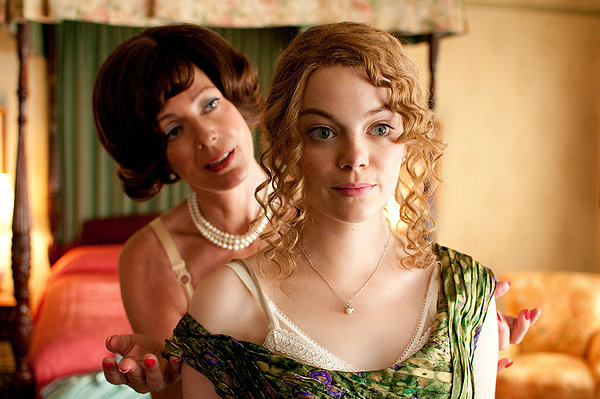 Naturally nobody is going to look as The Help as an exhaustive document of the Civil Rights era, but the movie seems to seriously downplay the intensity of that struggle. Sure it pays lip service to Medgar Evans assassination but by this time there were riots, churches being bombed, children being killed, open collusion between law enforcement and the Ku Klux Klan, and the Freedom Riders were being met by violent mobs. There are a lot of bigger things going on than black maids sitting down for interviews with a college girl. Come on, this is Mississippi we’re talking about here, the home of racism. I understand that the Civil Rights movement had thousands of anonymous acts of courage and the actions of these (fictional) women should not be out rightly discounted. However, the parting message of the film seems to be not about the courage of the black maids but the tenacity of Skeeter, a middleclass white woman who herself grew up with “help.” The Help’s mixed message on race relations reminds me of a similar situation with 2009’s beloved The Blind Side. That movie wasn’t so much about the triumph of a black athlete so much as a glowing picture to how great rich white people can be. And Sandra Bullock got an Oscar for it; that’s how great a white lady she was. The Help is another example of Hollywood taking a story primarily about minorities and having white people necessary to tell that story. Why are white people always necessary to tell some other race’s stories? Skeeter is an open-minded gal that speaks her mind and stands up to the Jim Crow South. That’s how she starts. By the film’s end, she’s now… an open-minded gal that speaks her mind and stands up to the Jim Crow South and now she has a publishing career. Good for her! Good for heroic white people! They had so much to lose back then.
I guess my main fault is that this is not Skeeter’s movie. I don’t even think she’s needed. Yes she provides the outlet for the stories and secrets of an undervalued class of people. But did she need to be the co-lead? Does she need her own storyline where she stands up to her mother cowing to racist social norms? She had her own maid (Cicely Tyson) unceremoniously dumped while she was at school. Surprisingly this does not give too many insights to Skeeter’s character. Do we need any scenes of her going out on dates so that we can forever be reminded how ahead of her time she was, how liberal and progressive she was and destined to be unappreciated by a pool of men who were looking for only pretty housewives? As my friend China Gentry said, we’d all like to think we’d be the forward-thinking progressive voice of change in these historical dramas, to make ourselves feel better, but we’d most likely just be another silent face in the background. The boyfriend storyline is a complete waste of time. Skeeter goes out with a drunk jerk, he comes back and apologizes, they go out again, then after she gets published he freaks out and storms out. And that is the last we see of this guy. That’s the end of his story. He apparently puts his foot down when it comes to dating a female author. This storyline adds nothing to the overall narrative or to the character of Skeeter. There’s entirely too much Skeeter in the movie, and I say this as a gigantic fan of Emma Stone (Easy A). It’s not the actress’ fault either because she performs well in her first dramatic film role. This is just not her movie. This is not a movie about heroic white people; at least it shouldn’t be. This is a movie about the help, so let’s devote more time to them, notably Minnie and Aibileen. The movie opens and closes with Aibileen’s voice over. She is the star of this story. Why do I need another character just to coax out her story? Yes, I understand the limitations to a woman in Aibileen’s position in those days, but that’s no excuse. She deserves to be the focus.
Davis crushes in this movie. She is a one-woman force of devastation. You can just see the wear on her face, the tremor in her eyes, the sadness etched into her face. This is a woman beaten down by her position, and Davis is excellent. How good is this woman? She’s so good she got nominated for an Oscar for a single eight-minute scene in 2008’s Doubt. That’s Judi Dench territory right there (Dench famously won a Best Supporting Actress trophy despite only appearing onscreen for about nine minutes in Shakespeare in Love). She has a few big acting moments but mostly she’s not an outspoken woman. She’s more a downtrodden woman used to the many disappointments of her lot in life. She raises other people’s children while seeing very little of her own son. She develops close relationships with those kids, and the kids feel more attached to their maids than their mommies. And there’s the shattering disillusionment that these children, who once loved their maids, will transform into spitting images of their parents. The help gets treated less like family and more like a disposable, impersonal employee. The ease of severing ties can be heartbreaking. And Davis lets you feel all that without even having to speak. Spencer (Dinner for Schmucks), in easily her biggest role of her career, is enjoyable with the more outspoken role. She’s more the mouthpiece for the audience.
 As I admitted in my review of 50/50, I don’t think there’s any role that Howard (fun fact: both Howard and Stone will play film versions of Gwen Stacy) can play where I won’t fall in love with her somewhat. This is more a hypothesis than a theory at this point. Hilly is a social queen, the Southern belle who likes things just the way they are. She has influence over the other middleclass wives in Jackson, but she does make for a pretty marginal main antagonist given the time period. She can threaten the livelihoods of the maids, so she is a threat, and her worldview is decidedly racist (she thinks using the same toilets will spread “black diseases”). She’s built up enough to be a threat but not enough to be unstoppable. She’s defeatable, unlike the intolerant ideology so prevalent in the South. We can’t defeat racism but we can topple one racist white lady. Well, we can laugh at her and bring up the fact that she ate something very gross once. I won’t go into spoilers, but this plot point where Minnie gets wreaks personal vengeance on Hilly via baked goods feels out of place for the tone of the film. It doesn’t fit.
I resisted seeing The Help for so long, believing it would be a painful experience with mushy emotions and many life lessons served up on an easy platter. And to some degree, the movie is exactly that. But it’s also hard to dislike the sweep of the old fashioned storytelling. The Help is a nice movie, extremely well acted, and filled with period details that will make the audience sense its authenticity. It’s easy to get caught up in the writing and the acting, so it’s easy to ignore the otherwise somewhat questionable examination on race relations. I don’t know why we still need white people to tell “their story.” The Help is a well-crafted movie but it fails to move the conversation forward. Perhaps that’s an unfair expectation. Not every Civil Rights era story is required to properly educate the public, let alone a work of historical fiction. Maybe I should just sit back and enjoy the story like so many million readers have. But the power of Davis’ performance claws at my memory, telling me she deserves a better movie focused on her character. For once, I’d like to see a Hollywood movie about race relations that doesn’t require white people as a framing device. Let’s let the right people tell “their story” for once.
Nate’s Grade: B
Share this:

Easy A (2010)
 Usually when I think “teen comedy” I think lowest common denominator and a pitch straight down the middle of the plate. Will there be fart jokes? Probably. Will the climax taken place at the prom? Absolutely. Does Easy A do either? Not a chance. This is the sort of teen comedy that would have greatly appealed to me back in my own days of high school institutional education.
Olive (Emma Stone) is a high school senior that gets good grades, behaves well, and spends her weekends hopping around her bedroom and singing a song she can’t get out of her brain. She’s not into parties or idiots or anything remotely dangerous. Then her world turns upside down when she fibs about losing her virginity. Suddenly Olive is branded as the school’s hussy. Inspired by Nathaniel Hawthorne’s famous character, Olive decides to embrace the rumors, accessorizing her wardrobe with plenty of scarlet “A”s along the corseted bust line. Olive’s gay friend asks her for a huge favor: he wants to use her fake notoriety to lose his virginity. The two will attend a party, find a room, and dramatically interpret animated sex. It works like a charm. Her pal is given a free pass, some extra popularity, and it isn’t long before other downtrodden high school rejects seek a similar deal. Outraged at Olive’s lack of shame is Marianne (Amanda Bynes), the school?s busybody and leader of a vocal Christian abstinence program. She doesn’t know whether she wants to save Olive or banish her.
 All hail the coming of Emma Stone, comedy goddess and future heartbreaker. Easy A is a fantastic showcase of the many strengths of this irresistible actress. After several supporting roles in films like Superbad and The House Bunny, this is the first opportunity for Stone to have a film where she gets to be the lead, and trust me folks, this won?t be the last one. Stone has a great way of becoming instantly empathetic and, much like the film, being brainy and playfully risqué at the same time. Watching the success of Stone is like watching the road not taken by Lindsay Lohan (be careful whose advice you take, Emma). Stone makes her good times seem effortless, like she really is having a blast playing up her bad girl image. Her facial expressions and sarcastic, know-it-all line readings help push her comedic range even further, and yet she remains completely empathetic the entire time. Stone is the kind of girl that other girls would want to hang out with and guys would crush on. It is impossible to not love this actress, and she makes Easy A easily enjoyable and downright effervescent at times.
The rest of the cast is having just as much fun with the material as Stone. Chief among them are Stanley Tucci and Patricia Clarkson as Olive’s hyper-literate parents. They may seem like they stepped off the train from a Diablo Cody movie at first, but you will quickly get used to their glib rapid-fire repartee. Some might dismiss them as kooks. Thomas Haden Church (Sideways) tries to make the glamorous movie idea of the Hip Teacher into a droll square and succeeds admirably. There’s even Lisa Kudrow (TV’s Friends) as a guidance counselor and Malcolm McDowell (Halloween) as a blasé principal (“This is public school. If I can keep the girls off the pole and the boys off the pipe, I get a bonus”). Then there’s Bynes (Hairspray, She’s the Man) in what was billed as her final film performance before hastily retiring from acting, and then following in the footsteps of other famous retirees like Michael Jordan, Stephen King, Jay-Z, and Brett Farve, and hastily un-retired. She has her cutesy, dimple-faced shtick she cling to, but what happened to her? Her face looks very swollen, like she had an allergic reaction on every day of shooting. It looks like someone inflated her head with the plot to turn her into a Macy’s Day balloon. I started to get concerned for Bynes by the end.
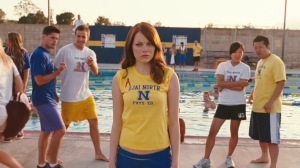 While Stone is the number one, two, and three reasons for seeing this movie, Easy A doesn’t let down her efforts. This is a teen comedy that might just be light years ahead of the pack. There are jokes guaranteed to go over the heads of a majority of audience members, from wisecracks about Sylvia Plath to French wordplay to the Kinsey scale. You’re not going to find any of that stuff in your typically brain-dead Freddie Prinze Jr. vehicle (is it just pathetic to keep holding onto a 10-year-old anti-FPJ grudge? The answer is, “No!”). Though I died a little inside when the movie resorts to explaining the plot of The Scarlet Letter to Joe Public; however, this intellectual Cliff Notes salve was saved by Stone bemoaning the idiotic 1995 Demi Moore film that takes some of the sharpest deviations I’ve ever seen from a classic literary adaptation (“If I have to grade one more paper talking about Hester Prynne taking baths all the time?”). The dialogue is routinely snappy and occasionally barbed, which is a bit of a surprise. It’s witty, a little cheeky, but it doesn’t go over the line or play for the easy gross-out gag. It?s a well-constructed, well-executed teen comedy that has a playful zing, a facetious tone that celebrates literature and makes being smart sexy.
While sex is at the forefront of the plot, the film does not treat the serious subject matter with flippancy. There’s some heavy stuff about what it means to sell out your ideals, prostituting yourself in more ways than the obvious. Olive begins her crusade as a means of taking ownership of her reputation and as an amusing character to play. But then as she dives ahead, accepting gift cards for her imaginary yet cred-boosting favors, the bloom of idealism dims and the meaning of her crusade become murky. What point is she trying to prove, exactly? In the end, is there a sharp difference between being a prostitute and being a “prostitute”? How big of a distance can irony give you? Easy A may have its fun when it comes time to doing the deed (I was howling with laughter about Olive chastising her first “client” about his comment on the aroma of sexual intercourse), but this is a teen movie ready to accept the consequences of its actions with a clear and level head.
 Not everything hums with precision. Easy A can be faulted for being too reverential and referential to 1980s teen comedies. Its ambition to be a modern-day member of this group is a bit too in-your-face. The abstinent Christian opposition feels too broadly drawn and setups for cheap shots and some downright mean punchlines. This movie is better than stooping to tin-eared caricature. The relationship between Olive and her best friend (Alyson Michalka) is vastly underdeveloped. The emergence of a Herpes outbreak also seems a little tacky, especially given its salacious carrier (trying hard not to spoil plot reveals). Then there are simply questions of believability. I?m not expecting a journalistic document of the American educational system, but since when was a high school student losing their virginity scandalous gossip? Why would Olive become the talk of the town by doing something that, according to the CDC, 80% of men and 75% of women have accomplished by age 19? Now, later in the film, the whiff of prostitution would definitely create a stir in the social gossip machine, and with technology, a rumor can spread at the speed of texting.
The film follows a well-worn path and owes a serious debt to the teen films of the 1980s, but Easy A is a winning teen comedy thanks to a snappy script, a playful sense of the taboo, and the courage to shoot for a higher level joke, also Stone’s charismatic comedic performance makes the grade. The entire movie has this bustling, quirky energy to it that feels un-labored. They make it all look so easy. Despite being a thorough genre flick, it is lifted thanks to its zesty writing and acting. In the most simplistically crass terms, Easy A scores.
Nate’s Grade: B
Share this:

Zombieland (2009)
 Zombieland is insanely entertaining and one of the most satisfying theatrical experiences of this year. It’s an American Shaun of the Dead, meaning that the zombie genre gets lovingly satirized with some wit, some bite, and a whole lot of blood. This movie isn’t nearly as clever as Shaun but it sure serves up the red meat of what you’d want in a crackling zombie action comedy. Woody Harrelson and Jesse Eisenberg make for an engaging odd couple pairing, director Ruben Fleischer posits a nice amount of visual whimsy with onscreen survival guide rules, and there is a glorious celebrity cameo midway into the movie that might qualify as my favorite 10 minutes of 2009. It’s funny and fiendish but it doesn’t break down the fourth wall. Zombieland does have some flaws to it, like a repetitious second act where the boys get duped by a pair of sisters (Emma Stone, Abigail Breslin) like three or four times, and the climax at an amusement park raises some obvious questions. Why turn on an amusement park and attract every zombie in town? Why dive out of a Hummer when you could drive off? The movie seems to take great aims to set up the damsels in distress, mostly because the inconveniently shut their brains off from survival mode. The silliness and macabre fun is infectious and Zombieland makes you hungry more adventures with these characters killing the undead in gross yet creative ways. I may be biased since Eisenberg’s character is from Columbus, Ohio (the crowd I was with cheered when we were informed our present home town had been decimated by zombies).
Nate’s Grade: A-
Share this:

The House Bunny (2008)
 Anna Farris (Scary Movies) is proving herself to be one of the most adept physical comedians of today. This is formulaic fish-out-of-water comedy set in the familiar territory of collegiate coeds, so you’ll be excused for thinking you’ve seen this movie before in a dozen incarnations. The nerdy outcast sorority adopts Farris as their housemother, and through no shortage of makeover montages, the girls come out of their shells and embrace their outer midriffs. However, The House Bunny doesn’t just stoop to pandering a hypocritical “believe in yourself” message tied to beauty makeovers to win over the fellas, but it almost does. Farris is the true draw for the film and she goes for broke as the daffy Playboy Bunny. She’s sweet and effervescent even at her most dimwitted; this woman knows how to sell a joke. Her comedic timing and line readings are superb. The movie isn’t anything more than a pleasing diversion, but without Farris and her comic gifts it would be something much worse. The House Bunny does what it does well enough to be disposable entertainment. She’s got the dumb blonde routine down cold, now it’s time for filmmakers to allow Farris more opportunity to hone her other comedic chops.
Nate’s Grade: B-
Share this:

Ghosts of Girlfriends Past (2009)
 I maintain that no story has been redone, recycled, re-purposed, and parodied more so than Charles Dickens’ classic holiday tale, A Christmas Carol. Dickens’ tale of redemption aided by supernatural ghosts and time travel has appeared in everything from Muppets to the Odd Couple. Statistically, the odds are good that right now as you read this very sentence television is airing some adaptation of this story right now. I suppose it was only a matter of time before Dickens got reduced to a romantic comedy setup. Ghosts of Girlfriends Past is a charmless and mostly empty movie that makes you pine for the comparative masterpiece of A Muppet Christmas Carol.
Connor Mead (Matthew McConaughey, playing himself for the thousandth time) is a hunky fashion photographer for Vanity Fair magazine and, boy, is he in-demand. Everyone wants his photo services and every woman wants to rip his clothes off. Connor is a notorious womanizer and he travels to the country to attend his younger brother Paul’s (Breckin Meyer) wedding. Connor is intent on dissuading his brother on the prospect of marriage, which Conner dubs archaic and he feels love is “comfort food for the uneducated and lonely.” It just so happens that Connor’s ex-girlfriend from way back, Jenny (Jennifer Garner), is the maid of honor at the wedding. She hasn’t seen her dubious ex for some time, but that doesn’t stop him from trying to make his move. Jenny and Connor were childhood pals, but an early bout of heartbreak led Connor to become the disciple of his Uncle Wayne (Michael Douglas), a boozy playboy who taught the kid everything he knew about bedding the babes. During Connor’s stay, the ghost of Uncle Wayne informs him that three spirits will visit to showcase Connor’s checkered past, present, and dodgy future, Dicken’s-style.
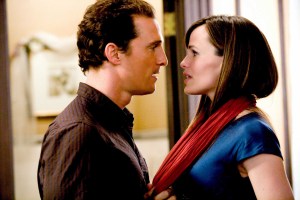 The movie is wholly unbelievable even for a contrived romantic comedy. The central romance between Connor and Jenny rests on the silly notion that after ten years apart, a lifelong selfish jerk can sweep his former girlfriend off her feet during a single crazy weekend. Connor’s redemptive arc is lackluster at best, and the movie just mimes the steps it feels that it needs to take to turn its lead insensitive jerk character into a sensitive jerk character. It doesn’t work. I refuse to believe for one second that a pretty, smart, confidant doctor such as Jenny would allow herself to get so completely suckered in by Connor’s “Baby I’ve changed” speech. It’s insulting and degrading. The compressed timeline reflects poorly on Jenny’s decision-making. The expedited timeline makes every human action seem far-fetched. There’s a scene where Connor opens a champagne bottle in the kitchen. The cork flies out and knocks one of the legs loose on the multi-tiered wedding cake. The cake is about to slip over when Connor slides in to stabilize it. Instead of redistributing the weight via the available legs, he tries reaching for the out of reach champagne bottle with his foot (the size of the bottle and the cake leg are not even close). A more believable situation would involve Connor trying to reach the fallen cake leg, not a champagne bottle, but alas. To make this example even worse, the filmmakers set up the disaster of a fallen wedding cake and then amazingly fail to show the goods. We only see the smashed aftermath. This is a comedy fundamental: set-up food disaster, let audience witness ensuing food-related disaster.
Ghosts of Girlfriends Past also doesn’t have one redeeming or marginally realistic female character. I would expect, given Garner’s star power and the natural importance of being the romantic lead, that Jenny would come across as a reasonable woman or someone worth fighting over. Sorry, Jenny is a powerfully underwritten character and Garner is left without much work other than serving as a reservoir of reaction shots. Seriously, that’s her main purpose in this movie; she is a cutaway image. Sandra (Lacey Chabert) is a shrieking high-maintenance shrew of a bride. The other female roles are largely one-note misogynistic fantasies (thanks male screenwriters Jon Lucas and Scott Moore). The trio of bridesmaids is gossipy chatterboxes and eager to get laid. Connor’s introduction to his future mother-in-law (Anne Archer) involves him casually groping her breasts, much to her prosaic approval. Connor has an irresistible way with the ladies, which makes everything without a Y chromosome want to sleep with the man. A young famous pop singer watches Connor dump three women simultaneously on an Internet conference call, insult them, and then she still strips off her clothes to bed the cad. She even states, “I don’t even know why I’m doing this,” and continues along. I’m just as confused what power Connor holds over the fairer sex because to me he’s just a twit.
 Here’s a telling example about how obvious this movie is written from an unenlightened male perspective: the central relationship dilemma is that Connor is afraid of cuddling. In the past, Jenny asked him to stay and cuddle but that was the breaking point, so he bolted. All of these women somehow manage to fall head over heels in love for a guy who willingly goes through women likes changes of underwear. It makes all the women comes across as emotionally needy, insecure, vapid bubbleheads who will sacrifice everything, including self-respect and dignity, to get a taste of McConaughey’s back sweat. Ghosts of Girlfriends Past is not a flattering movie for either sex.
The tone of this movie never finds an authentic and satisfying balance. Being a half-hearted tale of redemption during the period of a weekend, the movie crams in plenty of gooey sentimental claptrap. You’ll listen to characters talk about the true meaning of friendship, tear up over family memories, and then someone will make an inappropriate sex joke. There is a high level of semi-racy sex jokes that populate the world, appearing at odd moments, destroying any assembling emotions. Ghosts of Girlfriends Past will pretend like it’s building to something that actually matters and then it will throw it all away for a cheap sex gag — har har. There’s a moment where Douglas is illustrating how much ire Connor has wrought with visual metaphors. It begins to rain and he says that the downpour is made up of all the tears shed from ex-girlfriends and flings. Then it starts raining ripped pieces of confetti, and this we are told is all the tissues used. And then comes all the used condoms, and we watch Connor try and take cover before the aerial assault of used (and presumably “filled”) contraceptives annihilates him. It’s kind of gross and tonally disjointed from the rest of the sappy, happy PG-13 storyline.
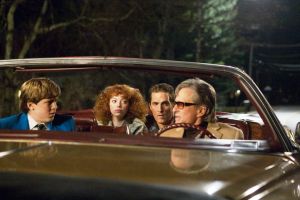 The movie is at its most amusing when it’s riffing on the expectations of following the Christmas Carol model. Connor is quite aware of the tried-and-true formula, so his comments along the way provide the movie’s only genuine laughs outside of Douglas. Really, Douglas’ character is the most entertaining character, and I kept wishing that the film would follow him even after death. Wouldn’t it be interesting to watch the life of a ghost involved in a Christmas Carol scenario? I imagine it would be a bit like a play rehearsal. I would enjoy seeing the behind-the-scenes work that goes into the scenario. I want to see ghostly foremen plot out unique scenarios for a list of real-life Scrooge cases, I want to see the ghost tryouts, I want to see the mechanics involved in the spiritual setup for this whole process. I enjoyed watching Uncle Wayne hit on his fellow spirits. But I suppose that approach would be too literary and break away from the cozy confines of the stillborn romantic comedy genre. And to prove that it is indeed a romantic comedy by the numbers, Ghosts of Girlfriends Past even includes the last minute dash to stop the romantic party from leaving via some method of transportation.
Ghosts of Girlfriends Past manages to squander every opportunity it has to be a better movie. The central idea could have worked but the execution is exceedingly lazy, charmless, and degrading to women in particular. The comic scenarios miss out on better laughs, and some of the better laughs are obvious and just around the corner, but the film routinely falls back on being a sexual farce. The characters don’t feel remotely like people and Connor is a terrible lead character with unfunny dialogue that reduces women to disposable pleasures. His transformation is contrived even for a romantic comedy. I’m not saying a cad character could not make for an entertaining lead here. Clearly Douglas is the best character, and his sleazy 1970s swinging sexpot has a fun Bob Evans vibe. Every moment he’s onscreen the movie comes alive in a new way, and Douglas is an actor that knows how to make lecherous appealing and appalling at the same time, like what Michael Caine pulled off in Alfie. This movie pales in comparison. Ghosts of Girlfriends Past should have been visited by the most important spirit of them all – the Spirit of Screenplay Rewrites.
Nate’s Grade: C-
Share this:

Superbad (2007)
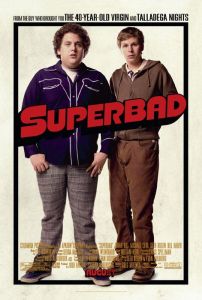 Seth Rogen makes me feel like a slacker. I’m two months older than him, but already he’s broken out as a comic actor on great-but-cancelled shows like Freaks and Geeks and Undeclared, and now he has risen to headlining star thanks to the runaway success of Knocked Up. Now here comes Superbad, a comedy he’s co-written with his friend Evan Goldberg, and I haven’t even gotten one movie off the ground or, for that matter, a starring role in any TV series, canceled or on the air. Oh well. At least Rogen’s consistent attachment to quality projects makes me a happy, if marginally envious, moviegoer.
Seth (Jonah Hill) and Evan (Michael Cera) are high school seniors looking to score with the ladies. Their nerdy friend Fogell (Chistopher Mintz-Plasse) has a scheme to get himself a fake ID, and the trio seizes upon this opportunity to become important figures in the teen circuit. With the promise of the fake ID, Jules (Emma Stone) has asked Seth to provide all the alcohol for a house part that she’s throwing that night. Not only that, Evan’s unrequited crush Becca (Martha MacIsaac) is going to be there. Seth and Evan figure that this party will be the best chance they have ever had to get lucky thanks to the miracles of what some would call, “liquid panty remover.” They just have to get the booze first. Fogell’s ID lists him as simply as McLovin. He is set back when his attempt to purchase alcohol is interrupted by a robber. He’s interviewed by Officers Michaels (Rogen) and Slater (Bill Hader) who take a shine to McLovin (“It sounds like a sexy hamburger”). The threesome spend a madcap night drinking, busting crime, sharing worldly wisdom, and running away at the faintest sign of other police officers.
 First off, Superbad is raucously funny. It’s plenty profane and has several memorable moments, like Seth’s imaginative scenarios for buying alcohol and a dance that goes in a very unexpected direction. The humor is timeless and built around the nervous interaction between the sexes; there are very few jokes that reference pop culture or dependent on a specific context. I imagine what makes Superbad hilarious will still make it hilarious in 20 years to a new audience that can relate to the same trials and tribulations of teen life, though perhaps at that point we will be replaced by robots.
What separates Superbad from other offensive sex comedies is that it’s really a story about male friendship. I don’t mean in the tacky, Hollywood vein of working together for a common goal, which is commonly to lose one’s virginity. Superbad is another entry into the Judd Apatow (40-Year Old Virgin, Knocked Up) school of comedy that professes that a comedy should be character-based and that those characters should be painfully human. This is no mere genre movie. Underneath all the boobs and booze discussion is the pain and worry of a long-standing friendship being able to survive. Seth and Evan have been close friends all of their lives, but many good friends have grown apart in time thanks to their lives moving in different places. There’s unspoken tension between the two of them and Seth is concerned he’s about to be abandoned by the person that means the most to him. Many films touch upon the indelible companionship between men but few can accurately articulate the authentic love that can foster bonds of friendship. Superbad explores the exploits of real friendship, and while it’s chock full of funny the film also has its fair share of moderately touching moments. You really do care about the characters and want them to triumph. Fogell’s ascension to becoming a confidant, cool lady’s man is one of the summer’s true pleasures. Apatow’s fingerprints are all over this, and that is a glorious thing.
But this isn’t some phony Porky’s-style high school sex comedy with male fantasy set pieces and lots of dunderheaded beauties prone to bouts of frequent nakedness. Superbad is a relatively realistic portrayal of high school life in the world of movies. This isn’t a school ordered by cliques of entrenched stereotypes like the jocks, the Goths, etc. In fact, I don’t think Superbad makes any social distinction between the students.
 Superbad is a celebration of the glories and anxieties of the male members’ member. Even for a teen sex comedy, the film is very phallus-centric, complete with a hilarious anecdote about a “treasure chest of dick drawings.” It seems Seth, at a young age, was stricken with the unique compulsion to draw a phalanx of penises. The anecdote is quite unexpected and funny and underscores how often the penis prevails in the minds of young men. The boys discuss at length the life and times of the penis, especially how women can compliment this. The constant dick-chat may get old after a while for most of the female audience in attendance (a.k.a. those without), and I can’t exactly blame them, but Superbad does convey, in a convincing manner, how much teenagers think about sex (“You know how many foods are shaped like dicks? The best kind”). Some have argued that there’s an undercurrent of misogyny with Superbad, but I feel like those detractors are missing the deeper point. These guys are totally terrified of women and go through one wild night just to avoid actually confessing their feelings to the objects of their affection. These guys don’t hate women, they’re just frightened and utterly bewildered by them, and so they rely on what pop culture and their peers have taught them is the way to a woman’s heart: booze.
The movie is taken to an extra level of excellence thanks primarily to the outstanding comedic performances by its cast. Cera was a star of brilliant understatement on TV’s Arrested Development, and when it comes to portraying awkwardness, Cera is king. The gangly teen is a textbook example on high school awkwardness; he feels uncomfortable in his own skin. He seems antsy to leave most scenes. His self-effacing smile, wide-eyed gawk, and nattering stutter are spot-on signals of clumsy, confused, and embarrassed teen life. Cera is a master with impeccably punctuated line deliveries. The kid could make any line funny by flawlessly placing a pause in the right place. Arrested Development was a great showcase for Cera’s comedic chops, and now Superbad is a juicy platform for the funniest straight man on the planet (and he’s only 18 years old).
 Hill has been a supporting player in previous Apatow productions, but this is his first major role. Hill is the loud, boorish, vulgar, and more outlandish half of the duo. When he gets worked into a frothy rage you can practically feel his indignant teen spittle. What makes Hill special is that, in an instant, he can go from foul-mouthed cretin to a vulnerable buffoon. In the end, when the police bust a party, Seth runs on instinct and his instinct is to save his friend. It’s the versatility of Hill that allows Superbad to channel the sweet, gooey center behind all the sex-obsessed hijinks.
Not all the different elements of Superbad seem to fit together. The cops subplot is played very broad and relies on a lot of physical comedy; it feels at odds with the genuine teen comedy that is the heart and soul of the movie. The subplot is indeed full of laughs and it turns McLovin into a legendary teen character, but it feels like a separate movie, albeit an interesting one. For a male-dominated comedy, the female roles are pretty sparse but even those take heed not to slip into empty stereotypes. Becca and Jules are portrayed as sensible and approachable.
In short, Superbad is super good, and it’s thanks to relatable characters, a sweet sensibility, plenty of raunch, and some excellent performances. Apatow has opened the 2007 summer with a winner and now he closes it with another one.
Nate’s Grade: B+


 nathanzoebl
You must be logged in to post a comment.