Blog Archives
The French Dispatch (2021)
 Wes Anderson’s latest quirk-fest is his usual cavalcade of straight-laced absurdity, exquisite dollhouse-level production design, famous faces popping in for droll deadpans, and the overall air of not fully getting it. The French Dispatch is structured like you’re watching the issue of a news magazine come to visual life, meaning that the two-hour movie is comprised of mainly three lengthy vignettes and a couple of short asides. This narrative decision limits the emotional involvement and I found myself growing restless with each of the three segments. I was amused throughout but each felt like a short film that had been pushed beyond its breaking point. Perhaps that is Anderson’s wry, subtle point considering the entire journalistic voice of the movie feels like somebody made a movie in the style of one of those esoteric, supposedly “funny” New Yorker cartoons. It’s occasionally so arch and droll that it feels too removed from actual comedy. This is not the most accessible Anderson movie for a newbie; it’s very bourgeois in the kinds of people it follows, the stories it pursues, and the intellectual and political conflicts it demonstrates. The first and best segment follows Tilda Swinton discussing a heralded but imprisoned experimental artist (Benicio del Toro) who is dealing with the pressure to produce. The second segment follows Frances McDormand as she investigates a Parisian student union revolting against the ignorant powers that be. The third segment follows Jeffrey Wright recounting an assignment where he investigated a master police chef (not “chief”) and gets in the middle of a wacky hostage negotiation. Each of them has the requisite charm and random asides we’ve come to expect from Anderson, including a leotard-wearing strongman that is called upon by the police to help during the hostage crisis, but it felt more like a collection of overlong short films than a cohesive whole. If you’re already a fan, by all means, step into The French Dispatch. If you’re new to the idiosyncratic world of indie film’s most precise curator, then I’d advise starting with a more digestible and earlier Anderson entry. I enjoyed myself during stretches, was getting frustrated during other stretches, and I hope Anderson focuses more on the big picture of his next picture.
Nate’s Grade: C+
Share this:

Birdman or (The Unexpected Virtue of Ignorance) (2014)
 Expecting a comedy from Mexican director Alejandro Gonzalez Inarritu would have preposterous. The man was known for his cinema verite of suffering, notably Babel, 21 Grams, Biutiful, and his best film, Amores Perros, roughly translated to Love’s a Bitch. Perhaps there isn’t much of a shift going from tragedy to comedy. Inarritu’s newest film, Birdman or (The Unexpected Virtue of Ignorance), has been wowing critics and audiences alike, building deafening awards buzz for its cast, Iarritu, and the superb cinematography, but will it fly with mainstream audiences? This may be one of the weirdest Oscar front-runners in some time.
Riggan (Michael Keaton) is an actor best known for playing the superhero Birdman in the early 1990s and walking away from the franchise. He’s still haunted by that role (sometimes literally) and struggling to prove himself as an artist. He’s brokered all his money into directing, adapting, and starring in a theatrical version of Raymond Carver’s short story, “What We Talk About When We Talk About Love.” The show is in previews and about to open its run on Broadway but it’s already got a rash of problems. The leading man needs to be replaced immediately. The supposed savior is famous actor Mike (Edward Norton), an undeniably talented but temperamental actor who pushes buttons to find some fleeting semblance of “truth.” Mike’s girlfriend, Lesley (Naomi Watts), is growing tired of his antics and desperate for her own long-delayed big break. Laura (Andrea Riseborough) is Riggan’s “girlfriend” and co-star and may be pregnant. Sam (Emma Stone), Riggan’s personal assistant and also his detached daughter, is fresh from rehab, and spiteful against her neglectful dad. Toss in Riggan’s best friend/manager/play producer (Zach Galifianakis), Riggan’s ex-wife (Amy Ryan), and a feared theater critic (Lindsay Duncan) who is determined to kill Riggan’s show to send a message to the rest of Hollywood polluting the integrity of the theat-tah. Oh, and throughout all this, Riggan hears an ominous voice that alternating encourages him and humiliates him.
 It’s an industry satire, a bizarre comedy, a father/daughter drama, an examination on identity and the complicated pulls of affection and admiration, and a stunning virtuoso technical achievement. As a movie, Birdman is hard to pin down or categorize. It’s a movie that you definitely need to experience on your own rather than have described (don’t stop reading, come back…), and that is a reason enough to see the film, a rare aspect among modern movies. It’s an artistically offbeat movie and yet it ultimately is about one has been actor looking back on his career and coming to terms with his own impact with pop-culture, art, and his family. It’s about a man struggling to find his place in his own life, beset at all odds by doubters and traitors and obstructionists. The refreshing aspect about Riggan is that he’s a has-been but not a sad sack; he’s fighting from the beginning, sometimes pathetically and sometimes in vain, but the man is always fighting to regain his dignity, to reclaim his life’s narrative, and to fight for his legacy. Riggan, after all, set the stage for the modern superhero industry that currently dominates Hollywood bean counters. He was too just soon, and the parallels with Keaton (Batman) are superficially interesting but there’s more of an original character here than a reflection of the actor playing him. He’s neurotic, egotistical, hungry, and fighting for respect, like many actors, and the film flirts with the façades people inhabit. Many of the characters are emotionally needy, desperate for validation wherever they can find it.
Another strength of the film is that it finds a moment for each of its talented ensemble players to shine, chief among them Keaton. The actor hasn’t had a showcase like this in some time and he is a terrific guiding force to hold the entire story together. Whether it’s marching in his tighty whities or working through his complicated degrees of neuroses, Keaton is alive in a way that is electrifying. We see several highs and lows over the course of two hours, some moments making us cheer on Riggan and others making us wince, but he comes across more like a person than just the butt of a joke. It’s also just fun to watch him adopt different acting styles when he steps on stage, including one early on where he’s purposely too stilted. It’s so comforting to watch Norton (The Grand Budapest Hotel) get to be great again, not just good but great. Early on, you see the appeal of Mike, his allure, and Norton keeps pushing the audience, as well as the characters, back and forth with his wealth of talent. Stone (Amazing Spider-Man 2) spends most of the film as the sulky daughter but she gets to uncork one awesomely angry monologue against her loser dad. The thawing father/daughter relationship ends up supplying the film with its only degree of heart. Watts (The Impossible) is comically frazzled for the majority of her time but gets a memorable character beat where she breaks down in tears, realizing her dream of “making it” might never materialize. Riseborough (Oblivion) also has moments where he sadness and vulnerability cut deep. The supporting characters aren’t terribly deep but they all have a moment to standout.
It’s a decidedly offbeat film that dips into the surreal though never dives completely inside. The movie is rather ambiguous about whether or not the fantastical flourishes are a result of Riggan being mentally ill, or at the least overtaxed with stress. Is there really a Birdman or is it a voice in his head, a manifestation of his ego or a ghost to remind him of the past when he was a star? Does Riggan really have the powers he seems to believe he does, including the ability to make objects move with his mind? Innaritu playfully keeps the audience guessing, treating the bizarre in an offhand manner reminiscent of magic realism. The bizarre embellishments blend smoothly with the film’s darkly comic tone. It’s a funny movie but one that you laugh at between clenched teeth.
 Is it all the unblinking camerawork a gimmick? I don’t think so. While the story can engage with its weirdness and surreal unpredictability, the long tracking shots bring a heightened reality to the unreal, they bring a larger sense of awe to the proceedings, watching to see the magic trick pulled off to the end. If anything, it’s an extra thrill to the script and greatly compounds the artistic audaciousness of the film, but I think it also channels the live-wire energy of theater, of watching actors have to walk that tightrope of performance and blocking, weaving together to pull off the ensemble. It makes the film medium feel more like live theater. Thematically I think the style also connects to the anxious mentality of Riggan. In the end, I don’t truly care that much whether it’s a gimmick or not (though I vote it is not) because the camerawork is rapturous. Made to resemble an entire two-hour tracking shot, it is a joyous thrill to watch these technical wizards do their thing, to watch the best in the business perform a visual magic trick over the duration of two hours. Even if you don’t care for the overall movie you can at least be entertained by the imaginative and thoroughly accomplished cinematography by Emmanuel Lubezki, fresh from his Oscar for Gravity and who should be clearing shelf space for the next bushel of awards he’s destined to win with this film. It’s an intoxicating experience to behold, though the film is structured into 10-minute or so chunks for feasibility. If you want to watch a real cinematic magic trick, check out the film Russian Ark, which is an entire movie, performed in one uncut single tracking shot.
I’m still wrestling with the debate over whether Birdman is an artistically ambitious romp or a truly great movie. Much like the characters in the film, I’m wrestling with whether I have confused my admiration with adoration. It’s a movie that I feel compelled to see a second time, and maybe a third, just to get a handle on my overall thoughts and feelings. That may be a sign that Birdman is a film for the ages, or maybe it’s just a sign that it’s not as approachable and denied a higher level of greatness by its obtuseness. Inarritu’s surreal showbiz satire is plenty entertaining, darkly comic, and a technical marvel thanks to the brilliant camerawork. The percussion-heavy musical score is another clever choice, naturally adding more urgency and anxiety to the proceedings. Birdman is a strange and beguiling movie, one that deserves to be seen, needs to be experienced, and stays with you rolling around in your brain. That sounds like a winner to me.
Nate’s Grade: A
Share this:

The Bourne Legacy (2012)
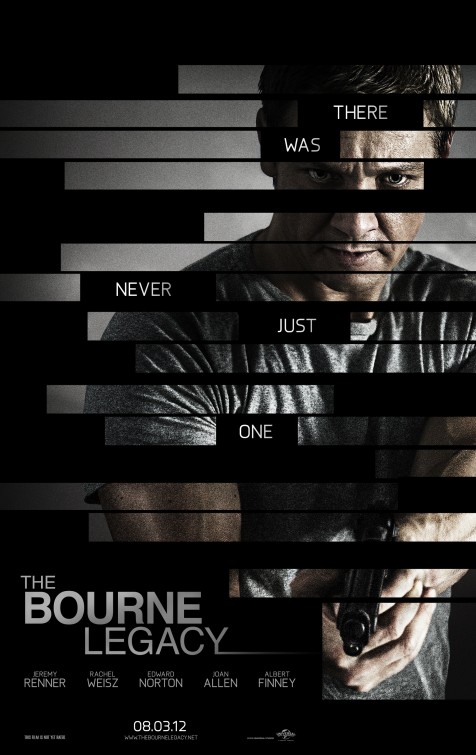 The Jason Bourne spy series has been a financial wellspring for Universal studios, so when Matt Damon and director Paul Greengrass (United 93) decided they had enough spy capers and hijinks, you can understand the studio’s concern. They elevated Tony Gilroy, a writer from the beginning of the series, to director. Gilroy has done some well-received directing gigs of his own now (Michael Clayton), so his ascent made sense from a continuity standpoint. I did wonder how much liberty the studio was going to give him, whether he was going to be boxed in to a style that had worked for the series. I never knew I should have had bigger misgivings, namely that The Bourne Legacy would ransom its conclusion and force the audience to make Legacy a hit.
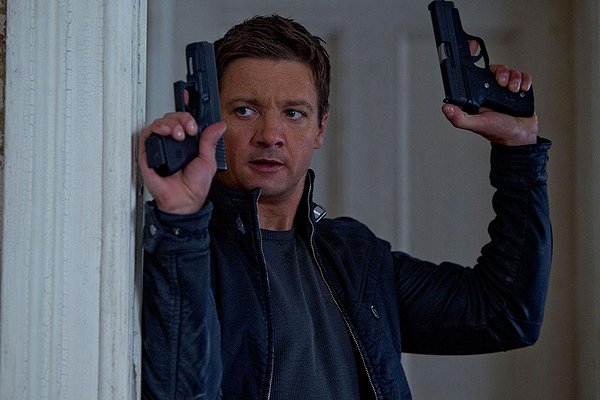
Apparently Jason Bourne wasn’t alone. The C.I.A. has a team of six different super agents, each undergoing rigorous training and chemical alterations to their DNA via a series of daily pills. Aaron Cross (Jeremy Renner) is out in the Alaskan wilderness when the C.I.A., led by Col. Eric Byer (Ed Norton) and Adm. Mark Turso (Stacy Keach), burn all their agents. They plan on starting over and that means eliminating all evidence of the spy program that gave birth to Bourne. That means Cross has to go as well. That also means the chemists and scientists working on the program must also be silenced permanently, and Dr. Marta Shearing (Rachel Weisz) narrowly escapes a workplace shooting. Cross seeks her out for her medical expertise. They both have a common enemy that wants them dead. Together, the duo heads over to Manila where Shearing’s company manufactures the super meds and so Cross can become a permanent super agent.
 What the hell did I just watch? I know it’s labeled The Bourne Legacy. That part I get. What I don’t understand is that the filmmakers are trying to extort the viewing public into granting a Legacy sequel. Let’s cut to the chase. This movie has no ending. I don’t mean a bad ending. This movie is completely absent an ending. Not just an ending but also a third act. It’s like the filmmakers lopped off the third act and said, “If you want to see where this story ends up, you better get us a sequel.” There is no resolution for ANY STORYLINE in the entire movie. None. The good guys are still scrambling, figuring out how to blow the big bad conspiracy. The big bad conspiracy is still alive and kicking. The patsy for their wicked shenanigans is still the patsy. There is nothing that can be construed as an ending. At least the Damon Bourne movies each had a beginning, middle, and end and tied up their film plots. Sure the characters carried over and there were some larger, overarching storylines, but at least those movies felt complete. The Bourne Legacy is badly incomplete, a gaping void of a third act, and a blunder that makes me question the sanity of the filmmakers. How could you make a big budget summer action movie and not provide any semblance of closure? When the Moby tune kicked in on the soundtrack, I sat stunned, pinned to my seat in disbelief. “No, it can’t be over. They couldn’t possibly just end things here.” Oh, and they do. So enjoy 2/3 of a movie, folks.
With the anticlimactic end in mind, I now understand why the first hour felt so draggy. It’s because they had to fill out a two-hour running time. Especially for the Bourne franchise, the first hour seems to really be paced lackadaisically. For an action movie, it sure takes its time to get going. I wouldn’t have minded if I felt like we were setting up something exciting, but really the story is about a super agent who just wants to get his meds. He travels across the U.S. and the world so he can get his pills, and then he does, and then the movie abruptly ends. I’m simplifying matters in a crass way, I admit, but doesn’t this storyline just feel a tad slight? Legacy also starts to feel like a retread when it comes to its plot mechanics. The C.I.A. is burning all their super spy agents through suicide pills. They are destroying everything before Congressional oversight can reveal their true dastardly deeds. But then we need an antagonist, right? So the government goons reveal they have a SECOND even more super secret program to train super assassins/spies (“It’s Treadstone without the inconsistencies”). How far are they going to take this? Is there going to be a third super duper ultra secret level of killer spies? It’s repeating the same steps the franchise has already taken, the expert spy vs. spy clashes, but now it’s starting to get silly in a way the franchise had previously avoided.
 The action sequences are serviceable but they’re not any better than what the franchise has produced before. Cross has a few nifty escapes but nothing that reminds you of Jason Bourne’s sheer ingenuity. What other man can take down bad guys simply with a rolled up magazine or a book? Aaron Cross just can’t compete with that. The final motorcycle chase is nice but it just seems to be repeating the same danger with little variation. The best action sequence is actually a bit macabre. It involves a workplace shootout. To even call it an action sequence is a bit of a disservice since it’s actually a tense and horrific scenario that is coming eerily all too familiar in the news. Weisz’s character has to hide while her co-worker methodically guns down his fellow lab workers. Oh, and he also took off the door handles, making it dire for help from the outside to get inside. It’s a horrific sequence that’s played out to stomach-knotting levels of tension, as the dread slowly mounts and the pessimistic inevitability looms. Now, obviously Weisz was going to survive, as we know this, but the sequence still resonates with real, primal terror.
So what does The Bourne Legacy have going for it in its favor? Well the duo of Renner and Weisz is a pretty good pairing. Renner (The Hurt Locker) has been rolled out as the next thinking man’s action hero, and he finds interesting depth to his spy character in a rather routine plot. But he’s even better when he’s onscreen with Weisz (The Constant Gardener). There’s plenty of shouting matches and intensity but they have workable chemistry and Weisz’s character gets to be an essential part of the spy heroics rather than a tagalong. I cannot fault the actors for the film’s flaws.
I understand why the Universal suits felt like they needed to pump new blood into their lucrative Bourne franchise. After a while, an amnesiac super spy is going to hit a breaking point; he’s going to run out of essential memories to recall (Bourne 5: where Jason Bourne gets back the memory that he does not like Indian food). I like Renner and Weisz. I even like Tony Gilroy as a director. What I do not like is only getting 2/3 of a movie. Whose bright idea was it to just lop off the third act and provide no resolution? The ending is so unbelievably jarring, so staggeringly incompetent, that I have to dock this movie major points. I can’t say the ending out and out ruins the film considering I was only marginally liking it beforehand. The Bourne Legacy is proof that sometimes imitation is not the best substitute for ingenuity. Gilroy is no Greengrass. Cross is no Bourne. Legacy is no complete movie.
Nate’s Grade: C+


 nathanzoebl
You must be logged in to post a comment.