Blog Archives
Ninja Assassin (2009)
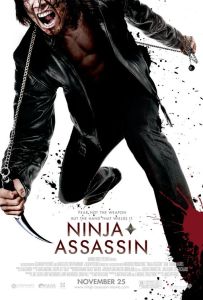 I never would have fathomed that a movie with both “ninja” and “assassin” in its title would barely hold my interest. This is a movie I got up and did the dishes through. Over-the-top never felt so boring, and perhaps it comes down to the flimsiest of stories strung together to connect the various ninja fights. It really does the bare minimum narrative-wise to get to the next opportunity for bloodletting, and oh what bloodletting! This is an extremely bloody movie but its power is undone because the violence is too stylized. Blood sprays like geysers and every slash of the flesh unleashes a balletic dance of painterly, soupy blood. The movie might work as disposable trash if only the action sequences were exciting. This isn’t a ninja movie but some half-assed video game. These aren’t Bruce Lee Ninjas, these ninjas can literally vanish into thin air before your eyes and they blend into the shadows. They are supernatural creatures that defy our traditional notions of what defines a ninja. This ain’t it. The characters all take such brutal beatings, and they spill tanker truckloads of blood, that it’s a wonder they can even stand let alone fight. There are a fee snazzy fight sequences but only thanks to choice in geography. The choppy editing only makes matters worse. I expected much more from the director of V for Vendetta. Ninja Assassin is just an un-engaging, hyper violent cartoon with a dimwitted story and little reason to care. The action isn’t even that good because the editing and lighting conspire to make sure you won’t be able to comprehend what’s going on. The best part of this entire damn stupid movie is the animated segment at the start of the closing credits. So have fun washing dishes until then, folks.
Nate’s Grade: C-
Share this:

Law Abiding Citizen (2009)
 Taking a few lessons from the grisly Saw franchise, this revenge thriller follows Clyde (Gerard Butler) track and kill the men responsible for murdering his wife and child. Except that pretty gets resolved in 15 minutes. The rest of the movie is Clyde’s misguided, morally queasy assault on the justice system; the judges, lawyers, police officers that keep a dying system going, letting guilty murderers walk. Clyde is specifically targeting the prosecutor (Jaime Foxx) that made a plea bargain instead of risking his conviction percentage at a trial. This is a violent vision that wants to rewrite our very Constitution, questioning giving accused murders the same considerations as soccer moms. The movie can come across as a conservative, Death Wish-style fantasy against the judicial system and those pesky civil liberties afforded to everyone. While shrouded in the guise of being a bloody thriller, the movie’s idea of moral ambiguity is pretty thin. Its ethical arguments don’t stand a second line of questioning. Sure, director F. Gary Gray (The Italian Job) can put together an exciting and tense sequence, and the film is filled with surprise, and Butler arguably gives his best performance since 300, but while I was entertained I was also offended at being expected to cheer every time Clyde knocked off another innocent citizen.
Nate’s Grade: C
Share this:

A Prophet (2009)
 France’s entry for the Best Foreign Film Oscar is like a much more realistic version of HBO’s soapy prison drama, Oz, for better and worse. We follow a young prisoner who gets caught up in the power dynamics of the many warring factions within the pokey. This is a dense, slow-burning drama that hooks you early but then seems to stall. Early on, our lead character is given an ultimatum by a Corsican boss: murder an informant held in the jail or die himself. It’s a turbulent moral struggle with definite intrigue as he considers his dwindling options of escape and practices a routine to slit a man’s throat to save his own. After that A Prophet introduces a stream of characters inside and out of prison and it gets more complicated. The film values realism but it means that the characters aren’t as colorful, and therefore memorable or interesting, as they would be in similar crime capers. It makes it hard to remember who is who and why exactly they’re important. The story follows the steady ascent of our lead from nascent to criminal boss but it all plays out as a series of small power plays with little grand gestures. This is not Scarface at all. There’s little action, scant suspense, but mostly the movie deals with the minutia of climbing the criminal underworld. It’s like the filmmakers want to impress you with the homework they did in sociology. A bland lead and an overabundance of procedural details blunts the film’s entertainment quality. I appreciate gritty realism but after a while I’d sacrifice some of that realism for some more engaging characters.
Nate’s Grade: B+
Share this:

Bad Lieutenant: Port of Call New Orleans (2009)
 This is a crazy movie. It is not weird, it is not bizarre; it is not silly. Werner Herzog’s whacked-out movie is a remake of a 1992 movie that wasn’t that good to begin with. This certifiably crazy movie mostly involves Nicolas Cage as a corrupt cop playing all sides and snorting everything that isn’t bolted down in the Big Easy up his nose. For a stretch during the middle, he starts to sound like Jimmy Stewart with lockjaw. The central murder investigation plot is pretty much an afterthought in an environment like this. You want the crazy, and with Cage and Herzog, it is in no short supply. There’s Cage threatening an elderly woman at gunpoint, crawling reptile POV shots, a man’s “soul” break-dancing after the man lies dead, and neon iguanas that may exist only in Cage’s drugged-out mind. The film has been described as a trippy parody of standard cops-and-robbers fare, or as a seriously demented anti-drug message, but I think the best description is just “crazy-ass movie.” It has moments that make you do nothing but shake your head and laugh, like when Cage is about to hit rock bottom and EVERY case/storyline gets solved in a matter of seconds to his bemused disbelief. The comedy is straight-faced but it is definitely there. Cage harnesses his eccentricities and delivers an insanely entertaining performance that reconfirms that there is indeed an actor underneath his Hollywood veneer. He is compulsively enjoyable and the movie is compulsively watchable, every crazy freaking second of it. Iguanas!
Nate’s Grade: B
Share this:

Dear John (2010)
 Best-selling author Nicholas Sparks is probably a perfectly reasonable human being. I’m sure he’s great at parties and that people love him. He may even have a dynamite recipe for sugar cookies. But I don’t know what happened to Sparks to turn him into the romance genre’s angel of death. His novels have followed a familiar practice of big Third Act deaths that usually deny readers their cherished happy endings. Is the motive to push people to make the most of our preciously little time spent on Earth? Is Sparks just sadistic and has found the secret to eternal life — the tears of millions of housewives and teenager girls. Whatever his rationale, another commonality for Sparks is that the film adaptations of his books are pretty corny and dreadful. A Walk to Remember, Nights in Rodanthe, Message in a Bottle; all about romance ultimately denied, none coming close to watchable. Dear John can at least be called watchable; however, watching should be limited to the confines of your living room TV when there’s nothing else on.
It’s the spring of 2001, and John Tyree (Channing Tatum) is enjoying his two-week leave from the military. He’s out surfing the fine North Carolina beaches when he rescues the handbag of Savannah (Amanda Seyfried) from being washed away. They two of them casually chat and soon those chats lead to barbecue invitations, parental visits, and kisses in the rain (a romantic movie tradition). Savannah takes an interest in John’s eccentric father (Richard Jenkins) because she recognizes his condition as autism. She’s been helping to watch her neighbor’s autistic child. Savannah would like to start her own horse camp for the autistic (sounds like an insurance nightmare). Life seems so full of promise and John promises to be back as soon as his military commitment expires in six months. Then 9/11 happens. John re-enlists and extends his tour another two years. This places great strain on his relationship with Savannah, but they write each other countless letters that manage to find John no matter what far-flung village he’s stationed at. Can their love exists on a series of hand-written letters? Well, look no further than the classic implications from the film’s title.
 Dear John goes through all the traditional Nicholas Sparks waterworks trademarks: young love leads to yearning, which leads to heartbreak, which leads to more yearning, which then inevitably leads toward one of the leads dying and everyone learning some sort of shallow profound meaning about life, blah blah blah. There are plenty of heightened melodramatic elements thrown into a fairly traditional, unspectacular love story, but all potent potential moments of drama feel underwhelming pretty much because the audience doesn’t care. John and Savannah are perfectly nice people and their love has that hopeful bloom, but their relationship is no more involving than watching a pretend couple in a commercial for greeting cards or life insurance. These people are vanilla. It makes it astounding, then, that such highly charged elements like cancer autism, and 9/11 fail to leave any impact. Dear John confuses listing dramatic events as drama itself. The dramatic stakes feel entirely too mellow and the film generally has a detached feeling, like it’s purposely distanced from the material for fear of getting too involved. This is a relationship movie that has its own commitment issues.
The military angle is respectfully explored, though not in much depth. John is torn apart by the pull of returning to his beloved but also of serving his country and, more personally, keeping his band of brothers in arms together. It’s a complicated scenario but the military commitment is another item in a list that should grab your interest but fail to do so. 9/11 isn’t given any deeper consideration other than the fact that it serves as a roadblock between our two lovebirds. If you want to see a more nuanced, complicated, and empathetic view of today’s overburdened military, check out the movie Stop-Loss, which also stars Tatum.
 The film drops any facade of being a romantic drama about midway through when Seyfried gets completely sidelined. She’s less a character and more an agreeable plot device; she’s self-aware and kind and knowing and receptive yet also naive. This makes her sudden character shift rather jarring, which seemingly paints Savannah as extremely co-dependant. Dear John then transforms into a serviceable father/son drama. There are some nice and moving moments between John and his father; this should have been the real focal point of the movie. Jenkins acts circles around everybody in this movie. It’s wonderful seeing a grown-up in these kind of movies show the kids ho this acting thing is done. Tatum actually might become a pretty good actor. He convincingly plays the more emotional moments well. He may very well prove to be the Patrick Swayze of his generation. Tatum can dance (Step Up), make the girls cry, and also handle some rock-socking action (G.I. Joe, Fighting, most of Tatum’s other movies). I think there’s an actor buried beneath that daunting physique waiting to blossom. Don’t disappoint me, Channing.
Dear John is a formulaic romance trained to seek pre-programmed audience responses (“Now you will laugh. Now you will cry. Now you will cry again. Now you will once again continue to cry…”). Lasse Halstrom (What’s Eating Gilbert Grape, Cassanova) directed this movie but you’d never be able to notice. I don’t want to be too harsh on the film because the acting is pleasant the story isn’t repulsive and does have some good moments, but mostly the movie comes across as bland and remote. The romance seems absent a beating heart to keep things moving. It’s all too lifeless. The character of Savannah best summarizes Dear John as a whole: mild pretense of wisdom, pretty to look at, genial, but fairly bland and difficult to convince is worth your valuable time.
Nate’s Grade: C
Share this:

The White Ribbon (2009)
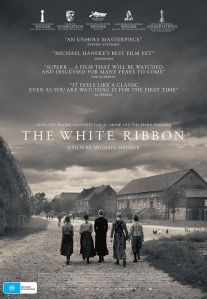 After all the awards and hype, I’m left fairly unmoved. I think I’m just not a fan of the director; I disliked Funny Games, disliked The Piano Teacher, and think Cache is vastly overrated. Michael Haneke is just not for me, and The White Ribbon is further proof of this fact. This is two and half-hours of incidents. Supposedly, since its victory at the 2009 Cannes Film Festival, this movie was dubbed as a case study examining the beginnings of antisemitism as a small German town undergoes a series of mysterious violent assaults and vandalism. I don’t know how in the world this explores any sort of psychological group think to later clarify Germany’s willingness to accept Hitler’s demands. All this movie does is show yet another example of teenagers rebelling. In typical Haneke fashion, characters can be unbelievably cruel to one another at the flick of a switch. Nothing really adds up and the pacing is so mind-numbingly deliberate to showcase the world of pre-World War I Germany. So when people leave the room we watch them walk off screen, hear their off screen noises, then they return and go off screen again and we can repeat the same jolly waiting game. I understand the artistic thought behind it, but I’d be much more forgiving if Haneke had developed a story and some characters worthy to wait for. This is a plodding and conceited exercise that reveals next to nothing about the human condition for cruelty, because, chiefly, you don’t really believe that these people exist nor do you care.
Nate’s Grade: C
Share this:

Edge of Darkness (2010)
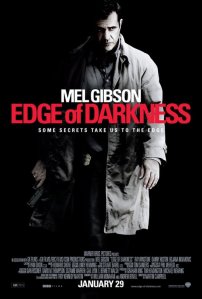 While I was watching Edge of Darkness, a conspiracy thriller that hearkens the return to acting for Mel Gibson, one thing kept sticking out to me, and no, it wasn?t the protracted ear-splitting “Bahstun” accents. One character makes comment about the current lowly state of affairs and says, “Everything’s illegal in Massachusetts.” That perked my ears, and then a second character says the exact same thing later in the movie, like it’s this flick’s summary, “It’s Chinatown.” What exactly does that mean specifically about Massachusetts? That the Bay State is somehow a nanny state, dictating behavior? Or is this a resigned admittance toward the futility of competing against the long arm of the law? I’ll tell you something that isn’t illegal in Massachusetts — gay marriage. They got a leg up on that one. This is the kind of internal conversation I had with myself while Gibson unraveled a fairly ho-hum conspiracy-of-the-week plot.
Detective Thomas Craven (Gibson) is a decorated Boston lawman. His grown daughter, Emma (Bojana Novakovic), is visiting from her job when she starts throwing up blood. She needs to tell her father some important secrets about her workplace. But as the two are about to leave for the hospital, a man cries out “Craven,” and follows it with a thunderous shotgun blast. Emma gets the full force and dies in her father?s arms. The media assumes Thomas was the target and the gunman had an old score to settle. However, the more Craven investigates the more convinced he is that his daughter was the real target. He looks into Emma’s connection to some dead environmental activists caught breaking into her place of work. The head of the company (Danny Huston) has plenty of important defense contracts and suspicious behavior. As Craven tracks down the truth he is assisted by the mystifying Mr. Jedburgh (Ray Winstone), a man normally hired to cover up any messy loose ends of governmental business. Jedburgh decides to work with Craven instead of against him, and the two men must fight for their lives.
 The real reason to see this fairly pedestrian police thriller is because of Gibson. It’s been a long eight years since his last onscreen role, and I must say I’ve forgotten about what a great actor the man can be. When this guy gets mad, you can practically feel the intensity. Gibson is terrific at playing a man with simmering emotions that often get the better of him. The lines and wrinkles give him a new canvas to play with, letting his age help tell the story of his character. Gibson seems to have this inner insanity to him, an admirable bent of crazy manic anarchic energy (I highly suggest checking out some of the Jimmy Kimmel Show shorts he’s been apart of). It makes him hard to ignore. He peppers in what he can with his character, a long-standing member of the law thirsting for answers and vengeance. What’s enjoyable is that he doesn’t go about knocking down every door to make people pay. Craven plays each interrogation differently depending upon his prey; sometimes he uses a soft touch and sometimes he opts for the tried-and-true punch to the nose. It’s little touches like this that bring out details in the character, and Gibson knows how to exploit them for maximum drama. Does anyone play instantly bereaved better than this man? He has a real knack for nailing scenes where a character is confronted with the sudden death of a loved one. His face is full of tics, his eyes glass over, it’s like he has lost all control and given over to the amassing and conflicting emotions. This clearly isn’t one of Gibson’s best performances, but after eight yeas of absence I’m more than willing to give the man a little latitude. An angry and bereaved Gibson is a Gibson I can enjoy watching on the big screen no matter how rudimentary the caper.
Edge of Darkness belongs to Gibson, but Winstone pretty much comes out of nowhere and hijacks the movie. Every time his character leaves the scene you’re anxiously awaiting his return. He’s an intriguing character, which makes me wonder why he’s gotten such a languished subplot. He could have been better involved in the story but the script keeps him to the narrative’s edges until the climax. Though a bit hard to understand thanks to a severe case of the mumbles, Winstone is by far the most interesting character in the movie. He’s an expert on fixing problems who tires of the long hours of shadowy, dastardly work. This is surely a character worthy of his own tale, or at least equal placement in the narrative, but instead Jedburgh functions as a sly informant when he should be running the show.
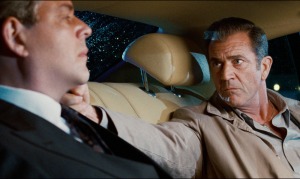 The script pretty much treads water. It’s not anything that’s particularly bad, but this story is pretty much content to stick with the basics. This isn’t a dumb movie per se, thanks to screenwriters William Monahan (The Departed) and Andrew Bovell (Lantana) adapting from the acclaimed BBC mini-series. Those guys know something about a crackling crime thriller, which this is not. The lizardly Huston couldn’t be any more obvious of a villain, but he’s not alone. The burly henchmen drive around in dark, tinted SUVs that seem to say that somebody got their nefarious goon driver’s license. This is the kind of movie that plays its hand early, telegraphing future revelations and double-crosses. When we’re introduced to a character right after Emma’s death, and the camera takes a deliberate amount of time hanging on that character’s pained expression, obviously we’ve been informed that this person is somehow connected. No prolonged reaction shot is ever meaningless in an action thriller. Every time Craven ties to gain information from a person of interest, they say, “I can’t talk. They’ll kill me,” and then that person is promptly killed as prophesied. You basically expect something “shocking” to happen every time a person leaves Craven’s presence (FYI: check both ways before crossing the street).
There’s a really engaging and politically active whistler blower story somewhere in here that could have used better attention. It seems the line between whistle-blower and activist is a thin one, and Craven must assemble enough evidence to make sure that his case cannot be dismissed as a kook. It’s an interesting dilemma, trying to assemble a compelling case that will hold up on objective scrutiny, that can’t be tossed out. That’s an interesting predicament considering the many eyes and ears of a large, legally autonomous corporate entity. Alas, that movie is not Edge of Darkness.
Gibson’s return to movie acting is definitely welcomed, even if it’s something as disposable as this. Edge of Darkness is a by-the-book conspiracy thriller that offers glimpses of something superior that could have been worked out. More attention could have been given to Winstone’s character. The whistleblower aspect could have been heightened and clarified. There could have been a bit more action and a little less blood. The bad guy could have been less obvious from the get-go. But in the end, there’s Gibson tapping into his mad Mel streak of appealing intensity. Not everybody can offer what Gibson does. It’s too bad then that Edge of Darkness fails to realize this virtue.
Nate’s Grade: B-
Share this:

Crazy Heart (2009)
 Crazy Heart is more than a country tune come to life. This is a transfixing slice-of-life flick that serves up a big piece of country lifestyle. This is a dusty, slow burning character piece where consummate actors just dissolve inside the bodies of their characters. Jeff Bridges is country music legend “Bad Blake,” a chain-smoking, alcoholic, hard-living dude who’s given up on everybody in his life, he included. Fame long gone, he performs from hole-in-the-wall bars to bowling alleys for small change and the embrace of middle-aged groupies in seedy motels. Jean (Maggie Gyllenhaal), an aspiring journalist, interviews Blake and the two seem unable to keep their flirtation at bay. She’s prone to making bad decisions, and he’s looking for somebody that will actually care about him as a person. The relationship between these two is starkly realistic, and the actors interact with astoundingly unrestrained intimacy; there isn’t a glimpse, a pivot, or a nuzzle that feels trite. The love-of-good-woman-grants-second-chance plot device may feel overdone, but Crazy Heart is more than the sum of two great performances (and they are great). There’s a heavy, elegiac pall to the movie, where tiny details quiver with insight about Blake’s life. Writer/director Scott Cooper explores the grimy, dismal lifestyle of a man living on the fumes of fame, rethinking his life’s choices and becoming reinvigorated with creative inspiration. Even better, everyone performs their own singing and they are all, without fail, excellent. Who knew that Colin Farrell could be a convincing country music star?
Nate’s Grade: A-
Share this:

District 9 (2009)
 I can’t believe I forgot to review this some how. The sleeper hit of the summer, District 9 is an intelligent, and rather obvious, apartheid metaphor, and a grandly executed action thriller with a strong moral compass. Aliens crammed into ghettos and being mistreated and abused? Sounds like Alien Nation to those with longer memories, however, writer/director Neill Blomkamp forges a docu-drama that manages to be bristling with ethical questions and kick-ass action. It’s very easy to get wrapped up in all the excitement, so much so that I was trying to will the characters onscreen to take certain precautions. Blomkamp manages to take shots at some easy targets, like shady corporations and mercenaries, but that doesn’t make the movie any less affecting. The movie belongs to actor Sharlto Copley, who begins the film as a dithering bureaucrat and ends as a truly unlikely action hero, and you buy every single step of this man’s satisfying emotional arc. While the Academy is picky when it comes to genre films, Copley deserves Oscar consideration; I haven’t seen a more compelling performance by an actor all year. The special effects are astounding, and they were accomplished on a scant budget of 30 million, which is probably what Transformers 2 spent on one explosion. District 9 makes you feel that movies can still surprise you, as long as we have visionary, intelligent life working outside the studio system.
Nate’s Grade: A
Share this:

An Education (2009)
 In 1961 Britain, Jenny (Carey Mulligan) is a 16-year-old schoolgirl plowing away at her education. She?s on track to enroll at Oxford “reading English” and her parents (Alfred Molina, Cara Seymour) have overscheduled the girl with hobbies and clubs to help build her academic portfolio. Then one rainy night she meets David (Peter Sarsgaard), a thirty something man who offers to give her and her cello a ride. This enchanting man keeps coming back around to see Jenny, sweeping her off her feet. He invites her to go to concert recitals with his older friends Danny (Dominic Cooper) and Helen (Rosamund Pike), trips to the country, and even a fabulous getaway to Paris. “You have no idea how boring my life was before you,” she confesses to David. But David is coy about how he can pay for such extravagances. Jenny’s grades begin to suffer and it looks like she may miss out on being able to enroll at Oxford. She has to make a decision whether to continue seeing David or going back to her primary school education.
An Education is a handsomely recreated period drama that manages to be very funny, very engaging, and very well acted. It’s also rather insightful and does an exquisite job of conveying that strange wonderful heartsick of love, maybe better than any movie since My Summer of Love. You can practically just drink in all of Jenny’s excitement. Jenny isn’t a silly girl prone to naivety. She’s a smart and clever girl, and not just because other characters say so or we see her stellar test grades destined for prime placement on the fridge. You witness her intelligence in how she interacts through different social circles. Since the movie is entirely Jenny?s story, we need to be convinced that she’s smart in order to believe her willingness to be duped. She has reservations about David’s habits but doesn’t want to risk going back to a dull life of books and family dinners. She has to be a smart, vibrant girl anxious to keep a good thing going, willing to ignore certain warning signs that otherwise might cause her pause. Even Jenny’s parents get caught up in the seduction, swooning over David and his upper class connections and comforts.
 The teen-girl-with-older-male aspect might make us squirm, but in the realm of 1961 Britain, it’s acceptable. Jenny and David don?t need to hide their affair in dank hotel rooms and avoid any suspicious eyes. We don’t get any agonizing inner turmoil over dating a teenage girl, mostly because it’s from Jenny’s perspective and that everybody else seems okay with it all. This acceptance means that the drama for An Education can focus on something less seamy. That doesn’t mean that everybody approves. While Jenny’s friends think she hit the jackpot, and hang from her every word about her amazing sophisticated boyfriend, her literature teacher (Olivia Williams) sees through David?s whirlwind of charms. This isn’t the tale of some girl being drawn into the dark side, turning into an unsavory, rebellious teenager flouting the law and good manners. Jenny is not that kind of gal.
Mulligan is fantastic and delivers such a sumptuous performance that you feel like a human being is coming alive before your eyes. She lights up with the dawning realization that a charming and worldly man is courting her, and you feel every moments of her swirling delight and awe. Mulligan even goes so far as to get even the small details right, like the way Jenny opens her eyes to peak during a kiss to make sure it’s all not just some passing dream, or the way she has to look away at times and break eye-contact because she’s just so happy, with those twinkling eyes and a mouth curling like a cherry stem. She’s bashfully coquettish in her physical attraction to David, though in my praise it also sounds like I, too, have fallen for the girl. Much ink has been spilled declaring Mulligan as a rising Audrey Hepburn figure, mostly because she sports that famous short bob of a haircut that many girls had in 1961. To me, Mulligan gives a stronger impression as being the luminescent little sister to Emily Mortimer (Lovely & Amazing, Match Point). Mulligan is a fresh young actress that delivers a performance of stirring vulnerability. It’s a breakout performance that will likely mean that Hollywood will come calling when they need the worrisome girlfriend role for the next factory-produced mass-market entertainment (she’s finished filming the Wall Street sequel, so perhaps we’re already there).
 Adapted by Nick Hornby (About a Boy) from a memoir by Lynn Barber, An Education follows the coming-of-age track well with enough swipes at class-consciousness. But man, I was really surprised how funny this movie is. An Education is routinely crackling with a fine comic wit, and Jenny and her father have the best repartee. Molina is an unsung actor and he dutifully carries out the role of “uptight neurotic father” with more than a stiff upper lip; the man puts his all in the role. While he can come across as hysterical at times, Molina is paternal with a capital P. It’s refreshing just to listen to smart people banter at an intelligent level.
The movie’s theme ponders the significance of education. There’s the broader view of education, learning throughout one’s life from new and enriching experiences. She gets to learn a bit more of the way of the world, and Jenny feels that she can learn more and have fun with David than sitting through lectures and slogging through homework. She values what David has to teach her above what she can find in a textbook. Jenny’s father stresses the virtues of learning and thinking but once Jenny has a chance to marry an upper class, cultured male then education no longer matters. She is now set for life through David. All that learning to become a dutiful housewife in a lovely, gilded cage. Is that the real desired end to personal growth: to snag a husband? The school’s headmistress (Emma Thompson in practically a cameo) doesn’t serve as a great ambassador to higher learning: she stresses the lonely hardships, internal dedication, and she herself is openly anti-Semitic, proving that an intelligent mind is not the same as being open-minded. To her, Jenny is jeopardizing her lone chance at a respectable life.
 Jenny rejects the traditional route of education and chooses to pursue a life with David, that is, until the third act complications beckon. Jenny finds out about David’s secret rather too easily, I’m afraid (secret letters should never be hidden the glove compartment). While the end revelations are somewhat expected, what is unexpected is that every character pretty much escapes consequences by the end of the film. No one is really held accountable for his or her decisions. Pretty much everyone is exactly where he or she left off just with a tad more street smarts. It’s the equivalent of learning not to trust every person after getting ripped off.
Despite all the hesitation, and the age difference, An Education is an actual romantic movie. It’s a coming-of-age charmer with all the preen and gloss of an awards caliber film. You feel the delight in the sheer possibility of life for Jenny. The story unfolds at a deliberate pace and allows the audience to feel every point of anxiety and bubbling excitement for Jenny. Mulligan gives a star-making performance and practically glows with happiness during the movie’s key moments, making us love her even more. The plot may be conventional but the movie manages to be charming without much in the way of surprises. Still, An Education is a breezy, elegant, and clever movie that flies by, even if its biggest point of learning is that age-old chestnut that something too good to be true must be.
Nate’s Grade: A-


 nathanzoebl
You must be logged in to post a comment.